Sunday, 29 January 2012

Fleshbait
by David Holman & Larry Pryce

(New English Library, 1979)


We need a smaller boat..?

More classy stuff from the ever-reliable New English Library.

Monday, 23 January 2012

Venom
(Piers Haggard, 1981)


It’s difficult to know where to start with a movie like ‘Venom’. Let’s just say that if you’ve had a quick look at the poster reproduced above and you’re still reading this, rather than running straight to your preferred movie provider to locate a copy, you might be reading the wrong weblog.

I’m unfamiliar with the novel, by Alan Scholefield, from which this film was adapted, but I can only imagine it to be the absolute epitome of hilariously contrived, late ‘70s, post-Jaws airport potboilers. Did it have a black cover with the title outlined in giant, shiny silver letters and an airbrushed illustration of a rampant snake-head? Was it about 400 pages longer than it really needed to be? I have no idea, but by god, I would like to think so.

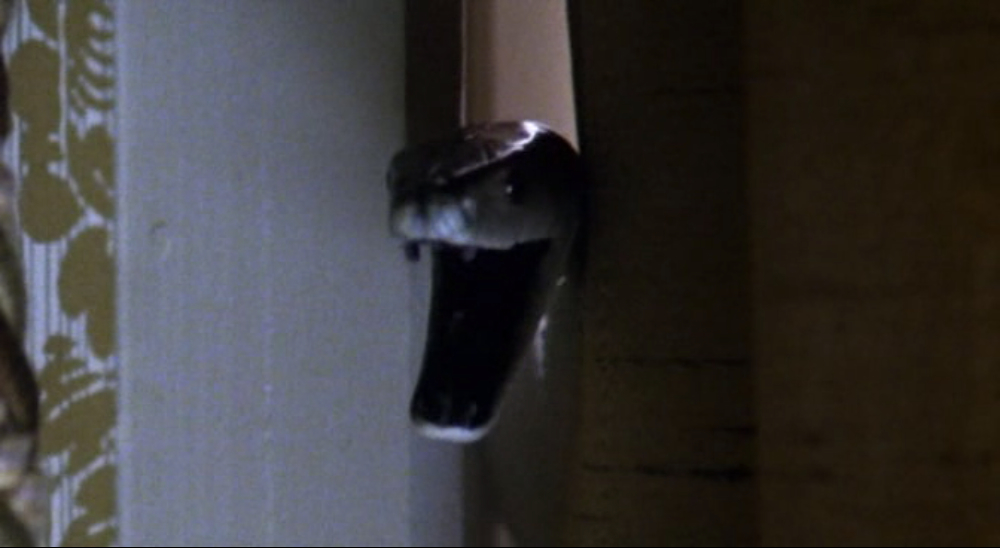
I don’t want to get bogged down in plot summarising, so let’s keep it simple and just state that this is indeed a film in which a trio of crooks played by Klaus Kinski, Oliver Reed and Susan George find themselves under siege by the police in a luxurious West London townhouse, with aged big game hunter Sterling Hayden and his chronically asthmatic, heir-to-a-colossal-fortune grandson as their hostages. By complete coincidence, the grandson has just come into possession of a new pet which, due to an innocent pet shop mix-up, turns out to be not the docile house snake he was promised, but – oh no! – a full size Black Mamba, most deadly poisonous snake in the entire world!

So yes, it’s Kinski and Reed vs the snake, vs the cops, and vs each other, with kid and grandpa (plus a late entrant in the form of Sarah Miles’ mild-mannered snake expert) stuck in the middle. Anything could happen, but it’s a fair bet it’s not gonna be pretty.


Initially entering production with Tobe Hooper as director, ‘Venom’ suffered a set-back when Hooper was either a)thrown off the project for being unmanageable and incompetent, or b)walked voluntarily after having his creativity intolerably compromised by the big-head producers and disobedient stars, depending on who you choose to believe. Either way, ‘Blood on Satan’s Claw’ director Piers Haggard took the reins mid-stream and, whilst he clearly doesn’t display much of the personal vision he brought to that film, he nonetheless delivers exactly what was required of him under the circumstances, streamlining the frankly ludicrous source material into an efficient, fast-moving thriller, whilst also coping with the unenviable task of having to put Kinski and Reed in a small room together and then tell them what to do all day long.

The essential who/what/wheres thus established (never mind the ‘why’s or we’ll be here all night), I think perhaps the best way to convey the many unique qualities of ‘Venom’ is via a quick list of bullet pointed items.

There will be spoilers, in case you’re bothered about that sort of thing.


* Sterling Hayden IS Action-Grandpa! Hopping around in a moth-eaten cardigan and the most unflattering beard foisted upon a fading Hollywood star by the cruel British since Robert Mitchum in ‘The Secret Ceremony’, he’s far too “golly gee” to really convince as a retired colonial adventurer, coming across more like some twinkly-eyed old codger who’s accidentally wandered in from a live action Disney movie. But the set-piece scene where he’s forced to hunt the snake across a darkened living room armed only with table-lamp and a cushion is a lot of fun, the tension only slightly diminished by fact that continuity has clearly established that the snake has buggered off into the heating ducts by this point.


* Susan George is brilliantly duplicitous as the cockney maid who initiates the kidnapping plan, clearly planning to set her two lovers/accomplices at each other’s throats as soon as the opportunity presents itself. Unfortunately, one of the film’s major drawbacks comes from having her die far too soon, causing the vicious little Jim Thompson-esque love triangle that's been brewing to fizzle out before it’s ever really got going. I guess somebody needed to get whacked to demonstrate the gruesome effect of the snake’s venom, and she was just deemed the least essential character vis-a-vis the story’s plot dynamics. I wish they woulda killed that annoying kid instead, but then the crooks would have lost their hostage angle… or they coulda killed Grandpa, but then there’d be no sensible ‘good guy’ presence to lead the snake hunt. Stupid plot dynamics! Stupid good taste! What they should have done of course is written in some additional pointless flunky characters and killed them off. But they didn’t, so… no more Susan George. Curses!


* It’s great watching Oliver Reed’s character making a b-line for the liqueur cabinet whenever things get tough – “I… I think I need a drink… yes, a DRINK.. a drink would help us all relax!” Whether this was part of the original story or just written in for Olly, who knows. This isn’t really the place for a cheap dig at Reed's alcoholism though, partly because that would be unnecessary and cruel, but also because he’s actually on pretty top form in 'Venom', delivering a characteristically barn-storming turn as a petty thug way out of his depth, desperately trying to keep his shit together. A stock character, but in Reed’s meaty hands his gradual collapse into panic and random violence is a pleasure to behold.


* Conversely, it’s safe to say Kinski probably didn’t invest a great deal of commitment in his work here, but at least he stays awake and delivers the lines, which is more than can be said for a lot of the exploitation pictures he made through the ‘70s. Basically he contents himself with just ‘doing the villain’, but as ever, he’s pretty great at it - seeing him curl his lip in disgust as he delivers his monotone ransom demands to the “poliiizeman” brings joy to my soul.


* The poliiizeman in question by the way is Nicol Williamson, toiling away just below the bigger names on the cast list as a character who seems like a genetically engineered prototype of every dour, no nonsense working class ‘70s British police detective ever. By turns he reminds me a bit of Robert Hardy in ‘Psychomania’, Alfred Marks in ‘Scream and Scream Again’, and the entire brood of stoney-faced functionaries who propped up Carter & Regan on ‘The Sweeney’. A perfect specimen, he’s armed with a full set of Scottish tough guy mannerisms, a dirty raincoat, a really ugly school tie, and he even enjoys the attentions of a weaselly aristocratic superior who pops up at inopportune moments to make disparaging remarks and ‘keep an eye’ on him.


* There’s a great bit where Kinski throws a cigarbox from the window of the house, announcing it to be “..a geeft from doctor Shtowe”. Nicolson opens the box, hands it over to the others with a look of disgust. The other cops open it – close up of a severed finger wrapped in tissue paper, followed by reaction shots of their horror and surprise – you know the drill. Long, shocked silence as they try to form a response. Young policeman ventures; “they’ve cut her bloody finger off!” Laugh? Why, I nearly…


* A cameo from Michael Gough, playing real life London Zoo snake-handler David Ball, anyone..? Well, why not.


* This one guy!


* Above all else though, ‘Venom’s sudden/violent finale is perhaps one of the most astounding sixty seconds of cinema I’ve seen in my entire life. I mean, for the love of god, we’re talking about Klaus Kinski, locked in deadly combat with a Black Mamba, plummeting to his death through a shattering balcony window, being riddled with police sniper bullets, as he succeeds in shooting the snake’s fucking head off a mere split-second before he hits the ground, narrowingly missing a set of cast iron railings.

Damn, if only they could have gone all the way and ended with the impalement, it would have perfect. Even so, watching this alone in my living room on a Sunday afternoon, I stood up and applauded. And to think, they gave Oscars to other films in 1981.

Smothered in Michael Kamen’s absurdly bombastic score, which makes the whole movie sound like Indiana Jones exploring a lost Babylonian tomb, ‘Venom’ is as spectacular a load of beserk, high-powered nonsense as could possibly be wished for. If you’ve read all the above and you’re still not rushing out to get a copy, well.. I fear there is no hope for you.

Friday, 20 January 2012

Stuff that has happened.


Sorry once again for falling off the posting wagon a bit – I’ve been running myself ragged trying to finish off my ‘best records of last year’ list on the other blog, and also doing some freelance work that’s been cutting into my writing time, but I’m back on top of things now and have lotsa good stuff lined up for the coming months.

Before that though, a couple of things worth a quick mention…

1.
In case you’ve not seen it elsewhere, exciting news about the rejuvenated Hammer sorting out their back catalogue! Now finally I can stop bitching about how rights issues etc have made it near impossible to see some of their best films and how difficult it is to actually find a copy of ‘Curse of Frankenstein’ etc, and instead just sit back and play the waiting game. (They’ve put up a new weblog keeping track of restoration developments here, if yr interested.)

Who knows, what with this, Kino’s Jean Rollin releases and Eureka’s new Repo Man disc, I might even have to bite the bullet and invest in a blu-ray player. I mean, don’t get me wrong, as a natural luddite I’m still inherently suspicious of all this HD business and believe that movies should be flat, as nature intended. But, y’know – extras, deleted scenes, nice picture quality, booklets full of pointless essays, cool stuff – I’m easily won over. I can always plug it in with a scart and watch stuff in glorious SD, just to be awkward.
2.
At the other end of the scale, it will probably come as little surprise to learn that we here at Breakfast in the Ruins are pretty bummed out about this whole SOPA/PIPA nonsense. Not being a US citizen, there’s not much I can do to directly influence such matters, but.. those of you who are don’t need me to tell you to go do what you need to do, I’m sure. I considered trying to take the blogs down for a day, but as that would prove a fairly awkward manoeuvre within the blogger structure, thought in the end I’d just do my bit by sitting on my arse and not posting anything for another day.

Hopefully the kind of ‘internet wars’ we’ve seen subsequently won’t escalate further, but let’s just say that, personally, I’m pretty narked about the whole business simply because up until yesterday I had links to a couple of dozen obscure, commercially unavailable movies all ready to go, now leading to dead pages. So, just in case I hadn’t made up my mind which side I was on yet, the copyrights lobby just entered my little universe by way of cancelling a whole season of forthcoming movie nights – way to win those hearts & minds guys, although frankly I guess they gave up on that sorta thing a few years ago when they took to throwing people in the slammer for listening to pop songs, as opposed to, say, rethinking their business practices to respond to a changing world, just like their predecessors have had to do for generations.

Purely in terms of movies, whilst I of course believe we should do everything our disposable income allows to support independent DVD labels and anyone else who’s out there treating marginal cinema with the respect it deserves, there’s still a vast universe of forgotten, whacked out stuff that no one’s ever gonna bother throwing on a disc, with only networks of fans to keep it alive and… y’see where I’m going with this, I’m sure, and the metaphorical producer is in the metaphorical control room making neck-slicing ‘wrap it up’ type motions at this point, so, uh, yeah - Damn The Man, and so forth, and GOODNIGHT!


Wednesday, 11 January 2012

Long Hair of Death
(Antonio Margheriti, 1964)


One of the more obscure items in Barbara Steele’s catalogue of Italian gothics, it’s easy to see why Antonio Margheriti’s supremely named ‘Long Hair of Death’ (god bless those literally translated titles) has ended up being somewhat overlooked in the history of such things. Appearing towards the end of the era in which these comparatively bloodless, black & white horror flicks were considered commercially viable (not that it stopped Steele ploughing through another four entries in the cycle before packing it in in ’66), ‘Long Hair..’ is a game of two halves really – uninspired through much of its run time, the film’s best sequences nonetheless contain some of the most powerful moments ever realised in Italian gothic horror.

Things certainly start off all guns blazin’, as we emerge from the opening credits into a vague, late-medieval mid-European setting (which at least makes a change from the vague, Victorian mid-European settings of most of these things), where condemned witch Adele Karnstein is being burned alive in the town square as her distraught and uncomprehending young daughter looks on. Meanwhile, Adele’s older daughter Helen (Steele) finds herself in the bed chamber of the local feudal lord, reluctantly submitting to his lecherous advances in a last-ditch attempt to delay her mother’s execution, as he assures her that his subordinates wouldn’t dare commence the burning without his presence, even as the flames take hold.


An extraordinarily bleak scenario for all concerned, with Margheriti's cross-cutting between the excruciating death of a mother and the rape of her daughter by a treacherous aristocrat leaving us in little doubt as to where the film's sympathies lie re: the old 'suspected witches vs church & state' debate, prefiguring the real-world hypocrisies dramatised by Michael Reeves’ ‘Witchfinder General’ and the raft of witchhunter-sploitation (if you will) movies that followed in the wake of Ken Russell’s ‘The Devils’ by a number of years.

This in itself is pretty unusual – I could be wrong, but I think ‘Long Hair..’ is the only Italian horror movie I’ve ever seen in which the ‘witches’ are presented as sympathetic victims rather than satanic evildoers – and Margheriti’s decision to hit us with such gruelling human drama is brave indeed, dredging up some slightly more visceral emotions than we’re used to experiencing in gothic horror movies, with their rather more emblematic expressions of ‘mourning’ and ‘despair’.

(In fact, as an aside, it’s interesting to note how easily ‘Long Hair of Death’ could be read as a feminist horror film, if admittedly on a rather shallow level. Throughout the film, the evils of patriarchal society are wheeled out in the form of sexual exploitation, forced marriage, domestic confinement and the use of innocent women as scapegoats for male crime. And when the Karnstein sisters eventually return to wreak their vengeance (hope I’m not giving too much away here), the implied collaboration of the castle’s taciturn matron/housekeeper character in their plans points not just to a personal or familial revenge, but to an organised cabal of women striking back against their oppressors. Not exactly PHD level stuff I’ll grant you, but interesting food for thought in the midst of the ultra-masculine Italian film industry, no?)


Anyway, getting back on track, the production design in this opening sequence is pretty stunning too. Bypassing the traditional ‘tied to the stake’ burning, the execution sees Adele confined within a kind of makeshift maze of burning hay bales, forcing her to flee in vain from the flames begging for mercy, and eventually to voluntarily climb the crucifix which acts as a central pillar, from whence the crowd can clearly witness her gruesome demise. Imaginative touches like this, along with the solemn hooded monks, iron-masked soldiers etc, lend the scene a disturbing sense of brutal medievalism, culminating with a beautifully tragic shot of Steele cradling a handful of ashes from the burnt out pyre, as the blackened crucifix looms above her, and the dead woman’s voiceover pledges supernatural vengeance. Carlo Rustehelli’s stately, genuinely haunting score undoubtedly helps add poignancy here too - he had scored Bava’s ‘Whip And The Body’ the previous year, and his work here is similarly subtle and effective, featuring only occasional theremin abuse.


Sadly, the very next scene sees the lustful lord ambushing Barbara in a remote stretch of countryside and unceremoniously hurling her off a bridge into a watery grave, after which the film pretty much follows suit, largely devolving into a stagey, poorly written melodrama with witchery and vengeance entirely forgotten. All verve and character seems to vanish from the direction and cinematography, and the remaining cast stride around a handful of shoddy interior sets (the crypt is ok, but I’ve seen better) like they’re killing time in an am-dram Shakespeare production.

And needless to say, whilst it may cop a riff or two from Macbeth, the drama that proceeds to unfold is far from Shakespearean in stature;

Leaping forward a few years, we’re reintroduced to the younger daughter we saw weeping at the execution – now an indentured servant at the castle – who has come of age in the shape of Halina Zalewska. As you might well expect, Elizabeth (for that is her name) is a rather sullen and troubled young woman who doesn’t really appreciate the crude advances of the Lord’s boorish son Kurt (the distinctly Shatner-esque George Ardisson), who had smugly presided over her mother’s execution. You’d think he might have at least realised that wasn’t an ideal basis from which to build a relationship, but then, he is a complete arse, so who knows.

Things do perk up briefly for another superb gothic set-piece in which Barbara Steele returns from the grave. Flinging open the doors of the family chapel amid a howling thunderstorm as the pastor conducts a plague mass based around the Book of Revelation, her appearance inflicts a fatal heart attack upon the by now elderly and guilt-ridden Lord, who dies clutching a ring he stole from her mother’s corpse. I mean, beat that for yr gothic atmosphere! Amazing!


After that though it’s back to the grind, as Barbara announces herself to be not an avenging spirit of the past, but Mary, a traveller marooned at the castle by the storm and fearful of continuing across hostile countryside. She swiftly sets her sights on seducing Kurt and… well let’s just cut to the chase and say that the major problem with the next thirty or forty minutes of the film (aside from the fact that nothing particularly cool or interesting happens) is that the previously established motivations of both our female leads seems to have been completely forgotten, whilst Kurt, who never had much motivation in the first place beyond being evil, just moons around like a goon. Elizabeth, who hates Kurt and was forced into marriage with him against her will, now suddenly seems to be desperately in love with him, and Barbara, or Mary, or whoever, seems all too happy to act as the happy-go-lucky femme fatale coming between them, with no hint as to what the hell she’s actually trying to achieve re: the whole returning from the grave thing.

Doubtless this was all wrought in an attempt to create a sense of mystery, and it’s all sorted out nicely in the big reveal at the end, but prior to that it’s a case of Bad Writing 101, resulting merely in confusion and disengagement from the narrative, as we assume one of those lazy-ass Italian scriptwriters was sleeping on the job again and just shoved in a bunch of pages from a different movie in the hope no one would notice.


It’s hard to overstate how dreary and muddled this middle section of ‘Long Hair of Death’ is, but things do at least rally for a brilliantly macabre finale that seems to eerily prefigure ‘The Wicker Man’ (pretty forward-looking film this, all things considered). And despite the stodge, the accumulated power built up during the good scenes gives the film an exquisitely foreboding aura that’s hard to shake, a feeling that is only enhanced by the apocalyptic shadow of the black death hanging over proceedings, and the accompanying sense of cloying medieval darkness that takes hold whenever the camera ventures out into the plague-ridden streets (a touch presumably inspired by Corman’s ‘Masque of the Red Death’, released six months earlier). Another interesting note is that, between the burning crucifix in the opening, the scene in the chapel, the severe bearded priests and the sight of hooded monks dragging plague victims from their homes, the film is absolutely drenched in oppressive, negative images of Christianity that must have carried particularly blood-curdling resonance for audiences in Italy.

If Margheriti had managed to keep up the momentum of ‘Long Hair of Death’s best scenes throughout, it would have been an unqualified masterpiece. As it is, connoisseurs of the Italian gothic will definitely want to check it out for its standout sequences, oddly radical political undertones and overall atmosphere - and Barbara Steele fans will certainly appreciate her relatively large amount of screentime - but newcomers to the sub-genre would be well-advised to start elsewhere.


Presumably a public domain item, 'Long Hair of Death' can be viewed in its entirety on Youtube.

Sunday, 8 January 2012

Penguin Time.

Taking a tip from Caustic Cover Critic, what better way to get in gear for the new year than with a gallery of some recent acquisitions from the best-dressed paperback imprint in town?

(1967, cover design by Alan Aldbridge, incorporating a detail from the ‘The Garden of Delights’ by Hieronymous Bosch)


(1964, cover by Alan Aldbridge)


(1966, cover by Brian Haynes)


(1962, cover uncredited)


(1957, cover uncredited)


(1952, cover by Charles Raymond, additional black marker by hands unknown)

Tuesday, 3 January 2012

Deathblog:
Don Sharp
(1921-2011)


Hitting the internet today for the first time since just after Christmas, I was sad to learn that yet another British horror stalwart, Don Sharp, passed away during December.

Although he seems to have been largely regarded as a competent ‘journeyman’ director who rarely invested much personality into his work, Sharp nonetheless cut a bloody swathe through popular cinema in the ‘60s and ‘70s, gaining a reputation for directing lively action sequences, and building up a CV which, if it contains few films that a sober viewer would consider ‘masterpieces’, can certainly fall back on a truckload of *really fun movies*.

Of his work for Hammer, I remember thinking ‘Kiss of the Vampire’ (’63) was pretty damn great, although sadly it’s a long time since I saw it. ‘Rasputin the Mad Monk’ (’66) and ‘The Devil Ship Pirates’ (’64) are both *really great fun*, heavy on the kind of fisticuffs and bravado that must into fed into the string of adventure movies and thrillers that he helmed during the ‘70s, including the Rod Steiger-starring IRA drama ‘Hennessy’ in 1975, a 1978 remake of ‘The Thirty Nine Steps’ and 1979’s ‘Bear Island’ with Donald Sutherland and Vanessa Redgrave. I’ve only seen one of the two Fu Manchu movies he directed for Harry Alan Towers, but as you’ll recall, I found it to be, well… *really great fun*.

The only bone-fide stinker I’ve seen from the Sharp canon is 1964’s ‘Witchcraft’, an uncharacteristically dull and stagey witch coven movie that I found a poor relation to more successful contemporary English gothics such as ‘City of the Dead’ or ‘Night of the Eagle’, although it has its fans.

The main reason for us to celebrate at the altar of Don Sharp here at Breakfast in the Ruins though is, of course, the immortal Psychomania. It would be wrong to try to present Sharp as the auteur of this unique and mystifying work, given that by all accounts he joined the project shortly before shooting on a strictly work-for-hire basis and seems to have done everything in his power to distance himself from the results, but nonetheless, the fast-paced action and sense of raucous bonhomie that can be detected in his other films certainly crosses over into ‘Psychomania’, mixing beautifully with the utter madness of the rest of the production, and adding a lot to the creation of one of the greatest weirdo horror films ever made.

So, so long Don, and thanks for putting in the hours to bring us some cracking, and indeed cracked, entertainments over the years.

Monday, 26 December 2011

Gothic Horror Round-up:
The Curse of the Werewolf
(Terence Fisher, 1961)


The only werewolf movie ever attempted by Hammer, and to be honest it’s not hard to see why. Not that there’s anything wrong with ‘Curse..’ exactly, but it’s certainly one of the most peculiar, loosely structured horror films the studio made during their ‘classic’ era, marred by a number of downright odd production decisions.

For a start, it’s supposed to be set in Spain, a circumstance that seems fairly inexplicable for a film made in England with a screenplay based on Guy Endore’s book ‘The Werewolf of Paris’. Apparently it was down to Hammer’s desire to reuse a bunch of sets that were lying around from an aborted Spanish Civil War film. Despite the best efforts of cast and production team though, this unconventional setting never quite gels, and the film is full of weirdly incongruous elements of ‘local colour’ that lend a certain feeling of dislocation to proceedings.

Funny isn’t it how a gothic horror film can purport to be set pretty much anywhere in central or Eastern Europe and still seem plausible as everybody storms about with English accents, but Spain just doesn’t ring true at all? (Hammer ran into the same problem again a few years later of course with ‘The Devil Ship Pirates’, only there it was exacerbated by the fact that the Spanish English were pitched against the English English, leading to confusion all round.)

(Whether or not this geographical detail gave the film a higher profile in Spain I’m not sure, but it’s an interesting point to ponder, given the possible influence exerted by Hammer’s sympathetic werewolf-hero on the wolfman created by Paul Naschy later in the '60s..?)

Perhaps more crucial to ‘Curse..’s commercial failure than the cockney Spaniards though is the decision to open the film with a whole half hours-worth of historical prologue, much of which seems less like a horror flick and more like some particularly morbid variation on an old Alexander Korda costume drama. There is at least an engagingly gruesome tale being told here, of a mute serving girl (Yvonne Romain) who, as the Mounds and Circles weblog put it recently, “..is unjustly imprisoned, raped by a feral lunatic, commits murder, gives birth to a werewolf and then kills herself”. Nice.

With an appropriately cruel and downbeat tone to them, these scenes – including Anthony Dawson’s fine turn as a cringing, debauching aristocrat - are actually very good, but with no central character or linear narrative to hang our hats on, even the most patient viewer will be asking WHERE THE HELL IS THE GODDAMN WEREWOLF ALREADY by the time the first half hour creeps by. Subsequently, we have a long segment detailing the adoption, christening and early life of our wolfman character, together with an extensive deviation into the nature of disagreements between a number of local shepherds and the ineffectual night watchman charged with protecting their flocks from wild animals, before we cut to ‘the present’ and our leading man Oliver Reed finally strolls on-screen with a carefree swagger just before the 50 minute mark.

Now, I don’t have to tell you that Oliver Reed as the wolfman is a bit of a hole in one and should naturally have been allotted more screentime, but in fairness to Hammer this was a good few years before Reed became a household name. In fact, like some of his other early b-movie roles (think ‘Beat Girl’ or ‘67’s ‘The Shuttered Room’), it’s interesting to see him cast not as the brooding tough guy, but as more of a feckless, happy-go-lucky young fellow, capering ‘round the screen like a bull in a china shop. Of course, being a werewolf and all, it’s not long before he gets to bring a more characteristic palette of angst, confusion and physical menace to the role.

As with ‘Baskervilles’, production values are top-notch in spite of the fell-off-the-back-of-a-lorry sets, and from his introduction onward, the film really picks up steam, finally heading in the direction we might have initially expected from a Hammer werewolf movie starring Oliver Reed. Well, kind of. First our hapless young lycanthrope gets a job bottling wine at a vineyard (“there’s the labels y’see, and there’s the bottles – you put the wine inside, you put the labels outside” says his layabout buddy Jose, showing him the ropes –another great low-key performance from TV actor Martin Matthews). Then he cultivates an unthinkable, Romeo and Juliet style relationship with the daughter of the vineyard owner, a circumstance confounded both by a long-standing family enmity and, more pressingly, our lad’s frequent full moon rampages.

A lot of fun if you’ve got a bit of patience, there is much to enjoy in ‘Curse..’ – some fantastic moments, quality performances, Oliver Reed being a frigging werewolf, and a well-told, heart-string tugging take on the old doomed wolfman tale at its core. With it’s rambling prologue, frequent down-time and odd digressions into low-rent historical epic territory though, the overall impression you’re left with is less that of a classic Hammer, more one that’s just… kinda peculiar.

Saturday, 24 December 2011

Gothic Horror Round-up:
Terror-Creatures from the Grave
(Massimo Pupillo, 1965)


Another doozy from the man who brought us ‘Bloody Pit of Horror’! Presented in English translation by the promisingly named Pacemaker Pictures, this rather more straight-laced affair (original title ‘5 Tombe per un Medium’ ) still stands as one of the more eventful and entertaining of Barbara Steele’s post-Black Sunday Italian gothics, telling a tale of undead plague victims rising from the swamps to wreak vengeance upon a clique of small town personages (including Luciano Pigozzi from ‘Black & Black Lace’ and ‘Werewolf in a Girls’ Dormitory’, and Alfredo Rizzo from every Italian movie ever) who have contrived to send Barbara’s husband, the local aristocratic mad doctor/occultist type, to his grave. Our upstanding bland hero guy (Walter Brandi, from ‘Bloody Pit..’ and ‘Playgirls & The Vampire’) is a big city lawyer who has received a mysterious letter from the dead man asking for his estate to be settled. Presumably he realises he’s stuck in a gothic horror movie about the same time he finds his car won’t start because there’s an owl stuck in the engine(!), and figures he might as well hang around for the duration.

Although adding little to the tradition as filtered through Whale, Corman, Fisher, Bava, Margheriti and the rest, Pupillo’s directiorial style is still enjoyably lively, his camera wobbling around on some kind of makeshift steady-cam, refusing to allow even the most stultifying dialogue scenes (and, god, if there’s one thing you’ve got to learn to live with in Italian gothics, it’s the stultifying dialogue scenes) to remain static for long, throwing in gruesome cut-away shots and atmospheric tableaus whenever good taste (or what passes for it in Italian b-movies) allows.

A slightly more down to earth example of gothic than the ethereal likes of ‘Castle of Blood’ or ‘Nightmare Castle’, ‘Terror Creatures..’ is largely concerned with real world malice and physical threat. Rather than a ghostly waif, Steele’s character is a frustrated dancer and socialite, angry at her husband for locking her away in the countryside, and the use of the old chestnut about a supposedly dead man returning to wreak vengeance on those who wronged him seems to mark out the point at which gothic horror meets the conventions of an early ‘60s mystery, krimi or proto-gialli flick (think Coppola & Hill’s ‘Dementia 13’, or Harald Reinl’s ‘The Strangler of Blackmore Castle’).

At the same time though, the bloodcurdling supernatural elements here are as bold and weird as anything in the work of Bava or Freda. A scratchy gramophone cylinder replays the thoughts of the deceased doctor’s supernatural investigations (“October 30th, today I made contact with them again..”), a device reminiscent both of the voiceovers and letters in ‘Messiah of Evil’ and of the diabolic conversations transcribed in Lovecraft’s ‘The Whisperer in Darkness’. An iridescent water-nymph sits on the edge of the fountain outside our hero’s window, singing a creepily beautiful folk song (presumably an entirely different one from that featured on the original Italian version). The severed hands of plague-ridden criminals come to life, wriggling in their glass case as the wonky, theremin-addled score blares, and some supernatural agency drains the water from a bowl of flowers on the dining room table.

Fearing the approach of the plague-creatures, a wheelchair-bound old man kills himself by falling onto an outstretched sword blade, whilst another censor-baiting scene has Steele commanding her step-daughter to help her scrub up in the bath (steady now). The only disappointment really is an ill-judged (and presumably budgetary) application of the old “never show the monster” principal during the finale, which marrs the action somewhat when things go full-on zombie, leaving the survivors battling half-heartedly with an unconvincing monster-cam.

Scarcely likely to be anyone’s idea of a masterpiece, ‘Terror Creatures..’ is still a fun b-movie, packed with incident and memorable moments, in spite of all the tedious blather and wooden dubbing. Widely available in a mangled public domain print that looks like it’s been rescued from the bottom of a well, a copy is no doubt available from your usual supplier of such things, deterioration and dust-on-the-needle sound mix giving even the film’s more banal moments an eerie period pallor that only increases its charm.

Friday, 23 December 2011

Gothic Horror Round-up:
The Hound of The Baskervilles
(Terrence Fisher, 1959)


Oh, what a treat. Perhaps unfairly neglected in the Hammer canon due to its nominal non-horror status, what could be better cinematic comfort food than this? Peter Cushing and Andre Morell portraying Holmes and Watson so definitively that I think they were occupying the characters in my mind long before I saw the film, and Christopher Lee essaying precisely the kind of role he's best at, the pompous and ineffectual Sir Henry Baskerville. John Le Mesurier is Barrymore the family retainer, world class ham Francis De Wolfe is Dr Mortimer, Ealing regular Miles Malleson is the doddering old bishop, and the cast is rounded out with a veritable coachload of other second string character actors, not a Bland Young Man amongst them. Even Italian actress Marla Landi gives it her best shot, adding a welcome dose of vengeful craziness to her role as the token pretty girl.

Everybody seems to be having a lovely time, and to be honest, when scheming gentleman farmer Ewen Solon invites the occupants of Baskerville Hall round to his place for dinner, I was sad that the damned plot got in the way, denying us a scene in which everybody sits around his rustic table, having a good laugh over a flagon or two of cider. Why can’t they all just get along?

But intervene the plot must, and whilst I’m unable to pass comment on the extent to which this is a faithful adaptation of the story (never bothered reading Conan Doyle to be honest), it’s certainly a good script from Peter Bryan – sharp, characterful and well-paced as you could hope for from a bit of 50s/60s b-movie hokum, exemplifying all the virtues of ‘quality’ held dear by partisans of Hammer’s pre-’66 output. As might well be expected, Fisher’s direction follows suit, and after the groundbreaking success of their recent Frankenstein and Dracula movies the studio clearly made no bones about playing this one about as close to a gothic horror as was humanly possible, incorporating strong scenes of villainy and bloodletting (not to mention a memorable set-piece that sees Lee menaced by a tarantula) that seem mild today but must have been fairly startling back in ’59.

Above all here, the production design is absolutely suburb, the eerie fog-strewn moors, the abandoned chapel and the underground caverns all contributing some of the most richly atmospheric backdrops ever seen in a Hammer picture, the autumnal cinematography looking better than ever, with subtle deployment of blue and green lighting amid the deep brown n’ black raising the film’s exterior sequences to a level approaching that of Bava’s early ‘60s masterpieces or the first half of Hammer’s own ‘Brides of Dracula’ - a definitive piece of technicolor gothic.

I’m not one of those who insists that Hammer’s Bray-era output was automatically superior to their subsequent releases, but still, it’s sad that the ubiquity of some of their later, sillier efforts tends to leave superb, low-key films like this one in the shadows. Should you ever need an example of all the more refined characteristics that stuffier Hammer-heads maintain the studio lost amid their embrace of flares, boobs, dinosaurs and shoddy methods of killing vampires, ‘..Baskervilles’ is the one to go for.