Showing posts with label creepy old houses. Show all posts

Friday, 11 September 2020

Lovecraft on Film:
The Unnamable
(Jean-Paul Ouellette, 1988)

“The witchcraft terror is a horrible ray of light on what was stewing in men’s crushed brains, but even that is a trifle. There was no beauty: no freedom – we can see that from the architectural and household remains, and the poisonous sermons of the cramped divines. And inside that rusted iron straightjacket lurked gibbering hideousness, perversion, and diabolism. Here, truly, was the apotheosis of the unnamable.”  - H.P. Lovecraft, ‘The Unnamable’

First published in the July 1925 issue of ‘Weird Tales’, H.P. Lovecraft’s brief tale ‘The Unnamable’ is an odd business, even by its author’s usual standards. Though ostensibly a conventional horror story, with an old dark house, a graveyard, scary folk tales and a grisly climax involving an indescribable monster to be found within its few short pages, Lovecraft’s intentions in drafting this one actually seem to have lain somewhere else entirely.

Seemingly functioning more as an extended in-joke aimed at the author’s fans and correspondents, ‘The Unnamable’ is in fact an archly self-aware piece of niche literary jocularity. Chiefly centred around a faux-Platonic dialogue conducted between two gentlemen lounging around in an Arkham cemetery, it also meanwhile provides a vehicle for Lovecraft’s sincerely held views on the value of mystery and ambiguity within literature and culture (as opposed to the smug, Christian Science-derived rationality proffered by his hypothetical critics).

Though identified in the story’s final sentence as “Carter”, the narrator of ‘The Unnamable’ is clearly a stand-in for Lovecraft himself – an amateur scribbler of spooky tales, criticised by his more down-to-earth friends for his “..constant talk about ‘unnamable’ and ‘unmentionable’ things”; “..a very puerile device, quite in keeping with my low standing as an author,” the narrator informs us, tongue firmly in cheek.

Beginning with the unforgettable opening gambit, “We were sitting on a dilapidated seventeenth-century tomb in the late afternoon of an autumn day at the old burying-ground in Arkham and speculating about the unnamable,” the story in fact allows us a rare glimpse of Lovecraft’s capacity not only to recognise, but to happily lampoon, the excesses of his own style, as he proceeds to pepper his text with adjective-clogged sentences so patently absurd that they surely must have been intended as a kind of winking self-parody.(1)

Much of this literary jiggery-pokery is inevitably lost in Jean-Paul Ouellette’s 1988 movie adaptation of ‘The Unnamable’, but nonetheless, the first-time writer/director does a surprisingly good job of retaining the self-reflexive tone of the piece, remaining faithful both to the flimsy outline of the story, and to the reassuringly eerie atmosphere of Lovecraft’s fantastical New England.(2)

Immediately expanding upon Lovecraft’s story, the film opens with a historical prologue which seems designed to reassure nervous Weird Tales fans that they can nix that outraged letter to the editor of ‘Crypt of Cthulhu’ – this movie’s got them covered.

In the drawing-room of a shadow-haunted, colonial mansion, an aged alchemist or warlock of some kind is chilling out with his extensive collection of grimoires. But, his contemplation of the Pnakotic Manuscripts is persistently interrupted by the unholy sounds emanating from the house’s gabled attic room, causing him to recall that this is where he has locked up the unseen, and indeed unnameable, creature which used to by his wife.

One cautious (and, it must be said, extremely slow) ascent of the perilous staircase later, following some shaky fingering of the wrought iron key which may perchance unlock the big, rusted padlock which keeps the door chained, and – surprise! – we’re treated to some of the best value late ‘80s gore that money can buy, and “the unnameable” is on the loose.

Though admirable in its intent to establish an authentically “Lovecraftian” feel, the meagre resources with which this film was produced are all too clearly on view during this prologue. Though the sets and lighting are pretty decent, and the grimoires and candles and stuff look lovely, some of the other period details have a bit of an Andy Milligan feel to them, which does not necessarily bode well for what follows.

(I just couldn’t get past the absolutely ridiculous nightcap/hanky thing the old man is wearing on his head, whilst the puritan minister who turns up to declare that the house should be sealed up and shunned for all eternity looks about twenty years old, and appears to be wearing a sheet of A1 printing paper with a hole cut in the middle around his neck.)

We’re on safer ground however – in terms of costumery, at least - as we zip forward to present day, where we find ourselves in a bucolic cemetery just down the road from Arkham’s Miskatonic University campus. Here, as per Lovecraft’s tale, a group of friends are indeed ‘speculating about the unnameable’. Admittedly, the mature adults of HPL’s story (in which the narrator’s rationalist antagonist is identified as “principal of the East High School”) have been recast here as fresh-faced students, and there are three of them, rather than two, but y’know – this is an ‘80s horror movie. Young victims are needed. 

Making an inter-textual jump never explicitly stated in the source text, Ouellette’s screenplay assumes that that our narrator, “Carter”, is in fact none other than Randolph Carter, protagonist of both HPL’s titular ‘Statement of…’ (1919), and his subsequent series of Dunsany-inspired “dreamland” fantasies.

As played here by the immediately likeable Mark Kinsey Stephenson, it is also clear that this Randolph Carter is going to be anything but a sickly, introverted Lovecraft stand-in. In fact, he comes across as a lively and rather charismatic figure right from the outset, becoming more-so as the movie progresses.

An oddball aspiring folklorist possessed of nervous energy and a presumably vast knowledge of esoteric lore, Stephenson’s Carter makes for a pretty great horror movie hero all round. It’s easy to imagine him having headed up his own TV show or on-going franchise in which he traipsed around New England, collecting old stories and investigating sinister goings-on, like some more collegiate equivalent of Manly Wade Wellman’s ‘Silver John’ character.

(Though this possibility sadly never came to pass, the appeal of Stephenson’s characterisation was clearly not lost on Ouellette and his collaborators; ‘The Unnamable’s 1992 sequel is sub-titled “The Statement of Randolph Carter”, with Stephenson top-billed.)

Unfortunately, none of the other characters here are quite so memorable, but again – we’re in ‘80s horror movie territory here, so they’re all just meat for the grinder, more or less. For the most part the cast acquit themselves fairly well, with Charles Klausmeyer standing out for his young Roman Polanski / John Moulder-Brown type look in the role of Carter’s younger buddy/protégé Howard Damon. (He also seems to wear a tweed suit and tie to campus every day, which lends a touch of class.) 

In this telling of the story, Carter’s rationalist antagonist in the graveyard discussion – business major Joel Manton, played by Mark Parra – becomes so worked up about his friend’s willingness to embrace the supernatural that he stomps off in the direction of the haunted house just across the way, declaring that he will spend the night there in order to prove that nothing untoward is going on within. (Good luck with that, fella.)

Shrugging this off, Carter and Damon meanwhile return to campus, where we re-join them the following morning in the Miskatonic University library, where they discuss Manton’s apparent failure to return from his impromptu camp-out.

Meanwhile, we suddenly find ourselves in the middle of a routine campus slasher, as two studious sorority girls (one of whom the shy Damon happens to have the hots for) are chatted up by a pair of generic frat-boys, one of whom proudly displays that universal signifier of jockitude, a woollen sweater hanging loose over his shoulders (where indeed it remains, worn like a cloak, for the entire remainder of the movie).

Claiming rather feebly that they need to undertake some nocturnal location-scouting for forthcoming initiation-related hi-jinks, the jocks manage to convince the reluctant girls to meet them at the spooky old house by the graveyard that evening for a thinly veiled double-date, and… well you don’t need to be much of an aspiring folklorist to figure out where all this is headed. (Toward a partial recreation of 1981’s ‘Hell Night’, if nothing else.)


This mixture of quirky, Lovecraftian atmospherics and rote slasher movie cliché may seem a little jarring at first, but ‘The Unnamable’s tone actually remains pretty consistent throughout, using hefty doses of humour and raised eyebrow self-awareness to distract attention from the minimal and formulaic plotting -- much as Lovecraft did in his original tale, in fact.

Despite the low budget, the film’s photography (courtesy of DP Tom Fraser) is pretty good, particularly once the action moves entirely into the cluttered, candle-lit interior of the derelict old house during the movie’s second half, making extensive, rather fantastical use of blue gel lighting, alongside some imaginatively patterned shadows.

So smitten do the filmmakers seem in fact by their creepy gothic lighting, the film actually begins to suffer from something of a middle act slump, as characters spend a very, very long time exploring the eerily lit interior sets. Feeling suspiciously like attempts to pad out a near non-existent narrative to feature length, these extended peregrinations could well induce severe wakefulness / attention-span issues amongst late night/inebriated viewers, but as a dedicated fan of ‘60s Italian gothics, I was personally happy enough to roll with ‘em.

Likewise, David Bergeaud’s ridiculously over-bearing, faux-classical keyboard score may prove an intolerable for some, but I actually found it weirdly endearing, functioning in a sense as a persistent reminder of the film’s independent/low budget origins and determined eccentricity, lest we begin expecting it to get too slick n’ professional.


As befits a movie dealing with the, ahem, “unnameable”, much of the drag in the middle half hour results from the filmmakers’ reluctance to reveal their monster. The mystery of what the creature actually looks like is maintained for what, by 80s/90s b-horror standards, feels like an exceptionally long time. And, when we do finally start to get some glimpses of our resident beastie, well…. the hairy goat legs were a bit of a surprise, I’ll tell you that much. [Cue momentary flashback to Dragnet (1987).] 

Unfortunately, most of the posters and box art for this movie rather give the game away, spoiling the eventual appearance of the monster by utilising stills which make it look a scrawny cousin of that demon thing from Ridley Scott’s ‘Legend’, but if we can put that out of our minds before viewing, the creature’s eventual Big Reveal within the movie itself is…. actually quite impressive.

Portrayed by actress Katrin Alexandre, who employs a series of extravagantly theatrical, choreographed movements, this creature’s amalgam of disparate monster tropes manages to justify the “unnameable” epithet about as well as anything which could be conjured up on this movie’s budget possibly could. 

Fans may be liable to declare that it looks absolutely nothing like the kind of entity we usually think of as fitting in to Lovecraft’s universe, but they’d be well advised to refer back to the source text, wherein HPL, who seems to been on a bit of a Cotton Mather-inspired backwoods folklore kick at this point, does actually state that his indescribable creature’s attributes include horns and cloven hooves, as well as the more familiar tentacles and shapeless, shifting clods of organic matter.

Obvious though it may be, the climactic scene here in which the monster skulks in the shadows whilst a doomed jock/sorority girl couple are making out in a deserted room (thus delivering the film’s requisite minimum quantity of gratuitous nudity), rolling a severed head into the view of the female partner, is very well done – a killer scare with some sharp editing. (Meanwhile, I’ve also got to admire the fact that the couple weren’t deterred by discovering a bloody femur bone beneath their makeshift bed.)


Another highlight in the lead-up to the film’s conclusion are the scenes which find a flustered Randolph Carter indulging in a few arch, rather Jeffrey Combs-esque line readings as he ploughs his way through the deceased warlock’s grimoire collection, which has apparently been left untouched for three centuries. Kicking up as much dust as you’d expect in the process, he eventually zeroes in on (what else?) the ‘Necronomicon’ itself, and, in a development almost certainly inspired by ‘The Evil Dead’, he’s soon located the requisite “anaal nathrakh”s necessary to send the unnamable creature which was once the ancient wizard’s wife back from whence it came. (3)

(Actually, it’s implied that Carter saves the day by invoking some kind of dryad-ish woodland spirits embodied in the trees outside the house, or something – an interesting, if under-explored, twist.) 

Though not a lost classic by any stretch of the imagination, ‘The Unnamable’ is nonetheless a noble effort. Ouellette was clearly a sincere fan of Lovecraft’s work, and his attempt to make a film which might actually appeal to his fellow cultists whilst also fulfilling the commercial requirements of a late ‘80s American horror movie demonstrates a certain amount of both daring and ingenuity.

Considering that he and his collaborators were working on a miniscule budget, utilising a largely inexperienced cast and crew, and working to a script which ultimately doesn’t add up to much more than a handful of well-worn genre clichés, I think ‘The Unnamable’ actually emerges as a surprisingly accomplished piece of work, within its own modest parameters. It conveys a ‘little-train-that-could’ style sense of fun and achievement, which seasoned connoisseurs of independent American horror should be able to appreciate, even if it couldn’t hope to hit the heights so recently scaled by Stuart Gordon and co in the field of Lovecraftian cinema. 

---- 

(1)Just as an example, try this one on for size: “Moreover, so far as aesthetic theory was involved, if the psychic emanations of human creatures be grotesque distortions, what coherent representation could express or portray so gibbous and infamous a nebulosity as the spectre of a malign, chaotic perversion, itself a morbid blasphemy against Nature?”

(2) After working in camera tech / continuity roles on a variety of marginal New York-based productions in late ‘70s, Ouellette seems to have gotten quite a big break when he was appointed as ‘second unit director (action)’ on ‘The Terminator’ in 1984, but sadly his career in the film industry never really seems to have gained much traction after this. Aside from the two ‘Unnameable’ films, his only other feature as director is a 1990 STV actioner named ‘Chinatown Connection’, and the remainder of his sparse CV comprises short films, a TV movie script and production credits on a few little-known projects in the early ‘00s. 

(3) Yeah, I know “anaal nathrakh” is actually from ‘Excalibur’, but gimme a break here – I just like it more than the ‘Evil Dead’ incantations.

Thursday, 27 February 2014

The House On The Brink
by John Gordon

(Patrick Hardy Books, 1983 /
originally published 1970)


 (Jacket design by Bert Kitchen.)

Yet another choice item rescued from the skip at my place of work, this is one of those old hardbacks with the wrap-around illustrated covers and slightly peeling protective coating that libraries in the UK used to be full of, and that always bring back a lot of peculiar memories for me.

I'm not familiar with the work of John Gordon, but to state the obvious: it looks pretty great, doesn't it?

Quoth Wikipedia:

"Most of John Gordon's novels are in the supernatural fantasy and horror genres and feature teenagers in the central roles. The adventures are often set in The Fens, an environment John found mysterious and inspirational in his own adolescence, and contain elements of East Anglian folklore (such as the doom dog - Black Shuck). His work has been compared to that of the acclaimed ghost novelist M.R. James. Indeed The House on the Brink (1970) is regarded by admirers as one of the greatest novels in the Jamesian Tradition."

The opening chapter certainly does have a strong 'Ghost Stories For Christmas' feel to it:

"He stood up and began to walk. The mud was cold and hugged his feet, reluctant to let him move. It got deeper and he wanted to turn back, but pride made him go on.
The stump was almost black. It lay at an angle, only partly above the mud, and dark weed clung to it like sparse hair. Like hair. But it was still too small for a body.
The mud was up to his knees and he was moving unsteadily. The last few yards were going to be difficult.
'Don't touch it!' Her voice from behind him was as thin as the wind through grass.
Without turning round he waved to reassure her.
Suddenly his raised hand was clenched as if he was fighting to keep his balance. She could not see his face. The corners of his mouth were pulled back in a snarl, his eyes stared, white-rimmed. For the stump was moving, turning like a black finger to point at him. Slowly, slowly, and his feet were trapped.
'Aaaaaah!' The sound in his throat was too small to reach her but she could see the stump. The blunt end of it seemed for another second to seek him and then suddenly it went blind. A slight quiver and it had laid itself down. He looked at it, panting. A waterlogged stump. Since the last tide it had been on the point of overbalancing. He had disturbed the mud and laid it to rest.
'Come back!' She was pleading.
His skin had gone cold. Now he was sweating. He laughed at himself and hauled one of his feet clear to turn towards her.
'Only a bit of wood,' he called. 'Told you!'
As he climbed the bank he said, 'A piece of bog oak isn't a body.'"

If that's only page two, I look forward to digging into the rest. Might give it a miss on those dark and stormy nights, though…


Saturday, 27 July 2013

Nippon Horrors:
Fear of the Ghost-House:
Bloodthirsty Doll
(Michio Yamamoto, 1970)


 Despite being home to one of the most productive popular film industries in the world during the ‘60s and ‘70s, Japan is usually perceived as having played only a marginal role in the explosion of horror film-making that took place elsewhere during that era. Partly, this could simply be down to the fact that very few Japanese genre movies not featuring Godzilla or Sonny Chiba secured much in the way of international distribution, thus encouraging producers to look to demands of the domestic box office rather than following global trends. And, looking at said demands, it is likely that they decided Japan simply didn’t NEED any Western-style horror films just at the moment.

From the stately Kaidan ghost stories of ‘Onibaba’ and ‘Ugetsu Monogatori’ to the fluorescent atom-age carnage of Ishiro Honda’s Kaiju/sci-fi films and their many imitators, and from the disturbing “Buddhist hell” mythos of Nobuo Nakagawa’s ‘Jigoku’ to the seemingly endless procession of historical torture and bondage films produced by directors like Teruo Ishii and Kiyoshi Kimori; from the ero-guro mysteries of influential author Edogawa Rampo to rural Japan’s mythic hordes of Oni and Tengu and Yokai monsters (memorably dramatised in Yoshiyuki Kuroda’s ‘The Great Yokai War’ aka ‘Spook Warfare’ (1968))…. I think it’s safe to say that Japanese popular culture had more than enough home-grown grotesquery and horror going on, without the need for any imported vampires wondering around incongruous stone castles indulging in a bit of tepid blood-letting.

Nonetheless though, Western horror films were evidently quite widely seen in Japan (for instance, British directors have often talked about being asked to provide stronger material for “the Asian cut”, a notion recently backed up by the discovery of a few moments of previously unseen gore on a Japanese print of Hammer’s ‘Dracula’), and it stands to reason that sometime, somewhere, someone in the Land of the Rising Sun was bound to have a bash at putting their own stamp on the conventions of good ol’ fashioned gothic horror.

Step forward Michio Yamamoto, a marginal figure at Toho(1) who in 1970 took a chance with a low budget, barely feature length programmer entitled ‘Chi wo sû Ningyô: Yûrei Yashiki no Kyôfu’ – often screened in the West under the name ‘Legacy of Dracula’, but more directly translated as something like ‘Fear of the Ghost-House: Bloodthirsty Doll’, which I’m sure you’ll agree is a touch more evocative (not to mention accurate, given the complete absence of Dracula).

The first entry in a loose trilogy of Japanese vampire films directed by Yamamoto over the next few years, ‘Bloodthirsty Doll’ certainly makes no bones about its debt to Western horror, opening with a nervous young man taking a cab-ride through a thunder storm to an isolated mansion where he hopes to be reunited with his college girlfriend Yuko. By the time our man has arrived at the crumbling, wrought-iron edifice of the titular ‘ghost-house’ (its European aspect is later explained by some throwaway dialogue about how the family’s former patriarch was an internationally-minded diplomat who built the house and subsequently let it fall into disrepair), and by the time he has been greeted by a mute, hunchbacked man-servant and presented to his girl’s pale, emotionless mother, who briskly informs him that his beloved died two weeks previously in a car accident, we’re deep into familiar gothic territory, already fending off distant memories of everything from Corman’s ‘House of Usher’ to Bava’s ‘Lisa & The Devil’.

In fact Yamamoto’s film seems so in thrall to Western tradition that were it not for the language and the physiognomy of the actors, the first half of ‘Bloodthirsty Doll’ could easily be mistaken for a lower tier Spanish or Italian gothic horror, with rattling doorknobs and creaking rocking chairs, oil lantern-lit graveyard exhumations, sleepless nights, creepy mannequins and nightie-clad nocturnal phantasms all present and correct. It is interesting I think that, despite the reported popularity of Hammer product in Japan, Yamamoto very much goes all out for a European (as opposed to British/American) approach to the genre here, eschewing logic and narrative momentum in favour of barely coherent, scribbled-on-the-back-of-beer-mat plotting, flat-lining non-performances from the central cast (at no point does anyone even threaten to develop a character), and eye-wateringly slow pacing.

Horror fans with little tolerance for such perceived deficiencies will likely find ‘Bloodthirsty Doll’s 70 minutes just as much of a chore as the last time they tried to stay awake through an Antonio Margheriti or Amando de Ossorio flick, but conversely, card-carrying Europhiles may be assured that, lacking though it may be in any flat-out craziness, Yamamoto’s film still draws deeply from the positive side of woozy Euro-horror stylistics, compensating for its lack of more traditional virtues by piling up heaps of precisely the kind of rich, fecund atmosphere that keeps us coming back again and again to even the more mediocre entries in the Euro-horror cycle, showcasing some beautifully cramped, shadow-filled mise en scene, a handful of memorably chilling images, and some moments of viscerally effective film-making that would easily serve raise it above the also-rans, were it a standard European production.

Though nowhere near as extravagant or accomplished as a Bava or Argento (Riccardo Freda’s early gothics might be a more appropriate comparison in directorial terms), Yamamoto nonetheless does his best to startle and unnerve whenever possible, clearly placing no great value on subtlety as he throws in 180 degree pans, ‘lightning strike’ insert shots and ‘shock’ usage of slow & fast motion on a regular basis, even breaking from the Euro blueprint by going directly for the jump-scare jugular on a several occasions. With the addition of Riichirô Manabe’s startlingly dissonant, drone-heavy score (which seems to directly prefigure Kenji Kawai’s memorable work on the ‘Ring’ films)(2), a number of scenes here are genuinely rather frightening, in spite of the somnambulant predictability of the plotting, evoking a feeling of physical threat that is rare indeed in European gothic, but that would go on to help define the aesthetic of the ‘90s J-horror boom a few decades later.

In fact, it is ironic that, despite its Western accoutrements, the elements of ‘Bloodthirsty Doll’ that work the best are those that seem most quintessentially Japanese. Although it is initially implied that she is a Western style vampire, Yukiko Kobayashi’s Yuka instead comes on like the purest Kaidan/J-horror bogey-woman you could ever hope to meet – a white-skinned, long-haired demon child with blank, marbled eyes and an evil grin, appearing out of forests and dark corners to raise the totem of her bloody, disfigured lower arms before striking out for her victims’ throats, sending them floor-ward in a split second before she disappears again, grinning gleefully – a monster far closer to the age-old ‘avenging female ghost’ archetype than to any variation on Count Dracula.

Correspondingly, I probably don’t need to tell you that Yuka’s posthumous condition is not the result of any prior vampiric encounter, but instead a supernatural manifestation of the burning desire for vengeance implanted in her soul by the assorted traumas and indignities she was subjected to in life. Discounting a rather flimsy attempt to tie her condition in with elements of hypnotism and mad science, ‘Bloodthirsty Doll’ is to all intents and purposes a Kaidan story in gothic horror drag, its attempts to modernise the formula of the classical Japanese ghost story for an audience raised on Western horror films anticipating (for better or for worse) the numerous similar projects undertaken by the country’s writers and directors around the turn of the millennium.

Though too modest in ambition and flat in execution to really count as ‘essential viewing’ for anyone less than completely obsessed with the idea of Japanese gothic horror films, ‘Bloodthirsty Doll’ is nonetheless a fairly effective little movie that makes me look forward to checking out the other two entries in Yamamoto’s 'vampire trilogy'.

---
VIEWING NOTE: At the time of writing, I am watching the three Yamamoto films on a set of out of print British DVDs released by the company ArtsMagic of Ebbw Vale, Gwent back in 2002. The quality of these releases is, I’m sorry to say, abysmal – letterboxed 4:3 taken straight from what looks like a particularly dark and foggy VHS source, with added digital pixilation thrown in for good measure. (The screen-shots above have been tweaked to make them look a bit more presentable). I know that, somewhere, better quality sub-titled versions of these films exist, for I have seen screen-shots elsewhere online. So if anyone feels like, say, pointing me in the right direction in time for my forthcoming reviews of the other two films, well… that would be lovely.
---

(1) Yamamoto’s film career certainly got off to a good start, working as assistant to Kurasawa on ‘Throne of Blood’ back in 1957, but subsequent to that he has only six directorial credits to his name, and about the same number of AD credits – a fairly pitiful scorecard in the relentlessly prolific world of Japanese commercial filmmaking.

(2) A prolific composer for both Toho and Shochiku through the ‘60s and ‘70s, Manabe worked on everything from Nagisa Oshima’s early films to a memorable handful of early ‘70s Godzilla flicks.

Tuesday, 13 July 2010

House Of The Devil
(Ti West, 2009)


Along with seemingly everyone else in the civilised world, I’m a long-time reader of of Stacie Ponder’s Final Girl blog, but until now I’ve never before managed to wrangle by writing schedule and idiosyncratic film-watchin’ habits sufficiently to allow me to take part in her Film Club. The overwhelmingly positive notices received by Ti West’s “House Of The Devil” though, together with the fact that the DVD seems to be on the shelves at a knock-down price every time I go to the shops, persuaded me to take a chance on it despite my general ambivalence toward modern horror, and… well fuck it, how many words is it going to take me to say “I had a copy lying around, so thought I might as well watch it and do a review”?


So, hmm – bit of a strange one, this “House of the Devil”, eh? Or rather, not so ‘strange’ at all really, given that it’s a film so thoroughly marinated in the established iconography of horror cinema that its supposedly terror-inducing contours end up seeming more cozy than anything – pure comfort food for fans of the genre.

What renders “House Of The Devil” unusual is rather the extent to which it seems to make a stand against the tide of conventional modern horror, offering no enticements or explanations at all to viewers unschooled in classic horror aesthetics, and the way it… well, uh, y’know, just the way in which it kind of jams together elements of the past in order to – in a sense – create something new.


Wes Craven’s “Scream” often gets rather tediously hailed as ‘the first post-modern horror film’, a claim that never ceases to infuriate me, partly because the film’s self-referential ‘innovations’ had already been explored ad-nausuem by smarter b-movies through the ‘70s and ‘80s, and partly because any argument that lends legitimacy to Craven’s candy-ass, cynical, misogynistic avalanche of crap is sure to get my goat. (Maybe you think differently? That’s ok, we can discuss it later, in the parking lot.)


In the past few years however, I believe we have seen popular culture begin to eat itself in a far more thorough-going and exciting fashion than the ‘90s irony culture embodied by “Scream” could have imagined, as a new generation ploughs the past back into endless new creations through filters of memory, deterioration and nostalgia. This methodology can be seen running wild through the world of music at the moment, via such flash-in-the-pan coagulations of aesthetics as ‘Hauntology’, ‘Witch House’*, ‘Glo-fi’, etc., but “House Of the Devil” is perhaps the first feature film I’ve seen which picks up these ideas and really runs with them, emerging as perhaps a good contender the first, genuine, 100% POST-MODERN horror movie.**

Much as Quentin Tarantino has made a lucrative and hugely enjoyable career out of crow-barring together all his favourite bits from old exploitation movies and imagining what might have transpired if they had had the resources, time and technical proficiency of Hollywood behind them, Ti West here seems intent on revisiting all the joys and peculiarities of VHS era horror that (presumably) enthralled him as a teenager. Step by step, he shows us what might have been if one of those weird, indefinably fascinating ‘80s shelf-fillers had been made as a labour of love by a talented a director who was able to take his time, concentrating on the film’s overall artistry and making those funny peculiarities a central feature of proceedings, rather than just a random distraction.


“House of the Devil”s plot-line is so minimal it’s scarcely worth reiterating. Girl gets baby-sitting job > goes to remote, spooky house > there are Satanists, in case you were wondering. I forget who it was who once defined gothic horror as “pretty girl goes into old house, gets the shit scared out of her”, but that's the deal here, no more no less. Most of the enjoyment in the movie arises not from the narrative, but from watching West shift his film through a whole universe of horror aesthetics with all the kaleidoscopic richness and randomised drift of a tumblr blog.


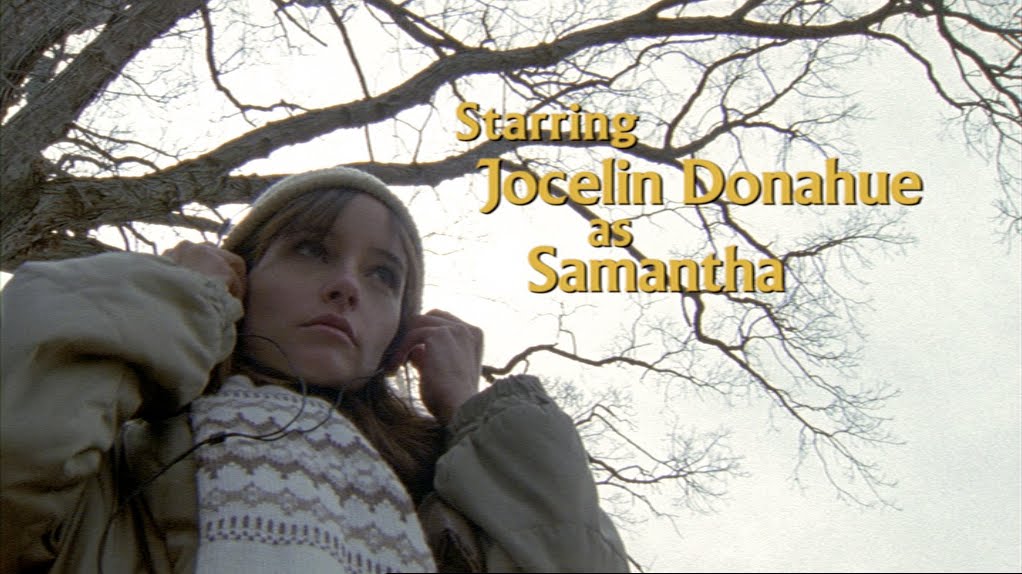
The film’s opening half hour, in which we bear witness the heavenly minutiae of our heroine Samantha (Jocelin Donahue)’s life as a small town college student in the 1980s, plays out like an extended love letter to all the oddly captivating prosaic detail that’s ever made your heart sing on an old horror tape. And when the actual horror itself finally gets going, we can sit back and let ourselves ricochet happily between slasher-era sartori (the takeaway pizza, the repurposed kitchen knife, the unsettling, jokey answerphone messages and all those endless phonecalls), late period ‘70s gothic (unnatural light through the stained glass windows, the harpsichord at the bottom of the stairs), hints of “Shuttered Room” style mad-relative-in-the-attic antics and Texas Chainsaw style deformed killer family mythos, Dennis Wheatley-approved old school Satanism, Phantasm-esque otherworldly graveyard shtick, all-purpose American haunted house tropes…. you name it, it’s probably in there somewhere.


Where West’s MO very much differs from Tarantino though is that “House Of The Devil” is a surprisingly subtle and slow-moving film – an approach that seems very brave given the fuck-yeah-gore approach favoured by most modern horror. In fact, it occurs to me that for a non-horror-fan viewer, unprepared to drink in the steady stream of referential, nostalgic reverie, “House Of The Devil” could easily become an unbearably dull experience – an exercise in deliberate mediocrity, lacking any entertainment-based pay-off.

As such, I can’t help but admire Ti West for taking a chance and placing the success of his film solely in the hands of those of us weird enough to react with joy at the sight of Samantha’s big, orange-padded walkman headphones, or at the beautiful climbing-the-stairs shots based on the bit where they find the mutilated body in ‘Night Of The Living Dead’. And given that he has apparently managed to make the film a roaring success on that basis, what can we say except HIGH FIVE, DUDE? What further proof could be needed that the Age of the Nerd is upon us?


The menacing kitsch of the house itself is wonderfully realised. These aren’t the kind of Satanists who live in rotting gothic splendour and leave a big ol’ grimoire conveniently open on the coffee table – rather their home evokes a horrid neo-classical banality that seeks to recall the stifling atmosphere of a million repressive parental homes. On second viewing, the empty, airless still-lifes that West frames within the house are by far the most chilling aspect of the film, recalling the way David Lynch filmed the interiors of the Palmer house in “Twin Peaks”, or the inexplicable dread of Pupi Avanti’s “House Of Laughing Windows” (a film whose influence seems to loom large over “House Of The Devil”).


Moreover, these eerie interiors represent the key point at which “House Of The Devil” really begins to transcend its status as a mere horror-movie-about-horror-movies, providing us with echoes of abuse and loneliness more subliminally menacing than any pasty-faced demonic crone. After all, you can punch one of those, but try punching an Edward Hopper painting. (Ok, obviously you COULD punch an Edward Hopper painting, but I’m talking figuratively here, let’s not go there.)


In fact, the only thing that ended up marring my enjoyment of the film was the inevitable satanic bloodbath that concludes proceedings – an odd thing for me to say, given that I generally welcome satanic bloodbaths as a fine addition to any motion picture. But, whilst there are a few wonderfully spine-tingling ‘evil reveal’ scares to be had in the closing twenty minutes of “House Of The Devil” (I’d tell you about ‘em, but I wouldn’t want to spoil ‘em), the full realisation of the film’s satanic shenanigans is rather hum-drum and predictable, somehow managing to feel infinitely less satisfying that the hour of sublime mudanity that proceeded it. I mean it’s some ok Satanism I guess, but it’s no "Devil Rides Out", y'know?

Actually, I probably would have enjoyed the film a lot more if the evil Satanists hadn’t revealed their existence AT ALL, and if Samantha had just gone to the house, hung around, noticed a few things that were *slightly* not-right, got a bit worried, and gone home. That would have been an amazing movie – a daring affront to the audience’s satanic bloodbath-based expectations, and a brilliant example of a horror movie whose horrors are created entirely in the imagination of the viewer; a new benchmark for restraint and the power of suggestion in the genre.

Sadly though, this isn’t that film, and when the time comes, the blood is spilled, the robes are donned, the knives are drawn, the doors are banged, the corridors are frenziedly run down, the teeth are bared, the colours are drained, and I start involuntarily humming The Ramones “You Should Never Have Opened That Door”.


Which is probably just as well I suppose. I mean, would anyone be rushing out to see this movie if the reviews had amounted to “ok, so nothing actually happens at all, but there’s some nifty interior décor and some great shot compositions, and the main theme music is totally killer”..?


This Ti West is a smart cat, I think. He knew what he had to deliver, and he got around to it within eighty minutes (PRAISE THE LORD, A MODERN MOVIE THAT ACTUALLY ENDS ON TIME), without resorting to any shitty ‘jump scares’ or ‘lightning strike’ cutting, and whilst still managing to turn in a film that often seems to function more as an extended video art project on aesthetic fetishisation than a narrative horror flick.

One thing that helps him to pull it off, I think, is sheer technical skill. Watching old VHS movies, and low budget cinema in general, we get used to certain things. Y’know what I mean - scenes will be inexplicably filmed in long shot, dialogue will not match on-screen action, bizarre music will deafen us at random intervals, people will talk about nothing in particular for minutes on end whilst the camera remains static, and so on. Some viewers learn to tolerate these deficiencies as natural wastage in between the cool bits, whilst some of us actively embrace them as perverse statements of otherworldly, homemade charm. But at the same time, would anyone want to watch a competent modern movie full of *deliberately contrived* long-shot addled padding..? Seems doubtful.


And so, like Tarantino before him, this is where West wisely breaks from mere re-enactment of the past, making sure that “House Of The Devil” is instantly recognisable as a good film, in the middlebrow newspaper critic / film studies teacher sense of the term. His directorial style is flawless, the film is perfectly paced, and flows beautifully. Every single shot is carefully and interestingly composed, full of rich incidental detail. The cinematography and production design is top notch. The acting is excellent, and all of the characters are lively, engaging and sympathetic (props in particular to Mary Woronov and Tom Noonan as our oddly loveable Satanist couple). The music is fantastic (opening credits theme = TUNE).

Even through sequences in which nothing whatsoever is happening, the film is a joy to behold. I could happily have watched Samantha and her best friend eating pizza and discussing the local property market for hours.


Subsequently, the film gains much of its power from the fact that the movie industry doesn’t usually let us see such specialist aesthetic fetishisation and vague, uneventful narratives in the context of a quote-unquote ‘good film’. “House Of The Devil” is a ‘good film’ that is utterly in thrall to the forbidden magic of ‘bad films’, and, as usual, the mainstream critics, copywriters and squares just won’t know what the hell to make of it, other than to acknowledge that it’s there, that people are watching it and enjoying it, and that it can’t be ignored forever.

A modest creative success on its own self-defined terms, “House Of The Devil” is far from the greatest film most cult movie buffs will have seen this week/month/year, but it DOES hopefully represent the stirring of a promising new approach to horror in the 21st century, and, speaking as a life-long fan of the weird, the obtuse and the cultish, it is always nice when one of ‘our guys’ manages to make a splash in the big pond, however fleetingly. Put me down as officially looking forward to whatever Ti West does next.


* Is that the best contrived sub-genre name ever, or what? Lovecraft fans will be delighted to learn there’s already a Brighton club-night called “Dreams In The Witch House”.

**As with all “the first [whatever] EVER!” type proclamations, this claim is of course utterly fatuous, and readers are encouraged to write in and tell me why “Abbott and Costello Meet The Wolfman” or “House of Frankenstein” or something was actually the first ever post-modern horror movie.