Showing posts with label Four Square. Show all posts

Thursday, 22 July 2021

Weird Tales:
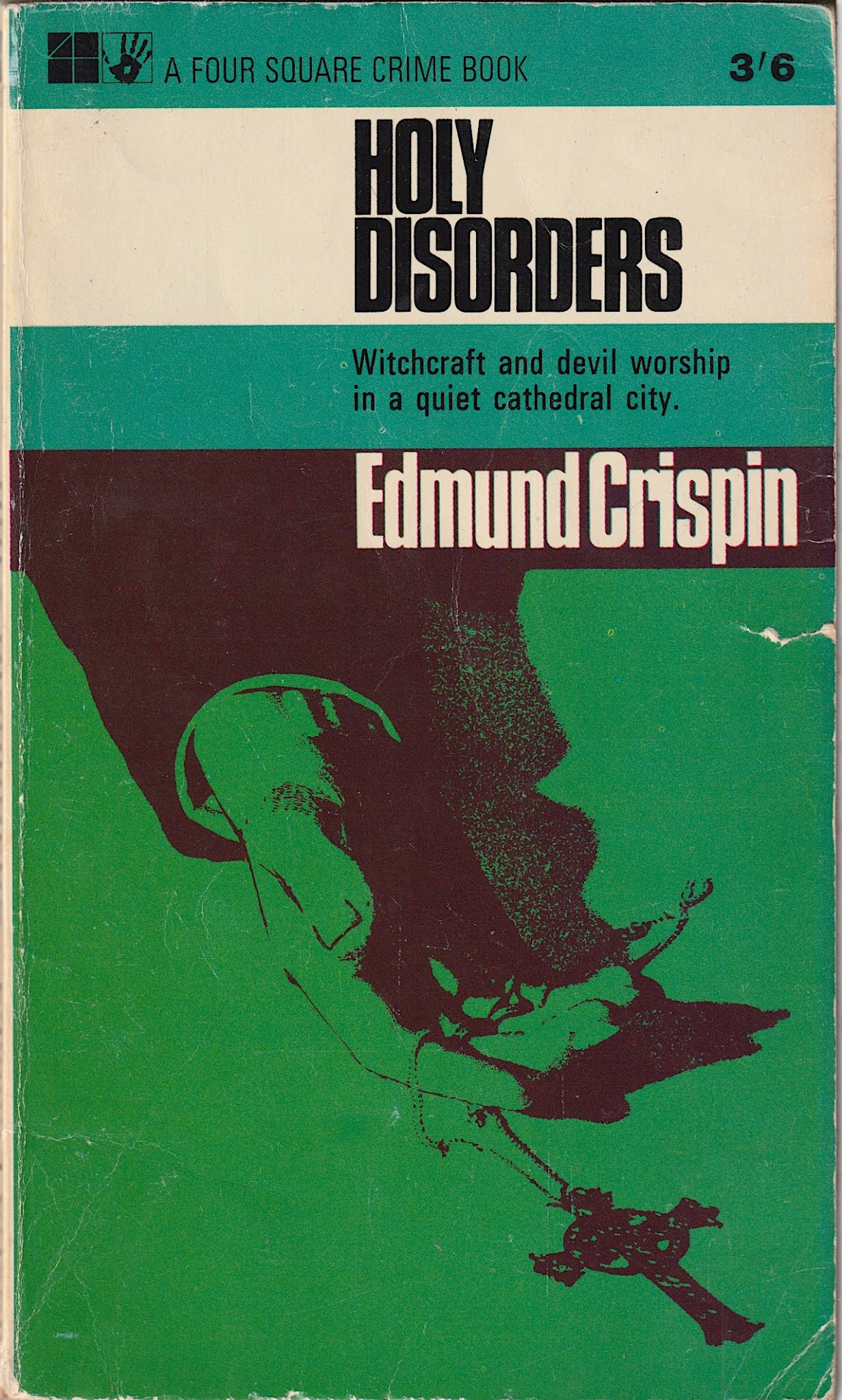
Holy Disorders
by Edmund Crispin

(Four Square, 1965 / first published 1946)


Though on the face of it this paperback looks to be yet another enticing, horror-adjacent offering from ‘60s New English Library imprint Four Square, readers familiar with Bruce Montgomery aka Edmund Crispin’s Gervase Fen novels will realise that the publishers have actually been pretty disingenuous in presenting this reprint as a straight Satanic thriller.

As the aforementioned readers will be well aware, the Fen novels are in fact broadly comedic, foregrounding an idiosyncratic campus humour pitched somewhere between P.G. Wodehouse and Bruce Robinson’s ‘Withnail & I’, leavened with cheeky, fourth wall-breaking asides and enough literary/classical in-jokes to make anyone who has not committed Palgrave’s ‘Golden Treasury’ and Bullfinch’s ‘Age of Fable’ to memory feel slightly inadequate as a human being.

Not everyone’s cup of tea, to be sure, but personally I’m happy to indulge Montgomery/Crispin’s whims, and find his books fairly amusing. More-so, I suspect, than the hypothetical 1965 reader who came into this one expecting some serious, Dennis Wheatley type affair, only to find our protagonist, retiring church music composer Geoffrey Vinter, blundering around causing havoc in the sporting goods section of a London department store during the first chapter, as he struggles to obtain the butterfly net which his friend, Oxford literary professor and amateur detective Gervase Fen, has ordered him to bring forthwith the the fictional Devonshire cathedral city of Tolnbridge.

Vinter, it transpires, has been summoned to Tolnbridge to stand in for the cathedral organist, who has been hospitalised after being bashed about the head by unknown assailants. Before he gets there however, we get to share at some length Geoffrey’s dismay at navigating Paddington Station during rush hour, his attempts to buy and imbibe several glasses of beer as he awaits his train, his developing friendship with the hapless shop clerk who has followed him from the department store in search of adventure, and his lengthy and tormented interactions with the other occupants of his train carriage, only a small handful of whom will go on to play any role in the unfolding mystery.

Amidst all this, the fact that several shambolic attempts are made on Geoffrey’s life during his journey thickens the plot, but otherwise scarcely seems worthy of note.

By chapter three (page 31), our man has finally arrived in Tolnbridge, which I take to be modelled to some extent on Montgomery’s adopted home of Totnes, although it differs from that fine town in a number of important details, not least the dominant presence of a cathedral, around which most of the book’s subsequent “action” (if such it may be termed) accumulates.

Significantly, Tolnbridge is also notrorious for “..a frenetic outburst of witch trials in the early seventeenth century, and the equally frenetic outburst of witchcraft and devil-worship which provoked them, and in which several clergy of the diocese were disgracefully involved”;

“‘This was the last part of the country,’ said Fen, “in which the trial and burning of witches went on. Elsewhere it had ceased fifty or sixty years earlier - and then hanging, not burning, had been the normal method of execution. The doings in Tolnbridge stank so that a Royal Commission was sent down to investigate. But when the Bishop Thurston died, the business more of less ceased. One of the last celebrated witch-trials in these islands was the Weir business in Edinburgh; that was in 1670. Tolnbrige continued for forty years after that, into the eighteenth century - the century of Johnson, and Pitt, and the French Revolution. Only a step away from our own times. A depressingly fragile barrier - and human nature doesn’t change much.’”

After arriving at the wrought-iron gates of the clergy-house, Vinter and newfound pal Fielding are introduced to the assortment of ecclesiastical hangers-on who will go on to comprise the story’s pool of suspects (if you don't know difference between a Precentor and a Canon, you’ll be pretty much at sea here). With Fen - effectively the Holmes to Geoffrey’s Watson - stubbornly failing to make an appearance however, there’s little for the pair to do but retreat to the nearest pub - which in this case is the ‘Whale & Compass’ (perhaps based on Totnes’s late lamented Kingsbridge Inn, or so I’d like to imagine).

To cut a long story  short, Gervase Fen eventually makes his appearance a few pints later, on page 58. Each of Crispin’s books seems to feature the detective adopting a new, loud and disruptive hobby, and in ‘Holy Disorders’ he is inexplicably fixated with capturing, and apparently performing unspecified experiments upon, various insects - hence both his demand for a butterfly net and his extended absence during daylight hours. The reason why Fen is residing in Tolnbridge, apparently at the expense of the church, is never sufficiently explained insofar as I recall, but be that as it may - with our sleuth finally accounted for, we can finally get on with the murder mystery component of the novel.

In addition to the fate of the aforementioned organist (who has been poisoned in his hospital bed, following the earlier assault), this comprises a ghoulish and somewhat surreal variation of the Locked Room mystery, in which the widely disliked Precentor, a Dr Butler, is inexplicably crushed beneath the colossal tombstone of ill-regarded medieval luminary St Ephraim - a tragedy which seemingly occurred when all doors to the building were locked, and no one else was inside.

Eccentric though his writing may be in most other respects, Montgomery/Crispin remained staunchly dedicated to the conventions of the old fashioned whodunnit, and as such, much of the text from hereon in is taken up with the gathering and consideration of alibis, methods and motives, all of which is unpacked at a length liable to prove excruciating to readers who are not fans of classic drawing room mysteries, including the provision of both a map of the crime scene and a lengthy suspect-by-suspect recap to help logically-minded readers reach their conclusion prior to what passes for ‘the big reveal’.

Although published in 1946, ‘Holy Disorders’ was evidently written during the war years, which lends an interesting backdrop to proceedings, reminding me somewhat of Powell & Pressburger’s bucolic wartime fantasias (particularly ‘A Canterbury Tale’ (1944)). 

There are frequent references to the war effort, to idle soldiers hanging about hither and yon awaiting orders, and to the latest news from overseas, and it is little surprise therefore that a further quirk is added to the already over-stuffed plot when it is revealed that the powers-that-be have detected illicit radio transmissions emanating from the vicinity of the cathedral, leading the discovery of a radio set hidden in an inaccessible part of the building, and the subsequent assumption that a cabal of Nazi spies must be abroad in sleepy Tolnbridge.

Amidst all this incident meanwhile, there is even room, surprisingly, for a little romance, as Geoffrey Vinter finds himself smitten with the daughter of the ill-fated Precentor - a graceful and demure young lady who, much in the manner of female characters in novels like this one, uncomplainingly acts as den mother and cook to the assorted oddballs hanging around the clergy-house. Like any good ‘Brief Encounter’ era Englishman, Geoffrey delivers his proposal of marriage whilst staring fixedly ahead at a row of radishes. (“Brutish roots,” he reflects, “what do they know of the agonies of a middle-aged bachelor proposing marriage?”)

This whole business is actually surprisingly affecting, forcing us to reflect on the fact that, whilst Edmund Crispin may have adopted the voice of a gout-addled college rector for his writing, Bruce Montgomery was actually only twenty-five years old when he completed this novel, and presumably subject to the same passions as other young men making their way in the world, and what have you.

With the novel’s rambling plotting already so loaded with under-developed tangents, it’s no surprise meanwhile to discover that the Black Mass / devil worship angle - though assuredly present - never amounts to much more than fairly half-hearted diversion. The irony here however is that the brief passages in which Crispin’s writing shifts away from comedy to explore more macabre subject matter are actually extremely effective, evoking an atmosphere worthy of the era’s horror/weird fiction greats;

“They paused by the hollow where the witches had burned. It was overgrown, neglected. Weeds and brambles straggled over it. The iron post stood gaunt against the fading light. They found rings through which the ropes and chains had passed. The air of the place was almost unbearably desolate, but in imagination Geoffrey saw the hillside thronged, above and below, with men and women whose eyes glowed with lust and fright and appalling pleasure at the spectacle to be offered them. […] A woman they had known - a next-door neighbour perhaps - a familiar face now become a mask of fear in whose presence they crossed fingers and muttered the Confiteor. Who next? And in the breast of that woman, what ecstasy of terror or vain repentance or affirmation? What crying to Apollyon and the God of Flies…? It needed little fancifulness to catch the echo of such scenes, even now. And here, they had accumulated - week after week, month after month, year after year, until even the crowds were sick and satiated with the screaming and the smell of burned flesh and hair, and only the necessary officers were present at the ending of these wretches, and the people stayed in their houses, wondering if it would not have been better to face the malignant, tangible living rather than the piled sepulchres of the malignant, intangible dead.”

I mean, you certainly don’t get that sort of thing in the middle of a Jeeves & Wooster.

Thereafter, this sense of a lurking evil underlying the city is given an atavistic twist via an extremely sinister (though underdeveloped) sub-plot which sees Fen interviewing a teenage girl who has been brain-washed through the use of drugs into participating in the Black Mass and carrying out the diabolical whims of her masters.

Sadly, the contemporary Satanic ceremony which Fen and Vinter subsequently manage to infiltrate proves both boring and rather farcical - it seems that the novel’s villains are merely using diabolism as a front for their more legitimately nefarious goals, again for reasons which remain somewhat unclear - but those ‘Witchfinder General’ / ‘Blood on Satan’s Claw’ vibes are really nailed down again during a section of the book in which (for reasons which appear entirely superfluous to the central narrative) our heroes are invited to read the long supressed secret diary of seventeenth century witch hunter Bishop Thurston. A section of this diary is reproduced in full, effectively comprising a short-story-within-a-novel, and once again, it is excellent stuff - a nasty little tale with a supernatural twist which could easily have found a home in any given ‘70s horror/ghost story anthology.

More representative of overall tone of the novel however are incidents such as that in which Fen and Vinter encounter a ‘Royal Professor of Mathematics’ who seems intent on reciting the entirety of Lewis Carroll’s ‘The Hunting of the Snark’ from memory, only to lose him again a few pages later following yet another visit to the pub, or the chapter which finds the investigators extracting much merriment from a visit to a potential suspect whose home boasts a pet raven resting upon a bust of Pallas above a chamber door, and a wife named Lenore, yet who pleads complete ignorance of the work of Edgar Allan Poe. (“I haven’t much time for verse - he’s good, is he?”)

In conclusion, you might say that, if Montgomery/Crispin had taken a slightly more serious approach to is storytelling there and had engaged more thoroughly with the more macabre elements of his tale, he could have written an absolutely splendid horror novel here. But, I suspect that’s rather like saying that if Noel Coward had ditched all that camp stuff and got a bit more into the rugged outdoors, he could have written a cracking western. 

At the end of the day, the Crispin/Fen novels are what they are. They are entirely reflective of the peculiarities and obsessions of their unconventional creator, but if you can angle your antenna somewhere in the vicinity of his preferred wavelength, they remain thoroughly entertaining, and certainly a little different from anything else you’re liable to find knocking about in your local Oxfam. 


Tuesday, 30 June 2020

Weird Tales:
The Evil Eye
by Boileau & Narcejac

(Four Square, 1961)


Before being subsumed into our dearly beloved New English Library at some point in the 1960s, paperback imprint Four Square published a wide variety of interesting stuff, including a lot of obscure and/or sought after titles (often in translation) which have rarely been reprinted since.

Four Square books also often featured bold, attention-grabbing artwork, of which this fabulous, comic book style ink & watercolour number from acclaimed SF/fantasy illustrator Josh Kirby provides a perfect example [the signature in bottom right confirms this as Kirby’s work, although it looks drastically different from his later, better known style]. As such, obscurities from the company’s long-lost back-list have done much to liven up second-hand book shopping in the UK across the decades, although collecting them can also prove a frustrating experience.

Due to their especially cheap binding (or so I’m assuming), Four Square’s paperbacks have a tendency to look reasonably well preserved on the outside, but to crack and fall to pieces, scattering dried out pages to the four winds, as soon as some poor fool tries to read them. Thankfully I just about managed to make it through ‘The Evil Eye’ without destroying it in the process, but… I’m not sure that many future readers will get a chance to enjoy the charms of this particular copy, let’s put it that way.

In the English-speaking world, Pierre Boileau (1906–1989) and Thomas Narcejac (1908 –1998) will almost certainly get more name recognition from film fans than literary types. With their names appearing ominously on the writing credits of Clouzot’s ‘Les Diaboliques’ (1955), Franju’s ‘Les Yeux Sans Visage’ (1960) and Hitchcock’s ‘Vertigo’ (1958), its safe to say that the duo’s residual influence has sunk deep into the very bones of the horror and thriller genres, as well as those of auteur and arthouse cinema more generally.

Back in France of course, Boileau-Narcejac are equally remembered for their achievements in the field of putting words together on the page, but for whatever reason, translations of their work have remained extremely scarce over the years. So, naturally I was keen to take the opportunity to check out some of their prose, despite the risk of the book crumbling to dust in my hands.

It’s probably fair to assume that ‘The Evil Eye’ (‘Le Mauvais Oeil’, originally published in France in 1956) is a minor work within the duo’s oeuvre, weighing in at just over 120 pages, and sadly the horror spin that Four Square’s packaging puts on the material turns out to be almost entirely erroneous, with the protagonist’s suspicion that he is afflicted with the power of the “evil eye” merely numbering among a number of fantasies and delusions which flicker through his unsettled mind through the course of the novel.

In fact, ‘The Evil Eye’ barely even qualifies as a thriller in the conventional sense of the term. What we have here rather is kind of a downbeat, quasi-gothic character study, in the ever-popular “dysfunctional remnants of an aristocratic family bounce off each other in their decaying old house” vein which went on to become so beloved of filmmakers in the late ‘60s / early ‘70s, for whatever reason.

It's a testament however to the talents of Boileau-Narcejac (and indeed to their translator on this occasion, Geoffrey Sainsbury) that this rather morose and uneventful tale actually remains a thoroughly engrossing read, drawing me into the story far more deeply than I suspected it would once I’d got the basic gist.

Our protagonist here is Rémy, a young man who has been paralysed from the waist down since infancy, when his mother apparently died under traumatic yet mysterious circumstances. We join him on the morning when, aged eighteen, and following the ministrations of a questionable ‘healer’ hired by his emotionally distant father, he gets out of bed and walks.

Disappointingly for Rémy, this Lazarus-like recovery prompts surprisingly little jubilation from either his brash, business-minded uncle or the two female servants who have provided him with his only real human contact over the years, and so, largely left to his own devices, he sets out to undertake the long-delayed process of growing up, digging into the inevitable backlog of uncomfortable family secrets in the process.

Intelligent, self-possessed and callously confident, yet at the same time hopefully naïve and chronically lacking in the kind of practical experience which most of us have gained by the time we reach adulthood, Rémy makes for an interesting and complex viewpoint character. Though he is not necessarily an “unreliable narrator” in the usual sense of the term, a lifetime of near isolation has left him with an unhealthily introspective approach to life, and throughout the novel, we’re forced to bear witness as he twists the people and events around him into his own melodramatic, self-centred narrative, unable to understand the feelings of others or to comprehend the more prosaic motivations behind their actions.

Though ‘The Evil Eye’ offers few of the shattering narrative revelations or surprise handbrake turns that Boileau-Narcejac’s cinematic reputation may have led one to expect, its strengths lie elsewhere – in the deceptively complex exploration of character dynamics, and in the cultivation of a richly ominous yet finely tuned atmosphere.

In fact, the book is steeped in that very particular world of seedy, grey-skied decay which seems to persistently creep into French culture of this era, from the damp-stained walls, musty bedclothes and corked, half empty bottles to a persistent impression of poverty and bankruptcy dogging the heels of the purportedly wealthy characters, and of the grindingly tedious, antiquated duties still performed by their indentured servants, long after modernity should have rendered them irrelevant.

Inevitably, the duo’s writing reminded me somewhat of the precise, descriptive prose of Georges Simenon, even as they push things far further than he would have done, including a few extraordinary, opium-scented flights of poetic fancy which can't help but push the tale toward the eerie, indefinable realm of what we’re obliged in this context to call le fantastique.

For all that it’s essentially a naturalistic, psychological tale in fact, one could perhaps apply a supernatural explanation to the book’s final paragraph ‘shock’ ending. But, this is never directly implied, cleverly leaving readers to map their own beliefs and gut feelings over the plainly recounted events.

All in all then, a surprisingly rewarding few nights reading, well worth making time for if you can manage to track down a copy that’s still in one piece.

Sunday, 26 November 2017

Got Carters.


Much like the later New English Library Edgar Rice Burroughs paperbacks, collecting these Carter Brown books with the Robert McGinnis girly artwork can start to feel like assembling a pack of trading cards or top trumps after a while.

Perhaps paperback collectors should devise some sort of game where we deal them out and play for keeps, using a system of values based on the coolness of the cover art, or something?

Anyway, here are three particularly choice additions to my hand, all picked up on a trip to Hay On Wye over the summer. ‘The Velvet Vixen’ in particular is one of my absolute faves I think. Look at that foot!

All of these were published in the UK by New English Library’s Four Square imprint between 1964 and 1966.

Tuesday, 14 March 2017

Shell Shock:
Gat Heat
by Richard S. Prather

(Four-Square/NEL, 1968)


Until recently, I’d never read a novel by Richard S. Prather all the way through, yet I own more of his books than most authors I actually like. Don’t ask me why – I mean, usually even the cover art isn’t much good (although I’ll make an exception for this one).

On reflection, I think it must be Prather’s gift for titles that keeps me parting with (extremely small amounts of) cash to add to my pointless collection of his work. Whilst I’ve still not acquired a copy of his hopefully beatnik-themed masterwork ‘Dig That Crazy Grave’, I could easily rattle off a top ten awesome/absurd monikers from the Prather canon, and it is this aspect of his career that I aim to primarily highlight in this new series of posts.

Though not as mirth-inducing or psychotic as some of his titles, ‘Gat Heat’ is a sublime bit of gutter pulp nomenclature that might well make it into my top five, and it was probably that, plus the rather unique aspect of the hip-hugger clad dame featured on the cover, that led me to pull this one off the shelf when, bolstered by the realisation that Prather is actually rated rather favourably in certain circles of vintage crime fiction fandom, I determined to finally actually sit down and read one of these damn things front to back.

And so, the verdict. Well, in short, Prather strikes me (on the basis of this novel at least) as a talented writer who was fully aware he was cranking out trash, and happy to let his standards slip accordingly.

His writing does often have bit of a raw, weird post-Cheney/Spillane punch to it, leavened with a hefty dose of goofball humour, and, at his best, he is capable of crafting bits of prose that read like extended strings of irresistible exploitation movie poster tag-lines. This is perfectly exemplified by chapter # 2 of ‘Gat Heat’, which begins with the immortal line;

“They were all naked. It was that kind of party. Even the dead guy was naked.”

And if at that point you don’t feel compelled to immediately cease whatever else you’re doing read on, you’re a better man than I.

Sadly though, such zingers become fewer and further between as the disappointingly linear blackmail storyline grinds into gear, and, once the novel’s beguiling setting – a delicious world of pre-Manson Hollywood decadence, ripe with wife-swapping parties, gaudy condos and brightly hued Cadillacs – has been satisfactorily established, it soon becomes a bit of a plod, despite Prather’s admirable efforts re: piling up blood-thirsty violence, extravagantly lecherous descriptions of scantily-clad dames and miscellaneous crazy, high octane shenanigans to beat the band.

(Clearly already geared up for the ‘70s, ‘Gat Heat’ actually reads like a 50/50 transition between an old-fashioned private eye mystery and one of the action-orientated ‘Men’s Adventure’ titles that would soon begin to take their place in the new decade.)

I’m not sure quite why I remained so unmoved by all this, given that I’m usually pretty happy with so-so pulpy private eye yarns, but what really bugged me I think is Shell Scott himself. Generally portrayed rather unappealingly on the covers of these books as a leering, albino buzzcut-sporting psychopath, Scott is a character who combines the blunt thuggery of Spillane’s Mike Hammer with the wise-cracking, womanising patter of yr average smirking Euro-Spy protagonist, and as such he tends to emerge as an almost insufferably smug narrator.

Whilst some of Scott’s habits (retrospectively assessing the quality of each punch he delivers to a crook’s jaw and ruing the circumstances that denied him a better performance, for instance) are quite endearing, others are decidedly less so (I hope he doesn’t go through all these books referring to women as “juicy tomatoes”, because it gets old pretty quick).

The most essential problem here though is that Scott – and by extension, the story he narrates – simply lacks the sense of moral ambiguity found at the heart of all the best P.I. tales.

From Sam Spade to Lemmy Caution to Lew Archer – they all inhabit a treacherous moral universe in which the slippery relationship between crime, the law and their own uneasy position as a reluctant conduit between the two is forever uncertain; corruption is ever-present, and questions of a given action’s justification ever unanswered. That’s the way these stories work, and it is a large part of what allows them to remain so compelling.

Take that away, and you’re left with, well… Shell Scott – a self-righteous bore whose delusions of self-determination fail to mask his more apparent function as a sadistic stooge for the established order. Every cop he meets is salt of the earth, an A-1 guy with a great sense of humour, whilst the ‘hoods’ he tangles with are diminutive, goblin-like hoodlums left over from the 1930s, who can’t pronounce ‘th’ sounds and have names like ‘Bingo’ and ‘Gippo’. Not much scope for ambiguity there.

Whilst Prather is careful not to put such dialogue directly into the mouths of his police characters, Scott speaks for his cop buddies when – ala ‘Dirty Harry’ a few years later – he repeatedly curses out the pen-pushers in the Supreme Court who won’t even let him give these crooks a well-deserved beating upon arrest, and decries the system that demands he must go through the absurd farrago of actually obtaining evidence against his suspects and letting them call their swanky lawyers, rather than just, say, shooting them.

Of course, given that nobody is reading ‘Gat Heat’ for the sake of court room intrigue, Shell Scott does end up shooting most of them, but in an off-hand, self-satisfied manner that can’t kind help but leave a bad taste in the mouth, as he blunders on towards his next comedic encounter with a bikini-clad ‘tomato’.

Of course you might say I’m expecting far too much of a light-hearted, read-in-one-sitting bit of pulp hoo-hah, and this reactionary take on the genre certainly has its precedents (I don’t recall Mike Hammer being haunted by too much moral uncertainty as he bashed villains’ teeth down their throats). But still, I dunno… arch and self-aware as Prather’s style may be, he essentially seems like a smart guy, so would it have killed him to have approached this tale of blackmail, multiple murder and sexual deceit with just a *touch* of the gravitas such topics entail, in between all the yukks..?

Anyway, more to the point, the artwork on the front of this one is pretty cool. It turns out the illustration is actually by Robert McGinnis, re-purposed by New English Library from the 1967 Carter Brown number pictured below. (I thought I detected a McGinnis-y look in the folds of her flares and contours of her belly, but wasn’t 100% sure.)

As of 1968, the ubiquitous exaggerated sales figures thrown around by all of Prather’s publishers had apparently reached the not unimpressive count of forty million, and NEL’s back cover blurb hedges its bets with a couple of paragraphs that could have been applied to literally any Shell Scott story, suggesting that perhaps they were just as reluctant to read these books as your correspondent.

More fun with the “steel-eyed, sliver-haired ‘tec” coming soon to these pages, potentially.


Wednesday, 20 August 2014

Martian Chronicles
(and Bonus Tarzan).


Ok, so first off, I’d like to both offer a quick apology to regular readers for letting my informal once-a-week posting schedule slip a little, and to alert you to the fact that such slippages might be liable to occur more frequently in the near future.

I prefer to avoid talking about my personal circumstances on the internet, but let’s just say that life events have conspired this month to kick the idea of maintaining a regular weblog into what I believe is known as ‘the long grass’. Thankfully I had a few previously scheduled posts lined up to take the slack, but those are now exhausted, so we’ll see how things go, but nonetheless, I hope to get some new stuff up here soon.

To give you something nice to look at in the meantime though, here are some recent acquisitions to my seemingly ever-growing collection of Edgar Rice Burroughs paperbacks. I confess, I’ve never so much as read a word of Burroughs, but he sure was a gift to cover artists, and as long as these New English Library editions keep jumping off charity shop shelves at me, priced at mere pennies, it’s difficult to say no.

In fact, so widely scattered and cheaply marked up are E.R.B’s works (second only to Moorcock in their awesome-science-fantasy ubiquity), it’s probably only a matter of time before I start forgetting which ones I’ve got already and buying doubles. Maybe we habitual second-hand bookshop fiends should get together and start swapping them like trading cards? Stock up comrades, you never know when you’re going to need to trade a few commoners for a super-rare to complete your John Carter collection. First one with a complete set of the NEL editions wins the admiration of all.

The NEL editions above are all 1972-74, and the Four Square is 1965. All artwork is unaccredited.

Sunday, 17 November 2013

Starship Troopers
by Robert A. Heinlein

(Four Square, 1961)


Not sure there’s much I can say about this one that hasn’t already been said, except:

1. I picked it up for 50p in a Nottingham charity shop. Condition = WRECKED.

2. The book itself may be astoundingly disagreeable fascistic hokum, but this cover illustration is the very epitome of old school two-fisted sci-fi hoo-hah, and for that I love it.

Saturday, 10 December 2011

A Few Quickies.


(Midwood, 1962)


(Four Square, 1964)

Perhaps the most chaste looking lesbian smut paperback ever published, courtesy of the usually reliably sleazy Four Square. Still a lovely design though – I like the title font, and the kind of slightly wonky free-hand oval ‘frame’.


(Panther, 1973)

Far from yr average ‘smut’ author, Violette Leduc is of course a legend of French letters, and this English language version of her ‘L’Asphyxie’ was initially translated and published by no less a bulwark of literary merit than the venerable Sir Rupert Hart-Davis. Still, easy to see where Panther were going with their early ‘70s editions. I mean, she’s French, and a lady, and it’s got skin in the title fer god’s sake. As the ads in the back reveal, Panther were rolling in dough from their similarly focused editions of Henry Miller and Wilhelm Reich, so Leduc must have seemed just the ticket for a bit more up-market sauciness.