Showing posts with label Harry Alan Towers. Show all posts

Thursday, 15 April 2021

Gothic Originals:
The House of Usher
(Alan Birkinshaw, 1989)

 One oft-overlooked wrinkle in the history of gothic horror cinema is the inexplicable revival of the form which seemed to take place at the close of the 1980s, nearly 20 years after the subgenre had last been considered a viable commercial prospect.

Largely (though not entirely) confined to the low budget/straight to video realm, this phenomenon is difficult to account for, but it is interesting to note in retrospect that it seems to have directly pre-empted the short-lived Hollywood gothic revival of the early/mid ‘90s, as epitomised by Coppola’s ‘Dracula’, Branagh’s ‘Frankenstein’, Neil Jordon’s ‘Interview with the Vampire’ and so on.

Could it simply be that, by the tail end of the ‘80s, slasher sequels, exorcist derivations and movies about stupid, rubber-faced goblin creatures were all thoroughly played out, yet the relentless thirst for new horror product down the local video shop yet remained unquenched, thus allowing a generation of directors and producers who came of age during the glory days of the 1960s (or in some cases directly contributed to them) to step in and pick up the slack..? I don’t know, but that seems as good of an explanation as any, so let’s go with it.

Possibly the best of these films was Stuart Gordon’s ‘The Pit & The Pendulum’ (1991), whilst the most unusual and original must be Roger Corman’s last directorial effort to date, ‘Frankenstein Unbound’ (1990). Elsewhere meanwhile, we find Argento & Romero’s oddball Poe anthology ‘Two Evil Eyes’ (1990), the Robert Englund version of ‘The Phantom of the Opera’ (1989), a new, Corman-produced ‘Masque of the Red Death’ (also ’89), and, further out on the limb within the sub-genre, Ken Russell’s characteristically bizarre ‘Lair of the White Worm’ (1988) and Dan Golden’s Bram Stoker-derived ‘Burial of the Rats’ (1994).

Strangest and seediest of all these productions though are surely the two Edgar Allan Poe derivations shot back-to-back in 1989 under the auspices of our old friend Harry Alan Towers - a man whom I assume will need no introduction to readers who have spent a certain amount time toiling in the depths of horror/exploitation cinema.

Though his most famed / notorious productions may have been far behind him by this point, the indefatigable Mr Towers had remained busy through the 1980s, lending his production talents (credited or otherwise) to a bewildering cross-section of softcore, horror and action projects, each more tasteless and disreputable than the last, some bankrolled (almost inevitably) by Cannon Films, with many co-financed and/or shot in Apartheid-era South Africa (not too cool, man).

As the decade drew to a close though, Towers must have smelled something fetid and sepulchral on the breeze. Clearly no stranger to the prospect of jump-starting moribund / public domain literary properties via the injection of a few cheaply acquired stars and vague contemporary trappings, the idea of launching his own re-do of the Corman/Poe cycle seems to have taken hold.

And, who better to assist Towers in this noble venture than Alan Birkinshaw - the man who, a decade earlier, brought us the unfeasibly entertaining Killer’s Moon?

Add Oliver Reed (then hitting the very nadir of his booze-fogged b-movie purgatory, thanks in no small part to a series of Towers collaborations) and the always-up-for-a-laugh Donald Pleasence to the equation, and you’ll readily appreciate that House of Usher ‘89 is not so much “in my wheelhouse” as actually commandeering the wheel, bottle in hand, and ploughing full steam ahead ahead toward the nearest iceberg. When the opportunity to watch it recently arose, declining was simply not an option. 


So, how does the whole thing actually pan out then? Well, diverging from Poe right from the outset (not that there’s any shame in that of course), we begin with a wealthy and fashionable American couple - Molly and Ryan, played by Romy Windsor and Rufus Swart - taking a jog in Hyde Park as part of their sojourn in England, sweatbands and reeboks in full effect as they duck back into the entrance of the swanky Park Lane Hotel.

(If you find yourself amused rather than insulted when we cut directly to a cramped interior set which if surely not representative of the accommodations offered by the swanky Park Lane Hotel… well, long story short, I think this movie might be for you.)

Somewhat inevitably, it turns out that the couple intend to visit Ryan’s long-lost uncle / only surviving relative at his remote country pile, and, in the first of many arbitrary/unconscious borrowings from earlier horror films mixed into Michael J. Murray’s screenplay, the movie briefly threatens to turn into a re-run of 1978 dud ‘The Legacy’. Subsequent events however make it seem more likely that Murray was more likely to have been cribbing from David McGillivray’s script for the late Norman J. Warren’s ‘Satan’s Slave’ (1976).

Lost on the way out to Uncle Usher’s abode, the couple swerve off the road to avoid a pair of ghostly children (a random horror trope which is never really elaborated upon), precipitating a near-fatal crash which leaves Ryan unconscious. Fleeing to the nearby mansion in search of help, Molly is greeted by sour-faced, formally-attired butler Clive (Norman Coombes), who soon thereafter ventures out to the wrecked car with a crowbar in order to correct that whole “near fatal” thing vis-à-vis her severely injured fiancée.

It’s only after waking from her obligatory dose of heavy sedatives in an extraordinarily garish, neo-classical bed chamber that Molly is introduced to haughty, soft-spoken Roderick Usher (Reed, of course), who seems to have borrowed not only his general demeanour but even his moustache from Michael Gough’s sinister uncle in ‘Satan’s Slave’.

In some ways, making Molly’s ersatz Madeline figure the inquisitive visitor to the Usher household, whilst relegating her male counterpart to the coffin-bound narcoleptic role (as per Madeline in the source text, the exact state of Ryan’s health remains unclear throughout), seems like an interesting reversal of the gender roles baked into Poe’s text. But, of course, things soon take the path of least resistance, falling back into a series of familiar horror movie ruts.

In this Usher variation you see, Roderick is determined to propagate his cursed bloodline by any means necessary - and Molly, needless to say, is his chosen vessel. Roderick also appears to be receiving experimental, life-extending medical treatment from a sleazy family doctor (Philip Godawa), briefly adding an extraneous touch of Frankensteinian mad science to proceedings.

Clive the butler’s equally sour-faced wife (Anne Stradi) meanwhile acts as reluctant housekeeper for the warped household, even though Roderick is evidently no fan of her cooking (“Clive, will you tell your wife I do not expect horse meat to be served at my table?”), whilst the servants’ mute daughter Gwendolyn (Carole Farquhar) seems to represent Molly’s best prospect for a non-crazy/evil ally as she contemplates her escape from a nightmarish future as the heavily sedated recipient of Oliver Reed’s tainted seed.


Which leads us neatly on to the matter of Reed himself. Though viewers of a cynical disposition might be tempted to assume that what we are seeing here is actually take # 26 of any given scene, during which he finally managed to recite the voluminous passages of dialogue written up for him on off-screen cue cards without corpsing or falling over, I feel there are moments here in which he actually delivers a pretty good performance.

His inimitable, hushed voice is still in good shape, which certainly helps, and though fairly static and subdued, he brings a sense of preternaturally decrepit desperation to some of his early scenes, hinting at a vulnerability rarely seen in his on-screen (or indeed off-screen) persona. Later on however, the script’s graceless dialogue and absurd situations defeat his better instincts, with Shatner-esque… pauses… tending to… predominate (thus lending further weight to the cue cards argument).

If Reed’s acting is a tad lacking in energy though, he - regrettably - seems to have retained a great deal of enthusiasm for manhandling his leading lady, in a manner which becomes increasingly questionable over the course of several scenes which call for close physical contact between himself and Romy Windsor.

I have no idea whether Windsor ever spoke about her experience making this film, or what her thoughts were on working with Reed, but she certainly looks pretty damned uncomfortable as he more-or-less dry humps her live on camera on at least one occasion. Recalling numerous tales of Reed’s less than gentlemanly conduct during this era, it seems reasonable to assume that the gusto with which he approached this task was less than entirely fictitious.

Horrifying as this seems however, even worse is to come during a particularly grotesque, hallucinogenic dream sequence (presumably modelled after those in the Corman/Poe pictures) depicting a daemonic marriage ceremony between Reed and Windsor. Here, we see Reed pick up a slice of a gigantic, tottering wedding cake, force it into Windsor’s mouth, and pull it out again with his teeth! Lord in heaven, I’ve never seen anything so repulsive.

Again, we should probably refrain from making any assumptions about a movie’s behind the scenes production circumstances, but whatever the truth of the matter, you’d better believe that this sight will leave a scar on my memory far more severe than any of the film’s ostensible ‘horror’ moments. You have been warned.

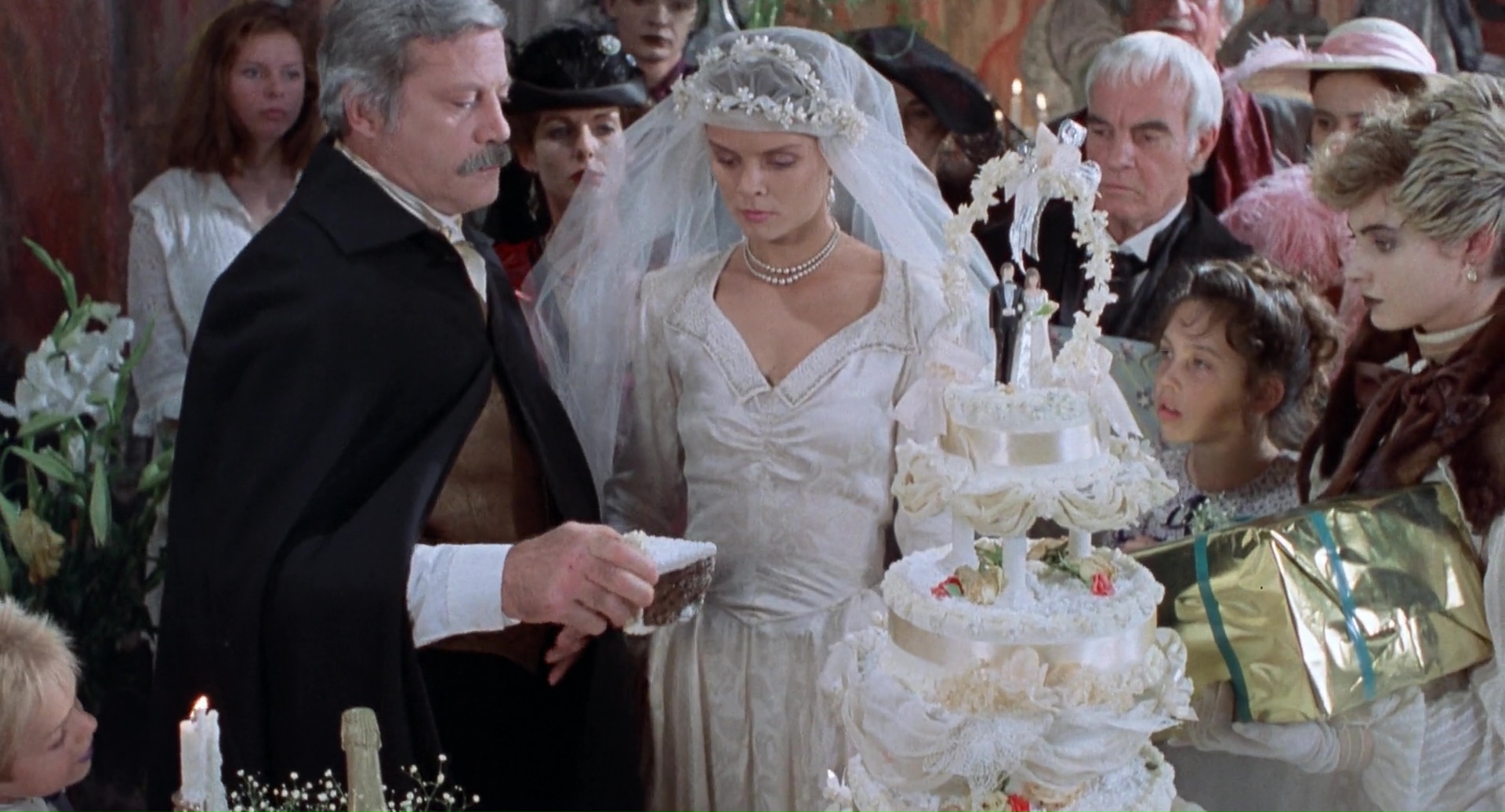
Moving swiftly on, another aspect of this ‘House of Usher’ liable to scar one’s senses is Leonardo Coen Cagli’s defiantly excessive production design, which throw the film almost immediately into a realm of phantasmagorical theatrical camp.

Although a few brief exterior shots on the Usher mansion were shot - I believe - at Knebworth House near Stevenage (an impressive Tudor edifice previously seen in ‘Horror Hospital’ (1973) and the aforementioned ‘Lair of the White Worm’), the interior sets are once again comically ill-matched.

To give credit where it’s due, Molly’s aforementioned bedroom is genuinely impressive in a crazy sort of way - a vast, medieval chamber decked out entirely in nightmarish pastel blue, it’s the kind of space which would indeed have fit the bill for a latter-day Ken Russell movie. The main ‘entrance hall’ set, complete with marble staircase, gilt curtains, hooded, faceless statues and Rubik’s Cube-styled windows, is pretty overwhelming too, conveying a similarly OTT, dreamlike feel.


Other areas within the candy-coloured mansion fare less well however, with a distinct whiff of air-brushed polystyrene and Dulux applied straight to plywood often predominating. Worst of all in this regard must be the ‘chapel’ set, which some overzealous scene painter has decorated with little black twirls, flames and spray-painted skulls, putting me in mind of the ‘goth room’ in some provincial indie nightclub. 


Uncle Roderick’s briefly mentioned background as an artist appears to have encouraged the film’s designers to load these sets up with all manner of mismatched tat, from Rodin-esque modernist sculptures to looming gargoyles, all-seeing eye covered Klimt pastiches, Italianate murals, moth-eaten Turkish carpets, faux-marble angel-y crap - you name it, and so long as it looks awful, it’s probably in here somewhere.

(It would probably be snarky to question how exactly all this is supposed to jibe with Roderick’s “acute sensitivity to certain colours”, which early in the film forces Molly to change her evening attire to “something a little more tasteful”, even though her initial choice of dress, though admittedly horrible, was actually a pretty good match for the mansion’s decor.)

Not that any of this is so dreadful in-and-of-itself, I should clarify - if anything, I appreciate the film’s wild disregard for realism and poverty-stricken attempts to overwhelm our senses. The problem lies more I think with DP Yossi Wein’s photography, which for the most part is odiously over-lit, its relentless brightness allowing no real mystery or atmosphere to accrue within these unhinged surroundings, highlighting their artificiality and essential silliness at every turn.


For all this baked-in shoddiness though, ‘House of Usher’ ’89 will still prove impossible for some of us not to enjoy on some perverse, unheimlich level. As uncharitable as some of my comments here may seem, I nonetheless found Birkinshaw’s film to be an absolute hoot, and would wholeheartedly recommend it to any admirer of distressed gothic aesthetics or oddball British horror.

Clearly a product of the same warped well-spring of inspiration which brought us ‘Killer’s Moon’, it is packed with enough uncouth eccentricities, bad ideas and baffling non-sequiturs to leave even the most jaded of psychotronic movie fans reeling - the aforementioned ‘cake incident’ foremost amongst them. (Hint when doing a psychedelic dream sequence, by the way: cutting away to shots of the dreaming character thrashing around in bed tends to spoil the effect somewhat.)

Early on for instance, we get a leering, grand guignol fake-out worthy of Todd Slaughter, as Clive the butler appears (for no apparent reason) to jam his wife’s arm into a hand-operated mincing machine, convincing us for one breathless moment that we’re witnessing a psychotic outburst of sickening gore… only for her to raise her arm from behind the machine, revealing that it’s merely the meat for tonight’s dinner being ground up. What larks.

Actually, now that I stop to think about it, pretty much all of the film’s big ‘horror highlights’ are equally arbitrary, not to mention highly derivative; hungry rat in cage (courtesy of ‘1984’, or possibly The Virgin of Nuremberg), grabby arms emerging from wall (‘Repulsion’ and/or ‘Dawn of the Dead’), head on serving platter (‘Tales That Witness Madness’ poster) - you get the idea.


Elsewhere, there is also much amusement to be gleaned from Molly’s pre-Usher profession as a hair stylist to the rich & famous. Apparently for instance, she’s so dedicated to her work that she managed to squeeze one of those full size Bakelite helmet hairdryer things into her suitcase!

Later, as she weeps inconsolably after learning that her fiancée is dead, the ever thoughtful housekeeper - distant and rude to fault through the rest of the film - picks her moment and asks, “I know you’ve got a lot on your mind, but whilst you’re here, could you do something with my hair?” Ever professional, Molly’s response is to throw her a can of mousse - “men love spikes”, she advises. (Recalling ‘Killer’s Moon’ again, moments like this cause me to wonder whether Birkinshaw had once again called upon his sister Fay Weldon to throw a few curveballs into the script.)

More emotional cross-wires can meanwhile be found in the final act, when Clive the butler learns of the deaths of his wife and child in separate Usher-instigated rampages - incidents which would play as tragic, gratuitous or cruel in most films, but here Birkinshaw pushes us straight into comedy by getting Norman Coombes to deliver two identical “OH MY GOD!” reaction shots in quick succession.

Another inexplicable curiosity meanwhile arises the film’s delightfully low rent synth score, jointly credited to two composers - George S. Clinton and Gary Chang - who both went to to enjoy noteworthy Hollywood careers, unlikely as that may seem. IMDB authoritatively informs me however that the rather fine, Carpenter-esque main theme used throughout ‘House of Usher’ was originally composed by Chang for John Frankenheimer’s 1986 Elmore Leonard adaptation ’52 Pick-up’, of all things. Had Towers just been pilfering tapes whilst visiting Cannon’s offices or something? God Only knows.


But wait a minute - didn’t I state, way back in the opening paragraphs of this review, that Donald Pleasence is in this film? Well, he is indeed! Turning up in the last half hour, he plays… well, to intents and purposes, he’s playing Saul Femm from James Whale’s 1932 ‘The Old Dark House’.

As the heretofore unmentioned lunatic brother locked in the attic, he manages to convince our heroine that he’s a poor, unfortunate fellow prisoner, before revealing, once granted his his freedom, that he’s actually a ruthless homicidal loon hell-bent on destroying everything in sight! (As in Jack Hill’s ‘Spider Baby’, these Ushers are cursed with a degenerative blood condition which pushes them further into psychosis as they get older, meaning that Pleasence’s character is pretty far gone.)

As usual, Pleasence does great work here. Evidently aware of his character’s pre-war inspiration, he has a great time putting his own spin on Brember Wills’ unforgettable performance in Whale’s film, bringing a sense of gravitas to his dialogue which temporarily even convinces us to take the film seriously. (“Thank god, an ACTOR,” I recall thinking at this point.)

Pleasance’s character is confined to a wheelchair (OR IS HE?, etc), and, apparently on account of his penchant for sculpture, he has a domestic hand drill strapped to one of his arms. Though allegedly utilised in a few moments of gory (off-screen) violence, I was chiefly struck my how thoroughly UN-threatening this looks, particularly when - in a moment which in a sense seems to sum up this movie’s crazy charm perfectly - he responds to being shut behind a locked door by a fleeing Molly by angrily drilling a series of very small holes straight into the plywood walls of the set! Whatcha gonna do Donald, hang some pictures?


Needless to say, this whole farrago concludes the only way it possibly could, with a decent into blood-curdling hysteria which Oliver Reed and Donald Pleasence rolling around on the floor in a frenzied, mutually suicidal wrestling match (shades of ‘Women in Love’ perhaps?), as the Corman/Poe-mandated conflagration erupts around them, sending these horrendous sets up in smoke once and for all.

Meanwhile, having rescued her hunky fiancée from behind a polystyrene tombstone, Romy Windsor finally flees back out into the fresh air of Knebworth House, presumably contemplating an immediate change of profession. (Actually, she went on to roles in ‘Surf Ninjas’, ‘Camp Nowhere’ and ‘Howling IV: The Original Nightmare’, but safe to say no more Harry Alan Towers productions were forthcoming.)

Towers and Birkinshaw though ploughed straight on in the same furrow, ensuring that ‘House of Usher’ was released more-or-less back to back with their visionary re-imagining of ‘The Masque of the Red Death’ - a film so assaultively crass it makes this one looks like a model of respectful sobriety by comparison. All being well, we’ll hopefully be digging into the garish mysteries of Red Death ‘89 here soon, so gird your loins folks, and make sure you come prepared. (Blindfolds, tranquilisers and hard liquor are all recommended.)


Tuesday, 26 June 2018

Deathblog:
Maria Towers / Rohm
(1945-2018)


Somebody up there seems to have decided that 2018 is the year in which the surviving stars of Jess Franco’s ‘60s films are to leave us, and, following the death of Janine Reynaud last month, I was saddened to learn this week (again via Tim Lucas’s blog) that Maria Towers – credited on screen under her maiden name, Maria Rohm - has passed away.

Probably best known for her intoxicating lead performance in what many consider the best film Franco ever made, 1970’s Venus in Furs, Rohm’s career in film proved inseparable from that of her husband and life partner, the notorious, globe-trotting producer Harry Alan Towers.

Between her screen debut in 1964 and her inauspicious swan song in Massimo Dallamano’s 1976 ‘Emmanuelle’ cash-in ‘Blue Belle’, almost all of the films she appeared in were Towers productions. Looking back over her CV however, it is interesting to note that, despite her striking beauty and obvious screen presence, the majority of her roles were supporting parts or cameos.

Significantly I think, it was only in her collaborations with Franco that she began to move toward lead / “star” parts, gradually edging her way up the cast-lists of the Franco/Towers joints, delivering memorable and sometimes provocative performances in The Blood of Fu Manchu, ‘The Girl From Rio’, ‘99 Women’, Justine and ‘The Bloody Judge’, gradually moulding herself into a powerful avatar of the same super-natural seductress figure who haunts other eras of Franco’s sprawling filmography in the shape of Soledad Miranda, Lina Romay, Alice Arno, or indeed Janine Reynaud.

Rohm finally attained immortality within Franco’s femme fatale pantheon when the aforementioned ‘Venus in Furs’ hit screens in 1970, and, notwithstanding special-guest-star Christopher Lee, she was top-billed for a second time as the predatory aristocrat Madame de St Ange in the same year’s extraordinary ‘Eugenie... The Story of Her Journey Into Perversion’ – the film that, more than any of the other Towers productions, provides the blue-print for the more unhinged, low budget sex-horror productions the director would go on to specialise in during the following decade.

It seems a great shame that Rohm never really pursued the promise she demonstrated in these roles after the Franco / Towers partnership soured in the wake of 1970’s disastrous ‘Count Dracula’, although, according to IMDB, she did put in an appearance in Franco’s impossible to see/quite-possibly-lost post-Towers production ‘Sex Charade’, providing further evidence of the ongoing rapport that clearly existed between the two. (From memory, I believe they both spoke very warmly of each other in interviews, but any insight into their professional relationship beyond that is, like so many things in this area of cinema, now lost to history.)

Thereafter, Rohm / Towers appears to have stayed at her husband’s side throughout the remainder of his long career as an indefatigable independent producer. Even after she ceased to act in his films, she earned ‘associate producer’ or ‘co-producer’ credits on many of the pictures he brought to the screen in the 1980s and 2000s, and, as is usually the case with these things, it’s probably safe to assume her behind the scenes contributions extended far beyond that.

Both before and after Towers’ death in 2009, she proved a resolute defender of her husband’s legacy, attempting whenever possible to direct attention to his achievements in the film industry rather than the unsavoury rumours that have often surrounded him, and overseeing the posthumous publication of his autobiography in 2013. Insofar as I can tell, she remained a warm and dignified voice in this particular dusty corner of cinema fandom, connecting with fans via social media, and her career-spanning interview with David Del Valle, recorded as a commentary track for Severin’s blu-ray release of ‘Count Dracula’, is well worth a listen.

For ‘Venus In Furs’ alone, she will forever remain an icon, but for all her work, she will be missed. R.I.P.

(A memorial page for Maria Towers can be visited here.)


Saturday, 29 March 2014

Franco Files:
The Blood of Fu Manchu
(1968)


AKA:

‘Fu Manchú y el Beso de la Muerte’ [Spain], ‘Der Todeskuss des Dr. Fu Manchu’ [“Dr. Fu Manchu’s Kiss of Death”, Germany], ‘Kiss & Kill’ [U.S.A.], ‘Against All Odds’, ‘Kiss of Death’ [U.S. video titles, according to IMDB?].

Context:

Having recently looked at one of the highlights of Jess Franco’s tenure with Harry Alan Towers, it seems only fitting that we should turn our attention to one of the flat-out stinkers… or at least, that’s how Franco’s two Fu Manchu movies usually seem to be viewed. Personally I’ve got a bit of a soft spot for this one, as we shall see below.

The Fu Manchu series was of course the flagship of Towers’ modest production empire through the mid/late 60s. He wrote the scripts for all of them under his ‘Peter Welbeck’ pseudonym, and whilst they’re certainly no classics, I think the earlier entries certainly stand up well as entertaining rainy afternoon type fare.(1) As the decade progressed though, the audience for these kind of old fashioned adventure movies was beginning to drift away, and I can only imagine that interest in the series (which was already pretty outmoded when it began, let’s face it) was fading fast.

So, enter Jess Franco! Put to work on the next Fu Manchu picture by his new paymaster, and lumbered with a characteristically daft ‘Welbeck’ script, Franco fans will recognise that such circumstances usually spell kryptonite for the director’s creativity, but hey, at least he got to shoot in Brazil and hang out with Christopher Lee, and… well, I think he probably made the best of a bad job, all things considered.

Content:

Rich with the kind of dazzling invention and realism that if the hallmark of Mr. Welbeck, the plot here concerns – what else? - Dr. Fu Manchu’s latest devious plan for world domination, which this time consists of hypnotising kidnapped slave girls and dispatching them to the homes of world leaders and sundry other important men, whereupon – get this – they will kiss them with their Cobra venom covered lips, resulting in blindness, coma and (eventually) death! Quite what advantages this plan has over, say, sending them letter bombs or something, I’m unsure, but y’know, it was the ‘60s - gotta make an effort.(2)

One of the first victims of this characteristically half-baked diabolical scheme is Fu Manchu’s dogged arch-nemesis, Nayland-Smith of Scotland Yard, who as a result is blinded and thus spends much of the film off-screen, wrestling with cobra-induced fever. Presumably this turn of events was written into the script after actor Douglas Wilmer, who played Nayland-Smith in the three earlier films, bailed on the series shortly before shooting began, leaving insufficient time for his replacement (Richard Greene) to step into the breach.

Nayland-Smith’s absence from proceedings is unfortunate, not least because it temporarily shifts the burden of heroism across to his ersatz-Watson sidekick Dr. Petrie (Howard Marion-Crawford), who sadly is portrayed here as an utter buffoon, with practically every line of his dialogue reduced a weak joke about how much he misses rainy old blighty and wants to have a nice cup of tea – a fixation that seems to obsess him to such an extent that he should probably seek whatever equivalent of addiction counselling is available to one-dimensional movie characters (he’s even moaning about not being able to reach his Thermos whilst he’s chained up in Fu Manchu’s dungeons!). (3)

As Petrie blunders into the Amazon rainforest following rumours of Fu Manchu’s last known whereabouts, the hero vacuum is somewhat eased by the introduction of rugged jungle adventurer type Götz George (German production money ahoy!) and wandering medic Maria Rohm (producer’s girlfriend ahoy!), who have also stumbled onto the trail of the villainous mastermind for… well, I forget the reasons to be honest, but they are around, anyway.

Much faffing about and several long digressions follow, and during its middle half hour, the film takes everyone by surprise by suddenly turning into a kind of South American jungle-western! Here, veteran Spanish actor Ricardo Palacios spits out scenery and cackles with gusto as a quasi-revolutionary bandit chief named Sancho Lopez. Together with his gang of sombrero-wearing cut-throats (must have been a long ride down from old Mexico?), Lopez takes command of the remote village where Rohm’s character is based, staging bloody massacres and raucous, whore-filled parties with equal enthusiasm.

Just a hunch here, but do you get the feeling maybe Franco or Towers or somebody came back all fired up from an early screening of ‘The Wild Bunch’ just before they started making this one..? It’s all pretty good fun anyway, so if you like the idea of Jess Franco knocking out about thirty minutes of a pulpy south-of-the-border western, dig in.

For the final half hour we’re back in more familiar Fu Manchu territory, but to be honest nobody really seems to have their heart in it anymore, as Franco’s camera starts wondering off to look at foliage and the film’s shaky adventure movie syntax frays to breaking point, with only a nice waterfall, a few sloppily choreographed fight scenes and Christopher Lee’s patented “stand up straight / say the lines / collect the cheque” methodology saving things from collapse.


Kink:

Watching these Fu Manchu movies, I always find myself wondering who the hell they were aimed at, and who actually bought tickets to see them back when they were in cinemas. I mean, on the surface they’re pretty much just old-fashioned, kiddie-friendly adventure movies, very much in the spirit of the b-movie swashbucklers that Hammer used to knock out for the half-term holidays, but as the series progressed, they seemed to start throwing in all these vaguely kinky, Sadean sorta elements that seem squarely aimed at a more adult, horror/sexploitation audience – a stylistic disjuncture that leads to a pretty schizophrenic feel at times.(4)

I probably don’t need to tell you what effect hiring Jess Franco had vis-à-vis this trend, and right from the opening shots, things are amped up considerably here. The movie opens with scantily-clad slave girls being marched through the jungle in chains by whip-wielding henchmen, and before we know it, they’re being man-handled by a leather-masked torturer and suggestively mocked by Fu Manchu’s daughter Lin Tang (Tsai Chin). This kind of BDSM slave fantasy stuff was already bubbling under the surface in earlier instalments, but it’s pretty full-on here, becoming almost as sleazy as one of Franco’s Women In Prison films.

The implicitly erotic figure of Lin Tang plays a bigger role than usual here too, basically taking on the bulk of day-to-day evil-doing business from her father, as he largely scales back his involvement to just the all-important “standing around talking about the plans” element. In numerous scenes, she can be seen bossing around the female captives and behaving to all intent and purposes like one of the sapphic wardresses in Franco’s later WIP epics, whilst towards the end of the film, she’s even seen cackling to herself on her father’s throne, suggesting the possibility of a fun ‘Lin Tang takes over’ plot-line that I don’t think was ever fully realised in these films(?). Anyway, I like her a lot in this one - she’s pretty cool, and Chin seems to actually be having fun in the role for once too.

Elsewhere, this film’s stand-in for the obligatory Franco night-club scene arrives via a sequence in which one of Fu Manchu’s hypnotised slave-girls walks out of the darkness to perform a libidinous dance for Sancho Lopez during his gang’s victory celebration. Going on for far longer than it reasonably should in this sort of movie, this sequence proves to be surprisingly strong stuff, with only the thinnest of diaphanous gowns hiding her boobs from the full glare of whatever kind of mixed up crowd did actually go and see this movie as she rubs and writhes with abandon… before Lopez prematurely ends her performance by bloodily shooting her, which must have further delighted parents and moral guardians, I’m sure. (And yeah, they were definitely goofing on ‘The Wild Bunch’ here, weren’t they?)

For those still keeping score after that point, there are fully bared breasts to be seen on several other occasions, along with assorted whipping and dungeon bondage bits, as any remaining illusions about these movies being made for a juvenile audience go completely out of the window.

3/5

Creepitude:

Mildly gruesome tortures and a few bits Kensington gore keep things on a Hammer-esque “good ol’ blood-thirsty stuff for the kids” sort of level, whilst smoke and dungeons and skulls and cobras and so forth during the Fu Manchu hideout scenes all perpetuate that particular kind of pulpy horror-not-horror atmosphere that defines these kinda films, whilst mixed up bits of DNA from jungle adventure movies, euro-spy flicks and westerns further dilute the brew elsewhere.

2/5

Pulp Thrills:

“The moon is full… the moon of life. Let her taste the kiss… of DEATH!”

So, just to recap, we’re talking here about a motion picture in which Dr. Fu Manchu, as played by Christopher Lee, hangs around in a hidden citadel in the heart of the Amazon, hypnotising kidnapped girls and using ancient Inca rituals to impregnate them with deadly cobra venom, for the eventual purpose of wiping out world leaders and thus conquering the planet. Those trekking through the treacherous, unmapped jungle to oppose him include a dysfunctional Holmes and Watson-esque duo, a proto-Indiana Jones two-fisted archaeologist and an obese Mexican bandit chief who appears to be getting paid by the guffaw. If that ain’t pulp enough for you, I’d suggest a trip to the saw-mill.

5/5

Altered States:

This is far from the most far-out film Jess Franco made, but if you were approach it from the opposite direction, as an example of a low budget matinee adventure film gradually going off the rails, I think it would emerge as being at least moderately weird.

In between the aforementioned hi-jinks, there is much ‘down-time’, much wondering-camera foliage footage and many focus-blurring scene transitions. Much like a more regular Franco film, things soon settle down into a familiar pattern, mixing exciting / kinky set-pieces with segments of plodding, procedural drag that could soon have the casual viewer (and with a movie like this, is there gonna be any other kind?) snoring in vain.

A brief montage demonstrating the progress of Fu Manchu’s schemes around the world does briefly highlight a few bits of absolutely eye-popping, pop art production design – very much in the style of the same year’s astonishing ‘The Girl From Rio’ and, more than likely, probably spliced straight in from unused footage shot for that film.

Music by Franco’s favoured composer Daniel White meanwhile is sadly not much to shout about, dominated as it is by assorted variations on an insipid tune that sounds like a slight variation on ‘Que Sera Sera’, which seems to play incessantly through the film’s middle half hour.

2/5

Sight-seeing:

Most of the jungle footage here appears to have actually filmed in some corner of the Amazon rainforest, insofar as I can tell, and indeed, the locations used are very interesting and impressive, including some genuine stalactite filled caves, and a monolithic waterfall that adds greatly to the scope of the film’s otherwise rather uneventful conclusion.

Usually with these things, one tends to assume that all the locations used were probably just a quick bus ride from Rio, where Franco and Towers were based for the simultaneously shot ‘The Girl From Rio’, but, given that the Southern-most part of the Amazon basin is right over on the other side of Brazil, maybe they actually relcoated completely? Or, maybe there IS sufficiently Amazon-like terrain to be found within spitting distance of Rio? I dunno. If anyone can identify the surely-that-must-be-quite-famous dam/waterfall that appears in the film, maybe we can pinpoint it on our sadly non-existent Jess Franco Locations Map? (Obviously it would be a transparent map on a Perspex wall with flashing lights, like the one Fu Manchu always has knocking about in his hideouts..)

Meanwhile, all the scenes in the town besieged by the bandits and the colonial governor’s mansion where Götz George is kept prisoner look to have been filmed back in Spain, with distinctly familiar-looking grand interiors, and a few exterior shots that I *think* might match up with the complex of buildings memorably used a few years later in ‘A Virgin Among The Living Dead’ and numerous of Franco’s other early ‘70s productions.

I’d have to run some of the films again to be sure, and I can’t be bothered to do that right now, but… someone should do a book about this stuff, y’know? Big coffee table hardback thing – “In The Footsteps of Franco” – combining the middle class travelogue market with the cult movie freaks, it should be a good seller. I’m game, if any publishers out there want to pay for the plane tickets.

Oh, and the Fu Manchu hideout stuff is largely done on sets that I’m guessing are redressed versions of the ones seen in ‘Brides..’, and god knows what else besides. (Hey, you need a dungeon? Give Harry a call.)

4/5

Conclusion:

‘The Blood of Fu Manchu’ is not film that really gets much love, but I must say, I quite enjoyed it. Sure, it’s sloppy, tedious, cynical and practically the dictionary definition of “a load of old rubbish”, but the sheer amount of stuff going on gives it a strangely epic flavour that few other Franco productions can really match, and, whilst fans of the director will have to accept that it explores his favoured themes and obsessions only in passing, taken as an example of a rainy Sunday pulp adventure movie that’s completely lost the plot and wondered off into unknown realms, I think it has a lot to recommend it. I’d definitely place it toward the top end of Franco’s catalogue of work-for-hire genre exercises.

‘The Castle of Fu Manchu’ followed later the same year from Franco & Towers, and even commentators who hated ‘Blood..’ admit that it looks like Citizen Kane compared to that one, so…. that’s something to look forward to I suppose?

--

(1)‘The Face of Fu Manchu’ (’65) and ‘Brides of Fu Manchu’ (’66), both directed by Don Sharp, are quite a bit of fun (I reviewed ‘Brides..’ here). I’ve not seen the third instalment, ‘The Vengeance of Fu Manchu’ directed by Jeremy Summers, but I think I’m gonna walk not run on that one given that Summers also made the unspeakably bad ‘House of 1,000 Dolls’ for Towers.

(2) Which is more than Christopher Lee and the film’s make-up team are doing here incidentally – aside from the floppy moustache, Lee isn’t even trying to appear Asian by this point in the franchise… which, though a let-down for fans of casual movie racism, is probably for the best, all things considered.

(3) My favourite thing about Marion-Crawford’s performances in these movies is his habit of yelling “FU MANCHU!?” in moustache-ruffling, outraged surprise at least once per film.

(4)If you think about it, I guess Hammer were actually doing much the same thing too, as ‘The Swords of Sherwood Forest’ gave way to ‘Prehistoric Women’ and ‘The Viking Queen’, although these Towers films, being considerably closer to the margins, tended to get more sleazy more quickly. As I mentioned in my earlier review, ‘Brides of Fu Manchu’ has to be the most erotically charged movie ever to be granted a ‘U’ certificate by the BBFC, and I’ve subsequently seen evidence that they even shot some alternate nude sequences for it (“for the Japanese market”, no doubt).

Tuesday, 4 March 2014

Franco Files:
Venus In Furs
(1969)


AKA:

‘Paroxismus’ (Italy?), ‘Black Angel’ (pre-release/script title), ‘To Fantasma tis Afroditis’ (“The Ghost of Venus”, Greece).

Context:

Beginning in about mid-1968, Jess Franco spent a couple of years on the payroll of maverick British producer Harry Alan Towers – a typically frantic period that saw the director signing his name (well, ONE OF his names) to a total of nine films. Whilst Towers’ production muscle succeeded in bringing bigger budgets and closer brushes with ‘respectability’ to Franco pictures though, the producer’s overbearing influence also often seemed to stifle Franco’s rogue creativity, leading to a body of work that can be broadly summarised as a load of old rubbish, a few missed opportunities, and at the top of the heap, two or three shining examples of Franco-genius where everything came together just as it should.(1)

And thankfully today, we’re looking at one of the latter. As was the case with most of his collaborations with Towers, Franco had a handful of slumming ‘name’ actors and a wide variety of international locations to work with here, but, unlike the confused literary adaptations and run of the mill genre exercises that comprised much of the rest of their joint output, 1969's ‘Venus In Furs’ gave the director a chance to funnel these attributes into a more personal project, delivering a commercially viable film that also allowed him to work through some of his characteristic obsessions with… well, a certain degree of freedom, at least.(2)

Often singled out as the Franco film that non-Franco fans are most likely to appreciate, and rated by many as his best work, ‘Venus..’ isn’t really a personal favourite of mine, but, taken on a purely technical level, it is certainly one of our hero’s more cohesive and accomplished efforts.

Content:

According to Franco, the seed for what eventually became ‘Venus In Furs’ was planted after a conversation he had at some point with the legendary jazz musician Chet Baker. Therein, Baker held forth about the strange stories & visions that unfolded in his mind whilst he was on-stage playing a solo, and, inspired by this idea, Franco hit upon the notion of making a film about a celebrated black trumpet player in the Miles Davis mould, who falls in love with a ghostly, white woman whilst lost in musical reverie.

As Franco tells it, Towers and the film’s potential American backers knocked hell out of this noble idea, insisting that audiences in the ‘States weren’t ready to accept a black, male protagonist, and so, reluctantly, Franco agreed to reverse the races of the two leads. Later claiming that this decision “tore the guts” out of his original vision, Jess nonetheless ploughed on with developing the project, which somewhere along the line got mixed up with the latest reiteration of his perpetual “avenging ghost of dead woman kills two blokes and a lady whilst falling in love with a living man” story, this time starring Towers’ number one lady, Maria Rohm.

In fact, the variation on that theme here veers so close to the narrative of the previous year’s Necronomicon that ‘Venus..’ practically becomes a slightly refined remake of that film. Seeing as how ‘Necronomicon’ was still doing brisk business in American theatres at the time under the name ‘Succubus’, the US backers were presumably not adverse to this development. ‘Venus..’ was eventually distributed by AIP in the ‘States, and all of Franco’s beloved jazz stuff – though still present – fell increasingly into the background as production went on.

To some extent, the art-house pretentions of ‘Necronomicon’ are revisited here along with the story - witness for instance the elegant “jet set party” in which members of the “Greek Riviera yachting crowd” appear frozen in statue-like still-life - whilst the ponderous beatnik narration of James Darren as the Chet Baker-esque trumpeter protagonist plays just as prominent a role in the English language version as the equivalent voiceovers did in the earlier film. Whilst still peppered with ridiculous nonsense though (“I tried not to remember why I had buried my horn..”), the narration here is nonetheless a lot weirder and funnier than the heavy-handed, self-aware blather of ‘Necronomicon’s English dub, with some pretty entertaining passages of soul-searching hep-cat jive going down, at times almost exactly replicating the loopy, first person drawl of a Bob Tralins-esque pulp novel.

James Darren has a bit of a “guy you get if you can’t get David Hemmings” kinda vibe about him, but he’s young and keen, and he actually emerges as one of Franco’s more engaging male protagonists, mixing lost-little-boy good looks and world-ravaged intensity to great effect. (And if Franco’s vision for the character perhaps didn’t stretch much beyond “BE LIKE CHET BAKER”, Darren certainly does his best to deliver.)

Initially, I thought that this mixed up horn player might be a bit of a one-off character in the Franco-verse, but actually of course, he fits right in: both as a more interesting successor to Jack Taylor’s character in ‘Necronomicon’, and as a direct forerunner of Taylor’s wondering poet in 1972’s ‘Female Vampire’, a film that in many ways is just as much a remake of ‘Venus..’ as ‘Venus..’ is a remake of ‘Necronomicon’ - a perfect example of how the cyclical logic of Franco’s ur-narrative blends and changes while the central riff plays on.

This archetype of the questing male artist whose psychic sensitivity locks him into a doomed love/obsession scenario with the ever-present female ghost/revenger is of course Franco’s way to hook the audience into the idea that is the central thematic concern of all these films (and of all ‘Bride Wore Black’ type revenge stories in general, when ya think about it): the matter of blind, unalterable cosmic fate.

This ever-present theme is particularly strongly communicated by the key scene in ‘Venus In Furs’ that sees Maria Rohm’s Wanda murdered by a trio of jaded aristocrats (Klaus Kinski, Dennis Price and Italian pop cinema regular Margaret Lee, for anyone keeping score). The sequence plays out slowly and theatrically, almost like a fairytale, heavily emphasising the obsession with fate that seems to fixate Franco whenever he wheels out this story. He even throws in tinted ‘flash-forwards’ from Kinski’s pre-murder face to the later scene of his own demise, just to drive the point home: these sadists may think they're in control of their destiny, but whether they know it or not, they're already victims.

Perhaps more interesting though are the repercussions of the fact that James Darren’s character passively witnesses Wanda’s murder – not an aspect of the story I can remember being passed across to many of its other variations.

“Man it was a wild scene,” reflects the trumpeter’s voiceover, “but if they wanted to go that rough, that was their bag”. The notion that Darren’s character on some level enjoys witnessing Wanda’s degradation is raised at several points in the film, and the implication that this romantic ‘innocent’ is thus in some way party to the crimes of Kinski & co. certainly throws some interesting twists into the formula.

Certainly, the strange fate that awaits Darren at the film’s conclusion can most usefully be read as the result of his realising too late that he too has been one of Wanda’s victims all along, rather than the post-revenge love interest he naively assumed himself to be, whilst the implications of his taking pleasure from viewing a sexualised murder taking place, then subsequently believing himself free of guilt, also provides unsettling commentary on the nexus of sadism and voyeurism at the heart of Franco’s cinema, obliquely suggesting that there is a stern moral judgement waiting to be passed on filmmaker and viewer alike.

All of which sounds pretty high-minded I suppose, but, this being Franco, there are of course some glaring flaws that prevent ‘Venus In Furs’ from ever becoming the mythic Franco ‘masterpiece’ that you could screen for your Film Studies lecturer and expect to get away with it.

For one thing, the movie is full of totally pointless, Mondo-esque stock footage of the Rio Carnival (presumably shot when Franco was in South America making ‘The Girl From Rio’ and ‘The Blood of Fu Manchu’ for Towers the previous year). And for another, the a-cappella musical sting that plays after each of Wanda’s revenge murders (y’know, that “Venus in furs will be smiling” one) is just incredibly infuriating - so heavy-handed and inappropriate that it almost kills the effectiveness of those scenes stone-dead.(3)

And the numerous scenes between Darren and his ‘real life’ girlfriend Rita (played by singer Barbara McNair) are also a bit of a drag, to be honest. Presumably the last remaining vestiges of Franco’s original “black trumpeter falls in love with a blonde goddess” storyline, these segments seem to have been preserved long after whatever point they're trying to make vanished from the script. They are interesting in that they play closer to a straight relationship drama than anything you’d usually see in Franco film, but sadly they’re also quite dull, and the ‘love triangle’ aspect of the story never really gels, wasting valuable time with what one suspects is only a pale echo of Franco’s original vision.


Kink:

Whilst ‘Venus In Furs’ has absolutely nothing to do with the Sacher-Masoch book of the same name (AIP insisted on the title for some reason, and Franco grudgingly obliged by having Maria Rohm wear furs in a few scenes), ironically it does to some extent reflect the director’s genuine interest in the works of the Marquis DeSade. The sex & sadism of Wanda’s murder scene in particular is amped up beyond anything else Franco had filmed up to this point in his career, and there's certainly a lot more waist-up nudity and (non-explicit) sex scenes here than I remember seeing in any of his earlier films, whilst the pain/pleasure dynamic of the whole thing is emphasised pretty strongly in Rohm’s grimly ambiguous performance.

Furthermore, it struck me whilst revisiting the film for this review that, between Rohm’s black bob wig, the occasional fetishisation of camera equipment and the extensive use of mirrors and fractured frames amid moments of elegant, stocking-fixated S&M, ‘Venus In Furs’ actually comes pretty close at times to replicating the style of renowned erotic comics genius Guido Crepax. (Despite the frequent stylistic cross-over between their work, I’m not aware that Franco ever admitted to admiring, or even being aware of, Crepax, so it is possible that the similarities are entirely coincidental; after all, they were basically both just horny devils with a good artistic eye and a thing for Louise Brooks haircuts, weren’t they?)

3/5

Creepitude:

Following ‘Necronomicon’s lead, ‘Venus In Furs’ continues Franco’s determination to frame his supernatural horror stories in a manner that completely rejects the clichés of ‘60s gothic horror film-making. As such, it is difficult to really think of ‘Venus..’ as being very “horror-y”, even though the violence is quite strong for the period and the weight of eternal doom hangs heavy over the characters.

The one exception to this rule is the scene of Wanda’s murder, which seems to knowingly wink in the direction of the gothic, taking place as it does in a candle-lit stone dungeon complete with an ornate wrought-iron grating through which Darren’s character observes the action, and a variable light source that seems to flash on and off every few seconds. Whether this is meant to represent some extremely unrealistic lightning, a swinging overhead light fixture (very noir) or simply some wild, non-diegetic stylistic quirk, I’m unsure, but it is certainly very effective, shading us from what we imagine to be fleeting moments of unseen brutality, even as the erotically-charged violence of the scenario is laid bare, setting the agenda for what is basically an inventive and unusual ‘ghost movie’ with suitably ghoulish aplomb.

3/5

Pulp Thrills:

Though it is not really ‘pulp cinema’ in the same sense as Franco’s pre-‘Necronomicon’ genre movies, ‘Venus..’ nonetheless perfectly epitomises the kind of “Mediterranean cocktail lounge erotic apocalypse” aesthetic that would go on to dominate his work for years to come, and that could easily have found itself replicated in some luridly jacketed airport best-seller later in the '70s.

Plus, you know – beatniks, hep-cat jive-talk, etc.

It would have been easy have go with 1 or 2 on this one, but instead I’m gonna give it…

3/5


Altered States:

‘Venus In Furs’ begins as only a Franco flick can, with shaky travelogue footage of Istanbul, and the shadow of a pair of hands resting against the glass of a hotel window overlooking the shimmering sea… by which point fans will have relaxed, safe in the knowledge that Uncle Jess is at the controls, whilst his detractors conversely will be preparing for the worst. Once the film gets going however, both camps may find themselves adjusting their expectations slightly...

For instance, whilst the flashback / flash-forward structure and general atmosphere of freaked out zaniness tend to render ‘Venus..’ a disorientating experience for those watching with one eye elsewhere, attentive viewers will soon cop to the fact that the film is actually a very linear and well-constructed example of Franco’s narrative technique, telling a simple story with circular thematic unity and barely any loose ends, and utilising a system of imagery that, by and large, remains coherent throughout.

Dig for example the way that characters involved in the central revenge narrative are repeatedly framed, tableau-like, against bright red walls. These shots are spread throughout the film, all leading up to a breath-taking concluding image of Maria Rohm stretched out & comatose on a tiled floor, coldly observed by her erstwhile victims as they lean against the walls of a deep red ‘ghost room’, the symbolism of which recalls the otherworldly terror-spaces of David Lynch’s films, as Wanda’s karma is demonstrated to have gone full circle; an idea that is powerfully conveyed without the use of any crude explanatory dialogue or join-the-dots exposition.

Also notable by its relative absence here is the kind of in-camera ‘experimentalism’ that characterised so many of Franco's films. A few of his trademark wobbly zooms and focus-blurring transition shots can still be found, but by and large I think, Towers kept Franco on a tight leash technically-speaking, and as a result most of the footage here is properly framed, in focus and professionally lit, leaving Jess to conjure his preferred atmosphere of psychedelic delirium through more conventional means of jagged angles, kaleidoscopic mirrors, jarring cuts, weird interior décor and wild music – all of which works excellently, elevating central sequences such as the murders of Price and Kinski to dizzying heights of sado-orgasmic revelry, whilst also no doubt earning the director a few box-ticks from viewers who lack patience with his usual diet of wandering zooms, incidental detail and fuzzed out extreme close-ups. (Interestingly, 'Venus..' also utilises a lot of slow-motion, tinted colours, solarized shots, and other post-production tricks that were presumably beyond the director's means as his budgets hit the poverty line and his workload multiplied over the next few years).

The film’s jazz elements also add greatly to its overall success I think. The notion that Franco “makes films like jazz” has become a bit of a truism amongst commentators on his work, but rarely did he make a film that  reflects his love of music as directly as this one – indeed, you can see him right there during the film’s performance scenes, laying it down on trombone, bass and piano alongside James Darren (a genuine trumpet player) and members of Manfred Mann’s late ‘60s ensemble ‘Chapter 3’.

Mann and his long-time collaborator Mike Hugg were deep into their own twisted jazz groove by this point, and hiring them to provide the soundtrack to this movie was an inspired move, even if, as is par for the course in a Franco film, I’m uncertain how much of what we eventually hear during the film’s other scenes actually originated with the credited composers.(4) (The American print of the film under review here includes a bunch of fairly generic sounding orchestral library cues, and then there’s that damn ‘Venus in Furs’ jingle to account for too…).

Anyway, regardless, the film’s jazz scenes are really cool, conveying a smoky, sweaty authenticity that captures the joy and swing of a weed-fuelled late night session via roving camera-work, snappy editing and some hot playing... and there are a lot of other good music moments to enjoy here too.

Barbara McNair’s best scene by far arrives when she delivers a great, ‘Stones-esque tough-ballad entitled either ‘Let’s Get Together’ or ‘I Got A Feeling’ (toss you a coin for it), whilst writhing around horizontally on a blue-tiled nightclub floor as the band rocks out behind her! (Fans will note that this is the closest ‘Venus In Furs’ gets to a kinky nightclub scene, which surely means it can’t POSSIBLY qualify as "the perfect Jess Franco film", right?). My favourite bit of music in ‘Venus..’ though has got to be the demonic, Bruno Nicolai-esque bass pulse that builds into a totally whacked out, atonal horn freakout whilst Dennis Price meets his demise – far out, man! (I'm guessing that one at least  is a Mann/Hugg joint.)

Through use of this musical heavy weather and formalist visual beat-down, Franco’s original idea of a dream / reality disjuncture occurring in the mind of a wigged out jazz musician is actually still communicated pretty well by ‘Venus In Furs’, even as that notion becomes pretty marginalised within the script. With the precise points at which Darren’s external reality blurs into Wanda’s internal dream-space remaining, as they should, extremely unclear, we are left with a film that is as trippy as anything Franco made in the ‘70s whilst also as cohesive as anything made by... well, you know, a ‘normal’ film director. Win/win? You tell me.

4/5


Sight-seeing:

One of Harry Alan Towers’ characteristically insane international co-productions, ‘Venus In Furs’ appears to have been filmed all over the place – Rome (in Carlo Ponti’s house!), Istanbul, Barcelona, Rio, maybe other places besides – but nonetheless, it somehow lacks the strong sense of place that pervades so many of Franco’s other productions.

Though some of it was undoubtedly shot by the man himself, the location-work in Istanbul and Rio feels very much like stock footage, crudely inserted around scenes shot on sets (actual SETS on a Franco film ferchrissake, what’s that all about?), and anonymous interiors that could have been filmed anywhere.

Occasional nice things do still stand out at times: a scene in which Darren and Rohm flee from the cops features a network of ancient, overhanging streets, presumably in Istanbul, that very much recalls the still-unidentified location that was put to such good use back in The Diabolical Dr. Z, and this actually leads on to a brief but snappily edited car chase(!) through some similarly colourful Turkish neightbourhoods.

For the most part though, as our dashing trumpeter himself puts it; “When you don’t know where you’re at, man, I tell ya, time is like the ocean..” - a statement that ironically makes a pretty good criticism of many of the less successful films Jess Franco turned in over the years.

2/5

Conclusion:

Having basically said a lot of broadly positive things about ‘Venus In Furs’ above, I’m at a bit of a loss when it comes to trying to express in words why the film leaves me a little cold. Whether viewed from within the Francoverse or outside it, it is certainly a richly accomplished and stylistically daring example of late ‘60s horror/exotica, with a great deal to recommend it, but… I dunno, man. Somehow it just feels a bit emotionally distant to me.

Maybe, speaking as a fan of Franco’s far more ragged and damaged ‘70s work, I just end up seeing this one as the equivalent of his shiny, well-produced major label album; it’s cool as far as it goes, and I can’t really fault it much, but… given the choice, you’ll always be more likely to find me chilling with the rough demos of the same material, or the weird drunken live album, if you get my drift.


(1) That may not sound like much of a compliment, but whatever your opinion of him, I think Jess Franco actually achieved a better hit rate than any of Towers’ other pet directors. Just try making it alive through a double bill of ‘Circus of Fear’ and ‘House of 1,000 Dolls’ if you want to get an idea of the sheer tedium involved in your average, non-Franco H.A.T. production.

(2) Whilst it was Towers’ influence that first brought them together, it is interesting to note that both Klaus Kinski and Dennis Price apparently found working with Franco sufficiently agreeable that they went on to collaborate with him again on some far cheaper productions during the ‘70s.

(3) Who the hell came up with this stupid jingle anyway, and how did it end up in the film..?! Given that Franco disapproved of the ‘Venus In Furs’ name and his claims he lost control of the final cut, it is reasonable to assume it wasn’t *his* fault, and it doesn’t really bear much resemblance to the rest of Mann & Hugg’s work on the movie either, so who knows…

(4) Check out Mann’s overlooked ‘Chapter Three’ LP, also from ’69, if you don’t believe me. It ain’t no ‘Quinn The Eskimo’, but it’s as fine a slice of moody, creeped out jazz-rock as you could possibly wish for, with some definite Italo-soundtrack overtones too. Recommended.

Sunday, 16 September 2012

FRANCO FILES:
Justine (1969)


AKA:
‘The Marquis de Sade: Justine’, ‘Justine de Sade’, ‘Justine & Juliet’, ‘Justine Ovvero le Disavventure Della Virtù’, ‘Les deux beautés’, ‘Deadly Sanctuary’.

Context:
The financial backing provided by maverick producer Harry Alan Towers allowed Jess Franco to produce some of his best ever work during the late ‘60s, but also resulted in some of his worst. Unfortunately, ‘69’s ‘Justine’ falls soundly into the latter category. Budgeted as a modest historical epic, featuring numerous familiar faces and running to an interminable 125 minutes, the film is a total misfire, perhaps the biggest blunder in either man’s catalogue (which is saying something).

Set in France and filmed in Spain with the cast speaking Italian, with an English producer and funding from West Germany, Liechtenstein and the USA, it is at least a great example of the way that Jess Franco films began to completely defy any idea of national identity, but sadly little of this variety is visible on-screen.

Content:
Apparently the intention here was to reinvent the Marquis DeSade’s philosophical novel ‘Justine’ as a kind of ‘Tom Jones’-esque bawdy romp, with Romina Power (a charisma-free young actress whom Franco claims was ‘imposed’ upon him by Towers) in the title role as the virtuous convent girl whose moral scruples land her up to her neck in cruelty, poverty and vice, whilst her amoral harlot of a sister (Maria Rohm) by contrast does very nicely for herself.

Applying such light-hearted treatment to such ponderous source material is a questionable decision at best, and, whilst I’m no fan of DeSade, even I can recognise that the banal episodic shenanigans and jaw-droppingly crass moralistic ending that Franco and Towers come up with here is a complete travesty of his work.

Amongst the roll-call of should-have-known-better thespians taking a deep sigh and collecting a cheque that probably bounced, the great Mercedes McCambridge (Johnny Guitar, Touch of Evil) plays a hardened convict who breaks Justine out of jail, and Klaus Kinski turns up to play the Marquis in a framing narrative that supposedly sees him penning the novel from his cell in the Bastille. In keeping with his other performances for Franco, Kinski essentially earns his pay by doing nothing whatsoever, sitting around in a powdered wig, looking bored out of his skull as somebody else (I think it might actually be Jack Palance?) intones his voiceover narration.

And speaking of Jack Palance, the movie’s sole saving grace (and the only bit that actually seems much like a Jess Franco movie) comes when Justine falls into the hands of a sect of sex-mad libertine monks led by Palance, who gives every indication of being smashed out of his gourd, delivering a truly crazed performance that must rank as one of the best/worst (delete as applicable) that the great man ever subjected us to during his years in Europe. For one scene that calls for him to walk from one location to another, he seems to have refused to move, and is instead inexplicably wheeled across the screen on some sort of cart as he stands motionless, with his hands raised in a kind of Nosferatu-like ‘doom claw’ posture. Damnedest thing I ever saw.

Kink:
For a project that ostensibly sees a meeting between Jess Franco, a bunch of money and The Marquis DeSade, I’m sad to report that ‘Justine’ is staggeringly un-erotic. You get some dream sequence flogging during the Kinski scenes, intermittent boobs elsewhere, but beyond that we’re in ‘sizzle not the steak’ territory here really. Dated nudge-wink type crap and tame jabs at authority that might have passed for ‘satirical’ in the 1780s predominate, and Jess only seems to work up any real enthusiasm during a brief visit to Jack Palance’s sex dungeon, where we get to witness a bit of sexy acupuncture (a motif that was to turn up again in a number of Franco’s later, more explicit films), spilling over into a super-imposition heavy psychedelic montage and… wow, I just typed the words “Jack Palance’s sex-dungeon”. But I’m afraid I’m still only giving this 2/5.

Creepitude:
Nothing doing. Admittedly, it’s not supposed to be a horror film, but by the standards of any genre, much of the movie is blandly photographed and horribly over-lit, and although the production seems to have a bit of cash behind it, most of the sets and costumes still end up looking like a West End musical. Again, best advice is to fast forward straight to the Palance section, which at least has cool lighting and echoy psychotronic music, and Howard Vernon smirking in a really terrible wig. 1/5

Pulp Thrills:
Perhaps if for some reason you’re totally obsessed with powdered wigs, hoop dresses and second rate 18th century bawdiness, you might get some fun out of this…? If so, I wish you all the best. Just in general. 1/5

Altered States:
The only psychotropic effect you’re likely to experience during ‘Justine’ is unquiet sleep, haunted by candy-coloured annoyance. Did I mention it’s over TWO HOURS long..? Christ. I know from my descriptions above it maybe kinda sounds like fun, but even by Franco standards this thing drags like a bastard. 1/5

Sight-seeing:
Much of the film is shot on sets, and pretty dodgy looking ones at that. In between however, we can at least enjoy some extensive location work in and around Barcelona, with Franco presumably using the clout that accompanies a modestly budgeted historical epic to shoot beside the fountains in the Parc de Montjuïc and the magnificent frontage of the Palau Nacional, in addition to the more traditional b-movie surroundings of a ruined abbey, a clifftop fort masquerading as a Parisian women’s prison and… oh look, a beautifully strange looking Gaudi-designed folly/gatehouse type thing! Bonus points for that. 3/5

Conclusion:
A textbook example of the way that period settings, literary subject matter and relatively big budgets stymied Franco’s creativity, his direction here is workmanlike at best, so lacking in all the things that usually make his films enjoyable, he might as well have not even bothered turning up. I mean, there are better people to hire if you just want someone to point the camera in the right direction, y’know?

Franco completists and those who’ve picked this up on one of the Anchor Bay box-sets might want to give it a go for the Palance sequence, which is a pretty good laugh with a few recognisably Franco moments, but aside from that, this is an extremely poor effort, and even a score from the usually reliably bad-ass Bruno Nicolai turns out to be overblown orchestral rubbish. Offered a choice between watching this and reading the book, my money’s on doing neither and just listening to The Rangers song a hundred times.