Showing posts with label private girls schools. Show all posts

Thursday, 23 September 2021

Krimi Casebook:
Monk with a Whip
(Alfred Vohrer, 1967)


There are few things in life I enjoy more than a mid-week Krimi. Settling down with a glass of single malt to savour the delights of ‘Monk with a Whip’, aka ‘The College Girl Murders’, whilst my neighbours presumably content themselves with whatever Netflix or Mouse Plus have to offer, I can’t help but feel I’m “living my best life”, as the kids might put it.

By 1967, it’s safe to say, Rialto Films’ prolific series of German language Edgar Wallace adaptations had already lived their best lives many times over. But, even as the well-worn formula began to look a little ragged around the edges, both the introduction of colour and the gradual retreat of censorship through the second half of the ‘60s helped the ‘krimi’ experience something of a second wind, and happily, ‘Der Mönch mit der Peitsche’ (as it was known to West German audiences) stands out as one of the prime beneficiaries of these developments.

Although the film is allegedly adapted from Wallace’s 1929 novel ‘The Terror’, by this point Rialto’s scriptwriters were no longer even pretending to tell a coherent mystery story. Instead, ‘Monk..’ foregrounds a startling succession of outrageous, mildly titillating pulp / comic book set-pieces, loosely tied together into a distinctly half-hearted whodunit narrative, the resolution of which singularly fails to address the questions raised by the improbable events which have preceded it. Which is fine by me, needless to say - the crazier these movies get, the better, so far as I’m concerned.

As such, the film begins in a mouldering Frankensteinian laboratory located beneath a fog-shrouded gothic church (elaborate beakers and test tubes full of bubbling, fluorescent potions present and correct), wherein an elderly, white-haired scientist has perfected a colourless, odourless poison gas. As he merrily demonstrates, this can achieve the frankly less than earth-shattering result of killing a bunch of mice in a matter of seconds. (Is it just me, or does this feel like pretty uncomfortable subject matter for a post-war German film? Let’s not even go there, shall we.)

Keen to test his invention out on a human subject, the amoral egghead orders his reluctant assistant to enter the new formula in the book in which they apparently record such things. But, as the assistant opens the book’s cover - boom! - the crazy doc has only gone and installed a miniaturised poison gas spray it! Down goes the assistant, cackle-cackle goes the prof.

Cue the reverb-drenched voice of “Edgar Wallace”, the obligatory blood-dripping crimson titles, and the explosion of a main title theme, which, though it is not on this occasion composed by primo Krimi maestro Peter Thomas, nonetheless provides a pretty good imitation of the squawking, lurching tones of his deeply eccentric psyche/jazz/exotica stylings. (Martin Böttcher, who handled pretty much all the key krimis not scored by Thomas, was the man responsible.)

Clearly intent on wringing some immediate profit from his dastardly invention, we next see the scientist above ground amidst the tombstones, where he hands over a poison-loaded prayer book and a suitcase full of other nefarious, gas-related goodies to an unseen criminal, who arrives in a chauffeured Rolls Royce. The doc doesn’t have long to gloat however, as - ka-pow! - he suddenly finds himself garrotted by the lasso-like whip wielded by a hulking ‘monk’ clad in bright red robes and a conical KKK hood! Ye gods.

It would be difficult for any movie to top the EC Comics-via-Mario Bava ghoulishness of this opening, but ‘Monk with a Whip’ keeps the motor running for its next, loosely connected, segment, which concerns a prison inmate who is sprung from the joint, only to find himself transported (blindfolded of course) to the lair of a Dr Mabuse-like super-criminal, who sits with his back to the interviewee, his voice seemingly booming from the walls of a darkened, wood-panelled aquarium, from which giant turtles, manta rays and suchlike cast eerie, green-tinted shadows.

(The antechamber the villain’s lair, lest I forget to mention it elsewhere, comprises a rickety indoor rope bridge over an artificial swamp populated by alligators and pythons!)

Equipped with the deadly prayer book seen in the earlier sequence, the prisoner is promised riches in exchange for assassinating - for no reason which is ever satisfactorily explained - a suspiciously mature looking pupil at a Catholic girls’ school. (“FINALLY,” exclaim the audience who tuned in for ‘The College Girl Murders’.)

It is the demise of this unfortunate young lady which attracts the attentions of Scotland Yard, and in particular, the indefatigable Sir John, played as always by Siegfried Schürenberg. “What will they try next?”, he exclaims, throwing down a report on the killing, before calling in our old friend Joachim Fuchsberger (here playing one Inspektor Higgins), who, as a veteran of both The Black Abbott and ‘The Sinister Monk’ (1965), should surely be well-qualified to get to grips with this particular case.

A cameo player in the earlier films in series, Sir John was usually found choking on his tea in response to Fuchsberger’s mod-ish behaviour, but here he finds himself promoted to a central character - essentially subbing for mercifully absent comic relief overlord Eddi Arent, as he goes out ‘in the field’ to assist Higgins with the investigation.

Sir John’s shtick here concerns his attempts to prove the value of the new, “psychological” detection techniques in which he has apparently received some training - a one joke set up which, sad to say, soon becomes quite tiresome, as he bumbles around making a fuss about the psychoanalytical significance of witnesses’ testimony and so on, all whilst Fuchsberger smiles indulgently in the background.

This does lead to one genuinely amusing moment, when Sir John declares that he will rush home and consult his reference books to ascertain the potent Freudian implications of a dormitory full of school girls experiencing a collective hallucination of a red-clad monk, only for Fuchsberger - who, as noted, has form in this area - to gently reassure him that, “they say they saw a monk because there was a monk”.

That aside though, I confess that the Scotland Yard elements of ‘Monk with a Whip’ didn't quite hit the mark for me. Fuchsberger in particular seems a bit tired here, both as an actor and a character. Lacking much of the ‘silver fox’ charisma he brought to earlier adventures, he is more of a straight up, down-at-heel detective in this one. Despite some token attempts at flirtatious banter with Sir John’s Moneypenny-ish secretary (played on this occasion by Ilse Pagé), the unlikely depiction of Scotland Yard as a kind of louche bachelor’s paradise, as seen in films like 1964’s Der Hexer, seems to have diminished considerably by this point.

Likewise, as per The Hunchback of Soho, this one comes up disappointingly short on the kind of incongruous, not-quite-right English detail we UK-dwellers love to chuckle at in these films. Set largely in anonymous rural locations, there is perhaps a sense here of the Rialto films attempting to increase their international appeal (foreshadowing perhaps the reliance on questionable co-production deals which would just about keep the Krimi brand on life support into the early ‘70s).

Changes were also clearly afoot in terms of casting, with few holdovers here from the ‘krimi gang’ who helped fill Rialto’s black & white era films with such a memorable gallery of rogues and red herrings - but, despite all this, if we can cease comparing ‘Monk with a Whip’ to earlier krimis for a few minutes, there is so much else to love here.

Primarily, the film’s lighting and production design - though evidently executed on a tight budget - is really rather wonderful. Nocturnal scenes (of which there are many) fare particularly well in this respect, as DP Karl Löb (who appears to have handled photography on the vast majority of ‘60s German cult films) intersperses fields of dark shadow and deep, mossy greens with occasional outbursts of searing primary colour - not least the crimson-clad monk himself - whilst the smoke machines are meanwhile working overtime, lending a bit of a ‘Blood & Black Lace’ vibe to proceedings; ‘60s pop cinema in excelsis.

Throughout the film in fact, colours are cranked up to an admirably extreme level of saturation; all of the female characters wear eye-popping, monochromatic dresses and swimsuits, whilst many of the sets find a way to glow with some kind of eerie phosphorescence or another, like a wild, candy-coloured riposte to the cheaper, more naturalistic brown n’ beige mundanity which begins to predominate during the less imaginatively shot interior dialogue sequences.

Director Alfred Vohrer may not manage to include quite so many of the baroque props or forced perspective / model-based trick shots which became his trademark (“Vohrer-isms” as I recently heard them described in the Projection Booth podcast’s Krimi episode), but he nonetheless does everything in his power to keep the film visually exciting.

In particular, Vohrer gets much mileage out of the scenes set in and around around the school’s swimming pool, which, inexplicably, includes a kind of ‘viewing window’ in the service area beneath the pool, allowing for a number of unusual/distorted shot compositions. (How exactly this airy, modern building fits in with the ancient gothic exteriors we see representing the school’s estate is anyone’s guess, but no matter.)

It is here that the film’s perpetually sweaty pervert science teacher character (played by Konrad Georg) likes to crouch, watching the bathing beauties swim by - but, the teacher’s voyeurism goes both ways, as, in one of the films best moments, the young heroine Ann (Uschi Glas) dives into the pool, and, gazing out through the submerged viewing window, spies the hanging corpse of the sweaty teacher, ironically deposited in his favourite peeping spot by the monk.

As such incidents suggest, there is still a strong undercurrent of macabre sordidness running through ‘Monk with a Whip, however light-hearted and campy things may become at times. As well as sweaty Konrad, characters like the shifty-eyed headmistress (Tilly Lauenstein) and menacing chauffeur (Günter Meisner) bring some fresh blood (so to speak) to the movie’s unwholesome ID parade of suspects, whilst the idea of the school’s pupils leaving the safety of their dormitories to ‘party’ in the red-lit lodge occupied by a shady writer and sundry leery teachers is also fleetingly explored.

Momentarily reminding me of 1962’s somewhat krimi-influenced Werewolf in a Girls’ Dormitory, this notion of lonely girls leaving the safety of their collective lodgings to drift into the dark woods, in search of illicit thrills, remains a potent addition to the mystery, and, though it is never fully developed here, we do at least get a nice piece of ‘Twin Peaks’-ish noir jazz to set the mood.

Then of course, there’s the whip-wielding monk itself - such a wonderfully absurd, surrealistic creation! Seemingly pulled straight off the cover of some especially depraved fumetti, it’s enough to make you forget that this was somehow at least the third film Rialto managed to make about malevolent masked clerics knocking people off in the dead of night before being subjected to an inevitable, ‘Scooby-Doo’-esque unmasking.

(If the plot is not complicated by at least one instance of an innocent character dressing up as the monk, or an unconscious hero being left lying around in monk robes, or multiple monks, or something, I believe you’re allowed to ask for your money back.)

As to that whole business with the odourless/colourless poison gas meanwhile, well, given that by the second half of the film the villains have been reduced to loading it into guns and squirting it into their victims’ faces, leaving a thick layer of fake cobwebs, I’m not really sure what advantage it holds over just, say, shooting people, especially given that the same criminal cartel employs a crimson-clad maniac with a lasso, but…. there I go with that pesky ‘logic’ again. It all adds to the fun, and boosts the body count - which at the end of the day is very much the point here.

I mean, let’s face it, but the time we account for Not-Dr Mabuse in his study / aquarium, with his snakes and crocodiles, and eerie florescent lighting, we’re pretty far gone into the realm of euro-cult delirium and - in my case at least - enjoying it all immensely.

As noted, the eventual ‘resolution’ to this mystery proves a complete damp squib, doing very little to rationalise any of the preceding carnage and leaving us essentially non-plussed as to why any of this madness really needed to happen, but at the end of the day - so what.

So long as that bloody monk gets his comeuppance and Higgins and Sir John can head back to the Yard in one piece for a pot of tea and some banter with the girls in the typing pool, all will be right with the world. As the nation’s foremost experts in the field of crimes involving girls’ schools, poison gas, secret passages, crocodiles and/or evil monks (we get a lot of that sort of thing in the home counties, don't you know), I’d like to think they have a long and rewarding career ahead of them - in my dreams, if nowhere else.

---


Wednesday, 9 October 2019

October Horrors 2019 # 5:
Killer’s Moon
(Alan Birkinshaw, 1978)


“It’s one of those nights, Pete. Blood on the moon, one mangled dog, one missing axe and a lost girl who’s just found a body – on the wrong end of the axe! How’s that for the great English outdoors?”

The late 1970s were a dark time indeed for British horror; as opportunities for theatrical exhibition dried up and the prospect of getting projects financed became ever more nightmarish, only the genial Norman J. Warren was really flying the flag for the genre by the time punk hit, and even he was generally making do on budgets more appropriate to a biscuit advert than a feature film.

Under these circumstances, it’s hardly surprising that a project as marginal and bizarre as Alan Birkinshaw’s ‘Killer’s Moon’ fell through the cracks in 1978, and is rarely acknowledged even today in histories of British horror. I’ll freely admit that, although I’ve long been aware of the film, it had not occurred to me until recently that I might actually want to watch it. Aside from anything else, the “escaped mental patients rape and murder school girls” plotline scarcely sounds very edifying, and reviews which tend to write the film off as revolting and amateurish are not exactly encouraging.

As horror fans will be well aware though, holding out this way is a mug’s game. Sooner or later, you’re going to see a bedraggled movie like ‘Killer’s Moon’ looking up at you with dewy eyes from some pile of bargain basement blu-rays, and think, what the hell, let’s give it a try. After all, my British horror palette is so jaded at this point that even such impossibly sleazy ventures as James Kenelm Clarke’s ‘Exposé’ / ‘The House On Straw Hill’ (1976) can sit happily on my comfort-viewing list; how much worse can this one possibly be?

Well, long story short, I’m glad I took the plunge, because I absolutely loved ‘Killer’s Moon’. I’m not sure what it says about me that I managed to find a film about a gang of maniacal, animal-mutilating rapists so thoroughly charming, but…. there’s just something about ‘70s British horror, isn’t there? That sense of haunting, otherworldly mundanity and whimsical oddness that just seems to rise atavistically from the landscape itself, completely defusing my critical faculties…. and ‘Killer’s Moon’ has it in spades.

The film certainly gets off to an appropriately foreboding start, as a bus carrying a group of teenage choristers and their two teachers, apparently taking a fairly extensive diversion on their way to Edinburgh, breaks down in a remote and inhospitable corner of the Lake District. Subsequently setting out on foot, they eventually find themselves seeking shelter in a gloomy manor house-turned-hotel, closed for the winter and occupied solely by an accomodating caretaker. (I loved the way that, when the teacher rings the doorbell, the caretaker opens the door immediately, as if she were waiting on the other side in anticipation of random visitors.)

Although nothing untoward has really happened up to this point, the threat of impending violence is palpable during these opening scenes. Arthur Lavis’s grainy photography imbues the damp woodland with the same kind of dark, overcast malevolence found in Jose Larraz’s ‘Vampyres’ and ‘Symptoms’, whilst the film’s surprisingly accomplished score, by John Shakespeare & Derek Warne, creeps and burbles along nicely, mixing devilish clarinet and piano figures with glockenspiel, free improv percussion and disconcerting electronic pulsations, echoing such folk-horror touchstones as John Scott’s music for ‘Satan’s Slave’, or Marc Wilkinson’s work on ‘Blood on Satan’s Claw’.

This sinister ambience jars very pleasantly with the naïve, Children’s Film Foundation-style performances delivered by most of the cast – “just say line loud enough for soundman to pick it up, luv” seems to have been the extent of the direction offered to the young performers here. It’s all quite lovely, but, at the same time, the pervading tone of bleak uneasiness means we can easily believe that some harrowing, ‘Last House..’ style awfulness could be coming down the pipe in due course.

Our first hint of the film’s slightly more, shall we say, ‘whimsical’, agenda arrives when we cut away to what purports to be a ministerial office in Whitehall (not sure about the wallpaper), where a government minister is being debriefed by a psychiatrist and a representative of the police force, who basically give us the sum total of this film’s narrative exposition in one easily digestible dose.

A quartet of psychopathic criminals, we learn, have escaped from a cottage hospital in the wilds of Cumbria. As if that weren’t bad enough, all four of them were taking part in an experimental treatment programme involving “lysergic acid in conjunction with dream therapy”. The net result of which is that, not only are the escapees presumably blitzed out of their minds on acid, they are literally “..walking around believing they’re in a dream”.

“My god”, exclaims the minister, neatly foreshadowing the action to come, “in my dreams I murder freely, pillage, loot and rape!”
“You do?” replies the policeman in surprise, before his superior swiftly changes the subject.

Despite the blackly comedic tone of this interlude, the mood back in the woods remains foreboding, as we trudge through an agonisingly extended build up during which the escaped maniacs remain largely unseen.

Instead, we spend time with Pete and Mike, a pair of jack-the-lad young campers who have pitched their tent somewhere in the vicinity of the ill-fated hotel. As if to prove that he can get his leg over even in the middle of a rain-sodden, uninhabited wilderness, Mike, when we first meet him, has just finished shagging Julia, the maid from the hotel, who has apparently popped out to meet him during her lunch hour. (Julia, incidentally, is played by Jane Hayden – sister of Linda, no less!)

Meanwhile, we also have the pleasure of meeting the area’s taciturn gamekeeper, an old geezer who keeps muttering about sensing that “something’s not right out there tonight”, and so on. (Perhaps he can hear the music on the soundtrack?)

Fears of very bad things to come are only increased by our first few encounters with the deeds of the elusive maniacs. Firstly, the campers are taken aback when a dog which appears to have had one of its legs hacked off hobbles into their tent (don’t worry folks, the genuine three-legged dog who was smeared with fake blood for this role looks perfectly content), after which they discover that their wood axe is missing. (1)

Needless to say, this is very much the point at which any responsible citizens would call a halt to their camping holiday and find a way to contact both the police and an emergency vet ASA f-ing P, but, as we will be continuously be reminded over the course of the next hour or so, common sense holds little sway in the inverted dream world of ‘Killer’s Moon’. So, Pete and Mike merely bandage up the poor old doggie, who dutifully limps off into the night, and proceed with their sojourn in the great outdoors as if nothing were amiss.

Our first proper sighting of the escapees meanwhile comes when one of their number – a lumbering brute in white hospital scrubs – infiltrates the cottage the groundskeeper shares with his wife, who, as you’d imagine, is not long for this world. The invader’s first order of business however is to menace the elderly couple’s cat, and, though the effects shot is obviously fake (thank god), a close up of the cat’s front paw supposedly getting sliced off is still outrageous – a shocking moment, and a clear indication that we’re dealing here with filmmakers who are unafraid to “go there” when it comes to gleefully tackling a few censor-baiting taboos.

Shortly thereafter, the campers encounter one of the schoolgirls, who is fleeing alone through the woods, having discovered the body of the murdered bus driver whilst on an errand to the phone box at the bottom of the road. Thereafter, the unhappy trio are also joined around the campfire by Julie, who is in a bit of a state. Whilst on her way back to the hotel, she matter of factly states, she was attacked and raped by three men in white overalls.

Gosh, that’s a bit of a rum do, approximates the sympathetic response of the boys to this grim news, but heaven knows, it’s not as if they can just head to the nearest town to seek help. I mean, it’s five miles away for heaven’s sake, what are they supposed to do, walk for a couple of hours?

In fact, the continued failure of the characters in ‘Killer’s Moon’ to make contact with the outside world become increasingly funny as the film goes on. On multiple occasions, various groups set out to make it to that nearby town or village, where they might “wake up the shopkeeper” or “look for a phone”, but none of them ever actually succeed in this relatively straight-forward task, repeatedly turning back, having decided that they’ve forgotten something, or can’t abandon their friends, or simply being chased back into the woods by the lurking maniacs.

If my tone seems rather flippant in view of the grim subject matter under discussion here, well, such is the strange frame of mind this film lulls us into. As soon as we actually get to spend some time with the dreaded maniacs, we find ourselves breathing a sigh of relief as we realise that nothing that bad is going to happen here.

‘Killer’s Moon’ has often been compared to ‘A Clockwork Orange’ (the bowler hat prominently worn by one of the fiends alongside his boots and overalls can’t help but be read as a deliberate reference), but to be honest there is very little resemblance between the menace and physical dynamism embodied by Alex’s gang in the Kubrick film and the lackadaisical berserkers on parade here.

To put it bluntly – this lot are fairly goofy. Two hefty, middle-aged chaps and two younger, somewhat foppish skinny ones, all four of them gurn up a storm, hamming it up as if they were stomping around in a local panto or something.

Although the film’s central rape scene, and a couple of subsequent low level molestations and stranglings, are inevitably pretty unsavoury, things remain reasonably restrained here compared to the kind of mean-spirited exploitation films that were coming out of Italy or the USA in the late ‘70s, and, basically, it’s difficult to take these awful acts seriously when the perpetrators are capering about the place, lip-smackingly referring to each other as “Mr Trubshaw” and “Mr Muldoon”.

Likewise, the whole business about the escapees believing they’re taking part in a shared lucid dream is just so utterly bizarre it’s difficult to know what to make of it, but it’s more or less played for laughs from the outset, as they intersperse their raping and pillaging with banter about who may or may not be a nurse or a hospital psychiatrist in real life, and hammer the kitchen table wondering why they can’t magic up some steak and chips. “Don't worry, she’s just a figment” Mr Jones cheerfully reassures his comrades as they look down at one murder victim, “I think I had her identified with the radiographer”.

In moments like this, it’s difficult to judge whether the makers of ‘Killer’s Moon’ were revelling in pitch-black humour, or whether the film’s assorted hilarity is entirely unintentional – an accidental result of the affectless, non-professional performances and giddily absurd situations.

Perhaps the most jaw-dropping example of this ambiguity comes when the most level-headed of the girls (who will later do in one of the killers with a sickle) comforts one of her violated friends by blankly telling her; “Look, you were only raped. As long as you don’t tell anybody about it, you’ll be alright. […] And if we ever get out of this alive, well, maybe we’ll both live to be wives and mothers.”

When you’ve picked yourself off the floor and wiped your eyes after this line is delivered, you’ll no doubt begin to wonder whether it is a bit of razor-sharp satire aimed at the sexist attitudes traditionally embodied by horror films, or alternatively something a male scriptwriter in 1978 might actually have considered a legitimate response to the situation.

And at this point, we should probably turn our attention to the fact that writer-director Alan Birkinshaw is the younger brother of the celebrated author and essayist Fay Weldon, and that, remarkably, it has been widely reported that he called in his big sister to entirely rewrite the dialogue for his ‘Killer’s Moon’ script prior to shooting.

This revelation certainly helps explain a few of the film’s tonal peculiarities, as well as pretty much confirming the satirical interpretation of the infamous lines quoted above, and helping ‘Killer’s Moon’ to top even Rita Mae Brown’s script for ‘The Slumber Party Massacre’ when it comes to unexpected collisions between literary feminism and misogynistic horror movies.

Weldon, for her part, seems to have suffered from a pretty bad case of sour grapes when it comes to her (uncredited) contribution to the film, telling an interviewer at some point that; “In the original script, the girls were ciphers. I gave them characters, which had the unfortunate effect of turning the film into a cult movie. I should have left it as it was. Picture dialogue: A. Picture movie: D. A terrible mix.” (2)

Sad to say, this verdict strikes me as both unduly self-regarding and entirely unfair - not only because, as discussed above, some of the film’s visuals are actually quite accomplished, but also because, despite Ms Weldon’s best efforts, the schoolgirl characters remain chronically underwritten and largely undistinguishable from one another.

Nonetheless, I think it’s safe to assume that there are a number of moments in ‘Killer’s Moon’ in which the mordant wit of the woman who once tried to popularise the slogan “vodka gets you drunker quicker” whilst working in the advertising industry [source] can be seen shining through – not least the Monty Python-esque exchange which occurs whilst one of the campers is being pursued by a gun-toting maniac.

“Go to hell you bastard, you’re mad!”, our hero yells. “What sort of a reply is that from a National Health psychiatrist?” responds Mr Trubshaw, still convinced he’s in a dream at the hospital, “I knew I should have gone private.”

An extremely strange film by any yardstick, ‘Killer’s Moon’ ultimately fits into no known lineage of British horror, despite the atmospheric similarities outlined above. To my happy surprise in fact, it reminded me not so much of any rape-atrocity film, slasher or ‘Clockwork Orange’ knock-off, but rather of the kind of films Jean Rollin was making at around the same time on the other side of the channel.

An unexpected comparison, I’ll grant you, but just think about it for a minute; we’ve got artfully framed shots of girls in night-gowns taking long walks through atmospheric woodlands and uninhabited buildings, off-beat, naïve performances and surreal, dream-like situations, all underpinned by the looming threat of hideous (yet reassuringly unrealistic) sexualised violence. I think I know where I’ve sampled this complex bouquet before. Swap around the national stereotypes and rejig the tone of the humour a little, and ‘Killer’s Moon’ could easily have slotted into Rollin’s filmography, somewhere between ‘Les Raisins de la Mort’ (1976) and La Nuit des Traquées (1980).

And, like each of Rollin’s films, ‘Killer’s Moon’ is an unforgettable, idiosyncratic experience too. To paraphrase Hunter S. Thompson, we’re looking here at a freakish mutant of some kind, never even considered for mass production; too weird to live, too unique to die. It’s up there on the shelf next to ‘Exposé’ the next time I need something easy-going to cheer myself up.

---

(1) According to an anonymous contributor to ‘Killer’s Moon’s IMDB trvia page: “Hannah, the three-legged dog used in this movie, was cast from a local dog agency. Moreover, Hannah had lost her leg after saving her master in a robbery at the pub that she lived in.”

(2) Unfortunately I can’t find a source for this quote, but again, it is reproduced in full on the film’s IMDB page.

Saturday, 14 March 2015

Gothic Originals:
The Vampire & The Ballerina
(Renato Polselli, 1960)


To us, er, ‘connoisseurs’, Renato Polselli is best known for directing some of the most deranged sex-horror films that emerged from Italy during the 1970s. From Erotic Castle Movie classic ‘The Reincarnation of Isobel’ (aka ‘Black Magic Rites’, 1973) to the appropriately named giallo ‘Delirium’ (1972) and the unspeakable ‘Revelations of a Psychiatrist on the World of Sexual Perversion’ (1974) - if mind-bending sleaze is your thing, Renato is your man. But, everyone has to start somewhere, and Polselli began his journey in ‘le cinema fantastique’ with this early outlier in the Italian gothic horror boom – ‘L'amante del Vampiro’, best known to English-speaking viewers as ‘The Vampire & The Ballerina’.

A close contemporary of Mario Bava’s game-changing ‘Black Sunday’ (which Polselli’s film beat into theatres by about three months if IMDB is to be believed), ‘Vampire & The Ballerina’ is a pretty silly film in and of itself, but nonetheless, it makes a fascinating case study for euro-horror scholars vis-à-vis the way in which it seems to accurately telegraph just about every development that would overtake the genre in the course of the subsequent decade.

From the rote formalisation of gothic cliché (the candelabra walk, the coach journey, the ancestor-painting-that-looks-just-like-the-heroine are all trotted out here in knowing, nudge-wink fashion, despite the film’s early production date), to the inclusion of titillating erotic content that prefigures the slide towards full on sexploitation that would characterise the few castle n’ candle movies still being made in the early ‘70s, ‘Vampire & The Ballerina’ has it all – not to mention the fact that, true to the spirit of decades of Italian horror yet to come, the film’s flimsy narrative seems entirely unconcerned with making what we in English-speaking territories quaintly refer to as “sense”.(1)

So: by means of a moderately accomplished opening sequence in which buxom stable maid falls victim to a be-cloaked vampire, we are introduced to our main location – that being a ballet academy apparently operating out of a well-appointed farmhouse in the middle of an idyllic rural locale.

Even by the standards of horror movie private girls’ schools, there’s not a great deal of academic discipline on display in this institution, and, once the stressful business of receiving the body of a murder victim in the front parlour and somberly mumbling about who might be responsible is dealt with, the female students soon return to their usual routine of lounging around in nightgowns and frilly undies, indulging in ceaseless nattering and giggling that, though it is only intermittently sub-titled on the Italian language print I’m watching, does not appear to portray the intellectual capacity of the nation’s young womanhood in a very positive light.

One of the girls seems to be openly carrying on an affair with school’s open-shirted lothario piano player, whilst another is romantically linked to the straight-laced son of the ‘Professor’ who seems to be running the joint. God only knows what kind of ‘ballet’ the prof is prepping his students for here, but his input chiefly seems to consist of sitting in an armchair smoking his pipe as he watches the girls perform libidinous chorus girl-style routines to ‘stripper jazz’ library cues in the middle of a carpeted living room scarcely very well equipped for ballet practice.

After several reels of this sort of thing, the aforementioned son-of-prof and a couple of the girls head off on a bit of a frolic in the beatific woodland surrounding the school and find themselves sheltering from a storm in the local shunned and abandoned medieval castle. Therein, they are surprised to make the acquaintance of a Bathory-esque Countess in dusty period clothing who invites them to dinner, and, well… you know where things are heading from there, more or less, thus allowing me to mercifully curtail the ‘synopsis’ segment of this review and move on to more important matters.

Though no actual nudity or love scenes are present, ‘erotic’ content in ‘The Vampire & The Ballerina’ is about as strong as it was possible to get in a commercially released film in 1960, with much of the run-time in the first half dedicated to footage of the girls offering titillating glimpses of their underclothes, whilst the several lengthy dance sequences see the camera concentrating almost entirely upon their fishnet-clad legs and buttocks. As is so often the case with ‘60s European cinema, most of the female cast look like they’ve been beamed down directly from some angelic modelling agency of hetero-male dreams, and, basically, there’s enough artfully presented cheesecake here to give any self-respecting lingerie fetishist a minor seizure.

Knowing as we do of Polselli’s later career, it is easy to read this movie (moreso than anything, say, Jess Franco was making at the time) as the work of a future sex film director straining at the leash in an era that prohibited him from making actual sex films. And, sadly, you can forget any idea of there being any Meyer-esque self-critique of the male gaze going on here either. Female characters remain largely undifferentiated and devoid of agency throughout, whilst Polselli’s directorial leering is just plain shameless, creating an aura of thoughtless, low level misogyny that some viewers will likely find more objectionable than that found in any number of later, more overtly explicit films of this nature.

Another way in which ‘Vampire & The Ballerina’ anticipates it’s director’s future is via the sketchy, semi-improvised plotting and general sense of narrative disintegration, which continued through most of his ‘70s output. Quite how such a minimal, undercooked storyline can still manage to generate so many loose ends and unnecessary diversions is as big a mystery as anything that’s actually transpiring on-screen, and indeed, the film does occasionally succeed in passing beyond the gates of logic into that magic realm so beloved of us Euro-horror devotees, wherein the viewer forgets what’s supposed to be happening at any given moment and simply floats downstream oblivious, drifting from one delirious set-piece to the next. Good times.

Like Paolo Heusch’s ostensibly similar Werewolf in a Girls’ Dormitory, I enjoyed the fairytale-like manner in which young characters keep walking into ‘the woods’, there to encounter a whole other world of dangerous new experiences, although it must be said that that metaphor loses its power somewhat given the wealth of free and easy sexuality already on offer back in the safety of the ballet school, whilst the thin story and uneven atmosphere fail to ever really achieve the level of mystery or threat necessary to sign off on such a potentially weighty theme.

And, that failure this leads us conveniently onto ‘Vampire & The Ballerina’s big downfall as a horror film – namely, the fact that whilst the ballerinas are generally present and correct, the vampire is bloody hopeless; truly one of the stupidest looking bloodsuckers ever seen on screen. Armed with a white fright wig, clownish eye make-up and a deeply crappy one-piece rubber mask, this cat looks like an amateur theatre-level cross between Grandpa Munster and Lon Chaney’s Hunchback, but without the charisma of either. The scenes in which he features are pretty much destroyed by his ridiculous get-up and cartoonish demeanor, whilst the sight of this somewhat geriatric weirdo fondling and neck-biting his lady victims is distinctly unappetizing – a total fail with regard to evoking the ‘vampire as sexual predator’ mythos that a film like this should surely be aiming for.

In between all the lightweight comedy bickering and schlocky vampire bits though, there are occasional stylish and evocative moments here that make it worth sitting things out, particularly in the first half of film, where Polselli frequently cuts away to eerie footage of tree branches blowing in the wind, running water, and other such things that serve to add uncanny sentience to the natural environment around the characters and also perhaps to reflect the oneiric, cyclical drift of the near-somnambulant storyline. Or, more likely, could just be a cheap trick to fill some space and build inexpensive ‘atmos’ by pointing the camera up or down for a few minutes after shooting a scene, but either way, it’s a nice, Franco-esque touch of the kind that I’m usually a sucker for.

(At this point, it is worth noting that the use of locations in ‘Vampire & The Ballerina’ is excellent – both the convincingly ruinous looking castle used for both interiors and exteriors and the tangled woodlands surrounding it add greatly to the film’s atmosphere.)

It is between a rush of these moody transition shots that by far my favourite sequence in the film commences, beginning as we suddenly see a somber funeral procession slowly stomping its way uphill to a weather-beaten medieval chapel - one of those strange moments often encountered in cheaper Italian and Spanish gothic horrors where, for a few brief seconds, the veneer of fantasy crumbles and we catch a genuine glimpse of the haunted, ancient Catholic Europe that was gradually disappearing with the onset of modernity at around the time these films were being made.

And, straight out of that, Polselli flips the script once more, throwing us into an absolutely terrific Hitchcock-via-Corman set piece in which we see the girl in the coffin (a victim of the vampire of course) suddenly open her eyes in a shock reawakening, as she stares upward through the coffin’s glass viewing window. Mixing claustrophobic close-ups of the victim’s anguished face with matching POV shots of the forest groves and open sky looming above her, and the mourners bending over the coffin as it is lowered into the ground, this really is a “buried alive” sequence to beat the band, and speaks well for Polselli’s abilities as a striking and innovative director, when he was in the mood.(2)

Admittedly, you could legitimately wonder why those mourners peering at the coffin don’t notice that the woman inside is now staring up at them very much alive, but hey - if there’s one thing I've learned about Polselli by now, it’s that he does not give a fuck about little details like that clouding his grand vision.

If only that kind of verve and imagination could have been applied to more evenly to the rest of the film, perhaps we’d be looking at pretty great slice of early Euro-horror here, but sadly it’s not to be, as anything involving the rubber-faced count and his vampire brides (whose joke-shop fangs are so big they can’t even close their mouths) swiftly devolves into tongue in cheek hokum, camera static and directorial vision thoroughly AWOL, dragging us back down to earth with a bump.

And to extend that metaphor, it’s unfortunate that the closing twenty minutes of ‘Vampire & The Ballerina’ pretty much nail our feet to the floor, as the pressing need to conclude the ‘story’ (which all right-thinking viewers will frankly forgotten about half an hour back) regrettably banishes mystery and delirium to the margins. A decade later, directors like Polselli had learned to just throw caution to the wind and give in to the chaos, but, this was 1960, and the powers that be seemingly demanded a happy ending, with monsters both explained and vanquished.

Beyond just the shitty make-up job on the vampires (a problem numerous other ‘60s horror directors overcame with gusto) and the iffy production design choices (the wide shot of the crypt was cool, but c’mon guys, the spring-loaded coffin lids and polystyrene skulls were a bit much), ‘Vampire & The Ballerina’s main problem I think is that it just isn’t quite willing to commit to being a full-on horror film.

All that was needed was clearly on hand in terms of talent and resources, but the half-arsed silliness that pre-dominates suggests that, despite the success of Hammer a few years earlier, the filmmakers still didn’t quite have the guts to embrace the genre the way Bava did a few months later, resulting in a campy detachment from the material that is unfortunate to say the least.

As such, the obligatory concluding chapter, in which the two male leads dutifully stomp off to the castle to confront the vampires and reclaim their womenfolk, is about as prosaic and pedestrian as such a thing can possibly be – a yawnsome recitation of the expected cliché (basically just another play-by-play re-run of the conclusion to Hammer’s ‘Dracula’), devoid of the wayward unpredictability and off-key sauciness that enlivened the earlier sections of the film. Oh well, it was fun while it lasted.

Whilst far too sloppy and uneven to be considered essential viewing for anyone on earth, ‘Vampire & The Ballerina’ still manages to make for a fascinating curio as an early example of the way in which sex and horror could be mixed up to dreamy and disorientating effect, and for all its faults, it still spells eighty minutes of solid fun for those of us who covet the dizzying perfume of that particular brew. To conclude, let’s publicly mark it down as a “mixed bag”, and then get on with secretly watching it ten times when there’s no one around to pass judgment. You know where I’m coming from on that one, I’m sure.


(1) In regards to this, it is worth noting that ‘Vampire & The Ballerina’ marks the debut writing credit of the ubiquitous Ernesto Gastaldi, whose uniquely unhinged way with a typewriter went on to pretty much define the shadier quarters of Italian popular cinema for the next twenty years, in a career that ranged from L'orribile Segreto del Dr. Hichcock and The Whip & The Body to ‘Almost Human’ and ‘2019: After the Fall of New York’, taking in more landmark productions than I could possibly list here.

(2) Online reading leads me to believe that this ‘buried alive’ sequence is actually a direct rip from Carl Dreyer’s ‘Vampyr’ (1932), a film I’ve not seen since I checked it out on a near unwatchable Redemption VHS release many years back, and basically remember very little about. Oh well, that’s what I get for being an uncultured swine.

Tuesday, 7 October 2014

Franco Files:
Bloody Moon
(1981)


In 1981, a group of callous German producers sparked a major incident in the esoteric world of horror movie sub-categorisation, when they thoughtlessly invited the ‘80s American Slasher Film to make incursions into the ancient kingdom of Jess Franco. Or perhaps it was the other way around. Nobody quite remembers. Either way, a confrontation was inevitable, and the results could have been catastrophic. Forces were mustered, and, in a darkened alley near a picturesque Alicante holiday village, the two sides met for a showdown.(1)

Strutting, Slasherdom paraded its arsenal:
* A large cast of young actresses, each of them more conventionally attractive and quote-unquote ‘wholesome’-looking (not to mention more frequently clothed) than those you would expect to see in a 1981 Jess Franco film.
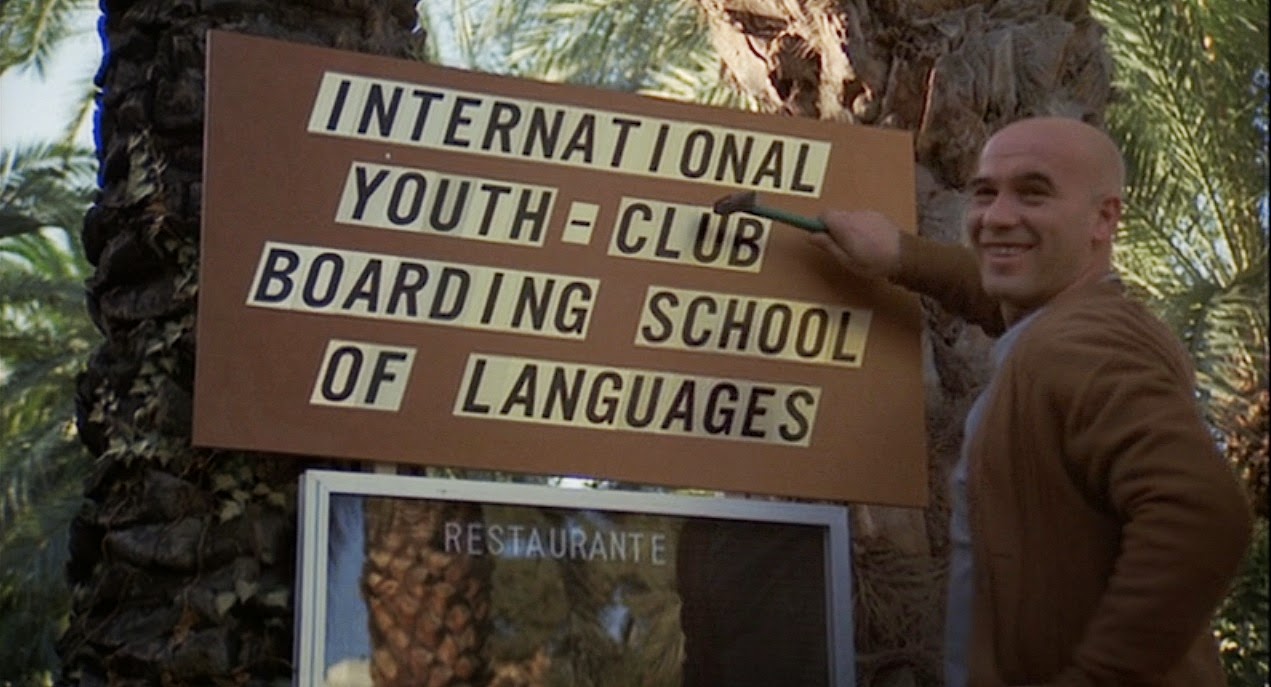
* The shadiest and most incompetently managed Spanish language summer school in the known world. (“International Youth-Club Boarding School of Languages” reads a sign spelled out in those slanted, adhesive letters that are usually used for putting house/room numbers on front doors.)

* Teen pool party opening sequence incorporating hand-held ‘killer POV’ shots and mildly ‘transgressive’ usage of a Mickey Mouse mask.

* A bold wardrobe of ‘80s casual attire that actually seems pretty spot-on in its circa-’81 anticipation of the more garish trends of the coming decade.

* A generous scattering of conveniently placed gardening tools and industrial wood-cutting equipment.

* Lumbering, mute gardener guy as obvious red herring.

* A succession of neatly cling-filmed corpses deposited in and mysteriously removed from closets for maximum jack-in-the-box scare / ‘huh-it’s-gone-am-I-going-crazy’ effect.

* Sinister introverted brother who has been released from mental institution, but clearly shouldn’t have been because he’s crazy and murderous. I mean, just look at him - he has a scar on his face and silently stares at stuff. Nuts, I tell you.

* An excruciating American-English dub track that seems designed specifically to make every female character sound like a congenital moron, and every male sound like a sleaze-dripping closet psychopath. (And to make us laugh like a drain whenever an underpaid voice artiste sighs and gives her best shot to a line like “I bet he’s never even made it with a girl, the phony Spanish lover!”)
His pride wounded by all this unfamiliar transatlantic hoo-hah, Franco responded in kind:
* Wobbly tracking shots across picturesque Spanish harbours, culminating in a focus pull on that big goddamn rock he seems to like so much.
* Exactly the same Costa Blanca shooting locations seen fifteen years earlier in Attack of the Robots.
* An actress who looks a lot like the regrettably absent Lina Romay moping seductively in the upstairs window of a Spanish hacienda in a transparent night-dress, contemplating mischief. (The very same window used to frame Françoise Brion in ‘..Robots’, if anyone’s taking notes.)
* Wobbly, focus-blurring zoom shots of the moon, because, y’know – moon.
* A soundtrack that sounds as if the employees of a German library music label began pulling all-nighters and experimenting with Gysin/Burroughs cut-up technique.
* Language school proprietor who struts into the student “Disco Club” in a white suit & black shirt combo, momentarily looking like some decadent, DeSadean strip-club overlord.(2)
* Gore effects so audaciously shoddy they practically break the fourth wall and engage you in discussion re: the persistence of notions of theatricality and disbelief suspension in genre cinema
* Uncomfortable (and illogical) incest-based sub-plot.
* Persistent, low level evocation of that particular atmosphere of intangible, woozy dementia found in only the finest deep cuts of European trash-horror.
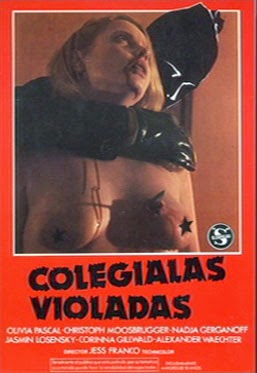
And so, battle commenced, in a conflict that will be known forever as ‘Bloody Moon’. Unless you live in Germany - then it's ‘Die Säge des Todes’ (“The Saw of Death”). Or Spain, in which case it’s ‘Colegialas Violadas’ (“Violated School Girls”). In Denmark, it was ‘Sexmord på Pigeskolen’ (“Sex-Death at the Girls’ School”?). Argentina went with ‘Terror y Muerte en la Universidad’. But no matter - to the likes of us, ‘Bloody Moon’ it is.

Legend has it that ‘Bloody Moon’s producers, keen for some reason to recruit the commercially washed up director of ‘Hellhole Women’ and ‘El Sexo esta Loco’ to their slasher dream project, lured Jess Franco on board by promising him the chance to work with up-and-coming German sexploitation star Olivia Pascal, the services of “one of the best effects guys in Hollywood”, and an original score by Pink Floyd.

Pascal materialised. The ‘Floyd did not. Effects ended up being masterminded by some guy Franco knew who handled props and owned a polystyrene head. A bit of a bummer for our long-suffering auteur, we might suppose, but seasoned Francohiles will well know that when the chips are down on a production, that’s often when the magic happens. Often, but not always. Sometimes ‘Oasis of the Zombies’ happens, but we’ve just got to cross our fingers and pray.

In the highly enjoyable interview included on Synapse’s recent blu-ray edition of ‘Bloody Moon’ (from which the screen-grabs above are definitely NOT taken), Franco speaks at length about his dislike for the film’s German composer, whom he angrily accuses of providing “fucking Dutch music”, whatever that’s supposed to mean. Hopefully we can assume that, rather than dismissing the entire cultural output of The Netherlands here, Jess is here referring to some particular form of film music popular at the time, or something like that? I’ve got no idea what he means to be honest, but regardless - if this German cat was bringing it, and Franco wasn’t digging it, my instinct is to go with Jess on this one. (Because if there’s one thing I’ve learned from the frankly unhealthy amount of time I’ve spent watching his work, it’s that JF knows a good tune when he hears one.)

Ever willing to take a deep breath and give it his best shot, Franco took up the bat and got swinging, digging into his own archive of surplus musical bits and bobs and applying a bit of the ol’ cut n’ paste to Gerhard Heinz’ credited score, with reliably off-kilter results. (The extraordinarily odd, squelchy cue that serves to weirdify the otherwise wholly routine “killer POV ascending the stairs” shot early in the film is my personal favourite moment in this regard.) 

It is easy to assume that Franco applied a similar ‘make do & mend’ spirit to all aspects of this ill-starred shoot too, his veteran’s determination to make the best of a bad job for once triumphing over the opposite tendency toward cack-handed laziness that more frequently shone through in his early ‘80s work-for-hire gigs. Despite all the initial signs of hostility between ‘Bloody Moon’s oil & water components, such inspiring leadership seems to have led to both parties in the dispute realising that they had more in common than they initially thought (after all, what was Franco’s earlier ‘Exorcism’ (1974) if not a peculiarly twisted entry in the pre-‘Halloween’ proto-slasher canon?), allowing the project’s conflicting aesthetics to blend and interact in strange and wonderful ways.

For me you see, the thing about slasher films is that their inherently minimal and repetitive format demands that, to become enjoyable for those of us who have no particular love for the genre, they must be… what’s the right word? Eccentric – that’ll do. To generate interest, a slasher must either a) be a technically excellent and emotionally involving motion picture ('Black Christmas' or Tony Williams' 'Next of Kin' spring to mind), or b), plug the gaps between dead teens with the most off-beat, aimless and just plain weird diversions that come to hand. And, given that so many products of the sub-genre’s early ‘80s golden age were cheap, amateurish films made by otherly inspired individuals for purely opportunistic reasons, many of them thankfully embark upon route b) with a great deal of gusto.

‘Bloody Moon’s Spanish-pretending-to-be-American compatriot ‘Pieces’ is perhaps the preeminent example of how things right, by which I mean wrong, by which I mean just sort of strange and confused, in this regard. The Australian-pretending-to-be-American ‘Strange Behaviour’ aka ‘Dead Kids’ is another good one, as is the genuinely-American-though-presumably-beamed-in-from-another-dimension ‘Hack O Lantern’. You can pencil in your own additions to the list, I’m sure. If not, the archives of Bleeding Skull should provide a lifetime's worth of pointers.To recap then: routine, competently made slasher = BORING. Eccentric, amateurish slasher = GOOD TIMES.

During Bloody Moon’s opening half hour, there were some shaky moments where I was worried things were heading in the former direction. The vacant, empty-eyed teens and tedious two-shot conversation scenes. The duh-brained “homages” to ‘Halloween’ and ‘Psycho’. The over-before-its-even-begun un-plotline. The surprisingly good but never quite exceptional cinematography. The presence of this so-called Nadja Gerganoff (in her only screen role) occupying the ‘slutty older sister’ role that should so rightfully belong to Lina. 

But I should have had faith. By the time a detailed discussion takes place regarding the most appropriate sweater to wear on a midnight fishing expedition with some lusty sailors, I was getting into the swing of things. After a perfectly cube-shaped polystyrene boulder narrowly misses our heroine's head, I had that nice “literally anything could happen next” buzz going on. As things stumble toward a climax, the pace quickens, slightly. Events get wilder, editing choppier, framing wonkier and music more unhinged. By the time Lina’s stand-in artlessly slices a guy in half with a chainsaw, I was ready to stand up, weeping with joy, and thank God for bringing all these people together for a few weeks on the sultry Spanish coast.

As far as the – ahem – serious consideration of Jess Franco’s cinematic legacy goes, few would seek to place ‘Bloody Moon’ on the same level as his more accomplished and personal work from the ‘60s and ‘70s. But as a Halloween-adjacent Friday night beer & pizza movie, it delivers beautifully, in ways that a non-Franco directed cynical cash-in slasher would likely never have achieved.

So, to return to where we began. It is 1981. The ‘80s American Slasher Film and the world of Jess Franco face each other across that dark alley near Alicante. Silence reigns. After a few minutes of whsipered discussion, they decide to cancel hostilities and made sweet love instead. The result? WE ALL WIN.

------------

Kink: 3/5
Creepitude: 3/5
Pulp Thrills: 4/5
Altered States: 2/5
Sight Seeing: 3/5

------------


(1) ‘Bloody Moon’s main production heavy-weight Wolf C. Hartwig was the man behind the interminable “Schoolgirl Report” series that pretty much defined the aesthetic of cheapo German sexploitation in the ‘70s (and of which Franco directed one of the stranger installments). Hartwig’s hefty catalogue of cinematic tat actually stretches as far back as 1959’s ‘Horrors of Spider Island’, and in 1977 he seemingly tried to re-balance the scales by taking the sole producer credit on Sam Peckinpah’s ‘Cross of Iron’, the same year he also handled ‘When Girls Make Love’ and ‘Confessions of a Naked Virgin’. I’ve not read up on the working relationship between Hartwig and Peckinpah, but one suspects they might not have seen eye to eye.

(2) The “Disco Club” also serves litre bottles of beer to students as a takeaway, plays lumpen, Shawaddywaddy style retro-kitsch rock n’ roll and allows entry to passing sailors (rollerskates optional). My kinda language school, as if we hadn’t established that much already.

Saturday, 21 June 2014

Nippon Horrors:
The Bloodthirsty Roses /
‘Evil of Dracula’
(Michio Yamamoto, 1974)


Having reviewed the first two installments in Michio Yamamoto’s trilogy of Japanese vampire movies, I feel duty-bound to take a crack at the final film, although to be honest I don’t have a great deal to say about 1974’s Chi O-Suu Bara (rough translation: ‘The Bloodthirsty Roses’), which reached American shores under the fittingly generic title ‘Evil of Dracula’.

Whereas the first of Yamamoto’s films was creepy and touched interestingly upon past and future J-horror tropes, and the second one had a memorably hypnotic and dream-like feel to it, ‘Roses..’/’Evil..’ offers no such points of interest, instead telling a by-the-book vampire story in a wholly predictable fashion, as if deliberately trying not to draw too much attention to itself amid the avalanche of Western gothic horror product that was finally spluttering to a halt around the time of its release.

The set up – in which a handsome young teacher (Toshio Kurosawa) travels to ‘the remote North’ to take up a post in an isolated private school – begins with yet another reiteration of the “Harker arrives at Castle Dracula” opening, as filtered through Universal, Hammer and innumerable parodies/imitations thereof. Thus the teacher arrives in an otherwise deserted Western-style cobwebbed mansion, and is greeted by Shin Kishida, playing the reclusive, daylight-shunning principal (GUESS WHO?). After this, the Girls’ School setting shifts things more toward a pattern reminiscent of Hammer’s ‘Lust for a Vampire’, released a year or two earlier, whilst some business with white roses turning red as the vampires feed seems to reflect the influence of Roger Vadim’s ‘Blood & Roses’ (1960).

Although the summer holidays begin shortly after the teacher’s arrival, a bunch of pupils continue to hang around on the slightly flimsy pretext that one of their fellows is bed-ridden with a mysterious ailment (GUESS WHAT?), and they have stayed on to keep her company. Thereafter, things proceed like clockwork. Some of the girls get bitten, some don’t. None of them have any personality or defining attributes, so it doesn’t really matter either way. Teacher meets a friendly doctor who clues him in on the ways of the supernatural, then ums and ahhs for about forty minutes of screen time before eventually venturing into the crypt to stake the undead fiend and his bride…. and that’s about it, plot-wise.

It is ironic that ‘Evil..’ should take its cue from ‘Lust For a Vampire’, as, in stark contrast to that film, Yamamoto maintains a grimly serious tone throughout, completely refusing to give in to the kind of humour and sex appeal that added a spark to many an uninspired vampire movie in the early ‘70s. Whilst few would want a Japanese remake of the fairly woeful ‘Lust..’ (though ask me again after a few beers and I might change my mind), the opposite approach taken here proves just as unsatisfactory, and, lacking as it is in the kind of dramatic engagement that would justify such dour solemnity, the film swiftly drifts toward tedium.

In keeping with Yamamoto’s earlier horror films, there is almost no reference to Japanese culture here at all, and the notion of a European gothic horror story taking place in the mountains of Hokkaido (or wherever), complete with genre-appropriate clothes, architecture, food and so on, seems more ridiculous than ever. Perhaps looking to offset this incongruity, the film’s sole concession to originality comes via its explanation of how vampirism came to Japan in the first place. Naturally enough, it seems it grew from a foreign / Christian source, an idea that was touched upon in ‘Lake..’. Thus a legend is recounted explaining how a European shipwrecked in Japan during the 17th century was tortured by the Shogunate until he rejected his Christian fatih and spat upon the cross, thus damning himself and apparently succumbing to vampirism.

“The white man lost his god and went mad,” the exposition-spouting doctor succinctly observes, before a drained colour flashback shows us this biblical-looking pilgrim fleeing across a conveniently placed desert, as he develops a taste for blood and vampirises a young girl, thus establishing the lineage of which our present-day Principal Dracula is a direct descendent.

Unfortunately, Kishida, who was pretty cool as Dracula in ‘Lake..’, seems a bit under the weather here, and, whilst he looks the part, his screams and growls (a highlight of the earlier film) are slightly lacking in conviction. A shame. A moody, Baudelaire-quoting teacher in the film’s Renfield role briefly adds a touch of interest, but he soon wanders out of the story for some reason, and with the rest of the cast too bland to carry a plywood coffin, let alone a movie, there is little left after the aforementioned flashback to hold our interest on the human side.

Generic as it is though, ‘Evil..’ is at least quite stylishly executed, suggesting that Yamamoto’s technical chops as a director have grown a little in the three years since ‘Lake..’, even as his apparent disinterest in narrative momentum has remained a constant. The sets from the previous movies have been scrubbed up and rebuilt a little, looking a bit grander as a result, and, more noticeably, the mountain setting allows for some very fetching rural location photography that helps create some richly atmospheric moments; a couple of spooky woodland scenes with fog rolling in off the lake prove particular highlights.

Vampire stalk/attack sequences are both more frequent and more skilfully realised than in the earlier films, with Yamamoto’s penchant for slow-moving, dead-eyed, marble-skinned vampire girls very much coming to the fore, and there are a few fairly gory moments to enjoy. Within the walls of the school, there are some good corridor walks and prototype jump-scares, and the special effects used for the final vamp disintegration scene (yes, another one) are quite impressive.

Riichirô Manabe’s score is excellent too, probably my favourite thing about this movie in fact, and definitely the best work Manabe did on this trilogy, with ‘Bitches Brew’-esque jazz squiggles accompanying the opening train station sequences, and waves of dissonant electronics, tremoloed synth pulses and distorted wah-wah guitar later doing a great deal to liven up the vampire sequences. Really great stuff.

But again – despite a higher quantity of vampire business realised with a greater degree of cinematic skill, there is nothing here that will make much of an impression on anyone who has seen more than a handful of Western vampire films, with no imagery that lingers in the mind after viewing and little to save us from mere clock-watching as Yamamoto’s characteristically sluggish pacing becomes increasingly trying through the long trudge of the middle half hour.

I don’t want to rag on ‘Evil..’ too hard, because as noted, it’s a reasonably well made and atmospheric gothic horror film with some effective moments. So instead, let’s just sum up by saying that there is absolutely nothing here to make horror fans jump out of their seats to track down a copy, but, if you’ve got the candles lit and the curtains flapping one dark night, and feel the need for a wholly conventional, soporifically paced vampire film with a certain amount of style, Yamamoto’s got your number.