Showing posts with label Kenji Misumi. Show all posts
Friday, 27 March 2015
This Month’s Zatoichi:
Zatoichi & The Chess Expert
(Kenji Misumi, 1965)
Zatoichi & The Chess Expert
(Kenji Misumi, 1965)
Kenji Misumi’s third film in the Zatoichi series – known as ‘Zatoichi Jigoku Taki’ (‘Zatoichi’s Trip to Hell’) to Japanese viewers, despite nothing much more hellish than usual transpiring within – seems to me to be going a bit ‘meta’ on us, as Daisuke Itô’s screenplay reprises the central themes and relationships from the director’s two (excellent) earlier films, but twists them in unexpectedly cynical and downbeat directions.
Thinking about it, maybe this dashing of our hero’s hopes is what constitutes the ‘hell’ of the Japanese title, but then that's never a point the film really makes with a great force, so maybe I’m giving whoever decided on the film's title too much credit. As far as the anglophone title goes, there is indeed a chess expert, so no additional pondering required on that score.
Just as in Misumi’s Tale of Zatoichi, Ichi here strikes up a rapport with a jaded lone wolf samurai (Mikio Narita, later a regular in ‘70s Toei yakuza flicks), and their blossoming friendship, based on a shared passion for Japanese shogi chess, is presented as a dignified match of noble equals, framed in stark contrast to the undifferentiated mobs of squabbling, swinish goons who intermittently harass them. Meanwhile, a parallel storyline sees Ichi forming an accidental relationship with a nomadic woman of questionable character (Kaneko Iwasaki), with whom he shares a duty of care for an adorable child (in this case a little girl who becomes infected with tetanus after being injured in a scuffle), in a near exact reprise of the previous year’s Fight, Zatoichi, Fight!.
In contrast to the tragic humanism with which both of these storylines played out in their original incarnations however, things here are rather less clear-cut, leaving sentimental old Ichi to deal with the fact that, however much he might want to recapture the warmth he felt for his departed friends in the earlier films, neither of his new companions are quite as principled or benevolent as they initially appear.
In theory, the idea of these heady themes of betrayal, disappointment and nostalgia intersecting with the kind of deft human drama that Misumi proved himself such a master of in his earlier efforts should make for extremely engaging viewing…. which leaves me at a bit of loss when it comes to explaining why ‘Zatoichi & The Chess Expert’ didn’t really work for me at all on first viewing.
Chris D, writing in his monumental Gun & Sword: An Encyclopedia of Japanese Gangster Films, describes ‘..Chess Expert’ as the moment at which “..the series finally gets great again”, praising not only Misumi’s direction, but also Narita’s performance and “master” Itô’s script, neither of which impressed me overmuch, I’m sorry to say. Thus far, Chris’s capsule reviews of each Zatoichi installment have seemed pretty spot-on, largely chiming with my own impressions of the films, so this sudden disparity has caused me to stop for a bit of reflection before banging out the fairly negative review I had initially planned for ‘..Chess Expert’.
You know that uncomfortable feeling when you walk away from a movie screening feeling fairly dismissive of what you’ve just seen, but the contrasting voices of trusted sources who seem to have got a great deal out of the experience cause you to stop and think… maybe I was just coming at that one from the wrong angle..? Maybe it just went over my head a little as I sat there primed for something a bit different..? Well, needless to say, ‘Zatoichi & The Chess Expert’ ain’t exactly ‘Last Year at Marianbad’, but nonetheless, I’ve got a feeling it might fall into this category for me on this occasion.
I WAS pretty tired when I watched it, fighting the slow drift towards sleep for much of the run time, so perhaps the blunt and relatively light-hearted storytelling of the last few Zatoichi installments had me calibrated for something a little different from the fairly dour approach taken here. Perhaps.
Certainly, Misumi’s direction is characteristically assured, with action set-pieces, tense stand-offs and dramatic interplay all a definite cut above those seen elsewhere in the series, but I confess, the screenplay lost me pretty early on, and I found myself struggling to regain interest in proceedings, as the various characters continue to idly hang around the film’s onsen location to no very fixed purpose, whilst the who, how and whys of the various groups of waddling thugs and low level bosses half-heartedly pursuing them never quite coalesced into anything very clear or compelling. There seemed to be a bit of a dreary, low energy kind of feel throughout, with many of the usual visual gags and set pieces that Zatoichi films use to draw us into the action falling a bit flat, and the story ends, once again, with a resigned, “is that it?” kind of a shrug.
To give the filmmakers the benefit of the doubt, perhaps this lethargy is the result of a deliberate attempt on to series away from formulaic genre melodrama and inject a certain amount of grumpy realism into proceedings. Indeed, one interesting aspect of ‘..Chess Expert’ is the greater emphasis it places upon the problems Ichi faces on account of his blindness. Of recent, our hero has proved so adept at negotiating the world around him that his disability almost seems to give him an advantage over his sighted antagonists, but here Ichi experiences a number of awkward and frustrating moments, whether bumping his head on pillars or scrabbling around on the floor for important objects, and even a few of his patented gambling tricks end up back-firing on him.
Perhaps Misumi and Itô were simply getting a bit sick of the quasi-superhuman feats that have increasingly become part of Ichi’s character, and were just trying to bring him back down to earth a bit. Whilst in retrospect I can appreciate this approach as a refreshing change and corrective, for this tired viewer who quite enjoyed the aforementioned superhuman feats, it’s nonetheless a bit of a bummer to see our hero moping around in a relatively powerless position. And, crucially, rather than replacing Ichi’s usual antics with something more interesting (as ‘Fight, Zatoichi Fight!’ managed so marvelously), the filmmakers instead seem content to follow the familiar patterns of the series, but just do everything kinda… half-heartedly?
For the moment then, I’ll reserve judgment on this one. There ARE some excellent moments here that even my sleep-deprived brain could appreciate – Ichi’s nocturnal confrontation with a gang of swordsmen amid the reeds of a muddy river would be a shoe-in for any showreel of the series’ best fight scenes, and the way the tension between Katsu and Narita is handled in the second half of the film, with each master swordsman awaiting the first sign that the other might be about to ‘draw’ whilst continuing to assume the mask of friendship, is really terrific.
But by and large… I dunno. The movie just never quite came together into anything that really grabbed me, and, just as in the previous installment, talent both behind and in front of the camera seemed wasted, with no one really sure where they were heading with this whole thing.
Perhaps then, '..Chess Expert' really is just a muddled and mediocre addition to a series whose QC standards are looking increasingly shaky by this point. Or perhaps, with Chris D’s words still echoing in my mind, I’ve got to consider the possibility that whilst I was struggling to keep my eyes open wondering who the hell these guys Ichi was fighting were again and what plot point all those meaningful close-ups of a fish-hook were meant to signify, there was actually a great wealth of dramatic nuance and subtle detail bubbling just below the surface, waiting to impress the more perceptive viewer.
Sadly, repeat viewings of any film are a bit of luxury for me at the moment, so oh well – c’est la vie. Instead, we’ll be hoping for the best as we plough straight ahead into ‘Zatoichi’s Vengeance’ (not to be confused with Zatoichi’s Revenge), which hit screens in Japan in May 1966. See you then!
Labels:
1960s,
Daiei,
film,
Japan,
Kenji Misumi,
Mikio Narita,
movie reviews,
samurai,
Shintaro Katsu,
yakuza,
Zatoichi
Sunday, 19 October 2014
This Month’s Second Zatoichi:
Fight, Zatoichi, Fight!
(Kenji Misumi, 1964)
Fight, Zatoichi, Fight!
(Kenji Misumi, 1964)
When Zatoichi surrenders his ride in a palanquin chair to a young mother struggling with her newborn baby, a tragic misunderstanding sees the poor woman falling victim to the blades of a pack of heartless, Ichi-hunting samurai. Feeling responsible for her death, Ichi takes on the responsibility of looking after her child, vowing to return him safely to his father in a distant village, hooking up with a troubled female thief (Hizuru Takachiho) en route for a journey that proves more cathartic than our hero might have anticipated
Returning to the Zatoichi franchise for the first time since he helped to create the character in 1962’s Tale of Zatoichi, director Kenji Misumi here continues to contemplate the same weighty themes that anchored that film, turning in perhaps the most accomplished, grown up and emotionally affecting Zatoichi film to date.
In contrast to its excitable English title, this is, it must be said, a very uncharacteristic Zatoichi film - one in which the fight scenes and sword-skill set-pieces (frequent and impressive though they are) are largely incidental, taking a clear second place to the more compelling human drama being enacted between Zatoichi, Takachiho, and the ill-starred baby they both find themselves looking after.
Whereas this potentially unpromising “three yakuza and a baby” plotline could easily have devolved into sappy, comic relief-ridden nonsense in the hands of a lesser director (or a lesser star), Misumi’s cast-iron understanding of human empathy and his eye for simple, effective visual storytelling steer us true throughout.
Cinematically speaking, there are moments of pure poetry to be found here – slow, meditative tableaus that serve to calm and contextualise the more turbulent passions of the characters, an approach very much in keeping with the unique atmosphere Misumi created in ‘Tale..’.
Also reminiscent of that earlier film is Misumi’s clear establishment of a ‘two tier’ system of human relationships within the film, which sees Ichi and the broadly admirable characters with whom he interacts existing on an entirely different plain from the beastly, avaricious yakuza and their associates, who are portrayed as not just irredeemable but practically sub-human in their unthinking cruelty. An absurdly simplistic duality of course, and one that fails to acknowledge the shades of grey necessary for any decent story of crime or conflict. But, this is a different kind of story, and as an evocation of the “uncaring world” in which lonely characters like Zatoichi tend to find themselves lost, it is a backdrop that works very well.
I don’t want to go overboard with the auteurist gushing here, but the two Misumi-directed Zatoichi films I’ve watched thus far strike me as presenting a very pure and honest form of cinema that immediately sets them apart from the era’s other chanbara films. Doing his best to avoid both exploitation movie box-ticking and the equally manipulative pretentions of art cinema, Misumi emerges instead with something that just seems, I dunno… basic, and good, like a nice loaf of bread. A film that rings true.
Though I have extensively sung the praises of Shintaro Katsu in prior Zatoichi reviews, you’d better get used to it I’m afraid, because in every film I see him in (whether Zatoichi or his other appearances), he impresses me even more, adding new notches and nuances to his characters at every turn, without ever succumbing to contrivance or showiness. In particular, the more personal nature of the story this time around gives him a bit of a challenge to get stuck into, and, never an actor content to merely coast by on his pre-existing star power, he gives it his absolute all.
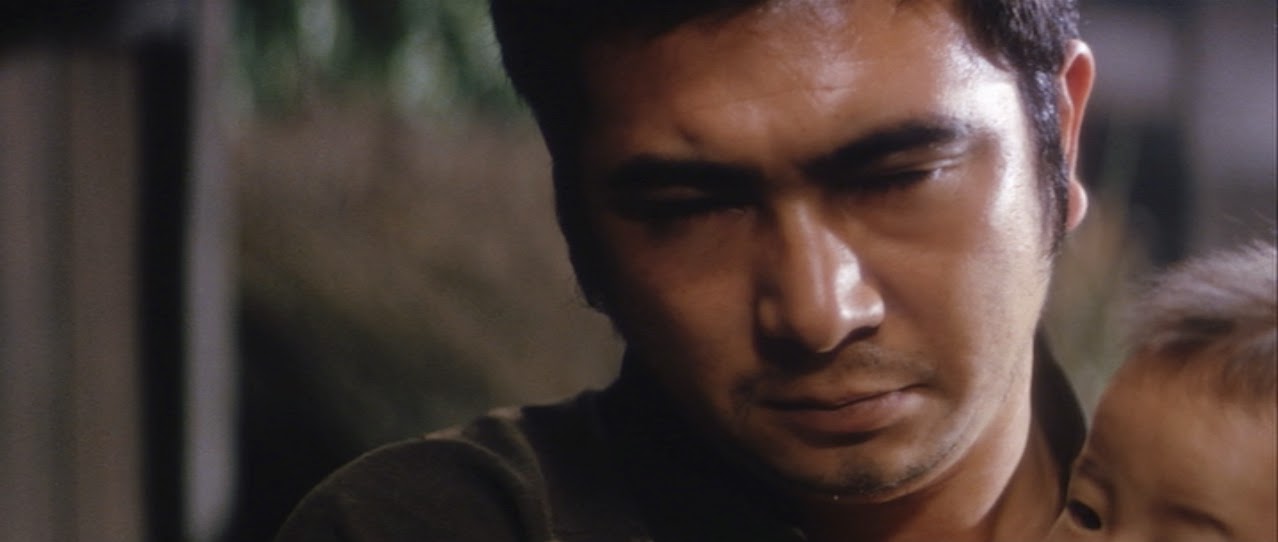
The strange, stumbling care Ichi takes with the baby, and his growing love for the child, is brilliantly portrayed by Katsu, without a hint of the mawkishness that usually accompanies such material, as the gentle (but, you will note, also actually funny) humour generated by his attempts to look after the baby (stealing clothes from scarecrows to act as diapers, etc) gradually develop into a deep and genuine warmth as we see realize the extent to which Ichi cares for his surrogate son. (Rather than being bluntly hammered home to us as per a modern Hollywood-style flick, this point is succinctly made via scenes such as the one in which Ichi hires a prostitute to take care of the baby for the night whilst he catches up on sleep next to her, but then frets so much about his ‘son’s wellbeing that he ends up staying awake whilst the lady-of-the-night dozes.)
As a consequence, the gloom that overtakes Zatoichi and his female companion when they finally reach the child’s father’s village and realise they must soon give up ‘their’ son and return to their respective lives of itinerant loneliness is palpable, and the scene in which Ichi says his private farewells to the baby prior to setting out to return him to his family is absolutely heartbreaking.
Of course, being a Zatoichi film, things don't work out quite that simply, especially after the baby’s father is revealed to be another yakuza scumbag. But still, the old weight of Ichi’s lonely destiny raises its head once more, as the impossibility of his raising a child as a blind fugitive constantly pursued by rampaging swordsmen eventually becomes clear to him, and he must do the decent thing, just as he had to accept the impossibility of his settling down to married life with gentle Otane in ‘Tale..’.
When Ichi eventually leaves the child in the care of the local priest, and makes his weary exit into the sunset, carrying the baby’s favourite plaything for a memento as he walks away, I think it’s safe to assume there wasn’t a dry eye in the house at this film’s original screenings (there certainly wasn’t in our house, I can tell you that). Transcending the usual clichés of genre melodrama and appealing to something deeper within all of us, it is just crushingly sad moment.
A real change of pace for the Zatoichi saga, and, I suppose you might say, an unexpected gem of low-key human drama hidden within the shell of a bodycount-heavy action flick, ‘Fight, Zatoichi, Fight’ (the interchangeable English title seeming more inappropriate than ever in this instance) is simply a great movie about people and the way they feel about stuff whilst living in the world, with no caveats or genre-specific schematics needed.
My admiration for Misumi, for Katsu, and for this wonderful series in general grows even stronger as we prepare – presumably – to step back onto the action/adventure treadmill when Zatoichi On The Road director Kimiyoshi Yasuda takes the reins for the final Zatoichi film of 1964, ‘Adventures of Zatoichi’, which hit screens in Daiei’s Tokyo cinemas on 30th December that year.
Labels:
1960s,
Daiei,
film,
Japan,
Kenji Misumi,
movie reviews,
samurai,
Shintaro Katsu,
yakuza,
Zatoichi
Thursday, 6 February 2014
This Month’s Zatoichi:
Tale of Zatoichi
(Kenji Misumi, 1962)
Tale of Zatoichi
(Kenji Misumi, 1962)
Like many other lucky boys of a movie nerd type persuasion I assume, I was overjoyed to find Criterion’s massive Zatoichi Box Set waiting under the Christmas tree back in December. And so, with something like 40 combined hours of blind swordman type action awaiting my attention, the least I can do to make such a grand investment worthwhile is to flex my (metaphorical) muscles and give the world a film-by-film run-down of this epic pop-cinema saga. I first considered doing an update weekly, but, given the obvious limitations of my usual viewing / writing timeline, I thought that seemed a bit too ambitious, so a monthly post it is. If I stick to schedule, we should finish up some time around March 2016. Here goes…
The character of Zatoichi – a blind masseur of low social standing who achieved legendary status in the yakuza underworld of late Edo period Japan through his super-human skill as a swordsman – was initially sketched out by author Kan Shimozawa in a short story, dryly narrated in the manner of a historical chronicle, and first published in 1949.
When Daiei studios optioned the story for a film, assigning screenwriter Minoru Inuzuka and veteran director Kenji Misumi(1) to develop the property and casting regular contract player Shintaro Katsu in the title role, it is safe to say they had no inkling of the extent to which this character (and more specifically, Katsu’s personification of him) would strike a chord with viewers, turning Zatoichi into a bone fide pop culture folk hero who proceeded to bestride the big screen for a further fourteen years and twenty five films, before extending his adventures even further following a move to TV in the mid ‘70s. (Inevitably, the character has enjoyed intermittent spin-offs and revivals ever since, including Takeshi Kitano’s divisive reinvention of the franchise in 2003. He was last seen on-screen in 2010, in the reportedly disappointing ‘Zatoichi: The Last’, directed by Junji Sakamoto.)
Here is where it all began though, in a medium-budgeted period action programmer that initially seems very much influenced by Akira Kurosawa’s game-changing ‘Yojimbo’ (released the previous year), boasting a very similar plot set-up, in which an itinerant outsider of uncanny martial skill wanders into a rural area blighted by the conflict between two rival yakuza clans. Although Katsu’s Ichi quickly establishes himself as a more even-tempered and generally likeable protagonist than Toshirô Mifune’s gruff Sanjuro, the motivations of both films’ protagonists remain similarly opaque, with their acquisitive pursuit of money in both cases appearing to be a mere front for some unspoken moral imperative.
Unlike ‘Yojimbo’ though, ‘Tale of Zatoichi’ is content to function merely as a reassuring popular entertainment, rather than as a self-aware, apple-cart upsetting critique of the form. The film’s opening scenes – full of blossoming trees, bountiful harvests and honest rural craftsmanship - create an intoxicatingly bucolic picture of feudal Japan that could scarcely be more different from the mud-choked hellhole of Kurosawa’s vision, and ‘Yojimbo’s bitter cynicism is in turn replaced here with the framework of a well-crafted genre potboiler – low on dirt and realism, even as its unconventional hero, whose very existence seems to stand in opposition to the authority invested in the Japanese caste system, seems to come straight from the more critical era that Kurosawa’s work helped usher in.
In many ways in fact, ‘Tale of Zatoichi’ could almost be mistaken for one of the overly romantic, conformist period movies that Kurosawa conceived ‘Yojimbo’ as an enraged response to. But, crucially, it can’t quite be dismissed so easily. Kurosawa, as I understand it, was angered by the tendency of such films to irresponsibly glamourise the lifestyle of the 19th century yakuza, even as their modern day equivalents were busy wreaking havoc on the moral & social underpinnings of post-war Japanese society.(2) Whatever else you may say about it, that is certainly not a charge that could be levelled at ‘Tale of Zatoichi’.
In fact, the portrayal of the yakuza here is entirely in accord with that seen in ‘Yojimbo’, as both films present the prototype gangsters as deceitful, ugly, near sub-human figures, worthy of nothing but contempt as they exhibit constant stupidity and cruelty, basically carrying on like Orcs in a fantasy movie.
The difference though is that, whilst ‘Yojimbo’ often seems like a work of pure misanthropy, the strict good / evil dynamics of the formula world in which ‘Zatoichi’ takes place calls for a more balanced approach - a requirement the film deals with by establishing a clear ‘two tier’ system within the film’s cast, as characters are strictly divided between cowardly, self-serving blaggards (all of the yakuza), and decent, principled individuals whom Ichi can talk to and feel comfortable around – here represented by the consumptive Edo samurai Hirate (Shigeru Amachi), and Otane (Masayo Banri), the estranged wife & sister of a pair of particularly reprehensible yakuza rotters.(3)
The sharp division between these two ‘levels’ of characters, and the different ways in which Ichi deals with them (threatening and deceiving the yakuza, whilst approaching the ‘decent folk’ with an openness that encourages immediate friendship) actually becomes pretty amusing after a while, and soon causes us to realise that the to-ing and fro-ing between the rival clans (in theory the main dramatic arc of the story) is basically completely irrelevant – an ugly distraction from the more meaningful interactions between Ichi, Hirate and Otane, all of whom conduct themselves with great, tragic elegance, whilst the yakuza fall into the background behind them like squawking, squabbling children.(4)
The inclusion of these more admirable characters – each of them bearing a tale of woe worthy of an enka ballad – may be a clear melodramatic contrivance, but it nonetheless lends ‘Tale of Zatoichi’ a strong humanistic aspect that is decidedly lacking in ‘Yojimbo’s bleak milieu, making Misumi’s film, for my money, a more engaging and sympathetic viewing experience than Kurosawa’s, irrespective of its populist form.
Shintaro Katsu, for his part, adds greatly to the film’s up-with-people atmosphere, appearing to have stepped fully formed into his most famous role, immediately establishing Ichi (the ‘Zato’ part of his name is a prefix establishing the character’s blindness by the way - his name as used in the film is merely Ichi) as an extremely likable and implicitly trustworthy protagonist – the kind of guy you feel could happily steer an audience through twenty five subsequent movies, even if that wasn’t the plan at this early stage.
Katsu’s trump card is a kind of quiet charisma that establishes his authority by means of almost zen-like inaction. Though Ichi occasionally delivers heart-felt speeches outlining his outlook on life (the movie’s original title translates as “The Life and Opinions of Masseur Ichi”), such outbursts can’t help but strike me as slightly out of character, and it will interesting to chart the extent to which these ‘opinions’ continue to be an element of the series as it progresses.
The ‘blind man with preternatural senses’ shtick has of course been done to death, and chances are it was pretty stale even in 1962, but Katsu’s natural charisma helps render it both convincing and charming, as he not only sells us on his Daredevil-meets-Sherlock Holmes level of perceptive intuition, but also somehow succeeds in expressing all of the thoughts & opinions assigned to him by the script solely through his physical presence and body language. A pretty remarkable achievement for a performer who doesn’t even open his eyes until the movie’s last reel, and a quality that weirdly puts me in mind of John Wayne, even if the calming influence of Ichi is the polar opposite of the antagonism generally embodied by The Duke.
Basically, like so many other iconic cinema heroes, I think Ichi works best as a guy who only speaks when he needs to, and who ensures that we remain in awe of his deadly skills by demonstrating them only in the briefest and most concentrated bursts. (For instance, few of the characters here are inclined to mess with him after he demonstrates his ability to slice an air-borne candle in two with such accuracy that both sides continue burning – a good, non-lethal way for him to keep his life sedate for a fairly lengthy chunk of screen-time.)
Such an approach does render the first hour of ‘Tale of Zatoichi’ conspicuously low on action for what is ostensibly an action film, but when Ichi’s first sword battle does eventually occur, his confrontation with two assassins in a darkened forest is such a beautiful and brutal dramatic moment that it scarcely matters – a few seconds of choreographed slaughter that serve to put the preceding fifty minutes of build-up completely out of the mind of any over-anxious action fans in the audience.
In fact, the tone of the whole film seems informed by Ichi’s quiet humour and the contradictions that his way of life represents. Like it’s protagonist, ‘Tale..’ is fast-moving yet calm, funny without being whimsical, emotionally involving but rarely overwrought… and just a lot of fun to watch, basically.
Lent a further touch of class by Chishi Makiura’s often masterful black & white photography, ‘Tale of Zatoichi’ stands as a fine example of the romantic period yakuza film. Above all, it is a movie that is comfortable in its own skin, never seeking to challenge or upturn the conventions of its genre, but nonetheless doing all it can to create an impressive and memorable motion picture within those conventions. Even taken as a stand-alone item rather than as the genesis of long-running series, it is a great little movie, and it’s easy to see why it proved such a phenomenal success with audiences.
-----
(1) Beginning his career as a director in 1956, some of Misumi’s more interesting credits include the kaidan item ‘Ghost Cat: Cursed Wall’ (1958) and four of the six entries in Toho’s famed ‘Lone Wolf & Cub’ series (1972-74). Inuzuka meanwhile has a set of directorial credits stretching back to the silent era, but seems to have largely retired by the time he went to work on Zatoichi. He contributed scripts to a number of subsequent entries in the series, but aside from that has no post-1960 credits on IMDB.
(2) Much can be said about the way that endemic corruption within Japanese institutions allowed the spheres of organised crime and legitimate business to cross over to an alarming and damaging extent in the post-war era. Speaking from a movie fan POV, many of Kinji Fukasaku’s ‘70s yakuza epics examine these issues in a way that Kurosawa might well have appreciated, if he hadn't become so sniffy about the violence & ‘negative influence’ of popular cinema by that point.
(3) Amachi is a familiar face to Japanese movie fans, having punched the clock for more awesome genre movies than we could possibly list here. Banri meanwhile went on to reprise her character in several subsequent ‘Zatoichi’ entries, so we can look forward to seeing more of her in future too.
(4) This demonstration of the futility of inter-gang conflict is of course an element that is carried across into any modern day yakuza movie worth watching (and indeed, any gangster-based crime story worth paying attention to anywhere in the world, more or less), but it is expressed with a particular directness and clarity here.
Labels:
1960s,
Daiei,
film,
Japan,
Kenji Misumi,
movie reviews,
ninkyo,
samurai,
Shigeru Amachi,
Shintaro Katsu,
yakuza,
Zatoichi
Subscribe to:
Comments (Atom)