Showing posts with label Stuart Gordon. Show all posts

Friday, 30 October 2020

Horror Express 2020:
More Short Takes.

Three more shorter-than-usual takes on recently watched Horror films to glide us into the big day itself tomorrow. Including some actual positive comments this time around.

#14 
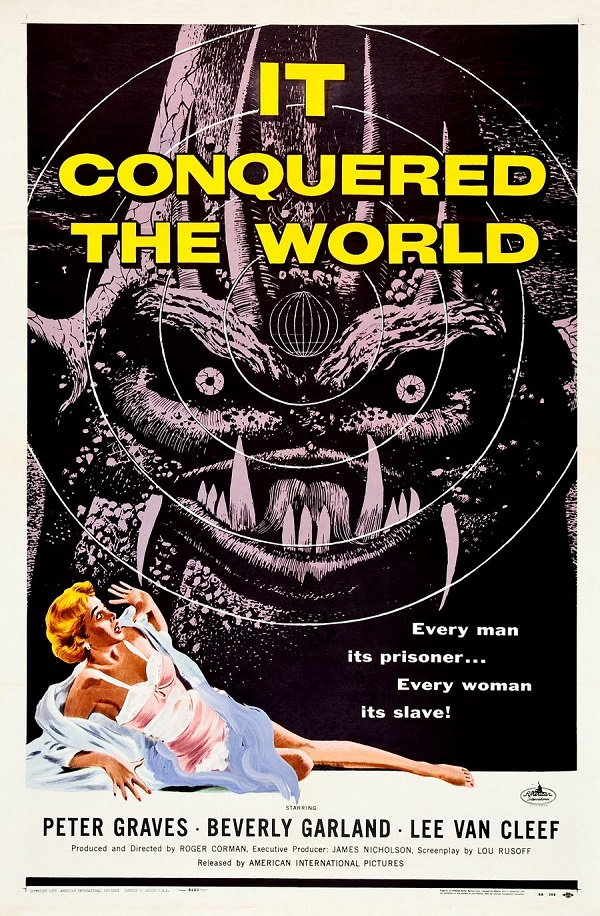
It Conquered the World 
(Roger Corman, 1956)


When AIP released The She-Creature (reviewed earlier this month) in 1956, it formed one half of a double-bill with this rather more widely remembered little number from Roger Corman. Quite a night out, by my estimation. For the sake of random cyclical completeness therefore, I thought I’d dig out ‘It Conquered The World’ and give it a quick going over, having not seen it for many a long year.

During the first half, I was surprised to note such a high incidence of clunky dialogue, painfully bad line-readings and general meandering tedium, which has no doubt done a lot to aid the film’s retrospective status as a more-or-less definitive cheap n’ cheesy b-movie. In view of the fact that the film's principal creatives were all smart and competent people however, I tend to suspect there was a certain amount of sniggering self-awareness creeping in here, which makes me sad.

As cynical as the production circumstances behind Roger Corman's movies may have been, when it comes to his directorial efforts, I've always appreciated his earnest dedication to making a straight-facedly decent movie out of whatever meagre resources were available to him. So, it’s disappointing to imagine him knowingly signing off on a load of sub-par crap at some points on this one, underestimating the intelligence of his audience in precisely the manner he usually so strenuously avoided. Perhaps Lou Rusoff’s script - just as shamelessly barmy as the one he provided for ‘The She-Creature’ - might to some extent be to blame?

Anyway, regardless, there is nonetheless a lot to enjoy here right from the outset. Surely no genre movie fan can fail to be moved by the sight of a (relatively) young Lee Van Cleef firing up his inter-planetary radio-set (hidden behind a curtain in the corner of the living room) to speak to his friend from Venus? 

Appearing just a few years after he played sneering, homosexual hitman Fante in Joseph H. Lewis’s classic ‘The Big Combo’, Van Cleef’s plummy, pointed-finger-aloft delivery of his dialogue here (“listen Paul - listen to the VOICE!”) must have become an acute embarrassment for him as he began settling into his more familiar taciturn cowboy persona over the next decade or so.

Meanwhile of course, the thunderously obvious nature of the obligatory anti-commie sub-text, expressed through Van Cleef’s interplanetary collaboration with a malign being who promises heaven on earth to mankind in exchange for their emotions and individuality, is so clearly comical that I’d like to believe that Corman - not to my knowledge a rabid McCarthyite - very much did have his tongue in his cheek in this regard.

And, once things get going in the second half, ol’ Jolly Roger really gives us our money’s worth. In fact, as soon as the Best Movie Monster Ever (accept no substitutes) shows up, conquering the fuck out of Bronson Canyon (if not quite the world) with his killer grin and adorable, residual-arm-waggling “just frontin’” moves, it’s all gravy for a surprisingly action-packed final act.

First we get the great Beverly Garland blasting away at the bugger with a shotgun (and, how often do we get see the heroine of a ‘50s sci-fi movie sneaking out from under her husband’s nose to give the monster hell, incidentally?), then the Dick Miller Commandos show up with their bazooka, and finally, an enraged Van Cleef getting up close and delivering the foam-melting coup de grace with an f-ing blowtorch, of all things! His final words: “I bid you welcome to this earth... you made it a CHARNEL HOUSE!”

For all the missteps and faffing about in the first half in fact, this is a thing of beauty and a joy forever - god bless you, Mr. Corman. 

 
#15 
Daughter of Darkness 
(Stuart Gordon, 1990)


Nothing to do with Harry Kumel or Delphine Seyrig, this is a made-for-TV vampire movie shot in Romania, directed by the late Stuart Gordon. In view of the info in the preceding sentence, I'd always assumed it must naturally be a Full Moon/Charles Band joint (some kind of spin off from their Eastern European ‘Sub-Species’ films perhaps?), but when I finally sat down to watch it this week, it immediately became clear that we’re dealing with a different kettle of fish entirely.

None of the usual suspects or company logos turned up on the straight-laced opening credits, and once things get underway, the tone is very different from yr usual Empire/Full Moon house style. It’s slicker for one thing, with somewhat higher production values, but also blander and more conventional, as if attempting to appeal to a mainstream TV audience, rather than rabid horror fans.

The plot sees a young American woman (Mia Sara) arriving in Bucharest in search of her long lost father, who turns out to be none other than Anthony Perkins. Along the way, she collides with variety of sinister and/or seductive characters, gets into a few scrapes involving the sinister dragon pendant she inherited from her Dad, has ominous bad dreams in which she traverses areas of the city she has never previously visited, and so on and so forth.

Thanks to Gordon’s brisk pacing and inventive direction, this is all fairly diverting, but unfortunately, once it gets down to brass tacks, vampire stuff in Andrew Laskos’ script is pretty hackneyed, much of the dialogue is fist-in-mouth terrible (the alleged “flirtatious banter” between Sara and U.S. embassy attaché Jack Coleman is especially painful) and the performances (with the exception of Perkins and a couple of the Romanian actors) are extremely poor. This latter point is especially disappointing, given that Gordon's theatrical background and good eye for casting usually helped his films to punch well above their weight in terms of acting and character stuff.

Meanwhile, the obvious requirement to stick to PG-level content also proves a stone drag. Although there are a few potentially memorable horror scenarios, and vampires’ manner of feeding proves a bit of an eye-opener, you can almost feel the director straining at the leash, wishing he could unleash some of the nastiness of his better-known work, but clearly under orders to keep things as mild as possible.

On the other hand though, the film is, as mentioned, very well directed, and the photography (by Romanian DP Iván Márk) is extremely good, making excellent use of the evocative and unusual urban locations. In fact, whereas many American horror films over the years have tried to hide the fact that they were made in Eastern Europe for budgetary reasons, this one makes a real virtue out of being shot under the nose of the Ceaușescu regime, which by my calculations must have been struggling through its final tempestuous final months at around the time ‘Daughter of Darkness’ was filmed.

As such, the film’s evocative and seemingly authentic Bucharest street footage carries an electric and fearful atmosphere, effectively conveying the idea of a city living under a cloud of intrigue and paranoia, and even incorporating a sub-plot about Sara being pursued by the dictator’s secret police.

With a stuttering electricity supply, gun-toting soldiers on every corner, and brief glimpses of breadlines and dishevelled streetwalkers visible as Sara roars through the streets in a broken down taxi, the film suggests an interesting contrast between these symptoms of late 20th century misery, and the older, more dust-shrouded European world represented by the shabby five star hotels, over-priced restaurants and subterranean craft workshops which both she and the vampires are obliged to frequent.

At times, I was even reminded of Zulawski’s use of East Berlin in ‘Possession’ (a comparison further suggested by the fact that this film’s main bad guy, British actor Robert Reynolds, is a dead ringer for a young Sam Neill), but... there the similarities end, unfortunately.

Overall, I’m not sure I’d recommend going to the trouble to track down ‘Daughter of Darkness’ unless you’re a Stuart Gordon completist (or an Anthony Perkins completist?), or unless you have a special interest in films shot in Romania, possibly. But, it is at least a sufficiently respectable effort for me to continue truthfully claiming that I’ve never seen a Gordon film I didn't enjoy. 

 
#16 
Gemini 
(Shinya Tsukamoto, 1999)


To be honest, I've never been much of a fan of director Shinya Tsukamoto, but I am a fan of films based on the writings of Edogawa Rampo, wild gel lighting and buying stuff from Mondo Macabro, so I thought I'd give this one a go.

Results proved…. mixed, shall we say. The basic Rampo-derived story, about a former battlefield surgeon (Masahiro Motoki) being terrorised by his doppelganger, remains very compelling, using an ostensibly simple horror conceit to explore a wide range of uncomfortable thematic territory, touching on the dehumanising effects of war, the collapse of family hierarchies and, most pointedly, the pernicious violence inflicted upon society by the rigid enforcement of socio-economic inequality.

Rest assured however, this is all treated by Tsukamoto more as a visceral, ero-guro tone poem than some high-minded political allegory, as he adapts his jarring, dissociative audio-visual style (often likened to the cinematic equivalent of a tape cut-up or extreme noise record) to the needs of a slightly more refined period setting, delivering some truly shocking and bizarre moments for us to, uh, ‘enjoy’, in the process.

Former pop idol Motoki does fine work too in what is a challenging pair of roles to put it mildly, with his portrayal of the ‘evil twin’ character in particular standing as easily the most unsettling display of skin-crawling evil I’ve encountered during this October season.

In many other respects though, I’m afraid I just didn’t dig the approach Tsukamoto takes to this material. Although there is some beautiful photography in places, the ‘extreme’ colour schemes used through much of the film are achieved through ugly-looking post-production filtering rather than actual, on-set lighting and production design, with the unfortunate effect of making a lot of the footage feel as if it’s been brutalised by the pre-sets on an arty teenager’s iPhone, whilst the director’s fixation with lo-o-ong sequences of people silently maintaining creepy/natural postures or just generally freaking out in front of the camera for minutes on end likewise got on my nerves.

Ultimately, these questionable aesthetic decisions served to distract me from the central narrative (which I was enjoying) to a sometimes catastrophic degree, ultimately making the whole venture feel a bit pretentious and uninvolving.

I’m also not really sure why the occupants of the film’s early 20th century “slums” all needed to be crazy, Noh-dancing neo-primitive cyberpunks, but hey, you hire the guy who made ‘Tetsuo: The Iron Man’, that's what you get I suppose.

Wednesday, 15 July 2020

Lovecraft on Film:
From Beyond

(Stuart Gordon, 1986)


I.

“That Crawford Tillinghast should ever have studied science and philosophy was a mistake. These things should be left to the frigid and impersonal investigator, for they offer two equally tragic alternatives to the man of feeling and action; despair if he fail in his quest, and terrors unutterable and unimaginable if he succeed.”
- H. P. Lovecraft, ‘From Beyond’ (1920)

“It ate him. It bit - off - his - head... like a gingerbread man!”
- Crawford Tillinghast (Jeffrey Combs), ‘From Beyond’ (1986)

After the surprise success of 1985’s ‘Reanimator’, a follow up was inevitable. Rather than embarking upon a direct sequel however (producer Brian Yuzna would later fill that gap in the market), director Stuart Gordon seems to have envisioned a thematically linked series of H.P. Lovecraft adaptations – presumably mirroring the pattern set by the Corman/AIP Poe cycle of the 1960s, which exerted a strong influence on Gordon’s work in the horror genre throughout his career.

Gordon’s initial proposal apparently involved adapting ‘The Shadow Over Innsmouth’ (written 1931, published 1936), one of the most conventionally structured and comparatively action-packed of Lovecraft’s Cthulhu mythos tales, but Empire Pictures boss and executive producer Charles Band put the nix on that idea.

Band was reportedly of the opinion that rampaging fish people wouldn’t make for good box office (whatever could have given him that idea?), but to give him his due, perhaps he was also concerned about the budgetary implications and/or the story’s rather icky racial/miscegenation sub-text. Either way, Gordon had to wait nearly fifteen years to realise his ‘..Innsmouth’ project, completing his quartet of Lovecraft films with ‘Dagon’ in 2001.

Back in the mid ‘80s though, Gordon, Yuzna and screenwriter Dennis Paoli instead went back to the drawing board and worked up a script based upon ‘From Beyond’, a short but perfectly formed Lovecraft tale which comprised part of the author’s first burst of literary creativity at the dawn of the 1920s, although again, it was inexplicably overlooked for publication until 1934, when he deigned to dig it out of his archives for the June issue of a small press publication named ‘The Fantasy Fan’. (1)

Weighing in at barely 3,000 words, ‘From Beyond’ is an important but oft-overlooked entry in Lovecraft’s oeuvre, arguably marking the earliest point at which the morass of imagery and ideas which we’re now inclined the throw together under the umbrella adjective “Lovecraftian” first began to coalesce – and, if you’ll forgive me a brief digression, it is an important story for me personally too.

When I first became aware of Lovecraft’s work as a teenager, some circumstance now lost to history prevented me from getting hold of the essential third volume of the then-standard Grafton / Harper Collins paperback anthology series, which contained the bulk of the core Cthulhu mythos stories. Instead, I had to make do for a while with volume # 2 (‘Dagon and Other Macabre Tales’), largely comprised of the earlier Dunsay/Poe-inspired tales and assorted other odds and ends.

Coming to these tales as a fan of reality-bending science fiction seeking gruesome new thrills, ethereal, pulp-poetic fragments like ‘The Tomb’ and ‘The White Ship’ initially left me rather non-plussed, but ‘From Beyond’ really grabbed me. I recall re-reading it multiple times, thinking, “ok, I get it now – this guy was really on to something”.

The June 1934 edition of ‘The Fantasy Fan’ – see footnote for further info.

Essentially, the story explores the notion that electrical waves keyed to certain frequencies can serve to activate “..unrecognised sense-organs that exist in us as atrophied or rudimentary vestiges”, expanding the range of human perception to allow us a glimpse of parallel layers of being which overlap with our day-to-day reality, causing us to realise that shapeless monsters float through the air around us in an incessant, seething throng. A simple idea, yet such a horribly compelling one.

Prefiguring the ‘multiverse’ theories first proposed by Schrödinger in the 1950s, whilst also touching upon weird, quasi-medieval notions of monads, ‘humours’ and other such unseen guff lurking within the firmament, ‘From Beyond’ finds Lovecraft tapping into the uniquely uncanny eldritch sweet spot midway between science and demonology which would go on to inform all of his best subsequent work.

In fact, ‘From Beyond’s mad scientist character, the splendidly named Crawford Tillinghast, squares that particular magick circle almost immediately, pushing his scientific fervour to the point where it impinges upon the realm of spirituality, as his ranting (which comprises a fairly hefty proportion of the text) begins to echo the kind of rhetoric espoused by advocates of the LSD experience and other such new age psychonauts over forty years later;

“‘Our means of receiving impressions are absurdly few, and our notions of surrounding objects infinitely narrow. We see things only as we are constructed to see them, and can gain no idea of their absolute nature. With five feeble senses we pretend to comprehend the boundlessly complex cosmos, yet other beings with a wider, stronger, or different range of senses might not only see very differently the things we see, but might see and study whole worlds of matter, energy, and life which lie close at hand yet can never be detected with the senses we have.’”

The manner in which Lovecraft manages to pull these high-falutin’ notions back into the horror genre is pretty inspired (“We shall see that at which dogs howl in the dark, and that at which cats prick up their ears after midnight”), and the inevitable revelation that “we are able to be *seen* as well as to see” provides the perfect hook upon which to hang the grisly denouement of this extraordinarily effective little story. (“Remember we’re dealing with a hideous world in which we are practically helpless,” Tillinghast reminds our unnamed narrator. “Keep still!”)


Initially likened to polyps or jellyfish, the “semi-fluid” things glimpsed by our narrator whilst under the influence of Tillinghast’s whirring electrical machine are soon revealed to be merely an appetiser on the story’s full menu of cosmic terrors, as the increasingly hysterical scientist begins to insist that he has “drawn down daemons from the stars”, leaving him hunted by “things that devour and dissolve”;

“‘My pets are not pretty, for they come out of places where aesthetic standards are— very different. Disintegration is quite painless, I assure you—but I want you to see them. I almost saw them, but I knew how to stop. You are not curious? I always knew you were no scientist!’”

Factor into this the story’s rich, Edwardian atmosphere of clanking, electrical machinery powered by “huge chemical batteries”, and the more conventional candle-lit, barely glimpsed horrors of the “..the ancient, lonely house set back from Benevolent Street” in which Tillinghast has been reduced to “..a shivering gargoyle” over the course of ten weeks of solitude, and you’ve got one hell of a potent little pulp yarn here. A pure, concentrated dose of head-fuckery for eager young minds, ‘From Beyond’ stands as one of most efficient summations of his strange art that HPL ever produced.

All of which presumably helps explain why the ‘Reanimator’ gang picked this story out as a good prospect for their next film, but, as you might well have imagined, bringing something like this to the screen was not without its challenges, to put it mildly.


II.

“Suddenly I myself became possessed of a kind of augmented sight. Over and above the luminous and shadowy chaos arose a picture which, though vague, held the elements of consistency and permanence. It was indeed somewhat familiar, for the unusual part was superimposed upon the usual terrestrial scene much as a cinema view may be thrown upon the painted curtain of a theatre.”
- H. P. Lovecraft, ‘From Beyond’ (1920)

Surprisingly, the chief issue faced by Gordon, Paoli and Yuzna in working up their script for ‘From Beyond’ was not the obvious difficulty of translating Lovecraft’s wild, inter-dimensional visions into a form which can be assembled by special effects technicians and stuck in front of a camera - but rather the more prosaic issue of the fact the source material is so narratively slight.

Boil it down to crude, storytelling terms in fact, and for all of ‘From Beyond’s mind-bending ideas and heady, delirious prose, in terms of earthbound cause and effect there’s not much going on here besides “man visits friend in creepy house, sees unspeakable stuff, goes mad”. An interesting, masculine take on the minimalist “girl gets scared in old house” formula which animated so many ‘60s gothic horror films, perhaps - but a difficult one to try to stretch out to ninety minutes.

In trying to work around this, the writers hit upon the same solution utilised so effectively by Richard Matheson in his scripts for the ‘60s Poe movies (specifically, ‘The Pit & The Pendulum’ (1961) and ‘The Raven’ (1963)) – namely, using up the entire source story during the pre-credits prologue, then just spending the rest of the run time riffing wildly off the loose thematic threads of the original tale, figuring out an entirely new story along the way. (2)

To reverse their achievement and cut a long story short though, let’s just say that the Gordon/Paoli/Yuzna adaptation of (or perhaps more correctly, ‘extrapolation from…’) ‘From Beyond’ is really quite the thing - an overpowering, hugely enjoyable and exuberantly tasteless horror film whose tone of barely controlled hysteria makes it difficult to fully digest on first viewing – or indeed to reduce to an easy capsule summation even on the fourth or fifth go-round.

In spite of its singularity and strength of vision however, I’ve always come away from the film feeling that something was slightly amiss – perhaps simply as a result of the fact that it sidesteps the essential idea which I found so compelling in Lovecraft’s story.


Here, the “thousand sleeping senses” of which HPL waxes lyrical are boiled down to mere stimulation of the pineal gland, which can't help but strike me as at least a bit reductionist, whilst the film’s idea of allowing said gland to physically change and expand, eventually bursting through the forehead of Crawford Tillinghast (Jeffrey Combs), causing him to spend the final act of the movie as an albino zombie - sucking out victims brains through their eye-sockets no less - feels like an all too obvious attempt to inject some crowd-pleasing, ‘Reanimator’-style medical gore into proceedings. (Having said that however, the horror fan in me of course can’t claim that Combs’ blood-drenched rampage through the wards of Arkham General Hospital is anything less than a joy to behold.)

Though somewhat updated to include flashing banks of both computer and valve-driven equipment, ‘From Beyond’s impressive attic laboratory set, built around the fluorescent, glowing tuning forks and central Van de Graaff generator-like sphere of the all important “resonator”, retains the spirit of that described by Lovecraft. At the same time though, I’ve always found the film as a whole to be curiously over-lit, notably lacking in the kind of shadow and decay stipulated by the story’s quasi-gothic atmospherics.

Even as sickly, over-saturated shades of red, green and purple play havoc over the screen once the effect of the resonator takes hold, we’re in a considerably more earthy – more fleshy - realm here than that described by HPL’s narrator, who likens Tillighast’s unnaturally hued attic to “..some vast and incredible temple of long-dead gods; some vague edifice of innumerable black stone columns reaching up from a floor of damp slabs to a cloudy height beyond the range of my vision.” (3)

In truth though, this change in visual emphasis is entirely appropriate to the new direction in which the film’s script takes the material. For all its gothic bells and whistles, Lovecraft’s story is essentially a coldly scientific nightmare. The denizens of his hidden layer of reality remain those we might encounter under a microscope – polyps, protozoa, and stranger, more unknowable alien life-forms.

After treating us to the sight of a few toothy, conga eel/hookworm-like beasties and spectral jellyfish though, the film largely jettisons the ‘parallel dimensions’ concept (or at least, fails to communicate it very clearly). Instead, it chooses to populate its unseen realm with something a great deal more recognisable to the experience of most human beings, even if, according to most accounts, it would have had Lovecraft himself reaching for the smelling salts.

To not put too fine a point on it, the new order of reality which is revealed when that naughty, bulbous pineal gland is vibrated just so in Gordon’s movie is full of nothing but SEX.


III.

DR KATHERINE MCMICHAELS: Don't you understand? This is the greatest discovery since van Leeuwenhoek first looked through a microscope and saw an amoeba.
BUBBA BROWNLEE: Yeah, but he wasn't down there *with* the amoebas!
- ‘From Beyond’ (1986)

Of course, bringing an element of, ahem, feminine allure into screen versions of Lovecraft’s pointedly sexless tales wasn’t exactly a new innovation at this point. Until John Carpenter made the case for men-only horror with his tangentially Lovecraftian ‘The Thing’ in 1982, keeping a pretty girl or two on hand to be frightened and imperilled (if not actually slaughtered) was considered the key commercial imperative of all horror cinema, for better or for worse, and filmmakers tackling material derived from Lovecraft were happy to follow convention.

Given that mid 20th century horror cinema could be seen to represent the most misogynistic corner of the most chauvinistic of creative industries, it is perhaps no surprise that when it ran headfirst into the fear-driven psycho-sexual dynamics bubbling away beneath the surface of Lovecraft’s fiction, the results were… less than progressive, shall we say, with the female characters conveniently parachuted into HPL-derived plotlines being largely defined in terms of violence, helplessness and victimhood, even more-so than we would normally have expected within genre product of this era.

Although such a scenario never actually occurred in Lovecraft’s writing, the recurrent idea of a damsel in distress being tied down on a stone slab and sacrificed to the Great Old Ones goes all the way back to The Haunted Palace in 1963, and by the end of the decade, things were taken considerably further, with Dean Stockwell’s icky, somewhat Mansonite ritual rape of the drugged Sandra Dee in The Dunwich Horror (1970) - a scene which finds its natural successor in the even more delirious sexual assault perpetrated upon Barbara Crampton in what soon became by far the most notorious scene in Re-animator.

None of these films though had the wherewithal to fuse sex and horror in anything like the manner attempted by ‘From Beyond’.

In the most significant change the Paoli/Gordon/Yuzna team made to ‘From Beyond’s source story, Crawford Tillinghast is essentially downgraded here from his central ‘mad genius’ role, instead assuming the function of a mere traumatised assistant and witness to events, pitched somewhere between the unnamed narrator of Lovecraft’s tale and the obligatory cringing hunchback of the Universal-derived Frankenstein movie tradition.

The latter in particular seems an apt comparison, given that primary responsibility for the film’s mad science maleficence falls instead upon the shoulders of a newly created character, Dr Edward Pretorius (Ted Sorel) - the name presumably borrowed from another camp-skirting, taboo-shattering horror sequel, James Whale’s ‘Bride of Frankenstein’ (1935).

Much like the character so memorably portrayed by Ernest Thesiger in Whale’s film (though of a more aggressively heterosexual inclination, to put it mildly), our Dr Pretorius here is an imperious sadist who seems to relish the opportunity of using science to tear down conventional limits of taste and decency, colouring the nature of his scientific breakthroughs with his own egomaniacal obsessions.


More than merely making folks horny, the pineal stimulation process perfected by Pretorius seems to accelerate the human libido like some crazed horror movie variant on Wilhelm Reich’s Orgone therapy, causing all living matter within range of the ‘resonator’ to eventually fuse into a kind of polymorphous perversion of undifferentiated flesh, held under the thrall of a dominant, alpha male will (that of Pretorius himself in this case, needless to say).

By raising the idea of jaded thrill seekers being being driven insane and/or propelled beyond bodily restrictions by sheer sensation, ‘From Beyond’ jettisons the austere cosmicism of Lovecraft, touching instead upon a mixed up set of ideas stretching all way back to the aesthetic extremism of J.K. Huysmans’ ‘Against Nature’ (1884), or perhaps even to antiquarian mutterings of Roman decadence which inspired it, whilst the story’s sub/dom, battle of wills element brings us back, somewhat inevitably, to that inadvertent progenitor of so many of sex-horror’s most compelling cinematic manifestations, De Sade himself.

Closer to home meanwhile, the predatory/devouring aspect of ‘From Beyond’s take on supernatural sexual hysteria directly pre-empts Clive Barker’s ‘Hellraiser’ (which hit big the following year), whilst its startlingly lurid body horror, together with Dr Pretorius’s post-human advocacy for the idea of the spirit unleashed from the limitations of the body, also puts the film on a similar trajectory to the shape-shifting, pan-sexual hallucinations of William S. Burroughs, or the treacherous world of David Cronenberg’s ‘Videodrome’ (1983).

Heady stuff indeed for a low budget horror flick, even if the film, perhaps wisely, works these ideas through not so much with actual human bodies, but via one of the most grotesquely chaotic parades of over-sized latex abominations that had ever been seen on screen up to this point, with the hardship that Sorel in particular must have experienced in the make-up chair frankly defying belief. (Always a keen proponent of the ‘crazed latex overload’ approach to horror, producer Yuzna would take these ideas to even further extremes in his own directorial debut ‘Society’ in 1989.)

With hyper-sensual sadist Dr Pretorius thus established as the film’s Big Bad, ‘From Beyond’s most inspired departure from horror movie convention has Barbara Crampton’s Dr Katherine McMichaels, rather than the top-billed Combs, emerge as the story’s prime motivator and central ‘doomed protagonist’ figure, creating in the process the most complex and interesting female character Lovecraftian cinema has seen before or since.


IV.

“‘You see them? You see them? You see the things that float and flop about you and through you every moment of your life? You see the creatures that form what men call the pure air and the blue sky? Have I not succeeded in breaking down the barrier; have I not shown you worlds that no other living men have seen?’”
- H. P. Lovecraft, ‘From Beyond’ (1920)

As ridiculous as it might sound, even today it’s extremely unusual to find a horror film in the gothic lineage in which the character inhabiting what we might call the ‘Vincent Price role’ – the domineering, morally ambiguous central figure who changes over the course of the story, becoming fascinated and/or possessed by the forces of evil – is a woman, but that’s essentially what Gordon & co give us here.

Although Jeffrey Combs provides a pretty much definitive reading of the nervous, weak-willed Lovecraftian protagonist here (it is difficult to read HPL’s description of Tillinghast’s “..high and unnatural, though always pedantic, voice” without recalling Combs’ unique line readings), he nonetheless seems aware that he is essentially a supporting character – a victim rather than instigator of events – this time around, despite his top billing on the poster, and he steps back accordingly. No match for the force of Pretorius’s malevolent sexual energy, Tillinghast essentially exits prior to the film’s final act, transformed into a mindless, albino monster before he meets his sorry fate.

As for Ken Foree’s turn as good-natured cop ‘Bubba’ Brownlee meanwhile, he seems to have wandered in from another film entirely (perhaps taking a wrong turn on his way to audition for a pre-‘Lethal Weapon’ buddy-cop movie?), with his light-hearted banter and comedic appetite feel absurdly out of place in the Lovecraftian universe. It’s always nice to see Foree (whom you’ll recall from Romero’s ‘Dawn of the Dead’ (1977)) getting a good role, and it’s impossible not to be charmed by his shtick - but nonetheless, Bubba’s materialist attitude and steadfast refusal to countenance the ‘other’ clearly indicate that he is no fit protagonist for this story. Indeed, his former football pro libido counts for little in the relentlessly hetero eyes of Pretorius, whose shapeless minions proceed to eat him at the first convenient opportunity.


It is Barbara Crampton’s Dr Katherine McMichaels therefore who lives on to battle ‘From Beyond’s inter-dimensional overlord, experiencing by far the most well developed arc doled out to any of this film’s characters in the process, with her earth-bound transformations between different female pulp archetypes in a way mirroring the trans-dimensional shape-shifting of Pretorius himself.

Crampton’s solid performance in ‘Re-animator’ gave us some hints that she was more than just yr average ‘80s ‘scream queen’ (or rather, more than just a somewhat competent actress who was willing to go all the way re: the singular demands of that film’s finale), but with ‘From Beyond’, the filmmakers really gave her a chance to step up and turn the tables on genre expectation, essentially taking centre stage amid the libidinous, latex excesses of the movie’s hyper-sexualised take on cosmic horror, and the results are pretty wonderful.

A radical psychiatrist who, we are told, disapproves of locking up schizophrenics, Dr McMichaels is initially introduced to us her through her antagonistic relationship with the more authoritarian Dr Bloch (Carolyn Purdy-Gordon), who accuses her younger colleague of exploiting rather than rehabilitating her patients, using them as guinea pigs for her research as they are presumably allowed to run free to indulge their most destructive whims.

Be that as it may (and to be honest, the script is clearly just using these argument to set the stage for the mayhem which will occur once Dr McMichaels is assigned custody of the incarcerated Tillinghast, rather than attempting make any grander point about contemporary psychiatry), Crampton presents an almost comically buttoned up and repressed figure during these early scenes, complete with tightly bunned hair, woollen overcoat and oversized glasses. Even here though, she already manages to inject a hint of submerged kinkiness into her performance, failing to hide her obvious excitement when Tillinghast, confined to his asylum cell, begins to tell her of the work he and Pretorius carried out.

Once our gang are back at the Pretorius house, ostensibly in an attempt to help Tillinghast by repeating the experiments which led to his collapse, Crampton gradually dials up the more sensual aspect of her character, as her prim mannerisms and fusty exterior begin to feel more and more like some kind of perverse dress-up, as the true scale and freakery of Pretorius’s activities (both earthbound and supernatural) become increasingly clear to the good doctor.

It’s almost a relief therefore when, in classic camp / fairy tale fashion, Crampton lets her blonde locks down and dons the obligatory frilly nightie in preparation for bed time, allowing things to get really charged as she knowingly takes on the role of the timorous gothic heroine, practically role-playing it for Pretorious’s unseen spirit as she takes that same nocturnal walk toward the cursed attic that thousands have trod before her. Approaching, and indeed fondling, the rather phallic edifice of the resonator, she uses it to summon her learned lover from beyond as if it were some tribal fetish object, prompting a traumatic, slimy encounter with Sorel’s by now thoroughly inhuman patriarch, apparently magnifying both her attraction and repulsion to the heavily sexualised Other.


By the time Katherine has transformed herself, via the contents Pretorius’s on-site sex dungeon, into a kind of mind-blown, insatiable dominatrix, we’re heading into pretty uncomfortable territory here, as the warped hues of the film’s lighting and garish sleaziness of its interior décor becoming increasingly nauseous.

Following a delirious special effects showcase which sees Foree (in startling tight red y-fronts) and Combs (in a Miskatonic Uni t-shirt) battling a decidedly vaginal (yet also kinda phallic) giant worm in the infernal, flooded basement, Gordon leads us on helplessly toward the trademark, “this is going considerably further than I expected” / envelope-pushing type scene which he likes to include in each of his horror movies – which in this case involves Crampton, in full black leather fetish get-up, mounting the bruised and unresponsive body of Combs, who has been reduced to a hairless, shuddering albino after being swallowed and spat out by the suggestive, spectral worm. (And honestly, they wonder why the MPAA had some issues!)

If we can reclaim our jaws from the floor whilst all this is going on, we may again wish to award the filmmakers a gold star for defying expectation by casting Crampton as the aggressor here, and concede that ‘From Beyond’s weird detournement of the kind of titillation which hetero-male horror fans tend to consider their birth-right is in many ways quite admirable (for it is here that the dark mystery of the sex-horror ideal truly resides, cf: Cronenberg’s ‘Shivers’ or Franco’s Lorna the Exorcist). By this point in proceedings in fact, things have become infused with such a miasma of sickness – of, for want of a better word, grossness - that we can’t help but be to some extent relieved when Foree intrudes upon the scene, pulling us back to reality with a dose of good ol’ fashioned restraint and self-respect and/or slut-shaming reinforcement of patriarchal values [delete according to taste].

In terms of the moral schema through which the film’s script deals with all of these inter-dimensional sexual shenanigans, submission to one’s desires is framed as triumph of pure ego over collective human responsibility. Satisfaction, under the terms imposed here by the predatory Pretorius, can only be achieved through the destruction of another soul. When Foree’s character tries to snap Katherine out of her new persona as a kind of sleazoid, brain-washed nymphomaniac, there is more than just mere puritanism at work. Bubba, as an archetypical down-to-earth realist, realises that the kind of idealistic quest for mindless sensation embodied by Pretorius can lead only to destruction – first of the bodies and souls of others, and ultimately or oneself.

Trying to extrapolate some kind of real world analogue from all this, it occurs to me that proponents of sado-masochism and/or so-called polyamorous relationships might well be inclined to take offence at ‘From Beyond’s approach to sexual ethics, but, I’ll leave that battle for them to fight, should they wish to. Instead, I’ll merely state that, in terms of a horror movie, the conflict which rages within our characters between all-consuming ego rampage and the inter-personal respect for the bodily and cerebral identities of others, works very well.

Whether or not ‘From Beyond’ ultimately works as a film however, will largely be a matter of personal taste. Even if the production veers dangerously close to outright cheesiness in places, I’ve certainly grown to love it over the years, largely thanks to the excellent set of performances delivered by the cast (another Gordon trademark) and the astounding special effects work (that basement worm battle is really a thing to behold).

Many viewers though will doubtless find the excesses of the movie’s visuals and ideas difficult to process, and, whatever fans may have had in mind for a follow up to ‘Re-animator’ back in 1986, some lunatic fusion of ‘The Rocky Horror Picture Show’ and ‘The Thing’ on an Empire Pictures budget was probably not it. Though the film has amassed a considerable cult following over the years, the initial reaction of audiences and critics was far from kind, with the response of many leaving theatres probably best summed up by one of the more memorable lines uttered by Combs’ Tillighast; “That… will be quite enough of that.”

Though Brian Yuzna proceeded to follow this particular strain of latex insanity even further in the aforementioned ‘Society’, he soon retreated to the comparatively safer ground of ‘Bride of Re-animator’, and ‘From Beyond’ meanwhile seems to have led to a decade long hiatus in Gordon and Paoli’s Lovecraftian adventures, as the director transitioned straight into a series of considerably more audience-friendly (or perhaps more to the point, producer-friendly) ventures, beginning with the thoroughly wholesome ‘Dolls’ (1987). Thus, ‘From Beyond’ is left to stand on its own merits as a kind of fascinating historical aberration. All of the film’s principal creatives and cast members would go on to make good horror films after this, and all of them would return to Lovecraft in some form or another, but none of them ever again attempted anything quite this unconventional and tonally extreme.

----


(1) Published between 1933 and 1935, ‘The Fantasy Fan’ was founded by an Elizabeth, NJ based teenager named Charles D. Hornig. Although its circulation remained minimal (subscribers numbered around 60, and the print run never exceeded 300 copies), ‘The Fantasy Fan’ is remembered an an important title within the earl ‘weird fiction’ community, publishing work by Lovecraft, Howard, Derleth and Bloch, as well as correspondence from HPL, Clark Ashton Smith and Forrest J. Ackerman. Surprisingly given their rarity and fragility, extant copies begin at a not unreasonable $150 at Abebooks. Further info via Wikipedia.

(2) In fact, there are numerous parallels between ‘From Beyond’ and Corman’s ‘The Pit & The Pendulum’ in particular. Both are the second movies in a series, coming hot on the heels of an initial big success, and both make a point of pushing the envelope far further than their respective predecessor, incorporating uncomfortable sexual content with a concentration on torture and/or S&M. Both have a rather unhinged, hysterical tone and encourage a dreamlike sense of shifting, uncertain realities, and on some level they also tell similar tales of a younger character losing his/her identity to the fleshy, sensual obsessions of an absent patriarchal figure. Both films even make extensive use of red in their colour schemes, for goodness sake. Coincidence? Quite possibly, but just putting the idea out there.

(3)Interestingly, both the extreme colour scheme used in ‘From Beyond’ and the discussion of ultra-violet light in Lovecraft’s original story seem to mirror the approach to visualising ‘impossible’ colours utilised by Richard Stanley in his recent adaptation of ‘The Color Out of Space’. As both films make clear, MAGENTA is clearly the colour of cosmic horror.
Thursday, 26 March 2020

Deathblog:
Stuart Gordon
(1947-2020)


Yesterday morning, I received the terrible news that Stuart Gordon, whose classic debut feature ‘Re-animator’ we were discussing on the blog just a few weeks ago, has passed away at the age of 72.

There is so much that could be said in the course of paying tribute, but to begin by reiterating something I wrote in those aforementioned ‘Re-animator’ posts, Gordon is one of very few directors in the genre/low budget realm of whom I can truthfully say that I have seen (nearly) all his films, and have enjoyed every single one of them.

I won’t run through the entire list here, but suffice to say, scanning his filmography is like reliving a parade of great memories – decades-worth of weekend movies nights and late night screenings with friends, each of them objectively classifiable as a blast.

Like many others I suspect, it was the Lovecraft connection which initially drew me to Gordon’s work, before I’d really developed a more general interest in lower budget horror movies. I can still remember my excitement at finding a VHS copy of ‘From Beyond’ in a charity shop at a point when that film was otherwise unavailable, and at paying what seemed at the time like a small fortune for a copy of ‘Dagon’ as soon as it was released in 2001-ish. As my movie fandom has grown in subsequent years though, gradually catching up on the rest of his output has been a real pleasure, and, as stated above, he’s never let me down.

Not all of Gordon’s films were masterpieces, but whether making personal passion projects which overcame budgetary constraints and producer interference to hit all the right notes, or work-for-hire assignments which turned out way better than they had any right to be, he had a Bava/Corman-like knack for making the absolute best of the circumstances he found himself working in, his craftsmanship, dedication and sincere love and respect for his pulp / genre subject matter shining through in every frame. Again and again through the late ‘80s and ‘90s, he managed to turn projects which I’m pretty sure would have been forgettable guff in the hands of most other directors into solidly crafted, entertaining and hugely likeable movies.

It’s instructive in this regard to compare the quality of the films Gordon made for Charles Band’s Empire and Full Moon Pictures to most of the other stuff they produced at around the same time, presumably on comparable budgets. I don’t want to rag too hard on the non-Gordon Empire/Full Moon films (there are certainly a few hidden gems in there), but by and large, there’s simply no comparison, to the extent that my standard refrain whenever I find myself watching a disappointing, schlocky American horror film has long been “I WISH STUART GORDON HAD DIRECTED THIS”.

Getting into specifics, I’ve always loved the way that Gordon managed to maintain a connection to the classic horror films of the ‘60s (and perhaps even the ‘30s?) in his work, particularly in terms of their painstaking production design, and of his direction of actors (which clearly draws greatly on his background in theatre, allowing performances to ‘go big’ without becoming campy or annoying), whilst at the same time avoiding the temptation to revert to mere nod-wink nostalgia, and always remembering to deliver tons of the assorted good stuff that contemporary fans of horror / sci-fi / action / whatever want to see.

Another thing which sets his horror films apart meanwhile is the sparks that fly as a result of the uneasy balance between humour and horror, lending them a unique and unpredictable tone that has often been imitated, but never quite equalled. Even in the most light-hearted of his films in the genre, there is always at least one scene which seems designed to push viewers way beyond their comfort zone, as if to remind us, “hey, you signed up to see a HORROR film, remember?”

More than anything else I’d imagine, it is these jarring moments of nastiness (from Herbert West tormenting the broken-backed cat in ‘Re-animator’ to the Zadok Allen character being skinned alive in ‘Dagon’, and many more besides) that must have prevented Gordon from pursuing the kind of mainstream acceptance that his obvious talent and flair for comedy and adventure material (not to mention his pivotal role in creating the ‘Honey I Shrunk the Kids’ franchise) might otherwise have prepared him for.

Admittedly, Gordon’s short run of sci-fi films during the ‘90s did see him branching out somewhat in this direction (most notably in his major studio debut, the totally awesome Christopher Lambert vehicle ‘Fortress’ (1992)), but even here, he still had a tendency to knock us off balance with some fairly, uh, uncompromising content (think for instance of the moment in ‘Robot Jox’ (1990) when a stand full of innocent spectators gets crushed and we’re suddenly seeing ersatz news footage of weeping relatives searching through the rubble, or of the depredations of Charles Dance and his petrol-powered penis in ‘Space Truckers’ (1996)). Perhaps this tendency goes back to the confrontational / ‘Theatre of Cruelty’ type stuff he used to get up to in his early theatrical days, who knows..?

Which leads us neatly onto Gordon’s parallel theatrical career, which, although time and space have conspired to prevent me from witnessing any of it first hand, would no doubt be considered by many to be of equal (or possibly even greater) importance to his film work.

Beginning as a self-confessed hippie radical, Gordon founded the Screw theatre company whilst attending the University of Wisconsin-Madison in 1968, overseeing a production entitled ‘The Game Show’, which, according to Wikipedia, “..locked the audience in the theater and seemingly humiliated, beat and raped them (audience plants were used). Every performance ended with the audience rioting and stopping the show.”

This was soon followed up by “..a political version of Peter Pan that got him and his future wife arrested for obscenity”. Incorporating nudity, drug use and a psychedelic light show, this production was apparently inspired by an incident which saw Gordon tear-gassed by Chicago police during an anti-Vietnam protest.

After severing ties with the university, Gordon and his wife, actress Carolyn Purdy-Gordon, founded the Chicago Organic Theater Company, with whom they would continue to work until (I believe) Gordon was forced to resign from his position as Artistic Director as a result of controversy arising from the production of ‘Re-animator’ in 1985. In the intervening years however, the Organic Theater Company seems to have carved out an important niche for itself within the American theatrical landscape, not least through producing two early works by David Mamet (‘Sexual Perversity in Chicago’ and ‘Bleacher Bums’), both of which were directed by Gordon – a relationship which was revived in 2005 when Gordon directed the film version of Mamet’s play ‘Edmond’, starring William H. Macy.

In fact, the final decades of Gordon’s life seem to have seen him returning to his theatrical roots in a number of ways, cross-pollinating them with his subsequent horror career via his work on Jeffrey Combs’ one man Edgar Allan Poe show ‘Nevermore’, and the self-explanatory ‘Re-Animator: The Musical’ (either of which I’m sure would make for a great night out), whilst also directing a two-hander cannibal drama named ‘Taste’ and shifting the focus of his film work more toward similarly small scale / real world projects such as ‘King of the Ants’ (2003, based on the Charlie Higson novel) and ‘Stuck’ (2007).

(Somewhere amongst all this though, we should note, he also found time to direct his two episodes of the ‘Masters of Horror’ TV anthology - based respectively on Lovecraft’s ‘Dreams in the Witch House’ and Poe’s ‘The Black Cat’ - both of which are very good indeed, and come highly recommended if you’ve not seen them.)

But – I’m rambling here. Beyond all of the above, the main thing to remember as we look back over Gordon’s life and career is that he always came across in interviews as a really smart, humble, big-hearted and hugely likeable guy, and I’m sure that everyone around the world who knew him or knows his work is going to miss him terribly. R.I.P.

Saturday, 7 March 2020

Lovecraft on Film:
Re-animator (1985) and
the Great ‘70s Lovecraft Drought.

(Part # 2 of 2)


III.

“I must say Dr. Hill, I'm very disappointed in you. You steal the secret of life and death, and here you are trysting with a bubble-headed co-ed. You're not even a second-rate scientist!”
- Herbert West, ‘Re-animator’ (1985)

[You can read Part # 1 of this post here.]

Prior to the surprise success of its film adaptation, H.P. Lovecraft’s six part serial ‘Herbert West: Reanimator’ had remained a contentious and obscure item within the author’s bibliography.

Predating Lovecraft’s tenure as a doyen of the ‘Weird Tales’ demi-monde, the serial’s completion dates back to his earlier involvement in the slightly more genteel ‘amateur publishing’ scene, originally appearing in six monthly instalments in a periodical named ‘Home Brew’ between February and July 1922. In view of Home Brew’s “semipro” status, it has generally been assumed that the publication of ‘Herbert West..’ represented Lovecraft’s very first paid writing gig (he later boasted that he received five dollars per instalment).

Given that Home Brew appears to have been a primarily humourous / satirical publication, billing itself as ‘America’s Zippiest Pocket Magazine’, and sometimes ‘A Thirst Quencher for Lovers of Personal Liberty’ (whatever that was supposed to imply circa 1922), one wonders how its readership can possibly have reacted to the then-unknown Lovecraft exercising his liberty by banging out a series of inordinately gruesome and morbid variations on the Frankenstein mythos.

Presumably the response can’t have been entirely negative however, given that ‘Home Brew’ went on to publish HPL’s ‘The Lurking Fear’ the following year, prominently announcing it on the cover of their January 1923 edition.

The June 1922 edition of ‘Home Brew’, featuring the penultimate chapter of ‘Herbert West: Reanimator’ – billed top left as “The HORROR from the SHADOWS – Better than Edgar Allen Poe [sic]” - alongside what look to be some “pungent jests” at the expense of the era's Women's Movement, and a Humorous Tale of Hootchers, whatever they might be.

In spite of this unlikely origin however, ‘Herbert West: Reanimator’ remains one of the most alarming, gore-splattered and generally over-the-top horror stories Lovecraft ever signed his name to, as well as one of the most straight-forwardly commercial. In fact, it has often been suggested that Lovecraft composed the story as a deliberate parody of the kind of crude and blood-thirsty tales peddled by the era’s pulps - hence its presence in what was ostensibly a ‘humour’ magazine, I suppose.

Possibly the author even stated this himself at some point (having not ploughed through the entirety of his voluminous correspondence, I’m unsure), but even so, it’s a theory that has never really rung true to me.

For one thing, ‘Herbert West…’ is rendered in dense and atmospheric prose which, though certainly pretty bizarre, is no less tortuously worked over than that of Lovecraft’s quote-unquote ‘serious’ tales, betraying little sign of any obvious ‘gags’. And besides – were there really a sufficient number of similar tales being published in early ‘20s pulps for Lovecraft to undertake a ‘parody’ of them…?

Again, I can’t claim an exhaustive knowledge of the market for weird/macabre fiction in the early 1920s, but I find it hard to believe that there was much of this kind of anatomically explicit, corpse-mangling body horror doing the rounds at the time (indeed, the notorious ‘weird menace’ / ‘shudder-pulp’ subgenre didn’t even make an appearance on America’s newsstands until the 1930s).

In terms of the general extremity of its content in fact, ‘Herbert West..’ often feels shockingly ahead of its time. It’s certainly difficult to locate many parodic chuckles amongst the story’s cannibalised children and literally ankle-deep gore, or in such chilling observations as, “he usually finished his experiments with a revolver, but a few times he had not been quick enough”.

At a push, you could perhaps detect a certain strain of humour in Herbert West’s obsessive single-mindedness, and in his repeated insistence that the horrors perpetrated by his reanimated corpses are simply the result of his being forced to work with raw materials which are “not fresh enough” – elements with could, at a stretch, have provided the impetus for the blackly comic tone which came to define Dennis Paoli’s script for Gordon’s film.

Either way, it is certainly easy to see the kernel of Jeffrey Combs’ performance as West in Lovecraft’s descriptions of the character as, “..a fastidious Baudelaire of physical experiment, a languid Elagabalus of the tombs”, “..gloat[ing] calmly over artificial monstrosities which would make most healthy men drop dead from fright and disgust”. (1)

For the most part though, as with much of Lovecraft’s later work, it is difficult to really judge how much of the laughter and disbelief engendered by the tale’s assorted craziness was intentional, and how much simply the result of HPL’s weird imagination shooting off sparks in random directions, overtaking his ability to effectively convey his ideas in words.

Are we meant to laugh at the idea of West absent-mindedly depositing the severed head of Major Sir Eric Clapham-Lee in a “hellish vat” of “reptile embryo tissue”? Or at the “shocking riot” later precipitated by the ragged platoon of misfit zombies led by the decapitated airman and his replica wax head, and the baffled press report of their activities recounted by our narrator (“..he was a menacing military figure who talked without moving his lips and whose voice seemed almost ventriloquially connected with an immense black case he carried”)? In what tone of voice are we to read Lovecraft’s description of the final chapter’s titular ‘Tomb-Legions’ as being variously “human, semi-human, fractionally human, and not human at all”?

From a modern perspective, it’s difficult not to find at least some amusement in all this (indeed, the OTT zaniness of the story’s final scenes was captured extremely well by Brain Yuzna’s sequel ‘Bride of Reanimator’ (1990), which incorporates quite a lot of the Lovecraft material excised from the first film), but really, these antics are no more surreal than the kind of off-kilter physical absurdities which frequently pop up in Lovecraft’s later, more ‘serious’ tales. (Just think for instance of the revelation of Wilbur Wheatley’s mutant pineapple body in ‘The Dunwich Horror’, or the wooden head and phonograph apparatus used by the alien Mi-Go to fool our protagonist into thinking he is conversing with a human being in ‘The Whisperer in Darkness’, to name but a few.)


There is certainly little to laugh at however in the heady philosophical themes which ‘Herbert West: Reanimator’ dabbles with. Both pre-figuring the bleak ‘cosmicism’ of Lovecraft’s later work and echoing the scientific angst of Shelley’s ‘Frankenstein’, the passages concerning Herbert West’s explicit desire to “..relegate the mystery of life to the category of myth” through his experiments speaks for themselves, with the mad medical student’s proclamations of his ultra-materialist beliefs feeling very much like a reflection of Lovecraft’s own - especially when our unnamed narrator begins railing bitterly against the cozy, superstitious illusions clung to by the complacent academic establishment, as represented by the Miskatonic University Medical School’s esteemed Dean Halsey.

In contrast to his friend’s militant insistence upon “..the essentially mechanistic nature of life,” our narrator’s nonetheless harbours some hopes of extracting news of the afterlife from the duo’s revitalised subjects (he “..yet held vague instinctive remnants of the primitive faith of my forefathers”, he admits), receiving nothing but chattering gibberish and howls of pain for his trouble (along with a memorable confession of his partners murderous intent). This feels like a dark and gloating dismissal of the ‘soul’ or divine spark within humanity on Lovecraft’s part, directly anticipating the grimly mechanistic view of life underpinning the post-Romero zombie mythos, into whose lineage Gordon’s film would neatly slot itself over six decades later.

However it was intended to be read though, one thing we know for certain about ‘Herbert West: Reanimator’ is that Lovecraft didn’t like it, decrying it in later years as worthless hack work which he only bothered completing for the money. (That $5 a month must have bought a lot of ham n’ beans for a young bachelor of Providence in the early ‘20s.)

This distaste for the material was apparently shared by Lovecraft’s primary literary executor, August Derleth, who for decades pointedly excluded ‘Herbert West: Reanimator’ from any of the collections of Lovecraft’s work posthumously published by his Arkham House imprint – an omission mirrored by the subsequent mass-market Lovecraft paperbacks of the ‘60s and ‘70s, which tended to replicate Arkham House’s texts wholesale. (2)

Recalling the origins of his film, Stuart Gordon has often stated that, though he’d read Lovecraft, he was entirely unaware of ‘Herbert West: Reanimator’ until a conversation about the absence of any contemporary Frankenstein movies led a friend to suggest he check it out as a potential source for his new horror project.

Following up on this lead, Gordon recalls that he was forced to put in an inter-library loan request with the Chicago Public Library, and, six months later, found himself summoned by telephone to consult the dusty, yellowing pile of pulp magazines which the noble librarians had diligently tracked down for him (presumably either the original ‘Home Brew’ issues or a 1941 set of re-prints in ‘Weird Tales’). Impressed with what he read, Gordon convinced the library staff to let him take a xerox of the story’s six chapters, and it is from this copy that the project which eventually became ‘Re-animator’ began to take shape.(3)


IV.

“Who's going to believe a talking head? Get a job in a sideshow!”
- Herbert West, ‘Re-animator’ (1985)

In looking at the way in which Lovecraft’s episodic, repetitious and frequently distasteful tale was transformed into a lean, commercially viable 90 minute feature film by ‘Re-animator’s production team, it will probably prove most instructive to consider the aspects of the story which were removed, and the ways in which their absence affected the remaining material as the project underwent a rather convoluted transition from a filmed theatrical production, to a proposed series of 30 minute TV episodes, to a stand-alone feature.

Most obviously, we have the filmmakers’ decision to shift the action to the present day – a budgetary necessity which allows Herbert West’s depredations to play out against a drab backdrop of generic hospital corridors, basement operating rooms and college dorms, immediately reclaiming the vast quantities of dough which would no doubt have been shelled out on vintage sets, costumes and period appropriate medical equipment, but perhaps also jettisoning Lovecraft’s wildly-wrought atmosphere of squalid, Edwardian gothic creepery in the process, foregrounding realism and losing that cherished sense of a world in which pieces of crockery, minor ailments and weather alike can all be justifiably described as ‘unnameable’.

Naturally, modernising the story meant ditching the outbreak of ‘plague’ which consumes Arkham in the story’s second chapter (‘The Plague-Daemon’), claiming the life of the esteemed Dean Halsey. (In typically over-wrought fashion, Lovecraft here make it sound as if the Black Death has finally reached New England – “..and then had come the scourge, grinning and lethal, from the nightmare caverns of Tartarus,” etc.) Also crossed out at this point, one assumes, was the entirety of chapter #5 (‘The Horror from the Shadows’), which sees West and his unnamed assistant enrolling in the Canadian Army as volunteer medics prior to the U.S.A.’s entry into World War One, thus allowing them to take advantage of the steady supply of fresh meat offered by the carnage of the Western Front. (4)

Though elements from both these chapters were cleverly integrated into Paoli’s eventual shooting script, we can nonetheless imagine the profound sense of relief producer Brian Yuzna must have felt as he consigned the pages detailing these assorted episodes to the office waste paper bin.

When interviewed by the H.P. Lovecraft Literary Podcast in 2009, Stuart Gordon also made clear that another section of Lovecraft’s tale never considered for adaptation was chapter # 3 (‘Six Shots by Moonlight’), in which West and the story’s narrator find themselves providing medical assistance to an illegal boxing ring, eventually administering their re-agent to the body of a deceased black pugilist, with predictably catastrophic results. (5)

Though this chapter is rich in potentially cinematic imagery, the main reason for its omission will, I think, be immediately clear to most modern readers. Namely, it represents one of the most noxious examples of racism in Lovecraft’s fiction, rivalled only by his singularly disturbing 1925 tale ‘The Horror at Red Hook’. Alongside the inevitable outburst of choice ‘othering’/dehumanising verbiage thrown in the direction of the “negro” boxer here furthermore, it’s interesting to note an even greater quantity of hatred is directed toward the Italian and Irish population who comprise the “polyglot” labour force of the fictional factory town of Bolton.

Forcibly reminding us of Lovecraft’s deep-rooted fear and loathing of pretty much everything in the world except Anglo-Saxon men of proven aristocratic lineage, his characterisation of these recent immigrants as a kind of brutal, barely sentient under-class is spiteful and ignorant in the extreme, leaving a bad taste in the mouth which significantly undermines the ghoulish pleasure we might otherwise take in the chapter’s memorably horrific finale – an image which in itself would likely have proved a bit too much for even the most liberal of rating/censorship boards, had it made it to the screen in the mid ‘80s. All in all then, no surprise perhaps that this entire episode met with a clear “no f-ing way” from the budding filmmakers.

Further changes meanwhile were necessitated by the casting of Jeffrey Combs as Herbert West, as the actor’s dark complexion and commanding presence immediately contrasted with Lovecraft’s repeated descriptions of his character’s “yellow hair, pale blue eyes and soft voice” – an example of the curious ambiguity Lovecraft’s work of this era seems to express toward the Teutonic racial ideals one would naturally have expected him to gravitate toward, given his virulent white supremacism. (See also his fascinating 1920 story ‘The Temple’, which seems to fall back on left-over WWI propaganda portrayals of the dastardly Hun, and the disquiet he apparently expressed to friends regarding the rise of Nazism during the 1930s.)

Yet another element excised from the film meanwhile was the story’s aforementioned philosophical angle, with the tightly paced horror/action/comedy formula understandably offering little opportunity to mull over the finer points of West’s materialist zealotry (although the motif of the re-animators attempting to obtain a message from the after-life is amusingly reprised in the “you…. BASTARD” exchange between West and Dr Hill’s severed noggin).

Rather than being consciously rejected by Gordon and Paoli however, one imagines that this aspect of the story was side-lined simply because it felt unnecessary to re-state it in the context of the mid 1980s.

When Lovecraft was writing, his strident expression of an almost misanthropically cruel scientific atheism, alongside his portrayal of the human body as profane, dead clay powered only by crude, electrical impulses, must have seemed a shocking, or at least provocative, statement of intent. Sixty years later however, such a stance was pretty much the default expectation for an audience of horror fans shaped by the work of Romero, Fulci and Cronenberg (not to mention the increasingly grotesque run of European Frankenstein movies which proceeded them in the ‘60s and ‘70s). Wasting time allowing the characters to pontificate about it would simply have been surplus to requirements. Zombies, man - we get it.

Far more of a shocker for the Lovecraft purists who dutifully rocked up to witness ‘Re-animator’ upon its release in 1985 must have been – brace yourselves – the addition of a female character to the story… and one who persists in going to bed with men, and taking her clothes off, even!

We needn’t dwell too much here upon Lovecraft’s pointed avoidance of the feminine within his fiction, but suffice to say, whilst nine out of ten horror fans would probably agree that Barbara Crampton’s performance as Megan Halsey adds immeasurably to ‘Re-animator’s success as a movie, her presence must similarly have proved the last straw for some of the dustier defenders of the author’s literary legacy.

Whilst most of us can likewise agree that the future of Lovecraftian cinema was better off without such hypothetical outraged purists however, there is immense irony in the fact that, although he would go on to establish himself as the greatest booster for Lovecraft’s work cinema has yet known, Stuart Gordon initially succeeded in putting ol’ H.P. back on the filmic map with an adaptation entirely lacking in any of the ideas or aesthetic tropes we would generally consider “Lovecraftian”.

Indeed, by systematically nixing the story’s gothic/period atmosphere, metaphysical pondering and overtones of racist/classist white male hysteria, Gordon and his collaborators transformed ‘Re-animator’ into a sleek, contemporary, audience-pleasing horror movie, so far removed from the ‘feel’ of its contentious literary precursor that, given the story’s obscurity at the time the film was made, they could probably have gotten away with not crediting their source material at all, had they wished to. Scrub out the script’s references to Arkham and Miskatonic, and in all likelihood, only a handful of scholars and ‘Weird Tales’ obsessives would even have noticed the theft. And, in the pre-internet era, what would a few spluttering editorials in ‘Crypt of Cthulhu’ have mattered anyway?

But, Gordon and Yuzna are honest gents, and they did credit their sources, even allowing executive producer/Empire Pictures head honcho Charles Band to proudly trumpet “H.P. Lovecraft’s classic tale of terror..” on the film’s posters and other marketing materials. In fact, this billing gels rather nicely with the film’s bold, orchestral score (from Band’s brother Richard), it’s luminescent animated credits sequence, and the broad, theatrical acting styles favoured by Gordon, all of which help lend a touch of literary ‘classicism’ to proceedings, squaring the circle of Lovecraftian cinema to that date by evoking the conventions of the Corman/Poe cycle of the 1960s, whilst at the same time rekindling the frayed links between horror cinema and Lovecraft/Weird Tales fandom for a new generation of insurgent, VHS-rocking gorehounds.

Whether any of the comparative flood of Lovecraft adaptations that have made it to the screen in subsequent decades have matched up to ‘Re-animator’s success as a perfectly formed entertainment is debatable, but making a Lovecraft movie is always a bold move, and I’d contest that even the wonkiest and most misguided attempts to do so have helped enrich our culture in some small fashion. Certainly more-so than the yawning void which preceded ‘Re-animator’s release through the ‘70s, that’s for sure, and for breaking the “unfilmable” curse, we owe Gordon, Yuzna, Paoli and co. a mighty thanks.

---

(1) Elagabalus = Roman emperor from 218 to 222AD who rose to power aged 14, and died aged 18 in an assassination plot reportedly orchestrated by his own grandmother, following a reign characterised by an unprecedented degree of sexual depravity and religious idolatry. Boy, those Romans, eh? (Thanks Wikipedia.)

(2) As far as I’m aware, the first publication of ‘Herbert West – Reanimator’ subsequent to it’s original appearance in ‘Home Brew’ and the 1942 re-print in ‘Weird Tales’ came in Arkham House’s 1987 anthology ‘Dagon and Other Macabre Tales’, the final collection in a three volume set of Lovecraft’s work edited by S.T. Joshi, which has been widely reprinted ever since. Though Arkham House claimed the contents of these collections were “selected by August Derleth” (who passed away in 1971), one naturally suspects that the inclusion of ‘Herbert West..’ must have been influenced by the recent success of Gordon’s film. (Source.)

(3) Although I don’t have a print source for this story, you can hear Gordon reiterate it in various place – the 2007 ‘Re-animator: Ressurectus’ documentary, his director’s commentary track for the film, and during his aforementioned guest appearance on the above-mentioned H.P. Lovecraft Literary Podcast, to name but a few.

(4) One writer who clearly did recall Herbert West’s adventures on the Western Front is Kim Newman, who includes West as a minor character in his WWI-set ‘Anno Dracula’ sequel ‘The Bloody Red Baron’ (1994), which sees him operating a deranged field hospital of pain, working under the tutelage of his equally misunderstood predecessor, the notorious Dr Moreau.

(5) Episodes 24 and 25 of the podcast, for the record – if you’ve enjoyed reading all this, you’ll probably find them worth a listen.