Showing posts with label Oliver Reed. Show all posts

Tuesday, 28 June 2022

Revisiting ‘The Damned’ (1962) - literally.

 Black leather, black leather, crash crash crash…

When I began this blog way back in 2009, one of the first films I felt compelled to review was Joseph Losey’s ‘The Damned’ (aka ‘These Are The Damned’, 1962), which at that point I’d just discovered via a bootleg DVD acquired from the much missed ‘Up The Video Junction’ stall in Camden Market.

In the years since then, the film has remained a firm favourite of mine, and has, I believe, accumulated a steadily growing cult following through subsequent legit releases and screenings.

Revisiting ‘The Damned’ with a more critical eye via Indicator’s definitive blu-ray release earlier, I can certainly appreciate the film has a few ‘issues’. As in a number of Losey’s ‘60s films, the narrative has a tendency to grind to halt in order to allow a succession of male / female couples engage in protracted bouts of inscrutable navel-gazing, their dialogue rendered in vague and faintly preposterous terms by screenwriter Evan Jones. In the grand tradition of Brian Donlevy in Hammer’s ‘Quatermass’ films meanwhile, imported American ‘star’ Macdonald Carey makes for thoroughly dislikeable ‘hero’ figure - an ineffectual middle-aged chauvinist with Hemingway/Henry Miller pretentions who spends the bulk of his screen-time trying to molest a clearly uninterested Shirley Anne Field. (1)

Leaving these quirks aside however, the film’s disorientating car crash of mismatched genre tropes (rock n’ roll delinquency, paranoid cold war SF, arthouse existentialism) remains bracing and unique, whilst the photography, locations, music and action choreography are all exceptional, and a young Oliver Reed practically melts through the celluloid with smouldering malevolence.

It is the film’s considerably darker second half that really gives ‘The Damned’ its staying power though, as the focus turns to the science fiction elements, and the intractable moral dilemma faced by the character played by Alexander Knox - sombre, aesthetically-minded civil servant fanatically dedicated to preparing mankind for “when the time comes,” as he euphemistically puts in in his faintly sinister, Ivor Cutler-esque Scottish brogue.

Pre-empting the terrible grandeur of Troy Kennedy-Martin’s BBC mini-series ‘Edge of Darkness’ (1985) by several decades, the events which transpire once Carey, Field and Reed crash in on Knox’s antiseptic underground facility soon become truly harrowing. Expanding the movie’s emotional/thematic scope far beyond the realm of the cheap n’ cheerful ‘Village of the Damned’ cash-in Hammer presumably envisioned when they commissioned it, Losey and Jones propose the idea that there is simply no sane response to a world which remains perpetually on the brink of nuclear annihilation - merely violence, cruelty and chaos, as any notion of rationality crumbles in the face of an unimaginable (and, the ultimate nightmare for a bureaucrat like Knox, unmanageable) reality.

Rarely has a subject been more suited to the kind of hyperbole which tends to infect the director’s work, and when Knox, gazing upon the mighty slabs of Portland stone strewn jaggedly around the landscape surrounding his cottage, observes that, “a force has been unleashed which will melt these stones,” it is difficult not to feel a chill run through you as the matter-of-fact accuracy of this seemingly fantastical statement sinks in.

Thankfully for us all however, the Isle of Portland on England’s south coast (within which Knox’s fictional outpost is located) and the neighbouring town of Weymouth, (where much of the rest of the film was shot) not only survived the era of the Cuban Missile Crisis, but remains unmelted to this very day.

I can personally vouch for this furthermore, because - to finally get to the point - my wife and I visited the area in May this year for a long delayed seaside holiday, thus giving me the opportunity to undertake my very own ‘The Damned’ location tour.

Before we begin, I should acknowledge that the work undertaken by the Reel Streets website proved invaluable in pinpointing some of the shooting locations used in the film, and that my own efforts have essentially added little to the material already gathered by their contributors… but nonetheless, I hope that my photos and observations carry some kind of psychogeographical interest for fans of the film and/or the Dorset coastline.


“What’s the matter, never seen a clock tower before?”

Most of the Weymouth landmarks used in the first half of ‘The Damned’ are pretty easy to spot - not least the memorial clock tower where Macdonald Carey first encounters unlikely urban warrior Shirley Anne Field (complete with a knife in her belt!)

As you can see, background biddies remain a constant sixty years down the line.


“Last one to the unicorn’s a cube!”

Though not quite as accessible as it apparently used to be, Weymouth’s towering memorial to the town’s erstwhile patron George III remains present and correct, including the heraldic unicorn which serves as Reed’s gang’s favoured assembly point.

(Interesting incidentally to note various people - including what looks like a bunch of blokes in the process of delivering some carpets - stopping to watch the filming in the second screengrab above.)


And where there’s a unicorn of course…. here’s the lion on the other side of what is generally referred to as The King’s Statue, with King himself (Reed) lurking beneath, plus a bit of a view of the junction of Westham Road and St Thomas Street, leading onto the town’s shopping streets.

The name of Reed’s character, his violent and high-handed behaviour, and the focus Losey places upon this ostentatious bit of royal statuary, are surely no coincidence, methinks. Indeed, whilst Weymouth’s seafront certainly has its charms, the uneasy atmosphere which results from the town’s long-standing association with royal patronage, an extensive naval/military presence in the surrounding area and the Esplanade’s continued function as a magnet for aimless youth and passing biker gangs (the latter admittedly now of a more wholesome middle-aged / middle class demographic)… all this makes it a pretty inspired location for the depredations of the umbrella-wielding King and his strange band of quasi-militaristic Teddy Boys / proto-Droogs.


Unfortunately, remodelling of the exterior of the 18th century Gloucester House on Weymouth’s Esplanade means that the conservatory-style hotel bar in which Alexander Knox meets Viveca Lindfor’s bohemian sculptor character is no longer really extant / accessible, but visitors can at least thrill to the sight of the surviving gatepost adjacent to the steps outside. 


Over in Weymouth’s harbour area meanwhile, The Royal Oak pub on Custom House Quay - which gets quite a lot of screen-time in ‘The Damned’ after Carey moors his boat outside it - happily still abides as a thoroughly unpretentious boozer. (An extension added to the Ship Inn opposite now covers most of the car park / bomb site area seen in the third screengrab above.)

Incidentally, the former home of the Devenish Brewery, whose wares are proudly advertised on the frontage of the pub’s 1962 iteration, can be found on the other side of the harbour in Hope Square (coincidentally home to what I’m confident in hailing as Weymouth’s best current pub, The Red Lion). An impressive Victorian edifice, the brewery was subsequently home to Weymouth Museum, and is now undergoing redevelopment into the usual flats-plus-god-knows-what.


Hopping up the steps toward Town Bridge, Losey’s crew used the elevation to get a great, high-angled shot of King’s gang departing after their confrontation with Carey.

Nice to see that the railings and phonebox are still present and correct, but the goods train seen chugging past in the background of the 1962 shot (presumably used to transport unloaded goods from the harbour) is most definitely a thing of the past.


Panning over to the bridge itself, the gang saddle up. 


And, just to bore you further, here’s a quick shot from earlier in the film of Field’s bike whizzing ‘round the corner by the Crown Hotel, just opposite the bridge.

Which brings us, finally, to Portland, a mile or two down the road, in which most of the rest of ‘The Damned’ was shot. This vast, rocky outcrop of elevated land existed as an island until the mid-nineteenth century, when an artificial sandbank was created to expedite transportation of the island’s titular stone to the mainland via a purpose-built rail line.

A strange and fascinating place by anyone’s estimation, Portland’s identity is defined by an unlikely combination of insular, coastal gothic (ancient cottages, derelict medieval churchyards, Roman remains, weird superstitions), heavy industry (the ubiquitous quarrying) and sinister institutional secrecy (former and current prison buildings, small military facilities of uncertain purpose, weather stations, incongruous brutalist barracks etc).

Checking Portland’s Wikipedia page [linked above], I was delighted to find a quote from much-loved theorist and documentarian Jonathan Meades, who in his 2012 book Museums Without Walls wrote: 

“Portland is a bulky chunk of geological, social, topographical and demographic weirdness. It is the obverse of a beauty spot. ‘Beauty’ in this construction implies the picturesque. Portland is gloriously bereft of this quality. It is awesome. There is nothing pretty about it.”

Having visited the place, it is difficult not to see this ‘weirdness’, in all its monolithic, misbegotten glory, mirrored in the unsettling mash-up of genre tropes executed by Losey and his collaborators in ‘The Damned’, suggesting that the location itself might have played as great a role in inspiring the form and ‘feel’ of the film as any of its human contributors.

The location which forms the focal point of much of the action in ‘The Damned’ - the “bird house” which Knox allows Lindfors’ character to use as a studio - is, it transpires, an outbuilding at the rear of a remote property known as Cheyne Cottage (which also appears in the film), still clearly visible halfway down Portland’s east coast.


Unfortunately, the building is not accessible to the public (it’s on private land, and stands on a steep plateau impossible to scale without climbing gear), meaning we were unable to get a closer look or check out the interior. From the nearby Cheyne Weares car park and viewpoint though, bolder visitors can at least scrabble a few hundred yards through the undergrowth to get a better view, and to access the lower quarry area which was also used extensively in the film (from the atmospheric cliff-top opening sequence, right through to the harrowing conclusion, in which our assorted characters struggle with the radiation-suited functionaries rounding up the cold-blooded children). 


(One of the only significant changes to the landscape since the film was shot is the fact that I’m pretty sure the path which once allowed vehicular access to the quarry area - as shown in the second screengrab above - has now been blocked off. Otherwise, I’m sure we would have followed that path back to the road / viewpoint rather than scrambling back up the hillside - encountering a bloody great adder along the way, incidentally.)

Further on down the coast toward Portland Bill, I’m fairly sure that the scene in ‘The Damned’ in which one of the children rescues Reed’s character after he falls from the cliffs must have been filmed on these flat, rocky stretches of shore - their forbidding and inaccessible location in the film rather undercut by the fact that turning the camera 180 degrees would have revealed rows of cosy, brightly coloured wooden beach huts. File under ‘magic of the movies’.


(It’s a shame incidentally that ‘The Damned’s crew couldn’t find an excuse to crowbar the nearby Portland Bill Lighthouse in the movie -- if only to allow it to be paired up with David Greene’s The Shuttered Room on an unlikely double bill of “arthouse-adjacent ‘60s British genre films in which Oliver Reed menaces an aging American actor involved in an inappropriate relationship with a younger woman in close proximity to a lighthouse”.)

After rounding the horn of the island (as it were), having a look around the lighthouse and enjoying a few much needed refreshments at the café, the return leg of our journey around Portland took us back along the island’s west coast, which has a considerably bleaker and more foreboding feel to it than the comparatively tourist-friendly east side.


Unfortunately, I couldn’t find a direct match for the entrance to the film’s ‘Edgecliff Establishment’, but the kind of hurricane fencing seen in both of the above screengrabs remains a ubiquitous presence around the south-west quarter of Portland, shutting off various areas and creating an odd network of self-contained compounds, each dotted with lonely pre-fab buildings and military vehicles.

All perfectly innocuous I’m sure, but it can’t help but make the place feel like catnip for UFO nuts or conspiracy theorists in search of precisely the kind of scary, underground facilities which ‘The Damned’ chose to locate here six decades ago. (Indeed, the film’s nocturnal chase scene, in which King’s gang pursue Carey and Field around the perimeter of Knox’s ‘establishment’, still capture the ‘feel’ of this area uncannily well.)

Located more or less slap-bang in the centre of Portland meanwhile, the suitably imposing St George’s Church is bordered on one side by the dust and desolation of a working quarry, and on the other by the outskirts of the town of Wakeham.


As you can see, the church yard now appears to be maintained more actively than was the case in 1962, although unfortunately, I was unable to locate either of the monuments Oliver Reed clambered upon to whistle commands to his gang members. Either they’re no longer extant, or murky reference pics and general exhaustion prevented me from locating them.

(The idea of King using this location to marshal his troops will have been recognised by locals as a complete nonsense incidentally. The church is not on raised ground, and is the better part of two miles from the other locations used in the film… but what director could resist the appeal of a location like this sitting just around the corner..?)

After this detour, our original plan had been to hoof it up to Portland’s northern settlement of Castletown to try to find the quiet side street in which King’s gang beat up Carey at the start of the movie (another geographical absurdity of course). But, suitably chastened by the weird awesomeness of Portland’s monolithic totality and bone-tired after a full day of hoofing around its fearsome coastal paths, the call of the nearby bus-stop and a swift return to the comforts of our Weymouth B&B could be resisted no longer.

---- 

(1) Just as a quick side-bar, I seem to remember that in my original 2009 post on ‘The Damned’, I spent some time criticising Shirley Anne Field’s performance - a foolish judgement on my part which I would hereby like to formally retract. I now believe she is actually pretty great here - charismatic, smart and self-possessed, despite having to contend with reams of deathless dialogue, questionable motivations and some distinctly uncomfortable scenes with Carey. What was I thinking, etc.

Thursday, 15 April 2021

Gothic Originals:
The House of Usher
(Alan Birkinshaw, 1989)

 One oft-overlooked wrinkle in the history of gothic horror cinema is the inexplicable revival of the form which seemed to take place at the close of the 1980s, nearly 20 years after the subgenre had last been considered a viable commercial prospect.

Largely (though not entirely) confined to the low budget/straight to video realm, this phenomenon is difficult to account for, but it is interesting to note in retrospect that it seems to have directly pre-empted the short-lived Hollywood gothic revival of the early/mid ‘90s, as epitomised by Coppola’s ‘Dracula’, Branagh’s ‘Frankenstein’, Neil Jordon’s ‘Interview with the Vampire’ and so on.

Could it simply be that, by the tail end of the ‘80s, slasher sequels, exorcist derivations and movies about stupid, rubber-faced goblin creatures were all thoroughly played out, yet the relentless thirst for new horror product down the local video shop yet remained unquenched, thus allowing a generation of directors and producers who came of age during the glory days of the 1960s (or in some cases directly contributed to them) to step in and pick up the slack..? I don’t know, but that seems as good of an explanation as any, so let’s go with it.

Possibly the best of these films was Stuart Gordon’s ‘The Pit & The Pendulum’ (1991), whilst the most unusual and original must be Roger Corman’s last directorial effort to date, ‘Frankenstein Unbound’ (1990). Elsewhere meanwhile, we find Argento & Romero’s oddball Poe anthology ‘Two Evil Eyes’ (1990), the Robert Englund version of ‘The Phantom of the Opera’ (1989), a new, Corman-produced ‘Masque of the Red Death’ (also ’89), and, further out on the limb within the sub-genre, Ken Russell’s characteristically bizarre ‘Lair of the White Worm’ (1988) and Dan Golden’s Bram Stoker-derived ‘Burial of the Rats’ (1994).

Strangest and seediest of all these productions though are surely the two Edgar Allan Poe derivations shot back-to-back in 1989 under the auspices of our old friend Harry Alan Towers - a man whom I assume will need no introduction to readers who have spent a certain amount time toiling in the depths of horror/exploitation cinema.

Though his most famed / notorious productions may have been far behind him by this point, the indefatigable Mr Towers had remained busy through the 1980s, lending his production talents (credited or otherwise) to a bewildering cross-section of softcore, horror and action projects, each more tasteless and disreputable than the last, some bankrolled (almost inevitably) by Cannon Films, with many co-financed and/or shot in Apartheid-era South Africa (not too cool, man).

As the decade drew to a close though, Towers must have smelled something fetid and sepulchral on the breeze. Clearly no stranger to the prospect of jump-starting moribund / public domain literary properties via the injection of a few cheaply acquired stars and vague contemporary trappings, the idea of launching his own re-do of the Corman/Poe cycle seems to have taken hold.

And, who better to assist Towers in this noble venture than Alan Birkinshaw - the man who, a decade earlier, brought us the unfeasibly entertaining Killer’s Moon?

Add Oliver Reed (then hitting the very nadir of his booze-fogged b-movie purgatory, thanks in no small part to a series of Towers collaborations) and the always-up-for-a-laugh Donald Pleasence to the equation, and you’ll readily appreciate that House of Usher ‘89 is not so much “in my wheelhouse” as actually commandeering the wheel, bottle in hand, and ploughing full steam ahead ahead toward the nearest iceberg. When the opportunity to watch it recently arose, declining was simply not an option. 


So, how does the whole thing actually pan out then? Well, diverging from Poe right from the outset (not that there’s any shame in that of course), we begin with a wealthy and fashionable American couple - Molly and Ryan, played by Romy Windsor and Rufus Swart - taking a jog in Hyde Park as part of their sojourn in England, sweatbands and reeboks in full effect as they duck back into the entrance of the swanky Park Lane Hotel.

(If you find yourself amused rather than insulted when we cut directly to a cramped interior set which if surely not representative of the accommodations offered by the swanky Park Lane Hotel… well, long story short, I think this movie might be for you.)

Somewhat inevitably, it turns out that the couple intend to visit Ryan’s long-lost uncle / only surviving relative at his remote country pile, and, in the first of many arbitrary/unconscious borrowings from earlier horror films mixed into Michael J. Murray’s screenplay, the movie briefly threatens to turn into a re-run of 1978 dud ‘The Legacy’. Subsequent events however make it seem more likely that Murray was more likely to have been cribbing from David McGillivray’s script for the late Norman J. Warren’s ‘Satan’s Slave’ (1976).

Lost on the way out to Uncle Usher’s abode, the couple swerve off the road to avoid a pair of ghostly children (a random horror trope which is never really elaborated upon), precipitating a near-fatal crash which leaves Ryan unconscious. Fleeing to the nearby mansion in search of help, Molly is greeted by sour-faced, formally-attired butler Clive (Norman Coombes), who soon thereafter ventures out to the wrecked car with a crowbar in order to correct that whole “near fatal” thing vis-à-vis her severely injured fiancée.

It’s only after waking from her obligatory dose of heavy sedatives in an extraordinarily garish, neo-classical bed chamber that Molly is introduced to haughty, soft-spoken Roderick Usher (Reed, of course), who seems to have borrowed not only his general demeanour but even his moustache from Michael Gough’s sinister uncle in ‘Satan’s Slave’.

In some ways, making Molly’s ersatz Madeline figure the inquisitive visitor to the Usher household, whilst relegating her male counterpart to the coffin-bound narcoleptic role (as per Madeline in the source text, the exact state of Ryan’s health remains unclear throughout), seems like an interesting reversal of the gender roles baked into Poe’s text. But, of course, things soon take the path of least resistance, falling back into a series of familiar horror movie ruts.

In this Usher variation you see, Roderick is determined to propagate his cursed bloodline by any means necessary - and Molly, needless to say, is his chosen vessel. Roderick also appears to be receiving experimental, life-extending medical treatment from a sleazy family doctor (Philip Godawa), briefly adding an extraneous touch of Frankensteinian mad science to proceedings.

Clive the butler’s equally sour-faced wife (Anne Stradi) meanwhile acts as reluctant housekeeper for the warped household, even though Roderick is evidently no fan of her cooking (“Clive, will you tell your wife I do not expect horse meat to be served at my table?”), whilst the servants’ mute daughter Gwendolyn (Carole Farquhar) seems to represent Molly’s best prospect for a non-crazy/evil ally as she contemplates her escape from a nightmarish future as the heavily sedated recipient of Oliver Reed’s tainted seed.


Which leads us neatly on to the matter of Reed himself. Though viewers of a cynical disposition might be tempted to assume that what we are seeing here is actually take # 26 of any given scene, during which he finally managed to recite the voluminous passages of dialogue written up for him on off-screen cue cards without corpsing or falling over, I feel there are moments here in which he actually delivers a pretty good performance.

His inimitable, hushed voice is still in good shape, which certainly helps, and though fairly static and subdued, he brings a sense of preternaturally decrepit desperation to some of his early scenes, hinting at a vulnerability rarely seen in his on-screen (or indeed off-screen) persona. Later on however, the script’s graceless dialogue and absurd situations defeat his better instincts, with Shatner-esque… pauses… tending to… predominate (thus lending further weight to the cue cards argument).

If Reed’s acting is a tad lacking in energy though, he - regrettably - seems to have retained a great deal of enthusiasm for manhandling his leading lady, in a manner which becomes increasingly questionable over the course of several scenes which call for close physical contact between himself and Romy Windsor.

I have no idea whether Windsor ever spoke about her experience making this film, or what her thoughts were on working with Reed, but she certainly looks pretty damned uncomfortable as he more-or-less dry humps her live on camera on at least one occasion. Recalling numerous tales of Reed’s less than gentlemanly conduct during this era, it seems reasonable to assume that the gusto with which he approached this task was less than entirely fictitious.

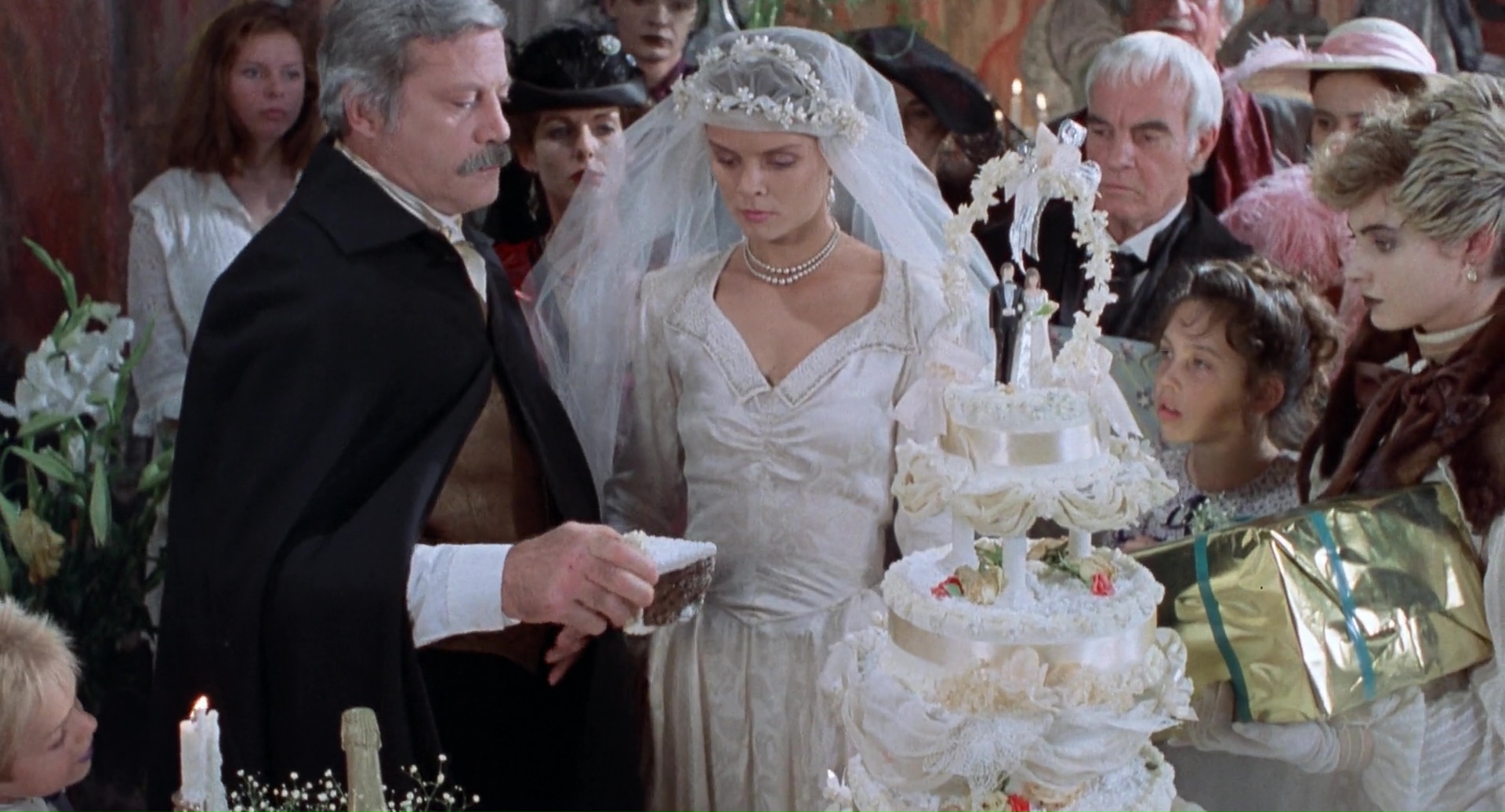
Horrifying as this seems however, even worse is to come during a particularly grotesque, hallucinogenic dream sequence (presumably modelled after those in the Corman/Poe pictures) depicting a daemonic marriage ceremony between Reed and Windsor. Here, we see Reed pick up a slice of a gigantic, tottering wedding cake, force it into Windsor’s mouth, and pull it out again with his teeth! Lord in heaven, I’ve never seen anything so repulsive.

Again, we should probably refrain from making any assumptions about a movie’s behind the scenes production circumstances, but whatever the truth of the matter, you’d better believe that this sight will leave a scar on my memory far more severe than any of the film’s ostensible ‘horror’ moments. You have been warned.


Moving swiftly on, another aspect of this ‘House of Usher’ liable to scar one’s senses is Leonardo Coen Cagli’s defiantly excessive production design, which throw the film almost immediately into a realm of phantasmagorical theatrical camp.

Although a few brief exterior shots on the Usher mansion were shot - I believe - at Knebworth House near Stevenage (an impressive Tudor edifice previously seen in ‘Horror Hospital’ (1973) and the aforementioned ‘Lair of the White Worm’), the interior sets are once again comically ill-matched.

To give credit where it’s due, Molly’s aforementioned bedroom is genuinely impressive in a crazy sort of way - a vast, medieval chamber decked out entirely in nightmarish pastel blue, it’s the kind of space which would indeed have fit the bill for a latter-day Ken Russell movie. The main ‘entrance hall’ set, complete with marble staircase, gilt curtains, hooded, faceless statues and Rubik’s Cube-styled windows, is pretty overwhelming too, conveying a similarly OTT, dreamlike feel.


Other areas within the candy-coloured mansion fare less well however, with a distinct whiff of air-brushed polystyrene and Dulux applied straight to plywood often predominating. Worst of all in this regard must be the ‘chapel’ set, which some overzealous scene painter has decorated with little black twirls, flames and spray-painted skulls, putting me in mind of the ‘goth room’ in some provincial indie nightclub. 


Uncle Roderick’s briefly mentioned background as an artist appears to have encouraged the film’s designers to load these sets up with all manner of mismatched tat, from Rodin-esque modernist sculptures to looming gargoyles, all-seeing eye covered Klimt pastiches, Italianate murals, moth-eaten Turkish carpets, faux-marble angel-y crap - you name it, and so long as it looks awful, it’s probably in here somewhere.

(It would probably be snarky to question how exactly all this is supposed to jibe with Roderick’s “acute sensitivity to certain colours”, which early in the film forces Molly to change her evening attire to “something a little more tasteful”, even though her initial choice of dress, though admittedly horrible, was actually a pretty good match for the mansion’s decor.)

Not that any of this is so dreadful in-and-of-itself, I should clarify - if anything, I appreciate the film’s wild disregard for realism and poverty-stricken attempts to overwhelm our senses. The problem lies more I think with DP Yossi Wein’s photography, which for the most part is odiously over-lit, its relentless brightness allowing no real mystery or atmosphere to accrue within these unhinged surroundings, highlighting their artificiality and essential silliness at every turn.


For all this baked-in shoddiness though, ‘House of Usher’ ’89 will still prove impossible for some of us not to enjoy on some perverse, unheimlich level. As uncharitable as some of my comments here may seem, I nonetheless found Birkinshaw’s film to be an absolute hoot, and would wholeheartedly recommend it to any admirer of distressed gothic aesthetics or oddball British horror.

Clearly a product of the same warped well-spring of inspiration which brought us ‘Killer’s Moon’, it is packed with enough uncouth eccentricities, bad ideas and baffling non-sequiturs to leave even the most jaded of psychotronic movie fans reeling - the aforementioned ‘cake incident’ foremost amongst them. (Hint when doing a psychedelic dream sequence, by the way: cutting away to shots of the dreaming character thrashing around in bed tends to spoil the effect somewhat.)

Early on for instance, we get a leering, grand guignol fake-out worthy of Todd Slaughter, as Clive the butler appears (for no apparent reason) to jam his wife’s arm into a hand-operated mincing machine, convincing us for one breathless moment that we’re witnessing a psychotic outburst of sickening gore… only for her to raise her arm from behind the machine, revealing that it’s merely the meat for tonight’s dinner being ground up. What larks.

Actually, now that I stop to think about it, pretty much all of the film’s big ‘horror highlights’ are equally arbitrary, not to mention highly derivative; hungry rat in cage (courtesy of ‘1984’, or possibly The Virgin of Nuremberg), grabby arms emerging from wall (‘Repulsion’ and/or ‘Dawn of the Dead’), head on serving platter (‘Tales That Witness Madness’ poster) - you get the idea.


Elsewhere, there is also much amusement to be gleaned from Molly’s pre-Usher profession as a hair stylist to the rich & famous. Apparently for instance, she’s so dedicated to her work that she managed to squeeze one of those full size Bakelite helmet hairdryer things into her suitcase!

Later, as she weeps inconsolably after learning that her fiancée is dead, the ever thoughtful housekeeper - distant and rude to fault through the rest of the film - picks her moment and asks, “I know you’ve got a lot on your mind, but whilst you’re here, could you do something with my hair?” Ever professional, Molly’s response is to throw her a can of mousse - “men love spikes”, she advises. (Recalling ‘Killer’s Moon’ again, moments like this cause me to wonder whether Birkinshaw had once again called upon his sister Fay Weldon to throw a few curveballs into the script.)

More emotional cross-wires can meanwhile be found in the final act, when Clive the butler learns of the deaths of his wife and child in separate Usher-instigated rampages - incidents which would play as tragic, gratuitous or cruel in most films, but here Birkinshaw pushes us straight into comedy by getting Norman Coombes to deliver two identical “OH MY GOD!” reaction shots in quick succession.

Another inexplicable curiosity meanwhile arises the film’s delightfully low rent synth score, jointly credited to two composers - George S. Clinton and Gary Chang - who both went to to enjoy noteworthy Hollywood careers, unlikely as that may seem. IMDB authoritatively informs me however that the rather fine, Carpenter-esque main theme used throughout ‘House of Usher’ was originally composed by Chang for John Frankenheimer’s 1986 Elmore Leonard adaptation ’52 Pick-up’, of all things. Had Towers just been pilfering tapes whilst visiting Cannon’s offices or something? God Only knows.


But wait a minute - didn’t I state, way back in the opening paragraphs of this review, that Donald Pleasence is in this film? Well, he is indeed! Turning up in the last half hour, he plays… well, to intents and purposes, he’s playing Saul Femm from James Whale’s 1932 ‘The Old Dark House’.

As the heretofore unmentioned lunatic brother locked in the attic, he manages to convince our heroine that he’s a poor, unfortunate fellow prisoner, before revealing, once granted his his freedom, that he’s actually a ruthless homicidal loon hell-bent on destroying everything in sight! (As in Jack Hill’s ‘Spider Baby’, these Ushers are cursed with a degenerative blood condition which pushes them further into psychosis as they get older, meaning that Pleasence’s character is pretty far gone.)

As usual, Pleasence does great work here. Evidently aware of his character’s pre-war inspiration, he has a great time putting his own spin on Brember Wills’ unforgettable performance in Whale’s film, bringing a sense of gravitas to his dialogue which temporarily even convinces us to take the film seriously. (“Thank god, an ACTOR,” I recall thinking at this point.)

Pleasance’s character is confined to a wheelchair (OR IS HE?, etc), and, apparently on account of his penchant for sculpture, he has a domestic hand drill strapped to one of his arms. Though allegedly utilised in a few moments of gory (off-screen) violence, I was chiefly struck my how thoroughly UN-threatening this looks, particularly when - in a moment which in a sense seems to sum up this movie’s crazy charm perfectly - he responds to being shut behind a locked door by a fleeing Molly by angrily drilling a series of very small holes straight into the plywood walls of the set! Whatcha gonna do Donald, hang some pictures?


Needless to say, this whole farrago concludes the only way it possibly could, with a decent into blood-curdling hysteria which Oliver Reed and Donald Pleasence rolling around on the floor in a frenzied, mutually suicidal wrestling match (shades of ‘Women in Love’ perhaps?), as the Corman/Poe-mandated conflagration erupts around them, sending these horrendous sets up in smoke once and for all.

Meanwhile, having rescued her hunky fiancée from behind a polystyrene tombstone, Romy Windsor finally flees back out into the fresh air of Knebworth House, presumably contemplating an immediate change of profession. (Actually, she went on to roles in ‘Surf Ninjas’, ‘Camp Nowhere’ and ‘Howling IV: The Original Nightmare’, but safe to say no more Harry Alan Towers productions were forthcoming.)

Towers and Birkinshaw though ploughed straight on in the same furrow, ensuring that ‘House of Usher’ was released more-or-less back to back with their visionary re-imagining of ‘The Masque of the Red Death’ - a film so assaultively crass it makes this one looks like a model of respectful sobriety by comparison. All being well, we’ll hopefully be digging into the garish mysteries of Red Death ‘89 here soon, so gird your loins folks, and make sure you come prepared. (Blindfolds, tranquilisers and hard liquor are all recommended.)