Showing posts with label Fredric Hobbs. Show all posts

Sunday, 1 July 2018

You Cannot Fart Around With Love:
A Tribute to Fredric Hobbs

(1931-2018)


“Even the distributor, who’s a very smart guy, said, ‘Everybody goes nuts at the end! Is that what you always do, Hobbs? In every movie you make everybody always goes nuts at the end!’ I said, ‘No, for chrissakes, listen to the dialogue! It’s in there […] But you know what? The images were so strong that nobody listened. That’s why some of my movies fail, in some things. People say, ‘Oh, the story’s weak, Hobbs doesn’t know how to do stories.’ That’s bullshit! My imagery is so powerful that they can't listen.”
- Fredric Hobbs, interview with Stephen Thrower, 2007

This week, I learned that Fredric Hobbs, a man I’d make a point of including on any list of my favourite American filmmakers, passed away in April at his home in Monterey, California. He was eighty five. (Source.)

As anyone who has read the chapter in Stephen Thrower’s indispensable Nightmare USA devoted to Hobbs and his work will be aware, to describe him as a ‘unique character’ would be something of an understatement.

Throughout his life, Hobbs primarily worked as a visual artist, and, insofar as I’ve been able to view or learn about it, I’ve always found both the theory and practice behind the “Art-Eco” movement of which he was the self-proclaimed founder to be quite appealing.

Mixing ecological / environmental concerns with a distinctly Californian outsider / pioneer aesthetic, much of his earlier work seems to have focussed on ‘moveable’ art of one kind or another, much of which can be seen in his films. Using monolithic “junk” sculptures, parade floats, ritualistic costumed processions and “drivable art”, he aimed to break away from sterile museum and gallery spaces, instead bringing his creations “straight to the people”, infiltrating everyday environments and, presumably, relishing the confusion and surrealism that resulted – a notion that, again, can be strongly felt in his cinematic work.

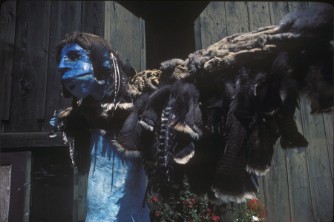
Assorted Fredric Hobbs art images taken from http://fredrichobbs.yolasite.com/

In addition to this, Hobbs also seems to have been deeply involved for a time with the preservation and restoration of the historic frontier town of Virginia City, Nevada (coincidentally the same locale in which acid-rock pioneers The Charlatans held their legendary residency at the Red Dog Saloon in 1965 – an event that many historians credit with first solidifying the aesthetic of San Francisco’s psychedelic counter-culture, a scene whose later mutations Hobbs would eventually incorporate into Alabama’s Ghost in 1972).

At one point, Hobbs was apparently the owner of Virginia City’s Silver Dollar Hotel, and he co-authored a history of the area, ‘The Richest Place on Earth: a History of Nevada's Comstock Lode’, with radical journalist and Hunter S. Thompson associate Warren Hinckle in 1978. More significantly for our purposes, he also shot Godmonster of Indian Flats in and around Virginia City in 1973.

Hobbs’ adventures in filmmaking began with an entirely independent production named Troika, which he initially deemed ready for exhibition in 1969. Consisting of three separate segments that may or not have been intended to be screened simultaneously on parallel screens (reports vary), this was a pretty experimental affair, utilising imagery and objects that seem to have arisen largely from Hobbs’ art practice. But, it also appears to have had a self-reflexive narrative of sorts, with the director appearing as himself, waging war in the name of art against a commercially minded Hollywood producer.

According to information unearthed by the Temple of Schlock weblog, ‘Troika’ was picked up for distribution by a company named Emerson Film Enterprises, and was screened at least a few times in both New York and Los Angeles, even gaining a remarkably positive review from Variety in October 1969. As far as I’m aware however, ‘Troika’ has never been released or screened in any form since that date, and no one has subsequently been able to view it without direct access to the materials held by Hobbs.

When Thrower interviewed Hobbs for his book, the director insisted ‘Troika’ was still unfinished(!), but he nonetheless provided Thrower with the means to watch it, thus allowing the writer to give a lengthy, and tantalising, description of its contents, running to what must be several thousand words. To give you but one extract;

“A fantastical biped, its mask-like face nodding within a carapace resembling some wondrous beetle, takes a ride on an old-West train. The creature (end credits refer to it as the Bug-Man; its onscreen name is Rax) disembarks to walk the hills, before being attacked by a savage seen burning a chicken with a blowtorch. Beaten with a stone-axe and left for dead, the Bug-Man staggers to a beach and collapses, twitching feebly, whereupon a deep reddish-orange woman emerges from the sea pushing a sculpture mounted on wheels. She attempts an erotic encounter, caressing the Bug-Man and fingering his wounds, but as he lies there unable to respond, she ends up pleasuring herself instead. Perhaps the encounter was not so one-sided after all; as if rejuvenated, we then see Rax enter an ice cave, where he encounters a black shaman called the Attentuated Man, a seven foot tall giant who speaks in drastically slowed down Arabic.”

And so on. After eventually concluding his description, Thrower observes;

“The version Fredric Hobbs has allowed me to see is still not the ‘final cut’, but it is already apparent to me that this is an important, original work by an artist of genuine vision. While his subsequent movies veer between astounding and frustrating, ‘Troika’ is his masterpiece, and its eventual release on DVD should be awaited with the utmost anticipation.”
- Nightmare USA, pp.358-360

Over a decade later, we are, sadly, still waiting.

Production stills from ‘Troika’, via Lost Media Wiki.

Quite how Hobbs went on from here to become involved in directing more commercial movies – or why anyone ever deemed it a sound investment to give him money to do so – is still not something I fully understand, but hey – it was a strange time, and for the sake of us all, I’m extremely glad that unreason prevailed in this regard, for at least a few years.

Bearing only scant resemblance to the marketable genres into which they were ostensibly supposed to fit, the three features Hobbs wrote and directed between 1971 and 1973 are a world unto themselves. Venturing far beyond the limits of such mild terms as “idiosyncratic” or “eccentric”, they are landmarks of High Weirdness, in which crude cinematic technique and egregiously theatrical performances fail to disguise the lunatic ambition and unrestrained visual imagination of their creator, not to mention his uniquely strange insight into life on earth and the human condition.

Inexplicably marketed as a sexploitation item by notorious producer Harry Novak, Hobbs’ first commercial film, Roseland, remains probably the least seen and most, shall we say, problematic of his three extant works. Perhaps taking the idea of a “sex drama” a bit more literally than anyone had intended, ‘Roseland’ finds Hobbs regular E. Kerrigan Prescott enunciating to the back of the room in the role of a popular operatic singer who has been confined to a psychiatric institute, where an extremely unconventional doctor attempts to cure him of his perceived sexual deviancy, following a scandalous incident that saw him hi-jacking the Ed Sullivan show to perform an allegedly obscene song entitled “You Cannot Fart Around With Love”.


Rebelling against the doctor’s regime, Prescott takes on the alter-ego of “the black bandit” and begins to indulge in nocturnal expeditions to steal prints of pornographic films. Meanwhile, heavily saturated fish-eye footage shows us an army of naked hippie primitives transporting a gigantic, phallic sculpture on a hill, draping it in chains of flowers, and dancing around it, maypole style.

Presumably this is supposed to represent a dream or vision of the kind of paradise that Prescott envisions emerging from his curious new philosophy, the ins and outs of which spends the majority of the film enunciating at length, both to the doctor, and to a black, jive-talking avatar of the artist Hieronymous Bosch (played by future Hobbs MVP Christopher Brooks), who emerges from beneath Prescott’s bed to act as some sort of spirit guide.

Basically playing out like an earnest diatribe on the need for a more progressive approach to human sexuality, as dramatised by an enthusiastic street theatre troupe and injected with industrial quantities of post-psychedelic mind damage, I can’t even begin to imagine what Novak’s usual audience made of all this. I suppose we must assume that, back in the day, punters were willing to sit through an awful lot of footage of strange, bearded men swapping spittle-flecked philosophical infective in order to eventually catch sight of some naked hippies.

Frankly, ‘Roseland’s value to 21st century viewers is equally questionable, but to Hobbs devotees such as myself, every glimpse into his singular creative process is gold, and the key facet of his filmmaking – namely, the idea of never taking the expected route from A to B, and ensuring that every small detail of his productions should in some way be rendered incredibly strange - is certainly in full effect throughout.

I realise of course that celebrating a film simply on the basis that it is “strange” or “weird” is fairly reductive, but it is difficult to know where else to start when considering Hobbs’ next production, the extraordinary Alabama’s Ghost. Sometimes written off as a “Blaxploitation horror film” (a summation that feels akin to describing Godard’s ‘Week End’ as a “comedy of manners”), I would make the case for ‘Alabama..’ being one of the most errant outpourings of unhinged creativity that has ever been placed before the American public in the guise of a narrative entertainment.

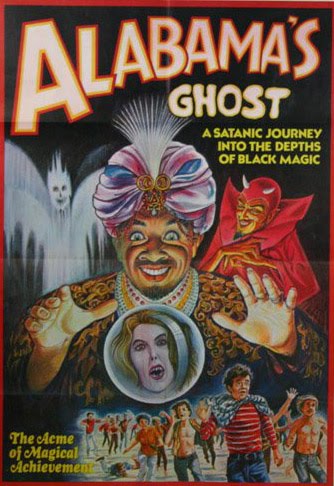
I wrote extensively about the film after first watching it back in 2011, but, in summary, ‘Alabama’s Ghost’ concerns the travails of Christopher Brooks as the titular Alabama – a free-wheeling hep-cat who discovers the artefacts and props of real life 1920s magician Carter The Great buried beneath Earthquake McGoon’s Irish pub, and subsequently decides to reinvent himself as a stage magician. This decision catapults him into a sprawling drama whose ever-shifting sands involve sinister Nazi mind control techniques, vampire world domination conspiracies, messianic desert rock festivals, obnoxious racist ghosts, paper-mache enhanced monster cars and – you probably saw this one coming – mind-altering psychoactive snuff. Also featuring voodoo blood-letting rituals, a rampaging elephant, witches, bikers, a robot, many, many hippies and music from The Loading Zone and The Turk Murphy Jazz Band.


Unsurprisingly, this heady brew – which to some extent retained the theatrical performance styles and lengthy, digressive dialogue of its predecessor, in spite of all the hullaballoo outlined above – proved impossible for America’s grindhouse/drive-in audiences to adequately digest, especially when the film was ill-advisedly marketed to inner-city theatres as a straight up blaxploitation item, and it soon sank without trace.

(It’s a real shame I think that no one came up with the idea of resurrecting ‘Alabama..’ as a “midnight movie” ala ‘El Topo’ or ‘Eraserhead’. Something tells me if would be far better remembered today if it had been allowed the chance to establish a similar cult following.)

After ‘Alabama..’, I’d imagine Hobbs probably had to put in a lot of persuasion to secure financial backing for his next project. In the end, I suppose his long-suffering production associates thought, well, the guy loves to build crazy creatures and big, monstrous costumes and stuff… how far wrong can he go with a good, old-fashioned monster movie? Little did they know.

Although Godmonster of Indian Flatswhich I reviewed here in 2012 – may lack the ostentatious freakery of ‘Alabama..’, it is at heart perhaps an even more unique proposition, and a film that I find more compelling and thematically rich each time I return to it.

To recap, ‘Godmonster..’ begins when a simple-minded shepherd, returning from a gambling and drinking binge, collapses amid his beloved flock and experiences what can only be described as a religious visitation. When he awakes, he finds that one of his sheep has given birth to some kind of shapeless, embryonic creature, which is subsequently commandeered and placed in an incubator by the local not-quite-mad-but-probably-getting-there scientist (again played by the irrepressible E. Kerrigan Prescott).

Meanwhile, we find ourselves drawn into the cut-throat world of local Virginia City politics, as a charismatic black cowboy named Barnstable (Brooks once again) arrives in town with the intention of trying to wrestle the city’s mining concessions away from the cabal surrounding the corrupt Mayor Silverdale, and handing them instead to his employer, a reclusive billionaire with the somewhat loaded name of Mr. Reich. (In view of Hobbs’ personal connections to Virginia City, one wonders how much of this storyline may have been inspired by his own experiences.)

How will Barnstable’s story intersect with that of the misshapen beast growing in the doctor’s lab? And what indeed of Madame Alta, the local clairvoyant, who briefs some of our more sympathetic characters on the nature of her connection to the land, and communes with spirits in the derelict, Wild West era cemetery?

Well, I may have watched the film three or four times, but… don’t ask me. What I can tell you however is that these parallel threads allow Hobbs a perfect opportunity to introduce some of the themes and networks of imagery that also informed his art into what might on the surface appear to be little more than a boilerplate monster movie narrative (anti-pollution sub-division).

In particular, Hobbs uses the film to consistently highlight the disjuncture that exists between the spiritual and materialistic impulses underlying American history and culture (even the “Godmonster” of the title hints at this all-consuming contradiction), whilst also exploring notions of environmental degradation, mutation and reclamation that now appear quite prescient.

When the fully grown “Godmonster” – designed by Hobbs himself, of course – eventually emerges meanwhile, it is quite a thing to behold, if not quite in the manner monster fans may have been hoping for. An utterly inexplicable mass of bulbous flesh with a camel-like head and gangly, malformed limbs, it is simultaneously forlorn, pathetic and hilarious. The scene in which it rambles out of the undergrowth to disrupt a children’s picnic has rightly become the stuff of cult movie legend.


Of course, the true horror of this story though lays not with the mild outrages committed by this poor, harmless beast, so misshapen that can barely stand upright, but with the directionless rage, avarice and hysteria exhibited by the confused local populace as they attempt to capture and destroy it.

Even as we may be driven to laughter by the “Godmonster”s lumbering, uncoordinated movements (at times it looks somewhat like a gigantic, hairy flea), we simultaneously feel vast sympathy for it during its traumatic journey through our world. In spite of its inhuman, faceless construction, there is a terrible poignancy to this sad-sack creation that is difficult to put into words.

The film’s final sequence, in which the strangely messianic, caged creature is crucified by proxy, pelted with silver dollars whilst the townspeople shriek and cry and argue beneath it as if descending into collective insanity, is senselessly harrowing – a kind of apocalyptic Golgotha of the Western American soul, and a bleak and genuinely upsetting conclusion to Fredric Hobbs’ brief directorial career. (His recollection of a distributor’s reaction to this divisive ending has been quoted at the start of this post.)

Having taken a bath three times on these basketcase motion pictures, it is perhaps unsurprising that Hobbs’ financial backers pulled the plug at this stage, and, with no other potential revenue sources forthcoming, Hobbs returned his attention to the art world.

Even on the basis of this limited canon, I believe that Hobbs deserves to be spoken of in the same breath as such filmmakers as Alejandro Jodorowsky, José Mojica Marins, David Lynch, Kim Ki-Young or Ken Russell – a true one-off whose personality veritably screams from every frame of his work - and am consistently saddened by the fact that his films remains so misunderstood and under-appreciated by the cult movie fraternity.

Sadly, Hobbs’ reputation is probably not helped by the fact the all currently extant copies of his films look absolutely terrible. ‘Alabama’s Ghost’ in particular is (to my knowledge) only available as a brutally cropped ‘80s-era VHS rip featuring murky, degraded colours that seem to reduce everything to an unsavoury shade of brown.

I’ve often reflected that, should I ever attain the time and finances necessary to enter the film restoration game, attempting to track down whatever elements still survive for ‘Alabama..’ would be my number one priority, but unfortunately, from what I can gather, the film’s legal ownership seems to be lost in some kind of limbo, and, by this stage, when every obscure horror film under the sun seems to be getting a special edition blu-ray, I’m sure others before me must have tried and failed.

Speaking of which, at the time of writing, The American Genre Film Archive are taking pre-orders for their forthcoming blu-ray release of ‘Godmonster of Indian Flats’, and have also helped spread the news of Fredric Hobbs’ passing in recent weeks.


Whilst on the one hand I am absolutely overjoyed at the prospect of soon being able to watch a transfer of a Hobbs film that does not, in the parlance of our times, look like ass, I was initially quite crushed to see that the extras on AGFA’s release offer no context at all on Hobbs or the film’s place within his work, instead filling out the disc with some generic cheesy-monster-movie type stuff.

Now, sadly, the knowledge that the director had been suffering from Alzheimer’s for around five years prior to his recent passing helps to explain why AGFA couldn’t go straight to the source for some background, but I’m still disappointed they were unable to at least reach out to Thrower or someone else who might have been able to properly contextualise the film for first time viewers.

Still, to some extent it is the mystery that surrounds this man and his work that continues to make it so fascinating, and, as long as the films are still out there in some form, we can at least be reassured that sympathetic viewers will be able to recognise them as something special, and will beat their way down the same well-worn Google trail I’ve taken in compiling this article in order to learn more.

In truth though, given both the prolific/obsessive manner in which he went about creating art, and the attention-grabbing nature of his work, I’m amazed at what an obscure figure Hobbs remains. I suppose it is possible that both his disinclination toward self-publicity and his, uh, somewhat extreme personality may not have exactly endeared him to writers or researchers who might have helped to raise his profile during his lifetime, but either way, the sheer dearth of available information about him is remarkable.

For a man who seems to have produced such a vast quantity of paintings, drawings and sculpture, there are very few images of his work online, and, although his capsule biographies speak of work held by major institutions, I can find very little in the way of info regarding exhibitions, auctions and so forth. Frankly, most of the information about him on the internet concerns his films, and, as we’ve established, not many people even seem to like his films. In 1980 he authored a book entitled ‘Eat Your House: An Art Eco Guide to Self-Sufficiency’, but I only know this because it is for sale on Amazon for £0.01 plus postage. (Should I take a chance?)

Just like the unseen content of ‘Troika’, the few scraps of information we do have are fascinating, and the vast gaps in the story remain tantalising.

How did he end up owning the Silver Dollar Hotel, and what did he do with it whilst he was there? How did he go about assembling the several hundred people who took their clothes off and carried his giant penis statue up a hill whilst filming ‘Roseland’, and how did the complaints of outraged locals that are reported in a scanned clipping from the San Mateo Times pan out? Why did he withdraw ‘Troika’ from circulation, and what on earth was he doing to it that rendered it “unfinished” over thirty years later? Why is there so little photographic evidence of the ‘Highway’ exhibition of “drivable art” that he apparently sent roaring across America at some point in the 1960s? What did he do to inspire a snarky, anonymous Youtube commenter to declare that he was “still alive and being obnoxious” in 2010? What was he UP TO through all these invisible years, and will We The People ever be able to benefit from seeing the results?

If I’ve learned anything from watching his films, it’s that the answers to these questions will not be simple.

R.I.P. Fredric Hobbs. Safe to say, we will not see his like again.

A memorial site set up by his friends and family can be visited here.


“Aesthetic communication may stop wars. If a man would build his own chartreuse gargoyle and live in it rather than glass and steel boxes, he could communicate better with his neighbour.”
- Fredric Hobbs, quoted in the San Mateo Times, January 1971

Friday, 31 January 2014

Deathblog:
Mike Vraney (1957-2014)
& Top Five Something Weird Releases.


I’m afraid I’m a bit late on this one, but it wasn’t until earlier this week that I learned – via a tribute post on Tim Lucas’s blog – that Mike Vraney, founder of the legendary Something Weird Video label, passed away at the start of January.

Conditions in whatever passes for the “industry” of restoring and repackaging old films may have moved on considerably since SWV’s glory days in the ‘90s, but the sheer volume of lunatic oddities and forgotten, marginal footage that they unleashed upon the world means that most of us are still playing catch-up, and it’s safe to say that most people who have been fans of weird movies for any length of time can probably recite their famous opening reel from memory. Their releases were certainly pivotal in inspiring me to begin taking an active interest in this kinda thing, and that crazy echo effect that plays beneath their logo still gives me a brilliant “I-have-no-idea-what’s-gonna-happen-next”, thrill of the unknown type tingle every time I hear it.

Of course, what ‘happened next’ wasn’t always all that great – try as I might, I’m really just not in the market for most of the seemingly endless ‘60s sexploitation flicks that they put so much effort into releasing, and, hilarious though most of his movies may be on first viewing, I’m not really that big a fan of their flagship director Herschell Gordon Lewis. But nonetheless, I’m glad that all that kinda stuff exists, and that there was someone dedicated enough to put it all out there – and, as Lucas’s obit makes abundantly clear, when it comes to the legacy of SWV, exists is very much the key word.

In the past few decades, we’ve got used to a world in which the chances of any currently existing piece of art or culture being lost forever is fairly minimal (or so we assume, anyway). But that certainly wasn’t the case back when Vraney was making the scene, and I think it’s fair to say that the impact he personally had on the preservation of pre-video tape era American film was vast.

All of those stranger, trashier, seedier flicks form the ‘50s, ‘60s & ‘70s that so many of us are currently so busy downloading, streaming, watching on Youtube..? A fair percentage of them wouldn’t just have been ‘hard to find’ without the efforts of Vraney and SWV, they would have been destroyed. The kind of material he specialised in fell well below the radar of any ‘official’ archive or film library, and if it wasn’t for his timely intervention, how many movies which are now marvelled over by viewers around the world (to say nothing of their value as a historical record of American life & culture in the mid-20th century) would have ended up in the incinerator? I don’t know much about Vraney as a person, but for that alone I think, he deserves our eternal respect.

As such, a good way to pay tribute seems to be to run through a quick list of some of my all-time favourite SWV releases, most of which would probably never have even reached our eyes without the efforts of Mike Vraney and his collaborators.

5. The Black Cat (1964)

Not to be confused with any of the numerous, more storied horror films inspired by Poe’s most-filmed tale, this out-of-nowhere regional obscurity – strangely accomplished on a technical level, yet utterly batshit in terms of acting & scripting – uses its literary source material as the jumping off point for the story of a strange, cackling man-child who, in between a lot of rather boring talky segments, commands our continued attention by means of force-feeding champagne to his frightened menagerie of animal friends, silently freaking out in an outburst of murderous rage in a ‘Moe’s Tavern’-esque dive-bar as an unknown, eye-patch wearing garage band plays, and finally lamping his long-suffering wife in the face with a fire-axe, in a full-on gore moment that could have escaped from an ‘80s Fulci movie. What does it all mean..? The immediate death of somebody’s dreams of being a great film director, more than likely, but I for one certainly enjoyed the resulting mess.

4. Blood Freak (1971)

My god, what can you possibly say about this one that hasn’t been said already? Truly one of most confounding brain-wrongs ever coughed up from the depths of marginal American film-making, it is staggeringly inept, utterly bizarre and genuinely rather unsettling in its presentation of a world in which everyone seems to be a severely traumatised and/or maladjusted individual under the influence of heavy sedatives, torn between the influence of evangelical Christianity, systematic drug abuse and chemically-enhanced factory farming. It’s like a Butthole Surfers album come to life in the form of a pro-God, anti-drug, Vietnam-damaged turkey-headed psychedelic gore movie, with the fact that it’s confused message seems to be entirely in earnest only rendering it all the more upsetting. Or at least, I think it is, anyway. To be honest, I’m still not sure whether the stern narrator who turns up at the end to warn us about the dangers of drug addiction whilst smoking cigarettes and coughing like a cancer patient is meant as a piece of intentional humour, or just the result of random, unthinking incompetence. In fact, I don’t know if anyone really knows. Most of the other people on screen act like they barely even know how to breathe or stand upright, so they’re not really giving us any clues. In the final analysis: I don’t know where this came from, or what it’s trying to say, but God help us all. UNcinema at its finest, and most terrifying.

3. The Fat Black Pussycat (1963)

Featured on the same disc as the aforementioned ‘Black Cat’ (hence no cover art), it’s been a long time since I watched this one so my memory ain’t all that clear, but my overall impression was that of it being an absolute belter of a weird little movie. As I recall, the story goes that it started life as a sorta New York shot murder mystery in which two square cops go under cover amid Greenwich Village beatniks, prompting much wonderful early Roger Corman / Jack Hill type comedic shenanigans as they search for a giallo-esque killer amid the wastrels and hep-cats of the coffee bar / house party scene. Then apparently, after all this was done and dusted, a new producer (the aptly named M.A. Ripps) got hold of the initial cut, decided it was too dull to release as was, and set out again to shoot a bunch of new foot age and a new ending, splicing additional moments of sex, violence and bomb blasts into existing scenes, and adding a horror-ish plotline about an evil cat taking over people’s minds and driving them to murder! The result? Disorientating moments of spatial and temporal incoherence, jarring and unpredictable shifts in tone, meaningful plot-lines that gradually veer off into drooling insanity, and (as I recall) more fun than those squares who insist upon watching movies that were all shot at the same time by the same people can even imagine.

2. Godmonster of Indian Flats (1973) / Roseland (1971)

You want “something weird”? You got it. And praise be to SWV for helping to disinter two thirds of the extant celluloid legacy of perhaps the greatest unsung hero of American outsider cinema, the one and only Fredric Hobbs. I already spilled much ink on the subject of ‘Godmonster..’ here, so instead we’ll say a few words about ‘Roseland’, which I was meaning to embark on a similarly detailed write-up of, but… just couldn’t face it, to be honest. Shot for producer Harry Novak on the basis of “nudity + whatever = bucks”, ‘Roseland’ is ostensibly Hobbs’ “sexploitation” film, in much the same way that Alabama’s Ghost is his “blaxploitation” film and ‘Godmonster..’ is his “monster movie”. Which is to say: certain images and ideas may momentarily cross over with the conventions of the genre in question, but basically 98% of the completed footage resembles nothing that has previously been seen in any motion picture made anywhere on earth.

Featuring Hobbs regulars E. Kerrigan Prescott and Christopher Brooks delivering their most fevered and theatrical performances to date (the latter in the role of a black Hieronymous Bosch), ‘Roseland’ to some extent concerns with the following: 1) Prescott’s career-ruining performance on the Ed Sullivan show of a big band show tune entitled ‘You Can’t Fart Around With Love’, an event that apparently traumatises the nation. 2) His subsequent mental illness, which sees him assuming the guise of ‘the black bandit’ and stealing prints of pornographic films from what appears to be a giant, echoing gymnasium. 3) The revelations imparted to him by the re-embodied spirit of Hieronymous Bosch, and his ongoing ideological conflict with a sleazy psychiatrist regarding issues of sexual morality that become increasingly unclear as the film progresses. And, 4), extremely lengthy messianic fantasy sequences in which armies of naked hippies trudge across expanses of unoccupied hillside to prostrate themselves in worship before a series of giant phallic statues. In conclusion, I would not recommend this film for viewing by the uninitiated, for that way lies only pain, but for those of us already driven to a state of fanaticism by Hobbs’ two later works, it represents another essential corner of the Bermuda triangle that is his brief but unique filmography.

1. Confessions of a Psycho-Cat (196?)

Yeah, so apparently I just really like cheap, black & white films of uncertain pedigree with vague counter-cultural affiliations and the word ‘cat’ in the title. Deal with it. Anyway, I’ll immediately cop that ‘Confessions of a Psycho-Cat’ isn’t really ostensibly ‘better’ (or weirder, or more entertaining) than any of the other films on this list, but for me, it still stands tall as the perfect example of an SWV release: a vicious, sleaze-packed and total impoverished exploitation picture, seemingly thrown together by a gang of sneering, Nouvelle Vague-digging beatniks, none of whom ever troubled the film industry again, and incorporating footage culled from at least two completely different projects, seemingly shot about five years apart. Pure magic. This was actually one of the first films I reviewed for this weblog, and, whilst I can’t really endorse either the tone or content of my writing back then (never mind the stolen screen-grabs, before I figured out how to do them myself), my enthusiasm for the film itself remains untarnished. In short, an unlikely ‘Most Dangerous Game’ framing story sets the scene for a deranged female huntress stalking the streets of New York in search of three nefarious losers who accepted her “stay alive for 24 hours” wager. Much semi-experimental, hand-held camera based mayhem ensues, incorporating twitchy, Hawaiian shirt-clad drug pushers, Jake LaMotta staggering about like a drunken human cannonball, wild modern jazz freakouts, bloody misogynistic murder flashbacks and a bow & arrow battle in Central Park. Whoa there. Just in case we get TOO excited, there are a lot of languorous, fully-clothed hippie ‘love’ scenes spliced in from the later, post-’67 shooting date too, but hey, it’s Something Weird, so you wouldn’t expect anything less really, would you? Go with it.

Something Weird Video still exists, and you can buy stuff from them here.


Saturday, 28 April 2012

Godmonster of Indian Flats
(Fredric Hobbs, 1973)


When we last encountered cracked conceptual genius Fredric Hobbs on this blog, he was busy trying to squeeze our brains through the sieve of the unforgettable Alabama’s Ghost. Needless to say, after a few months spent recovering from that experience, I was primed for more, and thankfully, so was Hobbs. In the brief window between wrapping up work on his magnum opus and witnessing its presumably disastrous unveiling on the grindhouse circuit, some damn fool gave Fred the green light once again, and production began almost immediately on 1973’s ‘Godmonster of Indian Flats’.

Perhaps they figured, well, how far off the rails can he go with a straightforward monster movie anyway? I fear you and I both know the answer to that question.

Having said that though, it’s clear from the outset that ‘Godmonster..’ is a far more low-key affair than ‘Alabama’, rarely seeking to replicate the overdriven freakery and psychedelic excess of its predecessor. More of a slow-burner in the weirdness stakes than an OMFG mindblower, close attention and contemplation nonetheless reveal it to be an equally inexplicable proposition; a bilious and indigestible film, by turns frustrating, whimsical, beautiful and genuinely upsetting, ‘Godmonster..’ is unmistakably the work of a creative mind running on a completely different set of rails from the rest of mankind, and for that alone it should be celebrated.


As Hobbs relates in an interview (more of a vast, disjointed monologue really) conducted by Stephen Thrower for his indispensable book Nightmare USA, the seeds of ‘Godmonster..’ were sewn largely from the director’s connections with the community of Virginia City in Nevada, a former goldrush city built on the profits of gold extracted from the legendary ‘Comstock Lode’, and subsequently preserved for the ages as a kind of period-authentic tourist town.

Hobbs created much of his best-known artwork during sojourns in Virginia City, as well as assisting in the restoration of town’s historic buildings and co-authoring the book ‘The Richest Place on Earth: The Story of Virginia City and the Heyday of the Comstock Lode’ (1978). So setting his film there, taking advantage of unusual architecture, awe-inspiring scenery and the goodwill of the local community, must have been a no-brainer really, and indeed ‘Godmonster..’ is in many ways a tribute to the strange atmosphere of Virginia City – full of local tales, local people and local peculiarities, even if it is not, I should imagine, the kind of homage many residents might have anticipated.

In classic ‘50s monster movie style, the film posits an isolated laboratory in the hills outside the town, where Dr Clemens (“head of Anthropology at the University of Reno”) and his perpetually dazed flower-child assistant Mariposa are working on unspecified matters requiring a great deal of secrecy and isolation. (In another great example of Hobbs’ knack for enhancing his movies through use of ‘found’ locations and props, Dr Clemens laboratory is housed in an incredibly sinister looking concrete pile that is apparently an abandoned US government cyanide factory.)


One night, Doc Clemens encounters Eddie, a simple-minded local sheep-farmer who has ended up penniless after a night of drinking following a fruit machine jackpot in Reno resulted in his being fleeced and run out of town by the Virginia City locals. Drunkenly collapsing amid his beloved sheep after the Doc drives him home (“how’s God’s children tonight?” he asks them), Eddie witnesses something that the film seems to invite us to interpret as a divine/miraculous happenstance.

First he sees a blinding light in the sky, and glimpses strange, swirling creatures in the darkness above him. Churning, super-imposed sheep imagery fills the screen and loud bahhing mixes with religious choral music on the soundtrack as a flash of lightning descends from the heavens, and Eddie awakes to find himself cradling a mewling, misshapen mass of newly-birthed sheep-flesh.


When he checks in on Eddie the next morning, the Doc apparently recognises the birth of this misbegotten creature as “an amazing event, almost incredible from a scientific standpoint… possibly the result of chromosomic breakdown and cross-fertilisation”, and immediately rushes it back to his lab, installing it in an incubator for further study. And, just when we’re wondering why the head of an anthropology department would need a fully-functioning medical lab equipped with a high-tech incubator and an all-purpose assortment of other mad scientist equipment, Clemens helpfully fills us in at length regarding the reasons he really came to the Comstock – namely, the investigation of “..a certain theory of cellular realignment..” inspired by unusual fossil imprints found in the abandoned mines, and goldrush-era legends concerning a supposed ‘mine monster’. Pity the poor clerk at the University of Reno who had to process the invoices for that one.

Meanwhile, back in town, other business is afoot, and Hobbs wants to make sure we know all about it. Mayor Silverdale – patriarchal head of the Virginia City Historical Society and also, allegedly, of a secret society known as the 601s who ‘protect’ the city’s interests – is having breakfast with one Mr Barnstable (played by Alabama himself, the one and only Christopher Brooks). Barnstable has come to the town on behalf of a Howard Hughes-esque billionaire named Rupert Reich with the intention of persuading the townsfolk to sell their mining concessions, allowing the Reich Corporation to commence a programme of economically-devastating industrial stripmining.


Understandably, Silverdale – whose desire to preserve the status quo upon which his power rests verges on fascistic paranoia – is less than sympathetic to Reich’s overtures. When the charismatic Barnstable refuses to take no for an answer and leave town though, Silverdale and his cronies decide to take more drastic action.

Somewhat uniquely, this action consists of seeking to ruin Barnstable’s reputation in the eyes of the townspeople by encouraging him to take part in a shooting contest during the town’s ‘Bonanza Day’ celebrations, then framing him with the death of a beloved local dog (whose owner, the local sheriff, instructs the beast to play dead).


Several long scenes are spent elaborating the details of this unfeasible ruse, as we hear about how the dog has been deposited with the sheriff’s nephew in Albuquerque for safe keeping, and witness the tearful funeral that is held for the purportedly slain mutt in the town’s central church. (“He was only a dog, but he filled out lives with joy and gaiety.. until a bullet struck him down” opines Silverdale’s lackey Maldove in the midst of the most solemn and overblown dog funeral oration in cinema history.)

In spite of his new status as a pariah and dog murderer though, Barnstable continues his quest to try to win over the townsfolk, experiencing much toing and froing and double-crossing that we won’t bother going into here, until he eventually finds himself on the verge of being lynched by the black-shirted 601s, after discovering that Silverdale has already gone over his head and sold out the town directly to Reich.

Escaping the lynch mob with the help of brothel proprietor/clairvoyant Madame Alta, Barnstable seeks sanctuary with Doc Clemens at Indian Flats, and it is during the subsequent tear gas assault by Silverdale’s men that the now fully-grown ‘Godmonster’ makes its inevitable escape.


It must be said at this point that, in purely technical terms, ‘Godmonster of Indian Flats’ is not really a great work of cinema. In keeping with what you might expect from a largely unheralded regional genre film, the pacing is pretty sluggish and the direction perfunctory (give or take the occasional moment of oddball inspiration). In spite of the remarkable shooting locations and the often astounding imagery presented on-screen, Hobbs works predominantly in bland medium and long shot, with camera movement clearly at a premium. Unconvincing post-production audio inserts are sometimes used to enhance or replace dialogue from original shoot, whilst the music track is largely comprised of stock ‘suspense’ cues and outdated theremin jams seemingly pulled straight from a ‘50s sci-fi/monster flick.

The performances – though less blunt than those in ‘Alabama’ – are still of the declamatory, am-dram variety common to many off-the-map independent films, meaning that if characters don’t QUITE enter a scene with the fingers looped in their belt buckles and say “WELL, I DO DECLARE..”, they constantly seem to be on the verge of doing so.

Not every story needs nuanced, method style intensity to get where it’s going though, and likewise, ‘Godmonster..’ doesn’t really *need* to be a great technical achievement to make its point, when the wayward imagination and unguessable sideways logic that Hobbs packs into his screenplay instantly serves to separate him from the Don Dohlers and William Grefes of this world.

By necessity, ‘Godmonster..’ is a slower, more realistic venture than ‘Alabama’, but even in his most earth-bound moments, Hobbs can’t help but get a bit weird. In the film’s opening few minutes depicting Eddie’s night out in Reno, rows of slot machines wheeze and drone like part of an alien landscape, as salty characters ramble their way through sprawling mouthfuls of quintessential Hobbsian dialogue. (“It’s getting’ up into drinking time… it’s the golden hours, boy… full of banjo-dust and starry-eyed broads, lookin’ for a good time…”, announces one Elbow Johnson, apropos of nothing, as he props up the bar.)

Elsewhere, Hobbs’ obvious love of street parades and Western culture is in full effect as he comes on like some cranky, cowboy Fellini during the scenes depicting Virginia City’s ‘Bonanza Day’, filling the screen with leering, drunken faces, blaring oom-pah bands, cheering prostitutes, pie-eating contests, railroad spike-driving demonstrations, sixgun-blasting yahoos and you name it.


As the film progresses, it starts to accumulate some heavy psychedelic and spiritual undertones too, regardless of Hobbs’ apparent efforts to try to ground his tale in scientific/economic reality.

Making their way through Virginia City’s hilltop graveyard, Eddie and Mariposa witness Madame Alta pushing her face against the branches of a tree, apparently in some kind of supernatural trance. Sitting beneath an impressive obelisk (‘Captain Storie’s Monument’), Eddie gives his own impressionistic account of the ‘Godmonster’s birth (“when I had this.. vision.. it seemed like the whole sky opened up.. filling the barn with gold-dust..”) whilst Mariposa chimes in with some trippy local folklore (“the Indians say they owe their origins to the marriage of a white wolf and a princess.. the wolf turned into a rock at the summit of Sugarloaf Mountain”).

Occult vibes continue to predominate when Alta gives Mariposa a particularly eerie fortune reading, warning her against “..a great machine, a machine of science, a machine of death..” as bead curtains swing in the breeze and the theremin goes into overdrive. “I’m clairvoyant remember… I see in the dark” Alta announces, before the scene cuts to a POV shot of railway tracks rumbling through the darkness in an abandoned mine tunnel.


This strange thread of mystical / emotional logic, which seems to be embodied by both of the film’s noteworthy female characters - in stark contrast to the boorish materialism exhibited by most of the males - is further explored in one of the film’s most peculiar and memorable scenes, when Mariposa corners the escaped monster and tries to communicate with it and soothe its anger. Engaging it in a kind of strange, cosmic dance, she attempts to lead it down the mountain…until Eddie stumbles onto the scene and thoughtlessly hurls a rock at the frightened creature.


And at the emotional heart of the film of course lies the ‘Godmonster’ itself. Designed and created by Hobbs in his trademark ‘eco-art’ style, it is one of the most hilarious, pitiful, godforsaken beasts imaginable - a shambling bag of fur and bone that looks like the contents of a KFC bucket wrapped up in a moth-eaten carpet, topped with a head that could have been stolen from a mummified camel. With opaque, black eye sockets, the creature appears to be blind, swinging a grotesque, overgrown limb ahead of itself like a kind of primitive feeler as it endeavours to keep its unstable frame upright.

Probably the most achingly sad creature ever created for a movie, just seeing the poor thing (which looks to be about the size of a large cow) painstakingly drag itself up the hillside on underdeveloped legs, shuffling about confusedly as Silverdale’s rough-riders surround it with lassos, is absolutely heartbreaking.

Only the cruel idiots who make up most of this film’s cast of characters could possibly deem this unfortunate animal a ‘monster’, and even its obligatory ‘rampage’ is lovably pathetic (it inadvertently destroys a Chevron gas station when it knocks over a petrol pump, then frightens some children by stealing their picnic food).


After the creature is captured, Silverdale calls an impromptu gathering at the town dump, and, absurdly, announces the poor beast – now confined in a giant parrot cage strapped to the back of a pick-up truck - as ‘the eighth wonder of the world’, outlining his plans to make a fortune charging tourists to see it.

The assembled townsfolk recoil in horror when the repugnant sight of the wounded, hog-tied beast is revealed (“kill it, kill it!”, someone shouts in disgust), and the crowd, who by this point have caught wind of the fact that Silverdale has sold them out to The Reich Corporation, attempt to charge the creature, pelting it with rubbish as the gathering collapses into chaos.

Coming totally out of the blue, the sheer, directionless frenzy that follows is really quite unsettling. “Kill them, kill them, run them down!”, Silverdale yells to his outriders as they lay into the crowd. A frightening and tragic scene of destruction ensues, as cars burn, citizens scream in each other’s faces and fight in the dirt, and horses trample screaming innocent bystanders. It’s not exactly the Odessa Steps I guess, but something about the modest staging of the scene, the way Hobbs is able to suddenly create a kind of apocalyptic fervour with about forty extras and a few cars and horses scattered around a bit of Nevada wasteground, is truly horrific.


In the end, the selfish, squabbling humans barely even notice as the long-suffering ‘Godmonster’ is pushed down the slope to its fiery death; a failed messiah whose brief and pointless tenure on earth has yielded nothing but pain, confusion and fear. As it suffocates beneath a mountain of burning trash, perhaps it remembers those few fleeting seconds of inter-species communication, when Mariposa led it in that strange dance on the mountainside, before a well-aimed rock ended even that glimmer of mutual recognition.

“People have said, ‘Why does everyone go crazy at the end?’,” recalls Hobbs in the Thrower interview. “Well it’s in the dialogue – they’ve been had! Even the distributor, who’s a smart guy, said, ‘Everybody goes nuts at the end! Is that what you always do, Hobbs? In every movie you make everybody always goes nuts at the end!’ I said, ‘No, for chrissakes listen to the dialogue!’ It’s in there – people in the crowd shouting ‘Silverdale’s got our money!’ But you know what? The images were so strong that nobody listened. That’s why some of my movies fail, in some things. People say, ‘Oh, the story’s weak, Hobbs doesn’t know how to do stories.’ That’s bullshit! My imagery is so powerful that they can’t listen.”


As the film ends, the camera pans upward to frame Silverdale, still ranting like a maniac, as a charred, apocalyptic landscape stretches before him. A few sheep graze contentedly as noxious sulphuric gas seeps up from earth around them, and the theremin wheezes on tunelessly.

Thus ends the cinematic career of Fredric Hobbs, wrapping up the strange tale he’s been stringing us along with for 85 minutes in about the bleakest, most misanthropic manner imaginable.

Some may question the proposition that independent American cinema has been significantly poorer for his absence in subsequent decades, but it’s certainly been a hell of a lot less strange, and that, I think, is a shame.

Saturday, 2 April 2011

Alabama’s Ghost
(Fredric Hobbs, 1972)


When assessing the work of the select group who comprise cinema’s pre-eminent purveyors of absolute, grade-A blood-curdling lunacy, certain trends quickly become clear.

For some directors – Alexandro Jodorowsky, Jose Morica Marins, Ken Russell say – filmic lunacy functions as a kind of grand ego trip, through which they seek to forcefully impress their strength of character upon the viewer, bludgeoning us with their singular worldview until we cry surrender. And if others in the top tier of weirdness - Nobuhiko Ôbayashi, Takashi Miike, H. Tjut Djalil or Andrzej Zulawski say – are less centrally present in their own work, their MO is equally clear: in one way or another, they seek to freak the audience out, to sicken and terrify us, overload us with information and generally provoke an extreme reaction.

What I think sets Fredric Hobbs – truly a dark horse in the insane-cinema race – apart from his competitors is that he refuses to employ any of these intimidation tactics, yet still makes a powerful run on the great WTF finishing line.

Outside of the handful of feature films he directed in the early ‘70s, Hobbs is best known for his work as a sculptor and designer, and is a frequent recipient of the much-disputed “outsider artist” tag. I’m not going to enter into the debate regarding the correct interpretation of that thorny piece of phraseology, but I will state that the thought-processes at work behind a film like “Alabama’s Ghost” come about as close to defining my own understanding of the term as any other piece of human self-expression I’ve thus far encountered.


In ‘Alabama’s Ghost’, Hobbs – who wrote, directed and produced – makes no attempt to position himself as an artistic visionary or philosophical superman, and I don’t believe that he was seeking to deliberately freak anybody out either. On the contrary, it seems that he was merely trying to tell an interesting story he’d thought up, in a way he thought viewers might find enjoyable. Good for him.

The crucial problem is though: we are not Fredric Hobbs. Every creative decision made during the creation of ‘Alabama’s Ghost’ is different from the one you or I would have made, and when placed within the context of consensus reality, what Hobbs perhaps intended as an easy-going supernatural comedy emerges as one of the most puzzling outbursts of chaotic, inexplicable bru-ha-ha ever committed to celluloid.

Given my morbid preoccupation with trying to reiterate every single noteworthy thing about a given film when writing about it here, I’m afraid that the following review may turn out to be a pretty gruelling experience for both of us. But nonetheless, “Alabama’s Ghost” was a real pinnacle of the kind of stuff I look for in a film, and I owe it to you to give it my best shot. Are we ready? Well ok, let’s go.


“Alabama’s Ghost” begins with an echo-laden monologue, narrated over footage of a darkened cityscape swathed in artificial mist. The monologue is quite lengthy, and packs in a tremendous amount of detail, beginning with a recap of the life and career of an Edwardian magician known as Carter the Great who died in Calcutta in 1935. This much is almost true - Charles Joseph Carter, stage-name Carter the Great, was indeed a legendary California-based magician who died in 1936. The narration then widens its scope to tell us about a female Nazi scientist called ‘Dr. Kirsten Caligula’, who created a substance called “raw zeta” which “when introduced into the human body through Chinese acupuncture techniques” could be transformed into the more malign “deadly zeta”, and could in turn be used as “..a broadcasting catalyst to enslave all humans within the sound of one's voice”. This bit is almost certainly not true.

Eventually, we cut to the film’s opening credits, which take place in a nightclub.


Quintessential Hobbs Moment # 1: Naturally this sequence couldn’t take place in just any old nightclub, so welcome to the end-of-season party at Earthquake McGoons, an Irish(?) bar, in which Mr. McGoon himself leads the festivities backed up by a Dixieland jazz band, singing the film’s somewhat less than melodious theme song as the credits scroll past over his sweaty, former-tough-guy features.

And what credits they are! The cast list promises us groupies, vampires, a sailor, a monkey (played by a human?!), witches, a ‘voodoo drummer’, and one actor who is credited as portraying “Granny/Moxie/Gault”. Plus music from The Loading Zone and The Turk Murphy Jazz Band, and a special appearance by Neena the Elephant! Are you psyched? I AM PSYCHED.


Watching from the bar is Alabama, a hep-cat jazz musician who seems to have been reduced to working as a handyman and general dogsbody at Earthquake McGoons. “Yeah man, that was smooth… like a hundred yellow pussycats dancing on jade”, he says in sarcastic appraisal of Mr. McGoon’s performance, before heading down to the basement to tidy everything away (I’ll skip over questioning what kind of bar-room jazz band needs to store its accruements in heavy storage chests in a vast basement equipped with a forklift truck). Whilst ruing his sorry position in life and expressing his wish to “quit this gig, write my own tunes, blow these cats back into the dark ages”, Alabama accidentally manoeuvres his forklift into a partition wall, revealing a hidden chamber containing… the stage props and possessions of Carter the Great!


As someone who has apparently always harboured dreams of becoming a stage magician, Alabama is overjoyed at this find, and when he discovers a Sausalito contact address for Carter’s family in a box also containing the magician’s personal stash of hashish and ‘Khartoum khaki’ (no, me neither), he decides to check it out.

Cut to the Sausalito sea-front, and Quintessential Hobbs Moment # 2, as Alabama momentarily walks past what looks like the frontage of a gigantic, expressionist cathedral made out of driftwood! This building is only visible for a few seconds and plays no part in the film whatsoever, but, well… what the hell? Was this a Hobbs creation that he just thought he’d throw in? Did it originally play a bigger part in the film? Or was it just THERE when they turned up to film, for some inexplicable reason? I mean, is there actually a giant, weird junk cathedral on the Sausalito sea-front? And more to the point, what kind of filmmaker puts an establishing shot of such a breathtakingly extravagant building into their film, then has their protagonist walk straight past it and go somewhere else..? Fredric Hobbs: I’m only about ten minutes into your film and already I love you.


But anyway: when Alabama makes his way to the Carter residence, where he is introduced to Carter’s elderly, bed-ridden sister, who insists on being addressed as “Granny”. Granny is initially fairly hostile to Alabama’s plans to take on the mantle of Carter the Great, reviving his stage-show for a new era. But after a few puffs of ‘Khartoum Khaki’ she lightens up, and instructs her granddaughter to take Alabama to “Moxie’s Museum”. Moxie, it turns out, is a cantankerous, wheelchair-bound former magician who inhabits a dusty museum of mystic paraphernalia, and who reluctantly agrees to school Alabama in the lost arts of magic.

(Oh, and did I fail to mention that after Alabama leaves, Granny pulls off her wig, unveils her vampire fangs and starts cackling like a wrong ‘un? Well I’ve mentioned it now.)

“Hey, this Iron Maiden of Nuremburg would sure look good backed up with a sound-system… yeah, we’d scare the hell out of them… I’d rattle that cage and make the whole act levitate… then I’d turn all the little chicks into a box an’ make ‘em disappear.. until they turned up in my motel room later on..” enthuses Alabama as he looks over Moxie’s exhibits – another fine example of the nonsensical, stream of consciousness diatribes that seem to comprise our jovial hero’s main way of communicating with the world.


Frankly this Moxie guy (played by the same actor as Granny) seems like a pretty dull customer, so it’s a relief that we’re spared the inevitable ‘training montage’, instead cutting directly to Alabama’s debut performance, billing himself rather immodestly as “Alabama, King of the Cosmos” as he takes the stage at (where else?) Earthquake McGoons.

Alabama wears a Napoleonic frock-coat and tricorn hat, and Granny’s granddaughter (I never did catch her name) is his glamorous assistant. As part of the show, Alabama picks a Hispanic man named “Domingo Burrito” out of the audience, and startles him with accurate facts about his ancestry. Mr. Burrito is then asked to stare into the panels on Carter the Great’s spirit cabinet, behind which he sees a vision of his great-grandfather, a Spanish Admiral, suffering in the flames of hell!

Also in the audience is big-time rock promoter Otto Max, who speaks with a completely unrecognisable accent (part Liverpudlian, part Jamaican, part Indian?), and is apparently greatly impressed with this disquieting, racially uncomfortable performance. Max approaches Alabama as he is chilling backstage on a golden throne, surrounded by adoring groupies (jeez, who knew that an off-season gig at Earthquake Macgoons could bring in that kind of action?) and offers to manage him, giving him the opportunity to expand his magic act into a spectacular touring psychedelic stage-show, and to use Max’s connections in the rock world to catapult himself into the big-time.


Little time is wasted as we cut to a montage of Alabama the Great’s Otto Max supported Psychedelic Spirit Show as it takes America by storm with its irresistible combination of dancing hippie chicks, vaudeville magic tricks, Alabama’s patented blather and the funk-rock fusion sounds of second wave San Fran group The Loading Zone!

To digress briefly, it occurs to me that this ‘psychedelic magic show’ sequence is, oddly, one of the only points at which “Alabama’s Ghost” touches on something approaching the reality of life in California in the early ‘70s. The live music/rock festival circuit in the USA really WAS becoming big business in the later hippie era, and concert promoters in the Otto Max mould really WERE making big bucks and getting big ideas. As a cursory viewing of ‘Woodstock’ or ‘Festival Express’ will attest, this era gave rise to a vast, nomadic audience of field hippies, bikers and miscellaneous drop-outs, all willing to lay down cash to nod out en masse in the open air, being entertained by, well… just about anything really it seems, so long as it involved psychedelic clap-trap and ‘good vibes’. Given the turgid and repetitive nature of much of the era’s bong-addled blues-rock, I’m surprised that some bright spark DIDN’T come up with the idea of presenting a rock n’ roll magic show like the one seen here, if only to liven things up a little.

Recordings I’ve heard in the past by The Loading Zone have never really grabbed me, but, as presented in ‘Alabama’s Ghost’, they’re a pretty tight outfit, noteworthy for a ethnic and gender diversity that is extremely rare for the period. Along with yer standard complement of moustachioed white dudes on drums and guitar, they’ve got a female organist, a female singer (who is oddly never seen on-screen), and a middle-aged black woman who is initially seen playing some wicked soul power style flute, but can later be spotted centre stage, laying down some fuckin’ killer low-end on a battle-scarred Fender bass, as the Alabama-show’s hippie dancing girls gyrate wildly on either side of her. Rock n’ roll!


Anyway, after the completion of Alabama’s first big tour, we cut to another Quintessential Hobbs Moment, as Alabama and Otto Max demonstrate their newfound fame and riches by cruising ‘round town in what can only be described as an elaborate paper mache monster-wagon. It’s the direct analogue of a scene in a more ‘normal’ film when our character might be shown driving around in a brand new Cadillac to signify that he’s ‘made it’, only Hobbs seems to have thought, well, if I was rich and famous, I’d probably prefer to drive an elaborate paper mache monster-wagon… so here we go! This incredible vehicle – a mobile Hobbs sculpture I’m assuming? – is given ample screen time throughout the rest of the movie, but no explanation of its existence is ever offered, and no one seems to consider it unusual, as if celebrity status in this film’s world automatically confers the right to hit the highway in a thing that looks like a parade float built by Clark Ashton Smith! The fact that Alabama and Otto seem to be cruising through an eerily deserted San Francisco suburb that looks like a location from “The Last Man on Earth” only adds to the inherent surrealism of the situation.


The two of them are busy brainstorming plans for Alabama’s next tour, the grand finale of which will be an appearance at a festival at Dune Crest on the California coast, organised by global media mogul Jerry Gault, during which Alabama will for the first time perform Carter the Great’s famed vanishing elephant trick.

Now, making an elephant disappear is a pretty cool trick for a stage magician, don’t get me wrong, but the way people talk about it in ‘Alabama’s Ghost’, you’d think it was some singular spiritual breakthrough for the whole human race – this film’s equivalent of ‘immanentizing the eschaton’ or whatever.

Take for instance the following dialogue exchange with takes place as Alabama and Otto speed toward the nearest hospital in a big, red ambulance carrying a girl who has been injured when one of Alabama’s tricks went wrong;

“I got spooked out there, something happened to me… I’m scared man, what’s gonna happen to me?”

“Shut up Alabama – now you just listen to me will you – shut up and calm down; nothing’s gonna happen to you – the girl’s alright, she won’t talk – she works for me and I’m booking her into a private sanatorium for rich freaks! D’you think I’m gonna blow the deal with the Jerry Gault Worldwide Special just because some chick got a little cut up? You keep working on that vanishing elephant act ‘til you’ve got it down pat like I told ya!”

“But I told you – I’m getting spooked – I promised Moxie I wouldn’t mess around with this elephant stuff, and now weird things’re startin’ to happen to me, like sometimes I think Carter’s ghost is floatin’ around my head… keepin’ a fish-eye on me, some evil fish-eye.. sending bad vibes down around my act..”

“Look, Alabama – if Carter ever shows up, I’ll book him into Miami for the squares, ok?”


Oh yeah, did I forget to mention that the mental and physical strain of preparing himself for the elephant trick has caused Alabama to ‘crack up’ and start seeing visions of Carter the Great’s ghost ordering him around? Well, uh, yeah, that’s happened. The ghost warns Alabama to “beware the vampire’s bloody contract, written in the hand of Gault,” which you’d think would be a pretty clear indication that he should take a second look at the deal with Gault, but Alabama doesn’t seem willing to take the hint.


Maybe this is simply because the ghost is rendered in such classic ‘gory locks’ style – flash of lightning and white face and booming, echoed voice and so on – making it pretty hard to take him seriously. At one point he refers to Alabama as “black man”, prompting our hero to retort, “I ain’t gonna take no shit from no white, racist ghost!” Rumours that this scene provided inspiration for Ray Parker Jr’s Ghostbusters theme until the producers persuaded him to tone it down a little are entirely unfounded, but should start here.

Anyway, between this supernatural hassle, the stress of preparation for the elephant disappearance and the discovery that his glamorous assistant/girlfriend is a flesh-eating vampire, the anxious Alabama eventually suffers some kind of mental collapse, at which point the film finally surrenders it’s last grasp at linear plotting, allowing fantasy and reality to merge into one squelching, boggle-eyed Frederic Hobbs-flavoured mush-swamp…


Alabama is running through some kind of dustball dream landscape, pursued by vampires, chanting “mamma, dadda, mamma dadda” to himself. Eventually he find his way back to his mother, who is rather uncharitably portrayed as living in some kinda derelict, depression-era shack. “Why, there ain’t no vampires living in this town no more,” Mama curiously remarks, trying to calm her son down, “the only vampires I know about moved to the city after prohibition”.

Seeing what a sorry state Alabama is in, Mama takes him to see Doc, the local voodoo witchdoctor guy, who performs a lengthy psychedelic exorcism upon him, calling upon the Loa to rid him of the torment of Carter’s ghost. Perhaps a somewhat less than accurate depiction of voudoun practice, but quite an imaginative one nonetheless, this exorcism involves ‘red Halloween stew’, a strange blue egg, shout outs to “the spooksies, the spooksies!”, and Doc sewing the carcass of a toad over Alabama’s heart.

All this seems to perk Alabama up, and so he, Mama and Doc pile into the monster-wagon and head on down to the festival for the elephant trick.


BUT – as well as a global media mogul, Jerry Gault turns out to be the same vampiric creepo who was pretending to be granny and Moxie earlier on! He has a Bond villain-esque secret lab from which he can monitor all terrestrial communications and beam a live broadcast of the elephant disappearance around the world via satelitte! And not only is he the head of a subterranean vampire cult, but he also fancies himself as some kind of global fascist overlord, and is in league with Dr. Kirsten Caligula (remember her?)!


Terrible, disturbing things happen as Hobbs’ camera spends time probing into Gault’s operations. One genuinely horrifying sequence shows an underground ‘vampire production line’ wherein screaming, naked innocents are tied down on a conveyer belt and chomped upon by hungry, black-hooded ghouls, as gigantic Eraserhead-like industrial machinery wheezes and churns in the background. It really is the stuff of nightmares, operated on a large-scale set with a complement of props and extras that seems far more elaborate that anything that was really required for a quick shock-scene in a movie like this - a more spine-chilling variation on the “I can’t believe I’m actually seeing this” moments that ‘Alabama’s Ghost’ seems to specialise in.


Meanwhile, hippies are converging on the site from miles around, and The Loading Zone are rocking the crowd (I’m assuming Hobbs took crowd footage from some genuine hippie festival and edited in tighter shots of the band playing to a smaller crowd – however it was done, the gathering certainly succeeds in looking impressively huge and pretty authentic).

Once again, Alabama is freaking out – somewhere along the line, he seems to have acquired a ‘proper’ girlfriend, called Midnight, to replace his previous treacherous neck-biting one. She is first seen escaping from the vampire production line, but then just seems to hang out with everybody as if she’s known them all for years…? Anyway, as some other people start to lead a rather sickly looking elephant toward the stage, she’s getting worried that Alabama won’t be able to perform the trick…

“Never mind that,” says Doc, “help me unpack this robot”.

Whaa…?!?!

It was there I think that I just gave up. The rest of the movie’s finale is just a blur.

See! An army of dirt-bikes crest the hill like an echo of Charlie Manson’s mythical dune buggy attack squad, only to be blasted to pieces by lasers from Robot-Alabama’s fingers!

See! Neena the Elephant beat Vampira to death with her trunk!

See! Alabama’s Mama make a daring escape as the monster-wagon careens into oblivion with the nazi-vampire overlord at the wheel!

See! The desert landscape strewn with vampire-hippie corpses, as the human attendees flee for their lives!

A right weirdo-movie hootenanny, basically.

The only thing that could have made it better would’ve been if the film ended with Alabama making a dismissive hand gesture, going “shee-it”, and walking off-screen.


In the tormented paragraphs above, I have tried to communicate the thoughts and feelings that accompanied my initial viewing of ‘Alabama’s Ghost’. But in concentrating wholly on trying to make sense of the events of the film, I don’t think I’ve quite succeeded.

I’ve not told you about the fact that, despite the wealth of extraordinary imagery on display, the film is composed in an extremely plain, matter of fact fashion, almost completely devoid of the kind of stylistic flourishes and audacious psychedelic tomfoolery you might have expected from far-out material like this. As a director, Frederic Hobbs is broadly competent, but never really shows his hand. Like a TV guy, just telling the story seems to be his main concern – a curious approach for a man clearly blessed with such a prodigiously beserk imagination.

Similarly, for a film so stuffed to bursting with unnecessary characters, absurd situations and insane ideas, ‘Alabama’s Ghost’ has an oddly slow-moving, lapsidaisical feel to it, wondering absent-mindedly from scene to scene with no particular hurry. The acting sticks closely to the declamatory, ‘local theatre group’ style that I so love in oddball low budget movies – an almost surreal mixture of careful intonation and exaggerated gesture that it’s hard not to warm to… well, if you’re me, at least. In the role of Alabama, Christopher Brooks (who scored an ultra-weirdo double-whammy by also appearing in Sun Ra’s “Space is the Place”) acts like a one-joke jazzbo beatnik caricature from a sit-com episode who somehow ended up starring in his own movie, and if I say I found him a hugely likeable and engaging protagonist, well, that should probably be measured against the fact that I’d happily watch a three hour movie about life and times of Maynard G. Krebs.

As some of the extracts I’ve quoted above will demonstrate, the dialogue in ‘Alabama’s Ghost’ is long-winded and discursive in the extreme. To give one example, whilst explaining the workings of her robot-Alabama, Dr. Caligula somehow ends up sharing her thoughts on the lifelike nature of the Abraham Lincoln dummy in Disneyland. In fact, all the characters tend to communicate in a kind of vague, repetitive babble that, if it’s not actually THAT far removed from actual human conversation, certainly makes for an odd experience when combined with the unnatural performance style favoured by the cast.

The orchestral score used in ‘Alabama’s Ghost’, by the way, largely sounds like a bunch of crackly, bombastic music cues that could have been pulled straight from an overwrought ‘40s b-movie.

Needless to say, none of the above should be taken as criticisms.

It’s probably redundant to say as much by this point, but ‘Alabama’s Ghost’ really is one of the strangest films I’ve seen in my life. That it manages to touch the very highest echelons of weirdness whilst also maintaining a good-natured, utilitarian earnestness, a simple desire to enthral and entertain, is pretty remarkable.

Frederic Hobbs’ other directorial efforts are “Roseland” (1971), “Godmonster of the Indian Flats” (1973) and the impossibly obscure experimental opus “Trioka” (1969).

God willing, they will all pass before my eyes before too long.