Showing posts with label decaying ancestral piles. Show all posts

Friday, 20 October 2023

Exploito All’Italiana:
Black Magic Rites
(Renato Polselli, 1973)

 So, having managed to maintain this blog for the better part of fifteen years, it feels remiss of me not have dedicated at least a few paragraphs to discussing the indescribable cinematic singularity which is Renato Polselli’s ‘Riti, Magie Nere e Segrete Orge nel Trecento’ [‘Rites, Black Magic and Secret Orgies of the Fourteenth Century’], aka ‘The Reincarnation of Isobel’, allegedly aka ‘The Ghastly Orgies of Count Dracula’… but known to most of us (for the sake of brevity, if nothing else) simply as ‘Black Magic Rites’.

So, what with it being October, and having just spent some time luxuriating in the glow of Indicator’s never-thought-I’d-see-the-day 4k restoration… now would seem to be the time to take a deep breath and get on with it.

It must be admitted from the outset that this is a very difficult movie to try to review in any conventional sense, as those who have seen it will surely appreciate.

It is not only the film’s almost total lack of narrative which causes difficulties for the potential critic, but the seeming lack of any unifying pattern or purpose whatsoever. Faced with the onslaught of audio-visual anarchy found herein, the idea of understanding what Polselli’s intentions were in creating this thing, or of positing any framework against which his success may be assessed, seems nigh on impossible.

‘Black Magic Rites’ is, essentially, about as close as a piece of ostensibly commercial cinema has ever come to a state of utter, formless chaos, a celluloid equivalent of the mad piping of the servitors of Lovecraft’s blind idiot god crouching vacantly at the centre of the uncaring universe.

If you go in with enough determination, and pay close enough attention, you can identify discrete scenes and sections within the film, albeit generally interrupting and overlapping with each other to no clearly defined purpose. (This time around for instance, I was particularly taken by the whole funeral / premature burial sequence).

But, basically, this is a 100-minute hypnotic drone of a movie - no form, no progression. Most of the characters here are doing exactly the same thing at the end that they were doing at the start. The intermittent fragments of narrative which do creep in from time to time feel a bit like a heavy psychedelic rock band half-heartedly trying to add lyrics and song structure to their music, only for it to be totally drowned out by the roar of their amplifiers.

And what exactly, the uninitiated may ask, might that metaphorical roar consist of?

Well, you know - fire, screaming, gurning faces, crimson gore, kaleidoscopic psychedelic hoo-hah, awkwardly framed tableaux of female and male bodies squeezed into all kinds of outré costumes (both 14th and 20th century vintage), frantic time-and-space shredding jump cuts and cross-edits, lurid red and green disco lighting, erotic torture, breath-taking scenery and groovy castles, anonymous, drooling creeps lurking in shadows, more fire, more screaming faces, hypnotism, witch burnings, widescreen vistas of ritual depravity, pitchfork wielding mobs, chintzy birthday parties, frantic, awkward softcore sex, outbursts of alarming, screechy comic relief, and Count Dracula (apparently). 

The usual, basically - just a whole lot more of it. An all-you-can-eat buffet of all purpose, fumetti-style gothic horror/sleaze.

Within the pantheon of Italian genre directors who have become admired and/or infamous amongst the fans who have painstakingly unearthed their work over the decades, Polselli stands out as the kind of figure who, if he didn’t exist, someone would have had to invent him.

I mean, he had to be out there somewhere on the margins, didn’t he? The guy whose films were more extreme, more hysterical, more chaotic and senseless than anyone else’s, and who was stricken by censorship, public indifference and critical bafflement to such an extent that many of his films were barely even released at all, languishing in unfathomable obscurity for decades, and in some cases remaining almost impossible to see to this day.

And yet, despite these catastrophic set-backs, he kept dusting himself off and coming back to make more of the damned things, driven on by who knows what unfathomable personal demons. Certainly, the few public comments he made during his lifetime shed little light on why he persisted in ploughing his long-suffering financiers’ money into such grotesque, bizarre and (crucially) unprofitable productions. Indeed, reading the sparse interviews conducted with Polselli whilst he was still with us, his attempts to explain himself seem alternately gnomic, cynical and entirely irrelevant to the work at hand.

Suffice to say that, if you were putting together some ‘Berberian Sound Studio’-styled fiction based around the world of Italian cult cinema, you could scarcely hope to create such a fascinating, baffling and hilarious character - and yet, here he is, large as life, with ‘Black Magic Rites’ standing as his defining artistic statement.

Enthusiasts such as myself often tend to praise Euro-horror films for achieving passages of surrealistic delirium. In ‘Black Magic Rites’ though, Polselli begins in a state of surrealistic delirium and keeps his foot down hard on the accelerator right through to the closing ‘FINE’.

As a result, it stands as an example of a piece of pulpy, cynical exploitation assembled with such fevered intensity that it goes full circle on the artistic spectrum, swallowing its own tail and emerging as an experimental art piece; an overwhelming sensory experience that would probably sit better on a double bill next to ‘Flaming Creatures’ or ‘Inauguration of the Pleasure Dome’ than with a Paul Naschy or Sergio Martino movie.

To return to my earlier music metaphor, watching ‘Black Magic Rites’ for the first time as a fan of Euro-horror feels a bit like growing up listening to canonical ‘60s rock, loving the occasional moments of dissonance and feedback... then suddenly discovering Les Rallizes Denudes or Mainliner. Whoa. Too much, man.

Before we get too carried away though, it’s worth splashing our faces with cold water and remembering that, of the individual elements which make up the totality of ‘Black Magic Rites’, none are entirely unique within the Italio-cult context.

The voluminous output of that nation’s cinema during the early ‘70s did, after all, include low budget horror films which, whether by accident or design, were almost entirely incoherent (Angelo Pannacciò’s ‘Sex of the Witch’), or formally and tonally inexplicable (Francesco Mazzei’s The Weapon, The Hour, The Motive). 

There were films which simply pushed WAY TOO FAR to ever see widespread, uncut distribution at the time of their production (Fernando Di Leo’s ‘Slaughter Hotel’ aka ‘Cold Blooded Beast’), and other entries in the “sexy gothic” sub-genre which knowingly plunged over the precipice into full-blown parody and deliberately disjointed, rambling nonsense (Luigi Batzella’s ‘Nude For Satan’) - all trends redolent of a pre-porno film culture which routinely allowed questionably committed filmmakers to essentially go out and shoot whatever the hell they felt like, so long the requisite nudity and softcore groping was delivered on time.

‘Black Magic Rites’ though is the only film I’m aware of which managed to simultaneously cash in on ALL of these crazy possibilities, creating a maximalist overload of ‘70s witch-smut insanity which has never been equalled.

Trying to account for all this on a rational basis, I’m tempted to consider the suggestion floated by Stephen Thrower in his supplement to the Indicator release, that, perhaps, Polselli had intended to make a somewhat more structured, narrative film but (as per the Pannacciò film cited above) simply lost control of the production, discovering after the money had run out and the actors fled the set that he was missing whatever footage he needed to pull the whole thing together.

Hitting the editing room therefore, perhaps with only a few days to spare before delivering a rough cut, he simply panicked, resorting to the only tool available to a director of crazy horror movies in such circumstances - Art! Or, more specifically - jump cuts, and dreams-within-flashbacks-within-dreams, special / temporal disorientation, overlapping images and audio tracks and hypnotic repetition of footage - all cut to the beat of Franco Reverberi’s freaky, ritualistic score. Yeah!

In other circumstances, such an endeavour could have emerged as simply unwatchable (and many would no doubt claim ‘Black Magic Rites’ is just that), but, even for the less fanatical viewer, the film’s aesthetic pleasures and unexpected outbursts of beauty certainly help to sweeten the pill.

‘Black Magic Rites’ was shot in Italian weirdo horror’s home-from-home, the 15th century Castello Piccolomini in Balsorano, previously home to everyone from The Crimson Executioner to Lady Frankenstein, and it must be said, Polselli uses the castello’s potential quite brilliantly in places, especially when he breaks away from the suffocating, colour-saturated gloom of the interiors to stage scenes on the castle battlements, showcasing the astonishing vistas of snow-capped mountains which form the backdrop to the valley in which the castle stands. (1)

A necessary refresher amid all the madness going on down in the ballrooms and dungeons, you can almost smell the fresh air during these sequences, and a similar chill wind of melancholic atmos can also be felt during the funeral / burial sequence I mentioned above, which is really beautifully put together, acting both as a reference to the best scene in Polselli’s earlier The Vampire and the Ballerina, and indeed to its original inspiration, Carl Dreyer’s Vampyr.  

Though I prefer to avoid going into ‘consumer guide’ mode in these reviews, it must be said that the new transfer of the film really helps to highlight the beauty of some of the individual images Polselli and his collaborators conjured up here amidst all the carnage and peek-a-boo nudity and cheap special effects, perhaps helping to lend the whole thing a bit more of a sense of artistry than was really evident in earlier editions. God knows the travails Director of Photography Ugo Brunelli probably had to go through whilst shooting all this stuff, but he certainly delivered the goods in technical terms.

His work, together with Reverberi’s appropriately wigged out yet infernally catchy score (heavy on hand percussion, primitive electronics and reversed/echoed vocal weirdness), work to ensure the film remains an aesthetically intoxicating experience, as well as a simply overpowering one - with this intention often succeeding in spite of Polselli’s feverish, ADHD-afflicted editing and obsession with rubbing our noses in the most unpleasant imagery he can conjure up at any given point.

By far the funniest thing about the new transfer though is that it retains the grandly ornate interval cards from the movie’s original Italian cinema screenings, which I don't recall seeing before. What a hoot! I mean, can you imagine the poor, unsuspecting audience, staggering out into the sunlight for a smoke after 45 minutes of this shit? (“Say pal, whatcha think's gonna happen next?”) 

Simply amazing - as indeed is every aspect of this astounding, unrepeatable film’s genesis, existence and continued survival.

Check it out, please, before the thousand-faced messengers of Azathoth think better of letting it out in the wild, and pull remaining copies through some black trans-dimensional vortex, leaving no trace but a lingering, half-forgotten memory, ready to be shaken off with tomorrow morning’s much needed coffee.

---

(1) As I believe I noted in my ‘Lady Frankenstein’ review a few years ago, I’m intrigued by the fact that, of the four noteworthy Italian horror film Mickey Hargitay appeared in, three were shot in the Castello Piccolomini! I mean, was this just a coincidence, or did he live nearby, or know the owners of the castle or something..? Sadly the man himself is no longer with us to provide an answer, but - any insight welcomed.

Saturday, 7 October 2023

Hammer House of Horror:
Children of the Full Moon
(Tom Clegg, 1980)

Up to this point in the series, the otherwise disparate episodes of ‘Hammer House of Horror’ have been united by their complete avoidance of the kind of gothic horror tropes with which the titular studio had become synonymous over the preceding decades.

True, we’ve had a witch episode, and a haunted house episode, but both have taken a rigorously quotidian approach to their subject matter, emphasising their present day settings and prioritising attention-grabbing narrative twists and the disruption of everyday life over the pulpy, escapist grandeur which defined Hammer’s glory days.

Like those episodes (and most others in the series, to be honest), ‘Children of the Full Moon’ centres around the travails of a recently married, contemporary British couple - in this case, smarmy young corporate solicitor Tom (Christopher Cazenove) and his wife Sarah (Celia Gregory), a possessor of no other immediately obvious character traits.

Whilst roaring around the West Country in their BMW in search of a holiday home belonging to Tom’s even-smarmier boss (the great Robert Urquhart, a veteran of ‘The Curse of Frankenstein’ (1956), no less), the young lovers fall victims to a supernatural joy-riding incident which leaves their swanky motor wrapped around a tree in what is, evidently, the middle of bloody nowhere.

This time around however, the fateful misadventures which befall our characters as they stomp off into the forest in search of help bring us such easy pleasures as creaking wrought iron gates surrounded by banks of spot-lit ground fog, dim lights burning in the windows of an imposing gothic revival manor house (Hampden House in Buckinghamshire, location fans may wish to note), shadowy cinematography, ominous howls in the night, axe-wielding folkloric woodcutters, creepy pale-skinned children in Victorian garb, and - as the episode’s title so subtly implies - some honest to goodness werewolves.

All of which proves a hell of a lot of fun, needless to say, even as Murray Smith’s knocked-off-in-a-weekend script remains sloppily predictable throughout.

In particular, it’s an absolute delight to see Diana Dors popping up here as the homely matriarch of the lycanthrope brood, giving it her all as usual, gradually dialling up the glassy-eyed malevolence behind her ingratiating smile and ‘Archers’-worthy Somerset drawl as things become increasingly hairy (pun intended) for our not-especially-likeable yuppie protagonists, perhaps adding a touch of ‘city vs country’ social tension to the thin subject matter in the process.

Sadly, we don’t get to see Diana experiencing a full-on werewolf transformation, but her opposite number (played by Jacob Witkin) eventually does the honours instead, and, in view of the TV drama level production budget and notorious difficulty of achieving decent werewolf effects, I think it must be acknowledged that the make up team here did a fair job.

Nonetheless, regular series director Tom Clegg was probably wise to minimise screen time for the werewolf, keeping the stalking beast safely confined to the darkened woods until the finale, whilst meanwhile allowing the bulk of the episode’s creepitude to instead fall upon the shoulders of wolf-family’s brood of creepy, carnivorous children.

Given that one of them plays the flute, that they have ‘suspicious’ foreign names like Tibor and Eloise, and that they wear incongruous Victorian costumes, M.R. James’ ‘Lost Hearts’ (or more likely, Lawrence Gordon Clark’s 1973 ‘Ghost Stories For Christmas’ adaptation thereof) would seem to be a prime influence here, which is certainly no bad thing.

As noted above, even casual horror fans will find very little to surprise them in the way this story pans out, but in a sense, the very predictability of Smith’s script serves to move the series away from the twist-heavy ‘Tales of the Unexpected’ type yarns which have tended to predominate in earlier episodes, and more towards something approaching good ol’, no nonsense gothic horror (albeit, a contemporary-set variation with a touch of ‘70s b-movie nastiness thrown in for good measure) - a change which I, for one, welcome with open arms.

In fact, if ‘Children of the Full Moon’ had been a segment of an Amicus anthology film from the preceding decade, it would have ranked as a pretty damn good one, which is high praise in this context. Definitely one of my favourite episodes so far in terms of pure entertainment value, even if its artistic merits may be questionable at best.

Wednesday, 4 October 2023

Gothic Originals:
La Llamada del Vampiro
[‘Cry of the Vampires’]

(José María Elorrieta, 1972)

In view of the cult which has built up around Euro-horror cinema, I’m surprised that this prime-era Spanish vampire flick has remained so determinedly obscure over the years. Rarely acknowledged or discussed even amongst genre die-hards, José María Elorrieta’s film is still only accessible (insofar as I’m aware) as a murky, fan-subbed TV rip with a very intrusive station logo burned into the top right corner (channel 18, folks).

Telling the tale of a sexy doctor (Diana Sorel) and her even sexier assistant (Beatriz Elorrieta - any relation?) who travel to a remote town afflicted by an outbreak of vampirism and soon agree to move into the local castle to care for the bed-ridden Baron and hang out with his feckless, would-be Byronic son (Nicholas Ney in his only screen credit), it’s probably fair to say that ‘La Llamada del Vampiro’ often feels quite a lot like an early Paul Naschy movie, minus the unique sense of imagination and enthusiasm which the great man brought to his productions.

In fact, I’d go one further and humbly suggest that quite a lot of what goes on in ‘La Llamada..’ comprises a direct imitation of the preceding year’s smash hit ‘La Noche de Walpurgis’ [aka ‘Werewolf Shadow’, aka ‘The Werewolf vs The Vampire Woman’].

Qualified professionals who clearly don’t let their intellectual acumen prevent them from expressing their femininity and indulging their fondness for wearing baby doll nighties and/or hot pants, Sorel and Elorrieta’s characters are clearly modelled on the glamorous archaeological researchers at the centre of Naschy and León Klimovsky’s film, even to the extent that, in both cases, one half of the learned duo gets romantically involved with a moody, black-clad fellow who wonders the woods bemoaning his cursed lineage, whilst the other instead becomes enslaved by a predatory lady vampire.

Meanwhile, in the course of presenting Ney’s scraggle-haired, “moping teenager” type character as an extremely unconvincing stand-in for Naschy’s Waldemar Daninsky, the film even manages to bungle things by getting its vampire and werewolf mythos all mixed up, presenting Ney (and, by extension, the other vampires) as folks who are pretty normal most of the time, but freak out, grow fangs and set off against their will to seek the blood of the living whenever the moon is full.

As if all this didn’t constitute enough of a ‘homage’ to ‘La Noche de Walpurgis’, ‘Llamada..’s debt becomes blindly obvious later on, when we’re treated to slo-mo shots of the vampire women dancing around in flowing night gowns, showing off their fangs - an effect shamelessly cribbed from one of the more memorable images in the earlier film.

Furthermore I might add, ‘Llamada’ even has the gall to shoot in many of the same locations as ‘..Walpurgis’, with both the Castillo de la Coracera and the familiar Monasterio de Santa María de Valdeiglesias once again pressed into service.

(Very much hallowed ground for Spanish horror, the extraordinary ruins and imposing castillos in the province of San Martín de Valdeiglesias near Madrid have provided a home for everyone from The Blind Dead to The Blancheville Monster, making it difficult to imagine any fans being unfamiliar with them by the time they get around to a lower tier picture like this one.)

Even leaving aside the issue of plagiarism in early ‘70s Euro-gothic though, suffice to say that we’re looking here at a pretty run-of-the-mill example of the genre - but, the thing is, I like the genre, so still managed to have a lot of fun with it regardless.

Indifferently directed, blandly photographed and entirely lacking in originality though ‘La Llamada del Vampiro’ may be, the simple pleasures of looking at the pretty ladies in their groovy costumes, taking another tour of the spectacular locations, and hearing some way-out bits of canned music from the CAM archives provided my refined sensibilities with all the stimuli required to keep me happily enthralled through the film’s double bill friendly 84 minute run time.

Speaking of the pretty ladies meanwhile, it’s also worth noting that the version of the film screened by good ol’ Channel 18 appears to have been the international export cut, complete with a variety of easily snippable naughty bits clearly intended to entice us saucy foreigners into the (presumably very few) cinemas which played this thing in territories beyond the reach of the still highly censorious Franco regime.

For the first half hour or so in fact, I thought this was going to be a pretty chaste, old fashioned exercise in gothic horror, notwithstanding a few of our heroines’ fashion-forward costume choices. But then, without warning, we start to get a few surprising flashes of full frontal female nudity, before, during the final half hour, we’re suddenly hit with a pretty full-on softcore lesbian scene, followed by some extended kinky business with chains and feathers in the castle dungeons, as the ever-growing legion of vampire ladies titillate their victims in the lead up to the film’s agreeably action-packed and chaotic finale.

All of which serves, I suppose, to belatedly edge the film into the ‘erotic horror’ category, although viewers approaching it primarily for this reason will be in for a good long wait before getting their jollies, that’s for sure.

Commentators of a more cynical disposition may be apt to question exactly what else anyone might want to approach it for, but personally I’d advise shunning such cynicism and embracing the half-hearted vision of le fantastique sloppily conjured up here by Elorrieta and his time-pressed collaborators. As outlined above, I still found plenty to give me a warm glow within this almost reassuringly routine and unexceptional addition to the Euro-horror canon.

Though certainly not any kind of overlooked classic, ‘La Llamada del Vampiro’ is definitely worth seeking out and saving up for that moment when you find yourself jonesing for another dose of that very particular ‘70s Spanish horror vibe, but have already seen all the good ones too many times. 


Friday, 9 June 2023

Krimi Casebook:
The Green Archer
(Jürgen Roland, 1961)


It’s been far too long since we last took a peek into the head-spinning world of Rialto Films’ series of West German Edgar Wallace adaptations, so what better way to get re-acquainted with their particular brand of ersatz-English weirdness than by screening 1961’s ‘The Green Archer’ (or ‘Der Grüne Bogenschütze’, as the Germans more poetically have it)?

This was the fourth entry in the series insofar as I can make out, released just one month prior to Alfred Vohrer’s definitive The Dead Eyes of London, and… it certainly gets off to a flying start.

Thunder crashes, and lightning splits a tree in the midst of a field of rain-lashed stock footage countryside overlooking an imposing gothic manor house. Immediately kicking a few bricks out of the ol’ fourth wall, series mascot / comic relief supremo Eddi Arent adjusts his regulation Stan Laurel-esque bowler and speaks straight to camera; “You couldn’t possibly make a movie out of this. Impossible!”

The scene, we gradually realise, is a dark and stormy night in Garre Castle, wherein elegantly attired secretary / caretaker Julius Savini (Harry Wüstenhagen, looking rather like a young Martin Landau) is conducting a public tour, apparently without the permission of his absent employer.

Arent’s characteristically eccentric reporter character (he works ‘for the newsreels’, and carries an antiquated box camera, despite this film being set in the early 1960s) is among the guests at this rare function, who, helpfully, are in the process of being briefed by Savini on the legend of The Green Archer - an emerald-hued avenger who is said to have fought against the house’s tyrannical medieval owners back in the 12th century, and whose spirit is now alleged to haunt the joint.

Quite why the aforementioned tyrannical owners chose to retain a statue of this irksome individual in their study is anyone’s guess, but… there ya go.

As the tour moves on, an elderly gentleman lingers, carefully examining the statue of the archer with an eyeglass. Shortly thereafter, the man turns up dead, with a bloody great green arrow sticking out of his back!

In true Krimi style, the other guests respond to this cold-blooded slaying with a mixture of amusement and mild annoyance, whilst a crash zoom brings us back into Arent’s confidence. “Yes, I think this will make a very nice movie,” he concludes.

Roll credits (featuring more rollickingly weird, Peter Thomas-esque music from the delightfully named Heinz Funk), and…. before we know it, we’re being haphazardly introduced to a bewildering multitude of loosely sketched out characters and sub-plots. Trying to keep track of what the hell is actually going on here in fact proves quite challenging, but, for the sake of this review, I’ll gird my loins and try to give it my best shot.

So, first of all, there’s this wealthy young man named John Wood (Heinz Weiss), who appears to have bought the abandoned building which sits opposite the gates to Garre Castle, with the intention of turning it into an orphanage. (“Bringing happiness to children is my greatest joy,” he exclaims, not at all suspiciously, shortly before we see his face reflected in a broken mirror.)

He is accompanied in this mission both by Valerie (the flawlessly beautiful Karin Dor), and by a silver-haired gent who appears to be her father, though the exact relationship between these three characters remains somewhat unclear. Valerie is apparently in desperate search of her biological mother, and believes (for reasons which also initially remain mysterious) that she can make progress in this direction by snooping around Garre Castle. As such, I suppose the implication must be that she is a former resident of one of the other orphanages administered by Weiss, and that the silver-haired fellow must be her adoptive father, but… who knows.

Anyway, Valerie also appears to be involved in secret tryst with one Mr LaMotte (top-billed Klausjürgen Wussow), whom we initially meet lurking around in a darkened room in her new home. It subsequently turns out though that he is actually a police inspector working undercover, and in this capacity he subsequently pops up, cunningly disguised behind a set of false whiskers, as a kind of handyman / wood carrier within the castle.

In doing so, he is replacing yet another ancillary character, an even shiftier, disgruntled handyman who some comes a-cropper, becoming the second latter-day victim of The Green Archer after inviting Arent’s reporter character back to his bungalow in, uh, Stanmore, apparently (hmm, someone’s been looking at the tube map, methinks) to dish the dirt on his employer.

This leads us on to the police contingent, sadly not headed up on this occasion not by everyone’s favourite playboy detective Joachim Fuchsberger or his principal Sir John, but by the rather more down-at-heel, fish-faced Inspector Higgins (Wolfgang Völz). He and his unequally unmemorable crew of underlings are of course soon all over Garre Castle like a rash, though they initially seem less intent on solving the attention-grabbing murder that has recently occurred there than they are on merely keeping tabs on the house’s errant and disreputable owner (of whom more later).

Meanwhile, there’s also this gargantuan, bald-headed fellow named ‘Coldharbour Smith’ knocking about. Resplendent in white suit and dark glasses, Coldharbour Smith (played by Stanislav Ledinek) runs “a disreputable nightclub down by the docks”, named ‘The Shanghai Bar’. (In a regrettably lazy touch, this more urban locale is introduced via stock footage of Piccadilly Circus - an area of London not notably close to any “docks”.)

Within the rather groovy, tiki-styled interior of the Shanghai Bar, we are introduced to an additional floozy (Edith Teichmann) whom, it transpires, is the wife of Julius Savini (you remember, the castle secretary guy), and who also appears to be somehow involved in… whatever the hell it is that may or may not be going on in or around Garre Castle.

Amidst this scattered and salty crew however, by far the most memorable character in the film turns out to be the aforementioned owner of the castle, Abel Bellamy (Gert Fröbe), who eventually arrives, disembarking from a flight at good ol’ London Airport, having apparently just spent some time over in the USA.

Indeed, although you wouldn’t necessarily know it from the German language track, Bellamy is meant to be FROM the USA, where he appears to made his name as a notorious, Al Capone-styled gangster who, for some reason, has bought himself a historic English manor house, where he wishes to live in privacy.

Fat chance of that however, as he is mobbed by a phalanx of reporters at the airport, firing questions at him about his unsavoury associations back in Chicago, and the murder which just took place on his property. A bullish and aggressive man whose Churchillian girth surpasses even that of Coldharbour Smith, Bellamy responds with rage, intimidation and violence - qualities which continue to define his interactions with pretty much everyone through the remainder of the movie.

Now, if you’re wondering how all of the above is able to coalesce into a coherent plotline, well… cards on the table, I haven’t the faintest idea. Simultaneously horrendously convoluted and hopelessly vague, Wolfgang Schnitzler and Wolfgang Menge’s adaptation of Wallace’s 1923 novel represents a singularly unsatisfactory example of the screenwriter’s art. (1)

In fact, by the time the thread of the narrative degenerates into a repetitive series of nocturnal creeping about, confinements and escapes during the latter half of the film, it’s probably best just to give up trying to figure things out, and just go with the flow.

After all, we have essentially got everything a Krimi fan could ask for at easy reach here. A creepy, ancient house full of labyrinthine corridors, complete with the inevitable secret passage leading down to a set of subterranean caverns; an over-stuffed cast of shifty, scheming oddballs; touches of urban modernity provided by nightclubs and gangsters; and, most importantly, some loon in a costume derived from a medieval spectre, running around murdering extraneous characters in a suitably outlandish manner.

Jürgen Roland’s direction is… decent. Though he lacks the attention-grabbing eccentricity of Alfred Vohrer or the pulp kineticism of Harald Reinl, he nonetheless utilises some stylish framing here, revelling in the pleasures of cramped, chaotic, multi-layered compositions, perhaps mirroring the film’s tangled plotting. He rarely fails to arrange the all-too-numerous figures on-screen into interesting patterns anyway, throwing in plenty of nice, looming foreground objects and subtle, gliding camera moves to keep things lively whilst he’s at it.

He is greatly aided in this by both Heinz Hölscher’s top notch black and white photography, and Mathias Matthies & Ellen Schmidt’s splendid production design, which incorporates many of those neat little props and macabre oddities found in all the best Rialto Krimis. (The skull and crossbones flag appended to castle gates to warn of an electric fence, the arm of the archer statue serving as the secret passage lever and the scurvy stuffed monkey in the interior of the bar, provide just a few examples).

The cast do solid work too, on the whole. I found Arent a lot less annoying here than in some other films in the series (or, perhaps I’m just gradually warming up to his unique comic stylings, god help me). Dor meanwhile is absolutely radiant, and Frobe certainly makes an impression as perpetually furious Abel Bellamy (both he and Ledinek’s Coldharbour Smith prove great heavies).

It’s a shame then, that - as I may have already mentioned once or twice - the film’s egregious scripting deficiencies mean that none of these qualities ever quite gel together the way they should.

Despite providing a fair amount of ambient / aesthetic enjoyment, ‘The Green Archer’ eventually sinks under weight of its own convolutions, combined with a lack of any fully sympathetic or charismatic characters, and a failure to deliver anything truly memorable or outlandish.

Most egregiously, The Green Archer himself is given very little to do, ultimately playing only a minor role in proceedings. A decision seems to have been taken to keep the phantom bowman either entirely off-screen or confined to the shadows, which strikes me as a very bad move. After all, the titular evil-doers in Monk with a Whip or The Face of the Frog weren’t at all shy about turning up to wreak on-camera havoc on a regular basis, lending a sense of berserk surrealism to proceedings which is sorely missed here.

That said though, after dragging rather dreadfully through its middle half hour, ‘The Green Archer’ does at least come to life a bit in its final ten minutes, briefly descending into all-out chaos as Abel Bellamy launches all-out war against the men of Scotland Yard, who are attempting to lay siege to his castle.

Suddenly, we’ve got machine guns blazing, detectives brandishing fizzing, cartoon-style bombs, half the remaining cast desperately trying to escape from one of those classic rapidly flooding dungeons, Eddi Arent roaring around in a weird little car… and all is right with the world.

This is all topped off with my favourite bit of ersatz-English weirdness in the film, which occurs during the the closing wrap-up scene, where we find a burly police constable moving between the shell-shocked survivors, sternly offering them “TEA WITH RUM” - a hearty beverage which seems to perfectly capture the essence of this uniquely odd sub-genre, and which I will henceforth make a point of enjoying each time I brave a visit to Krimi-land.


----

(1)Quoth IMDB trivia: “The producers originally wanted Wolfgang Schnitzler to become on of the regular writers of their Edgar Wallace Series. When Schnitzler’s script of this film was re-written by Jürgen Roland’s regular screenwriter Wolfgang Menge, Schnitzler was displeased and decided to leave the series.”


Tuesday, 18 October 2022

Gothic Originals / Exploito All’Italiana:
Murder Obsession
(Riccardo Freda, 1981)

An odd duck within the canon of Italian genre/exploitation directors by any measure, Riccardo Freda can often be a difficult character to really get an angle on.

On the one hand, he turned in two of the pre-eminent classics of ‘60s Italian gothic horror (The Horrible Secret of Dr Hichcock (1962), ‘The Ghost’ (1963)), and his extensive background in swashbucklers and historical epics ensured that his films always carry a dramatic, painterly visual flair and a rich sense of atmosphere. (Born in 1909, he had already been directing for nearly twenty years when he instigated his nation’s gothic horror cycle with ‘I Vampiri’ in 1957.)

At the same time though, he was also a slap-dash, inconsistent and self-sabotaging filmmaker with a highly divisive personality, as is evidenced by both long periods of inactivity his later years and the multitude of productions he walked away from or left unfinished (famously passing some of them on to his friend/protégé Mario Bava).

From the mid-‘60s onward in fact, even the work he did complete and sign off on is characterised by a woozy, rather incoherent/unfinished quality which makes it difficult to fully engage with.

All of these contrasting traits can be seen in spades in Freda’s swan-song, ‘Murder Obsession’ [‘Follia Omicida’], an intriguing but chronically uneven melange of classical gothic, giallo, supernatural horror and even slasher DNA first unleashed to bamboozle Italian audiences in February 1981.

Allegedly set in the UK, our tale here concerns movie actor Michael (Stefano Patrizi) who, along with his girlfriend Debora (Silvia Dionisio), travels to Surrey’s finest shadow-haunted Italianate palazzo to reunite with his mother Glenda (giallo veteran Anita Strindberg, who scarcely looks much older than Patrizi to be honest, but never mind) after many years of separation.

As per gothic tradition, Michael’s family pile turns out to be a decrepit, dust-enshrouded stone edifice with an intermittent electricity supply, presided over by deeply sinister man-servant (Oliver, played John Richardson from ‘Black Sunday’) who is expected to saw logs, tinker with fuse boxes, cook and serve all the food and prepare guest bedrooms at a moment’s notice whilst still finding time to lurk around every corner looking menacing.

Far more worryingly though, it also soon becomes clear that this is Michael’s first visit home since he inexplicably murdered his father (a celebrated musician and conductor, referred to by all and sundry as ‘il maestro’) whilst still a child, leaving his mother heartbroken and intermittently bed-ridden. Awkward.

And as if that weren’t uncomfortable enough, Debora is also forced to pretend to be Michael’s ‘secretary’ and is instructed to sleep alone in a pokey attic room, whilst the moody and reclusive lady of the house meanwhile fawns over her returned son as if he were a lost lover, repeatedly noting how much he resembles his long dead father.

In view of all this, it’s safe to say that a fun weekend in the countryside is not really on the cards for anyone, although a note of relative normality is at least sounded when a carload of victi -- I mean, uh, Michael and Debora’s glamorous film-making friends -- arrives on the scene, amongst their number such welcome Euro-cult faces as Martine Brochard and Laura Gemser.

Sad to say though that, despite all this, ‘Murder Obsession’s opening act feels like a bit of a bust (and not the kind that Gemser and Dionisio are frequently called upon to thrust in the general direction of the camera in an attempt to keep the presumed hetero-male audience engaged, either).

On the plus side, the film certainly inherits some of the grand, aristocratic sweep of Freda’s earlier horror classics, successfully adapted here for a lower budget production shot primarily on location. Some of the photography (by Cristiano Pogany) is painstakingly gorgeous, whilst the atmospheric potential of the echoing footsteps, vast, empty spaces and flickering candlelight of the palazzo are all expertly utilised.

That aside though… sigh. The pacing is leaden, the gossamer-thin plotting is both vague and boring, and the acting (particularly from Patrizi) is stilted and disengaged.
Most dreary of all though is the musical score, credited to the usually reliable Franco Mannino, who had frequently worked with Freda during the ‘50s and ‘60s. Largely consisting of indifferently recorded renditions of Bach and Liszt solo piano pieces, it really got on my wick.

Of course, Freda had gone to solo piano route before, with 1969’s ‘Double Face’ [‘A Doppia Faccia’]. On that film though, he’d had a haunting theme and sympathetic playing from the great Nora Orlandi to help him out. Here by contrast, we have to put up with hearing some of the film’s wildest and most intense sequences accompanied by (as Jonathan Rigby notes in Euro Gothic) a school assembly-level recitation of ‘Jesu, Joy of Man’s Desiring’. Not to rag on J.S. Bach or anything, but it’s a drag, man.

A more propulsive, contemporary horror score could really have given this film a welcome shot in the arm, especially through the rather lugubrious first half, during which Freda seems entirely uninterested in furnishing his public with any of the exploitation goodies a horror crowd in the early 1980s might reasonably have expected.

But, fear not. ‘Murder Obsession’ does at least get a lot better - by which I mean crazier, basically - as it goes along.

Mirroring the unusual ‘massive halfway point freak-out’ structure utilised in Freda’s penultimate horror film ‘Tragic Ceremony’ (originally released as - deep breath - ‘Estratto Dagli Archivi Segreti della Polizia di Una Capitale Europea’ (phew) in 1972), we’re suddenly roused from our languor when - ironically - we’re plunged into Debora’s head as she recounts the mother of all nightmares to Michael in the cold light of morning.

The ensuing dream sequence constitutes a ten minute(!) explosion of absolutely all the bat-shit / brilliant horror imagery a Euro-horror fan could possibly wish for, and which ‘Murder Obsession’ has so conspicuously failed to provide to this point.

This includes (but is not limited to) a black-gloved killer, pus-drooling zombie cultists, a ridiculous ‘Bloody Pit of Horror’ style giant spider, a rubber bat attack, a wall of skulls with bleeding eye sockets, a lengthy sequence in which Dionisio runs through fog-drenched, swampy undergrowth with her breasts hanging out of her flimsy nightie, getting sliced up by loose branches, and, finally, a scene in which she is tied to one of those classic X-shaped wooden frames and forced to drink the blood of a black cockerel as part of a black mass.

Good grief! It’s as if Freda had made a list of every kind of clichéd horror situation he’d quite like to include in his film… and then just threw them all together randomly to get it all out of the way in one go. (In a nice nod to Italio-horror heritage, this sequence also features prominent usage of a variation on the Bava family’s patented ‘wobbly glass’.)

After this, the second half of ‘Murder Obsession’ is more liberally dosed with good ol’ fashioned Italio-horror delirium (and indeed, murder, and obsession), as we get to enjoy flashbacks to a number of ‘Rashomon’-like variations on the ‘Deep Red’-esque primal scene which may or may not have precipitated the death of Michael’s father, prompting Michael to start to lose his grip on reality, as the film’s assigned cannon fo -- I mean, uh, glamorous friends -- simultaneously begin to be meet their inevitable, gory demise.

Most memorably, Michael finds Laura Gemser slaughtered next to him when he awakens following an adulterous, lake-side tryst, whilst meanwhile, Oliver the handyman has taken to conspicuously lugging a chainsaw up and down the palazzo’s crumbling staircases, and we also need to deal with the belated revelation that Michael’s mother is in fact a freakin’ SATANIST.

In the context of all this irrational, oneiric goodness, ‘Murder Obsession’ totally abandons the glum, self-serious air which dragged down some of its early scenes, even allowing the film’s astonishing parade of continuity blunders and production design SNAFUs to become rather endearing, instead of merely infuriating.

Chief amongst these is probably Gemser’s role as the most egregious ‘breathing corpse’ in cinema history. Which is not just nit-picking on my part, I’d like to make clear; I mean, she is not just breathing a bit when she is supposed to be playing dead - it’s as if she’d just finishing running a couple of laps around the castle’s grounds when Freda commanded her to lie down and act still and lifeless!

Elsewhere, the traditional gothic horror reveal of a hidden portrait of Michael’s father is rather spoiled by the fact that it seems to consist of a xeroxed photo of Patrizi pasted onto a background of random colours, and you’d need to be a pretty tolerant viewer not to remark on the tendency of John Richardson’s costume to change from a formal white uniform to a flamboyant red shirt between shots as he serves dinner to the palazzo’s guests.

Clearly, these are the kind of clangers which no remotely committed director would ever send to the lab for printing - much less a filmmaker like Freda, who had spent nearly four decades behind the camera at this point. Which leads us to speculate on what the hell he was up to here. Was he sending a message to his producers, letting them know that he was done with this stupid film? Or, was he just signalling to his audience that nothing here was meant to be taken remotely seriously?

Either way, such moments of amateurishness clash markedly with other parts of the film, which were clearly crafted with great care and attention, not least Debora’s discovery of Martine Brochard’s character’s body, and her subsequent flight through a thunder storm, which recalls the vibrancy of Bava’s ‘Blood & Black Lace’, and the breathtaking tableau towards the end of the film wherein a shot of the prone Michael reclining across his mother’s knees is staged to recreate the majesty of Michelangelo’s sculpture of the Pietà (1498-99), an image enhanced here by almost Caravaggio-like use of subdued colours and shadow.

As with the film’s anachronistic musical score, could such classical allusions represent attempts on the part of an elderly filmmaker to smuggle elements of the culture he really loved and valued into an example of the popular genre cinema in which he’d make his name decades earlier, but which he had subsequently come to despise..?

If so, it was likely a doomed effort, given how thoroughly such gestures are overwhelmed by the film’s deranged smorgasbord of gratuitous nudity, bloody violence and jarring tonal and narrative inconsistencies.

Though hugely enjoyable for fans of the more eccentric and outlandish end of Italian horror, ‘Murder Obsession’ is ultimately a dishevelled and confused refugee, not just from the austere gothic horrors of the 1960s, but also from the ‘Erotic Castle Movie’ cycle of the ‘70s, finding itself staring down the barrel of a notably unsympathetic new decade with no plan in mind except panic, flight and desperate self-immolation.

In all likelihood, we’ll never know just what was going through Riccardo Freda’s mind as he called ‘action’ and ‘cut’ on his set for the final time in his long career. But then, he always was a bit of an odd duck… which I think is where we came in.


Thursday, 7 October 2021

Gothic Originals:
La Cripta e L’Incubo /
‘Crypt of the Vampire’

(Camillo Mastrocinque, 1964)

One of the more frequently overlooked entries in Italy’s cycle of ‘60s gothic horrors, ‘La Cripta e L’incubo’ had escaped my attention prior to its re-emergence this year as part of Severin’s Eurocrypt of Christopher Lee box set. It is all the more satisfying therefore to discover that it actually holds up as one of the very best second-tier Italio-gothics, muscling in just below the canonical classics of Bava, Freda and Margheriti in my own personal ranking of such things.

Leaving aside for a moment the contributions of director Camillo Mastrocinque (who went on to helm the similarly underappreciated Barbara Steele vehicle An Angel for Satan two years later), ‘Cripta e L’incubo’ seems to have been a project chiefly instigated by its co-writers, future director Tonino Valerii and the ubiquitous Ernesto Gastaldi.

As Valerii and Gastaldi have both recalled in interviews, their script for the film was produced in a single, heavily caffeinated all-night writing session, after producer Mario Mariani called their bluff by telling them he’d finance the top flight horror picture Gastaldi was boasting about having written, if they could drop the script round to his office the following morning.

The fevered, ‘first thought / best thought’ approach to writing which resulted from this circumstance is perhaps reflected in the pleasantly disjointed mish-mash of ideas which eventually made it to the screen.

Expanding upon a garbled retelling of Le Fanu’s ‘Carmilla’ (already filmed by Roger Vadim as the epochal ‘Blood & Roses’ a few years earlier), the two writers add a largely unconnected opening half hour cribbed either from Hammer’s ‘Dracula’ or Corman’s House of Usher (bequiffed young hero José Campos has arrived at the sinister castle to catalogue and restore the library of Christopher Lee’s saturnine Count Karnstein), alongside assorted hints of Gastaldi’s future notoriety as an architect of the giallo (see below), some blatant borrowings from Bava’s ‘Black Sunday’/‘La Maschera del Demonio’, and a startling injection of below stairs black magickal intrigue which anticipates the kind of imagery more commonly encountered in the wave of Erotic Castle Movies which kept the Euro-gothic tradition alive through the ‘70s.

Charged with knitting all this together into a coherent whole, Mastrocinque - a veteran director tackling his first horror film here after decades of comedies and melodramas - seems to have faced a certain amount of criticism over the years, not least from Valerii and Gastaldi, neither of whom seem to have held him in high regard. Reading between the lines, one suspects the younger writers may have resented not being given the opportunity to take a crack at directing their script themselves, whilst the fact that Mastrocinque sacked Gastaldi’s wife (the recently departed Mara Maryl, R.I.P.) from the film after less than a day on set can scarcely have helped matters.

The director has also been criticised though by some later commentators, who have accused him of failing the lacking a ‘feel’ for the horror genre - an accusation I find rather unfair.

Admittedly, both of Mastrocinque’s horror films are lugubriously paced even by the standards of this sub-genre, downplaying the kind of visceral shocks modern viewers might expect, and ‘Cripta e L’incubo’s early scenes do feel rather stiff and uninvolving, but regardless - once the film gets going, it is positively dripping with the very best kind of gothic atmos, as the director’s rather stately, old fashioned style intersects quite beautifully with the more irrational, exploitational content the writers have jammed into the screenplay.

Right from the outset, the use of one of Italio-gothic’s homes-from-home, the Castello Piccolomini in Balsorano, as the primary shooting location adds greatly to the sense of crumbling, atavistic weirdness (the Castello’s later tenants included both Lady Frankenstein and The Crimson Executioner), whilst a frantic, wild-eyed performance from Adriana Ambesi as the troubled Laura Karnstein also immediately grabs our attention. Though she still looks appropriately stunning in her period accoutrements, Ambesi brings a distraught, human fragility to her character which sets her apart from the icy brunettes who usually dominate this emotionally frigid sub-genre.

Carlo Savina’s score meanwhile nails down the mood perfectly with dissonant, droning organ chords, creepy harp arpeggios and gratuitous theremin, and from the moment we hear a ghostly church bell tolling across the desolate valley housing the deserted ruins of the village which once bore the Karnstein name (subsequently seen in evocative location shots of some suitably blighted/abandoned locale), we know we’re getting the real deal here.

Presumably by accident rather than design (although he was certainly old enough to remember them the first time around), Mastrocinque draws here on imagery recalling the pre-war ur-texts of Euro-horror, giving us diaphanous, slo-mo curtains dancing in the breeze (ala Epstein’s 1928 ‘The Fall of the House of Usher’) and Cocteau-esque pools of translucent darkness, along with glass-topped coffins, spectral, ruin-dwelling crones, and other faint echoes of Dreyer’s Vampyr (1931).

At the same time though, ‘Cripta e L’incubo’ also pre-empts much of the more envelope-pushing content which would come to dominate the genre as time went on, giving the film a bit of a transitional feeling - a gateway from one mode/era of horror filmmaking to another, if you will.

As noted above, Valerii & Gastaldi have got the basics of the ‘Carmilla’ story rather muddled here, so that their Karnstein family are actually the occupants of the home into which the Carmilla surrogate character (renamed Ljuba, and played by Ursula Davis) is welcomed following the traditional coach crash.

In this retelling furthermore, the daughter to which the predatory vampire turns her attentions (that of course being Laura) already has a whole heap of trouble on her plate, what with being hypnotised into participating in black magick rites at the behest of housekeeper/covert witch Rowena (Nela Conjui), causing her to experience occasional possession by the spirit of her inevitable, curse-declaiming witch ancestor (whom we see in flashback meeting her grisly fate at the hands of the Inquisition, in a blatant lift from ‘Black Sunday’). In addition to to this, Laura also suffers from nightmares in which she experiences real-time visions of crimes perpetrated by Ljuba prior to her arrival at the castle. Poor lass - no wonder she’s feeling a bit flustered.

The lesbian connotations of the ‘Carmilla’ story may be subtlety handled here, but - presumably following the example of Vadim’s film - they are still present, which must have been dynamite for audiences in ’64. Meanwhile, red-blooded cinemagoers were also given the opportunity to thrill to the sight of Ambesi’s naked back, which is presented to us on multiple occasions, not least in particularly kinky context during the Satanic rites and the inquisition sequence (I don’t really need to tell you that Ambesi plays her own ancestor during the flashbacks do I?) The highly suggestive nightmare sequence in which Laura’s assorted female tormenters appear at her bedside bearing over-sized goblets of blood (paging Dr Freud), is also excellent.

Speaking of which, all that occult stuff down in the catacombs - sans any real explanation of its origins or narrative purpose - feels incredibly potent and deranged. Bearing a paper pentangle covertly sliced from an ancient manuscript, the malevolent Rowena calls upon the spirit of her infernal mistress, as a mesmerised Laura drops her robe and lays face down, spread eagled within the crudely wrought magic circle, and Savina’s music explodes into a cacophony of fevered gong battering and shrieking, ring-modulated feedback. Again, wild stuff for the early ‘60s.

The comingling of vampirism and diabolism may be old as the hills (even creeping into Hammer’s ‘Brides of Dracula’ and ‘Kiss of the Vampire’ in the years preceding this), but it still elicits a charge of pure weirdness which I never tire of, whilst the trope of a domestic servant turning to black magick to commune with his/her departed mistress/master is one which would recur incessantly through the next few decades of Euro-horror.

In particular, Rowena’s practice has a DIY / folkloric aspect to it which I find interesting. Late in the film, she whips out a ‘hand of glory’ (nearly a decade prior to ‘The Wicker Man’), and the sequence in which she creeps through the castle’s nocturnal halls, bearing her strange talisman, is one of the most evocative and wordlessly weird in the movie, providing a great showcase for the classically crepuscular monochrome cinematography (provided either by Julio Ortas or Giuseppe Aquari, depending on whop you speak to).

I’ve long believed there is a thesis waiting to be written on the symbolic significance of hands in Italian gothic horror (seriously, they’re everywhere), and the presence of this crudely embalmed murderer’s extremity, traditionally left burning at a victim’s bedside, could no doubt provide some great ammunition to the brave scholar tackling such a topic.

For a more direct expression of sexuality meanwhile, look no further than the scenes between Lee (looking rather louche in a terrific quilted dressing gown, monogrammed with an appropriately gothic ‘K’) and Véra Valmont, playing housemaid Annette. Rather surprisingly in view of the usual bottoned up conventions of the sub-genre, we at one point see the pair lounging about together in the Count’s bed chamber, having completed the latest bout in what appears to be a long term affair.

Surprisingly mature and cynical, the couple’s dialogue in this scene transcends the pulpy/melodramatic writing usually encountered in gothic horror, giving us a rather more interesting and ambiguous character relationship, which, as mentioned above, anticipates the kind of thing Gastaldi in particular would make his bread and butter in later years, once the giallo kicked off as a viable genre later in the decade.

All of this aided greatly by Mastrocinique’s decision - repeated in ‘An Angel For Satan’ - to play things totally straight, refusing to wink to the audiences or leave room for sniggers, even as the narrative piles up genre clichés like dirty dishes; mismatched remnants of delicious, pulp/comic book indulgence.

By maintaining a stately pace and liminal, laid-back tone, the director gives his cast the opportunity to stretch out and deliver something closer to ‘proper’ performances than was common within the genre. Lee (who provides his own voice on the English dub) seems more relaxed than usual here - grateful perhaps to be playing a low key, relatively sympathetic, role instead of being slathered in ‘walking dead’ face paint as per many of his other European Counts - whilst Ambessi, Valmont and Conjui are all very good.

Above all, ‘La Cripta e L’Incubo’ is a mood piece, and as such, it is probably not for all tastes. Those liable to be frustrated by the film’s sedate progress through a disjointed, weirdly structured and cliché-ridden narrative may prefer to give it a wide berth. But, for those of us who love the texture, the atmosphere, and the underlying sense of oneiric delirium which define Italian gothic horror, it is an absolute treat - a pure draught straight from the well of the genre’s fetid, short-lived high water mark. 

---


Thursday, 15 April 2021

Gothic Originals:
The House of Usher
(Alan Birkinshaw, 1989)

 One oft-overlooked wrinkle in the history of gothic horror cinema is the inexplicable revival of the form which seemed to take place at the close of the 1980s, nearly 20 years after the subgenre had last been considered a viable commercial prospect.

Largely (though not entirely) confined to the low budget/straight to video realm, this phenomenon is difficult to account for, but it is interesting to note in retrospect that it seems to have directly pre-empted the short-lived Hollywood gothic revival of the early/mid ‘90s, as epitomised by Coppola’s ‘Dracula’, Branagh’s ‘Frankenstein’, Neil Jordon’s ‘Interview with the Vampire’ and so on.

Could it simply be that, by the tail end of the ‘80s, slasher sequels, exorcist derivations and movies about stupid, rubber-faced goblin creatures were all thoroughly played out, yet the relentless thirst for new horror product down the local video shop yet remained unquenched, thus allowing a generation of directors and producers who came of age during the glory days of the 1960s (or in some cases directly contributed to them) to step in and pick up the slack..? I don’t know, but that seems as good of an explanation as any, so let’s go with it.

Possibly the best of these films was Stuart Gordon’s ‘The Pit & The Pendulum’ (1991), whilst the most unusual and original must be Roger Corman’s last directorial effort to date, ‘Frankenstein Unbound’ (1990). Elsewhere meanwhile, we find Argento & Romero’s oddball Poe anthology ‘Two Evil Eyes’ (1990), the Robert Englund version of ‘The Phantom of the Opera’ (1989), a new, Corman-produced ‘Masque of the Red Death’ (also ’89), and, further out on the limb within the sub-genre, Ken Russell’s characteristically bizarre ‘Lair of the White Worm’ (1988) and Dan Golden’s Bram Stoker-derived ‘Burial of the Rats’ (1994).

Strangest and seediest of all these productions though are surely the two Edgar Allan Poe derivations shot back-to-back in 1989 under the auspices of our old friend Harry Alan Towers - a man whom I assume will need no introduction to readers who have spent a certain amount time toiling in the depths of horror/exploitation cinema.

Though his most famed / notorious productions may have been far behind him by this point, the indefatigable Mr Towers had remained busy through the 1980s, lending his production talents (credited or otherwise) to a bewildering cross-section of softcore, horror and action projects, each more tasteless and disreputable than the last, some bankrolled (almost inevitably) by Cannon Films, with many co-financed and/or shot in Apartheid-era South Africa (not too cool, man).

As the decade drew to a close though, Towers must have smelled something fetid and sepulchral on the breeze. Clearly no stranger to the prospect of jump-starting moribund / public domain literary properties via the injection of a few cheaply acquired stars and vague contemporary trappings, the idea of launching his own re-do of the Corman/Poe cycle seems to have taken hold.

And, who better to assist Towers in this noble venture than Alan Birkinshaw - the man who, a decade earlier, brought us the unfeasibly entertaining Killer’s Moon?

Add Oliver Reed (then hitting the very nadir of his booze-fogged b-movie purgatory, thanks in no small part to a series of Towers collaborations) and the always-up-for-a-laugh Donald Pleasence to the equation, and you’ll readily appreciate that House of Usher ‘89 is not so much “in my wheelhouse” as actually commandeering the wheel, bottle in hand, and ploughing full steam ahead ahead toward the nearest iceberg. When the opportunity to watch it recently arose, declining was simply not an option. 


So, how does the whole thing actually pan out then? Well, diverging from Poe right from the outset (not that there’s any shame in that of course), we begin with a wealthy and fashionable American couple - Molly and Ryan, played by Romy Windsor and Rufus Swart - taking a jog in Hyde Park as part of their sojourn in England, sweatbands and reeboks in full effect as they duck back into the entrance of the swanky Park Lane Hotel.

(If you find yourself amused rather than insulted when we cut directly to a cramped interior set which if surely not representative of the accommodations offered by the swanky Park Lane Hotel… well, long story short, I think this movie might be for you.)

Somewhat inevitably, it turns out that the couple intend to visit Ryan’s long-lost uncle / only surviving relative at his remote country pile, and, in the first of many arbitrary/unconscious borrowings from earlier horror films mixed into Michael J. Murray’s screenplay, the movie briefly threatens to turn into a re-run of 1978 dud ‘The Legacy’. Subsequent events however make it seem more likely that Murray was more likely to have been cribbing from David McGillivray’s script for the late Norman J. Warren’s ‘Satan’s Slave’ (1976).

Lost on the way out to Uncle Usher’s abode, the couple swerve off the road to avoid a pair of ghostly children (a random horror trope which is never really elaborated upon), precipitating a near-fatal crash which leaves Ryan unconscious. Fleeing to the nearby mansion in search of help, Molly is greeted by sour-faced, formally-attired butler Clive (Norman Coombes), who soon thereafter ventures out to the wrecked car with a crowbar in order to correct that whole “near fatal” thing vis-à-vis her severely injured fiancée.

It’s only after waking from her obligatory dose of heavy sedatives in an extraordinarily garish, neo-classical bed chamber that Molly is introduced to haughty, soft-spoken Roderick Usher (Reed, of course), who seems to have borrowed not only his general demeanour but even his moustache from Michael Gough’s sinister uncle in ‘Satan’s Slave’.

In some ways, making Molly’s ersatz Madeline figure the inquisitive visitor to the Usher household, whilst relegating her male counterpart to the coffin-bound narcoleptic role (as per Madeline in the source text, the exact state of Ryan’s health remains unclear throughout), seems like an interesting reversal of the gender roles baked into Poe’s text. But, of course, things soon take the path of least resistance, falling back into a series of familiar horror movie ruts.

In this Usher variation you see, Roderick is determined to propagate his cursed bloodline by any means necessary - and Molly, needless to say, is his chosen vessel. Roderick also appears to be receiving experimental, life-extending medical treatment from a sleazy family doctor (Philip Godawa), briefly adding an extraneous touch of Frankensteinian mad science to proceedings.

Clive the butler’s equally sour-faced wife (Anne Stradi) meanwhile acts as reluctant housekeeper for the warped household, even though Roderick is evidently no fan of her cooking (“Clive, will you tell your wife I do not expect horse meat to be served at my table?”), whilst the servants’ mute daughter Gwendolyn (Carole Farquhar) seems to represent Molly’s best prospect for a non-crazy/evil ally as she contemplates her escape from a nightmarish future as the heavily sedated recipient of Oliver Reed’s tainted seed.


Which leads us neatly on to the matter of Reed himself. Though viewers of a cynical disposition might be tempted to assume that what we are seeing here is actually take # 26 of any given scene, during which he finally managed to recite the voluminous passages of dialogue written up for him on off-screen cue cards without corpsing or falling over, I feel there are moments here in which he actually delivers a pretty good performance.

His inimitable, hushed voice is still in good shape, which certainly helps, and though fairly static and subdued, he brings a sense of preternaturally decrepit desperation to some of his early scenes, hinting at a vulnerability rarely seen in his on-screen (or indeed off-screen) persona. Later on however, the script’s graceless dialogue and absurd situations defeat his better instincts, with Shatner-esque… pauses… tending to… predominate (thus lending further weight to the cue cards argument).

If Reed’s acting is a tad lacking in energy though, he - regrettably - seems to have retained a great deal of enthusiasm for manhandling his leading lady, in a manner which becomes increasingly questionable over the course of several scenes which call for close physical contact between himself and Romy Windsor.

I have no idea whether Windsor ever spoke about her experience making this film, or what her thoughts were on working with Reed, but she certainly looks pretty damned uncomfortable as he more-or-less dry humps her live on camera on at least one occasion. Recalling numerous tales of Reed’s less than gentlemanly conduct during this era, it seems reasonable to assume that the gusto with which he approached this task was less than entirely fictitious.

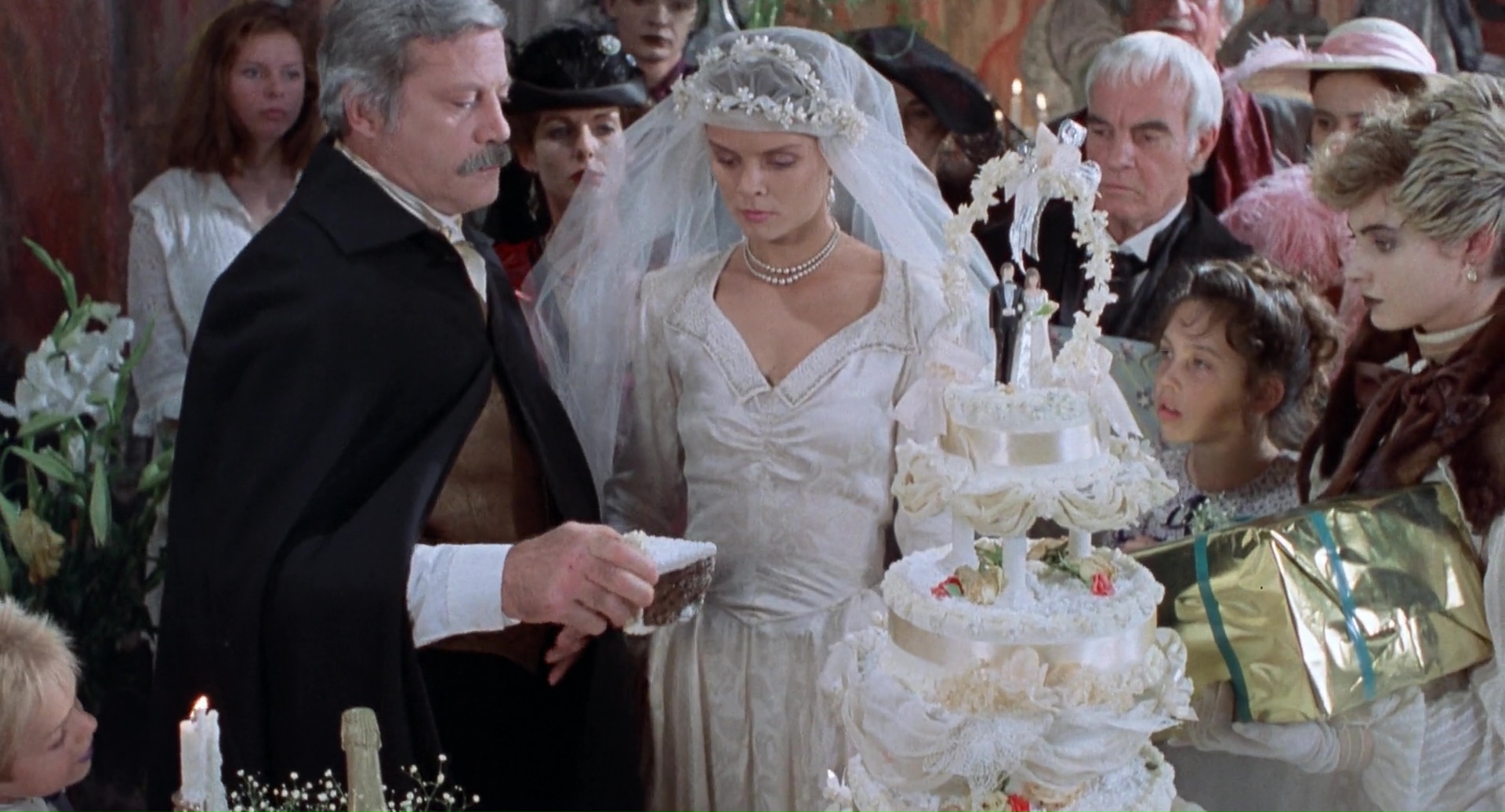
Horrifying as this seems however, even worse is to come during a particularly grotesque, hallucinogenic dream sequence (presumably modelled after those in the Corman/Poe pictures) depicting a daemonic marriage ceremony between Reed and Windsor. Here, we see Reed pick up a slice of a gigantic, tottering wedding cake, force it into Windsor’s mouth, and pull it out again with his teeth! Lord in heaven, I’ve never seen anything so repulsive.

Again, we should probably refrain from making any assumptions about a movie’s behind the scenes production circumstances, but whatever the truth of the matter, you’d better believe that this sight will leave a scar on my memory far more severe than any of the film’s ostensible ‘horror’ moments. You have been warned.


Moving swiftly on, another aspect of this ‘House of Usher’ liable to scar one’s senses is Leonardo Coen Cagli’s defiantly excessive production design, which throw the film almost immediately into a realm of phantasmagorical theatrical camp.

Although a few brief exterior shots on the Usher mansion were shot - I believe - at Knebworth House near Stevenage (an impressive Tudor edifice previously seen in ‘Horror Hospital’ (1973) and the aforementioned ‘Lair of the White Worm’), the interior sets are once again comically ill-matched.

To give credit where it’s due, Molly’s aforementioned bedroom is genuinely impressive in a crazy sort of way - a vast, medieval chamber decked out entirely in nightmarish pastel blue, it’s the kind of space which would indeed have fit the bill for a latter-day Ken Russell movie. The main ‘entrance hall’ set, complete with marble staircase, gilt curtains, hooded, faceless statues and Rubik’s Cube-styled windows, is pretty overwhelming too, conveying a similarly OTT, dreamlike feel.


Other areas within the candy-coloured mansion fare less well however, with a distinct whiff of air-brushed polystyrene and Dulux applied straight to plywood often predominating. Worst of all in this regard must be the ‘chapel’ set, which some overzealous scene painter has decorated with little black twirls, flames and spray-painted skulls, putting me in mind of the ‘goth room’ in some provincial indie nightclub. 


Uncle Roderick’s briefly mentioned background as an artist appears to have encouraged the film’s designers to load these sets up with all manner of mismatched tat, from Rodin-esque modernist sculptures to looming gargoyles, all-seeing eye covered Klimt pastiches, Italianate murals, moth-eaten Turkish carpets, faux-marble angel-y crap - you name it, and so long as it looks awful, it’s probably in here somewhere.

(It would probably be snarky to question how exactly all this is supposed to jibe with Roderick’s “acute sensitivity to certain colours”, which early in the film forces Molly to change her evening attire to “something a little more tasteful”, even though her initial choice of dress, though admittedly horrible, was actually a pretty good match for the mansion’s decor.)

Not that any of this is so dreadful in-and-of-itself, I should clarify - if anything, I appreciate the film’s wild disregard for realism and poverty-stricken attempts to overwhelm our senses. The problem lies more I think with DP Yossi Wein’s photography, which for the most part is odiously over-lit, its relentless brightness allowing no real mystery or atmosphere to accrue within these unhinged surroundings, highlighting their artificiality and essential silliness at every turn.


For all this baked-in shoddiness though, ‘House of Usher’ ’89 will still prove impossible for some of us not to enjoy on some perverse, unheimlich level. As uncharitable as some of my comments here may seem, I nonetheless found Birkinshaw’s film to be an absolute hoot, and would wholeheartedly recommend it to any admirer of distressed gothic aesthetics or oddball British horror.

Clearly a product of the same warped well-spring of inspiration which brought us ‘Killer’s Moon’, it is packed with enough uncouth eccentricities, bad ideas and baffling non-sequiturs to leave even the most jaded of psychotronic movie fans reeling - the aforementioned ‘cake incident’ foremost amongst them. (Hint when doing a psychedelic dream sequence, by the way: cutting away to shots of the dreaming character thrashing around in bed tends to spoil the effect somewhat.)

Early on for instance, we get a leering, grand guignol fake-out worthy of Todd Slaughter, as Clive the butler appears (for no apparent reason) to jam his wife’s arm into a hand-operated mincing machine, convincing us for one breathless moment that we’re witnessing a psychotic outburst of sickening gore… only for her to raise her arm from behind the machine, revealing that it’s merely the meat for tonight’s dinner being ground up. What larks.

Actually, now that I stop to think about it, pretty much all of the film’s big ‘horror highlights’ are equally arbitrary, not to mention highly derivative; hungry rat in cage (courtesy of ‘1984’, or possibly The Virgin of Nuremberg), grabby arms emerging from wall (‘Repulsion’ and/or ‘Dawn of the Dead’), head on serving platter (‘Tales That Witness Madness’ poster) - you get the idea.


Elsewhere, there is also much amusement to be gleaned from Molly’s pre-Usher profession as a hair stylist to the rich & famous. Apparently for instance, she’s so dedicated to her work that she managed to squeeze one of those full size Bakelite helmet hairdryer things into her suitcase!

Later, as she weeps inconsolably after learning that her fiancée is dead, the ever thoughtful housekeeper - distant and rude to fault through the rest of the film - picks her moment and asks, “I know you’ve got a lot on your mind, but whilst you’re here, could you do something with my hair?” Ever professional, Molly’s response is to throw her a can of mousse - “men love spikes”, she advises. (Recalling ‘Killer’s Moon’ again, moments like this cause me to wonder whether Birkinshaw had once again called upon his sister Fay Weldon to throw a few curveballs into the script.)

More emotional cross-wires can meanwhile be found in the final act, when Clive the butler learns of the deaths of his wife and child in separate Usher-instigated rampages - incidents which would play as tragic, gratuitous or cruel in most films, but here Birkinshaw pushes us straight into comedy by getting Norman Coombes to deliver two identical “OH MY GOD!” reaction shots in quick succession.

Another inexplicable curiosity meanwhile arises the film’s delightfully low rent synth score, jointly credited to two composers - George S. Clinton and Gary Chang - who both went to to enjoy noteworthy Hollywood careers, unlikely as that may seem. IMDB authoritatively informs me however that the rather fine, Carpenter-esque main theme used throughout ‘House of Usher’ was originally composed by Chang for John Frankenheimer’s 1986 Elmore Leonard adaptation ’52 Pick-up’, of all things. Had Towers just been pilfering tapes whilst visiting Cannon’s offices or something? God Only knows.


But wait a minute - didn’t I state, way back in the opening paragraphs of this review, that Donald Pleasence is in this film? Well, he is indeed! Turning up in the last half hour, he plays… well, to intents and purposes, he’s playing Saul Femm from James Whale’s 1932 ‘The Old Dark House’.

As the heretofore unmentioned lunatic brother locked in the attic, he manages to convince our heroine that he’s a poor, unfortunate fellow prisoner, before revealing, once granted his his freedom, that he’s actually a ruthless homicidal loon hell-bent on destroying everything in sight! (As in Jack Hill’s ‘Spider Baby’, these Ushers are cursed with a degenerative blood condition which pushes them further into psychosis as they get older, meaning that Pleasence’s character is pretty far gone.)

As usual, Pleasence does great work here. Evidently aware of his character’s pre-war inspiration, he has a great time putting his own spin on Brember Wills’ unforgettable performance in Whale’s film, bringing a sense of gravitas to his dialogue which temporarily even convinces us to take the film seriously. (“Thank god, an ACTOR,” I recall thinking at this point.)

Pleasance’s character is confined to a wheelchair (OR IS HE?, etc), and, apparently on account of his penchant for sculpture, he has a domestic hand drill strapped to one of his arms. Though allegedly utilised in a few moments of gory (off-screen) violence, I was chiefly struck my how thoroughly UN-threatening this looks, particularly when - in a moment which in a sense seems to sum up this movie’s crazy charm perfectly - he responds to being shut behind a locked door by a fleeing Molly by angrily drilling a series of very small holes straight into the plywood walls of the set! Whatcha gonna do Donald, hang some pictures?


Needless to say, this whole farrago concludes the only way it possibly could, with a decent into blood-curdling hysteria which Oliver Reed and Donald Pleasence rolling around on the floor in a frenzied, mutually suicidal wrestling match (shades of ‘Women in Love’ perhaps?), as the Corman/Poe-mandated conflagration erupts around them, sending these horrendous sets up in smoke once and for all.

Meanwhile, having rescued her hunky fiancée from behind a polystyrene tombstone, Romy Windsor finally flees back out into the fresh air of Knebworth House, presumably contemplating an immediate change of profession. (Actually, she went on to roles in ‘Surf Ninjas’, ‘Camp Nowhere’ and ‘Howling IV: The Original Nightmare’, but safe to say no more Harry Alan Towers productions were forthcoming.)

Towers and Birkinshaw though ploughed straight on in the same furrow, ensuring that ‘House of Usher’ was released more-or-less back to back with their visionary re-imagining of ‘The Masque of the Red Death’ - a film so assaultively crass it makes this one looks like a model of respectful sobriety by comparison. All being well, we’ll hopefully be digging into the garish mysteries of Red Death ‘89 here soon, so gird your loins folks, and make sure you come prepared. (Blindfolds, tranquilisers and hard liquor are all recommended.)