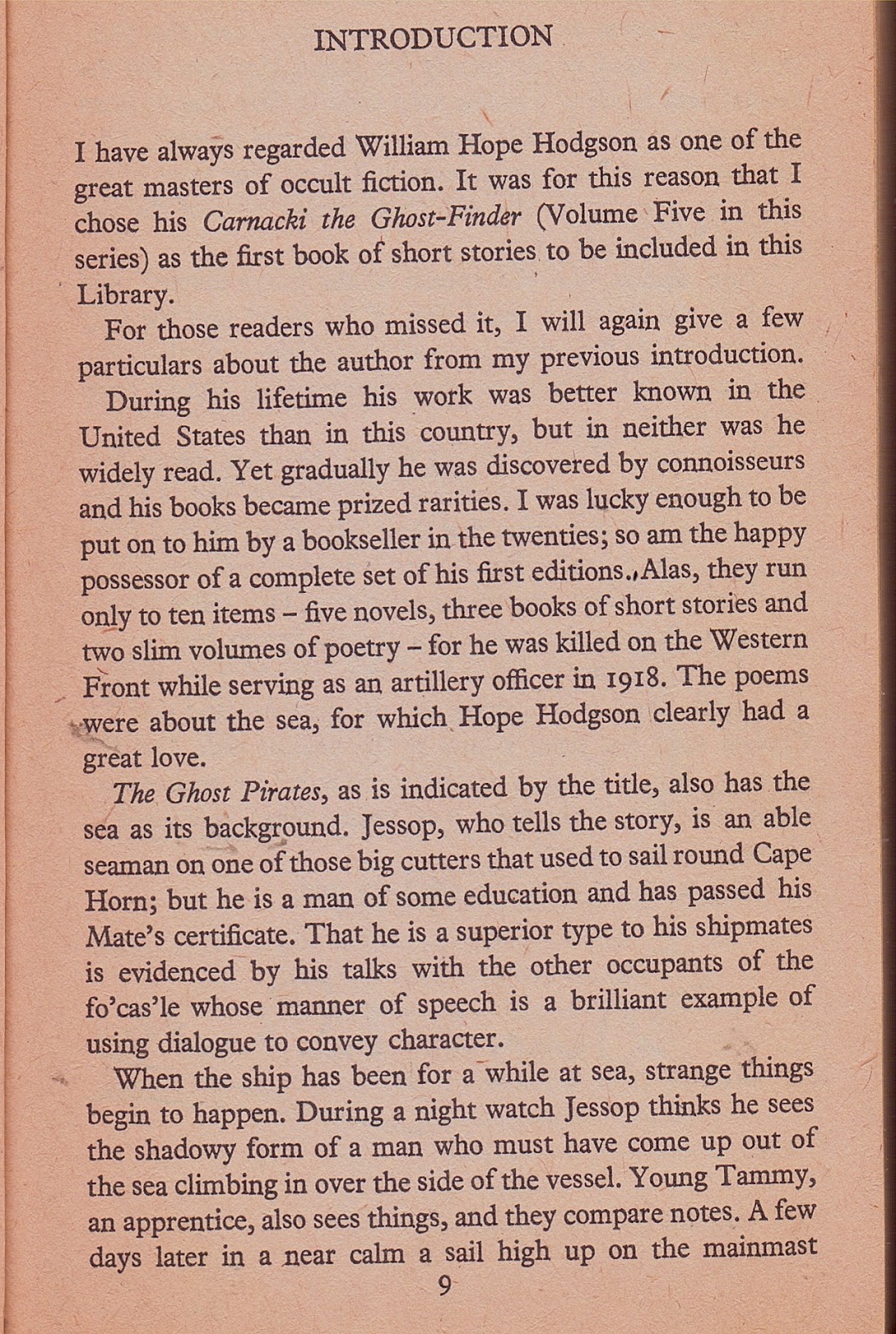
After searching for this book for much of my adult life (because if one of the greatest cosmic horror authors who ever lived had a yarn about Ghost Pirates, I want to read it), I actually found this copy in Japan a few years back, bizarrely enough.
I had intended to use it as the basis for one of my (long-neglected) series of Weird Tales posts, but after I actually started reading it, I soon put that idea aside.
It’s not that the book is disappointing as such, but… well let’s just say that it was clearly written as much for enthusiasts of nautical fiction as for fans of ghost stories. As such, the story’s supernatural elements are introduced extremely slowly and with great subtlety, whilst the relentless application of highly detailed seafaring jargon meanwhile leads to the book becoming quite difficult to follow for readers who grew up subsequent to the Great Age of Sail.
Much of the action concerns sailors running around different parts of the ship preparing for different weather conditions, and as such, a diagram to help us landlubbers identify the various decks, masts, sails and rigging referenced in the text would have proved extremely helpful. Characterisation meanwhile is fairly minimal, making it difficult to engage with what seems like a fairly boilerplate narrative of a band of able seamen caught between the regime of a sadistic and unreasonable First Mate and that of a distant and allegedly drunken Captain.
As is usually the case with Hodgson however, the novel’s supernatural revelation, when it does finally arrive, is actually a bit of a mind-blower. Rather than being harried by a more traditional ghost ship, it turns out that the vessel upon which the books characters are sailing has actually become trapped between dimensions, and thus is kind of ‘overlapping’ with the space occupied by an alternate universe vessel whose malignant, spectral occupants are gradually picking off our human crewmen one by one.
Pretty freaking far out, especially when you consider that Erwin Schrödinger first introduced the theory of parallel universes into popular thought in 1952, over forty years after ‘The Ghost Pirates’ was first published.
All four of the films included in Criterion Eclipse’s recent When Horror Came To Shochiku collection are pretty interesting and enjoyable in their own right, but for me the pick of the litter was definitely Hiroshi Matsuno’s ‘The Living Skeleton’ – noteworthy not just as the sole black & white film in the set, but also as the only one that veers closer to a Western-style supernatural horror than to an Ishirô Honda-influenced sci-fi/monster flick.
Well… to a certain extent, anyway. A delirious mixture of ‘60s gothic, ghoulish mad science, psychic turbulence and macabre aquatic psychedelia, one of the things that helps make ‘The Living Skeleton’ so unique is its refusal to tie itself down to any easily definable set of genre conventions, or to really go where you’d expect it to; Weirdo Horror in excelsis, basically.
Case in point is the startlingly brutal opening sequence, which doesn’t exactly scream “gothic horror”, instead throwing us straight into a nightmare scenario of an entirely different order, as the occupants of a modern day passenger ferry – the ‘Dragon King’ - are imprisoned and coldly massacred by a gang of machine gun-wielding pirates.
The most memorable shot here (an optical FX job, presumably) features the screaming face of a doomed woman reflected in the lenses of the sun-glasses worn by the scarred, bald-headed leader of the attackers – an image whose central significance to the story that’s about to unfold will gradually become clear, but which for now merely serves to highlight the surprising level of stylistic ambition exhibited by Matsuno and his collaborators. Certainly, in comparison to the rather workmanlike fimmaking seen in Shochiku’s other horror/SF titles, the quality of the direction and cinematography here is excellent, and remains so throughout, with rich black & white photography and some beautiful, deep focus compositions really setting the film apart, leaving only some shaky nautical model shots and lovably dodgy special effects (bats on strings, rubber skeleton attacks, that sort of thing) to reveal it’s poverty row origins.
Once this out-of-leftfield prologue is taken care of, a dreamy, gothic atmosphere increasingly begins to take hold, as the story (such as it is) proceeds with a heavy, doom-laden feel that recalls nothing so much as Jess Franco’s ‘Nightmares Come At Night’ or ‘A Virgin Among The Living Dead’, presenting a vague and uncertain tale of interchangeable identical twins, ghostly manifestations and fantasy/reality disjuncture that proves is just as difficult to summarise in concrete terms as the aforementioned Franco films, however much sense it might make on an emotional level.
With her porcelain features, big, sad eyes and sombre, elegant movements, leading lady Kikko Matsuoka is certainly every bit the Japanese answer to Soledad Miranda or Diana Lorys, and makes a perfect casting choice for this rare example of a fully-fledged Nippon Gothic, here assuming the role of Saeko, identical twin sister of the girl we saw being killed on the ship, who now lives in a remote cliff top church, ward of a benevolent Christian priest.(1)
Out of sight of her benefactor, Saeko also enjoys a healthy romantic relationship with Mochizuki, a young fisherman, and generally seems to be enjoying a happy and relaxed existence. But when the wind blows in from the sea, she hears her sister’s voice calling her, and when she and Mochizuki go snorkelling, she experiences a vision of weird fake skeletons, looking look like something out of a Mexican day of the dead parade, dancing before her eyes. Soon, a thick fog rolls into the harbour, bringing with it the empty hulk of the ‘Dragon King’, and any hope we may have had of separating linear reality from Saeko’s subjective descent into vengeful, identity-shifting craziness goes entirely up the spout, in best Euro-horror tradition.
As things proceed, the bare bones of a good ol’ supernatural bride-wore-black vengeance narrative take shape, with Saeko and/or her ghostly sister tracking down and dispatching the venal pirates in short order. It’s all very much the kind of thing Franco might have come up with between courses at some local eatery, and is detourned in some equally interesting directions as well, taking in noir-ish segments, pulpy mad science and some shock reveals in the final half hour, building up to a hellzapoppin’ Laboratory-based climax that plays like something out of ‘40s Monogram b-picture amped up with ‘60s drive-in gore.
And in case you were worried things weren’t QUITE Jess Franco-like enough already, the 25 minute mark also brings forth a totally gratuitous nightclub striptease sequence, in which two stocking-clad dancers shake their stuff to languorous dinner club jazz! Heavens be praised.
(If anyone’s keeping track out there in Film Studies-land, it occurs to me that the opening shot of the dance routine, which features the two symmetrically posed dancers picked out by spot-lights, is a deliberate echo of the sunglasses reflection shot mentioned earlier, with both images serving to remind us of the film’s central tale of psychically conjoined twins. He was no slouch, this Matsuno-san.)
Even more so than Michio Yamamoto’s vampire films, ‘The Living Skeleton’ is full of explicit references to Western horror, many of them rendered inherently surreal by their placement in a Japanese setting. The dual role played by Matsuoka seems a direct nod to the traditions of ‘60s gothic horror, and, whilst steeples, crucifixes and Christian funeral services may go hand in hand with church setting, the endless swarms of bats, diaphanous night-gowns, stone dungeons and wrought-iron candelabras definitely seem a little too way out for any sense of realism to be maintained for long. (The priest’s study even boasts a medieval suit of armour amongst its accoutrements, ferchrissake!)
More specifically though, Matsuno seems to be most concerned here with plundering the same current of imagery that John Carpenter tapped into a decade or so later for The Fog. You know the score, I’m sure: isolated seaside locale, pirates, churches, priests, vengeful ghosts, staticy radio broadcasts, lighthouses, skeletons and fog – lots and lots of fog. The convenient discovery of a ship’s log divulging the dark secrets of the ghost-ship’s history is particularly synchronicitous in this regard, but I doubt there’s any direct influence going on here (the chances of Carpenter having seen this film back in the day are pretty slim, and even if he did, I’m sure he’s a solid enough guy to have acknowledged his debt). Instead, I feel this is once again just a parallel take on the same nexus of collective unconscious type imagery from filmmakers on opposite sides of the world, and another example of the same watery thread that runs through a whole swathe of my favourite horror films and stories, from Lovecraft’s ‘The Shadow Over Innsmouth’ to Messiah of Evil, Jean Rollin’s ‘The Demoniacs’, and beyond.
With no production back story or literary/cinematic forebears as such, and with a director and writers who seem to have come out of nowhere and swiftly returned there, (2) ‘The Living Skeleton’ is a real one-off, difficult to place within any grand narrative of Japanese genre cinema, Asian horror tradition, or much else for that matter.(3) About the nearest I can get to linking it to any of its domestic peers is in vague, thematic terms – there’s the ubiquitous figure of the long-haired avenging female ghost of course, and the overwhelming concern with the ocean and ships as a source of fear – a motif that seems to occurs again and again in post-war Japanese horror (I’ll leave you to draw your own conclusions) - plus the psychic vengeance angle, all of which remind me somewhat of Hideo Nakata’s ‘Ring’ (a film that increasingly seems like a sort of rosetta stone for the recurring thematic concerns of Japanese horror, in spite of its time-specific technological aspect).
Like the best under-the-radar Western horror films, there is a real “where the hell did THIS come from?” thrill to the discovery of a movie like ‘The Living Skeleton’; a feeling that any seasoned horror fan should relish. Though rather insubstantial and sluggish of pace here and there (there are a few of those ol’ run-time padding “journey between locations” bits that we could probably have done without), as a piece of film-making it displays a high level of style, visual imagination and atmosphere-building know-how; qualities which are only enhanced by its ‘grab-bag’ approach to genre conventions and plot ideas.
Further increasing our enjoyment, and cutting through the Euro-horror somnambulance somewhat, there are some great turns from a supporting cast packed with capable character actors - Asao Uchida as a crafty, drunken gambler, Nobuo Kaneko as a nefarious club owner and Ko Nishimura as the cadaverous ship’s doctor all provide great value for money. And even the soundtrack is excellent for that matter, with a main theme that mixes up spy movie strings with thin fuzz guitar buzzing like a wasp on the periphery (lest we forget which decade we’re in), with heavily-treated tremolo guitar and eerie, reverbed harmonica reveries elsewhere suggesting that the lessons of Morricone and Nicolai were not lost on composer Noboru Nishiyama.(4)
You’ve probably gathered as much already, but I’ll freely admit that I loved just about everything about ‘The Living Skeleton’, and would highly commend it to anyone who enjoys the kind of stuff I write about on this blog. Sharing some aesthetic choices with the very wooziest end of ‘60s/’70s Euro-horror, it is a thoroughly irrational, oneiric venture that sails closer than any other Japanese film I’ve seen to the kind of territory mapped out by filmmakers like Jean Rollin and Jess Franco at around the same time. Which perhaps isn’t everyone’s idea of a good time, but my own cry of delight at having discovered not just a Japanese Jess Franco film, but a Japanese Jess Franco film that is arguably more accomplished than any actual Jess Franco film, must have been audible from space.
(1) A prolific actress in the late ‘60s, Matsuoka’s more notable credits include roles in Kinji Fukasaku’s two Rampo/Mishima adaptations, ‘Black Lizard’ and ‘Black Rose Mansion’, and an uncredited appearance in ‘You Only Live Twice’.
(2) Well, co-writer Kyûzô Kobayashi also gets a script credit on the same year’s ‘Goke: The Bodysnatcher From Hell’, but aside from that I’m gettin’ nothing.
(3)As previously mentioned, Western-style Japanese gothic horrors are rare as hens teeth; investigations are ongoing, but the only one I’m aware of prior to ‘The Living Skeleton’ is Ghost of the Hunchback aka ‘House of Terrors’, a terminally obscure 1965 Toei film from ‘Goke’ director Hajime Sato. Unsubtitled DVD-R of an Italian TV broadcast anyone..?
(4)Another obscure figure, Nishiyama’s four credits on IMDB are rounded out by two little known Daiei films, and Koji Wakamatsu’s ‘Affairs Within Walls’ (1965).
“So I never hitchhiked before, and I just wanna be careful. Can I ask you something?” “Sure.” “Are you weird?” “Yes. Yes, I am weird.” “You’re weird? Thank god! The last ride I had was normal it was disgusting..”
There is something irreducible about The Fog – a simple story strongly and imaginative told, it inhabits a self-defined world oblivious to criticism. It is a slower, gentler and more visually expansive film than we would have expected from John Carpenter in 1980, and one of very few modern(ish) American horror films to zero right in on the kind of ‘comforting eeriness’ that forms such integral part of the appeal of the kind of older, ‘weird tales’ horror that the fim quietly references throughout. A beautiful communal viewing experience, “The Fog” plays as a mass media-era equivalent of the campfire ghost story so memorably narrated by John Houseman in the film’s opening.
A digression: can only speak for myself here, but I’ve always hated that Stephen King-birthed style approach to American horror stories that started to become prevalent through the ‘70s and ‘80s, wherein our story is seen to take place in a normal, healthy suburban community which is threatened by some malign outside influence. I mean, like I could give a crap whether Suzy and Bobby can get to school safely, or whether sinister occult forces are out to undermine the sanctity of marriage, or any of this other OH NO, THREAT TO THE STATUS QUO bullshit! I’m here to hang out with the weirdos! No, what I like are horror stories in which the world itself is weird - in which time and space seem frozen in some strange interzone in which the conflict or threat seems to grow, or return, from the surroundings that nature or humanity has built for it, rolling in as naturally as, well.. the fog.
I’m not sure whether I’m explaining myself very well, but this is something that is returned to time and time again in the films that appear further up this list, and it is a feeling that Carpenter captures perfectly through the town of Antonio Bay in “The Fog”.
Imagine if you will, a perpetually off-season Northern California coastal town, full of dark, empty streets, cheaply-built beach-houses stretching out into the bay. Businesses failing from a basic lack of people to patronise them, but continuing nonetheless, running on empty cos the rents are so low. Nautical knick-knacks, weather stations on the cliffs. Everyone is friendly, but kinda suspicious with it. Adrienne Barbeau is a single mother who runs a radio station that broadcasts out of a lighthouse, playing anonymous, jazzy muzak through the dark hours of the night. As the only DJ, she chooses to run the station through the night, and shuts it down during the day, for some reason. Janet Leigh is the mayor. Sailors and harbour officials look out to sea and talk boat-talk. Nobody ever really seems to do any work, and everyone is very vague about the concept of, y’know, leaving.
If you’re thinking “I wanna live there” then join the club. Come on over and and we’ll watch “The Fog” together. Rarely have I seen a more perfectly inviting mini-universe built up in a film, a place I’d be more inclined to walk straight through the screen and become part of. Dark secrets and vengeful ghost pirates notwithstanding, I wanna take a ride out to Spivey Point right now.
So many of the elements compiled in “The Fog” help to define a certain, strange strain of horror that I love, but that I don’t really have a name for. The isolation, the coastal setting. The disembodied radio broadcasts, severed communications, fragmented narration. The weird, highly localised folklore. Figures emerging from/returning to the sea. The lighthouse. These things move me wherever they turn up, but, oddly, we’ll be seeing every single one of them again in another film higher up the list – a film made before “The Fog” that I think is even better. I don’t believe the similarities are anything more than completely coincidental, but in some ways they are truly uncanny, as if the two were tapping directly into the same nexus of imagery and atmosphere…
Anyway, I could happily list the many, many qualities of “The Fog” all day long, but I’m sure that would be surplus to requirements. Should you ever find your faith in john Carpenter slipping, just consider that he made this – a film about vengeful ghost pirates so great that the vengeful ghost pirates are the least good thing in it.
For further elucidation, I direct your attention to this great piece written by Erich Kuersten of Acidemic earlier this year. I concur with all points made, and for some reason had never previously clocked the uncanny parallels to “The Birds”.
And so, we reach 1974’s ‘El Buque Maldito’, often screened to English-speaking audiences under the hedging-its-bets title ‘Horror of the Zombies’, ‘The Ghost Galleon’, or the slightly more specific ‘Ship of Zombies’.
This third ‘..Blind Dead’ movie, you’d have to admit, has a pretty cool premise. And I’ll bet it already sounded pretty cool when the production team got together to pitch some ideas around for the next Templar movie. “Ok, so how about we set the whole thing out at sea, and the Templars have their own ghostly galleon that emerges from a supernatural fog to prey upon becalmed sailors”, somebody must have said. “That sounds amazing!” the producers or financial backers must have responded, their minds filled with the promise of swashbuckling zombie/pirate action, “let’s do it!” And Amando de Ossorio must have sat back with a deep sigh, and contemplated the practicalities of actually making a workable zombie ghost ship movie on a Spanish b-movie budget. His thoughts must have then turned to the comfort of whatever material rewards the success of his first two movies had brought him, and the fact that his little horror franchise was now sufficiently well-established that whatever garbage he turned out would be distributed to fleapits, drive-ins and the like around the globe in a variety of butchered prints with misleading titles, whether or not it was actually watchable being a moot point.
And he must have just thought well, fuck it, and made an executive decision not to even bother getting out of bed for this movie if he could possibly help it. For, whilst I may have been unfairly snarky about the previous two movies in places, they’re masterpieces compared to this one. (It sure had a great poster though, huh?)
A total failure as a film it may be, but so strange is the manner in which it fails that in it’s own way it’s almost fascinating, a thoroughly lifeless excuse for a zombie caper inexplicably torpedoed by masses upon masses of needless, confusing exposition that almost takes over the movie from the poor old Templars.
Clearly this film’s creators learned nothing from the more surrealistic excesses of ‘70s Euro-horror, as exemplified by their countryman Jess Franco. So you want some girls in bikinis bobbing about in a boat in the middle of the ocean…? Well, JUST PUT THEM THERE, for christ’s sake! Bring the zombies, and we’ll ask questions later. This shit doesn’t have to make sense!
But such wisdom is lost upon de Ossorio and co, who chase their own tails through the whole first half of ‘Horror of..’/’Ghost Galleon’/whatever, trying to explain and legitimise their batty, convoluted storyline, and at the end of all that it STILL doesn’t make much sense. “Yeah, maybe”, I can imagine Amando sneering, “but now I’ve only got forty minutes left to fill and I’ve barely spent a peseta!” Fair enough I suppose.
So the plot – and I’m not looking forward to typing all this – centres on a feisty (yes, I’m afraid so) young model, who is trying to break her roommate / best friend into the modelling business, by getting her a contract with an exclusive agency. Roommate vanishes with no prior warning, after dropping hints that she’s landed a big job, and Feisty goes to complain to the head of the agency, and to see what’s up. When she arrives, she runs into this sleazy character who’s apparently some kind of well-known industrial mogul / international playboy type. And so our heroine stomps about petulantly, demanding answers for so long that everybody seems to assume she’s part of the furniture, and they start discussing their sinister, top secret conspiracy regardless of her presence. To wit: her roommate and another model are currently afloat in a motorboat in the middle of the ocean. This is part of an elaborate publicity stunt on behalf of Mr. Mogul, who wishes to reap the benefits of the attendant publicity when two pretty, bikinied girls are daringly rescued whilst modelling his company’s exciting new range of motor-boats! But of course! Makes sense, doesn’t it? Except for… well, except for the fact that it’s about the stupidest thing I ever heard.
Such a ludicrous plot device might have been just about passable if it were mentioned in passing in a more exciting film, but the sheer amount of time this movie spends arsing about with the ins and outs of this guy’s moronic scheme is almost a deliberate insult to the audience’s intelligence, although quite how far you’d have to go to successfully insult the intelligence of a guy who’s watching a bunch of movies about poorly animated skeletons menacing semi-clothed women and then wasting his time writing voluminous tracts about them on the internet, who can say.
Anyway, everybody at Mr. Mogul’s secret HQ seems to be treating this caper with the utmost seriousness, and tempers are frayed when the girls disappear off the radar, and report back by radio to say that they’re immersed in a mysterious fog and are unable to find their way out. Cut to the life-raft, where they’ve also caught sight of a creepy-looking old-timey galleon cleaving out of the fog, and the-girl-who’s-not-the-roommate decides to go and board it in search of help.
Meanwhile, Mogul and Head of Modelling Agency go to consult this science guy working for the coastguard, who initially rubbishes all their baloney about mysterious fogs, but when they mention some specifics on the galleon, he becomes extremely excited, telling them all about the legends of the evil ghost-ship and how he’s dedicated his life to studying its appearances etc. etc. His performance is hilariously OTT, momentarily livening things up. Mogul decides, well, Christ, we’re not getting any sense out of this guy, so I’m going to jump in my yacht to go rescue the girls. Science guy is all like, oh, please, please let me come with you, I’ve been waiting all my life for this moment, and oh, by the way, we’re all DOOMED, and we’ll never return alive. Sure, sure, the more the merrier, says Mogul, and so he, the modelling agency lady, the nutty professor, our feisty heroine and a couple of other characters for luck all set out on the yacht to get this shit sorted out.
Phew. In a certain sense, I almost respect the laziness Amando de Ossorio demonstrates with regard to every other aspect of this film, but I fear he missed a trick in not just replacing the opening half hour with a title card reading “Right, this is basically a remake of ‘Tombs of the Blind Dead’, ON BOATS.” Indeed, many of the film’s scene set-ups and character relationships seem to be directly recycled from the first movie.
And so it goes on. Sadly, the directorial flair and gleeful morbidity that de Ossorio brought to the proceeding films is nowhere to be seen here, as scene after scene is rendered with fixed camera, poorly focused long shots. Stripped of their horses and their medieval surroundings, the Templars, when they finally emerge, are a shadow of their former selves. With little in the way of interesting editing or atmospheric FX on hand to hide their essentially cheapo nature, their showing here must rank as one of the crappest gangs of cinematic zombies on record as they trundle around listlessly, arms stuck out straight in front of them in a thoroughly silly fashion.
Once everybody is trapped on the galleon, the film takes on a repetitious, Scooby-Doo-like ambience. Very, very slow Scooby-Doo, mind you. Scooby-Doo on ketamine, maybe. On and on it goes, as various combinations of characters traipse back and forth, back and forth across the same three wobbly ghost-ship sets, the whole thing seeming to drag on endlessly to no particularly satisfying conclusion, and indeed no conclusion at all in my case, as, I confess, I fell asleep for real this time, dreaming of unconvincing ghouls forever stalking poorly dubbed, barely recognisable characters across creaky pirate ships, in some self-sustaining nightmare of eternal boredom. This film is so mind-numbingly slow-paced in fact, even during scenes of distasteful, sleazy violence, that in places it feels as if they’re actually trying to make some kind of point about the banality of evil, as aptly demonstrated by the clip below:
There’s a fourth ‘Blind Dead’ film, mystifyingly entitled ‘Night of the Seagulls’ (boy, that’ll really pack ‘em in). Apparently it follows the further adventures of the Templar party-boat, as it comes to shore in a remote fishing village, where, I think it is safe to assume, our errant Knights probably chase around yet another bunch of scantily-clad girls, like the cadaverous Benny Hills they’ve been reduced to.
I’ve not yet seen ‘Night of the Seagulls’. I have no plans to attempt to see it, or to try to track down a copy. But nonetheless, I have no doubt that it's tale will be unfolding in front of my tired eyes before too long, whether I like it or not. Pity me.
Or rather, don’t pity me, it’s my own stupid fault. I could have spent the time trying to come up with something worthwhile about Godard or Louis Malle, or about some genuinely good forgotten masterpiece. But I didn’t. Instead I wrote this, using far more words than is strictly necessary to write a ‘comprehensive’ guide to a four film cycle of dubious merit, despite the fact that I fell asleep halfway through the third film, and didn’t really pay much attention through parts of the second. Perhaps these lapses can themselves be seen as critical judgements, or at least as honest reflection of my own personal engagement with this odd series of films? Clearly I would have been kicked out on my ass had I tried to submit all this to even the most sloppy of print publications, but, such is the glory of the internet age that I can do whatever I like, safe in the knowledge that perhaps four, maybe even five, people will have read this far. And it is they who should truly be pitied. I mean, at least the girl who got tied to a rack and stabbed by a skeleton in ‘Return of the Evil Dead’ hopefully got paid for her troubles.