So, synopsis time! A painfully introverted PhD student specialising in behavioural patterns of marine life, Siobhán (Hermione Corfield) is reluctantly persuaded by her supervisor to undertake a bit of fieldwork - namely, signing up for a research excursion on rust-bucket fishing trawler the Niamh Cinn Oir, wherein she makes the acquaintance of the unfeasibly diverse crew with whom she (and we) will spend the next 90-odd minutes.
In contrast to the wall-to-wall rough bastards you’d reasonably expect to find manning an Atlantic trawler, we’re instead introduced to hard-bitten yet well-meaning husband and wife skipper team Gerard and Freya (Dougray Scott & Connie Neilson), their sturdy and ever-cheerful son Johnny (Jack Hickey), and the family’s superstitious, and indeed suspicious, grandma Ciarra (Olwen Fouéré). Below stairs meanwhile, we’ve got Syrian refugee and unrecognised engineering genius Omid (Ardalan Esmaili) and another young man of middle eastern descent, Sudi (Elie Bouakaze), whose girlfriend is expecting a baby back home, and who regales us with his plans for a happy future, so -- I’m sorry mate, but you realise we’re in a who’s-going-to-die-first horror movie here, so might as well just get you measured up for that body bag right now, eh?
Speaking of which, exposition of the film’s supernatural plotline is wisely kept paper-thin, but long story short: after Skipper Gerard plots a course through a maritime ‘exclusion zone’ in search of a better catch, the trawler finds itself colliding with what transpires to be an unprecedentedly huge, translucent squid-like creature, whose suckers soon cause little patches of alarming, corrosive goo to begin seeping through the hull.
Sadly, the conspiratorial angle implicit in the fact that this massive, unknown creature is simply flopping around happily in an area from which the powers-that-be have pointedly prohibited civilian shipping is never investigated by Hardiman’s script, but no matter, as there’s plenty else going on to keep our characters busy once their vessel breaks away from the squid’s grasp. Not least, an unknown infection of spreading through the crew causing a variety of unpredictable, scary symptoms, furiously multiplying parasites in the water supply, a sabotaged engine, no means of contacting the outside world, and… well, you get the picture.
During ‘Sea Fever’s first half, the film’s gloomy tone, overcast, seaweed n’ barnacle-drenched ambience and plausible-seeming scientific chat all rather put me in mind of early ‘70s UK TV staple Doomwatch, establishing an atmosphere of drab realism which nicely enhances the impact once the full-on SF/horror elements are let out the bag and given a run around later on.
In particular, the low key atmos which prevails aboard ship contrasts nicely with the notes of Lovecraftian awe conjured up by the effects-heavy underwater sequences wherein we encounter the mysterious life forms first-hand, in footage whose eerie, CG-enhanced beauty proves surprisingly effective.
By far the film’s strongest suit though turns out to be its ensemble performances, with the cast having clearly been given a free hand to treat the whole thing as a long-form chamber piece/collaborative exercise, as all concerned do great work in transcending the potentially clichéd roles assigned to them by the script, effectively capturing our sympathies/attention in the process.
Though it can make few claim toward originality (see below), writer/director Neasa Hardiman’s screenplay is nonetheless peppered with curious bits of detail which also help add a bit of depth to proceedings, whether through random folkloric digressions (such as grandma Ciarra explaining the significance of the trawler’s name, or the crew reacting with consternation to the discovery that they’ve inadvertently set sail with a redhead aboard ship), or the assorted cool, DIY schemes Siobhán and Omid come up with to try to fight back against the alien incursion (using a hacked smartphone to generate UV light for instance); schemes which, refreshingly, totally fail to work in most instances.
There are, it must be said, a few glaring absurdities which stretch credulity along the way - most notably the vexed issue of the radio, which apparently falls apart after the boat bumps into the squid, causing the skipper to immediately declare that they’re now out-of-contact with the mainland, despite not even bothering to ask the two highly proficient tech bods on-board to try to fix it. (And what, no back-up radio? GPS tracking? Distress signals? FLARES, fergodsake? I mean, I’ll cop that it’s a been a few years since I spent any time on a boat, but I’d imagine it must take more than a few loose wires on the ol’ CB for a 21st century fishing trawler to declare itself lost without hope…?)
But, the crew must of course be entirely isolated in a confined space - that’s the point, for such is a prerequisite of the formula which inevitably takes ‘Alien’ as it’s foundational ur-text. In addition to which, it must be acknowledged that Hardiman draws heavily on the blue-print provided by John Carpenter’s ‘The Thing’ here, hitting most of the same basic plot beats to one extent or another, and repurposing a number of that film’s key set-pieces in a manner which I scarcely need to unpack here, so bleedin’ obvious will it be to the vast majority of the viewing public.
But, if you’re going to steal, steal from the best etc, and within the limited gene pool of ‘Alien’/‘The Thing’-type movies, ‘Sea Fever’ makes optimum use of its modest resources, rarely putting a foot wrong. Not exactly a mindblower or shredder of preconceptions then, but, the next time you find yourself in search of something to fill that particular salty sweet spot in your viewing schedule - look no further folks, this one’s solid.
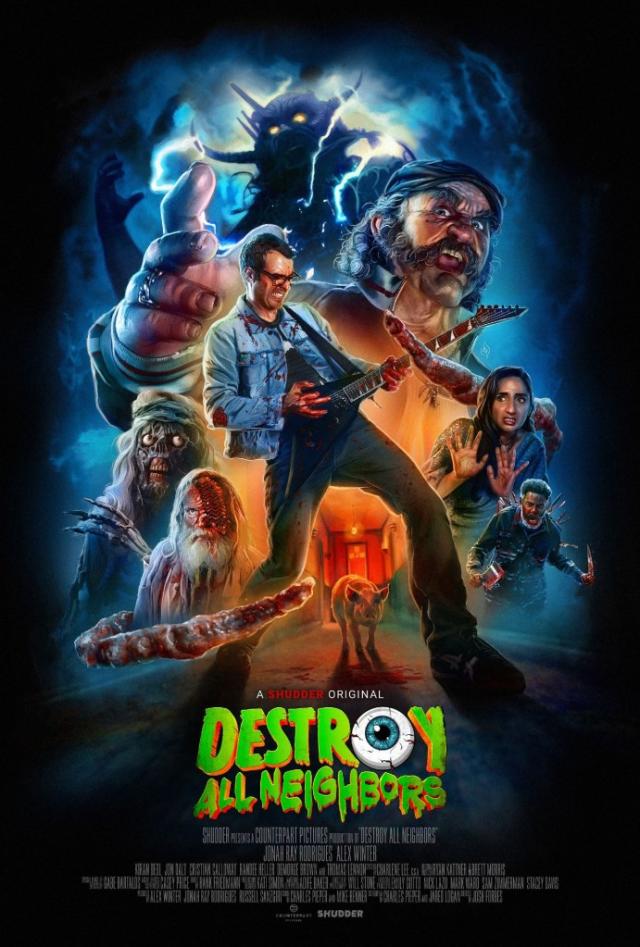
Later on said night though, spirits were subdued (and low level spending priorities reassessed), as it was agreed that Josh Forbes’ gonzo horror-comedy just didn’t quite hit the spot.
It’s difficult for me to put my finger on quite why that is though, given that all the necessary elements for a good time do indeed seen to be present and correct in this saga of an anxious prog-rock obsessive William Brown (Jonah Ray) battling to complete his home-recorded magnum opus in the face of overwhelming disruption from his bestial new neighbour (Alex Winter of ‘Bill & Ted’ fame, unrecognisable under a mass of prosthetics).
Indeed, there are a lot of individual bits and pieces here which I liked a lot - not least copious amounts of muso/record nerd humour, partially arising from the amusing mythos surrounding the film’s fictional prog titans Dawn Dimension, and a ton of wild and oft-impressive practical gore effects sure to warm the heart of any ‘80s horror fan.
Ray does great twitchy, whining, self-pitying work in the lead role, whilst still managing to make his character at least somewhat sympathetic, and there are numerous scenes and individual gags along the way which are genuinely very funny, but… I dunno, man. Somehow the overall structure and tone of the whole thing just felt off - its story and characters presented in an indigestible, sometimes frankly just plain obnoxious, fashion which I didn’t really care for.
The problems begin, I feel, with Winter’s characterisation of Vlad, the nightmare neighbour. Buried under such heavy, orc-like make-up that we initially wonder whether he’s even supposed to be human, Winter seems to be going for a kind of broad, Eastern European macho stereotype here, dropping weird, garbled dialogue which frequently proved difficult to decipher. He’s certainly an unnerving presence, that’s for sure, but… I think he’s also supposed to be funny, and on that level, well… I just don’t get it, I guess?
Likewise, several of the film’s other OTT comic characters (the coke-addled, Crosby-esque singer-songwriter who makes William’s day-job at a recording studio a misery, the hobo who hassles him for croissants on his way to his car, etc) represent an aggressively emphatic brand of low-brow / one-joke character comedy which soon becomes both tedious and exhausting.
This is especially regrettable, given that the bits of the film which actually are funny (such as William’s attempt to bribe the security guard outside a blast furnace with a rare demo tape, or his interactions with his long-suffering girlfriend (Kiran Deol)) tend to be those which adopt a more low-key / down-to-earth kind approach, letting the surrealism of William’s increasing disconnection from the world outside his head sink in more effectively than all the putty-faced gurning / shouty stuff utilised elsewhere.
Although it was presumably Forbes’ intention for us to feel thoroughly disorientated by the descent into hallucinatory psychosis which accelerates after [not-really-spoiler-alert] William kills Vlad and dismembers/disposes of his body, the film soon begins to feel confused and rudderless at this point, in a manner which I don’t think was entirely intentional (an effect not exactly helped by a number of exceptionally unlikely plot twists).
By the time we reach the grand excelsis of the movie’s conclusion, which sees William finally finishing his album aided by a band of re-animated monster corpses in a hi-jacked studio utilising phantasmagorical, lightning-blasting equipment, we can certainly enjoy all the triumphant audio-visual, effects-driven absurdity of the situation, but at the same time, I couldn’t shake the feeling that the essential point of the exercise had been rather lost in transit (a feeling perhaps not inappropriate to the film’s unabashed celebration of bombastic prog excess).
Is this, essentially, a parable about the dangers of shutting the people around you out of your creative life? If so, I fear it doesn’t really come across terribly well. And, I realise that being cynical and un-PC and so on is cool in this cultural context, but should the film really be taking William’s ghastly crimes quite so lightly? Are we supposed to continue to identify with his personal/creative struggles as he alternates between whining self-pity and delusional slaughter? Because doing so is tough-going, frankly, but as we’re never allowed to leave his increasingly suffocating subjective POV, we’re never offered an alternative.
Whereas the presumed prime influences on Forbes’ film (Frank Henenlotter, early Peter Jackson) managed to skate across such questions in their work with charm, grace and a certain degree of humanity, ‘Destroy All Neighbours’ instead ultimately collapses in on itself, leaving behind a nasty residue of white boy smarm and mild nausea.
Perhaps that old chestnut about the perils of deliberately setting out to make a ‘cult movie’ may be applicable here? Or, pure speculation on my part, but perhaps the film’s problems simply stem from the contributions of its three credited screenwriters being insufficiently integrated into a coherent whole? Whatever the case though, sadly ‘Destroy All Neighbours’ many virtues as a piece of crazy-ass, low budget genre cinema find themselves scattered unevenly amidst a flood of nasty, unpalatable goo which just won’t wash out.

Naturally, this set me to wonderin’ what became of the film’s director, who looked to be the Great White Hope of US horror cinema for a few minutes back there. To be honest, I lost track of his career following 2011’s underwhelming ‘The Innkeepers’, so, it’s a great feeling therefore to catch up with his triumphant return to the world of mid-budget horror all these years later, and to discover that it builds upon many of the qualities which impressed me so much in ‘House..’.
So, once again, ‘X’ gives us a beautifully detailed period setting (late ‘70s rather than early ‘80s in this case), and again includes an extremely lengthy (but almost hypnotically captivating) ‘slow burn’ build up before anything happens to 100% confirm that we’re definitely watching a horror movie. But, when those things do finally begin to happen, they do so in a way which proves extremely satisfying.
Before we get to all that though, ‘X’s initial set up - in which a threadbare cast and crew set off for a remote Texas farmstead to shoot a zero budget porno movie - proves interesting, fun and (like every aspect of the film) reflective of a writer/director with an innate understanding of (and love for) the aesthetics of vintage genre filmmaking.
It’s easy to imagine for instance that any number of the ultra-scuzzy regional ‘70s porn flicks which survive today as anonymous, public domain scans of heavily damaged prints could well have been the one these guys are setting out to make here, whilst the character dynamic which plays out between the opportunistic strip club-owner producer and his seasoned sex industry ‘stars’ on the one hand, and the high-minded film student cameraman and his girlfriend/assistant on the other, seems modelled to some extent on that documented in Joel DeMott’s legendary Demon Lover Diary from 1980.
Which is to say that, as in any good slasher film, there is plenty going on here to keep us busy until the vaguely defined threat lurking somewhere out in the darkness finally takes shape and makes its presence felt - and, needless to say, plenty of opportunity to fill the opening act with sex, and arguments, and people running around at night without (m)any clothes on, without seeming too forced or far fetched.
And, make no mistake - this is an extremely good slasher film. No more, no less. (Well, perhaps just a little bit more? See below.)
Without resorting to Tarantino-style fanboy blather, West dutifully doffs his cap to all the requisite precursors in this particular backwoods corner of the genre (not only ‘Psycho’ and ‘Texas Chainsaw..’, both directly referenced in the text, but also ‘Eaten Alive’, ‘Tourist Trap’, etc), and proceeds to do right by them.
And, once ‘X’ locks into a familiar stalk n’ slash pattern during its second half, the director plays a very nice little game with genre expectations which I’ve rarely seen any other contemporary filmmaker achieve too successfully. Namely, giving us exactly what we expect to happen - but still making it work.
When discussing music after a few drinks, I’m sometimes inclined to grandly declare that the art of great rock n’ roll lays in doing the simple stuff well, and, in both ‘X’ and ‘House of the Devil’, West seems determined to prove that the same formula can also be applied to horror filmmaking.
Based on these two examples at least, notions of surprise and unpredictability (usually so key to horror/thriller storytelling) play very little role in his cinema. Anyone with the slightest familiarity with genre conventions should be able to grok the entire premise of ‘X’ right from the outset, and in each of the film’s ‘kill scenes’ in turn, exactly what we think is going to happen happens.
But, in West’s hands, it happens really fucking well. Like a chef who has spent his life carefully refining the same menu night after night, he gives it to us but good.
(In fact, West’s dedication to perfecting the predictable even goes so far as orchestrating the best needle-drop of ‘(Don’t Fear) The Reaper’ in movie history, right at the pivotal moment bridging the film’s “slow burn” and “horror” sections. Again, original it ain’t - but awesome it surely is.)
Meanwhile, another similarity which unites ‘X’ and ‘House of the Devil’ (and indeed ‘The Innkeepers’, insofar as I recall) is the idea of the old preying upon the young, drawing explicitly upon the implicit fear of the elderly or infirm which lurks just beneath the surface of so many teen-centric ‘70s/’80s horror films.
Which brings us neatly to is what is ostensibly ‘X’s main talking point (though it is not something I found terribly interesting whilst in the process of actually watching it) - namely its status as quite possibly the first film in history to feature characters aged in their 20s and their 80s played by same actress (rising star Mia Goth, who delivers one hell of a performance in both roles, just for the record).
Surprisingly unaddressed in the writing I’ve seen about this film is the fact that, whichever way you cut it, the concept of getting young actors to don heavy aging make-up to play elderly characters seems pretty damned offensive, even in cases where those characters aren’t portrayed as psychotic killers. (As a comparison, just consider how far you’d get these days trying to make a film in which the same methodology was applied to race, or to disability, and you’ll see my point.)
At best, this could usually be considered fairly distasteful practice, inherently disrespectful to the older actors who may potentially have appreciated the chance to play these roles; but, in this case, as so often in the best horror movies, I think we can make an exception.
By which I mean, in addition to the practical difficulty of finding elderly performers willing / able to pull off the kind of physical extremity required of ‘X’s Pearl and Howard, I think we can also place ‘X’ within a lineage of horror cinema going all the way back to Tod Browning and Benjamin Christensen, in which filmmakers have purposefully stepped beyond the bounds of ‘good taste’, courting offense or disgust in order to confront viewers with taboo imagery and uncomfortable ideas, viscerally challenging conventional screen representations of ‘difference’, and hopefully provoking some thought in the process.
By casting heavily made up young actors as his damaged and homicidal geriatrics, West seems intent, not just on forcing us to question our own discomfort at the idea that aging/unattractive bodies may still harbour physical desire and the yawning gulf between flesh and spirit implicit in this, but also in drawing our attention to how thoroughly such unexamined fears permeate many of the 20th century horror films we all love so much.
Heavy stuff to unpack, you'd have to admit, but, like all truly great pulp/genre art, ‘X’ evokes these ideas merely as a by-product of simply being a fun watch - a perfectly-crafted, fantastically enjoyable exemplar of its sub-genre, whose side order of taboo-breaking thematic discomfort never spoils the deep sense of basic, popcorn-munching comfort this implies.