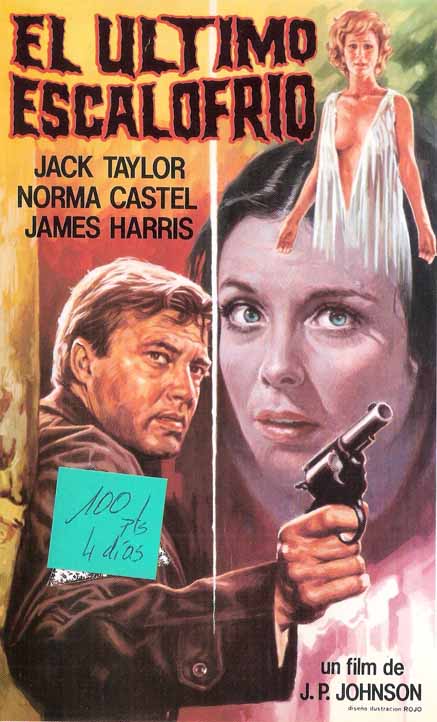
AKA: ‘Des Frissons sur la Peau’ (‘The Shiver of Fear’, France), ‘Le Chemin Solitaire’ (‘The Solitary Way’, France?), ‘El Ultimo Escalofrío’ (‘The Final Chill’, Spain), ‘French Emanuelle’ (UK), ‘Sicarius: Febbre di Sesso’ (‘Sicarius: Sex Fever’, Italy).
In several interviews conducted for DVD releases of his films, Jess Franco expressed a strong dislike for the work of ‘Emmanuelle’ director Just Jaeckin, claiming (if I recall correctly) that Jaeckin’s erotic films were cold, soulless affairs in which the director arranged his female cast like shop window dummies – in contract, presumably, to Franco’s own somewhat earthier and more emotionally engaged approach to dirty movie-making.
As such, one imagines Franco must have been less than thrilled at the prospect of making movies with ‘Emanuelle’ (one ‘m’, you’ll note, to avoid legal action) in the title, as seemingly became obligatory for all purveyors of euro-smut in the decade following the success of Jaeckin’s film. Perhaps we could read a certain black humour into the fact that this, Jess’s first ‘Emanuelle’ cash-in, features the titular character (here played by Norma Kastel) falling to her death from a clifftop balcony within the opening half hour, after which the movie becomes a flashback-heavy investigation into her murder… although, that reading of events is rather torpedoed by the fact that this film was actually shot BEFORE Jaeckin’s 'Emmanuelle', and was first screened in France in 1973, under the title ‘Des Frissons sur la Peau’.(1)
As has been mentioned in these pages before, Franco was pretty much on fire through the years 1972-74, producing an absolutely staggering quantity of work, much of it amongst his very best, the director working so fast that his films from this period almost seem like the result of cellular multiplication, with themes, locations, casts, costumes and script ideas all blurring into one another to create a sprawling sea of cinema that arguably represents the creative peak of Franco’s career.
Perhaps shot sometime between ‘La Comtesse Noire’ (Female Vampire) and ‘Les Nuits Brûlantes de Linda’ (Hot Nights of Linda), if the clues provided by locations, cast members and hairstyling are anything to go by, ‘Tender & Perverse Emanuelle’ (or whatever you want to call it) certainly isn’t amongst Franco’s best efforts from this period, but it nonetheless absorbs enough of the good stuff from the films surrounding it on his CV to make it a keeper for his ever-growing cult of devotees.
Like Lorna the Exorcist, ‘Tender & Perverse..’ begins with a contextless but intoxicating lesbian love scene, featuring an extended version of some footage that memorably appeared in the aforementioned ‘Hot Nights..’, featuring Lina Romay and a partner blowing cigarette smoke around a moodily lit, red-hued night club void, before (in this version) getting down to some serious softcore business. As the cry of Lina’s orgasm echoes over a swift cutaway to a clifftop shot of waves crashing against the shoreline far below, we know we’re in safe hands.
After this promising opening though, there is an unavoidable feeling of shoddiness to the way the rather slapdash melodrama / murder mystery plotline unfolds, not helped by one of the worst English dubs ever inflicted upon a Franco film. Regrettably for the dubbers, who seem to be making it up as they go along, there are a great many dialogue scenes and much procedural faffing about, making me wonder whether the French or Spanish versions might have featured a somewhat more compelling storyline than we get here - a distinct possibility, but I wouldn’t count on it based on the tedium that often resulted when Franco tried to make straight thrillers during the ‘70s. (See The Devil Came From Akasava for but one example.)
In places, Franco toys with the idea of expanding the murder mystery angle into full-on giallo territory – a hastily shot scene in which a woman playing piano in a bar is attacked via a garrote-wielding killer POV shot prefigures the slasher hi-jinks of Bloody Moon – but he never really follows this stylistic twist far enough to merit much interest.
‘Tender & Perverse..’s Citizen Kane-derived flashback structure recalls Franco’s excellent ‘Sinner’ (’73), but whereas that film was skillfully and deliberately constructed, the juxtaposition of scenes here seems fairly random, with flashbacks and sub-plots often feeling like flimsy excuses to mesh together a bunch of unconnected footage and sex scenes that one suspects could even have been shot for other projects.
Whereas the sex in most of Franco’s early ‘70s erotic films fits in quite naturally, feeling very much in keeping with the nature of the characters and the drift of the story, here it veers more toward the path taken by clumsier practitioners of the genre, with characters often seeming to get it on with each other at random intervals, for no terribly compelling reason. Not quite “the director blows the whistle and off they go” territory, but closer to such than Franco films of this vintage normally venture.
Whilst the resulting scenes are explicit enough to ensure that the film probably remained unseen outside of ‘specialist’ cinemas – sometimes playing the cheeky trick of adding anonymous insert shots to more chaste footage of the film’s lead actors - they are also sufficiently short and thinly spread out amongst straight crime/thriller footage that the movie would likely arouse nothing except frustration amongst the patrons of such establishments, raising the question of precisely what kind of contemporary audience the film could possibly have hoped to attract, even if it was an effective thriller (which for anyone other than us brain-scrabbled Franco devotees, it almost certainly isn’t).(2)
Cast-wise, Kastel herself is no great shakes as the ostensible lead, whilst as her husband, played by Spanish exploitation mainstay Alberto Dalbes, spends the whole picture just looking alternately bored and grumpy – an aura Dalbes continued to cultivate through his entire film career, insofar as I can tell.
More welcome is the presence of the ever-wonderful Jack Taylor, here looking at his very best, matching up his ‘Female Vampire’ mustache with some exquisitely classy threads to create the perfect exemplar of a dashing ‘70s gentleman. I don’t recall whether or not I’ve taken time here in the past to wax lyrical re: Jack Taylor, but needless to say - from his deep, soulful eyes and natural sense of style to the strange sense of innocence he seems able to bring even to roles in the very sleaziest movies, he is tops as far as I’m concerned, and it’s always a pleasure to spend time in his company.
It's also always a pleasure of course to spend time with Lina Romay, who here adopts a bit of a beatnik look for her first in-character scene as Jack’s wife / Dalbes’ sister, wearing shades and what appears to be a black nylon body-stocking. Through most of the rest of the film, she opts for a pair of fetching, thick-framed granny glasses, and, whilst the appalling dubbing makes it difficult to really get much of an angle on her performance, it is nice to see her in a slightly more subdued, naturalistic role than was usual in this era, wearing little make up and shunning the frenzied weirdness that characterized her appearances in ‘Comtesse..’, ‘Lorna..’ and ‘..Linda’, even though she remains the instigator of much of the film’s gratuitous hanky-panky.
Amongst the other familiar Franco faces popping up here, we’ve got rotund French comedian ‘Bigotini’ (who added inexplicable comic relief to ‘Hot Nights..’ and ‘73’s ‘Plaisir à Trios’) playing a rare straight role as a cop, and Antonio Mayans, who became Franco’s go-to male lead and general right hand man from the mid ‘70s right through to the director’s death in 2013, making what I believe may be his very first Francoverse appearance, as a minor character rejoicing under the perfect punk name of "Richard Scary".(3)
Meanwhile, the movie’s obligatory night-spot, ‘Yvonne’s Bar’, doesn’t have quite the same je ne sais quoi as the psychedelic dives of other Franco flicks, despite the application of some extremely blurry, freaked out camerawork, but it can at least boast Alice Arno (who appeared in almost every film I’ve thus far mentioned in the review) working behind the bar, so that’s ok.
In addition to a quintessential Franco cast, ‘Tender & Perverse..’ also benefits from the use of some quintessential Franco locations – some of them probably so familiar to the director’s fans by this stage that we’re quite liable to get confused and begin to believe we visited them during childhood or something. From the towering Alicante skyline to that familiar harbour with the big rock that Franco always films with exactly the same pan shot, it’s all here, whilst the clifftop villa with the red-tiled roof in which most of the action in ‘Hot Nights..’ took place stands in here as Kastel and Dalbes’ pad.
For all that it fails as both a thriller and a sex movie, ‘Tender & Perverse..’ does at least hit the spot as a pure Jess Franco movie, making extensive use of some of Jess’s favourite in-camera techniques to evoke a sense of drifting, dreamlike unreality. Focus is treated as optional luxury throughout, and the aforementioned bar/night club scenes in particular degenerate almost completely into a psychedelic mess of fuzzy, over-saturated wide-angle blurring.
For many other scenes, the lens seems to be smeared with more Vaseline than can possibly be sensible, whilst ‘Emanuelle’s solitary wanderings early in the film are enlivened by the same kind of extreme over-exposure that graced Janine Reynaud’s journey through the streets of Lisbon in Necronomicon, giving the scenes a kind of intense, unearthly glow, as, in some moments, she and her husband seem to disappear entirely into a sea of pure, blinding white.
This dreamlike, distorted atmos is only enhanced by Daniel White’s characteristically lugubrious piano score, the woozy tones of which seem to be launching a calculated assault against the audience’s attention span. White’s music for Franco’s films is certainly an acquired taste, that’s for sure - whilst some may claim it achieves a similar ambient sublimity to Badalamenti’s score for Twin Peaks, others may simply find it soporific and banal. I can’t decide where I stand on it really – it probably depends on how far after midnight it is, and how much I've had to drink. Count me as being on the fence for the moment, and maybe I’ll give you an opinion once I wake up, because the combination of White tinkling the ivories, the English dubbers spouting a load of improvised bullshit about dreams and nightmares and Franco playing hell with the focus knob has got me drifting off toward sleepy-time pretty damn quick….
Rest assured though, my dreams will be happy ones. Whilst most aficionados probably wouldn’t place ‘Tender & Perverse Emanuelle’ even within the top 25 horror-tinged erotic thrillers Jess Franco signed (one of) his name(s) to over the years, I nonetheless found it very enjoyable way to break the married life-imposed Franco abstinence that I have heroically undertaken over the past nine months or so. Whilst far from top drawer, it is still a picture that successfully invokes all of the most distinctive characteristics of the great man’s work, leading to a cinematic experience that, love it or hate it, couldn’t possibly have been created by any other human being – which certainly counts for something.
With Stephen Thrower’s long-awaited book finally arriving very soon (touch wood), a ticket to a whole evening dedicated to Mr. Thrower’s thoughts on Franco in my pocket and exciting new blu-rays on the way soon from both Kino/Redemption and Severin, it looks like I could be falling off the wagon for a good long while this time, perhaps following Emanuelle off that cliff into the shimmering Iberian waters below, as Lina moans distantly somewhere in the intermittently dubbed background. Bon voyage!
------------------------
Kink: 3/5
Creepitude: 1/5
Pulp Thrills: 2/5
Altered States: 3/5
Sight Seeing: 3/5
-------------------------
(1) From what I can gather, the ‘Emanuelle’ hook was only added when the film was dubbed into English, and even then, the dubbing “artists” (I use the term loosely in this case) seem unsure, as the title character’s name changes back and forth between Emanuelle and the script’s original Barbara from scene to scene. (The fact the English title card misses the ‘e’ off ‘perverse’ also suggests things were done in a hurry.)
(2) Of course we only need point toward ‘Lorna the Exorcist’ or ‘A Virgin Among The Living Dead’ to demonstrate how little of a fuck Franco gave about satisfying audience / producer expectations in the early ‘70s, but the lack of commercial potential seems particularly glaring in the case of a film like this ‘Tender & Perverse..’, which seems more like a misguided genre exercise, largely lacking the singular vision and crazed artistry of the aforementioned projects.
(3) ‘Bigotini’, we should note in passing, possesses a truly intimidating soup-strainer moustache that puts Taylor’s in the shade. In fact, all in all, ‘Tender & Perverse Emanuelle’ must rank as one of the most moustache-heavy films in Franco’s catalogue, with almost every male cast member luxuriating in designer facial hair of one kind of another. Scenes in which Bigotini and another moustachioed cop take in Jack and Dables for questioning actually approach some kind of ‘70s mustache critical mass…. all it would have taken is an additional picture of Maurizio Merli pinned to the wall, and the consequences for the time-space continuum could have been unthinkable.
Showing posts with label Alberto Dalbés. Show all posts
Monday, 15 June 2015
Tuesday, 15 October 2013
FRANCO FILES:
The Devil Came From Akasava
(1970)
The Devil Came From Akasava
(1970)
AKA:
According to IMDB, original shooting title for this one was ‘Hüter des Steines’ (“Guardian of the Stones”). Upon release, most territories went with a variation on the English ‘..Akasava’ title, although Greece opted for ‘Aorati apeili’ (“Phantom Menace”?), and Italian viewers were offered the chance to enjoy ‘Una Venere Senza Nome per l'ispettore Forrester’ (“Inspector Forrester and the Nameless Venus”..!?).
Context:
Just speculation on my part really, but at several points in his career, Jess Franco seems to have used a quick spy or detective film as a kind of ‘chill out zone’ during particularly heavy periods of filmmaking. I'm not sure why these genres were singled out for such treatment, but perhaps their pulpy and predictable architecture proved a bit more relaxing for Franco than the risqué sex and horror themes of his better-known work – the equivalent of a quiet week by the pool for this relentlessly prolific director, perhaps?
1975’s ‘Downtown’ and 1966’s ‘Residencia Para Espías’ both fit this pattern, but ‘The Devil Came From Akasava’ is perhaps the most definitive example of the phenomenon, emerging mid-way through the brief but extremely busy period that Franco spent working for German producer Arthur Brauner’s company CCC Films. (According to the chronology presented in ‘Immoral Tales’, Franco began work for CCC in late 1969, and in addition to '..Akasava', had completed ‘Vampyros Lesbos’, ‘She Killed in Ecstasy’, ‘Jungfrauen Report’, ‘La Venganza del Doctor Mabuse’ and ‘X312: Flight To Hell’ for them by the end of 1970).
Quite why the decision was taken to make a spy film at this particular juncture - long after the Euro-spy cycle had faded away, and during a rather troubled/transitional phase in the James Bond franchise – is something of a mystery, but at a guess, maybe it was Brauner himself who had a preference for these bland, slightly outmoded genre thrillers? (After all, ‘X312’ and the Dr. Mabuse film are hardly your usual Franco fare, and his final film for CCC the following year was a very-late-period krimi, ‘Der Todesrächer von Soho’ (aka ‘Death Packs His Bags’), with Brauner himself co-writing.)
Content:
Hang on, the devil came from WHERE..? No, me neither. Well apparently, Akasava is fictional African nation, and it there that our “adventure” begins, as we see some kind of super-precious stone being dug out of the wall of a mine-shaft by a bloke in a radiation suit. The stone is subsequently sealed in a lead-lined briefcase and, despite the radiation suit bloke being able to casually take his helmet off as he cradles it in the opening scene, it now gives off a prodigious radioactive glow, sufficiently powerful to vaporise anyone in the immediate vicinity when the case is opened, just like in ‘Kiss Me Deadly’ (or ‘Repo Man’, or ‘Pulp Fiction’, depending on your age and level of hip-ness).
Various haggard-looking gentlemen and a few ladies are of course after this stone, and in pursuit of their goal, they walk back and forth between places a lot. Sometimes they drive jeeps between the places, and sometimes they even take aeroplanes. Whilst they are in the places, they natter on incessantly about nothing of particular import, and occasionally die, in a not terribly exciting fashion.
So yes, basically what we’ve got here is a singularly dull reworking of ‘60s Euro-spy cliché, in which everyone seems pretty laidback and nothing particularly interesting happens, and that both opens and closes with footage of some salty characters shooting at each other with pop-guns whilst running around a complex of off-season holiday chalets.
Some familiar faces are amongst their number: Franco himself, Howard Vernon, Alberto Dalbés, Ewa Strömberg (a blonde actress who appeared in most of Franco’s CCC productions) and the ubiquitous Paul Muller. Krimi regulars Walter Rilla and Horst Tappert are also on hand, adding to the feeling that ‘..Akasava’ was in some sense intended as a vague tribute to the Edgar Wallace cycle.
Most notably though, the legendary Soledad Miranda is here too, portraying a glamorous British secret service agent (or glamorous Interpol person, or something - it’s kind of unclear), in one of only three lead performances she supplied to Franco films prior to her untimely passing.
Kink:
So, look, I’ll level with you. There is only one reason for anyone to bother watching this film: Soledad Miranda. Admittedly, she’s not given a great deal to do here (nobody in this film really gets much to do), but, as has been widely acknowledged, the sight of Soledad Miranda lounging around looking bored is roughly equivalent to that of most screen performers unicycling across a tightrope over an active volcano. So fair enough.
Given that the time Franco was able to spend working with this extraordinary actress was cut so tragically short, it seems an dreadful shame that he stuck her in pictures as gloomy as this one and ‘She Killed in Ecstasy’, but whatcha gonna do? No one knew what the future held, so there is little blame to be placed.
Anyway, it goes without saying that she looks spectacular here. As with any great ‘sex symbol’ type movie actress, Miranda has charisma and energy to match her beauty, usually standing out as by far the most exciting thing on screen, regardless of one’s sexual preferences. And, this being a Jess Franco film, she does at least get to strut her nigh-on elemental stuff here in several obligatory night-club striptease scenes.
Obviously close cousins of the iconic night-club scenes in ‘Vampyros Lesbos’, with the same black backdrop and the same ‘Sexadelic’ library music going into overdrive, these performances are a little more conventional perhaps, with no candelabras or mannequins anywhere in sight, but still, those enchanted by the equivalent scenes in the earlier film will definitely want to check them out. Certainly, there are few actresses who could look as beguiling whilst straddling a red-upholstered bar chair, clad head to foot what looks like long strips of used cine-film, as Miranda does here.
3/5
Creepitude:
Few horror elements, or any atmospheric touches suggesting such, are to be found here, although there are a couple of decidedly un-thrilling violent slayings to enjoy(?).
1/5
Pulp Thrills:
Allegedly based on an Edgar Wallace story (though no one seems sure which one), you’d expect to get a fair old dose of pulpy shenanigans from this tale of triple-crossing secret agents, dodgy African doctors, gun-toting strippers and psychotic butler-assassins. But once again, ‘Akasava’ comes up short. Too poverty-stricken for any of the glitz or visual stimulation found in the earlier euro-spy cycle (or even in Franco’s earlier ‘Red Lips’ movies, for that matter), and with a pitifully small allowance of action and intrigue, things play out in a workaday TV movie sort of fashion that largely fails to capitalise on the potentially fun ideas presented by the story.
Though rambling and childishly illogical as you please, the plot-line is also extremely dry, almost entirely lacking in the kind of wit and invention that might have made it work. I’m perfectly happy to watch a thriller in which we don’t really know what’s going on, but when we simply don’t CARE what’s going on, that presents a bit more of a problem, y’know?
2/5
Altered States:
‘Akasava’ largely finds Franco in a“bored / get it done”, point-and-shoot sort of mood. It was movies like this one that helped make his abuse of the zoom lens a running joke, and indeed he takes this time-saving ‘technique’ to unhappy extremes here, never once pausing to set up a new shot when circumstances instead allowed him to get away with wobbling left or right, hitting the zoom and refocusing a few times instead.
When it is used to deliberately disorientating or psychedelic effect (as in Dracula: Prisoner of Frankenstein for instance), I like this style a great deal, but when applied to the hum-drum material found here it is simply irritating – precisely the kind of abuse of cinematic space that the anti-zoom lobby complain about.
Also much in evidence here is the other bug-bear of Franco detractors, his lugubrious pacing. We’ve spoken a lot about this in earlier reviews, and I think the crux of the matter is that, when a Franco film creates a world that’s fun to get lost in, I’m more than happy to indulge him and take my time. But in an ostensibly ‘plot-driven’ film such as this one, when things meander on endlessly whilst we’re watching, say, some people hiring a car at an airport, or discussing the whereabouts of their cousin in a hotel breakfast room, the boredom that results is simply excruciating.
Thankfully, things are at least propelled along by some GREAT music. Unfortunately for those of us who have already seen ‘Vampyros Lesbos’ and ‘She Killed in Ecstasy’ though, it is mostly the same music, all pulled off Manfred Hübler and Siegfried Schwab’s legendary ‘Vampire Sound Incorporated’ library LPs, ‘Sexadelic’ and ‘Psychedelic Dance Party’. (Much of the music used in these three films was re-issued on CD in the ‘90s as Vampyros Lesbos: Sexadelic Dance Party, and I’d guess that if you’re reading this, there’s about a 75% chance that you already own it and listen to it with obsessive regularity. As well you should.).
Usage of the Vampire Sound material in ‘..Akasava’ concentrates mainly on just one or two primary cues, which are looped in teeth-grindingly repetitious fashion, but in the film’s favour is the fact that this pre-existing soundtrack allowed at least some scenes to be cut to the music, upping the pace somewhat and allowing some sequences to manifest a (largely accidental) sense of style and purpose, particularly during the slightly more eventful final half hour.
There are occasional nice shots, particularly in Soledad’s scenes, with mirrors, reflections, objects d’art etc. used to good effect, and a couple of instances of surprisingly good lighting. Mildly sexy bits featuring Ms Miranda seem to be scattered at roughly 15 minutes intervals through the finished film, and these bits, as per usual when Franco’s eye is in the viewfinder, tend to be the best bits, cinematically speaking. But nonetheless, it is a bland, ‘down-time’ feel that largely predominates.
2/5
Sight-seeing:
If there’s one thing even a sub-standard Jess Franco spy movie should be able to deliver, it’s some groovy locations, but disappointingly, most of Akasava seems to resemble an off-season Iberian holiday camp.
“Beautiful country, isn’t it?”, Franco’s character proclaims as we’re shown some non-descript mud-flats during a boat ride to… somewhere. Not sure where this bit was filmed, but it looks like some kind of appropriately impoverished third world harbour. Brief shots of Moorish architecture rather suggest Turkey, leading me to think that perhaps this footage was shot whilst Franco & co were over there for ‘Vampyros Lesbos’?
In keeping with the generally lacklustre nature of this production though, it’s hard to really get a sense of place, with cast & crew rarely bothering to venture much beyond their hotel rooms. In fact, if non-descript, early ’70s budget hotel interiors and airport corridors are your thing, you will see sights in this movie that will carry your soul to new heights of reverie. And for the rest of us - well, it could be worse I suppose, but I’m not about to book my ticket to Akasava just yet.
Requisite attempts at some spy movie ‘globe-trotting’ also take us to London. You could probably write a book about German commercial cinema’s obsession with setting films in unconvincing versions of ‘London’, but, surprisingly, I get the feeling parts of this film may actually have been shot there. The inevitable faded establishing shots of Tower Bridge may not bode well, but the location of a secret rendezvous between Soledad and a middle-aged police inspector – supposedly a London brothel, with a sign outside reading ‘Chez Jackie’ – DOES have a convincingly shabby British look to it.
Just a hunch, but could this be the same down-market Paddington hotel where Pete Tombs met Franco in the early ‘90s..? (See this blog post for details.) According to Tombs, Franco said that he discovered the hotel whilst working for Harry Alan Towers in the late ‘60s, and that he subsequently stayed there whenever he visited the city. Though he was no anglophile and rarely shot in the UK, JF clearly liked the feel of this “run-down Edwardian flophouse”, and it doesn’t seem beyond the realms of possibility that he might have done it over as an unconvincing “brothel” for one of his films.
(In a disorientating shot / reverse shot arrangement during this sequence, the inspector, standing in a spacious hotel lobby with a grubby carpet, appears to be conducting a conversation with a dressing gown-clad madam ensconced in what looks like an upstairs bed-sit with a wood-panelled kitchenette in one corner and the rest of the room masquerading as a café, with several small tables and a jukebox. A bizarre moment of low budget cognitive dissonance that I very much enjoyed.)
2/5
Conclusion:
The number of these kinda pulpy thrillers and spy films Jess Franco made during the ‘60s, you’d think he’d be able to knock one out in his sleep by this point. Unfortunately, ‘The Devil Came From Akasava’ very much gives the impression that he called our bluff and did actually direct it in his sleep.
Aside from Soledad Miranda, and the awesome music (which most fans have probably already heard in several other films, and own on CD), I honestly can’t think of any reason to bother watching this film. But having said that, I can’t really say that I disliked it either. In fact I found it’s sheer, inoffensive aimlessness quite soothing. If I were a fugitive criminal who’d been instructed by his boss to go and hide out in the cinema all day until the heat was off, I think I’d be very satisfied if a film like this was playing on a loop.
I could mull over my predicament, plan and scheme and lament my sorry state, without ever being overly distracted by the brightly coloured people walking around, talking about whatever and occasionally dying up there on the screen. It’s like an ambient movie - a vaguely pleasing, background kinda thing. The vintage genre cinema equivalent of one of those Brian Eno albums, perhaps. Could that be a first? Maybe. Let’s assume it was deliberate and chalk it up as another great idea from Jess Franco Ltd!
Subscribe to:
Posts (Atom)