Showing posts with label Herman Cohen. Show all posts

Tuesday, 16 December 2014

The Songs of Herman Cohen:
Black Zoo
(Robert Gordon, 1963)


Where can you possibly go, after Horrors of the Black Museum and Konga? Forsaking such obvious destinations as ‘prison’, ‘self-imposed exile’ and ‘a career in real estate’, the indomitable Herman Cohen instead added two and two to make five and gave us BLACK ZOO, the grimly unspectacular finale to his Michael-Gough-as-mad-bastard trilogy.

Like its predecessors, ‘Black Zoo’ is a curious film, but it is never “weird” in quite the same way that we might enthusiastically describe a lunatic aberration like ‘Konga’ as “weird”. On the contrary, what we have here is a gloomy and utilitarian bit of sizzle-not-the-steak drive-in schlock, saved from oblivion only by vestige of the fact that, like all good gutter pulp entertainment, it occasionally blunders into situations and concepts that are just so damn peculiar they seem entirely beyond the ken of a well-ordered mind.

Unlike ‘Konga’, ‘Black Zoo’ is not a film that’s ever likely to be revived for any raucous midnight screenings, or championed as some wild, way-out b-movie triumph - basically it’s too cheap and depressing to really make for a fun time for any but the most jaded or dedicated of trash-horror viewers. But nonetheless - to stretch Friedman’s famed maxim to breaking point, you’re not lacking the steak here, so much as you’re getting some pretty strange-looking steak, liberally flavoured with something you can’t quite place and really aren’t too sure about.


The most immediately notable difference between ‘Black Zoo’ and the two previous Cohen/Gough collaborations is that this one is shot, and apparently set, in America rather than the UK. Southern California to be precise, although you wouldn’t know it from the bare sets and featureless suburban exteriors on display.

It is here that we find Gough’s by now thoroughly familiar villainous, egomaniacal bastard character (this time named Michael Conrad) operating a small zoo, ‘Conrad’s Animal Kingdom’, wherein members of the public can gawp at his prized collection of caged big cats, delight at the antics of the performing chimpanzees trained by Conrad’s wife Edna (Jeanne Cooper), and attempt to spot the seams on the costume of a rather familiar looking moth-eaten gorilla. All this assuming that visitors can duck the constant threat of being cornered by the smarmy, faux-aristocratic proprietor himself and regaled with patronising homilies about the beauty of the natural world (“don’t forget, animals have feelings, just like you or me”), his obvious psychopathic streak just barely concealed beneath his philanthropic posturing.

Even more so than in his earlier horror roles, Gough presents a abominably hateful presence here – truly one of the nastiest, most cringingly dislikable protagonists ever to grace the screen, with the threadbare nature of the ‘Black Zoo’s production values placing the emphasis almost entirely upon his performance, thus driving him on to unprecedented and frankly quite upsetting outbursts of spittle-flecked, lip-curling mania. Harsh vibes, to say the least.


Given the baronial, ubermensch-like self-regard with which Gough’s character carries himself, I kept waiting for him to draw our attention to his renowned scientific expertise, the results of his ground-breaking research, his cursed aristocratic ancestry or his unrivalled academic prowess. But no – apparently Michael Conrad is just some bloke who runs a zoo and thinks a lot of himself. This is a Crazy Zookeeper Movie, take it or leave it, and when a highly strung Michael Gough starts gnashing his teeth in fits of paranoid rage as he fingers the keys to the leopard cages, you can probably more or less guess where such a disappointingly reductionist plot set-up is headed.

I say ‘more or less’, because as mentioned, Cohen & Aben Kandel’s script throws in some otherly inspired curveballs that are arguably worth sticking around for. Before that though, things initially proceed in thoroughly dispiriting fashion, rehashing many elements of the two earlier films with no great enthusiasm but plenty of mean-spirited zeal, as Conrad stomps around treating his wife like shit, treating their mute servant/adopted son Carl (Rod Lauren) like his own personal slave, and exploding with ill-founded jealousy when Edna dares suggest that Carl might appreciate being treated like a human being once in a while, eventually culminating in Herman Cohen’s ultimate expression of gruesome domestic dysfunction, as a red-faced Gough hurls a foul-looking dish of casserole straight at the kitchen lino.

Little known actress Cooper just about manages to retain her dignity, putting in a pretty good turn as Edna, though she might as well be carrying a sign reading “you just try getting work in this industry as a middle-aged woman”, such is the feel of grim, get-the-job-done professionalism her presence conveys.


Meanwhile of course, Conrad, reveling in hypocrisy wherever he can, goes into ‘lecherous creep’ mode at warp-speed as soon as spies some busty, be-sweatered art students (one played by Marianna Hill, who went on to appear in BITR favourites like ‘Messiah of Evil’, ‘Blood Beach’, and, oh yeah, something called ‘The Godfather: Part II’) making sketches of his prized tiger, sparking a contrived courtship just as hellish as the one he cooked up with Claire Gordon in ‘Konga’. Add a “big shot property developer” trying to muscle in on the zoo’s real estate into the mix, a show biz friend of Edna’s trying to persuade her to ditch her husband and take her performing chimp act back on the road(!), and, yeah, here we go again, etc.

Bullying people, leering at college girls and murder are really only sidelines for Conrad though. What he loves most in life is animals, and specifically HIS animals. Quite how, why and where he acquired this obsession fixation with wild beasts is never really explored, but then, neither is his justification for worshipping his feline chums like living gods whilst remaining largely indifferent to their day-to-day discomfort as they prowl around their sad, bare cages being gawped at by gangs of insultingly cartoonish American holiday-makers.

As in ‘..Black Museum’, Cohen & Kandel have come up with the potential for a pretty interesting “insight into the mind of a psychopath” character study here, but once again they seem completely uninterested in building upon it in any meaningful fashion. “He’s just NUTS,” seems to be about as far as their thought process deigns to venture. Pay attention though, because this is where things start to get weird, with the lack of anything resembling a conventional back story / psychological justification for our anti-hero’s antics rendering things stranger still.


‘Black Zoo’s first real “rub your eyes and shake your head” moment arrives once business at Conrad’s Animal Kingdom is concluded for the day, when, his daily quota of snarling and belittling presumably met, Conrad strides over to the pipe organ installed in the corner of his living room (never a good sign, let’s face it), and begins to play a slow, lonesome fugue.

Carl opens the study door, and one by one the zoo’s big cats are ushered in, where they deposit themselves on a selection of moth-eaten furniture to listen to the conclusion of their master’s recital. “My children,” he addresses the animals after the music is concluded, “I brought you here because we have to face to problem..”. Evil, scheming men out in “the so-called world of humans” are out to destroy their home, Conrad tells his ‘children’.

No prizes for guessing what Conrad’s proposed solution to this problem is, but let’s just say that, as in ‘Konga’, I’m driven to wonder how visiting your perceived enemy’s home and throwing a wild animal in their face is in any way less conspicuous than visiting their home and just, say, killing them using more conventional means – especially given the speed which you’d assume even the most incompetent police force might join the dots between a case of murder-by-tiger and a local zoo managed by an egotistical nutcase.


As a jaded 21st Century viewer, I may not share the simplistic “Wow, zoo animals!” shuck upon which much of this ‘Black Zoo’s presumed entertainment value seems to rest (as ever, Cohen’s sheer disdain for his audience knows no bounds), but even I’ve got to admit – the sight of Michael Gough delivering a lecture to a room full of docile big cats, speaking to them much in the manner of a condescending school headmaster before treating them to another demonstration of his baleful organ mastery, is a somewhat peculiar bit of business to say the least.

The best (by which I mean ‘weirdest’) scenes in ‘Black Zoo’ are yet to come however, and the next obvious stand-out as the funeral Conrad holds for his prize tiger, Baron, who has regrettably been shot by ill-fated junior zookeeper Elisha Cook Jr (for more on him, see below).

This solemn ceremony takes place in a beautiful, fog-shrouded forest grove that seems to belong to a completely different world from the cramped interiors and concrete car parks seen elsewhere in the film. Carl even pulls the tiger’s coffin to its final resting place on a kind of antiquated wooden cart that seems to have been stolen from the set of some period Euro-horror film, and as the other animals file one by one through drifting banks of bright blue fog and past neo-classical statues and gnarled tree-roots, silently observing the burial from their apparently purpose-built, rock-carved seats in a forest clearing, ‘Black Zoo’ briefly becomes an utterly phantasmagorical experience, temporarily assuming the aspect of a Corman/AIP Poe adaptation that’s gone slightly insane.

(This is perhaps not an entirely unexpected development, given that ‘Black Zoo’s Director of Photography Floyd Crosby had overseen pretty much all of the best entries in the AIP gothic horror cycle up to 1963. Considering the uniqueness and popularity of the atmosphere he helped create on those pictures, it’s possible that the entire funeral sequence here might have been developed as an excuse for him to strut his stuff.)


Whilst we’re still trying to get our heads around this sylvan gothic tiger funeral, Cohen & co. ratchet up the weirdness up even further, as we’re suddenly dropped into a meeting of what appears to be some kind of illicit cult of animal worshippers of which Conrad is a member (the “True Believers”, as led by “The Great Radoo”, he tells us). I really don’t know where the script-writers are going with this, or how in the hell they came up with such a bizarre notion, but the results seem like some ill-thought out mixture of Christian snake-handlers, a Wheatley-esque satanic coven and one of those eerie Hollywood huckster cults that Phillip Marlowe and The Continental Op used to tangle with back in the day.

‘The Great Radoo’, it turns out, is a chap with a bit of a Lenin-esque look about him, who begins to lead the ceremony after an attendant ritualistically places a mangy-looking tiger-skin rug on his head(!). Radoo then calls upon his brethren (including of course several white-pearled society ladies, several swarthy ‘foreign’ looking gentlemen and a cheery fellow in a turban) to console Conrad on the tragic loss of his beautiful feline soul-mate.

“The soul of Baron, expelled before its time, is now adrift”, Radoo announces, as he and Conrad begin a bizarre fire ritual aimed at guiding Baron’s soul to its reincarnation in a new body. Right on cue, some dinner-jacketed voodoo guys begin beating their drums, and the congregation begin chanting a half-hearted litany of some kind (“enter, enter, enter”). Then, another attendant appears and hands Conrad a whole new tiger-cub – the recipient of Baron’s soul! How’s that for generosity? I mean, I don’t know what kind of subscription fees this animal cult charges, but on the basis of this exchange I certainly can’t fault the benefits.


Where did all this animal cult stuff come from? What does it all mean? I’ve never heard of anything like it before. Really one for the psychotronic brain-wrong hall of fame, I think – one of those prime moments of unintentional surrealism that can be found in all three of these Cohen/Gough collaborations, irrespective of their other merits as motion pictures or works of creative expression. Needless to say, the greater implications of Conrad’s association with this strange group are never really explored, and subsequent to the meeting scene, they are scarcely mentioned again.

As far as other stuff worth a mention in ‘Black Zoo’ goes, well, as mentioned above, there’s good old Elisha Cook Jr to look out for - one of my favourite old time Hollywood character actors, and no doubt yours too. Branching out ever so slightly from his stock “pitiful loser” persona (see the If Charlie Parker Was A Gunslinger blog’s Elisha Cook Jr Gets the Shaft Again strand), Cook’s character here is a rather more surly, dim-witted sort of brute, who, as discussed, incurs Conrad’s psychopathic wrath by cruelly doing away with Baron Mk. I.

Though it’s always a pleasure to see him in action, it’s also kind of sad to see Cook’s stand-in being unconvincingly chomped by a lion midway through ‘Black Zoo’, just a few years after his definitive performance in Kubrick’s ‘The Killing’ – a career slump that perhaps suggests Cook’s real life luck might have been just as lousy as that of the characters he played, at least if the kind of thankless roles he was taking at this point were anything to go by. (For a further connection to the AIP/Poe cycle, look out for Cook’s touching portrayal of a deformed wretch in ‘The Haunted Palace’ the same year. He also of course reunited with Marianna Hill in ‘Messiah of Evil’ a few years later.)


Thus far, we haven’t mentioned the credited director of this particular farrago, and, as with the previous films, Cohen seems here to have gone for his usual MO of hiring a washed up has-been in need of a quick pay cheque, and guiding the poor sap’s career straight to an undignified full-stop. Robert Gordon (not to be confused with much-loved British horror producer Richard Gordon) began directing with a series of low budget boxing pictures in the ‘40s, before making probably his biggest impression with ‘It Came From Beneath The Sea’ in 1955. After that he helmed a couple of unheralded western programmers, and was subsequently relegated to TV-land until Cohen brought him back into the world of features for ‘Black Zoo’.

Gordon’s direction here is as flatly competent as you might fear, with static medium shots predominating, and the same ugly framing and uninspired use of the widescreen frame that blighted ‘..Black Museum’. In fairness though, other aspects of ‘Black Zoo’s technical side fare a lot better, even as the film’s production design rarely stretches much beyond a dispiriting ‘filmed in a prison camp’ kind of look.

Floyd Crosby’s photography is actually rather superb, sometimes verging into the kind of over-saturated pastel Technicolor you’d expect of a ‘60s b-movie, but more frequently pulling off a combination of deep, dark shadows and richly muted primary colours very much reminiscent of his work on the Poe films, lending things a painterly feel that ‘Black Zoo’s cheap-jack situations and minimal set-dressing scarcely merit. Music, by b-movie vet and Sam Fuller collaborator Paul Dunlap, is similarly a lot better than this film really deserves – a testament perhaps to Cohen’s ability to pull an unexpected level of talent into his productions when back on his Hollywood home turf.


Though it for the most part remains an unremarkable bit of mean-spirited drive-in filler, there is nonetheless a kernel of utter craziness at the heart of ‘Black Zoo’ that forever guarantees it a place on my shelves, and on the shelves of all those who consider strangeness for its own sake to be one of the highest virtues a movie can attain.

Basically, whilst watching ‘Black Zoo’, I find myself imagining some middle-aged guy slumped in front of a late night TV screening, suddenly looking incredulous and calling to his wife in the kitchen: “Maude, get out here, you gotta see this! This movie I’m watching, it’s… it’s kinda…strange…”. Then he shivers and rubs his eyes before taking a deep breath and changing the channel. You know – that kind of strange. The kind of strange that has you thoroughly settled into dreary, verge-of-sleep plod, then imperceptibly shifts gears into “is this really happening… where are they going with this?” territory. And, as much as all the out-and-out crazy movies of the world might rant and rave and throw spectral snake-gods and regurgitated robot worms in our faces, isn’t it this more subtle incursion of inexplicable delirium into the midst of an otherwise prosaic time-waster that really represents the strangest strangeness of all..? I dunno. Discuss.

Such a feeling of course offers no excuse for my having used probably the best part of 10,000 words discussing the Cohen/Gough trilogy when I could have been doing something useful instead, but what can I say, at least it’s DONE now, and I can hopefully go a few months without having to contemplate Michael Gough’s smarmy, grinning villain-face… well, until I finally get around to starting my long-awaited Norman J. Warren review thread and get stuck into ‘Satan’s Slave’ at least. As for Cohen, I’ve had quite enough of him for the time being too, and hope I can spend slightly more of 2015 writing about some films that actually deserve such lengthy contemplation. But wait, what’s that you say, IMDB? He moved back to the UK after this one? ‘Trog’, with Joan Crawford? ‘Beserk’, with Joan Crawford AND Michael Gough? ‘Craze’, with Jack Palance? Dear god. Help me, please, I - - [communication ends].


Saturday, 7 June 2014

The Songs of Herman Cohen:
Konga
(John Lemont, 1961)


Having started work on a series of posts earlier this year examining the British-made films of American ex-pat producer Herman Cohen, I confess I’ve found myself repeatedly staggering to a halt when it comes to writing about the very film that inspired me to undertake such a questionable venture in the first place. I’m sure those who have seen the film will know where I’m coming from when I say: what can you possibly write about ‘Konga’? If any motion picture justifies the text equivalent of a stunned, awkward silence, it is this one.

In common with many people who actually *like* genre films, I’m often reluctant to engage with the ubiquitous “so bad it’s good” mentality, not only because I have an increasingly low tolerance for the accompanying snark and the unpleasant attitudes of cultural superiority that underlie it, but also because, as has frequently been pointed out elsewhere, that formula as commonly used is a something of an oxymoron. More often than not, it is applied to films that are imaginative and entertaining on their own terms, and thus successful and to some degree ‘good’, with no qualifiers needed, whilst the vast majority of genuinely ‘bad’ films remain on the shelf unwatched, for the simple reason that they’re too dull to attract anyone’s interest. (To avoid a similar fate, I will save the rest of my diatribe on this subject for another day.)

Sometimes though, you get a film like ‘Konga’ that practically stands up and demands to be counted in the “so bad it’s good” category, meaning that writing about it without falling into the attendant critical pitfalls becomes a tough gig indeed. In fact, one of my first thoughts after viewing the film was something along the lines of “could this be the closest British cinema ever got to a ‘Plan 9 From Outer Space’?” On further reflection though, I suspect that the circumstances that led to ‘Konga’s creation are very much the opposite of those that produced Ed Wood Jr’s magnum opus, even if the results are similar vis-a-vis their unprovoked assaults on normal cinematic protocol.

You see, whereas Wood’s best-known films become fascinating and engaging as a result of the poignant discrepancy between their creator’s earnest ambitions and the resources and skill needed to realise them, ‘Konga’ by contrast is a professionally funded (if admittedly low budget) movie put together by experienced film industry professionals. It is far too competent to qualify as a work of Uncinema, in spite of its frequent craziness, but it is rendered unintentionally extraordinary by vestige of the filmmakers’ sheer cynicism, laziness and disdain for their audience.


Case in point: all you need to know about ‘Konga’, really, is that it is a film in which a chimpanzee who is fed growth hormones grows up to be a gorilla, whilst a world-renowned biologist looks on without batting an eyelid.

That an incident of such obvious stupidity can have made it to the production stage without anyone pointing it out seems inconceivable, and thus we must look at the producers’ rationale for including it. The fact is, obtaining the use of both a trained chimp and a moth-eaten gorilla suit was probably easy enough for a low budget movie production. Trying to factor in either a real gorilla, or else some sort of giant-sized chimp costume, would have proven a lot more costly and difficult. So, they just went with the path of least resistance.

I don’t know anything about Herman Cohen’s manner or personality – for all I know, he might have been an erudite man of letters and a great humanitarian. But, solely from watching his movies, it’s hard not to imagine him, chomping on a cigar at this particular production meeting, saying; “For chrissakes, just shoot it already! Chimp, gorilla… the kids who go to these movies, they won’t give a FUCK.”

Well, I give a fuck, Mr. Cohen – in fact I’ve just spent the best part of half an hour pondering and writing about the whole chimp/gorilla issue, and I’m a busy man (ahem). But nonetheless, I’m not here to criticise. In fact, I’m really glad that things worked out the way they did. After all, if Cohen and his collaborators had just made a logical and carefully considered reworking of the old King Kong formula, I’m pretty sure I wouldn’t be talking about it here today. It is the sheer, couldn’t-give-a-fuck sloppiness that lies behind just about every creative decision in ‘Konga’ that helps make it such a deliriously joyful experience.


Things are frankly absurd right from the outset, as a fateful plane crash in the jungles of Uganda is represented by some plane flight footage that looks like it was probably filmed on a bit of scrubland near an amateur airstrip in the South-East of England, with canned “jungle noises” dubbed in over the top. Cue a post-production ‘explosion’ effect just as unconvincing as the kind of CGI nonsense you might see in a 21st century straight-to-cable movie (so I suppose ‘ Konga’ was ahead of it’s time in that respect at least?), and we cut straight to a radio studio, where an announcer informs us that a private plane bearing Professor Charles Decker, the famous English botanist, has been lost during “an exploratory trip to Africa”, leaving the Professor missing presumed dead. Cut again to a newspaper stand, as the seller barks, “read all about it, Professor Decker, crash survivor, returns after year in jungle”, and, having got that bit of initial set up out of the way in admirably concise fashion, we now meet the man himself, addressing the nation’s journalists (all three of them) upon his return to London airport.

The presence of Michael Gough in full ‘sombre & imperious’ horror movie mode bearing an inquisitive chimpanzee in his arms is a strange sight to take in, and if the ladies & gentlemen of the press are understandably a bit taken aback by the Professor’s new-found best buddy (“Konga has a name and a place in my heart.. we’ve grown rather attached to each other”), wait until they hear what else he has to say for himself.

“You mean what YOU CHOOSE TO CALL civilisation?” he immediately throw in when questioned about his delayed return to the developed world, and if that alone wasn’t enough to get your Mad Scientist Alert buzzing, his vague exclamations about “a new species of insectivorous plants”, “a revolutionary link between plant and animal life” and the necessity of “tearing up a lot of text books” should make things fairly clear.

“That little chimp is the first in a long line of kings, kings of the earth!”, Decker shortly thereafter announces to his all-purpose assistant, secretary, cook, housekeeper and lover Margaret (Margo Johns), and we can pretty much seal the deal.


Soon after that, Decker is busy tearing up the flowers Margaret has lovingly tended for him in the greenhouse, declaring that they have ‘outlived their usefulness’ (a phrase that Gough manages to turn into something of a catchphrase through the rest of the film) and will go on to serve as mulch for the crazy new carnivorous plants he’s brought back from Africa. By the time we find him inspecting the conspicuously gigantic cage he has ordered to be installed laboratory (not to mention shooting his pet cat in an outburst of fevered, egotistical rage), you might think that the rest of the movie pretty much writes itself, but, lazy and cynical though it may be, ‘Konga’ is nothing if not imaginative.

Where it could easily have just gone for another tedious “man finds a big ape, brings to city” story, the decision to mix things up with a Frankenstein mad scientist yarn, complete with a dose of horror/slasher business in the middle section and a decidedly queasy side order of poorly written domestic abuse drama, proves a heady brew indeed, and the screenplay that’s supposed to pull it all together (credited to Cohen and his regular co-writer Aben Kandel) offers up such a relentless tirade of barely thought out rubbish and questionably-inspired, cheap-jack buffoonery that even the most notorious b-movie trainwrecks that the USA produced in the previous decade start to look like sombre works of scientific speculation by comparison.


For a start, Decker’s man-eating plants are wonderful. Absolutely foul creations, they consist of veiny black phallic shafts with lolling red tongues that sway back and forth, chomping at anything that comes near them. Really the stuff of nightmares, and one pities the poor sods on the special effects crew who had to crouch underneath operating them through lengthy scenes of heated melodrama that take place in the greenhouse. (There are also carnivorous venus fly-traps, and what looks like a brood of killer avocados.)

Meanwhile, the aforementioned chimp / gorilla transformations are accomplished via the age-old horror movie means of “wobbly screen” effect plus some dodgy green-screen ‘enlargement’, but when Konga assumes his final (or at least, normal gorilla sized) form, I’m confident that all true connoisseurs of the man-in-a-suit gorilla will agree, the suit used in ‘Konga’ is truly a thing of beauty.

Fitted out with shag-carpet fur, permanently smirking facial features, wild, independently mobile eyes and ill-fitting hind-quarters that cause him to lumber about rather in the manner of a toddler who’s filled his nappy, Konga is an icon of everything that’s great about low budget monster movies, sharing the slightly unhinged charisma of classic-era Godzilla as he effortlessly steals every scene he’s in, providing a happy, grinning contrast to what seems like hours of Michael Gough doing his “biggest-bastard-in-the-world” thing.

Before moving on, I think it is worth quoting verbatim the following anonymous contribution to ‘Konga’s trivia page on IMDB:

“Producer Herman Cohen first considered using "ape" actor Steve Calvert, who had worked with Cohen on Bride of the Gorilla (1951) and Bela Lugosi Meets a Brooklyn Gorilla (1952), but Calvert had retired from performing in his gorilla suit. Cohen turned to another renowned "ape" actor George Barrows, but only hired Barrows' gorilla costume, not Barrows himself. The actor Paul Stockman was instead chosen, based primarily on being a good fit for Barrows' costume. Barrows was annoyed when his gorilla costume was returned from England in bad shape.”

So now you know. As an aside, I’m absolutely thrilled by the suggestion in this factoid that not only was being a ‘gorilla suit performer’ a valid career choice in this era, but that said performers actually owned and maintained their own personal suits. There’s a lot of fun to be had for someone researching that whole milieu, I’m sure.


Having acquired his own hypnotically suggestible, English speaking gorilla in record time, and with a good forty minutes or so still to go before the film’s finale gets underway, Decker does what any self-respecting paranoid psychopath would do, ‘testing’ his creature’s ‘obedience’ by means of murdering those whom he perceives as standing in his way. This he accomplishes largely by means of driving his creepy and highly recognisable black van to the home of his victims, before letting Konga out of the back and ordering him to go in and KILL, KILL, KILL, whilst the doctor lurks about somewhere nearby.

A fool-proof method, I’m sure you’ll agree, and clearly far less likely to arouse suspicion than just doing away with his ‘enemies’ in some more conventional, non-ape related manner. But again: who’d bother watching that movie? The best of these murder sequences features George Pastell, Hammer’s go-to guy for non-specific ‘ethnic’ roles (you can see him portraying swarthy foreigners of one kind of another in ‘The Mummy’, ‘Stranglers of Bombay’ and ‘The Reptile’), as a turbaned rival botanist who ‘threatens’ Decker’s work. The moment when Konga reaches through a set of shelves to strangle him, perfectly on cue, before indulging in some spirited laboratory trashing, is a lot of fun.


Alongside all the monkey business and suggestive rubbery flora though, there is a slightly nastier, more modern edge at work in ‘Konga’ too. All of the Cohen/Gough movies feature this slightly disturbing undercurrent of dysfunctional relationships and emotional abuse (much of it generated by the sheer toxicity of Gough’s beastly characterisations), and ‘Konga’ is no exception.

Margaret is a pitiful creature, and Decker’s treatment of her is comically foul from the outset. “Now Margaret, you know there’s little room for sentiment in the life of a scientist,” he smugly explains to upon his glorious return from the jungle, and things go downhill from there as his barely disguised contempt for her crashes unhappily against her equally mysterious devotion to him.

Johns does her best to portray Margaret as a headstrong & intelligent woman, but the sexist dynamics of the script render it a wasted effort. Given Decker’s singular lack of charm, the curious question of why she puts up with his odious and patronising behaviour in the first place remains unaddressed, and even later in the film, when it becomes obvious that he has been busy sending a giant ape out to cold-bloodedly murder people, she initially keeps quiet and sticks with him. Why? Because the hateful, loveless psychopath has promised to MARRY her if things go well for him, and that would obviously be a happy ending, right?

Though poorly written and camply performed, these power games carry a real fingers-down-the-blackboard discomfort that belies ‘Konga’s status as a quirky throwback to ‘50s monster movies, instead prefiguring the more squalid and upsetting strain of domestic dysfunction that would begin to predominate in British horror during the ‘70s.

Like Hammer’s Baron Frankenstein (to whom he bears more than a passing resemblance), Dr. Decker’s affected scientific coldness certainly doesn’t preclude the potential for sexual lust, and, with Margaret having ‘outlived her usefulness’ in that regard, the second half of the film has him setting his sights on Sandra (Claire Gordon), the top student in his ‘college’ class, as the story’s unsavoury melodrama moves into full swing.

At this point, we might pause to question why a scientist of such high standing that his exploits are recounted on the front page of newspapers still has to hold down a job teaching beginners level biology to a class of disinterested yahoos what looks to be a local Further Education college. Perhaps there is some transatlantic confusion going on here regarding the use of the word ‘college’ as opposed to ‘university’, but that still doesn’t really account for the discrepancy between the Dean sitting in a wood-panelled study earnestly contemplating his institution’s historic reputation, whilst the student body appears to consist mainly of sub-normal 30 year olds who sit sniggering at school desks and leap up for break-time when the bell goes. (“Now as you can see, in addition to leaves and stems, these ferns have roots, which collect water”, Decker tells his class of full-time botany students at one point.)

In my review of Horrors of the Black Museum, we touched upon Cohen’s tendency to put ‘teen’ characters in his movies, “so that the teenagers can relate to someone in the film”, but if these jiving goofballs are his idea of audience-surrogates, the level of contempt he must have had for the people who paid to see his movies is simply staggering.


Anyway, as you might well imagine, Decker’s attempts to seduce Sandra are creepy beyond words. “This may not have anything to do with class work, but I can’t get over how you’ve grown” he says in his mock-gentle voice as he imparts tutory ‘wisdom’ to her after class, and it gets more cringeworthy from thereon in. Urgh.

Despite Sandra’s declaration that she intends to forsake boys to concentrate on her dedication to “chemistry and physics” (so… not biology or botany then?), Claire Gordon’s blank eyes and practiced smile radiate nothing but cue-card reading emptiness – really an astonishingly bad performance, and a reminder that some of acting here hasn’t much improved since ‘..Black Museum’, despite the presence of some stronger players in the supporting cast.

Of course, Decker is determined to have his way with the young hussy whether she likes it or not, even sending Konga out to take care of her equally witless boyfriend, and when he finally gets her alone in the greenhouse, the sight of Gough aggressively pawing this ‘teenager’ is as horribly distasteful as you’d imagine, even as the bizarre, phallic plants waving softly in the background push the whole scene into the realm of utter surrealism. (He also offers her “greater glory than any woman has ever known”, which seems a bit rich coming from a guy whose plan doesn’t seem to extend much beyond living in the jungle with an army of hypnotised gorillas.)


It is this grim scene that of course leads directly to ‘Konga’s inevitable and much celebrated transformation into a proper Big Monster Rampage, as the neglected Margaret finally snaps and shoots Konga up with a huge overdose of the growth formula, setting free and ordering him to KILL, KILL, KILL his sort-of creator.

Bad news for all concerned within the movie, but good news for us the viewing public, as we finally get to see our simian hero strut his stuff, free of Michael Gough’s overbearing influence.


Ar, yeah, that’s the stuff.

“Fantastic,” says the gent pictured below in a manner that delighted Island of Terror and delights me no less, “there’s a huge monster gorilla that’s constantly growing to outlandish proportions loose on the streets!”


As befits a man with such a clear grasp of the situation, he’s onto the ‘war office’ by ‘radio-telephone’ within seconds, and the official response to Konga’s brief reign of terror takes shape.


Before we finish, it’s only fair that we should throw in a quick word on director John Lemont. He had a pretty short career in film, but in addition to orchestrating the myriad absurdities of ‘Konga’, he also directed, produced and co-wrote two other films – ‘The Shakedown’ (1960) and ‘The Frightened City’ (1961) – neither of which I’ve seen, but they both look like really solid British crime films with great casts. I think we can safely say that these Cohen productions were never really “director’s films”, and, like poor old Arthur Crabtree on ‘..Black Museum’, one suspects that if questioned about ‘Konga’, Lemont’s reaction might well have been along the lines of “It was a cheque, for god’s sake! Why can’t you leave me alone?!”. ‘Konga’ was the last feature film he directed.

In Lemont’s favour, we can at least give credit where its due and say that ‘Konga’ does actually look a lot nicer than ‘..Black Museum’, with better compositions, a more workable aspect ratio, improved use of colour and, for the most part, more lively performances and better pacing. None of which is likely to do much to salve the director’s bruised dignity in the face of a movie in which a red-headed rag-doll is used as a stand-in for the lead actress as her character is waved around by a man in an ill-fitting gorilla suit, but I’m prepared to believe he did his best.


And as to Michael Gough, well let’s just say that if Peter Cushing and Christopher Lee were both sometimes upset at the ribbing they got from the snooty British theatrical establishment for their participation in horror films, Gough must have had balls of steel to hold his head high in the West End whilst ‘Konga’ was in the cinemas.

Between his roles for Cohen and his occasional turns for Hammer, Gough was busy with enough TV work to keep ten lesser men in employment, and managed to keep his parallel career in theatre ticking over too, so I’ll assume he approached things in the right spirit and didn’t let the type-casting that resulted from roles like this one get to him too much. After all, if somebody trashes your work in films as worthwhile as ‘The Revenge of Frankenstein’ and ‘The Gorgon’, you’ve got a right to be annoyed. If they’re gonna give you hard time for hamming it up in ‘Konga’, there’s not much to do except smile and nod and point to the new car that’s driving you to rehearsals for that Ayckbourn play you’re doing next month.

Quite a leap from that to the unedifying fate our favourite love-to-hate thespian meets back in ‘Konga’, as an extremely unconvincing dummy with super-imposed Gough-head is thrown from a hairy paw onto the unforgiving cobbles of Westminster. With Margo Johns unceremoniously chucked into a fire, Claire Gordon apparently eaten by a venus flytrap and only a corpse-stiff Michael Gough pleading for his life with the big ape, there’s no ‘beauty killed the beast’ sting in the tail here – just a few more braces of machine-gun fire, and one of the most poignant closing images even seen in the canon of monkey-related cinema.

What lessons can be draw from this excursion to Herman Cohen’s hideously amoral universe, you may well ask. Well, if you’re going to kill someone in a fit of jealousy or paranoia, probably best just get on with it without getting any giant animals involved - that would seem to be the main one; a doctrine which was followed in word if not in spirit when the Cohen/Gough team reunited once more, to complete their inglorious trilogy with 1963’s singularly odd ‘Black Zoo’. We’ll be getting round to that one soon, so, once again: you have been warned.


Friday, 21 February 2014

The Songs of Herman Cohen:
Horrors of the Black Museum
(Arthur Crabtree, 1959)


An outsider in the British film industry of the ‘60s and ‘70s, American ex-pat producer Herman Cohen masterminded a series of low budget horror & exploitation films that were, well… terrible, by and large. Thankfully for our purposes in beginning this new review strand though, Cohen’s productions went about being terrible in such a distinctively bizarre fashion that you’d be hard-pressed to find a fan of British horror cinema who doesn’t love them on some level.

Back in the ‘States, Cohen had enjoyed success through the ‘50s working with American International Pictures on the likes of ‘I Was a Teenage Werewolf’ and ‘I Was a Teenage Frankenstein’ (both 1957), taking the then largely moribund American horror genre (which was hardly that sophisticated as it stood at the dawn of the ‘50s, let’s face it), and further boiling it down into a bland, teen-orientated mush. His reputation for selling tickets as a cinema publicity man was already well-established even before that however; legend has it that when James H. Nicolson initially set out to find a partner with whom to establish the company that became AIP, Cohen was first on his list before Sam Arkoff got the call.

For reasons best known to himself, Cohen declined Nicolson’s offer, and, after spending a few years producing pictures for the fledging company on a freelance basis, exercised similarly mysterious logic in deciding to relocate to London. Whether his motivation was personal, financial, or just a wild “what the hell” kind of hunch, I’ve no idea, but following his arrival on British shores, Cohen seems to have picked up exactly where he left off, carving out a new niche for his particular brand of cheap, juvenile horror films in the land whose most recent exports in the genre had so recently started to rejuvenate gothic horror film-making around the world.


Which brings us, finally, to the opening salvo of Cohen’s British campaign, ‘Horrors of the Black-Museum’. Shot in a few weeks at the notoriously cramped Merton Park studios (British cinema’s own ‘poverty row’, more or less), this garish and implausible shocker certainly caused a few raised eye-brows and uncomfortable throat-clearings when it first appeared in 1959 – inspired as much by its sheer ineptitude as its shamelessly prurient approach to screen violence, one suspects.

Until I started watching these Herman Cohen productions, it had never before occurred to me that even the very cheapest British films from the black & white era tend to present a base level of professionalism and quote-unquote ‘quality’ that functions as something of a national trademark. That’s not to say that the resulting films are always worth watching - in fact, it’s that very veneer of ‘respectability’ that renders many of them so staggeringly boring. With a canny, low brow-centric American at the helm however, what’s most immediately notable about ‘..Black Museum’ is the way it completely ignores these expectations, instead veering so far in the opposite direction that it must have felt like a slap in the face for viewers raised on Britain’s more genteel approach to cinema.

The ‘Black Museum’ of the film’s title refers of course to the infamous archive of murder weapons and sundry paraphernalia apparently maintained, closed to the public, by Scotland Yard. Say what you like, but it’s a great title, and I’m sure there are a few good horror yarns that could be pulled out of such subject matter, although sad to say, this isn’t really one of them. Indeed, beyond a few lines of establishing dialogue, the nature of the titular museum never really comes into play at all.(1)


Instead, the film primarily concerns itself with the nefarious activities of one Edmund Bancroft (Michael Gough), an arrogant celebrity crime expert who seems to divide his ample free time between gloating over the souvenirs in his own private “black museum”, and swaggering over to Scotland Yard to taunt the officers of the law as they manfully go about the business of investigating as-yet unsolved crimes. (Quite why they continue to let him in is anyone’s guess, as he doesn’t seem to do anything during his visits except insult people and generally get in the way.)

And as it turns out, there quite a few unsolved crimes to command the Yard’s attention during the course of this picture, as London is rocked by a series of apparently motiveless murders, all of them carried out using a range of bizarre and unlikely antique implements. As Michael Gough continues to pranny about wasting police time before heading back to his basement to cackle amid his ghoulish waxworks, it doesn’t exactly take a genius to figure out what’s going on here, and, so, yeah… that’s your plot, more or less.

We should probably also mention that Bancroft commits his crimes with the help of a teenage assistant (Graham Curnow), whom he keeps in a state of hypnosis and routinely injects with some sort of inexplicable turn-into-a-monster serum, and that said assistant’s burgeoning romance with a young Shirley Anne Field (!) leads to the fiend’s eventual downfall, but that just about wraps things up, story-wise.(2)

Basically what little plot there is here simply acts as a wrap-around for a series of spectacularly silly murder scenes, the first and most notorious of which sees a curvaceous young lady meeting a sticky end via a set of binoculars fitted with retractable steel spikes. Splat. As with all of the subsequent ‘set-piece’ sequences in the film, there is an unearthly absurdity to these events that render them kinda wonderful, but… we’ll return to that in a minute.


First, let’s get it out of the way and simply state that, above all else, ‘Horrors of the Black Museum’ is a very poorly made film indeed. One of the cornerstones of the movie’s publicity campaign was the claim that it was shot in “widescreen hypnovista” or somesuch , an innovation that apparently boiled down to the use of Eastman Color and 2.35:1 Cinemascope ratio - still an extremely unusual choice for low budget films at the time, and a striking selling point even without the attendant hyperbole, one imagines.

Unfortunately however, credited director Arthur Crabtree and his crew clearly had no idea of how to effectively use the cinemascope frame. An industry veteran with credits stretching back to the early ‘30s, Crabtree had just finished work on the fantastic US-UK co-production ‘Fiend Without a Face’ (1958), which certainly proved his b-movie chops beyond question, but it’s also worth noting that the director was pushing sixty at the time, and that ‘..Black Museum’ proved to be his final film. Not that I wish to unduly denigrate anyone’s work in these pages, but, with retirement looming, maybe Crabtree simply didn’t give a shit?

‘Horrors of the Black Museum’ certainly gives that impression, relying as it does on dull, fixed camera long-shots that serve to immediately distance the viewer from the on-screen action, taking what could have been an effective shocker in the punchier old 4:3 ratio, and rendering it an instant bore, with actors forced to roam endlessly across a vast wilderness of shabby, poorly dressed sets (a drawback that earlier directors of cheap horror movies had often used the tighter aspect ratio to avoid).

The use of colour proves problematic too, with many scenes blandly overlit in uniform TV sit-com fashion, lacking any of the shadow or atmosphere you’d expect from a ‘50s / ‘60s horror film and instead presenting a world of gaudy puce and magnolia painted walls and rented furniture that helps create one of the ugliest pre-‘70s horror films on record. Oh, for a cobweb or two, or a chance to turn those bloody lights off for a minute…

To the production team’s credit, the set for a cluttered Portobello Road antique shop is very nicely done, some of the night-time interiors are lit in appropriately moody fashion, whilst the framing and general ‘look’ of the film improves dramatically for some (not all) of the scenes set in Bancroft’s museum. But for the most part, you know you’re in trouble when you watch a widescreen film in the correct ratio, and find yourself wishing it was a cropped TV version just so you wouldn’t have to keep looking at all that bloody crap in the corners. And sadly, the film’s problems don’t end there.


Long-time readers will know that I’m not usually one to take issue with, uh, ‘variable’ performances in movies, but seriously, the standard of acting here is simply appalling. Curnow is as wooden as you’d expect in his thankless teenage sidekick role,(3) but it is incredible to think that Field became one of Britain’s most acclaimed young actresses only a year or two after her sub-school play level stumble through this one.(4) Most of the supporting cast are just as rubbish too, often practically staring at the camera in search of direction that clearly wasn’t forthcoming, before shrugging and just setting the controls to “audition for amateur production of ‘The Hunchback of Notre Dame’” mode.

Under such circumstances, it’s hardly surprising that Michael Gough steals the show, but that doesn’t  mean we should hand him a medal just by default. Gough was a fine actor of course, and very much his own man in many of the better horror films he appeared in over the years, but here, as in his subsequent collaborations with Cohen, he seems dead set on simply trying to establish himself as Britain’s answer to Vincent Price - a notion that’s not quite as entertaining as it sounds, unfortunately.

Shamelessly appropriating the exaggerated mannerisms and camp demeanour of Price in his more light-hearted, ‘theatrical villain’ roles (cf: ‘House of Wax’, ‘The House of Haunted Hill’), Gough doles out the requisite ham with fearsome gusto, but fails to hit the crucial note of restraint and sympathy that Price lent to even his silliest villains, thus rendering Bancroft a thoroughly dislikeable individual, not only for his fellow characters on screen, but for the audience too.

More than any other ‘horror star’ I can think of, Gough always liked to play his villains as pure, black-hearted bastards – which works just fine when he’s a shadowy presence, pitted against some equally compelling good guys, but here, on-screen almost all the time as a Price-esque anti-hero, his constant, cringing bastard-ness basically just makes him a pain in the ass.


As Jonathan Rigby pointed out in his book ‘English Gothic’(5), Bancroft actually has the potential to become a pretty interesting character: a limping egomaniac with a mile-wide sadistic streak, it is implied that he is impotent in his relations with women, yet he uses drugs to keep a teenage boy under his control, then freaks out when said boy breaks up their S&M-inclined ‘private world’ by inviting a girl to visit..? It certainly would have been interesting to see where a director like Pete Walker might have taken such material a few years later, but anyone looking for any deeper psychological insight here will leave disappointed. In keeping with Cohen’s earlier AIP productions, both cast and script seem determined to keep things safely within the realms of conventional pantomime villainy.

And, maybe that’s just as well to be honest. After all, the future of British horror wasn’t exactly lacking in tormented psychopaths (Michael Powell’s ‘Peeping Tom’, released the following year from ‘..Black Museum’s UK distributors Allied-Amalgamated, marked a complete 180 degree reversal of Cohen’s approach to the genre), but rarely did it produce anything as deliciously goofy as this.

Because yes, in spite of all I’ve said above, ‘Horrors in the Black Museum’ remains an absolute hoot, if you’re in the right frame of mind. And, whilst I want to avoid going the “so bad it’s good” route, the film’s very ineptitude plays a big part in its weird appeal.

You know that particular feeling you get from a lot of cheaper American exploitation films, where it seems like no one on either side of the camera really knew what they were doing, and the script seems to have been written in some kind of stoned fugue, resulting in scenes that seem to have fallen out of a parallel universe where everything’s a bit ‘off’..? Well ‘..Black Museum’ is one of the few British films that captures that feel in spades. True, the dialogue scenes and expositional bits are a crushing bore, but when we hit the central murder sequences, and the set-ups that surround them, all bets are off as we lurch full-on into realms of delightfully unintentional surrealism.

The aforementioned binoculars scene is wacky enough – with the victim and her flatmate busy tottering about in high heels and tight-fitting dresses as the morning post arrives – but it’s merely a warm-up for some of the berserk wrong-headedness that follows.


My favourite part of ‘..Black Museum’ is definitely the section of the film featuring pin-up model June Cunningham as Bancroft’s doomed mistress. Beginning with a hilariously camp, crockery-shattering shouting match between the pair (“Without your cane, you’re only half a man; and without your money, you’d be no man at all!”), the whole of the ten-minutes-or-so sequence that follows plays like a parody of a British film, as made by someone who’s never actually seen  one all the way through.

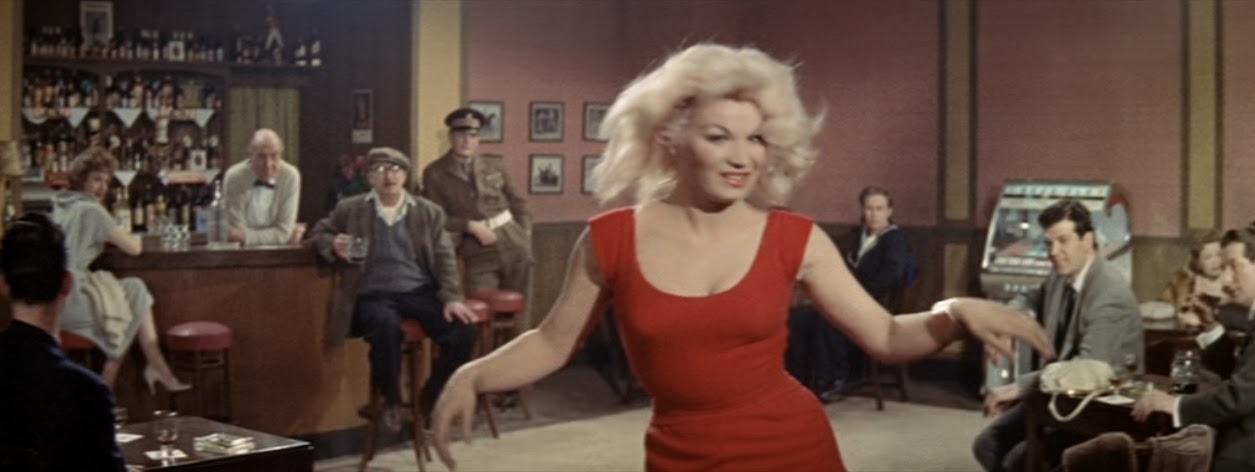
Determined to embark on a big night out in search of a new sugar-daddy, Cunningham (whose characterisation basically doesn’t extend much beyond a Diana Dors-esque caricature of a brainless-hussy-with-a-heart-of-gold) bravely sets sail for her local “pub” – an establishment whose location-shot exterior resembles a grand, Edwardian hotel, whilst the set-bound interior looks more like a windowless portacabin furnished with a bar-counter and a few tables. Here, she heads to the jukebox and puts on a swing record that sounds at least ten years older than this movie, then proceeds to perform a ludicrous, elephant-footed bump n’ grind dance routine in the middle of the floor, whilst the handful of down-at-heel extras lurking at the tables look on with what I can only read as either embarrassment or blank disinterest.

Somehow, the film fails to acknowledge the inherent comedy (and accompanying tragedy) of this Monroe-wannabe show-girl seeking romance and adventure in what appears to be the least glamorous drinking establishment on earth, and plays this scenario entirely straight, as if it were an everyday occurrence in the silent, bare-walled drinking halls of olde England.


After exchanging some toe-curling flirtatious ‘banter’ with the pub’s least mildewed looking inhabitant, and receiving a strangely touching tribute from the barman (“you really livened my place up tonight – you certainly made it a lot of fun”), June staggers off into the night after few too many flagons of Blue Nun (or whatever), and is escorted home by two courteous policemen who apparently have nothing better to do on a Saturday night than stroll around quiet residential streets, making idle conversation with passersby.

Fascinatingly off-key as all this is however, it’s basically just all padding leading up to what happens next, as Cunningham, safely back in her flat, strips down to her lacy underclothes (pretty saucy stuff for a 1959 British film), lies down drunk and happy on her bed, and….

- To be honest, I think we need a paragraph break / SPOILER WARNING to really prepare us for what happens next -

…screams, as she looks up and sees that a makeshift, portable guillotine has been attached to the top of her bed, apparently operated by a leering, oatmeal-faced zombie!

Before we can even begin to make sense of this insane turn of events, zombie-guy pulls the lever, off comes June’s noggin, and he picks up his guillotine and flees straight through the front door!


I mean… what can you possibly say to a film that suddenly throws something like that at you, in complete defiance of all notions of sanity, logic and physical possibility..? The whole guillotine bit probably doesn’t last much longer than twenty seconds, but the sheer, overwhelming joy of the “WHAT THE HELL?!” reaction it’s likely to inspire in every single conscious viewer makes sitting through the remaining hour or so of trudging, poorly shot rubbish that comprises the rest of ‘..Black Museum’ instantly worthwhile, at least according to my own strange system of values.

Those few seconds might represent my overall favourite moment of the film, but the remaining run-time has plenty of other lunatic fun to enjoy: from Bancroft’s unveiling of a room-sized 1950s computer system that seems to exist for the sole purpose of electrifying people, to his cackling removal of a fresh laboratory skeleton from a vat of acid, to the threadbare monster transformation / chase / shoot-out finale filmed on the cheap at Battersea funfair – it’s all the kind of wondrous, brain-damaged b-movie nonsense that later, more self-conscious practitioners of the form could never hope to rival, and, having rambled on here for long enough all ready, I’ll leave adventurous viewers to discover the rest of the film’s exquisite pleasures for themselves.

Whilst I certainly wouldn’t recommend Herman Cohen’s British films to casual viewers or well-adjusted human beings in general, what makes them so fascinating for weirdos like me is the shotgun wedding they represent between two otherwise incompatible modes of filmmaking.

If Cohen had continued to produce movies in the ‘States rather than moving to the UK, I think it’s likely that they would have been pretty unremarkable: more of the same sub-William Castle shenanigans and teens n’ hotrods double-bill fillers (not that there’s anything wrong with that, but y’know..). And conversely, if the mainstays of low budget British filmmaking in the late ‘50s had gone to work on the kind of material Cohen brought to the table, there’s a fair chance the results would have been equally forgettable: more dour and low-key quota-fillers, better written and performed perhaps, but too cowed by fear of negative press attention and the ever-present shadow of the censor to really go all-out with their grotesque or fantastical elements, and probably quite yawn-some as a result.

But somehow, when the oil of “make ‘em cheap, sell ‘em big” American drive-in hucksterism met the murky water of lower tier British exploitation, something extraordinary emerged. Certainly not something *good* by any stretch of the imagination, but then or now, the results remain a bit of an eye-opener.

And, believe it or not, ‘...Black Museum’ was just the beginning. Fuelled by the film’s modest success, Cohen and Gough were soon back at work, cooking a project that was in all senses bigger, stupider and even more astoundingly ridiculous than its predecessor. What are those booming footsteps we hear approaching..? Yes friends, KONGA was just around the corner. You have been warned.


---
(1)For anyone who’s interested, the Black Museum does indeed exist, and, whilst it is still not open to public, occasional one-off tours and open-days have taken place in recent years; further details to be found here.

(2)“I always try to put in the young teen, so the teenagers can identify with someone in the film”, Cohen helpfully explained to ‘Scarlet Street’ fanzine [#17-18, Winder/Spring 1995, as quoted in ‘English Gothic’ (see reference below)].

(3)According to a trivia entry on IMDB, Curnow was in a relationship with popular Welsh/Italian screen comic Victor Spinetti at the time, and used his fee from this film to buy a flat for the couple in Marylebone. So that’s nice, although to be honest I’m kind of astonished that the fee for appearing as the juvenile lead in ‘Horrors of the Black Museum’ was enough to put anyone on the property ladder, even in 1959.

(4)I can only assume that, like Crabtree perhaps, Field’s disdain for the project had her roboting through the role in pure “I don’t want to be here, and I hope everyone realises that” fashion. ‘Saturday Night and Sunday Morning’ put her on the map a year later of course, but we’ll always love her around her for appearing in ‘The Damned’.

(5)Jonhathan Rigby, ‘English Gothic: A Century of Horror Cinema’ (Reynolds & Hearn, 2000), pp. 58-59