Showing posts with label spiders. Show all posts

Saturday, 22 July 2023

Horror Express:
Verotika
(Glenn Danzig, 2019)

Say what you like about Glenn Danzig’s widely derided feature debut as writer/director/composer/co-cinematographer, which I finally persuaded myself to get around to watching last week - it’s a remarkable achievement in at least one respect.

Specifically, I’m referring to fact that, despite having been a successful musician and public figure for at least forty years at the time of this film’s production, Danzig still managed to create a movie exactly like the one a horny sixteen-year-old goth kid would probably have made, given access to the same resources.

Whatever your thoughts on the result of his efforts, his refusal to countenance any form of maturity whatsoever here is genuinely quite extraordinary, arguably making ‘Verotika’ the most purely (accidentally?) punk rock thing he has been associated with since Robo quit as The Misfits drummer in 1983.

Unfortunately however, simply being a contender for the most adolescent film ever directed by a sixty-four year old man does not necessarily mean ‘Verotika’ is worth watching. Indeed, for anyone lacking either a pre-existing interest in its creator’s oft-questionable oeuvre or a very indulgent attitude toward low budget 21st century horror, I’d recommend a hard pass.

As much as I’d love to defy critical consensus and declare this an unappreciated masterpiece, the sad truth is that, by any reasonable yardstick, ‘Verotika’ is an extremely bad film in pretty much every respect; indifferently directed, cheaply staged, sketchily scripted (to put it kindly), thoughtlessly misogynistic, entirely devoid of originality and filled with dead-eyed non-performances from a cast seemingly comprised of aspirant fetish models and porn stars. (1)

To paraphrase Chris Morris, we’re looking here at a crass, ugly and deeply stupid work, and yet.... what kind of horror/exploitation fan would I be if I couldn’t find something perversely captivating in the midst of this lumbering, irredeemable mess of nonsense?

Though it is not remotely as significant or enjoyable, ‘Verotika’ still, to some extent, captures the same mixture of gleeful nastiness and utter weirdness which helps make the early Misfits material so extraordinary. For all its faults, it bears the same gory signature of an artist whose brain-damaged concerns have (perhaps worryingly) remained remarkably consistent across five decades of creative output.

To run down a few elements of the ‘weirdness’ part of that equation, I’ve firstly got to commend Danzig’s refusal to adhere to the narrative conventions which usually govern the EC-via-Amicus anthology framework he has chosen to work within here.

The idea that segments within a horror anthology should consist of concisely rendered cautionary tales with a circular/twist ending goes completely out the window form the outset, but… in a way, I appreciated the open-endedness of this. 

 I mean, let’s just take the first story here - ‘The Albino Spider of Dajette’ - and admit that I have no idea why the aspirant fetish model with eyeballs where her nipples should be (played by Ashley Wisdom) gets victimised by an anthropomorphic spider monster which manifests itself whilst she is asleep, and proceeds to rape and murder women.

And if there is ultimately no connection at all between the eyeballs-for-nipples thing and the spider-monster thing, well… why not? That’s life, right? Here’s this poor girl, just tryin’ to get through life with her freakish eye-boobs, and today, she’s having an especially hard time of it, vis-a-vis the whole aforementioned spider-monster situation. There’s no moral pay-off, no clever resolution, no lessons learned - fuck you, O.Henry! It’s actually quite refreshing.

(Of course, I didn’t realise at this point in my viewing that I was actually watching by far the most well-developed of the film’s three segments, but… we’ll get back to that soon enough.)

More mystifying - as one or two commentators have noted - is Danzig’s inexplicable decision to have the cast of this first story deliver their lines in ersatz French accents.

If the intention here was to lend the film a sense of continental exoticism, I’m afraid it's rather undercut by the fact that ‘Verotika’ otherwise remains as all-American as a burger van parked outside a Sunset Boulevard strip joint. And, given that few of the performers appear to have much prior acting experience, and seem to have been informed about the whole accent thing about sixty seconds before shooting began.... well, you can imagine the range of out-rrrageous ac-CENTS we’re treated to here.

(My favourite must be the waiter who advises our heroine to hurry home before she falls victim to “zee neck brea-CURR”.)

Were it not for Danzig’s total devotion to the gospel of low-brow / trash culture, I’d be tempted to speculate that he intended this French accent thing as a kind of Brechtian disassociation technique - like Werner Herzog using hypnotised actors in ‘Heart of Glass’, but far more entertaining. But no. There is no way a man as steadfast in his aesthetic beliefs as Glenn Danzig would countenance such pretentious/abstract bullshit.

Indeed, the most incredible thing about all this is that he is entirely sincere, but… we’ll return to that train of thought later, because unfortunately we still need to address the film’s two remaining stories. 


So, sadly, the weird charm of the eyes-for-nipples/spider-monster business is entirely jettisoned in the second ‘tale’ presented here. A paper-thin item about a stripper with a mildly burned face (Rachel Alig) murdering and stealing the faces of other strippers, this one largely just serves as an excuse for what feels like hours of dispiriting bump n’ grind strip club footage, accompanied by a succession of mediocre stoner rock tracks.

Disappointingly, it also drops the French accents, but is notable for those of us charting ‘Verotika’s divergence from horror anthology tradition in that it doesn’t even attempt to have an ending. It basically just sets up its premise, and… stops? C’mon Glenn, give us something!

The third story, ‘Drujika: Countess of Blood’, certainly gives us… something… in that it’s a period-set Countess Bathory type affair. The attempt at a medieval setting is fairly ambitious under the circumstances, including use of actual horses, some limited location shooting and - get this! - a real wolf (albeit a not terribly threatening one).

But, on the other hand, you know we’re in trouble as soon as you note that the green-screened panoramic photo backdrop depicting the Contessa’s castle includes clouds of unmoving, still photographed smoke. Mario Bava, this ain’t.

With her spiked crown, latex fetish gloves and habit of staring contemplatively at bunches of grapes, the Contessa (played by Alice Tate) takes us straight into full-on Nigel Wingrove territory, somewhat reminiscent of those dreadful Redemption video promos we all had to sit through back in the bad old days every time we wanted to watch a Jean Rollin film.

Probably the film’s most overtly erotic segment, this one also finds Danzig indulging in some pretty shameless ‘chained virgin’ type fantasies. Perhaps he was going for a vague Borowcyzk / ‘Immoral Tales’ kind of vibe, though the faint Eastern European accents adopted by the cast aren’t as funny as the French ones, and again, the intended effect is rather spoiled by the arid, atmos-free L.A. porno feel, which hangs around the footage like disinfectant in a hospital ward.

Unfortunately, this also proves to be the film’s most boring segment - because, above all I think, what kills ‘Verotika’s chances in the midnight movie / so-bad-its-good stakes is actually its pacing.

Like so many amateur / first time filmmakers, Danzig just cannot cut his stuff for shit, stretching out most shots at least a few beats too long, and the concluding story finds him expanding this lethargic approach to a frankly quite trying degree, as he subjects us to several extended, silent medium-close ups of the Contessa bathing in blood or gazing at herself in the mirror which just seem to go on forever, seriously challenging the wakefulness of any late-night viewers who have proved hardy enough to stick with the movie thus far.

As expected by this point, there’s also pretty much no narrative here at all - just the blood-bathing Contessa going about her virgin-slaying day-to-day in more or less the manner you’d expect.

There is a certain audacity to the bit where she manages to begin fondling and eating a girl’s extracted heart whilst it remains beating and attached to the victim’s blood vessels, but the impact is deflated by the absurdly realised special effects, including the use of a heart prop whose size seems closer to that of an organ belonging to a large mammal than that of a human being. 

But, it matters not. Only an utter goon would demand realism in a context like this, and besides, to return to the point I touched on above, ‘Verotika’s sole saving grace - the unique component that allows this otherwise terrible film to cycle back round and grasp at something approaching warped greatness - is that Danzig is utterly sincere in his intent to make a sexy, gory erotic horror movie.

Unbelievable as it may sound in view of what I’ve outlined above, there is not an ounce of self-mockery or camp intent discernible here. Given how rare this total absence of self-awareness is in any creative industry these days, maybe we should take a moment or two just to think about that - to let it sink in.

Like the aforementioned goth kid sitting in the corner of the classroom, scribbling drawings of women who look like Death from ‘Sandman’ fucking bat-winged demons, Danzig believes his half-baked cartoon atrocities are transgressive and shocking, and that if you don't like it, you just can't handle his dark vision.

Given how few of us can make it to adulthood whilst retaining such knuckleheaded naivety - let alone preserve it through the rigors of adult life - isn’t that, in itself, a beautiful thing?

Or, to put it another way, I’d rather sit through ‘Verotika’ a million times than read a page of Morrissey’s stupid novel.

Saner voices may contend that neither option is compulsory, but saner voices have no place in this discourse. For as the man of the hour himself once sang, “possession of a mind is a terrible thing..”.

 --

(1)As it seems ungallant to let a statement like that stand without unpacking it a bit, here are the results of my IMDB-based research into ‘Verotika’s cast. So, we do indeed have several porn stars (primarily Ashley Wisom), along with a large number of people who have very few IMDB credits aside from this one (so who knows what they normally do all day), and a few legit actors.

Surprisingly, probably the most noteworthy person in the cast is actually the one with the silliest name, Kansas Bowling, who it turns out has won considerable acclaim as a director of music videos (working with Iggy Pop amongst others) and played a small role as one of the Mansonites in Tarantino’s Once Upon a Time in Hollywood. As one of the Contessa’s victims in ‘Verotika’, she is assigned the thankless task of remaining dead and topless through several very long scenes.

Monday, 8 June 2020

Kaiju Notes:
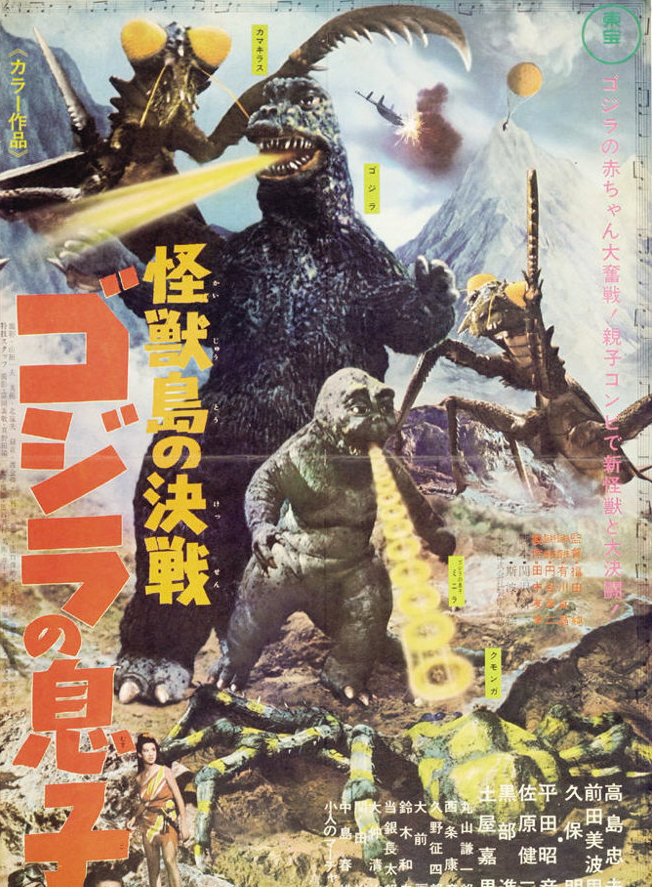
Son of Godzilla
(Jun Fukuda, 1967)


FEATURING:

Godzilla!

Minira!

Kumonga, the giant spider!

A bunch of giant Praying Mantises!
 

1.
Ok, let’s begin with a quick show of hands. Who here has seen the original, 1933 ‘King Kong’? Yes, just as I thought, every self-respecting man, woman and child. Now, who has seen RKO’s hastily slapped together 1934 sequel, ‘Son of Kong’? [Cue awkward silence, tumbleweed.] I rest my case.

For whatever reason however, the top brass at Toho studios seem to have overlooked this lesson from history, and verily it was decreed that director Jun Fukuda’s second modestly budgeted addition to the Godzilla franchise would take the form of ‘Kaijûtô no Kessen: Gojira no Musuko’ [‘Decisive Battle on Monster Island: Godzilla’s Son’], better known to the English-speaking world simply as ‘Son of Godzilla’.

As you can imagine, I wasn’t exactly looking forward to this one as I worked my way through Criterion box set of Showa-era Godzilla films, but… sometimes you’ve just got to grit your teeth and hit ‘play’ on these things, y’know? I mean, it’s a learning experience, if nothing else - and having paid something in the region of ten quid for each movie on this set, you’d better believe I’m going to take my seat in the classroom, pencil and paper at the ready, and get what I can from it.

2.
Well, guess what – to my surprise, it turns out that ‘Son of Godzilla’ isn’t all that bad. In fact, it’s pretty good fun all-round. Though clearly a step down from Fukuda’s extremely enjoyable Ebirah: Terror of the Deep, it retains much of the breezy, event-packed charm of its predecessor, and includes some memorable scenes and top-notch special effects.

As in ‘Ebirah..’, the influence of ‘King Kong’ upon Fukuda’s Godzilla films is clearly evident. Once again here, we have a danger-filled tropical island setting, in which a bunch of excitable guys run around getting into scrapes. We have another native girl in peril (actually, she’s the daughter of a long-lost prior explorer this time around), and a primary monster who is more concerned with protecting a vulnerable dependent (his ‘son’ in this case) from the depredations of lesser monsters than he is with fucking the humans’ shit up.

In fact, the film even seems to draw upon the legend of ‘King Kong’s lost spider pit sequence for inspiration, effectively recreating it in the form of a stand-out scene in which our characters tangle with Kumonga, the island’s resident giant spider.

By far the best things in this movie however are the giant praying mantises which regularly pop up to menace all and sundry. Inadvertently created by the humans’ crazy climate experiments (more on which below), these blighters put me in mind of the infamous pulp horror paperback Eat Them Alive, although needless to say they don’t get up to any such nasty business here. Nonetheless, the effects used to realise these creatures – seemingly utilising huge, string-operated puppets, big enough to go toe-to-toe with the man-sized Godzilla suit – are really superb, and the fight scenes in which The Big G tears ‘em apart have a real clout.


3.
Speaking of which, although ‘Son of Godzilla’ does inevitably get a bit goofy and mawkish later in it’s run-time, there’s something pleasingly animalistic and.. non-anthropomorphic?.. about the scene in which ‘Minira’ [as he has been named by fans, though he is never identified as such on-screen] is initially introduced.

It’s certainly a pretty traumatic introduction to the big, bad world for the young ‘un, as he immediately finds himself menaced by the aforementioned mantises, which have been swarming around his big, speckled egg, until daddy reluctantly stomps along to sort ‘em out.

Instead of greeting his new-born with affection though, Godzilla’s first interaction with the little one is to knock him over with an accidental swing of his mighty tail, before he goes huffing and puffing off over the horizon, leaving his mewling bairn to fend for itself.

Though they do later establish a slightly more traditional, audience-pleasing father/son relationship, we’re still basically left here with the perversely endearing idea of Godzilla being a bit of a shit dad – or a dedicated practitioner of ‘laissez faire’ parenting, at best. Lazing around and snoozing whilst the kid is in trouble and/or wants attention, he doesn’t exactly exert himself too hard when it comes to schooling his charge in the ways of giant monster-dom.

4.
Having said that however, if ‘Son of Godzilla’ is remembered for anything, it’s probably for the later scene in which Daddy Godzilla takes his son down to the river for a bit of male bonding and tries to teach him to utilise his radioactive fire breath – but, the best young Minira can initially manage is some puffy little smoke rings. Oh, how adorable!

Which seems a good point as which to stop and reflect on how far we’ve come from the days when those fiery blasts of radioactive death were decimating entire districts of central Tokyo, threatening to obliterate Japan’s shaky post-war reconstruction in one unholy conflagration, and terrified crowds fled in blind panic, and so on.

5.
The biggest question to arise from all this though of course concerns the mysteries of Godzilla’s reproductive cycle, and more specifically, the pressing issue of who the hell the mother might be!?

Needless to say, the film’s screenwriters never deign to address this, which is probably for the best, all things considered. All we know is that, at the point at which our story begins, the big egg containing Minira is just sitting in the middle of this weird island, and Godzilla seems duty-bound to slog his way back toward it in order to reluctantly exercise his solo paternal duties once the kid hatches.

Thus, we’re left with a scenario weirdly reminiscent of the compromised, all-male lineage of Disney’s McDuck family (though we do at least have a direct father-son relationship here I suppose, in contrast to Disney’s fragmented hierarchy of parent-less uncles, nephews and cousins).

6.
In designing Minira, I suspect that the monster effects team led by Eiji Tsubaraya and Sadamasa Arikawa were probably going for the fool-proof “overload of cute” approach which has achieved such consistent success with Japanese audiences across the decades - but, happily, I’m not sure that they quite succeeded.

Limited movement lends a particularly uncanny aspect to Minira’s moulded, baby-like face, complete with painted on eyeballs, and despite the filmmakers having gone to the trouble of hiring a dwarf actor (professional wrestler ‘Little Man’ Machen) to inhabit his suit, he retains a gawky, adult-proportioned posture which never looks quite right, especially as he stumbles over studio rocks, bawling in an electronically-altered baby voice, reminiscent of Devo’s perpetually disturbing Booji Boy mascot.

He’s a real freak in other words, and naturally this allows us us cynical, grown-up viewers to love him far more than if he were merely some perfect, proto-Pikachu type kawaii monstrosity.


7.
Another significant development which ‘Son of Godzilla’ brings to the franchise is the creation of ‘Monster Island’ – the ecologically unstable tropical archipelago which Godzilla and his pals will be depicted as being confined to in later films, their movements carefully monitored and controlled by the human authorities.

Although the presence of Kumonga the spider suggests that this nameless island was at least slightly monstrous to begin with, its transformation into a full scale kaiju playground seems to have been largely the result of this movie’s human storyline - which for the record is fairly diverting, recalling one of those ‘40s jungle adventure type b-movies in which a bunch of wise-guys hang out in tents in a studio-bound clearing, along with a token dame, an antsy reporter and so forth.

In fact, that’s exactly what happens here, except for the fact that the scientific research team led by Dr Kusumi (Tadao Takashima) have some nice, colourful buildings and advanced laboratory facilities to hang about in as they conduct a series of frankly rather crazy localised terraforming experiments, which seem to involve using some kind of cloud level chemical air-bursts and electro-magnetic pulses to radically alter the island’s climate.

Dr Kusumi speaks grandly of a future in which the problem of over-population can be overcome by fertilising the world’s deserts and so forth, but at this stage at least, his experiments seem reckless and destructive, subjecting the island to intolerable, baking heat (the guys survive indoors with their air-con), and inadvertently causing unforeseen mutations in the local fauna, including the creation of our old friends the giant mantises.

Later on meanwhile, in the film’s oddly touching climax, they decide to blast the place with an icy blizzard, leaving Godzilla and Minira frozen in each other’s arms, no doubt awaiting the next occasion on which Toho will call upon their services to liven up the bank holiday box office.

---

Saturday, 18 May 2019

Bloody NEL:
Lord of the Spiders
by Michael Moorcock

(1975)


Once again, I’m going to be out of the country for a few weeks, so whilst I’m gallivanting, I’ll leave you in the company of some recent additions to my paperback mountain, beginning with a few from the ever-pungent exploitation vats of New English Library.

Even before the late ‘70s saw paperback racks suddenly overflowing with sharks, crocs, rats, bears and crabs (more of which in a few days), monsters already seem to have often taken pride of place on NEL’s SF covers (see To Outrun Doomsday, for example), and, in their own weird sort of way, these delightful bat-headed spider things feel as iconic as anything in the realm of ‘70s British paperbacks. (Unfortunately, I haven’t been able to find a name to attach to the cover art anywhere online, but as ever, info or speculation is welcomed in the comments.)

Likewise, I’ve always had a real soft spot for Michael Moorcock’s early straight science fiction novels, but for some reason I’ve never gotten around to this one – originally published in ’68 as ‘Blades of Mars’ - or it’s predecessor ‘City of the Beast’.

Basically these books are an unabashed homage to Edgar Rice Burroughs’ Mars and Venus stories (lest we forget, Moorcock began his literary career, aged 17, as the editor of ‘Tarzan Adventures’), and verily, they are red-blooded stuff, full of grand sentences, with many commas, ending in proud exclamation points!

(Perhaps the fact that NEL also reprinted the Burroughs books in the ‘70s had something to do with their decision to acquire these particular Moorcock works? Who knows..)

Anyway, it never ceases to amaze me that Moorcock was knocking out this delightfully old school stuff at the same time that he was championing the most far out voices of SF’s experimental / psychedelic new wave as the editor of New Worlds. But then, that goes straight to the heart of what makes him such a unique and vital figure in the field of popular culture really, doesn’t it? At any given point in his career, he has contained multiples, and his determined refusal to acknowledge a dividing line between high and low culture, between intellect and entertainment, between reality and fantasy, should stand as an inspiration to us all.

Tuesday, 15 February 2011

Bloody Pit of Horror
(Massimo Pupillo, 1965)


Yes folks, it’s ‘Bloody Pit of Horror’! You’ve hit ‘play’, and there’s no turning back now! A jewel in the crown of pan-European exploito-horror mulch, this lively ‘shocker’ was allegedly lensed in 1965, but features a cartoonish matinee spirit and winningly naive approach to sleazy thrills that just screams NINETEEN SIXTY ONE to me. Nonetheless, ’65 it is, a year in which director Pupillo seems to have cut a bloody swathe through the world of cheap Italian horror movies, directing Barbara Steele in ‘5 Tombe Per Medium’ (aka ‘Terror Creatures From The Grave’), then knocking out this one and a third gothic horror called ‘La Vendetta di Lady Morgan’ in quick succession, despite having done little of interest either before or since.

To spare.. oh, I dunno, subterranean exploration enthusiasts, maybe?.. from disappointment, it should be noted that ‘Bloody Pit of Horror’ features no pits, bloody or otherwise. It does have a castle, and within that castle is a dungeon, which you’d think would have done nicely for an exciting title-noun that was at least vaguely accurate. But no, they had to go with ‘pit’. Whether or not the film inspires ‘horror’, and the extent to which it may be deemed ‘bloody’ are matters for further debate, which we shall perhaps return to.

Original Italian title is the slightly more dashing ‘Il Bioa Scarletto’, and the movie will also answer to ‘A Tale of Torture’, ‘Virgins for the Hangman’ or ‘The Crimson Executioner’, depending on where and when you happen to reside. ‘Bloody Pit of Horror’ seems to be the one that stuck though, and why not - that title’s gleeful, boneheaded absurdity suits the film in question perfectly.


Supposedly inspired by the writings of the Marquis de Sade (presumably in much the same way that ‘Hot Tub Time Machine’ takes inspiration from the work of H.G. Wells), goofball levels are off the scale right from the outset here, as we see an unhinged looking gentleman in a bright red KKK hood with attached cape being man-handled into a shockingly cheap looking iron maiden by some guys in sorta Roman Solider-via-Conquistador get up. An echoing PA system voiceover drones on about how this chap’s nefarious deeds will live in infamy.

“Fools, all of you! I am the Crimson Executioner!”, says The Crimson Executioner, shortly before the oversized butter knives glued onto a plywood door descend to end his life. “Ah-hahahahahahahahahahahahaha!”, he adds. “This day shall be written in blood! No man can judge me! I am the supreme law! I shall have my REVENGE!”

But more on The Crimson Executioner later. For now, we cut to the present day, where we join a group of employees from the art department of an Italian publishing house. Split evenly between dashing young photog/design guys and vapid glamour models, they are busy touring the countryside in a fleet of sports cars, in search of the perfect gothic castle in which to shoot some sexy covers for their new range of horror novels.


Whilst that concept sinks in, let us pause a moment while I make a brief appeal to any readers who may have connections in the Italian publishing industry;

I know that I don’t have much experience in photography or design per se, and I realise that my command of Italian is – how to best put it? – entirely non-existent, but all I’m saying is – if you have a vacancy, keep me in mind. After nearly a decade of gainful employment in various sectors, I really feel that your industry is one in which I could truly realise my full potential. If you were to give me a chance, you would not regret it. I understand that there might not be enough space at first for me to tag along on the expenses-paid gothic castle location scouting tours and such, but I’m willing to work my way up. Thank you.

Anyway, as you might expect, this jolly crew do manage to find a castle to fit their (apparently quite specific) needs. When no answer is received to their bangings ‘pon the front door, they assume the place to be uninhabited, and persuade a guy who seems to be the lone male model to utilise his impressive ‘jungle jim’ style skills, scaling a tower and gaining them access.


As you might also expect, the castle turns out to be far from uninhabited. It is actually the home of a reclusive individual named Travis Alexander, played by legendary muscleman and Jayne Mansfield husband Mickey Hargitay, and his… uh… (ok, deep breath) … and his squad of strapping, moustachioed man-servants, all of whom wear identical stripy sailor jerseys and tight white jeans and apparently march around barking orders and stamping their feet like soldiers on parade 24 hours a day, unquestioningly obeying their master’s every command. Many ways to finish this paragraph spring to mind, but I ain’t saying a word.

Upon discovering the intruders in his castle, Mr. Alexander indulges in some Torgo-esque toing and froing, but eventually opts to let them to stay the night, on condition that they leave him alone to enjoy his hermetic isolation, and that they do not enter the dungeon. So, naturally, the next scene sees our gang setting up their photo shoot in the medieval torture dungeon, happily swinging around on some blood-curdling looking implement, girls in bikinis and one guy wearing a skeleton suit! These publishing types, honestly.

I’ll admit that up until this point I had my suspicions that the rationale behind the whole ‘pretty girls cross-country castle tour’ concept might be less than entirely work-related, especially when it became clear that the boss of the publishing house and one of the writers were along for the ride. But in all fairness to these guys, as soon as they’re in situ it’s straight down to business, setting up the gear, ordering the models around, calculating how many rolls of film they can shoot before sunrise, etc. Rarely has the act of shooting pictures of a girl in a sexy pirate outfit being strangled by a skeleton been handled with such consummate professionalism.


Even after the film’s first fatality – which sees the guy in skeleton suit impaled with more butter knives when the rope holding aforementioned torture device in place ‘mysteriously’ snaps – the boss is determined that his team should overcome this tragedy and keep working. After all, he’s got a schedule to keep! Deadlines! I mean, can you imagine a pulp horror novel coming out a bit late, with an imperfect cover photo? It simply wouldn’t do.

So this movie’s been good woozy fun so far, but the next thing I remember is a scene that really raised the stakes big time. A scene that left me speechless, unable to even evoke the holy syllables of Whaa – Thaa – Fugg? A scene, in short, that reminds me why I got into the business of watching movies like this in the first place.

Get this: one of our male characters (who seems to be emerging as the hero of the piece) hears a cry for help from a neighbouring chamber. Rushing in, he finds one of the girls tied by her wrists and ankles in the middle of a huge artificial spider’s web! Don’t come any closer, she warns him, explaining that the killer has rigged up loads of arrows around the chamber’s walls, which are primed to fire as soon as anyone touches the web! And indeed, the walls are lined, not with crossbows and some other kind of practical arrow-firing devices, but actual longbows, mysteriously balanced against the walls somehow! Furthermore, the unfortunate lady continues, there is a poisonous spider slowly making its way towards her, and once bitten, she will die immediately! The spider in questions looks kinda like some furry, mechanical beastie straight out of puppet show, wobbling along on a plainly visible string.


After slapping myself about the face a few times to ensure that I was still awake, and that, yes, this insane spectacle was actually unfolding before me, I saw our hero lie face down on the ground, and proceed to slowly wriggle along the floor like a worm, propelling himself with odd, spasmodic movements, in a tension-building attempt to reach the doomed girl without setting off the arrows! At this point I simply raised my hands in supplication and tearfully offered praises to the gods of WTF b-cinema for showing me this thing.

And really, you could spend a lifetime pondering the whys and wherefores of how the scriptwriters came up with this deranged scenario in the first place, how it ended up actually being realised for the film in such utterly ludicrous fashion, and how the actors felt at being asked to perform in it … I mean, it’s not even clear whether we’re supposed to read the spider and web as being ‘real’, or whether they’re supposed to be mechanisms built by the killer, although frankly either scenario is equally fucking crazy. If you value your sanity, probably best put such questions aside and just let it all wash over you.


What troubled me above all about this incredible sequence though is the fact that the girl apparently seems pretty enthusiastic about the idea of dying in the middle of this spider web contraption, explaining the whole set-up to her would be rescuers in detail, and begging them to abandon her to her singularly weird fate - “Don’t you see? It’s a diabolical trap! It’s impossible for anyone to reach me! Nobody can stop the mechanism!”, etc. The killer must have been a pretty good talker, I suppose – which we can maybe take as foreshadowing of a sort.

I also loved the way that when our worm-crawling hero reaches the centre of the web-maze seconds too late to save to save the girl from the venomous bite, he expresses his frustration by picking up the ‘deadly’ spider and drop-kicking it into the middle of the web, causing a few arrows to half-heartedly flop to the ground posing no danger to anyone! Outstanding.


By this point, my goofball-measuring equipment (it’s sort of a prototype, loosely based on the Rock-o-meter from ‘Rock N’ Roll High School’) had long since overheated and ceased to function, which is just as well, as there is no way its limited capacity could have survived the white hot hurricane of goofery that is Mickey Hargitay as The Crimson Executioner – for naturally it is he who has been perpetuating all this mischief, convinced that he is the reincarnation of the aforementioned medieval torture-monger.

Taking on the guise of The Crimson Executioner, Hargitay sports a get up that makes him look rather like a pro-wrestler who decided to attend a costume party dressed as The Phantom, got drunk, lost his shirt and then decided to go for Flavor Flav instead by adding a huge, clock-like gold medallion to the ensemble. You might have thought it would be difficult for a scene featuring only one man to strictly be termed ‘homoerotic’, but then you presumably haven’t seen Hargitay gazing lovingly into the mirror, oiling his muscular torso as he rants to himself at length about the virtues of his perfect body – claims that are somewhat undermined by the fact that he adopts a slightly hunchbacked ‘gorilla posture’ and hobbles around grunting like a pirate, his features contorted into a kind of snarling mask of perpetual discomfort.


When setting out to assess Mickey Hargitay’s performance here, stock phraseology about how he ‘chews up the scenery’ or somesuch seems woefully inadequate in trying to convey the sheer ham-fisted delight he brings to the role as he capers around his torture dungeon in a state of delirious, childlike glee, accompanied at all times by the incessantly repeated ‘Crimson Executioner’ theme, which sounds a bit like the proud inventor of the world’s first underwater theremin giving a bathtub demonstration (word to composer Gino Peguri for a varied and enjoyable soundtrack all round actually).

Hagitay’s Shatner-esque cadences must be heard to be believed as he sets about tormenting the remaining characters in a manner that might have seemed fairly sadistic in a film that was less… well… y’know - a film that was less like ‘Bloody Pit of Horror’.

“The Crimson Executioner… invented the torture of icy water… for creatures like you!”, he taunts, shaking his fist at a girl who is having icy water dribbled across her back.

“I will punish you for your lechery!”, he promises, spitting in the face of the head of the publishing house, whom he has confined in a comically oversized neck manacle.

“The Crimson Executioner will torture you! Yes… will torture you… until DEATH!”, he announces to nobody in particular, spreading his arms and gazing skyward in joy.

Man, this guy is something else.

Watch entranced, as he straps two of the models onto some kind of rotating wooden contraption and pushes knives through slats in an adjacent screen at boob level, causing the fabric of their brassieres to be veeeery slowly stripped away, and their tender flesh to be cut, just a little bit! I mean, let’s not get carried away here, right? Standards of decency must be upheld. What’s that you say, Crimson Executioner..?

“My vengeance needs blood! The Crimson Executioner... CRIES OUT for blood!”


Such an instantly iconic, endlessly quotable character – I’m surprised that The Crimson Executioner hasn’t cast a wider shadow across subsequent horror history. Surely more than one ‘trash auteur’ must have watched this over the years and thought “this is great, all I need to do is get some theatrical goof-off to run around in a hood, and the rest of the movie writes itself”? One thing’s for sure – nobody who’s ever stumbled across this movie is liable to forget him, and the temptation to spend weeks after viewing wondering around the house in exaggerated wrestler stance, muttering “The Crimson executioner does this, The Crimson executioner does that”, is probably not an uncommon affliction.

Brilliantly, The Crimson Executioner’s reign of terror isn’t ended when he is outwitted or bettered in combat by our hero, as is traditional. I dunno whether I missed an important plot point here, but I’ve watched the film several times now (god help me), and it still appears that he just gets so overwrought about all the evening’s excitement that, after delivering one last fevered monologue about how his beautiful body has been “defiled” by earthly corruption, he simply keels over and dies!

A long tracking shot lingers over the multitude of carcasses that are now strewn around the dungeon floor, and the surviving couple stand in shock, wracking their brains to for some kind of profound closing message they can pull from this thoroughly meaningless outbreak of anachronistic barbarism.

“Well I won’t write any more horror stories, that’s for sure… the man who said truth is stranger than fiction made no mistake!”

You said it buddy! I mean, people in the real world made this movie – beat that, fiction.

‘Bloody Pit of Horror’ has long lurked in the Public Domain, and a splendidly murky, degraded, pixellated print of the film can be streamed/DLed from just about anywhere on the internet, including archive.org here or Youtube here. If you’ve got a reliable net connection, why, you could watch it everyday! What a world we live in! In fact, pesky family or relationship responsibilities notwithstanding, I’d go as far as to say you SHOULD watch it everyday! Go on, you know you want to.


Man, Psychovision looks pretty crappy.

Wednesday, 10 February 2010

Me n' Coffin Joe, Part # 3:
This Night I Will Possess Your Corpse (1967)


Three years after the success of “At Midnight I Will Take Your Soul”, Ze Do Caixao returned to Brazil’s screens in a film that bears all the defining marks of a sequel, essentially revisiting the themes and structure of it’s predecessor, but with more violence, more sleaze, a longer running time and even more ranting, but losing the self-contained charm of the earlier film in the process, replacing it with the first full manifestation of the kind of wildly excessive, oneiric sadism that Jose Marins would make his trademark in the coming years.

Rather than being dispatched for good by the combined forces of supernatural justice at the end of “At Midnight..”, it seems that Coffin Joe was merely… uh, badly burned or something, and “This Night..” begins with him returning to his home town fully recovered after a spell in hospital, and absolved of his crimes by a rather shoddy looking court on the basis of a lack of evidence. And unfortunately for the human race, it seems Joe hasn’t learned a damn thing from his ordeals, as he’s immediately up to his old tricks, harping on endlessly about the sanctity of his bloodline and the foolishness of religious belief and so on. Some bloody use that turned out to be, sigh the wandering ghosts somewhere in the background.

Stretching the shaky continuity further, business at the undertakers must have been booming in Joe’s absence, as his funeral parlor now finds itself equipped with a standard issue hunchback assistant named Bruno (his school play level make-up job somehow makes the poor guy look more repulsive than professional effects ever would have done), and also with a new complex of underground torture dungeons. Convenient!

Marins’ production values seem to have taken a corresponding leap forward too, at least if we can judge by such yardsticks as more sets, more expansive framing, more actors, more special effects, etc. I was disappointed to note though that the claustrophobic, gothic atmospherics that so livened up “At Midnight..” have been misplaced along the way, ironically falling victim to the arrival of more professional lighting, and the decision to shoot most of the external scenes on location. Gone are the restrictive corridors of forest and swathes of shadow that Marins conjured up on his chicken shack soundstage, and instead we get, well… realistic daytime footage of the same fairly boring looking place in Brazil, much of the time.

Sadly, many of the interior sets follow suit. That said, Joe’s dungeon/laboratory/whatever set up is lovably goofy - real mad scientist 101, straight of an Al Adamson or Ted V. Mikels flick, with weird, seemingly gas-powered machinery, the good ol’ strap-down gurney and parrots (?!) flying around for some reason. Quite what the machinery is for is anyone’s guess, although Joe does proclaim “not sadism – science!” at one point in the film, so maybe he’s got something on the backburner a bit more methodical than just throwing snakes at ladies and hoping for the best. Anyway, with this notable exception, most of the other interiors just have a lot of brick and white walls standing in for the delightfully cluttered compositions of the earlier film, unfortunately. Ho hum.

“At Midnight..” also features a whole ton of padding and subplots which were absent from the one-track-mind narrative of the first film – in fact the damn thing’s jam-packed with wild and wooly antics involving local politics, a kind-hearted wrestler, fixed poker games, tavern brawls and all manner of scheming and duplicity which I won’t try and run down for you in this review or we’ll be here all day.

One of the film’s most surprising scenes comes early on, when Joe saves a young boy from being run down by a careless soldier on a motorbike. Given his batshit philosophies and general disdain for humanity, one would assume that Joe only seeks a child of his own for purely utilitarian ends, to act as a miniature continuation of himself. But here, as he plays with the kid at the side of the road and curses the cyclist for his lack of attention, we start to realise that Joe just really digs kids, and hates the way that social and religious forces compel them to grow up into adults that he deems weak and ignorant. This one brief scene, in which Joe is framed as the protective force standing between the children and the hapless, accident-prone grown ups, is (to my knowledge) the only moment in Jose Marins’ entire filmography in which the director’s alter-ego is made to seem even remotely sympathetic. That it is never elaborated upon or followed up as the film proceeds full steam ahead in the direction of seedy, misanthropic carnage, simply makes it all the more curious.

Anyway, fathering a son is still Coffin Joe’s foremost objective in life, only now he seems to be framing this desire in even more deranged and fascistic terms, declaring that his first born will be the leader of a new race of supermen, free from human weakness. Ever the man of action, Joe decides that the first step is to find a mother befitting of his high standards, and as such he immediately sets about kidnapping the town’s six most desirable women. This quickly accomplished, he deposits them in a purpose-built ladies’ dormitory that he seems to have stashed away in his tardis-like lair, and prepares to instigate the first of film’s two extended sequences of horrifying shenanigans, as he subjects his potential brides to a series of ‘ordeals’ to determine which of them is most worthy of his seed.

Admittedly, women weren’t given a great deal to do in the first Coffin Joe film prior to becoming victims, but it soon becomes clear in “This Night..” that the level of Jose Marins’ misogyny, or, at best, his lack of empathy toward the opposite sex, was absolutely staggering when he was making these films. Kidnapped by a freak, these six able-bodied women just sit there impassively in their nightgowns, failing to display any emotion or resistance whatsoever, as their captor rants away, explaining in his characteristically roundabout fashion that he basically intends to kill five of them, and to rape the lucky survivor.

Upping the ante on the spider-based murder of his wife from the first film, Joe waits until the girls are soundly asleep (cos hey, what else are they gonna do after the man’s left the room?), and unleashes a box full of tarantulas upon them in a queasy sequence that goes on far, far longer than is strictly necessary (“necessary” being a pretty redundant term with Marins at the controls), cutting between close-ups of giant spiders crawling across the bodies of writhing, terrified girls and Joe’s staring eyes and belly-laughing chops, his pet creatures clearly presented as a direct extension of his body, and of the camera’s gaze. Somewhere, there’s a psychoanalyst hitting the big red button under his/her desk, and we haven’t even got to the snakes yet.


Ah yes, the snakes. When Joe deems one of the girls worthy of survival because she wasn’t too bothered by the spiders, she gets to watch as her companions are locked in a narrow underground chamber and left to the mercy of a bunch of venomous vipers and boa constrictors. Shots of the snake attack are intercut with equally icky footage of Coffin Joe trying to force himself upon the surviving lady. When she breaks down and admits that she is less than enthused by this whole turn of events, Joe decides she is not free from ‘weakness’ after all and thus can never be the mother of his child. Oh well, ya win some, ya lose some.


What I found most bizarre in this sequence though is what happens when Joe shrugs off his disappointment and tells her she is free to go. “Aren’t you afraid I’ll report all this to the authorities?”, she asks. No, Joe tells her, for I can tell that you have fallen hopelessly in love with me and will henceforth do my bidding. And she does.

What the EEEnfernoo is going on here? I thought I was at least getting used to the fuzzy logic with which Jose Marins conducts his movies, but once again his cracked-in-the-head approach to human behaviour has left me speechless.


Later in the film, Coffin Joe meets another girl, the daughter of a wealthy local dignitary, and things become even more confoundingly ridiculous when she immediately attaches herself to Joe and begins parroting his patriarchal, survival-of-the-strong philosophies back to him without even being prompted and doesn’t seem to mind when he slaps her around, causing our man to take a drag on his pipe and look on contentedly, as if to say “well, I knew the gal for me would come along eventually”.

Rarely in any sphere of creative endeavor – even the most bone-headed of superhero comics or fan fiction – have I encountered such a complete inability on the part of a male writer to conceive of women as independent, decision-making beings.

Not that I’d wish to really launch a defense of Mojica Marins, whose filmmaking ethics are clearly about as questionable as the Shell answer-man, but what I think we have to realise when dealing with Marins’ movies is that once they’ve got their initial plot set-ups and exposition out of the way and allowed him to get his horror on, all semblance of human characterisation and real world cause & effect are totally outta the window. In some quarters, Marins is often compared to Bunuel and Jean Cocteau, and, whilst that’s a comparison we should be wary of taking too far, “This Night..”s relentless concentration on personal dream logic and unforgettably intense imagery certainly speaks of such.

To put it bluntly, when Coffin Joe is ‘in the zone’, all other characters in the film are reduced to little more than bodies that do what they’re told. All through the film, things either happen comically slowly or appear sped up with no apparent logic, people say things that make almost no sense whatsoever, and a discordant mixture of music cues and random noises blare away with little relation to the action onscreen. Basically, the whole thing is freaked out on a level that only the very strangest of global filmmakers are able to compete with, and if things end up being almost unbelievably offensive too, well hey, that’s all just grist to the big WTF mill as far as Mr Marins is concerned. For every viewer left un-appalled by one of his films, Ze Do Caixao must shed a tear of failure.

What he is essentially going for here is Hitchcockian “shock cinema” on a cruelly primitive level. He doesn’t give a damn whether or not the audience expect these girls (or any of the characters other than Coffin Joe for that matter) to be recognisable, sympathetic humans – hell, he’d probably have used mannequins instead, except they don’t scream or wriggle so well. The reaction he’s going for is simply to make us squirm in our seats and go ICK ICK ICK, GIANT HAIRY SPIDERS! and AAARGH, SNAKES! and OH MY GOD THAT’S HORRIBLE, and JESUS CHRIST, I’VE NEVER SEEN ANYTHING LIKE THAT IN MY LIFE BEFORE! And it is his overwhelming success in obtaining these reactions where so many other horror directors have failed that continues to make his work so unique, regardless of the fact that on a personal level he seems to dwell somewhere on the slippery slope between “socially maladjusted” and “out of his freakin’ mind”.

This can all be clearly seen in the sequence that viewers will remember most vividly from this film – Coffin Joe’s descent into Technicolor hell! Although in some ways a mere warm up for the utter mind-flaying Marins would inflect on the world a few years later in “Awakening Of The Beast” (which recycles the B&W to colour gimmick), “This Night..”s vision of hell is in some ways even more brutally extraordinary.

Put it this way: think about every film you’ve seen over the years that has portrayed a visit to hell. It’s usually pretty metaphorical, right? In the name of sanity and good taste, filmmakers will usually find some smart or abstracted means by which to portray the infernal regions, be it the bureaucratic hell of ‘The Screwtape Letters’, the hallucinatory hell-on-earth of ‘Jacob’s Ladder’, the dopey S&M fantasies of ‘Hellraiser’ or the desert wasteland of Fulci’s ‘The Beyond’. Even the towering ode to literalism that is ‘Bill & Ted’s Bogus Journey’ has the decency to present hell as a kind of stylized labyrinth in which we’re pursued by childhood fears.

But as we have surely gathered by now, sanity and good taste are not virtues held in high esteem by Jose Mojica Marins. If he’s going to take us to hell, he’s going to round up all the colour film stock, polystyrene, greasepaint and out of work actors his remaining budget can muster and take us to motherfucking HELL. And so, when Coffin Joe discovers that one of the women he murdered was pregnant, this sets him off on a predictably severe existential crisis which, combined with another one of those pesky peasant curses, sees him literally dragged through the ground, emerging in a garishly lit underground realm in which the legions of the semi-naked damned writhe in agony, being stabbed with pitchforks by red-skinned, loin-cloth clad demons!

Satan, also played by Marins (hey, why not?), sits upon his bloody throne, laughing uproariously as he zaps unfortunate sinners with lightning bolts, causing severed limbs to fly across the screen in a vision straight from the mind of a rabid eight year old boy. Rivers of stage-blood run through channels crudely hacked into the sets; naked women are bloodily crucified as boa constrictors crawl around their necks; floors and walls that looks like regurgitated pizza throb and moan with the torments of the damned; disconnected heads and body parts wave frantically through gaps in the ceiling. And meanwhile, cult film fans the world over proceed to foam at the mouth, fall off their chairs or manifest other suitably extreme reactions in sheer disbelief that their was some deranged guy with no money in the middle of Brazil actually MAKING THIS CRAP HAPPEN, AND FILMING IT.


It is a strange kind of joy to try to explain, that exquisite “I can’t believe I am actually seeing this” feeling. It’s not big, and it’s not clever, but it’s a form of joy all the same, and probably the reason I keep firing up movies like this when I could be doing something sensible.

Overall, I’m starting to get the impression that the cinema of Jose Marins is rather like being trapped inside the seething, sweaty mind of some leather overcoat-clad, catholic guilt-wracked teenager – you know, the kind you probably knew some variation of in school/college who quotes bowdlerised Nietzsche and seems to have a very high opinion of himself, but is cripplingly terrified/fascinated by the perpetually distant opposite sex.

It is not a place I can really recommend spending time, but on the other hand it does lead us into a hallucinogenic cavalcade of truly horrific horrors, realised with the kind of lingering intensity that makes you suspect Marins never got over his teenage disappointment that when you go to see a movie called, say, ‘Pit of Bloody Horror’, you rarely get to see eighty minutes-worth of pits full of bloody horror, and decided it was his personal destiny to make amends for this failure, in the name of prurient, emotionally-stunted horror fans everywhere. And so, for those of us with a hardy constitution and at least a certain fondness for the prurient, emotionally-stunted horror fan that lurks within us all (ok, some of us more than others), films like “This Night I Will Possess Your Corpse” are irresistible, providing further proof, as if it were needed, that being out of one’s freakin’ mind can often convey just as many advantages upon an intrepid filmmaker as it can problems.