Showing posts with label kung fu. Show all posts

Tuesday, 22 August 2023

Horror Express:
Cinta Terlarang [‘Forbidden Love’]
(Pitradjaya Burnama, 1995)

Though it dates from somewhat after the ‘70s-’80s glory days of Indonesian horror/fantasy cinema, the opening of Pitradjaya Burnama’s ‘Cinta Terlarang’ certainly makes good on his nation’s proud history of maniacal cinematic insanity, as two women wearing translucent white dress shirts over their sensible white pants descend the steps leading to a cobweb-shrouded, blue fog-drenched subterranean altar chamber.

It turns out that Ratih (Lela Anggraini) and Nita (Welda Hidayat) are here to exact black magickal vengeance upon the father of Ratih’s unborn child, who has refused to claim the child or even marry her (the swine!)

Conveniently, all the gear they need for this task is neatly stored in a box which they extract from inside a smoking, blue-light emitting coffin, including both an ancient grimoire and some rather fetching ceremonial leotards and matching cloaks, which they promptly change into, as the scene is inexplicably intercut with footage of dancers writhing in a neon-drenched night club.

Right on cue, the reverb-y voice of an apparent demonic entity chimes in, telling them, “your spite of love will be the foundation of our alliance”. A black rooster is duly slaughtered (in long shot, and I believe the effect is faked, thank god) and its blood dripped onto a photograph of the witches’ intended victim. (1)


Clearly, this kind of threat to the patriarchal order cannot be left unchecked, and so, outside the witches’ lair, a bunch of men armed with machetes and clubs have assembled, apparently taking orders from Ratih’s shady, white-haired boyfriend, and another fellow who seems to be acting as his occult advisor.

After gaining access to the altar chamber, shady boyfriend belatedly attempts to take the gentlemanly route, apologising to Ratih for his prior conduct and offering her his hand in marriage. Evidently though, it’s a bit late for that, and the girls are having none of it, responding to his overtures with suitably miffed “HMPH!”s, before - brilliantly - they strike martial arts poses and begin enthusiastically beating the living daylights out of loverboy and his henchmen, employing their new-found supernatural fighting prowess in the process.

In the course of the ensuing melee however, Ratih regrettably ends up getting decapitated by the falling lid of the blue-lit coffin. “You’re mean and cruel,” her still conscious severed head spits at the assembled males. “Await my revenge!”

“I will come back after 13 full moons,” Ratih’s now-disembodied voice continues as Nita grabs her bloody noggin and makes a flying, wire-assisted exit, “and I will bring the sacrificial blood of three male virgins! Remember that! Remember that!”

At which point, I sat back and offered praise to whatever unholy deities preside over the unruly world of Indo-horror, for once again allowing the genre’s efforts to hit that perfect sweet-spot of bloody, fantastical craziness I so crave in my cinema viewing.


Meanwhile, at Jakarta’s famed Cleopatra Executive Discotheque (the signage is fucking amazing) - which we have been randomly cutting to throughout the preceding sequence - another, rather confusing, storyline begins to unfold. 

This involves a chap named Andre (Sonny Dewantara, sporting a mighty ‘tache), who is arguing with his girlfriend over the paternity of their unborn child.

As Andre’s girlfriend storms off, never to return, Nita watches pensively from the bar, whilst a woman named Lola (top-billed Sally Marcellina, in a fetish-y combo of lace and leather) reacts to cut-away shots of a black cat, and contemplates a bloody tampon she lifts from a bin in the bathroom. (2)

At the end of the night, Andre (who later turns out to be the son of Ratih’s white-haired boyfriend) goes home with Lola (who may or may not be a prostitute - it’s a little unclear). Before they can get it on though, Lola falls asleep, and - apparently being a more chivalrous soul than his conduct thus far would tend to suggest - Andre gently tucks her into bed and calls it a night.

Back in the witches’ realm however, Nita is now poised over her scrying bowl, as Ratih’s spectral head looms from the shadows pleading for reincarnation. And so, a black cat is dispatched to Lola’s residence, and, we presume, a rather vague form of possession-based vengeance is about to be enacted!


The first fruits of this malediction are reaped the following night, during a truly uproarious scene in which Lola, at the behest of the sleazy, quasi-pimp type guy who seems to control her activities at the night club, goes home with a musclebound dude named Randy. 

At the height of their passion, after she has spent quite a long time sensually rubbing her face around Randy’s knees (which I suppose must be as far as local censorship at the time permitted these things to progress), Lola announces, “now it is time for me to suck your blood”! After transforming into a vision of Ratih, complete with her purple ceremonial garb, proceeds to send Randy reeling with a set of bloody gashes scratched across his face. 

Then, she goes one better by sucking his very life-force (represented by a kind of post-production laser beam) directly out of his brain, before plunging her fist into his chest and eviscerating him with her bare hands. Blimey! 


To western eyes and ears, ‘Cinta Terlarang’ will seem ‘80s to a fault, in spite of its mid-90s release date. Hazy, diffused lighting provided by blinding blue spotlights is filtered through smoke and translucent, billowing curtains, along with gleaming neon and the best chrome / glass / silk interiors the production could manage.

The bedroom sets within which much of the action takes place often look as if they’re under water, such is the quantity of blue light pulsing through their windows, and thumping electro-pop and wistful, Tangerine Dream-esque synth jams dominate the soundtrack.

Though there is no actual nudity (again, presumably due to diktats of local censorship), implied sexual content is fairly strong, and almost every frame of the movie features at least one woman wearing some form of impractical, kinky lingerie. (Seriously, the costume designer(s) must have had the time of their lives on this one, and the results are remarkable.)

In this regard however, it’s worth noting that the ill-fated Randy also strips down to his Y-fronts and does a sweaty erotic dance at one point, whilst a subsequent hunky victim of Lola/Ratih also gets stripped and tied to the bed, so - props are due to the filmmakers for making a rare attempt at equal opportunities titillation, I suppose.


In spite of all the mad supernatural horror stuff I’ve described above in fact, the prime intention here was presumably to ape the style of the then-ubiquitous erotic thrillers emerging from the USA in the wake of ‘Basic Instinct’ - a conclusion supported by the (very sparse) promotional materials for the film which can be found online,  featuring images of clinching couples and nothing to suggest this is actually a horror movie. 


And indeed, this is largely the direction the film takes during its middle half hour, possibly with a side dish of TV soap opera thrown in for good measure. A garish approximation of high gloss eroticism takes precedence, whilst a love triangle plot line develops involving Andre, Lola and… Nita, who, in civilian life, it transpires, is actually Lola’s possessive lesbian lover!

Amidst the lengthy stretches of melodramatic relationship talk which result from all this however, director Burnama at least has the good sense to keep the witches’ cauldron boiling, as Ratih and Nita instigate further occult outrages, claiming that aforementioned pimp guy as Lola/Ratih’s second victim, and also undertaking an unsuccessful spectral assault upon Andre’s Dad’s house.

(The latter, incidentally, fails largely as a result their insistence on utilising billowing silk and flying vases as their sole weapons, leading to Ratih’s spirit being buried beneath a glowing flower pot on the lawn, trapped by an ‘antidote talisman’ which the occult advisor guy has told him Andre’s Dad to bury there!)


Just to further confuse the film’s genre identity meanwhile, there are also a number of decently choreographed martial arts fight scenes, suggesting that perhaps Burnama secretly wished he was helming a full scale action movie. (Perhaps the influence of sexed up Hong Kong action movies like ‘Naked Killer’ (1992) and ‘Robotrix’ (1991) can also be detected here?)

Naturally, this is all to the good in terms of the film’s overall entertainment value, and the scenes in which the thoroughly bad-ass Nita lays waste to gangs of machete-wielding goons in her slo-mo, silk-flowing splendour prove especially awesome, even incorporating some fairly elaborate HK/wuxia style wire-work in places. (3)

In a sense, I can see a similar methodology at work here to that guiding H. Tjut Djalil’s classic of Indo-horror/action insanity, ‘Lady Terminator’ from 1989. 

With that film, Djalil didn’t seem able to simply make a straight rip-off of ‘The Terminator’, instead switching out the sci-fi elements in favour of an insane, quasi-feminist black magickal possession story. By the same token, Burnama seems to have been unable (or unwilling) to make a standard erotic thriller here without spicing it up with… an insane, quasi-feminist black magickal possession/revenge story (and indeed, some kung fu). For this excellent decision making, we can all offer him our gratitude.

Having said that though, in visual terms, ‘Cinta Terlarang’s ultra-garish ‘80s bad trip splatter-horror aesthetic is actually probably more closely aligned with Djalil’s later ‘Dangerous Seductress’ (1992)… but yes, that one also goes pretty big on the insane, quasi-feminist black magickal shit as I recall, so the point still stands.


Though ‘Cinta Terlarang’ is evidently working on a lower budget than Djalil’s films - and is, comparatively speaking, less ambitious in its craziness as a result - all of this helps illustrate why I believe that pre-2000 horror films from Indonesia are always worth checking out, even when, like this one, they don’t quite manage to entirely achieve their potential.

Speaking of which, the pedant in me demands that I state that ‘Cinta Terlarang’ is fairly incoherent in logical, thematic, emotional, and even spatial, terms, but honestly - does it matter, when there is so much pure, wild, diabolical fun here to enjoy?

On a more depressing note meanwhile, the existence and rediscovery of wonderful films like this one also causes me to reflect sadly on the way in which a nation whose popular cinema was once overflowing with unashamed lesbian love, implied oral sex, vampiric flying heads, kung fu battling witches and leather-clad Lady Terminators laying waste to neon-drenched nightclubs, has, in more recent years, regressed to a state in which media portrayals of homosexuality are effectively outlawed, sex outside of marriage has recently been criminalised, and women are increasingly facing harassment for venturing outside without full face-covering.

Oh well. For now, let’s all close our eyes tight and/or cue up ‘Cinta Terlarang’ and return for 80-something minutes to wild and carefree days of… 1995? I know - who’d have thought it, right?

-- 


 --

(1)Curiously, the demonic entity in ‘Cinta Terlarang’ is addressed by the witches as “Eyang”, which the internet informs me means “grandparent” in Indonesian, perhaps suggesting some kind of diabolical ancestor worship is going on here?

(2)It is only after watching the film several times, and writing this review, that I’ve finally realised that, rather than just being totally inexplicable, that bit with the bloody tampon is perhaps meant to imply that Andre’s girlfriend is not actually pregnant, thus excusing him of being an arsehole when he refuses to believe her? If so, this plot point is… not very clearly explained, to put it mildly.

(3)Given that Nita possesses such impressive fighting prowess whilst in her witch-y incarnation, I’m curious why another scene finds her (in her day time / ‘jilted lesbian lover’ guise) hiring a bunch of male goons to beat up Andre whilst taking no part in the assault herself, but… NEVER MIND!

Monday, 28 September 2015

Furious
(Tim Everitt &
Tom Sartori, 1984)


 It occurred to me recently that I seem to have fallen into a bit of a… well, ‘rut’ isn’t quite the right word, but a bit of a comfortable routine, let’s say, in regard to the films I’ve been choosing to write about on this blog. Satisfying though it is to turn out functional reviews of straight-forward genre movies (yes, Jess Franco is a genre), long-time readers may be forgiven for wondering what happened to my vain attempts to grapple with the very existence of such wild outpourings of otherness as Alabama’s Ghost, or A Woman After a Killer Butterfly.

Well, rest assured, I certainly haven’t given up on seeking out and watching such films when the opportunity arises, even if trying to express my feelings about them in words often proves a pretty daunting task, amid the responsibilities of quote-unquote ‘adult life’.

Nonetheless though, I feel it’s time to step back up and do my duty toward the kind of synapse-malfunctioning cinematic weirdness that continues to perplex and delight me on a regular basis. As such, what we’ve got here is a little US-made ‘What The Fu’ number that, whilst it can’t quite compete with the “glancing blow from the Flying Guillotine” level of derangement achieved by many of its Asian counterparts in the martial arts/wuxia game, nonetheless beckons the patient viewer into a whole other realm of non-standard consciousness. So it’s probably about time I nixed the italics and started to tell you about it.


The twin gifts of VHS crate-digging and easy digital distribution of otherwise unavailable movies has in recent years drawn wider attention to all sorts of jaw-dropping oddities, from the depredations of the Intrepidos Punks to the travails of the Ginseng King, but one of the most fascinating artifacts that has filtered down to me lately through the VHS-to-Avi grapevine is entitled ‘Furious’, and dates from 1984.

I can’t remember quite how I ended up watching this fan-made Youtube trailer for ‘Furious’ (1984), but watch it I did. I learned, as you will too if you click through the above link, that ‘Furious’ (1984) appears to be an extremely low budget American kung-fu film in which, amongst other things, a boiler-suited Devo-esque rock band plays atonal synth music, a giant polystyrene dragon’s head belches dry ice, and an evil sorcerer fires live chickens out of his hands, hadoken style.

I know – nuff said, right? If you feel like deserting this review straight away and finding a way to obtain ‘Furious’ (1984) by any means possible, be my guest. We’ll check in again after you’ve finished watching it.

For those who have decided to read on, I should caution that, once ‘Furious’ (1984) is acquired in some form, expectations generated by the description above should be simmered down a little, and attention spans tweaked accordingly before viewing. Perhaps try a few minutes of meditation, stare at the ceiling whilst playing a Terry Riley record, or put aside your default movie-beers for a pot of green tea. That’s more the vibe you need to go for here, I feel.

Basically, those anticipating a non-stop cavalcade of high velocity, laugh-out-loud zaniness will be left with only a fairly thin serving of WTF yuks spread across a modest 74 min run-time. Viewers willing to put such concerns aside though and simply take the film as it comes will find themselves experiencing a more genuinely inexplicable piece of work than they could possibly have anticipated.


I don’t know whether there’s much tangible background information out there to explain the existence of ‘Furious’, but at the time of writing, I know next to nothing about the circumstances of its production – which is perhaps for the best.

The only real ‘name’ individuals involved here are brothers Phillip and Simon Rhee, renowned karate champions who went on to achieve certain amount of success via the ‘Best of the Best’ trilogy of STV action flicks in the early ‘90s.(1)

If ‘Furious’ was conceived as an early vehicle for the Rhee brothers though, it’s safe to say it was one that stalled before getting past the front gate. Possibly this was a result of their decision to work with what we might assume to be a gang of idiosyncratic So-Cal film students jointly inspired by marijuana, New Age mysticism and the films of Jean Cocteau… but all of that is pure speculation.

All we can say for sure about the story behind ‘Furious’ is based on what we can glean from watching the movie itself - and the fact the information thus gleaned adds up to almost nothing whatsoever is in a sense what makes the film so fascinating. Like all great outsider movies, ‘Furious’ succeeds by vestige of its continual refusal to adhere to *any* recognisable pattern. It toys with familiar genres and tropes here and there (kung-fu, art film, sci-fi, comedy), half-heartedly rubbing them together before ultimately discarding them and – in keeping with the wisdom commonly dished out to martial arts protagonists – finding its own path and following it to the bitter end.

The aims, methods and motivations of the creative team behind ‘Furious’ remain entirely opaque throughout the film’s duration. There is almost no point in the course of the film’s run time at which you could stop and think “yeah, I see where these guys were going with this”. We simply have no idea. Chances are, we never will either, unless someone tracks down credited writers/directors/producers Tim Everitt and Tom Sartori and demands an explanation. Even then, one imagines their faded memories and protestations of innocence wouldn’t do a great deal to illuminate matters. Basically, ‘Furious’ remains a glorious mystery – which is exactly the way we like it around here, needless to say. (2)


Sometimes the only way to get anywhere with a review like this is via a synopsis, so, let’s get down to it.

Post-credits sequence, and the wind whistles gently through some low, grassy hills. A beautiful young woman in traditional Chinese costume is fleeing from some men dressed in a manner suggestive of barbaric Mongol warriors. The woman appears to be following the guidance of a flattened ivory tusk, which, when spun on her open palm, points her in a certain direction. The Mongols communicate with each other using loud bird calls. This goes on for quite some time. The swirling, birds-eye-view crane shots utilised here are quite impressive, speaking well of the film’s technical know-how and ambition, but, as the pacing is quite relaxed and we have no idea who these people are, none of it is terribly exciting.

After the woman reaches a plateau on the summit of a vertical cliff face and fights off some of the Mongols with a wooden pole, the tusk leads her to a small cave containing a human skull and a cigar box. Regrettably, the lead Mongol – who is a blonde caucasian, incidentally - catches up with her and kills her (off-screen), claiming the magic tusk for himself.


We cut to Simon Rhee, who is lighting some candles in front of a framed photograph of the deceased woman, and shedding a few manly tears. In contrast to the previous scene, clothes and accoutrements here are suggestive of the late twentieth century.

Simon, who lives in a wooden shack in the forest, is clearly very sad. The small army of children in karate pyjamas who stand patiently outside his home awaiting his teachings can sense this, and it makes them feel sad too. Simon dutifully marches them all off to a sort of makeshift training ground and demonstrates some kick-ass moves for them, but they can tell his heart is not in it. When the punch bag he is using falls to the ground, he solemnly leads them back home, and returns to his shack.

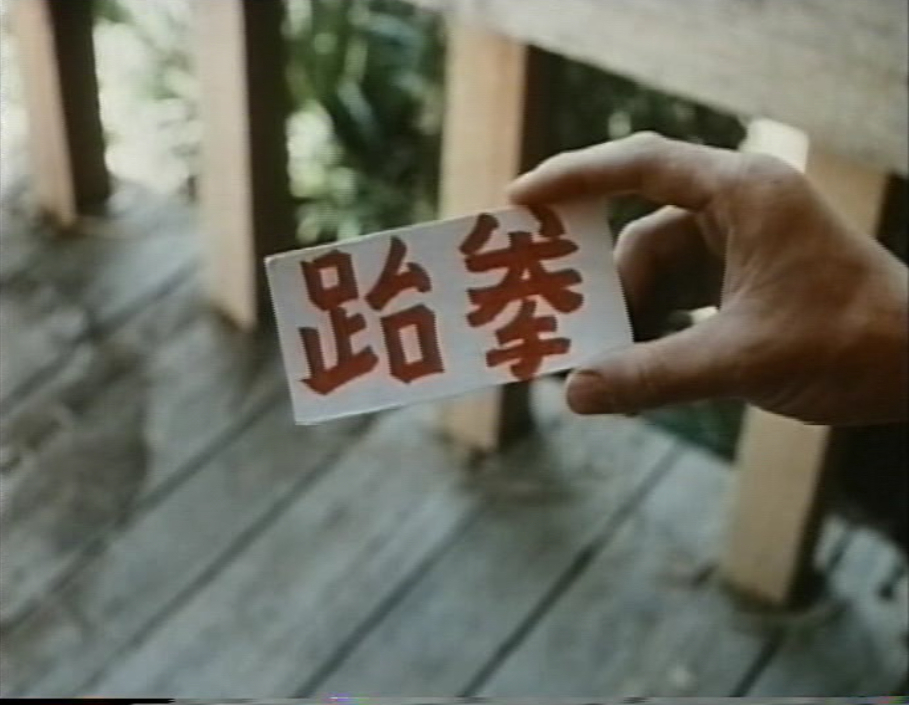
Then, the chief Mongol guy from the opening scene knocks on Simon’s door (further proving himself a jerk by casually kicking a dog in the process). He hands Simon a single playing card, and leaves again in silence. Written upon the card are two Chinese characters.


Cut to an establishing shot of a sinister, glass-fronted black tower-block. Perhaps it might be a university library or something in real life, but murky synth pulses on the soundtrack signify evil. In a dojo within the building, a karate demonstration is in progress. Phillip Rhee – white haired, wearing ‘aging’ make-up – watches approvingly.

“Alright”, he says, clapping his hands. Thirteen minutes in, and this is the film’s first word of dialogue, bird calls and grunts of exertion notwithstanding. Phillip’s right hand men are a black guy with a fine moustache and a really snazzy looking jacket, and a white guy with an equally good moustache and a very sinister demeanor. The chief Mongol appears from behind a black curtain and nods to them.


In a control room elsewhere in the sinister building, functionaries in white boiler suits and wrap-around shades monitor CCTV signals. Outside, two similarly clad guards oversee the main entrance. They appear to be robotically controlled minions or something? It’s not very clear.

Simon approaches the main entrance purposefully. Inserting the card the Mongol gave him in a reader in the door, he gains admission. Cautiously exploring the darkened office space behind the dojo’s black curtain, Simon sees a chicken cross a corridor. This will be the first of many chickens featured in ‘Furious’. Encountering the white, mustached henchman, Simon is summoned to an audience with Phillip, who is levitating in a black-walled room with rather groovy floor tiles.

Following a few master/pupil pleasantries, it seems they have a lot to talk about. “Your sister’s fate has becomes known to me, and your actions henceforth will alter the karmic debt she is paid”, Phillip says. “You are now between anvil and hammer – one truly orders one’s own destiny. The dove is a gentle creature, full of good – but if it encounters creatures greater than itself, it can be transformed.”

As he speaks, the mustached man pulls out a red handkerchief and performs some simple magic tricks, producing a bird from a handkerchief by way of demonstrating this dove metaphor.

“Seek who wears this sign,” says Phillip, passing Simon a pendant engraved with another mysterious character. “This will be the first stage on your journey.”


Presently, Simon and a small group of his ‘friends’ – two soft spoken, shaggy-haired white dudes in Hawaiian shirts and a lady in a knitted jumper carrying a Polaroid camera – visit a Chinese restaurant whose name has been identified as containing the character etched on the pandent.

Finding the restaurant closed, the gang are exploring what appears to be the courtyard of a small shopping mall when an unmarked black truck pulls up, and some men, led by the black guy in the snazzy jacket from the earlier scene, begin unloading – of course – CRATES OF CHICKENS.

Angered by the sight of Simon and his friends hanging around near the closed restaurant, the men become aggressive, initiating a free-for-all kung fu battle in which the mild-mannered friends hold their own quite well against the restaurant’s heavies – until that is, the stakes are raised by the intervention of a chef, who appears seemingly from nowhere and, with a vicious “Hi-YAH!”, dispatches one of Simon’s friends with a flying meat cleaver!

From then on, it’s absolute carnage. Crates full of chickens are thrown from roofs. The jumper lady gets in a great crotch kick and eye gouge combo. Simon slices the chef’s throat with his own cleaver. There are nunchucks, rooftop snipers and slow motion falls from first floor balconies. For a minor altercation regarding the opening hours of a Chinese restaurant, things are getting pretty intense.

Simon eventually succeeds in routing his opponents, who flee in the black chicken truck, but in the aftermath of the battle, all three of his friends lay dead. It’s safe to say his “journey” has not got off to a good start.


By this point, we are about one third of the way through the movie. Thereafter, it starts to get strange.

There are several visits to a shrine in the wilderness, where sinister voices whisper inaudibly on the soundtrack in a quite unnerving manner, whilst we are treated to some disorientating cross-cutting between Simon and a statue of the Buddha. “Travelling in a spiritual void can be dangerous”, an extremely sinister whispering voice repeats several times on the second of these visits. “Beware of Chan, he is evil”, the voice proceeds to repeat no less than ten times, as a montage of pieces of footage from other parts of the film is juxtaposed with shots of Simon contorting his face in pain. Who the hell is Chan, we may be forgiven for asking. Whilst I assume it must be Phillip Rhee’s character, I’m still not entirely sure.

And as to the scene in which Simon sensibly returns to the Chinese restaurant when it is open… what can you say? Ostensibly this is a public place of business, open to all, but, in keeping with the unwarranted aggression previously displayed by its staff, what we find within instead resembles a kind of interzone between two worlds - a cavernous, darkened room in which pensioners tuck into plates of greasy-looking duck, willing participants in some kind of terrifying, alien surrealism, reminiscent of the ‘other place’ sequences in David Lynch’s ‘Twin Peaks: Fire Walk With Me’.

The difference is though, whereas Lynch’s films evoke a very deliberate brand of gnawing, nightmarish otherness, ‘Furious’ seems to have stumbled into this dread realm entirely by accident, for reasons that I doubt even the filmmakers themselves would be able to sufficiently explain.

Rather than transcribing events in detail, it is probably best if I leave the specifics of this scene to your imagination until you get a a chance to see it for yourself – suffice to say, it had quite an effect on me.


In some ways, the methodology of ‘Furious’ reminds me of nothing so much as George Barry’s Death Bed – another unique piece of marginal American cinema. The same sort of slow, pulsing rhythm and careful positioning of strong visual elements is very much in evidence, as is the focus on close-up shots of inanimate objects and disembodied body parts; vivid images pulled from the natural resources surrounding the film’s production and examined, juxtaposed, mined for some obtuse poetic value or oddball humour, as if witnessing the workings of a mind entirely different from your own slowly unfolding before your eyes.

Whilst Barry succeeded in bringing a singular vision to the screen though, the disparate elements that play into ‘Furious’s final form are more suggestive of a malfunctioning brain-trust of different individuals, each pulling in a slightly different direction. Basically, the movie plays like an over-ambitious student film that went off the rails as different contributors began throwing in their own ideas (“hey, I know these guys who are really good at karate”, “hey, these friends of mine have this really weird band”, “hey, I found this fantastic location up in the mountains”, “hey, let’s make this film really COSMIC”, “no, it’s got to be FUNNY, put in more chickens!” etc), only later trying to piece the results together into something approaching a workable whole.

One consistent element at least is the pacing, which remains leisurely throughout – more Jess Franco than Sammo Hung – suggesting the presence of someone behind the camera more concerned with crafting a piece of meditative art cinema than a rousing action / adventure effort.

Martial arts sequences that play more like sporting demonstrations than life or death battles are admittedly quite commonplace in the world of low budget kung fu, but rarely have I encountered showdowns quite as *languid* as the ones featured here. Though the aforementioned Chinese restaurant massacre is admittedly quite frantic, later fights have me itching to inaugurate the term “stoner-fu” – a phrase that could sum up the whole film quite nicely to be honest, should you need a one sentence soundbite to sell it to friends or local film club or whatever. (I’ll also give you “it’s like ‘Miami Connection’ meets ‘The Seventh Seal’!” free of charge.)

Not that there are any issues with the quality of the martial techniques on display in the film, I hasten to add. Simon Rhee is an excellent screen-fighter, insofar as I’m qualified to judge, whilst most of the other participants get a few good licks in too, and there are some decent stunts thrown in for good measure. Entirely divorced from the editing rhythms and directorial velocity that energises Hong Kong kung fu though, these scenes nonetheless tend to become as hypnotic and temporally disengaged as a Franco sex scene, or a Werner Herzog stare into the undergrowth. Ultimately, the result is just kind of pleasant. Undemanding. Like watching people performing yoga in the park during your lunch break. With the film’s ostensible ‘story’ remaining largely unguessable, you almost expect the fighters to shake hands when their considerate brawling is concluded.

The music in ‘Furious’, credited to one Mikhail Bodik, largely consists of stuff that sounds like it was pilfered from one of those dusty old Hollywood soundtrack LPs favored by Andy Milligan. This plays incessantly, sometimes overlaid with startling outbursts of atonal synth racket and passages of aching melancholia that could have escaped from Leyland Kirby’s Haunted Ballroom. Much of the time, the music is very low in the mix – sometimes finding itself almost drowned out by birdsong and other background noise – lending it a subliminal, slightly intangible feel that, along with the awkwardly post-synced dialogue, adds greatly to the ‘disconnected’ atmosphere of the film as a whole.


Amid the obtusely symbolic craziness that comprises much of ‘Furious’s second half, a highlight for many viewers will no doubt be Simon’s battle with the aforementioned mustached magician henchman. This fellow seems to be the lord of the ‘chicken magic’ that rules the roost (sorry) within Phillip/Master Chan’s evil empire. We have earlier seen him using magical fireballs to transform some of Phillip’s fighters into chickens (for reasons that never become clear), and here he cackles maniacally as he uses occult hand gestures to summon hens out of thin air and propel them at Simon with great force – an impressive feat, to say the least.

At the height of this confrontation, for reasons that also remain entirely obscure to me, the magician is transformed into a small pig. I mean, an actual small pig, whose head briefly protrudes from the man’s robes, before falling to the ground where it lies prone. Apparently close to death, the pig begins to speak, and, astonishingly, its words appear to be roughly in sync with its lip movements. How do you suppose they pulled that one off, without the aid of any digital effects..?

At first I at a loss trying to figure out how this effect was achieved, but upon revisiting the film for this review, I’m forced to conclude that the filmmakers simply shot footage of the reclining pig chewing or licking its lips, and had the voice actor dub his lines around the animal’s natural movements – a circumstance that certainly helps explain the strange, Yoda-like cadences with which it speaks.

Forming a deathbed confession of sorts, the discourse of the magician-as-pig  is quite difficult to follow, but if I’m interpreting it correctly, he seems to accuse Phillip/Chan with utilizing “capitalism and fast food franchises” in addition to “sorcery” as tools with which to further his evil goals, one of which seemingly involved keeping the magician-pig in psychic bondage.

The pig also speaks of “forbidden Mongolian caves”, to whence the magical tusk he entrusts to Simon will point the way, containing “the key to the universe”. If you’re still doggedly holding out for an explanation of what the hell is going on by this stage in proceedings, I’m afraid that’s about as close as you’re going to get.


Oh yeah, and I forgot to mention - that Devo-esque band I mentioned earlier are only in the film proper for about ten seconds, although we get to see a bit more of them during the closing credits. Comprising a few of the black towerblock’s boilersuit-clad minions, I can only assume that the implication is that some of these zombie-guards have been given leave to form a weird rock band on their down-time, which I suppose makes about as much sense as anything else in ‘Furious’. (Considerately, they drop their instruments and race out to help when an alarm goes off alerting them to intruders.)

I wish we could hear the sound that these guys were actually making, rather than the post-dubbed synth squiggles on the soundtrack, because it looks absolutely wild.


From all of the above, you might well get the impression that ‘Furious’ is mad as the proverbial bag of snakes – a diagnosis that, whilst tempting, ultimately does the film a disservice I think.

Though it is indeed incomprehensible to a degree that is almost unique in the annals of commercial cinema, I don’t believe that ‘Furious’ is really “insane” as such.

In fact, I would argue that the storyline is actually quite linear, in its own strange way. The problem is though, rather than using conventionally understandable events and signifiers to move the narrative forward, the film instead seems to be operating via a system of visual secret codes whose meaning has been completely lost somewhere on the rocky road between brain, script and screen.

The spinning magic tusk, the chickens, the exploding cigar box, the Mongols, the hand gestures, the playing cards and magic tricks - what does it all mean? All of these things seem like elements of some particular fantastical mythology created by the filmmakers, but no one has taken the time to introduce us to it, or to provide us with a key by which to interpret it, leaving us merely to guess or imagine the significance of each passing absurdity.

In keeping with film’s vague, esoteric themes, it often seems as if ‘Furious’ operates according to its own unique system of divinatory correspondences – the private tarot of some lost, incense-fogged soul wondering around the corridors of an abandoned film school somewhere in the wilds of California.

Further thought along these lines inevitably leads us back to speculation as to who made this film and why, and, short of any forthcoming revelations on the subject, we, like the interpreters of Nostradamus, could just go on speculating indefinitely. Far better I think to empty our minds of such thoughts, and enjoy ‘Furious’ for what it is – the shell of what was once a poverty-stricken independent genre movie, filled to the brim with exquisite mystery, awkwardly mixed by hands unknown.


-----------------------------

(1) In recent years, Simon Rhee has also found work as a stunt coordinator on numerous A-list Hollywood productions, according to IMDB.

(2) For the record, Tim Everitt went on to direct a couple of low budget thrillers in the ‘90s and has subsequently worked on visual effects on a number of bigger Hollywood productions. Tom Sartori has numerous credits as a ‘colorist’ for TV series and documentaries. If either of these gentlemen has ever publically spoken about ‘Furious’, I am unaware of it.

Tuesday, 2 July 2013

Deathblog:
Jim Kelly
(1946 – 2013)

“Where you going?”

“Out in the moonlight, baby.”

Sad to hear yesterday of the death of karate and tennis pro and sometime totally-awesome-movie-star Jim Kelly.

Just a few weeks ago, I spent a nice afternoon on the couch watching ‘Enter The Dragon’ on VHS – first time I’d seen it in a while, and a welcome reminder of what an extraordinarily entertaining picture it is. Post-screening, conversation turned, as is inevitably the case, to what an incredible bad-ass Jim Kelly is, what a bad decision it was to kill him off before the film’s finale (oops – spoiler alert?), and how sad it is that he only played significant roles in about five films, rather than, like, a thousand.

I’ve not yet had the pleasure of catching any of his subsequent blaxploitation flicks (‘Black Belt Jones’, ‘Three The Hard Way’, ‘Black Samurai’ etc.), but based solely on his performance in ‘..Dragon’, I think it’s safe to say he had the potential to be one of the most effortlessly cool, charismatic, capable and just plain funny action stars of all time. R.I.P.

Friday, 18 January 2013

Panic Over Istanbul:
A Two-Fisted Turkish Triple Bill!


Polite Notice: I’m afraid this is going to be a fairly huge post. As it’s a continuous piece of writing covering three films I watched in a single sitting, I didn’t want to split it up. So you might want to get comfortable, pour a drink.. whatever gets you through the day whilst reading rubbish about old movies on shiny computer screens. It’s gonna be a lot of fun though, honest. You’ll get through it in no time. Pour another drink, that should help.

A phenomenon that flew under the radar of even the most adventurous international film fans until recently, the strange world of Turkish pulp/pop cinema has enjoyed a bit of a resurgence over the past few years, as the remaining artefacts of this apparently wildly prolific popular film industry have finally found their way to the eyes & ears of Western viewers. This is partly down to the pioneering efforts of DVD companies such as Onar Films (now sadly defunct following the death of founder Bill Barounis), and partly due to the slightly more shady means of bootlegging, file-sharing and internet streaming, which has allowed curious layabouts and bored teenagers all over the world to share a laugh and a WTF over such Youtube perennials as ‘Turkish Star Wars’ and ‘Turkish ET’.

There’s more to this tradition than just inept rip-offs of Hollywood hits however, and whilst an admirably carefree approach to the plunder of copyrighted characters, music and sometimes even actual footage seems to have defined Turkey’s b-movie output right from its origins in the early ‘60s, these films are in other respects rather inspired – a form of impoverished, audience-pleasing popular cinema that is funny, fast-moving and hugely entertaining… for those of us who can still appreciate the simple joys of a bunch of guys in outlandish costumes punching each other, at any rate.

To all intents and purposes, these are exactly the kind of films that ten year old boys would make if given the chance, expressing a sense of comic book naivety that makes your average Mexican lucha libre movie look like the lost musings of Pasolini by comparison. Simplistic plotlines, cartoonish violence, thinly veiled imitations of popular characters running around in home-sewn costumes, beautiful ladies in their underclothes, weird Bond-style villains and their assorted low-rent schemes and, most importantly, non-stop action – these are the things that make these movies tick, and tick they do, like the clock on a primitive time-bomb, thrown from the window of an out of control Skoda.

In Turkey, costumed heroes seem to be afflicted neither by the surrealist identity confusion of the French pulp tradition, nor by the angst of post-Stan Lee American superheroes. In a Turkish movie, if a guy wears the mask, then that’s who he is, and you’d better duck cos he’s coming to kick your ass! This is brutishly utilitarian film-making, but it’s also precisely the kind of undemanding, unpretentious entertainment I feel we need more of in these days of tediously contrived, middle-brow ‘cleverness’. Also, these flicks are only about sixty or seventy minutes long, so as long as you can find ‘em*, you can really binge on them – the cinematic equivalent of crunchy, sugar-coated sweets. That’s exactly what I did over Christmas, and I was taking notes too, so without further ado, let’s relocate to some unimaginably dingy flea-pit auditorium in the heart of Istanbul and enjoy three surviving examples of this proud tradition, spread evenly across the decades.

  Based on a now fairly obscure character pilfered from 1940s American comic books and an accompanying Republic Pictures serial**, Casus Kiran [aka Spy Smasher] (Yilman Atadeniz, 1968) concerns the exploits of the titular costumed hero, who, in this Turkish reiteration at least, loves his country and makes sure everybody knows his name. “That damned Spy Smasher,” his opponents are want to exclaim, “he messes up everything!”

And perhaps their umbrage is to some extent justified, as, despite our hero’s well-advertised disdain for espionage, the villains he faces in ‘Casus Kiran’ at no point seem to do anything that really identifies them as spies. On the contrary, they’re the gangsterest bunch of gangsters you ever laid eyes on, right down to their propensity for sporting wide-brimmed hats, pencil moustaches and tommy guns, in addition to the more central business of running crooked nightclubs, overseeing illegal poker games and stockpiling prodigious quantities of cash and gold. Led by a guy called Black Glove (he doesn’t wear a black glove) and an uber-boss known only as The Mask (you better believe he wears a mask), there is admittedly some stuff about them holding a stolen tape recording naming prominent individuals involved in a spy ring, but this particular plot point seems to be forgotten almost immediately, furthering the impression that spying is strictly a sideline for these fellows.

As things rolled on and no evidence of spying emerged, it occurred to me that perhaps Interpol and the Turkish authorities are merely taking advantage of Spy Smasher’s indefatigable enthusiasm for smashing spies, unleashing him instead against some particularly troublesome common criminals, whilst the real business of cold war subterfuge goes on unhindered. Makes sense really. But, with the presumed sequel in which Spy Smasher turns against his masters to uncover corruption and intrigue within the Turkish state sadly lost to history, let’s concentrate instead on the adventure at hand.


Spy Smasher is cool! Decked out in a somewhat Batman-ish costume, he rides around on a motorbike as warped fragments of Davie Allan & The Arrows’ immortal Blue’s Theme plays on the soundtrack. With him is his girlfriend Sevda, and Sevda is even cooler! She carries a Lugar, has nifty flip-up sunglasses and wears go-go boots and a kinda one piece black khaki mini-skirt type ensemble (sexy and practical!).

As they roar off to an abandoned building to have it out with baddies, Sevda and Spy Smasher seem to be really enjoying themselves. Evidently sharing the same passion for unthinking two-fisted justice, they seem to have a real nice, healthy relationship going on, especially considering that one partner never removes his face mask and insists on being addressed by his superhero name.

After an exciting introductory section with shoot-outs, explosions and frantic chases, there’s a bit of a lull as the plot gets underway, but after that the rest of the movie is basically just one extended fight scene, strung together with brief bits of expositive connecting tissue and shots of Spy Smasher cruising around on his bike.


As the man behind all of the legendary Kilink films***, director Yilman Atadeniz certainly knows his onions re: this kind of thing, and the sheer amount of fisticuffs he manages to cram into seventy-something minutes is fairly remarkable. Lacking the ‘drop three henchmen in single blow’ powers of his American counterparts, poor old Spy Smasher is forced to give each goon a thorough going over before moving on to the next one, and often he seems exhausted by the time he finally manages to get near the ‘proper’ villains, just as more goons descend, and another bout of knuckle sandwiches and body-slams begins. It’s hard not to share our hero’s frustration here, as The Mask and Black Glove repeatedly make their cowardly escape, leaving him pounding against a solid wall of thugs.

I’m sure I won’t be spoiling things much by revealing that Sevda and Spy Smasher do eventually catch up with the villains and their sinister operation, following them to their island hideaway via a moderately awesome speed-boat chase across Istanbul harbour. In a brilliant touch, The Mask is apparently so perturbed by Spy Smasher’s activities that he’s decided to cut his losses and leave town entirely, arranging for the gang’s reserves of gold to be melted down and shaped into what looks like the rear seat of a family car, the upholstery apparently stuffed with their remaining stock of cash! Surely this would seem to be setting things up for a wild car chase once the seat is installed in a vehicle, but sadly that never transpires. Maybe they were planning an additional closing chase or something, but as it is, seventy five minutes was in the can, whatever miniscule resources a film like this could command were presumably running low, and so Spy Smasher instead wraps things up using his tried & tested formula – painstakingly beating the shit out of everyone.


Sometimes erroneously known as ‘Turkish Spiderman’, T. Fikret Uçak’s 3 Dev Adam [3 Mighty Men] (1973) begins with a scene that fans of that character certainly won’t forget in a hurry.

On a deserted beach, a woman is buried up to her neck in the sand. Spiderman looks on as his goons lift up a small motorboat and start manoeuvring the churning propeller of the outboard motor toward the woman’s face. The woman screams as the propeller gets closer. Spiderman give the order, and blood is seen splattering across the bare legs of his female consort, as he waves his fists in the air and silently cheers.


Clearly this kind of madness cannot be allowed to continue. But fear not, the combined forces of El Santo and Captain America are on the case. Arriving – sans costumes, surprisingly – at Istanbul airport, the duo and their female companion (Julia, apparently) are greeted by the Turkish police, and head straight for a briefing on the antics of ‘Spider’ and his gang, who are embroiled in some kind of weird racket involving smuggling stolen antiques to the USA and crooked Mexican currency transactions, or something. With flawless attention to detail, Santo here takes the form of a lanky long-haired guy, whilst Captain America looks rather more dandyish than you might have anticipated in his snakeskin jacket, loud yellow shirt and spotted neckerchief.


If ‘Casus Kiran’ only reached the 21st century via a sun-damaged print that could have been rescued from the bottom of an ashtray in an abandoned porno theatre, my copy of ‘3 Dev Adam’ somehow manages to look even worse, adding about ten generations of VHS fuzz to the mix. But we’ve got it, and that’s the main thing. Quality is so poor that it’s often difficult to tell who’s who outside of close-ups, and as such I certainly appreciated it when our heroes finally donned their brightly coloured costumes for the duration of the innumerable fight scenes.

And, despite the increased level of violence compared the equivalent ‘60s movies, the action here still has a wonderfully cartoonish quality to it (as you might reasonably expect, I suppose). Just dig the bit where Captain America repeatedly bangs a goons head into a wall-mounted frying pan, complete with CLANG CLANG CLANG sound effect – this seconds after he’s announced his presence by jumping through a paper wall. Great stuff.

And whilst Spider is escaping from his initial confrontation with Captain America, roaring away through the sand dunes in his Cadillac no less, Santo initially finds himself reduced to a slightly uncharacteristic ‘sneaking around’ type role, breaking into the office of a bad guy-affiliated gym at night, where he stuffs some secret documents into the crotch of his pants before swiftly returning to his natural comfort zone as he tangles with the heavily moustached manager, and, naturally, a posse of nocturnal karate dudes who (as they helpfully explain) sneak in to train after dark. So you can probably guess how all that pans out. You’ll forgive the ignorance of a wrestling novice, but what’s the name of that move where he picks up a guy on his shoulders and spins him round, knocking over all the other guys..? You know the one I mean. I always love that one. Happy times.


As will be clear from the opening scene onwards, ‘Spider’ is, to all intents and purposes, Kilink [see earlier footnote for more on him], returning with a new red and blue body-suit, but a similarly nefarious set of priorities. Obviously fully cogent with his responsibilities in maintaining the noble traditions of masked Turkish villains, he likes to hang out on his yacht with a small harem of mini-dressed girls and a modestly stocked bar, there to cackle and rant to his heart’s content. Aficionados of these kinda movies probably won’t need told that our arch-fiend is just a little too paunchy to really pull off the skin-tight one-piece bodysuit, and has an absolutely tremendous evil laugh.

Naturally he runs a crooked nightclub too, and his resume of evil is soon ramped up even further when he casually steps out to strangle a naked woman to death in the shower for… reasons that rather elude me, plot-wise.. oh, hang on, yeah – he stole a statue from her apartment, that’s right. So clearly the lengthy naked strangulation scene was a simple matter of narrative necessity.

In another wonderfully indefensible shock scene, Spider further demonstrates his badness (like it needed any more demonstrating!) in a sequence that sees Turkish b-cinema achieving new heights and/or depths by ripping off the Room 101 scene from Orwell’s ‘1984’, as a poor disobedient flunky has his face eaten by hungry rats, a process aided by a purpose built rat delivery mechanism. In the unlikely event that Spider is ever brought to trial for his various outrages (rather than merely being blown up, crushed or punched to death), I’d like to imagine there’d be an anguished social worker sitting there thinking, “I knew giving that guy a library card was a bad idea”.


As you might well have guessed, Spider and his psychotic tomfoolery does rather tend to steal the show in ‘3 Dev Adam’, but there’s certainly no shortage of other fun stuff to enjoy, all aided by the film’s wildly over-saturated comic book colour scheme, which achieves near radioactive brightness in its current degraded form. More period-appropriate awesomeness can be found when some great psychedelic rock (no doubt requisitioned from elsewhere) blares during a fashion show that looks like it’s being staged in the producer’s living room, and, back at Spider’s club, we get to enjoy a Jess Franco-worthy op-art striptease act featuring a silhouetted drummer, and a concealed dancer who dramatically breaks through a coloured paper circle to emerge into view at the act’s conclusion. I think that happens shortly before Santo, Julia and Captain America arrive incognito and totally trash the joint, but I might be getting confused.

You wouldn’t think confusion would really figure much in a story this basic, but as events pile atop events and endless brightly-hued goons are hurled hither and yon, soon the whole thing blends into an endless dream of running around and punching, and before you know it things have reached an unparalleled level of dementia when a love scene between Spider and his chief lady is briefly interrupted by footage of some cackling, punch & judy style puppets. (Actually, thinking about it, I’m not sure if that bit was even supposed to be there – it could have just been the result of someone accidentally flipping the channel at some point in the film’s trek through the VHS duping wilderness, but at the same time I wouldn’t put it past a movie like this to throw it in deliberately just for the sheer hell of it.)


Anyway, you get the idea. If ‘3 Dev Adam’ perhaps doesn’t *quite* achieve the same level of non-stop action as ‘Casus Kiran’, the addition of sleaze, graphic violence and flat-out lunacy to the formula serves to make it an even more remarkable effort overall – a thing of beauty and a joy forever. Within their limited field of operation, both of these films are simply tons of fun, with cast and crew evidently putting their all into trying to equal the more expensive action spectaculars seen in ‘professional’ film & TV, and, by vestige of their sheer giddy enthusiasm, pretty much succeeding, emerging with a product that’s still guaranteed to keep aggressive children, simple-minded adults and random weirdoes glued to their seats in a state of stupefied happiness, all these years later.


Of course by the latter half of the ‘70s, things were pretty tough for low budget commercial cinema the world over as blockbuster-era Hollywood tightened its grip on the market, and no doubt the returns from this kind of ultra-marginal, localised fare would have been particularly badly hit. So what choice did it have but to get tough in return? Apparently safe in the knowledge that they wouldn’t even register on the radar of big studio lawyers, Turkish b-filmmakers seemed to have decided by this stage that direct, unashamed rip-offs of Hollywood properties were the way to go, resulting in such oddities as former international film festival award-winner Metin Erksan directing ‘Seytan’ (“The Turkish Exorcist”) in 1974, and the final film we’re looking at today, Çetin İnanc’s Vahsi Kan [Wild Blood] (1983), commonly known – with somewhat more justification this time round – as “Turkish Rambo”.


By the time he made this one, İnanc was pulp / action movie veteran, having served time as assistant and screenwriter to the aforementioned Yilman Atadeniz (man, imagine what the SCRIPT for one of those films must look like..) before beginning his own directorial career the terrific sounding ‘Iron Claw The Pirate’ in 1969, and, with ubiquitous Turkish action star Cuneyt Arkin heading up its cast, 'Vahsi Kan' features notably better production values that the earlier films we’ve looked at today, making it the only one that a hapless square might be liable to mistake for a ‘proper’ movie. If they’d had a few drinks. And if they were watching it from a distance. I mean, let’s not go nuts here, but the editing and pacing are pretty decent, and there are some shots that are stylishly done here and there, some great stunt-work, some performers who are allowed to attempt a bit of ‘acting’ rather than just running around punching stuff, and, well, y'know - that sort of thing.

Alongside a slightly upgraded level of technical competency though, the dawn of the VHS era also seems to have ushered in a dramatic increase in the level of gritty, exploitative nastiness, and WHOA THERE, you’ll be tempted to exclaim as the film opens with a montage of crazed thugs delivering savage beatings, living room-trashings and sexual assaults, things sure have gotten NASTY since the costumed hi-jinks that predominated just a few years earlier (and, given the gory highlights of ‘3 Dev Adam’, that’s no mean boast).


After this furious if rather incoherent opening (featuring a mixture of salty looking tough guys, dodgy interior décor and cheesecake dollybirds that rather puts me in mind of Pete Walker’s early crime films), things proceed to get even more furious and incoherent, as we cut to an elderly man who is apparently being driven into town so that he can testify in some sort of unspecified trial, with his teenage daughter at the wheel (the gratuitous upskirt camerawork from the floor of the driver’s seat is an audacious bit of sleazoid cinematic ingenuity), and his young son in the back seat.

Encountering what appears to be a pile of shirtless male corpses in the middle of the road as they pass through a remote forest clearing, the family are understandably astonished when the men appear to return to life sporting gory zombie make-up, and advance upon the car.

As their faux-undead assailants get ahold of them, the car’s occupants are swiftly shot, strangled, burned alive and – in the daughter’s case - raped, the camera leering relentlessly at her legs and red-pantied ass as her attackers manhandle her. Yes, I’m afraid it is all quite horribly distasteful, but thankfully for our sensitive Western eyes, this girl seems to be made of sterner stuff than your average nameless victim, and she dispatches her primary attacker with a sharpened tree branch before making a getaway on foot before things get *too* hard to stomach.


What happens next initially seems entirely nonsensical (and never really becomes wholly sensical, to be honest), but can perhaps best be summarised via the notes I scribbled down whilst viewing;

"White-haired prisoner being escorted on foot by two soldiers turns the corner and wanders into the apparently remote scene of the aforementioned outrage; an exploding car is represented by a shot of a small ground charge going off in an entirely different location and the soldiers go flying; despite the white-haired guy being a handcuffed prisoner, he seems to be giving orders to everyone and is left to roam around unaccompanied as an ambulance takes his captors to the hospital… what the hell is going on!?"

Well he’s a bad-ass, that’s what’s going on. Casually striding through the wilderness like some Turkish version of 80s era Johnny Cash, toothpick between his lips, handcuffs now lost, this silver fox is none other than Cuneyt Arkin – our Turkish Rambo himself. And thus far I think I like him a lot better than the American Rambo. I mean, admittedly Arkin looks to be about twenty years older than Stallone was when he played the equivalent role, but he’s got screen presence to die for, and he’s got the moves too. None of the performers in the earlier movies discussed above really had a chance to make much of an individual impact, but this guy is a *star*, and İnanc’s camera and script treat him accordingly.

Just watch as he stares down and single-handedly beats the shit out of a whole battalion of tooled up biker-thugs - don't mess with this guy! Look, he even jumps off a hundred foot cliff and survives, no bother at all, before making haste into the jungle.


With our central character established, I’m assuming that hereafter things proceed to follow the storyline of ‘First Blood’ pretty closely, as Riza (for that is his name) gets his obligatory bandana sorted out and goes into full throttle mentalist survivalist mode pretty much immediately, lurking under piles of leaves, crawling around in the mud and catching wild crabs for food (warning: nasty crab-slicing shot), glaring around madly, brandishing his Rambo-knife and… hang on, why does he have a bloody great knife? Didn’t he just escape from police custody or something?

Well, whatever. Here things get kinda interesting vis-à-vis this review, because you see, I’ve never actually seen the original ‘First Blood’. I mean, maybe I saw some of it on TV when I was a teenager and it blurred into some of the other Rambo movies, but I’m pretty sure I’ve never actually sat down and watched it all the way through. Try not to judge me too harshly here - by the time I was old enough to watch violent movies like that I was already a long-haired, Philip K Dick-reading layabout, and wasn’t really into the idea of cheering on this dumb Reaganite muscleman as he went around giving people a hard time, y’know? A proper appreciation of the art of lunkheaded action films would have to wait until, well, now apparently, and I’ve got a lot of catching up to do. So in short, I’m not really sure how much of what unfolds in ‘Vahsi Kan’ is ripped directly from ‘First Blood’, and how much is original. But I’m sure YOU’VE probably seen the proper ‘First Blood’, so let’s give this a try shall we?

Does ‘First Blood’ have a sub-plot about a psychotic quadriplegic guy who blows people up by leaning back on a detonator built into the back of his wheelchair? If not, chalk one up for the Turks!


How about a Vincent Price lookalike villain who spends most of the movie sitting in his hideout ranting insanely about loyalty and vengeance as he slugs Johnny Walker and ignores his bored & dissolute bikinied girlfriend? (“Most entertaining” according to my notes, and who are you to argue?)


One thing I’m fairly certain ‘First Blood’ doesn’t have is a sexy jungle girl, so three cheers for ‘Vahsi Kan’. Because, yeah, you remember that poor rape victim who fled into the woods about half an hour back? Well inevitably Ram – sorry, Riza – bumps into her fairly sharpish as he’s doing his rounds of the jungle, and, one quickly whipped up jungle girl outfit later (Cuneyt Arkin is so cool, I believe that his skills would actually stretch to such feats of improvised combat zone tailoring), the apparently universal rule that every Turkish movie hero must have a feisty female sidekick remains intact.

Not that the girl is terribly feisty, disappointingly. This is quickly established when the pair bond during a cringingly stupid moment that sees her trying to clamber over what is clearly an easily navigable slope (it’s, like, maybe three feet high), only to fail and call upon Riza’s assistance. Oh, and as was made abundantly clear earlier on, Çetin İnanc’s camera just cannot get enough of this actress, regardless of the dramatic context, so naturally a lengthy topless bathing scene ensues almost immediately. Well if you’re gonna make a thoughtlessly misogynistic macho movie, you might as well go all out, right?


Happily, ‘Vahsi Kan’ carries over all of the relentless energy and non-stop violence of the earlier films, and is just as entertaining and moderately unhinged, in spite of the far grimier exploitational tone. There are occasional outbursts of the kind of goofery that inevitably accompanies such super-quick, super-cheap film making (fatal knife blows that clearly miss their target, carved stone steps suddenly appearing in remote, inaccessible caves etc), but in general the film’s action scenes are vigorous and brutal and fast-moving and hopefully impressive enough to cause anyone watching this movie purely for the sake of mockery to think again.

As with all of these films, there’s certainly a lot to laugh at, but there’s a lot that’s worthy of genuine appreciation too, and a spirit of wild, unpretentious fun that should be cherished and applauded. It’s a shame that resourceful directors like İnanc felt they had to spend their time imitating Hollywood epics rather than filming their own crazy stories, but needless to say, I’d definitely take the kind of mayhem that ensues when guys like this go to work on a property like Rambo over any of the tepid ‘reimagined’ garbage that’s been clogging up ‘proper’ cinemas in recent years. How to conclude, other than just to note that I've got aching eyes and an aching belly, and that the past four hours passed in a blur of more unadulterated FUN than any similar stretch of time in recent memory. Recommended viewing..? You bet.


*‘Casus Kiran’ is available to download with English sub-titles from The Internet Archive. As to the other films featured here, seek and ye shall find.

**Thanks to Todd Stadtman’s review of Casus Kiran at Teleport City for filling me in on the character’s pre-Turkish history.

***Well I think they’re legendary anyway. I saw one screened in public last year, so they must be doing ok. See here and here for the lowdown on Kilink and his convoluted origins.

The posters used in this post are taken from the awesome & informative gallery at http://www.turkposter.com/turkish1.htm.