Showing posts with label Robert Fuest. Show all posts

Thursday, 1 November 2018

Belated Happy Halloween Everybody.

Well, phew – that was a lot of fun. My productivity both in work and day-to-day life may have suffered, but knocking out over 28,000 words of horror movie reviewin’ in the space of a month proved very enjoyable. Although I’ve fallen one short of last year’s total of fifteen reviews, I’ve still just about managed to meet my self-imposed ‘post every two days’ deadline, despite being derailed both by extra-curricular ‘Train To Busan’ re-evaluation [watch this space], and by the need to bang on for absolutely ages about Mandy. My review of The Monster Club just about made it under the wire at 11pm on Tuesday night… and we’re done.

Huge thanks to everyone who took the time to leave comments, or simply to read these posts – I really appreciate it, and I’m sorry I haven’t had a chance to reply to some of them yet; all have been most apposite and welcome.

I hope that your own October was just as full of gratuitous and irresponsible wallowing in horror movies as mine has been. To finish things off nicely, here are a few brief-as-possible run-downs of some other movies I’ve managed to fit in this month, but have lacked either the time or inclination to write up in full.

All The Colors of The Dark 
(Sergio Martino, 1972)

Making Martino’s other gialli look like light-weight trifles in comparison, ‘All The Colors Of The Dark’ (which I returned to for the first time in a few years late weekend) makes for an oppressively heavy and intoxicating viewing experience. The film’s Polanski-esque immersion into the increasingly unreliable perceptions on a woman on the verge of complete nervous collapse leads to an airless and claustrophobic feel, and, unusually, Edwige Fenech makes for a fairly inscrutable and unsympathetic heroine on this occasion, meaning that the ninety plus minutes we spend following her every move are rather less pleasant than her fans may have anticipated.

The non-supernatural elements of Gastaldi’s script are likewise fairly tedious and over-familiar (a fact not helped by the film’s infuriating habit of introducing characters who look almost exactly like other characters), and Martino seems to struggle at times with extracting his preferred level of stylistic grandeur from the unusually drab British locations.

When he does get his mojo on though, the film crashes into heady, oneiric territory with almost frightening glee. Susan Scott / Nieves Navarro is great as the spaced out, witchy neighbour character, and the castle-bound Sabbath / orgy sequences she leads Edwige to are far stronger and more rapey than I remember from previous viewings - both totally freaked out and genuinely rather upsetting. (My wife was absolutely mortified by the bit where a cute little doggie gets sacrificed. Oops - I’d have held this one back for solo viewing if I’d remembered.)

Meanwhile, Ivan Rassimov drips menace as only he can, glowering mightily in his distinctive fashion, and, as fans will be well aware, Bruno Nicolai’s music is absolutely off-the-hook. One of the most raging, psychedelic Euro-cult scores of all-time, it adds hugely to the film’s overall impact.

Indeed, ‘All the Colors..’ remains an essential slice of full strength giallo / euro-horror business – the cinematic equivalent of being force-fed claret and sleeping pills, more or less – even if it falls to some extent into the “easier to admire than to love” basket.

Black Moon
(Roy William Neill, 1934)

Despite a wonderfully alluring poster and the always welcome presence of Fay Wray, this voodoo / plantation island tale from Neill (who went on to become the regular director for Universal’s Sherlock Holmes series) has never really gained much traction amongst vintage horror fans – probably due to the fact that it is both profoundly mediocre and very, very racist.

Lacking either the dream-like atmospherics of ‘White Zombie’ or the intelligence and subtlety of ‘I Walked With a Zombie’ (and, indeed, lacking any zombies), I suppose you could at least make a case for this one as the go-to template for all subsequent undistinguished voodoo b-movies, but that aside, it has very little going for it – unless you’re scared of black people I suppose, in which case… well, I suggest seeking psychiatric help rather than wasting your time watching old movies.

Actually, my one pertinent observation here is that this film represents an example of prevailing social attitudes having changed so profoundly in the eight decades since it was made that (child sacrifice notwithstanding), the supposed “bad guys” (ie, the black islanders and the white lady who grew up with them and digs their culture) now seem vastly more sympathetic than the stuck-up, slave-owning “good guys”. So, that’s quite interesting, I suppose?

Meanwhile, the staged voodoo rituals are filmed with a sweaty, feverish intensity, and the manipulative imperilment of a white child within them would almost certainly not have been allowed once the Production Code kicked in a year or two later…. but, beyond that, nothing much to see here folks – please move along.

In fact, I’d go as far as to say that, unless you’re working on a biography of one of the principal cast members or carrying out a study of colonialist attitudes in 1930s horror films, there is very little reason to watch this in the 21st century.

Dr Phibes Rises Again!
(Robert Fuest, 1972)

It recently occured to me that, although I have naturally seen Robert Fuest’s ‘The Abominable Dr Phibes’ (1971) many times over many years, as is only right and proper, I’d never actually got around to watching the sequel.

With this oversight duly corrected, I can immediately understand why this one is somewhat less well-regarded than its predecessor. Whereas the first Dr Phibes film feels like a perfectly formed cinematic creation, with every detail carefully planned out in advance, ‘..Rises Again’ by contrast is absolutely all over the place, feeling very much like a series of random incidents strung together with little rhyme or reason, leaving all kinds of incongruous bits and pieces flapping inelegantly in the breeze.

This is especially unfortunate given that Fuest’s plan for this film seems to have been even more extravagantly ambitious than the first one, with Dr Phibes’ decision to decamp to a network of cyclopean ancient Egyptian ruins allowing the director to indulge in some of the most wildly imaginative (and, no doubt, expensive) sets and props of a career spent more or less specialising in such things. (Caroline Munro’s Rolls Royce coffin is a definite highlight.)

I’ve not yet had a chance to dig into the various extras on the blu-ray, but one suspects that a perfect storm of budgetary and scheduling problems, studio interference and unsympathetic editing may well have led Fuest to crash and burn here.

No one could accuse him of not giving it his best shot however, and whilst ‘..Rises Again’ is objectively a far poorer film than its predecessor, that thankfully doesn’t prevent it from being an absolute hoot from start to finish – a raving mad car crash of fiendish weirdness, the like of which has rarely been seen before or since, with an extraordinary cast and some murder set-pieces so grandiose and surreal they even eclipse those of the first film.

I mean, really, what can you really say to the sight of Milton Reid getting a golden snake rammed through his brain (I think that might actually be my favourite scene from either film), Hugh Griffith being cast out to sea in a giant gin bottle (rather cruel I thought, given his well-known drinking problem), John Thaw getting his face chewed off by an Andean Condor, and the likes of Terry Thomas, Peter Cushing and Beryl Reid all turning up for no apparent reason to take a bite out of the scenery before disappearing again..?

It would take a hard-hearted movie fan indeed to witness such wonders and still emerge complaining that the script doesn’t make much sense, the humour is puerile and the make-up effects are a bit iffy. Highest possible recommendation.

Zombie Creeping Flesh
(Bruno Mattei, 1980)


AKA ‘Hell of the Living Dead’ and probably about a dozen other things.

Claiming that this is the best film ever realised by the dynamic duo of Mattei and Fragrasso may not sound like much of a compliment, but… there ya go, make of it what you will.

Unfortunately, ‘Zombie Creeping Flesh’ is marred by a veritable avalanche of poorly matched stock footage during its ill-advised cannibal movie-style middle section (not only do we get to see grey elephants stampeding across the majestic plains of Papua New Guinea but I think they cram in enough National Geographic ‘native tribal customs’ clips to cover about three continents) -- but, if we can leave all that aside, I’d argue that all of the legit, men-on-the-scene type stuff with our team of hard-boiled commandos tangling with the zombies is actually pretty damn boss.

The mad laughing, Klaus Kinski-type dude is great; the business with the zombified kid is brutal (but great), the Baader-Meinhof style terrorist siege that introduces us to the commandos is, uh, *kinda* great, the stolen Goblin music on the soundtrack is great, and the whole opening section with the zombie outbreak in the power plant is awesome.

And, nearly forty years down the line, dare I even suggest that the film’s once laughably heavy-handed political sub-text actually now seems pretty on-point, vis-à-vis the developed world inflicting plague and environmental devastation upon poor island communities..? Not least in the eerie (and weirdly audacious) scene that sees New Guinea’s representative at the U.N. angrily pleading his nation’s case to a near-empty chamber.

Well, anyhow - it may not be as funny as Zombi Holocaust, as icky and dream-like as ‘Burial Ground’ or as brilliantly mental as Cannibal Apocalypse, but if the clock strikes midnight and you find yourself in the mood for some rock solid Italio-action-horror goodness, this one won’t let you down.

Salem’s Lot
(Tobe Hooper, 1979)

I’ve never been much of a Stephen King fan, so I’ve not read the novel, but I can easily believe that this leisurely three hour TV-mini-series-converted-into-theatrical-feature type effort gives a pretty good impression of what the experience of reading it might be like, complete with reams of extraneous sub-plots and secondary characters, heavy small-American-town-gone-to-seed vibes, and a brave, easy-lovin’ novelist with big glasses turning up to save the day.

Overall, this isn’t a bad vampire story – nothing too earth-shattering, but there are plenty of effective moments; it’s interesting to see James Mason of all people popping up as the sinister, vamp-enabling antique dealer, Elisha Cook seems to have wondered straight in off the set of ‘Messiah of Evil’ six years earlier, the circa ’73 fashions everyone wears already seem to be gathering dust, I loved that little jeep with the canvas door that the playboy writer guy zooms around in, and there’s some choice stuff with the pre-‘Lost Boys’ vampire hunting monster kid character. (DAD: “magic, monsters – what do you see in all this?”, KID: “I dunno, I just like it I suppose – the same way you liked numbers, so you became an accountant”.)

Things take a startlingly apocalyptic turn towards the end (I could have done with a bit more of that), and the eventual revelation that the head vampire is none other than motherfucking Graf Orlok himself is absolutely brilliant – like his silent-era predecessor, he’s a pure monster-vampire who doesn’t mess around, and a truly terrifying figure.

So that’s good, but, ah, I dunno – unless you watched this on TV at an impressionable age or you’re a big King fan, I don’t think ‘Salem’s Lot’ will really knock your block off. *SHRUG* It passes the time well enough, I suppose, but I wouldn’t really recommend prioritising it unless you’ve got a lot of time on your hands.

Actually, perhaps the most surprising thing here is the revelation that cantankerous wild man of genre cinema Tobe Hooper once managed to direct over 180 minutes-worth of blandly proficient TV movie story-telling without freaking out or doing anything crazy (well, not on-screen, at least). I’ve not read up on the background, but I’m guessing that perhaps it was this uncharacteristic fit of good behaviour that got him the gig on ‘Poltergeist’..?


And finally….

Halloween
(David Gordon Green, 2018)


Well, this was a bit of a mixed bag. As is outlined at length by Robert Skvaria’s review at Diabolique, this “forget all the other sequels” sequel to Carpenter’s original faces serious problems with regard to its scripting, its attempts to tell a character-based story and its questionable approach to mental illness. In fact, I’d go so far as to say that the opening twenty or thirty minutes are flat-out dreadful.

Some plummy-voiced true crime podcasters go to visit Michael Myers in a Bedlam-style loony bin where the inmates stand in the yard chained to lead weights and howl like dogs. Some doctor is like, “Donald Pleasence is dead now, so I’m here – any questions?”, and everyone goes on and on about the “legend” of Myers, unveiling artefacts and reminders from the original film as if they were The Holy Grail and…. please god, make it stop.

Well, thankfully, it does more or less stop, and from the moment Myers is on the loose, things improve considerably. The strongest element of H-2018 comes via the fact that director Green understands The Shape, and how best to use it – ie, as a purely cinematic conceit, rather than as a flesh & blood “character” (god forbid).

He realises that when the on-screen characters struggle for survival, they are not battling against some guy in a mask, but against the fiendish ingenuity of the filmmakers themselves, and his film proceeds to exploit this forty year old revelation extremely well.

I’ll say straight out that I do not really give a damn about Michael Myers’ psychiatric diagnosis, or about Laurie Strode’s troubled family history, or about her granddaughter’s poorly realised (and ultimately pointless) high school shenanigans – and, more to the point, this film does very little to make me care about them, despite exerting great effort in trying to do so.

But, each time the switch flicks into “horror mode” (and thankfully it stays there for the entirety of the second half), the game is on, The Shape is in play, and the pay-offs are extremely satisfying. Forget all that script stuff, revert to your lizard/survival brain, and enjoy, because as well-crafted stalk n’ slash hokum, mixing wink-nod references to the original with some new surprises, H-2018 really does the business.

(It’s nice to hear Carpenter and his boys back on soundtrack duty too. I wouldn’t say that their re-working of the original score is exactly a knock-out, but I appreciated the way they held back the main theme for so long – just dropping it when it really counts – and the addition of some squelchy, doom metal guitar chords sounded nice through the cinema’s sound system.)

Oh, and the eventual message of all that Strode family hand-wringing by the way? Seems to be that becoming a paranoid, survivalist prepper may alienate you from wider society, harm your children and destroy your family relationships in the short term – but they’ll all come running back to you in tears as soon as a monster shows up, so it’ll all turn out good in the end. Hey, I can dig it. Sure makes a change from “love conquers all”.

Happy post-Halloween November drudgery, everybody!

Wednesday, 1 August 2012

The Devil’s Rain
(Robert Fuest, 1975)


As I found myself preparing to watch ‘The Devil’s Rain’ last week, I thought it might be fun to do something a bit different with this review - kind of a ‘Live Blog’, recording my observations as they occur to me whilst viewing. So, headphones on and VLC Player and Word document open side by side, that’s exactly what I did. Grammar, phrasing and fact checking have subsequently been revised, but aside from that, what follows is an exact record of the transactions that took place on that fateful night, between this 1975 motion picture and my brain.

00:35 Hieronymus Bosch credits sequence. Inspired or lazy? Your call. Either way, something tells me ‘The Devil’s Rain’ is unlikely to be able to live up to magnified details from ‘The Garden of Earthly Delights’ presented here.

01:00 One of those movies where you feel like the casting director (Lea Stalmaster, take a bow) should be driving around in a golden Cadillac. Ernest Borgnine, Ida Lupino, William Shatner and a pre-fame John Travolta – together at least.

01:20 Anton LaVey as ‘Technical Advisor’? Gimme a break. Total mersh Satanist movie.

01:40 Until his credit popped up, I had no idea this was directed by Robert Fuest (‘The Abominable Dr. Phibes’, ‘The Final Programme’). Expectation.. rising.

05:40 “Winds…. knocked the lines down!” – ah, William Shatner. How have I managed all these years, watching films that he’s not in?


07:20 So… Shatner’s father has returned home, cryptically noted that ‘Corbis’ is waiting in the desert, waiting for the book, then promptly melted into a pile of multi-coloured poster-paint goo, right there on the doorstep. Ida Lupino has intoned the words “In nomine Satanis” for presumably the first and last time in her storied career, and Shatner’s reaction shot says it all. So far this is… awesome? Well it depends on your point of view I guess, but I’m pretty happy with the way things are shaping up.

9:00 Grimoire hidden under the carpet. They’ll never find it there! I like how this book is being imbued with such vast metaphysical import. Kinda reminds me of those Lovecraft stories wherein even being in the room as the Necronomicon is enough to drive you to a state of nervous paralysis.

10:00 Shatner’s got a magnum and a cowboy hat. He’s going to fight the devil… on his terms. I can scarcely wait.


11:45 Goddamn. I was going to crack wise about the family’s strange, kindly-old-man servant (I think he’s a servant of some kind? Although he could just as easily be an uncle or something? I don't think it's ever made clear..), but this scene in which Shatner finds him tied to the ceiling by his feet, shrieking like a trapped beast, is actually incredibly upsetting. A very peculiar and unnerving performance from TV actor Woody Chambliss (who also played the kindly old man in Jim McBride’s unusual post-apocalypse movie ‘Glen & Randa’).


14:00 Man, the composer is reeeaaallly pushing that creepy dissonant, scraping glissandro string stuff. It can still be a great effect on soundtracks when done well, but the way he’s hammering it here is just beyond ridiculous, blasting it beyond cliché and out the other side.

16:00 Great, dreamy landscape shots illustrate Shatner’s journey to ‘the desert’. Loving the abandoned chapel set against the sky. For a mainstream(ish) studio picture, ‘The Devil’s Rain’ has a very disconnected, otherworldly atmosphere going on – reminds me slightly of dope-addled hippie era horror movies like ‘Werewolves on Wheels’ and ‘The Velvet Vampire’.


16:30 I love the way that the abandoned settlement where the Satanists dwell is obviously just a backlot Western town; “Be careful stranger, no one’s set foot in that there ghost town since they finished doing second unit work on ‘The Outlaw Josey Wales’ last month…”

16:59 Tumbleweed!

18:00 Borgnine!


18:20 Borgnine’s water is bitter…but it’s a sweet way to end a thirst. Do I detect a certain fairy tale quality to this story?

20:33 A challenge! Shatner’s faith against Borgnine’s! I don’t know what to think.


21:40 Chanting… altar… pentagram. Job’s a good ‘un.

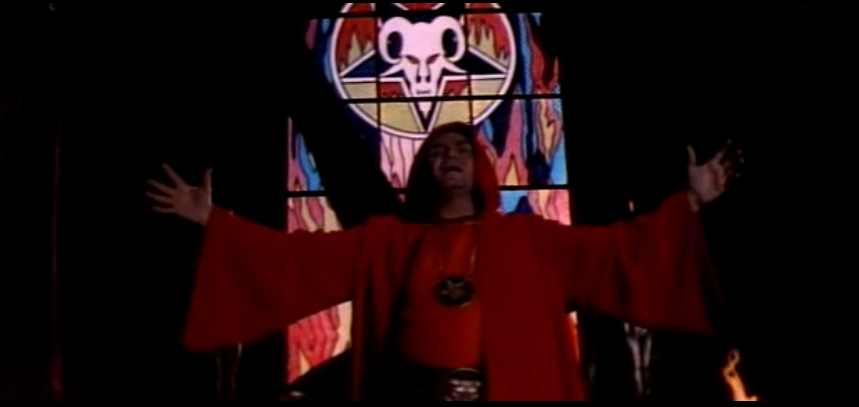
23:20 “Come forth from the abyss… open wide the gates of hell” – hmm, pretty corny stuff this. Old Anton earning his cheque, no doubt. Awesome stain glass window though, and I appreciate the shots of the dude playing the organ.

27:00 Satanists bleed multi-coloured goo. Protective talisman turns into a snake. Eyeless Lupino (un)stares on, and Shatner’s on the run. This whole sequence is really well shot.


29:00 Whoa, sudden scene change! Ok, so… is everything we’ve seen so far actually taking place in the subconscious of a woman (Mrs Preston? Shatner’s moustachioed brother’s wife?), who is taking part in some kind of ESP experiment in front of a lecture theatre full of students…?

31:30 Well, no, actually. Turns out that was just some kind of inexplicable diversion. Now we’re back down to… well I hesitate to say ‘earth’, but wherever it is the preceding scenes have been taking place…where Moustachioed Bro and his wife have returned home in search of his vanished family. The sheriff says half the county’s been washed away by the floods and he can’t possibly spare any men, but uh, if you guys want to grab some guns and go hunting for yr missing relatives in that old Western backlot town, be my guest – gimme a call in the morning or whatever and let me know how it goes. Now that’s the kind of light touch approach to law enforcement I can get with.

34:00 William Shatner fears not the torments of hell. In case you had any doubts.


37:00 Beautifully symmetrical long-shot of the car pulling up outside the frontier chapel… hokey as all this is, Fuest seems to be doing his best to build a real strong sense of oneiric disorientation…

43:00 Ladies and gentlemen, introducing John Travolta in his debut screen appearance, being kicked down the stairs by a dude with a moustache.

44:45 Red-tinted flashback to the Satanists’ origins as a heretical puritan sect back in colonial days. I’ll admit that my grasp of American history might be a bit shaky in places, but I wasn’t aware that many 17th century puritan sects made it out quite as far as Southern California..?


46:50 Love Ancestor-Borgnine’s faux innocence: oh, tis a mob of flaming torch weilding villagers at the door. What brings you fellows out here so late in the evening?

47:20 “Thou art the one… SLUT!” – another dialogue first for a great actor.

49:00 Ernie pulls some real oomph into his obligatory burned-at-the-stake “I curse you all” speech.

52:00 Ok, so thus far I wouldn’t go as far as to say this movie is ‘good’ exactly, but I certainly respect the filmmakers’ decision to turn in a film for a Hollywood studio that not only goes for a full-on delirious/dreamy fantastique atmosphere, making *no attempt whatsoever* to frame its action in the real world, but also seems to have been scripted by a somnambulant wino who once read a Dennis Wheatley book…

52:30 Holy shit! Maybe it’s just because I’m watching this with headphones on in the dark, but that wholly predictable backseat-of-the-car jump scare really put the wind up me. For all that I dissed the soundtrack above, the sound mix here was fucking murderous.

55:00 I wish I could have been there when they were filming this mass Satanist rally in the desert. Looks like a beautiful evening. All the open flame blowing in the breeze, sackcloth against yr skin… ah, that’s living.


56:15 So, uh… there was just a sudden insert shot of a dynamite explosion and now Ernest Borgnine has turned into a furry-faced, horned goat-man.

58:00 You too may wish to by sprinkled with ‘the waters of forgetfulness’ after watching Goat-Borgnine torture a shirtless William Shatner.

60:00 Goat-Borgnine looks too mischievous and lovable to really be a decent villain. I want him to caper off and lead us to a whimsical fantasy adventure of some kind, not stand here droning on about the doom that awaits our immortal souls.


70:30 This ‘devil’s rain’ vessel full of howling souls thing is a neat special effect. Very much reminds me of the kind of tricks Fuest was pulling off in ‘..Dr. Phibes’.

77:00 Vengeance of Goat-Borgnine forestalled due to melting.

79:30 More inexplicable dynamite blasts, to accompany the melting. You’d think God was some sort of unhinged mining prospector, the amount of bang-sticks he seems to be throwing around the place.

82:00 You know, everything I’ve read about this film over the years has mentioned the ridiculous amount of time dedicated to the melting of the cultists, but now that I come to watch it myself, I’m kinda disappointed. I was expecting a sequence of unparalleled repetitious madness, but actually the time allotted to the melting seems fairly reasonable. I mean, they clearly had a lot of cool melting effects to show off, and nothing much else to offer by way of a finale (give or take a few sticks of dynamite), so four or five minutes of melting doesn’t strike me as particularly excessive. In fact I could easily have gone for some more melting. I wanted a whole endless, senseless psychedelic melting extravaganza, goddamnit!


84:00 Chapel explodes – again, for no reason.

85:00 Well, there we have it folks. ‘The Devil’s Rain’. It is what it is, I suppose. Despite being probably one of the silliest films ever bankrolled by a Hollywood studio, it’s certainly worth a watch for us weirdo horror fans. It has some great ideas and distinctive visuals, and if they’d focused more on the darker aspects of the story and not made the portrayal of black magic so cartoon-ish and OTT, it could have been a pretty effective weirdo horror film. As it is though, the writing is intolerably flimsy (even from a Euro-horror fan’s POV), the acting is jaw-droppingly bad (ditto), the pacing is all over the joint, and the whole thing never quite comes together the way it should. Ah well – I still kinda enjoyed it, and I’m glad they had the guts to make it the way they did, rather than just doing some lifeless Exorcist/Omen knock-off and pleasing the suits. It brought us the sight of Ernest Borgnine turning into a giant goat and melting into a pile of poster paint goo, and for that I am thankful.


And thus ends our survey of '70s Backwoods Satanist Movies That Inexplicably Feature Great, Sam Peckipah-affiliated Actors. If anyone can think of any more that I might have overlooked though, please let me know, and I'll track them down post-haste!

Wednesday, 13 January 2010

The Final Programme
(Robert Fuest, 1973)


Michael Moorcock’s Jerry Cornelius books, along with his other assorted forays into non-linear and radical fiction in the 1960s and 70s, have long been one of my favourite bodies of work in modern literature, as both this blog’s title and current banner picture attest. Initially conceived as a public domain character and signifier of a new ‘instant genre’ by Moorcock and his fellow writers at New Worlds magazine in the mid ‘60s, and continuing in some form through to the late ‘80s, the Cornelius stories mix a recurring cast of ambiguous, larger than life characters into a time-shifting panorama of alternate world apocalyptic scenarios, usually derailing expectations of a conventional action/adventure narrative in favour of a jarring Ballard/Burroughs-inspired approach that sees oblique emotional battles and existential sagas of entropy and decay played out beneath disconnected vignettes full of dazzling, brutal and beautiful imagery that function like dream collages of the twentieth century’s most poignant nightmares, dreams and disasters.

Despite their proudly ‘difficult’ nature, I’ve always thought that the Cornelius stories carry vast cinematic potential. Whilst reading books like “The English Assassin” and “The Condition of Muzak” for the first time as a teenager, the climatic scenes of destruction and rich aesthetic details seemed to leap into full visual form in my mind, as if crying out for a visionary director to appear on the scene and make them a reality. Of course, to do these books justice, a potential film adaptation would require not only the aforementioned director, but also Hollywood blockbuster scale production values and enough creative freedom to allow for the almost total abandonment of a linear narrative – a combination of elements that seems unlikely to become a viable prospect for would-be producers and financial backers anytime soon, unfortunately.

So needless to say, “The Final Programme”, writer/director Robert Fuest’s 1973 adaptation of the first Cornelius novel, is NOT that film by any stretch of the imagination. But, as Jerry’s only cinematic outing to date, or simply as a goofy early 70s sci-fi/spy caper in its own right, I thought the film must surely be worthy of a viewing and a quick review at the very least.

Having sung Moorcock’s praises above, it is ironic that many of “The Final Programme”s failings as a Cornelius movie carry straight across from the source material. Whilst it’s still a good read, it’s safe to say that “The Final Programme” is probably the weakest entry in the series. Initially serialised in New Worlds in ’65-’66 and finally appearing as a novel in ’69, it seems to have been written before the elements that went on to define the later books had truly coalesced. For one thing, many of the series’ most memorable characters – Una Persson, Bishop Beesley and Shakey Mo Collier amongst them – are notable by their absence, having presumably not been created yet. More importantly though, “The Final Programme” is also the only one of the books to retain the vestiges of a traditional linear narrative, replete with elements suggesting the kind of rather less challenging counter-culture spy spoof that may have seemed daring in the mid-‘60s, but that must have quickly become dated as the decade’s greater excesses picked up speed. Clinging rather naively to a strain of pre-hippie utopianism that was stone dead by the dawn of the ‘70s, events in “The Final Programme” often seem to lack any real narrative drive as they ramble on toward a ‘dawning of the new age of man’ type conclusion that sees Jerry and the vampiric Miss Brunner united in an awkward alchemical marriage, an idea that seems almost embarrassing in light of the far more convincing sense of collapse, despair and near cosmic pessimism that Moorcock developed as he moved the series into the grimmer realities of the 1970s.

Of course, such missteps can be easily overlooked when they spring from the pen of an author as prolific and imaginative as Moorcock, especially in the context of a book that also introduces us to the doomed psychodrama of the Cornelius siblings for the first time, and that rewards us with perhaps only actual instances of Jerry fulfilling his original role as ‘the James Bond of the counter-culture’. But in a standalone motion picture, this sense of narrative drag, underpinned by a rather confused and simplistic philosophy, is more of a problem, especially as the aforementioned ‘70s comedown was already in full swing by the time the film entered production.

It seems that the idea of adapting the book came from Robert Fuest himself, and, riding high from the cross-over success of the two ‘Dr. Phibes’ movies, it seems he had enough muscle behind him to get the wheels rolling (if, admittedly, on a pretty miniscule budget). Somewhat inevitably, Fuest approaches the film as an excuse for what we might call a ‘Zany Countercultural Caper’ movie. I’m not sure whether or not any film critics have previously bothered to trace the history and conventions of the ‘Zany Countercultural Caper’ (ZCC, if you will), but it is a genre that’s long been recognised in the autonomous state of my head, so I’m gonna go with it, and possibly write a longer piece on the subject at a later date.

Although rarely seen as the province of high cinematic art, the ZCC aesthetic did manage to bring us its fair share of utterly strange and incredible films during the ‘60s, but by the turn of the ‘70s, entries in the genre were often floundering, carrying with them a residual sense of ‘bummed out-ness’ that undermined the light-hearted goofery on screen, as the films began to seem increasingly out of step with the fast-moving times and a cloud descended that not even the sight of Peter Sellers wearing a variety of amusing hats could quite lift. This feeling perhaps reached its nadir with Joseph McGrath’s Terry Southern adaptation ‘The Magic Christian’ in 1970, in which we were expected to guffaw at the oh-so-satirical sight of stuffy, bowler-hatted bankers fighting each other for a pile of money dropped into a vat of excrement, accompanied by the strains of Thunderclap Newman’s abysmal ‘Something in the Air’, right at the moment when the ACTUAL counterculture was fast disintegrating into drug addiction and political extremism.

And it is at the far end of this ‘bummed out’ after-life of the ZCC cycle that we find “The Final Programme”. Despite the fairly frivolous storyline and characterisations, an undertone of melancholy can be detected throughout the film, thanks in part to Norman Warwick’s decidedly autmunal cinematography (which at times pays a visit to the same drab, overcast ‘70s Britain seen in flicks like Jose Larraz’ “Vampyres”), and to the film’s obvious budgetary constraints.

As anyone who has seen “The Abominable Dr. Phibes” will know, Fuest was far from an untalented director, and, as with that film, his love of imaginative mise en scene is evident throughout “The Final Programme”, as is a healthy dose of the energy, dark humour and love of visual puzzles and gadgets that Fuest demonstrated in “..Phibes”. The overall effect is muted though by a painfully obvious lack of resources - reportedly, the film’s budget was less than £60,000, a meagre enough sum for folks inside the British film industry to start taking bets as to whether Fuest would be able to deliver the finished product at all. It’s to his credit that he did come through on such a pittance, and with a movie that doesn’t ENTIRELY fail as an eye-popping sci-fi extravaganza to boot, but nonetheless – compromises clearly had to be made at every turn.

It’s clear for instance that Fuest relished the idea of realising the interior of the Cornelius mansion – a purpose-built pop-art labyrinth which Jerry and his father’s associates have to infiltrate at one point, braving clouds of poison gas, chess/music based boor opening puzzles, a balloon-like maze of brightly coloured parachute fabric and weirdly dated modernist décor in the process. And whilst all this is handled as well as it possibly could be under the circumstances, the whole sequence is rendered somewhat unsatisfactory, possibly because the sets emerge resembling an up-market Dr. Who set, and the low-key visual approach can’t help but sit awkwardly with such an extravagant set-up.

Similarly, when we get a glimpse of Jerry’s London flat, it’s less of a space-age bachelor pad, and a lot more like the kind of gaff that someone – say, someone in the film industry - might ACTUALLY have lived in circa 1973, complete with well-trodden carpet, messy kitchen, Venetian blinds etc… which is kind of charming actually.

In fact, for me the most effective moments in “The Final Programme” came when the film embraces this underlying pessimism and drabness. I particularly enjoyed the wonderfully realised sequence in which Jerry drives his Rolls Royce through the woodlands bordering the Cornelius estate, sipping scotch and guzzling chocolate digestives from the glove box, for a secret rendezvous with the family retainer to outline his plans for ousting his brother Frank and rescuing his sister/lover Catherine.


Also great is the scene in which Jerry briefly visits Trafalgar Square and finds Nelson's Column buried under a mountain of abandoned cars – a brilliant and evocative image, even though aforementioned budgetary constraints only allow us a few quick shots of the scene (one of which can currently be seen at the top of this blog). And it’s also great to see a prologue and a few later inserts in which Jerry relocates to a suitably moody Indian temple location to consult with his guru/buddy, the mystic scientist Professor Hira.

Altogether less effective are the film’s various attempts at ZCC-worthy antics and set-pieces. For instance, Sterling Hayden makes a mystifying cameo as a Texan general, ranting and raving with a comedic fake beard in what seems to be a goof on his role in ‘Dr. Strangelove’. Pretty much totally pointless, although his scene does at least manage convey well the apocalyptic feeling of Moorcock’s books. Witness the moment when the General’s sultry, Iron-Cross wearing German secretary conveys a message received from the malfunctioning WWII radio set –

“You heard about Amsterdam?”

“Yeah – some mistake. 28 miles of white ash.”

“For once the Americans did something right.”


Moments like that can’t help but make me smile, in spite of the film’s flaws.

The movie’s other big ZCC set piece is a protracted sequence in which Jerry visits a sort of gigantic underground pinball arcade / pleasure palace, in which he arranges to buy some explosives off a mate of his, plays pinball, watches girls spinning around in giant hamster wheels and nuns playing slot machines, flirts with groupies and swaps mumbled dialogue with a whitefaced woman who is supposed to some sort of psychic. Then there’s the scene where Miss Brunner takes Jerry out to dinner, to a club where semi-nude combatants wrestle in a vat of milk and rude waitresses profer plasticated tubes of gourmet industrial waste-contaminated wine – ah, that crazy apocalyptic future. All of this seems an attempt to infuse the film with some decadent, Barbarella-via-Fellini visuals, but none of it really makes much of an impression, despite presumably using up a hefty chunk of Fuest's spending money.


Budgetary constraints also take their toll on the story’s requisite globe-trotting, and again, Fuest is definitely deserves the admiration of all tight-fisted filmmakers for shooting scenes that purport to take place in Kazakhstan, Albania, Lapland and India, all seemingly without leaving the British Isles. Much like Kubrick recreating the Vietnam war in the London suburbs for ‘Full Metal Jacket’, careful framing and cinematography means that the results are far from ridiculous, but the local colour that helps liven up a lot of more expensive spy yarns is… shall we say, somewhat lacking.

And so, with limited production values undermining “The Final Programme”s potential as a visual spectacle, it is up to the cast to carry the film, and by and large, I think they do a surprisingly good job. Almost inevitably, screen versions of much-loved fictional characters are going to disappoint, and when Jon Finch makes his first appearance as Jerry, he looks all KINDS of wrong. Far from the svelte dandy of Moorcock’s Eternal Champion mythos, Finch initially turns up in aviator shades, with curly locks, muttonchop sideburns and a rather too robust physique – more of a Jim Morrison type; a big hippy oaf. Despite this poor first impression, it is to Finch’s credit that he actually embodies the character pretty well, playing Jerry with the sort of arrogant swagger and studied charisma that befits a superhero born of the rather elitest British counterculture. And more to point, he’s got a terrific stride, a brooding, Oliver Reed style physicality, and looks as if he was born in the requisite frock coat and driving gloves.

Such a portrayal is great as far as it goes, with Fuest and Finch occasionally approaching the same brand of lapsed aristocratic profanity that Bruce Robinson captured so perfectly in ‘Withnail & I’. But as the film goes on, Jerry’s characterisation becomes increasingly heavy-handed and eventually flat-out irritating, as his feigned boredom and constant demands that people “piss off” start to grate, making him seem more like an irritable teenager than a jaded interdimensional assassin. Subtlety and unpredictability are vital components of any eccentric British hero, and both are squandered here as the scripting inexplicably takes a nosedive. Likewise, the first time Jerry’s fondness for ‘choccy biccies’ is referenced (in aforementioned driving scene) it’s an amusing idiosyncrasy, and a great image, but by the time Fuest has crammed a gag about it into every single scene, it simply becomes infuriating, as if he hasn’t got the imagination to pull any other traits out of this potentially fascinating character, leaving Jerry looking like a one dimensional bore on a par with a cat stroking villain or a one-armed man.

In fact, there seems to be an overall drop in quality in “The Final Programme”s second half, not just as scene set ups become sparser and less interesting as – I suspect – the production began to run short on time/money, but the genuine wit of the some of the earlier scenes is also traded in in favour of lame gags and visual puns, as exemplified when Jerry gets a glimpse of a brain preserved in a tank of water, and comes out with “evidently some kind of brain washing machine” – ouch. Pretty poor show from a guy who was effortlessly tossing out wry, Alfie-style one-liners not half an hour previously.

Also characteristic of the way in which the freedoms of post-60s anything goes ‘creativity’ can often lead to inconsistency and boredom is the way that Catherine Cornelius (as played by Sarah Douglas, who went on to become Ursa In Superman II!), the film’s natural love interest / leading lady, is unceremoniously dispatched halfway through the film by a stray needle-gun round as Jerry and Frank fight it out in her bedchamber, having only had a chance to utter a few lines. Obviously this is another element carried over from the novel, and it probably would have been considered a bit beyond the pale for the film to dwell on Catherine and Jerry’s incestuous relationship. But rather than seeming distraught at the death of his one true love, Jerry simply seems bored in subsequent scenes, as he drifts under the influence of Miss Brunner.


As an amoral and manipulative older woman who vampirically ‘consumes’ her lovers for sustenance, and who is portrayed in Moorcock’s stories as a pre-emptive Thatcherite attempting to control the fluctuations in world events via the logic of primitive computer programming, Miss Brunner seems an extremely unlikely choice for a substitute heroine, and a traditional Hollywood narrative would not have allowed her to fall into that role. But hey, this is the new era baby, we can do whatever we like (even if it’s dull and makes no sense).

In actual fact though, Jenny Runacre is a fine actress, and manages to make the character her own. Moorcock’s Miss Brunner is always a bit of a gargoyle – one of the only characters in the mythos who is generally outright ridiculed for what she represents – but Runacre’s performance brings a lot more subtlety to the role, creating an ambiguous but not entirely unsympathetic character, despite an initial lack of resemblance to the stern dominatrix of Moorcock’s books. The scene is which she ‘consumes’ her subservient assistant Jenny (Sandy Ratcliff) in a lesbian encounter on Jerry’s couch is extremely well done, and pretty daring for this kind of movie – definitely another highlight.

There are some welcome faces in the supporting cast too, and in particular the always wonderful Graham Crowden (whom you’ll recall from Lindsay Anderson’s ‘If..’ and ‘Britannia Hospital’) takes on quite a prominent role, breathing life into the otherwise quite dull rogue scientist Mr. Smiles. Patrick Magee puts in an appearance too, as a disgraced scientist who shelters the fleeing Frank in his Eastern European villa, although sadly he’s not given much time to rev up his patented scenery woodchipper before falling victim (off-screen, thankfully) to Miss Brunner’s lusts.

The film’s soundtrack has some interesting moments, although it’s not that prominent overall – there are some nice period psyche jams anyway, and a surprisingly pleasant bit of mellow trad jazz, courtesy of Gerry Mulligan, plays over the end credits, and…

Oh yes, the end. Well, I’m not going to give it away or anything, but let’s not beat around the bush: the ending of this film stinks. It is, in the parlance of our times, a total fail – the kind of thing where you just think “hang on, they must have viewed the daily rushes at some point, and somebody thought that was good?” So the less said about that the better, really.

So there we go – ‘The Final Programme’, ladies and gents. Not exactly a rip-roaring success of a motion picture, but far from a total wash-out, and certainly worth seeking out if you count yourself a fan of Moorcock’s books, or ‘70s British science fiction, or the aesthetics of pop art informed action/adventure movies in general. At it’s best moments, the film is truly excellent, and even outside of them it still has enough striking images, great performances and memorable scenes crammed into it to last a canny b-movie maker for years, and sometimes, out of the corner of your eye, you can just about see the vision of the New Worlds writers moulding itself into tangible form. Thus it’s a crying shame that these abundant strengths are so pulled down by the even more abundant failures and missed opportunities, particularly in the saggy and de-energised final act and the startlingly crap conclusion.

A noble effort from Mr. Fuest then, but the bottom line is that I’m still waiting for my mythical Terry Gilliam-meets-Jean-Luc Godard character to emerge from the shadows and make the REAL Jerry Cornelius movie. Better stock up some fire wood and ammunition then, cos entropy levels being as they are, it’s gonna be a long wait.