Showing posts with label psycho killers. Show all posts

Thursday, 24 October 2024

October Horrors # 9:
Hammer House of Horror:

The Mark of Satan


(Don Leaver, 1980)

And so, my three year odyssey through the corridors of the Hammer House of Horror concludes with this final, 13th episode - and, on reflection, I think we should probably compliment the series’ producers on deciding to bid farewell to their viewers with the televisual equivalent of a painful kick in the cobblers.

Despite boasting a name suggestive of pulpy gothic horror pleasures, ‘The Mark of Satan’ actually follows the pattern set by the preceding The Two Faces of Evil episode, easily beating it to the prize for the grimmest and most uncomfortable instalment of the series, even though it can’t quite match its predecessor in terms of dramatic power or overall quality.

Eschewing the bucolic Home Counties charm of most earlier episodes, Don Shaw’s script instead presents a grimy, impoverished and morally / emotionally stunted vision of working class England, wherein a weak-willed trainee hospital orderly (Edwyn Rord, played by Peter McEnery) suddenly finds himself afflicted by what we’re forced to assume is a sudden, catastrophic descent into paranoid schizophrenia.

Possibly reacting to the pressures of his overbearing mother, his absent father and his transfer to a gruesome and rather stressful new role in the hospital morgue - or possibly not - we join Edwyn as he becomes obsessively fixated on a series of synchronicities involving the number ‘9’, and, after being put to work on the corpse of a patient who seemingly died on the operating table after subjecting himself to a bit of DIY trepanation, he also begins to believe that he has contracted a “virus of evil” from the dead man.

Crackly police radio messages which Edwyn apparently receives from the weather vein above the hospital car park certainly don’t help, and in short, he is soon nursing one monster of a persecution complex, becoming convinced that his colleagues (including theatrically-minded Welsh pathologist Dr Harris, played with Pleasence-esque relish by Emrys James) are involved in an elaborate Satanic conspiracy against him - orchestrated, of course, by his nagging, rude and relentlessly abusive mother back home.

Things go from bad to worse for Edwyn once he becomes involved in the machinations of the family’s lodger Stella, played with truly bone-chilling, ‘10 Rillington Place’-esque understatement by Ken Russell regular Georgina Hale. A coldly self-serving single mother with a new baby and a psychopathic streak a mile wide, Stella sets about using Edwyn’s delusions to her own advantage in a horribly banal, small-minded fashion (she just wants her landlady out of the way so that she can sit in the front room, basically), exhibiting no recognisable human emotion whatsoever as the ensuing carnage plays out.

Managing to incorporate autopsies, surgical grue, old lady killing, self-trepanation and implied baby-eating, this is the probably the only episode of HHoH which I can really imagine incurring the wrath of whatever censorious bodies oversaw the content of ITV back in 1980, which is perhaps why they left it until last on the broadcast schedule for the series.

Certainly, it’s easy to imagine Mary Whitehouse and her ilk spontaneously combusting as soon as they got a load of this shit, callously pumped into the nation’s living rooms under the guise of family entertainment, but in tone as well as content, ‘The Mark of the Devil’ is some dark, mean-spirited business.

Full of lurid, fisheye-lensed psychotic freakouts, writhing tormented faces and other such OTT visuals, it is baroque, clammy, claustrophobic and nasty; curiously in view of Hale’s presence, it all feels a bit like the work of some pound shop Ken Russell substitute, letting loose in a really bad mood.

Plot-wise, Shaw’s churning brew of unappetising weirdness soon settles down into a ham-fisted and thoroughly exploitative take on the perils of mental illness which, in its own weird way, is probably about as close as anything on British TV ever came to the nihilistic spirit of the ‘70s American grindhouse.

Whether or not you choose to take any of this as a recommendation of course, is entirely down to you and your… aesthetic sensibility? (Doesn’t sound quite as good as ‘conscience’ that, does it, but no frowning judgement from me in these pages.)

So, er, thanks for that, Hammer House of Horror! See you all down the pub for a celebratory, post-series drink? Or, uh…. perhaps not?

Thursday, 12 October 2023

Hammer House of Horror:
Carpathian Eagle
(Francis Megahy, 1980)

So we’re up to episode #9 here, and, whilst there were undoubtedly a few clunkers earlier in the run of ‘Hammer House of Horror’, by damn, they’re really hitting their stride by this point! The two preceding episodes were perhaps my two favourites to date, and this one is definitely a strong contender too.

Largely ditching the ‘Tales of the Unexpected’ / “bad things upset the life of a blameless contemporary couple” formula used by most of the earlier episodes, this one (co-written by Bernie Cooper and director Megahy) plays out more like a spec script for a prospective Halloween episode of ‘The Sweeney’ which was ditched for being too weird. (And if that description’s not enough to reel you in… you’re probably reading the wrong weblog, to be honest.)

Anchored around a gritty police procedural framework, ‘Carpathian Eagle’ finds world weary / soft spoken Detective-Inspector Cliff (Anthony Valentine) investigating the exploits of an erotic murderess who, in true Jess Franco style, has been preying upon a succession of outrageously shabby would-be playboys in the dark hinterlands of the Home Counties commuter belt, harvesting their hearts with a curved ceremonial dagger.

A radio interview overheard whilst he’s making his tea n’ toast in the morning leads our detective-hero into the midst of a somewhat Bathory-inspired gothic horror back story, involving the legend of a heart-extracting Hungarian countess whose alleged last living descendant (played by Siân Phillips) is still hanging around in good ol’ blighty, and subsequently also the travails of her nephew, a haughty, Rudolf Nureyev-type character who has defected to the west in order to escape the persecution he faced behind the iron curtain whilst plying his trade as a renowned female impersonator. (1)

All of which you’d think would be more than enough to keep DI Cliff busy, but the lonely lad also finds time to cultivate a budding romance with the be-permed author (played by Suzanne Danielle, star of ‘Carry On Emmanuelle’) whose interview publicising her book on the heart-gouging countess led him to make the connection in the first place, and whose taste in pattern-framed glasses and garishly mis-matched print dresses proves more obscene than any of the kinky outfits donned by the murderess during her seductions.

Indeed, one of the great pleasures for me personally in going through these Hammer House of Horror episodes has come from noting the highly specific fragments of period detail, unique to that peculiar period in UK social history in which a hangover from the flares n’ sideburns ‘70s was gradually blending into the cruel dawn of the Thatcherite yuppie era - and, in addition to having a really odd, interesting story, it is here that ‘Carpathian Eagle’ really shines.

Just about every scene provides an absolute riot of horrendous fashion choices, exquisitely dated interior decor, flashy motors, sexist / homophobic attitudes, nostalgia-swathed branded products and shabby, deadzone suburban locations, the like of which fairly boggles the mind.

The sequences involving the succession of hapless murder victims prove especially remarkable in this regard, painting such a repulsively fascinating picture of life in these isles circa 1980, I could probably write an extended essay about each one.

The first victim is none other than Barry Stokes (the man-shaped alien from 
Norman J. Warren’s ‘Prey’, here sporting an unflattering pencil moustache), who is tooling around the country lanes in his vintage Jag when he picks up a provocatively dressed, rainbow-hued young lady and carts her straight back to the ‘secret’ bedroom he keeps hidden from his wife, where he lies, resplendent and smug, upon a bed of furs, awaiting his bloody comeuppance.

Then, perhaps most memorably, we have ‘Randy Andy’ (“Andy’s the name, and randy’s my game”), a loathsome, lime-green shirted middle-aged singles bar crawler who resembles a local radio breakfast show host, and who bombards his statuesque conquest with a whole pamphlet’s-worth of the world’s worst pick-up lines before dragging her back to a Stone Age Bachelor Pad which must be seen to be believed.
Even more direct in his approach though is no less a personage than Pierce Brosnan(!), who turns up as a tracksuited jogger, latching on to his pink nylon-clad prey in an overcast public park. “I fancy you, you fancy me… why mess about?”, he ventures, before creeping back to his bed-sit and attempting to smuggle his would-be shag-partner (whose luminous gear can probably be seen for miles around) past the eyes of his watchful landlady, who, revisiting a comedy cliché you’d hope would have died out at the end of the 1950s, “has got a bit of a thing about visitors”.
Though it’s difficult not to imagine him transmogrifying into Jon Thaw at times, Anthony Valentine certainly proves a sympathetic male lead in comparison to this lot, a worthy addition to the pantheon of down-at-heel British horror cops alongside Ian Hendry in ‘Theatre of Blood’ and Alfred Marks in ‘Scream and Scream Again’, and to the script’s credit, his character actually seems to grow and become more open-minded as the strange events of the story unfold.

During Valentine’s investigation of the first crime scene, we bear witness to a sterling example of ‘70s style police work. “Any sign the geezer was bent?,” he demands to know - the plod’s logic apparently being that the killing was clearly sexual in nature, but that no mere female would have had the physical strength to carry it out.

Later on though, once things have gotten a bit weirder, we start to see a different side of DI Cliff, as he sticks up for the effeminate nephew character, expressing apparently genuine admiration for his artistry, and cutting off his boorish colleague’s queer-baiting jibes, telling him, “you’re thinking in clichés old son - Tadek’s a hard lad, he’s just very nervous, that’s all”. Which is considerate of him, given that he’s talking about a bloke who’s ostensibly the prime suspect is series of brutal murders, but…. no spoilers here, readers.

Loosely plotted and rattling along at a fearsome clip ‘Carpathian Eagle’ represents a colossal improvement on Francis Megahy’s previous directorial outing in this series (the woeful Growing Pains). 

Throwing in more ideas and imagery along the way than it really knows what to do with, and packed with memorably off-the-wall performances from a host of lesser known character players and TV pros, it in fact constitutes an almost overpowering conjuration of the exact moment in British culture which saw my birth, refracted through a distorting mirror of sketchily-plotted, sex n' violence-drenched cross-genre weirdness.


And, needless to say, I loved every minute of it - just a staggeringly entertaining 50-something minutes of television, which I've not really fully recovered from or properly assembled my thoughts on yet, some 24 hours later. 

---

(1) As a curious side note, the nephew character is played by an actor named Jonathan Kent, whose only previous screen credit was in an impossible to see, quite possibly lost, 1976 BFI-financed adaptation of the Marquis De Sade’s ‘Justine’ by director/producer Stewart MacKinnon. Quite a thread for some inquisitive cultural historian to tug on there I suspect…

Sunday, 28 November 2021

Horror Express:
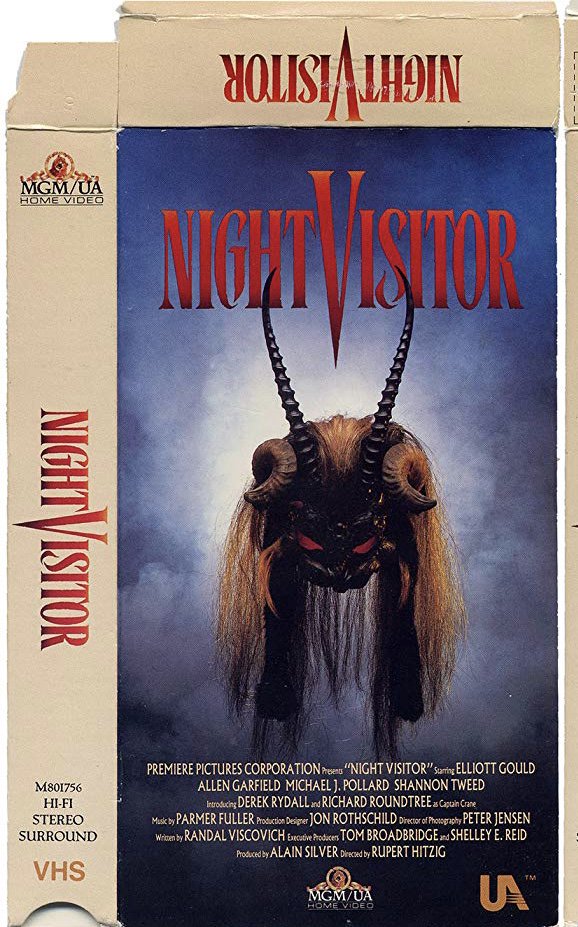
Night Visitor
(Rupert Hitzog, 1989)

It is the 1980s, in anonymous American suburbia. Generic off-brand hair metal blasts from the radios of shiny new convertibles, as obnoxious, sub-Michael J. Fox high school wise-acres cruise around the sun-dappled streets wearing unbelievably garish shirts. But wait, what’s this? Some kind of evil, Satanic serial killer is crawlin’ kerbs in a less salubrious part of town, murdering prostitutes and leaving pentagrams daubed in blood upon walls! What gives?

From this can't-fail premise, Rupert Hirzog’s ‘Night Visitor’ (also known by the even worse title ‘Never Cry Devil’) unfortunately proceeds to fail spectacularly.

To be honest, I’m not even sure where to begin, but... let’s start with swaggering teen hero Billy Colton (Derek Rydall, of ‘Deathwish 4: The Crackdown’ and ‘Phantom of the Mall: Eric’s Revenge’), who, as was so often the case in this post-McFly/Bueller era, is a complete dickhead.

Though the script is predicated on our ability to sympathise with his plight, everything Billy does is immature, cowardly and irritating. Much of the dialogue he shares with his sole friend Sam (Scott Fults, from a lot of TV), his obvious love interest Theresa (Teresa Van der Woude, from ‘Killer Workout’) and his hard-working single mom (Brooke Bundy, from ‘A Nightmare on Elm Street 3: Dream Warriors’) sounds as if it’s been beamed in, garbled, from another planet. I don't care about any of them. I want them off the screen.

The plot, which draws heavily on Tom Holland’s ‘Fright Night’ (1985), involves the voyeuristic Billy witnessing his sexy new neighbour (Shannon Tweed - nuff said) being murdered by his high school history teacher (Allen Garfield, from ‘The Conversation’ and ‘Nashville’!), bedecked for the occasion in his finest Satanic regalia.

Of course, no adults or authority figures believe Billy when he tries to tell them about this, for the eminently believable reason that he’s a complete tit who has presumably never said anything truthful or helpful in his entire life to date. And so, as per Holland’s film but with none of its charm or invention, our feckless hero’s lonely war against his evil teacher begins in earnest.

Unfortunately, the crazy Satanist brothers who comprise the film's villains (Garfield, plus Michael J. Pollard from ‘Bonnie and Clyde’ and ‘Split Second’) are played entirely for laughs, meaning that they never constitute any kind of real threat.

In fact, there's something very incongruous and distasteful about the way they do genuinely nasty things (like keeping kidnapped hookers hog-tied in their basement), but whenever they’re on-screen together, it’s proto-‘Dumb and Dumber’ type goofball humour all the way. It’s all pretty skin-crawling to sit through, to be honest. Very uncomfortable.

But wait - wasn’t Elliot Gould supposed to be in this movie..? He’s top-billed on the opening crawl, and indeed he eventually turns up about halfway through, playing a retired detective who I suppose is meant to be this film’s equivalent of the Roddy McDowell character in ‘Fright Night’ (or Tom Atkins in ‘Night of the Creeps’). His character is very poorly written though, adding nothing to the narrative, and poor old Mr Gould seems confused, embarrassed and disengaged throughout - as well he might.

Richard Roundtree (from…. look, I’m not going to insult your intelligence by going there, ok?) is good as the inevitable cop, but then he always is, isn’t he? It seems as if he’s wandered in from a better movie, just doing his thing.

Actually, the work-a-day cop stuff is probably the least excruciating element of this picture all around. Roundtree’s partner gets the movie’s best line when she says “..we should arrest them just for weirdness” following their initial visit to Garfield & Pollard’s hellhole suburban pad, and there’s also a nice cameo from Henry Gibson (‘Nashville’, ‘The Long Goodbye’) as an expert on occult crimes. (As the surfeit of brackets in this review should indicate, the MVP on this production was definitely the casting director!)

One explanation for ‘Night Visitor’s chronic tonal disjunctures can by found via an entry on the film’s IMDB trivia page, which states:

Writer Randal Viscovich claims the majority of his screenplay was watered down by order of the executive producers. He wrote a trashy and exploitative horror film that included cannibalism and graphic nudity. He was shocked to see it lightened and even the language toned down.

Yep, that sounds about right. Anyway, low-level goofiness and generalised ‘80s nostalgia (plus a few drinks) got me through this one without actively recoiling from it, but honestly.... it was pretty bad. Real wasted potential all round. Rarely has my long-standing “I’ll watch anything with satanic cultists in it” policy come up against such a challenge.

So, what purpose does this review serve then, other than potentially upsetting some of the surviving people who put their hard work into helping this thing reach the screen, on the off-chance they happen to google it up?

Well, first off, it hass always been my belief that negative/scabrous criticism is an important part of the cultural conversation (ie, I always read the bad reviews first). And secondly, on a more practical level, it appears that some maniacs have released ‘Night Visitor’ on blu-ray. As noted above, the plot synopsis sounds pretty cool and the cast is great, so…. I just felt the need to put this out there as a warning. I’m not saying don’t watch it, but - forewarned is forearmed, right? Be careful out there.

--


Monday, 12 July 2021

Noir Diary # 15:
The Lineup
(Don Siegel, 1958)


Following the lead of the film itself, let’s start off here by getting the boring bit out of the way: Don Siegel’s ‘The Lineup’ is, technically speaking, a TV spin-off.

Also known as ‘San Francisco Beat’, ‘The Lineup’ began as a radio drama in 1950 before moving to TV via the auspices of CBS in 1953. Generally viewed as a close competitor to Jack Webb’s more successful ‘Dragnet’, the show followed basically the same formula, following the day-to-day crime-fighting travails of straight-laced SFPD detective Lieutenant Ben Guthrie (played by Warner Anderson, who here resembles a somewhat older, less physically intimidating Lee Marvin), with Tom Tully (mysteriously absent from the movie version) as his partner, Sergeant Matt Grebb.

Over a decade since Jules Dassin initially kick-started the trend for cross-breeding Film Noir tropes with shot-on-location / faux-documentary police procedural stuff in 1947’s ‘The Naked City’, it’s safe to assume that movie-goers knew the drill pretty well by this point, and one can only imagine that yet another based-on-the-hit-TV-series trudge through the same good-solid-detective-work, ‘crime doesn’t play’ type palaver didn’t exactly sound too thrilling.

Assigned director Don Siegel and screenwriter Stirling Silliphant apparently agreed. After Silliphant knocked out a script which the pair both saw as the basis for an exciting, unconventional crime movie, Siegel claims that he pleaded with producers Frank Cooper and Jaime Del Valle for the opportunity to extract the movie from the ‘Lineup’ brand and let it stand alone as its own thing - but no dice. Although Cooper & Del Valle apparently didn’t give much of a damn how the film actually turned out, a ‘Lineup’ movie had been promised, and a ‘Lineup’ movie was going to be delivered.

Needless to say, Siegel and Silliphant responded to this decision by essentially pulling the same audacious bait and switch on their audience that Robert Aldrich and A.I. Bezzerides had laid on fans of Mickey Spillane’s Mike Hammer novels a few years earlier with their extraordinary and iconoclastic ‘Kiss Me Deadly’ (1956).

Doing little to hide their disdain for the franchise they were ostensibly working within, the director and screenwriter proceeded to entirely side-line the familiar certainties that viewers of the TV show might have been expecting, largely confining the obligatory police procedural segments to the opening twenty minutes, and pointedly relegating the show’s star Warner Anderson to the bottom of the on-screen cast list.

Meanwhile, they proceeded to kick up a veritable sandstorm of darker, more challenging and just plain weirder material, resulting in a movie which, a few decades after the dust had settled, began to gain recognition as one of the most startling and forward-thinking American crime films of its era.

Right out of the gate, Siegel’s take on ‘The Lineup’ plunges us into chaos. Out of control automobiles screech around the Embarcdaero in San Francisco’s port district, as suitcases are flung around, incomprehensible yells are exchanged and a police officer is callously mown down by a speeding taxi before the driver takes a bullet in the back and careers into the side of a jack-knifed truck. When Guthrie and his surrogate partner Quine (played by frankly terrifying tough guy actor Emile Meyer) dutifully arrive on the scene to assess the damage, all they can do is despairingly ask, “why?!” (1)

Twenty minutes or so of briskly-paced but uninspiring A-to-B police-work - sticking broadly within the TV show’s remit, albeit with a somewhat harder edge and more attractive locations - help them answer this question to a certain extent, as they uncover the bare bones of an elaborate conspiracy to smuggle heroin into the city, using pre-loaded ‘oriental’ souvenirs carried through customs by unsuspecting tourists.

There are some fun moments during this opening slog - both Anderson and Mayer do solid work, there is some exquisite San Francisco location shooting and I particularly enjoyed the bit where the police’s ‘lab man’ opens up a suspect package with a flick-knife, licks a big dollop of powder off his finger and declares, “yep, it’s heroin alright” - but it is only once the focus shifts elsewhere that the movie really begins.

Indeed, Siegel had literally wanted the film to begin here, as we board a flight into the city and meet the two contractors hired by an unseen cartel to reclaim the hidden dope from its unwitting carriers -- and boy, what a pair they are.

The uncertain relationship between psycho triggerman Dancer (Eli Wallach - blank stare, twisted grimace, porkpie hat) and his older, somewhat effeminate ‘handler’ Julian (brilliantly played by Robert Keith - beady eyes, skull-like grin, pencil moustache) was reportedly intended by Silliphant to mimic that of an aspiring Hollywood star and his agent (“if he continues to listen to me, he’ll be the best,” Julian declares at one point, in the process of talking up his boy’s unparalleled talents in the field of crime). A sly, in-jokey conceit, this approach which works superbly, creating an unforgettably amoral, inscrutable odd couple whose interplay pretty much dominates the film from this moment onward. (2)

Once Julian and Dancer (god, that name) are on the scene, Guthrie and Quine fall almost entirely into the background, turning up merely to shake their heads over the latest corpses and radio in for roadblocks and ambulances. We’re 100% with the bad guys on this one, and that’s just as well, because we just can’t keep our eyes off these two creeps - They’re just fascinatingly perverse in every respect.

As Sergio Angelini thus observes in his essay on the film for the Indicator label’s Columbia Noir Vol. 1 box set, “chaos is given a face and a psychological profile while order is merely represented by men in hats”. In truth though, what keeps us so glued to the travails of these goons is that Silliphant and Siegel never allow us to get an angle on - as the guy who gives Dancer the low-down at the port puts it - “what makes [them] tick”. They are nightmare figures from a world we will never understand.

Where did they come from? (The script tells us Miami, implausibly citing their alleged tans, but if so they must have been living underground like moles.) How did they meet? Has Julian spent his entire life recruiting young psychopaths and sponging off their ill-gotten gains like some kind of sociopathic boxing promoter? What exactly is the nature of their relationship? (Let’s not even go there.)

Throughout the film, the characters Dancer and Julian encounter seem as unsure what to make us them as we are. Pushed by their port-side contact, Dancer makes some blunt statement about not having had a father, but that doesn’t really take us very far in terms of armchair psychology. Later in the film, when tearful hostage Dorothy Bradshaw (Mary LaRoche) demands to know “what kind of men” the pair are, the string of gnomic non-sequiturs the lizard-like Julian spits out in response (“women have no place in society”, “crying is aggressive and so is the law”, “people of your class don’t understand the criminal’s need for violence”) raise more questions than they answer.

All we know at the outset however is that, like all good agents, Julian has his boy learning proper English grammar (“how many characters on a street corner know how to say, ‘if I were you?’”), tempering Dancer’s sullen, animalistic incomprehension with his own twisted sense of refinement. Meanwhile, he gleefully obsesses over the poetic implications of the last words of the Dancer’s victims, which - in another wonderfully tweisted detail of Silliphant’s script - he scrupulously records in a notebook.

Add a young Richard Jaeckel to the equation as the duo’s feckless ‘wheelman’ - fish-faced, bowtied and alcoholic, he’s been drafted in at short notice after the phony taxi driver we saw in the opening got snuffed - and it’s clear the deck is stacked for some pretty hair-raising mayhem over the next sixty minutes or so.

As Angelini further notes, our ostensible ‘heroes’, the quotidian cops, don’t even get to share any screen-time with these outlandish villains. Mirroring the movie’s opening, Guthrie and Quine only make it to the final showdown in time to despairingly survey the carnage. Seemingly left speechless before the final fanfare crashes in, they are denied even their obligatory “well that just about wraps things up” sign off, closing the movie on a note of nihilistic self-destruction which an empty dedication to hard working SFPD does little to dissipate.

In spite of his legendary status amongst crime/noir aficionados, in truth I’ve always felt that Don Siegel’s work as a director can be a bit hit and miss (it’s difficult to imagine his cult gaining much traction on the basis of pictures like Private Hell 36, for example). Looking across his wider career however, he always seems to come alive when dealing with tales of morally ambiguous anti-heroes or outright maniacs of one kind or another - so of course it figures that he was absolutely at the top of his game for this one. Basically we’ve got the man who brought us ‘Riot in Cell Block 11’ and ‘Dirty Harry’ firing on all cylinders here, and the results are nothing short of spectacular. 

In fact, ‘The Lineup’ feels very much like the Ur-text of all past and future Siegel movies, revelling in the pulp-crime aesthetics of his earlier black & white pictures whilst prefiguring elements of the most memorable films he would go on to make over the next few decades (not only the high voltage action and San Fran location work of ‘Dirty Harry’, but the psychotic criminal protagonists of ‘The Killers’ (1964), the elliptical visual storytelling of ‘Charley Varrick’ (1973), and many more besides, I'm sure).

As Siegel wrangles raw, livewire energy, technical precision and unsettling, off-beat artistry here, it’s easy to understand why a young Michael Reeves made a pilgrimage to the director’s doorstep early in the ‘60s to prostrate himself before the master; as a concise summation of the director’s formal strengths and auteurist tics, ‘The Lineup’ is pretty hard to beat.

As with so many of these ‘50s Columbia flicks, the claustrophobic framing and expressionistic shadows of ‘traditional’ noir style have been thoroughly swept away in ‘The Lineup’ (aside from anything else, the entire movie takes place in daylight). Rather than merely falling back on a kind of bland quasi-realism however, Siegel and his DP Hal Mohr offer an alternative visual sensibility which proves just as compelling as the old-time good stuff.

It has often been said that, in a Siegel movie, the camera is always in the right place, and ‘The Lineup’ consistently bears this out, as he and Mohr make inspired use of the by-now-standard widescreen aspect ratio, framing the film’s locations in such a way as to highlight jagged, horizontal lines bisecting bright, white spaces, creating an anxious collage of portside cranes, highway overpasses, art deco tower blocks and advertising hoardings.

Throughout proceedings, the placid serenity of the San Francisco skyline is cut through with a jittery, urban energy, as examples of every means of mechanised transportation known to man (ships, planes, motorcycles - even a blimp at one point) roar hither and yon behind the action, emphasising the relentless velocity of the movie’s plotting whilst casually pre-empting the starkly modernist take on the crime genre inaugurated by John Boorman’s ‘Point Blank’ a decade later.

All of which of course is merely a high-falutin’ way of leading up to the fact that the extended car chase sequence which forms ‘The Lineup’s finale is totally out of control, incorporating a level of stunt-work, action direction and cranked up, adrenalin rush cutting which feels startlingly ahead of its time, pretty much single-handedly inaugurating the “beat THAT” lineage of attention-grabbing car action which would eventually go on to bring us the successive thrills of ‘Bullitt’, ‘The French Connection’, ‘To Live and Die in L.A.’ and so on.

Certainly, I’m not aware of anything else from ‘50s that even comes close to this level of visceral excitement. Even though Siegel falls back on using back projection for most of the interior car shots, it’s at least the best back projection you’ll ever see, with the actors’ reactions and the movement of the ‘foreground’ car perfectly timed to match the hair-raising swerves and near misses of the pre-shot footage, lending it a sense of realism which rarely wavers.

In fact, the sweaty, maniacal claustrophobia of these ‘in-car’ shots - which see the crooks collapse into violent, recriminatory mania as their hostages cower and shriek and the car screeches crazily to avoid on-coming traffic - anticipate yet another trope which would become a staple of hardboiled filmmaking a few decades later, primarily on the other side of the Atlantic, where similar in-car chaos was utilised to great effect in films like Mario Bava’s ‘Rabid Dogs’ (1976) and Pasquale Festa Campanile’s Hitch-Hike (1977), amongst others.

And, when we move outside for the wider exterior shots, well, the stunt-work is just honest-to-god breath-taking, climaxing in a heart-stopping emergency stop / handbrake turn on the edge of an unfinished highway overpass which would have given Jackie Chan the jitters thirty years later. (3) 

Once we stop to think about it for a few minutes of course, much of Silliphant’s script for ‘The Lineup’ is outrageously implausible. Right from the outset, the idea that an international criminal cartel would go to the trouble of planting shipments of dope on unsuspecting tourists, only to then hire a pair of highly conspicuous out-of-town psychos to collect the goods, leaving a trail of murder victims and drug traces in their wake, is totally absurd.

And, that’s before we even get on to the practicalities of smuggling junk in the handles of ivory tableware, or - my personal favourite - the notion that a reclusive, wheelchair-bound mob boss would undertake a dope pick-up himself, in-person and apparently alone… and in a location which can only be reached by navigating multiple flights of stairs, no less!

But, when a movie’s writing is this consistently inventive and attention-grabbing, when the on-screen action is so fast-moving, so packed with wild beauty and delicious craziness, the viewer is forced to engage a mind-set usually reserved for watching giallo and euro-horror movies and simply ask, who cares?

As James Ellroy points out in his characteristically scabrous contributions to the commentary track for the film recorded alongside noir expert Eddie Muller, when it comes down to it, crime fiction is essentially bullshit. Nothing as sensational or destructive as the events portrayed in this film has ever gone down in the annals of real life crime in America - so as long as you’re making shit up, why not go wild?

As in a Fulci or Argento film, each one of the aforementioned scripting absurdities allows for the creation of cinematic moments - most of them heretofore unmentioned in this review - so audacious and unexpected that only the most joyless, movie-hating pedant would really have cause to complain.

From Vaughn Taylor’s ice-cold turn as ‘The Man’, to the assassination Dancer carries out in the steam bath of ‘The Seaman’s Club’, so loaded with unspoken sexual tension it’s a wonder it didn’t jam the projector, to the horribly suggestive sight of Julian tearing apart the innards of child’s Japanese doll as its owner looks on aghast and uncomprehending - almost every scene in ‘The Lineup’ offers something unforgettable. Like some golden treasury of pulp crime excess, it all serves to build a picture of a precarious, morally bankrupt world in which our bourgeois certainties might explode into bloody violence might explode at any moment.

For a ‘50s studio film, ‘The Lineup’ ultimately presents a remarkably frightening conception of the world, and, anchored by exceptional performances for Wallach and Keith, it remains entirely believable on an emotional level, even as the plotting skirts the fringes of outright insanity, helping cementing its place in the pantheon alongside ‘The Big Combo’, ‘Touch of Evil’ and ‘Kiss Me Deadly’ as one of the very best American crime films of the ‘50s. Hard-boiled cinema at its finest.

 -----

(1) You’ll recall Emile Meyer for his role as the crooked cop in ‘The Sweet Smell oSuccess’ (1957), or perhaps as the priest in Kubrick’s ‘Paths of Glory’ (also ‘57), or as Rufus Ryker in ‘Shane’ (1953). Once you’ve seen him in anything however, his face’ll stick with you, that’s for sure.

(2) Outside of this film, I mainly know Robert (father of Brian) Keith for his role as the unconventional, sympathetic cop character in another excellent San Francisco noir, ‘Woman on the Run’ (1950), but as a solidly reliable character actor he played smaller roles in a raft of quote-unquote ‘classics’ over the years, including ‘The Wild One’ (’53), ‘Guys and Dolls’ (’55) and ‘Written on the Wind’ (’56).

(3) Legend has it that stuntman Guy Way performed this stunt with his own girlfriend in the back seat of the car, doubling the movie’s female hostage. She needed to be helped out of the vehicle, having entered a state of extreme shock, and Siegel later implied in an interview that the couple’s relationship never recovered.

Thursday, 8 October 2020

Horror Express 2020 #4:
The Exorcist III
(William Peter Blatty, 1990)

Within the realm of sequel-driven horror franchises, it’s fair to say that the Exorcist series has always been a bit of an outlier. Admittedly, it got off to an earlier start than most of them, and began from a far higher level of critical acclaim and self-serious artistic intent - but still.

In stark contrast to the “iconic/ground-breaking original followed by reams of (at best) entertaining crap” furrow ploughed by ‘Halloween’, ‘..Elm Street’, ‘Hellraiser’ et al, ‘The Exorcist’ seems to have attracted highly strung, artistically-minded filmmakers like moths to a flame, each determined to fight tooth and nail with the studios to bring their own unique visions to the screen. A strategy which, unfeasibly, multiple generations of studio execs actually seem to have encouraged, even after the ridicule unfairly heaped upon John Boorman’s commercially disastrous ‘Exorcist II: The Heretic’ back in ’77.

Boorman, William Peter Blatty and Paul Schrader may all in turn have lost their battles with the suits, ultimately delivering compromised, imperfect movies which they were never truly happy with, but, viewed with a few decades of hindsight, I believe that these sequels can be viewed as a disparate trilogy of wildly ambitious, unconventional films, each of which I personally find more rewarding than Friedkin’s original (which I’ve never really cared for, truth be told).

All of which is a long-winded way of getting around to the fact that I watched the theatrical release cut of Blatty’s ‘The Exorcist III’ [pedants will wish to note that it had not yet gained the ‘Legion’ sub-title applied to the later reconstruction of the writer/director’s preferred cut at this point] for the first time last month, and, though it can’t hold a candle to the weird majesty of ‘The Heretic’, I nonetheless enjoyed it a hell of a lot more than I was expecting to.

Although Blatty’s high-minded thematic concerns to some extent fall by the way-side here, that’s fine by me, as again, his particular brand of existential Catholic dualism has never really floated my boat. But, when it comes to the more down to earth matter of making a Bloody Good Horror Movie, it’s difficult to watch ‘Exorcist III’ and not conclude that this gentleman had the chops.

In purely audio-visual terms, the writer/director’s approach to this task basically seems to have consisted of throwing in way too much of everything. Every single thing in this movie is creepy and foreboding and upsetting and scary, and every time there's a chance to throw in a jump scare or a disembodied demon growl, you're damn well gonna get one.

Outside of some suitably evocative Washington DC location work, settings here run to lofty, shadow-haunted churches, forced perspective hospital corridors and sombre, steel-shuttered asylums - all photographed by DP Gerry Fisher in a drained, colourless palette which may be tediously familiar to us these days, but must have seemed a pretty fresh approach back in 1990.

(It’s interesting to note that Adrian Lyne’s ‘Jacob’s Ladder’, the other film which immediately springs to mind as a precursor to this now ubiquitous grim-dark, institutional aesthetic was also released in 1990.)

Barry De Vorzon’s score of course also deserves a big shout-out in this regard. Presumably asserting a huge influence upon post-2000 horror movie (and indeed video game) music, the composer’s relentless soundscape of treated, disembodied vocal textures, rusty gate shrieks and bowel-shaking rumbles pretty much defines the kind of thing which would become de rigour for straight-faced horror in the wake of Kenji Kawai’s soundtracks to Hideo Nakata’s ‘Ring’ films a decade later.

THAT hospital hallway scene (if you’ve looked up anything horror movie-related on Youtube in the past decade or so, you’ll know it) is of course the film’s unquestioned cinematic highlight, but viewed in context, it forms part of a steady succession of exquisitely nerve-jangling sequences spread across the opening two thirds of this picture, each executed with a seemingly impossible mixture of Lewton-esque restraint and utter, baroque excess.

In terms of plotting meanwhile, I’m happy that Blatty chose to entirely dispense with the old “possessed little girl” routine here, as the “occult crime story” angle extrapolated from his source novel is a lot more fun all round.

The movie-obsessed Lieutenant Kinderman (previously played by the late Lee J. Cobb) is my favourite character in Freidkin’s ‘Exorcist’, so it’s great to see him return as the protagonist here, and even greater that he seems in the interim to have transmuted into the gargantuan figure of George C. Scott.

As a life-long devotee of the ‘Go Big’ school of acting, Scott has always been a favourite of mine, and he here delivers what must surely count as one of his absolute best late-era performances, taking his usual ‘simmering human pressure cooker’ thing to a whole new level, playing it taut and low key during his character’s most emotionally trying moments, before boiling over and completely losing his shit when we least expect it. As a showcase of repressed rage, hardboiled, craggy compassion and a dogged determination to resist the rigours of age, it’s pretty awe-inspiring stuff.

Opposite Scott meanwhile, our resident demonically-inhabited, body-jumping psychopath The Gemini Killer (Brad Dourif, with a little bit of help from the first movie’s Jason Miller) boasts the most ridiculous collection of show-boating serial killer trademarks I've ever encountered pre-‘Silence of the Lambs’.

Not only does he only kill people whose names begins with ‘K’, but he uses an extremely obscure, specialist drug to paralyse his victims, cuts off a certain finger from each hand, draws astrological symbols on their backs, and replaces pieces of their bodies with vandalised religious paraphernalia! Man is certainly not short of ideas.

In fairness to Blatty though, I suppose this convoluted MO does indeed represent the kind of symbolic cluster-fuck which I suppose might occur should an already thoroughly coo coo killer end up bouncing around the same bonce with a host of demons and the restless spirit of a tormented priest.

As heavy-handed as some of these story elements may seem though - and as ‘on the nose’ as the director’s favoured imagery of mutilated statuary, demonic crucifixions and angelic visitations may be - this is all balanced out to some extent by Blatty’s deeply eccentric approach to screenwriting.

Drawing on his oft-forgotten background as a scripter of screwball comedies, he seems determined to leaven the metaphysical hand-wringing we’d expect of an Exorcist movie with frequent excursions into high stakes, oddball humour and touches of quasi-Lynchian surrealism which I’m surely the studio must have considered totally ‘off-brand’, as well as seeding the movie with a dense tapestry of synchronicitous inter-textural referencing, touching on everything from Conrad’s ‘Lord Jim’ to the Rider Waite Tarot deck to Powell & Pressburger’s ‘The Red Shoes’ and (believe it or not) Mel Brooks’ ‘Space Balls’.

We could perhaps glimpse this trait to a certain extent in the first film via Kinderman’s cinephile banter, and it was given free reign in his directorial debut ‘The Ninth Configuration’, but it’s really turned up to eleven in ‘Exorcist III’. 

The sheer density of Blatty’s dialogue can take a while to get used to, and I’ll freely admit that I was more or less instantly lost by the early scene in which Kinderman obliquely criticises his fellow officers for their racism and lethargy by angrily throwing passages from ‘Macbeth’ in their general direction. Once you get into the swing of it though, it brings a really unique feel to proceedings, adding spice and flavour to what might otherwise have become a pretty po-faced exercise in over-cooked, airport blockbuster bombast.

Speaking of which -- we probably need at this point to address the film’s final act. Shot under duress by Blatty and the principal cast after studio Morgan Creek rejected the anti-climactic conclusion of the director’s initial cut, instead demanding a bit more action and an actual, gosh-darned exorcism, it’s… a bit of a mess, to say the least.

I mean, of all the actors you could have hustled in to play a new character needed for a bunch of pick-up shots for a major studio film with the clock ticking down to release… the legendarily temperamental Nicol Williamson (google up yr own anecdotes) is probably not the man I would have chosen. But, his casting here as hastily parachuted-in bell, book & candle guy Father Morning seems reflective of the sheer level of graft, blundering and back office vanity involved in these reshoots.

Actually, Williamson does perfectly fine work here, adding a certain amount of gravitas to a part that basically amounts to cipher created to satisfy box office expectations, and Blatty directs his scenes with a conviction comparable to the main bulk of the film. Sadly though, neither of them are a match for the risible hullaballoo of snakes, flame-pits, elderly, levitating Oscar winners, glowing gateways to hell, spectral crucifixes, indoor hurricanes and general shrieking hysteria which the producers apparently deemed necessary to provide the punters with the requisite bang for their buck.

Kinderman, had he been able to peel himself off the special effects-drenched cell walls at some point during these proceedings, might well have returned to The Scottish Play and muttered something about “sound and fury” - and indeed, this whole ridiculous finale only serves to confirm my suspicion that, despite Blatty’s noble efforts, ‘Exorcist III’ doesn’t really succeed in saying anything terribly profound about anything (in this cut, at least).

Viewed purely as a horror movie though, for the most part it is absolutely cracking stuff. Imaginative, unconventional, viscerally effective and often brilliantly executed, it now also has the added advantage of feeling extremely prescient, vis-a-vis the ways in which the genre has developed in subsequent decades.

To not put too fine a point on it, prior to 1990 very few horror films looked or sounded like this one. After 2000, they pretty much all did. Coincidence? Just ask all those kids currently at film school who probably spent their formative years watching SCARIEST EVER MOVIE SCENE eight thousand times on Youtube, then consult with Blatty’s restless spirit re: thoughts on Playing The Long Game.

Friday, 1 May 2020

Horror Express:
The Haunted House of Horror
(Michael Armstrong / Gerry Levy, 1969)

If you’ve read around the history of British horror a bit, chances are you’ll already be familiar with the convoluted background of this singularly ill-starred production, but nonetheless, it’s impossible to really put the contents of the film in their proper context without reference to behind-the-scenes shenanigans, so I’ll recount the tale for you in brief below.

So, basically – in 1967, ambitious young writer/director Michael Armstrong made a short film entitled ‘The Image’, starring an equally young and ambitious David Bowie. To follow up on the relative success of this venture, Armstrong put together a proposal for his debut feature – a violent psychological horror/thriller with a shocking-at-the-time homosexual twist, provisionally entitled ‘The Dark’, also starring Bowie. Tigon’s Tony Tenser was sold on the idea, and approached the British office of American International Pictures to sort out a co-production deal… which, by common consent, is where the trouble began.

To retrospective gasps from the world as it existed just a few short years later, AIP’s UK head honcho Louis M. ‘Deke’ Heywood nixed the casting of Bowie, insisting that fading ‘Beach Party’ heartthrob Frankie Avalon would prove a better box office draw, whilst also excising some of the more controversial elements from Armstrong’s script. The director, apparently grokking that compromise is the name of the game in commercial cinema, acquiesced, and set about shooting whatever was left of his masterpiece amid what seems to have been an atmosphere of persistent back office interference.

As Armstrong tells it, after principal photography was completed, he was told that Heyward didn’t think the footage was up to scratch, and had requested two weeks of re-shoots. Hastily throwing together ideas for a bunch of new and revised material he could use to beef things up, Armstrong anxiously prepared for the big production meeting – only to discover that it had taken place without him. He could collect his full fee, and would retain his director’s credit, but Heyward’s assigned director (Gerry Levy, who’d recently helmed the disastrous ‘The Body Stealers’ for Tigon/AIP) would handle the re-shoots, so, thanks for your hard work old chap, but best just go home and put your feet up, and we’ll sort everything out, alright?

Nine months later, something called ‘The Haunted House of Horror’ (we can blame Tenser for the title – not one of his best) made it to the screen, and is, to put it charitably, a complete dog’s breakfast.

It may be a cheap shot to observe that this back story is more interesting than anything that actually happens on-screen, but it’s unavoidable really. The fact is, most of the enjoyment which can be gleaned from this misbegotten cultural artefact comes from trying to keep track of whose footage we’re watching at any given moment, as fragments of Armstrong’s attempt to expose the venomous cynicism and psycho-sexual dysfunction of his swinging London contemporaries are interspersed – sometimes within the same scene, or exchange of dialogue – with redubbed material or new insert shots highlighting Heywood & Levy’s perverse determination to transform the project into some kind of outdated “teens in the haunted house” type drive-in caper.

As such, we’re never quite sure whether the mod-ish youngsters who initially assemble at a Central London house party are meant to be wolfish, psychedelic degenerates or gormless, Scooby-Doo-esque innocents. When they subsequently decamp to a derelict rural mansion for a phony séance (just for KICKS, y’know), the sudden lurches between teeth-grindingly witless dialogue of the “gosh, let’s get outta here before we see a ghost” variety and outbursts of shrieking, mean-spirited hysteria are jarring in the extreme… although the sad truth is that neither mode is really terribly engaging.

As presented here, the central conceit that, upon discovering that one of their friends has been brutally murdered, the party-goers decide to respond not by calling the police and/or leaving the dark old house to seek help, but instead by disposing of the body and instigating an extended private game of “one of us is the murderer, but who?”, just seems flat out ridiculous.

Perhaps if (as I suspect may originally have been the case), the script had established these guys as a bunch of sinister, ulterior motive-harbouring ne’erdowells with legitimate reasons to fear the fuzz, it might have worked. As is though, it feels as if Shaggy just got knifed, and Velma and Freddie are like, “shit man, we need to ditch the stiff”. We just can’t buy it, in order words – especially when it’s square-as-a-slide rule Frankie Avalon who’s trying to sell the others on this deeply questionable course of action.

Elsewhere, Heywood/Levy-mandated sub-plots involving veteran tough guy actor George Sewell as a spurned older lover of one of the girls, and a doddering Dennis Price as a police detective, prove almost unbelievably tedious, serving little purpose beyond padding out the run time – examples of the kind of cinematic ‘dead air’ which will sadly be all too familiar to devotees of Jess Franco and/or Harry Alan Towers. Even during the central ‘spooky house’ segments though, the pacing is often pretty slack and the action repetitious.

On the plus side, the pungent swinging ‘60s atmos of the film’s opening scenes will (as with just about anything filmed in this magic time and place) be worth the entry price alone to some viewers. The fuzzed up grooves which play during the house party scenes are pretty cool (it’s The Pretty Things, working once again under their ubiquitous ‘Electric Banana’ pseudonym, I believe), and the production design and set dressing - by future Norman J. Warren collaborator Hayden Pierce - is excellent too, during the Armstrong footage at least.

Some of the ‘tiptoeing around the dark house’ stuff is convincingly atmospheric, and, most memorably, the film’s two murder set pieces (both featuring male victims) are exceptionally gory for the period, edited together as sequences of ‘Psycho’-like shock cuts which I presume must remain largely true to the director’s original intent.

In places, we can also see that Armstrong had a pretty good knack for drawing strong performances from the film’s young cast (perhaps the fact he was around the same age himself helped in this regard), although the chopped and mangled nature of the footage prevents any of them from really establishing a consistent identity for themselves, whilst Avalon – whose be-cardiganed and be-quiffed character is ludicrously introduced as “..the epitome of Swinging London” – proves as wooden and out-of-place as you’d fear.

Likewise, we can just about see how the final reel revelation of the killer’s identity and motivation might potentially have provided a powerful and disturbing denouement, if the preceding seventy-five minutes had provided us with an appropriate frame of reference for it all, and if the pivotal scene had been performed by two actors who actually seem to have been in the same room with each other and understood the significance of the dialogue they were delivering – neither of which, sad to say, is the case here.

Whilst most of the blame for the sorry state in which ‘Haunted House of Horror’ reaches us must inevitably lie with Heywood & Levy though, it’s fair to say that there is likewise little left here to suggest that Armstrong’s original cut would have been a singular work of genius. Perhaps, as Heywood & co would no doubt have argued had posterity granted them the opportunity, he was simply too young and inexperienced to deliver a releasable, commercial feature? Perhaps, in tacking 30 or 40 minutes of hastily-shot filler onto the footage he delivered, they were simply trying to protect their investment and get the thing into cinemas?

Perhaps. But probably not. The cack-handedness of the producer’s insidious attempts to alter the tone and emphasis of the material, together with the remnants of a more coherent aesthetic vision which can be glimpsed in Armstrong’s footage, certainly lend credence to the director’s hard-luck story. Even if the film he delivered may have been a bit rough around the edges, Armstrong’s original cut would almost certainly have comprised a darker, more tonally consistent and more noteworthy contribution to the canon of British horror than the dispiriting hodge-podge of inconsequential guff AIP left us with.

It may not have established its director as a worthy successor to Polanski or Michael Reeves, but it would at least have given us a juicy chunk of sordid, late ‘60s gristle to chew on, prefiguring the grimy, proto-slasher tradition of Pete Walker’s ‘The Flesh & Blood Show’ and Richard Gordon’s ‘Tower of Evil’ by several years, or else mirroring the congealing counter-cultural ennui of Alan Gibson’s ‘Goodbye Gemini’ or Reeves’ ‘The Sorcerers’.

And, if we’d gotten his original wish and managed to cast Bowie, well… the sky’s the limit. Safe to say, we’d all have had umpteen releases of ‘The Dark’ sitting on our shelves by this point, and ‘Sight & Sound’ would have knocked out a cheery 50th anniversary piece a few months ago. Perhaps Armstrong might even have gone onto a longer and more rewarding directorial career, rather than packing the whole thing in after being shafted even more comprehensively by Adrian Hoven whilst trying to direct ‘Mark of the Devil’ in Germany a year or two later. Who knows. It’s a funny old game, this film industry lark.

We must, I suppose, at least admire Armstrong’s self-control in not attempting to recreate his film’s groin-stabbing finale in real life after seeing ‘Haunted House of Horror’ for the first time. He did get to enjoy at least some small quantity of revenge a few years later however, using ‘Deke’ Heywood as the basis for the pointedly named character of ‘Big Dick’ in what remains perhaps his most endearing contribution to British cinema, the semi-autobiographical sex film satire ‘Eskimo Nell’ (1975).

---

One of many things which is arguably more rewarding than watching ‘Haunted House of Horror’ is looking at some of the wonderful artwork which distributors around the world came up with to try to sell it. In particular, note the Italian poster, which tries to pass it off as a Poe adaptation!

Thursday, 9 April 2020

Noir Diary # 9:
Phantom Lady
(Robert Siodmak, 1944)


Before he went on to establish himself as one of the directors most closely associated with the ‘noir’ aesthetic via ‘The Killers’ (1946), ‘Criss-Cross’ (1948) and ‘Cry of the City’ (1949), German émigré Robert Siodmak’s first dip in dark waters of the retrospectively defined genre slipped out fairly quietly from Universal’s cash-strapped war-time production line in January 1944, lost in the shuffle to some extent, even as it managed to beat such first wave Film Noir landmarks as Wilder’s Double Indemnity, Preminger’s ‘Laura’ and Dmytryk’s ‘Murder, My Sweet’ to the screen by a few months.

Though ‘Phantom Lady’ stands as quintessential Film Noir in terms of its maniacal, pulpy tone, pungent urban atmospherics and brooding cinematography, it is nonetheless easy to see why it has been somewhat overlooked by critics and academics in comparison to those aforementioned, textbook-ready trendsetters. Despite the fact that its story originally emerged from the none-more-noir typewriter of Cornell Woolrich, this one is an odd duck in the line-up, to say the least.

With no femme fatale figure, no doomed ruminations on masculine guilt and no spectre of implacable fate hanging darkly over its characters, those who insist on defining the genre purely in terms of its story elements and underlying thematics will likely have a hard time explaining why ‘Phantom Lady’ even is noir, even as the film’s overall ‘feel’ screams it to the rafters.

In terms of its script in fact, this is really more of an audience-friendly mystery/suspense joint, despite traces of the characteristic pessimism underlying Woolrich’s plotting. In trying to account for this, we’re perhaps best to zero straight in on the contribution of associate producer Joan Harrison, a key collaborator of Alfred Hitchcock throughout the 1930s who followed him to Hollywood, overseeing the scripts for his early American films and gaining a coveted co-writing credit on several of them.

At this point in her career, Harrison had managed to negotiate her own contract as a producer for Universal, and ‘Phantom Lady’ became her first project in this capacity. Most sources seem to agree that it was Harrison was primarily responsible for adapting Woolrich’s book for the screen (despite the on-screen credit going to Bernard C. Schoenfeld), and if we view the film with the Hitchcock connection in mind, then, BINGO, everything falls into place.

Basically, ‘Phantom Lady’ splits protagonist duties between a sympathetic ‘wrong man’ (New York architect Scott Henderson, played by Alan Curtis) racing to prove himself innocent of his wife’s murder, and his loyal ‘girl Friday’ secretary (Carol ‘Kansas’ Richman, played by the striking Ella Raines), who continues sleuthing around trying to clear her boss’s name after he’s been sent down by the judge, going to increasingly extreme lengths to try to locate the titular “phantom lady” in whose company Henderson insists he spent the evening of the murder. Chief clue, or dare we say, ‘macguffin’: the ostentatious, one-of-a-kind hat the lady in question was wearing at the time.

In a quote-unquote ‘true’ noir, this set-up would soon have veered toward the dark side of the street. If not murder, Henderson would sure as hell be guilty of something – a ruined shell of man, tormented by the shadow of his implied infidelities and marital cruelty, likely as not – whilst Richman, for her part, would almost certainly have been coded as having an affair with her boss before Mrs Henderson kicked the bucket, casting heavy shade on the purity of her own motives.

None of this is explored here however, as Raines’ character keeps her infatuation with blame-free nice guy Mr Henderson primly under wraps until it can be safely revealed in the final reel, and Harrison’s script instead keeps things determinedly light and linear, prioritising logical plot progression, casual wit and forward momentum over introspection or moral ambiguity.

In other words, it’s exactly the kind of story one could imagine her prepping for Hitch – a breezy, engrossing yarn in which a pair of relatable, good-natured characters race against time to solve an inscrutable, clue-laden mystery, leavened with just a touch of macabre ghoulishness (the film’s initially unseen antagonist is a rampant necktie strangler, predating ‘Frenzy’ by three decades).


Siodmak may well have had his own ideas on how best to approach this material, but for the most part, he serves his producer’s vision well here. As with many of the director’s later films, ‘Phantom Lady’ sets out its stall as an exercise in stylish, efficient movie-making, offering up a few dutch angles, deep focus shots and smooth, gliding camera moves to keep us on our toes, before unexpectedly transitioning into stretches of breathless, almost overpowering, gothic / expressionistic pulp beauty, realised with a mastery guaranteed to knock even the most jaded of cineastes off their straight-backed chairs.

The first of ‘Phantom Lady’s two real stand-out ‘bits’ is a narratively inconsequential sequence which see Raines’ character tailing a desultory bartender (a great turn from veteran character actor Andrew Tombes) as he travels home across the city after shutting up shop at 4am on the dot. A classic, leisurely paced pursuit sequence of the kind we’d go on to see time after time in later crime movies, these few short scenes become a tour de force for both DP Woody Bredell and the film’s production team, showcasing a shadow-haunted back-lot recreation of nocturnal New York whose atmospheric depth and level of detail is pretty jaw-dropping.

Like just about all Hollywood movies of this vintage, ‘Phantom Lady’s street scenes were entirely confined to a sound stage, judiciously enhanced by some theatrical backdrops and stunning matte effects, but when Raines creeps her way up the creaky stairs to an El-Train station in pursuit of Tombes, and as they stand huddled on opposite ends of the freezing platform, eyeballing each other suspiciously until the train shudders into view, it’s almost impossible to believe we’re not traversing the same location used so memorably by Friedkin in ‘The French Connection’ nearly three decades later.

And, when they step off the train a few short minutes later, the mainline hit of raw, set-bound visual poetry Siodmak gives us is just immense; the steam rising from the sidewalk, the bums playing dice on the corner, the hypnotic, ever-present flash of neon, all culminating in an economically staged, off-screen hit-and-run, rendered with just a screech of tyres on the soundtrack, and someone flinging Tombes’ hat back into frame! If this ain’t Film Noir, I don’t know what is.


Actually, the presentation – or lack thereof – of violence and death in ‘Phantom Lady’ is interestingly handled throughout. Although it essentially concerns the exploits of a serial killer, and includes a body count to rival that of any ‘40s thriller, the film maintains an almost obsequious adherence to the Production Code, pushing absolutely everything off-screen. Each time though, Siodmak (I’m assuming) manages to include some kind of gut-wrenching detail to help make these invisible events real and upsetting for the viewer; witness for instance the grief-stricken Curtis berating the off-screen ambulance crew for apparently dragging his wife’s hair across the floor(!) as they remove her corpse from his apartment; brutal.

The real highlight of the movie however is ten or so minutes we get to spend in the company of everyone’s favourite natural born loser, the one and only Elisha Cook Jr, who enjoys one of his best ever roles here, playing the keen-eyed drummer in the band at the theatrical revue Curtis and his “phantom lady” attended during their ill-fated night out together.

Functioning almost as a kind of stand-alone short film, and featuring a wilder, more exuberant visual style than much of the material that surrounds it, Cook’s sub-plot finds him absolutely not believing his luck when Raines, sexily dolled up in black as a ‘bandrat’, or whatever the appropriate ‘40s synonym for ‘groupie’ is, comes on to him as he clocks out from his theatre gig, as part of an unlikely ruse to try to pump him for information.

Playing a brasher, more confident character than he was usually allowed to, Cook initially seems to be flying about fifty feet high in some bout of pre-coital amphetamine fury here (“stick with me snooks, I’ll buy you a whole carload of hats,” he tells Raines at one point), and it’s an amazing thing to witness. As he leads her through the shadowed back streets to a darkened doorway, through which muffled music can be heard, we’re expecting of course to be ushered into some dingy nightclub or basement bar, but no - when the door swings open, to our surprise, the musicians are way up close, as is the back wall.


Yes, it’s an after-hours rehearsal room jam session, half a dozen amped up hep-cats wailing away, sound bouncing off the brick, with just a low table covered in half empty liquor bottles providing a focus in the centre, and it is likewise magnificent. Chaotically framed by Siodmak and beautifully shot by Bredell, it is one of the rawest and most intoxicating musical sequences I’ve ever seen in a movie of this vintage, all the more so once the performance reaches what I’ve read several reviewers straight-facedly describe as Cook’s “erotic drum solo” – but really, what else could you possibly call it?

With his eyes bulging from their sockets, his gap-toothed grin looking as if it’s about to consume the rest of his face, Cook frenziedly beats his pagan skins whilst leering at Raines like some Big Daddy Roth cartoon come to life – an astonishing outburst of full tilt craziness from an actor most of us will remember for so expertly portraying the walking embodiment of the word “pathetic” across five decades of American film.

It’s all the more remarkable in fact given that Cook is able to segue straight back into his more familiar ‘fall guy’ persona when, after Raines inevitably gives him the slip, he returns to his apartment to find the Mad Strangler (top-billed Franchot Tone, making his first appearance in the film) waiting in for him in the darkness, his sinister, serial killer monologue all prepared.

“Oh, how interesting a pair of hands can be,” Tone reflects, staring at his appropriately massive mitts as Cook cowers before him, that unique combination of pride and outright terror dancing across his face. “They can trick melody out of a piano keyboard, they can mold beauty out of a piece of common clay, they can bring life back to a dying child. Yes, a pair of hands can do inconceivable good. Yet the same pair of hands can do terrible evil. They can destroy, whip, torture, even kill. I wish I didn't have to use my hands to hurt another human being…”.

So long, Elisha, it’s been nice knowing you.


Such is the ability of this film’s Woolrich-derived plotting to continually knock us off balance, twisting the story’s seemingly relentless linear through-line to pull the rug from under us, evoking a sense of ‘mystery’ that puts me in mind, not so much of Hitchcock, but of the weirder end of French crime fiction with which his influence cross-pollinated via the auspices of ‘Vertigo’ and ‘Les Diaboliques’ originators Boileau-Narcejac.

We can see this early on, immediately following Curtis’s evening out with the “phantom lady”. All we know of his character as this point is that he’s a seemingly carefree man-about-town who picked up a woman in a bar and took her to the theatre, but when he returns home to his cozy apartment, he, and we, are suddenly confronted with a coterie of almost surreally grotesque police detectives holding court in his living room, primed to give him a hard time. For a few moments, we’re completely disorientated, before being left to digest the news that a) this guy is married, and b) his wife is dead, all in a matter of seconds.

Subsequently, Woolrich’s touch can also perhaps be discerned in the way the film stretches the real world feasibility of its tale gossamer thin, to the point where we find ourselves almost prepared to believe there must be a supernatural explanation for the seemingly impossible (at the very least, Kafka-esque) series of events our unfortunate protagonist finds himself faced with.

Could this “phantom lady” have been an actual phantom, we’re momentarily inclined to wonder, as the police do the rounds of potential witnesses with a bedraggled Curtis in tow, only to hear a bartender and cab driver both confirm unequivocally that he was alone during his big night out. (The subsequent revelation that these witnesses have merely been bribed by the seemingly omniscient villain of the piece meanwhile snaps us back to reality with a sadistic glee that ‘Fantomas’ authors Marcel Allain & Pierre Souvestre would surely have appreciated.)


Some may find the more elaborate contrivances of ‘Phantom Lady’s script bit clunky, but approach it in the right frame of mind and Siodmak’s careful pacing and command of dramatic atmospherics will help ensure that the unlikely twists and revelations of the film’s second half hit home in an appropriately macabre, pulpy fashion.

Sadly however, the movie significantly loosens its grip on our collective throats during the final reel, wherein an emotionally weightless, blink-and-you’ll-miss-it conclusion to the drama is followed up by a pat happy ending which feels contrived and smug in the extreme, making us feel foolish for having been so engrossed in the action of the preceding 70 minutes.

If this sappy ending feels tagged on, well, that’s because it was. As with so many ‘40s studio productions, studio-mandated re-shoots were apparently inserted at the last minute before release – a decision which is reported to have enraged Joan Harrison to the extent that she resigned from her newly minted position at Universal on the spot, refusing to return to work for the studio for a number of years.

In truth, I don’t think there is any reason to believe that the film’s original ending would have been significantly darker or more ambiguous than the one we’ve been left with, but at the same time, I have little doubt that the footage signed off by Siodmak and Henderson would have at least sold us on the Hitchcock-ian happy ending a lot more successfully than the the studio’s bland and blundering amendments.

(As it is, you can almost pinpoint the moment when the original footage gives way to the reshoots – when Thomas Gomez’s detective character inexplicably barges through the door of the killer’s apartment to rescue Raines from his clutches would be my guess.)

For the most part however, ‘Phantom Lady’ is fantastically rewarding viewing – a resolutely hard-boiled, richly evocative and deeply eccentric production that does a pretty fair job of embodying everything I love about lower budget ‘40s Hollywood noir, whilst at the same time providing tons of uproarious, earthy fun.

True, there’s not a lot of psychological depth to explore here, and the tight-knit mystery plotting allows for precious little blurring of the tale’s rather arbitrary moral black & whites, but even if this rubs you up the wrong way, the nocturnal New York and Elisha Cook Jr sequences raise the movie to a whole other level – flat-out incredible films-within-films that cement ‘Phantom Lady’s status as essential viewing for all noir aficionados.

---