Showing posts with label Edogawa Rampo. Show all posts

Friday, 30 October 2020

Horror Express 2020:
More Short Takes.

Three more shorter-than-usual takes on recently watched Horror films to glide us into the big day itself tomorrow. Including some actual positive comments this time around.
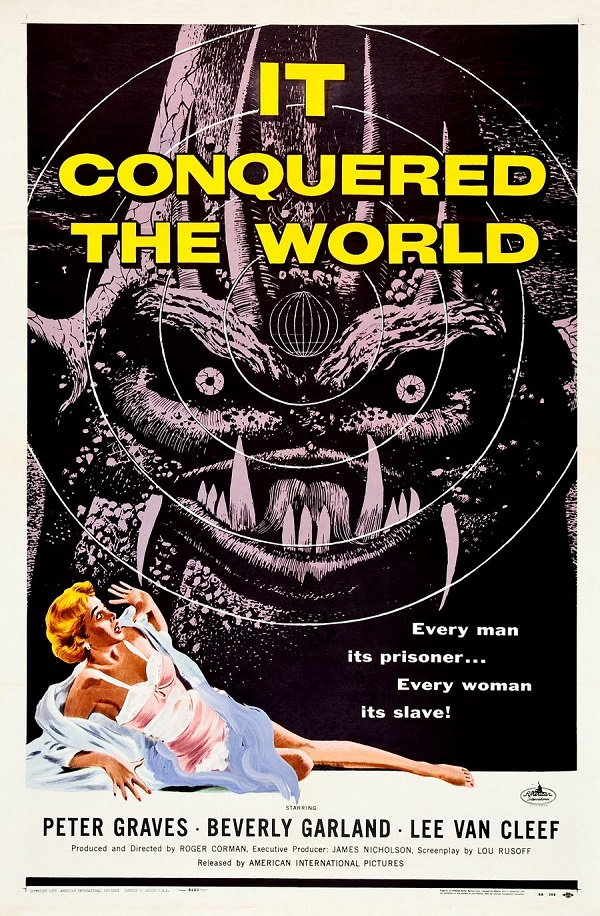
#14 
It Conquered the World 
(Roger Corman, 1956)


When AIP released The She-Creature (reviewed earlier this month) in 1956, it formed one half of a double-bill with this rather more widely remembered little number from Roger Corman. Quite a night out, by my estimation. For the sake of random cyclical completeness therefore, I thought I’d dig out ‘It Conquered The World’ and give it a quick going over, having not seen it for many a long year.

During the first half, I was surprised to note such a high incidence of clunky dialogue, painfully bad line-readings and general meandering tedium, which has no doubt done a lot to aid the film’s retrospective status as a more-or-less definitive cheap n’ cheesy b-movie. In view of the fact that the film's principal creatives were all smart and competent people however, I tend to suspect there was a certain amount of sniggering self-awareness creeping in here, which makes me sad.

As cynical as the production circumstances behind Roger Corman's movies may have been, when it comes to his directorial efforts, I've always appreciated his earnest dedication to making a straight-facedly decent movie out of whatever meagre resources were available to him. So, it’s disappointing to imagine him knowingly signing off on a load of sub-par crap at some points on this one, underestimating the intelligence of his audience in precisely the manner he usually so strenuously avoided. Perhaps Lou Rusoff’s script - just as shamelessly barmy as the one he provided for ‘The She-Creature’ - might to some extent be to blame?

Anyway, regardless, there is nonetheless a lot to enjoy here right from the outset. Surely no genre movie fan can fail to be moved by the sight of a (relatively) young Lee Van Cleef firing up his inter-planetary radio-set (hidden behind a curtain in the corner of the living room) to speak to his friend from Venus? 

Appearing just a few years after he played sneering, homosexual hitman Fante in Joseph H. Lewis’s classic ‘The Big Combo’, Van Cleef’s plummy, pointed-finger-aloft delivery of his dialogue here (“listen Paul - listen to the VOICE!”) must have become an acute embarrassment for him as he began settling into his more familiar taciturn cowboy persona over the next decade or so.

Meanwhile of course, the thunderously obvious nature of the obligatory anti-commie sub-text, expressed through Van Cleef’s interplanetary collaboration with a malign being who promises heaven on earth to mankind in exchange for their emotions and individuality, is so clearly comical that I’d like to believe that Corman - not to my knowledge a rabid McCarthyite - very much did have his tongue in his cheek in this regard.

And, once things get going in the second half, ol’ Jolly Roger really gives us our money’s worth. In fact, as soon as the Best Movie Monster Ever (accept no substitutes) shows up, conquering the fuck out of Bronson Canyon (if not quite the world) with his killer grin and adorable, residual-arm-waggling “just frontin’” moves, it’s all gravy for a surprisingly action-packed final act.

First we get the great Beverly Garland blasting away at the bugger with a shotgun (and, how often do we get see the heroine of a ‘50s sci-fi movie sneaking out from under her husband’s nose to give the monster hell, incidentally?), then the Dick Miller Commandos show up with their bazooka, and finally, an enraged Van Cleef getting up close and delivering the foam-melting coup de grace with an f-ing blowtorch, of all things! His final words: “I bid you welcome to this earth... you made it a CHARNEL HOUSE!”

For all the missteps and faffing about in the first half in fact, this is a thing of beauty and a joy forever - god bless you, Mr. Corman. 

 
#15 
Daughter of Darkness 
(Stuart Gordon, 1990)


Nothing to do with Harry Kumel or Delphine Seyrig, this is a made-for-TV vampire movie shot in Romania, directed by the late Stuart Gordon. In view of the info in the preceding sentence, I'd always assumed it must naturally be a Full Moon/Charles Band joint (some kind of spin off from their Eastern European ‘Sub-Species’ films perhaps?), but when I finally sat down to watch it this week, it immediately became clear that we’re dealing with a different kettle of fish entirely.

None of the usual suspects or company logos turned up on the straight-laced opening credits, and once things get underway, the tone is very different from yr usual Empire/Full Moon house style. It’s slicker for one thing, with somewhat higher production values, but also blander and more conventional, as if attempting to appeal to a mainstream TV audience, rather than rabid horror fans.

The plot sees a young American woman (Mia Sara) arriving in Bucharest in search of her long lost father, who turns out to be none other than Anthony Perkins. Along the way, she collides with variety of sinister and/or seductive characters, gets into a few scrapes involving the sinister dragon pendant she inherited from her Dad, has ominous bad dreams in which she traverses areas of the city she has never previously visited, and so on and so forth.

Thanks to Gordon’s brisk pacing and inventive direction, this is all fairly diverting, but unfortunately, once it gets down to brass tacks, vampire stuff in Andrew Laskos’ script is pretty hackneyed, much of the dialogue is fist-in-mouth terrible (the alleged “flirtatious banter” between Sara and U.S. embassy attaché Jack Coleman is especially painful) and the performances (with the exception of Perkins and a couple of the Romanian actors) are extremely poor. This latter point is especially disappointing, given that Gordon's theatrical background and good eye for casting usually helped his films to punch well above their weight in terms of acting and character stuff.

Meanwhile, the obvious requirement to stick to PG-level content also proves a stone drag. Although there are a few potentially memorable horror scenarios, and vampires’ manner of feeding proves a bit of an eye-opener, you can almost feel the director straining at the leash, wishing he could unleash some of the nastiness of his better-known work, but clearly under orders to keep things as mild as possible.

On the other hand though, the film is, as mentioned, very well directed, and the photography (by Romanian DP Iván Márk) is extremely good, making excellent use of the evocative and unusual urban locations. In fact, whereas many American horror films over the years have tried to hide the fact that they were made in Eastern Europe for budgetary reasons, this one makes a real virtue out of being shot under the nose of the Ceaușescu regime, which by my calculations must have been struggling through its final tempestuous final months at around the time ‘Daughter of Darkness’ was filmed.

As such, the film’s evocative and seemingly authentic Bucharest street footage carries an electric and fearful atmosphere, effectively conveying the idea of a city living under a cloud of intrigue and paranoia, and even incorporating a sub-plot about Sara being pursued by the dictator’s secret police.

With a stuttering electricity supply, gun-toting soldiers on every corner, and brief glimpses of breadlines and dishevelled streetwalkers visible as Sara roars through the streets in a broken down taxi, the film suggests an interesting contrast between these symptoms of late 20th century misery, and the older, more dust-shrouded European world represented by the shabby five star hotels, over-priced restaurants and subterranean craft workshops which both she and the vampires are obliged to frequent.

At times, I was even reminded of Zulawski’s use of East Berlin in ‘Possession’ (a comparison further suggested by the fact that this film’s main bad guy, British actor Robert Reynolds, is a dead ringer for a young Sam Neill), but... there the similarities end, unfortunately.

Overall, I’m not sure I’d recommend going to the trouble to track down ‘Daughter of Darkness’ unless you’re a Stuart Gordon completist (or an Anthony Perkins completist?), or unless you have a special interest in films shot in Romania, possibly. But, it is at least a sufficiently respectable effort for me to continue truthfully claiming that I’ve never seen a Gordon film I didn't enjoy. 

 
#16 
Gemini 
(Shinya Tsukamoto, 1999)


To be honest, I've never been much of a fan of director Shinya Tsukamoto, but I am a fan of films based on the writings of Edogawa Rampo, wild gel lighting and buying stuff from Mondo Macabro, so I thought I'd give this one a go.

Results proved…. mixed, shall we say. The basic Rampo-derived story, about a former battlefield surgeon (Masahiro Motoki) being terrorised by his doppelganger, remains very compelling, using an ostensibly simple horror conceit to explore a wide range of uncomfortable thematic territory, touching on the dehumanising effects of war, the collapse of family hierarchies and, most pointedly, the pernicious violence inflicted upon society by the rigid enforcement of socio-economic inequality.

Rest assured however, this is all treated by Tsukamoto more as a visceral, ero-guro tone poem than some high-minded political allegory, as he adapts his jarring, dissociative audio-visual style (often likened to the cinematic equivalent of a tape cut-up or extreme noise record) to the needs of a slightly more refined period setting, delivering some truly shocking and bizarre moments for us to, uh, ‘enjoy’, in the process.

Former pop idol Motoki does fine work too in what is a challenging pair of roles to put it mildly, with his portrayal of the ‘evil twin’ character in particular standing as easily the most unsettling display of skin-crawling evil I’ve encountered during this October season.

In many other respects though, I’m afraid I just didn’t dig the approach Tsukamoto takes to this material. Although there is some beautiful photography in places, the ‘extreme’ colour schemes used through much of the film are achieved through ugly-looking post-production filtering rather than actual, on-set lighting and production design, with the unfortunate effect of making a lot of the footage feel as if it’s been brutalised by the pre-sets on an arty teenager’s iPhone, whilst the director’s fixation with lo-o-ong sequences of people silently maintaining creepy/natural postures or just generally freaking out in front of the camera for minutes on end likewise got on my nerves.

Ultimately, these questionable aesthetic decisions served to distract me from the central narrative (which I was enjoying) to a sometimes catastrophic degree, ultimately making the whole venture feel a bit pretentious and uninvolving.

I’m also not really sure why the occupants of the film’s early 20th century “slums” all needed to be crazy, Noh-dancing neo-primitive cyberpunks, but hey, you hire the guy who made ‘Tetsuo: The Iron Man’, that's what you get I suppose.

Saturday, 17 June 2017

Four Rampos.


We return here to our old pal Edogawa Rampo, with four random entries from a long series of paperbacks collecting his stories, issued by Kadakawa Books during the 1970s. The superb cover illustrations are provided by paper-cut artist Masayuki Miyata (1926–1997), a framed example of whose work we previously saw displayed at Rampo’s house [see link above].

Each of these volumes contains several tales, but the names / title stories, in the order they are displayed above, are:

1. Kumo-Otoko (The Spider Man) (1974)
2. Panorama-to Kidan (The Strange Tale of Panorama Island) (1974)
3. Kage-Otoko (Man of Shadows) (1973)
4. Sankaku-kan no Kyohu (Fear of the Triangular House?) (1974)

The fifth image is a generic series illustration, repeated on the back cover of all four volumes. In common with many Japanese paperbacks, the artwork is printed on detachable, hardback-style dust jackets -- which is pretty cool.

Though I have been banging on about him occasionally on the blog for quite a while, it is only in the past year or so that I have actually made the effort to begin tracking down and reading Rampo’s stories in English translation, and, even more-so than I might have expected, they are absolutely extraordinary.

Though capsule biographies of Rampo often tend to paint him as a devotee of Western-style mystery and detective stories, the way in which he spikes the conventions of coldly logical, whodunit detection with the irrational perversity of human desire feels uniquely transgressive, unlocking fearful vistas of ambiguity and apprehension that place him within an aesthetic world that is entirely his own; a world that I feel is brilliantly captured by Miyata’s artwork.

I picked these books up for peanuts in Nakano Broadway, and now just wish that I could read them.

Tuesday, 14 July 2015

Japan Photo Spectacular:
A Visit to Edogawa Rampo’s House.

Within easy walking distance of Tokyo’s Ikebukuro transport hub, on the corner of one of the spotlessly clean boulevards surrounding the prestigious Rikkyo University campus, markings affixed a nest of stone owls beckon passersby down a side street. Follow, and you will soon find yourself outside the Edogawa Ranpo Memorial Centre for Popular Culture Studies, a small research centre affixed to the equally modest family home of its namesake, which is now preserved as a small museum and archive.


We previously touched upon the work of Tarō Hirai, aka Edogawa Rampo (1894 - 1965) in these pages when I reviewed Teruo Ishii’s Horrors of Malformed Men back in 2013, but for the uninitiated, Rampo might best be summed up as the godfather of Japanese crime, mystery and horror fiction.(1)

As a keen scholar of English popular writing, Rampo did a great deal to familiarise the Japanese public with the history and legacy of Western mystery fiction, and was one of the first writers to find success writing such stories in Japanese. When it comes to getting a handle on his own literary endeavours however, such inherited genre tags prove woefully inadequate.

Taking inspiration both from the logical detection of Conan Doyle and the morbid preoccupations and high concept vignettes of his other primary influence (and if you’re wondering who that was, just try saying his pen-name out loud a few times in a Japanese accent and see what emerges), Rampo added a far stronger strain of eroticism to the mix, along with a perverse sense of the absurd that was entirely his own. Soaking the results in the richly decadent atmosphere of Taishō era Tokyo and the weird imagery of Edwardian pulp magazines, Rampo created a unique literary aesthetic whose essence was succinctly encapsulated by the handy genre tag of ero-guro-nansensu – ‘erotic grotesque nonsense’.(2)

Framed in the entrance-way of the Rampo house, visitors can see a roughly scribbled manuscript in which the author attempted to list and categorise his favourite Western detective stories, isolating the elements and formulas that he fed into his own work. On the opposite wall, a beguiling modern painting inspired by Rampo’s writing can also be seen. [UPDATE: this is likely the work of Masayuki Miyata - see comments.]


Although most of the house itself is off-limits to casual visitors, numerous windows are packed with displays of Rampo memorabilia, including many rare editions of his work.


The books seen in the final photo above help to remind us that, despite his fixation with weird sex and death, Rampo also enjoyed a parallel career as a highly successful children’s author, concocting numerous adventures for his Shōnen Tantei-Dan (“Boys Detective Club”) – a set of stories beloved of generations of Japanese children, and still widely read to this day.

The French windows at the rear of the Rampo house allows visitors to see directly into Rampo’s living room / study, which is preserved in exactly the manner in which he left it following his death in 1964. A finely appointed room, no doubt about it, and I got a particular kick out of seeing the dusty boxes of Japanese and Scotch whisky displayed side by side on his writing desk – a nice visual metaphor for the East-meets-West nature of his writing, not to mention it’s combination of aesthetic refinement and primitve shock.


As we were gawping at this living room, a young archivist appeared from within, clad in a light-weight kimono with slicked back hair and old fashioned glasses, looking as if he could have stepped straight out of one of Rampo’s stories. Offering us tea, he asked us whether there was any particular aspect of the master’s work we would like to discuss, or any documents we would like to consult. It was with great sadness that, due to our tight schedule of tourist-y business and my extremely minimal comprehension of spoken Japanese, we were forced to decline his offer on this occasion.

We did of course though find a few minutes to venture further into the grounds to have a look at Rampo’s purpose-built library / warehouse. Described by the author as his “illusory castle”, the walls of this unique structure are reinforced with layers of earth and, apparently, recycled Edo Period literature. According to Rampo’s Wikipedia page, the building even survived the allied firebombing that destroyed much of the surrounding area in 1945.


An obsessive bibliophile by anyone’s standards, Rampo’s library is said to comprise some 20,000 volumes in both Japanese and English, presumably including his legendary collection of homoerotic literature. Again, public access is strictly limited, but peering through the viewing window in the front door did at least give us an idea of the kind of riches housed within.


Happily, English editions of Rampo are widely available (Tuttles’s Japanese Tales of Mystery and Imagination and Kurodahan Press’s Black Lizard & Beast in the Shadows both look like good bets), and those seeking an easy way into the spirit of his work are also advised to check out some of many excellent and somewhat disturbing movies extrapolated from his stories (the aforementioned ‘Horrors of Malformed Men’, Kinji Kukasaku’s Black Lizard and Noboru Tanaka’s Watcher in the Attic all come highly recommended). You could also seek out Suehiro Maruo’s sumptuous manga adaptation ‘The Strange Tale of Panorama Island’ (published in translation by Last Gasp), or, for a somewhat quicker fix, try hitting play on the following cheery credits sequences for two different TV iterations of the much-loved Boys Detective Club.


--------------------------------

(1) As you may have noted, Edogawa’s name can be romanised either as ‘Ranpo’ or ‘Rampo’ – both are used seemingly interchangeably, but I think I’ll go for the latter, just because it sounds more fun.

(2)Officially defined as spanning the years 1912 to 1926 (the reign of the Emperor Taishō), culture during the Taishō period is often characterised in a manner that seems reminiscent of Weimar Germany, as art and literature became increasingly introspective, imaginative and transgressive, displaying an aesthetic elegance and sense of escapism that often sits uncomfortably alongside the period’s political turmoil and the rise of the fanatical nationalism that would eventually drive Japan into the Second World War.

Friday, 23 August 2013

Nippon Horrors:
Horrors of Malformed Men
(Teruo Ishii, 1969)


Although it has achieved a certain level of cult notoriety in the West following its release on American DVD, Teruo Ishii’s ‘Horrors of Malformed Men’ remains largely unseen in its country of origin. Surprisingly, it is effectively banned in Japan to this day, with no officially sanctioned screenings or releases on the horizon.

From a foreigner’s point of view, the film’s continued suppression seems slightly mystifying, but most likely it all stems from the use of the taboo word kikei (translated as ‘malformed’) in the title. Direct reference to physical disability has always been a big no-no in polite Japanese society, and this word - perhaps roughly equating to something like ‘schizo’ or ‘spastic’ in English but with more of a sweary connotation - was considered extremely distasteful when used on a movie poster, particularly in conjunction with a storyline that touches on the idea of disabled people taking their revenge against the able-bodied world.

Presumably, such potentially offensive material made distributors reluctant to handle the film, and the ensuing negative publicity caused Eiran, the usually fairly relaxed Japanese censorship board, to single out ‘..Malformed Men’ for special attention, making it a hot potato somewhat along the lines of ‘The Devils’ or ‘Straw Dogs’. Quite how Toei (the studio who produced the film) reacted to this controversy, I’m unsure, but perhaps they simply chose to bury the damn thing forever, too resentful to bother opening old wounds again, in spite of the growing demand from cult movie aficionados for the film to be seen.

Anyway, regardless of the exact details, you’ll appreciate that I was pretty apprehensive about the idea of sitting down to watch a film that caused such consternation in a land that happily accepts the excesses of Norifumi Suzuki and Takashi Miike (not to mention those of Ishii himself, who came to ‘..Malformed Men’ off the back of such hits as ‘Inferno of Torture’ and ‘Orgies of Edo’). Believe it or not, I’m not usually someone who much enjoys excessively gruelling or icky cinema, and all signs pointed towards this one being a singularly grim experience. But nonetheless, reviews I’d read sounded intriguing, images I’d seen from the film looked fascinating, and it certainly seems to hold an exalted position within the pantheon of Japanese cinematic weirdness. And, well, y’know - no obscure movie fan ever gained anything by NOT watching a film, right? Taking a deep breath and preparing for whatever morbid insanity you’re about to witness is all part of the fun.

And to be honest, the first feeling that hit me once I settled into the flow of ‘..Malformed Men’ was one of happy relief. Whilst admittedly still stuffed with enough warped behaviour to keep a convention of mental health professionals busy for weeks, Ishii’s film is nonetheless a lot more fun than I had been anticipating – a colourful and vibrant work that often seems closer in spirit to the cracked surrealism of early 20th century pulp fiction than to the bleak travails of modern day Endurance Horror.

One of those movies that throws together so many different strands that trying to tie them all together in a few paragraphs is liable to leave one pretty breathless, ‘..Malformed Men’s pleasantly pulpy atmosphere is far from accidental when viewed in the light of a storyline that fuses a particularly disturbing variation on H.G. Wells’ ‘The Island of Dr. Moreau’ with a mish-mash of additional ideas taken from the writing of celebrated mystery writer Edogawa Rampo. And you guys all know what’s up with celebrated mystery writer Edogawa Rampo, right..?

Well, ok - time for another deep breath. A hugely popular figure in Japanese culture, Rampo – real name Tarō Hirai - began writing in the 1920s, taking his cue from Western weird tales and detective fiction, and in particular that certain, peculiar combination of the two perfected by Edgar Allan Poe (just try saying his pen-name out loud with a Japanese accent). Rather than simply rehashing the work of his inspirations though, Rampo refashioned the form in uniquely Japanese style, adding strong elements of the perverse and erotic imagery that fascinated him in his private life to create a new sub-genre of horror/mystery fiction, the ubiquitous ‘ero-guro-nansenso’ (yes, that’s ‘EROTIC GROTESQUE NONSENSE’ to the likes of us), that has gone on to exert an influence upon just about all subsequent horror-themed films and manga in Japan.

I’ve not yet had the pleasure of reading Rampo’s work in translation, but I can easily believe that watching the opening half hour of ‘..Malformed Men’ gives a pretty good idea of what being thoroughly immersed in the world of ‘ero-guro-nansenso’ might be like, as a succession of bizarre and seemingly inexplicable incidents pile up at dizzying speed, pulling us into a macabre web of mystery, and establishing a pulpy atmosphere that Ishii cannily proceeds to cross-breed with a heavy dose of the kind of confrontational experimentalism that makes Japanese culture from the late ‘60s such a consistently wild ride, resulting in a cinematic experience that is, well… unique, to say the least.

Unsettling right from its opening seconds, ‘..Malformed Men’s credits sequence sees composer Hajime Kaburagi offering up a unholy mess of doomed choral bombast and crashing industrial noise, accompanying close-up nature footage of assorted poisonous spiders, broken up by bright blocks of primary colour. Following this, the first shot of the movie proper gives us a screen full of darkness and a deranged female shriek, before our gaze moves down across an unhinged woman’s face and a mighty pair of bare breasts, coming to rest on the blade of a nasty-looking dagger raised in her hands. As the camera pulls back, we find a lone male, trapped in a poorly lit prison cell, surrounded by a crowd of apparently insane women in torn red kimonos who cavort around him in uncoordinated and generally menacing fashion, drooling, cackling and writhing in erotic oblivion as they caress the bars of the cell and torment their male prisoner, the camera  leering at their distressed bodies in a decidedly distasteful manner. If there’s a more comprehensively ‘ero-guro’ way to begin a movie than this, I’d like to see it.

After a few minutes of this sort of thing, a doctor enters, calming the women down with a few blows from his bull-whip, and we learn that we are actually inside an extremely poorly organised lunatic asylum, where Hitomi (Teruo Yoshida), a former medical student and current inmate, has awakened to find himself mistakenly locked in the women’s cell. The doctor returns him to his appointed cell, but this does little to improve his state of mind. You see, Hitomi has completely lost his memory, and has no recollection of how he arrived at his current predicament. The only clues he can dredge up from the recesses of his mind are images of a rocky coastline, upon which a horrifying, androgynous figure dances, and the melody of a particularly haunting children’s nursery rhyme. Furthermore, a sinister bald man in the opposite cell seems intent on trying to assassinate him, which scarcely helps matters.

When the bald man attacks him during the night, Hitomi ends up killing his assailant in self-defence, and in the ensuing confusion manages to flee the asylum. Whilst making his getaway, he encounters a young female circus performer who seems to be humming the lullaby he remembers from his dream. Accosting the girl, Hitomi learns that she is an orphan, adopted by the circus with no memories of her childhood, but that she thinks the melody originates in a village somewhere along Japan’s Western coast. The pair meet again later, at the circus, but as the girl begins to tell Hitomi more about where she learned the song, she is struck down by a flying dagger. Seeing the bloody knife in Hitomi’s hands, the crowd assume him to be the murderer, and he’s on the run again.

And so things go on. Before long, Hitomi discovers that a man with an identical face to his own and an identical scar of his foot, an heir to the wealthy Kimodo family, has recently died. The dead man’s father, a somewhat feared and eccentric character rumoured to possess deformed, webbed hands, has apparently not been seen since he set sail for his private island, a rocky outcrop dimly visible from the mainland, announcing his intention to turn it into some sort of “pleasure island”. A spot of grave-robbing, a faked suicide and a surprise ‘resurrection’ later, and Hitomi has taken on the identity of the dead man and finds himself being alternately seduced by both his doppelganger’s wife Chioko, and his mistress Shizuko (Yukie Kagawa, whom we last saw making her mark on the pinky violence genre in Girl Boss Blues: Queen Bee’s Counter-Attack).

At this point, the film briefly threatens to become rather conventional, as the tale of Hitomi trying not to slip up as he impersonates his dead doppelganger rambles on to no great effect. But after Chioko is mysteriously poisoned, and Shizuko subjected to threatening notes and poisonous snake attacks, our hero(?) once again finds himself determined to unravel the mystery of precisely what in the hell in going on… and all clues point toward that mysterious island, where his “father”, the enigmatic Jagoro Kimodo (Tatsumi Hijikata), holds court.

If there is one image in ‘Horrors of Malformed Men’ that viewers will never forget, it is that of Jagoro himself – stick-thin, long-haired, Rasputin-eyed – performing his near-inhuman dance of torment amid the crashing waves and jagged rocks of his island shore. The word ‘extraordinary’ scarcely does justice to this character’s physical presence, and, though I was surprised to find such a notable high-brow personage appearing in a disreputable exploitation film, it still made perfect sense when I hit up Wikipedia and discovered that Hijikata (who also appeared the following year in Ishii’s excellent ‘Blind Woman’s Curse’) was actually a Big Figure in the world of post-war Japanese art - the founder of the Butoh school of dance and performance art, no less.

One of the main themes explored by Hijikata’s dance performances is said to have been “the transmutation of the human body into other forms, such as those of animals”, and, as it turns out, that is a project that his character in ‘..Malformed Men’ has been undertaking in a somewhat more direct fashion, as Ishii proceeds to build Jagoro up into a truly terrifying villain – a sort of unholy amalgam of Dr. Moreau, Fu Manchu and Charles Manson, bent on wreaking cathartic destruction upon both the norms of the human body and those of the world in general, which he sees as having ‘wronged’ him and his deformed ‘people’.

As Hitomi and Shizuko arrive upon the island, greeted by Jagoro as heirs to his insane legacy, the film explodes into a kind of kaleidoscopic oblivion worthy of Alexandro Jodorowsky at his most unglued, as Ishii’s taste for cinematic grotesquery and the choreography and design of Hijikata and his fellow Butoh practitioners combine to summon up a harrowing circus of impossible, Heironymous Bosch-esque delights, in a series of  short sequences upon which the film’s reputation as a world class freak-out presumably rests.(1)

“Let me show you my ideal world”, says Jagoro. As if on cue, an army of slender, long haired figures, naked but for chains and red capes, crest the hilltop, headbanging on all fours like some otherworldly Slayer crowd, as whip-wielding hunchbacks goad them on. On the waters of a river beside a sylvan forest grove, a silver skinned woman sits legs spread on the prow of a boat, juggling flaming torches beside an artificial tree of bird cages. Covered in blood and sand, another naked girl writhes, apparently surgically attached to the rear end of a goat. Huge fires rage as more naked, chalk-covered women writhe in eerie silence… and that’s all before we hit the island’s mylar-sheeting bedecked psychedelic nightclub, to say nothing of the Bava-esque gel lit operating theatre…

Needless to say, once the narrative regains some ragged semblance of normality, there is a wealth of dark and dreadful family secrets to be revealed through the remainder of the film, acts of awful vengeance and twisted reconciliation to be enacted… but, out of respect for the spirit of mystery, I will leave you in the dark about these for the time being.

By this point this is going to sound like a fairly redundant observation, but ‘Horrors of Malformed Men’ is a pretty strange business. In its top-heavy piling of mystery upon mystery, it reminded me a little of Kim Ki-Young’s extraordinary A Woman After a Killer Butterfly. But unlike that carefully controlled venture into labyrinthine gothic melodrama, Ishii’s film has a crazed and rather uneven feel to it. Whilst some sequences are bold and unforgettable, others are shoddy and unconvincing, betraying either an extremely stretched budget/production schedule or a variable level of engagement from the director (in reality a little of both, most likely), often attempting to save the day with ‘shock’ visuals that come across as cheap and prurient, undercutting the film’s stronger, more affecting, moments.

In its attempt to cram as many Rampo stories as possible into a single storyline, the narrative also becomes frustratingly digressive and episodic, failing to capitalise on many of its best ideas and refusing to let any of the characters (save maybe Jagoro) develop any personality beyond a cardboard cut-out level, meaning that, despite grasping at a grand emotional sweep for its suitably bizarre conclusion, it never really manages to transcend its origins as a gory comic book potboiler.

But since when did the weirdo horror warriors amongst us care about that sort of thing, right? Some films invite praise for their perfect conception and realisation, but everyone involved in this one hopefully realised they were competing in a different arena entirely. On a purely visceral level, ‘..Malformed Men’ is as imaginative, repulsive and rich in cognitive dissonance as the contemporary films of Koji Wakamatsu, and as feverishly unpleasant as the later works of directors like Kazuo Komizu.(2) A singular experience, whichever way you look at it, and as perfect an expression of the dictats of the ero-guro-nonsenso philosophy as one could possibly wish for.

(1) For what it’s worth, I think the inevitable influence of Erle C. Kenton’s ‘Island of Lost Souls’ can be felt heavily here too, from minor details such as the cave the visitors walk through en route to the rest of the island, to the disturbingly crude make-up effects used to realise the ‘malformed men’ and the incongruous jungle noises and animal calls that often dominate the soundtrack. I think it says a lot for the 1932 film that, in spite of ‘..Malformed Men’s myriad excesses, it is arguably still the more upsetting of the two.

(2) See Komizu’s ‘Entrails of a Virgin’ (1986) for a particularly mean-spirited cinematic kick to the face.