Showing posts with label Ti West. Show all posts

Sunday, 18 February 2024

New Movies Round Up # 2:
Horror.

Sea Fever 
(Neasa Hardiman, 2019)

As far as niche sub-genres go, sea-bound eco/survival horror is generally a good bet, and this modest, primarily Irish indie production takes a pretty convincing shot at it. It’s a rather less exciting prospect to try to write about, truth be told, but I feel like telling you about it nonetheless, so buckle up, and we’ll get through this whole ‘review’ thing together.

So, synopsis time! A painfully introverted PhD student specialising in behavioural patterns of marine life, Siobhán (Hermione Corfield) is reluctantly persuaded by her supervisor to undertake a bit of fieldwork - namely, signing up for a research excursion on rust-bucket fishing trawler the Niamh Cinn Oir, wherein she makes the acquaintance of the unfeasibly diverse crew with whom she (and we) will spend the next 90-odd minutes.

In contrast to the wall-to-wall rough bastards you’d reasonably expect to find manning an Atlantic trawler, we’re instead introduced to hard-bitten yet well-meaning husband and wife skipper team Gerard and Freya (Dougray Scott & Connie Neilson), their sturdy and ever-cheerful son Johnny (Jack Hickey), and the family’s superstitious, and indeed suspicious, grandma Ciarra (Olwen Fouéré). Below stairs meanwhile, we’ve got Syrian refugee and unrecognised engineering genius Omid (Ardalan Esmaili) and another young man of middle eastern descent, Sudi (Elie Bouakaze), whose girlfriend is expecting a baby back home, and who regales us with his plans for a happy future, so -- I’m sorry mate, but you realise we’re in a who’s-going-to-die-first horror movie here, so might as well just get you measured up for that body bag right now, eh?

Speaking of which, exposition of the film’s supernatural plotline is wisely kept paper-thin, but long story short: after Skipper Gerard plots a course through a maritime ‘exclusion zone’ in search of a better catch, the trawler finds itself colliding with what transpires to be an unprecedentedly huge, translucent squid-like creature, whose suckers soon cause little patches of alarming, corrosive goo to begin seeping through the hull.

Sadly, the conspiratorial angle implicit in the fact that this massive, unknown creature is simply flopping around happily in an area from which the powers-that-be have pointedly prohibited civilian shipping is never investigated by Hardiman’s script, but no matter, as there’s plenty else going on to keep our characters busy once their vessel breaks away from the squid’s grasp. Not least, an unknown infection of spreading through the crew causing a variety of unpredictable, scary symptoms, furiously multiplying parasites in the water supply, a sabotaged engine, no means of contacting the outside world, and… well, you get the picture.

During ‘Sea Fever’s first half, the film’s gloomy tone, overcast, seaweed n’ barnacle-drenched ambience and plausible-seeming scientific chat all rather put me in mind of early ‘70s UK TV staple Doomwatch, establishing an atmosphere of drab realism which nicely enhances the impact once the full-on SF/horror elements are let out the bag and given a run around later on.

In particular, the low key atmos which prevails aboard ship contrasts nicely with the notes of Lovecraftian awe conjured up by the effects-heavy underwater sequences wherein we encounter the mysterious life forms first-hand, in footage whose eerie, CG-enhanced beauty proves surprisingly effective.

By far the film’s strongest suit though turns out to be its ensemble performances, with the cast having clearly been given a free hand to treat the whole thing as a long-form chamber piece/collaborative exercise, as all concerned do great work in transcending the potentially clichéd roles assigned to them by the script, effectively capturing our sympathies/attention in the process.

Though it can make few claim toward originality (see below), writer/director Neasa Hardiman’s screenplay is nonetheless peppered with curious bits of detail which also help add a bit of depth to proceedings, whether through random folkloric digressions (such as grandma Ciarra explaining the significance of the trawler’s name, or the crew reacting with consternation to the discovery that they’ve inadvertently set sail with a redhead aboard ship), or the assorted cool, DIY schemes Siobhán and Omid come up with to try to fight back against the alien incursion (using a hacked smartphone to generate UV light for instance); schemes which, refreshingly, totally fail to work in most instances.

There are, it must be said, a few glaring absurdities which stretch credulity along the way - most notably the vexed issue of the radio, which apparently falls apart after the boat bumps into the squid, causing the skipper to immediately declare that they’re now out-of-contact with the mainland, despite not even bothering to ask the two highly proficient tech bods on-board to try to fix it. (And what, no back-up radio? GPS tracking? Distress signals? FLARES, fergodsake? I mean, I’ll cop that it’s a been a few years since I spent any time on a boat, but I’d imagine it must take more than a few loose wires on the ol’ CB for a 21st century fishing trawler to declare itself lost without hope…?)

But, the crew must of course be entirely isolated in a confined space - that’s the point, for such is a prerequisite of the formula which inevitably takes ‘Alien’ as it’s foundational ur-text. In addition to which, it must be acknowledged that Hardiman draws heavily on the blue-print provided by John Carpenter’s ‘The Thing’ here, hitting most of the same basic plot beats to one extent or another, and repurposing a number of that film’s key set-pieces in a manner which I scarcely need to unpack here, so bleedin’ obvious will it be to the vast majority of the viewing public.

But, if you’re going to steal, steal from the best etc, and within the limited gene pool of ‘Alien’/‘The Thing’-type movies, ‘Sea Fever’ makes optimum use of its modest resources, rarely putting a foot wrong. Not exactly a mindblower or shredder of preconceptions then, but, the next time you find yourself in search of something to fill that particular salty sweet spot in your viewing schedule - look no further folks, this one’s solid.
 

Destroy All Neighbours 
(Josh Forbes, 2024)

Watching the trailer for this one when it popped up on Shudder early in January prompted a bit of an “ok, clear the viewing calendar, Friday night is covered” moment on my part, momentarily making that £5 monthly subscription fee feel a bit easier to justify.

Later on said night though, spirits were subdued (and low level spending priorities reassessed), as it was agreed that Josh Forbes’ gonzo horror-comedy just didn’t quite hit the spot.

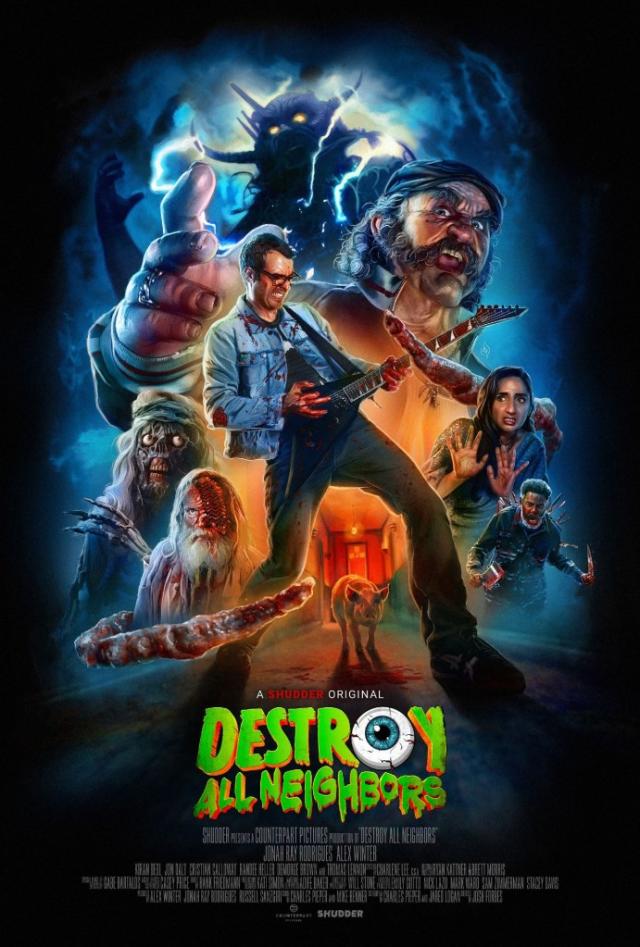
It’s difficult for me to put my finger on quite why that is though, given that all the necessary elements for a good time do indeed seen to be present and correct in this saga of an anxious prog-rock obsessive William Brown (Jonah Ray) battling to complete his home-recorded magnum opus in the face of overwhelming disruption from his bestial new neighbour (Alex Winter of ‘Bill & Ted’ fame, unrecognisable under a mass of prosthetics).

Indeed, there are a lot of individual bits and pieces here which I liked a lot - not least copious amounts of muso/record nerd humour, partially arising from the amusing mythos surrounding the film’s fictional prog titans Dawn Dimension, and a ton of wild and oft-impressive practical gore effects sure to warm the heart of any ‘80s horror fan.

Ray does great twitchy, whining, self-pitying work in the lead role, whilst still managing to make his character at least somewhat sympathetic, and there are numerous scenes and individual gags along the way which are genuinely very funny, but… I dunno, man. Somehow the overall structure and tone of the whole thing just felt off - its story and characters presented in an indigestible, sometimes frankly just plain obnoxious, fashion which I didn’t really care for.

The problems begin, I feel, with Winter’s characterisation of Vlad, the nightmare neighbour. Buried under such heavy, orc-like make-up that we initially wonder whether he’s even supposed to be human, Winter seems to be going for a kind of broad, Eastern European macho stereotype here, dropping weird, garbled dialogue which frequently proved difficult to decipher. He’s certainly an unnerving presence, that’s for sure, but… I think he’s also supposed to be funny, and on that level, well… I just don’t get it, I guess?

Likewise, several of the film’s other OTT comic characters (the coke-addled, Crosby-esque singer-songwriter who makes William’s day-job at a recording studio a misery, the hobo who hassles him for croissants on his way to his car, etc) represent an aggressively emphatic brand of low-brow / one-joke character comedy which soon becomes both tedious and exhausting.

This is especially regrettable, given that the bits of the film which actually are funny (such as William’s attempt to bribe the security guard outside a blast furnace with a rare demo tape, or his interactions with his long-suffering girlfriend (Kiran Deol)) tend to be those which adopt a more low-key / down-to-earth kind approach, letting the surrealism of William’s increasing disconnection from the world outside his head sink in more effectively than all the putty-faced gurning / shouty stuff utilised elsewhere.

Although it was presumably Forbes’ intention for us to feel thoroughly disorientated by the descent into hallucinatory psychosis which accelerates after [not-really-spoiler-alert] William kills Vlad and dismembers/disposes of his body, the film soon begins to feel confused and rudderless at this point, in a manner which I don’t think was entirely intentional (an effect not exactly helped by a number of exceptionally unlikely plot twists).

By the time we reach the grand excelsis of the movie’s conclusion, which sees William finally finishing his album aided by a band of re-animated monster corpses in a hi-jacked studio utilising phantasmagorical, lightning-blasting equipment, we can certainly enjoy all the triumphant audio-visual, effects-driven absurdity of the situation, but at the same time, I couldn’t shake the feeling that the essential point of the exercise had been rather lost in transit (a feeling perhaps not inappropriate to the film’s unabashed celebration of bombastic prog excess).

Is this, essentially, a parable about the dangers of shutting the people around you out of your creative life? If so, I fear it doesn’t really come across terribly well. And, I realise that being cynical and un-PC and so on is cool in this cultural context, but should the film really be taking William’s ghastly crimes quite so lightly? Are we supposed to continue to identify with his personal/creative struggles as he alternates between whining self-pity and delusional slaughter? Because doing so is tough-going, frankly, but as we’re never allowed to leave his increasingly suffocating subjective POV, we’re never offered an alternative.

Whereas the presumed prime influences on Forbes’ film (Frank Henenlotter, early Peter Jackson) managed to skate across such questions in their work with charm, grace and a certain degree of humanity, ‘Destroy All Neighbours’ instead ultimately collapses in on itself, leaving behind a nasty residue of white boy smarm and mild nausea.

Perhaps that old chestnut about the perils of deliberately setting out to make a ‘cult movie’ may be applicable here? Or, pure speculation on my part, but perhaps the film’s problems simply stem from the contributions of its three credited screenwriters being insufficiently integrated into a coherent whole? Whatever the case though, sadly ‘Destroy All Neighbours’ many virtues as a piece of crazy-ass, low budget genre cinema find themselves scattered unevenly amidst a flood of nasty, unpalatable goo which just won’t wash out.


X 
(Ti West, 2022)

A few Halloweens ago, I found myself impulsively re-visiting Ti West’s ‘House of the Devil’ from 2009, and discovered that, not only had it aged very well, but that I actually enjoyed it even more than I did at the time of it release.

Naturally, this set me to wonderin’ what became of the film’s director, who looked to be the Great White Hope of US horror cinema for a few minutes back there. To be honest, I lost track of his career following 2011’s underwhelming ‘The Innkeepers’, so, it’s a great feeling therefore to catch up with his triumphant return to the world of mid-budget horror all these years later, and to discover that it builds upon many of the qualities which impressed me so much in ‘House..’.

So, once again, ‘X’ gives us a beautifully detailed period setting (late ‘70s rather than early ‘80s in this case), and again includes an extremely lengthy (but almost hypnotically captivating) ‘slow burn’ build up before anything happens to 100% confirm that we’re definitely watching a horror movie. But, when those things do finally begin to happen, they do so in a way which proves extremely satisfying.

Before we get to all that though, ‘X’s initial set up - in which a threadbare cast and crew set off for a remote Texas farmstead to shoot a zero budget porno movie - proves interesting, fun and (like every aspect of the film) reflective of a writer/director with an innate understanding of (and love for) the aesthetics of vintage genre filmmaking.

It’s easy to imagine for instance that any number of the ultra-scuzzy regional ‘70s porn flicks which survive today as anonymous, public domain scans of heavily damaged prints could well have been the one these guys are setting out to make here, whilst the character dynamic which plays out between the opportunistic strip club-owner producer and his seasoned sex industry ‘stars’ on the one hand, and the high-minded film student cameraman and his girlfriend/assistant on the other, seems modelled to some extent on that documented in Joel DeMott’s legendary Demon Lover Diary from 1980.

Which is to say that, as in any good slasher film, there is plenty going on here to keep us busy until the vaguely defined threat lurking somewhere out in the darkness finally takes shape and makes its presence felt - and, needless to say, plenty of opportunity to fill the opening act with sex, and arguments, and people running around at night without (m)any clothes on, without seeming too forced or far fetched.

And, make no mistake - this is an extremely good slasher film. No more, no less. (Well, perhaps just a little bit more? See below.)

Without resorting to Tarantino-style fanboy blather, West dutifully doffs his cap to all the requisite precursors in this particular backwoods corner of the genre (not only ‘Psycho’ and ‘Texas Chainsaw..’, both directly referenced in the text, but also ‘Eaten Alive’, ‘Tourist Trap’, etc), and proceeds to do right by them.

And, once ‘X’ locks into a familiar stalk n’ slash pattern during its second half, the director plays a very nice little game with genre expectations which I’ve rarely seen any other contemporary filmmaker achieve too successfully. Namely, giving us exactly what we expect to happen - but still making it work.

When discussing music after a few drinks, I’m sometimes inclined to grandly declare that the art of great rock n’ roll lays in doing the simple stuff well, and, in both ‘X’ and ‘House of the Devil’, West seems determined to prove that the same formula can also be applied to horror filmmaking.

Based on these two examples at least, notions of surprise and unpredictability (usually so key to horror/thriller storytelling) play very little role in his cinema. Anyone with the slightest familiarity with genre conventions should be able to grok the entire premise of ‘X’ right from the outset, and in each of the film’s ‘kill scenes’ in turn, exactly what we think is going to happen happens.

But, in West’s hands, it happens really fucking well. Like a chef who has spent his life carefully refining the same menu night after night, he gives it to us but good.

(In fact, West’s dedication to perfecting the predictable even goes so far as orchestrating the best needle-drop of ‘(Don’t Fear) The Reaper’ in movie history, right at the pivotal moment bridging the film’s “slow burn” and “horror” sections. Again, original it ain’t - but awesome it surely is.)

Meanwhile, another similarity which unites ‘X’ and ‘House of the Devil’ (and indeed ‘The Innkeepers’, insofar as I recall) is the idea of the old preying upon the young, drawing explicitly upon the implicit fear of the elderly or infirm which lurks just beneath the surface of so many teen-centric ‘70s/’80s horror films.

Which brings us neatly to is what is ostensibly ‘X’s main talking point (though it is not something I found terribly interesting whilst in the process of actually watching it) - namely its status as quite possibly the first film in history to feature characters aged in their 20s and their 80s played by same actress (rising star Mia Goth, who delivers one hell of a performance in both roles, just for the record).

Surprisingly unaddressed in the writing I’ve seen about this film is the fact that, whichever way you cut it, the concept of getting young actors to don heavy aging make-up to play elderly characters seems pretty damned offensive, even in cases where those characters aren’t portrayed as psychotic killers. (As a comparison, just consider how far you’d get these days trying to make a film in which the same methodology was applied to race, or to disability, and you’ll see my point.)

At best, this could usually be considered fairly distasteful practice, inherently disrespectful to the older actors who may potentially have appreciated the chance to play these roles; but, in this case, as so often in the best horror movies, I think we can make an exception.

By which I mean, in addition to the practical difficulty of finding elderly performers willing / able to pull off the kind of physical extremity required of ‘X’s Pearl and Howard, I think we can also place ‘X’ within a lineage of horror cinema going all the way back to Tod Browning and Benjamin Christensen, in which filmmakers have purposefully stepped beyond the bounds of ‘good taste’, courting offense or disgust in order to confront viewers with taboo imagery and uncomfortable ideas, viscerally challenging conventional screen representations of ‘difference’, and hopefully provoking some thought in the process.

By casting heavily made up young actors as his damaged and homicidal geriatrics, West seems intent, not just on forcing us to question our own discomfort at the idea that aging/unattractive bodies may still harbour physical desire and the yawning gulf between flesh and spirit implicit in this, but also in drawing our attention to how thoroughly such unexamined fears permeate many of the 20th century horror films we all love so much.

Heavy stuff to unpack, you'd have to admit, but, like all truly great pulp/genre art, ‘X’ evokes these ideas merely as a by-product of simply being a fun watch - a perfectly-crafted, fantastically enjoyable exemplar of its sub-genre, whose side order of taboo-breaking thematic discomfort never spoils the deep sense of basic, popcorn-munching comfort this implies.

Wednesday, 7 September 2011

London Frightfest 2011, Part # 2.

The Innkeepers
(Ti West, 2011)


Ti West’s ‘House of the Devil’ very much impressed me as a semi-abstract, post-modern horror movie, and if this follow-up is ultimately a less distinctive piece of work, one can hardly blame the director for striking out in a slightly more commercial direction, foregrounding characterisation, humour and reassuring ‘boo!’ moments over weird, minimal dread.

Strong ‘Shining’ vibes are in evidence from the outset here, as the credits roll over a series of faded photographs of a town centre hotel in its historical heyday, leading gradually up to the present day, where we join the establishment's last few minimum wage staff members, sitting out a marathon weekend shift before the place finally closes down for good.

Like ‘House..’, ‘Innkeepers’ goes for the looong slowburn before any horror stuff gets going, and your overall enjoyment of the picture will likely hinge on your tolerance for the bitchy, Clerks-esque chemistry between the two leads - directionless teen Claire (Sara Paxton) and slightly older college dropout Luke (Pat Healy). Personally I very much enjoyed their shenanigans – I thought both performances were very good, and that the script built them up nicely as strong and individually motivated characters whilst keeping things just on the right side of whiny. Individual tastes may vary however – if you don’t have much sympathy for these kinda flawed, slacker-ish characters and their assorted bellyaching, you could be in for a tough ride.

Anyway, Claire and Luke are rather half-heartedly trying to investigate paranormal phenomena in the hotel, running a Geocities-style website full of hilariously unconvincing videos of doors slamming and ‘unexplained bathroom incidents’, and stalking the corridors at night with a tape recorder, in search of ‘EVP recordings’.* As you might assume, this investigation provides the hook that leads us straight into a wholly traditional haunted house narrative.

Aside from the aforementioned nod to ‘The Shining’, the big reference point here is, inevitably, Robert Wise’s ‘The Haunting’, from which ‘The Innkeepers’ inherits its emphasis on strong characters, its pattern of slow-building set-piece scares and its atmosphere of gradually escalating hysteria. Indeed, the only other real character in the movie, a TV actress turned new age healer played by Kelly McGillis, seems very much like an older, more washed out version of Theo the psychic from Wise’s movie.

Such similarities can hardly be seen as derivative though, or even deliberate. Wise’s film casts such a definitive shadow over the haunted house sub-genre that all these elements are pretty much mandatory. In fact, ‘The Innkeepers’ is notable for the extent to which West seems to pull back from the haze of referential imagery and horror-fan nostalgia he perfected in ‘House of the Devil’, instead inviting us to see his film as a free-standing, wholly contemporary effort. And this, sadly, is where it falls short.

Like both ‘House of the Devil’ and ‘The Haunting’, ‘Innkeepers’ is extremely well-constructed, and will scare the pants off you exactly as it sets out to – seeing it in the cinema, I won’t deny that I was watching a lot of the later scenes through gaps in my fingers. Unlike ‘The Haunting’ though, the film crucially fails to really tie any psychological depth or emotional resonance into its scares – an absolute necessity for any decent ghost story. The scariness here, though undoubtedly effective, is of an entirely manipulative variety, utilising the kind of purely physical ‘shock’ effects that serve to turn a horror film into little more than a rollercoaster ride. And I don’t know about you, but I hate rollercoasters.

There is nothing genuinely disturbing in ‘The Innkeepers’, nothing that’s going to lurk in your mind in the dark hours of the night, nothing that instigates any particular catharsis, for either ourselves or the characters. Whilst it’s in progress, yes, you’ll jump outta your skin, and feel uncomfortable, and beg the characters not to go down to that bloody basement again, and so on. But when it’s over, it’s over.

Basically Ti West seems to have no interest at all in developing the narrative beyond the bare bones of a generic haunted house story, and in fact he fails to even comply with the basic expectations of the sub-genre by giving us a big reveal regarding the nature of the evil that lurks in the hotel. Some may defend that as a deliberate ambiguity, but given the lack of any particularly striking details to hook our imaginations to it just seems like a lack of interest to me, making the film a strangely hollow experience. Sure there are a few vague intimations of dark and twisted going on, but just as the Satanic cult in ‘House of the Devil’ seemed rather perfunctory when they finally turned up, the supernatural aspect of the storyline here never really extends beyond “there are some ghosts”.

It’s interesting that with both this film and ‘House..’, West seems to be building a reputation for making horror films in which all the best stuff happens before the horror starts. And in a way, I think that’s kinda applaudable – a nice reversal of the priorities of some of his more gore/shock-obsessed peers, anyway. Despite some significant drawbacks, ‘The Innkeepers’ is still well worth a watch for anyone who fancies a nice old fashioned spook movie with a bit of character to it. The humans in the film certainly pull their weight and will give you a few rewarding memories, even if the ghosts don’t.


*When that phrase was mentioned, the pedant in me immediately wanted to scream that, no, the term ‘EVP’ is traditionally used to describe mysterious voices turning up on dead radio frequencies and blank recording media – if you’re wondering around with a microphone capturing external noises then they’re just, y’know… regular recordings. Before I write an angry letter though, I’ll charitably assume this was a deliberate error thrown in demonstrate the general half-arsedness of our investigative duo, rather than a scripting mishap.

Tuesday, 13 July 2010

House Of The Devil
(Ti West, 2009)


Along with seemingly everyone else in the civilised world, I’m a long-time reader of of Stacie Ponder’s Final Girl blog, but until now I’ve never before managed to wrangle by writing schedule and idiosyncratic film-watchin’ habits sufficiently to allow me to take part in her Film Club. The overwhelmingly positive notices received by Ti West’s “House Of The Devil” though, together with the fact that the DVD seems to be on the shelves at a knock-down price every time I go to the shops, persuaded me to take a chance on it despite my general ambivalence toward modern horror, and… well fuck it, how many words is it going to take me to say “I had a copy lying around, so thought I might as well watch it and do a review”?


So, hmm – bit of a strange one, this “House of the Devil”, eh? Or rather, not so ‘strange’ at all really, given that it’s a film so thoroughly marinated in the established iconography of horror cinema that its supposedly terror-inducing contours end up seeming more cozy than anything – pure comfort food for fans of the genre.

What renders “House Of The Devil” unusual is rather the extent to which it seems to make a stand against the tide of conventional modern horror, offering no enticements or explanations at all to viewers unschooled in classic horror aesthetics, and the way it… well, uh, y’know, just the way in which it kind of jams together elements of the past in order to – in a sense – create something new.


Wes Craven’s “Scream” often gets rather tediously hailed as ‘the first post-modern horror film’, a claim that never ceases to infuriate me, partly because the film’s self-referential ‘innovations’ had already been explored ad-nausuem by smarter b-movies through the ‘70s and ‘80s, and partly because any argument that lends legitimacy to Craven’s candy-ass, cynical, misogynistic avalanche of crap is sure to get my goat. (Maybe you think differently? That’s ok, we can discuss it later, in the parking lot.)


In the past few years however, I believe we have seen popular culture begin to eat itself in a far more thorough-going and exciting fashion than the ‘90s irony culture embodied by “Scream” could have imagined, as a new generation ploughs the past back into endless new creations through filters of memory, deterioration and nostalgia. This methodology can be seen running wild through the world of music at the moment, via such flash-in-the-pan coagulations of aesthetics as ‘Hauntology’, ‘Witch House’*, ‘Glo-fi’, etc., but “House Of the Devil” is perhaps the first feature film I’ve seen which picks up these ideas and really runs with them, emerging as perhaps a good contender the first, genuine, 100% POST-MODERN horror movie.**

Much as Quentin Tarantino has made a lucrative and hugely enjoyable career out of crow-barring together all his favourite bits from old exploitation movies and imagining what might have transpired if they had had the resources, time and technical proficiency of Hollywood behind them, Ti West here seems intent on revisiting all the joys and peculiarities of VHS era horror that (presumably) enthralled him as a teenager. Step by step, he shows us what might have been if one of those weird, indefinably fascinating ‘80s shelf-fillers had been made as a labour of love by a talented a director who was able to take his time, concentrating on the film’s overall artistry and making those funny peculiarities a central feature of proceedings, rather than just a random distraction.


“House of the Devil”s plot-line is so minimal it’s scarcely worth reiterating. Girl gets baby-sitting job > goes to remote, spooky house > there are Satanists, in case you were wondering. I forget who it was who once defined gothic horror as “pretty girl goes into old house, gets the shit scared out of her”, but that's the deal here, no more no less. Most of the enjoyment in the movie arises not from the narrative, but from watching West shift his film through a whole universe of horror aesthetics with all the kaleidoscopic richness and randomised drift of a tumblr blog.


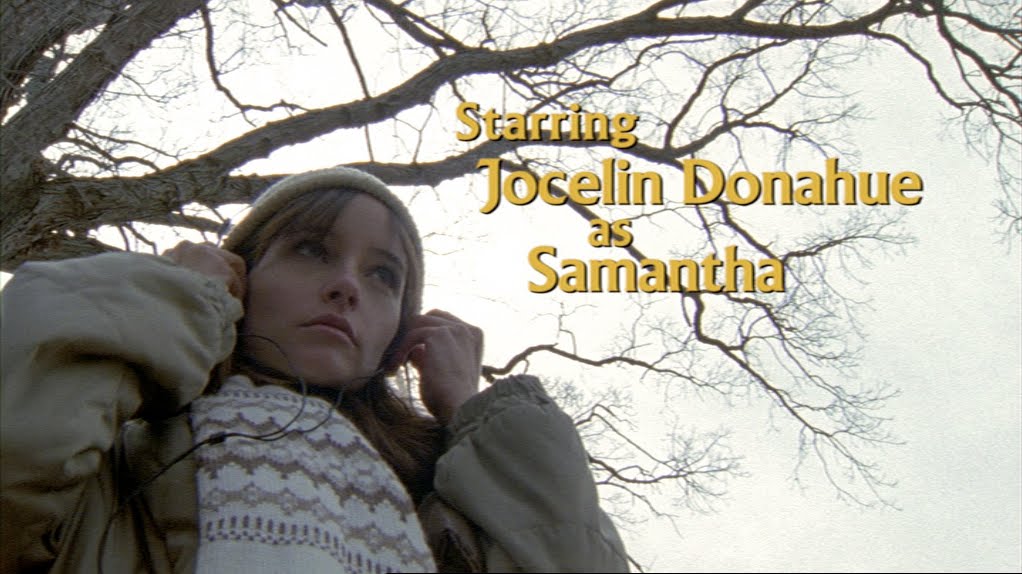
The film’s opening half hour, in which we bear witness the heavenly minutiae of our heroine Samantha (Jocelin Donahue)’s life as a small town college student in the 1980s, plays out like an extended love letter to all the oddly captivating prosaic detail that’s ever made your heart sing on an old horror tape. And when the actual horror itself finally gets going, we can sit back and let ourselves ricochet happily between slasher-era sartori (the takeaway pizza, the repurposed kitchen knife, the unsettling, jokey answerphone messages and all those endless phonecalls), late period ‘70s gothic (unnatural light through the stained glass windows, the harpsichord at the bottom of the stairs), hints of “Shuttered Room” style mad-relative-in-the-attic antics and Texas Chainsaw style deformed killer family mythos, Dennis Wheatley-approved old school Satanism, Phantasm-esque otherworldly graveyard shtick, all-purpose American haunted house tropes…. you name it, it’s probably in there somewhere.


Where West’s MO very much differs from Tarantino though is that “House Of The Devil” is a surprisingly subtle and slow-moving film – an approach that seems very brave given the fuck-yeah-gore approach favoured by most modern horror. In fact, it occurs to me that for a non-horror-fan viewer, unprepared to drink in the steady stream of referential, nostalgic reverie, “House Of The Devil” could easily become an unbearably dull experience – an exercise in deliberate mediocrity, lacking any entertainment-based pay-off.

As such, I can’t help but admire Ti West for taking a chance and placing the success of his film solely in the hands of those of us weird enough to react with joy at the sight of Samantha’s big, orange-padded walkman headphones, or at the beautiful climbing-the-stairs shots based on the bit where they find the mutilated body in ‘Night Of The Living Dead’. And given that he has apparently managed to make the film a roaring success on that basis, what can we say except HIGH FIVE, DUDE? What further proof could be needed that the Age of the Nerd is upon us?


The menacing kitsch of the house itself is wonderfully realised. These aren’t the kind of Satanists who live in rotting gothic splendour and leave a big ol’ grimoire conveniently open on the coffee table – rather their home evokes a horrid neo-classical banality that seeks to recall the stifling atmosphere of a million repressive parental homes. On second viewing, the empty, airless still-lifes that West frames within the house are by far the most chilling aspect of the film, recalling the way David Lynch filmed the interiors of the Palmer house in “Twin Peaks”, or the inexplicable dread of Pupi Avanti’s “House Of Laughing Windows” (a film whose influence seems to loom large over “House Of The Devil”).


Moreover, these eerie interiors represent the key point at which “House Of The Devil” really begins to transcend its status as a mere horror-movie-about-horror-movies, providing us with echoes of abuse and loneliness more subliminally menacing than any pasty-faced demonic crone. After all, you can punch one of those, but try punching an Edward Hopper painting. (Ok, obviously you COULD punch an Edward Hopper painting, but I’m talking figuratively here, let’s not go there.)


In fact, the only thing that ended up marring my enjoyment of the film was the inevitable satanic bloodbath that concludes proceedings – an odd thing for me to say, given that I generally welcome satanic bloodbaths as a fine addition to any motion picture. But, whilst there are a few wonderfully spine-tingling ‘evil reveal’ scares to be had in the closing twenty minutes of “House Of The Devil” (I’d tell you about ‘em, but I wouldn’t want to spoil ‘em), the full realisation of the film’s satanic shenanigans is rather hum-drum and predictable, somehow managing to feel infinitely less satisfying that the hour of sublime mudanity that proceeded it. I mean it’s some ok Satanism I guess, but it’s no "Devil Rides Out", y'know?

Actually, I probably would have enjoyed the film a lot more if the evil Satanists hadn’t revealed their existence AT ALL, and if Samantha had just gone to the house, hung around, noticed a few things that were *slightly* not-right, got a bit worried, and gone home. That would have been an amazing movie – a daring affront to the audience’s satanic bloodbath-based expectations, and a brilliant example of a horror movie whose horrors are created entirely in the imagination of the viewer; a new benchmark for restraint and the power of suggestion in the genre.

Sadly though, this isn’t that film, and when the time comes, the blood is spilled, the robes are donned, the knives are drawn, the doors are banged, the corridors are frenziedly run down, the teeth are bared, the colours are drained, and I start involuntarily humming The Ramones “You Should Never Have Opened That Door”.


Which is probably just as well I suppose. I mean, would anyone be rushing out to see this movie if the reviews had amounted to “ok, so nothing actually happens at all, but there’s some nifty interior décor and some great shot compositions, and the main theme music is totally killer”..?


This Ti West is a smart cat, I think. He knew what he had to deliver, and he got around to it within eighty minutes (PRAISE THE LORD, A MODERN MOVIE THAT ACTUALLY ENDS ON TIME), without resorting to any shitty ‘jump scares’ or ‘lightning strike’ cutting, and whilst still managing to turn in a film that often seems to function more as an extended video art project on aesthetic fetishisation than a narrative horror flick.

One thing that helps him to pull it off, I think, is sheer technical skill. Watching old VHS movies, and low budget cinema in general, we get used to certain things. Y’know what I mean - scenes will be inexplicably filmed in long shot, dialogue will not match on-screen action, bizarre music will deafen us at random intervals, people will talk about nothing in particular for minutes on end whilst the camera remains static, and so on. Some viewers learn to tolerate these deficiencies as natural wastage in between the cool bits, whilst some of us actively embrace them as perverse statements of otherworldly, homemade charm. But at the same time, would anyone want to watch a competent modern movie full of *deliberately contrived* long-shot addled padding..? Seems doubtful.


And so, like Tarantino before him, this is where West wisely breaks from mere re-enactment of the past, making sure that “House Of The Devil” is instantly recognisable as a good film, in the middlebrow newspaper critic / film studies teacher sense of the term. His directorial style is flawless, the film is perfectly paced, and flows beautifully. Every single shot is carefully and interestingly composed, full of rich incidental detail. The cinematography and production design is top notch. The acting is excellent, and all of the characters are lively, engaging and sympathetic (props in particular to Mary Woronov and Tom Noonan as our oddly loveable Satanist couple). The music is fantastic (opening credits theme = TUNE).

Even through sequences in which nothing whatsoever is happening, the film is a joy to behold. I could happily have watched Samantha and her best friend eating pizza and discussing the local property market for hours.


Subsequently, the film gains much of its power from the fact that the movie industry doesn’t usually let us see such specialist aesthetic fetishisation and vague, uneventful narratives in the context of a quote-unquote ‘good film’. “House Of The Devil” is a ‘good film’ that is utterly in thrall to the forbidden magic of ‘bad films’, and, as usual, the mainstream critics, copywriters and squares just won’t know what the hell to make of it, other than to acknowledge that it’s there, that people are watching it and enjoying it, and that it can’t be ignored forever.

A modest creative success on its own self-defined terms, “House Of The Devil” is far from the greatest film most cult movie buffs will have seen this week/month/year, but it DOES hopefully represent the stirring of a promising new approach to horror in the 21st century, and, speaking as a life-long fan of the weird, the obtuse and the cultish, it is always nice when one of ‘our guys’ manages to make a splash in the big pond, however fleetingly. Put me down as officially looking forward to whatever Ti West does next.


* Is that the best contrived sub-genre name ever, or what? Lovecraft fans will be delighted to learn there’s already a Brighton club-night called “Dreams In The Witch House”.

**As with all “the first [whatever] EVER!” type proclamations, this claim is of course utterly fatuous, and readers are encouraged to write in and tell me why “Abbott and Costello Meet The Wolfman” or “House of Frankenstein” or something was actually the first ever post-modern horror movie.