Showing posts with label bikers. Show all posts

Tuesday, 2 July 2024

Cormania:
Gas-s-s-s! Or, It Became Necessary to Destroy the World in Order to Save It
(Roger Corman, 1970)


If we were to chart Roger Corman’s engagement with socio-political issues in his work upon some kind of hypothetical scale, then at the opposite end of it from the uncomfortably effective The Intruder, we would find ‘Gas-s-s-s!, or, It Became Necessary to Destroy the World in Order to Save It’ [henceforth ‘Gas’, just for the sake of our sanity], an inexplicable, rather hare-brained movie which, over fifty years later, is difficult not to see as one of its directors greatest failures. (I mean, say what you will about Creature From The Haunted Sea, but at least it had reasons for being crap.) (1)

This is extremely regrettable, given that the project represents an important milestone in Corman’s career on a number of levels. Not only does it mark the conclusion of his cycle of ‘counter-culture’ films (following on from ‘The Wild Angels’ in ’66 and ‘The Trip’ in ’67), but also his final collaboration with American international Pictures (following fifteen years of fruitful co-dependence), and in fact his final work as a director of independent commercial cinema in the United States. (2)

So, what’s ‘Gas’ all about then? Well… it’s difficult to say really, and that very uncertainty soon becomes a pretty big part of the problem.

A pastel crayon animated prologue introduces us to some high ranking military officials (including such personages as ‘General Strike’, and ‘Dr Murder’ - and if you find that magazine cartoon level of humour uproariously funny, there’s hope you might enjoy this movie yet), who, in the process of attending a ceremonial function at a chemical research base in Alaska, accidentally uncork a beaker containing a cloud of custom-made poison gas which now promises to spread across the earth, killing everyone aged over twenty-five.

Moving into live action post-credits, we meet a long-haired, wise-crackin’ campus troublemaker (Bob Corff) and his adorable, only marginally less wide-crackin’ girlfriend (Elaine Giftos), who depart Dallas in a salmon pink Cadillac and promptly get involved in a series of tiresome comical capers, eventually joining forces with a group of other sketchily-defined, more-or-less hippie-aligned young people (including amongst their number both a young Bud Cort, and one Tally Coppola, later to become Talia Shire). Together, this merry band traverse a marginally post-apocalyptic version of the American South-West, enduring a multitude of symbolic / quixotic encounters and threats as they vaguely pursue an Oz-like quest to consult an ‘oracle’, whose billboards (including a count-down in miles) they spot along the highway.

And… that’s about it, really. I mean, I wish I could tell you what the wearying procession of factions, marauders, aggressors, cultists, herd-like victims and all-purpsoe extraverted weirdos our protagonists run into along the way were actually meant to represent, but, as the film’s attempts at satirical humour alternate wildly between blunt, eye-rolling obviousness and head-scratching, lost-in-translation obscurity, it is honestly difficult to locate anything here which we squares might term a ‘point’.

Which might have been all well and good, if only Corman and his collaborators been able to wrangle some other value from these narratively unglued proceedings, but, sadly, the kind of pupil-dilating visual excess and subversive, taboo-breaking chaos which defined the era’s more successful underground/counter-cultural filmmaking is in very short supply in ‘Gas’.

Shot in a range of uninhabited / wreckage-strewn desert locations across Texas and New Mexico, the film’s footage soon becomes fairly monotonous, in spite of the natural beauty of the surroundings and some intermittently impressive photography from DP Ron Dexter. The tone of the action meanwhile remains cloyingly light-hearted, employing a gratingly twee take on hippie-era surrealism, whilst the characters remain vacant, distant and uninteresting.

Even the garish, mid-century Americana of the costumes and production design simply remain… standard issue, for the most part. Please bear in mind that I say all this as a viewer who usually maintains an extremely high tolerance for what Kim Newman has termed ‘Weird Hippie Shit’, but in a word, ‘Gas’ simply feels tired.

Just a few short years earlier, Corman could reasonably have claimed to have had his finger on the pulse of the intersection between popular culture and the underground (after all, ‘The Wild Angels’ not only launched a whole new era-defining genre, but provided direct aesthetic inspiration for generations of proto-punk rebels in the process).

The shadow-haunted autumn/winter of ’69 though found Corman and screenwriter George Armitage (future director of ‘Grosse Pointe Blank’ and the fantastic Miami Blues) beginning work on ‘Gas’ at precisely the moment in which the optimism of the 1960s evaporated, leaving something darker and more fragmented behind it, ready to curdle as the decade turned… and ensuring that the film’s happy-go-lucky, flower-child hipster-isms must have felt painfully irrelevant by the time their film finally opened in September 1970. (3)

In this context, scenes which may have passed as wild, Godardian po-mo provocations back in the mid-‘60s (such as the film’s lampoon of a western shoot-out, in which characters point their fingers at each other whilst shouting the names of famous cowboy actors) simply play out as eye-rolling tedium - self-satisfied acting class wheezes dragged out for far longer than is really necessary.

Indeed, for a Corman production, ‘Gas’ feels uncharacteristically bloated and excessive. Shot across multiple locations in several states (and dogged by inevitable weather-related delays along the way), he seems to have become fixated here on mounting vast public spectacles of one kind of another.

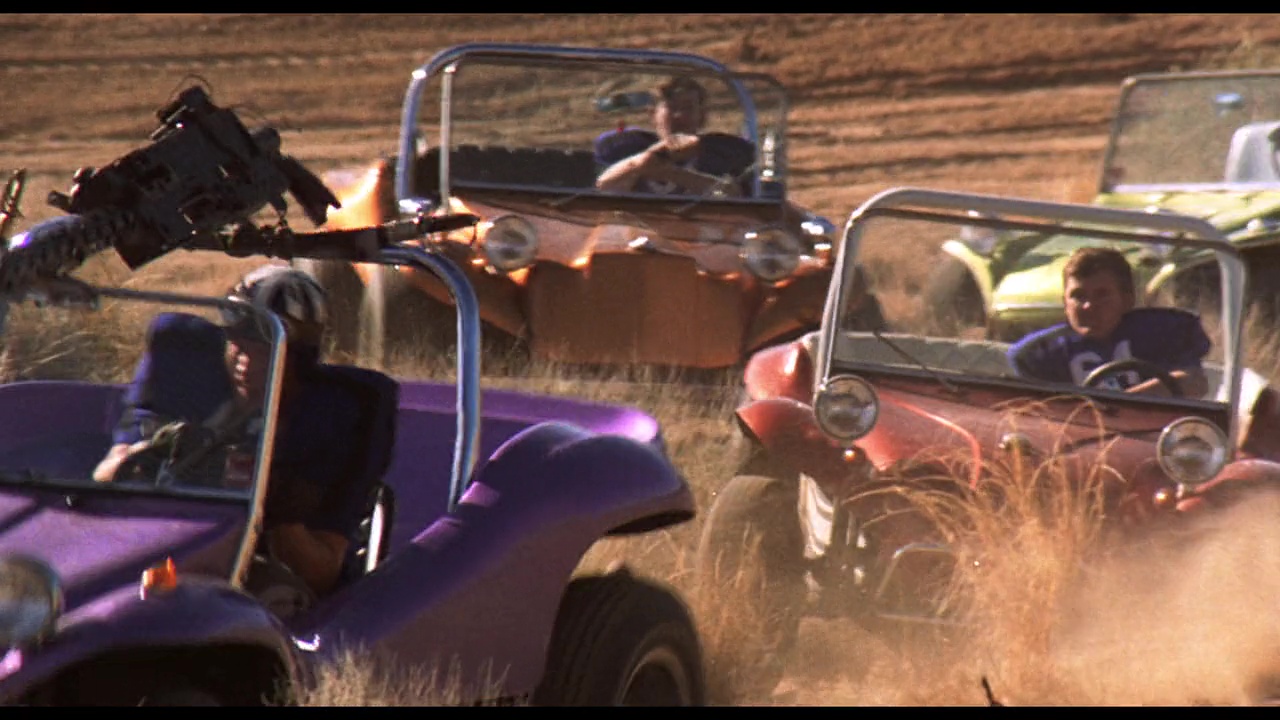
The finished film is stuffed full of marching bands and parades, crowds of extras fleeing through the streets of Western town sets pursued by gangs of stuntmen on brightly painted bikes and sidecars, convoys of golf carts, JCBs and tooled up dune buggies (triggering entirely accidental flashes of Mansonoid paranoia), cheerleaders, football teams and hundreds of people crammed onto a remote mountaintop for the film’s conclusion… all, ultimately, to very little effect.

Amidst all this sound and fury, it becomes difficult to avoid the conclusion that the man who once shot a film as beautifully crafted as ‘Little Shoppe of Horrors’ on a single set in two and a half days has lost his way very badly somewhere along the line.

Perhaps the sole quantifiable pleasure I took from ‘Gas’ in fact came from the music - and this is entirely due to the fact that I’m a big fan of the perennially underrated Country Joe & The Fish, and in particular of their gifted lead guitarist Barry ‘The Fish’ Melton, who was charged with composing ‘Gas’s songs and incidental cues (as heard in the rare moments when the brass marching bands, cheerleading chants and honking car horns shut up for a few minutes). (4)

It’s nice to hear the various bits and pieces Melton came up with (recordings never otherwise released, insofar as I’m aware), and we also get to enjoy some choice footage of the band in full flow at some kind of outdoor festival held at a drive-in theatre, backed up by a bitchin’ psychedelic light show, inter-cut with footage of two of the young hippie characters making out during an acid trip, and accompanied by subliminal flashes of underground movie-style abstract imagery.

Arguably the film’s strongest sequence, the overall effect here is only partially spoiled by the presence of Country Joe McDonald (who I’m fairly sure would not have made the twenty-five year old cut-off point required for this movie’s plot, incidentally) doing some kind of terminally unamusing skit about how he’s an omnipotent, god-like figure named ‘A.M. Radio’, or somesuch. (My god, this obnoxiously performative, satire-lite fucking hippie ‘humour’, I swear… it’s enough to make me want to shave my head and enlist in the nearest para-military organisation post-haste.)

Aside perhaps from hardcore C.J. Fish fans though, it’s difficult to imagine that anyone at the time of ‘Gas’s original release was actually digging what Corman was laying down here. Whilst ‘straight’ audiences must have simply been confused and alienated by all this mystifying hullaballoo, the campus radicals and garage band suburban punks the movie was presumably supposed to appeal to would surely by this point have felt patronised and turned off by its parade of quirky, central casting hippies mouthing half-baked flower power witticisms, long past their sell-by date in the hyper-accelerated climate of mid-century pop culture.

Even within the sphere of disastrous, released-too-late hippie movies, ‘Gas’ ranks low, lacking the lo-fi earnestness of the Firesign Theatre’s “electric western” ‘Zachariah’, the wild artistic vision of Dennis Hopper’s ‘The Last Movie’ or the magisterial visual gimmickry of Antonioni’s ‘Zabriskie Point’.

But the saddest thing of all is that, despite all this, ‘Gas’ seems to have been a project which mattered to Corman a great deal.

He spends over five pages of his 1990 memoir ‘How I Made a Hundred Movies in Hollywood and Never Lost a Dime’ discussing the film, acknowledging the gruelling nature of the production, and regretting his decision to begin filming without a finished script. But, he also speaks enthusiastically of his success in creating “an apocalyptic, Strangelovian satire,” - one which, sadly, sounds a lot more exciting in Corman’s recollection than any of the footage which actually ended up on the screen;

“My films and my politics were getting more radical, more “liberated,” as the 1960s were coming to a close. I was truly beginning to believe I could do anything, which is why the picture ran a little out of control. Any idea that came to us, we would put in.” 
[…] 
“We ended up with some pretty wild and surreal images. We had a group of Hell’s Angels riding in their colors in golf carts instead of their choppers. The Texas A&M football team became a band of marauders on dune buggies, terrorizing the Southwest. We had Edgar Allan Poe speeding through the frame on a Hell’s Angels chopper with a raven on his shoulder, making comments from time to time. […] We re-created the Kennedy assassination while it was sleeting. Then we finally got to the Acoma mesa, which is virtually cut off from civilization, accessible only by a steep and winding dirt road.”

Although everything Corman describes can kind of be seen in the movie if you squint hard enough, I think the failure of any of it to actually make much of an impression on the viewer simply goes to prove that, much as I love him, Roger Corman was no Alejandro Jodorowsky. Logic, working within fixed limits and careful advance planning were the engines which powered his best cinema, and the mellow ideals of middle class So Cal suburbia remained his aesthetic base-camp, even as the wily tendrils of psychedelia and European decadence repeatedly threatened to drag him further afield. At the end of the day, maximalist cosmic wig-flipping was simply not his bag, man.

Nonetheless, Corman remained extremely unhappy about a number of cuts he claimed were made to ‘Gas’ in post-production, and which he blamed primarily on AIP’s James H. Nicholson, whom he felt had become increasingly conservative and intolerant of risk-taking in the films his company released, citing these arbitrary cuts as reasons for the film’s incoherence and commercial failure.

Strong words perhaps from a man who in later years would become famous for insisting his protégés’ films came in at under 88 minutes in order to save on film canisters, but above all, AIPs decision to cut the film’s intended final shot remained a source of great bitterness to Corman, ending one of the longest and most productive relationships in the history of independent cinema on an extremely sour note;

“The unkindest cut of all was the last scene. I ended the film with a spectacular shot from on top of the mesa, with a view sixty, seventy miles to the horizon. We had the entire tribe there and everyone else who had been in the film. It was a celebration. The leading man kisses the woman and I zoom back. It was a cliché I had never used to end a film. I did it precisely because it was a cliché. I had the entire marching band of the local high school. I had a whole group of Hell’s Angels. I had a bunch of guys on dune buggies. I had a football team. I had our whole cast in this wild celebration as the camera zoomed back and over the shot. God, who was a running character throughout the film, made his final comments on what went on. 

There must have been three hundred people on top of that mesa. It was one of the greatest shots I ever achieved *in my life*. And AIP cut the entire shot. They ended the picture on the couple’s clichéd kiss - because they didn’t like what God was saying. The Picture ended and made no sense.”

For a more revealing take on Corman’s state of mind during the production of ‘Gas’ though, I think the last word must go to production manager Paul Rapp, quoted in the same book;

“The ‘Gas-s-s-s!’ shoot was the toughest one I ever saw Roger go through. I had never seen Roger in a nasty, bad mood like that. He seemed very down, snarling and weary. The Dallas sequences were around Thanksgiving and they had all-time record cold and blizzard conditions. It was miserable. Roger was shivering the whole time, wearing the same parka he had for ‘Ski Troop Attack’. 
[…] 
The day we set up the last sequence at the mesa Roger seemed really adrift. The Indians were terrible to work with. He seemed isolated, almost directing like a robot. The last scene was a big action shot with the entire cast, dune buggies, motorcycles, and the whole Indian tribe coming together. The first take was a complete mess. Roger just sat there. I got everybody back in their positions for a second take and looked over at Roger. He just nodded. I called action for him, and surprisingly, this time it went perfectly. Roger got up from his chair slowly, thanked everybody, and said very quietly, “Let’s go home.” (5)

---

(1)According to IMDB trivia, ‘Gas’s lengthy sub-title was inspired by an unnamed Major in the U.S. Army, who is alleged to have justified the total destruction of a Vietnamese town and its inhabitants on the basis that, “it became necessary to destroy the town in order to save it” - a reference which would have stood as the darkest and most effective piece of satire in the entire picture, if only an effort had been made to draw the audience’s attention to it.

(2) The WWI aerial combat epic ‘Von Richtofen and Brown’, which Corman shot in Ireland for United Artists, saw release in 1971, and subsequent to that he did not return to the director’s chair until 1990’s ‘Frankenstein Unbound’ - a film which I would argue stands more as a one-off vanity project produced by his own studio (albeit, a very worthwhile and interesting one) than as a strictly commercial proposition.

(3) Ironically in view of how badly the film falls victim to it, it’s interesting to note that Armitage’s script for ‘Gas’ is both aware of the hyper-accelerated fashion cycle of the ‘60s, and indeed pokes fun at it via the character played by Cindy Williams, a devotee of ‘old timey’ pop music who hangs around the jukebox listening to “golden oldies” by the likes of Jefferson Airplane and The Grateful Dead; a familiar motif found in near-future fiction written at the time by slightly bamboozled older geezers, and in Thomas Pynchon novels all the way up to 2009.

(4) It seems that Corman had originally planned to make ‘Gas’ with The Grateful Dead appearing on-screen and providing the soundtrack, only to end up - in characteristic Corman fashion - telling them to get lost when they turned up demanding more money than had been agreed upon, and immediately getting Country Joe on the line instead.

(5) All quotes in this review are taken from ‘How I Made a Hundred Movies in Hollywood and Never Lost a Dime’, by Roger Corman with Jim Jerome (De Capo press edition, 1998), pp. 162-167.

Tuesday, 13 October 2020

Horror Express 2020 #6:
Mas Alla Del Terror /
‘Further Than Fear’

(Tomás Aznar, 1980)

The more I learn about global genre cinema, the more I appreciate those increasingly rare opportunities to jump into something with absolutely no idea what to expect. As such, this remarkably obscure Spanish horror - available solely as an extremely smeary VHS-rip, insofar as I’m aware - proved a rare treat.

Going in, all I knew about Tomás Aznar’s film was:

1. It features some pretty great electro-rock music, which was once featured on an episode of El Diabolik’s Psychotronic Soundtracks.
2. It was released in Spain under the auspices of ‘Cinevisión’, the same company responsible for Escalofrío / Satan’s Blood a few years earlier.
3. It was advertised using the fairly awe-inspiring, Frazetta-plagiarising poster you see reproduced above. (1)

All in all then, the omens looked good.

Perhaps one of the things which has led to ‘Mas Alla Del Terror’ receiving so little attention from horror fans is the misleadingly mild pre-credits sequence, which sees a young woman (Lola, played by Raquel Ramírez) being picked up from a roadside café by an older man, with the couple’s earnest dialogue suggesting that they are engaged in some kind of long-term adulterous relationship.

Lola insists on taking her partner to some out of the way, rural idyll, where, in a matter of seconds, things go from second-rate Truffaut to full-on Ruggero Deodato, as she attempts to steal the man’s wallet, prompting him begin savagely beating her, before she in turn pulls a knife and remorselessly carves him up.

“Dirty fucker - this ain’t shit buddy,” she exclaims as she contemptuously pockets the measly few pesetas which comprised his roll, wiping her blade on his tie and leaving him bleeding out from multiple chest wounds as she sets out to hitchhike back to town. Yikes!

Post-credits, we re-join Lola in what seems to be her more natural habitat, rocking regulation leathers as she trades sneering, scatological insults with the other members of her equally amoral, drug-huffing misfit biker gang (“Fuck, you smell like camel shit - find yourself a good dentist”, she greets a dealer dishing out wraps of hash outside a nightclub).

From here, the movie kicks into gear as a kind of ‘Mad Foxes’-via-‘Last House..’ type psychotic youth-gone-wild gang movie, as these punk kids indulge in all kinds of gratuitous cruelty, exchanging dialogue that (if the fab-subs to be believed) consists largely of increasingly obscene sexual insults, which I won’t recount here lest they offend the sensibilities of the very internet itself.

After an attempt to rob a greasy spoon cafe (dig that low level of ambition) escalates into an impromptu killing spree, the gang - who now essentially comprise Lola plus leader Chema (Francisco Sánchez Grajera) and wingnut Nico (Emilio Siegrist) - briefly go on the road ‘Rabid Dogs’-style with a pair of hostages. So fucked up are our anti-social anti-heroes though, they can’t even keep this relatively straight-forward scenario on the road for more than five minutes of screen time, before internecine bickering leads to a roadside altercation soon leaves them lost in the depths of the countryside with a totalled car.

Spying lights as they trudge across the featureless nocturnal landscape, the gang come upon a well-appointed house, and, as you might well expect, get stuck straight into a dispiritingly gruelling home invasion scenario. After taking a tyre iron to the family dog (mercifully, VHS murk obscures this footage, but I REALLY hope the whines of canine distress on the soundtrack aren’t genuine), they proceed to remorselessly brutalise the elderly lady they find within, whilst her youthful grandson (we presume) hides terrified upstairs.

Mindlessly destructive brutes that they are, the gang have soon set the house alight, leaving the helpless residents to perish. But wait! As it turns out, the poor grandmother they've just left for dead was actually a high-ranking Satanic priestess of some kind, and she proceeds to curse them with her dying breaths, promising supernatural vengeance in the name of Astaroth, Beelzebub and the whole merry gang!

Shortly thereafter, the gang and their hostages once more find themselves shit-out-of-luck transport-wise, holed up in a remote, ruined church with eerie, skeleton-filled catacombs beneath it - by which point, we can probably get a handle on where things are heading next, I should think.

It’s a shame however that the pacing of this horror-themed second half of the film pretty much grinds to a halt in comparison to the frantic, action-packed stuff which has preceded it. Much aimless waiting and wandering fills up the remaining minutes of run-time, whilst I also found the idea of having the evil-doers’ victims return in spectral form to wreak their ironic vengeance - much in the manner of a Japanese kaidan - to be pretty old hat. I mean, couldn’t they have rustled up a few demons or zombies or something, instead of just going with the old EC Comics “b-but I saw you, you were dead - arg!” route?

Well, no matter - on the plus side, they certainly picked a great location for it - an arid, rustic set of ruins which just reek of poverty-stricken misery and menace. There's a lot of great Armando de Ossorio / ‘..Blind Dead’ type atmosphere to enjoy here, not least when the acrid, cobweb-shrouded skeletons in the catacombs are briefly unleashed to take care of the Stockholm Syndromed female hostage, whilst things are livened up considerably by intermittent outbursts of the aforementioned killer, Goblin-esque disco-rock (courtesy of one J.P. Decerf and the ever-reliable CAM library). (2)

Even beyond their penchant for senseless murder meanwhile, there’s something singularly warped and repulsive about the gang members here, as they fill their remaining hours with low level blasphemy and icky sexual perversity (at one point one of the guys aimlessly masturbates into the fire whilst shrieking an improvised litany in praise of “fornication”), sneering and drooling in the face of death like true no-hope punks.

As the remaining characters gradually meet their predestined demise, new elements are added to the medieval ‘triumph of death’ mural which takes pride of place on the church’s walls - a common ‘body count movie’ motif, but nicely done - heralding the eventually reappearance of the avenging witch, and a rather fine, high five-worthy ending which I won’t spoil for you here.

Whilst I certainly wouldn’t go so far as to hail it as a lost classic, ‘Mas Alla Del Terror’ is, as you may have gathered, wild as all hell - an off-the-map rampage of low rent sleaze, grime and amoral hell-raisin’ which gradually finds itself enveloped by a cloak of old school, Iberian gothic doom.

Production values are minimal, performances are perfunctory (aside from Ramirez, who is brilliant, and should clearly have wielded her flick knife in more movies) and Azner directs with no great amount of flair, but there is nonetheless a ton of fun to be had here for a certain, special audience. Indeed, I’m amazed that this film’s potential has remained largely untapped by all the late-era Euro-horror / video nasty fans out there.

It would certainly be lovely to see a restored version popping up at some point in the future, but for now, let’s just say that this one is well worth a trip down to the VHS/torrent catacombs if it sounds like your particular cup of rancid, spiked tea.

-----

(1) Apparently originating on the cover of ‘Vampirella’ # 11 in 1971, this iconic Frank Frazetta witch illustration seems to have had a big impact on horror movie poster artists - it was also recycled just a blatantly for the remarkably misleading advertising which accompanied Matt Cimber’s perennially underappreciated The Witch Who Came From The Sea in 1976.

(2)Once again, thanks are due to the aforementioned El Diabolik podcast for filling me in on the soundtrack info and name of the composer. Check out Episode 46 of their fine programme to hear some of the music from this wild out in the wild.

Thursday, 25 October 2018

October Horrors # 12 / Thoughts on…
Mandy
(Panos Cosmatos, 2018)


1.

“Where the mystic swims, the psychotic drowns,” attentive listeners may hear Nicholas Cage growl during his climactic show-down with Linus Roache’s narcissistic, Mansonite cult leader towards the end of Panos Cosmatos’ ‘Mandy’. I’m unsure of the origin of this phrase (it sounds like it could be an unattributed quote from somewhere or other?), but it certainly seems to hit the mark re: Cosmatos’ apparent desire to leave both his characters and, potentially, his audience struggling to keep their heads above water amidst a veritable tsunami of sensory overload.

I recall director Ben Wheatley, in interviews around the release of his (excellent) film ‘A Field in England’ a few years back, lamenting what he saw as the disappearance of the “Head Movie” – a phenomenon he saw as being exemplified by films like ‘2001: A Space Odyssey’ and ‘The Holy Mountain’ – from contemporary screens, and declaring his intention to add his own modest contribution to this seemingly defunct canon. Cosmatos, we assume, must have felt a similar absence… but his own reaction to it is anything but modest.

Refracting its director’s apparent desire to create the Ultimate Acidhead Movie through the lens of what I take to be his own childhood aesthetic obsessions, and further filtering it through the grand stylistic excess of some his contemporaries in nouveau-cult cinema (Winding Refn, Strickland etc), ‘Mandy’ is, inarguably, one hell of a trip.

Like a powerful psychotropic experience, it is a film that leaves a long, pungent aftertaste. It’s the kind of movie that sits in the back of your mind after viewing, like a big mental snowball of unearned experience, just waiting to be poked with a stick.

The fact that many of ‘Mandy’s on-screen characters spend much of their time tripping balls provides a none-too-subtle hint that this is indeed a valid way to read the film, but there is far more going on here than just some ‘Fear & Loathing..’/‘Inherent Vice’ styled stoner fantasia. Applying this phantasmagorical portrayal of chemically-altered perception to an ultra-violent horror/fantasy framework, the film offers us characters whose psychotropic intake has taken them to the very edges of humanity, and in some cases terrifyingly far beyond them.

At the opposite end of the scale from those who approach drug-taking from the comfortable, new age perspective of guided meditational growth, this is a film for those wild(wo)men who prefer to go into it weaponised – with extreme metal in their ears, darkened woods or concrete hinterland as their surroundings and physical danger close at hand, as if daring the expanded universe to tear them apart.

I am very much not one of those people, but, so long as it all remains safely within the confines of a motion picture screen, with sound properly balanced and the camera safely mounted on a tripod, I can surely dig it.

Based on reviews I’ve read so far, ‘Mandy’ seems to have left writers unable to resist the temptation to resort to dubious, hyperbolic sound-bites in an attempt to encapsulate the experience of watching the film, so, here’s my shot at the pull-quote bulls-eye: ‘Mandy’ is like watching Jodorowsky direct a ‘Death Wish’ sequel written by Robert E. Howard, as your pupils expand to the size of dinner plates and your fingers begin to wriggle before your eyes like Lovecraftian spaghetti.

If that sounds like a recommendation to you, I highly recommend finding time to catch this one theatrically whilst you have the chance. Please take this opportunity to search for screenings in your local area.

In the meantime, the following numbered thoughts and tangents may be best appreciated by those who have already seen the film, but if you haven’t, I shouldn’t worry – it’s pretty difficult to “spoil” a story that can be expressed in its entirety in one sentence, and that was probably first carved in stone by some ancient scribe before the dawn of recorded time.


2.

‘Mandy’ has rather strange relationship to reality… and not just because of all the acid, either.

In one sense, the film, particularly during its opening (pre-revenge) section, is a detailed and highly specific evocation of a particular time and place (a mountainous area of the USA, 1983). (1)

Every prop, item of clothing, vehicle or piece of furniture, and each small aspect of the web of cultural reference points that drift through the idyllic existence of Red (Cage) and Mandy (Andrea Riseborough) – all of these have been carefully chosen to scratch a nameless, deeply buried nostalgic itch that many viewers (particularly those born in the ‘80s) will not even have been aware of until they watch this movie and feel a touch of it in their bones. (2)

These temporal conjurations extend even to the texture of the film itself. Though evidently shot with all the smooth, HD clarity that the 21st century has to offer, ‘Mandy’s photography simultaneously swarms with a thick, almost intrusive layer of film grain, recalling more than anything the unique ‘feel’ of 16mm footage blown up to 35, as exemplified during the ‘80s by break-out low budget features such as ‘The Evil Dead’ and Jim VanBebber’s ‘Deadbeat at Dawn’.

Within this scheme, visual textures are deliberately tweaked scene by scene to sink hooks into deep-buried memories. When we see Red engaged in his work felling trees, climbing into a chopper with his co-workers for the ride home, the heavy grain is combined with washed out greens and browns, recalling any number of ‘80s Vietnam / forest survival type movies, whilst a later scene in which he and Mandy drift in a boat upon shimmering lake adopts a blown-out, over-saturated VHS kind of look, flashing us straight back to the gently psychedelic drift of a ‘70s bigfoot documentary.

In this regard, ‘Mandy’ is an exercise in high level aesthetic alchemy – a creative excavation of the recent past comparable to that which the Ghostbox label have carried out for the UK of the 1970s. As an evoker of *feel*, as a wrangler of the wildly divergent strands of temporal-cultural suggestion, Cosmatos here proves himself a master.

Naturally, the more obvious and potentially comedic signifiers of the era have for the most part been avoided; by and large, things are more subtle. This may, for instance, be the most METAL film not to actually feature any metal on the soundtrack. (3)

The use of fonts, cult-ish visual signifiers and the occasional t-shirt is as far as it goes, but the essence of METAL (in capitals) nonetheless runs rich and deep through these two hours. Fans of the genre will be left no doubt that Cosmatos is one of their own, though nary a power chord is struck nor a devil horn thrown. (A battle axe is forged in the shape of the ‘F’ from the Celtic Frost logo however, so… what more proof of good faith could fans possibly require?)


3.

But, on the other hand… well, speaking of battle axes, let’s just say that my reference to Robert E. Howard above wasn’t just plucked out of thin air. After the prolonged and appalling home invasion/murder sequence that constitutes ‘Mandy’s transitional central phase, it becomes increasingly clear that a hologram of Howard’s Hyborian Age has been super-imposed upon the USA of the early 1980s.

(A not inappropriate collision of worlds, given how thoroughly the sword & sorcery genre suffused that era’s popular culture, with John Milius’s 1982 ‘Conan the Barbarian’ in particular instigating an unsettling communion between Howard’s might-is-right prehistoric philosophy and the equally fantastical macho individualism of Reagan-ite political discourse; a heady fusion that, nearly forty years later, still filters through to ‘Mandy’s otherwise rather contradictory notion of a fuzzily nostalgic vigilante revenge story.)

When Red hits up his enigmatic pal Carruthers (a wonderful one scene bit from 80s/90s action vet Bill Duke) to reclaim his crossbow, we’re presented with a fistful of the kind of ominous exposition you’d usually expect some D&D players to receive from an aged traveller in a remote tavern. There have been “rumours of dark riders”, they were last seen heading for such-and-such a place, he “once glimpsed them upon the horizon”, and so on.

Leaving aside the question of exactly what kind of druggy, Satanic grapevine Carruthers picked up this info from, given that he seems to be a total recluse, we may find ourselves rubbing our eyes and wondering where exactly we are again..? The United States in 1983 suddenly seems very far away.

Indeed, from front to back, this is a story that, with a few minor adjustments, could have happened to Conan or King Kull, rather than a 40-something lumberjack played by Nicholas Cage, and the simplistic, video game-like storytelling favoured by Howard predominates from the moment Red’s quest for vengeance begins. [You know - Conan/Cage obtains weapons, confronts enemies, is captured. Escapes, kills enemies, reclaims weapons, proceeds directly to next set of enemies, and so on.]

We know this is not a post-apocalyptic world, because there’s stuff on TV, and people have jobs and visit grocery stores, but at no point do we actually visit a human habitation that comprises more than a single building. Isolated, makeshift homesteads and compounds dotted around the wilderness provide our only points of reference, and signs of wider societal organisation are entirely absent. No vehicles that are not directly connected to our story travel the roads through the forest.

Much of this I think is this is simply the result of Cosmatos’ desire to cut absolutely all connecting tissue out of his narrative. Acting less on the basis of conventional, A-to-B cinematic story-telling and more like some restless, ‘Metal Hurlant’ style comic book artist, this director doesn’t really give a damn about how his characters get from one place to another, or how they find out where they’re supposed to be going in the first place.

Instead, he is happy simply to teleport his hero (who, lest we forget, is actually wielding a battle axe) straight from one spectacular action set-piece to the next, wringing maximum value out of each epic confrontation, with no time for any non-epic messing about in-between.


4.

Boy, those Cenobite bikers (can we go with “Cenobikers”?) are quite a piece of work. I won’t go into their “origin story” (as it is one of the few details of ‘Mandy’s plot that it is probably best for viewers to discover as they go along), but, jesus - what a terrifying conception.

The moment when they are first ‘summoned’ – interrupting what up to this point has been a film ostensibly set in the real world, and a richly detailed version of it at that – is truly startling, causing us to share to some extent the fear we might actually experience if we found one of these creatures standing in front of us.

Deep, nasty dread is henceforth infused into all that follows, and I found the subsequent strobe-lit nocturnal kidnapping almost impossible to watch; it is just too horrible to contemplate, recalling the ghost of childhood anxiety that, no matter how unlikely it seems, or however often your parents tell you otherwise, such horrors – as expressed through the somehow-very-‘80s biker / serial killer / demon composite that I’m sure I recall all too clearly from some nasty comics that my parents should probably have not let me read at the time - may actually be out there somewhere.

And, indeed, they might. One of the things that makes these particular monsters so ghastly is that, though they may lurk at the very far end of unlikelihood and have no real life analogues (I hope), the explanation that is eventually offered for their existence is not actually a supernatural one. As a ready-made urban myth ready so be shared wherever young people gather to take drugs and get up to no good in the dark, they are wonderfully potent. (I mean, there’s a whole slasher movie franchise just waiting to happen there, at the very least.)

Also: along with this fairly direct tribute to ‘Hellraiser’, one of the relatively few blunt, Tarantino-style “homages” that creeps into ‘Mandy’ involves a big shout-out to Phantasm II, of all things. We’re among friends here, no doubt. (4)


5.

Ok, the Nicholas Cage thing. Let’s get on with it.

Personally, I really ‘cannot hang’ (as I believe the phrase goes) with this comedy/meme thing that’s built up around Mr Cage in recent years. To be honest, I prefer to think of him as just a extremely fine actor whose apparent willingness to say ‘yes’ to just about anything, though admirable, doesn’t always help his reputation in these days of social media snark.

To misquote Norma Desmond, it’s not his playing that’s too big, it’s the pictures that are too small. Like a modern day Klaus Kinski, he might get a bit goofy and OTT in the mediocre, run-of-the-mill assignments that take up much of his time, but, once in a blue moon, a project arrives that is worthy of his particular, highly tuned sensibilities - and at that point, you can just wind the fucker up and watch him go.

A few years back, Werner Herzog (funnily enough) gave him one such opportunity with the brilliant (and seemingly quite under-rated?) ‘Bad Lieutenant: Port of Call - New Orleans’ – and, needless to say, with ‘Mandy’ Cosmatos gives him another chance to strut his stuff on the level where he truly belongs. Once again, he does fantastic work here. (5)

I would leave it at that, were it not for the fact that many attendees the screening I attended evidently thought differently in this regard, having apparently pitched up with the primary intention of wringing maximum Cage-laffs from proceedings.

There is, it must be said, a lot of intentional humour in ‘Mandy’. There are zany one-liners and everything, and these tend to be mixed up quite jarringly with passages that are otherwise harrowing or savage. So, I appreciate that people may get a bit disorientated by this and take a “what can you do but laugh?” approach to navigating the choppy waters of this singularly intense and unusual movie.

There are other sections here however that are clearly not meant to be funny. The already infamous ‘bathroom scene’ is one of them, but, in view of the unspeakably terrible things that happen to Cage’s character during this film, I don’t believe he is overplaying here at all. Hell, if anything, he’s underplaying. Few of us, I’d imagine, would proceed in quite such a reasonable manner in similarly dire circumstances.

Seemingly channelling Warren Oates’ devastating portrayal of masculine grief in Peckinpah’s ‘Bring Me The Head of Alfredo Garcia’ (a divisive head-trip of a revenge film with which ‘Mandy’ shares more than a few eerie parallels, now that I come to think of it), Cage is pretty on point here, and I could really have done without the chuckles in the row behind me.

I’d assume that at least some of these chucklers were the same people who were already loudly yakking away on their phones about other things in the queue ahead of me as they left the auditorium, whilst the closing credits were still rolling. I mean… c’mon man. Maybe you liked the movie, maybe you didn’t, but please - give it a few minutes to settle in before you’re planning tomorrow’s fucking brunch.

Thankfully though, these were not the only people who made it to this sold out city centre screening. A middle-aged couple with matching straight black hair, silently putting on their matching leather battle jackets. A big guy with impressive wrist tattoos and an unreadable metal band logo t-shirt, smoking a rollie with shaking hands on the step outside the cinema. Various other lone, scraggle-haired individuals, quickly striding off into the late afternoon shadows; heading straight back to their black light basements, I would like to think.

In aspirational terms at least, these folks feel more like my kind of people, and it is spiriting to see that word of mouth (or word of wi-fi, at least) has already connected ‘Mandy’ to its real audience.


6.

For all its savage violence, drug-damaged black humour and kaleidoscopic visuals, and despite the crassness of its neanderthal boilerplate revenge storyline, ‘Mandy’, like ‘..Alfredo Garcia’ before it, is a love story.

I mean, the clue’s in the name, man. Cosmatos could easily have called his film “Demon Fire” or “Serpent’s Eye” or something, and would probably have sold some extra tickets to people who might currently be apt to mistake it for a romantic comedy whilst scanning the listings - but that’s not what it’s about.

Without Mandy, and the thirty or so minutes we spend with her, none of the other stuff in the film would matter a damn. It would be some huge, empty, post-modern, lol-worthy mega-action laff-fest, and I probably would have concluded my thoughts on it far earlier than this.

Like ‘..Alfredo Garcia’, this is a film split into two halves, hinged around a transitional moment of blackest desolation at its centre. And, as with ‘..Alfredo Garcia’, it is the first half – slow, almost meditative in tone – that will eventually live longest in your memory.

So, how can I best put this? I have a very strong, very good feeling about Red and Mandy’s life together in the early part of the film. Their house and its surroundings are beautiful, the pace of their life and the time they spend together is beautiful. I mean, I may not particularly want to go to work as a lumberjack, but that aside – their life is about as close to a vision of an ideal existence as I could possibly imagine.

Perhaps not everyone will share this feeling, but as we have established, ‘Mandy’ is probably not a film for everyone. For those within a certain age-group though, or those who hark back to the recent past, or enjoy things like rock music, or science fiction, or solitude…? Well I’d imagine that if you’re reading this weblog, you’re probably in the club, let’s put it that way.

Mandy herself is not some generic, pretty wife character who exists solely in order toprovide moral justification to Arnie or Charles Bronson as they embark upon their regulation seventy minutes of cathartic violence. Mandy is different. Mandy is cool.

In spite of a necessarily limited amount of dialogue and screen time, Andrea Riseborough does an amazing job of building her into a fully-formed person (and, she is probably going to have to deal with people staring at her on the street and silently mouthing “mandy” for years to come as a result).

We’re perhaps not going to fall head-over-heels for her like Roache’s creepazoid cult leader does, but she is someone we would all like to play a bit part in our lives. She is the kind of acquaintance we would always think of warmly, wondering what she’s up to, but confident that it must be a-ok, whatever it is – and most of all, we’d appreciate what a good thing she has with Red. She’s the kind of affirmative, self-contained person who might send you a postcard now and then, and you’d always be very happy to receive it.

We in the audience might all chuckle at it when it plays out the first time, but in retrospect, the scene in which Red and Mandy sit together on the sofa, distractedly eating their dinner whilst completely enraptured by Don Dohler’s ‘Night Beast’ (1982) as it plays out on their fuzzy portable TV, is… well it’s something that will stay with us, let’s put it that way.


7.

Perhaps the soul of any revenge movie can be judged by what the revenger does after his or her labours are complete. It is always a tricky, uncertain moment, determining what we will be left with after the fleeting catharsis of vengeance has faded, and there are many directions a story can be taken in during those vital few minutes before the credits roll. Something though tells me that any such film in which the protagonist brushes off their hands and goes home, congratulating themselves on a job well done, is probably not a good one.

As Nicholas Cage sits dazed after his final confrontation, he is closer - in appearance, mental state and deed - to one of the Cenobikers he has recently dispatched than he is to the man who initially set out on his quest for vengeance. He has tasted their sacred acid and worn their armour; he is just as plastered in blood and filth as they were, and has committed acts scarcely less horrendous.

The thought of his returning to any kind of quote-unquote ‘normal’ life after all this is unthinkable. This netherworld of drugs and psychosis and mindless debasement would seem to have swallowed him whole. Has he indeed drowned, as per the aphorism he so recently muttered?

We might worry at this point that the film, along with its central character, has rather lost touch with  where it began, left empty and exhausted after a solid hour of mind-flaying, hysterical madness.

But then – that flashback. Perfectly placed. Devastating. I’ll spare you the details.

Tears in our eyes at the end of a film in which Nicholas Cage snorted a faceful of cocaine off a shard of broken glass after crushing the head of a demon biker?

I know this film has had a lot of hype already, but really – believe it.

Movie of the year? Are you kidding..?

Like Mandy listening to that cult leader’s hippie folk song, I survey the competition and laugh.

Stay metal, friends.

---------

(1) Suitably vague, the film’s stated location of “The Silver Mountains” generates search engine hits for areas in Washington, Idaho and Michigan, and ‘Mandy’ was seemingly filmed in Belgium, rather surprisingly.

(2) Oddly enough, the one thing that didn’t really ring true for me in the film’s production design was Mandy’s Motley Crue t-shirt. She and her husband are more-or-less in their 40s, we presume, and it seems unlikely to me that someone who was this age in 1983 would have much use for Nikki Sixx and co. (They would, in fact, be baby boomers pretty much – of the same generation as the psychotic hippies who proceed to persecute them.) All is forgiven however, when she wears a Black Sabbath T in the next scene. Spot on.

(3) Admittedly, doom-lord Stephen O’Malley’s contributions to the late Jóhann Jóhannsson’s soundtrack probably help in this regard. Before any arguments erupt, we should also probably note at this juncture that the use of the one pre-existing song featured in the movie – ‘Starless’ by King Crimson – is both totally sublime and hugely appropriate… but calling it metal is probably a stretch, for my purposes at least.

(4) FUN FACT: Christopher Figg - producer of the original ‘Hellraiser’ and subsequently of Neil Marshall’s ‘Dog Soldiers’ (2002), amongst other things - can be found prominently listed in ‘Mandy’s production credits. For his apparent role as a behind-the-scenes instigator of superior horror cinema across four decades, we salute him.

(5)As an aside, I wish that Herzog could / would return to his brief dalliance with making fictional, Hollywood-type movies. I mean, we all know he can draw a few thousand quid from the bank and make a weirdo Werner Herzog documentary without breaking a sweat, but the strange collision between Werner wackiness and mainstream genre movie aesthetics made both ‘Bad Lieutenant’ and ‘Rescue Dawn’ fairly extraordinary, IMHO.

Friday, 1 May 2015

Nikkatsu Trailer Theatre # 3:
A DRAGON SYMBOL
ADORNS THEIR HELMETS!


Well I don’t know about you readers, but I’m already heading to my local picture house to demand a ticket for Yasuharu Hasebe’s third and final instalment in the Stray Cat Rock franchise, and the fact this is neither 1970 nor Tokyo be damned.

Thursday, 29 November 2012

Deathblog:
Spain Rodriguez
(1940 – 2012)


Sad news filtered through last night about the death from cancer of one of my all-time favourite American underground comix artists, the inimitable Manuel ‘Spain’ Rodriguez.

Like the recently departed Koji Wakamatsu, Spain translated his uncompromising political beliefs into works of hair-raising visual imagination, assuming a perspective that, if it’s a lot more earnest and macho than most of his ‘60s contemporaries (Crumb, Spiegelman, Deitch etc.), is all the more awesome for it.

Contributing to seminal anthologies like ‘Zap! Comix’, and rolling on into such exquisitely named solo ventures as ‘Zodiac Mindwarp’ and ‘Mean Bitch Thrills’, Spain took a heavily EC Comics influenced style and infused it with his experiences as an outlaw biker and Latino street kid, creating a totally brutal, bad-ass, proto-punk approach to comic books – the visual equivalent of listening to some heavy, weed-ravaged biker rock – that is totally unique, and echoes of his work can I think be felt in everything from 2000AD to Charles Burns.

One of my favourite Spain joints is a great Lovecraftian gothic horror strip I’ve got in an old comix anthology somewhere, but since I can’t lay my hands on it at the moment in order to scan, I’m going to have to rely on the good graces of Tumblr to crib some stuff, and, thankfully, it provides.

I think this guy’s mighty talent pretty much speaks for itself, so here without further ado is his EC tribute cover to ‘Skull # 5’ (Last Gasp, 1972), followed by – hey, why not? – his comic book interpretation of Alexandro Jodorowsky’s “El Topo”. Just what the doctor ordered.


For further background and interview stuff w/ Spain, see here, or here.

Obit from the SF Chronicle here.

Thursday, 8 November 2012

THINK PINK, Round II:
Girl Boss Blues:
Queen Bee’s Counter-attack

(Norifumi Suzuki, 1971)


Putting on make up in pale neon light rouses my blood
A beautiful flower in Nerikan secretly finds her own way
Only with her beauty… Sukeban Blues

The night in Nanka is cluttered with chaotic flowers
The battle flower blossoms to fight all her foes in the world
Only with her beauty… Sukeban Blues

Between 1971 and 1974, Norifumi Suzuki directed about a dozen pinky violence-related films for Toei*, putting him very much in the driving seat of this short-lived genre, at least in terms of its sleazier and crazier ‘70s incarnation. Given the director’s seemingly all-consuming obsession with dysfunctional sexual weirdness, one could legitimately raise concerns about leaving the guy in charge of a laundry room, let alone a whole cinematic sub-genre, but, four decades down the line, we can hopefully at least enjoy the chaos that resulted.

The first of four Suzuki-directed entries in the ‘Girl Boss’ series, ‘Queen Bee’s Counter-Attack’ is actually one of his earliest shots at the genre, but, though somewhat light on the vengeance and bloodshed side of things, it still manages to deliver just about everything else you could ask of a wild & woolly pinky violence adventure, in industrial strength quantities.

In keeping with many other sukeban movies, the emphasis here is very much on celebration of the hippie/outlaw lifestyle – a kind of hyper-caffinated exploitation version of the previous generation’s ‘sun tribe’ films, but even further removed from reality. Whilst Western movies of this ilk usually purport to represent a kind of “torn from today’s headlines” realism (with an accompanying moral sting), Japanese culture was under no such illusions, with films such as this happily acknowledging that their characters are totally unreal figures living a life of promiscuous sex and comic book mayhem, presumably allowing the devious girl-gangers and long-haired, devil-may-care bikers herein to become irresistible escapist fantasy figures for male and female viewers alike.

Suzuki helpfully signals this by staging the action in a deliberately ‘flat’, cartoonish style, lining up characters on screen like bowling pins and using their exaggerated reactions to move from one set-piece to another at a frenetic pace, allowing for a constant stream of zany incident that leaves us in little doubt as to the director’s tongue-in-cheek intentions. And let’s be glad he keeps his tongue where we can see it, because, this being a Suzuki film, it’s naturally crammed with sordid antics guaranteed to alternately enrage, offend and astound any well-adjusted individuals who find themselves accidently watching ‘Girl Boss Blues: Queen Bee’s Counter-Attack’ of an evening.

The promise of casual sex is ever-present in these ‘Girl Boss’ flicks, with the female characters agreeing to sleep with men at the drop of a hat, offering a taste of paradise to sweating, cowardly salarymen or a good night in the sack to the slightly more appealing young bikers or yakuza… provided they can turn a profit on the exchange. In fact, the code adhered to by the film’s inexplicably named ‘Athens Gang’ strictly forbids members from “dating or being manipulated by one particular man”, and women who refuse to use their sexuality for personal gain, or else harbour dreams of a conventional, monogamous relationship, are treated as fools or neophytes throughout.

Suzuki of course can always be relied upon to go further and get crazier with this material than anyone else on the block, and the #1 jaw-dropping exploitation highlight here is undoubtedly the infamous ‘bike fuck’ sequence, wherein the film’s (male) biker gang – perhaps inspired by the cover of Flower Travellin’ Band’s debut album, perhaps not – decide to race their machines naked as the lord intended, but this time with their ladies (mostly Athens Gang members, in a curious deviation from their ‘no profit/no sex’ philosophy) strapped on beneath them. The starting line is set and the rules are simple: stop when you come, and the last one motoring is the winner! What more of a perfectly ridiculous, OTT exploitation sequence could you possibly ask for!? It’s all in good fun too (well, I thought it was pretty fun at least), but, as mentioned, there is no shortage of other material here that sets out purely to offend.

If you get past the opening twenty minutes – during which a teenage girl is forced to break her hymen with her fingers as a gang initiation rite – you might think there’s not much more the film can throw at you, but for sheer I-can’t-fucking-believe-this nastiness, it’s hard to beat the later sub-plot in which an ‘uppity’ pop idol who ignores her former friends pays rather severely for her assumed transgressions when the gang get their yakuza allies to ambush her in a lift and brutally gang rape her. Objectionable enough in itself, this scene attains jaw-dropping heights of crassness by accompanying the action with a jaunty, swanny-whistle based party tune, and when we cut straight to a bar where the girls are celebrating the violation and subsequent ruined career of their rival, the combined effect is unbelievable – an astoundingly tasteless bit of business, even by the shaky standards of a Toei pinky violence movie.

As is usually the case in these PV flicks though, Suzuki seems determined to have his cake and eat it as regards the film’s approach to its female characters, balancing out such horribly exploitative moments with a solid, pro-female emotional core that remains weirdly convincing in spite of all the outrages that surround it. As noted, the ‘Athens Gang’ live according to a strict set of rules that not only governs their sexual behaviour, but also encourages them to avoid falling under the influence of men and to strive for “power, courage and strength” through their sisterhood (look closely and you’ll see that the gang’s cramped apartment hang-out is decorated with pictures of armed revolutionary fighters). The gang’s current boss and the instigator of their code (Reiko Ike, natch) didn’t sign off on the aforementioned rape scheme, and it is this that leads her into a conflict with returning former boss Jun (played as a total bad-ass by Teruo Ishii regular Yukie Kagawa) that dominates much of the film’s run time. Ike confesses to her second in command (Miki Sugimoto) that she was driven to reject conventional society and join a gang after being raped as a young girl, and, one by one, several of her comrades reveal similar tales of grief, allowing for some moments of genuine catharsis that are hard to write off entirely.

As you might imagine, this sort of thing makes for a movie that is wildly uneven in tone, and the waters are muddied further when things veer heavily into yakuza territory for a whole other male-dominated plotline that plays like a pastiche of one of Kinji Fukasaku’s ‘Battles Without Honour & Humanity’ movies, with Hawaiian shirted thugs facing off all over the place as whisky is gulped, teeth are spat out and dearly-held principles are abandoned. (I was quite surprised to see Tôru Abe, one of Japan’s most respected actors, popping up as a yakuza boss, but actually a quick look at his CV reveals that he paid the rent with cameos in a number of sukeban and PV-related movies in the early ‘70s.) “Without money, honour and humanity can be lost in a second” one character opines over a glass of Johnny Walker, as a highly Fukasaku-esque tale of old-fashioned, principled yakuza being ploughed under by brute economics proceeds to unfold.

All of which strikes me as pretty curious to be honest, given that, although he’d made a few lesser known crime movies up to this point, Fukasaku’s game-changing ‘Battles..’ series didn’t even BEGIN until two years after this movie came out, which makes me uncertain quite what Suzuki was riffing on here, but, well… my knowledge of Japanese cinema being what it is, I’ll leave any further speculation to the better-informed amongst you. Just thought I’d throw that out there.

You won’t have much time to ponder such matters whilst ‘Queen Bee’s Counter-Attack’ is actually in progress mind you, as Suzuki somehow manages to also cram in a hefty dose of parental melodrama, enough bawdy behaviour to fuel the scripts for several ‘Porkys’ sequels, masses of gratuitous dirtbike racing footage, a musical interlude featuring what appears to be a transvestite or transsexual club singer, a devious plan involving blackmailing the head of a pharmaceutical company to provide raw materials for a hyper-addictive new street drug, and, well… you get the idea. Frankly how he manages to crow-bar so much STUFF into an 80 minute run-time is one of cinema’s great mysteries - it’s like that clowns-emerging-from-the-car trick, only infinitely more entertaining.

I guess the final, plot-heavy quarter of an hour drags slightly, and the dirt road shoot-out conclusion is rather po-faced and ineffective, but after a film that’s given us this much joyous mayhem & taboo-smashing craziness, such failings are hard to criticise too much. Provided as you can put your ‘morally upstanding member of the human race’ badge aside for a while and roll with the punches, ‘Queen Bee’s Counter-Attack’ is yet another perfect, mindless slice of everything that makes early ‘70s Japanese exploitation movies so exhilarating.

*Not that stopped him also finding time to fit in such classy-sounding pinku productions as ‘Tokugawa Sex Ban: Lustful Lord’ and ‘Modern Porno Tale: Inherited Sex Mania’ during these years. Bit of an autobiographical slant going on there, Nori…?

Mp3 > The Sukeban Blues

Friday, 2 November 2012

THINK PINK, Round II:
Stray Cat Rock: Machine Animal
(Yasuharu Hasebe, 1970)


The second or possibly third entry in the Stray Cat Rock series (as they were filmed back to back and realised in pretty quick succession, the chronology is kinda unclear), ‘Machine Animal’ is a more substantial venture than Toshiya Fujita’s light-weight Wild Jumbo, but it’s still pretty throwaway stuff in the grand scheme of things, and can probably best seen as a warm up for Yasuharu Hasebe’s more accomplished work on the exhilarating Stray Cat Rock: Sex Hunter, released later the same year.

Far milder and less salacious than the Toei pinky violence movies that quickly followed, the ‘Stray Cat Rock’ films (with the notable exception of ‘Sex Hunter’) stick pretty closely to the format of post-‘Hard Days Night’ youth/pop music movies, assuming a jaunty, upbeat tone and interspersing their gang war/crime caper storylines with cod-psychedelic musical interludes, way-out fashion shows and assorted goofy montage sequences, rich in gratuitous split screen, camera swirl and other low budget visual effects. What differentiates these Japanese youth movies from their Western counterparts though is of course the fact that they’re prepared to go so much further with their counter-cultural mischief. Restrained as ‘Machine Animal’ may be in view of what came later, it’s still hard to imagine a similarly light-hearted American film in which the heroines get ahead in life by hot-wiring cars, fighting with knives and wantonly guzzling LSD, and it’s that spirit of unrepentant, amoral wildness that keeps us coming back to these films, helping to render even such comparatively minor efforts as this solidly entertaining.

And speaking of wildness, the promise of crazy shenanigans would certainly seem to be on the table when it becomes clear that the plot-line here concerns Meiko Kaji’s gang (the same one seen in ‘Sex Hunter’, to all intents and purposes) getting mixed up with a couple of lively characters who have arrived on their Yokahama turf harbouring an American deserter from Vietnam, and hoping to pay their way out of the country using profits from the 500 hits of acid they’re carrying. Crikey. Contemporary or what?

Sadly, our dreams of a wild sukeban trip sequence are never quite realised – the girls who initially sample the goods just act a bit dopey for a while then get over it, whilst limited means and sparse production design prevent the later ‘freak out’ sequence from really scaling the heights of psychedelic delirium the way we might have hoped, although it’s nice enough as far as these things go.

It’s also nice to note that, whilst they may have been slightly more enthusiastic about it than their American counterparts, Japanese filmmakers were apparently just as clueless about the emerging drug culture, as witnessed by the fact that LSD in the Stray Cat Rock world comes in the form of industrially produced pharmaceutical capsules that can be gulped down by the dozen with no apparent ill effects – a goofy detail that sits well alongside the ridiculous stream of beatnik-via-blaxploitation banter that the fan sub-titles on my copy of the film subject us to. (I mean, not that I’m saying the characters aren’t presumably busting out their best Nippon hep-cat moves at any given point, but if you’re reading sub-title dude, I’d love to know the precise Japanese vocab for “you jive turkey!” or “friggin’ dames!”)

Though it’s only fully manifested in ‘Sex Hunter’, one interesting aspect of all the SRC films – missing from many of Toei’s later PV flicks – is their political undercurrent, particularly as regards the tensions raised by the influx of foreign culture and foreign visitors into post-war Japan (even the air-headed ‘Wild Jumbo’ features buried crate of WWII weaponry and a scene in which Meiko Kaji and Tetsuya Fuji humiliate some American tourists). Of course much of the angst-ridden contradiction that makes ‘Sex Hunter’ such fascinating viewing arises from the fact that, socially and culturally speaking, these youth movie owe their entire existence to the influence of American culture, and as such, ‘Machine Animal’ seems to present a proudly internationalist vision of Japan, with scenes taking place in a Greek bar, a German bakery and an American bowling alley.

The presence of a sympathetically portrayed Vietnam deserter meanwhile seems like a particularly daring inclusion, especially as by far the film’s most harrowing moment comes when he’s mercilessly gunned down by Japanese police, in what seems like a clear nod to the agenda of Japan’s militant student protest movement. (It must be said however that the effectiveness of this storyline is undermined somewhat by one of the film’s strangest time/budget-enforced inconsistencies, vis-à-vis the fact that this brave refugee from the good ol’ USAF is portrayed by a bemused looking teenage Asian guy who speaks broken English in a broad Japanese accent.)

In keeping with a lot of other sukeban flicks, the girl gangers here are initially presented as being somewhat subordinate to their male counterparts, with the opening scenes seeing them riding as passengers with the male ‘Dragon Gang’, rather than conducting their own gang business. In fairness though, the plot does swiftly move in the direction of a male/female gang war (just like in ‘Sex Hunter’, actually), and ‘Machine Animal’ is one of the relatively few sukeban movies I can think of in which the girls actually DO get to do some bike-riding at one point.

But again, the inept / tongue-in-cheek execution of said sequence tends to foul things up a bit; “Jeepers! We need our Hondas!” Meiko (allegedly) exclaims about an hour into the film, and the subsequent scenes in which the girls putter about on two-stroke mopeds sporting groovy goggles & colour-coordinated helmets as they slowly negotiate a series of carefully placed ramps and obstacles are pretty hilarious to be honest – obviously shot as quickly and cheaply as was humanly possible, presumably without the use of any stunt personnel, and generally played for laughs.

And, as in ‘Sex Hunter’, the girls’ street gang abilities are compromised to the extent that they don’t even take part in the fighting during the movie’s final showdown, instead standing round helplessly as the two male heroes duke it out with their opponents – disappointing, to say the least.

Ah well. One thing Stray Cat Rock movies are usually good for at least is rockin’ music and awesome psychedelic nightclub scenes, and, although some of the incidental music is pretty square, ‘Machine Animal’ certainly delivers the goods in this respect. In the Astro Go-Go Club, the girls’ hang-out of choice, silver-clad girls dance suspended above the stage on an elaborate scaffolding type arrangement, whilst a female organist/flautist busts out some wild prog moves, leading a Sunset Strip styled garage band through a couple of loungey yet enjoyable tunes (a soundtrack note on IMDB identifies the band as Zee Nee Voo, if that means anything to Group Sounds aficionados out there). I’d love to tell you that Hasebe’s presentation of these performances matches the psychedelic splendour of ‘Sex Hunter’s club scenes, or the director’s earlier pop-art triumphs in 1966’s ‘Black Tight Killers’, but sadly that’s not the case, and again, things seem rushed, with unimaginative lighting and awkward jump cuts giving things of bit of a ‘70s Top of the Pops vibe (UK readers will know what I mean).

Elsewhere, Michi Aoyama – a singer/actress who turned up in at least a couple of other films for different studios during the ‘60s – makes a memorable appearance as a 12-string strumming folk goddess who hangs out in the aforementioned Greek bar, where she dissolutely belts out a couple of ballsy, low-register blues numbers that are genuinely rather fantastic. Further information on her life and career would certainly be welcomed, should anyone have any.

Meiko Kaji too is her usual cool self, with her trademark vengeance-hat present and correct and the solemn, untouchably bad-ass persona that she’d adopt in so many classic movies over the next few years already well in evidence – more-so than this material demands or deserves, really. It’s notable that her character doesn’t take drugs or join her sisters in the gang acid freakout, and maintains a discreet distance from the rest of the film’s goofy hi-jinks too. Basically it doesn’t take a genius to spot that she had her eye on more demanding, tonally ‘serious’ roles than Nikkatsu were offering her here. Naturally the beautiful, lonesome ballad she sings to an empty boat-shed is another of the film’s highlights (although sadly, for all his/her jive-talkin’ fortitude, the sub-titler of my copy has neglected to provide translated lyrics for the film’s songs – always one of my favourite aspects of watching these movies).*

Regular SCR male lead Tatsuya Fuji also fares pretty well in ‘Machine Animal’, as one of the two acid-dealin’, deserter-shelterin’ dudes, and Meiko’s presumed love interest. This time playing neither a raging psychopath nor an insufferable goon, he’s surprisingly effective as a kinda rough-hewn, free-wheeling leading man in the Peter Fonda mould, revealing some of the charisma that made him a minor star in the Nikkatsu cosmos, prior to his later ascent to cinematic immortality in Nagisa Oshima’s ‘In The Realm of The Senses’ in ’76.

If it seems like I’m concentrating a lot on such incidental detail here, that’s largely because the actual thread of this movie’s plot after the initial set-up has been established is crushingly simplistic and repetitious, as drugs, then money for drugs, then hostages go back and forth and back and forth between film’s feuding factions like some infernal merry-go-round, seemingly for a lack of any other ideas to keep the narrative ticking over, until we just want the damn thing to end.

Nonetheless, Hasebe does his best to maintain interest, throwing in a lot of the kind of “just for the hell of it” formal experimentation that the SCR series does so well, with split screens, slo-mo etc. all present and correct, helping to generate a real out-of-nowhere emotional charge for the film’s few serious/violent moments, and pointing the way toward the stylistic tour de force of ‘Sex Hunter’, a film that sees all the best elements hinted at here magnified ten-fold.

In keeping with previous ‘Think Pink’ entries, I’ve uploaded a few of the film’s best musical moments for you here.

*Although it may seem like I’ve dissed the poor subber(s) a few times in this review, I’d nonetheless like to earnestly thank them for their efforts – I realise it’s a lot of hard work for zero reward, and without their help I’d probably never get the chance to watch films like this one with even the slightest understanding of what was going on, so please, keep up the good work guys – it’s appreciated.