“Oliver Haddo ceased to play. Neither of them stirred. At last Margaret sought by an effort to regain her self-control.
‘I shall begin to think that you really are a magician,’ she said, lightly.
‘I could show you strange things if you cared to see them,’ he answered, again raising his eyes to hers.
‘I don’t think you will ever get me to believe in occult philosophy,’ she laughed.
‘Yet it reigned in Persia with the magi, it endowed India with wonderful traditions, to civilised Greece to the sound of Orpheus’s lyre.’
He stood before Margaret, towering over her in his huge bulk; and there was a singular fascination in his gaze. It seemed that he spoke only to conceal from her that he was putting forth now all the power that was in him.
His voice grew very low, and it was so seductive that Margaret’s brain reeled. The sound of it was overpowering like too sweet a fragrance.
‘I tell you that for this art nothing is impossible. It commands the elements, and knows the language of the stars, and directs the planets in their courses. The moon at its bidding falls blood red from the sky. The dead rise up and form into ominous words the night wind that moans through their skulls. Heaven and Hell are in its province; and all forms, lovely and hideous; and love and hate. With Circe’s wand it can change men into beasts of the field, and to them it can give a monstrous humanity. Life and death are in the right hand and in the left of him who knows its secrets. It confers wealth by the transmutation of metals and immortality by its quintessence.’
Margaret could not hear what he said. A gradual lethargy seized her under his baleful glance, and she had not even the strength to wish to free herself. She seemed bound to him already by hidden chains.
‘If you have powers, show them,’ she whispered, hardly conscious that she spoke.”
- pp. 90-91
W. Somerset Maugham (1874 – 1965) is not usually a name that springs to mind when one thinks of the great horror writers early 20th century. Indeed, the best-selling author of ‘Of Human Bondage’ and ‘The Moon and Sixpence’ goes entirely unmentioned in H.P. Lovecraft’s wide-ranging survey Supernatural Horror in Literature (although, far further down the line, I gather Stephen King has expressed a fondness for his work).
Given Maugham’s reputation for florid Victoriana and good, old-fashioned story-telling, I approached his 1908 novel ‘The Magician’ - a tale inspired by the (broadly negative) impression Maugham formed of Aleister Crowley whilst both men were living in Paris in around 1902 - expecting something reasonably down to earth.
I picked the book up recently partly just out of sheer curiosity, and partly to soak up some fin de siècle Parisian atmosphere. I suppose I was anticipating some kind of slightly bohemian society melodrama with a few sinister overtones, framing a thinly veiled, industrial strength character assassination of a legendary blaggard – and whilst the book certainly delivers on this score, as it went on, I was pleasantly surprised to find myself reading a full-blooded supernatural horror story that wouldn’t have been out of place in Bram Stoker’s canon, further enlivened by some wildly excessive, hallucinogenic excursions into realms of depraved occult phantasmagoria. So, yeah - that’s certainly a recommendation that fans of this era’s literary fantastique can take to the bank.
Central to the story of course is Maugham’s Crowley analogue, Oliver Haddo - an exaggerated and titanic caricature of The Great Beast who bestrides ‘The Magician’ with a force of will that makes it feel as if the prose itself is cowering in his presence.
Clearly unconcerned about the prospect of upsetting his character’s real life model, Maugham’s descriptions of Haddo dwell obsessively upon his physical girth; we are constantly reminded that he grotesquely, unnaturally fat, as well as sweaty, pale and morbidly unhealthy in all manner of other respects. (Curiously, this characterisation feels slightly prophetic, given that, by my calculations, Crowley was a mere 27 years old and in fairly gaunt physical shape, having recently returned from one of his debilitating mountain-climbing exploits, when Maugham met him in Paris.)
Haddo’s conversation meanwhile echoes his physical appearance, in that is obscenely verbose and self-regarding. After making his entrance to the British ex-pats dining club where are heroine Margaret, her fiancé Arthur and their party are enjoying their supper, Haddo immediately sets about bullying and haranguing the assembled artists and dilettantes until, stung by his barbs or disquieted by the bad atmosphere he has introduced, they all make their excuses and call it a night, leaving Haddo to regale our protagonists with tales of his unparalleled bravery and skill in the field of big game hunting (a clear analogue for Crowley’s mountaineering), alongside darker hints of his sinister occult beliefs.
Although Haddo is a grotesque and cartoonish figure, Maugham does an excellent job here of capturing the aspect of Crowley’s character which has allowed him to remain such a fascinating figure within our culture – and, in the context of this novel, a frightening one too. Namely, the fact that whilst he may have been a liar, egomaniac, wastrel, blowhard, confidence trickster, sexual predator, drug addict, bully, spendthrift, really crappy poet and wanton abuser of men, women, children and animals alike, at the same time, he could never be entirely written off as a fake.
That’s not to say that Crowley possessed the kind of supernatural powers which are attributed here to Oliver Haddo, but for all his myriad failings as a human being, his work in the field of ceremonial magic, and the philosophy which accompanied it, have proved sufficiently revelatory to have entirely redefined the discourse surrounding his chosen subject area across the span of an entire century, whilst his dedication to his craft, and his associated feats of endurance, stamina, memory and persuasion, remain remarkable.
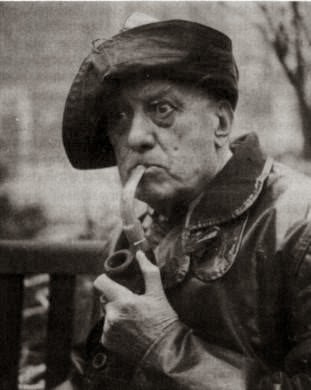
These latter qualities are carried over wholesale to the fictional Haddo, the legitimacy of whose powers is first indicated by his forceful gaze, which, in an identical manner to that which can be observed in the most famous photographs of Crowley, has the uncanny quality of seeming to look through, rather than at, the object of his gaze.
As we will gradually learn, Haddo’s learning and intellect also appear to be vast (he can quote entire tracts of books on a wide variety of subjects from memory), he plays the piano like a veritable demon, and, according to a letter helpfully provided by a former university colleague whom our hero contacts to learn more about this troublesome rascal, his achievements in the fields of hunting and sports are genuine and widely acknowledged.
During the book’s first real horror set-piece, we find Haddo – who has accompanied his new ‘friends’ to the fairground, largely against their wishes – intimidating an Egyptian snake-charmer with a tirade of terrible and forbidden incantations in his own language, before coaxing the deadly cobra into biting him on the arm, apparently suffering no ill effect from the fatal venom, and promptly snapping the creature’s neck.
Clearly Haddo – like the notoriously spiteful and litigious Crowley – is not a man you’d care to get on the wrong side of, in spite of his boorish public persona. But, of course, that is exactly what happens here, as the upstanding Arthur (it’s difficult not to picture him as being played by the aptly named David Manners from Browning’s ‘Dracula’ and Ulmer’s ‘The Black Cat’) subjects Haddo to “a sound thrashing” after the ill-mannered brute kicks his fiancée’s pet dog in a fit of pique.
Thereafter, the gargantuan magus instigates his elaborate scheme of vengeance, bending the impressionable Margaret to his indomitable will and eventually coaxing her into marriage, after which ‘The Magician’ falls into a similar formula to Stoker’s ‘Dracula’, as Arthur, Margaret’s best friend Susie and Dr Porhoët - a genial French surgeon with a special interest in Alchemy who acts as the novel’s Van Helsing character – become a close-knit unit, united by their determination to free their mutual friend from Haddo’s malign influence.
One area in which Maugham’s creation departs significantly from the real life Crowley is that of the precise nature of his magic(k)al work. The author seems to have been either unfamiliar with, or uninterested in, the ‘Western esoteric’ tradition of ceremonial magic from which Crowley’s practice originated, with the enactment of rituals and spiritual communion with supernatural intelligences mentioned only fleetingly in the text (and then only in the vague context of unspeakable, implicitly orgiastic, bacchanal rites and so forth).
Instead, Oliver Haddo is portrayed as a kind of modern day alchemist, working toward his abominable goals through chemical experiments which, for the modern reader, seem to veer closer to the realm of mad science than black magic, digging deep into that fascinating, pre-20th century hinterland of weirdness in which cutting edge chemistry seems to exist side-by-side with the blackest of ancient diabolism.
To his credit, Maugham seems to have conducted an absolute ton of research in this area, and ‘The Magician’ verily overflows with esoteric lore, as the works of figures such as Paracelsus, Éliphas Lévi and Hermes Trismegistus are discussed at length, whilst Dr Porhoët bangs off lists of (genuine) priceless Latin grimoires which could have given Lovecraft himself palpitations.
Combined with the novel’s parallel interest in exploring the more romantic and macabre aspects of both classical and comparatively recent visual art, which repeatedly had me pausing my reading to google up images of the works the characters are discussing (both Margaret and Susie are in Paris as aspiring painters, so there’s a lot of art chat), and the overall effect is pretty intoxicating.
For my money, the most remarkable part of ‘The Magician’ is the chapter setting out Haddo’s seduction / establishment of mental control over Margaret. Written from her point of view, the sequence of events begins when Haddo gains admission to her lodgings under the pretext of being struck by some kind of medical emergency. Once ensconced, he begins to slowly lure her (and by extension, we the readers) into his trap, initial acting with great humbleness and civility, before he turns his eye to the prints of paintings pinned upon his victim’s wall and begins holding forth about them with great eloquence, before ranging freely through the canon of sensuous and decadent art, as if trying to batter his listener into submission through sheer over-powering rhetoric.
He then makes his way to the piano, were he unleashes torrents of spell-binding, demoniac music, the like of which poor old Margaret has never heard in her life. And finally, once she is thoroughly cowed by his over-bearing presence, he makes his way to the kitchen and, producing a vail of strange, blue powder, treats her to a demonstration of its startling power;
“Immediately a bright flame sprang up, and Margaret gave a cry of alarm. Oliver looked at her quickly and motioned her to remain still. She saw that the water was on fire. It was burning as brilliantly, as hotly, as if it were common gas; and it burned with the same dry, hoarse roar. Suddenly it was extinguished. She looked forward and saw that the bowl was empty.
The water had been consumed, as though it were straw, and not a drop remained. She passed her hand absently across her forehead.
‘But water cannot burn,’ she muttered to herself.
It seemed that Haddo knew what she thought, for he smiled strangely.
‘Do you know that nothing more destructive can be invented than this blue powder, and I have enough to burn up all the water in Paris? Who dreamt that water might burn like chaff?’
[…]
‘He took a long breath, and his eyes glittered with a devilish ardour. His voice was hoarse with overwhelming emotion.
‘Sometimes I am haunted by the wild desire to have witnessed the great and final scene when the irrevocable flames poured down the river, hurrying along the streams of the earth, searching out the moisture in all growing things, tearing it even from the eternal rocks; when the flames poured down like the rushing of the wind, and all that lived fled before them until the came to the sea; and the sea itself was consumed with vehement fire.’”
Haddo then urges Margaret, who by this point is thoroughly under his control, to breathe deeply of the fumes produced by the blue powder…. and after that, we’re off to the races, basically;


It’s amusing here to contemplate an era when a lady’s chronic moral degradation is shudderingly revealed in the fact that she tells a dirty joke during dinner and dares to tip her hat to “a woman known to be of low virtue”, but on the other hand, the implications of after-hours debauchery in the pleasure palaces of the Riviera in this section of the book also carry a pungent whiff of brimstone, suggestive of a debased, morally bankrupt European aristocracy drifting rudderless into the jaws of the First World War.
The final act of ‘The Magician’ however is where things get really wild, cementing the novel’s horror credentials. As our heroes converge upon Haddo’s blighted family seat in Staffordshire (in the tradition of Poe and, later, Lovecraft, vegetation fails to grow upon the blasted landscape surrounding his night-haunted abode), we’re treated in quick succession to a series of set pieces that could have come straight from a 1930s issue of ‘Weird Tales’, leaving us in no doubt as to the novel’s supernatural worldview.
A necromantic séance on a moonless night, a life-or-death battle with Haddo’s spectrally projected avatar, and, finally, the terrible, sanity-shaking sights which await our protagonists when they eventually batter their way into the furnace-like interior of the locked attic laboratory atop the magus’s decrepit stately home – dark secrets which, needless to say, will remain unrevealed here.
Considered with over a century’s hindsight, ‘The Magician’ feels like one of those fascinating works which seems to gather and reflect influence in all kind of unexpected directions. As well of potentially drawing from Stoker alongside the legends surrounding the real life Crowley, Maugham also seems to have drawn here from the success of George du Maurier’s 1894 novel ‘Trilby’ (which introduced the world to the character of Svengali), whilst the book’s take on contemporary alchemy may also have found an echo in the unheimlich imaginings of Hanns Heinz Ewers’ influential but deeply questionable ‘Alarune’, published a few years later in 1911.
Thereafter, the influence of Maugham’s book can arguably be felt to some extent in all of the mesmeric Satanic demagogues who would soon be romping all over the shadier reaches of popular culture, perhaps even playing into the creation of some of the greatest works of early American horror cinema, with both Karloff’s Hjalmar Poelzig in the aforementioned ‘The Black Cat’ (1934) and the twisted homunculi sealed in bell jars by Ernest Thesiger’s Dr Pretorius in Whale’s ‘Bride of Frankenstein’ (1935) embodying elements which could potentially have been pulled from the lurking shadow of Oliver Haddo. (1)
Meanwhile, ‘The Magician’ also seems noteworthy as one of the only fictional works I can recall in which an author has had the cast-iron balls necessary to present a thinly veiled portrait of a still-living individual, portraying them as a diabolical, murderous villain.
In view of Aleister Crowley’s tendency to let rip against his ‘enemies’ with curses, magickal battles and wildly extravagant lawsuits, I think he must have either had a soft spot for Maugham, or else secretly enjoyed the attention which ‘The Magician’ brought his way, because his public response to the book’s publication seems to have been relatively benign.
Writing under the name “Oliver Haddo”, Crowley produced a satirical review of ‘The Magician’, which was published by ‘Vanity Fair’. With typical point-missing insouciance, Crowley seems to have focused here upon accusing Maugham of plagiarism, alleging that he ‘stole’ parts of his novel from such works as Franz Hartmann’s ‘The Life of Paracelsus’ and ‘Dogme et Rituel de la Haute Magie’ by Eliphas Levi - a pretty fatuous suggestion, given that it is plainly obvious Maugham did indeed consult the books Crowley cites, using them as historical sources for his broadly original fictional story. (2)
Wisely, Maugham refused to respond to Crowley’s accusations, later claiming that he had not even bothered to read the ‘Vanity Fair’ review, adding that, “I daresay it was a pretty piece of vituperation, but probably, like his poems, intolerably verbose”.
In the same ‘fragment of autobiography’, which has prefaced most latter-day editions of ‘The Magician’, Maughan also claims that, many years later, in the flush of his literary success, he received an unsolicited telegram which read as follows;
“Please send twenty-five pounds at once. Mother of God and I starving. Aleister Crowley.”
Once again, he declined to respond.
---


(1)Funnily enough, Thesinger actually knew Maugham socially, as a result of their work in London theatre; he appeared in the cast of Maugham’s play ‘The Circle’ in 1921.
(2) Crowley also accused Maugham of ripping off H.G. Wells’ ‘The Island of Dr Moreau’, but I really can’t see much similarity between the two novels at all, to be honest.