Showing posts with label 1940s. Show all posts

Thursday, 26 October 2023

Horror Express:
The Vampire’s Ghost
(Lesley Selander, 1945)

I had a lot of fun with Lesley Selander’s The Catman of Paris earlier this month, so thought I’d make some time (only 58 minutes required) to check in on the other b-horror he directed for Republic Pictures in the mid ‘40s.

As with ‘Catman..’, the title is intriguingly silly, betraying an attempt to hang onto the coattails of Universal’s waning horror output (they’d released both ‘The Mummy’s Ghost’ and ‘The Ghost of Frankenstein’ in the proceeding years), but... mixed results here, I'd say.

From the outset, ‘The Vampire’s Ghost’ proves to be a rather inert and talky affair, set amid the confines of a pokey and generally uninspiring backlot version of darkest Africa, wherein a largely undistinguished cast of white colonial types trudge through their allotted paces with no great surfeit of enthusiasm.

On the plus side though, it sure has some interesting notions buried within it.

Though he’s certainly no ghost, our resident vampire here turns out to be a former member of Queen Elizabeth I’s court, who - perhaps uniquely in the annals of cinematic vampirism - now finds himself running a gin joint in a fictional central African state, fleecing sailors in dice games and ruing the weary burden of his immortal condition, like some cut-price, blood-drinking Rick Blaine.

An odd fit for the vampire role, John Abbott initially looks more like the kind of guy you’d cast as an accountant or an elevator operator. But, he has a deep, sonorous voice and Peter Lorre-worthy bug-eyes, and ultmately leans into his unusual characterisation very well.

There’s an absolutely sublime scene for instance where, after being wounded by a spear whilst out on ‘safari’, Abbott uses his powers of mental persuasion to command the film’s hero (Charles Gordon) to carry him to the summit of a nearby mountain, where he luxuriates in the healing light of the full moon, his head resting on the precious Elizabethan box containing the grave soil of his original resting place, presented to him by the Queen after the Armada. Great stuff.

At first, it seems as if the vampire is going to be characterised as a variation on the Wandering Jew/Wolfman archetype - condemned to walk the earth for all eternity whilst seeking an escape from his supernatural affliction, and trying to warn the other characters away from him, lest they fall victim to his curse.

Later on though, he seems to have lost this benevolent streak, and, having given fair warning, gets straight on with the business of dominating Gordon’s mind, reducing him to a brain-dead slave, whilst he claims the leading lady (Peggy Stewart) for himself, whisking her off to the remote, abandoned temple of a supposed “death cult”, where, inexplicably in view of the film’s geography, a four-armed Hindu idol awaits them. (I liked the way Abbott plays all this with  “another day, another dollar” resignation, as though he’s been through it all a hundred times before.)

Many of these interesting and unconventional story elements can presumably be traced back to legendary screenwriter and SF pioneer Leigh Brackett, who takes co-writer and original story credits here, the same year she worked for Howard Hawks on ‘The Big Sleep’. And, as I can’t locate any additional background on her involvement with this film... that’s about all I have to say about that.

Stylistically meanwhile, the movie seems to draw heavily from Val Lewton’s then-recent series of b-horror successes at RKO, even directly mimicking ‘I Walked With A Zombie’ (1943) during scenes in which the white folks sit nervously in their bamboo-shaded bungalows, muttering darkly about the jungle drums affecting the productivity of the natives down at the ol’ plantation and so on, whilst the presentation of the vampire’s killings seems to echo both ‘The Leopard Man’ (1943) and ‘Cat People’ (1942) in places.

Unfortunately though, Selander proves unable to muster even a fraction of the atmosphere Jacques Tourneur brought to those projects - largely through no fault of his own, I’m assuming, as a “first take, best take” policy clearly seems to have been in operation, whilst even the film’s best ‘horror’ moment (the vampire’s murder of the bar's sultry dancing girl Adele Mara, in a shadowed bedroom with the incessant pounding of the drums as a backdrop) is subjected to a disappointing early fade.

As ever with movies like this, I’m also obliged to note that events play out in what is very much the boilerplate “white man’s Africa” of the era’s pulp magazines and Jungle Jim serials. So, even if it can’t quite summon up the energy to be overtly racist about it, if you’re looking for sympathetic portrayals of indigenous African characters or veiled commentary on the vampiric nature of colonialism or somesuch, well, I’m afraid you won’t find it here, partner.

As usual with these things, the sight of African-American actors forced to play benign, half-witted tribespeople gabbling away in pidgin English also rather grates, especially in view of the film’s failure to conjure any of the gravitas or sense of place which Tourneur, or even Victor Halperin (‘White Zombie’), brought to their respective entries in the sub-genre. So, if you’re the sort of sensible viewer who doesn’t feel the need to tolerate this kind of crap when watching old movies - be forewarned.

Indeed, whilst dedicated scholars of pulp horror, vampire lore or off-beat poverty row programmers are sure to find enough intriguing content in ‘The Vampire’s Ghost’ to keep them occupied long after the credits have rolled, purely in terms of the film’s entertainment value, I’m going to have to close by suggesting that more general horror fans might want to think twice and/or keep their expectations in check when approaching this one.

Tuesday, 17 October 2023

Horror Express:
The Catman of Paris
(Lesley Selander, 1946)

Forming one half of a rare horror double feature knocked out by western and serial specialists Republic Pictures in the mid 1940s, ‘The Catman of Paris’ was presumably born out of an attempt to capitalise on whatever pre-release publicity might have accompanied Universal’s woeful ‘She-Wolf of London’ (released one month later), cross-referenced with the widespread success enjoyed by Val Lewton and Jacques Tourneur’s ‘Cat People’ just a few years earlier, and perhaps also a lingering memory of Guy Endore’s 1933 novel ‘Werewolf of Paris’.

Despite the attention-grabbing title and poster though, to be honest I was resigned to the fact that this would probably be pretty dull fare… so was pleasantly surprised when, for the first reel at least, it turned out to be absolutely bonkers.

For a start, the top hat and opera cape-clad ‘catman’ meows in the voice of a regular house cat, which is delightful, and, in his first (off-screen) appearance, he strikes in the form of a big, expressionist shadow with Nosferatu fingers, gliding across the walls of back lot 1890s Montmartre. Crikey!

The main character / chief catman suspect is a young author, Charles (played by Carl Esmond), who has just caused a sensation by publishing a novel entitled ‘Fraudulent Justice’, in which he recounts in accurate detail the proceedings at a scandalous closed trial, to which only a few select government ministers had been allowed access… yet he claims to know nothing of this, insisting that the whole thing came to him in a dream.

Additionally, he has just returned from ‘the tropics’, where he was struck down by an intense fever which seems to have left him suffering from bouts of amnesia... which of course neatly coincide with the ‘catman’ killings. The first victim of which, we should note, was a Ministry of Justice clerk carrying a confidential dossier containing details of the trial Charles is alleged to have forbidden knowledge of, whilst the second victim ends up being his vindictive ex-fiancée (a great turn by singer and b-movie stalwart Adele Mara).

So, all in all, you can see why the gendarmes (engagingly represented by believer / sceptic duo Gerald Mohr and Fritz Feld) soon want to have a few words with our defensive and bewildered protagonist - although of course they don’t attempt anything so vulgar as to throw him behind bars and see what happens when he next experiences one of his alleged periods of amnesia, because you can’t go around treating a gentleman like that, now can you?

Whenever Charles experiences one of his amnesiac attacks incidentally, we see the same series of images projected over footage of his agonised face, in the same order: some sheaves of wheat blowing in the wind, a fork of lightning striking across what looks like a solarised black sun, the face of a hissing cat, and - entirely inexplicably - a shot of a thing which looks like some kind of space capsule (but couldn't possibly be, in view of the film's production year), floating in a storm-tossed sea with icebergs in the background, spewing oil from its cone/nozzle.

If any living person has an explanation of what in the hell that’s all about, I’d certainly love to hear it.

There’s also a memorably bizarre moment when we see a very striking shot (repeated from the opening credits) of a black cat walking through a highly detailed miniature scale model of one of the street sets, appearing as a giant beast, until the camera pulls back, and Mohr shoos the pesky moggie out of the way, casually announcing, “this is a replica of the murder site I had made over night..”. (WHAT?!)

Similarly perplexing, there’s a great bit later on in which Fritz Feld outlines he wildly holistic rationale for believing a cat-demon is on the loose in Gay Paree, citing a volume of ‘Astrological Prognostications’ apparently compiled by his grandfather, in which “further evidence of planetary influence on transmutation” suggests a regular historical reoccurrence of were-cat phenomena which can be traced back to the reign of Ivan The Terrible. 

The were-cat under investigation in the current case, it seems, is in fact the ninth in the this astrologically defined series, thus making it the final reoccurrence, as per the scientifically recognised nine live of the cat. Any questions?

Meanwhile, pre-empting Glenn Danzig’s Verotika by 70+ years, the film’s entire cast consists of American actors ordered to adopt French accents of highly variable quality and consistency. (Perhaps the worst offender in this regard is leading lady Lenore Aubert, who largely sticks to yankee diction, with the exception of referring to her beloved as “Sharl” at all times.)

That questionable decision aside though, Parisian atmos is ‘The Catman of Paris’ is largely limited to finding space in its lean 62 minute run time for a genuinely entertaining, highly energetic can-can routine, taking place in the Café du Bois, the decadent, fin-de-siecle basement hang-out where Charles and his best pal / literary agent Henry (Douglass Dumbrille) meet to carouse away their evenings in the intoxicating social whirl of whichever sound stage Republic weren’t currently shooting a western on.

Indeed, director Selander had shot well over fifty(!) oaters for Republic by the time he changed tack to handle ‘The Catman..’, and whilst his style remains admirably pacey and fluid throughout, there is definitely still a persistent sense of he and his employers’ more usual day-to-day creeping in around the edges here.

In their commentary track on Imprint’s recent blu-ray release, Kim Newman and Stephen Jones have a whale of a time pointing out costumes which might previously have belonged to ranchers, riverboat gamblers or saloon girls, noting extras who look burlier and more heavily whiskered than habitués of the Parisian underworld really should, and observing that the night club set is clearly a slightly rejigged frontier saloon.

For the most part though, this odd cross-genre bleed actually plays very much in the movie’s favour, as the talky, set-bound boredom which inevitably begins to predominate once the details of the plot get underway is broken up by such unusual (and welcome) additions to the ‘40s b-horror formula as a furniture-smashing, ‘knock down drag out’ bar fight (complete with a leap off the bar from Esmond), and an elaborate, under-cranked stage-coach chase, taking place, one assumes, in some Gallic equivalent of Central Park.

In addition to the errant images and intriguingly odd plot details I outlined above, this all proved enough to keep me thoroughly hooked right up to the film’s finale, when the dreaded ‘catman’ finally makes an appearance, and boy, it’s a memorable one.

A spirited take on a furry-faced, ersatz Mr Hyde, the well-dressed fiend has a lot of fun chasing Lenore Aubert around like a slightly more menacing Benny Hill, until a barrage of police bullets knocks him on his arse, prompting a big reveal / wrap up scene which will remain unspoiled here, aside from noting that its proffered explanation of the event swhich have just transpired frankly makes no sense whatsoever.

So, that’s ‘The Catman of Paris’ folks - W, and indeed TF.

On the basis of this one, you’d better believe I’ll be making time to check out the other Republic horrors post-haste.

Saturday, 1 October 2022

Horror Express:
The Climax
(George Waggner, 1944)

Mild horror elements and the presence of Boris Karloff provide intermittent points of interest in this otherwise justifiably forgotten Universal Technicolor spectacular, which seems to have been conceived largely as a means to squeeze a bit more revenue out of the set dressing, costumes and female lead from the studio’s commercially successful 1943 version of ‘The Phantom of the Opera’.

It tells you something about the extent to which tastes change over the decades that, back in the ’40s, someone at Universal apparently emerged from a screening of the already notoriously watered down ‘Phantom..’ remake and thought, “you know what that needed? Less mystery, less of that guy in the mask - more singing and frilly dresses.”

Even by the standards of a frothy musical melodrama, the narrative here feels woefully half-hearted - a grab-bag of poverty row clichés and rehashed ‘Phantom..’ elements, devoid of any real suspense or surprise. As for the film’s frequent, and lengthy, musical numbers meanwhile…. christ almighty.

I mean, I’m certainly no opera buff, but even if I had ambitions in that direction, I’m pretty sure that a series of light comic librettos written by the director of ‘The Wolf Man’ would probably not be the best place to begin my education, especially when performed by Susanna Foster in glass-shatteringly shrill fashion.

Indeed, it’s pretty difficult to buy the idea that Karloff’s brooding, self-serious character would give a hoot about the performance of the kind of chintzy, insipid material which apparently comprises his opera house’s bread and butter.

(In case you were wondering, Karloff portrays a sinister doctor employed by the opera house to minster to its performers. Some years back, he throttled his one true love - a preternaturally gifted soprano - to death, and has subsequently led a furtive existence as a kind of love-lorn closet psychopath, determined to ensure no one performs her signature piece, ‘The Magic Voice’.)

On the plus side, the film’s Technicolor photography is pretty ravishing, and, even if the stage performances and backstage stuff is sometimes a bit eye-watering, the darker scenes in Karloff’s office / lair convey a hazy, mouldy kind of atmosphere which puts me in mind of Warner Bros’ early ‘30s colour horrors (cf: Doctor X).

It’s interesting too meanwhile to see '40s Universal horror’s specialist in *cough* ‘ethnic’ roles, Turhan Bey, cast here as the earnest romantic lead, in which capacity he proves quite likeable (certainly moreso than the bland, whitebread chumps who usually occupy such roles).

It’s also a nice surprise to see Karloff getting the chance to play a flat-out malevolent, Svengali-esque villain here, rather than the ‘sympathetic, bumbling scientist’ bit he usually ended up trotting out during periods in which horror was out of fashion. As with Claude Rains in the previous year’s ‘Phantom..’, his performance is actually pretty brilliant - a “worth the entry price alone” level plus point, assuming you can tune out all the rubbish that’s going on around him and concentrate instead upon his vengeful, soft-spoken glowering.

The wild, Vaseline-lensed opening flashback sequence, in which Karloff’s character viciously disposes of his aforementioned one-true-love, is likewise pretty damn great, with the OTT colours and lighting effects lending a bit of a ‘50s exotica kind of feel to proceedings, whilst the malicious doctor’s eventual downfall in the final reel also has a nice gothic kick to it, pre-empting the fiery denouements routinely inflicted upon Vincent Price in Corman’s Poe cycle a generation later.

Outside of that ten minutes-or-so of rewarding screentime however, I fear ‘The Climax’ stands as a cultural artefact whose relevance as an entertainment for humans has long since dried up and crumbled to dust. Here in our benighted 21st century, it’s a recommendation for Universal/Karloff completists who don't mind keeping a finger on the ‘fast forward’ button only, I suspect.

Monday, 21 March 2022

Noir Diary # 17:
Framed
(Richard Wallace, 1947)


The very definition of an efficient, tightly plotted b-noir, 1947’s ‘Framed’ begins with a perfect visual metaphor for what’s to follow, as protagonist Mike Lambert (Glenn Ford) literally crashes into the small town in which the action takes place behind the wheel of an out-of-control truck with no functioning brakes.

The platonic ideal of a doomed film noir patsy, Lambert is an unkempt, down-on-his-luck drifter (an unemployed mining engineer, so he claims), who accepted the driving gig offered to him by an unscrupulous trucking company purely as a means to get himself to the next town along the trail. After painfully extracting his fee from said trucking firm’s local rep, he deposits it directly into the hat of the argumentative man whose fender he damaged in the process of bringing his death-trap of a vehicle to a halt, and heads straight for the nearest bar to see if he can scare up some credit.

Within the insalubrious environs of the La Paloma Cafe, we soon come to understand how Lambert has ended up in such dire straits. Clearly he’s one of those guys whose thirst for liquor is matched only by his inability to handle its effects, and, after a few shots of rot-gut, we find him trying to hock his gold watch to the barkeep for stake money to join the 24/7 crap game taking place upstairs, only to be saved from further humiliation when the crooked local fuzz waltz in to pick him up on a spurious dangerous driving charge finagled by the trucking company.

In spite of this world championship level display of loserdom however, archly mannered waitress Paula (Janis Carter) appears inexplicably enamoured of the new arrival; so much so that it is she who steps in to cover the fine Lambert is ordered to pay after a jerry-rigged court appearance, before also shelling out to provide the hotel room in which he sleeps off the effects of his subsequent drinking binge.

Anyone thinking that Paula’s efforts might be motivated by philanthropy, pity or good old fashioned lust however would be well advised to consult this movie’s title. Before you know it, our hero’s new guardian angel has quit her job at the bar, and is on the phone to arrange a meet-up with the smarmy vice-president of the local bank (Steve Price, played by Barry Sullivan), letting him know that she’s found exactly the right guy for their purposes. Same height as Price, same build, and no annoying friends or family to get in the way. Oddly, they’re not too concerned about his facial features… I wonder why?

Before we get the full dope on the ugly fate our hero is being measured up for however, ‘Framed’ takes an unexpected detour into B. Traven territory, as Lambert - suddenly determined to try to make something of himself - heads for the local Assaying Office. For the benefit of readers not based in the South-Western U.S.A. in the early 20th century, this was apparently a place to which would-be mining prospectors could bring samples of stuff they’d dug up, to get its mineral content analysed, and happily, Lambert’s visit happens to coincide with that of a garrulous fellow (Jeff Cunningham, played by Edgar Buchanan) who has just received confirmation that he’s struck a life-changing haul of silver up in them-there-hills.

Better still, when Lambert offers his services as an engineer for the forthcoming mining operation, Cunningham recognises him as the guy who paid him back for damage to his car the previous afternoon, clapping him on the shoulders and declaring him an HONEST MAN. So, hands are shaken, a partnership is born, and the new best buddies retire to nearby café (one which actually serves food, unlike the La Paloma) for a slap-up breakfast and some serious mining talk.

The only snag is, to finance the outfit, Cunningham will need to get a loan from the local bank, but don’t worry, it’s such a sure thing that…. ah. You see where this going. Forewarned by Paula, vice-president Steve turns Cunningham down flat, leaving the disgruntled prospector with no choice but to leave town to drum up some dough elsewhere, leaving Lambert to cool his heels… and to head straight back into the arms of one of the most robotically psychotic femme fatales ‘50s noir had to offer. Some guy just can’t get a break, huh?

Ben Maddow’s script for ‘Framed’ may not be high art, but it’s certainly high craft. A frustrated poet and documentarian before he turned to screenwriting to make a buck, Maddow cheerily lifts a few ideas from then-recent hits (Double Indemnity, ‘The Treasure of the Sierra Madre’, and the previous year’s ‘Gilda’, also starring Ford), but he nonetheless gives us one of those great, watertight yarns in which every detail pays off, every character trait serves a purpose, and in which the overriding theme of the piece remains consistent, without ever getting heavy-handed about it.

In the synopsis above, I’ve casually referred to Mike Lambert as the film’s ‘hero’, and, despite his chronic lack of gumption, that descriptor remains more accurate than was often the case in the realm of noir. For all his faults, Lambert is indeed a scrupulously honest man, trying to ply an honest trade, only to find the combined forces of state and capital (the police and judiciary, banks, employers, the idle rich, even disgruntled suburbanites in one case) lined up against him, working in cahoots to keep him penniless, homeless, and preferably consigned to a wooden casket ASAP, all as part of their venal, corrupt daily routine.

(With an outlook like this, it’s no surprise to learn that Maddow found himself blacklisted post-haste once the dark fog of HUAC descended upon Hollywood, his official screen credits drying up shortly after he earned an Oscar nomination for his similarly themed work on John Huston’s classic ‘The Asphalt Jungle’ (1950).)

The great ‘nearly man’ of 40s/50s household name leading men, Glenn Ford also does fine work here, dialling down the charisma he exuded to varying degrees in other roles to effectively portray a guy who is only one or two rungs up the ladder from the Elisha Cook Jrs of this world -- a stone loser, but one whose side-eye glances convey a sly, calculating self-awareness rather than mere blubbering self-pity, letting us know he’s possessed of just enough grit and smarts to overcome the forces rallied against him… if only he could stay away from the bottle, and the crap table - and most importantly, from Janis Carter.

Though she never scaled the same career heights as her co-star, Carter (whose other genre credits include ‘Night Editor’ (1946) and the notorious ‘The Woman on Pier 13’ aka ‘I Married a Communist’ (1949)) is equally memorable here, creating a character who ranks second only to Lizabeth Scott in ‘Too Late For Tears’ (1949) in noir’s pantheon of cold-blooded female predators.

When Sullivan’s character met her two years ago, Paula was modelling “someone else’s furs”; now she has to make do ugly, lace n’ polka-dot small town finery, but not for much longer. A dead-eyed, remorselessly amoral dame straight out of a philandering studio mogul’s worst nightmares, she’s clearly capable of leaving any of the men who dote upon her to perish in a flaming car wreck at a moment’s notice, just to gain an extra percentage point on the purloined dough which sits awaiting her in that numbered safe deposit box back in town.

There is kind of a performative, self-aware aspect to the behaviour of both lead characters in ‘Framed’ - a feeling that Mike and Paula simply complying with the expectations of their archetypes, if you will, unable to break free from the roles they’ve been assigned within Maddow’s rat-trap of a script. Some viewers might see as a weakness of the film, but personally I really enjoyed the weird, fateful quality it brought to proceedings.

Paula is so obviously ice cold and insincere in her interactions with Lambert and Price, it’s difficult to believe that either of them could believe her rote “I’m crazy about you / let’s run away together” jive for a second. Indeed, Lambert appears suspicious of her motives right from the get-go, but nonetheless, he still keeps trudging straight back to the horrible, chintzy bungalow she rents on the outskirts of town, accepting her stream of lies, rationalisations and half-hearted declarations of devotion with heavy-lidded resignation, like some cut price, off-brand version of Robert Mitchum’s storm-tossed fatalism in the same year’s ‘Out of the Past’.

Though ‘Framed’ has none of the high-falutin’ dreaminess we associate with such top tier noirs, Wallace’s direction is punchy and efficient in the best tradition of Columbia crime pictures, relying on fast cutting and simple visual storytelling to get its point across, whilst the film is further elevated by fine supporting performances from Sullivan, whose smarmy bank exec contains a finger of the same juice which would later fuel Fred McMurray’s character in Billy Wilder’s ‘The Apartment’ (1960), and Edgar Buchanan, who essentially plays the movie’s dishevelled, proletarian conscience, offering Lambert a fleeting glimpse of friendship, hard work and proper, American Dream-type redemption.

The work of Director of Photography Burnett Guffey was not generally as showy as that of his more celebrated competitors in the chiaroscuro racket, and with the best will in the world, this picture’s small town / daylight setting and familiarly drab Columbia interior sets offer little scope for expressionist grandeur.

Nonetheless though, Howe’s steady hand ensures that the movie always looks at least pretty good, employing the steady hand which led some wag to describe him as the “little black dress” of noir photographers to transcend the penny-pinching production design, using mirrors, blinds and jagged, asymmetric shapes to keep things interesting, whilst a few brief nocturnal street scenes evoke the kind of sleek, inky smooth menace he would go on to employ so beautifully on career highlights like ‘The Reckless Moment’ (1949) and ‘In a Lonely Place’ (1950). (1)

If anything in ‘Framed’ cuts against the grain of noir expectation, it’s probably the film’s ending, which - whilst straining here to avoid spoilers - does not proceed in the direction which the hard-boiled nihilist crowd might have wished, let’s put it that way. As much as such a conclusion sounds bad on paper however, in practice it’s handled here with an elegance and open-ended emotional ambiguity which actually works rather beautifully, leaving open the possibility that good ol’ Mike Lambert - now weighted down by an extra layer of cynicism and soul-sickening regret - might be back soon, trying hawk that damned gold watch in some seedy bar ‘round the corner from your place, next week, next year, or on into eternity.

--- 


(1) I need to credit Imogen Sara Smith’s excellent audio commentary on the Indicator blu-ray release of ‘Framed’ for hepping me to that quote about Guffey, but I don’t remember who she attributed it to, and google hasn’t helped me put a name to it, so… answers on a postcard etc.

Tuesday, 7 December 2021

Horror Express:
The Devil Commands
(Edward Dmytryk, 1941)

 Darker, creepier and more intense than the other ‘mad doctor’ movies Boris Karloff made for Columbia between 1939 and 1941, this fourth and final instalment in the loosely connected series finds incoming director Edward Dmytryk really upping the ante, delivering a film which remains startling and somewhat unnerving to this day, in spite of its brutally foreshortened 64 minute run time and all too evident budgetary constraints.

A brief but highly effective prologue gets the antennae of us Lovecraft-fanciers tingling right from the off, as the daughter of Karloff’s Dr Julian Blair delivers an ominously deadpan voiceover narration, intoned over a series of very well done model-shots which take us on a slow pan toward the doors of a derelict, storm-lashed cliff-top mansion;

“In Barsham Harbour, on nights like this, when lightning rips the night apart, why do people close the shutters which face toward my father’s house, and lock their doors, and whisper? Why are they afraid? No one goes near my father’s house. I don’t know where my father is. I only know that for one brief, terrible moment, he tore open the door to whatever lives beyond the grave.”

I don't know about you, but I’m sold.

Thereafter, we rewind seven years, and the film’s first act settles down into a pattern very much in keeping with the Karloff’s other Columbia pictures, as the gentle and soft-spoken Dr Blair, a research fellow at a fictional New England college, astounds his fellow boffins by demonstrating that the human brain generates an electro-magnetic impulse which can be recorded, and potentially ‘read’, via electrodes attached to the subject’s temples, hooked up to a primitive, EEG-like encephalogram. (1)

Claiming that “the wave impulse of woman, the so-called weaker sex, is much stronger than man’s”, Dr Blair uses his beloved wife Helen (Shirley Warde) as his primary experimental subject. His beliefs become both more questionable and more obsessive though when, stricken with grief after Helen dies in a car accident, he observes that his machinery is still recording the unique ‘signature’ of her brainwaves, convincing him that his wife’s spirit remains present in the ether, attempting to communicate with him.

As you might well imagine, ‘The Devil Commands’ becomes a gloomy and rather sad affair at this point, and Karloff conveys Dr Blair’s misery and exhaustion with almost painful conviction. Viewers who had previously turned out to see Karloff in Nick Grinde’s ‘The Man They Could Not Hang’ (1939), ‘The Man with Nine Lives’ or ‘Before I Hang’ (both 1940) will have been more than familiar with the path the good doctor subsequently takes, as his mental health gradually crumbles, and as he repeatedly ignores the advice proffered by the film’s procession of straight-laced supporting players, who urge him to give up his weird work and take a well-earned break.

The film’s tone shifts considerably however when, on the advice of his simple-minded assistant Karl (Cy Schindell) - only potentially mad scientists are assigned one of those, you see - Dr Blair attends a séance conducted by a renowned medium, the stentorian Mrs Blanche Walters (Anne Revere).

Though Mrs Walters is initially pretty pissed off when the doc busts up her phony séance, easily exposing the assorted gimmicks she has been using to hoodwink her clients, she nonetheless reveals herself to be as cold, avaricious and amoral an operator as any film noir spider-woman - so naturally, when Blair suggests that she could make herself a great deal of dough assisting him with his experiments, she’s all ears.

Before long, the doctor’s increasingly unhinged attempts to channel vast amounts of electricity through Mrs Walters’ brain in an attempt to make contact with Helen’s roving spirit lead to poor old Karl getting accidentally lobotomised. Blanche, who seems suspiciously well versed on how to handle such situations, suggests they duck out and make a quick getaway before anyone finds out about the accident, prompting the unlikely trio to flee the campus and hit the road, setting themselves up in the remote cliff-top manse we saw during the film’s prologue.

Once this memorably eerie set-up, reminiscent both of Lovecraft’s ‘From Beyond’ and the unhinged finale of Michael Curtiz’s Doctor X a decade earlier, has been established, palpable fear and loathing on claustrophobic interior sets is soon the order of the day. In a neat turn-around, we’re reintroduced to our characters a year or two down the line, through the eyes of the county sheriff, who comes a-knocking, investigating, oh, y’know, just some bodies which have gone missing from the local cemetery (uh-oh).

After the door is opened by a cowering, lantern-bearing maid (a great performance from character actress Dorothy Adams), the sheriff soon encounters the lumbering, Igor-like Karl, before Blanche descends the rickety, shadowed staircase, glaring daggers in full-on, imperious Lady Macbeth mode. And as to the good doctor, who shambles into view behind her, meanwhile… well, he’s certainly given up brushing the dust out of his hair, let's put it that way.

Under Blanche’s encouragement no doubt, Blair has of course gone full loony by this stage, and the crooked couple have indeed been re-appropriating the carcasses of the local citizenry for use in their experiments. In a breathtaking tableau of psychotronic weirdness, they have in fact wired up the mouldering corpses in what look for all the world like antiquated, metallic diving suits with flashing Tesla coils appended to their helmets. They are seated around a table with their arms out-stretched, in some perverse, quasi-scientific imitation of a séance, whilst the doctor’s banks of McFadden-esque electrical equipment whir and drone behind them. Good lord!

With shit like this going down, it’s naturally only a matter of time before a torch-wielding mob is called for - but, given that we know the house is still standing seven years hence, they’re required on this occasion to nix the flames and do their worst with clubs and wooden poles instead. Yikes.

Edward Dmytryk would soon of course go on to play a significant role in defining the aesthetic of film noir with the classic ‘Murder, My Sweet’ (1944), and he takes the opportunity here to prove himself a post-expressionist stylist per excellence here, ladling on angular shadows, spot-lighting, venetian blinds and dutch angles as if they were going out of fashion, and employing harsh, jagged editing patterns to produce a rather fevered, dissonant tempo.

The film’s production crew meanwhile douse practically every scene in thunder, lightning and squalling gales, undercutting the science-based plotting with the kind of quasi-gothic atmos you could cut up and sell by the pound, whilst mournful cellos saw away on the stock music score, emphasising the essentially tragic nature of the storyline.

Towering over the bumbling, submissive Karloff during the second half of the film, Anne Revere likewise acts up a storm, giving us the kind of vile, emotionless femme fatale / heartless bitch character who could eat Phyllis Dietrichson or Mrs Danvers for breakfast.

The uncertain nature of her relationship with Karloff’s character is in fact one of the movie’s most intriguingly perverse elements. Could they really have a romantic connection? Seems unlikely, given that Dr Blair is still utterly fixated on trying to establish contact with his late wife. We’ve already established that Mrs Blanche Walters is driven by a desire for money, but surely hanging around in a dilapidated mansion living off the diminishing resources of a crazy old geezer wasn’t exactly what she had in mind. Does she just get a kick out of lording it over the doctor and his mindless servant, or - is she hooked on the thrill she derives from having thousands of volts of electricity (and potentially the disembodied brainwaves of the dead) blasted through her nervous system on a regular basis..?

The latter possibility could have conceivably made her an early precursor to Barbara Crampton’s character in Stuart Gordon’s adaptation of From Beyond, but, forced to rattle through its potent story at breakneck speed to hit the era’s one hour b-movie finishing line, ‘The Devil Commands’ is allowed little time to explore such niceties as character motivation, leaving a wealth of rampaging ambiguity in the gaps between scenes which makes the film all the more fascinating.

Of course, the title and poster blurb assigned to this movie by Columbia upon its release are a complete misnomer. The film contains no reference to the devil, and he certainly issues no commands. Indeed, it is interesting to note that there is no allusion to religion or Christian belief to be found anywhere in the film; even the obligatory blather about defying God’s law or somesuch which was routinely shoehorned into this era’s post-Frankenstein mad doctor movies in notable by its absence.

Perhaps one explanation for this is that the script for ‘The Devil Commands’ (credited to Robert Hardy Andrews & Milton Gunzburg) was loosely derived from William Sloane’s science-based supernatural novel ‘The Edge of Running Water’ (first published in 1939) - an acclaimed work, often hailed as a landmark in the field of ‘cosmic horror’, which I’ve been meaning to obtain a copy of for many years at this point. (2)

Whilst I’d imagine that the film probably ditches or reworks many of the details of Sloane’s story, disquieting remnants of what I understand to be his core premise remain. Namely, we’re talking here about the idea that, whilst Dr Blair believes that his experiments allow him to make contact with departed human souls, he is actually tapping into something else entirely.

This truly frightening concept, beautifully implied by the novel’s title, is realised rather more bluntly during the frenzied climax of Dmytryk’s film, wherein we see Dr Blair’s table of wired up corpses become possessed by some unholy St Vitus’ dance as the riled up mob of townsfolk approaches, summoning up what, in their audio commentary for the film’s blu-ray release, the ever-reliable Kim Newman and Stephen Jones identify as perhaps cinema’s first example of a full-blown trans-dimensional vortex.

If on one level ‘The Devil Commands’ remains a morbid and joyless rumination on the self-destructive futility of seeking solace from beyond the grave, it is simultaneously animated by a crazed spark of total morbid madness which proves extremely compelling. Crashing heedlessly into the realm of what-man-was-not-meant-to-know with a fervour far more alarming than than anything generally encountered in the rather sedate world of early ‘40s scientific horror films, it stands as a raw, wild and genuinely unnerving classic of the weird/cosmic end of the genre.

---  


---  

(1) I’m no scientist, but it’s interesting to note that, whilst Karloff’s learned colleagues in ‘The Devil Commands’ treat his theories as if they pretty far-out speculation, Dr Blair’s initial ideas about brainwave activity are essentially correct, and paper-and-ink EEGs very much like the once he demonstrates in the film had actually been in use since at least the early 1920s.

(1) This 1967 Bantam edition of Sloane’s novel, with its IMPOSSIBLY CREEPY cover illustration, is a particular paperback holy grail of mine.

Thursday, 22 July 2021

Weird Tales:
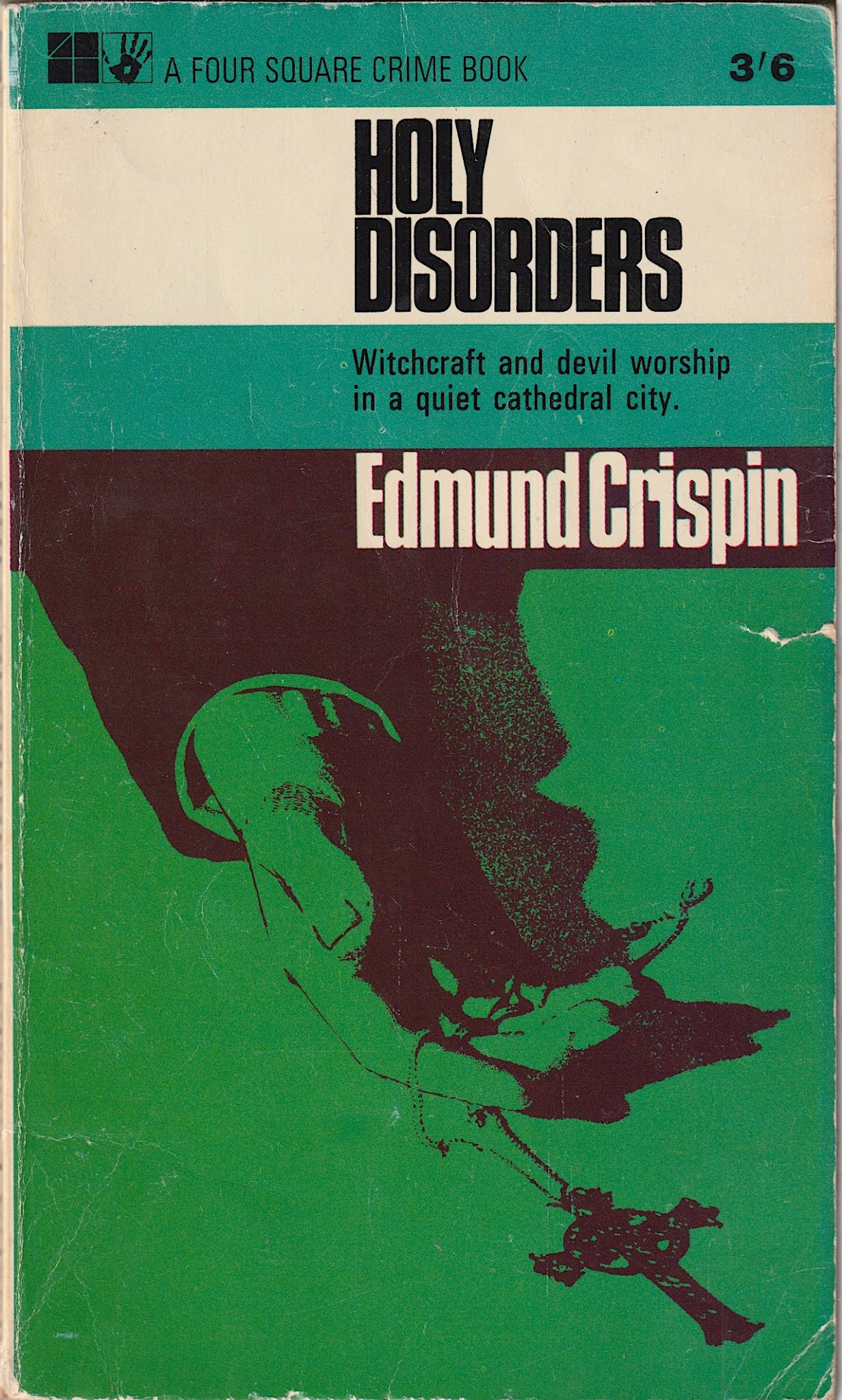
Holy Disorders
by Edmund Crispin

(Four Square, 1965 / first published 1946)


Though on the face of it this paperback looks to be yet another enticing, horror-adjacent offering from ‘60s New English Library imprint Four Square, readers familiar with Bruce Montgomery aka Edmund Crispin’s Gervase Fen novels will realise that the publishers have actually been pretty disingenuous in presenting this reprint as a straight Satanic thriller.

As the aforementioned readers will be well aware, the Fen novels are in fact broadly comedic, foregrounding an idiosyncratic campus humour pitched somewhere between P.G. Wodehouse and Bruce Robinson’s ‘Withnail & I’, leavened with cheeky, fourth wall-breaking asides and enough literary/classical in-jokes to make anyone who has not committed Palgrave’s ‘Golden Treasury’ and Bullfinch’s ‘Age of Fable’ to memory feel slightly inadequate as a human being.

Not everyone’s cup of tea, to be sure, but personally I’m happy to indulge Montgomery/Crispin’s whims, and find his books fairly amusing. More-so, I suspect, than the hypothetical 1965 reader who came into this one expecting some serious, Dennis Wheatley type affair, only to find our protagonist, retiring church music composer Geoffrey Vinter, blundering around causing havoc in the sporting goods section of a London department store during the first chapter, as he struggles to obtain the butterfly net which his friend, Oxford literary professor and amateur detective Gervase Fen, has ordered him to bring forthwith the the fictional Devonshire cathedral city of Tolnbridge.

Vinter, it transpires, has been summoned to Tolnbridge to stand in for the cathedral organist, who has been hospitalised after being bashed about the head by unknown assailants. Before he gets there however, we get to share at some length Geoffrey’s dismay at navigating Paddington Station during rush hour, his attempts to buy and imbibe several glasses of beer as he awaits his train, his developing friendship with the hapless shop clerk who has followed him from the department store in search of adventure, and his lengthy and tormented interactions with the other occupants of his train carriage, only a small handful of whom will go on to play any role in the unfolding mystery.

Amidst all this, the fact that several shambolic attempts are made on Geoffrey’s life during his journey thickens the plot, but otherwise scarcely seems worthy of note.

By chapter three (page 31), our man has finally arrived in Tolnbridge, which I take to be modelled to some extent on Montgomery’s adopted home of Totnes, although it differs from that fine town in a number of important details, not least the dominant presence of a cathedral, around which most of the book’s subsequent “action” (if such it may be termed) accumulates.

Significantly, Tolnbridge is also notrorious for “..a frenetic outburst of witch trials in the early seventeenth century, and the equally frenetic outburst of witchcraft and devil-worship which provoked them, and in which several clergy of the diocese were disgracefully involved”;

“‘This was the last part of the country,’ said Fen, “in which the trial and burning of witches went on. Elsewhere it had ceased fifty or sixty years earlier - and then hanging, not burning, had been the normal method of execution. The doings in Tolnbridge stank so that a Royal Commission was sent down to investigate. But when the Bishop Thurston died, the business more of less ceased. One of the last celebrated witch-trials in these islands was the Weir business in Edinburgh; that was in 1670. Tolnbrige continued for forty years after that, into the eighteenth century - the century of Johnson, and Pitt, and the French Revolution. Only a step away from our own times. A depressingly fragile barrier - and human nature doesn’t change much.’”

After arriving at the wrought-iron gates of the clergy-house, Vinter and newfound pal Fielding are introduced to the assortment of ecclesiastical hangers-on who will go on to comprise the story’s pool of suspects (if you don't know difference between a Precentor and a Canon, you’ll be pretty much at sea here). With Fen - effectively the Holmes to Geoffrey’s Watson - stubbornly failing to make an appearance however, there’s little for the pair to do but retreat to the nearest pub - which in this case is the ‘Whale & Compass’ (perhaps based on Totnes’s late lamented Kingsbridge Inn, or so I’d like to imagine).

To cut a long story  short, Gervase Fen eventually makes his appearance a few pints later, on page 58. Each of Crispin’s books seems to feature the detective adopting a new, loud and disruptive hobby, and in ‘Holy Disorders’ he is inexplicably fixated with capturing, and apparently performing unspecified experiments upon, various insects - hence both his demand for a butterfly net and his extended absence during daylight hours. The reason why Fen is residing in Tolnbridge, apparently at the expense of the church, is never sufficiently explained insofar as I recall, but be that as it may - with our sleuth finally accounted for, we can finally get on with the murder mystery component of the novel.

In addition to the fate of the aforementioned organist (who has been poisoned in his hospital bed, following the earlier assault), this comprises a ghoulish and somewhat surreal variation of the Locked Room mystery, in which the widely disliked Precentor, a Dr Butler, is inexplicably crushed beneath the colossal tombstone of ill-regarded medieval luminary St Ephraim - a tragedy which seemingly occurred when all doors to the building were locked, and no one else was inside.

Eccentric though his writing may be in most other respects, Montgomery/Crispin remained staunchly dedicated to the conventions of the old fashioned whodunnit, and as such, much of the text from hereon in is taken up with the gathering and consideration of alibis, methods and motives, all of which is unpacked at a length liable to prove excruciating to readers who are not fans of classic drawing room mysteries, including the provision of both a map of the crime scene and a lengthy suspect-by-suspect recap to help logically-minded readers reach their conclusion prior to what passes for ‘the big reveal’.

Although published in 1946, ‘Holy Disorders’ was evidently written during the war years, which lends an interesting backdrop to proceedings, reminding me somewhat of Powell & Pressburger’s bucolic wartime fantasias (particularly ‘A Canterbury Tale’ (1944)). 

There are frequent references to the war effort, to idle soldiers hanging about hither and yon awaiting orders, and to the latest news from overseas, and it is little surprise therefore that a further quirk is added to the already over-stuffed plot when it is revealed that the powers-that-be have detected illicit radio transmissions emanating from the vicinity of the cathedral, leading the discovery of a radio set hidden in an inaccessible part of the building, and the subsequent assumption that a cabal of Nazi spies must be abroad in sleepy Tolnbridge.

Amidst all this incident meanwhile, there is even room, surprisingly, for a little romance, as Geoffrey Vinter finds himself smitten with the daughter of the ill-fated Precentor - a graceful and demure young lady who, much in the manner of female characters in novels like this one, uncomplainingly acts as den mother and cook to the assorted oddballs hanging around the clergy-house. Like any good ‘Brief Encounter’ era Englishman, Geoffrey delivers his proposal of marriage whilst staring fixedly ahead at a row of radishes. (“Brutish roots,” he reflects, “what do they know of the agonies of a middle-aged bachelor proposing marriage?”)

This whole business is actually surprisingly affecting, forcing us to reflect on the fact that, whilst Edmund Crispin may have adopted the voice of a gout-addled college rector for his writing, Bruce Montgomery was actually only twenty-five years old when he completed this novel, and presumably subject to the same passions as other young men making their way in the world, and what have you.

With the novel’s rambling plotting already so loaded with under-developed tangents, it’s no surprise meanwhile to discover that the Black Mass / devil worship angle - though assuredly present - never amounts to much more than fairly half-hearted diversion. The irony here however is that the brief passages in which Crispin’s writing shifts away from comedy to explore more macabre subject matter are actually extremely effective, evoking an atmosphere worthy of the era’s horror/weird fiction greats;

“They paused by the hollow where the witches had burned. It was overgrown, neglected. Weeds and brambles straggled over it. The iron post stood gaunt against the fading light. They found rings through which the ropes and chains had passed. The air of the place was almost unbearably desolate, but in imagination Geoffrey saw the hillside thronged, above and below, with men and women whose eyes glowed with lust and fright and appalling pleasure at the spectacle to be offered them. […] A woman they had known - a next-door neighbour perhaps - a familiar face now become a mask of fear in whose presence they crossed fingers and muttered the Confiteor. Who next? And in the breast of that woman, what ecstasy of terror or vain repentance or affirmation? What crying to Apollyon and the God of Flies…? It needed little fancifulness to catch the echo of such scenes, even now. And here, they had accumulated - week after week, month after month, year after year, until even the crowds were sick and satiated with the screaming and the smell of burned flesh and hair, and only the necessary officers were present at the ending of these wretches, and the people stayed in their houses, wondering if it would not have been better to face the malignant, tangible living rather than the piled sepulchres of the malignant, intangible dead.”

I mean, you certainly don’t get that sort of thing in the middle of a Jeeves & Wooster.

Thereafter, this sense of a lurking evil underlying the city is given an atavistic twist via an extremely sinister (though underdeveloped) sub-plot which sees Fen interviewing a teenage girl who has been brain-washed through the use of drugs into participating in the Black Mass and carrying out the diabolical whims of her masters.

Sadly, the contemporary Satanic ceremony which Fen and Vinter subsequently manage to infiltrate proves both boring and rather farcical - it seems that the novel’s villains are merely using diabolism as a front for their more legitimately nefarious goals, again for reasons which remain somewhat unclear - but those ‘Witchfinder General’ / ‘Blood on Satan’s Claw’ vibes are really nailed down again during a section of the book in which (for reasons which appear entirely superfluous to the central narrative) our heroes are invited to read the long supressed secret diary of seventeenth century witch hunter Bishop Thurston. A section of this diary is reproduced in full, effectively comprising a short-story-within-a-novel, and once again, it is excellent stuff - a nasty little tale with a supernatural twist which could easily have found a home in any given ‘70s horror/ghost story anthology.

More representative of overall tone of the novel however are incidents such as that in which Fen and Vinter encounter a ‘Royal Professor of Mathematics’ who seems intent on reciting the entirety of Lewis Carroll’s ‘The Hunting of the Snark’ from memory, only to lose him again a few pages later following yet another visit to the pub, or the chapter which finds the investigators extracting much merriment from a visit to a potential suspect whose home boasts a pet raven resting upon a bust of Pallas above a chamber door, and a wife named Lenore, yet who pleads complete ignorance of the work of Edgar Allan Poe. (“I haven’t much time for verse - he’s good, is he?”)

In conclusion, you might say that, if Montgomery/Crispin had taken a slightly more serious approach to is storytelling there and had engaged more thoroughly with the more macabre elements of his tale, he could have written an absolutely splendid horror novel here. But, I suspect that’s rather like saying that if Noel Coward had ditched all that camp stuff and got a bit more into the rugged outdoors, he could have written a cracking western. 

At the end of the day, the Crispin/Fen novels are what they are. They are entirely reflective of the peculiarities and obsessions of their unconventional creator, but if you can angle your antenna somewhere in the vicinity of his preferred wavelength, they remain thoroughly entertaining, and certainly a little different from anything else you’re liable to find knocking about in your local Oxfam. 


Thursday, 4 March 2021

Noir Diary # 13 / Thoughts on…
Mildred Pierce
(Michael Curtiz, 1945)


I.

Ever since I decided to start writing up my viewings of ‘40s/’50s Film Noir a couple of years ago, I’ve found myself bedevilled by the question of where, precisely, the boundaries of ‘noir’ lie. It’s an issue I’ve wrestled with to some extent in pretty much every one of these Noir Diary posts to date, and, with every critic, fan, reference book and blu-ray label on earth drawing their preferred demarcation line somewhere entirely different from all the others, it is not a debate which seems liable to be happily resolved any time soon.

In trying to find a workable way to define ‘noir’ therefore, my current thinking is that, though we may treat it as such for the sake of convenience, noir is not a genre, in the conventional sense of the term. In some ways, this is a pretty obvious point to make - after all, no one in the USA prior to about 1975 ever sat down and said “I’m gonna make a film noir” - but I think it bears repeating.

Instead, I believe noir can probably be best understood as an ineffable essence - a kind of aesthetic virus, if you will - which infects a wide swathe of cinema and literature to a greater or lesser degree. As irreducibly ‘noir’ as the canonical classics of the form may seem, it’s worth remembering that they all simultaneously belong to other genres as well. To the people who wrote and directed them, the 40s/50s films we now categorise as noir were gangster movies, police procedurals, psychological thrillers, murder mysteries, or, in this case, even a quote-unquote ‘women’s picture’.

The germ of what we now call ‘noir’ is something which crept into them from outside, changing and perverting the material it infected; eating away moral clarity, tilting camera set ups and dimming the lights like some celluloid Dutch elm disease. And, like everyone’s favourite virus here in the second decade of the 21st century, the effects of this bug were varied and unpredictable in the extreme.

Some films emerged so slathered in the thematics and visuals of noir than their root genre almost shrivels up and dies; for others, noir simply hangs in the background, barely perceptible, like some eerie seed of doubt. Then, there are movies in which the noir is spread unevenly - confined to certain scenes or sub-plots, or hitting full strength in some reels whilst completely disappearing from others. In spite of its storied position in the noir canon, ‘Mildred Pierce’ fits perfectly into this latter category.

II. 

Considered as a standalone short film, opening fifteen minutes of ‘Mildred Pierce’ are as vivid and intoxicating an invocation of the 1940s So-Cal noir aesthetic as has ever been conjured before the cameras.

Straight out of the opening credits, the sound of six gunshots is foleyed over an exterior shot of a luxurious yet lonely Malibu beach house with a shiny black sedan parked outside. Cut to the interior, where a man in formal dress spins to face the camera, clutching his chest. He just has time to gasp the name of the movie’s titular heroine(?) before he hits the floor, as inert as the remains of the chic standing lamp he pulled down with him.

Cut to a breath-taking crane-shot of (a studio recreation of) a rain-sodden Santa Monica seafront, water gleaming on the wooden boardwalk in the light of neon hoardings for bars and seafood restaurants as the unmistakable figure of Joan Crawford - looking like a Cossack officer in her wide-shouldered fur coat and hat - strides away from us toward the pier. 

As she stares at the black waves below, her contemplation is broken by the sound of a beat cop’s baton tapping on the iron railings. The first words spoken in the film if we discount the murder victim’s final utterance, the cop’s ensuing lines (“if you take a swim, I’ve gotta take a swim. Is that fair? Because you feel like killing yourself, I gotta get pneumonia?”) give us a brilliant example of the approach to dialogue which will remain consistent throughout the film. Most readily attributable to sole credited screenwriter Ranald MacDougall, these lines are simple and to the point, lacking the literary self-consciousness of many post-war noirs, but are nonetheless attention-grabbing, memorable and devoid of cliché. (1)

(It is only on repeat viewings that we might note that, a few years prior to this in the film’s chronology, Mildred’s beloved younger daughter did indeed die from pneumonia after “taking a swim”, instigating a fatal shift in her mother’s psychological make-up.)

Anyway, the cop’s well-chosen words seem to do the trick, turning Mildred (for of course it is she) away from her watery grave and pointing her in the direction of a loud, claustrophobic seafront bar, where she immediately falls in with the lecherous, fast-talking Wally Fay (Jack Carson), an old friend who seemingly owns the joint. Clearly an inveterate hustler, Wally is suspicious when Mildred - who, we are given to understand, has routinely rejected his crude advances since time immemorial - invites him back to her pad for a quiet drink.

Mildred is clearly in an unsettled state of mind, but, like every noir fall guy, Wally prides himself on keeping his eye on the prize, never looking a gift horse in the mouth, etc etc. So, before we know it, he’s propping up the sleek, chromium bar back at that accursed beach house, boastfully bantering to himself, as Mildred slips out, ostensibly to change, and locks the door behind her.

By the time he finds the corpse, it’s too late. Careening around the increasingly labyrinthine beach house, Wally ascends winding, disorientating flights of stairs, dense lattices of shadow thrown by the house’s baroque / art deco accoutrements hemming him in from all sides, as he too cries Mildred’s name.

Photography by Ernest Haller, whose CV includes ‘Gone With The Wind’, ‘Rebel Without a Cause’ and 183 other top-flight flicks, and art direction from Curtiz’s regular collaborator Anton Grot (also see: Doctor X), are, of course, fiendishly superb here, briefly bringing a touch of Orwellian nightmare sci-fi to proceedings.

Eventually making his exit by crashing through the French windows, Wally briefly staggers across the sand - inevitably reminding us of the unforgettable finale to Robert Aldrich’s ‘Kiss Me Deadly’ a decade later - before he is frozen in the beam of a searchlight, trained on him from the road above by the cops Mildred presumably called.

Soon regaining his wise-cracking composure once he’s back amongst other men, he tells them, “you know, this is a pretty big night for you guys; yeah, lots of excitement - there’s a stiff in there”. “Izzat so? And I suppose you were running right down to the station to report it?” retorts the younger cop, who’s clearly got Wally’s number.

Amazing. Just amazing. Really, if you’re in search of the condensed essence of ‘noir’, it doesn’t get much better than that my friends.

The subsequent scenes, in which Mildred is picked up from the opulent mansion she apparently shares with her adult daughter and informed that her husband(!) has been murdered, are equally great. The limbo-like inertia of the police squad-room - where thick-necked cops sit around, smoking, eating sandwiches or desultorily typing up their nightly reports as Mildred is forced to sit amongst them in her Cossack finery, awaiting the attention of the investigating officer, is brilliantly conveyed. (“Would you like a paper, lady?” some toad-like brute asks her, as if the wife of a murder victim might want to catch up on the sports pages or something.)

As she is eventually ushered into the strangely inviting environs of the interrogation room (incongruously low-lit, as if by firelight) and disconcerted by the smooth, logical and ingratiating tone taken by the detective within (“even his more courteous, somewhat friendlier types gave one pause for concern,” begins the IMDB bio of actor Moroni Elson), we know we’re sliding headlong toward extended flashback territory, as Mildred is coerced into recounting her sorry tale.

Even as we cross that one off our “Film Noir signifiers” bingo card however, first-time viewers expecting to file this one alongside Double Indemnity and ‘The Big Sleep’ are liable to be taken aback by the extent to which the film takes a stylistic handbrake turn as soon as the fairy-dust of noir glamour disappears in the flash of a back-in-time dissolve, leaving us adrift in the flat, sit-com greyscale of the (then novel) surroundings of pre-fab suburbia, where a somewhat fresher-faced Mildred Pierce exchanges her furs for apron and oven gloves, thoroughly immersed in the drudgery of domestic routine.

III. 

When I first watched ‘Mildred Pierce’, around twenty years ago(!) at this point, I didn’t get it. I was in the process of discovering Film Noir for the first time via a Film Studies module I was taking in college, and as such, my expectations of the “genre” chiefly revolved around gun-toting gangsters, scummy tenement apartments, crumpled fedoras and weary P.I.s striking matches on their unshaven jaws.

By failing to deliver on these hallowed signifiers of the hard-boiled idiom, ‘Mildred..’ fell flat for my younger, dumber self. I mean, not only does it feature only a single murder, which we see in the opening minute, but it then has the audacity to follow the day-to-day travails of somebody’s freakin’ mother - and like, who’s got time for that, right?!

Returning to the film as a respectable, wage-earning adult however, greater life experience and (I would like to think) more mature tastes have allowed me to engage far more deeply with the tale being told during the - entirely noir-free - central hour of their movie’s run-time.

Admittedly, I’ve not been through a painful divorce, raised a hateful harridan of a daughter or gone into the restaurant business during the interim, but what can I say? I suppose I can now at least relate to such quintessentially ‘grown-up’ concerns, meaning that, when Mildred’s extended confession begins, I no longer tune out.

At 114 minutes, ‘Mildred Pierce’ is a long film for its era, and it packs a hell of a lot into that run-time. Full of ostensibly repetitious character encounters, melodramatic contrivances and mountains of detail concerning the titular heroine’s property deals, legal transactions and business plans, this material could, in clumsier hands, have become a colossal bore. Indeed, one suspects that it is only the prestige Curtiz was still enjoying a few years downstream from the success of ‘Casablanca’ that prevented Warner Bros from scything through the screenplay in no uncertain terms.

But, thank god, they didn’t. And at the risk of stating the obvious here, ‘Mildred Pierce’s final cut is a fast-moving, thoroughly engrossing, friction-free joy to sit through - an example of ‘40s Hollywood artistry raised to its absolute zenith.

Always a gifted director, Curtiz brings both a steady hand and an unparalleled mastery of visual storytelling to proceedings, whilst MacDougall’s writing is, as mentioned, exceptional. Haller, Grot, editor David Weisbart and composer Max Steiner are also all at the top of their game, and in front of the camera, Crawford is - of course - magnificent, whilst the rest of cast is packed out with carefully chosen, lesser-known players who inhabit their roles just perfectly.

Basically - this crew could have made a film about the history of Battenberg cake and it would have been worth watching, so seeing them take on an inspired adaptation of a second tier James M. Cain novel is just dandy, thank you very much.

IV. 

The nebulous concept of the ‘women’s picture’ represents a distinct category within studio era Hollywood filmmaking - one which, predictably enough, been largely overlooked by the male-dominated critical / Film Studies establishment.

Being just as in thrall to the whims of said establishment as anyone else, I’m not really sufficiently familiar with the form to judge how indicative ‘Mildred Pierce’ is of its overall conventions, but certainly one suspects that many (now largely forgotten) movies aimed at female audiences must surely have followed the same basic trajectory seen in the film’s central hour; a steadfast, hard working wife/mother overcomes the obstacles life throws at her, negotiates her relationships with men, fights her corner in assorted melodramatic conflicts and misunderstandings, and so forth.

The big difference of course is that, in the regular run of things, one supposes that these stories would most likely have ended with their heroine finding true (legally sanctioned) love, securing a bright future for herself and her children, etc etc…. which is where the shadow of our old friend ‘noir’ begins to creep in once again.

One of the masterstrokes of ‘Mildred Pierce’ is the complex characterisation of the three men who play a role in its heroine’s life. Though all of them are eventually found severely wanting on the scales of the film’s moral schema, they are all somewhat fascinating characters in their own right, and, crucially, none of them are portrayed as entirely irredeemable. This adds a note of moral ambiguity to proceedings which takes us beyond the realm of boilerplate melodrama, even as Mildred is weeping into her oven gloves in her suburban kitchen as first husband Bert (Bruce Bennett) walks out on her.

Openly conducting an affair with the oft-mentioned “Mrs Beiderhoff”, Bert Pierce is initially depicted as a cruel and gloomy sad-sack who refuses to acknowledge his own culpability for the failure of the couple’s marriage. But as the film goes on, and the machinations of the plotting become more complex, he emerges as something of a paragon of plain-spoken honesty, offering Mildred his heartfelt apologies and best wishes when she proves him wrong by achieving success on her own terms, and attempting - in a characteristically vague sort of way - to protect her from the sharks who are circling.

Significantly, Bert is also the only character in the movie who is not entirely fixated on making money. Unemployed when the flashback segment of the movie begins, he remains glum, dishevelled and content with with relatively lowly position in the economic hierarchy. Even after a brief bit of exposition informs us that he has eventually found work in (where else) the aerospace industry, he remains uninterested, it seems, in signing up to the crazed pursuit of the dollar which motivates the rest of the cast.

Framed more-or-less as Bert’s polar opposite meanwhile, the aforementioned Wally Fay is a ruthless opportunist, a loud-mouthed braggart and a shameless lecher who, as he repeatedly demonstrates, is willing to throw his business partners under a bus at a moment’s notice in pursuit of his own interests. But, despite all this, his fondness for Mildred seems genuine, he works hard to help make her business a success, and despite his boorish conduct, he never forces himself upon the female characters in the movie after they’ve rejected his overtly cartoonish advances.

Armoured against ethical doubts by the same spiel employed by carpet-baggers and capitalist ultras to this day (hey, it’s just good business, nothin’ personal, etc), against all the odds, we kind of end up liking the guy. There are even moments here when, fleetingly, Mildred and Wally seem to be operating as a pretty tight team - a kind of proto-power couple almost - until his roving eye for some amoral side deals inevitably gets the better of him.

Which just leaves the most fascinating gentleman of all, Monte Beragon (Zachary Scott). Gifted with a name worthy of an Iberian dragon-slayer, this fellow has sometimes been likened by critics to a gender-reversed femme fatale (homme fatale?), but personally I’m not sure that glove really fits.

In stark contrast to the raw sexual magnetism generally assigned to yr average ‘femme fatale’ in fact, the root of Monte’s seductive charms remains rather elusive. With his receding hairline, cleft chin and skinny build, Scott leaves us with the impression that Joan Crawford could probably break him over her knee and send his remains wafting away on the ocean breeze, leaving him a far weaker, more compromised, figure than the ‘black widows’ who routinely preyed upon the protagonists of male-orientated noir.

Given that Beragon is also stony broke - and everyone in the movie seems to know it - it is presumably only his intangible aura of old world, aristocratic glamour which keeps a steady stream of debutantes and wealthy widows heading back to his heavily-mortgaged beach house. (Though the script is reluctant to address Beragon’s promiscuity directly, references to his notoriety in the ‘society pages’ and a running gag about the multiple bathing costumes he keeps on hand for his many ‘sisters’ make the point clearly enough.)

And, in good time, we get a first-hand taste of his talents too, as, thanks to Curtiz’s proven talent for handling romantic material, the scene in which Monte eventually gets Mildred alone in his ‘lair’ zings with more of a sense of inter-personal chemistry and genuine human warmth than the rest of the movie put together… even as bad news and piled up IOUs combine to douse their passion more or less immediately.

Between them, these three fatally-flawed suitors then add up to far more than mere shooting gallery ducks for Crawford’s world-beating super-woman to knock down, allowing the film to chart a surprisingly complex (if resolutely cynical) cross-section of the relationships between the sexes in the competitive, hot-house environment of post-war America. (2)

As Mildred’s loyal right-hand-woman Ida (brilliantly played by a scene-stealing Eve Arden) remarks at one point as the pair raise a lunch-time glass of bourbon, effectively cutting the crap and compressing a fair share of the complex machinations of the film’s plotting into a single sentence: “to the men we’ve loved… the stinkers”.

V. 

Though the relentless fixation on acquiring wealth which triggers the bulk of the conflict within the script could lead some to label ‘Mildred Pierce’ an ‘anti-capitalist’ film, several factors - not least the movie’s refusal to elevate Bert Pierce to a higher plain for his prioritising of emotional honesty over material gain - suggest that a slightly different moral dynamic is actually at work here.

If anything, the film functions primarily as a kind of unabashed celebration of the Protestant Work Ethic, promoting hard graft as the engine through which the put-upon proletariat can improve themselves and take revenge upon their social ‘betters’; a theme which I assume must go all the way back to Cain’s source novel, as such messages were often close to the writer’s heart, in spite of the nihilistic air which defines his best-known material.

Thus Mildred becomes an almost Christ-like figure for those who strive to better themselves and their families through hard work - an avatar perhaps for the overlooked female labour force brought to the fore during WWII - whilst the scenes demonstrating the success of her restaurant chain convey the sheer exhilaration of post-war American prosperity better than anything else in the era’s movies; a seething world of polished chromium, gleaming glass, imitation leather and bubbling grease, every inch of space filled by voluminous, big-spending customers whose gigantic automobiles idle outside, ready to send them roaring off to the next fashionable destination, amid the not-yet-polluted air of the Pacific Coast Highway.

Meanwhile, true evil within the film’s moral schema is reserved for those refined, Luciferian layabouts - as represented by the tag team of Monte Beragon and Mildred’s spoiled elder daughter Veda (Ann Blyth) - who scrounge their living off the hard work of others whilst mocking the honest toil which underpins their wasteful, dissolute lifestyles.

Stretching right back across the Atlantic and down through the annals of antiquity, this particular class-based dynamic can be traced through the whole deathless lineage of Europe’s debauched aristocracy, from the fall of Rome to the French and Russian revolutions, to the gout-addled, rotten borough squires of British popular fiction (an archetype splendidly lampooned by Charles Laughton in ‘Jamaica Inn’ (1939)), and, more pertinently, the related lineage of ‘Jane Eyre’-derived gothic heartthrobs who were busy menacing and abusing their pure, proletarian maidens in vast swathes of the celluloid which followed in the wake of that rather more celebrated Hitchcock/Du Maurier joint, 1940’s ‘Rebecca’. (3)

It is in in imitation of this legion of sub-Byronic cads - along with a touch perhaps of the aristocratic affectations of the silent era Hollywood elite - that Monte Beragon was presumably moulded, and in this sense, ‘Mildred Pierce’ becomes less of an anti-capitalist parable and more of an all-American class war diatribe, in which evil and corruption ultimately derive, not from capital itself, but from snobbery and laziness, from refined manners, bohemian self-indulgence and any remaining hint of old world entitlement.

A very different prospect from the kind of native-born, inherently American, corruption routinely unpacked in the literary noir of Chandler and Hammett… but, having said that, the rot lurking at the heart of the American dream can certainly be seen elsewhere in the film - if not in the figure of the foreign-coded Monte, then certainly in that of his protégé, and the movie’s ultimate villain, Veda.

VI. 

If I suggested above that man trouble accounts for a fair share of Mildred’s woes, it is the remainder which ends up being both far more significant and far more uncomfortable, ultimately swinging the picture firmly in the direction of Film Noir - and for better or for worse, it’s a very female pile o’ trouble indeed.

In general, I try not to make a habit of hurling misogynist insults at the screen whilst watching films, but if you can get through the first half of ‘Mildred Pierce’ without yelling “you BITCH” in the general direction of Ann Blyth’s Veda, well, your olde world manners must be more refined than my own, let’s put it that way.

Arguably the most memorable character in a film packed full of memorable characters, Veda functions as a magnet for audience hatred right from the outset. A full-on, ‘Bad Seed’-level monster whilst playing younger in her earlier scenes, the toxic snobbery and insincerity which seems to have taken possession of her - traits not obviously inherited from either of her parents - seems so inexplicable, it almost pushes the movie in the direction of horror. (Certainly, it’s difficult to imagine that the producers of the aforementioned 1956 film didn’t have Veda in mind to some extent.)

Beyond mere vindictive, bad-kid nastiness though, there is something so perversely vile, so cruelly idiotic, about the idea of a child attacking her own mother for her perceived low class breeding (“..you never talk about your people, or where you came from, do you mother?”), that Crawford’s inchoate reaction to her daughter’s behaviour can’t help but mirror our own.

In a more conventional, more sentimental story, it would be easy to imagine Veda learning the error of her ways as she grows up, redeeming herself as time goes by and becoming less of a conceited, duplicitous cow as a result. But - thankfully - that’s not the film we’re watching here. The essence of ‘noir’ has sunk deep into the bones of ‘Mildred Pierce’.

And so, under the questionable tutelage of Monte Beragon and Wally Fay, the teenage Veda is soon a fully signed up apprentice femme fatale - a Phyllis Dietrichson or Cora Smith on training wheels, complete with a side-gig as a night club bawler (clearly the money mummy spent on all those music lessons didn’t go to waste) and the future of at least one promising young man already crushed beneath her wheels.

There is a sense here that we’re supposed to see Mildred’s parenting - spoiling her daughter with gifts and luxuries whilst failing to put the time aside to actually build a relationship with her - as being somehow responsible for Veda’s beastly conduct, but to be honest, this intended bromide on child-raising is one element of the screenplay which never quite lands, which is perhaps for the best.

Better by far I think to just see Veda as some Satanic anomaly - a force of nature capable of bringing down her indomitable mother the way no mere man ever could. And indeed, it is the warped, rather obsessional nature of this mother / daughter relationship which really steers the movie back toward darkest noir territory during its final act.

As has often been noted, once Veda has flown what’s left of the family coop, Mildred - perhaps still mourning the tragic loss of ‘good’ daughter Kay - dotes on her as if she were a lost lover rather than an errant daughter, going to what we in the audience recognise as absurd, self-destructive extremes to try to win back her tarnished “love”.

Things proceed to become outright queasy, as the sequences depicting the eventual reunion of mother and daughter are shot more like passionate love scenes than parent/child interactions. There is some freaky, co-dependant kind of shit going on between these two we realise, altogether too late, and the result is… pretty weird, to be honest, bringing the sense of intoxicating gothic perversity which has been lurking deep beneath the surface of his story gasping, finally to the surface.

In cultural / symbolic terms, the extent to which Veda dominates the action in ‘Mildred Pierce’s second half causes the film to sometimes plays more like a prequel / precursor to the full-blooded Film Noir tradition than a fully fledged example of it. Through no fault of her own (?), Joan Crawford’s paragon of hard-working American motherhood, pursuing the American dream for all it’s worth, has given birth to a witch the boys back in Salem never dreamed of, ready to scour the underbelly of her mother’s rotten dream, devouring its losers and rejects with a relentless cruelty.

As critics Molly Haskell and Robert Polito joke in the discussion included as an extra on Criterion’s blu-ray and DVD editions of ‘Mildred Pierce’, you just know, when the cops lead Veda away to the cells at the film’s conclusion, that she’ll be running that damn prison in a couple of weeks.

And as soon as she gets out, well… she’s gonna be heading straight for the nearest Robert Mithum or Fred McMurray, and the whole terrible cycle begins a-new; evil slouching toward Malibu to be born.

------

(1) Although Ranald MacDougall takes the sole on-screen credit for ‘Mildred Pierce’s script, and I’ve assigned authorship to him in this post just to make everybody’s life a little easier, authorship of the screenplay is, as with most studio era movies, highly contested.

So - deep breath. First off, Warner Bros apparently commissioned no less than eight writers to produce treatments based on Cain’s novel (including an unused draft from William Faulkner), making it unlikely that everything except MacDougall’s effort went straight in the trash. Secondly, quoth IMDB trivia; “writer Catherine Turney [who wrote a number so Barbara Stanwyck and Bette Davis pictures at around this time] was credited on some release prints, but chose to have her name removed.” Thirdly, producer Jack Wald (who instigated the project) has taken credit for devising the opening sequence and the murder-based flashback structure. And finally, also from an anonymous posting on IMDB: “due to script problems, some of the film was improvised by the actors together with Michael Curtiz”! So in conclusion: who the hell knows who wrote this thing.

(I will at least say though that, if that last claim is to be believed, the cast must really have been improvising at the top of their game, because, as mentioned, the dialogue in ‘Mildred Pierce’ is consistently excellent, and seems (to my mind at least) to suggest the work of a single authorial voice.)

(2) As an aside, it’s interesting to note that, despite it being filmed whilst WWII was still being fought, the script for ‘Mildred Pierce’ does not address the war, or its potential effect on the lives of the characters, in any way whatsoever. Instead, the film seems to take place during the kind of exciting economic ‘boom’ period we’d retrospectively tend to associate with the recovery of the late ‘40s and early ‘50s - a fact apparently not lost on Warner Bros, who seem to have deliberately delayed the film’s release until October 1945, when the war was safely in the rear view mirror.

(3) Seriously, it seems like you couldn’t hurl a brick in ‘40s Hollywood without hitting a few of these ‘Rebecca’-type gothic romance movies. Just off the top of my head, you’ve got ‘Dragonwyck’ (1946), ‘Secret Beyond The Door’ (1947), ‘The Spiral Staircase’ (1946), ‘Jane Eyre’ (1943), ‘My Name is Julia Ross’ (1945), ‘Gone to Earth’ (1951)…. and no doubt many others which I’ve not bothered to watch, as I don’t particularly seek these things out.