Showing posts with label Nazis. Show all posts

Wednesday, 28 September 2022

Horror Express:
Draguse ou Le Manoir Infernal
(Patrice Rhomm, 1974)


“Just my luck. Some people meet with Ursula Andress or Brigitte Bardot in their dreams. I always meet with some crazy woman who thinks she’s Nostradamus…” 

Also unleashed upon the Parisian public as ‘Perversiones Lubriques’, ‘Draguse ou Le Manoir Infernal’ is a horror-tinged French sex film directed by Patrice Rhomm, a filmmaker probably best known (relatively speaking) for contributing to the script for the thoroughly batzo Italio-Belgium trash classic ‘The Devil’s Nightmare’ (1972).

Armed with the knowledge, the opening ten minutes of ‘Draguse’ had me ready to declare Rhomm an unheralded pulp horror savant. Sadly, I fear things went a little awry as my viewing progressed, but… let’s kick off with the good stuff, shall we?

Enlivened by the strains of a delightfully spooky, propulsive library track, ‘Draguse’s opening credits give us skeletal trees under an overcast sky and brooding shots of one of those shabby / decrepit rural houses so believe of low budget French horror.

As a handheld camera proceeds to explore the house’s suitably rundown interior, silver-haired Eurocine mainstay Olivier Mathot begins to deliver a monologue in voiceover, explaining that he is being transported to this house in his dreams, wherein his spirit is imprisoned within a pentangle (nattily represented by a mirror with what looks like some cake icing daubed upon it) as he is forced to witness the lewd and perverse displays enacted for him by a witch named Draguse (Eurocine & Jess Franco regular Monica Swinn).

Soon, a flash of lightning turns the pink candles black (frankly neither colour is really suitable for the lighting needs of god-fearing citizens, I fear), a gnarly-looking skull and crossbones appears upon the frame of some kind of antique furnace-type thing, and Draguse baptises the skull with a trickle of deep red blood.

With these formalities out of the way, more rockin’ library music kicks in, as Swinn treats us to some lascivious dancing in a baby doll nightie, before spreading her legs across a nearby armchair and proceeding to pleasure herself (non-penetratively, I hasten to add) with a massive bone.

My god, what is this movie? It’s demented, and amazing. Total ‘70s witch-smut nirvana.

It is at this point however that Monsieur Mathot awakens with the standard issue “whaaa, where am I?!” comic flourish, and we discover that, like seemingly all people in ‘70s French movies, he actually lives in a cramped, high rise Parisian apartment with amazing wallpaper and flowery bed sheets, shared on this occasion with his perpetually naked and very much up-for-it wife (Martine Fléty, who also appeared in a number of Jess Franco films in the late ‘70s).

Much to Ms Fléty’s chagrin however, Mathot soon turns out to be essaying that most tedious of sex comedy clichés, the serious-minded, frigid academic who steadfastly ignores the parade of willing female flesh which is constantly paraded before him wherever he goes.

A historian by trade, Mathot’s character dreams of publishing his great historical monograph on The Queens of Scotland, but his publisher (played by director Rhomm) has other ideas - namely, inexplicably hiring this sexless stick in the mud to write a series of erotic novels for the paperback market.

Taking this new assignment rather more seriously than anyone presumably intended, Mathot declares that he will relocate to the countryside and rent the house seen during the opening, in order to gain the solitude he needs to compose his new literary masterworks. In a turn of events more far-fetched than any of the film’s supernatural elements, his publisher not only voices his approval for this idea, but even volunteers to cover the rent.

Before heading out to the sticks however, our hero begins his ‘research’ by conducting an in-depth survey of Paris’s adult entertainment industry - or, in other words, Rhomm’s camera goes on a lengthy, handheld ramble around the exteriors of various sex shops and porno cinemas, whilst Mathot contributes a witless, nattering voiceover over the top.

I’m assuming that the film’s original audience (who would have been more than familiar with such sights) must have found the inclusion of this time-killing filler material absolutely infuriating, but the passage of a few decades has ironically turned it into an absolute goldmine for 21st century smut historians, giving us a fleeting glimpse of all manner of funky, pop art-influenced décor and long-forgotten posters and cinema hoardings, not least some promo material for the Jess Franco sex comedy ‘Le Jouisseur’ (aka ‘Sexy Erotic Job’, aka ‘Roland, The Sexiest Man in the World’). So, count that as another point in ‘Draguse’s favour, if you are thus inclined.

When Mathot eventually arrives at his shabby rural hideaway (which, with typical porno logic, is still close enough to town for him to walk to the red light district to buy cigarettes), we might reasonably have expected the film’s horror quotient to pick up again, but sadly that’s not quite the way things pan out, despite a few spooky manifestations from the titular Draguse.

Instead, the movie veers off into a rather lackadaisical series of disconnected vignettes. First, Mathot picks up a prostitute (Sylvia Bourdon, who went on to appear the following year in the inserts shot by Jean Rollin for the bastardised porno version of his own ‘Lips of Blood’). Then, once that’s all over with, he dresses up like Count Yorga and visits a fun fair, somehow convincing an idle, hippy-ish bloke to return with him to the house to have sex with the (apparently now corporeal) Draguse, who subsequently kills him, leaving Mathot (who is apparently now dreaming this whole escapade) to dispose of the body.

After dawdling well past the half-way mark with this sort of thing, ‘Draguse..’ then makes a belated attempt to transform itself into a kind of Amicus-style anthology movie, as Swinn turns up in a second role, playing a sort of “real life” avatar of Draguse.

Ostensibly a secretary who has been dispatched by Mathot’s publisher to help him get his shit together, this lady begins telling him erotic / macabre tales ostensibly based on the house’s sordid history, each of which is dramatised as a stand-alone vignette featuring Mathot as the male protagonist.

So, first we enjoy the ‘tale’ (if it can indeed be termed as such) of a stuffy tutor trysting with a hotpants-clad nymphet (Danièle Nègre). Then, we bear witness to a Nazisploitation-themed light bondage threesome, in which a Hitler-fixated photographer (Mathot again) lures a model (Claudine Beccarie, who appeared in the original version of ‘Lips of Blood’) back to his lair for some jackbooted hi-jinks with a dominatrix (French porno regular Erika Cool).

I could make a point of noting that everyone present in this scene (plus Swinn to boot) reunited two years later for Eurocine’s epic disasterpiece ‘Train Spécial pour SS’ (aka ‘Special Train for Hitler’)… but to be honest, material like this was so ubiquitous in the lower depths of Western European exploitation cinema during this era that you’d almost be surprised if a film featuring Mathot and Swinn didn’t include somebody busting out the swastikas and riding crops at some point.

(A special mention should probably be made however of the fact that, once several Nazi marching songs have been aired on the gramophone, the reminder of the scene is soundtracked with what sounds like a recording of chugging train carriages. Tasteful.)

Anyway - by this point, any vestige of the witchy / horror aesthetic featured in ‘Draguse’s opening scenes is long gone, and sadly it never really returns. Towards the end of the film, there’s even a suggestion that the ‘real life’ Draguse (the secretary lady) may have been spiking Mathot’s drinks, causing him to hallucinate, thus conveniently nixing the film’s supernatural element altogether. (Given that secretary-Swinn doesn’t even turn up until two thirds of the way through the movie, this explanation …. well, hell, it makes about as much sense as anything else here I suppose…)

Whilst ‘Draguse’ is eventually a bit of a bust in terms of horror, it should be noted that it is equally unsatisfactory as a sex film, in spite of all the kinky shenanigans outlined above.

Attaining modest historical significance as the first domestic French production to be awarded the country’s ‘X’ certificate (meaning that it could be legally screened with unsimulated sex scenes), the film nonetheless continues to inhabit an uncomfortable no man’s land between ‘soft’ and ‘hard’ cores.

A few, fleeting moments of explicit ‘action’ are included, but the film still largely relies on simulated coupling, often confined to long shots and lacking the artful/imaginative approach which allowed directors like Franco to liven up such ‘hard soft’ material in this period. (And yes, I’m going for a record for “most references to Jess Franco in a non-Franco review” here - thanks for noticing.)

This problem is exacerbated by the fact that the middle-aged Mathot - who ostensibly takes part in every sex scene - did not ‘do’ hardcore, meaning that an obvious body double is employed for his sporadic full frontal / below the belt shots. Disastrously however, it appears that even Mathot’s allotted stunt-cock had trouble performing, lending the film’s sex scenes an awkward, fragmentary quality which somehow feels far more furtive and unsavoury than the, uh, ‘natural flow’, shall we say, of the full-on pornography which would come to dominate low budget French film production over the next few years.

Despite the fact that it conspicuously fails in pretty much everything it set out to achieve however, I must confess that - for some peculiar reason - I found ‘Draguse ou Le Manoir Infernal’ both exceptionally charming and hugely enjoyable.

I’m not sure I can quite explain why this is the case. Perhaps it was watching those Jean Rollin softcore movies all those years ago which warped my brain, or perhaps my recent enthusiasm for the films of Michel Lemoine has something to do with it [see my write-up on his ‘Les Désaxées’ here], but I just love the wonky, off-kilter, frankly ridiculous world in which these pre-hardcore French erotic films take place.

Even in a frankly shabby, low budget effort like this, it just all feels like so much fun; it’s all so inherently, casually surrealistic, full of bright, comic book-like colours and weird, canned music, interspersed with time-killing scenes in which characters sit in outdoor cafes or on patios, sipping white wine and having earnest conversations about utterly irrelevant topics.

In this particular instance, Patrice Rhomm directs with such a hap-hazard, “eh, what the hell” type disregard for narrative and cinematic logic - never mind the expectations of his chosen genres - that this strange effect is only intensified, adding an “anything could happen next, and WE DON’T PARTICULARLY CARE if it does” type insouciance to proceedings which I can’t help but get a kick out of.

So, the next time a furtive man approaches you in the park to ask whether you’d like to go back to his country house and have sex with a spectral witch, why not consider putting your finer feelings aside, and simply replying “well, I’m not doing anything else this afternoon, so, eh, why not?” Then finish off your unfiltered gitane, pull on your fringed velvet jacket and shuffle off after him…. as long as the funky harpsichord plays, you’ll be just fine.


Sunday, 14 June 2020

Gothic Originals:
The Virgin of Nuremberg
(Antonio Margheriti, 1963)


(AKA ‘Horror Castle’, ‘The Castle of Terror’, ‘Das Schloss des Grauens’, etc.)

When ploughing my way through the canon of ‘60s Italian gothics a few years back, I overlooked this early effort from Antonio Margheriti – his first entrée into the horror genre, I believe - simply because I couldn’t locate a watchable copy. Nowadays of course, the internet provides, but I’m not sure that ‘La Vergine di Norimberga’ was entirely worth the wait.

Filmed in colour on the same sets used for Mario Bava’s The Whip and The Body (does the presence of Christopher Lee indicate that both films were filmed around the same time?), Margheriti conjures some splendid - albeit entirely conventional - passages of gothic atmosphere here, complete with all the looming, cob-webbed staircases, candelabra-bearing, night-gowned peregrinations and baroque, wrought iron latticework one could possibly ask for.

Ernesto Gastaldi’s script (supposedly based on a book by the fictitious sounding ‘Frank Bogart’) meanwhile throws a few novel ideas into the mix to off-set the clichés – not least the decision to make this one of the first ‘60s gothic horror films which ostensibly takes place in the present day. It’s unfortunate therefore that the filmmakers consistently fail to put these innovations to very effective use, but… more on that later. (1)

For now, let’s simply state that the idea of our unsuspecting young bride (Mary, played by Rossana Podestà, in this case) discovering that the airless rooms of her aristocratic German husband’s creepy familial mansion are haunted not only by the memory of his most infamous ancestor, a scarlet-garbed inquisition torturer, but also by the more recent horrors of the Third Reich, is a fantastic and potent one indeed.

Specifically, the heroine’s dashing husband Max (Georges Rivière) is the son of a deceased Nazi general / surgeon, whose legacy is personified by the menacing presence of Lee, who remains largely in ‘looming heavy’ mode here in the role of Erich, the taciturn, scar-faced former adjutant of the house’s dead patriarch, who, obedient to the last, now spends his days maintaining his erstwhile commanding officer’s on-site family museum, dusting off the thumb-screws and iron maidens, and keeping the black-hooded effigy of the ‘The Punisher’ (as the medieval torturer was known) in good nick.

“He laid down the law in this region, and punished adultery with death,” Max cheerily notes of his nefarious ancestor. “It seems he killed many women, torturing them to death. Was he a moralist, or a maniac?” Let’s hope that was intended as a rhetorical question.

Though this ‘return of the torturer’ plot-line is a direct lift from Corman’s ‘The Pit & the Pendulum’, which had been a huge hit in Italy the previous year, the version of it presented here must surely have exerted a strong influence upon Massimo Pupillo’s camp classic Bloody Pit of Horror (1965), after which the idea of defunct torture instruments being put to use by contemporary killers went on to become a common motif in Italian horror, recurring in Fernando Di Leo’s ‘Slaughter Hotel’, Bava’s ‘Baron Blood’ and Emilio P. Miraglia’s ‘The Night Evelyn Came Out of the Grave’, to name but a few.

Likewise, the rich crossover between gothic horror’s familial, sins-of-the-past atavism and unresolved Nazi guilt was irreverently explored in a number of later European horrors - Jean Brismée’s supremely entertaining ‘The Devil’s Nightmare’ (1971) and Sergio Bergonzelli’s delirious giallo ‘In The Folds of the Flesh’ (1970) immediately spring to mind - but ‘The Virgin of Nuremberg’ feels very much like ground zero in this regard.

Indeed, unease over the inclusion of such contentious subject matter at this comparatively early date perhaps accounts for the fact that the treatment of this theme is somewhat bungled here by Gastaldi and Margheriti. The shaky lines connecting dusty medieval sadism, ultra-masculine Teutonic tradition and the apparent impossibility of reconciling war-time atrocities with peace-time forgiveness are all plainly visible to the viewer, but they remain frustratingly undrawn by the writer and director.

In particular, the final act revelation (conveyed to us via a crudely assembled stock footage-based flashback) that Max’s father was actually one of the conspirators who plotted to assassinate Hitler circa 1944, and that he was subsequently disfigured and driven insane by the punishments inflicted upon him as a result, feels like a real face-palm-worthy example of missing the point.

Thereafter, the film’s villain is allowed to become an ultimately sympathetic figure, somewhat akin to the tragic / damaged characters played by Vincent Price in the early Poe films, rather than the black-hearted, unrepentant monster from Europe’s collective id which this story’s younger characters should really be finding a way to stand up to and deal with as they try to build a new life for themselves in the 1960s.

Whilst the skull-faced killer’s depredations may be curtailed in the physical sense at the film’s conclusion, the psychic and historical wounds he represents remain untended and unacknowledged, lending the film a numb, depressing feel which is only enhanced by the longueurs of relative tedium which precede its finale.

Readers familiar with Margheriti’s work will be aware that his chief behind-the-scenes innovation involved dramatically speeding up production schedules on his films by using the kind of multi-camera shooting style which would later become the norm for TV soap operas and sit-coms. Said readers will also sadly be aware though that, however much money this technique may have saved for his producers, it also had a tendency to leave Margheriti’s films feeling distant and emotionally uninvolving, even when (as here) all the necessary ingredients for a greatness were seemingly present and correct.

This was by no means always the case of course (career highlights like ‘Castle of Blood’ (1964) and Cannibal Apocalypse (1980) remain absolute bangers), but ‘The Virgin of Nuremberg’ suffers particularly acutely from Margheriti’s characteristic lack of dynamism, to the extent that it’s run-time feels padded to an absurd degree, even at a double-bill friendly 80 minutes.

The purportedly exciting final act in particular feels like a master class in how to not generate tension, as Rivière’s character finds himself stuck in that ever-green classic, the locked room slowly filling with water, whilst Podestà, unaware of her husband’s predicament, traipses around the house’s interior in the company of a maid, in search of a door that the killer hasn’t yet locked.

Suspenseful stuff, you might think, but as Margheriti proceeds to simply cut between master shot footage of these two scenarios for about ten minutes, with no narrative development and no clearly defined, visible goal for his imperilled characters, even the most indulgent of viewers will be liable to find their eyelids crashing down in anticipation of bed-time.

Performances are likewise pretty flat across the board. Not even Sir Chris (who is dubbed by other actors in all of the film’s extant language tracks, much to his chagrin no doubt) manages to make much of an impression, despite some impressive scar make-up, whilst editing and audio/visual match up feels sloppy throughout (in the version viewed for this review, at least), suggesting that a rushed and/or uncaring attitude prevailed during the film’s post-production.

An incongruously upbeat, jazz-inflected score from the usually reliable Riz Ortolani doesn’t exactly help matters either, incorporating a series of hysterically bombastic cues which sometimes feel entirely inappropriate to the relatively sedate activity on screen.

In accordance with its torture theme, ‘The Virgin of Nuremberg’ does dutifully include a few ghoulishly sadistic horror ‘bits’, which I’m sure must have sent the British censors in particular into a veritable meltdown when it arrived on these shores as ‘Caste of Terror’ in 1964. Most notably, one somewhat revolting scene involves an unfortunate woman getting a basket containing a hungry rat strapped to her face - whilst ‘The Punisher’ meanwhile delivers a chilling monologue concerning the universality of torture techniques across the globe, which serves as probably the film's most legitmately unsettling moment.

The rat device dates from the fifteenth century and was utilised as far afield as China, he calmly informs his victim, as if she might find this interesting. Whilst the modern era has brought us many innovations, he darkly reflects, the old methods are the best.

Though not as explicit or impactful as they might have been in the hands of some of Margheriti’s more visually daring contemporaries, such ‘shock’ moments – including the ‘Black Sunday’-influenced opening in which Podestà finds a mutilated corpse within the iron maiden, and some equally gory B&W surgery flashbacks - have a touch of sordid, low rent nastiness about them which makes them feel like distant precursors to the hey-day of Nazisploitation other more full-on forms of Italian exploitation, which were still some 15 years down the line at this point. (The idea of a hideously mutilated, insane surgeon lurking in a darkened dungeon even reminded me slightly of Fulci’s ‘The House by the Cemetery’ (1981), if we’re keeping score.)

If the sheer number of later films I’ve managed to name-check above might suggest that ‘The Virgin of Nuremberg’ deserves to be reconsidered as a significant landmark in the development of Italian horror though, this would have been cold comfort to anyone who actually paid to see this visually attractive but otherwise rather dreary plod through the halls of gothic cliché in the early 1960s, especially after the local censors’ scissors had inevitably done a number on it.

Unsurprisingly perhaps, the film doesn’t seem to have made much headway in winning over the hearts and minds of horror fans in the decades since then either, despite of its scattered innovations and points of interest, joining such later cobweb-strewn Margheriti snooze-fests as ‘Web of the Spider’ (1971) and ‘Seven Deaths in a Cats Eye’ (1973) on the “walk don’t run” / “not as good as it sounds” list.

----

(1)Curiously, this film also assigns an extremely unlikely co-writing credit to Edmond T. Gréville, the Anglo-French director best remembered for 1960s ‘Beat Girl’. Quite how he got involved, god only knows, but I think it's fair to say that the finished script feels far more like Gastaldi's work than anyone else's, to the extent that I'm comfortable with naming him as the primary author. 

(Pure speculation here on my part here, but, given that Christopher Lee also appeared in ‘Beat Girl’, and also boasted an Anglo-French background, perhaps he and Gréville were friends? Perhaps Lee brought him in to do some rewrites, or perhaps Gréville just threw in some ideas over dinner which were then brought to the production by Lee, or something? Who knows...)

Sunday, 17 February 2019

Noir Diary #1:
Witness to Murder
(Roy Rowland, 1954)


It’s funny how these things happen in Hollywood sometimes, isn’t it? ‘Witness to Murder’, in which Barbara Stanwyck looks out of her window one night and sees her neighbour in the opposite apartment block cheerily killing a woman, was released by United Artists four months before Hitchcock’s ‘Rear Window’ premiered in August 1954.

The most likely explanation of course is simply that producer Chester Erskine (who also takes credit for ‘Witness to Murder’s screenplay) got wind of the idea behind Hitch’s next big picture and decided to ‘leap-frog’ it, much as outfits like The Asylum and ScyFy do with blockbusters these days. Personally though, I always like to try to give the little guy a break, so it’s interesting to speculate about other possibilities.

Perhaps Erskine had been independently working up an idea based on the same Cornell Woolrich story that inspired ‘Rear Window’, rejigging it somewhat when (for obvious reasons) he couldn’t get the rights? Or, could both projects have just end up being developed in parallel, growing from a treatment that might have been swishing across studio big-wigs desks for years, or even from some loud-mouth who might have been making the rounds of Hollywood parties with a “hey, I got a great idea for a picture…” routine..?

Who knows. Perhaps Hitchcock scholars might be able to shed some light on the matter (I don’t think there are any Chester Erskine scholars), but in all likelihood the exact circumstances that led to ‘Witness To Murder’s fortuitous release date are now lost to time. Fortunately however, ‘Witness..’ is a more interesting movie than its reputation as a kind of low rent ‘Rear Window’ rip-off would tend to suggest, rambling off in a different direction entirely as soon as the strikingly similar initial premise is out of the way.

Whereas in ‘Rear Window’ for instance, Jimmy Stewart’s attempts to apprehend the killer are hindered by his literal lack of mobility, in ‘Witness to Murder’, Stanwyck finds herself having to contend with the more fundamental lack of societal mobility that results simply from being a woman in 1954. At least her character Cheryl Draper is one of those self-confident, single career–women who tend to pop up with great regularity in Hitchcock’s ‘50s films (funnily enough), so that probably helps, but even so, Stanwyck’s evident bad-assery cuts little ice with the assorted male authority figures whom she is required to convince of the truth of her tale.

So, yes, I’m afraid it looks like we’re dealing with one of those old “I know what I saw, but what can I do to make them believe me?” numbers here, but things certainly perk up a bit when the detectives who initially respond to Cheryl’s call on the night of the murder head over to the alleged scene of the crime, and find none other than George Sanders lounging around in his luxoriously padded dressing gown.

Sanders’ character here turns out to be one Albert Richter, a sort of controversial public intellectual whose work, we are told, celebrates humanity’s violent instincts in aggressively Nietzschean terms, arguing that murder can be morally justified in certain circumstances (such as when intellectually superior specimens like himself find themselves annoyed by their inferiors, for instance). So, uh… yeah.

Despite this however, Sanders manages to charm the cops with his trademark panache, just about maintaining his cool as he distracts their attention from the remaining evidence of his crime (kicking a stray lipstick under the desk, standing in front of the torn curtain, that sort of thing), until he eventually hustles them out of the door, wishing them a hearty good night and casually suggesting that his lady accuser across the hall may have just gotten a little over-excited, or something equally patronising; because we all know how daffy women can get now and again when they’re left on their own, don’t we chaps?

Thereafter, watching the unfolding battle of wits between Stanwyck and Sanders becomes this film’s main selling point, with both delivering far stronger performances than Erskine’s boilerplate scripting really deserves. Clearly, Sanders’ unconventional character provides the most intriguing element here, and thankfully we get to see plenty of him, as he ups his game against Stanwyck, indulging in an audacious bit of Gaslighting (stolen typewriter, false letters) in order to get her committed to an asylum.

Richter’s cause is helped considerably by the sheer level of dismissal that Cheryl receives from the powers-that-be, and, following her brief incarceration in the nuthouse, even she begins to doubt her recollection of events (maybe I did imagine it, maybe I was dreaming, etc). The film misses a trick here I think due to the fact that both the reality of the murder and Richter’s guilt have clearly been established from the outset, thus preventing this temporary weakening of our heroine’s resolve from creating any genuine ambiguity or memory / perception-based uncertainty. (No chance of this one turning into one of those new, fangled psychological thrillers, no sir!)

Never mind though, because there is still a lot of fun to be had with the final act revelation that – as anyone who has been appraised of his rather extreme views might reasonably have suspected – Richter is actually an escaped Nazi fugitive, passing himself off as an American under an assumed name!

This particular bit of post-war paranoia of course takes us straight back to Orson Welles’ similarly plotted ‘The Stranger’ from 1946 (a movie which also perhaps finds an echo in ‘Witness to Murder’s climactic, tall building-based denouement), whilst, for his part, Sanders certainly had good form playing suave Nazis. In particular here, he seems to be drawing upon superbly menacing characterisation he brought to Fritz Lang’s ‘Man Hunt’ (1941), reminding us just what a great villain he could be when he played it straight(ish).

One of the best moments in ‘Witness to Murder’ comes when, driven to the end of his tether by Cheryl’s continued badgering, Richter suddenly breaks his ‘cover’ and unleashes a mouthful of spluttering, German invective, before announcing that no one can prevent the inevitable triumph of the “4th Reich”! Oops.

Even better though is Stanwyck’s reaction to this. Although her character is already aware of Richter’s Nazi past by this point in the story, the withering look of bored non-surprise she gives him (as if to say, “yeah… figures”) is simply fantastic.

So, that’s all well and good, but, the eternal question - is it noir? Well…. long-term readers will be all too familiar with the issues I have with the tendency to arbitrarily categorise all pre-1960 Hollywood thrillers as Film Noir, but basically I think we’re looking at a borderline case here.

Though the film spends much of its time futzing around in more mundane b-movie mystery territory, delineating the space between ‘good’ and ‘evil’ with tedious clarity, the darkness of Richter’s background and the psychotic nature of his infiltration of American life nonetheless lend it a welcome tang of noir-ish societal corruption. (Did I mention that he is engaged to an influential widowed heiress, and has previously left a prostitute strangled in an L.A. park in order to protect his reputation?)

Likewise, the aforementioned asylum sequence recalls the ‘crooked doctor’ / ‘shady clinic’ motifs that proliferate in the work of Chandler and Hammett, and it is realised here with consummate skill. In terms of set design, it doesn’t look as if they had much more to work with than a couple of old bed frames, but the way the sequence is staged makes it truly memorable. In the foreground, a black inmate (future Oscar nominee Juanita Moore) croons a blues lament, her gently defused shadow standing out on the far wall, whilst a catty white woman yaks away behind her, repeatedly telling her to shut up, and an elderly lady sits forgotten in the corner, obsessively repeating the same phrase again and again.

Though hardly progressive in its portrayal of mental illness, this brief, throwaway scene presents a nightmarish extension of the film’s central theme of women’s concerns being side-lined by patriarchal authority; carrying both a raw, exploitation kick and an undertow of dream-like sadness, it attains a notable level of pulp artistry.

Which helps bring us neatly to the main justification for ‘Witness to Murder’s categorisation as noir – namely, the presence of the great John Alton, an inspired cinematographer whose talents helped define the look of many of the very best low budget noirs (‘Raw Deal’, ‘He Walked By Night’ and The Big Combo, to name but a few).

Though director Roy Rowland does competent enough work here, it is Alton’s touch that is most strongly felt in the film’s visuals, with his attention-grabbing compositions and trademark use of single source spot-lighting adding real atmospheric clout to otherwise rather flat stretches of script, turning simple set-ups such as the one in which the pair of detectives walk down the corridor to Richter’s apartment into ominous tableaus of high contrast silhouettes and jagged angles, with the looming threat of violence ever-present; absolute text book film noir, needless to say.

Beyond all this though, the surest indicator of ‘Witness to Murder’s noir cred is the fact that mild-mannered male lead Gary Merrill – playing the affable, pipe-smoking middle-aged cop who provides an unlikely romantic interest for Stanwyck – feels completely out of place amid the brooding shadows and rampaging Nazis. Get back to yer slippers and cocoa, pops, the world around him seems to be saying, cos the nice little murder mystery you thought you were in is going downtown.

Saturday, 2 April 2011

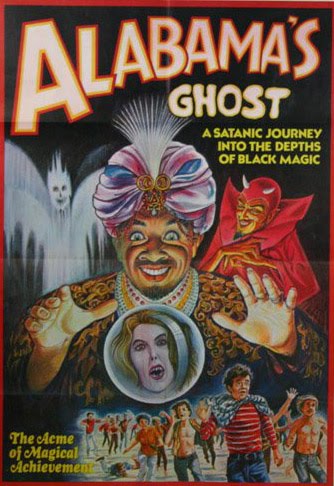
Alabama’s Ghost
(Fredric Hobbs, 1972)


When assessing the work of the select group who comprise cinema’s pre-eminent purveyors of absolute, grade-A blood-curdling lunacy, certain trends quickly become clear.

For some directors – Alexandro Jodorowsky, Jose Morica Marins, Ken Russell say – filmic lunacy functions as a kind of grand ego trip, through which they seek to forcefully impress their strength of character upon the viewer, bludgeoning us with their singular worldview until we cry surrender. And if others in the top tier of weirdness - Nobuhiko Ôbayashi, Takashi Miike, H. Tjut Djalil or Andrzej Zulawski say – are less centrally present in their own work, their MO is equally clear: in one way or another, they seek to freak the audience out, to sicken and terrify us, overload us with information and generally provoke an extreme reaction.

What I think sets Fredric Hobbs – truly a dark horse in the insane-cinema race – apart from his competitors is that he refuses to employ any of these intimidation tactics, yet still makes a powerful run on the great WTF finishing line.

Outside of the handful of feature films he directed in the early ‘70s, Hobbs is best known for his work as a sculptor and designer, and is a frequent recipient of the much-disputed “outsider artist” tag. I’m not going to enter into the debate regarding the correct interpretation of that thorny piece of phraseology, but I will state that the thought-processes at work behind a film like “Alabama’s Ghost” come about as close to defining my own understanding of the term as any other piece of human self-expression I’ve thus far encountered.


In ‘Alabama’s Ghost’, Hobbs – who wrote, directed and produced – makes no attempt to position himself as an artistic visionary or philosophical superman, and I don’t believe that he was seeking to deliberately freak anybody out either. On the contrary, it seems that he was merely trying to tell an interesting story he’d thought up, in a way he thought viewers might find enjoyable. Good for him.

The crucial problem is though: we are not Fredric Hobbs. Every creative decision made during the creation of ‘Alabama’s Ghost’ is different from the one you or I would have made, and when placed within the context of consensus reality, what Hobbs perhaps intended as an easy-going supernatural comedy emerges as one of the most puzzling outbursts of chaotic, inexplicable bru-ha-ha ever committed to celluloid.

Given my morbid preoccupation with trying to reiterate every single noteworthy thing about a given film when writing about it here, I’m afraid that the following review may turn out to be a pretty gruelling experience for both of us. But nonetheless, “Alabama’s Ghost” was a real pinnacle of the kind of stuff I look for in a film, and I owe it to you to give it my best shot. Are we ready? Well ok, let’s go.


“Alabama’s Ghost” begins with an echo-laden monologue, narrated over footage of a darkened cityscape swathed in artificial mist. The monologue is quite lengthy, and packs in a tremendous amount of detail, beginning with a recap of the life and career of an Edwardian magician known as Carter the Great who died in Calcutta in 1935. This much is almost true - Charles Joseph Carter, stage-name Carter the Great, was indeed a legendary California-based magician who died in 1936. The narration then widens its scope to tell us about a female Nazi scientist called ‘Dr. Kirsten Caligula’, who created a substance called “raw zeta” which “when introduced into the human body through Chinese acupuncture techniques” could be transformed into the more malign “deadly zeta”, and could in turn be used as “..a broadcasting catalyst to enslave all humans within the sound of one's voice”. This bit is almost certainly not true.

Eventually, we cut to the film’s opening credits, which take place in a nightclub.


Quintessential Hobbs Moment # 1: Naturally this sequence couldn’t take place in just any old nightclub, so welcome to the end-of-season party at Earthquake McGoons, an Irish(?) bar, in which Mr. McGoon himself leads the festivities backed up by a Dixieland jazz band, singing the film’s somewhat less than melodious theme song as the credits scroll past over his sweaty, former-tough-guy features.

And what credits they are! The cast list promises us groupies, vampires, a sailor, a monkey (played by a human?!), witches, a ‘voodoo drummer’, and one actor who is credited as portraying “Granny/Moxie/Gault”. Plus music from The Loading Zone and The Turk Murphy Jazz Band, and a special appearance by Neena the Elephant! Are you psyched? I AM PSYCHED.


Watching from the bar is Alabama, a hep-cat jazz musician who seems to have been reduced to working as a handyman and general dogsbody at Earthquake McGoons. “Yeah man, that was smooth… like a hundred yellow pussycats dancing on jade”, he says in sarcastic appraisal of Mr. McGoon’s performance, before heading down to the basement to tidy everything away (I’ll skip over questioning what kind of bar-room jazz band needs to store its accruements in heavy storage chests in a vast basement equipped with a forklift truck). Whilst ruing his sorry position in life and expressing his wish to “quit this gig, write my own tunes, blow these cats back into the dark ages”, Alabama accidentally manoeuvres his forklift into a partition wall, revealing a hidden chamber containing… the stage props and possessions of Carter the Great!


As someone who has apparently always harboured dreams of becoming a stage magician, Alabama is overjoyed at this find, and when he discovers a Sausalito contact address for Carter’s family in a box also containing the magician’s personal stash of hashish and ‘Khartoum khaki’ (no, me neither), he decides to check it out.

Cut to the Sausalito sea-front, and Quintessential Hobbs Moment # 2, as Alabama momentarily walks past what looks like the frontage of a gigantic, expressionist cathedral made out of driftwood! This building is only visible for a few seconds and plays no part in the film whatsoever, but, well… what the hell? Was this a Hobbs creation that he just thought he’d throw in? Did it originally play a bigger part in the film? Or was it just THERE when they turned up to film, for some inexplicable reason? I mean, is there actually a giant, weird junk cathedral on the Sausalito sea-front? And more to the point, what kind of filmmaker puts an establishing shot of such a breathtakingly extravagant building into their film, then has their protagonist walk straight past it and go somewhere else..? Fredric Hobbs: I’m only about ten minutes into your film and already I love you.


But anyway: when Alabama makes his way to the Carter residence, where he is introduced to Carter’s elderly, bed-ridden sister, who insists on being addressed as “Granny”. Granny is initially fairly hostile to Alabama’s plans to take on the mantle of Carter the Great, reviving his stage-show for a new era. But after a few puffs of ‘Khartoum Khaki’ she lightens up, and instructs her granddaughter to take Alabama to “Moxie’s Museum”. Moxie, it turns out, is a cantankerous, wheelchair-bound former magician who inhabits a dusty museum of mystic paraphernalia, and who reluctantly agrees to school Alabama in the lost arts of magic.

(Oh, and did I fail to mention that after Alabama leaves, Granny pulls off her wig, unveils her vampire fangs and starts cackling like a wrong ‘un? Well I’ve mentioned it now.)

“Hey, this Iron Maiden of Nuremburg would sure look good backed up with a sound-system… yeah, we’d scare the hell out of them… I’d rattle that cage and make the whole act levitate… then I’d turn all the little chicks into a box an’ make ‘em disappear.. until they turned up in my motel room later on..” enthuses Alabama as he looks over Moxie’s exhibits – another fine example of the nonsensical, stream of consciousness diatribes that seem to comprise our jovial hero’s main way of communicating with the world.


Frankly this Moxie guy (played by the same actor as Granny) seems like a pretty dull customer, so it’s a relief that we’re spared the inevitable ‘training montage’, instead cutting directly to Alabama’s debut performance, billing himself rather immodestly as “Alabama, King of the Cosmos” as he takes the stage at (where else?) Earthquake McGoons.

Alabama wears a Napoleonic frock-coat and tricorn hat, and Granny’s granddaughter (I never did catch her name) is his glamorous assistant. As part of the show, Alabama picks a Hispanic man named “Domingo Burrito” out of the audience, and startles him with accurate facts about his ancestry. Mr. Burrito is then asked to stare into the panels on Carter the Great’s spirit cabinet, behind which he sees a vision of his great-grandfather, a Spanish Admiral, suffering in the flames of hell!

Also in the audience is big-time rock promoter Otto Max, who speaks with a completely unrecognisable accent (part Liverpudlian, part Jamaican, part Indian?), and is apparently greatly impressed with this disquieting, racially uncomfortable performance. Max approaches Alabama as he is chilling backstage on a golden throne, surrounded by adoring groupies (jeez, who knew that an off-season gig at Earthquake Macgoons could bring in that kind of action?) and offers to manage him, giving him the opportunity to expand his magic act into a spectacular touring psychedelic stage-show, and to use Max’s connections in the rock world to catapult himself into the big-time.


Little time is wasted as we cut to a montage of Alabama the Great’s Otto Max supported Psychedelic Spirit Show as it takes America by storm with its irresistible combination of dancing hippie chicks, vaudeville magic tricks, Alabama’s patented blather and the funk-rock fusion sounds of second wave San Fran group The Loading Zone!

To digress briefly, it occurs to me that this ‘psychedelic magic show’ sequence is, oddly, one of the only points at which “Alabama’s Ghost” touches on something approaching the reality of life in California in the early ‘70s. The live music/rock festival circuit in the USA really WAS becoming big business in the later hippie era, and concert promoters in the Otto Max mould really WERE making big bucks and getting big ideas. As a cursory viewing of ‘Woodstock’ or ‘Festival Express’ will attest, this era gave rise to a vast, nomadic audience of field hippies, bikers and miscellaneous drop-outs, all willing to lay down cash to nod out en masse in the open air, being entertained by, well… just about anything really it seems, so long as it involved psychedelic clap-trap and ‘good vibes’. Given the turgid and repetitive nature of much of the era’s bong-addled blues-rock, I’m surprised that some bright spark DIDN’T come up with the idea of presenting a rock n’ roll magic show like the one seen here, if only to liven things up a little.

Recordings I’ve heard in the past by The Loading Zone have never really grabbed me, but, as presented in ‘Alabama’s Ghost’, they’re a pretty tight outfit, noteworthy for a ethnic and gender diversity that is extremely rare for the period. Along with yer standard complement of moustachioed white dudes on drums and guitar, they’ve got a female organist, a female singer (who is oddly never seen on-screen), and a middle-aged black woman who is initially seen playing some wicked soul power style flute, but can later be spotted centre stage, laying down some fuckin’ killer low-end on a battle-scarred Fender bass, as the Alabama-show’s hippie dancing girls gyrate wildly on either side of her. Rock n’ roll!


Anyway, after the completion of Alabama’s first big tour, we cut to another Quintessential Hobbs Moment, as Alabama and Otto Max demonstrate their newfound fame and riches by cruising ‘round town in what can only be described as an elaborate paper mache monster-wagon. It’s the direct analogue of a scene in a more ‘normal’ film when our character might be shown driving around in a brand new Cadillac to signify that he’s ‘made it’, only Hobbs seems to have thought, well, if I was rich and famous, I’d probably prefer to drive an elaborate paper mache monster-wagon… so here we go! This incredible vehicle – a mobile Hobbs sculpture I’m assuming? – is given ample screen time throughout the rest of the movie, but no explanation of its existence is ever offered, and no one seems to consider it unusual, as if celebrity status in this film’s world automatically confers the right to hit the highway in a thing that looks like a parade float built by Clark Ashton Smith! The fact that Alabama and Otto seem to be cruising through an eerily deserted San Francisco suburb that looks like a location from “The Last Man on Earth” only adds to the inherent surrealism of the situation.


The two of them are busy brainstorming plans for Alabama’s next tour, the grand finale of which will be an appearance at a festival at Dune Crest on the California coast, organised by global media mogul Jerry Gault, during which Alabama will for the first time perform Carter the Great’s famed vanishing elephant trick.

Now, making an elephant disappear is a pretty cool trick for a stage magician, don’t get me wrong, but the way people talk about it in ‘Alabama’s Ghost’, you’d think it was some singular spiritual breakthrough for the whole human race – this film’s equivalent of ‘immanentizing the eschaton’ or whatever.

Take for instance the following dialogue exchange with takes place as Alabama and Otto speed toward the nearest hospital in a big, red ambulance carrying a girl who has been injured when one of Alabama’s tricks went wrong;

“I got spooked out there, something happened to me… I’m scared man, what’s gonna happen to me?”

“Shut up Alabama – now you just listen to me will you – shut up and calm down; nothing’s gonna happen to you – the girl’s alright, she won’t talk – she works for me and I’m booking her into a private sanatorium for rich freaks! D’you think I’m gonna blow the deal with the Jerry Gault Worldwide Special just because some chick got a little cut up? You keep working on that vanishing elephant act ‘til you’ve got it down pat like I told ya!”

“But I told you – I’m getting spooked – I promised Moxie I wouldn’t mess around with this elephant stuff, and now weird things’re startin’ to happen to me, like sometimes I think Carter’s ghost is floatin’ around my head… keepin’ a fish-eye on me, some evil fish-eye.. sending bad vibes down around my act..”

“Look, Alabama – if Carter ever shows up, I’ll book him into Miami for the squares, ok?”


Oh yeah, did I forget to mention that the mental and physical strain of preparing himself for the elephant trick has caused Alabama to ‘crack up’ and start seeing visions of Carter the Great’s ghost ordering him around? Well, uh, yeah, that’s happened. The ghost warns Alabama to “beware the vampire’s bloody contract, written in the hand of Gault,” which you’d think would be a pretty clear indication that he should take a second look at the deal with Gault, but Alabama doesn’t seem willing to take the hint.


Maybe this is simply because the ghost is rendered in such classic ‘gory locks’ style – flash of lightning and white face and booming, echoed voice and so on – making it pretty hard to take him seriously. At one point he refers to Alabama as “black man”, prompting our hero to retort, “I ain’t gonna take no shit from no white, racist ghost!” Rumours that this scene provided inspiration for Ray Parker Jr’s Ghostbusters theme until the producers persuaded him to tone it down a little are entirely unfounded, but should start here.

Anyway, between this supernatural hassle, the stress of preparation for the elephant disappearance and the discovery that his glamorous assistant/girlfriend is a flesh-eating vampire, the anxious Alabama eventually suffers some kind of mental collapse, at which point the film finally surrenders it’s last grasp at linear plotting, allowing fantasy and reality to merge into one squelching, boggle-eyed Frederic Hobbs-flavoured mush-swamp…


Alabama is running through some kind of dustball dream landscape, pursued by vampires, chanting “mamma, dadda, mamma dadda” to himself. Eventually he find his way back to his mother, who is rather uncharitably portrayed as living in some kinda derelict, depression-era shack. “Why, there ain’t no vampires living in this town no more,” Mama curiously remarks, trying to calm her son down, “the only vampires I know about moved to the city after prohibition”.

Seeing what a sorry state Alabama is in, Mama takes him to see Doc, the local voodoo witchdoctor guy, who performs a lengthy psychedelic exorcism upon him, calling upon the Loa to rid him of the torment of Carter’s ghost. Perhaps a somewhat less than accurate depiction of voudoun practice, but quite an imaginative one nonetheless, this exorcism involves ‘red Halloween stew’, a strange blue egg, shout outs to “the spooksies, the spooksies!”, and Doc sewing the carcass of a toad over Alabama’s heart.

All this seems to perk Alabama up, and so he, Mama and Doc pile into the monster-wagon and head on down to the festival for the elephant trick.


BUT – as well as a global media mogul, Jerry Gault turns out to be the same vampiric creepo who was pretending to be granny and Moxie earlier on! He has a Bond villain-esque secret lab from which he can monitor all terrestrial communications and beam a live broadcast of the elephant disappearance around the world via satelitte! And not only is he the head of a subterranean vampire cult, but he also fancies himself as some kind of global fascist overlord, and is in league with Dr. Kirsten Caligula (remember her?)!


Terrible, disturbing things happen as Hobbs’ camera spends time probing into Gault’s operations. One genuinely horrifying sequence shows an underground ‘vampire production line’ wherein screaming, naked innocents are tied down on a conveyer belt and chomped upon by hungry, black-hooded ghouls, as gigantic Eraserhead-like industrial machinery wheezes and churns in the background. It really is the stuff of nightmares, operated on a large-scale set with a complement of props and extras that seems far more elaborate that anything that was really required for a quick shock-scene in a movie like this - a more spine-chilling variation on the “I can’t believe I’m actually seeing this” moments that ‘Alabama’s Ghost’ seems to specialise in.


Meanwhile, hippies are converging on the site from miles around, and The Loading Zone are rocking the crowd (I’m assuming Hobbs took crowd footage from some genuine hippie festival and edited in tighter shots of the band playing to a smaller crowd – however it was done, the gathering certainly succeeds in looking impressively huge and pretty authentic).

Once again, Alabama is freaking out – somewhere along the line, he seems to have acquired a ‘proper’ girlfriend, called Midnight, to replace his previous treacherous neck-biting one. She is first seen escaping from the vampire production line, but then just seems to hang out with everybody as if she’s known them all for years…? Anyway, as some other people start to lead a rather sickly looking elephant toward the stage, she’s getting worried that Alabama won’t be able to perform the trick…

“Never mind that,” says Doc, “help me unpack this robot”.

Whaa…?!?!

It was there I think that I just gave up. The rest of the movie’s finale is just a blur.

See! An army of dirt-bikes crest the hill like an echo of Charlie Manson’s mythical dune buggy attack squad, only to be blasted to pieces by lasers from Robot-Alabama’s fingers!

See! Neena the Elephant beat Vampira to death with her trunk!

See! Alabama’s Mama make a daring escape as the monster-wagon careens into oblivion with the nazi-vampire overlord at the wheel!

See! The desert landscape strewn with vampire-hippie corpses, as the human attendees flee for their lives!

A right weirdo-movie hootenanny, basically.

The only thing that could have made it better would’ve been if the film ended with Alabama making a dismissive hand gesture, going “shee-it”, and walking off-screen.


In the tormented paragraphs above, I have tried to communicate the thoughts and feelings that accompanied my initial viewing of ‘Alabama’s Ghost’. But in concentrating wholly on trying to make sense of the events of the film, I don’t think I’ve quite succeeded.

I’ve not told you about the fact that, despite the wealth of extraordinary imagery on display, the film is composed in an extremely plain, matter of fact fashion, almost completely devoid of the kind of stylistic flourishes and audacious psychedelic tomfoolery you might have expected from far-out material like this. As a director, Frederic Hobbs is broadly competent, but never really shows his hand. Like a TV guy, just telling the story seems to be his main concern – a curious approach for a man clearly blessed with such a prodigiously beserk imagination.

Similarly, for a film so stuffed to bursting with unnecessary characters, absurd situations and insane ideas, ‘Alabama’s Ghost’ has an oddly slow-moving, lapsidaisical feel to it, wondering absent-mindedly from scene to scene with no particular hurry. The acting sticks closely to the declamatory, ‘local theatre group’ style that I so love in oddball low budget movies – an almost surreal mixture of careful intonation and exaggerated gesture that it’s hard not to warm to… well, if you’re me, at least. In the role of Alabama, Christopher Brooks (who scored an ultra-weirdo double-whammy by also appearing in Sun Ra’s “Space is the Place”) acts like a one-joke jazzbo beatnik caricature from a sit-com episode who somehow ended up starring in his own movie, and if I say I found him a hugely likeable and engaging protagonist, well, that should probably be measured against the fact that I’d happily watch a three hour movie about life and times of Maynard G. Krebs.

As some of the extracts I’ve quoted above will demonstrate, the dialogue in ‘Alabama’s Ghost’ is long-winded and discursive in the extreme. To give one example, whilst explaining the workings of her robot-Alabama, Dr. Caligula somehow ends up sharing her thoughts on the lifelike nature of the Abraham Lincoln dummy in Disneyland. In fact, all the characters tend to communicate in a kind of vague, repetitive babble that, if it’s not actually THAT far removed from actual human conversation, certainly makes for an odd experience when combined with the unnatural performance style favoured by the cast.

The orchestral score used in ‘Alabama’s Ghost’, by the way, largely sounds like a bunch of crackly, bombastic music cues that could have been pulled straight from an overwrought ‘40s b-movie.

Needless to say, none of the above should be taken as criticisms.

It’s probably redundant to say as much by this point, but ‘Alabama’s Ghost’ really is one of the strangest films I’ve seen in my life. That it manages to touch the very highest echelons of weirdness whilst also maintaining a good-natured, utilitarian earnestness, a simple desire to enthral and entertain, is pretty remarkable.

Frederic Hobbs’ other directorial efforts are “Roseland” (1971), “Godmonster of the Indian Flats” (1973) and the impossibly obscure experimental opus “Trioka” (1969).

God willing, they will all pass before my eyes before too long.