Showing posts with label gaslighting. Show all posts

Monday, 7 October 2024

October Horrors # 3:
Hammer House of Horror:
Visitor From The Grave

(Peter Sasdy, TV, 1980)

In spite of a solid pedigree connecting it back to Hammer’s theatrical era (director Sasdy, plus a script by Tony Hinds under his John Elder pseudonym), this 11th episode of ‘Hammer House of Horrors’ sadly ranks as one of the series’ absolute worst.

The story here concerns a mentally fragile, just released-from-the-nuthouse heiress Penny (‘Dark Shadows’ veteran Kathryn Leigh Scott), who, left at home one night by her boyfriend in the remote commuter belt cottage they apparently share, is menaced and assaulted by a stranger, whom she kills with a shotgun blast to the face (providing the episode’s requisite split second of gore in the process).

When Penny’s obviously caddish BF (Simon McCorkindale) returns to find her absolutely freakin’-the-fuck-out and scopes the mess, he insists they cover up the killing and bury the body in the woods, in order to avoid a return to the institution for her, and charges for owning an unlicensed gun for him. But, before long, Penny finds herself tormented by apparitions of her gory-locked victim, and is driven in desperation to seek the assistance of a stereotypical gypsy fortune teller and an even more stereotypical Indian yogi, in an attempt to exorcise the unquiet spirit of the dead man who is apparently pursuing her.

Aaaand, if you’ve got through that synopsis and/or about ten minutes of this episode without clocking that some gaslightin’ is a-going on here, well… I envy you, to be honest. Watching badly scripted movies must be so much fun for you.

All in all, this is a drab, dispiriting sort of affair with precious little to recommend it. Hinds’ script is hackneyed, predictable and tired, offering none of the shock or surprise which a story like this traditionally demands. I suppose you could credit Sasdy with trying to bring a bit of atmos to proceedings from time to time, but he doesn’t get very far with it to be honest, and also probably also needs to bear a degree of responsibility for the fact that the acting is terrible across the board.

I don’t want to be unduly unkind, but it must be said that Leigh Scott’s attempt here to portray a mentally ill woman is just plain excruciating, comprising largely of flapping about in hysteria and emitting bursts of incomprehensible shrieking. In particular, the moment when she seemingly forgets how to speak midway through attempting to pronounce the word ‘rape’ is unbearably uncomfortable - and probably not in the way she or the filmmakers were intending.

Even she takes second place though to Gareth Thomas, who appears here in full brown-face as the Indian mystic guy, bellowing away in what sounds like a Welsh accent as he attempts to drown out a super-imposed floating head during one of the most unintentionally hilarious séance sequences in screen history.

To avoid needing a file a wholly negative review however, here are a few notes on some minor redeeming features which entertained me along the way:

1. The shot towards the start of the episode showing McCorkindale parking his Jaguar XJS alongside a white Range Rover outside his all-mod-cons thatched cottage nails HHofH’s distinctive “home counties yuppie gothic” aesthetic just way too perfectly [see screengrab above].

2. Likewise, McCorkindale’s thoroughly dodgy character makes a fine addition to this series’ rogues gallery of truly horrible male protagonists, strolling around in a cricket jumper and apparently purporting to enjoy country pursuits and (unlicensed) pigeon shooting, when he’s not disappearing overnight to hang out in Soho wine bars on ‘business’, covering up murders, and getting into disagreements over gambling debts with violent, heavy-handed geezers.

I particularly liked the bit where haughtily declares that he’s been out shooting birds, “to make a pigeon pie for dinner”. I mean, who the hell was making pigeon pies in 1980?! Not this bloke or his pill-popping, neurotic missus, that’s for sure. What an absolute tool.

3. There are also some really cool music cues used in this episode, featuring adorable ‘War of the Worlds’ type fuzz guitar stings and laser gun ‘phew phew’ noises. Marc Wilkinson of ‘Blood on Satan’s Claw’ fame is credited as composer, and I wish his work (assuming that’s what we’re hearing) was higher in the mix.

Unfortunately, ‘Visitor From The Grave’ breaks a long run of really good episodes of ‘Hammer House of Horror’ (the preceding four or five episodes were all absolute bangers - try clicking through to the ‘Hammer’ label below and scrolling down if you’d like to catch up with my thoughts on ‘em). Only two more episodes to go now, before my three year October odyssey finally concludes. Let’s hope they can go out on a high.

Thursday, 21 October 2021

Nippon Horrors:
Girl Divers of Spook Mansion
[Ama no Bakemono Yashiki]
(Morihei Magatani, 1959)


After hitting on the idea that making films about the female Ama divers of Japan’s remote coastal communities could prove a great way to get red-blooded males into cinemas, Shintoho studios must have found themselves wondering just what the hell kind of stories they could actually tell about these plucky maidens of the deep. So, in a sense, the idea of the splicing this nascent sub-genre with the series of interesting, low budget horror films the studio was also making at around the same time [also see: Ghost Cat Mansion, The Lady Vampire] must have been a bit of a no-brainer.

Which brings us to ‘Girl Divers of Spook Mansion’, the first in a brief flurry of ‘spooky Ama’ movies which also produced such unforgettable transliterated titles as ‘Ghost of the Girl Diver’ and my personal favourite, ‘Girl Diver Trembles in Fear’ (both 1960).

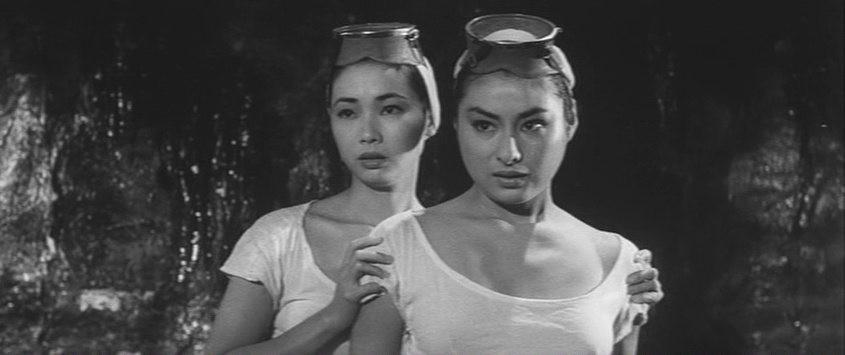
In real life of course, Ama divers were famed for setting out to sea in nothing more than loincloths, but in deference to standards of cinematic decency circa 1959, our divers here naturally all wear neat little halter-tops, big white bloomers and head-scarves. Pervs in the audience may be reassured though that, once they get down to sub-aquatic business, there's a whole lot of transparency goin’ on (all very tastefully done, mind).

(Those still protesting a lack of realism meanwhile may wish to reflect on the fact that, given the extreme physical duress of open sea diving and the level of expertise needed to carry it out effectively, the majority of real life Ama were liable to have been muscular, weather-beaten, mature women, in stark contrast to the happy-go-lucky gaggle of aspiring models and actresses seen strutting their stuff here; accuracy on this point however has never, so far as I’m aware, been demanded by these movies’ audiences.)

Whilst on the subject of the more exploitational aspects of these movies’ conception, Japanese genre film historians (hi, guys) may likewise wish to consider the scene early in ‘Girl Divers of Spook Mansion’ depicting a beach-side cat-fight between the leaders of two rival Ama factions, which plays out pretty much exactly like the equivalent stock scene from any given Toei ‘Pinky Violence’ movie a decade later. Indeed, lead diver Reiko Seto has a hard-boiled attitude and venomous stare that could have could have seen her managing quite nicely on the mean streets of early ‘70s Shinjuku.

Meanwhile, on the horror side of things, viewers expecting a lightweight, ‘Beach Party’ style affair are liable to be taken aback by the film’s unsettling credits sequence, which depicts members of the female cast frozen in various kinds of sinister/monstrous activity, mirroring the kind of tableaux traditionally seen in Japanese ‘ghost houses’ during the late summer Oban season.

Further to this, there is indeed some fairly strong kaidan-via-gothic type stuff to enjoy during the first half of the film, as the more central storyline sees a woman named Kyoko (future Toei star Yôko Mihara) arriving in the Ama village from Tokyo, after receiving a letter from her friend Waka (Kuniko Yamamura).

Waka appears to be living alone in a gigantic, Western-style mansion filled with an entire museum's-worth of dusty old statuary and antique knick-knacks from around the globe - seriously, the set-dressers just went crazy decking out this place - assisted, as as standard in such situations, by staff including a cackling hunchback and a sinister, stink-eye dispensing housekeeper who is often seen carrying a cat (rarely a good omen in these kind of things).

Waka claims she is being haunted by (I think) the ghost of her missing sister, who was last seen running toward the ocean after her husband was lost at sea, and indeed, some wonderfully spooky imagery and a few beautifully executed jump scares ensue. (Seriously, if jump scares were competitively-rated ala ice-skating, I’d hold up a “9” for these - just perfectly done.)

Disappointingly of course, it eventually becomes clear that the supernatural elements of this haunting are all phony, as Waka is actually being gas lighted by a gaggle of pleasingly maniacal villains who are looking to steal the family treasure, which it transpires is hidden in an underwater cave (and they would have gotten away with it too, if it weren't for those meddling pearl divers!)

Once the penny drops, there's still plenty to enjoy in the film’s more light-hearted, action/adventure-orientated second half however, including heavy Nikkatsu vibes as local youngsters groove to what sounds very much like Hawaiian music in the tiki-style beachside bar, and the wonderfully overplayed antics of the aforementioned villains (who include a corrupt, kimono-clad local politician and a lecherous, cigar-chomping fake marine scientist).

As is almost always the case with Japanese films of this era, the scope photography is splendid throughout, with the stuff in the shadowy, snake-haunted cave during the final act standing out as particularly atmospheric, even as it leads up to a great, LOL-worthy demise for the main villain. Perhaps best of all though, we get to enjoy the presence of a young Bunta Sugawara, making only his fifth credited screen appearance here as Mihara’s cop boyfriend. Spending much of his screen-time strutting around, Tarzan-style, in a pair of swimming trunks he appears to have stolen from a small child(!), Bunta makes for an engaging and off-beat presence here, as well as offering ‘a little something for the ladies’ in the midst of all the diving girls.

In closing, I should probably point out that I watched ‘Girl Divers of Spook Mansion’ without the benefit of subtitles, hoping that a rudimentary knowledge of basic Japanese vocab and a general familiarity with b-movie plotlines would see me through. As a result, I fear there were probably a number of story elements and sub-plots going on here which completely passed me by, and even the basics I've outlined above should be taken as a ‘best guess’. But nonetheless, I enjoyed the film a great deal.

Irrespective of the language barrier, the mixture of elegant, spook-house atmos, wistful seaside nostalgia, pulpy serial plotting and strangely wholesome titillation on offer here has much to recommend it, and viewers with a yen for the, uh, gentler side of Asian horror shouldn’t hesitate to dive in (sorry, couldn’t help myself) without delay.

--- 

Poster image borrowed from the ever-wonderful Pulp International.