If we were to chart Roger Corman’s engagement with socio-political issues in his work upon some kind of hypothetical scale, then at the opposite end of it from the uncomfortably effective The Intruder, we would find ‘Gas-s-s-s!, or, It Became Necessary to Destroy the World in Order to Save It’ [henceforth ‘Gas’, just for the sake of our sanity], an inexplicable, rather hare-brained movie which, over fifty years later, is difficult not to see as one of its directors greatest failures. (I mean, say what you will about Creature From The Haunted Sea, but at least it had reasons for being crap.) (1)
This is extremely regrettable, given that the project represents an important milestone in Corman’s career on a number of levels. Not only does it mark the conclusion of his cycle of ‘counter-culture’ films (following on from ‘The Wild Angels’ in ’66 and ‘The Trip’ in ’67), but also his final collaboration with American international Pictures (following fifteen years of fruitful co-dependence), and in fact his final work as a director of independent commercial cinema in the United States. (2)
So, what’s ‘Gas’ all about then? Well… it’s difficult to say really, and that very uncertainty soon becomes a pretty big part of the problem.
A pastel crayon animated prologue introduces us to some high ranking military officials (including such personages as ‘General Strike’, and ‘Dr Murder’ - and if you find that magazine cartoon level of humour uproariously funny, there’s hope you might enjoy this movie yet), who, in the process of attending a ceremonial function at a chemical research base in Alaska, accidentally uncork a beaker containing a cloud of custom-made poison gas which now promises to spread across the earth, killing everyone aged over twenty-five.
Moving into live action post-credits, we meet a long-haired, wise-crackin’ campus troublemaker (Bob Corff) and his adorable, only marginally less wide-crackin’ girlfriend (Elaine Giftos), who depart Dallas in a salmon pink Cadillac and promptly get involved in a series of tiresome comical capers, eventually joining forces with a group of other sketchily-defined, more-or-less hippie-aligned young people (including amongst their number both a young Bud Cort, and one Tally Coppola, later to become Talia Shire). Together, this merry band traverse a marginally post-apocalyptic version of the American South-West, enduring a multitude of symbolic / quixotic encounters and threats as they vaguely pursue an Oz-like quest to consult an ‘oracle’, whose billboards (including a count-down in miles) they spot along the highway.
And… that’s about it, really. I mean, I wish I could tell you what the wearying procession of factions, marauders, aggressors, cultists, herd-like victims and all-purpsoe extraverted weirdos our protagonists run into along the way were actually meant to represent, but, as the film’s attempts at satirical humour alternate wildly between blunt, eye-rolling obviousness and head-scratching, lost-in-translation obscurity, it is honestly difficult to locate anything here which we squares might term a ‘point’.
Which might have been all well and good, if only Corman and his collaborators been able to wrangle some other value from these narratively unglued proceedings, but, sadly, the kind of pupil-dilating visual excess and subversive, taboo-breaking chaos which defined the era’s more successful underground/counter-cultural filmmaking is in very short supply in ‘Gas’.
Shot in a range of uninhabited / wreckage-strewn desert locations across Texas and New Mexico, the film’s footage soon becomes fairly monotonous, in spite of the natural beauty of the surroundings and some intermittently impressive photography from DP Ron Dexter. The tone of the action meanwhile remains cloyingly light-hearted, employing a gratingly twee take on hippie-era surrealism, whilst the characters remain vacant, distant and uninteresting.
Even the garish, mid-century Americana of the costumes and production design simply remain… standard issue, for the most part. Please bear in mind that I say all this as a viewer who usually maintains an extremely high tolerance for what Kim Newman has termed ‘Weird Hippie Shit’, but in a word, ‘Gas’ simply feels tired.
Just a few short years earlier, Corman could reasonably have claimed to have had his finger on the pulse of the intersection between popular culture and the underground (after all, ‘The Wild Angels’ not only launched a whole new era-defining genre, but provided direct aesthetic inspiration for generations of proto-punk rebels in the process).
The shadow-haunted autumn/winter of ’69 though found Corman and screenwriter George Armitage (future director of ‘Grosse Pointe Blank’ and the fantastic Miami Blues) beginning work on ‘Gas’ at precisely the moment in which the optimism of the 1960s evaporated, leaving something darker and more fragmented behind it, ready to curdle as the decade turned… and ensuring that the film’s happy-go-lucky, flower-child hipster-isms must have felt painfully irrelevant by the time their film finally opened in September 1970. (3)
In this context, scenes which may have passed as wild, Godardian po-mo provocations back in the mid-‘60s (such as the film’s lampoon of a western shoot-out, in which characters point their fingers at each other whilst shouting the names of famous cowboy actors) simply play out as eye-rolling tedium - self-satisfied acting class wheezes dragged out for far longer than is really necessary.
Indeed, for a Corman production, ‘Gas’ feels uncharacteristically bloated and excessive. Shot across multiple locations in several states (and dogged by inevitable weather-related delays along the way), he seems to have become fixated here on mounting vast public spectacles of one kind of another.
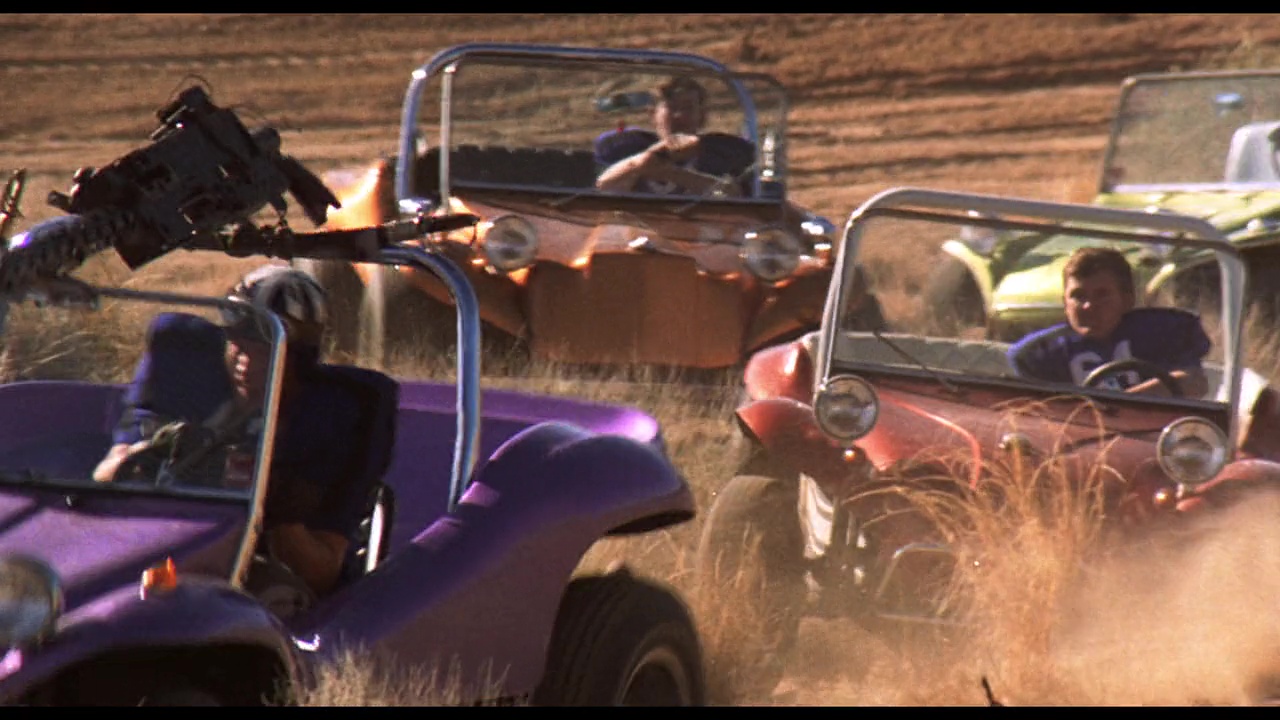
The finished film is stuffed full of marching bands and parades, crowds of extras fleeing through the streets of Western town sets pursued by gangs of stuntmen on brightly painted bikes and sidecars, convoys of golf carts, JCBs and tooled up dune buggies (triggering entirely accidental flashes of Mansonoid paranoia), cheerleaders, football teams and hundreds of people crammed onto a remote mountaintop for the film’s conclusion… all, ultimately, to very little effect.
Amidst all this sound and fury, it becomes difficult to avoid the conclusion that the man who once shot a film as beautifully crafted as ‘Little Shoppe of Horrors’ on a single set in two and a half days has lost his way very badly somewhere along the line.
Perhaps the sole quantifiable pleasure I took from ‘Gas’ in fact came from the music - and this is entirely due to the fact that I’m a big fan of the perennially underrated Country Joe & The Fish, and in particular of their gifted lead guitarist Barry ‘The Fish’ Melton, who was charged with composing ‘Gas’s songs and incidental cues (as heard in the rare moments when the brass marching bands, cheerleading chants and honking car horns shut up for a few minutes). (4)
It’s nice to hear the various bits and pieces Melton came up with (recordings never otherwise released, insofar as I’m aware), and we also get to enjoy some choice footage of the band in full flow at some kind of outdoor festival held at a drive-in theatre, backed up by a bitchin’ psychedelic light show, inter-cut with footage of two of the young hippie characters making out during an acid trip, and accompanied by subliminal flashes of underground movie-style abstract imagery.
Arguably the film’s strongest sequence, the overall effect here is only partially spoiled by the presence of Country Joe McDonald (who I’m fairly sure would not have made the twenty-five year old cut-off point required for this movie’s plot, incidentally) doing some kind of terminally unamusing skit about how he’s an omnipotent, god-like figure named ‘A.M. Radio’, or somesuch. (My god, this obnoxiously performative, satire-lite fucking hippie ‘humour’, I swear… it’s enough to make me want to shave my head and enlist in the nearest para-military organisation post-haste.)
Aside perhaps from hardcore C.J. Fish fans though, it’s difficult to imagine that anyone at the time of ‘Gas’s original release was actually digging what Corman was laying down here. Whilst ‘straight’ audiences must have simply been confused and alienated by all this mystifying hullaballoo, the campus radicals and garage band suburban punks the movie was presumably supposed to appeal to would surely by this point have felt patronised and turned off by its parade of quirky, central casting hippies mouthing half-baked flower power witticisms, long past their sell-by date in the hyper-accelerated climate of mid-century pop culture.
Even within the sphere of disastrous, released-too-late hippie movies, ‘Gas’ ranks low, lacking the lo-fi earnestness of the Firesign Theatre’s “electric western” ‘Zachariah’, the wild artistic vision of Dennis Hopper’s ‘The Last Movie’ or the magisterial visual gimmickry of Antonioni’s ‘Zabriskie Point’.
But the saddest thing of all is that, despite all this, ‘Gas’ seems to have been a project which mattered to Corman a great deal.
He spends over five pages of his 1990 memoir ‘How I Made a Hundred Movies in Hollywood and Never Lost a Dime’ discussing the film, acknowledging the gruelling nature of the production, and regretting his decision to begin filming without a finished script. But, he also speaks enthusiastically of his success in creating “an apocalyptic, Strangelovian satire,” - one which, sadly, sounds a lot more exciting in Corman’s recollection than any of the footage which actually ended up on the screen;
“My films and my politics were getting more radical, more “liberated,” as the 1960s were coming to a close. I was truly beginning to believe I could do anything, which is why the picture ran a little out of control. Any idea that came to us, we would put in.”
[…]
“We ended up with some pretty wild and surreal images. We had a group of Hell’s Angels riding in their colors in golf carts instead of their choppers. The Texas A&M football team became a band of marauders on dune buggies, terrorizing the Southwest. We had Edgar Allan Poe speeding through the frame on a Hell’s Angels chopper with a raven on his shoulder, making comments from time to time. […] We re-created the Kennedy assassination while it was sleeting. Then we finally got to the Acoma mesa, which is virtually cut off from civilization, accessible only by a steep and winding dirt road.”
Although everything Corman describes can kind of be seen in the movie if you squint hard enough, I think the failure of any of it to actually make much of an impression on the viewer simply goes to prove that, much as I love him, Roger Corman was no Alejandro Jodorowsky. Logic, working within fixed limits and careful advance planning were the engines which powered his best cinema, and the mellow ideals of middle class So Cal suburbia remained his aesthetic base-camp, even as the wily tendrils of psychedelia and European decadence repeatedly threatened to drag him further afield. At the end of the day, maximalist cosmic wig-flipping was simply not his bag, man.
Nonetheless, Corman remained extremely unhappy about a number of cuts he claimed were made to ‘Gas’ in post-production, and which he blamed primarily on AIP’s James H. Nicholson, whom he felt had become increasingly conservative and intolerant of risk-taking in the films his company released, citing these arbitrary cuts as reasons for the film’s incoherence and commercial failure.
Strong words perhaps from a man who in later years would become famous for insisting his protégés’ films came in at under 88 minutes in order to save on film canisters, but above all, AIPs decision to cut the film’s intended final shot remained a source of great bitterness to Corman, ending one of the longest and most productive relationships in the history of independent cinema on an extremely sour note;
“The unkindest cut of all was the last scene. I ended the film with a spectacular shot from on top of the mesa, with a view sixty, seventy miles to the horizon. We had the entire tribe there and everyone else who had been in the film. It was a celebration. The leading man kisses the woman and I zoom back. It was a cliché I had never used to end a film. I did it precisely because it was a cliché. I had the entire marching band of the local high school. I had a whole group of Hell’s Angels. I had a bunch of guys on dune buggies. I had a football team. I had our whole cast in this wild celebration as the camera zoomed back and over the shot. God, who was a running character throughout the film, made his final comments on what went on.
There must have been three hundred people on top of that mesa. It was one of the greatest shots I ever achieved *in my life*. And AIP cut the entire shot. They ended the picture on the couple’s clichéd kiss - because they didn’t like what God was saying. The Picture ended and made no sense.”
For a more revealing take on Corman’s state of mind during the production of ‘Gas’ though, I think the last word must go to production manager Paul Rapp, quoted in the same book;
“The ‘Gas-s-s-s!’ shoot was the toughest one I ever saw Roger go through. I had never seen Roger in a nasty, bad mood like that. He seemed very down, snarling and weary. The Dallas sequences were around Thanksgiving and they had all-time record cold and blizzard conditions. It was miserable. Roger was shivering the whole time, wearing the same parka he had for ‘Ski Troop Attack’.
[…]
The day we set up the last sequence at the mesa Roger seemed really adrift. The Indians were terrible to work with. He seemed isolated, almost directing like a robot. The last scene was a big action shot with the entire cast, dune buggies, motorcycles, and the whole Indian tribe coming together. The first take was a complete mess. Roger just sat there. I got everybody back in their positions for a second take and looked over at Roger. He just nodded. I called action for him, and surprisingly, this time it went perfectly. Roger got up from his chair slowly, thanked everybody, and said very quietly, “Let’s go home.” (5)
---
(1)According to IMDB trivia, ‘Gas’s lengthy sub-title was inspired by an unnamed Major in the U.S. Army, who is alleged to have justified the total destruction of a Vietnamese town and its inhabitants on the basis that, “it became necessary to destroy the town in order to save it” - a reference which would have stood as the darkest and most effective piece of satire in the entire picture, if only an effort had been made to draw the audience’s attention to it.
(2)The WWI aerial combat epic ‘Von Richtofen and Brown’, which Corman shot in Ireland for United Artists, saw release in 1971, and subsequent to that he did not return to the director’s chair until 1990’s ‘Frankenstein Unbound’ - a film which I would argue stands more as a one-off vanity project produced by his own studio (albeit, a very worthwhile and interesting one) than as a strictly commercial proposition.
(3)Ironically in view of how badly the film falls victim to it, it’s interesting to note that Armitage’s script for ‘Gas’ is both aware of the hyper-accelerated fashion cycle of the ‘60s, and indeed pokes fun at it via the character played by Cindy Williams, a devotee of ‘old timey’ pop music who hangs around the jukebox listening to “golden oldies” by the likes of Jefferson Airplane and The Grateful Dead; a familiar motif found in near-future fiction written at the time by slightly bamboozled older geezers, and in Thomas Pynchon novels all the way up to 2009.
(4)It seems that Corman had originally planned to make ‘Gas’ with The Grateful Dead appearing on-screen and providing the soundtrack, only to end up - in characteristic Corman fashion - telling them to get lost when they turned up demanding more money than had been agreed upon, and immediately getting Country Joe on the line instead.
(5)All quotes in this review are taken from ‘How I Made a Hundred Movies in Hollywood and Never Lost a Dime’, by Roger Corman with Jim Jerome (De Capo press edition, 1998), pp. 162-167.
Goddamn hippies. They turn up when you least expect it, don’t they?
I thought I had pretty much mapped out the entirety of the ‘hippie horror’ sub-genre a few years back (around the time I started making this thing), but these unexpected stragglers just keep dragging me back in.
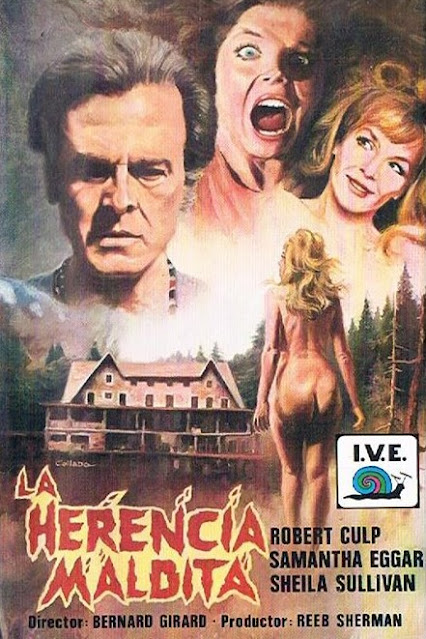
On the surface of things, ‘A Name For Evil’ appears to be a sort-of-haunted house movie, theatrically released in ’73 with name stars Robert Culp and Samantha Eggar. Writer/director Bernard Girard was a TV veteran who occasionally made the jump into features, but even his one paragraph IMDB bio notes that “the majority of his film output has been routine”.
Cueing this up of a weekday evening, I was expecting, I suppose, some fuzzy, bucolic mid ‘70s TV movie vibes. Perhaps a bit of a pre-Stephen King, ‘Flowers in the Attic’/‘Burnt Offerings’ airport paperback kind of feel?
Well, I certainly got all of that. Indeed, we’ve got sun-dappled ‘70s cathode ray ambient gorgeousness as far as the eye can see. But, I also got so much more… and simultaneously, also kind of… much less, if you know what I mean (man).
Right from the outset, things are a bit… off. The distinctly Corman/Poe-esque opening titles consists of super-imposed/interweaving close-ups on a series of Bosch-via-Bacon expressionist paintings. Even more unnervingly however, the titles appear to have been set in some ‘70s equivalent of comic sans, and inform us that this is a “a Penthouse Production presentation”. Hmm.
The weirdness continues as footage of sunshine shimmering on water is cross-faded with images of construction cranes, cement mixers and skeletal tower blocks. “I don’t wanna build filing cabinets twenty stories high,” construction company exec John Blake (Culp) protests in voiceover. “I wanna build something beautiful! Every time I come into the office it makes me sick - I’m getting outta here!”
I don't know whether he’s turned on and tuned in yet, but John Blake is certainly ready to drop out. He wears a mustard yellow shirt, a funky neckerchief and brown leather jacket, and tells his middle-aged secretary that she’ll soon be “wrapped in cellophane, on sale for 49 cents a pound” if she doesn’t quit her job.
Via fragmentary, vérité type footage reminiscent of a ‘Medium Cool’/‘Putney Swope’-esque counter-culture satire, we see Blake triumphantly quit the rat-race for good, leaving his enraged brother/partner to pick up the pieces. (“You’re as loony as your great-grandfather The Major, and you’ll end up the same way - nuts!”)
Returning to his penthouse apartment (or, “this infernal plastic anthill”, as he likes to call it), Blake continues to talk anti-materialist turkey with his presumably long-suffering wife Joanna (Eggar). Obviously their relationship is on the rocks (because, y’know - the ‘70s), but John hopes that his plan to relocate to (and subsequently renovate) a beautiful yet dilapidated lakeside timber frame mansion he has recently inherited will bring them back together.
He also takes the opportunity to throw his television set off the balcony, allowing us to watch it descend to the ground and shatter in slo-mo, ‘Zabrinskie Point’-style (a particularly sweet moment for director Girard, one imagines), just in case he hadn’t quite made his point clearly enough yet.
Later that evening, John is rapping in the general direction of his sleeping wife, telling her how they’re going to “..find out the truth, together” (try looking for it when she’s awake next time dude, I think you’ll find that yields better results), when suddenly, without warning, sitars and tamburas are blaring on the soundtrack, and we cut to gel-lit, heavily super-imposed footage of naked, bead-covered dancing girls gyrating to the sound of a drowsy, finger-picked guitar which has joined the ersatz Indian drone. Sound the klaxon! Red alert! We’ve got some full strength hippie shit going on here.
Never fear though, it all vanishes as quickly as it arrived, and after a brief fantasy sequence in which Culp and Eggars try to embrace through a pane of glass (SYMBOLISM), we’re back in the ‘real’ world. It goes without saying of course that the aforementioned mansion has reached John’s ownership through the family line from the aforementioned ‘Major’, and, once the couple reach it, they learn - much to John’s joy and Joanna’s chagrin - that it is also both, a) completely uninhabitable, and b) located way out in the back of beyond, with nothing but suspicious, gimlet-eyed creepy locals as far as the eye can see.
Particularly notable in this regard is Jimmy (inexplicably played by Kansas City jazz legend Clarence ‘Big’ Miller), the mansion’s simple-minded live-in caretaker, whose role seems to consist of lumbering around refusing to do any work, creeping up on people when they least expect it, and occasionally muttering things like, “once the Major’s, always the Major’s”. (A pretty demeaning, racially stereotyped role for a renowned musician like Miller to take on, I would have thought, but… who knows.)
Anyway, things progress more or less as one would imagine, and, in terms of both plot and atmosphere, ‘A Name For Evil’ seems to fit squarely into the “city folk with back-to-nature aspirations hit the country and get more than they bargained for” mould of ‘Let’s Scare Jessica To Death’ (1971) or Dark August (1976).
But then, during the second half of the film, things get increasingly tripped out and unglued - so much so that it started to put me more in mind of, I dunno, Brianne Murphy’s ‘Blood Sabbath’ (1972 - real dark heart of brain-fried regional hippie horror, that one) or Tonino Cervi’s witchy political allegory ‘Queens of Evil’ (1970), with a touch of Altman's nightmarish ‘Images’ (’72) lurking about in the background somewhere too.
Before we get to all that though, I must confess that I kept nodding off whilst trying to watch ‘A Name For Evil’ - a factor which would normally prohibit me from attempting to review a film, but in this case, I’ll make an exception. Because, the fact is, ‘A Name For Evil’ is a great film to fall sleep to - so much so that it often feels like it could have been made explicitly for that purpose.
Once the basic set-up has been established, very little happens. The horror element is extremely mild and unthreatening (basically just the ghost of The Major turning up occasionally to whisper in people’s ears or interfere with some building work), whilst the whole thing is so dream-like and sedate already, what with all those fuzzy, bucolic forests and shimmering lakes... after a while, you just end up closing your eyes and going to nice places. It’s inevitable. Just go with it.
At some point about two thirds of the way through the film, I awoke from a little snooze to find Robert Culp was riding a spectral white stallion through the forest to some kind of local bar / barn dance place, where there are campfire sing-alongs and wrestling contests going on, huge platters of spaghetti are being thrown around, and folk-pop singer Billy Joe Royal is on stage, performing his song ‘Mountain Woman’. (1)
Blake begins dancing with a blonde woman (Culp’s real life fourth wife Sheila Sullivan). She tears his shirt off, and suddenly the camera goes fish-eye crazy and everyone is naked! There are human pyramids of head-banging naked people. Billy Joe Royal is surrounded by naked girls as he strums his guitar. It’s a kaleidoscope of nudity!
Then, we’re outside, and there are are weird, naked pagan hippie ceremonies going on out in the woods. Culp and Sullivan make wild, passionate love on the forest floor, as the distant strains of ‘Mountain Woman’ reverberate ceaselessly in the background.
I'm pretty sure I didn't dream any of that. I think it all happened... within the movie, I mean. Whether or not it happened to Culp’s character, who can say.
Crawling back to the shack the next morning like a soggy tom-cat, John slips indoors and immediately gets into a situation with Joanna, who gives him hell for ruining her sleep, insisting that he actually spent the night next to her, “masturbating like a fourteen year old child”(!) This line is subsequently repeated several times in voiceover (as if it wasn’t bad enough the first time around), as Culp wanders around amid his beloved nature, looking aggrieved, and presumably reflecting on his inability to separate fantasy from reality, or somesuch.
But then, he drives back to the bar / barn dance place (so I guess it must be real?), and meets up again with the blonde woman (so I guess she was real too?), and they start having heavy conversations about, y’know…. life, and stuff.
Man, what a weird movie. It only marginally counts as horror, but the half-hearted supernatural elements, creepy atmospherics and monied, middle-aged protagonists jibe so strangely with the discombobulated psychedelic / counter-culture stuff which takes up so much of the run-time… just where in the hell was this thing coming from? And more to the point, where was it going? (Cos either way, I have a feeling it didn’t quite get there.)
Once again, we must turn to the oracle of the IMDB trivia page for answers:
“Filmed in 1970 as a psychological thriller that parodied then-modern society, production swelled over budget and MGM ultimately shelved the movie. Three years later, Penthouse magazine's movie division acquired the rights to re-cut the film and market it as a horror movie.”
Well, I suppose that helps clear a few things up (not least the film’s persistent reliance on off-screen voiceovers), but… I mean… I’m still not sure this version of events quite makes sense.
I mean,
one assumes Penthouse’s number one priority would have been adding more sex to
the film, but, all the gratuitous nudity and weird orgy stuff occurs within the
hippie/counter-culture sequences which I’m pretty sure must have formed part of
the original 1970 footage. OR, did Penthouse actually acquire this film
BECAUSE it had loads of naked people in it, and then realised that the rest of
it was a load of (by ’73) heinously outmoded hippie blather, so tried to turn it
into a horror film instead..? But, that scenario doesn’t work either, because
visual elements of the ‘horror’ plotline (ie, the ghost of and the
spooky occurrences he instigates) are embedded within footage featuring the
principal cast and original locations from 1970, so…. agh, I don’t know.
Goddamned hippies. They never make it easy for us, do they? Whatever untold stories lurk behind the battered extant prints of ‘A Name For Evil’ though, they don’t really matter. It is what it is, and I make no apology for loving this kind of ambient, plotless weirdness and the unique and beautiful moment in culture which allowed it to exist, so… yeah. Dig it, and so forth.
At the time of writing, a tape-sourced print of ‘A Name For Evil’ can be acquired free of charge from Rare Filmm.
---
---
(1)Quoth Wikipedia: “Billy Joe Royal (1942 - 2015) was an American country soul singer. His most successful record was ‘Down in the Boondocks’ in 1965.” Insofar as I can tell, ‘Mountain Woman’ does not appear in his discography of recorded work, but it was written by acclaimed session player and producer Emory Gordy Jr, with lyrics by Ed Cobb - the man who gave the world The Standells’ ‘Dirty Water’, Gloria Jones’ ‘Tainted Love’ and the career of The Chocolate Watch Band, amongst other things. Far out.
“Tex then told Sadie to scout the house for other people. She evidently climbed up the redwood ladder to look in the loft. And then she walked to the south, toward the hallway off which were the two main bedrooms of the house. In the room on the left, Abigail Folger lay reading alone. She looked up, she saw Sadie, and Abigail waved! Waved and smiled, and Sadie smiled back and walked away. Hi death.”
- p.233
Long ago, in my late teenage years, I decided it was time for me to overcome my natural distaste for ‘true crime’ subject matter and get the full dope on this whole Manson Family business, which I kept finding fearful references to in the ‘60s counter-culture books and rock biogs that composed the bulk of my non-fiction reading at the time.
A remaindered copy of Los Angeles County Assistant D.A. & Chief Prosecutor Vincent Bugliosi’s exhaustive 1974 book ‘Helter Skelter: The True Story of The Manson Murders’ certainly did the trick with regard to nailing down the essential facts of the matter (or, the officially recorded versions thereof, at least), but at the same time, the book’s mountain of dry, forensic detail raised as many questions as it answered, particularly with regard to the aspect of the whole business that most interested me – that being, the wider cultural and sociological circumstances that allowed these insane events to transpire in the first place.
When I learned of the existence of Ed Sanders’ ‘The Family’, I naturally supposed that an investigation undertaken by a member of The Fugs might shed a slightly different light on things, but sourcing a copy of Sanders’ book proved difficult at the time, and besides, I didn’t really have the stomach for reading two massive Manson tomes in quick succession.
Fast forward to 2019 however, and I’ve actually ended up with two paperback copies of ‘The Family’ (boring story not worth recounting here), so, with Charlie himself now finally six feet under and the ever-classy Quentin Tarantino apparently revving up his new, Manson-related movie for release to coincide the 50th anniversary of the Tate-LaBianca murders… the time finally seemed nigh to actually read the damned thing. (1)
Before continuing, I should issue a disclaimer to clarify that I generally take a dim view anything which seeks to glorify and/or obsess over the activities of real life serial killers. In and of himself, Charles Manson was little more than a psychotic confidence trickster and pimp, worthy of no more interest or respect than any other creep who has ever made a career out of exploiting human misery.
What fascinates me rather is the frequently extraordinary nature of the marginal – and otherwise largely undocumented - worlds in which Manson moved, and the unique socio-cultural circumstances that allowed him to achieve such remarkable success (in psycho cult leader terms, at least) within them.
Manson’s followers have often been likened to locusts in terms of their tendency to hoover up cash, drugs, vehicles, food, crash-space and favours from anyone who gave them even the slightest opportunity to do so, but in the same way, Charlie himself strikes me as a kind of cultural locust.
In addition to his extensive and well-documented connections to the music and movie industries (which we need not reiterate here), the wider scope of Manson’s activities also seemed to encompass various other cult religious groups, assorted ‘hippie’ communities (including the core San Francisco scene centred around The Diggers, The Grateful Dead and the Haight Ashbury Free Clinic), several fringe Christian churches, Scientology and its shadier off-shoots, Anton Lavey’s comical Church of Satan, certain therapy / self help institutions, behavioural/hypnosis specialists and the formative roots of California’s New Age culture, along with the world of literary science fiction, prison sub-cultures (of both racist and homosexual varieties), college students and Berkeley activist groups, pirate radio broadcasters, underground and documentary filmmakers, the world of strip clubs, go-go dancers and ‘stag films’, outlaw motorcycle gangs, desert motor-racing enthusiasts, a wide variety of drug traffickers and manufacturers, the community of stuntmen and cowboys hanging around the Spahn Ranch, and even the culture of modern day gold prospectors and wilderness homesteaders whom The Family interacted with in Death Valley.
Excepting perhaps Dennis Wilson, I’m not aware that Manson ever hung out with any surfers (his activities being primarily directed in-land), and his virulent racism prohibited him from interacting with any black, Latino or Native American sub-cultures (despite his constant bleating about “Black Panthers”, there doesn’t seem to be any evidence that he was ever even in the same zip code as any of them) - BUT, that aside, it seems as if pretty much EVERYONE who has was cultivating a lifestyle outside of the square, mainstream norm in Southern California in the late 1960s was touched by the dirty fingers of Manson at some point, and the groups on the above list who had any credibility to begin with all found themselves degraded and damaged to some extent by the association. Meanwhile, he managed to feed something gleamed from every single one of them into the insane, indigestible gumbo of his eventual ‘Helter Skelter’ project.
II.
How did so many doors open for him? That’s the question that fascinates. Purely in terms of his attempts to infiltrate the entertainment industry, the fact that a character this unkempt, criminally-minded and evidently deranged could manoeuvre himself into a position one step removed from figures of such diverse cultural import as Doris Day, Kenneth Anger, Nancy Sinatra and Neil Young, is remarkable. Even if he’d never turned to murder, Manson's exploits as a kind of Sunset Strip Rasputin would remain intriguing to those of us with an interest in this particular historical milieu.
And happily, as the back cover blurb for Panther’s UK paperback of ‘The Family’ strongly implies, these wider connections between Manson and the cultures he managed to infiltrate is very much the subject that Sanders gets stuck into herein, striking an extremely precarious balance between credibility and sensationalism in the process.
At the outset, I was slightly worried that, given his own sub-cultural affiliations, Sanders may have been tempted to take a more sympathetic line on Manson and his cronies than Bugliosi, but rest assured, he goes even harder on them than the Chief Prosecutor, if such is possible, with his pejorative-heavy descriptions of the Family members betraying the anger of a man who has seen the public image of the movement he tied himself to warped and discredited by the actions of a bunch of kill-crazy goons.
As anyone who taken even the slightest interest in this stuff will be aware, attempting to research the wider activities of the Manson Family is liable to lead one pretty quickly into a bottomless Death Valley black hole of mis/disinformation, rife with missing links, random dead ends and irresolvable contradictions. For each verifiable fact that can be established about The Family, there are a thousand rumours, exaggerations and outright lies to contend with.
As Sanders outlines in his introduction, his method for dealing with this was basically to trawl through the testimony of anyone and everyone who interacted with The Family and proved willing to talk about the matter (indeed, the author implies that his hippie/yippie ‘cred’ allowed him access to deeper sources than the authorities were able to tap), and then to cross-reference these interviews against a map and timeline outlining (as far as is possible) the locations and activities of the killers, their associates and (where relevant) their victims. Basically it seems, everything that proved both interesting and not verifiably untrue made it into the book, leaving us to draw our own conclusions.
As we’ll discuss below, Sanders’ excursions into the further realms of speculation got him into no small amount of trouble, and the accuracy of more or less everything he throws into ‘The Family’ remains open to question, but, when you’re dealing with a set of witnesses who were likely various combinations of stoned, mentally ill, terrified, brain-washed and self-interested at the time of their testimony, I’d argue that he was probably right to retain as many of the “apparently”s, “allegedly”s and “it is reported that..”s as possible.
I do wish that Sanders had been a bit more forthcoming about his sources, and a bit more circumspect about the wilder rumours he offers up as ‘fact’, but at the same time, when it comes to defining the contours of the vast psychic maelstrom emanating from the undeniably grim realities of Hollywood, August 1969, I tend to think there is probably just as much value in hearing what people were saying about the events in their immediate aftermath, as in the cold hard facts themselves – and, so long as you can take him with a generous pinch of salt, Sanders’ book certainly provides an invaluable record of the former.
III.
“It seems strange that all of a sudden they got in to wearing black capes. The girls made Charlie one that reached to the floor. With a flourish Manson tried it on, remarking how no one for sure now could see him when he creepy-crawled. Mary Brunner had a black cape. Sadie had a cape. Squeeky, according to Danny DeCarlo, used to dye clothing black in a pot in the Spahn Ranch kitchen.”
- p. 185
If nothing else, the version of Charlie presented here was certainly industrious. Whereas you’d naturally expect a messianic cult leader to express hostility toward competing gurus, Manson, in keeping with his locust-like M.O., often seems to have actively encouraged the crossover of personnel and ideas between his ‘Family’ and various other groupings of fringe whackos, and Sanders’ book is particularly strong when it comes to making the case that the Mansonites were not an isolated phenomenon, but merely the most high profile symptom of a entire network of similarly demented (and potentially dangerous) groups who seemed to flourishing on the far outskirts of American society.
It is reported, for instance, that in 1968 Manson was present as a “guest of honour” at a bizarre trial / exorcism rite undertaken by some kind of homosexual “death cult” operating out of a commune house (the Waller Street Ashram, otherwise known as the “Devil House”) in Haight Ashbury. During this alleged event, a young man identified only as “Pussycat” – the former lover of the cult’s boss, one Father P., who is later said to have visited Manson at Spahn Ranch - was put through a series of gruelling ordeals to try to save him from a supposed demonic possession orchestrated by a deserter from the group. “Poor Pussycat,” quoth Sanders. (2)
The author also spends a full chapter outlining the eye-opening history of an outfit known as the Solar Lodge of the O.T.O., an illegitimate off-shoot from the branch of the famed Crowleyite magickal order, which seems to have mutated by the late ‘60s into a controlling personality cult masterminded by a woman named Jean Brayton, the wife of a USC philosophy lecturer.
Like The Family, The Solar Lodge made their home on a remote desert ranch, and there seems to have been a clear crossover of ideas (and, Sanders implies, personnel) between Brayton’s group and the Mansonites. Brayton is reported for instance to have also preached a gospel of hard-line racism, predicting the approach of an apocalyptic race war and telling her followers they would need to hide-out in underground caverns to survive the resulting carnage (sound familiar?).
The control Brayton and her husband exercised over their followers seems to have been even more sadistic and authoritarian than that practiced by Manson, but, thankfully, The Solar Lodge was put on ice in July 1969, when their leadership was arrested en masse on child abuse charges, after some horse traders who had visited their ranch called the police, having observed what investigating officers later confirmed to be a six-year-old boy chained up in a six foot square wooden crate and left exposed to the desert sun – which gives us some insight into the kind of outfit these particular creepos were really operating.
It should be noted however that, despite the publicity surrounding this ‘boy in the box’ case, Sanders’ claims regarding Manson’s connections with the Solar Lodge seem never to have been verified elsewhere. A brief web search reveals that the Braytons – who were soon back on the street and heading up another neo-Crowleyite religious order after initially fleeing to Mexico to avoid the child abuse charges – actually initiated legal action against Sanders in 1973, reaching an out of court settlement which ensured that the entire chapter related to the Solar Lodge was excised from future editions of ‘The Family’. Presumably, Panther’s UK paperback, dated that year, must have made it to the printers shortly before this agreement came into effect. Lucky me! (3)
In parallel with the Solar Lodge, Sanders also raises the spectre of a particularly shady motorcycle gang known as the Satan’s Slaves, whose members are alleged to have provided the connecting tissue between the Solar Lodge, the Mansonites, the Ku Klux Klan and something the author refers to as the “Kirke Order of Dog Blood” (seriously, don’t ask). (4)
“There are subjects associated with the Manson case that are so soaked in evil that the mere knowing of them is like a nightmare,” Sanders states later in the book, kicking off a chapter in which he addresses rumours of unidentified Satanic groups (presumably, but not definitively, connected to the quasi-mythical Kirke mob referenced above) carrying out animal sacrifice / blood-drinking / orgy rituals on several remote West Coast beaches in 1968-69. Pretty hair-raising stuff.
Sanders goes on to print verbatim the transcript of an interview with a young male Manson Family hanger on, who claims to have been present at the Spahn Ranch when a set of films – apparently made by another cult group – were screened, depicting both the killing of domestic animals and the apparent decapitation of a human female, carried out in ritual circumstances on a nocturnal beach.
To be honest, the interviewee sounds pretty out of it, but Sanders insists that the information he provided on other subjects proved reliable, so – make of this what you will. As far as I’m aware, nothing concrete on any of this has ever come to light in subsequent decades, so by this stage, it’s nothing more than another sinister, apocryphal underground legend to add to the ever-growing bonfire of such, any grain of truth lost in a long-forgotten vortex of misfiled missing persons reports and blighted, undocumented lives.
In fact, Sanders seems to have had a real bee in his bonnet about the possibly that The Family may have filmed some of their own crimes (presumably using the equipment they stole from a CBS outside broadcast truck in early ’69?), repeatedly hinting that certain “uptight persons” are holding back information from him on this subject to protect their own skins. Whoever these “persons” were, they must have done a pretty good job, because again, fifty years on, this hypothetical footage remains elusive, insofar as I’m aware. (5)
Amid all this shady occult networking, I was surprised to note that Sanders’ book entirely overlooks Manson’s widely documented connections to that most infamous of Scientology spin-offs, The Process Church of the Final Judgement. The details of Manson’s interactions with The Process Church became public knowledge so early in the game that they even made it into New English Library’s otherwise largely fictitious Manson book (which I wrote about here), so it seemed surprising to me that Sanders would have ignored such a rich vein of High Weirdness.
Well, guess what – the first edition copy of ‘The Family’ consulted by writer John Anthony Day for this review, published in The Harvard Crimson magazine in 1971, apparently contained an extensive (indeed, the reviewer claims, excessive) amount of information concerning Manson’s connections to The Process. But, Day also notes that Robert De Grimston, founder of the Process Church, had launched a $1.5 million lawsuit against Sanders and his U.S. publishers. So, consulting the entirely Process-free 1973 U.K. paperback, we can probably guess how that worked out. (6)
IV.
Sanders’ narrative becomes even sketchier, and even more queasy, when he occasionally turns his attention to the wider scope of The Manson Family’s crimes – unsolved category. Basically this consists of a grim run down of unsolved killings (primarily rape-murders of young women, with a weirdo/mutilation element) which were committed during 1968-69, at points when Sanders’ research leads him to believe that members of The Family were in the immediate vicinity.
As you can well imagine, reading capsule summaries of these cold cases – each of them a potential mini-Black Dahlia, just waiting for the True Crime podcasters to descend – is a grim business, and I’m actually not sure which possibility is more disturbing to contemplate; that Tex, Clem, Charlie and the gang were occasionally enjoying a brutal “boy’s night out” as they drifted hither and yon across the West Coast, or alternatively, that these killings actually had nothing whatsoever to do with the easy scapegoat of Satanic psycho-hippies, instead simply representing yr average, run-of-the-mill crime stats for a large American state over a two year period, the faceless perpetrators simply blending back into the mainstream ebb-and-flow of society and keeping their heads down. (7)
Of all the legally dubious claims contained within ‘The Family’ however, Sanders perhaps sails closest to the wind when he isuggests a connection between Charles Manson and the Esalen Institute, a storied and influential spa resort and spiritual / therapeutic retreat based in Big Sur, which survives to this day.
These claims centre around the admittedly intriguing fact that, a week prior to the Tate-LaBianca killings, Manson seems to have jumped behind the wheel of a stolen Hostess Twinkie bakery truck and spent a weekend tooling around the Big Sur area – entirely on his own, unusually, although he did manage to recruit a new Family member / sex slave / punching bag (a pregnant seventeen-year-old named Stephanie) along the way.
Sanders believes that Manson travelled to Big Sur to visit Esalen, and indeed, various rumours to this effect swirl about the lower depths of online Manson-ology. This is significant due to the fact that Cielo Drive murder victim Abigail Folger was a frequent visitor to the Institute, and Sharon Tate may or may not have also attended at some point.
The suggestion of a tangible connection between Manson and his future victims is chilling enough in itself, but once again, Sanders over-plays his hand by stating, apparently apropos of nothing, that both Folger and Tate were present at Esalen on the same weekend that Manson allegedly visited – a suggestion which I’m sure is contradicted by the official record, if not elsewhere in this very book.
Unsurprisingly perhaps, the Esalen Institute have spent the past fifty years vigorously denying that Manson ever came anywhere near them (their statements on the matter have been pretty weird and contradictory however, but.. that’s another story), and indeed, Sanders reports that a cast iron veil of secrecy hangs over the whole affair, even stating that representatives of the Institute have issued what he describes as a “veiled snuff threat” against him, should he persist in pursuing the matter.
Was there another, subsequent edition of ‘The Family’ with the references to Esalen also redacted? I wouldn’t be surprised. (8)
Exactly how many re-drafts did the text of this book go through to avoid legal action, I wonder? Three, four? I mean, I’m guessing the Kirke Order of Dogs Blood were unlikely to put a call through to their lawyers, but even so, if Sanders took some of the stuff he reports here remotely seriously, he must have spent a few years in fear of waking up some dark night with the smell of axle grease in his nostrils and a curved blade pressed to his throat.
V.
“There was one heavy problem facing Helter Skelter. By early 1969, the West Valley Station of the Los Angeles sheriff’s department had in use Bell-65 two-man helicopters with powerful searchlights installed that could light up a city block from 1000 feet in the air. Manson had various plans to deal with these helicopters. One was to attack the helicopter with magic. Another method was to thwart the helicopters at night by taping the headlights of the dune-buggy battalion with black tape, leaving only a small slit to allow a thin ray of light to escape, hopefully undetectable from the air.”
- p. 124
There is much more I could go on to say about other aspects of ‘The Family’; there is so much rich, soggy flesh here to pile onto the bones of the crazed milieu Manson and his followers operated within. Not least, the significant portion of the book which Sanders devotes to outlining the vast auto-theft / dune buggy manufacturing ring orchestrated by the Mansonites during their final months of freedom - an operation which proved necessary simply to keep the cult’s membership mobile and maintain supply lines across the incredibly inhospitable terrain which Charlie seemed increasingly fixated on forcing his followers to inhabit.
As is implied by the book’s memorable sub-title, Sanders details Manson’s apparent dream of drilling his Family into a unit of full on, ‘Road Warrior’ style desert outlaws, undertaking armed raids on the small towns bordering the Death Valley national monument, carrying off food and women like some kind of motorized neo-vikings, and bamboozling the cops from their impenetrable network of underground hidey-holes.
Even if they’d been left to their own devices however, the chances of The Family achieving this level of self-sufficient barbarity seems remote. Another thing that becomes clear from Sanders’ book is that, far from their rep as ruthless killers, these hapless hippies – many of them nursing either young children or severe mental illness by the time Helter Skelter took hold – were simply not prepared for the hardship of the desert.
As food and shelter became scarce, as Charlie became more violent and demanding, and as lines of communication between various outposts started to fray, The Family’s vital biker allies disappeared, and tertiary family members began drifting away at a steady rate, several of them walking vast distances across the desert in the search of help.
When a combination of armed police units and National Park officials finally began carrying out raids and pulling the Mansonites into custody on grand theft auto and arson charges in September/October 1969, the roving miscreants are reported to have been in an appalling physical condition, riddled with sores and parasites and caked in mud to protect themselves from the sun, the girls having tonsured and shaved their hair into bizarre, Mohawk-ish arrangements….. a far cry from the heady days of '68, when Gregg Jakobson and his fellow “golden penetrators” would cruise over to the group’s latest Hollywood hang-out to enjoy a few sexual favours in exchange for vague promises of booking Manson in for another studio session.
Where might this trip have ended, if the authorities hadn’t moved in to put a stop to it? Would the whitened bones of The Family’s hardcore members and assigned assassins now be buried in the sands of some distant canyon, as survivors of the nastier end of biker/field hippie sub-culture mutter darkly of their legend, and probable fate?
God knows, it certainly would have saved the State of California a lot of time and effort, and given a few generations of “transgressive culture” assholes and neo-nazis one less incarcerated icon to look up to.
Crazy, man. Crazy.
A song for the closing credits:
----
(1) I was initially shocked to hear that Tarantino (and, more to the point, the studio marketing bods backing him up) had decided to tie-in the release of their new movie with the anniversary of – uh - *a mass murder*, but cooled down after reflecting on Jello Biafra’s memorable answer to a question re: whether a Dead Kennedys concert on the anniversary of JFK’s shooting was in good taste: “well, the assassination wasn’t very tasteful either”.
(2)It is interesting to note that, despite his racism, misogyny and relentless enthusiasm for heterosexual congress, Manson never seems to have espoused any homophobic sentiments, having spent much of his of early life exploring the “other side of the tracks” whilst incarcerated.
(3)Those wishing to journey further down the Brayton / Solar Lodge rabbit hole are advised to begin here.
(4)Trying to google up some info on the Satan’s Slaves who were active in California in the mid/late ‘60s turns up practically nothing, beyond the knowledge that dozens of other motorcycle clubs have used the same name over the years (most prominently in the U.K.), and a reference to a California-based gang bearing that name who were “patched over” by (ie, incorporated into) The Hell’s Angels in 1978.
(5)Adult film fans with a stronger stomach for research than myself may wish to take note of the following paragraph, from p. 126: “Around this time [January 1969] Charlie and the girls made a pornographic movie by the swimming pool at 2600 Nicholas Canyon Road in the hills above Malibu. The producer, according to Los Angeles homicide officers, was Marvin Miller.” Your safety filter-free search engine of choice awaits.
(6)It seems ironic in the extreme that De Grimston should have filed for defamation against Sanders in the same year that The Process Church’s official magazine proudly published an article dictated by Manson from his prison cell, but Jesus/God/Lucifer/Satan moves in mysterious ways I suppose.
(7)The timeframe of Sanders’ book, it should be noted, discounts the inclusion of the several rather more compelling “officially unsolved” murder cases which sprang up in parallel with the trial of Manson and his co-defendants during 1970, including the violent death of at least one woman who severed ties with the remnants of The Family, and the mysterious disappearance of a controversial and reportedly incompetent attorney who for a time was representing several of the Mansonites in court… until he reportedly went on a camping holiday and never returned, delaying the trial for several weeks as a result. But, this isn’t a True Crime blog, so I’ll shut up now, and let you investigate further, should you wish to.
(8)If you’ve somehow found your way out of the other internet wormholes I’ve dumped on you so far in this post, take a leap into this one for everything you need to know re: Manson and Esalen. My own takeaway is that, compared to a lot of these rumours, the kernel of this one actually seems pretty plausible.
I mean, it’s certainly not beyond the realm of possibility that Charlie may have called on the Institute, either to try to connive his way in as a guest lecturer/visiting guru, or to audition for someone involved in organising Esalen’s annual folk festival, and that he may have subsequently kept quiet about it to salve his ego after the Institute - known for its tight security and elitest attitude - presumably just told him to get lost. From there, is it too much of a stretch to suggest that, in the depths of his enraged, stoned/paranoid mind, he might have pegged the Esalen crowd as the same “type” he encountered when he scoped out 10050 Cielo Drive in search of Terry Melcher? And, a week later, Helter Skelter time? We will likely never know, but hey - it’s a theory. What’s that? Oh yeah, NOT A TRUE CRIME BLOG. Sorry.
Very sad to hear this week about the passing of Czech filmmaker Věra Chytilová, who directed one of my all-time favourites ‘Sedmikrasky’ (‘Daisies’) in 1966.
In the unlikely event that anyone bothered to ask me, I’d be inclined to pick ‘Daisies’ (no pun intended) as one of the key works of ‘60s counter-cultural cinema, and I recall that Chytilová’s particular mixture of formal / political radicalism, raucous entertainment value and dream-like fantasy was very much on my mind vis-à-vis the kind of thing I wanted to look at when I started this blog, even though I never actually got around to writing about it.
Sadly, the notions of “ground-breaking feminist cinema” and “psychedelic slapstick mayhem” don’t coincide as often as perhaps they should, but ‘Daisies’ stands tall as a rare and joyous example of what can be achieved when things are done right – a unique, funny, bizarre, sexy, other-worldly, thought-provoking and staggeringly beautiful film that also represents a definitive example of one of my favourite imaginary sub-genres - “surrealistic movies about young women who have zany adventures, upset people and generally ferment anarchy for no good reason”, a category of films that would be just as numerous and popular as, say, kung-fu if I had my way. (Also see Smashing Time, Louis Malle’s ‘Zazie Dans Le Metro’, Jacques Rivette’s ‘Celine & Julie Go Boating’.)
Of course, Chytilová left a whole life’s worth of other film & art projects behind her too, and I daresay she’d be pretty pissed off at the 95% of casual obituary writers who have just concentrated on her ‘greatest hit’, but what can I say – laziness and lack of time has thus far denied me the opportunity to engage with her wider work, which, along with numerous other less heralded works of the Czech New Wave, is currently lost somewhere on my long-list of potential viewing priorities, but… one day, one day.
A more informative obit, along with a Vimeo window that allows you to watch the entirety of ‘Daisies’ (why, that can’t be allowed, surely?), can be found here.
Even more-so than movies or comic-books, you might assume that lower tier sci-fi paperback designers would have been a bit slow in picking up on youth culture trends, but just look at all this bad trip, pop-art madness - merely a taster of the innumerable eye-grabbing volumes that were hitting shelves prior to 1970, all waiting to be harvested from book fairs and charity shops the world over.
All of the above are more or less trad pulp skiffy yarns enlivened by some way-out graphics, but by way of contrast, here’s a rather toe-curlingly try-hard attempt to bring SF to the new youth market. The logic is sound: hippies read sci-fi, and half the people who write it seem to veer in that direction too, so let’s bang out some sci-fi for hippies. The execution however? I think I'll pass. ('She Stripped For Cider' in the author biog made me laugh though.)
Wikipedia reveals that 'The Unicorn Girl' is the middle volume of an apparent 'Greenwich Village Trilogy' published by Pyramid. Characters were shared, but each volume was written by a different author, the other two being respectively credited to underground press luminary and Crawdaddy! editor Chester Anderson, and "professional magician and magic author" T.A. Waters. Presumably any resemblance between "Mike and Chester, fearless hippy explorers of a thousand worlds" and their apparent creators would be wholly coincidental..?
(Pyramid, 1969)
All cover artists and designers featured in this post are uncredited, by the way.
The second or possibly third entry in the Stray Cat Rock series (as they were filmed back to back and realised in pretty quick succession, the chronology is kinda unclear), ‘Machine Animal’ is a more substantial venture than Toshiya Fujita’s light-weight Wild Jumbo, but it’s still pretty throwaway stuff in the grand scheme of things, and can probably best seen as a warm up for Yasuharu Hasebe’s more accomplished work on the exhilarating Stray Cat Rock: Sex Hunter, released later the same year.
Far milder and less salacious than the Toei pinky violence movies that quickly followed, the ‘Stray Cat Rock’ films (with the notable exception of ‘Sex Hunter’) stick pretty closely to the format of post-‘Hard Days Night’ youth/pop music movies, assuming a jaunty, upbeat tone and interspersing their gang war/crime caper storylines with cod-psychedelic musical interludes, way-out fashion shows and assorted goofy montage sequences, rich in gratuitous split screen, camera swirl and other low budget visual effects. What differentiates these Japanese youth movies from their Western counterparts though is of course the fact that they’re prepared to go so much further with their counter-cultural mischief. Restrained as ‘Machine Animal’ may be in view of what came later, it’s still hard to imagine a similarly light-hearted American film in which the heroines get ahead in life by hot-wiring cars, fighting with knives and wantonly guzzling LSD, and it’s that spirit of unrepentant, amoral wildness that keeps us coming back to these films, helping to render even such comparatively minor efforts as this solidly entertaining.
And speaking of wildness, the promise of crazy shenanigans would certainly seem to be on the table when it becomes clear that the plot-line here concerns Meiko Kaji’s gang (the same one seen in ‘Sex Hunter’, to all intents and purposes) getting mixed up with a couple of lively characters who have arrived on their Yokahama turf harbouring an American deserter from Vietnam, and hoping to pay their way out of the country using profits from the 500 hits of acid they’re carrying. Crikey. Contemporary or what?
Sadly, our dreams of a wild sukeban trip sequence are never quite realised – the girls who initially sample the goods just act a bit dopey for a while then get over it, whilst limited means and sparse production design prevent the later ‘freak out’ sequence from really scaling the heights of psychedelic delirium the way we might have hoped, although it’s nice enough as far as these things go.
It’s also nice to note that, whilst they may have been slightly more enthusiastic about it than their American counterparts, Japanese filmmakers were apparently just as clueless about the emerging drug culture, as witnessed by the fact that LSD in the Stray Cat Rock world comes in the form of industrially produced pharmaceutical capsules that can be gulped down by the dozen with no apparent ill effects – a goofy detail that sits well alongside the ridiculous stream of beatnik-via-blaxploitation banter that the fan sub-titles on my copy of the film subject us to. (I mean, not that I’m saying the characters aren’t presumably busting out their best Nippon hep-cat moves at any given point, but if you’re reading sub-title dude, I’d love to know the precise Japanese vocab for “you jive turkey!” or “friggin’ dames!”)
Though it’s only fully manifested in ‘Sex Hunter’, one interesting aspect of all the SRC films – missing from many of Toei’s later PV flicks – is their political undercurrent, particularly as regards the tensions raised by the influx of foreign culture and foreign visitors into post-war Japan (even the air-headed ‘Wild Jumbo’ features buried crate of WWII weaponry and a scene in which Meiko Kaji and Tetsuya Fuji humiliate some American tourists). Of course much of the angst-ridden contradiction that makes ‘Sex Hunter’ such fascinating viewing arises from the fact that, socially and culturally speaking, these youth movie owe their entire existence to the influence of American culture, and as such, ‘Machine Animal’ seems to present a proudly internationalist vision of Japan, with scenes taking place in a Greek bar, a German bakery and an American bowling alley.
The presence of a sympathetically portrayed Vietnam deserter meanwhile seems like a particularly daring inclusion, especially as by far the film’s most harrowing moment comes when he’s mercilessly gunned down by Japanese police, in what seems like a clear nod to the agenda of Japan’s militant student protest movement. (It must be said however that the effectiveness of this storyline is undermined somewhat by one of the film’s strangest time/budget-enforced inconsistencies, vis-à-vis the fact that this brave refugee from the good ol’ USAF is portrayed by a bemused looking teenage Asian guy who speaks broken English in a broad Japanese accent.)
In keeping with a lot of other sukeban flicks, the girl gangers here are initially presented as being somewhat subordinate to their male counterparts, with the opening scenes seeing them riding as passengers with the male ‘Dragon Gang’, rather than conducting their own gang business. In fairness though, the plot does swiftly move in the direction of a male/female gang war (just like in ‘Sex Hunter’, actually), and ‘Machine Animal’ is one of the relatively few sukeban movies I can think of in which the girls actually DO get to do some bike-riding at one point.
But again, the inept / tongue-in-cheek execution of said sequence tends to foul things up a bit; “Jeepers! We need our Hondas!” Meiko (allegedly) exclaims about an hour into the film, and the subsequent scenes in which the girls putter about on two-stroke mopeds sporting groovy goggles & colour-coordinated helmets as they slowly negotiate a series of carefully placed ramps and obstacles are pretty hilarious to be honest – obviously shot as quickly and cheaply as was humanly possible, presumably without the use of any stunt personnel, and generally played for laughs.
And, as in ‘Sex Hunter’, the girls’ street gang abilities are compromised to the extent that they don’t even take part in the fighting during the movie’s final showdown, instead standing round helplessly as the two male heroes duke it out with their opponents – disappointing, to say the least.
Ah well. One thing Stray Cat Rock movies are usually good for at least is rockin’ music and awesome psychedelic nightclub scenes, and, although some of the incidental music is pretty square, ‘Machine Animal’ certainly delivers the goods in this respect. In the Astro Go-Go Club, the girls’ hang-out of choice, silver-clad girls dance suspended above the stage on an elaborate scaffolding type arrangement, whilst a female organist/flautist busts out some wild prog moves, leading a Sunset Strip styled garage band through a couple of loungey yet enjoyable tunes (a soundtrack note on IMDB identifies the band as Zee Nee Voo, if that means anything to Group Sounds aficionados out there). I’d love to tell you that Hasebe’s presentation of these performances matches the psychedelic splendour of ‘Sex Hunter’s club scenes, or the director’s earlier pop-art triumphs in 1966’s ‘Black Tight Killers’, but sadly that’s not the case, and again, things seem rushed, with unimaginative lighting and awkward jump cuts giving things of bit of a ‘70s Top of the Pops vibe (UK readers will know what I mean).
Elsewhere, Michi Aoyama – a singer/actress who turned up in at least a couple of other films for different studios during the ‘60s – makes a memorable appearance as a 12-string strumming folk goddess who hangs out in the aforementioned Greek bar, where she dissolutely belts out a couple of ballsy, low-register blues numbers that are genuinely rather fantastic. Further information on her life and career would certainly be welcomed, should anyone have any.
Meiko Kaji too is her usual cool self, with her trademark vengeance-hat present and correct and the solemn, untouchably bad-ass persona that she’d adopt in so many classic movies over the next few years already well in evidence – more-so than this material demands or deserves, really. It’s notable that her character doesn’t take drugs or join her sisters in the gang acid freakout, and maintains a discreet distance from the rest of the film’s goofy hi-jinks too. Basically it doesn’t take a genius to spot that she had her eye on more demanding, tonally ‘serious’ roles than Nikkatsu were offering her here. Naturally the beautiful, lonesome ballad she sings to an empty boat-shed is another of the film’s highlights (although sadly, for all his/her jive-talkin’ fortitude, the sub-titler of my copy has neglected to provide translated lyrics for the film’s songs – always one of my favourite aspects of watching these movies).*
Regular SCR male lead Tatsuya Fuji also fares pretty well in ‘Machine Animal’, as one of the two acid-dealin’, deserter-shelterin’ dudes, and Meiko’s presumed love interest. This time playing neither a raging psychopath nor an insufferable goon, he’s surprisingly effective as a kinda rough-hewn, free-wheeling leading man in the Peter Fonda mould, revealing some of the charisma that made him a minor star in the Nikkatsu cosmos, prior to his later ascent to cinematic immortality in Nagisa Oshima’s ‘In The Realm of The Senses’ in ’76.
If it seems like I’m concentrating a lot on such incidental detail here, that’s largely because the actual thread of this movie’s plot after the initial set-up has been established is crushingly simplistic and repetitious, as drugs, then money for drugs, then hostages go back and forth and back and forth between film’s feuding factions like some infernal merry-go-round, seemingly for a lack of any other ideas to keep the narrative ticking over, until we just want the damn thing to end.
Nonetheless, Hasebe does his best to maintain interest, throwing in a lot of the kind of “just for the hell of it” formal experimentation that the SCR series does so well, with split screens, slo-mo etc. all present and correct, helping to generate a real out-of-nowhere emotional charge for the film’s few serious/violent moments, and pointing the way toward the stylistic tour de force of ‘Sex Hunter’, a film that sees all the best elements hinted at here magnified ten-fold.
In keeping with previous ‘Think Pink’ entries, I’ve uploaded a few of the film’s best musical moments for you here.
*Although it may seem like I’ve dissed the poor subber(s) a
few times in this review, I’d nonetheless like to earnestly thank them
for their efforts – I realise it’s a lot of hard work for zero reward,
and without their help I’d probably never get the chance to watch films
like this one with even the slightest understanding of what was going
on, so please, keep up the good work guys – it’s appreciated.




 ---
---