Showing posts with label pirates. Show all posts

Wednesday, 26 September 2018

Dennis’s Library (#33):
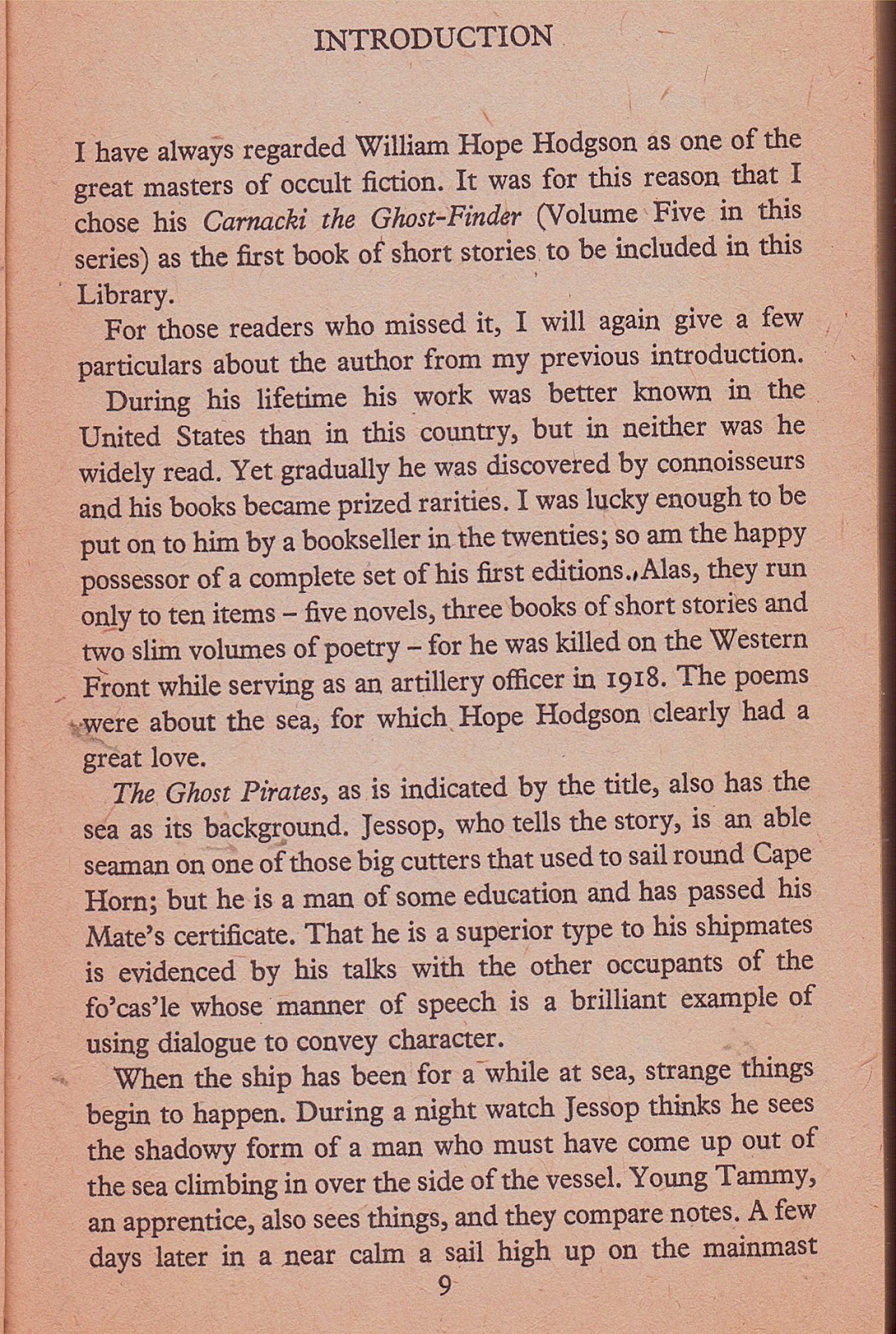
The Ghost Pirates
by William Hope Hodgson

(Sphere, 1975)

After searching for this book for much of my adult life (because if one of the greatest cosmic horror authors who ever lived had a yarn about Ghost Pirates, I want to read it), I actually found this copy in Japan a few years back, bizarrely enough.

I had intended to use it as the basis for one of my (long-neglected) series of Weird Tales posts, but after I actually started reading it, I soon put that idea aside.

It’s not that the book is disappointing as such, but… well let’s just say that it was clearly written as much for enthusiasts of nautical fiction as for fans of ghost stories. As such, the story’s supernatural elements are introduced extremely slowly and with great subtlety, whilst the relentless application of highly detailed seafaring jargon meanwhile leads to the book becoming quite difficult to follow for readers who grew up subsequent to the Great Age of Sail.

Much of the action concerns sailors running around different parts of the ship preparing for different weather conditions, and as such, a diagram to help us landlubbers identify the various decks, masts, sails and rigging referenced in the text would have proved extremely helpful. Characterisation meanwhile is fairly minimal, making it difficult to engage with what seems like a fairly boilerplate narrative of a band of able seamen caught between the regime of a sadistic and unreasonable First Mate and that of a distant and allegedly drunken Captain.

As is usually the case with Hodgson however, the novel’s supernatural revelation, when it does finally arrive, is actually a bit of a mind-blower. Rather than being harried by a more traditional ghost ship, it turns out that the vessel upon which the books characters are sailing has actually become trapped between dimensions, and thus is kind of ‘overlapping’ with the space occupied by an alternate universe vessel whose malignant, spectral occupants are gradually picking off our human crewmen one by one.

Pretty freaking far out, especially when you consider that Erwin Schrödinger first introduced the theory of parallel universes into popular thought in 1952, over forty years after ‘The Ghost Pirates’ was first published.

Here’s what Dennis had to say on the matter:

Thursday, 9 February 2017

Two-Fisted Tales:
Cutlass Empire
by F. van Wyck Mason

(Jarrolds, year unknown [1949/50?])


As I have probably mentioned here before, there is a tradition in the area in which I live that sees people, apparently unable or unwilling to pay a visit to the charity shop of their choice, leaving all manner of unwanted objects – furniture, books, children’s toys, random junk – outside their homes, inviting neighbours and passers-by to take what they please.

Usually, the boxes (or merely piles) of books that turn up on an almost weekly basis yield little of interest, but – sometimes – you strike gold.


Sir Henry Morgan (1635-1688) presumably needs no introduction here, but the details of his life and death remain absolutely extraordinary, even before they received the F. van Wyck Mason treatment. (Interestingly, Morgan also provided the inspiration for John Steinbeck’s first novel, ‘Cup of Gold’ (1929), which I’d imagine must make an interesting contrast with the accounts of his exploits found here.)

F. van Wyck Mason (1902-1978) meanwhile was a prolific pulp writer of the 1920s and 30s who seems to have switched his attention to historical novels from the ‘40s onward, penning upward of fifty such volumes prior to his death at the age of 76 – presumed drowned whilst swimming off the coast of Bermuda, apparently.

Wikipedia summarises Mason’s writing style as “colourful though straightforward”, and indeed, this claim is more than borne out by a few random-page-openings of ‘Cutlass Empire’, in the spirit of which, I offer you the following;

pp. 11-12:

“Aware of a powerful and steady growing appetite, Harry turned his steed into a very narrow and dark cobbled street that reeked of manure, sewage and cooking odours. He Smiled. At the other end of this noisome thoroughfare lay the Angel Inn – and Anne. Darkly demure, she should be waiting, eagerly, tenderly.

A wider grin curved the rider’s sun-cracked lips. And then there was always Clarissa to be enjoyed, providing she had not gone a-visiting up-country. Plague take it, he’d far from forgotten the curious golden-white loveliness of her hair and the fresh pink of her complexion.

He urged his mount to a faster walk. No telling when a window might open and, to a cry of ‘Ware slops!’, a bucket of swill, excreta or trash might come raining down upon the greasy cobbles.

In his mind’s eye Harry Considered Anne Pruett. Like most people born in the West Country, she wasn’t tall and her soft, dark brown hair would be caught up by a bow over the nape of her neck; there was something infinitely provocative about her slightly upturned nose and grey-green eyes, and short but vividly tinted features. Heigh-ho! A sturdy, generously built wench was Mistress Pruett’s daughter, and just blossoming into a bountiful maturity. Certes! Anne’s curves seemed designed by nature to fit, ever so comfortably, into a fellow’s arms.

Would three weeks’ separation have softened her resistance? Harry assured himself it must have. A perplexing lass, this Anne Pruett – ‘twasn’t often one came across a tavern keeper’s brat who cried ‘No!’ and seemed to mean it.”

pp. 107-108:

“Enoch Jackman long since had reeled in to sprawl, snoring like a dozen foghorns, across the untidy, earthen floored bedroom, but Captain Achille Tribitor, master of a brigantine just returned from a moderately fortunate cruise off the coast of Cuba, continued singing louder than ever. More than half drunk, he plucked at a Potuguese guitar and happily serenaded the various gecko lizards reposing themselves against the palm thatch roof of Anytime Polly’s ramshackle ordinary.

As for Morgan, he sat glowering at an earthenware jug of fiery rum which had cost him the exorbitant sum of two pistoles; the stuff wasn’t worth even a tenth of that sum, but, in Cayona, one had to expect such brigandage.

The more he considered old Watts’ contemptuous dismissal of his plea for even a small independent command, the more resentful he grew. Not one of the other captains had led his men so successfully that his command had not been reduced by a single casualty.

‘The Devil fly off with that old wrinkle-belly,’he gloomed. ‘If only he wasn’t Susan’s father –-‘

[…]

Ready good nature mercurially restored, Morgan bellowed with laughter at the vision of a pagan god perched among the elms shading the old walled farm in Llanrhymny. He remembered now if whom the the ‘Red Rose against the Grey Wall’ reminded him.

Susan! By heavens – was it not utterly amazing that so charming and delicate a maid could thrive on the roistering coast of this barbaric island – like a beautiful flower on a dung heap?

Rose! That’s what Susan was – a rose. Morgan smiled to himself – a wise, private little smile. Dear Susan. After the soul-dulling brutalities, the crass savagery, the unbelievable obscenities he had experienced in the past three years, her presence was like a long cool draught to a sailor perishing of thirst.

Tribitor struck a loud chord on his guitar. ‘One observes,’ he remarked, ‘that you, mon ami, are at heart a poet and a great trouveur. Surely the angels in le bon Dieu’s heaven must be envious.’

‘Aye, I’m a poet,’ Morgan admitted. A rare, a supremely wonderful, inspiration was kindling his imagination. What of that golden rose from the bishop’s palace? True, he had been saving that superb example of the goldsmith’s art for an especially auspicious occasion, but by heavens he wasn’t going to wait! Tonight – yes, this very night, gallantly, humbly and devotedly – he would toss his golden rose through Susan’s window!”

pp.230-231:

“Hopeful, but not yet satisfied, Morgan watched a gradual change cover over those dark and predatory faces. Tongues slipped out to lick sun-cracked lips for all the world like those of so many cats congregated about a fishmonger’s barrow.

Morgan leaped into the circle of firelight, glared at Gascoigne and shouted him down by sheer lung-power. Out on the ships anchored in the river, crews heard his bellowings and grinned.

‘E Lord! Old ‘Arry’s giving ‘em wot-for tonight.’

‘Do you know what this timorous fugitive from a school for young women is going to say? I do! He’s going to warn you that Porto Bello is guarded by five strong castles--’

‘Five?’ demanded Harrington. ‘Gods mercy, you can’t be serious.’

‘Aye, there are five, but there’ll be no call to reckon with more than two of ‘em – maybe only one – provided you follow my orders to the letter. From the stone on which he stood Morgan’s large and vivid black eyes flickered from one to another of his captains’ faces.

‘Well, Harry,’ Jackman invited. ‘Speak your mind. I’ll at least listen to ye – ye’re damn seldom mistook in yer tactics.’

‘I intend to attack the city from its rear and so ignore those great forsts at the entrance to the harbour. Now listen.’ Like the skilful speaker he had become, he lowered his voice. ‘Hearken, all of you. I intend to descend to Estera Longa Lemos, land our forces five miles to the north of Porto Bello and then circle inland to gain the city’s rear. Since the greatest part of their batteries point to seawards, and since the Dons have no suspicion of our presence, why, we’ll be into their town before they half wake up!’

‘But, nom d’un chien!’ Gascoigne roared. ‘The Spaniards are commanded by Castellon himself – the best and bravest of their generals!’”

And so on. You get the general idea, I’m sure.

A work of almost incalculable entertainment value, ‘Cutlass Empire’s 422 uninterrupted pages of this-sort-of-thing first saw print in America in 1949, so we can presumably date this British edition to some time shortly thereafter.

Wednesday, 11 September 2013

Nippon Horrors:
The Living Skeleton
(Hiroshi Matsuno, 1968)


All four of the films included in Criterion Eclipse’s recent When Horror Came To Shochiku collection are pretty interesting and enjoyable in their own right, but for me the pick of the litter was definitely Hiroshi Matsuno’s ‘The Living Skeleton’ – noteworthy not just as the sole black & white film in the set, but also as the only one that veers closer to a Western-style supernatural horror than to an Ishirô Honda-influenced sci-fi/monster flick.

Well… to a certain extent, anyway. A delirious mixture of ‘60s gothic, ghoulish mad science, psychic turbulence and macabre aquatic psychedelia, one of the things that helps make ‘The Living Skeleton’ so unique is its refusal to tie itself down to any easily definable set of genre conventions, or to really go where you’d expect it to; Weirdo Horror in excelsis, basically.

Case in point is the startlingly brutal opening sequence, which doesn’t exactly scream “gothic horror”, instead throwing us straight into a nightmare scenario of an entirely different order, as the occupants of a modern day passenger ferry – the ‘Dragon King’ - are imprisoned and coldly massacred by a gang of machine gun-wielding pirates.

The most memorable shot here (an optical FX job, presumably) features the screaming face of a doomed woman reflected in the lenses of the sun-glasses worn by the scarred, bald-headed leader of the attackers – an image whose central significance to the story that’s about to unfold will gradually become clear, but which for now merely serves to highlight the surprising level of stylistic ambition exhibited by Matsuno and his collaborators. Certainly, in comparison to the rather workmanlike fimmaking seen in Shochiku’s other horror/SF titles, the quality of the direction and cinematography here is excellent, and remains so throughout, with rich black & white photography and some beautiful, deep focus compositions really setting the film apart, leaving only some shaky nautical model shots and lovably dodgy special effects (bats on strings, rubber skeleton attacks, that sort of thing) to reveal it’s poverty row origins.

Once this out-of-leftfield prologue is taken care of, a dreamy, gothic atmosphere increasingly begins to take hold, as the story (such as it is) proceeds with a heavy, doom-laden feel that recalls nothing so much as Jess Franco’s ‘Nightmares Come At Night’ or ‘A Virgin Among The Living Dead’, presenting a vague and uncertain tale of interchangeable identical twins, ghostly manifestations and fantasy/reality disjuncture that proves is just as difficult to summarise in concrete terms as the aforementioned Franco films, however much sense it might make on an emotional level.

With her porcelain features, big, sad eyes and sombre, elegant movements, leading lady Kikko Matsuoka is certainly every bit the Japanese answer to Soledad Miranda or Diana Lorys, and makes a perfect casting choice for this rare example of a fully-fledged Nippon Gothic, here assuming the role of Saeko, identical twin sister of the girl we saw being killed on the ship, who now lives in a remote cliff top church, ward of a benevolent Christian priest.(1)

Out of sight of her benefactor, Saeko also enjoys a healthy romantic relationship with Mochizuki, a young fisherman, and generally seems to be enjoying a happy and relaxed existence. But when the wind blows in from the sea, she hears her sister’s voice calling her, and when she and Mochizuki go snorkelling, she experiences a vision of weird fake skeletons, looking look like something out of a Mexican day of the dead parade, dancing before her eyes. Soon, a thick fog rolls into the harbour, bringing with it the empty hulk of the ‘Dragon King’, and any hope we may have had of separating linear reality from Saeko’s subjective descent into vengeful, identity-shifting craziness goes entirely up the spout, in best Euro-horror tradition.

As things proceed, the bare bones of a good ol’ supernatural bride-wore-black vengeance narrative take shape, with Saeko and/or her ghostly sister tracking down and dispatching the venal pirates in short order. It’s all very much the kind of thing Franco might have come up with between courses at some local eatery, and is detourned in some equally interesting directions as well, taking in noir-ish segments, pulpy mad science and some shock reveals in the final half hour, building up to a hellzapoppin’ Laboratory-based climax that plays like something out of ‘40s Monogram b-picture amped up with ‘60s drive-in gore.

And in case you were worried things weren’t QUITE Jess Franco-like enough already, the 25 minute mark also brings forth a totally gratuitous nightclub striptease sequence, in which two stocking-clad dancers shake their stuff to languorous dinner club jazz! Heavens be praised.

(If anyone’s keeping track out there in Film Studies-land, it occurs to me that the opening shot of the dance routine, which features the two symmetrically posed dancers picked out by spot-lights, is a deliberate echo of the sunglasses reflection shot mentioned earlier, with both images serving to remind us of the film’s central tale of psychically conjoined twins. He was no slouch, this Matsuno-san.)

Even more so than Michio Yamamoto’s vampire films, ‘The Living Skeleton’ is full of explicit references to Western horror, many of them rendered inherently surreal by their placement in a Japanese setting. The dual role played by Matsuoka seems a direct nod to the traditions of ‘60s gothic horror, and, whilst steeples, crucifixes and Christian funeral services may go hand in hand with church setting, the endless swarms of bats, diaphanous night-gowns, stone dungeons and wrought-iron candelabras definitely seem a little too way out for any sense of realism to be maintained for long. (The priest’s study even boasts a medieval suit of armour amongst its accoutrements, ferchrissake!)

More specifically though, Matsuno seems to be most concerned here with plundering the same current of imagery that John Carpenter tapped into a decade or so later for The Fog. You know the score, I’m sure: isolated seaside locale, pirates, churches, priests, vengeful ghosts, staticy radio broadcasts, lighthouses, skeletons and fog – lots and lots of fog. The convenient discovery of a ship’s log divulging the dark secrets of the ghost-ship’s history is particularly synchronicitous in this regard, but I doubt there’s any direct influence going on here (the chances of Carpenter having seen this film back in the day are pretty slim, and even if he did, I’m sure he’s a solid enough guy to have acknowledged his debt). Instead, I feel this is once again just a parallel take on the same nexus of collective unconscious type imagery from filmmakers on opposite sides of the world, and another example of the same watery thread that runs through a whole swathe of my favourite horror films and stories, from Lovecraft’s ‘The Shadow Over Innsmouth’ to Messiah of Evil, Jean Rollin’s ‘The Demoniacs’, and beyond.

With no production back story or literary/cinematic forebears as such, and with a director and writers who seem to have come out of nowhere and swiftly returned there, (2)  ‘The Living Skeleton’ is a real one-off, difficult to place within any grand narrative of Japanese genre cinema, Asian horror tradition, or much else for that matter.(3) About the nearest I can get to linking it to any of its domestic peers is in vague, thematic terms – there’s the ubiquitous figure of the long-haired avenging female ghost of course, and the overwhelming concern with the ocean and ships as a source of fear – a motif that seems to occurs again and again in post-war Japanese horror (I’ll leave you to draw your own conclusions) - plus the psychic vengeance angle, all of which remind me somewhat of Hideo Nakata’s ‘Ring’ (a film that increasingly seems like a sort of rosetta stone for the recurring thematic concerns of Japanese horror, in spite of its time-specific technological aspect).

Like the best under-the-radar Western horror films, there is a real “where the hell did THIS come from?” thrill to the discovery of a movie like ‘The Living Skeleton’; a feeling that any seasoned horror fan should relish. Though rather insubstantial and sluggish of pace here and there (there are a few of those ol’ run-time padding “journey between locations” bits that we could probably have done without), as a piece of film-making it displays a high level of style, visual imagination and atmosphere-building know-how; qualities which are only enhanced by its ‘grab-bag’ approach to genre conventions and plot ideas.

Further increasing our enjoyment, and cutting through the Euro-horror somnambulance somewhat, there are some great turns from a supporting cast packed with capable character actors - Asao Uchida as a crafty, drunken gambler, Nobuo Kaneko as a nefarious club owner and Ko Nishimura as the cadaverous ship’s doctor all provide great value for money. And even the soundtrack is excellent for that matter, with a main theme that mixes up spy movie strings with thin fuzz guitar buzzing like a wasp on the periphery (lest we forget which decade we’re in), with heavily-treated tremolo guitar and eerie, reverbed harmonica reveries elsewhere suggesting that the lessons of Morricone and Nicolai were not lost on composer Noboru Nishiyama.(4)

You’ve probably gathered as much already, but I’ll freely admit that I loved just about everything about ‘The Living Skeleton’, and would highly commend it to anyone who enjoys the kind of stuff I write about on this blog. Sharing some aesthetic choices with the very wooziest end of ‘60s/’70s Euro-horror, it is a thoroughly irrational, oneiric venture that sails closer than any other Japanese film I’ve seen to the kind of territory mapped out by filmmakers like Jean Rollin and Jess Franco at around the same time. Which perhaps isn’t everyone’s idea of a good time, but my own cry of delight at having discovered not just a Japanese Jess Franco film, but a Japanese Jess Franco film that is arguably more accomplished than any actual Jess Franco film, must have been audible from space.


(1) A prolific actress in the late ‘60s, Matsuoka’s more notable credits include roles in Kinji Fukasaku’s two Rampo/Mishima adaptations, ‘Black Lizard’ and ‘Black Rose Mansion’, and an uncredited appearance in ‘You Only Live Twice’.

(2) Well, co-writer Kyûzô Kobayashi also gets a script credit on the same year’s ‘Goke: The Bodysnatcher From Hell’, but aside from that I’m gettin’ nothing.

(3) As previously mentioned, Western-style Japanese gothic horrors are rare as hens teeth; investigations are ongoing, but the only one I’m aware of prior to ‘The Living Skeleton’ is Ghost of the Hunchback aka ‘House of Terrors’, a terminally obscure 1965 Toei film from ‘Goke’ director Hajime Sato. Unsubtitled DVD-R of an Italian TV broadcast anyone..?

(4) Another obscure figure, Nishiyama’s four credits on IMDB are rounded out by two little known Daiei films, and Koji Wakamatsu’s ‘Affairs Within Walls’ (1965).

Friday, 31 May 2013

Top Fifteen Hammers:
Part # 2.

Posted as part of the Peter Cushing Centennial Blogathon.

10. Cash on Demand (1961)

At the risk of making them sound like a particularly successful biscuit factory, there is something about the level of craftsmanship and quality control Hammer maintained during their peak years that really sets their films apart. A combination of technical know-how and creative self-belief that allowed them to take to take an unambitious b-picture like this one and turn it into something special – an engrossing, affecting and quietly timeless little number, with all the requisite elements for a fine, low budget motion picture, all in their proper place.

In lesser hands, Jacques Gillies’ source play could easily have become fodder for a teeth-grinding exercise in quota quickie tedium, centring as it does on one of the more polite bank heists in cinema history, as bullish conman Andre Morell forcibly intrudes into the hermetic world of tyrannical suburban bank manager Peter Cushing. Whilst the film’s setting may be quaint however, its crime elements are excellently handled, exemplary in their edge-of-seat tension building, generating a sense of menace and suspense here that the makers of higher octane thrillers would do well to match.

That aside though, it’s the performances that really make it stand out. Seeing Cushing and Morell – two of my favourite actors – butt heads is very much the equivalent of a British character actor title fight, with both really punching on top form. Always a genial and domineering presence when he’s given a lead role to sink his teeth into, Morell brings the same sense of authority and determination that made him so memorable in ‘Plague of the Zombies’ and the BBC version of ‘Quatermass & The Pit’, but tempered here with a caddish, upper-crust kind of destructive criminality that makes his character a truly nasty piece of work. Cushing, for his part, always excelled at playing torn, schizophrenic characters – men either conflicted and uncertain, or else hiding their true nature behind a wall of repression – and here, in the character of Henry Fordyce, he finds an opportunity to fully express this theme within a real world context, leading to what is arguably one of his best ever performances.

Fordyce’s Dickens-inspired character arc, which sees him rediscovering his long-buried capacity for human feeling by means of a Scrooge-like last reel rebirth, could easily have been played as bit of cloying sentimentality, but Cushing instead adopts a deeper, more subtle approach to the part, making sure that hints of Fordyce’s humanity break through his shell even during his most intensely dislikeable moments. For all his evident faults and petty cruelties, Fordyce’s eccentric gestures and slight uncertainties of judgement serve all the times to suggest a parallel, internalised world in which he is indeed a man who feels and loves and does what he believes to be right, away from the eyes of his cowed employees, and probably even those of his unseen family. It’s the same essential key note that is repeated throughout Cushing’s numerous portrayals of tormented villainy, reminding us that though a man may be capable of monstrous acts, there is no such thing as a man who is a monster; that within the breast of even the most craven, despicable wretch, a human heart still beats. A fairly basic point, whether examined through the prism of a horror, a crime story or a straight drama, but it is rare to see it expressed with the level of lyricism and conviction Cushing brings to his modest part in this none-more-modest movie.


9. Brides of Dracula (1960)

Although it’s probably one of the best-loved Hammer horrors amongst fans, there’s something about ‘Brides of Dracula’ that has never quite sat well with me. I mean, don’t get me wrong, I really, really like it – hence its position on this list. But something about it bugs me. I guess I see it as film of two halves really; the first half, set in and around Castle Meinster is admittedly stunning, no question. One of the most awe-inspiring bits of high gothic artistry ever produced in popular cinema. The sheer depth and scale of the illusion Fisher, Robinson, Asher et al create here from a few sets, a few matte paintings and a few lighting effects is truly remarkable, probably the zenith of Bray-era Hammer’s always excellent production design, with a grand and tragic narrative to match, including a devastating turn from Martita Hunt as the mother of our errant vampire. Not that making ‘60s gothic horror movies was a competitive sport or anything, but if it ever came down to an instant KO, bare-knuckled tournament, I think the opening half hour of ‘Brides..’ takes down Corman, and maybe even beats Mario Bava on points; incredible stuff.

After that though, for me at least, it kinda gets a bit lost. All that faffing about at the boarding school kinda saps the film’s momentum and, whilst I’ve frequently heard it praised elsewhere, I can’t help but find the conclusion a bit of a let-down. Yeah, the stuff with Van Helsing cauterising his infected wound is pretty damn cool, but I get frustrated at the titular brides’ failure to do much beyond just stand around, and the method of Count Meinster’s final demise just strikes me as bloody silly – the genesis of Hammer’s unfortunate tradition of killing off their vampires in increasingly stupid and anti-climactic ways, swiftly leading to a situation where their arch-fiends seem so vulnerable it’s no wonder Dracula spent most of his later outings lurking about in a darkened crypt. Between running water, hawthorn bushes, inconveniently shaped shadows and randomly angled pieces of wood, just walking down the high street must have been an obstacle course of death for the poor sod. But anyway – ‘Brides of Dracula’. Um, to be honest, I haven’t seen this one for a while at the time of writing – probably long overdue for a re-watch, so don’t take me to task too harshly if you disagree with my assessment.

8. She (1965)

Ok, so you’d be hard-pressed to really defend this one as a legitimately good film – by any reasonable standard it’s rambling, shoddy, unconvincing and dated. But on the level of pure cinematic comfort food, it’s perfect.

Claiming it as “the closest thing Hammer ever did to an Indiana Jones movie” seems a bit wrong-headed given the film’s origin in the H. Rider Haggard novel that at least partially formed the basis for the exotic pulp adventure aesthetic that the creators of the Jones films drew upon so heavily all those years later, but nonetheless, it’s a good one-line summation of what’s going on here, and Peter Cushing, in his tougher-than-usual portrayal of Haggard’s Major Horace Holly, is every inch the precursor of Harrison Ford, rocking stubble, leathers and an ever-present hipflask (pity he wasn’t around for casting when Sean Connery got the dad part in ‘..Last Crusade’).

Post-dubbed Ursula Andress doesn’t do a lot for me here I’m sad to say, but I suppose there’s only do much you can do with the role of a stone-faced 1,000 year old goddess, and needless to say, the rest of the cast more than more up for her lack of charisma – Morell! Lee! And, uh… Cribbins?! Well, why the hell not. It’s even kinda nice to see John Richardson from ‘Black Sunday’ as the juvenile lead, even if he is characteristically annoying. Likewise, you may chuckle at the polystyrene boulders and wobbly columns, but I’d defy you to make a better film set in the uncharted wilds of North Africa without leaving Herefordshire – well done people! (Actually it seems they headed over the Isreal for some of the desert stuff, but, uh… my point still stands, more or less.)

A perfect exemplar of my firmly-held belief that nothing that begins with Peter Cushing and Bernard Cribbins instigating a brawl in a belly-dancing club can possibly be bad, ‘She’ is utterly undemanding, hugely enjoyable, and basically I want it on TV every rainy afternoon from now until the end of eternity.

7. The Reptile (1966)

Another one I’ve written about previously, but what else can I tell you friends - I love The Reptile. I mean, you’d perhaps be forgiven for thinking that a b-level production with a plot synopsis that barely extends beyond “there is a reptile” might not add up to much, but as was so often the case during Hammer’s classic years, John Gilling and his collaborators really rise above. Fetid Cornish moorland atmosphere, weird echoes of high imperial decadence, Michael Ripper finally getting to step up to the plate for a steadfast hero role, Jacqueline Pierce’s big dark, dreamy eyes, and of course, Noel Willman’s sitar-smashing frenzy – one of the most brilliant and beserk moments in any Hammer picture. Yeah, an evening with this Reptile is time well spent.

6. Captain Clegg (1962)

So, for those of you who are unfamiliar with this one: how do you fancy watching an early ‘60s Terrence Fisher film based on Russell Thorndike’s Edwardian pulp classic ‘Dr. Syn: A Tale of the Romney Marsh’, in which Peter Cushing plays a notorious pirate captain who narrowly escaped the hangman’s noose, reinventing himself as the mild-mannered vicar of the rural Kent parish in which his former self is ‘buried’, and from which he now orchestrates an intricate smuggling operation? With the help of cohorts including coffin-maker Michael Ripper and two-fisted libertine Oliver Reed, Clegg and his gang gallop across the night-haunted marshes in the guise of luminous, skeleton-suited ‘marsh phantoms’, running rings around His Majesties sour-faced revenue-men in a noble quest to raise the living standards of the local peasantry and provide the upstanding folk of South-East England with a steady supply of cheap booze, aaaand… well, basically, if your aesthetic sensibilities are anything like mine, you are probably straining at the leash by this point to watch what surely must be one of the GREATEST FILMS OF ALL-TIME, much as I was before I finally tracked down a decent copy of this harder-to-find-than-it-should-be Hammer epic and sat down with some nut-brown ale to experience what was sure to be a rare state of Bodhisattva-like oneness with the universe.

As it turns out, the reality of ‘Captain Clegg’ (better known in the US as ‘Night Creatures’) couldn’t possibly live up to my off-the-scale expectations, but that didn’t stop it from still being really, really good. With both feet firmly planted in the tradition of Hammer’s “pirate movies without pirate ships” half-term swashbucklers, there is perhaps a tad more theatrical faffing about and inconsequential toing and froing going on here than 21st century viewers may be comfortable with, but that aside, there is still so, so much to enjoy. Even though it’s not strictly a horror film, the fog-shrouded nocturnal atmosphere, the fixation with graves, executions and premature burials and the sight of the ‘marsh phantoms’ charging across the moors like precursors to the Blind Dead all add up to one of Hammer’s best ever gothic fantasias – an approach that is very much in keeping with the feel of Thorndike’s decidedly weird stories. Seeing Cushing transform from an absent-minded country parson to a merciless criminal gang leader in a split second is a sheer joy, and when the great man takes up his blade for a bit of chandelier-bothering swashbucklage towards the end, well… I’m certainly a happy camper. I probably don’t need to tell you that the supporting cast are superb, the production design is second to none, and aside from anything else, how great is it to see a Hammer film in which we’re invited to cheer on a bunch of booze-sozzled lags, decadent romantics and scurvy outlaws as they get one over on the forces of austere state bureaucracy? It’s like a version of ‘Whiskey Galore’ where shit just got real, and another kick in the pants to those over-reaching auteurists who’d seek to identify Fisher directly with the puritanical morality of his horror films.

To be concluded...