Showing posts with label remote islands. Show all posts

Thursday, 26 January 2023

New Movies Round-up.

So, for no particular reason, last weekend was a “new movie special” in my house. A rare occurrence, to say the least. Here then are some notes on the post-2020 releases we covered. 


New Order 
(Michel Franco, 2021)

Well, you'd have to go a long way to find a commercially released fictional film more thoroughly depressing than this one.

It kicks off like Mexico’s subtlety-free answer to ‘Parasite’, as a swanky wedding party full of head-in-the-sand rich people is crashed by the feral, green paint-splattered rioters that the media has been warning everybody about for days, prompting their own security staff to also turn against them, with predictably harrowing results.

Meanwhile, the apparently well-intentioned bride-to-be is out swerving roadblocks, trying to obtain urgent medical care for the wife of a former domestic servant. Long story short, she is captured by a cartel of rogue soldiers, who are taking advantage of the new martial law regime to orchestrate their own mass kidnapping operation, based out of a disused prison building.

Rape, torture and general dehumanisation ensues, until the bride’s brother and fiancé- fresh from burying their dead after the wedding massacre - take the ransom demands to the family’s high level military-industrial connections, who proceed to close down the embarrassing rogue element within their ranks the only way they know how: by killing absolutely everyone involved, including the prisoners, and framing the poor, long-suffering working class family whom the bride was initially trying to help for her kidnap and murder. They are executed. The End.

Jesus. I perhaps should have put in a spoiler warning before the above paragraphs, but to be honest, it’s clear within the first five minutes that nothing nice is going to happen to anyone here; the remaining screen time is just an exercise in delineating the precise detail of how their lives are going to be destroyed.

Basically comprising a blandly restaged mega-mix of assorted terrible situations which have occurred in different regions of the world in recent years, liberally spiced with older visual references to the Mexican and French revolutions, Michel Franco’s film offers little thematic nuance, no glimmer of hope, no trace of human warmth - just a relentless parade of middle class nightmare fuel and craven injustice.

Normally, I’m inclined to at least give these kind of short-sharp-shock dystopian atrocity films props for their ability to shake viewers out of their complacency and so forth, but in this case… well, let’s just say, if you want to find out about the distressing consequences of the growing disparity between rich and poor or the dangerous slide toward corrupt authoritarianism across the globe, there are a wealth of documentaries and activist films out there which can give you the skinny on that. Given that you’ll emerge feeling like crap either way, I daresay they would constitute a more useful viewing experience than Franco’s rather slick and emotionally detached outburst of one-note rage.

At least he has the decency to cram it all into less than ninety minutes, but that’s still longer than I really wished to spend being battered with the “LIFE IS SHIT” stick. 

 
Slash/Back 
(Nyla Innuksuk, 2022)

Now this one on the other hand, I really liked!

Basically, what we've got here is ‘Over the Edge’ meets ‘The Thing’, shot in an Inuit fishing village just south of the Artic Circle, where a gang of bored teenage girls are forced to defend their community against body-hopping alien monsters whilst their parents are off getting drunk at a square dance.

Things are very nearly ruined by some absolutely terrible CGI animals, mixed with scarcely-much-better, “guy in a Halloween mask” level practical effects... but, given that the horror aspect of the film is soft-pedalled throughout, none of this really matters too much.

Really, the alien/monster stuff is just an excuse to get the girls into tense and scary situations, allowing their characters and relationships to morph and reshape themselves under pressure, and allowing them to use their combined ‘ancient hunting culture + modern digital teen’ style moxie to fight back against the invaders. All of which is handled just beautifully by first-time director Innuksuk and the teenage cast, and is really where the film excels.

The remote setting is an unusual and compelling one for an action/adventure story, giving us a lot of casual insight into 21st century life as experienced by indigenous peoples in Canada’s far north along the way, and all four of the central characters are just awesome. They speak and behave like real teenagers, but are also hugely likeable and super-cool - a very difficult balance to pull off, but ‘Slash/Back’ nails it 100%. (Again, I'm reminded of Jonathan Kaplan’s classic ‘Over The Edge’ (1979) in this regard.)

I guess this is more-or-less teen-friendly viewing, but its approach to the material is in no way condescending or juvenile, and it’s easy to imagine that viewers in the girls’ own age group would get a real kick out of seeing them band together to kick ass with hunting rifles and giant choppers whilst protecting their younger sublings from harm, making this a solid “family movie night” recommendation for anyone out there with kids.

Fun, heart-warming low key stuff,  this certainly made for a perfect palate-cleanser after the joyless slog of ‘New Order’. I mean, if kids like this are growing up out there in the frozen North (and aspiring filmmakers presumably a mere couple of the generations older are casting them in cool movies), maybe there’s hope for the human race after all, y’know?

 
Enys Men
(Mark Jenkin, 2023)

Ostensibly the latest self-proclaimed “folk horror” / hauntological hang-out movie to receive a big push from the BFI and big hype from the hipper end of the media here in the UK, it’s probably fair to say that filmmaker Mark Jenkin’s second feature as director takes a rather different approach to this kind of genre-adjacent territory to the Stricklands and Wheatleys of this world.

I haven’t seen Jenkin’s previous film ‘Bait’, but I became interested in checking this one out after reading that he still shoots using a 16mm bolex without sync sound, processing the resulting footage in his kitchen sink and single-handedly foleying the entire soundtrack - a statement of DIY intent which I find both appealing and intriguing, given that I’m sure he could have easily wrangled professional level production values off the back of his first film’s success, had he wished to.

And indeed, this notion of filmmaking reinvented as a kind of rural handicraft can be strongly felt throughout ‘Enys Men’, with the director’s focus often seeming to dwell less on the elliptical tale of a woman (Jenkin’s partner Mary Woodvine) residing alone on a fictional Cornish island observing a copse of rare flowers (in 1973, natch), and more on the windswept vistas of the oppressive, rocky coastline, or the richly textured detail Jenkin wrings out of the man-made elements within the frame. (His obsessive concentration on radio apparatus, petrol generators, kettles and the like suggests a sense of bone-deep analogue fetishism which I suspect it will be difficult for any of us pre-digital relics to fully begrudge.)

All of this looks absolutely beautiful, needless to say, rendered uncanny and weirdly subjective by heavy layers of grain, flashes of over-saturation and other assorted artefacts of Jenkins’ determinedly lo-fi technique, whilst the director’s own score - seemingly conjured up from a bunch of found sounds and radio static filtered through some pedals - furthers the homemade vibe.

I also enjoyed the way in which Jenkin maps out the topography of his imaginary island using carefully framed bits of mainland - a process which put me in mind of certain ‘70s Jess Franco films - whilst the film’s ominous use of abandoned mine workings allowed me to loosely place it within the canon of earlier “Cornish horror”, alongside Doctor Blood’s Coffin, ‘Plague of the Zombies’ and Mike Raven's ‘Crucible of Terror’, which pleased me no end.

Not that there’s a great deal of explicit horror stuff here, it must be said… or indeed much in the way of a clearly delineated series of events at all, really. Though the film is densely packed with images and movement (the inability of the bolex to extend shots beyond thirty seconds probably helps in that regard), the narrative information we are given eventually becomes so oblique, contradictory and chronologically disjointed that each viewer will probably emerge with their own interpretation of exactly what the hell is going on here… which is probably just as it should be.

In fact, ‘Enys Men’ fulfils its function as a kind of ‘mystery film’ with a rare intelligence and lack of pretention, allowing images and sounds to function like pieces of a cursed jigsaw puzzle, never quite fitting together into a satisfying, coherent whole, but suggesting a wealth of strange and intriguing patterns along the way.

As such, I suspect many viewers lured in by the hype surrounding the film’s release will find themselves left cold and irritated by the whole experience, and I certainly wouldn't blame them for that. It’s not exactly what you’d call a ‘film for everyone’, that’s for sure.

Personally speaking though, whilst it didn’t have a huge emotional impact on me, I still really enjoyed it on a meditative/aesthetic level, simply because the stuff it’s made out of (grainy 16mm footage of craggy headlands, deconstructed fragments of M.R. James-esque ghost stories, eerie coastal ruins, retro-‘70s lo-fi experimentalism) always really appeals to me. After all, I’m only a few years younger than Jenkin, I grew up in a broadly similar environment, and I suspect that some of the same bone-deep connection he clearly feels to this material must carry over to some extent. Your own ability to tune into the same wavelength may vary, but that’s just fine.

Monday, 8 June 2020

Kaiju Notes:
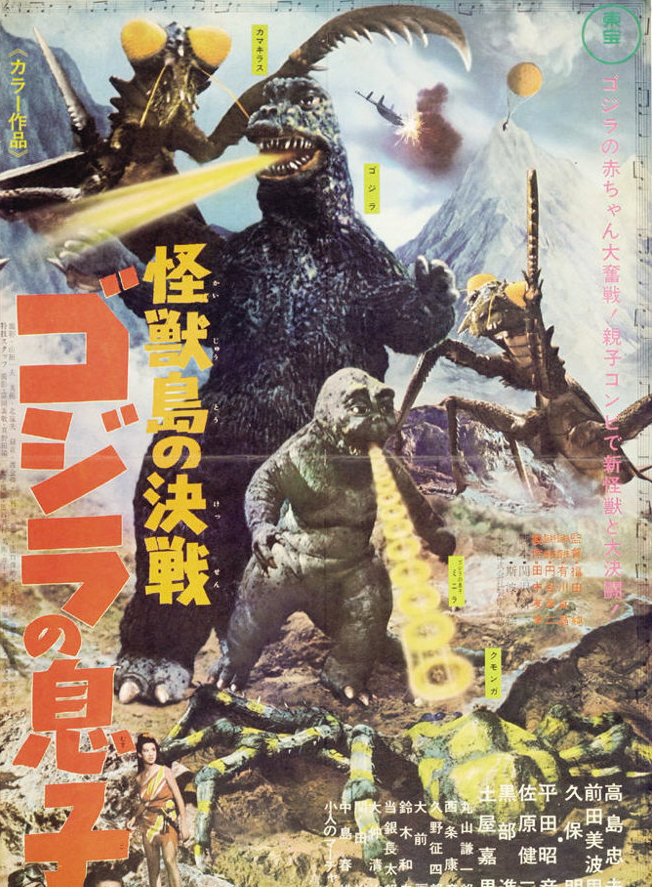
Son of Godzilla
(Jun Fukuda, 1967)


FEATURING:

Godzilla!

Minira!

Kumonga, the giant spider!

A bunch of giant Praying Mantises!
 

1.
Ok, let’s begin with a quick show of hands. Who here has seen the original, 1933 ‘King Kong’? Yes, just as I thought, every self-respecting man, woman and child. Now, who has seen RKO’s hastily slapped together 1934 sequel, ‘Son of Kong’? [Cue awkward silence, tumbleweed.] I rest my case.

For whatever reason however, the top brass at Toho studios seem to have overlooked this lesson from history, and verily it was decreed that director Jun Fukuda’s second modestly budgeted addition to the Godzilla franchise would take the form of ‘Kaijûtô no Kessen: Gojira no Musuko’ [‘Decisive Battle on Monster Island: Godzilla’s Son’], better known to the English-speaking world simply as ‘Son of Godzilla’.

As you can imagine, I wasn’t exactly looking forward to this one as I worked my way through Criterion box set of Showa-era Godzilla films, but… sometimes you’ve just got to grit your teeth and hit ‘play’ on these things, y’know? I mean, it’s a learning experience, if nothing else - and having paid something in the region of ten quid for each movie on this set, you’d better believe I’m going to take my seat in the classroom, pencil and paper at the ready, and get what I can from it.

2.
Well, guess what – to my surprise, it turns out that ‘Son of Godzilla’ isn’t all that bad. In fact, it’s pretty good fun all-round. Though clearly a step down from Fukuda’s extremely enjoyable Ebirah: Terror of the Deep, it retains much of the breezy, event-packed charm of its predecessor, and includes some memorable scenes and top-notch special effects.

As in ‘Ebirah..’, the influence of ‘King Kong’ upon Fukuda’s Godzilla films is clearly evident. Once again here, we have a danger-filled tropical island setting, in which a bunch of excitable guys run around getting into scrapes. We have another native girl in peril (actually, she’s the daughter of a long-lost prior explorer this time around), and a primary monster who is more concerned with protecting a vulnerable dependent (his ‘son’ in this case) from the depredations of lesser monsters than he is with fucking the humans’ shit up.

In fact, the film even seems to draw upon the legend of ‘King Kong’s lost spider pit sequence for inspiration, effectively recreating it in the form of a stand-out scene in which our characters tangle with Kumonga, the island’s resident giant spider.

By far the best things in this movie however are the giant praying mantises which regularly pop up to menace all and sundry. Inadvertently created by the humans’ crazy climate experiments (more on which below), these blighters put me in mind of the infamous pulp horror paperback Eat Them Alive, although needless to say they don’t get up to any such nasty business here. Nonetheless, the effects used to realise these creatures – seemingly utilising huge, string-operated puppets, big enough to go toe-to-toe with the man-sized Godzilla suit – are really superb, and the fight scenes in which The Big G tears ‘em apart have a real clout.


3.
Speaking of which, although ‘Son of Godzilla’ does inevitably get a bit goofy and mawkish later in it’s run-time, there’s something pleasingly animalistic and.. non-anthropomorphic?.. about the scene in which ‘Minira’ [as he has been named by fans, though he is never identified as such on-screen] is initially introduced.

It’s certainly a pretty traumatic introduction to the big, bad world for the young ‘un, as he immediately finds himself menaced by the aforementioned mantises, which have been swarming around his big, speckled egg, until daddy reluctantly stomps along to sort ‘em out.

Instead of greeting his new-born with affection though, Godzilla’s first interaction with the little one is to knock him over with an accidental swing of his mighty tail, before he goes huffing and puffing off over the horizon, leaving his mewling bairn to fend for itself.

Though they do later establish a slightly more traditional, audience-pleasing father/son relationship, we’re still basically left here with the perversely endearing idea of Godzilla being a bit of a shit dad – or a dedicated practitioner of ‘laissez faire’ parenting, at best. Lazing around and snoozing whilst the kid is in trouble and/or wants attention, he doesn’t exactly exert himself too hard when it comes to schooling his charge in the ways of giant monster-dom.

4.
Having said that however, if ‘Son of Godzilla’ is remembered for anything, it’s probably for the later scene in which Daddy Godzilla takes his son down to the river for a bit of male bonding and tries to teach him to utilise his radioactive fire breath – but, the best young Minira can initially manage is some puffy little smoke rings. Oh, how adorable!

Which seems a good point as which to stop and reflect on how far we’ve come from the days when those fiery blasts of radioactive death were decimating entire districts of central Tokyo, threatening to obliterate Japan’s shaky post-war reconstruction in one unholy conflagration, and terrified crowds fled in blind panic, and so on.

5.
The biggest question to arise from all this though of course concerns the mysteries of Godzilla’s reproductive cycle, and more specifically, the pressing issue of who the hell the mother might be!?

Needless to say, the film’s screenwriters never deign to address this, which is probably for the best, all things considered. All we know is that, at the point at which our story begins, the big egg containing Minira is just sitting in the middle of this weird island, and Godzilla seems duty-bound to slog his way back toward it in order to reluctantly exercise his solo paternal duties once the kid hatches.

Thus, we’re left with a scenario weirdly reminiscent of the compromised, all-male lineage of Disney’s McDuck family (though we do at least have a direct father-son relationship here I suppose, in contrast to Disney’s fragmented hierarchy of parent-less uncles, nephews and cousins).

6.
In designing Minira, I suspect that the monster effects team led by Eiji Tsubaraya and Sadamasa Arikawa were probably going for the fool-proof “overload of cute” approach which has achieved such consistent success with Japanese audiences across the decades - but, happily, I’m not sure that they quite succeeded.

Limited movement lends a particularly uncanny aspect to Minira’s moulded, baby-like face, complete with painted on eyeballs, and despite the filmmakers having gone to the trouble of hiring a dwarf actor (professional wrestler ‘Little Man’ Machen) to inhabit his suit, he retains a gawky, adult-proportioned posture which never looks quite right, especially as he stumbles over studio rocks, bawling in an electronically-altered baby voice, reminiscent of Devo’s perpetually disturbing Booji Boy mascot.

He’s a real freak in other words, and naturally this allows us us cynical, grown-up viewers to love him far more than if he were merely some perfect, proto-Pikachu type kawaii monstrosity.


7.
Another significant development which ‘Son of Godzilla’ brings to the franchise is the creation of ‘Monster Island’ – the ecologically unstable tropical archipelago which Godzilla and his pals will be depicted as being confined to in later films, their movements carefully monitored and controlled by the human authorities.

Although the presence of Kumonga the spider suggests that this nameless island was at least slightly monstrous to begin with, its transformation into a full scale kaiju playground seems to have been largely the result of this movie’s human storyline - which for the record is fairly diverting, recalling one of those ‘40s jungle adventure type b-movies in which a bunch of wise-guys hang out in tents in a studio-bound clearing, along with a token dame, an antsy reporter and so forth.

In fact, that’s exactly what happens here, except for the fact that the scientific research team led by Dr Kusumi (Tadao Takashima) have some nice, colourful buildings and advanced laboratory facilities to hang about in as they conduct a series of frankly rather crazy localised terraforming experiments, which seem to involve using some kind of cloud level chemical air-bursts and electro-magnetic pulses to radically alter the island’s climate.

Dr Kusumi speaks grandly of a future in which the problem of over-population can be overcome by fertilising the world’s deserts and so forth, but at this stage at least, his experiments seem reckless and destructive, subjecting the island to intolerable, baking heat (the guys survive indoors with their air-con), and inadvertently causing unforeseen mutations in the local fauna, including the creation of our old friends the giant mantises.

Later on meanwhile, in the film’s oddly touching climax, they decide to blast the place with an icy blizzard, leaving Godzilla and Minira frozen in each other’s arms, no doubt awaiting the next occasion on which Toho will call upon their services to liven up the bank holiday box office.

---

Thursday, 2 April 2020

Kaiju Notes:
Ebirah, Terror of the Deep
(Jun Fukuda, 1966)


FEATURING:

Godzilla!

Ebirah!

Mothra!

Some kind of mangy prehistoric bird thing!

1.
As I’ve previously observed in these posts, the success of a kaiju movie often depends upon the presence of a good human story to counterbalance the monster action, and ‘Ebirah: Terror of the Deep’ [Japanese title: ‘Gojira, Ebirâ, Mosura: Nankai no Daiketto’ (‘Godzilla, Ebirah, Mothra: Big Duel in the South Seas’)] thankfully proves a corker in this regard.

The seventh film to feature Godzilla, and the first not helmed by the monster’s creator Ishiro Honda, ‘Ebirah..’ wisely scales back on the planet-wise crises envisioned (and rather half-heartedly staged) by the last few entries in the series, instead foregrounding the tale of Ryota (Toru Watanabe), a young lad from a remote coastal village whose older brother has gone missing out at sea.

After travelling to the big city to harangue the authorities and media about this sadly routine disappearance of a sailor during bad weather, Ryota decides his only hope is to follow his brother out to sea in order to find out what happened to him, and as such he finds himself drawn to a rock n’ roll dancing endurance contest(!), the top prize of which is a luxury yacht. Although he is too late to take part himself – the contest is into its third day - Ryota hooks up with two exhausted ne’erdowells (Chotaro Togin & Hideo Sunazuka) who have just bailed out after countless hours of relentless frugging.

Noting their new friend’s overwhelming enthusiasm for all things nautical, these guys offer Ryota a lift as they swing by the local marina – a jaunt which soon leads the feckless trio to begin trespassing on one particularly swish looking yacht. As they explore the cabin however, they’re surprised by a gun-toting man (Godzilla series regular Akira Takarada), whom they assume to be the boat’s owner.

Inexplicably, the man invites the young troublemakers to stay the night and get some sleep (what?!)… but when the gang awake, they discover that the irrepressible Ryota has already rigged the sails, hoisted up the anchor, and that they are all now well on their way to the remote South Seas islands around which Ryota’s brother disappeared!

It is at this point that our protagonists discover that Takarada is not in fact the legitimate skipper of their purloined vessel – in fact, he is in fact a master safecracker, on the run with a suitcase full of stolen dough, and his gun isn’t even loaded! But, such minor details cease to matter much once a catastrophic storm blows up, capsizing the stolen yacht. Clinging to the hull of their stricken vessel, our protagonists see a gargantuan claw rise from beneath the tumultuous waves as a searing electric guitar lick intrudes upon the soundtrack. Ebirah! [“Ebi”, incidentally, is the Japanese word for prawn or shrimp, which I’d imagine must have made this monster’s name pretty amusing for the domestic audience.]

When they awake after the storm, sprawled upon a deserted island shore in the traditional movie manner, our accidental castaways soon discover that the island in question is chiefly occupied by a sinister, fascistic military organisation known as – wait for it - ‘The Red Bamboo’, whom I’m sure were not intended to bear any similarity to the forces of any real world nation with a tendency to claim sovereignty over various rocky outcrops off the coast of Japan [looks nervously over digital shoulder].

Ill-advisedly as it transpires, The Red Bamboo have chosen this island as the perfect site upon which to construct a secret nuclear reactor (its interior is big of steel gangways and groovy, primary coloured pipework), and they have furthermore begun kidnapping the peaceful, colourfully-attired natives of the nearby Infant Island – home of Mothra, you’ll recall. This is in order to put them to work manufacturing industrial quantities of the fruit-based yellow substance which has traditionally served the Islanders as a repellent to Ebirah, thus allowing shipping to move freely in the immediate vicinity of the island without being clobbered by the bad-tempered lobster-god who effectively serves as its guardian.

Before long, Ryota and his friends find themselves joining forces with Daiyo (Kumi Mizuno), a spirited and statuesque female islander who has escaped from the clutches of The Red Bamboo. Daiyo’s distinctive ‘south seas’ outfit seems to suggest a significant degree of cultural crossover between Infant Island and Blood Island, in terms of fashion at least, and her arrival prompts much charmingly bungled chivalry and attempts at non-verbal communication on the part of our ‘heroes’, before, in the course of evading her captors, they find themselves descending into a cave beneath the cliffs, where, to their surprise, they find none other than Godzilla himself taking an extended kip! What all this going on around him, it seems a fair bet that the King of the Monsters’ slumber may wind up being disturbed before too long…


I realise that the preceding paragraphs of straight plot synopsis run far longer than is usual for this blog, but I present them to you simply in order to help demonstrate the fact that ‘Ebirah..’ is a whole lot of fun even before it’s featured monsters begin knocking lumps out of each other.

Rather than filling up the runtime with boardrooms full of harried government functionaries discussing the monsters’ latest movements, and static scenes of soldiers and journalists passively observing kaiju throwdowns through binoculars, Fukuda and scriptwriter Shin'ichi Sekizawa here give us a simple, fast-moving character-driven story with enough interesting stuff going on to work on its own terms, whilst keeping the scale of the action small enough for the film’s budget to really do it justice, and the results really vindicate this shift in emphasis.


2.
Mirroring this lively ‘human story’, the kaiju action in ‘Ebirah..’ also seems invested with a renewed sense of excitement. Just as the film saw Fukuda taking over from Honda for the first time as director, it also finds the legendary Eiji Tsubaraya assigning responsibility for the monster effects to his long-standing deputy Sadamasa Arikawa, with what appear to be very encouraging results.

In particular, the increased use of matte shots, false perspective etc really pays dividends here, with individual shots and interactions between different elements within the frame carefully planned out, in what seems like a deliberate attempt to avoid the flat, “monsters lolling about aimlessly in a field and/or alien planetscape like boxers between rounds” type approach seen in the past two films.

The shots of Ebirah’s colossal claw rising from the roiling, nocturnal waves as our hard-luck heroes struggle to keep their yacht afloat in the foreground in particular are extremely impressive; frightening and atmospheric, they convey a sense of scale and immensitude which has been lacking from these movies for quite a while.

Equally effective meanwhile are the shots which see human characters fleeing the stomping feet of Godzilla, and if, when we reach the big monster fights, they’re no less cartoon-ish than those seen in ‘..Astro-Monster’ and ‘King Ghidorah..’, they nonetheless have a sense of rough n’ ready energy and full contact violence about them which really gives them an edge.

Ebirah, when he finally emerges from the water, makes for an appealingly grisly new foe for Godzilla, and if their initial showdown begins as little more than a glorified game of catch, no over-grown playground thugs in the audience will be able to resist the simple pleasures of seeing The Big G heading a weighty looking boulder toward his opponent, who retaliating by performing the universally acknowledged “come on if you think yr hard enough” gesture with his gargantuan claws.

Balancing out all this testosterone though, it’s great too to see Mothra back in action in her full, winged form too, needless to say. Once again, her characterisation as female means she’s relegated to playing the ‘peace maker’ here, calming Godzilla’s rage after his final battle with Ebirah, putting him back in his place like a big sister, and, delightfully, carrying the Infant Islanders and their friends to safety via an ingenious makeshift basket/gondola thing, just before the island goes ka-boom. [See point #3 of my above-linked Ghidorah: The Three Headed Monster post for reiteration of the reasons why I love Mothra.]


3.
Likewise, the portrayal of Godzilla himself in ‘Ebirah..’ is interesting and a lot of fun. Taking a step or two back from the comedic/heroic persona he was moving toward in last few films, he’s a more ambiguous, slightly more menacing presence here. Certainly, he no longer gives much of a damn about humanity, carelessly trashing the Red Bamboo’s nuclear research facility and stomping their soldiers without a second thought.

But, more than anything, he really just spends the entirety of this film acting as if he really wants everyone to just leave him the hell alone, essentially staggering through the picture like the kaiju equivalent of a guy with a severe hangover who finds himself having to deal with a leaking washing machine, rotten milk in the fridge and disgruntled neighbours banging on his door; an impression I find both hilarious and endearing.

I mean, the first thing he sees after he staggers out of his cozy hiding place in the cliff-face after being rudely awakened, Frankenstein style, with a jerry-rigged lightning conductor, is this bloody giant lobster thing that wants to pick a fight with him. Then, as soon as he’s sent that guy packing, he sits down to catch his breath, and before you know it, some fucking mangy-looking prehistoric bird thing suddenly flies out of nowhere and starts pecking him! What the holy hell?! And THEN, when he’s finally pulverised that bugger, here comes The Red Bamboo’s bloody air force, zooming around his head, giving him a hard time. What a shitty day!

It’s telling I think that, in between these assorted bouts, poor old Godzilla simply sits down on the nearest mountainside, looking completely exhausted, and falls asleep. (The fact that his costume, re-used from ‘..Astro-Monster’ the previous year apparently, looks as if it’s seen better days, having suffered water-damage during the initial Ebirah fight, probably only aids this ‘hungover’ vibe.)

Poor Godzilla! All he wants is to sit in a dark, quiet hole somewhere and get a bit of rest. No wonder then that he seems so thoroughly pissed off by the time the film reaches its conclusion, kicking the shit out of the nuclear facility with reckless abandon, and tearing Ebirah’s claws straight off and battering him to death with them in a display of crazed ferocity rarely equalled in a Toho kaiju movie.

Opening with what I imagine to be the kaiju equivalent of a tormented yell of “What?! You want some more, do you?!”, this second and final Godzilla/Ebirah battle is genuinely brutal stuff, leaving us with little expectation that the movie’s title monster is going to be popping up from ‘neath the ocean waves for any jolly monster team-ups anytime soon. Having pushed The Big G way over the line when he was in a rotten mood to start with, he gets properly fucked up for his troubles.


4.
Just as Fukuda has taken on direction, and Arikawa the effects, ‘Ebirah..’ is further freshened up by a mod-ish, light touch score from Akira Kurosawa’s go-to composer Masaru Satô, marking a notable change of pace from the bombastic, baleful (and increasingly inappropriate) Akira Ifukube compositions used in earlier films. Incorporating elements of the Ventures-inspired ‘eleki’ genre which was tearing the charts in mid-60s Japan, Satô’s work here is an uncharacteristically groovy, John Barry-esque delight which perfectly matches the bright, energetic feel of the film, with the searing guitar strings which accompany Ebirah’s emergence from the waves proving particularly memorable.

5.
As you will probably have gathered by now, ‘Ebirah..’ is one of my favourite Godzilla sequels. Definitely in my top five, anyway. Perhaps the fact that the Big Guy doesn’t even wake up until fifty minutes into proceedings helps account for the lack of love it tends to receive from fans, but I’ve always found this to be slightly unfair, given the extent to which he gets stuck in once he is finally on the scene – not to mention the fact that the section of the film preceding his appearance cannot by any stretch of the imagination be described as dull.

For some, Jun Fukuda’s entries in the series are marked by a sense of flippancy which seen to stand in contrast to the aura of solemnity associated with Honda, but this too strikes me as a lazy and unfair point of comparison – insofar as this film is concerned, at least.

As great a director as Honda could be when given the opportunity, he was clearly getting pretty tired of Godzilla franchise by the mid ‘60s, as he became increasingly disillusioned with the family-friendly direction Toho insisted on taking the series in. Fukuda’s more light touch, character focused approach, by contrast, feels like an ideal fit for the studio’s vision, allowing Godzilla to fully crash his way into the realm of ‘60s pop art / youth culture immortality, his weightier and more symbolic origins long forgotten.

In later efforts directed by Fukuda, this change in tone would inevitably begin to impact upon the overall quality of the films, but for ‘Ebirah..’ at least, the production team was still firing on all cylinders, leading to what for my money is the best entry in the series since ‘Godzilla vs Mothra’ in ’62.


Friday, 26 April 2019

Blood Island Journal # 3:
Mad Doctor of Blood Island
(Gerado de Leon & Eddie Romero, 1969)


Back on Blood Island a year or so after all that business with the sludge monster and the sacrificial virgins, and things actually seem to have changed quite a bit for this non-continuous quasi-sequel.

For one thing, the island itself seems a bit more developed than it was the last time around. The islanders now enjoy the benefit of some paved roads, a pony and trap and at least one electric generator. Sadly, there are far fewer totem poles, but the main village now boasts a “government house”, whatever that is.

For another thing, the outrageous colour palette of the previous picture has been toned down, with the exotica / tiki bar vibes scaled back slightly (perhaps to a “7”, down from “10”), lending a marginally more naturalistic feel to proceedings that reflects the film’s curiously morose, down-beat emotional timbre. Despite the promise of that irresistible title (what’s the matter doc, Market Street not good enough for ya anymore?), it looks as if shit’s about to get real on the ol’ Isla de Sangre.

Which, I must confess, is a development that is not entirely to my liking. Watching ‘Mad Doctor..’ for the first time, I found myself missing the goofy charm and over-saturated excesses of ‘Brides..’. Though a “dark and brooding” approach can often work well for Filipino horror (look no further than Terror is a Man for a perfect example), I have my doubts re: how far it can really go when it comes to distracting our attention from the meandering pacing and slapdash production values inherent to these late ‘60s Hemisphere horrors.

Thankfully however, Romero and de Leon at least came up with a fool-proof strategy to help keep the mid-west drive-in crowds in their seats – namely, cranking up the gore and sleaze to what at the time must have seemed fairly preposterous levels.

This intent is clearly signalled by one of the most attention-grabbing pre-credits sequences this side of Jose Larraz’s ‘Vampyres’, in which we see an anonymous, stark naked Filipino girl fleeing through the (rather scrubby looking) jungle, before getting bloodily mauled by a hairy-handed green zombie / monster. Yikes!

Following this unambiguous statement of intent (surely the exploitation movie equivalent of a hand-on-heart oath of allegiance?) however, we’re soon back to the grind of PLOT and TALKING, as a new shipment of outsiders approach the torrid coast of Blood Island – but hey, at least a wealth of “so, why are we going to this island again?” type expository chat allows us to clearly establish who’s who this time around.

This is just as well, because, as seems to have become a trademark of Eddie Romero’s films in particular, ‘Mad Doctor of Blood Island’ has, frankly, too many characters.

Shipping in on the boat, we firstly have an American couple (John Ashley and Angelique Pettyjohn) who have come in search of Angelique’s estranged father. I’m not sure if the reasoning behind the father’s presence on Blood Island is ever made clear, but he seems rather like one of those “trading company agent” type characters found in colonial-era South Seas tales. He’s certainly a sweat-drenched, alcoholic misanthrope who seems to have been driven mad by the malarial climate, at any rate.

Played by one Tony Edmunds (in his only screen role), he initially rejects the opportunity to re-establish a relationship with his daughter (presumably because it would upset his busy schedule of sprawling around in a state of fever-ish dissolution). (1)

Also on the boat is an alternative Filipino protagonist, Carlo, played by Ronaldo Valdez. Having been raised on the island, he is heading back there to track down his mother (played by veteran Pinoy character actress Tita Muñoz), after receiving the news that his father has died. *She* seems be ensconced as the live-in servant and lover of one Dr Lorca (Ronald Remy, star of Hemisphere’s earlier ‘The Blood Drinkers’ (1964)).

As you might well imagine, this guy is the “Mad Doctor” of the title, although disappointingly he never really gets very “mad” here, in the usual horror movie sense of the term. In fact, he remains disconcertingly chilled out through most of picture, regarding the assorted hullaballoo caused by his errant experiments with a sense of expressionless neutrality. Whether Remy was heroically resisting the urge to over-act (going instead for “cold scientific distance”), or simply lacked the necessary charisma for the role, is largely a moot point however, and will likely depend on your level of sympathy for the production.

In addition this lot meanwhile, we also have another significant character, Marla (Alicia Alonzo), an island girl who seems like a twisted and vengeful variation of the upstanding Alam from ‘Brides..’. A childhood playmate of Carlo, she now seems fixated both on seducing him, and on taking revenge against Dr Lorca for the death of her lover, Carlo's late father.

So, yes – if you’re thinking that this seems like an awful lot of human drama to try to cram into a movie that is basically being sold on the promise of seeing naked girls being torn apart by a slimy green monster, you have a point.

Some commentators have suggested that the introduction of a parallel storyline involving Filipino characters could have been an attempt to broaden the film’s appeal for local audiences, but actually this seems doubtful. ‘Mad Doctor..’, like its predecessors, was shot in English, with the majority of funds coming from overseas, and - insofar as I’m aware – the possibility of a theatrical release in The Philippines was never even considered.

Nonetheless, it’s certainly nice to see that the filmmakers were confident enough by this stage to devote a significant portion of screen time to characters of their own nationality, and it is interesting to note that this coincides with the introduction of a more pervasive sense of melancholy than was present in the old fashioned, “white folks getting into trouble in the jungle” tales that characterised the preceding Blood Island films.

For all the monsters and bloodthirsty japes, just about everyone in ‘Mad Doctor..’ is basically deeply unhappy, with most of the characters struggling with grief or loss in one form or another. The arched eyebrow “humour” that dominated dialogue exchanges in ‘Brides..’ has largely vanished, whilst the Carlo / Dr Lorca storyline incorporates a queasy undertone of incestuous desire which culminates in a handful of uncomfortably harrowing, taboo-skirting scenes in the film’s final act

If all this sounds pretty intriguing on paper however, I wish I could report that it was a bit more enjoyable on celluloid. Unfortunately, the means by which Romero and de Leon choose to unpack these complex character relationships – think long stretches of bland, monotone dialogue and repetitive shot / reverse shot editing patterns – soon poses a challenge both to viewers’ attention spans, and potentially their very wakefulness.


Never fear though, because the monster is here, and, if he’s not even remotely as much fun as ‘Brides of Blood’s world-beating sludge-beast, he certainly scores a few points in terms of sheer unpleasantness.

This time around, the film’s wacky, quasi-scientific premise involves Dr Lorca’s technique for reviving / extending animal life through the direct injection of chlorophyll - which results, inevitably, in the creation of one or more shambling, psychopathic moss-zombies.

Half-man, half-cactus, is the general idea here I suppose, and, though fairly laughable from a make-up POV, the green paint-splattered, paper-mache headed menace that periodically emerges to terrorise Blood Island nonetheless has a genuinely icky feel to it that puts me in mind of the muesli-faced fiends found in second string Italian zombie movies of the early 1980s. This comparison remains pertinent with regard to what the creature actually does too; boy, he sure goes for it!

Succumbing to the temptations of the cartoonish, full strength gore approach inaugurated earlier in the decade by Herschell Gordon Lewis, de Leon and Romero cheerfully employ a range of special effects that make Lewis seem like a champion of gritty surgical realism by comparison, transforming ‘Mad Doctor..’s monster attack scenes into a ludicrous rampage of flying mannequin limbs, screaming, blood-splattered naked people and shock zooms into piles of steaming entrails, sure to leave any seasoned connoisseur of trash cinema beside themselves with delight.

Considerably less delightful for most viewers however will be the rather unique “in-camera effect” that is utilised throughout the film’s horror sequences. Basically, this consists of the camera operator relentlessly cranking the zoom function in and out again, in time with some pulsing rhythm of his own devising, much in the manner of a child fooling around with a video camera for the first time at a family picnic.

Personally, I found this gimmick absolutely infuriating. It makes many of the film’s livelier scenes feel disorientating and difficult to follow, and some potentially great visuals are ruined forever by the murky motion blurring which results. Individual tolerance may vary however, and I can at least appreciate the fact that enjoyment of this technique is largely a matter of context.

Say what you will about the folks behind Hemisphere, but they certainly knew their market, and I can well imagine that, in a Saturday afternoon matinee full of screaming kids, having this pulsating, zoom-y weirdness kick in whenever the monster is nearby must have proved very effective. For your humble correspondent however, sitting alone beside the blu-ray player half a century later in earnest contemplation of a cinematic text (god help me)… not so much. (2)

Unfortunately, a further – significant - obstacle for most 21st century viewers attempting to enjoy ‘Mad Doctor of Blood Island’ hoves into view about halfway through, when the filmmakers decide to include a short, but still extremely unpleasant, display of real life animal cruelty.

Regrettably, the ill treatment of animals is an aspect of Filipino culture that can often be seen creeping into the nation’s genre cinema, but there can be no cultural justification for the reprehensible conduct we see here, as some unfortunate pigs and goats are tied down and stabbed as part of a staged “tribal ritual”.

Thankfully, this footage is mercifully brief (comprising only a few seconds of screen time), but it’s still pretty difficult to stomach, so – viewer discretion (and/or a speedy hand on the remote control) is advised.

Moving swiftly on however, ‘Mad Doctor..’s non-zoom-damaged, non-animal slaughtering segments can at least boast a few other attractions that may (or may not) make the whole thing worth ploughing through, including, but not limited to:

1. Loads of lascivious, erotic dancing from the island’s more shapely young residents (I suppose the extended dance party finale of ‘Brides of Blood’ must have gone down well with audiences).

2. The spiriting sight of the gum-chewing, slightly Southern accented John Ashley unleashing some gone-to-seed white guy kung fu as he scatters spear-wielding guards like nine-pins, as well as rocking an incongruous powder blue suit and wing-tip collar to complement his kiss-curled, Ricky Nelson-type looks.

3. The unique presence of Angelique Pettyjohn, an unconventional leading lady whose emergence from bed when disturbed by a moss-zombie banging at her door (a scene coincidentally blessed with some splendid, Bava-esque gel lighting) must have lingered long in many adolescent imaginations. Gamely gallivanting around Blood Island in a frilly pink mini-dress being menaced by zombies, snakes, surly tribesmen and the like (Tito Arevalo’s bombastic scoring gives equal weight to all of these potential threats), she’s a great screamer who leads me to want to use the word “lascivious” twice in the space of a few paragraphs. (3)

Having got that out of the way, I’d like to move things on to a brief discussion of this film’s assorted promotional ballyhoo – chiefly dreamed up by Hemisphere marketing consultant and later Independent International Pictures mogul Sam Sherman – which is a lot of fun, and must have played a significant role in ensuring that ‘Mad Doctor of Blood Island’ remains probably the most infamous and fondly remembered of the “blood island” films, despite being arguably the weakest instalment in the series, in purely cinematic terms.

Shot on spec by Romero using Caucasian teenagers apparently rounded up from the domestic quarter of the nearest U.S. military base, the film’s “green blood” prologue, in which patrons are encouraged to drink whatever hideous fluorescent potion the distributors managed to hand out whilst reciting the “Oath of Green Blood” is an absolute hoot, whilst the film’s demented trailer – inexplicably featuring a voiceover performed by legendary underground theatre performer and New York eccentric Brother Theodore – is an absolute classic too.

For all this attention-grabbing tomfoolery however, ‘Mad Doctor..’ for the most part remains a rather grim, potentially headache-inducing trudge of a viewing experience. Despite the polystyrene walled dungeon finale and occasional moments of classical gothic atmos in fact, the film in retrospect seems interesting for the way in which it moves beyond the campy, ‘40s-derived template that still defined most low budget horror films of the late ‘60s.

Instead, the dour pessimism and envelope-pushing content lurking behind the garish marketing materials makes the feel – at a push - somewhat more like a precursor to the more explicit and downbeat horror films that would begin to emerge from both Europe and the USA during the 1970s. Certainly, if the purpose of a horror film is to be horrible, ‘Mad Doctor of Blood Island’ succeeds about as well its production circumstance could have allowed, providing enough unsavoury content to warp the minds of monster kids and morality campaigners alike. Apparently it managed to fly under the radar of the latter group however, and must have proved sufficiently popular with the former that Dr Lorca returned, less than a year later, in ‘Beast of Blood’. Sanity allowing, I’ll be landing once again on the golden sands of Blood Island soon to bring you the low down on that one. God help us all.


---
(1) As an aside, I found it interesting that the “alcoholic dad” character is identified by the islanders as “Mr. Willard” – presumably a nod to Conrad’s ‘Heart of Darkness’, which is curious, given that both Eddie Romero and John Ashley worked behind the scenes on the Filipino shoot for ‘Apocalypse Now’ a few years later.

(2) Yes, in case you were wondering, anecdotal evidence suggests that these movies were regularly screened to pre-teen crowds throughout the USA, with any trims for gore and nudity presumably at the mercy of the theatre manager’s scissors. What a great time to have been alive!

(3) At this point, I think we are duty-bound to mention Pettyjohn’s later claim that she and John Ashley were doing the deed for real during their brief love scene in ‘Mad Doctor..’. Though naturally nothing to support this assertion survives on screen, it’s certainly a pretty steamy sequence, and, given that Pettyjohn went on to become one of the few ‘legitimate’ actresses to move into hardcore porn during the ‘70s whilst Ashley is widely remembered as an irrepressible horndog, such shenanigans don’t seem entirely beyond the realm of possibility.

Sunday, 24 March 2019

Blood Island Journal # 2:
Brides of Blood
(Gerardo de Leon
& Eddie Romero, 1968)


OBLIGATORY SCREENSHOT DISCLAIMER: As usual, I need to make clear that the screenshots above are sourced from an old DVD edition of this film, and NOT from the recent Severin blu-ray referred to in the text, which I can confirm looks a lot better.

I should also note that the footnotes in this review deal exclusively with background on the cast members, so please let this inform your decision re: whether or not you wish to scroll down to read ‘em.

---

Coming to 1968’s ‘Brides of Blood’ straight off the back of Eddie Romero & Gerardo de Leon’s initial excursion into the realms of South Seas monsterism, 1959’s highly accomplished Terror is a Man, is a transition guaranteed to provoke a bad case a cinematic whiplash.

Whereas in ‘Terror..’, character beats and plot situations were simple, clearly outlined and anchored by a set of solid performances, the opening scene of ‘Brides..’ instead finds us thrown into a cramped ship’s cabin, where a bunch of guys – and one token ‘blonde bombshell’ (‘Miss Beverly Hills’, later known as Beverly Powers) – sit around a table, midway through a conversation that doesn’t really seem to make a whole lot of sense (the poor sound recording doesn’t help matters).

Who are they? What are they up to? With no proper introductions, the amount of time it takes us to figure out the answers to these questions is frankly pretty annoying. I know that we movie reviewers are traditionally supposed to be dismissive of “exposition”, but can I have some please?

There seems to be some kind of innuendo going on concerning the sexual inadequacy of the blonde’s husband, and her implied attraction to a husky, shirtless sailor who stands behind her. In a scene that has absolutely no connection to anything else that happens in the film, this sailor proceeds to take matters into his own hands by pushing the woman into a cabin and violently forcing himself upon her. Pretty rough stuff for any movie’s opening minutes, but don’t worry readers - it’s one of those movie rapes where she seems to be quite into it. Because she’s a slut, I suppose? That’s what we in the business call “characterisation”, folks! (1)

Welcome to the choppy waters of Blood Island. “Here comes the local rotary club,” sneers Beverley, apparently none the worse for her recent assault, as the “natives” parade from their huts to welcome our protagonists (whoever they are) as they disembark upon the golden shores of this torrid tropical paradise.

Welcoming the new arrivals to his hut, the village’s dignified headman (played by Andres Centenera, who has a great face for horror movies) tells his guests that he is happy to see them, but wishes they could have visited a few months earlier, because unspecified events have recently caused his people to “return to primitive ways”, for which he feels great shame. (Speaking as someone with a spare bedroom, I know how he feels.)

The headman does not expand upon this unsettling line of chat, but he does introduce us to his comely granddaughter Alam (Eva Darren), who speaks perfect English and, like all the women on Blood Island, wears a fetching full length skirt and strapless bra ensemble made from floral patterned fabric. In all seriousness, it’s a great look. (2)

By this point, I think we’ve more or less got the drop of who our ‘heroes’ are. Beverly’s character name is Carla Henderson, and her husband is Dr Paul Henderson, a scientist who has returned to the island to do some unspecified tests that later turn out to have something to do with nearby atomic testing. As played by aging b-movie stalwart Kent Taylor, Dr Henderson resembles Vincent Price after a five-day drinking binge, and proves similarly ineffectual. His wife meanwhile seems determined to continue crowbarring crude sexual innuendoes into every conversation, no matter how inappropriate. (3)

Accompanying this happy couple is a happy-go-lucky young matinee idol type played by John Ashley. This turns out to be Jim, a “Peace Corps man”, apparently. I confess ignorance re: the operations of the Peace Corps, but I can only imagine Jim must have pissed off someone pretty important to find himself shipped out to Blood Island to teach the locals how to dig irrigation ditches. Still, he seems happy enough, especially once he sets eyes on Alam. (4)

So I’ll be honest with you – the first half an hour of ‘Brides of Blood’ is pretty hard going. So much so that I began to seriously question the wisdom of my decision to spend a not inconsiderable amount of money on a blu-ray box set of these films. Though there are some artfully composed, low angle shots here and there (a Gerry de Leon speciality, it seems), the majority of the direction is pure “point & shoot” kind of stuff, whilst performances are hesitant and unconvincing, and the plot rambles on uneventfully like the very worst kind of clock-watching ‘40s b-movie.

As I mentioned in my review of ‘Terror is a Man’, what we are essentially looking at here I think is a pair of talented and creative filmmakers delivering product “on spec” for an American distributor (Hemisphere Films), fully aware that their paymasters only priorities were to keep things cheap and provide enough exploitable material for the U.S. drive-in market. Back in ’59, de Leon and Romero were still making an effort, but by this stage, their disinterest in the material is clear.

The introduction of a colonial plantation owner type (Mario Montenegro) seems a potentially interesting development, and I liked the fact that none of the American visitors seem to bat an eyelid at the fact that his household comprises a hulking, whip-wielding major domo named Goro (Eddie Romero regular Bruno Punzalan) and a coterie of capering dwarfs in loincloths. (I mean, I don’t know about you, but I’d at least have some concerns about who cooked the soup.)

Later scenes shot in the (studio?) interior of this guy’s mansion are composed with a greater degree of care than the island location stuff, lending them a nice, over-heated Italian gothic feel, but the initial sequences involving him drag terribly, especially as the run-time is painfully padded out with footage of people tramping back and forth through jungle clearings as they move between the ‘village’ and ‘mansion’ locations.

The only thing that this opening stretch of ‘Brides..’ really has going for it in fact is the uniquely weird atmosphere shared by all of these Filipino / Hemisphere horror films. In part, this is created by the outrageously lurid colour photography (apparently DP Justo Polino never saw a white shirt he didn’t want to make a little bit green, or a sky that couldn’t be improved by a bit of blazing, radioactive pink), and the cacophonous assemblage of sub-Les Baxter ‘exotica’ on the soundtrack (I hope you dig that “wah-la wala-wala wah-la” chant, because you’re going to be hearing it a lot), but beyond that, a kind of queasy, subliminal strangeness seems to permeate everything on Blood Island.

It’s as if the humid climate and cross-cultural confusion of the shooting location has seeped into the DNA of the film itself. Things have a dazed, unreal quality to them, as reminders of the poverty stricken living conditions of the local extras (scrappy-looking fishing boats and nets hung out to dry, disconcertingly authentic looking mud huts, and hungry looking dogs and pigs snuffling around in the background) find themselves existing side by side with the wildest of movie-making contrivances, such as the goofy totem poles and big ceremonial heads prominently inserted into just about every shot, or the ‘aloha’-style floral necklaces hung around the necks of the modelling agency-sourced female villagers.

This faintly oneiric atmosphere allows the movie to pick up a real crazy head of steam as it goes along, finally boiling over into full scale delirium during the infinitely more entertaining second half.

The first real showstopper comes when some of our Caucasian intruders spy upon the villagers’ ceremony of appeasement for their resident monster-god. Yes, these are those “primitive ways” that the headman was going on about earlier, and it must be said that whichever of his ancestors came up with them back in the time of the ancients sure wasn’t messing around.

Pungent red gel lighting illuminates the night-for-night photography as braziers burn, clouds of purple smoke waft by, and a pair of nubile, writhing virgins are tied to some of those good ol’ X-shaped cross-beams. Our previously dignified headman takes it upon himself to yank off their strapless floral bras (face it, it was going to happen at some point), before he retreats into the bushes to await the approach of “the evil one”.

And, holy mackerel, what a monster it is! I’ve honestly never seen anything quite like this thing. It looks as if someone dropped a load of toxic blue paint over the head of the Ghostbusters Marshmallow Man and stuck googly eyes and a big, toothy mouth onto the remains of its semi-melted face. I love it! Stomping into view like he owns the joint (SPOILER ALERT: he does), the monster descends upon the helpless females with a mass of echoed groaning, panting noises, giving them a frankly indecent pawing before the camera cuts in close on their screaming faces, and the scene – perhaps mercifully – cuts.

Pretty freaky stuff for ’68, but, in case all this wasn’t sleazy enough for you, a subsequent dialogue exchange between Alam and Jim leaves us in no doubt whatsoever so to what this extraordinary beast was actually getting up to just out of shot;

“The men will survive this, because it needs only women. He does not devour his victims, he merely satisfies himself on them.”

“But they were torn to pieces!”

“This is his way of satisfying himself.”

Yikes.

The flimsy rationale for this monstrous activity turns out to involve side effects from the Bikini Atoll bomb tests (Blood Island must have been just downwind, presumably). In addition to causing one of the island’s most prominent citizens to transform into an amorous sludge monster whenever the moon is high, this pesky radiation has also played havoc with the island’s eco-system, causing trees to sprout aggressive, independently mobile vines, which writhe around like bulbous tentacles, fatally ensnaring anyone who veers too close to them. What fun!

Basically, where the first half of ‘Brides..’ saw a lot of people walking interminably through the jungle for no particularly compelling reason, the second half finds them running through it for no particularly compelling reason, shouting and screaming, hacking away at murderous vine-tentacles, and perhaps even being chased by the monster and/or Goro. All of which proves a hell of a lot more entertaining, needless to say.

Whilst all this is going on meanwhile, the dynamic Dr Henderson seems primarily concerned by the unusual behaviour exhibited by a cockroach he has trapped in a jar; “you should have seen this little beast - it had horns and fangs, and even tried to attack a lizard”. For Chrissakes, look out the window, doc – your wife’s about to get eaten by an independently mobile mutant tree! Bloody scientists, I don’t know.

This apparent disdain for the scientific method also extends to the movie’s conclusion. Whereas b-movie convention would normally dictate that Henderson should come up with some ingenious means of combatting the monster and returning the island’s foliage to its natural state, de Leon & Romero instead posit a simpler solution, as John Ashley simply hands out flaming torches to the villagers and suggests that the time has come to just find this goddamn monster and fuck it up. Which they then proceed to do. God bless the Peace Corps!

After the beast has been dispatched in the requisite fiery conflagration, the movie, wonderfully, continues to play out for a further seven minutes of joyous celebration. Maximum tiki bar vibes are in effect here, as the remaining villagers use the same clearing they had previously employed for their ritual sacrifices to stage a rip-roaring party. The blues and purples of the colour scheme become almost overwhelming, as the island’s more attractive young people writhe and grind against each other to the hypnotic sound of the pipes and drums (we’ll be seeing a lot more of this in the following year’s ‘Mad Doctor of Blood Island’), with things eventually reaching their climax as Alam performs a smokin’ hot erotic dance for the enjoyment of of Hero Jim. Oh yeah!

The head-man, who a few minutes of screen-time earlier had been ready to feed his granddaughter to the ancestral god-monster, is now seen happily groovin’ it up, swigging from a mug of the local home brew and casting approving looks in the direction of his potential new grandson-in-law. Other couples meanwhile sneak off into the undergrowth to get busy with their own “primitive ways”, having apparently decided to overlook the fact that their island has been irreparably ravaged by H-bomb radiation, and that the trees are liable to spring into life and strangle them at any moment. Good times! I forget what happened to Carla and the good doctor, but frankly, who cares.

This was my first proper visit to Blood Island, and I must say, whilst it took me a while to settle in, I ended up having a great time. I really got a kick out of the dancing, and the totem poles, and the sunsets… but most of all it was the PEOPLE who really made it worthwhile. So friendly! And the sludge monster. He was pretty cool too. I give it four stars on Trip Advisor, and I’m looking forward to heading back soon.

Posters sourced via Wrong Side of the Art.

---

(1) This whole business must have been a bit of a baptism of fire for Miss Hills/Powers, who a few months earlier was twistin’ with The King himself in the 1968 Elvis movie ‘Speedway’. A prolific Hollywood bit player and TV actress with a wealth of ‘stripper’, ‘blonde’ and ‘dancer’ roles on her CV, she seems to have retired from the screen in the mid-‘70s, shortly after appearing as ‘Topless Swimmer [Uncredited]’ in ‘Jaws’.

(2) Happily, Eva Darren appears to have enjoyed a long and rewarding acting career subsequent to her appearance in ‘Brides..’, working in Filipino film and TV right up to the present day. Incidentally, IMDB lists her character name here as ‘Alma’, but I’m pretty sure the people in the movie are saying ‘Alam’, so will go with that.

(3) Described by IMDB as “..a modestly popular “B” actor of the 1930s and 1940s”, Kent Taylor retired from acting in 1975 – perhaps wisely, given the questionable immortality he had acquired in the preceding decade for his rather doddering appearances in such Al Adamson atrocities as ‘Satan’s Sadists’ and ‘Brain of Blood’. (BEST CREDIT: he appeared as a character named “Tonga Jack Adams” in the Florida-shot jungle movie ‘The Mighty Gorga’ in 1969.)

(4)Apparently Ashley was so taken with The Philippines that he more or less relocated to Manila after shooting ‘Brides..’, appearing in just about all of the subsequent Hemisphere horror films, and acting as a producer/fixer for numerous U.S.-Filipino co-productions in the following decade. Gossip  suggests that Ashley was undergoing a messy divorce from fellow AIP Beach Party alumnus Deborah Walley when he agreed to appear in ‘Brides of Blood’ (perhaps the title appealed?), and that his off-screen adventures with the local female population had much to do with his enthusiasm for Filipino life.