Showing posts with label vice ridden coasts. Show all posts

Thursday, 1 July 2021

Franco Files:
Gemidos de Placer /
‘Cries of Pleasure’

(1982)

OBLIGITORY DISCLAIMER: Readers should be aware that the screengrabs above are NOT sourced from Severin’s 2019 blu-ray edition of ‘Gemidos de Placer’, which I can confirm looks splendid. They originate instead from an older, seemingly VHS or TV-sourced, scan of this film which I happened to have knocking about.

One of the pleasures of life as a Jess Franco fan is that, just when you think you’ve finally got the drop on where the great man was coming from at any given point in his sprawling and tempestuous career, he can still turn around and surprise you.

Never was this more true than during the early 1980s, a period which saw Franco cranking out a frankly bewildering quantity and variety of celluloid, most of it delivered directly to the door of his sometime paymasters at Barcelona-based Golden Film International - a firm whose naive husband and wife proprietors can easily be pictured weeping uncontrollably as yet more couriers arrive at their office door bearing new film cans to add to the ever-growing mountain of unreleased / unreleasable product piling up around them… all courtesy of the tireless Senor Franco.

As more of Franco’s Golden-era films become readily available to viewers who were denied the opportunity to obsessively haunt back-street Spanish sex cinemas in the early 1980s (largely thanks to the noble efforts of Severin Films, Stephen Thrower and Francophile underworld of the fan-sub/trading circuit), his work during this creatively fertile era is increasingly revealed as a series of sharp left-hand turns, with his output during 1982 alone ranging from lackadaisical sex comedies to sado-erotic treasure hunts, neo-noir / new wave youth movies, gothic horrors and inexplicable, family-oriented kung-fu fantasies. In the midst of which, we find the little number we’re looking at today - one of the most sombre, disturbing and formally experimental works of his entire career.

Sketchily distributed around porno theatres for a few months in 1983, with promotional material consisting solely of a generic photo-collage poster featuring a man who doesn’t even appear in the movie thrusting his Y-fronts in the direction of Lina Romay’s face, ‘Gemidos de Placer’ [‘Cries of Pleasure’] is, like many of Franco’s best erotic films, a work that only a stone-cold psychopath could emerge from feeling frisky.

Yet another descent into the soul-withering, sex-horror netherworld previously explored in the likes of Lorna the Exorcist and Doriana Grey, ‘Gemidos..’ takes place, perversely, in just about the most beautiful location imaginable – a luxurious villa situated high on the cliffs above the director’s spiritual home, the Valencian coastal town of Calpe. (1)

Bright, elevated and open to the elements (not to mention publically visible for miles around), this villa seems a frankly absurd place for this tale of insular, amoral depravity and dead-eyed introspection to play out, but… would it be too much of a stretch to suggest that Franco is deliberately playing on some Antonioni-esque notion of spiritual disconnection between human beings and their environment here? I wouldn’t put it past him.

Beginning with a stunning vista of the Calpe’s unmistakable Peñón de Ifach, the film’s opening shot slowly pans across the bay to reveal the figure of Franco’s regular camera tech/right hand man during this period, Juan Solar, here playing the mute, guitar-strumming servant who will go on to act as mute witness to the assorted atrocities committed within the villa.

After zooming in for a close-up on Solar’s fingers picking out a cyclical guitar melody as he leans precariously on the balcony’s guard-rail, the camera then pulls back as a heart-rending Daniel White piece for solo cello abruptly cuts in on the soundtrack, revealing the shimmering surface of a swimming pool. In what appears to be the director’s tribute to ‘Sunset Boulevard’, a naked male corpse (recognisable to fans as Franco’s ubiquitous ‘80s leading man Antonio Mayans) floats face down in the water.

Sadly we don’t get a narrating voiceover from Mayans’ corpse in this case, but Solar’s character instead does the honours (dubbed with Franco’s own voice, weirdly), and it is within his warped, potentially unreliable, memories we will presumably be spending the next eighty-something minutes.

Already in this this extended opening shot, we have a Leone-esque sense of grandeur and clammy, melancholy feel which immediately sets ‘Gemidos..’ apart from the fly-by-night sex comedies and exploitation flicks which surround it in Franco’s ’82 filmography, but as we slide back, noir-style, into the past, the minimalist plot which begins to unfold nonetheless feels very much like a mish-mash of familiar bits and pieces, reheated from the director’s numerous earlier tales of Sadean libertines getting up to no good in Mediterranean beauty spots.

Antonio (Mayans), apparently an idle playboy of some kind, arrives home at his villa, bringing his latest squeeze Julia (Romay) to “meet his servants,” numbering both Fenul (Solar’s character) and Marta (Elisa Vella), who soon reveals to Julia that she is actually both Antonio’s long-term lover and kind-of adopted daughter.

(This bit of plotting is patently ridiculous, by the way - Marta claims that Antonio and his wife plucked her out of poverty on the Barbary Coast when she was a young girl, and that she has lived with them ever since… despite the fact that Vella’s features are closer to being East Asian than African, and that she is clearly around the same age as the other cast members! Franco’s full spectrum disdain for realism will be further discussed below.) (2)

“He raped me when I was twelve, and I’ve loved him ever since,” Marta casually states, a troubling assertion which very much sets the tone for much of what is to follow. And yes, in addition to his new girlfriend and his live-in slave girl, turns out that that insatiable rascal Antonio also has a wife to deal with - Martina, played by Rocío Freixas. And as it happens, she is being released from the clinic today, so she’ll be home in time for dinner. Great! (3)

As you’d reasonably expect of an ‘80s Franco joint, casual nudity, languid seductions and fevered tongue-waggling are soon the order of the day, but right from the outset, the sex here is dark, with Antonio reaching his first climax with Julia as he whispers of his plan to murder Martina and steal her (apparently considerable) fortune.

Of course, Antonio is also simultaneously conspiring with Marta to do away with Julia, but… needless to say, it all becomes a bit of a blur before long, especially once Marta brings out another round of her “special cocktails” (“it’s an old recipe, from my ancestors”). They seem to have quite an effect. And, at the end of the day, does it really matter who’s doing what to whom anyway, so long as everybody cums and somebody dies?

“Twenty minutes of plot, sixty minutes of sex” may be a common complaint whenever quote-unquote ‘mainstream’ film criticism tries to get to grips with with erotica/porn, but here Franco proves that in the right hands (so to speak), the sex itself can be both aesthetically and narratively compelling, even as it progresses at the strung out, tidal pace at which he prefers to weave his weird spell. After the initial set up, the narrative progresses (in both linear and emotional terms) almost entirely through the compulsive, obsessional sexual (and occasionally homicidal) behaviour of the characters within the villa.

And, we haven’t yet mentioned the film’s primary technical innovation - namely, the fact that, uniquely within his filmography, Franco chose to shoot much of ‘Gemidos de Placer’ as a series of extended, real time single takes, in the manner of Hitchcock’s ‘Rope’.

Zooming and refocusing mid-shot in order to save time and minimise camera set-ups had of course been Franco’s standard MO for many years at this point, but even so, the amount of rehearsal and pre-planning needed to keep his cast engaged and on-point, and his compositions varied and imaginative, across ten or twelve minutes of uncut screen time must have been considerable.

Belying the semi-improvisational, “shoot first, ask questions later” methodology with which Franco is generally assumed to have assembled his films, ‘Gemidos..’ in fact stands as a testament to the kind of hard graft he was prepared to put into even the most marginal, sparsely distributed projects, when inspiration struck.

Restricted to a fixed camera position, acting as his won operator as per usual, the director’s trusty zoom lens is of course running hot throughout, as he delves once more into his hypnotic, all-consuming pursuit of sexual abstraction. Though perhaps not as psychedelic as some other Franco projects, ‘Gemidos..’ certainly has its moments.

Ranging far and wide from his voyeur’s vantage point in the centre of the room, the director/camera man shoots the languorous depravity being enacted at his behest through distorting glass screens, swinging bead curtains and even the gauze of a Japanese print screen, at times transforming the villa’s gaudily prosaic holiday home furnishings into his patented brand disorientating avant garde freakery. By and large however, this particular outing feels more narcotic than psychotropic; more an addict’s exhausted reverie than a cosmic trip into the depths of the upholstery.

Nonetheless, anyone who’d still write Franco off as a lazy or slap-dash filmmaker should consider the effort which must have gone into planning the single, extended shot which comprises Marta’s violation, murder and the disposal of her body. From his fixed position at the top of the villa’s staircase, Franco covers all of the necessary action, scanning up and down to the stairs with perfect timing to catch characters as they move from room to room, zeroing in on faces and details as required - essentially using a technique first adopted as a cost-cutting exercise to mount a remarkable display of cinematic virtuosity.

It is one of the inherent ironies of the director’s eccentric approach to cinema however that appreciation of his technical achievement here will likely be lost on many first time viewers, as they instead try to deal with the unconvincing-bordering-on-non-existent ‘special effects’ through which Marta’s death is conveyed. Franco always of course favoured, shall we say, ‘emblematic’ make-up effects over any attempt at realism, but the practical difficulties of applying stage-blood to Elisa Vella’s body whilst a shot was actually in progress seems to have pretty much flummoxed him here.

The results prove so half-hearted that they fail to really serve their intended narrative purpose, leaving us temporarily uncertain what has actually occurred. Have they just cut her a bit? Is this part of some kinky game? Has she passed out or gone to sleep? Oh, no, wait -- here comes poor old Fenul to drag the body away. That’s… pretty dark.

In a sense though, perhaps it’s just as well that the presentation of this murder is so botched - the sheer callous cruelty of seeing a remorseless couple casually kill their devoted daughter/slave in a drugged up haze midway through a sex act would be so horrible as to be almost unwatchable, were it presented in a more realistic manner. Even by the twisted standards of a Jess Franco sex-drama, the extent to which Marta is treated as human garbage by the people she claims to love her feels truly vile. (The Marquis de Sade, who is generously assigned a story credit here, would no doubt have approved.)

Nymphomania may be a ubiquitous concept in erotica, but Franco is one of few filmmakers I’m aware of who manages to portray this much ballyhooed affliction, not as a mere fantasy of female promiscuity, but as something closer to what it would presumably boil down to in reality; as a kind of all-consuming sickness, an unscratchable itch, prompting an agony of ever more remote, unsatisfactory physical debasement and mental dysfunction.

Seeing Lina Romay writhing alone on a sofa in a darkened room, contorting her body in a truly alarming (even by her standards) auto-erotic fit, whilst a plaintive guitar melody is accompanied by Franco’s own eerie, wordless vocals on the soundtrack, is a weird and dissonant experience indeed. Rivalling the aforementioned ‘Lorna..’ and ‘Doriana..’ as one of Lina’s most extreme performances, her body language in ‘Gemidos..’ becomes increasingly monstrous and unnatural as the film progresses, further complicating its ostensible function as common-or-garden erotica.

Likewise, whilst it is obligatory for any remotely kinky erotic movie to have somebody banging on about the intertwined nature of pleasure and pain at some point, Franco here dares here to remind us that this relationship is a two-way street. Pain may become pleasurable, sure, whatever, but physical pleasure can also blur all too easily into pain, and by the final stretch of this film’s debauchery, the two states have become effectively indistinguishable, as the characters’ ever-more desperate coupling begins to seem less like personal gratification and more like some kind of compulsive self-mutilation.

For a while there in fact, it seems as if poor old Antonio is actually going to be fucked to death, as, exhausted after innumerable bouts of sexual congress, he painstakingly tries to rouse himself for one more go-round, as Lina, equally pale and far-gone, dutifully mounts him. Essentially presenting sex as self-destruction, it’s an expression of mania worthy of a Zulawski movie.

Though ‘Gemidos de Placer’ lacks the pulpy / fantastical accoutrements of Franco’s earlier tales of Sadean evil-doers – no red-tinted black masses, basements full of frozen lovers or cannibal feasts for these libertines – a more prosaic, more unsettling evil is revealed in Fenul’s mumbled voiceovers, which serve to drag the film firmly into the realm of horror.

Introducing a terrible flipside to Antonio and Martina’s strutting, elitist exhibitionism, he implies that one of his main roles within the villa is to dispose of the bodies, recalling an occasion on which his master and mistress apparently killed a young boy and pleasured themselves whilst smearing their with his blood (“..he was so little - they sliced his throat like a pig”).

“I don't like it when they become soggy and begin to dissolve… covered in flies..,” he muses at the film’s conclusion, implying a recurring pattern of sexually-motivated murder which these characters have been indulging in for…. who knows how long?

In view of this knowledge of course, Martina’s closing declaration that “unlimited debauchery awaits” following Antonio’s death sounds none too promising, either for the two surviving women, or for anyone else for that matter. How long will either of them last, and who else will suffer at their hands in the process, we’re forced to ask as they painfully maneuverer themselves once again into sixty-nine position for a desultory, exhausting final sex scene which - like so much in this uniquely grim inversion of softcore smut - feels more funereal than erotic.

------------------------ 

SCORECARD: 
 
Kink: 4/5 
Creepitude: 4/5 
Pulp Thrills: 2/5 
Altered States: 3/5 
Sight Seeing: 4/5 

-------------------------

(1) If you missed it the first time around, please do check out the first (and thus far only, sadly) instalment of my Great Jess Franco Location Tour - primarily covering Calpe - here.

(2) Elisa Vella’s only other credits on IMDB comprise three other Franco films from the early/mid ‘80s, the best known being ‘Mansion of the Living Dead’ (also 1982).

(3) In addition to appearing in a number of Franco projects during 1982-3, Rocío Freixas appears to have been a regular fixture in lower tier Spanish exploitation and sex cinema between ’76 and the early ‘80s, capping off her career with an appearance in Jose A. Rodriguez’s no doubt uproarious El Erótico y Loco Túnel del Tiempo [‘The Wacky and Erotic Tunnel of Time’] in 1983.

Thursday, 21 September 2017

FRANCO FILES:
Los Blues de la Calle Pop
(1983)


During my visit to Spain last year, prior to my pilgrimage to Calpe for the inaugural instalment in the (hopefully soon to be continued) Great Jess Franco Locations Tour, I was obliged to spend several days just down the coast in Benidorm – a town whose negative reputation couldn’t even begin to prepare me for the reality of its sheer, staggering awfulness.

A baking strip of wall-to-wall concrete and claustrophobic, decaying high rise hotels sucking the life out of a once idyllic beach front, Benidorm is populated largely by roving gangs of bloated, sun-burned British tourists, many of whom seem determined to live down to their nation’s very worst stereotypes by behaving in as thuggish and xenophobic a manner as they can get away with without attracting the attention of the town’s ever-present (and presumably long suffering) police patrols.

Along the front, bars seem to blast out Queen and Bryan Adams for about sixteen hours a day whilst serving microwaved pizzas and endless steins of watered down lager, whilst further back from the beach, the streets, distressingly, begin to resemble the dying centre of some economically deprived English town - full of familiar decaying chain stores, rubbish-strewn pavements and a vague sense of menace.

Deeper into what passes for Benidorm’s “pleasure quarter” meanwhile, in between Brit-owned faux-pubs proudly advertising the fact that no Spanish is spoken within, one can find beer-sodden strip joints, sex clubs and, I’m sure, vice-related enterprises of a less legal nature, all of an order so grimy and desperate that even Jess Franco himself might have thought twice before paying them a visit.

In view of these horrors, I have subsequently been delighted to discover ‘Los Blues de la Calle Pop’ (“The Blues of Pop Street”), an extremely strange little movie that Franco filmed in Benidorm in the midst of his early ‘80s Golden Films purple patch. (1) Herein, our hero rechristens the town “Shit City”, reimagining it in his own inimitable fashion as a kind of neo-noir dystopian wonderland of organised crime, rampaging punks and sweaty sexual violence.

Fitting roughly into the lineage of whimsical, ramshackle thrillers Franco had been occasionally banging out ever since La Muerte Silba un Blues in ’62, the inexplicably named ‘.. Calle Pop’ (wouldn’t “Shit City” have been a better title?) begins with a scene in which down at heel private eye Felipe Marlboro (Antonio Mayans) is hired by a sad-eyed young lady named “Mary Lucky” (played, with typical Franco weirdness, by a one-shot actress credited only as “Mary Sad”). She pleads poverty, but reluctantly agrees to pay Marlboro back with a bit of casual sex if he will travel to Shit City to locate her missing boyfriend, who goes by the name of “Macho Jim”.

Mary hands Mayans a picture of “Macho Jim”, and, in a rather bizarre visual gag, we see an insert shot of a Frank Frazetta-style barbarian illustration, prompting the observation that ol’ Jim certainly seems to live up to his name. Other shots of Frazetta artwork will proceed to pop up once or twice through the rest of the film, though whether they are intended as Godardian avant garde interjections or just weird attempts at humour, who knows.

Similarly, quite why the protagonist of this movie is named “Felipe Marlboro”, despite being essentially the same character as Franco’s frequently recurring private eye Al Periera, whom Mayans played on many occasions, is likely to remain a mystery for the ages.

In a further eccentric touch, stills of the Manhattan skyline are used to illustrate the opening credits sequence, over which the credits are scrawled in the form of blood-red children’s sprawl, accompanied by crude, stick-man illustrations, whilst a dusty old bossa-nova/fuzz-rock track blares in the background.

Arriving in ‘Shit City’, Marlboro of course has to stay at one of Benidorm’s very few actual cool-looking hotels (shot from high angle, its geometric outline briefly captures a touch of the sinister, futuristic vibe Franco brought to the ‘Grande-Motte’ complex in Lorna The Exorcist).

Whilst making himself at home, Felipe discovers that his neighbour in the hotel is some kind of loud-mouthed dominatrix type person who seems to have stepped straight out of Derek Jarman’s ‘Jubilee’, complete with hair like a poodle attacked with spray paint, studded leather jacket and a dog collar.

Though Marlboro declines her offer of casual sex, they still hang about together a bit, and as such, he subsequently finds himself in the hot seat when she is unceremoniously murdered by a gang of sadistic underworld heavies, catapulting our hero into a theoretically complex (but actually just boring and inconsequential) sub-‘Big Sleep’ style mystery with the elusive “Macho Jim” at its epicentre… or something.

(The movie’s primary antagonist, by the way, is an unhinged flamenco dancer who assaults his victims via aggressive dance moves, accompanied by snatches of canned music on the soundtrack and cries of “please, not the flamenco!”. Perhaps it’s a Spanish thing, I dunno, but speaking as a foreigner I must say I found this line of humour somewhat less than hysterical. Flamenco-guy’s main sidekick however is a moustached ‘70s long hair / aviator shades type dude, which I thought made for an amusing contrast.)

As I have stated in prior reviews, I feel that, to some extent, Jess Franco never really got the 1980s. Whilst he remained as prolific as ever through the first half of the decade, I just don’t think he was ever managed to exploit the aesthetic of the era as successfully as he had during the ‘60s and ‘70s - thus aligning himself with a long list of ‘60s veterans in all creative fields who hit the skids in a big way once 1980 rolled around.

But, this failure certainly wasn’t down to any lack of effort on Franco’s part, and, as my brief synopsis above implies, what we find ourselves looking at here is – brace yourselves – a Jess Franco movie full of punks.

Yes, the streets of Shit City are veritably overflowing with cockerel-haired, safety pin adorned, leather-clad miscreants, of whom the ill-fated dominatrix girl and “Macho Jim” (when he eventually makes an appearance) and but two, and indeed, Franco’s take on the punk sub-culture is just as off-beat as you might imagine.

Well, I say ‘off-beat’, but it’s really more just lazy, to be honest. The beliefs and tastes of the ‘punks’ are never addressed by the film, and basically it is easy to imagine that, when Franco found himself working on a story that featured a lot of ‘youth’ characters, he just asked “hey, uh, how are the kids dressing these days? It’s all this ‘punk’ thing, isn’t it?”, prompting whoever was responsible for the film’s make up and costumes gave him a big HELL YES and then go absolutely bananas with the idea.

Whoever was responsible, ‘Los Blues de la Calle Pop’s low rent urban warriors are certainly a sight to behold, verging on ‘Rollerblade’/‘Intrepidos Punks’ level ridiculousness at times. Much face paint is in evidence alongside the requisite overdose of hair-spray, whilst the female punks sport plastic-y looking chains and fragments of mismatched lingerie, whilst appearing to have taken a few lessons from the Betty Rubble school of DIY dress design.

My favourite male punk meanwhile is a guy who wears a black golf visor with “PUNK” written on it with correction fluid, combined with a homemade swastika patch, black leather driving gloves and a Phil Oakey-style face-covering forelock. I don’t know how much they paid him to walk around Benidorm dressed like this, but it wasn’t enough. (2)

Meanwhile however, there is not even the slightest hint of ‘new wave’ music to be found within ‘..Calle Pop’ – quite the contrary, in fact. Indeed, I’m sorry to report that most of the music used here is at best inappropriate, at worst singularly dreadful, consisting of a bunch of lumpen, cheesy big band jazz cues of the kind more traditionally used to enforce a ‘jaunty’ atmosphere in unspeakably Germanic sex comedies. (Hell, for all I know Franco might have picked up some tapes of this stuff whilst making an unspeakable German sex comedy.)

Wherever it originated from, this ‘wacky’ guff plays loudly and incessantly through much of the film, pretty much destroying any attempt to create a dystopian/neo-noir kind of ambience, and driving me to distraction in the process. (Seriously - it’s awful.)

We do at least get some brief respite from the trombone however when, in a delightful instance of only-in-a-Jess-Franco-film surrealism, it turns out that Shit City’s punk rockers like to congregate in a ‘piano bar’, where they listen intently as the director himself (playing a kind of loosely Film Noir inspired nightclub pianist/informer type character named “Jack Chesterfield”) lays down some gentle boogie-woogie and mellifluous lounge jazz for their delectation.

This being a Franco film of course, the ubiquitous punks are also dedicated strip club patrons, and it is here, needless to say, that we encounter Lina Romay – appearing in her ‘Candy Coster’ alter-ego – who essays the role of “Butterfly”, the latest in a long line of happy-go-lucky exotic dancers / sex workers portrayed by Romay in Franco’s films from the mid ‘70s through to the mid ‘80s.

Often, Lina’s nightclub scenes are highlights of the films in which they feature, with the couple’s unique voyeur/exhibitionist relationship firing on all cylinders (from my own reviews, Los Noche de los Sexos Abiertos, filmed the same year as this one, proves a pertinent example), but sadly, Franco’s mojo seems to have deserted him here, and the strip club routines are pretty dire.

Capturing Lina as she works her way through a listless, buttock-grinding routine that proves distinctly unflattering to her increasingly plump form, these typically lengthy digressions see her rolling around and gyrating rather clumsily on the grubby stage, basically resembling the kind of unedifying spectacle one might expect to see in an actual Benidorm strip club. Rendered even less enjoyable by the fact that she seems to be moving to a completely different beat from the mind-numbing easy listening cue heard in the finished film, I’m afraid this is definitely not a highlight of Ms Romay’s storied career in erotic cinema.

Actually, it is interesting to note that, for the most part, ‘Los Blues de la Calle Pop’ is entirely lacking in the kind of sexual content one would expect of an ‘80s Franco film. Though the storyline itself is full of unseemly business (prostitution, strip clubs, sexualised murders), someone involved in the production seems perhaps to have taken a last minute decision to pitch the film at a slightly different audience, and as such, nudity and on-screen sex is kept to a minimum (by Franco standards, at least). Despite being staggeringly sleazy in most other respects, the aforementioned nightclub scenes for instance don’t even see Lina taking her g-string off (which perhaps to some extent explains why both she and Jess seem so bored with the whole affair).

But then, late in the movie, Franco goes and blows the whole deal with a lengthy Mayans/Romay love scene, filmed as was often his want in this era entirely via near-abstract close-ups, including the sight of Mayans spending a great length of time sticking his chops into what I’m *fairly sure* must be an artificial bush (though with Lina, I wouldn’t count on it). Maybe they thought the censors wouldn’t mind if it was a fake one, or something? Who knows.

In light of this confused approach, it is difficult to figure out quite who this film was supposed to be aimed at, or indeed how it secured a release at all, given its DIY level production values and lack of any easily exploitable content. (3) As with most of Franco’s straight ‘thrillers’, casual viewers are liable to find ‘..Calle Pop’ an off-putting, meandering and generally infuriating experience, whilst its intentional comedy elements alternate between the hopelessly clumsy and the simply incomprehensible. The “youth movie” aspects that the film’s domestic VHS release gamely tried to play up meanwhile never really materialise, with the generally sleazy vibe further mitigating against this idea, so, without any real erotic material to fall back on, what does that leave us, beyond a barely releasable load of lackadaisical, in-jokey Franco hoo-hah?

Well, for dyed-in-the-wool Franco freaks such as myself of course, such barely releasable hoo-hah is very much our bread and butter, and in spite of everything, ‘Los Blues de la Calle Pop’ is actually a surprisingly engaging film on a purely visual level. As I discovered when returning to it to take some screenshots for this review, if you play it through with no sound or subtitles, it actually starts to look like pretty great in places.

Some scenes utilise rich, deliberate colour schemes (red walls and stained glass), picked out with what looks like it might have been quite decent cinematography before the ravages of VHS took hold. At various points in the film, different varieties of red filters are even used – sometimes to create an atmospheric ‘evening’ effect, and sometimes just for the sake of random weirdness (such as making a drab hotel lobby look like a photographic dark room).

In another characteristic Franco touch, ‘accidental’ camera blunders (over-saturated sunlight, lens flare, botched focus etc) are actively encouraged, and indeed exaggerated in the name of added visual interest. In particular, rainbow-coloured light halos, created by strong light sources shone directly into the camera, can be seen exploding all over the place like cost-free psychedelic effects.

At the other end of the technical spectrum meanwhile, a brief scene in Lina’s dressing room casually pulls off a nifty ‘infinite mirror’ effect, and a red-tinted final confrontation between the two leads is constructed with great skill and no small amount of style, paying effective tribute to the jagged framing and editing patterns of classic Film Noir. The film’s editing (credited to David Raposo) is actually very good throughout, meaning that, mystifyingly awful though it may be in many ways, ‘..Calle Pop’ at least never drags. (4)

Franco’s usual ADHD tendencies also see him splicing in static close-ups all kinds of posters and decorations adorning the bars and apartments in which the film is shot, some of which – including the Frazetta illustrations referenced above and a Victorian print of a train accident assigned the English caption “Oh Shit!” - seem to provide oblique commentary on the on-screen action. Between shots of Bogart, Marilyn, Led Zeppelin and Adam & The Ants, the cultural iconography of Benidorm circa 1983 is certainly well-explored here.

Locations are used reasonably well (I was particularly delighted to see an early ambush/fight sequence staged within the monolithic shopping mall that I ventured into to pick up some breakfast supplies during my stay), and the idea of reimagining Benidorm as a kind of floating, pulp fictional dystopia is an absolutely brilliant one, although sadly Franco doesn’t seem to have put a huge amount of effort into realising it on screen.

As usual in these Al Periera-type movies, he seems to have been more concerned with goofing on a few half-remembered scenes from whatever classic Hollywood crime movies were on his mind at the time, and, as usual, one suspects this was a lot more fun for the director than it is for his audience.

For first time in fact, we get a definite sense in ‘..Calle Pop’ of Franco getting old. Up to the mid-70s at least, his films felt at least somewhat in tune with the zeitgeist, comfortable in their own skin you might say, but here he demonstrates little interest in the contemporary characters and settings, instead subjecting his viewers to the squarest music imaginable whilst giving every indication of wishing to return to the glory days of his youth, taking in some black & white studio masterpiece in a darkened Madrid picture house.

One gets the feeling here that by this stage in his career Franco really just wanted to make his own ‘Kiss of Death’ or ‘The Big Combo’ or something… but, when you find yourself in Benidorm in 1983 with a few Pesetas in yr pocket and a cast & crew consisting mainly of local kids, you’ve got to adjust to your circumstances, and ‘..Calle Pop’ is the somewhat confused result – a massively self-indulgent work, complete with an overriding tone of camp self-awareness that would go on to shape the majority of the director’s dreaded post-1990 Shot-On-Video output.

For its sheer strangeness, for the chance to see Franco’s take on Benidorm, and for all the random, piano bar-frequenting punks, I confess I actually quite enjoyed ‘Le Blues de Calle Pop’ on its own terms, but at the same time, it is not a viewing experience I would necessarily recommend to many other human being. As should be abundantly clear by this point, we’re well into a “For Madmen Only” corner of Franco’s filmography here, so if you’re anything less than a tenth level adept of the great man’s canon, I’d advise approaching with caution.


…

(1) Despite being shot during the period in which Franco was primarily working for Golden Films, ‘..Calle Pop’ seems to have been shot without their intervention, with the credits assigning the production solely to Franco’s own Manacoa Films. Combine this with the lack of any credited producer and ‘..Calle Pop’s bottomless eccentricity, lack of easily exploitable genre elements and general obscurity all come into sharper focus.

(2)In tracking down and watching ‘Los Blues de la Calle Pop’, I have actually found myself fulfilling my long-standing ambition of discovering a film crawling with punks which was NOT included in Zack Carlson & Bryan Connolly’s otherwise encyclopaedic Destroy All Movies: The Complete Guide to Punks on Film. I wish I could take the opportunity to become probably about the 78th person to point out this oversight to the authors, but the book’s promotional website is long-dead by this stage, and it was out of print the last time I checked, so what can ya do?

(3)According to IMDB’s always eerily hyper-specific box office data, ‘Los Blues de la Calle Pop’ did actually enjoy a brief theatrical run in Spain, selling exactly 5,401 tickets and earning 1,291,425 Spanish Pesetas.

(4) An editorial assistant on a number of mainstream/arthouse films in Spain during the ‘70s (as well as the 1975 Exorcism knock-off “The Devil’s Exorcist” with Jack Taylor), Raposo seems to have moved toward (s)exploitation fare when he took on full ‘editor’ status in the early’80s, although I believe this film is his only credit for Franco.


Thursday, 9 February 2017

Two-Fisted Tales:
Cutlass Empire
by F. van Wyck Mason

(Jarrolds, year unknown [1949/50?])


As I have probably mentioned here before, there is a tradition in the area in which I live that sees people, apparently unable or unwilling to pay a visit to the charity shop of their choice, leaving all manner of unwanted objects – furniture, books, children’s toys, random junk – outside their homes, inviting neighbours and passers-by to take what they please.

Usually, the boxes (or merely piles) of books that turn up on an almost weekly basis yield little of interest, but – sometimes – you strike gold.


Sir Henry Morgan (1635-1688) presumably needs no introduction here, but the details of his life and death remain absolutely extraordinary, even before they received the F. van Wyck Mason treatment. (Interestingly, Morgan also provided the inspiration for John Steinbeck’s first novel, ‘Cup of Gold’ (1929), which I’d imagine must make an interesting contrast with the accounts of his exploits found here.)

F. van Wyck Mason (1902-1978) meanwhile was a prolific pulp writer of the 1920s and 30s who seems to have switched his attention to historical novels from the ‘40s onward, penning upward of fifty such volumes prior to his death at the age of 76 – presumed drowned whilst swimming off the coast of Bermuda, apparently.

Wikipedia summarises Mason’s writing style as “colourful though straightforward”, and indeed, this claim is more than borne out by a few random-page-openings of ‘Cutlass Empire’, in the spirit of which, I offer you the following;

pp. 11-12:

“Aware of a powerful and steady growing appetite, Harry turned his steed into a very narrow and dark cobbled street that reeked of manure, sewage and cooking odours. He Smiled. At the other end of this noisome thoroughfare lay the Angel Inn – and Anne. Darkly demure, she should be waiting, eagerly, tenderly.

A wider grin curved the rider’s sun-cracked lips. And then there was always Clarissa to be enjoyed, providing she had not gone a-visiting up-country. Plague take it, he’d far from forgotten the curious golden-white loveliness of her hair and the fresh pink of her complexion.

He urged his mount to a faster walk. No telling when a window might open and, to a cry of ‘Ware slops!’, a bucket of swill, excreta or trash might come raining down upon the greasy cobbles.

In his mind’s eye Harry Considered Anne Pruett. Like most people born in the West Country, she wasn’t tall and her soft, dark brown hair would be caught up by a bow over the nape of her neck; there was something infinitely provocative about her slightly upturned nose and grey-green eyes, and short but vividly tinted features. Heigh-ho! A sturdy, generously built wench was Mistress Pruett’s daughter, and just blossoming into a bountiful maturity. Certes! Anne’s curves seemed designed by nature to fit, ever so comfortably, into a fellow’s arms.

Would three weeks’ separation have softened her resistance? Harry assured himself it must have. A perplexing lass, this Anne Pruett – ‘twasn’t often one came across a tavern keeper’s brat who cried ‘No!’ and seemed to mean it.”

pp. 107-108:

“Enoch Jackman long since had reeled in to sprawl, snoring like a dozen foghorns, across the untidy, earthen floored bedroom, but Captain Achille Tribitor, master of a brigantine just returned from a moderately fortunate cruise off the coast of Cuba, continued singing louder than ever. More than half drunk, he plucked at a Potuguese guitar and happily serenaded the various gecko lizards reposing themselves against the palm thatch roof of Anytime Polly’s ramshackle ordinary.

As for Morgan, he sat glowering at an earthenware jug of fiery rum which had cost him the exorbitant sum of two pistoles; the stuff wasn’t worth even a tenth of that sum, but, in Cayona, one had to expect such brigandage.

The more he considered old Watts’ contemptuous dismissal of his plea for even a small independent command, the more resentful he grew. Not one of the other captains had led his men so successfully that his command had not been reduced by a single casualty.

‘The Devil fly off with that old wrinkle-belly,’he gloomed. ‘If only he wasn’t Susan’s father –-‘

[…]

Ready good nature mercurially restored, Morgan bellowed with laughter at the vision of a pagan god perched among the elms shading the old walled farm in Llanrhymny. He remembered now if whom the the ‘Red Rose against the Grey Wall’ reminded him.

Susan! By heavens – was it not utterly amazing that so charming and delicate a maid could thrive on the roistering coast of this barbaric island – like a beautiful flower on a dung heap?

Rose! That’s what Susan was – a rose. Morgan smiled to himself – a wise, private little smile. Dear Susan. After the soul-dulling brutalities, the crass savagery, the unbelievable obscenities he had experienced in the past three years, her presence was like a long cool draught to a sailor perishing of thirst.

Tribitor struck a loud chord on his guitar. ‘One observes,’ he remarked, ‘that you, mon ami, are at heart a poet and a great trouveur. Surely the angels in le bon Dieu’s heaven must be envious.’

‘Aye, I’m a poet,’ Morgan admitted. A rare, a supremely wonderful, inspiration was kindling his imagination. What of that golden rose from the bishop’s palace? True, he had been saving that superb example of the goldsmith’s art for an especially auspicious occasion, but by heavens he wasn’t going to wait! Tonight – yes, this very night, gallantly, humbly and devotedly – he would toss his golden rose through Susan’s window!”

pp.230-231:

“Hopeful, but not yet satisfied, Morgan watched a gradual change cover over those dark and predatory faces. Tongues slipped out to lick sun-cracked lips for all the world like those of so many cats congregated about a fishmonger’s barrow.

Morgan leaped into the circle of firelight, glared at Gascoigne and shouted him down by sheer lung-power. Out on the ships anchored in the river, crews heard his bellowings and grinned.

‘E Lord! Old ‘Arry’s giving ‘em wot-for tonight.’

‘Do you know what this timorous fugitive from a school for young women is going to say? I do! He’s going to warn you that Porto Bello is guarded by five strong castles--’

‘Five?’ demanded Harrington. ‘Gods mercy, you can’t be serious.’

‘Aye, there are five, but there’ll be no call to reckon with more than two of ‘em – maybe only one – provided you follow my orders to the letter. From the stone on which he stood Morgan’s large and vivid black eyes flickered from one to another of his captains’ faces.

‘Well, Harry,’ Jackman invited. ‘Speak your mind. I’ll at least listen to ye – ye’re damn seldom mistook in yer tactics.’

‘I intend to attack the city from its rear and so ignore those great forsts at the entrance to the harbour. Now listen.’ Like the skilful speaker he had become, he lowered his voice. ‘Hearken, all of you. I intend to descend to Estera Longa Lemos, land our forces five miles to the north of Porto Bello and then circle inland to gain the city’s rear. Since the greatest part of their batteries point to seawards, and since the Dons have no suspicion of our presence, why, we’ll be into their town before they half wake up!’

‘But, nom d’un chien!’ Gascoigne roared. ‘The Spaniards are commanded by Castellon himself – the best and bravest of their generals!’”

And so on. You get the general idea, I’m sure.

A work of almost incalculable entertainment value, ‘Cutlass Empire’s 422 uninterrupted pages of this-sort-of-thing first saw print in America in 1949, so we can presumably date this British edition to some time shortly thereafter.

Tuesday, 22 November 2016

Exploito All’Italiana:
Spasmo
(Umberto Lenzi, 1974)


Well, my Exploito All’Italiana season earlier this year may have stalled after three measly reviews, but my concerted attempts to watch and write about as many horror movies as possible during October certainly helped get things back on track, with a few delirious evenings spent in the company of Cinecittà’s favourite sons, so – let’s get going with some more glorious, blood-soaked escapism...

Over the years, I’ve developed quite a soft spot for the work of Umberto Lenzi, and I tend to feel he gets somewhat of a raw deal from more – uh – ‘high-minded’ fans of Italian cult cinema. At his best, Lenzi was capable of delivering genuinely great movies (his ‘70s poliziotteschi entries chiefly spring to mind), and, even if circumstances rarely allowed him to deliver said ‘best’, his remaining filmography is nonetheless characterized by such a surfeit of high energy, non-fuck-giving, eager-to-please craziness that it would be churlish not to simply give in and be entertained by the majority of the pictures that bear his name, however shamelessly awful they may be in conventional terms (his much-loved ‘Nightmare City’ (1981) is a perfect case in point).*

Though it has rarely found favour with genre critics, I was thus delighted to discover that Lenzi’s late-to-the-party giallo ‘Spasmo’ (its title simply the Italian for “Spasm” you’ll note, rather than an insult to cerebral palsy sufferers) follows this latter formula to a tee, transforming a production that could easy have been a bit of an also-ran within the genre in the hands of another director into an uproariously enjoyable exercise in mild to moderate level celluloid delirium.

Veering somewhat toward the more excessive/ridiculous end-point of the genre already explored by Emilio P. Miraglia in ‘The Night Evelyn Came Out of the Grave’ (’71) and ‘The Red Queen Kills Seven Times’ (’72), ‘Spasmo’ dials down the sexual content and gothic decadence of those films, but otherwise adopts very much the same game plan vis-à-vis submerging us headfirst in a swirling, irrational nightmare of nonsense that seems purpose-built to break the brains of anyone actually approaching this thing as an ostensibly solvable whodunit.

Beginning from a relatively linear (if extremely sketchy) starting point that sees an idle Tuscan playboy (Robert Hoffman) ditching his wife(?) at a yacht party in order to embark on a tryst with mystery girl Suzy Kendall, ‘Spasmo’ proceeds to bombard our poor, free-lovin’ hero with such a relentless profusion of inexplicable events and breakneck changes of plan that I spent the first hour or so convinced that there was *no way on earth* Lenzi could actually tie all this stuff up into a single, coherent plotline – especially given that Hoffman consistently responds to these challenges with some of the worst decision-making I’ve ever witnessed from a horror/thriller protagonist. (Yes, the “no, don’t do that – you idiot!” guy at your hypothetical viewing party will likely need some extra blood pressure pills to get through this one.)

Nonetheless though, ‘Spasmo’ pulls off a series of shock revelations in its final act (including a fine example of the ever popular Ivan Rassimov-ex-machina) that kind of, sort of, just about leaves things making a flimsy sort of sense… assuming you don’t start factoring issues of believable human behavior or psychology into your calculations.

What I liked most of all about ‘Spasmo’ though is that it is completely, unmistakably a giallo, flyin’ its flag without shame. Where other directors opted to downplay the more clichéd aspects of the genre or to turn them on their head as things drifted toward self-parody once Argento and Martino had nailed down the template for all time in the early ‘70s, Lenzi instead seems happy to fully embrace the genre’s trademark aesthetic, to the extent that, were someone to come out of the blue and ask me “so, these giallo movies, what are they all about then?”, I’d be tempted to screen ‘Spasmo’ for them in preference to the work of any of the genre’s more celebrated proponents.

Though Lenzi may lack the technical flair and strength of vision possessed by said proponents, as an unpretentious, base level example of everything that made the emergence of this genre in this particular time and place such wonderful fun, ‘Spasmo’ does the business just perfectly.

Along with the aforementioned plot convulsions, the film’s exquisite atmosphere of shabby-genteel ‘70s Mediterranean languor remains unmatched this side of a contemporary Jess Franco flick, at least in my movie library. Fashions, accoutrements and interior décor are as beautifully garish as could be hoped for (at one point, a fugitive Hoffman returns to the scene of a crime because he left his medallion behind), and Lenzi & co make use of some absolutely fantastic shooting locations too -- most notably, a refurbished cliff-top watchtower whose atmospheric environs add a welcome frisson of gothic horror-ish isolation to the movie’s middle half hour, helping stave off any hint of boredom as the plotting loops the loop like an out of control bi-plane.

Though one imagines he probably didn’t exactly bring his A-game to the studio for this one, Ennio Morricone’s score nonetheless adds greatly to proceedings too, as the maestro comes through with some choice moments of slithering funk and atonal electronic freakery, in the rare breaks between incessant repetitions of his obligatory harpsichord-blasting main theme – all adding up to a kind of giddily familiar “mega-mix” package of the sort of material he provided to more celebrated gialli in the past.

One reason for ‘Spasmo’s low critical standing amongst fans may be its perplexing lack of any particularly memorable or blood-thirsty murder set-pieces, but, much as you’d expect with good ol’ Umberto at the helm, violent incident is nonetheless both frequent and jolting – particularly when he begins to whip things up into a more frenzied pace in the film’s final act, instigating bouts of aggressive jump cut montages and ‘am-I-the-one-going-crazy?’ unreliable narrator flashback stuff that recalls the excesses of Renato Polselli’s aptly named ‘Delirium’ (1972).

Factor in the somewhat surrealistic sub-plot that sees somebody lurking about in the dark leaving grotesquely mutilated latex sex dolls in Hoffman’s wake, and a sinister hired killer who seems to have been made up to look almost exactly like Dario Argento (one of several bits of wacky, intentional humour I think you can identify ‘Spasmo’, should you have a mind to), and I would invite readers to pause and ask themselves: really,  what more could one ask of a rip-roaring second tier giallo…?

Basically, the whole thing feels rather like staggering about on some treacherous Tuscan cliffs late at night in the company of strangers whilst ripped on several bottles of bootleg Chianti - and that, needless to say, is a feeling that this blog can wholeheartedly recommend. Aside from the fact that the film’s producers seem to have struck a product placement deal with Johnny Walker instead of J&B (heresy!), this is ninety minutes of pure giallo nirvana so far as I’m concerned.

----

* Without wishing to interrupt the main text with such concerns, I would like to make clear that this positive assessment of Umberto Lenzi’s work does not extend to his early ‘80s cannibal films, and the deeply regrettable animal cruelty featured within them. Just for the record.

Monday, 15 June 2015

Franco Files:
Tender & Perverse Emanuelle
(1973)

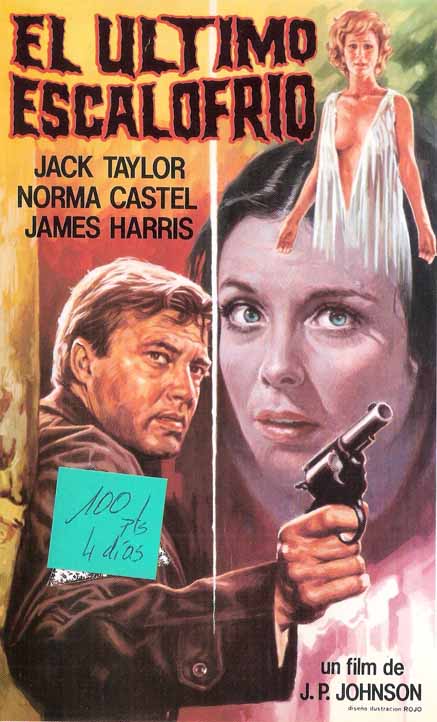
AKA: ‘Des Frissons sur la Peau’ (‘The Shiver of Fear’, France), ‘Le Chemin Solitaire’ (‘The Solitary Way’, France?), ‘El Ultimo Escalofrío’ (‘The Final Chill’, Spain), ‘French Emanuelle’ (UK), ‘Sicarius: Febbre di Sesso’ (‘Sicarius: Sex Fever’, Italy).

In several interviews conducted for DVD releases of his films, Jess Franco expressed a strong dislike for the work of ‘Emmanuelle’ director Just Jaeckin, claiming (if I recall correctly) that Jaeckin’s erotic films were cold, soulless affairs in which the director arranged his female cast like shop window dummies – in contract, presumably, to Franco’s own somewhat earthier and more emotionally engaged approach to dirty movie-making.

As such, one imagines Franco must have been less than thrilled at the prospect of making movies with ‘Emanuelle’ (one ‘m’, you’ll note, to avoid legal action) in the title, as seemingly became obligatory for all purveyors of euro-smut in the decade following the success of Jaeckin’s film. Perhaps we could read a certain black humour into the fact that this, Jess’s first ‘Emanuelle’ cash-in, features the titular character (here played by Norma Kastel) falling to her death from a clifftop balcony within the opening half hour, after which the movie becomes a flashback-heavy investigation into her murder… although, that reading of events is rather torpedoed by the fact that this film was actually shot BEFORE Jaeckin’s 'Emmanuelle', and was first screened in France in 1973, under the title ‘Des Frissons sur la Peau’.(1)

As has been mentioned in these pages before, Franco was pretty much on fire through the years 1972-74, producing an absolutely staggering quantity of work, much of it amongst his very best, the director working so fast that his films from this period almost seem like the result of cellular multiplication, with themes, locations, casts, costumes and script ideas all blurring into one another to create a sprawling sea of cinema that arguably represents the creative peak of Franco’s career.

Perhaps shot sometime between ‘La Comtesse Noire’ (Female Vampire) and ‘Les Nuits Brûlantes de Linda’ (Hot Nights of Linda), if the clues provided by locations, cast members and hairstyling are anything to go by, ‘Tender & Perverse Emanuelle’ (or whatever you want to call it) certainly isn’t amongst Franco’s best efforts from this period, but it nonetheless absorbs enough of the good stuff from the films surrounding it on his CV to make it a keeper for his ever-growing cult of devotees.

Like Lorna the Exorcist, ‘Tender & Perverse..’ begins with a contextless but intoxicating lesbian love scene, featuring an extended version of some footage that memorably appeared in the aforementioned ‘Hot Nights..’, featuring Lina Romay and a partner blowing cigarette smoke around a moodily lit, red-hued night club void, before (in this version) getting down to some serious softcore business. As the cry of Lina’s orgasm echoes over a swift cutaway to a clifftop shot of waves crashing against the shoreline far below, we know we’re in safe hands.

After this promising opening though, there is an unavoidable feeling of shoddiness to the way the rather slapdash melodrama / murder mystery plotline unfolds, not helped by one of the worst English dubs ever inflicted upon a Franco film. Regrettably for the dubbers, who seem to be making it up as they go along, there are a great many dialogue scenes and much procedural faffing about, making me wonder whether the French or Spanish versions might have featured a somewhat more compelling storyline than we get here - a distinct possibility, but I wouldn’t count on it based on the tedium that often resulted when Franco tried to make straight thrillers during the ‘70s. (See The Devil Came From Akasava for but one example.)

In places, Franco toys with the idea of expanding the murder mystery angle into full-on giallo territory – a hastily shot scene in which a woman playing piano in a bar is attacked via a garrote-wielding killer POV shot prefigures the slasher hi-jinks of Bloody Moon – but he never really follows this stylistic twist far enough to merit much interest.

‘Tender & Perverse..’s Citizen Kane-derived flashback structure recalls Franco’s excellent ‘Sinner’ (’73), but whereas that film was skillfully and deliberately constructed, the juxtaposition of scenes here seems fairly random, with flashbacks and sub-plots often feeling like flimsy excuses to mesh together a bunch of unconnected footage and sex scenes that one suspects could even have been shot for other projects.

Whereas the sex in most of Franco’s early ‘70s erotic films fits in quite naturally, feeling very much in keeping with the nature of the characters and the drift of the story, here it veers more toward the path taken by clumsier practitioners of the genre, with characters often seeming to get it on with each other at random intervals, for no terribly compelling reason. Not quite “the director blows the whistle and off they go” territory, but closer to such than Franco films of this vintage normally venture.

Whilst the resulting scenes are explicit enough to ensure that the film probably remained unseen outside of ‘specialist’ cinemas – sometimes playing the cheeky trick of adding anonymous insert shots to more chaste footage of the film’s lead actors - they are also sufficiently short and thinly spread out amongst straight crime/thriller footage that the movie would likely arouse nothing except frustration amongst the patrons of such establishments, raising the question of precisely what kind of contemporary audience the film could possibly have hoped to attract, even if it was an effective thriller (which for anyone other than us brain-scrabbled Franco devotees, it almost certainly isn’t).(2)

Cast-wise, Kastel herself is no great shakes as the ostensible lead, whilst as her husband, played by Spanish exploitation mainstay Alberto Dalbes, spends the whole picture just looking alternately bored and grumpy – an aura Dalbes continued to cultivate through his entire film career, insofar as I can tell.

More welcome is the presence of the ever-wonderful Jack Taylor, here looking at his very best, matching up his ‘Female Vampire’ mustache with some exquisitely classy threads to create the perfect exemplar of a dashing ‘70s gentleman. I don’t recall whether or not I’ve taken time here in the past to wax lyrical re: Jack Taylor, but needless to say - from his deep, soulful eyes and natural sense of style to the strange sense of innocence he seems able to bring even to roles in the very sleaziest movies, he is tops as far as I’m concerned, and it’s always a pleasure to spend time in his company.

It's also always a pleasure of course to spend time with Lina Romay, who here adopts a bit of a beatnik look for her first in-character scene as Jack’s wife / Dalbes’ sister, wearing shades and what appears to be a black nylon body-stocking. Through most of the rest of the film, she opts for a pair of fetching, thick-framed granny glasses, and, whilst the appalling dubbing makes it difficult to really get much of an angle on her performance, it is nice to see her in a slightly more subdued, naturalistic role than was usual in this era, wearing little make up and shunning the frenzied weirdness that characterized her appearances in ‘Comtesse..’, ‘Lorna..’ and ‘..Linda’, even though she remains the instigator of much of the film’s gratuitous hanky-panky.

Amongst the other familiar Franco faces popping up here, we’ve got rotund French comedian ‘Bigotini’ (who added inexplicable comic relief to ‘Hot Nights..’ and ‘73’s ‘Plaisir à Trios’) playing a rare straight role as a cop, and Antonio Mayans, who became Franco’s go-to male lead and general right hand man from the mid ‘70s right through to the director’s death in 2013, making what I believe may be his very first Francoverse appearance, as a minor character rejoicing under the perfect punk name of "Richard Scary".(3)

Meanwhile, the movie’s obligatory night-spot, ‘Yvonne’s Bar’, doesn’t have quite the same je ne sais quoi as the psychedelic dives of other Franco flicks, despite the application of some extremely blurry, freaked out camerawork, but it can at least boast Alice Arno (who appeared in almost every film I’ve thus far mentioned in the review) working behind the bar, so that’s ok.

In addition to a quintessential Franco cast, ‘Tender & Perverse..’ also benefits from the use of some quintessential Franco locations – some of them probably so familiar to the director’s fans by this stage that we’re quite liable to get confused and begin to believe we visited them during childhood or something. From the towering Alicante skyline to that familiar harbour with the big rock that Franco always films with exactly the same pan shot, it’s all here, whilst the clifftop villa with the red-tiled roof in which most of the action in ‘Hot Nights..’ took place stands in here as Kastel and Dalbes’ pad.

For all that it fails as both a thriller and a sex movie, ‘Tender & Perverse..’ does at least hit the spot as a pure Jess Franco movie, making extensive use of some of Jess’s favourite in-camera techniques to evoke a sense of drifting, dreamlike unreality. Focus is treated as optional  luxury throughout, and the aforementioned bar/night club scenes in particular degenerate almost completely into a psychedelic mess of fuzzy, over-saturated  wide-angle blurring.

For many other scenes, the lens seems to be smeared with more Vaseline than can possibly be sensible, whilst ‘Emanuelle’s solitary wanderings early in the film are enlivened by the same kind of extreme over-exposure that graced Janine Reynaud’s journey through the streets of Lisbon in Necronomicon, giving the scenes a kind of intense, unearthly glow, as, in some moments, she and her husband seem to disappear entirely into a sea of pure, blinding white.

This dreamlike, distorted atmos is only enhanced by Daniel White’s characteristically lugubrious piano score, the woozy tones of which seem to be launching a calculated assault against the audience’s attention span. White’s music for Franco’s films is certainly an acquired taste, that’s for sure - whilst some may claim it achieves a similar ambient sublimity to Badalamenti’s score for Twin Peaks, others may simply find it soporific and banal. I can’t decide where I stand on it really – it probably depends on how far after midnight it is, and how much I've had to drink. Count me as being on the fence for the moment, and maybe I’ll give you an opinion once I wake up, because the combination of White tinkling the ivories, the English dubbers spouting a load of improvised bullshit about dreams and nightmares and Franco playing hell with the focus knob has got me drifting off toward sleepy-time pretty damn quick….

Rest assured though, my dreams will be happy ones. Whilst most aficionados probably wouldn’t place ‘Tender & Perverse Emanuelle’ even within the top 25 horror-tinged erotic thrillers Jess Franco signed (one of) his name(s) to over the years, I nonetheless found it very enjoyable way to break the married life-imposed Franco abstinence that I have heroically undertaken over the past nine months or so. Whilst far from top drawer, it is still a picture that successfully invokes all of the most distinctive characteristics of the great man’s work, leading to a cinematic experience that, love it or hate it, couldn’t possibly have been created by any other human being – which certainly counts for something.

With Stephen Thrower’s long-awaited book finally arriving very soon (touch wood), a ticket to a whole evening dedicated to Mr. Thrower’s thoughts on Franco in my pocket and exciting new blu-rays on the way soon from both Kino/Redemption and Severin, it looks like I could be falling off the wagon for a good long while this time, perhaps following Emanuelle off that cliff into the shimmering Iberian waters below, as Lina moans distantly somewhere in the intermittently dubbed background. Bon voyage!

------------------------

Kink: 3/5
Creepitude: 1/5
Pulp Thrills: 2/5
Altered States: 3/5
Sight Seeing: 3/5

-------------------------


(1) From what I can gather, the ‘Emanuelle’ hook was only added when the film was dubbed into English, and even then, the dubbing “artists” (I use the term loosely in this case) seem unsure, as the title character’s name changes back and forth between Emanuelle and the script’s original Barbara from scene to scene. (The fact the English title card misses the ‘e’ off ‘perverse’ also suggests things were done in a hurry.)

(2) Of course we only need point toward ‘Lorna the Exorcist’ or ‘A Virgin Among The Living Dead’ to demonstrate how little of a fuck Franco gave about satisfying audience / producer expectations in the early ‘70s, but the lack of commercial potential seems particularly glaring in the case of a film like this ‘Tender & Perverse..’, which seems more like a misguided genre exercise, largely lacking the singular vision and crazed artistry of the aforementioned projects.

(3) ‘Bigotini’, we should note in passing, possesses a truly intimidating soup-strainer moustache that puts Taylor’s in the shade. In fact, all in all, ‘Tender & Perverse Emanuelle’ must rank as one of the most moustache-heavy films in Franco’s catalogue, with almost every male cast member luxuriating in designer facial hair of one kind of another. Scenes in which Bigotini and another moustachioed cop take in Jack and Dables for questioning actually approach some kind of ‘70s mustache critical mass…. all it would have taken is an additional picture of Maurizio Merli pinned to the wall, and the consequences for the time-space continuum could have been unthinkable.