Showing posts with label Edgar Allan Poe. Show all posts

Thursday, 15 April 2021

Gothic Originals:
The House of Usher
(Alan Birkinshaw, 1989)

 One oft-overlooked wrinkle in the history of gothic horror cinema is the inexplicable revival of the form which seemed to take place at the close of the 1980s, nearly 20 years after the subgenre had last been considered a viable commercial prospect.

Largely (though not entirely) confined to the low budget/straight to video realm, this phenomenon is difficult to account for, but it is interesting to note in retrospect that it seems to have directly pre-empted the short-lived Hollywood gothic revival of the early/mid ‘90s, as epitomised by Coppola’s ‘Dracula’, Branagh’s ‘Frankenstein’, Neil Jordon’s ‘Interview with the Vampire’ and so on.

Could it simply be that, by the tail end of the ‘80s, slasher sequels, exorcist derivations and movies about stupid, rubber-faced goblin creatures were all thoroughly played out, yet the relentless thirst for new horror product down the local video shop yet remained unquenched, thus allowing a generation of directors and producers who came of age during the glory days of the 1960s (or in some cases directly contributed to them) to step in and pick up the slack..? I don’t know, but that seems as good of an explanation as any, so let’s go with it.

Possibly the best of these films was Stuart Gordon’s ‘The Pit & The Pendulum’ (1991), whilst the most unusual and original must be Roger Corman’s last directorial effort to date, ‘Frankenstein Unbound’ (1990). Elsewhere meanwhile, we find Argento & Romero’s oddball Poe anthology ‘Two Evil Eyes’ (1990), the Robert Englund version of ‘The Phantom of the Opera’ (1989), a new, Corman-produced ‘Masque of the Red Death’ (also ’89), and, further out on the limb within the sub-genre, Ken Russell’s characteristically bizarre ‘Lair of the White Worm’ (1988) and Dan Golden’s Bram Stoker-derived ‘Burial of the Rats’ (1994).

Strangest and seediest of all these productions though are surely the two Edgar Allan Poe derivations shot back-to-back in 1989 under the auspices of our old friend Harry Alan Towers - a man whom I assume will need no introduction to readers who have spent a certain amount time toiling in the depths of horror/exploitation cinema.

Though his most famed / notorious productions may have been far behind him by this point, the indefatigable Mr Towers had remained busy through the 1980s, lending his production talents (credited or otherwise) to a bewildering cross-section of softcore, horror and action projects, each more tasteless and disreputable than the last, some bankrolled (almost inevitably) by Cannon Films, with many co-financed and/or shot in Apartheid-era South Africa (not too cool, man).

As the decade drew to a close though, Towers must have smelled something fetid and sepulchral on the breeze. Clearly no stranger to the prospect of jump-starting moribund / public domain literary properties via the injection of a few cheaply acquired stars and vague contemporary trappings, the idea of launching his own re-do of the Corman/Poe cycle seems to have taken hold.

And, who better to assist Towers in this noble venture than Alan Birkinshaw - the man who, a decade earlier, brought us the unfeasibly entertaining Killer’s Moon?

Add Oliver Reed (then hitting the very nadir of his booze-fogged b-movie purgatory, thanks in no small part to a series of Towers collaborations) and the always-up-for-a-laugh Donald Pleasence to the equation, and you’ll readily appreciate that House of Usher ‘89 is not so much “in my wheelhouse” as actually commandeering the wheel, bottle in hand, and ploughing full steam ahead ahead toward the nearest iceberg. When the opportunity to watch it recently arose, declining was simply not an option. 


So, how does the whole thing actually pan out then? Well, diverging from Poe right from the outset (not that there’s any shame in that of course), we begin with a wealthy and fashionable American couple - Molly and Ryan, played by Romy Windsor and Rufus Swart - taking a jog in Hyde Park as part of their sojourn in England, sweatbands and reeboks in full effect as they duck back into the entrance of the swanky Park Lane Hotel.

(If you find yourself amused rather than insulted when we cut directly to a cramped interior set which if surely not representative of the accommodations offered by the swanky Park Lane Hotel… well, long story short, I think this movie might be for you.)

Somewhat inevitably, it turns out that the couple intend to visit Ryan’s long-lost uncle / only surviving relative at his remote country pile, and, in the first of many arbitrary/unconscious borrowings from earlier horror films mixed into Michael J. Murray’s screenplay, the movie briefly threatens to turn into a re-run of 1978 dud ‘The Legacy’. Subsequent events however make it seem more likely that Murray was more likely to have been cribbing from David McGillivray’s script for the late Norman J. Warren’s ‘Satan’s Slave’ (1976).

Lost on the way out to Uncle Usher’s abode, the couple swerve off the road to avoid a pair of ghostly children (a random horror trope which is never really elaborated upon), precipitating a near-fatal crash which leaves Ryan unconscious. Fleeing to the nearby mansion in search of help, Molly is greeted by sour-faced, formally-attired butler Clive (Norman Coombes), who soon thereafter ventures out to the wrecked car with a crowbar in order to correct that whole “near fatal” thing vis-à-vis her severely injured fiancée.

It’s only after waking from her obligatory dose of heavy sedatives in an extraordinarily garish, neo-classical bed chamber that Molly is introduced to haughty, soft-spoken Roderick Usher (Reed, of course), who seems to have borrowed not only his general demeanour but even his moustache from Michael Gough’s sinister uncle in ‘Satan’s Slave’.

In some ways, making Molly’s ersatz Madeline figure the inquisitive visitor to the Usher household, whilst relegating her male counterpart to the coffin-bound narcoleptic role (as per Madeline in the source text, the exact state of Ryan’s health remains unclear throughout), seems like an interesting reversal of the gender roles baked into Poe’s text. But, of course, things soon take the path of least resistance, falling back into a series of familiar horror movie ruts.

In this Usher variation you see, Roderick is determined to propagate his cursed bloodline by any means necessary - and Molly, needless to say, is his chosen vessel. Roderick also appears to be receiving experimental, life-extending medical treatment from a sleazy family doctor (Philip Godawa), briefly adding an extraneous touch of Frankensteinian mad science to proceedings.

Clive the butler’s equally sour-faced wife (Anne Stradi) meanwhile acts as reluctant housekeeper for the warped household, even though Roderick is evidently no fan of her cooking (“Clive, will you tell your wife I do not expect horse meat to be served at my table?”), whilst the servants’ mute daughter Gwendolyn (Carole Farquhar) seems to represent Molly’s best prospect for a non-crazy/evil ally as she contemplates her escape from a nightmarish future as the heavily sedated recipient of Oliver Reed’s tainted seed.


Which leads us neatly on to the matter of Reed himself. Though viewers of a cynical disposition might be tempted to assume that what we are seeing here is actually take # 26 of any given scene, during which he finally managed to recite the voluminous passages of dialogue written up for him on off-screen cue cards without corpsing or falling over, I feel there are moments here in which he actually delivers a pretty good performance.

His inimitable, hushed voice is still in good shape, which certainly helps, and though fairly static and subdued, he brings a sense of preternaturally decrepit desperation to some of his early scenes, hinting at a vulnerability rarely seen in his on-screen (or indeed off-screen) persona. Later on however, the script’s graceless dialogue and absurd situations defeat his better instincts, with Shatner-esque… pauses… tending to… predominate (thus lending further weight to the cue cards argument).

If Reed’s acting is a tad lacking in energy though, he - regrettably - seems to have retained a great deal of enthusiasm for manhandling his leading lady, in a manner which becomes increasingly questionable over the course of several scenes which call for close physical contact between himself and Romy Windsor.

I have no idea whether Windsor ever spoke about her experience making this film, or what her thoughts were on working with Reed, but she certainly looks pretty damned uncomfortable as he more-or-less dry humps her live on camera on at least one occasion. Recalling numerous tales of Reed’s less than gentlemanly conduct during this era, it seems reasonable to assume that the gusto with which he approached this task was less than entirely fictitious.

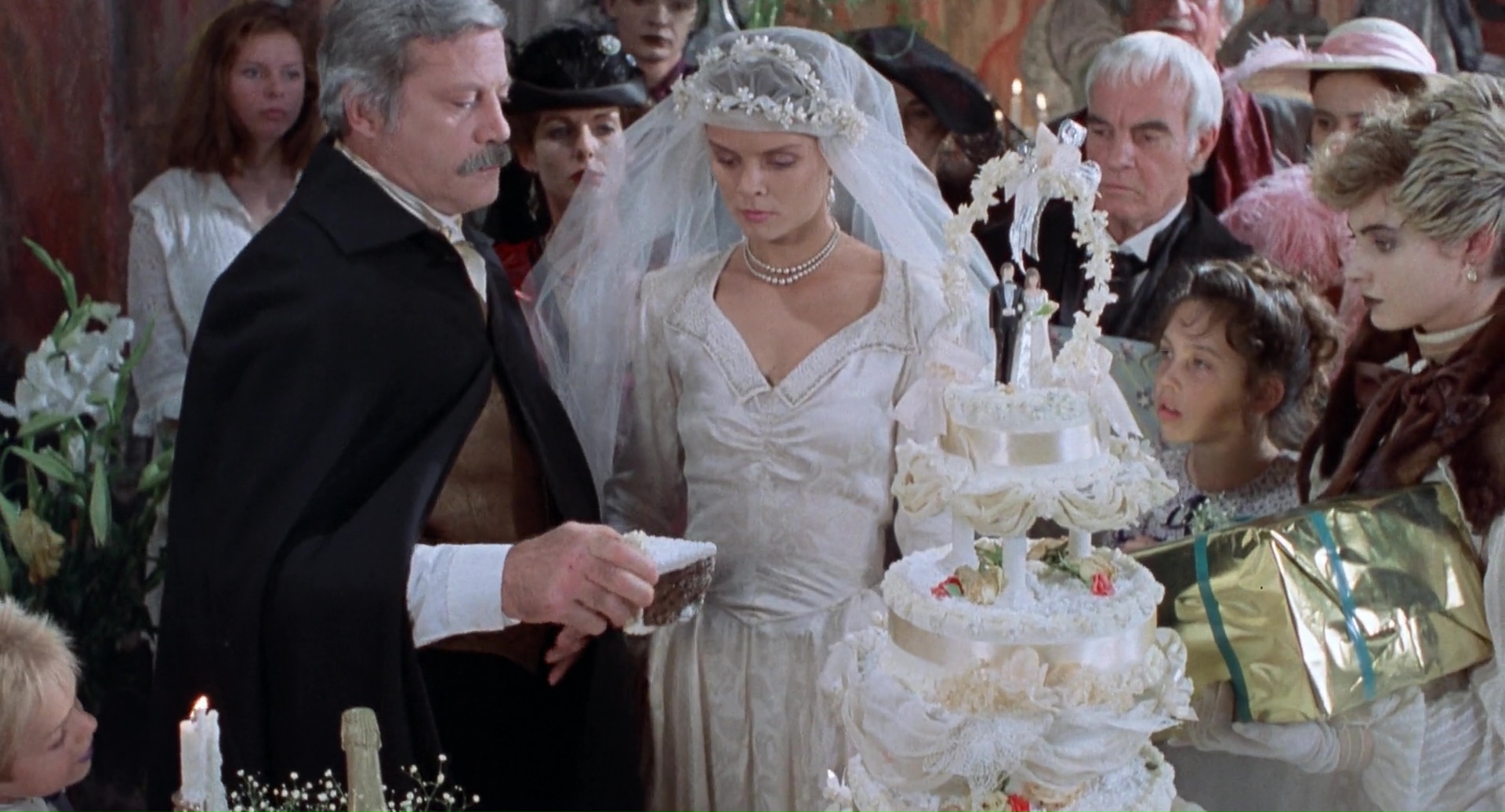
Horrifying as this seems however, even worse is to come during a particularly grotesque, hallucinogenic dream sequence (presumably modelled after those in the Corman/Poe pictures) depicting a daemonic marriage ceremony between Reed and Windsor. Here, we see Reed pick up a slice of a gigantic, tottering wedding cake, force it into Windsor’s mouth, and pull it out again with his teeth! Lord in heaven, I’ve never seen anything so repulsive.

Again, we should probably refrain from making any assumptions about a movie’s behind the scenes production circumstances, but whatever the truth of the matter, you’d better believe that this sight will leave a scar on my memory far more severe than any of the film’s ostensible ‘horror’ moments. You have been warned.

Moving swiftly on, another aspect of this ‘House of Usher’ liable to scar one’s senses is Leonardo Coen Cagli’s defiantly excessive production design, which throw the film almost immediately into a realm of phantasmagorical theatrical camp.

Although a few brief exterior shots on the Usher mansion were shot - I believe - at Knebworth House near Stevenage (an impressive Tudor edifice previously seen in ‘Horror Hospital’ (1973) and the aforementioned ‘Lair of the White Worm’), the interior sets are once again comically ill-matched.

To give credit where it’s due, Molly’s aforementioned bedroom is genuinely impressive in a crazy sort of way - a vast, medieval chamber decked out entirely in nightmarish pastel blue, it’s the kind of space which would indeed have fit the bill for a latter-day Ken Russell movie. The main ‘entrance hall’ set, complete with marble staircase, gilt curtains, hooded, faceless statues and Rubik’s Cube-styled windows, is pretty overwhelming too, conveying a similarly OTT, dreamlike feel.


Other areas within the candy-coloured mansion fare less well however, with a distinct whiff of air-brushed polystyrene and Dulux applied straight to plywood often predominating. Worst of all in this regard must be the ‘chapel’ set, which some overzealous scene painter has decorated with little black twirls, flames and spray-painted skulls, putting me in mind of the ‘goth room’ in some provincial indie nightclub. 


Uncle Roderick’s briefly mentioned background as an artist appears to have encouraged the film’s designers to load these sets up with all manner of mismatched tat, from Rodin-esque modernist sculptures to looming gargoyles, all-seeing eye covered Klimt pastiches, Italianate murals, moth-eaten Turkish carpets, faux-marble angel-y crap - you name it, and so long as it looks awful, it’s probably in here somewhere.

(It would probably be snarky to question how exactly all this is supposed to jibe with Roderick’s “acute sensitivity to certain colours”, which early in the film forces Molly to change her evening attire to “something a little more tasteful”, even though her initial choice of dress, though admittedly horrible, was actually a pretty good match for the mansion’s decor.)

Not that any of this is so dreadful in-and-of-itself, I should clarify - if anything, I appreciate the film’s wild disregard for realism and poverty-stricken attempts to overwhelm our senses. The problem lies more I think with DP Yossi Wein’s photography, which for the most part is odiously over-lit, its relentless brightness allowing no real mystery or atmosphere to accrue within these unhinged surroundings, highlighting their artificiality and essential silliness at every turn.


For all this baked-in shoddiness though, ‘House of Usher’ ’89 will still prove impossible for some of us not to enjoy on some perverse, unheimlich level. As uncharitable as some of my comments here may seem, I nonetheless found Birkinshaw’s film to be an absolute hoot, and would wholeheartedly recommend it to any admirer of distressed gothic aesthetics or oddball British horror.

Clearly a product of the same warped well-spring of inspiration which brought us ‘Killer’s Moon’, it is packed with enough uncouth eccentricities, bad ideas and baffling non-sequiturs to leave even the most jaded of psychotronic movie fans reeling - the aforementioned ‘cake incident’ foremost amongst them. (Hint when doing a psychedelic dream sequence, by the way: cutting away to shots of the dreaming character thrashing around in bed tends to spoil the effect somewhat.)

Early on for instance, we get a leering, grand guignol fake-out worthy of Todd Slaughter, as Clive the butler appears (for no apparent reason) to jam his wife’s arm into a hand-operated mincing machine, convincing us for one breathless moment that we’re witnessing a psychotic outburst of sickening gore… only for her to raise her arm from behind the machine, revealing that it’s merely the meat for tonight’s dinner being ground up. What larks.

Actually, now that I stop to think about it, pretty much all of the film’s big ‘horror highlights’ are equally arbitrary, not to mention highly derivative; hungry rat in cage (courtesy of ‘1984’, or possibly The Virgin of Nuremberg), grabby arms emerging from wall (‘Repulsion’ and/or ‘Dawn of the Dead’), head on serving platter (‘Tales That Witness Madness’ poster) - you get the idea.


Elsewhere, there is also much amusement to be gleaned from Molly’s pre-Usher profession as a hair stylist to the rich & famous. Apparently for instance, she’s so dedicated to her work that she managed to squeeze one of those full size Bakelite helmet hairdryer things into her suitcase!

Later, as she weeps inconsolably after learning that her fiancée is dead, the ever thoughtful housekeeper - distant and rude to fault through the rest of the film - picks her moment and asks, “I know you’ve got a lot on your mind, but whilst you’re here, could you do something with my hair?” Ever professional, Molly’s response is to throw her a can of mousse - “men love spikes”, she advises. (Recalling ‘Killer’s Moon’ again, moments like this cause me to wonder whether Birkinshaw had once again called upon his sister Fay Weldon to throw a few curveballs into the script.)

More emotional cross-wires can meanwhile be found in the final act, when Clive the butler learns of the deaths of his wife and child in separate Usher-instigated rampages - incidents which would play as tragic, gratuitous or cruel in most films, but here Birkinshaw pushes us straight into comedy by getting Norman Coombes to deliver two identical “OH MY GOD!” reaction shots in quick succession.

Another inexplicable curiosity meanwhile arises the film’s delightfully low rent synth score, jointly credited to two composers - George S. Clinton and Gary Chang - who both went to to enjoy noteworthy Hollywood careers, unlikely as that may seem. IMDB authoritatively informs me however that the rather fine, Carpenter-esque main theme used throughout ‘House of Usher’ was originally composed by Chang for John Frankenheimer’s 1986 Elmore Leonard adaptation ’52 Pick-up’, of all things. Had Towers just been pilfering tapes whilst visiting Cannon’s offices or something? God Only knows.


But wait a minute - didn’t I state, way back in the opening paragraphs of this review, that Donald Pleasence is in this film? Well, he is indeed! Turning up in the last half hour, he plays… well, to intents and purposes, he’s playing Saul Femm from James Whale’s 1932 ‘The Old Dark House’.

As the heretofore unmentioned lunatic brother locked in the attic, he manages to convince our heroine that he’s a poor, unfortunate fellow prisoner, before revealing, once granted his his freedom, that he’s actually a ruthless homicidal loon hell-bent on destroying everything in sight! (As in Jack Hill’s ‘Spider Baby’, these Ushers are cursed with a degenerative blood condition which pushes them further into psychosis as they get older, meaning that Pleasence’s character is pretty far gone.)

As usual, Pleasence does great work here. Evidently aware of his character’s pre-war inspiration, he has a great time putting his own spin on Brember Wills’ unforgettable performance in Whale’s film, bringing a sense of gravitas to his dialogue which temporarily even convinces us to take the film seriously. (“Thank god, an ACTOR,” I recall thinking at this point.)

Pleasance’s character is confined to a wheelchair (OR IS HE?, etc), and, apparently on account of his penchant for sculpture, he has a domestic hand drill strapped to one of his arms. Though allegedly utilised in a few moments of gory (off-screen) violence, I was chiefly struck my how thoroughly UN-threatening this looks, particularly when - in a moment which in a sense seems to sum up this movie’s crazy charm perfectly - he responds to being shut behind a locked door by a fleeing Molly by angrily drilling a series of very small holes straight into the plywood walls of the set! Whatcha gonna do Donald, hang some pictures?


Needless to say, this whole farrago concludes the only way it possibly could, with a decent into blood-curdling hysteria which Oliver Reed and Donald Pleasence rolling around on the floor in a frenzied, mutually suicidal wrestling match (shades of ‘Women in Love’ perhaps?), as the Corman/Poe-mandated conflagration erupts around them, sending these horrendous sets up in smoke once and for all.

Meanwhile, having rescued her hunky fiancée from behind a polystyrene tombstone, Romy Windsor finally flees back out into the fresh air of Knebworth House, presumably contemplating an immediate change of profession. (Actually, she went on to roles in ‘Surf Ninjas’, ‘Camp Nowhere’ and ‘Howling IV: The Original Nightmare’, but safe to say no more Harry Alan Towers productions were forthcoming.)

Towers and Birkinshaw though ploughed straight on in the same furrow, ensuring that ‘House of Usher’ was released more-or-less back to back with their visionary re-imagining of ‘The Masque of the Red Death’ - a film so assaultively crass it makes this one looks like a model of respectful sobriety by comparison. All being well, we’ll hopefully be digging into the garish mysteries of Red Death ‘89 here soon, so gird your loins folks, and make sure you come prepared. (Blindfolds, tranquilisers and hard liquor are all recommended.)


Friday, 11 October 2019

October Horrors 2019 # 6:
The Black Cat
(Harold Hoffman, 1966)

 It says something about the wild liberties cinema has taken with Edgar Allan Poe’s work over the years that Harold Hoffman’s 1966 independent production of ‘The Black Cat’ is actually one of the more faithful adaptations of Poe I can remember seeing, despite featuring a brawl at a rock n’ roll bar, an application of insulin shock treatment, a guest appearance by the Scotty McKay Quintet, a car chase and a man trying to feed champagne to his pet toucan.

Though the film-making here is pacey and technically proficient, one-shot director Hoffman made this one in Dallas, Texas in 1965, with funding partially provided by New York-based Hemisphere Pictures (yes, the Blood Island / Filipino co-production guys), and a sense of ineffable regional oddness shines through loud and clear in the finished product.

Aside from the 1960s setting, Hoffman’s main deviation from the text of Poe’s most disturbing and personal story is the fact that our protagonist Lou (Robert Frost – not the poet, obviously) is no longer a struggling writer, but in fact a very wealthy one. Lou (no surname provided) resides comfortably in a grand mansion he has inherited from his late parents, and the rationale for his descent into alcoholic delirium is given a more contemporary, Freudian update, as he is haunted by his hatred for his over-bearing father, whilst simultaneously revering the memory of his sainted mother.

When we meet Lou, he has been married for one year to the pretty but rather vacant Diana (Robyn Baker), apparently winning her heart with his romantic sensibility, child-like kindness and grasp of poetic-type lingo, so that’s nice for them both. Slightly less encouraging however is the fact that Lou increasingly likes to stay up all night, getting blind drunk and hanging out with his menagerie of caged animals, whom he speaks to in a crazy, cackling voice whilst attempting to force feed them alcohol.

One gets the feeling that Robert Frost may have made more than a few return visits to his local picture palace to catch Anthony Perkins in ‘Psycho’ a few years earlier, and he does great work here, delivering an endearingly twitchy, hellzapoppin’ uncomfortable-in-his-own-skin type performance. Sadly, Baker is, shall we say, an actress of more limited range, and the film ultimately suffers from her failure to garner much sympathy from viewers once her husband goes off the deep end.

As per Poe, Lou’s delicate mental balance seems to be upset by the introduction of the titular black cat, Pluto, into his household, as the cat soon comes to replace Diana in his affections. Also as per Poe, Lou begins heading further afield to get hammered – in this case, to a swinging joint where the aforementioned Scotty McKay and his boys (best known for their memorably raucous recording of Train Kept A-Rollin’, issued in 1968 with ‘Theme from The Black Cat’ on the flip) are busy laying down polite, white bread versions of ‘Bo Diddley’ and ‘Brown Eyed Handsome Man’.

These scenes are a lot of fun, complete with go-go dancers, a small crowd of modishly attired extras ravin’ it up, and the inebriated Frost looking cool as a cucumber as he cuts some rug, lit cigarette hanging precariously between his lips. (‘60s garage aficionados will also no doubt appreciate the chance to get a good look at the band doing their thing too.)

It’s kind of wonderful to suddenly realise we’re watching an Edgar Allan Poe movie with a rock n’ roll soundtrack (there are some groovy instro cuts too, and McKay and the band return later to sing ‘Sinner Man’, complete with piratical eye patches for some reason), and things get even more enjoyable when Lou’s raging drunkenness gets out of hand and the whole scene degenerates into a full on bar-room brawl, flying stools, smashing mirrors and everything. Good times!

In fact, whilst the success of the Corman/AIP Poe films earlier ‘60s must surely have inspired this project, at least in terms of convincing people it was a financially viable prospect (you can almost hear the filmmakers exclaiming “hey, they haven’t done ‘The Black Cat’ yet – let’s go!”, having apparently missed the middle segment of 1962’s ‘Tales of Terror’), it’s interesting to note the extent to which Hoffman refuses to draw upon their example here, eschewing gothic cliché and instead keeping things resolutely contemporary in terms of both setting and style.

As a result, ‘The Black Cat’ ends up feeling more akin to one of Corman’s snappier, black & white ‘50s productions, or one of those oddball hipster flicks that Something Weird Video used to specialise in digging up (indeed, I first watched ‘The Black Cat’ many years ago on a SWV double feature with the demented beatnik serial killer movie ‘The Fat Black Pussycat’ (1963), which I must get around to reviewing at some point).

After all this rockin’ fun, things adhere fairly closely to the Poe blueprint, and, though the film thankfully steers clear of full-on animal cruelty, prospective viewers should be aware that animals were at least made to feel a bit uncomfortable during its production, with a cup of liquid thrown over a caged monkey and a cat on a make-shift leash getting dragged up a flight of stairs, as well as providing a convincingly gruesome (staged) depiction of the pussycat gore the subject matter demands. The close up of a severed eyeball amid a mass of matted blood and fur in Lou’s clawed hand in particular is a great horror moment, though animal lovers of a sensitive disposition may beg to differ.

Once Lou has managed to burn his goddamn house down whilst in the process of electrocuting poor old Pluto, our lad is understandably confined to a sanatorium, where a scene depicting the application of the aforementioned insulin therapy (a grim and discredited procedure, needless to say) is truly rather horrifying, with his screams going way behind the comfort zone.

After a routine “yes doc, modern psychiatry has left me completely cured, yep, I ‘m a changed man alright, no doubt about that whatsoever” type sequence, Lou is back on the street – or, more specifically, in the more modest suburban home he now shares with Diana – and naturally he’s soon back to his old tricks. Another fun scene finds him freaking out in a low-life drinking den, where he unleashes a stream of crazy-man invective in the direction of a prospective hooker who has latched onto him. Amazingly, she continues to court him as a potential customer, even after he has slurringly accused her of being “a witch”, “the devil’s wife”, “an agent sent by my father” and “a cat in human form”. She must have really needed the business.

If the film drags a bit after this point, that’s largely just due to the fact that it plainly follows the story – and of course, we all know the story. Could the resulting feeling of ho-hum over-familiarity perhaps offer us an insight into why most other Poe adaptations tended to go so wildly off-piste with their story-telling (particularly in the USA, where, I gather, students are even required study this stuff in High School)?

The one remaining highlight – and it’s a doozy – comes when Lou (as per the story, once again) suddenly brains his long-suffering wife with a wood axe – whammo! This is a startlingly full-on, ahead of its time gore effect which punk rock fans of a certain age will immediately recognise as the source of the still used on the cover of The Angry Samoans’ Inside My Brain album.

To put my ‘serious critic’ hat on for a moment, ‘The Black Cat’s main weakness as a Poe adaptation is its superficiality. Whilst Hoffman dramatises the story in an admirably straightforward fashion, in the process of updating the explanation for the protagonist’s condition to reflect a paradigm of mid-20th century pop-psychiatry, he entirely jettisons Poe’s doom-laden musings on the underlying evil of the human condition, and loses most of the bleakly disturbing atmosphere which accompanied it in the process.

Meanwhile, we’re never really given a chance to engage with or share in Lou’s internal torments, despite Frost’s highly enjoyable performance, meaning that the movie’s eventual message never really delves much deeper than: hey girls, keep away from rich guys with parent issues who go a bit wacky when they drink – they ain’t no good, so do the right thing and you’ll keep your cranium intact.

Whilst these deficiencies prevent it from really being hailed as a lost classic of the horror genre however, Hoffman’s film is still a fun, divertingly weird watch, complete with a handful of startlingly memorable moments, a few laughs and some cool tunes, and its near total obscurity strikes me as slightly unfair. I certainly found it to be well worth the investment of 70-something minutes, and those with an interest in Poe adaptations and / or off-beat American regional horror in general are strongly encouraged to track it down.

Thursday, 8 October 2015

Four Poes.


(Everyman Library, 1975 – cover photograph by Graham Tucker.)

(Panther, 1967 – “Cover illustration shows ‘Venus Asleep’ be Paul Delvaux. Reproduction by courtesy of the Tate Gallery, London.”)


(Signet, 1960 – cover illustration unaccredited.)


(Digit, year unknown – cover illustration unaccredited.)

Normal posting schedule to hopefully be resumed shortly, but in the meantime, to help get us in an appropriately Autumnal / All Hallows-ish frame of mind, please enjoy this gallery of paperback Poe editions I’ve recently acquired.

By the time my own autumn has done come, I predict I will probably own about 147 printed versions of ‘The Gold Bug’, but, such is the vividness and variety of illustration & design work assigned to Poe collections over the years, I find it hard to say no when I spy one of these on the shelves.

Also, re: the Everyman edition pictured above, let’s just say that if that is indeed a ‘photograph’ as the back cover states, I want this Graham Tucker on my hypothetical payroll, pronto.

Monday, 17 December 2012

GOTHIC ORIGINALS:
The Fall of the House of Usher
(Roger Corman, 1960)


Thinking over this latest round of gothic horror reviews, it occurred to me that thus far we’ve not really touched upon American International Pictures’ hugely influential (and more to the point, hugely enjoyable) series of Edgar Allan Poe adaptations. Having previously only previously covered the cycle’s decidedly inglorious swan-song Cry Of The Banshee, now seems as good a time as any to return to the beginning, and marvel at the difference ten years can make.

Reportedly shot by Roger Corman for the princely sum of $200,000 over a marathon (by his standards) fourteen days, it’s safe to assume AIP must have made a pretty good return on their investment, as ‘The Fall of the House of Usher’ proceeded to kick-start a series of releases that spanned the whole of the following decade, defining the aesthetic of gothic horror cinema to such an extent that, perhaps even more-so than Hammer’s early successes, it is this film that can take responsibility for flooding the world’s screens with a tide of coffins, crypts and candelabras in the years that followed.

Right from its opening moments, ‘House of Usher’ seems intent of defying the limitations imposed by its low budget, as a wide tracking shot across a bleak, mist-laden moor haunted by dead, overhanging branches leads directly to a spectacularly overwrought matte shot of the titular house that remains breath-taking, in spite of its evident unreality. In fact, Daniel Haller’s production design in this opening sequence is so grandiose it suggests a cartoonish, almost ‘disneyfied’ take on gothic horror – diving headfirst into the kind of heady romantic imagery that Hammer hinted at, but were always reluctant to dwell upon, let alone take to the level of garish excess seen here. Such impressions are reinforced by Les Baxter’s quirky, over-bearing score, featuring a preposterous main theme that anticipates Danny Elfman’s oeuvre just as thoroughly as the accompanying visuals succeed in inventing about 90% of the cloying, comfort blanket gothic aesthetic that Tim Burton would later call his own.

As soon as future Italian b-movie stalwart Mark Damon his dismounted and made his entrance to the house however, it becomes clear that this bombastic introduction has overplayed things somewhat, and that, initially at least, we’re in for a drama that is considerably more sombre and low-key than casual viewers might have been anticipating. In fact, lacking any capacity for special effects or rampant supernatural shenanigans, the first half of the movie very much becomes a challenge to see how well the audience’s attention can be held by a cast of only four actors discussing largely abstract concerns within the confines of a few finely adorned sets. Not exactly a recipe for runaway box office success you might think, but when Corman is in the director’s chair, the script is by Richard Matheson and one of the actors in question is Vincent Price, you can rest assured that the viewer’s attention is not going to waver for long.

Price’s smooth-skinned, albino-like appearance will initially come as something of a surprise to those of us used to his more haggard demeanour in later films - but when he begins to speak, all doubts fade. Whilst it’s easy to throw such distinctions at any number of the films he made in the ‘60s and early ‘70s, for my money this is truly a career-best performance from the great man, with the hyper-sensitive recluse Roderick Usher seeming very much like the role he was born to play. The speech in which he describes the “morbid acuteness of the senses” with which his character is afflicted is rightly the stuff of legend, and just hearing his inimitable voice roll across Matheson’s perfectly turned Poe-esque dialogue is an absolute joy (“Two drops of fire… guttering in the vast, consuming darkness..”).

Like the film itself, Price’s art lies in taking things to the very edge of camp, but NEVER stepping over the line, maintaining an old world seriousness of purpose that allows him to invest a line as simple as “believe me sir, I bear you no malice” with a crushing pathos, his delivery alone telling us all we need to know about the dark secrets and untold years of torment that the remainder of the film proceeds to elaborate upon in more colourful detail.

As would become the norm with the Poe films, Matheson’s script takes considerable liberties with its literary source, but necessarily so in this case, given that a direct adaptation of Poe’s characteristically peculiar story would probably last about twenty minutes and include a lengthy poetry reading and scenes in which a guy recites quotations from a fictional medieval romance. Nonetheless, I think Matheson captures the feel of Poe’s work excellently, the dialogue-heavy format allowing him to pluck choice phrases from the original text and extrapolate them into icy, tormented soliloquies that – I would contend – stay remarkably true to the author’s pitch black intent.

One of literature’s blunter tales of the conflict between entropy and death and the eternal urge to life, ‘The Fall of the House of Usher’ of course exemplifies the underlying themes of all classically composed gothic horror, and Matheson’s script very much maintains that focus. “Something crept across the land, and blighted it,” Price intones with chilling relish at one point, as Poe’s central device of allowing psychological malady to assume physical form and transform the world of his characters remains paramount, more-so than the more conventional supernatural hi-jinks that took centre stage in later instalments.

Even the film’s nominal supernatural conceit – that of the house literally becoming possessed by evil as a result the misdeeds of its former inhabitants – remains true to Poe’s original notion of a psychological subjectivity and his understanding of the way a curdled mind can infect its surroundings, even as Price’s descriptions of the “savage degradations” of his ancestors express a wonderful, fairground ghoulishness sure to tingle the spines of a 1960 horror crowd (“Vivian Usher – blackmailer, harlot, murderess… she died in the madhouse..”).

(The portraits themselves incidentally are wonderfully striking, expressionistic works (the tormented canvases seen in Roderick’s study even more so), far more memorable than the usual knocked-up-in-a-few-hours-by-the-set-designer efforts that tend to pass for great art in films like this. Interestingly, the paintings are credited to one Burt Shonberg, a guy who, along with art department credits on several Corman films, is probably best known as co-proprietor and chief decorator of the legendary Laguna Beach beatnik hang-out Café Frankenstein. He subsequently painted murals for other LA counter-culture venues such as The Purple Onion and Pandora’s Box, and created the spectacular cover to Love’s Out Here album in 1969.)

Artwork aside, the design of the film’s interior sets is of course executed in definitive gothic style, with Haller & Corman’s décor and choice of visual motifs exerting a huge influence upon the aesthetic of ‘60s horror in general, and upon the Italian school in particular. For an example, just check out the rusty, wrought-iron gateway to the family crypt, and the way that not only this device itself, but also the decision to frame characters behind it as some kind of broad signpost of mental instability, turned up in all kinds of movies over the next few years (Whip & The Body and The Horrible Dr. Hichcock to name but a few).

In fact, the entirety of the film’s crypt sequence (featuring the revealing of brass name plaques identifying coffins as belonging to the still living, the obligatory disinterment of an uncannily preserved relative, etc etc) was reintegrated so persistently by the Italian directors that it became a cliché almost immediately, making it difficult to really judge the original effectiveness behind what now seems like ‘House of Usher’s most conventional horror movie moment, when a coffin falls open to reveal a dusty skeleton (“shit, they’ve sat through twenty five minutes of this stuff, let’s give ‘em a skeleton”).

With such a limited range of dramatic possibility, things do start to get slightly creaky as the picture creeps toward feature length, but in fact this inadvertently allows ‘House of Usher’ to add another notch to its impressive list of ‘firsts’, as the tradition of the psychedelic dream sequence that would follow through all the AIP/Corman films is hereby established. A characteristically enjoyable blue and purple-tinted fantasia ensues, as Mark Damon’s sleeping spirit is harangued not just by the ghosts of Usher ancestors, but by swatches of coloured mist and sharp, expressionistic frames and shapes… that strange, slightly LA-beatnik tinged strain of modernism shining through again, maybe..?

Anyway, the deftness with which Corman handles the sombre tone of the material here is hugely impressive, given that his most successful directorial efforts up to this point (‘A Bucket of Blood’, ‘Little Shop of Horrors’) had been comedies, and that the Poe series itself would veer off into similar territory almost immediately with the knock-about matinee fun of ‘Tales of Terror’ and ‘The Raven’. All of those are great movies, no question, but immeasurably different in tone from this one, in which – despite occasional hints of knowing humour - a genuine feeling of crushing morbidity predominates, evoking a macabre atmosphere that is easily on a par with the grimmest of the Italian epics that followed. Whilst conventional horror ‘shocks’ are few, in Corman’s capable hands the story still builds to a tremendously suspenseful conclusion that, though it would be reiterated a thousand times over the next decade, is still powerful enough to make an indelible impression upon anyone who has allowed themselves to be caught up in the drama.

“At least she has been spared the agonies of trying to escape”, Roderick Usher here proclaims after his sister’s apparent death - a blunt reminder of the unflinching pessimism at the heart of Poe’s universe that few if any subsequent adaptations of his work would dare touch upon.
 

Friday, 22 June 2012

Gothic Horror Round-Up II:
Cry of the Banshee
(Gordon Hessler, 1970)


And so from the sublime to the ridiculous, as 1970’s ‘Cry of the Banshee’ sees AIP’s long-running series of Vincent Price-led gothics finally spluttering to a halt, with a conclusion as ill-starred as any vengeful witch could’ve hoped for.

Allegedly annoyed that AIP had denied them the preparation time needed for a trip to Scotland to research ancient celtic folklore or somesuch, screenwriter Christopher Wicking and director Gordon Hessler apparently decided to show them the error of their ways by throwing together a screenplay based on nothing whatsoever, reworking Tim Kelly’s initial draft into a hackneyed mess of nonsense set in some non-specific part of 16th century England, where cruel local magistrate Edward Whitman lords it over both the local populace and his own family, in a tepid amalgamation of Price’s far more memorable roles in ‘Witchfinder General’ and ‘Masque of the Red Death’.

Anyone coming to this film hoping to learn a thing or two about banshees and what they get up to will be soundly disappointed, as the fascinating mythology pertaining to said creatures is entirely ignored, leaving us with nothing but some vague were-creature and one of the most annoyingly inconsistent pre-christian witch cults in cinema history to function as thorns in Price’s side.

Hey, wait a minute, pre-xtian witch cults, you say? That sounds like some pretty fun stuff! Yeah, that’s what I thought too, but sadly this concept is handled just as poorly as the banshee stuff, with the sinister, forest-dwelling cult here taking the form of a bunch of obnoxious first-year drama students, prancing about in togas and night-gowns, performing tedious hippie era ‘self-actualisation’ exercises. Head witch Oona, as portrayed by veteran stage and screen actress Elizabeth Bergner, must merit some sort of award as “most irritating witch of all time”, narrowly beating Lila Zaborin from ‘Blood Orgy of the She-Devils’ to the prize as she gurns away under an unkempt fright-wig, rolling her eyes and vocalising her painfully over-enunciated declamations in a voice that’s sort of half Irish, half Romany, and all ‘drunken am-dram auntie’.

The filmmakers seem to have tried to incorporate some belated ‘social commentary’ into this scenario, characterising the cultists as peace-loving drop-outs being persecuted by the cruel and repressive authorities. In fact Wicking is even on record as saying that he meant Price’s persecution of the cultists to remind viewers of Mayor Daley’s crushing of dissent at the ’68 Democratic Convention, if you can believe that. Like most elements of the film through, the execution of this idea too confused and half-arsed to really amount to much.

“Oona is good, Oona heals, Oona is love”, her followers chant, but if these cultists are supposed to be benign and sympathetic figures, why do we also see them praising Satan, conjuring up curses at the drop of a hat, orchestrating the deaths of people who weren’t even remotely to blame for their persecution, and basically doing everything that Vince’s ‘repressive’ regime accuses them of..? Exploiting all the bad karma of Satanism without any of the accompanying cool stuff and gnarly rites, Oona’s cult are just about the most charmless gang of woodland devil worshippers you could ever have the misfortune to encounter.

As regular readers will know, I absolutely loved Hessler and Wicking’s Scream & Scream Again, which they made immediately prior to starting work on ‘..Banshee’. And whilst I suppose a dose of ‘Scream..’s errant pacing and unhinged randomness can be felt in ‘..Banshee’ to a certain extent, the duo’s approach sadly achieves an altogether more negative result here, as a general lack of any of the novelty, enthusiasm or imagination that made the earlier film so unique leaves us with a movie that, beyond just feeling a bit pointless, leaves a bad taste in the mouth in just about every respect.

First and foremost, the film spends much of its run-time exhibiting a distinctly unhealthy strain of cruelty and misogyny that quickly outstays its welcome. If Michael Reeves’ ‘Witchfinder General’ succeeded in introducing a new level of grim realism into period horror films at the dawn of the ‘70s, the makers of ‘..Banshee’ certainly take full advantage of these developments. Unfortunately though, they seem to have missed the point of Reeves’ film entirely, using the ground gained by their predecessor simply as an excuse to fill their own film with as much sleaze and unpleasantness as thought they could get away with.

Throughout the film, breasts are exposed with monotonous regularity, inevitably accompanied by torture, beatings and sexual assault, as the kind of scenes that were powerful and upsetting in ‘Witchfinder..’ are reiterated as pure, mindless exploitation, dwelt upon in a way that, whilst ostensibly less explicit than European efforts like 1971’s ‘Mark of the Devil’, somehow comes across as even more distasteful. In spite – or perhaps because of - its hammy, old fashioned atmosphere, I think ‘..Banshee’ actually stands out as one of the rapiest, most cynically nasty British horror films of the ‘70s (which is saying something, considering the excesses that were to come later in the decade).

Of all the female cast, only Hilary Dwyer (from ‘Witchfinder..’) as Price’s daughter emerges with her dignity intact, and even she has to face up to the challenge of some absolutely senseless dialogue, the script demanding that her character suddenly deliver lines like “it’s as though we were all seeds of evil”, apropos of nothing. It’s stuff like that that dooms most of the performances in this movie, as actors good, bad and indifferent all seem to flounder with the material they’ve been handed. Bergner, despite her storied career, is just plain awful, Swedish actress Essy Persson does the best she can with a thankless role as Price’s much-abused wife, and it’s very sad see the once great Welsh actor Hugh Griffiths wasted (in both senses of the word) as a comic relief gravedigger.

Cheap, ‘who-cares-anyway’ production decisions and highly variable cinematography also take their toll, as exemplified by the face-slappingly awful moment in which two characters casually look out of a castle window at night before their POV immediately cuts to some completely unmatched daylight stock footage of wolves roaming through some woodland. And by the time Persson finds herself being menaced by a disembodied halloween werewolf claw, any hope that this movie might redeem itself has faded pretty much to zero, with not even the ever-reliable Vincent Price able to summon up enough energy to salvage proceedings.

By this stage, Price was apparently already unhappy with the declining quality of the films AIP were offering him, and the half-hearted sleaze and myriad absurdities of ‘..Banshee’ can scarcely have done much to improve his mood. Of course, Price never really gives a ‘bad’ performance, but he’s clearly finding it hard to hide his disgruntlement here, knocking out passages of dialogue that were clearly written with his dulcet tones in mind as quickly as he can before stalking dejectedly off-screen. And it’s hard to blame him really; prior to the upswing his career took in the early ‘70s thanks to such quality vehicles as ‘The Abominable Dr. Phibes’ and ‘Theatre of Blood’, it’s easy to imagine him being a bit worried about where he was headed at this point, perhaps seeing himself descending the same slippery slope toward demeaning trash that had claimed so many aging horror stars before him.

So… yeah. As you might have gathered, I really didn’t like this one much. In the ‘plus’ column, we’ve at least got a terrific, Terry Gilliam-designed animated credits sequence, and a fine, foreboding score by Wilfred Josephs. Some of the woodland scenes are nicely photographed, capturing at least a hint of the mossy, verdant atmospherics found in the infinitely superior ‘Blood on Satan’s Claw’. Oh, and the ending is quite nicely executed in a gleeful, twist-in-the-tail kinda way.

But seriously, that’s about all I’m getting here in terms of positives.

I suppose I shouldn’t be that hard on ‘..Banshee’. In the grander scheme of things it’s still perfectly watchable, and it at least tries to explore some interesting ideas, even if it doesn’t get very far with them. In fact, if this was some zero budget regional independent movie from the same era, you’d probably rank it as a good effort. But as a professional production with a wealth of talent and experience behind it, coming at the tail end of a series that had produced almost a dozen far better (and far more *likeable*) movies by this point, it seems like a ropey, embarrassing mess, and a sad way to send the Price/Poe films to their unquiet grave.

Wednesday, 29 December 2010

#12
The Black Cat

(Edgar G. Ulmer, 1934)


“Strange about the cat… Joan seemed so curiously affected when you killed it..”

Recently, I’ve been conteplating the notion that cats, black ones in particular, are good omens for a horror film. From Lucio Fulci’s astoundingly peculiar “Il Gatto Nero” to the Peter Lorre/Vincent Price segment of Corman’s “Tales of Terror”, to zany beatnik murder caper “The Fat Black Pussycat”, and even that nutso low budget ‘60s version of “The Black Cat” put out by Something Weird where that guy force-feeds his parrots champagne and whacks his wife in the face with an axe, the presence of a black cat seems to be a pretty reliable indicator of a great time. Whether or not my theory would stand up to a viewing of 1972’s Night of 1000 Cats remains to be seen, but for the moment I’m sticking to it. And where better to mark the genesis of this noble cinematic lineage than with Edgar Ulmer’s 1934 Black Cat – surely one of the strangest and most extraordinary horror films ever made, and the one I’m going to try my best to hold forth about here today.

Ahem.

A common interpretation of German Expressionist cinema of the 1920s sees it as a therapeutic/interpretive reaction to the mechanized horrors of World War I, and the same logic is of course applied to the whole of the wider explosion in Modernism that took place in the arts after the war. And if the Universal/Hollywood horror film of the 1930s can be seem as the bastard child of Expressionism, then “The Black Cat” is the mutant beast that squares the circle, as Austrian director Ulmer combines the familiar gothic trappings of Universal horror with a strange variation on stark, European Modernism, drawing us back explicitly to the traumas wrought upon European consciousness by the Great War.

As soon as the opening credits have rolled, our straight/normal honeymooning couple have the singularly bad luck of seeing their train carriage canoodling disturbed by an anxious Bela Lugosi, who tells them in agonising detail of the fifteen years of soul-destroying hell he has spent in a POW camp. Try that one out for ‘things you’d least like to happen on your wedding night’. When they all leave the train and continue their journey by coach, the driver regales them with tales of how the land they are traversing was the scene of some of the worst slaughter of the war, cheerily recalling the sight of bodies piled upon bodies, before the poor fellow promptly joins them when the coach takes a tumble off the rain-soaked mountain road, a circumstance that sees our characters changing their travel plans and paying a visit to Bela’s ‘old buddy’ - Boris Karloff as the almost impossibly sinister visionary architect Hjalmar Poelzig, whose terrifying modernist edifice of a house is literally built atop the mass graves of the men who died during the war under his treacherous command. Worst honeymoon ever, I think it’s fair to say.

A top-heavy wreck of conflicting aesthetic and cultural ideas, in which traditional horror movie notions of good and evil are left vague at best, “The Black Cat” is a challenging film to really write about or analyse. More-so than just about any other ‘golden age’ horror movie, it is an uncomfortable, disturbing viewing experience, reconstructing distant echoes of Poe’s original scenario into a modernist nightmare in which characters seem to exist in a constant state of nervous desperation and nothing ever quite seems to make sense.

As their characters renew their long-standing blood rivalry, Lugosi and Karloff seem to be competing to see who can appear the most utterly cracked, maxing out their respective allowances of morbid weirdness almost straight away as they start indulging in marathon staring contests, twitching like lunatics and undertaking lengthy, unprovoked digressions about such matters as ‘the dark of the moon’ and ‘the nature of evil’, as the appropriately named Peter Manners as Mr. Straight Guy looks on incredulous. Even their servants are fucking mental – Karloff’s major-domo played by craggy-face horror regular Egon Brecher, and Lugosi’s servant some kind of mute oriental strong man. In a scene that has to be seen to be believed, Bela spears Karloff’s cat with a thrown fork, before Boris quietly explains that his friend ‘suffers from a nervous affliction’ that renders him utterly terrified of cats – the only point at which cats, or Bela’s inexplicable fear thereof, are referred to in the whole damn movie!

Dull as they are, it’s hard not to sympathise with our ‘normal’ couple, plunged unexpectedly into this realm of world class boggle-eyed lunacy, trying to relax and recuperate in a complex of bare, Travelodge-esque bedrooms, under constant threat of Bela Lugosi or Boris Karloff barging in unannounced through the communicating doors to subject them to strange tirades of obsequious politeness. Bela is supposed to be a ‘good guy’, relatively speaking, and indeed he does his damnedest to take on a Van Helsing style gravitas when telling young Joan of the dangers she faces from evil old Karloff, but he’s not fooling anyone – it’s clear that he’s just as much of a vengeance-crazed loon as his opposite number, and understandably she just wants the whole lot of them to fuck off and leave her alone with her husband.

Then, just when you feel things have gotten about as freaky as was possible for a 1934 movie without its makers being incarcerated in the name of general public well-being, Ulmer drops the bomb that Karloff’s character is a Satanist. I mean, an actual, honest to god Satanic cult leader who summons his robe-clad coven to celebrate the rites of Lucifer around a terrifying Cubist/Expressionist altar in the catacombs beneath his house!

I realise that doesn’t exactly sound like much of an eye-opener by modern horror standards, but how many Satanic cults do you reckon had been seen in American cinema prior to 1934..? Now I’ve not done any actual research into the matter, but I’m gonna take a wild guess and say NONE. And furthermore, I don’t really think devil worshippers and black magic cults began to become an accepted part of horror movie procedure until probably the late fifties/early sixties, with the emergence of films like Jacque Tourneur’s “Night of the Demon” and Hammer’s “The Witches”. Why on earth did Ulmer feel the need to make Polzig a Satanist? Like, as if this film wasn’t berserk enough already! The Satan angle comes completely out of nowhere in the film’s final act, serves little actual narrative purpose, and rendered “The Black Cat” so controversial that Universal allegedly cut down Ulmer’s director’s cut down to a lean sixty minutes prior to release, whilst the British censor objected so strongly to the Satanism that he excised it completely, presenting UK film-goers with a version that ran less than fifty minutes.

Thank god for obscurely-inspired maniacs like Ulmer though, because “The Black Cat”s black mass is absolutely breathtaking – the first scene of its kind seen in popular cinema anywhere in the world, and the last too for many years, it brings a dream-like, ritualistic intensity to the film that prefigures all my favourite bits of modern horror.

Everything about “The Black Cat” is completely inexplicable – it is a work of near protean high weirdness, a haunted, desperate, genuinely unstable film in which nothing is easy, nothing is certain, no one is happy, nothing is the way it should be. I know I’m often inclined on this site to talk about my conception of ‘the weirdo horror film’ - well, “The Black Cat” (perhaps in a fifty/fifty split with the next item on our list) can be considered the daddy of them all.

Tuesday, 21 December 2010

#17
The Masque of the Red Death
(Roger Corman, 1964)


“The doctor dances in the white room… but I passed close by him. Truly Prospero, do you not know me?”

Until I acquired a new copy on DVD last year, I’d built up “Masque of the Red Death” to near-mythical status in my own mind, based on catching it randomly on TV a few years ago – an event that was perhaps responsible for triggering my whole love of ‘60s gothic horror. The rich, overwhelming colours, the swirling shapes of the dancers, the suffocating, decadent evilness of the whole venture – Corman’s vision may have had little to do with the blacks and blues and empty, echoing stone chambers that Poe’s writing has always communicated to me, but on its own terms it was a real aesthetic mind-blower – a mixture of psychotropic ‘60s excess and esoteric medieval grue in Hollywood drag, fusing the core themes of Poe’s story to the more extreme accruements of its own era, like, I dunno, Kenneth Anger meets Torquemada on the set of a ‘Robin of Sherwood’ movie or something.

So naturally when it came to revisiting it, my expectations were high. And as ever with high expectations, I was slightly disappointed. Having familiarised myself in the meantime with the work of Mario Bava and Terrence Fisher, of Rollin and Margerheti and all the other masters of weird cinematic gothic, “..Red Death” made less of an impact on me than it did the first time ‘round. Nicolas Roeg’s dazzling colour-coded cinematography and Daniel Haller’s otherworldly art direction seemed somewhat less dazzling and otherworldly. Having decided that I tend to prefer Vincent Price in tragic/sympathetic roles, his portrayal of the amoral Prince Prospero, though still excellent, seemed to lack that certain something that characterises his very best performances. The metaphysical pronouncements of the emissary of the Red Death began to sound less eerily profound, more like some of yr hastily pulled together AIP mumbo-jumbo.

Of course, that’s what happens when you build things up to gigantic proportions over time. If not approached as a life-changing masterpiece, “Masque..” is merely a really, really excellent example of a technicolor era gothic, with a first class cast incorporating at least four members of the official Breakfast in the Ruins Weirdo Horror Hall of Fame, a heavy, oneiric atmosphere, an luridly imaginative script and superb production design. The film’s big set pieces – Prospero’s opening visit to the village, Juliana’s dream-sequence and blood-pledge to Satan, the manifestation of the Red Death and the closing Dance of Death – are all breathtaking.

And, all other considerations aside, we should remember: this is a film in which Patrick Magee is hung from the ceiling dressed in a gorilla suit and set on fire by a dwarf. If that doesn’t guarantee a film a place in my top 20, what would?