Showing posts with label orientalism. Show all posts
Tuesday, 1 May 2018
Pre-War Thrills:
The Mask of Fu Manchu
(Charles Brabin, 1932)
The Mask of Fu Manchu
(Charles Brabin, 1932)
So, to get this out of the way right from the outset: if you’re going to take an interest in the pulp fiction or popular literature of the early 20th Century, you’re going to encounter a lot of racism.
H.P. Lovecraft may have taken most of the flak for this in recent years (largely due to the fact that he is one of the only pulp magazine writers still liable to be read by the kind of young/educated readers most liable to take offence at his repellent views), but, as fascinating as it may be to ponder the psychological underpinnings of Lovecraft’s errant fears and prejudices, the digger one digs into the work of his contemporaries, the clearer it becomes that these prejudices were far from uncommon.
Put into context alongside the unabashed imperialism and hysterical miscegenation fears of writers like Seabury Quinn and Dennis Wheatley, the deeply offensive caricatures of non-white characters that litter the work of Edgar Wallace or the dozens of other, more obscure, examples that blogger Samuel Wilson has chronicled over the past few years via his True Pulp Fiction project, Lovecraft’s more notorious passages are noteworthy only for the unusually strident manner in which he expressed his views, rather than for the views themselves (and, as fans and detractors alike will appreciate, HPL was writer who liked to express just about everything in pretty strident terms).
More than any other writer of course, it is Fu Manchu’s creator Sax Rohmer who must, through the very nature of his most famous creation, be singled out as the poster boy for all this Pulp Racism. I confess I’ve not read enough Rohmer to really make a call on the extent to which this assumption is justified, but…. well really this is all just a long-winded way of saying that I probably shouldn’t have been too surprised to discover that a Fu Manchu movie from 1932 is pretty damned racist.
Perhaps I’d been lured into a false sense of security here by my familiarity with the 1960s series of Harry Alan Towers/Christopher Lee Fu Manchu movies [see my reviews of ‘Brides of…’ and ‘Blood of…’ here and here]. Though still a far cry from what anyone would be liable to deem ‘politically correct’, these films are essentially pretty good-natured affairs that tend to treat their antagonist’s ethnicity as a mere incidental detail – a bit of exotic colour to liven up his Bond villain-esque schemes for world domination.
Charles Brabin’s film, by contrast, is definitely pulling no punches. “You hideous yellow monster,” heroine Karen Morley spits at Boris Karloff’s Fu Manchu at one point, shortly after he in turn promises to “..destroy your whole accursed white race”. Clearly sensitivity of any kind was not on the cards here.
Adapted by a veritable raft of screenwriters from the simultaneously published Rohmer novel of the same name, ‘The Mask of Fu Manchu’ indeed presents us with a villain whose motivations are somewhat different from those of the unilateral, ego-driven super-villain proposed by most other screen adaptations. Instead, Fu Manchu’s attempts to swipe the face-mask and sword of Genghis Khan from under the noses of the British archaeologists who have just excavated them is motivated by his plan to use the ceremonial power of these artefacts to inspire the people of Asia (yes, all of Asia) to unite and overthrow their Western oppressors.
Leaving aside the fact that, given the geo-political shit that had gone down in the century or so prior to 1932, people in many parts of Asia had pretty legitimate cause to want to overthrow their Western oppressors, the notion that the sight of a Chinese man carrying some paraphernalia belonging to a Mongol folk hero would somehow cause everyone from Istanbul to Yokohama to rise up in revolt is just so utterly bizarre that I don’t even know where to start with it really. It just left me speechless to be honest, but… such is the level of wilful cultural ignorance we’re dealing with here, apparently.
When, late in the film, we see Fu Manchu strutting his stuff on the stage of what looks like a disused theatre, rousing a crowd of guys who largely resemble moth-eaten Afghan warlords of some kind to a mild display of scimitar-rattling enthusiasm (“conquer and breed – kill the white man and take his women”, he memorably exhorts them), we have to wonder how the hell anyone was *ever* supposed to buy this idea, even in the further reaches of fanciful pulp delirium.
Needless to say, the film’s steadfast defenders of the British Empire spend a great deal of time asserting the seriousness of Dr Fu’s rather whimsical scheme, but it doesn’t help that those defenders aren’t really a very persuasive bunch, by and large.
For reasons best known to themselves, the scriptwriters on ‘Mask of Fu Manchu’ seem to have nixed the idea of including Rohmer’s likeable Holmes/Watson surrogates Nayland Smith and Dr Petrie, who usually provide the bulk of the heroic daring-do in these stories, instead entrusting our attentions to bunch of fairly grumpy, interchangeable middle-aged men who never really succeed in making much of an impression.
As our nominal protagonist, Morley does what heroines do in these kind of things – being alternately headstrong and hysterical, wearing a pith helmet and fretting about her missing-presumed kidnapped archaeologist father and/or archaeologist husband - whilst the assorted interchangeable chaps offer little in the way of reassurance once she’s out on-site in the Gobi Desert.
To be fair, Nayland Smith is actually present (in the shape of Lewis Stone, who also appeared in The Lost World), but he spends the first half of the movie directing operations remotely from back in London, and when he does finally get in on the action he proves only marginally more formidable than the other fellows, with his name warranting scarcely so much as a shrug from his supposed arch-nemesis.
Oh well. At least Boris Karloff’s take on Fu Manchu has got to be worth the price of admission, right? Well, perhaps, but, with all due respect to Karloff, I’m not sure he comes over all that well here to be honest.
Whereas Christopher Lee in the ‘60s movies presented an appropriately towering, saturnine presence (much as you’d expect I suppose), Karloff’s Fu Manchu feels like a physically smaller figure, with a loquacious, conniving sort of vibe about him.
Much is made in the script of Fu’s doctorates from Cambridge, Edinburgh, Harvard etc, and in light of this, Karloff speaks in his own delightfully melodious tones, without attempting any hint of an accent. As lovely as it must have been for him to give his voice a good work-out after non-speaking roles in ‘Frankenstein’ and ‘The Old Dark House’ however, the cliché-riddled diatribes the script equips him with are scarcely very edifying, and, well… perhaps it’s just me, but the idea of a Fu Manchu who is ceaselessly nattering away rather distracts from the taciturn, Confusion menace I prefer to associate with the character.
On plus side, Karloff does muster some splendidly diabolical expressions, and makes good use of his long, claw-like fingernails, but his performance can scarcely have been helped by a somewhat excessive make-up job – complete with pointed ears – that makes the “Devil Doctor” look more like a fire-damaged elf than a Chinese man. (Attempting to cash-in on Karloff’s recent breakthrough as a horror star, this explicitly monstrous/non-human Fu Manchu was rather optimistically billed as “The Frankenstein of the Orient” on some of the movie’s posters.)
Likewise, the casting of the great Myrna Loy as Fu Manchu’s lascivious daughter Fah Lo See bodes well, but production anecdotes suggest that Loy (who had often been cast in ‘oriental’ roles during the silent era, in spite of her entirely European heritage) made no secret of her distaste for the material, and her resentment at essentially being forced to appear in the film by MGM is reflected in a performance pointedly lacking in any kind of enthusiasm. (1)
Other gossip meanwhile relates that, when Karloff requested a script prior to shooting, he received nothing but gales of laughter in response, and subsequently had to deal with having his dialogue passed to him from day to day on single-spaced, typo-ridden pages. It also seems worth noting at this juncture that an initial attempt at principal photography on the film collapsed in chaos after three days, with initial director Charles Vidor subsequently finding himself sacked by the studio, and Brabin drafted in at short notice to replace him.
Under such circumstances, it’s hardly surprising that, in purely narrative terms, the completed ‘Mask of Fu Manchu’ is alternately boring and nonsensical, essentially boiling down to lot of stodgy, indifferently shot dialogue scenes interspersed – seemingly at random – with flourishes of morbid, horror movie atmospherics and grand, opulently transgressive set-pieces.
Thankfully though, the latter sequences survive as fairly jaw-dropping examples of deranged, pre-code decadence, and indeed, even as the film embodies the most regrettable aspects of its era’s pulp fiction, it also manages to bring the very best of the pre-war “Shudder Pulp” aesthetic to the screen, going all out to justify Fu Manchu’s reputation as “The Lord of Strange Deaths” with a series of hair-raising, grand guignol spectacles, rendered with such lavish enthusiasm that they feel like ‘Weird Tales’ cover illustrations come to life.
After minor bits of ghoulishness early on (one character gets a knife in the back, a severed hand falls from a tree at another’s feet etc), things really get underway in this regard when we see Fu Manchu subject the first of his English captives to “the torture of the bell” – a somewhat Poe-like conception that sees the poor chap spread-eagled across a slab whilst a gigantic bell bongs away immediately above him.
Not the most gruesome of on-screen torments perhaps, but it’s at least agreeably bizarre, and Fu Manchu’s attempts to entice information from his victim by dangling grapes from his claw-like finger nails and fooling him with salt water carry an icky charge of sadism that serves to set us up nicely for the depredations to follow.
Subsequent highlights include the extraordinary sight of captured leading man Charles Starrett stripped to a loin cloth and strapped to a table with metal brace around his neck as Fah Lo See covetously surveys his naked flesh, a phalanx of Nubian slaves arranged on pedestals behind her like human statues. When Dr Fu himself makes the scene – ominously clad in a surgical gown - the exceptionally icky action that follows involves the fresh blood of lizards and tarantulas being drawn into a syringe and mixed with snake venom pulled directly from the wound of a dying sacrificial victim(!), all to aid the creation of a mind control serum that we then see injected straight into Starrett’s neck.
One of the earliest horror scenes I’m aware of that dares to go straight for a gross-out / gag reaction, this alarming juxtaposition of bodily fluids and creepy-crawlies almost seems to prefigure the post-‘Black Magic’ excesses of ‘70s/’80s Hong Kong horror, and as such proves pretty hard to top in terms of nastiness.
Even more extraordinary in some ways however is a subsequent scene in which poor old Nayland Smith finds himself strapped to a kind of gigantic see-saw, balanced mere feet above a pit fill of – apparently genuine – alligators. Single shots appear to confirm that Lewis Stone himself was hanging mere inches away from the jaws of these surly looking beasts (no stuntmen here!), whilst, elsewhere, another captured good guy (who presumably won the on-set coin toss prior to shooting) merely has to contend with the none-more classic device of having horizontal spiked walls slowly closing in upon him.
Marvellously, all this madness is rendered in lavish, no-expense-spared fashion by MGM, who at the time were riding high as Hollywood’s top-grossing studio, meaning that, like Doctor X before it, ‘The Mask of Fu Manchu’ is able to take full advantage of the brief, magic window that followed in the wake of ‘Dracula’ & ‘Frankenstein’s box office returns, when horror and pulp adventure subjects could temporarily command something approaching A-picture production values.
Both the opening scenes, set in a shadow-haunted British Museum, and the later explorations of Fu Manchu's suitably extravagant subterranean lair employ a series of genuinely vast sets, elaborately dressed with a wildly imaginative mixture of scientific apparatus and faux-Chinese artistry, incorporating throne rooms, amphitheatre-like torture chambers and – my personal favourite – a curtained-off circular alcove carved from a dividing wall within Fah Lo See’s bed-chamber, wherein, we suppose, Fu’s daughter likes to recline with her “victims” (more on which below).
Tony Gaudio’s photography intermittently catches some fine, shadowy vistas on all this high camp weirdness, and, despite the chaos that apparently characterised the production, the film intermittently displays some great bits of visual imagination – most notably the introductory shot of Fu Manchu himself, in which we see Karloff’s fiendish visage reflected in distorting mirror, inexplicably raising a glass of dark, foaming liquid to his lips as electricity crackles dangerously from some off screen device, casting jagged shadow across his face.
It is in moments like this I think that the film’s conception of Fu Manchu really comes alive, portraying him as a man so completely immersed in his hermetic world of rare poisons, venomous concoctions and scientifically-derived terror machines that they have practically (or literally, in this case) become his food and drink, placing him beyond the threshold of mere humanity – a theme that is taken up later in the film, when we see him almost dancing with the sparking, unearthed electricity current that fly from his machinery.
‘The Mask of Fu Manchu’ also echoes ‘Doctor X’ in providing another fine exemplar of early horror’s post-‘Frankenstein’ fascination with the sinister properties of electricity. Indeed, Fu Manchu’s impressive array of spark-spewing equipment – including an actual death ray, no less - were built by Kenneth Strickfaden, the legendary architect of the laboratory sets in Universal’s Frankenstein series, and his creations definitely get a good work out here.
Perhaps we could read a touch of metaphorical significance into all these electricity bolts flying around the place too, given that, as has often been observed, there is something weirdly sexual about Karloff’s portrayal of Fu Manchu, with his sinuous movements and his propensity to unleash sighs of pleasure furthering the impression that the scenes within his lair were purposely designed to convey a particular kind of frisson to the thrill-hungry audience MGM were hoping to attract to the picture. (Heck, even the carved figures on doors of Genghis Khan’s tomb look a bit saucy.)
In this respect, the film is particularly keen to push the envelope in regard to Loy’s character, making the nature of the sexual interplay between Fah Lo See and her father’s captives abundantly clear whenever the opportunity arises. When Fu Manchu initially interviews his captured archaeologist, he basically offers to let the man sleep with his daughter in exchange for information about the location of Genghis Khan’s swag (“even this, my daughter, I offer to you”), but the boot is very much on the other foot later in the picture, when, prior to his ordeal with all the snake venom and tarantula blood, Charles Starrett finds himself chained to a dungeon ceiling, stripped to the waist and whipped (with what look like leather straps) by Fah Lo’s musclebound Nubian slaves… all whilst the lady herself looks up, working herself up into a bit of a sweat as she insists they hit him harder, and faster.
After this, we see Starrett’s exhausted body deposited – where else – in Fah Lo See’s bed chamber, where she lasciviously caresses his bloodied torso until the scene is interrupted by the entrance of her father. Essentially, the filmmakers outline her activities as a sadistic sexual predator about as unambiguously as they possibly could without moving into full on stag movie territory, and, though the power of these scenes is somewhat undermined by Myrna Loy looking as if she was being forced to emote at gun point, modern viewers can still thrill as they contemplate the long decades that would pass before American audiences would next be allowed to enjoy the sight of a woman experiencing orgiastic pleasure as she oversees a man-on-man bondage session.
To be honest, given the puritanical edicts that would begin to be imposed upon Hollywood productions just a few years after this film’s release, it’s surprising that the early proponents of the Hays Code didn’t suffer a collective coronary when they learned of the kind of depravity depicted in ‘The Mask of Fu Manchu’. In fact, having apparently failed to learn the lessons of the disastrous reception that greeted their release of Tod Browning’s notorious ‘Freaks’ a year earlier, it seems in retrospect as if MGM were hell-bent here on crafting a horror movie calculated to offend absolutely everyone on some level.
I mean, even if you were a 1930s citizen with liberal enough sensibilities to roll with all the sadistic torture and sexual perversity, chances are you might have drawn a line at the film’s blunt racial prejudice and dumb-headed colonialism (or failing that, at least been a bit grossed out by all the lingering close-ups of snakes and spiders).
As a result of this triple threat to public morals (and stomachs), it’s scarcely surprising to learn that ‘The Mask of Fu Manchu’ seems to have become one of the most widely censored films in history. It was banned outright in some territories (including many European countries and, unsurprisingly, in Japan), whilst other local jurisdictions proceeded to arbitrarily cut the film as they saw fit. Some excised bits of the more extreme content, whilst others snipped the inflammatory dialogue, and some even imposed cuts on the grounds of blasphemy, before moral guardians presumably did the same in the next state/county/town, until surviving release prints must have been sliced and diced beyond the worst nightmares of a Lucio Fulci/Jess Franco archivist.
Adding to the confusion, it seems that, when MGM staff returned to the film with a view to striking a new print in the 1970s, they were so shocked by the racially insensitive content that they sliced many offending lines of dialogue straight out of the negative, creating a bowdlerised version that became the only way to watch the movie for decades to come, until the nigh on miraculous discovery of a clean, uncut lab print returned it to circulation in all its unsavoury glory in the 21st century.
For all the multitudinous outrage that ‘The Mask of Fu Manchu’ provoked however, the moment modern viewers might be liable to find most unsettling is one that largely escaped to attention of censors at the time – namely, the scene during the film’s conclusion in which Nayland Smith and his comrades take control of Fu Manchu’s death ray and turn it upon the arch-fiend and his followers, who are gathered in the hall below.
What I found noteworthy here is that, rather than alarming the villains and prompting them to scatter (as would normally be the case with this sort of thing), our heroes actually mow down every single one of the quote-unquote “Asian” ne’erdowells, even leaving the weapon running to mop up the survivors as they head off in triumph.
Distantly recalling the same dark questions raised by the old College Debating Society chestnut about whether or not the USA would ever have dared to drop an atomic bomb on a European city, there is something genuinely chilling about the sight of the good guys in an action-adventure story casually massacring several hundred defenceless people in a locked room, without their heroism being at all called into question as a result.
Immediately after this meanwhile, the film reaches the nadir of its unapologetic racism in a deeply regrettable closing scene that finds Nayland Smith and his friends aboard ship on their way home to England. They are in the process of consigning Genghis Khan’s sword and mask to the bottom of the ocean (because, y’know, fuck that shit), when they freeze upon hearing the sinister crash of an oriental gong.
Their surprise turns to laughter however when a short, pot-bellied, gap-toothed Chinese man enters stage right to declare that dinner is served. Do you have a doctorate from Harvard, or from Christ’s College, Nayland Smith jokingly asks the man, who shakes his head in mute incomprehension, giggling along with his relieved interrogators as they shuffle past him and head off to get their grub. Cue triumphant musical flourish and ‘The End’ card.
The comparison between this pitiable ship steward and the defeated Fu Manchu is thus made explicit, and the message that the film leaves us with is clear: as long as we keep these people away from our institutions of learning and make sure they don't get any funny ideas, they’ll remain where they belong - illiterate, buck-toothed and banging the dinner gong – and all will be right with the world.
Taking the film far beyond a mere “this is the way they did things in 1932” level of background racism, it’s hardly surprising that these ugly sentiments proved controversial even at the time (apparently the Chinese Ambassador to the USA lodged a complaint about the film following its release), and perhaps, like ‘Freaks’ before it, ‘The Mask of Fu Manchu’ can best be seen as another example of MGM disastrously misjudging public tastes in their rush to try to cash in on the contemporary vogue for horror.
Certainly, no sequels to were forthcoming, despite the obvious potential for turning Fu Manchu into a series character. Karloff quietly returned to work at Universal after filming was completed, and, as we’ve discussed above, the film was withdrawn from circulation in its uncut form for pretty much the entirety of the 20th century.
But, eighty plus years down the line, we can hopefully at least strive toward some semblance of 20-20 hindsight and acknowledge that, for all of the deplorable attitudes it embodies, ‘The Mask of Fu Manchu’s errant combination of hare-brained colonialism and grotesque, sexualised sadism still proves fascinatingly unsettling and alluring, carrying with it an intoxicating whiff of the forbidden that edges it toward the same “dark camp” category within which ‘Freaks’ eventually found its niche as a celebrated cult film.
With its baroque excesses and general air of taboo-trampling derangement, ‘Mask..’ certainly stands up as just as much of an unforgettable viewing experience as the other (ostensibly far superior) films I’ve covered elsewhere in this review thread, irrespective of the hateful attitudes expressed within it.
--
(1) Confusingly, Fah Lo See inexplicably became Lin Tang (played by Tsai Chin) in the ‘60s movies, and she had already been renamed Ling Moy (played by the beautiful Eurasian star Anna May Wong) in an earlier Fu Manchu adaptation with Warner Oland, 1931’s ‘Daughter of the Dragon’. In Rohmer’s novels, she was Fah lo Suee, so ‘Mask of..’ gets it closest.
Sunday, 1 October 2017
October Horrors # 1:
Werewolf of London
(Stuart Walker, 1935)
Werewolf of London
(Stuart Walker, 1935)
During the Second World War, American studio horror films (and Universal’s efforts in particular) managed to boil themselves down into a set of formulaic clichés that have come to broadly define the idea of “cheesy horror films” in the popular imagination ever since.
That much we know, but the shadow cast by eight subsequent decades of monster movie branding makes it easy to forget that, a full decade before Glenn Strange was stomping about in the Frankenstein get-up and some mad scientist was trying to decide which brains to put where whilst the torch-wielding mob knocked on his door, many of the first wave of American horrors from the early/mid 1930s were far more unpredictable and just-plain-weird than this reductive set of clichés would suggest - and not just the designated classics helmed by Whale, Browning, Freund and Ulmer either.
My theory, y’see, goes that, during the pre-war years, studio directors and writers who found themselves assigned to a horror picture were obliged to strike out in all kinds of tentative new directions, faced as they were with a new, commercially popular genre for which no easily replicable template had yet been established. For a few years at least after the runaway success of ‘Frankenstein’ and ‘Dracula’, the thinking seemed to be that a big part of what pulled the punters in to see these movies was the sheer novelty of their subject matter – that oh-so-bankable “nothing-like-this-seen-before-on-the-screen” factor.
Rather than merely seeking to imitate those earlier hits therefore, Universal and the other studios seemed to want their boys to crank out some genuine ‘Shock of the New’… and mad-as-a-barrel-of-bats pictures like ‘Werewolf of London’ were the inevitable result.
As everybody knows, it was Curt Siodmak’s script for 1941’s ‘The Wolf Man’ that basically laid down the law for all future cinematic werewolves, pretty much inventing the werewolf mythology we now take for granted, and, as such, it feels all the more surprising to go back a further six years and discover that Universal’s first – commercially unsuccessful - stab at a werewolf movie completely ignored the monster’s origins in European folklore, instead pulling together elements of “exotic” orientalist adventure fiction, newly minted Frankensteinian mad science, slight echoes of ‘abominable snowman’ mythos and a hefty dose of Jekyll & Hyde to tell a very different tale of lycanthropy.
Written from scratch by John Colton and producer Robert Harris (was this the first Universal horror that didn’t even pretend to follow any literary antecedent?), we’re essentially talking here about a werewolf story that involves excursions to remote Himalayan valleys, rare night-blooming flowers, sinister underground networks of lycanthropy sufferers, electronically-generated artificial moonlight, hints of faux-Buddhist mysticism, octopus-tentacled man-eating plants, Jack The Ripper-style Victorian London skulduggery, and… well, you get the idea.
It’s all great stuff, and, watching for the first time, I went through most of the film with absolutely no idea where it was all going next -- which is a lovely feeling when it comes to a genre movie made over eighty years ago.
On a more prosaic level meanwhile, another thing ‘Werewolf of London’ has going for it in the weirdness stakes is the casting in the lead role of Henry Hull – a prolific character actor who here delivers a very convincing impression of a granite-jawed, hammer-headed lummox entirely devoid of human feeling.
Seriously, Hull’s character – a pioneering botanist and plant-hunting adventurer - is so rude to everyone he encounters during the film, it’s a miracle he has any friends or supporters at all, let alone a beautiful wife (Valerie Hobson from ‘Bride of Frankenstein’ and ‘Kind Hearts & Coronets’) to ignore and belittle, a whole garden party full of wealthy associates to offend, and a luxuriously appointed mansion house/botanical gardens/laboratory set-up in which to receive them.
Though Hull never becomes an out-right villainous character (in the vein of Peter Cushing’s Frankenstein, or the roles Michael Gough played for Herman Cohen in the ‘60s), he nonetheless comes across as a conceited, self-centred asshole, and much of ‘Werewolf of London’s failure to engage with audiences over the years has retrospectively been blamed on the film’s decision to present them with such an entirely unsympathetic protagonist.
Personally however, I’ve never much cared for this “central character must be sympathetic” jive that critics sometimes fall into, and I very much enjoyed the way that Hull’s perpetually enraged presence makes every conversation in the film feel spectacularly awkward. This allows ‘Werewolf of London’s idle chatter-filled dialogue scenes to side-step the usual blandness and expositional drag, instead filling the movie with pregnant non-sequiturs, uncomfortable silences and “well… I suppose I’d better be going then…” type moments, all of which I found most amusing.
(To be honest, Hull seems like such a goddamned weirdo, it’s easy to believe that few of these emphases were actually present in the script – it’s as if the other actors just had no idea how to react to him.)
Speaking of weirdoes meanwhile, the somewhat more likeable Warner Oland is also on hand as the inscrutable Dr Yogami, essentially offering a slight variation on the Charlie Chan character he played in dozens of sixty minute programmers through the 1930s. Though supposedly a more villainous figure than Hull’s character in terms of the storyline – not to mention racially offensive on more levels than can be calculated without the help of a spreadsheet – Oland’s faux-Asian quack doctor is a veritable teddy bear compared to our leading man, which leads once again to some very strange cognitive dissonance in terms of the way business is conducted on-screen.
Though ‘Werewolf of London’ is nothing special in terms of artistry or atmosphere, Stuart Walker’s direction is breezy and fast-moving, most of the film’s performances are lively and Hull’s transformation into an inadvertently rockabilly-styled wolfman is a hoot (sacrilege though it may be to say so, I think I actually prefer the make-up job here to Jack Pierce’s work on the ’41 Wolf Man). It’s all just such a wonderfully imaginative load of cracked, b-movie fun, it is impossible not to enjoy it on some level – so if you’ve previously overlooked it, I’d definitely recommend giving it a shot at the nearest opportunity.
For a perfect case study in what went wrong with horror movies between the mid ‘30s and mid ‘40s meanwhile, just try contrasting ‘Werewolf of London’ with its quasi-sequel, ‘She Wolf of London’ from 1946 - a sixty minute programmer so utterly lacking in interest that I can honestly believe it was concocted as part of some studio in-joke to try to drive audiences home to bed before the main feature came on.
I was going to do a separate review of ‘She Wolf..’, but… there really is nothing to say. I might just as well review the carpet in my living room. If, like me, you’ve got both of these movies on a double feature disc, please do yourself a favour and just skip the second one entirely. Hell, watch ‘Werewolf of London’ again instead – you’ll be happier that way, trust me.
Labels:
"London",
1930s,
film,
Henry Hull,
horror,
mad botanists,
movie reviews,
OH17,
orientalism,
PWT,
Stuart Walker,
The Himalayas,
Universal,
Valerie Hobson,
Warner Oland,
Werewolves
Tuesday, 23 September 2014
Franco Files:
Cartes sur Table /
‘Attack of the Robots’
(1966)
Cartes sur Table /
‘Attack of the Robots’
(1966)
By the dawn of the 1960s, hatchet-faced American actor Eddie Constantine had become an pretty iconic figure in European popular cinema, playing Peter Cheyney’s hard-as-nails private eye Lemmy Caution in a series of French thrillers that included seven films between 1953 and 1963.
Two years after his final ‘straight’ Caution film, things took a rather strange turn when Constantine found himself reprising his best known character in the lead role of Jean-Luc Godard’s inscrutable arthouse sci-fi mash-up ‘Alphaville’, and with his screen persona thoroughly beyond-the-looking-glass by that point, it’s a fair bet that things scarcely got any more normal for Eddie when 1966 found him working for Jess Franco, playing the lead in two films completed that year.
One was the self-explanatory ‘Residencia para Espias’, and the other the little number we’re looking at today. Released around Europe with the inexplicably bland title ‘Cartes sur Table’ (‘Cards on the Table’), the film reached American shores under the somewhat more punchy ‘Attack of the Robots’, and, whilst neither title really bears *that much* relevance to the events portrayed therein, no prize is offered for guessing which of the two names I prefer.
So, with an English title that suggests a sci-fi movie and a star chiefly associated with two-fisted detective roles, it comes as something of a surprise to settle into ‘Attack of the Robots’ and discover that what we're watching here is actually nothing less than a fully-fledged euro-spy film, marching out in all its Bond-ripping finery.
As a director ever shackled to the whims of contemporary box office trends, Franco made a number of films during the ‘60s that fall vaguely within the ‘eurospy’ bracket, but, crucially, he seems to have had little interest in making anything like a straight treatment of the genre. The live action comic book of ‘Lucky The Inscrutable’ (1967) is too weird and uneven to really hit its appointed generic prerequisites, whilst 1968’s two ‘Red Lips’ films are simply too goofy to count, and I’ve not yet had a chance to see the aforementioned ‘Residencia..’, meaning that, for now, ‘Attack of the Robots’ is by default the closest thing we have to a genuine Jess Franco eurospy film.
Of course, being a Franco film, ‘Attack..’ is still full of off-piste diversions and eccentricities, pushing heavily toward the sillier end of the genre’s stylistic spectrum and often toppling over into full-blown spoof territory. But nonetheless - aficionados of the marginally more well-known second string spy extravaganzas filling cinemas through the mid ‘60s will feel thoroughly at home here, in spite of the director’s relentless piss-taking.
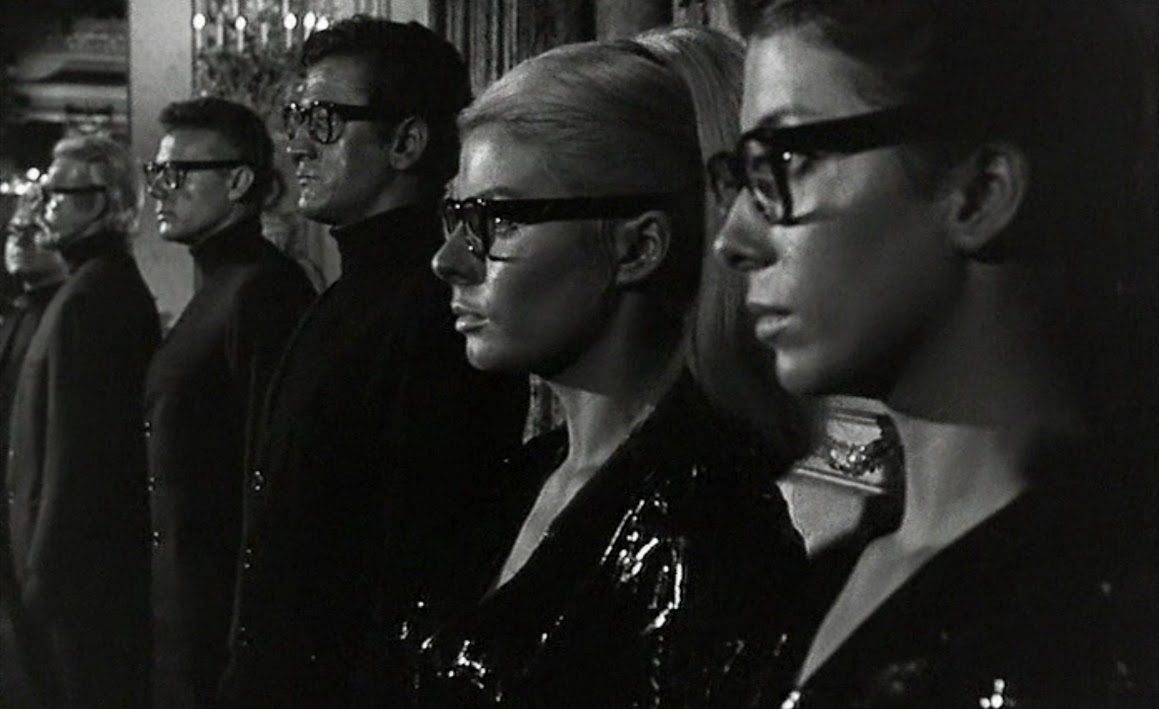
Anyway! Plot summary! So, it seems mysterious assassins in black-face make up, black turtlenecks and Michael Caine glasses are popping up all over the place, annihilating important people as they head into big buildings to do important things! What the hell are the forces of international law and order going to do about it..?
(The loveably unconvincing globe-trotting during this opening assassination montage eases us into the low budget eurospy vibe perfectly, as on-screen captions inform us we’re visiting Buenos Aires, Amsterdam etc, despite seeing nothing more than vague shots of cathedral steps and airport runways.)
About ten minutes of exposition-laden chat at Interpol HQ follows, eventually leading us to introduction of Eddie Constantine, here not playing Lemmy C, but our old pal “Al Peterson” (in the English dub), a troublesome former agent picked out of a rolodex by an administrator with a surprisingly thorough knowledge of his operatives’ blood types. (Having copped that the assassins all have the same rare blood type y’see, they need an agent who matches it, vis-à-vis the general idea that the villains will latch on to him and pick him up for, well, whatever processes they use to create these ‘robot’ assassins… and Lemmy – I mean Al – is the only man for the job.)
Within the eurospy context, the comment that Peterson can be found “somewhere on this planet with a gorgeous blonde & a bottle of scotch” tells us all he need to know about our hero’s persona, even if the sexy dame we see him sweet-talking when the action cuts to a riverside casino in some questionably exotic ‘oriental’ locale is actually a brunette.
Much business with living statue geisha girls, soul-witheringly cheesy xylophone music and subterranean opium dens follows, as Eddie finds himself kidnapped by a cackling, shrieky-voiced Chinese agent named Lee Wee (Vincente Roca),(1) prompting an overload of sub-Fu Manchu orientalism that combines with a kind of bizarre back-and-forth slapstick comedy routine and some surprisingly elaborate set dressing to create the impression of a sequence that could have been taken from a film thirty years older than this one.
After he gets through with all that, our man finds his old buddies from Interpol waiting in his hotel room, and is duly given the lowdown. And if shooting in Bangkok or Buenos Aires may be off the menu for yr average Jess Franco production, his budget could at least stretch to a week or two in sunny Alicante, whence Peterson is soon dispatched with a new cover identity, a bag full of improbably dangerous gadgetry and the winningly Bond-like mission of simply hanging around drinking and womanizing until the bad guys obediently turn up to pounce on him. (“How many James Bond films have you seen recently?”, Eddie asks his handlers. “More than you’d think” comes the rather gnomic reply.)
Upon his ‘arrival’ in Spain, Constantine drops the obligatory tuxedo and returns to his more familiar uniform of a shabby looking suit & tie with crumpled, ill-fitting hat, reasserting the visual identity he had constructed for himself in the Lemmy Caution films, even as ‘Attack of the Robots’ ostensibly finds him playing a different character in a very different scenario.(2)
Within minutes, Eddie - sorry, Al - has scoped out a beautiful but suspicious dame (Sophie Hardy, in her only role for Franco), checked into a fancy hotel, indulged in a fist-fight with an overly effusive Mexican, and been spied upon by a furtive agent in a safari suit (‘60s Franco regular Marcelo Arroita-Jáuregui). And for the next thirty minutes or so things proceed in much the way you’d imagine really, which is just dandy.
Presumably filmed in close proximity to the preceding year’s The Diabolical Dr. Z (much of the same supporting cast reappear here, as do some of the props, most likely), ‘Attack of the Robots’ was also co-authored by that film’s scriptwriter, future Luis Bunuel collaborator Jean-Claude Carriere, whom we might conceivably credit with some this film’s more darkly witty moments.
The hackneyed Lee Wee stuff might not be terribly successful as comedy, but once we get past that, much of the rest of the film is actually pretty funny, with the combination of Franco’s cartoon-ish enthusiasm and a few well-placed zingers that I assume Carriere smuggled into the script leading to some genuinely amusing moments - not least the obligatory “gadget demonstration scene”, which is one of the best spoofs of such I recall seeing, as Eddie’s handlers palm off a series of increasingly absurd devices upon him with perfect deadpan unconcern, including a pair of electrified driving gloves that supposedly carry enough charge to kill “twenty adults, or about thirty children”, and, brilliantly, an explosive, poison gas equipped cigar whose contagion can only be avoided through use of a secret vial of antidote that can only be accessed by playing a particular jig on a flute disguised as a fountain pen (you might want to read that back a few times).
Further spoofy shenanigans follow in the shape of a random kid sending messages back to the villains using a ‘radio’ hidden inside a toy car,(3) and an agent who spends much of the film glued to a payphone delivering a series of uber-conspicuous code messages (“the roses and the gladioli have been set in the vase at last. You can play the delicate melody… but only in the minor key”). You get the general idea, I’m sure.
Unlike a crime or horror picture, a ‘60s spy movie really needs the oversaturated blast of cheap Eastman colour to get its groove on, and as such, ‘Attack..’ suffers somewhat from being shot in black & white, however admirable Franco’s moody, noirish photography might be. With this in mind, perhaps the decision to go as broad as possible with the humour may have been seen as the fimmakers’ best hope of overcoming such obvious budgetary limitations in the terminally overcrowded 1966 spy movie marketplace…? But who knows.
Either way, it was probably a good move. Rarely has there been a genre or an era in which the distinction been ‘serious’ examples of a form and spoofs thereof was as wafer-thin as in the post-‘Thunderball’ hey-day of these kinda movies, and, regardless of his producers’ intentions, Franco seems to have been very much on board with this on ‘Attack..’, amping up the same kind of breezy, good-natured bonhomie that predominated in La Muerte Silba un Blues to create a film that is similar in spirit to the uproariously entertaining Tony Kendall / Brad Harris ‘Kommissar X’ movies.(4)
From a directorial point of view, the filmmaking here is competent, briskly paced and engaging in a workmanlike sorta way, with only occasional lapses into sluggishness, even if Franco’s camerawork is nowhere near as inspired as it was in ‘..Dr. Z’ or Necronomicon. Fans worried that ‘Attack..’ might be little more than a goof-off should relax however, as, happily, the envelope-pushing kinkiness and general pop art dementia that crept into ‘..Dr. Z’ is back here in spades.
Just dig the movie’s villainess (Françoise Brion as “Lady Cecilia Addington Courtney”) wearing a shiny PVC dress as she takes a riding crop to similarly attired female ‘robots’ for instance, or a kidnapped girl being dragged around in chains prior to her dry ice and electric shock-based conversion into a ‘robot’. Franco was still riffing on exactly the same pulpy “women in chains” kinda stuff right through to the late 1970s of course, via Dietrich-era bangers like ‘Blue Rita’ and ‘Swedish Nympho Slaves’, and, though obvious limited by the more modest conventions of mid-‘60s action-adventure fare, he nonetheless has plenty of space to indulge his whims here.
Speaking of which, there are also two absolutely great nightclub scenes to enjoy here. Nothing quite as far-out as the “Miss Muerte” routine from ‘..Dr.Z’ perhaps, but classic Franco all the same. Clad in skin-coloured bodysuit & feather boa, Hardy vamps upon a velvet-curtained stage alongside a string quartet and a bunch of vaudeville bongo guys as feather fall from the sky, and later, apparently in the same room, she lounges in lingerie on a round central stage, looking more than a little like Maria Rohm in ‘Venus In Furs’ as she removes her stockings. It’s all a tad saltier than the “good clean fun” approach to sex appeal found in most eurospy flicks, but then would we really expect anything less from Uncle Jess?
Another thing you can always rely on Franco to come through with (in this era at least) is a damn good villain lair, and he certainly doesn’t let us down on that score here, building (perhaps literally) on ‘..Dr Z’s memorably zany lab scenes to create a direct precursor to what became the ultimate expression of his own particular brand of psyched out villain-lair cool in 1968’s staggering ‘The Girl From Rio’.
Allegedly located on a secluded island accessible only by motorboat (allowing Franco to indulge in a few woozy ‘out on the boat’ hand-held shots that prefigure the distinctive opening to ‘72’s ‘Countess Perverse’), the above-ground section of this particular lair consists of a beautiful hacienda-style summerhouse that longtime Franco viewers will probably feel they know their way around pretty well, given that both the exteriors and interiors have appeared intermittently in the director’s films across at least three decades. (Off the top of my head, it’s definitely one of the main locations for both ‘Plaiser a Trois’ (1972) and ‘Bloody Moon’ (1981), and no doubt many others besides.)
Filmed with high angles and heavy shadow, the shots in which Eddie make his through this building and its surroundings have a nice gothic horror feel to them, but naturally it’s when we get below ground that things really kick off. Here we find loads of great ‘computer’ machinery – giant dials, rows of flashing lights, rehabilitated typewriter keyboards, big “don’t pull this one” electricity levers, you name it – spread across an operations room that comes complete with a flashing light-enhanced world map (sadly not a transparent perspex one, but you can’t have everything), and rows of zombified fembot secretaries typing away at their ‘space-age’ workstations.
It is here that we also meet Lady Courtney’s male counterpart, “Lord Percy” (yes, the villains here are supposed to English toffs, presumably), who turns out to be none other than the esteemed Spanish thespian Fernando Rey - a man who was certainly no stranger to knocking out generous handfuls of b-movie appearances in between his more prestigious assignments.(5)
The finale, in which Rey’s character is toasted alive in his own electronic robot-making machine – a dry ice-filled perspex tube surrounded by stylized asymmetrical electrical cables into which the victim is lowered via a sort of medieval torture chamber chain & pulley system - proves a prime bit of sub-‘Bride of Frankenstein’ craziness, and the elaborate bedchamber scene between Constantine and Brion, with the ‘robots’ lined up around the bed, has a delightful air of sado-sexual weirdness to it too, all combining with some requisite eurospy goon-pummeling and self-destruct button pushing to ensure that, regardless of the merits of what transpired beforehand, the last few reels of ‘Attack of the Robots’ are an absolute hoot.
Whilst it’s not really anything special in the grand scheme of things, and is unlikely to inspire much in the way of widespread enthusiasm from 21st century viewers unaccustomed to the subtle joys of this-sort-of thing, ‘Attack of the Robots’ nonetheless sits high on the list of comparatively rare ‘60s Franco flicks that should prove essential viewing for both fans of the director’s work, and enthusiasts of breezy, low budget ‘60s pulp fare in general – a wonderfully off-beat eurospy contender that’s thoroughly entertaining on its own generic merits, even as its more erotic and surreal aspects directly prefigure some of the director’s later work, much to the delight of those of us out there taking note of such things.
---
Kink: 3/5
Creepitude: 1/5
Pulp Thrills: 5/5
Altered States: 2/5
Sight Seeing: 3/5
---
(1) An actor with an impressive CV of credits in European genre movies, Roca also appeared for Franco in ‘..Dr Z’, ‘Lucky The Inscrutable’, ‘The Bloody Judge’, ‘Sadisterotica’ and ‘Night of the Assassins’, and stepped beyond the Francoverse for bit-parts in ‘A Bullet For The General’, ‘Companeros!’ and ‘Horror Express’, amongst others. Whether or not he played an excruciating ching-chong Chinaman in any of them, I’m unsure at the time of writing.
(2) It’s likely that Constantine’s costume change may have been more of a marketing gimmick than anything else. The continued popularity of his “Lemmy Caution” screen persona across Europe can perhaps be gauged from the fact that in several countries, distributors went as far as to attach the name ‘Eddie’ to this movie’s title. E.g., ‘Kortene på Bordet, Eddie’ (“Cards on the Table, Eddie”, Denmark), ‘O Eddie Enantion tis Speiras ton Dolofonon’ (“Eddie Against the Gang of Murderers”, Greece).
(3) For more on those, begin here.
(4) Basically the child just holds the car to his mouth and talks into it, without the filmmakers even bothering to insert an appropriate sound effect – talk about a cheapskate effect. I half suspect Franco just found some kid playing with a toy car on the street and roped him into doing a few shots for the movie with the promise of some candy.
(5) Perhaps Franco hooked up with Rey when they were both working on Welles’ ‘Chimes At Midnight’ a year or two earlier? Just a thought. Either way, this was Rey’s only appearance in a Franco film to my knowledge.
Two years after his final ‘straight’ Caution film, things took a rather strange turn when Constantine found himself reprising his best known character in the lead role of Jean-Luc Godard’s inscrutable arthouse sci-fi mash-up ‘Alphaville’, and with his screen persona thoroughly beyond-the-looking-glass by that point, it’s a fair bet that things scarcely got any more normal for Eddie when 1966 found him working for Jess Franco, playing the lead in two films completed that year.
One was the self-explanatory ‘Residencia para Espias’, and the other the little number we’re looking at today. Released around Europe with the inexplicably bland title ‘Cartes sur Table’ (‘Cards on the Table’), the film reached American shores under the somewhat more punchy ‘Attack of the Robots’, and, whilst neither title really bears *that much* relevance to the events portrayed therein, no prize is offered for guessing which of the two names I prefer.
So, with an English title that suggests a sci-fi movie and a star chiefly associated with two-fisted detective roles, it comes as something of a surprise to settle into ‘Attack of the Robots’ and discover that what we're watching here is actually nothing less than a fully-fledged euro-spy film, marching out in all its Bond-ripping finery.
As a director ever shackled to the whims of contemporary box office trends, Franco made a number of films during the ‘60s that fall vaguely within the ‘eurospy’ bracket, but, crucially, he seems to have had little interest in making anything like a straight treatment of the genre. The live action comic book of ‘Lucky The Inscrutable’ (1967) is too weird and uneven to really hit its appointed generic prerequisites, whilst 1968’s two ‘Red Lips’ films are simply too goofy to count, and I’ve not yet had a chance to see the aforementioned ‘Residencia..’, meaning that, for now, ‘Attack of the Robots’ is by default the closest thing we have to a genuine Jess Franco eurospy film.
Of course, being a Franco film, ‘Attack..’ is still full of off-piste diversions and eccentricities, pushing heavily toward the sillier end of the genre’s stylistic spectrum and often toppling over into full-blown spoof territory. But nonetheless - aficionados of the marginally more well-known second string spy extravaganzas filling cinemas through the mid ‘60s will feel thoroughly at home here, in spite of the director’s relentless piss-taking.
Anyway! Plot summary! So, it seems mysterious assassins in black-face make up, black turtlenecks and Michael Caine glasses are popping up all over the place, annihilating important people as they head into big buildings to do important things! What the hell are the forces of international law and order going to do about it..?
(The loveably unconvincing globe-trotting during this opening assassination montage eases us into the low budget eurospy vibe perfectly, as on-screen captions inform us we’re visiting Buenos Aires, Amsterdam etc, despite seeing nothing more than vague shots of cathedral steps and airport runways.)
About ten minutes of exposition-laden chat at Interpol HQ follows, eventually leading us to introduction of Eddie Constantine, here not playing Lemmy C, but our old pal “Al Peterson” (in the English dub), a troublesome former agent picked out of a rolodex by an administrator with a surprisingly thorough knowledge of his operatives’ blood types. (Having copped that the assassins all have the same rare blood type y’see, they need an agent who matches it, vis-à-vis the general idea that the villains will latch on to him and pick him up for, well, whatever processes they use to create these ‘robot’ assassins… and Lemmy – I mean Al – is the only man for the job.)
Within the eurospy context, the comment that Peterson can be found “somewhere on this planet with a gorgeous blonde & a bottle of scotch” tells us all he need to know about our hero’s persona, even if the sexy dame we see him sweet-talking when the action cuts to a riverside casino in some questionably exotic ‘oriental’ locale is actually a brunette.
Much business with living statue geisha girls, soul-witheringly cheesy xylophone music and subterranean opium dens follows, as Eddie finds himself kidnapped by a cackling, shrieky-voiced Chinese agent named Lee Wee (Vincente Roca),(1) prompting an overload of sub-Fu Manchu orientalism that combines with a kind of bizarre back-and-forth slapstick comedy routine and some surprisingly elaborate set dressing to create the impression of a sequence that could have been taken from a film thirty years older than this one.
After he gets through with all that, our man finds his old buddies from Interpol waiting in his hotel room, and is duly given the lowdown. And if shooting in Bangkok or Buenos Aires may be off the menu for yr average Jess Franco production, his budget could at least stretch to a week or two in sunny Alicante, whence Peterson is soon dispatched with a new cover identity, a bag full of improbably dangerous gadgetry and the winningly Bond-like mission of simply hanging around drinking and womanizing until the bad guys obediently turn up to pounce on him. (“How many James Bond films have you seen recently?”, Eddie asks his handlers. “More than you’d think” comes the rather gnomic reply.)
Upon his ‘arrival’ in Spain, Constantine drops the obligatory tuxedo and returns to his more familiar uniform of a shabby looking suit & tie with crumpled, ill-fitting hat, reasserting the visual identity he had constructed for himself in the Lemmy Caution films, even as ‘Attack of the Robots’ ostensibly finds him playing a different character in a very different scenario.(2)
Within minutes, Eddie - sorry, Al - has scoped out a beautiful but suspicious dame (Sophie Hardy, in her only role for Franco), checked into a fancy hotel, indulged in a fist-fight with an overly effusive Mexican, and been spied upon by a furtive agent in a safari suit (‘60s Franco regular Marcelo Arroita-Jáuregui). And for the next thirty minutes or so things proceed in much the way you’d imagine really, which is just dandy.
Presumably filmed in close proximity to the preceding year’s The Diabolical Dr. Z (much of the same supporting cast reappear here, as do some of the props, most likely), ‘Attack of the Robots’ was also co-authored by that film’s scriptwriter, future Luis Bunuel collaborator Jean-Claude Carriere, whom we might conceivably credit with some this film’s more darkly witty moments.
The hackneyed Lee Wee stuff might not be terribly successful as comedy, but once we get past that, much of the rest of the film is actually pretty funny, with the combination of Franco’s cartoon-ish enthusiasm and a few well-placed zingers that I assume Carriere smuggled into the script leading to some genuinely amusing moments - not least the obligatory “gadget demonstration scene”, which is one of the best spoofs of such I recall seeing, as Eddie’s handlers palm off a series of increasingly absurd devices upon him with perfect deadpan unconcern, including a pair of electrified driving gloves that supposedly carry enough charge to kill “twenty adults, or about thirty children”, and, brilliantly, an explosive, poison gas equipped cigar whose contagion can only be avoided through use of a secret vial of antidote that can only be accessed by playing a particular jig on a flute disguised as a fountain pen (you might want to read that back a few times).
Further spoofy shenanigans follow in the shape of a random kid sending messages back to the villains using a ‘radio’ hidden inside a toy car,(3) and an agent who spends much of the film glued to a payphone delivering a series of uber-conspicuous code messages (“the roses and the gladioli have been set in the vase at last. You can play the delicate melody… but only in the minor key”). You get the general idea, I’m sure.
Unlike a crime or horror picture, a ‘60s spy movie really needs the oversaturated blast of cheap Eastman colour to get its groove on, and as such, ‘Attack..’ suffers somewhat from being shot in black & white, however admirable Franco’s moody, noirish photography might be. With this in mind, perhaps the decision to go as broad as possible with the humour may have been seen as the fimmakers’ best hope of overcoming such obvious budgetary limitations in the terminally overcrowded 1966 spy movie marketplace…? But who knows.
Either way, it was probably a good move. Rarely has there been a genre or an era in which the distinction been ‘serious’ examples of a form and spoofs thereof was as wafer-thin as in the post-‘Thunderball’ hey-day of these kinda movies, and, regardless of his producers’ intentions, Franco seems to have been very much on board with this on ‘Attack..’, amping up the same kind of breezy, good-natured bonhomie that predominated in La Muerte Silba un Blues to create a film that is similar in spirit to the uproariously entertaining Tony Kendall / Brad Harris ‘Kommissar X’ movies.(4)
From a directorial point of view, the filmmaking here is competent, briskly paced and engaging in a workmanlike sorta way, with only occasional lapses into sluggishness, even if Franco’s camerawork is nowhere near as inspired as it was in ‘..Dr. Z’ or Necronomicon. Fans worried that ‘Attack..’ might be little more than a goof-off should relax however, as, happily, the envelope-pushing kinkiness and general pop art dementia that crept into ‘..Dr. Z’ is back here in spades.
Just dig the movie’s villainess (Françoise Brion as “Lady Cecilia Addington Courtney”) wearing a shiny PVC dress as she takes a riding crop to similarly attired female ‘robots’ for instance, or a kidnapped girl being dragged around in chains prior to her dry ice and electric shock-based conversion into a ‘robot’. Franco was still riffing on exactly the same pulpy “women in chains” kinda stuff right through to the late 1970s of course, via Dietrich-era bangers like ‘Blue Rita’ and ‘Swedish Nympho Slaves’, and, though obvious limited by the more modest conventions of mid-‘60s action-adventure fare, he nonetheless has plenty of space to indulge his whims here.
Speaking of which, there are also two absolutely great nightclub scenes to enjoy here. Nothing quite as far-out as the “Miss Muerte” routine from ‘..Dr.Z’ perhaps, but classic Franco all the same. Clad in skin-coloured bodysuit & feather boa, Hardy vamps upon a velvet-curtained stage alongside a string quartet and a bunch of vaudeville bongo guys as feather fall from the sky, and later, apparently in the same room, she lounges in lingerie on a round central stage, looking more than a little like Maria Rohm in ‘Venus In Furs’ as she removes her stockings. It’s all a tad saltier than the “good clean fun” approach to sex appeal found in most eurospy flicks, but then would we really expect anything less from Uncle Jess?
Another thing you can always rely on Franco to come through with (in this era at least) is a damn good villain lair, and he certainly doesn’t let us down on that score here, building (perhaps literally) on ‘..Dr Z’s memorably zany lab scenes to create a direct precursor to what became the ultimate expression of his own particular brand of psyched out villain-lair cool in 1968’s staggering ‘The Girl From Rio’.
Allegedly located on a secluded island accessible only by motorboat (allowing Franco to indulge in a few woozy ‘out on the boat’ hand-held shots that prefigure the distinctive opening to ‘72’s ‘Countess Perverse’), the above-ground section of this particular lair consists of a beautiful hacienda-style summerhouse that longtime Franco viewers will probably feel they know their way around pretty well, given that both the exteriors and interiors have appeared intermittently in the director’s films across at least three decades. (Off the top of my head, it’s definitely one of the main locations for both ‘Plaiser a Trois’ (1972) and ‘Bloody Moon’ (1981), and no doubt many others besides.)
Filmed with high angles and heavy shadow, the shots in which Eddie make his through this building and its surroundings have a nice gothic horror feel to them, but naturally it’s when we get below ground that things really kick off. Here we find loads of great ‘computer’ machinery – giant dials, rows of flashing lights, rehabilitated typewriter keyboards, big “don’t pull this one” electricity levers, you name it – spread across an operations room that comes complete with a flashing light-enhanced world map (sadly not a transparent perspex one, but you can’t have everything), and rows of zombified fembot secretaries typing away at their ‘space-age’ workstations.
It is here that we also meet Lady Courtney’s male counterpart, “Lord Percy” (yes, the villains here are supposed to English toffs, presumably), who turns out to be none other than the esteemed Spanish thespian Fernando Rey - a man who was certainly no stranger to knocking out generous handfuls of b-movie appearances in between his more prestigious assignments.(5)
The finale, in which Rey’s character is toasted alive in his own electronic robot-making machine – a dry ice-filled perspex tube surrounded by stylized asymmetrical electrical cables into which the victim is lowered via a sort of medieval torture chamber chain & pulley system - proves a prime bit of sub-‘Bride of Frankenstein’ craziness, and the elaborate bedchamber scene between Constantine and Brion, with the ‘robots’ lined up around the bed, has a delightful air of sado-sexual weirdness to it too, all combining with some requisite eurospy goon-pummeling and self-destruct button pushing to ensure that, regardless of the merits of what transpired beforehand, the last few reels of ‘Attack of the Robots’ are an absolute hoot.
Whilst it’s not really anything special in the grand scheme of things, and is unlikely to inspire much in the way of widespread enthusiasm from 21st century viewers unaccustomed to the subtle joys of this-sort-of thing, ‘Attack of the Robots’ nonetheless sits high on the list of comparatively rare ‘60s Franco flicks that should prove essential viewing for both fans of the director’s work, and enthusiasts of breezy, low budget ‘60s pulp fare in general – a wonderfully off-beat eurospy contender that’s thoroughly entertaining on its own generic merits, even as its more erotic and surreal aspects directly prefigure some of the director’s later work, much to the delight of those of us out there taking note of such things.
---
Kink: 3/5
Creepitude: 1/5
Pulp Thrills: 5/5
Altered States: 2/5
Sight Seeing: 3/5
---
(1) An actor with an impressive CV of credits in European genre movies, Roca also appeared for Franco in ‘..Dr Z’, ‘Lucky The Inscrutable’, ‘The Bloody Judge’, ‘Sadisterotica’ and ‘Night of the Assassins’, and stepped beyond the Francoverse for bit-parts in ‘A Bullet For The General’, ‘Companeros!’ and ‘Horror Express’, amongst others. Whether or not he played an excruciating ching-chong Chinaman in any of them, I’m unsure at the time of writing.
(2) It’s likely that Constantine’s costume change may have been more of a marketing gimmick than anything else. The continued popularity of his “Lemmy Caution” screen persona across Europe can perhaps be gauged from the fact that in several countries, distributors went as far as to attach the name ‘Eddie’ to this movie’s title. E.g., ‘Kortene på Bordet, Eddie’ (“Cards on the Table, Eddie”, Denmark), ‘O Eddie Enantion tis Speiras ton Dolofonon’ (“Eddie Against the Gang of Murderers”, Greece).
(3) For more on those, begin here.
(4) Basically the child just holds the car to his mouth and talks into it, without the filmmakers even bothering to insert an appropriate sound effect – talk about a cheapskate effect. I half suspect Franco just found some kid playing with a toy car on the street and roped him into doing a few shots for the movie with the promise of some candy.
(5) Perhaps Franco hooked up with Rey when they were both working on Welles’ ‘Chimes At Midnight’ a year or two earlier? Just a thought. Either way, this was Rey’s only appearance in a Franco film to my knowledge.
Friday, 30 August 2013
Nippon Horrors Interlude:
The Demon Samurai by Clay Grant
(Belmont Tower Books, 1978)
The Demon Samurai by Clay Grant
(Belmont Tower Books, 1978)
Well after I read the back cover copy, I couldn’t leave this one on the shelf.
As it turns out, in spite of the loopy storyline, Grant’s prose is as clunky and long-winded as any other bottom dollar late period pulp, and – inevitably, perhaps – his tale of a macho American horror producer embroiled in a supernaturally troubled international co-production comes suffused with an atmosphere of alienating orientalism so thick that it often makes for painful reading.
Both of these flaws are perfectly exemplified by a page I flicked to at random, in which Grant describes his protagonist’s visit to a Tokyo doctor’s surgery. After several paragraphs of entirely bland description, our bold scribe concludes that “..it would have been the same as a doctor’s waiting room anywhere else in the world, but for the fact that everyone in sight was Japanese.” Clearly, the editors at Belmont Tower must have been proud to have a writer of such rare insight on the payroll.
But, we shouldn’t mock too easily. Hasn’t crude stereotyping and rambling digression been the bread butter of pulp fiction since day one? And is the gratuitous other-ing of a foreign culture carried out by Grant here really much different from, say, the affectionate goofing on Chinese stereotypes seen in John Carpenter’s universally beloved “Big Trouble in Little China”? Is his vision of Japan through the eyes of an unsympathetic foreigner, with wizened old senseis, impossibly beautiful geishas and hyper-active computer whiz-kids around every corner, not just a light-hearted take on the same material explored in Paul & Leonard Schrader’s script for The Yakuza?
Well, whatever. Who cares. ‘Demon’s Samurai’ could be forgiven any number of sins if it was actually much fun to read, but the irony is that whilst Grant produced a pretty joyless novel, he similtaneously knocked out a plot line that could have made for one HELL of a fun movie. In my mind I’m seeing a Toho / AIP co-production circa 1980, with Kinji Fukasaku and Larry Cohen wrestling for the director’s chair…. ah, if only…
And whilst I drift off into reveries over that one, here are some other no doubt equally scintillating offerings from Belmont Tower’s 1978 line up. (And, I mean, say what you like about 'The Demon Samurai', but it's a screaming bonfire of risk-taking originality compared to these titles...)
Labels:
1970s,
Belmont Tower,
books,
Japan,
kaiju,
monsters,
NH,
orientalism,
pulp fiction
Subscribe to:
Comments (Atom)