Let’s start this one off with a confession: I’m afraid I’ve never been much into kung-fu movies. I don’t dislike them or anything, but at the same time I’ve never embraced them quite so readily as I have most other exploitation genres.
My stock explanation for this has long been to just to say that I’m not really all that excited by the idea of watching a bunch of guys fighting, but clearly this logic doesn’t stand up to much scrutiny. I mean, if you look at things in those reductionist terms, I’m not *particularly* interested in watching people wondering around in the woods looking confused, or bored actresses performing unconvincing softcore sex scenes, or some guy with rubber fangs going around biting people’s necks… but I’m still happy to dedicate thousands of hours to watching films in which all that stuff happens.
No, I think perhaps my disinterest in kung-fu dates back further, to when I was about 12 or 13, and I had this friend who – as wimpy teenage boys are apt to do – had decided he was really into martial arts, and so his dad had bought him a box set of all the pre-‘Enter The Dragon’ Bruce Lee films. What a cool dad! They were all rated 18, and I was totally psyched to watch them. With my childish expectations calibrated according to a mixture of big budget Hollywood action flicks and Mortal Kombat style video games though, it was a brutally disappointing experience.
If I’d seen the slicker, more Westernised ‘Enter The Dragon’, I probably could have dug it, but the appeal of the Hong Kong flicks was entirely lost on me at the time. Not only were they entirely lacking in the kind of skull-crushing, eyeball mangling gore-violence I was anticipating, but, well… what is this shit, y’know? Where are all the explosions, the motorbike chases, the sword-fights? Why is everybody speaking in that weird way where the words don’t match their lips? So he’s just got to protect his buddy’s restaurant from some goons? You mean.. that’s the whole plot? Shouldn’t he be SAVING THE WORLD or some shit? Some fucking hero, this guy. Spiderman would’ve saved a few small businesses from goons before the opening credits. If he’s not gonna pull anyone’s spine out in the next five minutes, I’m outta here.*
I thought it was funny when Bruce Lee punched some guy through a wall and he left an exact outline of his shape, with splayed arms and legs. And I liked the inexplicable comedy bits where he drank loads of soup, or made a kid cry at the airport. But aside from that… well it was just guys slugging each other really, and, not being in a frame of mind that allowed me to appreciate the grace and power of the way in which they were doing the slugging, I was pretty underwhelmed. And, having failed to cultivate the appropriate frame of mind in subsequent years, kung-fu and ‘fight movies’ in general remain a bit of a blindspot for me ever since.
I mean, I’ve seen a few Jackie Chan and Sammo Hung movies and thought they were awesome, and I’ve seen a few of the wackier Shaw Bros flicks with all the magic and special effects and whatnot, and they were great too, but I’ve never really investigated further. My wider interest in Japanese films has at least led me though to check out Sonny Chiba in ‘The Streetfighter’, a quintessentially kick-ass venture that really delivers on the kind of bone-crushing grue my 12 year old self might have appreciated. And that brings us (finally) to the little number pictured above, housed in a sweet 1983 big box from the venerable Video Tape Centre of Suffolk Street, SW1.
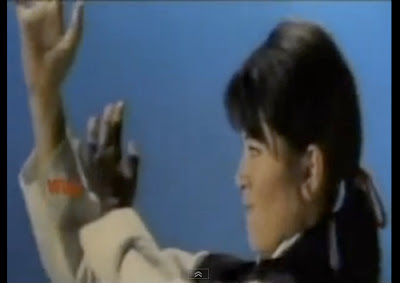
I was going to continue with a disclaimer saying something along the lines of “I really enjoyed ‘Sister Streetfighter’, but because I don’t really watch many of these films, I’m perfectly prepared to accept the fact that all the things I thought were weird or noteworthy about it are pretty standard kung-fu topes”. Hopefully that won’t actually be necessary though, because having looked up a few online reviews, it seems it wasn’t just me who got KOed by the film’s general goofiness - in fact the general consensus seems to be that ‘Sister Streetfighter’ really is just
totally crazy.
Of particular interest to me is the fact that several key-players from the late ‘60s/early ‘70s heyday of Japanese action/exploitation films are involved in the film (Kazuhiko ‘Wandering Ginza Butterfly’ Yamaguchi directs, and our old pal Norifumi Suzuki co-wrote the script), but the tone and style is so different from the Toei films I was writing about in my Think Pink feature that you’d never guess in a million years that this movie emerged from the same studio within the same five year period.
Whilst it’s true that popular film industries all over the world went into a catastrophic financial nosedive during the ‘70s, it seems that in Japan the decline took place more quickly and severely than elsewhere, reaching a crunch point as early as 1974, when the relatively lavish action and youth films that had filled the release schedules only a few years earlier started to disappear, replaced by nastier, lower budget sex films and, after the international success of ‘The Streetfighter’, an occasional bit of kung-fu. As such, watching ‘Sister Streetfighter’ feels a bit like watching an Italian film from the early ‘80s, when directors who’d helmed slick, even
respectable, productions a decade earlier found themselves jamming econo, going straight for the gore/boobs/blockbuster rip-off jugular and basically blowing whatever reputation they had left out their ass in thoroughly entertaining fashion.
Clearly made with both eyes on the international market, it actually features far less sleaze and nastiness than your average Japanese exploitation flick - the bone-breaking action of ‘The Streetfighter’ has been significantly scaled back, presumably to reflect Etsuko Shihomi’s more genteel fighting style, and, give or take the odd implied rape and a relatively tame torture set-piece during the finale (are these guys actually
incapable of making a movie in which no women get tied up and beaten..?), things more or less conform to ‘70s Western notions of good taste.

In most other respects though, it very much shares the spirit of the kind of threadbare, one camera epics that the Italians were trying to foist upon the world market as their film industry collapsed around them. One of the first things you’ll notice about the film is that, in stark contrast to the technical professionalism found in earlier Toei films, the camerawork is completely out to lunch. Whole scenes are weirdly framed and blurred, and the camera rattles around like it’s been mounted on one of those rickety coalmine wagons. Sudden lurching pans and ‘da-da-dah!’ shock zooms happen relentlessly, for no reason, to the point where the constant disorientation is almost headache inducing.
Perhaps seeking to ‘dumb down’ their product to fit the lower expectations of overseas kung-fu audiences, Yamaguchi and co also seem intent on packing the film with as many chop-socky clichés as they can come up - maybe it’s just the English dubbing track that’s to blame, but did they REALLY have to throw in that awful ‘Hong Kong Garden’/’Kung Fu Fighting’ music cue – you know the one - every time the action switches to Hong Kong..? I think most of the characters here are meant to be Chinese, hanging out in the ex-pat community in Yokohama, but for all the English dub cares for such subtleties they could be living on Mars, and with the filmmakers all too happy to throw aside such tired notions as continuity and basic coherence, the result is a flick that often plays more like some crazy-ass, death-or-glory shit from Indonesia or The Philippines than a product of one of the oldest and proudest film industries in the world.
Maybe I’m reading too much into Suzuki’s contribution to the film’s writing, but ‘Sister Streetfighter’ definitely exhibits a certain strain of bewildering, fast-moving craziness that strongly echoes that found in his pinky violence films. Who cares that our heroine is suddenly teleported to a clifftop rope bridge for one showdown, then inexplicably returns from the dead after plummeting to the rocks below, when you’ve got a guy in a feather headdress firing poisoned blowpipe darts hiding round every corner, and a former priest in a black cape leaping out of a wardrobe armed with a prototype spear-gun when you least expect it, all whilst distorted library music blares and the camera blasts around the place like an out of control helicopter..?
Then there’s this whole thing about heroin being smuggled boxes full of wigs, a wild Franco-esque nightclub scene, and even a classic, shrieking rubber bat attack scene at one point, just because, well.. why the hell not? Perhaps compensating for the lack of any serious sex n’ violence, random zaniness amped up to the nth degree seems to have been the intention here, and it's a strategy that certainly works for me.

Much of the film’s entertainment value arises from that fact that the main drug dealer bad guy’s favourite hobby is ‘collecting killers’, surrounding himself with what must surely be one of the most unlikely arrays of eccentric martial artists ever assembled on-screen. “It’s just as much fun as a car full of gorillas”, he enthuses. And, whilst I have to admit that I think a car full of gorillas would be
pretty fun, he may have a point. In one wonderful / hilarious sequence, the Big Boss is shown chilling by the pool as his collection of freakish combatants practice around him, the movie helpfully freeze-framing with on-screen captions telling us who they are – “Tessin – The Sickle User!”, “Hachigen Ma - Japanese Cudgel Play!”, “Eva Parrish – Karate Champion of Australia!”, and so on.
Some of these guys we get to see quite a bit of (that annoying bastard in the red robe with the nun-chukas just won’t shut up and die), but others (like poor old Eva) are never heard from again. Playing a particularly prominent role in proceedings is a guy named ‘Hammerhead’, a generic self-regarding demi-boss with his own gang of loyal goons. What I liked about them is that they march about with what appear to be steel wastepaper baskets on their heads, but when engaging in a fight they immediately
take them off, presumably realising how unhelpful such ‘armour’ would prove to be in a hand to hand combat situation, but unwilling to fully abandon the enjoyment they gain from parading through the streets with steel buckets on their heads. I also like the fact that the big prize the bad guy has promised him when he kills Shihomi is “a gym you can be proud of”.

Another WTF highlight is the inclusion of the ‘Amazons 7’, a troupe of tiny Thai kick-boxing ladies who wear animal masks and Fred Flintstone style leopard-skin mini-dresses. As with many of the more outlandish baddies on display, Etsuko and Sonny Chiba deal with them in disappointingly double-quick time, but hey, ya pays ya money, ya takes ya choice.
Oh yeah, did I mention that Sonny Chiba is in this movie? The original American advertising certainly did, misleadingly proclaiming him to be the star, when in fact he manages little more than a extended cameo, turning up every now and then to kick some ass (which he does spectacularly, of course) before enigmatically disappearing again. Dunno what it is that keeps tearing him away from this desperate life & death conflict. I guess he’s just a busy man. Bizarrely, the back cover blurb on the UK VHS claims that Chiba’s character has ‘..the power to become invisible!’, which I can only assume is the result of the writer working from a translated plot synopsis that said something like “Chiba keeps vanishing”, and taking it a bit too literally.

Left to carry the film largely on her own, Etsuko Shihomi does a pretty great job if I’m any judge. Presumably pretty young when the movie was made, she’s a charismatic and likable enough screen presence to stand alongside Chiba, a capable actress within the confines of what is admittedly an astoundingly silly movie, and – insofar as a rube like me is able to tell – an extremely impressive karate fighter and physical performer. If Chiba can be taken as a fairly obvious unofficial reference point for Ryu in the Streetfighter video games then Shihomi is a shoe-in for Chun Li, and it’s not surprising that she followed up for success here with ‘The Streetfighter’s Last Revenge’, ‘Return of the Sister Streetfighter’, ‘Sister Streetfighter: Fifth Level Fist’ and a whole raft of other karate movies that, along with some straight acting roles, kept her busy all the way through to the mid ‘80s, including ‘Karate Inerno’ (directed by Teruo Ishii) and the brilliantly named ‘Which is Stronger, Karate or The Tiger?’ (aka ‘Sonny Chiba’s Dragon Princess’).

So, in conclusion: ‘Sister Streetfighter’ makes barely any sense, is jam-packed with craziness, has a cool, ass-kicking cast, and appears to have been thrown together in about a week by a bunch of jittery maniacs with a few domestic camcorders and a hang-glider. Perfect entertainment, in other words. A thing of beauty and a joy forever, as the boy Keats once had it. If I’d seen this back when I was 12 years old, my life might have been very different (and hopefully not just because I’d be running around with a bucket on my head orchestrating ill-advised wig-based smuggling escapades).
Until somebody bothers to issue a takedown notice, ‘Sister Streetfighter’ can be viewed in its fuzzy entirety on
Youtube (from whence I took the rough screenshots above). Meanwhile, here’s the US trailer:
If I recall correctly, the VTC tape also has a bonus trailer for some movie in which Chuck Norris and Lee Van Cleef fight the Illuminati. It looked pretty great! Remind me what the title is in the comments box and win, well… a very fleeting sense of self-satisfaction, and possibly an acknowledgment when I edit this post to include a link to the trailer.
* It should be noted that these are my garbled 15+ years ago recollections of the Bruce Lee films, and do not necessarily reflect what actually happens in them, even in the slightest. I haven’t watched them since, but I’m sure they’re all marvellous. Please don’t spam me Bruce fans.