Showing posts with label hillbillies. Show all posts

Wednesday, 26 January 2011

Jazzman in Nudetown
by Bob Tralins

(Gaslight Books, 1964)


Well, vis a vis my previous post on the subject – I gave in. I went back for it. And furthermore, I’ve read it. Another legend lies dead at my feet, slain by nerdly curiosity and the willingness to spend money on weird junk.


Although I very much enjoyed the book, I’m gonna come right out and say that, sadly, I don’t think that Big Bob Tralins is really the smart, self-aware yukk-meister that various of his titles and cover copy might suggest. The bulk of the prose and plotting in “Jazzman..” is standard issue pulp doggerel, full of long stretches of the kind of autopilot writing that quickly turns to mush on the journey between eyes and brain. I've encountered far worse, but I've certainly read better.

Sadly, the approach to hip culture taken by the book is flat and off-message enough to convey the impression that Big Bob had never actually been without spitting distance of a real life representative of the counterculture. His arsenal of 1964 jazz reference points seems limited to the strictly trad likes of Louis Armstrong and Leadbelly, and in one chapter our beatnik narrator repeatedly refers to a bunch of aggressive rednecks lounging outside a small-town barbers shop as “hep cats” – a glaring error bespeaking a woeful failure to grok the hip vernacular.

BUT, what “Jazzman in Nudetown” may lack in authenticity, it more than makes up for in lively, if sporadic, imagination. The book’s saving grace, the thing that truly raises it to a kind of cracked, outsider poetry, is Tralins’ gloriously unhinged attempt at first person beat narration.

What Bob really seems to have taken on board here is the multitude of possibilities offered to the bored hack writer through the introduction of a free n’ easy beatnik writing style. After all, laying down some sub-Kerouac blather is easy AND fun, and Tralins seizes the opportunity with both hands here, happily throwing out whatever instinctive/alliterative crap boiled up from his noggin with gleeful abandon. Why have your hero drink whisky when he can ‘suck down on woozle juice’? Why have girls when you can have ‘wiggle witches’? And if, like Tralins, you start occasionally producing sentences that just plain make no sense whatsoever, well – cool it pops, this just ain’t your square ‘makes sense’ kinda read, you dig? Big Bob is busting out some first-thought best-thought, and it’s beautiful, man. No redrafting needed.

These outbursts of good-humoured beatitude seem to explode from the book every couple of pages like a transition from black & white into Technicolor, but sadly they become fewer and further between as the novel proceeds, with the good ol’ ‘workmanlike slog’ approach predominating from the halfway point onward. Nevertheless though, some of the best passages in ‘..Nudetown’ are timelessly demented, rendering it essentially reading for any connoisseur of beatsploitation.

So, for the record, “Jazzman in Nudetown” tells the tale of Jock Midnight, erstwhile leader of Jive Midnight and his Jive Cats, a somewhat unconventional clarinet, trombone and hambone percussion trio whose popularity has made Jock a hep-cat supreme back home in California, or so he tells us. But Jock is a long way from home as the book opens, on the lam from a Georgia correctional facility, having been framed by some racist cops who didn’t look kindly on his investigations into the disappearance of his trombone player and best buddy Fat Joe Bullets.

As he stumbles out of the woods, Jock is immediately picked up by one Lilly Mae Tinch, a gigantic, high maintenance nymphomaniac, and her accomplice Phoebe, who offer him a job, prompting the following exchange, which surely deserves a place in the history of spectacularly ill-advised chat-up lines;

--
“How’d you like a job?”
“For money?”
Both girls laughed at my expression. “What else?”
“What kind of job,” I said, locking my gaze with the big blonde’s. “You both look like a couple of sex jobs to me”.
I got away with it. They were swingers, just like I’d figured. Groovy enough to collar the jive without blinking their eyes into question marks.

--

This being a pulp smut novel, Jock’s bold approach to seduction pays swift dividends, and the extraordinary opening to the next chapter bears quoting in full;

--
“I kept feeling the empty giggle bottle under my pillow. That’s what finally woke me up. It wasn’t made to sleep on. It was dawn and the faint rays of the sun were streaming down upon the bed from between the drawn slats of the venetian blinds. I started to get up, but a heavy thigh over my hip held me fast. Lily Mae’s big arms were entwined around my chest from the back, I could feel her breath on the top of my head, and the delicious warmth of those huge breasts against my shoulders. Man! What a way to wake up!

Phoebe was on the other side of me, lying on her stomach, the pillow over her head. The creased and wrinkled sheet covered half of her lush body, exposing flesh from the center of her back in one sweep all the way down to her sleek, rounded hocks. Even in the fresh wash of morning sun she was grooby. Beautifully grooby. A ginch with a figure like a Greek cat in the Louvre with the delicate complexion of bare marble. Feeling no pain.

I never did get around to finding out if Lilly Mae was the fairy lady though. The lack of sleep, the booze, the weariness and fatigue that had been ragtiming after me finally cornered the market on my energy and swamped me. Zazzle! Did I pass out before – or after? No. I smiled at myself, remembering. Old Jock Midnight hadn’t let the girls down. Neither wiggle witch had been disappointed.

Untangling myself from the sleeping blonde boa, I eased myself down to the foot of the bed and got to my feet. I was wobbly, but I made it to the bath. Closing the door, after sloshing cold water on my face I greeted my reflection in the mirror. I looked good, real good. My complexion was as ruddy as a piece of mouldy swiss cheese that had been left in the pantry of an abandoned summer camp for girls. After the mice finished with it. Only difference was, I’d been gadzooked by two swinging cats!”

--

It is Lilly-Mae who leads Jock to ‘Nudetown’, which, disappointingly, is not some chaotic paradise of lecherous vice, but simply our freewheelin’ protagonist’s pet name for ‘Newton’, a depressingly fully-clothed redneck shithole in and around which the rest of our story takes place.

In one of the pleasantly eccentric plot twists that render this book worth reading, it turns out that Lilly Mae is a distant descendent of Blackbeard the pirate, and is seeking to retrieve his long-lost treasure from its hiding place in the Georgia swamplands. What follows is about one hundred pages-worth of crossings and double-crossings and characters being menaced with shotguns, sapped on the head and dumped in swamps, seemingly endless chase scenes and confrontations with redneck cops. Eventually, the whole thing turns into a kind of ham-fisted civil rights-era protest story, as Jock Midnight finds himself incarcerated in Nudetown jail on the basis of his being an obvious “negra-lover”, yelling beatnik-tinged obscenities from his cell window at the villainous pigs who are squaring up against the town’s peace-loving black community in the street outside.

I realise I’m making “Jazzman in Nudetown” sound pretty fantastic here, but really, it isn’t. If Bob Tralins had been able to keep up the pace of the extract quoted above, it would be a stone-cold classic, but as is I think I’d merely deem it a moderately grooby waste of a few hours.

POST-SCRIPT:

In one of Bob Tralins’ flights of beatnik fancy, he makes metaphorical reference to a “jinky board”, whatever that is. This immediately reminded me of the fictional pulp writer Jack Steinblatt featured in the Daniel Clowes comic “MCMLXVI” (which you can find in the excellent “Caricature” anthology);
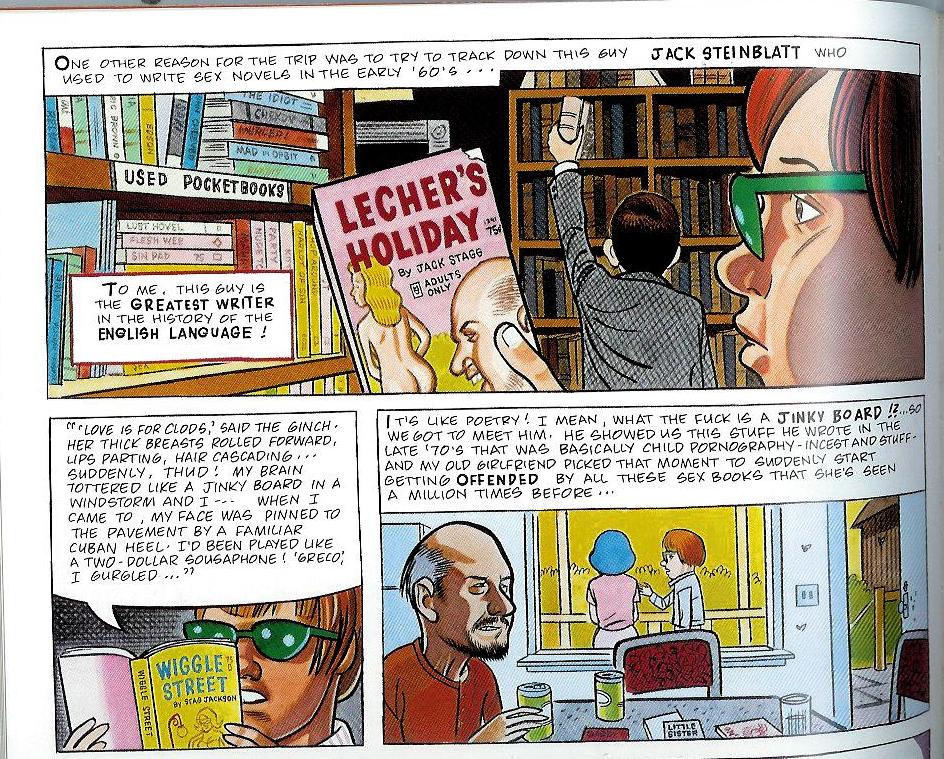

Could Steinblatt be directly based on Tralins? Did Clowes actually plough his way through “Jazzman in Nudetown” at some point? Or were these mysterious “jinky boards” in fact a common element of smut-pulp vocabulary?

If you know the answers to these questions, well… probably best seek help. But let me know first.

Friday, 12 November 2010

Swamp Brat
by Allen O’Quinn
(Gold Medal, 1958)


Heh heh. SWAMP BRAT! Yeah.

I don’t have much to say about this one, but the front & back covers make for a lovely work of pulp artistry. Appropriately, the interior of my copy looks like it's been stored in a swamp, which accounts for the 50p price-tag and makes me like it all the more.

Wednesday, 10 November 2010

Honey Blood
by Glenn Low
(Novel Books, 1961)


Movie reviews will be returning shortly, as soon as I get a spare five minutes to finish some of ‘em, but in the meantime - I call another paperback week! At least I’ve got some good ammunition at the moment, beginning with this little beauty.


It always creeps me out a bit when the blurb on smut paperbacks addresses the audience as “you guys” or “you men” etc, taking it for granted that their readership are sub-normal brutes, but this one takes things to a whole other level of creepiness - it sounds like a child-molester hassling to a little boy. And then that freakin’ arrow! Jeez! For the record, “Honey Blood” features no, uh, ‘forbidden world’ content, so I don’t know where they were going with that one.


Good grief.

If not quite the Russ Meyer-meets-Herschell Gordon Lewis fever dream the cover might imply, “Honey Blood” is still pretty rough stuff for 1961, telling a blunt tale of hillbilly thuggery with admirable brevity. Our protagonist is Coker, who has the hots for an assemblage of throbbing body parts named Honey. Honey’s sole personality trait is her love for Junza. Junza is a crazy, murderin’ psychopath who has just escaped from the big house, chained to Coker’s innocent brother Jamie. The above extract clues you in nicely re: where that’s all heading.

Not exactly a story for the ages, but what a cover, huh?

Saturday, 14 February 2009

J.C. (William F. McGaha, 1972)


Yes, that’s right, “broads, bikes and blacks”. Clearly not the sort of thing the REAL Jesus would want anything to do with, eh?

Of course, the most immediate irony here is that despite the flagrantly offensive poster, (presumably designed to sell the movie to a redneck drive-in audience who were expected to be shocked and thrilled by the prospect of a film that dared portray something other than white men who drive cars), 'J.C.' is actually a surprisingly earnest and well-intentioned film, its sympathies laying firmly with the hapless, peace-loving hippies who are harassed at every turn by the villainous forces of redneck bigotry. Which is not to say it’s worth watching, but… at least it’s heart is in the right place, which is more than can be said for most other cheapo biker/hippie flicks.

Independently financed, ‘J.C.’ would seem to have been a bit of a labour of love for writer/director/producer/star William McGaha. According to IMDB, McGaha had helmed two previous shoestring quickies prior to the dawn of the post-Easy Rider hippie exploitation market - “Bad Girls For The Boys” (‘66) and “The Speed Lovers” (‘68). Whether or not he had actually morphed into a fully paid up freak brother by ‘72, he certainly does a fine impression of one in the eponymous role of J.C. Masters, a perpetually stoned biker whose gentle sensibilities are such that he can scarcely leave the house without swiftly becoming appalled at the brutality and bad vibes that greet him.

The whole opening section detailing J.C.’s day to day life is actually quite entertaining, in a barely watchable Cheech & Chong sort of way. Marvel as J.C. gets a job on a construction site, gets the giggles when he sneaks out for a quick smoke with his best pal, and quits because the taunts of his cracker co-workers are bringin’ him down! Guffaw as J.C. gets wasted in his psychedelic ‘pad’, and rolls around on the floor in his pants for far longer than is strictly necessary! Wonder why the hell you’re even watching this movie anyway as J.C. sits on the can reading the newspaper and gets so BUMMED OUT at all the evil in the world he can scarcely bring himself to stand up! Sigh sympathetically as J.C.’s girlfriend gets pissed off because he quit his job, but then can’t stay mad at him because he’s just too damn lovable, like a big hippie puppy dog! You get the general idea.

Unfortunately though, a movie like this is duty-bound to have a plot, and some sort of point, and this arrives when J.C. and his old lady get together with all their biker pals for a big, open air hoedown, during which J.C. drags himself to the top of a hill and starts drivelling on in a portentous manner about seeing “a big eye opening up in the sky” and about how he’s seen a glorious vision of a place where he and his buddies can live free of the hassles and discrimination of the straight world, and, y’know, things of that nature. For reasons that the script fails to sufficiently explain, J.C’s chums, rather than just assuming he’s stoned again and putting him to bed early, are deeply affected by his ramblings, declaring themselves his disciples and vowing to follow him to the ends of the earth in a grand quest for…. whatever.

The first stop in their quest, for reasons that remain equally vague, is J.C.’s old hometown, a backwoods Alabama shithole he left when he was 17, where he has a sudden urge to visit his sister, who is now married with kids, living the Christian life. Some reasonably authentic and evocative footage follows, as the gang motor through the centre of town in all their field hippie finery, McGaha’s camera doing a good job of capturing the sights, sounds and gawking “hey, that fat hairy guy’s a-filmin’ us” disbelief of smalltown Alabama circa 1972, at least until the actual actors portraying the local crew of yahoos and curmudgeons turn up, nullifying any sense of realism as they wave their fists and say stuff like “damn you boy, you weren’t never no good”, expressing violent consternation at his daring to “bring n*ggers into town”. What we learn here is that J.C.’s disciples, whilst they may be goofy and stoned, are also a pretty solid and uncompromising bunch who ain’t gonna take this shit laying down, instead taking the time to score maximum RIGHT ON points by defending their belief in racial and sexual equality in a town square debate with a fuming, racist storekeeper.

Once safely ensconced at J.C.’s sisters’ idyllic rural homestead, the gang camp out on the lawn, getting on with their hippie shenanigans in earnest as J.C. and his sister have some deeep talks about their differing ways of life, whilst waiting for her bad tempered cracker husband to come home and give everybody a hard time. This confrontation just about passes without incident, but not before J.C.’s best buddy Ben (the black guy) almost gets his head bashed in with an iron bar. It’s shortly after this that Ben, having established that he’s spending time in a town where most of the populance would lynch him as soon as look at him, displays a nigh-on herculean disregard for his own safety as he gets one toke over the line and wobbles off into town on his own to pick up a six pack. Naturally it’s only a matter of seconds before he’s in the local slammer on a narcotics charge, getting the shit beaten out of him by the cranky sheriff (played by Slim Pickens, bringing all the gravitas of a Smokey & The Bandit bit-part) and his deputy (a vengeful Vietnam vet who just won’t shut up about the service he gone done for his country). J.C. pays them a visit to attempt some diplomacy, only to discover that Deputy McKnucklehead is in fact his long-standing high school nemesis, and…. well after that the movie basically descends into a load of grim n’ squalid hippies vs. rednecks carnage that I’m sure you can pencil in in your brain without my plot synopsisin’ help.

For all the good will in the world, ‘J.C.’ is not really a classic movie. Direction and acting throughout may most generously be summed up as ‘adequate’, although in it’s portrayal of the confrontation between the ‘new’ and ‘old’ American South, the film is unusually direct for a b-movie, and the claustrophobia and racial/social tension is pretty compelling in places – more ‘In the Heat Of The Night’ than ‘Satan's Slaves’. The central problem is the rather lame-brained script, which systematically fails to really capitalise on any of the reasonably interesting issues the concept raises. Even the most screamingly obvious JESUS=HIPPIE parallels are left unexplored, despite, one would imagine, being the central conceit that kick-started the film in the first place. One of the better scenes has the sheriff delivering a monologue on J.C.’s family history – it turns out his father was a local religious fanatic with a handful of cult-like followers, who raised his son to be some kind of messiah (hence the name) – but once again, this potentially rich vein of interesting-ness is left undeveloped, and it scarcely mentioned again. J.C. only mirrors Jesus to the extent that he has the same initials, the same beard, a vague belief in peace & love and a few disciples, and beyond that… well if you don’t like it, write yer own damn thematically engaging script, city boy! Our one’s got fist fights and shotguns and Slim Pickens, and if that’s not good enough for ya, too bad.

Likewise, most of the characters’ actions and motivations don’t really make a great deal of sense at any point, and, for all the film’s clear cut sense of moral righteousness, I’m duty-bound to report that there’s also an absolutely appalling sequence wherein one of the hippies gets an eyeful of J.C.’s sister and tries to rape her. Having had his ass kicked, he goes back to apologise to her, coming out with something along the lines of “I’m sorry ma’am, ah didn’t mean nuffink by it, I’m a hippie and we’re used to just takin’ what we want”. Stirred by such enlightened reasoning, the sister instantly forgets her lifetime’s dedication to becoming a steadfast wife & mother, and lets the little creep have his way with her! What, and indeed, The Hell?

For all that though, you’ve still got to have a certain amount of respect for ‘J.C.’, as an exploitation movie that manages to drop almost any element of exploitation and instead strives to become what is, on at least some level, a serious drama. Top marks for effort anyway, even if William McGaha couldn’t quite pull it off. One suspects he was maybe spending too much time freakin’ out in his pants in his psychedelic shack when he should have been writing a better script, such is the unnerving realism of those early scenes, but either way, his failure to appear on the credits of any subsequent IMDB-recognised motion picture in any capacity sadly speaks volumes about the impressions this one gave people of his talent.

Original music, by the way, is provided by an outfit called ‘Covenant’ or something, who, appropriately enough I guess, have that cleaner-than-clean early ‘70s born again hippie thing going on, sounding much like I’d imagine all those private press Christian psych LPs that jaded collectors get all hot and bothered about probably sound. Eg, not good.
Some kind soul has uploaded a few scenes from the movie to youtube:


J.C. can be downloaded in full as an .avi file from Culta Rare Video.