Showing posts with label spies. Show all posts

Wednesday, 16 December 2020

Deathblog:
John le Carré
(1931-2020)

To my shame, I’ve been a late-comer to John le Carré’s work. Scanning over his books (which have always been gifted by their publishers with singularly boring cover designs) in innumerable charity shops through my youth, I’d long assumed that they must be dry, procedural, unappealingly nationalistic affairs - the kind of spy novels read by grey-faced, commuter-belt dads, padded out with tedious detail about the firing rate of sniper rifles, the mechanics of phone-tapping and the precise dimensions of expensive suitcases. Not my bag man, especially in those relatively hopeful, paranoia-free years which followed the fall of the Berlin Wall.

To his eternal credit, it was my brother who convinced me to think again, passing on a copy of ‘The Spy Who Came in from the Cold’ (1963), and solemnly instructing me that I needed to read it. He was right - I did need to read it. Not simply one of the best cold war thrillers, I’d class it as one of the best novels written in the second half of the 20th century, period.

Reportedly composed by the author in a kind of frantic fugue in the months following the Cuban Missile Crisis, ‘The Spy Who..’ turns the reader’s expectations of a ‘spy story’ inside out, obscuring the methodology and purported grander purpose of espionage and focusing instead upon the fragmenting identity of its protagonist and the ugly human cost of low level cold war brinksmanship.

Building to a suitably bleak crescendo of morally bankrupt existential absurdity, the novel is a match for any of Graham Greene’s tonally similar masterpieces, and the widespread acclaim with which it was received could easily have seen le Carré undertaking a similar leap toward the realm of literary fiction. The fact that he chose not to, instead remaining firmly ensconced within the more comfortable terrain of genre / ‘popular’ fiction across the decades as he eyed the critical establishment with suspicion, very much counts in his favour, I feel.

Though it veers a little more toward the kind of procedural detail I was initially dreading, ‘The Looking Glass War’ (1966) is a solid follow up, doubling down more directly on the earlier novel’s core theme of men and women being left to die ‘in the field’, solely in order to satisfy the petty, bureaucratic jealousies of London’s administrative hierarchies.

With those two under my belt, I took a step backwards and read le Carré’s second novel, ‘A Murder of Quality’ (1962). Noting that the author’s famed intelligence agent George Smiley was the protagonist, and aware of le Carré’s low key approach to his art, I began the book convinced that their must be some sort of nefarious international conspiracy underlying what initially seemed like a fairly benign whodunit, remaining alert for hidden inferences and code words which would blow the whole thing wide open.

At one point, I recall seizing upon a passing reference to a character’s wife collecting donations for an Eastern European refugee charity, thinking, “aha, finally, that must be the connection”, only to realise in the last few pages that I actually had just been reading the kind of innocuous Home Counties murder mystery which Inspector Morse might have sorted out of a Sunday evening a few decades later. Ho hum.

Back on safer ground, my next (and to date most recent) foray into le Carré’s world was what most people would probably consider his second masterpiece, 1974’s ‘Tinker Tailor Soldier Spy’. In stark contrast to his ‘60s spy novels, this labyrinthine tale of George Smiley’s quest to identify the Soviet double-agent operating within the highest echelons of British intelligence is at heart a genre potboiler, complete with clearly defined goodies and baddies, as the absent spectres of Control and Karla loom like a sainted elder and a red devil over the chessboard upon which le Carré’s grey-faced cast of inscrutable, tormented middle-aged men endlessly circle one another, seeking a momentary advantage.

You would not immediately grok this however from the dense lexicon of ministerial hierarchies, committee membership lists, coded filing systems and obscurely named internal departments through which the author tells his tale. I’ll be honest, the pointed avoidance of sensationalism or directly expressed emotion which characterises le Carré’s quote-unquote ‘mature’ style can take some getting used to.

If the idea of a thriller written by an administrator doesn’t sound like too much of an oxymoron though, ‘Tinker Tailor..’ embodies this idea beautifully, and as you allow yourself to sink into its quiet, judicious world of painstaking information gathering, and let the full scope and resonance of the author’s vision become clear, the eventual impact is staggering. 

(Well I remember sitting on a long haul flight a couple of years back, taking a brief break from reading and realising that I’d become breathlessly excited at the prospect of Smiley managing to remove a confidential file from a reading room without the necessary permission.)

Ideally I think, ‘Tinker Tailor..’ should probably be read in conjunction with watching the 1978 BBC TV series, directed by John Irvin - a brilliant adaptation which retains the core structure, characters and feel of the novel, whilst also finding time to depict some of the more conventionally exciting, action-packed diversions which le Carré decorously left off-page.

As much as tributes have naturally concentrated upon the plotting and realism of le Carré’s novels though, I’d also like to highlight what a fantastic prose stylist he was. Though his characters may initially seem like little more than surnames wearing old school ties, his knack for humanising and differentiating them through seemingly casual asides or tantalising suggestions of hidden depths, is often extraordinary.

Each one of the le Carré novels I’ve read thus far has contained indelible, seemingly random, references and descriptions which stay with me long after I’ve read them - from the protagonist of ‘The Looking Glass War’ somehow finding malign intent in a child’s toy as he idles at an airport en-route to his fatal mission, to the description in ‘Tinker Tailor..’ of a small-minded finishing school headmaster “beating the flanks of his dachshund like a drum” as he casts uncharitable aspersions in the direction of a supply teacher whose actual achievements and experiences he couldn’t even begin to imagine, or to Smiley’s instant dismissal of a rumour that Control has been seen alive and well in North Africa on the basis that “the only place he ever felt at home was Surrey, or the Lords Cricket Ground”.

Whatever subject turned his attention to, le Carré was, above all else, an exceptionally gifted writer, and gradually acquainting myself with the rest of his extensive oeuvre is a task I’ve been greatly looking forward to over the coming years and decades.

On a personal note meanwhile (as if any of this has been anything but), I also can’t help but mention how much I’ve appreciated le Carré’s re-emergence as a public figure in the 21st century. Interviews such as those featured in the excellent 2000 documentary ‘The Secret Centre’ (which sadly doesn’t seem to be available to view on line, but can be found as an extra on the recent blu-ray reissue of the ‘Tinker, Tailor..’ series) left me with an impression of le Carré as a wise, compassionate and clear-headed thinker, and it has subsequently been gratifying to discover that, whilst a lifetime of opposition to communism lent him a distrust of the political left which I do not necessarily share, his views on many subjects closely echoed my own, and he expressed them with a directness and eloquence which I greatly appreciate. [In addition to the link above, I’d also refer you to the concluding paragraphs of this BBC online obituary.]

What le Carré referred to as “[his] England” is, I would hope, mine too, and as our nation continues to toil under the yoke of assorted bullies, bastards and dead-eyed incompetents, the loss of one of the all-too-few affirming flames who are able to make me feel proud, rather than ashamed, of my nationality has been especially keenly felt this week. RIP old chap - you will be much missed.

Wednesday, 25 November 2020

Two-Fisted Tales:
Brother Cain
by Simon Raven

(Panther, 1965)


Though the brightly-hued cover photo affixed to this edition of Simon Raven’s second published novel ‘Brother Cain’ carries a distinct whiff of pop-art / psychedelic chic, Panther’s paperback was actually printed in February ’65, too early to have really hitched a ride on the ‘swinging sixties’ bandwagon, whilst the book itself was first published back in the grey, buttoned up world of 1959.

One of those renowned-in-their-day-but-now-largely-forgotten authors whose work always sparks a certain fascination, Simon Raven (1927-2001 - and yes, that was indeed his birth name) wrote voluminously through much of the latter half of the 20th century, and, read today, his books feel both strikingly modern (in terms of their frank and non-judgemental approach to sexuality and general air of shark-ish cynicism) and hopelessly old fashioned (being largely concerned with a segment of upper crust British society whose values and behaviours now seem entirely alien, probably even to those lucky enough to have been born into it).

Freely mixing elements of personal / social writing and thinly veiled autobiography into popular genre thrillers, Raven’s more noteworthy works include Oxbridge vampire yarn ‘Doctors Wear Scarlet’ (loosely adapted into Robert Hartford Davis’s disastrous Incense for the Damned in 1971) and, on the other side of the coin, the ten volume ‘Alms for Oblivion’ sequence, which follows the lives and loves of a cadre of toffs, set against the changing social and political mores of post-war England. (I read the first few chapters of the first volume of this epic saga a few years back and actually found it quite compelling, but unfortunately I lost my copy on a train and haven’t got around to picking it up again since.)

Throughout his early literary career, Raven seems to have been fixated on the dilemmas faced by male scions of the English upper classes who, whether through conscious rebellion or mere lethargy and personal weakness, have squandered the privileges conferred to them by their noble upbringing and must find alternative paths through life. This theme is certainly front and centre in ‘Brother Cain’, whose protagonist Jacinth Crewe (note the Moorcock-ian initials) finds himself in a predicament closely mirroring that apparently faced by the author himself a few years beforehand.

Having been expelled from Eton on the grounds of moral turpitude and subsequently forced to curtail his studies at Cambridge due to what we might charitably call a self-inflicted lack of funds, the novel joins Crewe as he is invited to offer his resignation to the British army’s elite training academy at Sandhurst, having accrued gambling debts sufficiently gargantuan as to bring his entire regiment into disrepute.

“Honour and dishonour are conventions,” Captain Crewe’s understanding commanding officer advises him during their final interview, effectively establishing the theme of the novel to follow. “They are relevant in the world in which you have so far existed: they will not be relevant in the world for which it is clear you are now destined.”

Retreating to London with his tail (amongst other things) between his legs, Jacinth throws himself upon the mercy of his regiment’s allotted merry widow, one Miss Kitty Leighton, who, after a night or two of wild passion at her Chelsea flat, places a call to a mysterious contact who may be able to assist her disgraced and destitute young lover before the debt collectors come knocking.

Thus, Jacinth is summoned to a lunch date at the Trocadero in Piccadilly (decades before it became the tourist-choked hellhole we know it as today), where he is greeted by dirty mac-clad, brown ale supping “professional messenger” Mr Shannon - a character I found it impossible not to imagine being played by Donald Pleasance.

Though highly suspicious on all levels, the proposal Mr Shannon’s anonymous employers wish to convey to Captain Crewe is entirely too good for the desperate young layabout to resist. In short, his gambling debts will be covered in full, and he will be issued with sufficient funds to allow him to fly to Rome and install himself in the swank Hotel Hassler overlooking the Spanish Steps, there to await further instructions.

What with this being the height of the First Cold War and everything, you’ll be unsurprised to hear that when those orders do eventually arrive, they direct Jacinth to an appointment at a shabby ‘Institute for the Promotion of Mediterranean Art’, a flimsy front for a top secret wing of the British government whose job, to all intents and purposes, is to create new James Bonds.

Which is to say, Jacinth and the other young rascals corralled by the nameless ‘organisation’ are pointedly not being groomed as spies or intelligence agents. Instead, they are basically just hatchet men - proponents of what one of their instructors (who is of lower middle class extraction, and so naturally a graceless, grudge-bearing git) bluntly calls “the cold art of murder”.

Taking a more refined view on things, the Big Cheese of the whole operation, who naturally enjoys the benefit of a ‘proper’ education, instead waxes lyrical to his new recruits about how, in the light of communist infiltration and so forth, the democratic institutions so cherished by western nations can only be preserved through the unilateral execution of acts which the champions of democracy would find impossible to countenance, should they become aware of them.

(Being unfamiliar with Raven’s own political leanings, assuming he had any, it’s difficult to get a handle on whether this justification for extra-judicial murder and mayhem, which continues at some length, is being presented as satire, or simply as a statement of the author’s own beliefs.)

Furthering the Bond parallel, Jacinth and his fellow recruits are essentially allowed to adopt the lifestyles of globe-trotting playboys, so long as they follow their orders precisely, ask no questions, and leave whatever moral scruples they may once have possessed at the door. And, if they have any thoughts of ducking out and taking their chances in civilian life, well…. their more ruthless classmates will simply have an easy first assignment to look forward to, won’t they?

Despite his military rank, Jacinth Crewe is still more a feckless dosser than a cold-blooded killer, and, still bedevilled by confused notions of personal honour and brotherly conduct, he is naturally terrified by the prospect of having to immerse himself in the paranoid, compassionless world promised by his new profession - all the more so when, with a neatness which surely defies mere coincidence, he is paired up for training with one Nicholas Le Soir, the former schoolmate whose charms led to his being expelled from Eton for corrupting the morals of a younger boy. (This incident directly mirrors Raven’s real life expulsion from Charterhouse public school, incidentally.)

Now a qualified surgeon, Le Soir has arrived at the ‘organisation’ after being struck off and effectively exiled from the UK for performing an illegal abortion upon the daughter of a prominent Catholic family (oops), and the plot is further thickened once both Jacinth and Nicholas find themselves drawn into an embryonic love triangle with Le Soir’s promiscuous yet sexually dysfunctional cousin Eurydice, who is also resident in Rome, working for an equally questionable ‘cultural mission’…. and who seems suspiciously keen on pumping her two mixed up suitors for information on the nature of their employment.

And, there I will leave my plot synopsis, but suffice to say, Raven proves himself eminently capable of setting up a fast-moving, exquisitely intriguing yarn here, even if his story’s conclusion - following an incident in a bat-infested railway tunnel, a scheme to virally infect the whores of a high class brothel and a head-spinningly convoluted murder scheme set against the backdrop of a Venetian masked ball, amongst other diversions - eventually veers more toward the kind of existential, internecine futility in which John le Carré would later specialise than the two-fisted action-adventure stuff beloved by Ian Fleming’s fans.

In view of the fact that ‘Brother Cain’ was first published a full decade before the legalisation of male homosexuality in the UK, one of the most striking aspects of the book for modern readers is Raven’s forthright and unapologetic presentation of his male characters’ bisexuality. Not only acknowledging this dark secret of the English public school system, which tended to be referred to only through implication and innuendo by other writers of this era, he seems keen on eagerly exploring its every nook and cranny, pushing the book’s language about as far as the era’s censorship would allow.

“I’m not a homosexual, or at least, not very often,” Jacinth muses to himself as he drifts into introspective reverie in the flight to Rome. (“What shall I do about women? Well I suppose there must be brothels..,” he charmingly adds, as if to bolster his own sense of masculinity.)

As soon as he falls asleep though, he finds himself dreaming of a beautiful American boy he once briefly courted at Cambridge (and who will, of course, play an integral role in the unfolding plot), and as the book goes on, it becomes increasingly clear that Jacinth’s most significant and long-lasting relationships have always been with other men.

In spite of its attention-grabbing plotline in fact, ‘Brother Cain’ often reads more like a semi-autobiographical personal novel than it does a thriller. More specifically, it seems like an attempt on Raven’s part to take stock of his life to date, and to redefine his place in the world as he hit his early 30s. As noted, the parallels between the background of the book’s protagonist and that of the author himself are considerable, and, given the multiple accusations of libel which were levelled against Raven as a result of his writing over the years, it wouldn’t be surprising to learn that many of the secondary characters in ‘Brother Cain’ were simply thinly veiled versions of his own friends, lovers and acquaintances.

Suffice to say, Raven was presumably not actually press-ganged into committing top secret outrages on behalf of the British crown, but, at a push, you could perhaps see Jacinth Crewe’s recruitment by the ‘organisation’ as a reflection of Raven’s own unique arrangement with the publisher Anthony Blond, who, when the author found himself in particularly dire straits, is reported to have agreed to pay him £15 a week in perpetuity and to publish his books as and when he completed them, on the understanding that he should leave London and never return.

Elsewhere, the book’s story is jammed with sinister, wisdom-dispensing potential father figures and unbalanced, mothering women, whilst Jacinth’s ruthless generational contemporaries all seem ready and willing to trample on his yearning, sensitive soul, creating a maelstrom of weird moral / psychological angst which can only really end with our protagonist becoming entirely consumed by it as he slips helplessly between the cracks separating the world of ‘honour and dishonour’ from the one in which most of us now live, in which such concepts are simply a quaint irrelevance.

Normally of course, I’d be pretty pissed off to find a book which has all the makings of a rip-roaring mid-century thriller derailed by such a load of ponderous navel-gazing, but Simon Raven was such a fascinating character, and the lost world of foppish decadence in which he dwelled such an enticing one to visit, that in his case, I’ll happily make an exception. 

Whatever you may think about his conduct or way of life, Raven was a strange and unique literary talent; even at this early stage of his career, his prose and plotting are crisp, witty and ruthlessly efficient, and I’ll certainly be redoubling my quest for more of his work as soon as the doors of the world’s surviving second hand bookshops begin to creak open once again.


Tuesday, 23 September 2014

Franco Files:
Cartes sur Table /
‘Attack of the Robots’

(1966)

By the dawn of the 1960s, hatchet-faced American actor Eddie Constantine had become an pretty iconic figure in European popular cinema, playing Peter Cheyney’s hard-as-nails private eye Lemmy Caution in a series of French thrillers that included seven films between 1953 and 1963.

Two years after his final ‘straight’ Caution film, things took a rather strange turn when Constantine found himself reprising his best known character in the lead role of Jean-Luc Godard’s inscrutable arthouse sci-fi mash-up ‘Alphaville’, and with his screen persona thoroughly beyond-the-looking-glass by that point, it’s a fair bet that things scarcely got any more normal for Eddie when 1966 found him working for Jess Franco, playing the lead in two films completed that year.

One was the self-explanatory ‘Residencia para Espias’, and the other the little number we’re looking at today. Released around Europe with the inexplicably bland title ‘Cartes sur Table’ (‘Cards on the Table’), the film reached American shores under the somewhat more punchy ‘Attack of the Robots’, and, whilst neither title really bears *that much* relevance to the events portrayed therein, no prize is offered for guessing which of the two names I prefer.

So, with an English title that suggests a sci-fi movie and a star chiefly associated with two-fisted detective roles, it comes as something of a surprise to settle into ‘Attack of the Robots’ and discover that what we're watching here is actually nothing less than a fully-fledged euro-spy film, marching out in all its Bond-ripping finery.

As a director ever shackled to the whims of contemporary box office trends, Franco made a number of films during the ‘60s that fall vaguely within the ‘eurospy’ bracket, but, crucially, he seems to have had little interest in making anything like a straight treatment of the genre. The live action comic book of ‘Lucky The Inscrutable’ (1967) is too weird and uneven to really hit its appointed generic prerequisites, whilst 1968’s two ‘Red Lips’ films are simply too goofy to count, and I’ve not yet had a chance to see the aforementioned ‘Residencia..’, meaning that, for now, ‘Attack of the Robots’ is by default the closest thing we have to a genuine Jess Franco eurospy film.

Of course, being a Franco film, ‘Attack..’ is still full of off-piste diversions and eccentricities, pushing heavily toward the sillier end of the genre’s stylistic spectrum and often toppling over into full-blown spoof territory. But nonetheless - aficionados of the marginally more well-known second string spy extravaganzas filling cinemas through the mid ‘60s will feel thoroughly at home here, in spite of the director’s relentless piss-taking.

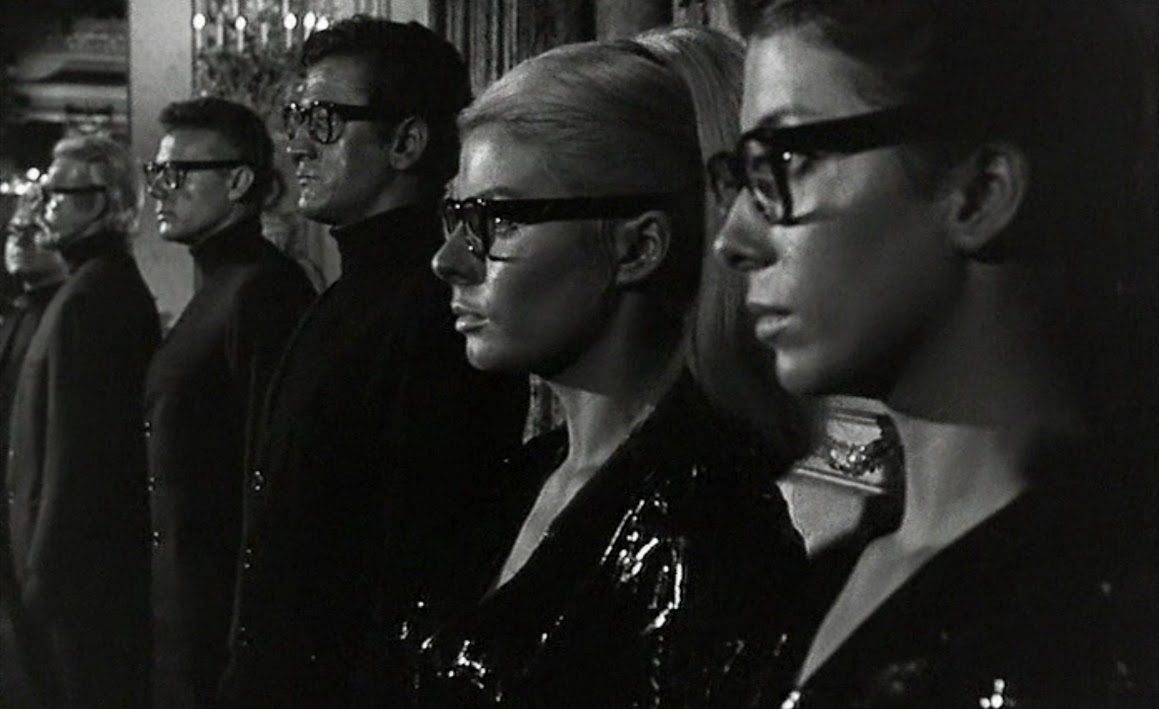
Anyway! Plot summary! So, it seems mysterious assassins in black-face make up, black turtlenecks and Michael Caine glasses are popping up all over the place, annihilating important people as they head into big buildings to do important things! What the hell are the forces of international law and order going to do about it..?

(The loveably unconvincing globe-trotting during this opening assassination montage eases us into the low budget eurospy vibe perfectly, as on-screen captions inform us we’re visiting Buenos Aires, Amsterdam etc, despite seeing nothing more than vague shots of cathedral steps and airport runways.)

About ten minutes of exposition-laden chat at Interpol HQ follows, eventually leading us to introduction of Eddie Constantine, here not playing Lemmy C, but our old pal “Al Peterson” (in the English dub), a troublesome former agent picked out of a rolodex by an administrator with a surprisingly thorough knowledge of his operatives’ blood types. (Having copped that the assassins all have the same rare blood type y’see, they need an agent who matches it, vis-à-vis the general idea that the villains will latch on to him and pick him up for, well, whatever processes they use to create these ‘robot’ assassins… and Lemmy – I mean Al – is the only man for the job.)

Within the eurospy context, the comment that Peterson can be found “somewhere on this planet with a gorgeous blonde & a bottle of scotch” tells us all he need to know about our hero’s persona, even if the sexy dame we see him sweet-talking when the action cuts to a riverside casino in some questionably exotic ‘oriental’ locale is actually a brunette.

Much business with living statue geisha girls, soul-witheringly cheesy xylophone music and subterranean opium dens follows, as Eddie finds himself kidnapped by a cackling, shrieky-voiced Chinese agent named Lee Wee (Vincente Roca),(1) prompting an overload of sub-Fu Manchu orientalism that combines with a kind of bizarre back-and-forth slapstick comedy routine and some surprisingly elaborate set dressing to create the impression of a sequence that could have been taken from a film thirty years older than this one.

After he gets through with all that, our man finds his old buddies from Interpol waiting in his hotel room, and is duly given the lowdown. And if shooting in Bangkok or Buenos Aires may be off the menu for yr average Jess Franco production, his budget could at least stretch to a week or two in sunny Alicante, whence Peterson is soon dispatched with a new cover identity, a bag full of improbably dangerous gadgetry and the winningly Bond-like mission of simply hanging around drinking and womanizing until the bad guys obediently turn up to pounce on him. (“How many James Bond films have you seen recently?”, Eddie asks his handlers. “More than you’d think” comes the rather gnomic reply.)

Upon his ‘arrival’ in Spain, Constantine drops the obligatory tuxedo and returns to his more familiar uniform of a shabby looking suit & tie with crumpled, ill-fitting hat, reasserting the visual identity he had constructed for himself in the Lemmy Caution films, even as ‘Attack of the Robots’ ostensibly finds him playing a different character in a very different scenario.(2)

Within minutes, Eddie - sorry, Al - has scoped out a beautiful but suspicious dame (Sophie Hardy, in her only role for Franco), checked into a fancy hotel, indulged in a fist-fight with an overly effusive Mexican, and been spied upon by a furtive agent in a safari suit (‘60s Franco regular Marcelo Arroita-Jáuregui). And for the next thirty minutes or so things proceed in much the way you’d imagine really, which is just dandy.

Presumably filmed in close proximity to the preceding year’s The Diabolical Dr. Z (much of the same supporting cast reappear here, as do some of the props, most likely), ‘Attack of the Robots’ was also co-authored by that film’s scriptwriter, future Luis Bunuel collaborator Jean-Claude Carriere, whom we might conceivably credit with some this film’s more darkly witty moments.

The hackneyed Lee Wee stuff might not be terribly successful as comedy, but once we get past that, much of the rest of the film is actually pretty funny, with the combination of Franco’s cartoon-ish enthusiasm and a few well-placed zingers that I assume Carriere smuggled into the script leading to some genuinely amusing moments - not least the obligatory “gadget demonstration scene”, which is one of the best spoofs of such I recall seeing, as Eddie’s handlers palm off a series of increasingly absurd devices upon him with perfect deadpan unconcern, including a pair of electrified driving gloves that supposedly carry enough charge to kill “twenty adults, or about thirty children”, and, brilliantly, an explosive, poison gas equipped cigar whose contagion can only be avoided through use of a secret vial of antidote that can only be accessed by playing a particular jig on a flute disguised as a fountain pen (you might want to read that back a few times).

Further spoofy shenanigans follow in the shape of a random kid sending messages back to the villains using a ‘radio’ hidden inside a toy car,(3) and an agent who spends much of the film glued to a payphone delivering a series of uber-conspicuous code messages (“the roses and the gladioli have been set in the vase at last. You can play the delicate melody… but only in the minor key”). You get the general idea, I’m sure.

Unlike a crime or horror picture, a ‘60s spy movie really needs the oversaturated blast of cheap Eastman colour to get its groove on, and as such, ‘Attack..’ suffers somewhat from being shot in black & white, however admirable Franco’s moody, noirish photography might be. With this in mind, perhaps the decision to go as broad as possible with the humour may have been seen as the fimmakers’ best hope of overcoming such obvious budgetary limitations in the terminally overcrowded 1966 spy movie marketplace…? But who knows.

Either way, it was probably a good move. Rarely has there been a genre or an era in which the distinction been ‘serious’ examples of a form and spoofs thereof was as wafer-thin as in the post-‘Thunderball’ hey-day of these kinda movies, and, regardless of his producers’ intentions, Franco seems to have been very much on board with this on ‘Attack..’, amping up the same kind of breezy, good-natured bonhomie that predominated in La Muerte Silba un Blues to create a film that is similar in spirit to the uproariously entertaining Tony Kendall / Brad Harris ‘Kommissar X’ movies.(4)

From a directorial point of view, the filmmaking here is competent, briskly paced and engaging in a workmanlike sorta way, with only occasional lapses into sluggishness, even if Franco’s camerawork is nowhere near as inspired as it was in ‘..Dr. Z’ or Necronomicon. Fans worried that ‘Attack..’ might be little more than a goof-off should relax however, as, happily, the envelope-pushing kinkiness and general pop art dementia that crept into ‘..Dr. Z’ is back here in spades.

Just dig the movie’s villainess (Françoise Brion as “Lady Cecilia Addington Courtney”) wearing a shiny PVC dress as she takes a riding crop to similarly attired female ‘robots’ for instance, or a kidnapped girl being dragged around in chains prior to her dry ice and electric shock-based conversion into a ‘robot’. Franco was still riffing on exactly the same pulpy “women in chains” kinda stuff right through to the late 1970s of course, via Dietrich-era bangers like ‘Blue Rita’ and ‘Swedish Nympho Slaves’, and, though obvious limited by the more modest conventions of mid-‘60s action-adventure fare, he nonetheless has plenty of space to indulge his whims here.

Speaking of which, there are also two absolutely great nightclub scenes to enjoy here. Nothing quite as far-out as the “Miss Muerte” routine from ‘..Dr.Z’ perhaps, but classic Franco all the same. Clad in skin-coloured bodysuit & feather boa, Hardy vamps upon a velvet-curtained stage alongside a string quartet and a bunch of vaudeville bongo guys as feather fall from the sky, and later, apparently in the same room, she lounges in lingerie on a round central stage, looking more than a little like Maria Rohm in ‘Venus In Furs’ as she removes her stockings. It’s all a tad saltier than the “good clean fun” approach to sex appeal found in most eurospy flicks, but then would we really expect anything less from Uncle Jess?

Another thing you can always rely on Franco to come through with (in this era at least) is a damn good villain lair, and he certainly doesn’t let us down on that score here, building (perhaps literally) on ‘..Dr Z’s memorably zany lab scenes to create a direct precursor to what became the ultimate expression of his own particular brand of psyched out villain-lair cool in 1968’s staggering ‘The Girl From Rio’.

Allegedly located on a secluded island accessible only by motorboat (allowing Franco to indulge in a few woozy ‘out on the boat’ hand-held shots that prefigure the distinctive opening to ‘72’s ‘Countess Perverse’), the above-ground section of this particular lair consists of a beautiful hacienda-style summerhouse that longtime Franco viewers will probably feel they know their way around pretty well, given that both the exteriors and interiors have appeared intermittently in the director’s films across at least three decades. (Off the top of my head, it’s definitely one of the main locations for both ‘Plaiser a Trois’ (1972) and ‘Bloody Moon’ (1981), and no doubt many others besides.)

Filmed with high angles and heavy shadow, the shots in which Eddie make his through this building and its surroundings have a nice gothic horror feel to them, but naturally it’s when we get below ground that things really kick off. Here we find loads of great ‘computer’ machinery – giant dials, rows of flashing lights, rehabilitated typewriter keyboards, big “don’t pull this one” electricity levers, you name it – spread across an operations room that comes complete with a flashing light-enhanced world map (sadly not a transparent perspex one, but you can’t have everything), and rows of zombified fembot secretaries typing away at their ‘space-age’ workstations.

It is here that we also meet Lady Courtney’s male counterpart, “Lord Percy” (yes, the villains here are supposed to English toffs, presumably), who turns out to be none other than the esteemed Spanish thespian Fernando Rey - a man who was certainly no stranger to knocking out generous handfuls of b-movie appearances in between his more prestigious assignments.(5)

The finale, in which Rey’s character is toasted alive in his own electronic robot-making machine – a dry ice-filled perspex tube surrounded by stylized asymmetrical electrical cables into which the victim is lowered via a sort of medieval torture chamber chain & pulley system - proves a prime bit of sub-‘Bride of Frankenstein’ craziness, and the elaborate bedchamber scene between Constantine and Brion, with the ‘robots’ lined up around the bed, has a delightful air of sado-sexual weirdness to it too, all combining with some requisite eurospy goon-pummeling and self-destruct button pushing to ensure that, regardless of the merits of what transpired beforehand, the last few reels of ‘Attack of the Robots’ are an absolute hoot.

Whilst it’s not really anything special in the grand scheme of things, and is unlikely to inspire much in the way of widespread enthusiasm from 21st century viewers unaccustomed to the subtle joys of this-sort-of thing, ‘Attack of the Robots’ nonetheless sits high on the list of comparatively rare ‘60s Franco flicks that should prove essential viewing for both fans of the director’s work, and enthusiasts of breezy, low budget ‘60s pulp fare in general – a wonderfully off-beat eurospy contender that’s thoroughly entertaining on its own generic merits, even as its more erotic and surreal aspects directly prefigure some of the director’s later work, much to the delight of those of us out there taking note of such things.

---

Kink: 3/5
Creepitude: 1/5
Pulp Thrills: 5/5
Altered States: 2/5
Sight Seeing: 3/5

---


(1) An actor with an impressive CV of credits in European genre movies, Roca also appeared for Franco in ‘..Dr Z’, ‘Lucky The Inscrutable’, ‘The Bloody Judge’, ‘Sadisterotica’ and ‘Night of the Assassins’, and stepped beyond the Francoverse for bit-parts in ‘A Bullet For The General’, ‘Companeros!’ and ‘Horror Express’, amongst others. Whether or not he played an excruciating ching-chong Chinaman in any of them, I’m unsure at the time of writing.

(2) It’s likely that Constantine’s costume change may have been more of a marketing gimmick than anything else. The continued popularity of his “Lemmy Caution” screen persona across Europe can perhaps be gauged from the fact that in several countries, distributors went as far as to attach the name ‘Eddie’ to this movie’s title. E.g., ‘Kortene på Bordet, Eddie’ (“Cards on the Table, Eddie”, Denmark), ‘O Eddie Enantion tis Speiras ton Dolofonon’ (“Eddie Against the Gang of Murderers”, Greece).

(3) For more on those, begin here.

(4) Basically the child just holds the car to his mouth and talks into it, without the filmmakers even bothering to insert an appropriate sound effect – talk about a cheapskate effect. I half suspect Franco just found some kid playing with a toy car on the street and roped him into doing a few shots for the movie with the promise of some candy.

(5) Perhaps Franco hooked up with Rey when they were both working on Welles’ ‘Chimes At Midnight’ a year or two earlier? Just a thought. Either way, this was Rey’s only appearance in a Franco film to my knowledge.

Thursday, 21 November 2013

The Three Day Alliance
by Howard R. Simpson

(Ensign, 1975)


 From a distance, this might look the very essence of ‘70s retro-cool spy movie chic, but the closer one looks, the shoddier it gets. That one-piece, full-body knitted romper suit the girl seems to be wearing? That horribly forced, unnatural pose against the blank photo studio backdrop? And just take a good look at our super-spy himself - jesus, how many sit-com bank manager and Hammer bartender auditions did that guy fail before he was reduced to this? See the hatred in his eyes, and shudder.

Still, love those bright-yet-muted colours, and the simple-yet-elegant design, I suppose. Loved it enough to drop an astonishing *£3* on it in a Herne Hill vintage emporium recently, anyway.

Tuesday, 15 October 2013

FRANCO FILES:
The Devil Came From Akasava
(1970)


AKA:

According to IMDB, original shooting title for this one was ‘Hüter des Steines’ (“Guardian of the Stones”). Upon release, most territories went with a variation on the English ‘..Akasava’ title, although Greece opted for ‘Aorati apeili’ (“Phantom Menace”?), and Italian viewers were offered the chance to enjoy ‘Una Venere Senza Nome per l'ispettore Forrester’ (“Inspector Forrester and the Nameless Venus”..!?).


Context:

Just speculation on my part really, but at several points in his career, Jess Franco seems to have used a quick spy or detective film as a kind of ‘chill out zone’ during particularly heavy periods of filmmaking. I'm not sure why these genres were singled out for such treatment, but perhaps their pulpy and predictable architecture proved a bit more relaxing for Franco than the risqué sex and horror themes of his better-known work – the equivalent of a quiet week by the pool for this relentlessly prolific director, perhaps?

1975’s ‘Downtown’ and 1966’s ‘Residencia Para Espías’ both fit this pattern, but ‘The Devil Came From Akasava’ is perhaps the most definitive example of the phenomenon, emerging mid-way through the brief but extremely busy period that Franco spent working for German producer Arthur Brauner’s company CCC Films. (According to the chronology presented in ‘Immoral Tales’, Franco began work for CCC in late 1969, and in addition to '..Akasava', had completed ‘Vampyros Lesbos’, ‘She Killed in Ecstasy’, ‘Jungfrauen Report’, ‘La Venganza del Doctor Mabuse’ and ‘X312: Flight To Hell’ for them by the end of 1970).

Quite why the decision was taken to make a spy film at this particular juncture - long after the Euro-spy cycle had faded away, and during a rather troubled/transitional phase in the James Bond franchise – is something of a mystery, but at a guess, maybe it was Brauner himself who had a preference for these bland, slightly outmoded genre thrillers? (After all, ‘X312’ and the Dr. Mabuse film are hardly your usual Franco fare, and his final film for CCC the following year was a very-late-period krimi, ‘Der Todesrächer von Soho’ (aka ‘Death Packs His Bags’), with Brauner himself co-writing.)


Content:

Hang on, the devil came from WHERE..? No, me neither. Well apparently, Akasava is fictional African nation, and it there that our “adventure” begins, as we see some kind of super-precious stone being dug out of the wall of a mine-shaft by a bloke in a radiation suit. The stone is subsequently sealed in a lead-lined briefcase and, despite the radiation suit bloke being able to casually take his helmet off as he cradles it in the opening scene, it now gives off a prodigious radioactive glow, sufficiently powerful to vaporise anyone in the immediate vicinity when the case is opened, just like in ‘Kiss Me Deadly’ (or ‘Repo Man’, or ‘Pulp Fiction’, depending on your age and level of hip-ness).

Various haggard-looking gentlemen and a few ladies are of course after this stone, and in pursuit of their goal, they walk back and forth between places a lot. Sometimes they drive jeeps between the places, and sometimes they even take aeroplanes. Whilst they are in the places, they natter on incessantly about nothing of particular import, and occasionally die, in a not terribly exciting fashion.

So yes, basically what we’ve got here is a singularly dull reworking of ‘60s Euro-spy cliché, in which everyone seems pretty laidback and nothing particularly interesting happens, and that both opens and closes with footage of some salty characters shooting at each other with pop-guns whilst running around a complex of off-season holiday chalets.

Some familiar faces are amongst their number: Franco himself, Howard Vernon, Alberto Dalbés, Ewa Strömberg (a blonde actress who appeared in most of Franco’s CCC productions) and the ubiquitous Paul Muller. Krimi regulars Walter Rilla and Horst Tappert are also on hand, adding to the feeling that ‘..Akasava’ was in some sense intended as a vague tribute to the Edgar Wallace cycle.

Most notably though, the legendary Soledad Miranda is here too, portraying a glamorous British secret service agent (or glamorous Interpol person, or something - it’s kind of unclear), in one of only three lead performances she supplied to Franco films prior to her untimely passing.

Kink:

So, look, I’ll level with you. There is only one reason for anyone to bother watching this film: Soledad Miranda. Admittedly, she’s not given a great deal to do here (nobody in this film really gets much to do), but, as has been widely acknowledged, the sight of Soledad Miranda lounging around looking bored is roughly equivalent to that of most screen performers unicycling across a tightrope over an active volcano. So fair enough.

Given that the time Franco was able to spend working with this extraordinary actress was cut so tragically short, it seems an dreadful shame that he stuck her in pictures as gloomy as this one and ‘She Killed in Ecstasy’, but whatcha gonna do? No one knew what the future held, so there is little blame to be placed.

Anyway, it goes without saying that she looks spectacular here. As with any great ‘sex symbol’ type movie actress, Miranda has charisma and energy to match her beauty, usually standing out as by far the most exciting thing on screen, regardless of one’s sexual preferences. And, this being a Jess Franco film, she does at least get to strut her nigh-on elemental stuff here in several obligatory night-club striptease scenes.

Obviously close cousins of the iconic night-club scenes in ‘Vampyros Lesbos’, with the same black backdrop and the same ‘Sexadelic’ library music going into overdrive, these performances are a little more conventional perhaps, with no candelabras or mannequins anywhere in sight, but still, those enchanted by the equivalent scenes in the earlier film will definitely want to check them out. Certainly, there are few actresses who could look as beguiling whilst straddling a red-upholstered bar chair, clad head to foot what looks like long strips of used cine-film, as Miranda does here.

3/5


Creepitude:

Few horror elements, or any atmospheric touches suggesting such, are to be found here, although there are a couple of decidedly un-thrilling violent slayings to enjoy(?).

1/5


Pulp Thrills:

Allegedly based on an Edgar Wallace story (though no one seems sure which one), you’d expect to get a fair old dose of pulpy shenanigans from this tale of triple-crossing secret agents, dodgy African doctors, gun-toting strippers and psychotic butler-assassins. But once again, ‘Akasava’ comes up short. Too poverty-stricken for any of the glitz or visual stimulation found in the earlier euro-spy cycle (or even in Franco’s earlier ‘Red Lips’ movies, for that matter), and with a pitifully small allowance of action and intrigue, things play out in a workaday TV movie sort of fashion that largely fails to capitalise on the potentially fun ideas presented by the story.

Though rambling and childishly illogical as you please, the plot-line is also extremely dry, almost entirely lacking in the kind of wit and invention that might have made it work. I’m perfectly happy to watch a thriller in which we don’t really know what’s going on, but when we simply don’t CARE what’s going on, that presents a bit more of a problem, y’know?

2/5


Altered States:

‘Akasava’ largely finds Franco in a“bored / get it done”, point-and-shoot sort of mood. It was movies like this one that helped make his abuse of the zoom lens a running joke, and indeed he takes this time-saving ‘technique’ to unhappy extremes here, never once pausing to set up a new shot when circumstances instead allowed him to get away with wobbling left or right, hitting the zoom and refocusing a few times instead.

When it is used to deliberately disorientating or psychedelic effect (as in Dracula: Prisoner of Frankenstein for instance), I like this style a great deal, but when applied to the hum-drum material found here it is simply irritating – precisely the kind of abuse of cinematic space that the anti-zoom lobby complain about.

Also much in evidence here is the other bug-bear of Franco detractors, his lugubrious pacing. We’ve spoken a lot about this in earlier reviews, and I think the crux of the matter is that, when a Franco film creates a world that’s fun to get lost in, I’m more than happy to indulge him and take my time. But in an ostensibly ‘plot-driven’ film such as this one, when things meander on endlessly whilst we’re watching, say, some people hiring a car at an airport, or discussing the whereabouts of their cousin in a hotel breakfast room, the boredom that results is simply excruciating.

Thankfully, things are at least propelled along by some GREAT music. Unfortunately for those of us who have already seen ‘Vampyros Lesbos’ and ‘She Killed in Ecstasy’ though, it is mostly the same music, all pulled off Manfred Hübler and Siegfried Schwab’s legendary ‘Vampire Sound Incorporated’ library LPs, ‘Sexadelic’ and ‘Psychedelic Dance Party’. (Much of the music used in these three films was re-issued on CD in the ‘90s as Vampyros Lesbos: Sexadelic Dance Party, and I’d guess that if you’re reading this, there’s about a 75% chance that you already own it and listen to it with obsessive regularity. As well you should.).

Usage of the Vampire Sound material in ‘..Akasava’ concentrates mainly on just one or two primary cues, which are looped in teeth-grindingly repetitious fashion, but in the film’s favour is the fact that this pre-existing soundtrack allowed at least some scenes to be cut to the music, upping the pace somewhat and allowing some sequences to manifest a (largely accidental) sense of style and purpose, particularly during the slightly more eventful final half hour.

There are occasional nice shots, particularly in Soledad’s scenes, with mirrors, reflections, objects d’art etc. used to good effect, and a couple of instances of surprisingly good lighting. Mildly sexy bits featuring Ms Miranda seem to be scattered at roughly 15 minutes intervals through the finished film, and these bits, as per usual when Franco’s eye is in the viewfinder, tend to be the best bits, cinematically speaking. But nonetheless, it is a bland, ‘down-time’ feel that largely predominates.

2/5


Sight-seeing:

If there’s one thing even a sub-standard Jess Franco spy movie should be able to deliver, it’s some groovy locations, but disappointingly, most of Akasava seems to resemble an off-season Iberian holiday camp.

“Beautiful country, isn’t it?”, Franco’s character proclaims as we’re shown some non-descript mud-flats during a boat ride to… somewhere. Not sure where this bit was filmed, but it looks like some kind of appropriately impoverished third world harbour. Brief shots of Moorish architecture rather suggest Turkey, leading me to think that perhaps this footage was shot whilst Franco & co were over there for ‘Vampyros Lesbos’?

In keeping with the generally lacklustre nature of this production though, it’s hard to really get a sense of place, with cast & crew rarely bothering to venture much beyond their hotel rooms. In fact, if non-descript, early ’70s budget hotel interiors and airport corridors are your thing, you will see sights in this movie that will carry your soul to new heights of reverie. And for the rest of us - well, it could be worse I suppose, but I’m not about to book my ticket to Akasava just yet.

Requisite attempts at some spy movie ‘globe-trotting’ also take us to London. You could probably write a book about German commercial cinema’s obsession with setting films in unconvincing versions of ‘London’, but, surprisingly, I get the feeling parts of this film may actually have been shot there. The inevitable faded establishing shots of Tower Bridge may not bode well, but the location of a secret rendezvous between Soledad and a middle-aged police inspector – supposedly a London brothel, with a sign outside reading ‘Chez Jackie’ – DOES have a convincingly shabby British look to it.

Just a hunch, but could this be the same down-market Paddington hotel where Pete Tombs met Franco in the early ‘90s..? (See this blog post for details.) According to Tombs, Franco said that he discovered the hotel whilst working for Harry Alan Towers in the late ‘60s, and that he subsequently stayed there whenever he visited the city. Though he was no anglophile and rarely shot in the UK, JF clearly liked the feel of this “run-down Edwardian flophouse”, and it doesn’t seem beyond the realms of possibility that he might have done it over as an unconvincing “brothel” for one of his films.

(In a disorientating shot / reverse shot arrangement during this sequence, the inspector, standing in a spacious hotel lobby with a grubby carpet, appears to be conducting a conversation with a dressing gown-clad madam ensconced in what looks like an upstairs bed-sit with a wood-panelled kitchenette in one corner and the rest of the room masquerading as a café, with several small tables and a jukebox. A bizarre moment of low budget cognitive dissonance that I very much enjoyed.)

2/5


Conclusion:

The number of these kinda pulpy thrillers and spy films Jess Franco made during the ‘60s, you’d think he’d be able to knock one out in his sleep by this point. Unfortunately, ‘The Devil Came From Akasava’ very much gives the impression that he called our bluff and did actually direct it in his sleep.

Aside from Soledad Miranda, and the awesome music (which most fans have probably already heard in several other films, and own on CD), I honestly can’t think of any reason to bother watching this film. But having said that, I can’t really say that I disliked it either. In fact I found it’s sheer, inoffensive aimlessness quite soothing. If I were a fugitive criminal who’d been instructed by his boss to go and hide out in the cinema all day until the heat was off, I think I’d be very satisfied if a film like this was playing on a loop.

I could mull over my predicament, plan and scheme and lament my sorry state, without ever being overly distracted by the brightly coloured people walking around, talking about whatever and occasionally dying up there on the screen. It’s like an ambient movie - a vaguely pleasing, background kinda thing. The vintage genre cinema equivalent of one of those Brian Eno albums, perhaps. Could that be a first? Maybe. Let’s assume it was deliberate and chalk it up as another great idea from Jess Franco Ltd!


Friday, 18 January 2013

Panic Over Istanbul:
A Two-Fisted Turkish Triple Bill!


Polite Notice: I’m afraid this is going to be a fairly huge post. As it’s a continuous piece of writing covering three films I watched in a single sitting, I didn’t want to split it up. So you might want to get comfortable, pour a drink.. whatever gets you through the day whilst reading rubbish about old movies on shiny computer screens. It’s gonna be a lot of fun though, honest. You’ll get through it in no time. Pour another drink, that should help.

A phenomenon that flew under the radar of even the most adventurous international film fans until recently, the strange world of Turkish pulp/pop cinema has enjoyed a bit of a resurgence over the past few years, as the remaining artefacts of this apparently wildly prolific popular film industry have finally found their way to the eyes & ears of Western viewers. This is partly down to the pioneering efforts of DVD companies such as Onar Films (now sadly defunct following the death of founder Bill Barounis), and partly due to the slightly more shady means of bootlegging, file-sharing and internet streaming, which has allowed curious layabouts and bored teenagers all over the world to share a laugh and a WTF over such Youtube perennials as ‘Turkish Star Wars’ and ‘Turkish ET’.

There’s more to this tradition than just inept rip-offs of Hollywood hits however, and whilst an admirably carefree approach to the plunder of copyrighted characters, music and sometimes even actual footage seems to have defined Turkey’s b-movie output right from its origins in the early ‘60s, these films are in other respects rather inspired – a form of impoverished, audience-pleasing popular cinema that is funny, fast-moving and hugely entertaining… for those of us who can still appreciate the simple joys of a bunch of guys in outlandish costumes punching each other, at any rate.

To all intents and purposes, these are exactly the kind of films that ten year old boys would make if given the chance, expressing a sense of comic book naivety that makes your average Mexican lucha libre movie look like the lost musings of Pasolini by comparison. Simplistic plotlines, cartoonish violence, thinly veiled imitations of popular characters running around in home-sewn costumes, beautiful ladies in their underclothes, weird Bond-style villains and their assorted low-rent schemes and, most importantly, non-stop action – these are the things that make these movies tick, and tick they do, like the clock on a primitive time-bomb, thrown from the window of an out of control Skoda.

In Turkey, costumed heroes seem to be afflicted neither by the surrealist identity confusion of the French pulp tradition, nor by the angst of post-Stan Lee American superheroes. In a Turkish movie, if a guy wears the mask, then that’s who he is, and you’d better duck cos he’s coming to kick your ass! This is brutishly utilitarian film-making, but it’s also precisely the kind of undemanding, unpretentious entertainment I feel we need more of in these days of tediously contrived, middle-brow ‘cleverness’. Also, these flicks are only about sixty or seventy minutes long, so as long as you can find ‘em*, you can really binge on them – the cinematic equivalent of crunchy, sugar-coated sweets. That’s exactly what I did over Christmas, and I was taking notes too, so without further ado, let’s relocate to some unimaginably dingy flea-pit auditorium in the heart of Istanbul and enjoy three surviving examples of this proud tradition, spread evenly across the decades.

  Based on a now fairly obscure character pilfered from 1940s American comic books and an accompanying Republic Pictures serial**, Casus Kiran [aka Spy Smasher] (Yilman Atadeniz, 1968) concerns the exploits of the titular costumed hero, who, in this Turkish reiteration at least, loves his country and makes sure everybody knows his name. “That damned Spy Smasher,” his opponents are want to exclaim, “he messes up everything!”

And perhaps their umbrage is to some extent justified, as, despite our hero’s well-advertised disdain for espionage, the villains he faces in ‘Casus Kiran’ at no point seem to do anything that really identifies them as spies. On the contrary, they’re the gangsterest bunch of gangsters you ever laid eyes on, right down to their propensity for sporting wide-brimmed hats, pencil moustaches and tommy guns, in addition to the more central business of running crooked nightclubs, overseeing illegal poker games and stockpiling prodigious quantities of cash and gold. Led by a guy called Black Glove (he doesn’t wear a black glove) and an uber-boss known only as The Mask (you better believe he wears a mask), there is admittedly some stuff about them holding a stolen tape recording naming prominent individuals involved in a spy ring, but this particular plot point seems to be forgotten almost immediately, furthering the impression that spying is strictly a sideline for these fellows.

As things rolled on and no evidence of spying emerged, it occurred to me that perhaps Interpol and the Turkish authorities are merely taking advantage of Spy Smasher’s indefatigable enthusiasm for smashing spies, unleashing him instead against some particularly troublesome common criminals, whilst the real business of cold war subterfuge goes on unhindered. Makes sense really. But, with the presumed sequel in which Spy Smasher turns against his masters to uncover corruption and intrigue within the Turkish state sadly lost to history, let’s concentrate instead on the adventure at hand.


Spy Smasher is cool! Decked out in a somewhat Batman-ish costume, he rides around on a motorbike as warped fragments of Davie Allan & The Arrows’ immortal Blue’s Theme plays on the soundtrack. With him is his girlfriend Sevda, and Sevda is even cooler! She carries a Lugar, has nifty flip-up sunglasses and wears go-go boots and a kinda one piece black khaki mini-skirt type ensemble (sexy and practical!).

As they roar off to an abandoned building to have it out with baddies, Sevda and Spy Smasher seem to be really enjoying themselves. Evidently sharing the same passion for unthinking two-fisted justice, they seem to have a real nice, healthy relationship going on, especially considering that one partner never removes his face mask and insists on being addressed by his superhero name.

After an exciting introductory section with shoot-outs, explosions and frantic chases, there’s a bit of a lull as the plot gets underway, but after that the rest of the movie is basically just one extended fight scene, strung together with brief bits of expositive connecting tissue and shots of Spy Smasher cruising around on his bike.


As the man behind all of the legendary Kilink films***, director Yilman Atadeniz certainly knows his onions re: this kind of thing, and the sheer amount of fisticuffs he manages to cram into seventy-something minutes is fairly remarkable. Lacking the ‘drop three henchmen in single blow’ powers of his American counterparts, poor old Spy Smasher is forced to give each goon a thorough going over before moving on to the next one, and often he seems exhausted by the time he finally manages to get near the ‘proper’ villains, just as more goons descend, and another bout of knuckle sandwiches and body-slams begins. It’s hard not to share our hero’s frustration here, as The Mask and Black Glove repeatedly make their cowardly escape, leaving him pounding against a solid wall of thugs.

I’m sure I won’t be spoiling things much by revealing that Sevda and Spy Smasher do eventually catch up with the villains and their sinister operation, following them to their island hideaway via a moderately awesome speed-boat chase across Istanbul harbour. In a brilliant touch, The Mask is apparently so perturbed by Spy Smasher’s activities that he’s decided to cut his losses and leave town entirely, arranging for the gang’s reserves of gold to be melted down and shaped into what looks like the rear seat of a family car, the upholstery apparently stuffed with their remaining stock of cash! Surely this would seem to be setting things up for a wild car chase once the seat is installed in a vehicle, but sadly that never transpires. Maybe they were planning an additional closing chase or something, but as it is, seventy five minutes was in the can, whatever miniscule resources a film like this could command were presumably running low, and so Spy Smasher instead wraps things up using his tried & tested formula – painstakingly beating the shit out of everyone.


Sometimes erroneously known as ‘Turkish Spiderman’, T. Fikret Uçak’s 3 Dev Adam [3 Mighty Men] (1973) begins with a scene that fans of that character certainly won’t forget in a hurry.

On a deserted beach, a woman is buried up to her neck in the sand. Spiderman looks on as his goons lift up a small motorboat and start manoeuvring the churning propeller of the outboard motor toward the woman’s face. The woman screams as the propeller gets closer. Spiderman give the order, and blood is seen splattering across the bare legs of his female consort, as he waves his fists in the air and silently cheers.


Clearly this kind of madness cannot be allowed to continue. But fear not, the combined forces of El Santo and Captain America are on the case. Arriving – sans costumes, surprisingly – at Istanbul airport, the duo and their female companion (Julia, apparently) are greeted by the Turkish police, and head straight for a briefing on the antics of ‘Spider’ and his gang, who are embroiled in some kind of weird racket involving smuggling stolen antiques to the USA and crooked Mexican currency transactions, or something. With flawless attention to detail, Santo here takes the form of a lanky long-haired guy, whilst Captain America looks rather more dandyish than you might have anticipated in his snakeskin jacket, loud yellow shirt and spotted neckerchief.


If ‘Casus Kiran’ only reached the 21st century via a sun-damaged print that could have been rescued from the bottom of an ashtray in an abandoned porno theatre, my copy of ‘3 Dev Adam’ somehow manages to look even worse, adding about ten generations of VHS fuzz to the mix. But we’ve got it, and that’s the main thing. Quality is so poor that it’s often difficult to tell who’s who outside of close-ups, and as such I certainly appreciated it when our heroes finally donned their brightly coloured costumes for the duration of the innumerable fight scenes.

And, despite the increased level of violence compared the equivalent ‘60s movies, the action here still has a wonderfully cartoonish quality to it (as you might reasonably expect, I suppose). Just dig the bit where Captain America repeatedly bangs a goons head into a wall-mounted frying pan, complete with CLANG CLANG CLANG sound effect – this seconds after he’s announced his presence by jumping through a paper wall. Great stuff.

And whilst Spider is escaping from his initial confrontation with Captain America, roaring away through the sand dunes in his Cadillac no less, Santo initially finds himself reduced to a slightly uncharacteristic ‘sneaking around’ type role, breaking into the office of a bad guy-affiliated gym at night, where he stuffs some secret documents into the crotch of his pants before swiftly returning to his natural comfort zone as he tangles with the heavily moustached manager, and, naturally, a posse of nocturnal karate dudes who (as they helpfully explain) sneak in to train after dark. So you can probably guess how all that pans out. You’ll forgive the ignorance of a wrestling novice, but what’s the name of that move where he picks up a guy on his shoulders and spins him round, knocking over all the other guys..? You know the one I mean. I always love that one. Happy times.


As will be clear from the opening scene onwards, ‘Spider’ is, to all intents and purposes, Kilink [see earlier footnote for more on him], returning with a new red and blue body-suit, but a similarly nefarious set of priorities. Obviously fully cogent with his responsibilities in maintaining the noble traditions of masked Turkish villains, he likes to hang out on his yacht with a small harem of mini-dressed girls and a modestly stocked bar, there to cackle and rant to his heart’s content. Aficionados of these kinda movies probably won’t need told that our arch-fiend is just a little too paunchy to really pull off the skin-tight one-piece bodysuit, and has an absolutely tremendous evil laugh.

Naturally he runs a crooked nightclub too, and his resume of evil is soon ramped up even further when he casually steps out to strangle a naked woman to death in the shower for… reasons that rather elude me, plot-wise.. oh, hang on, yeah – he stole a statue from her apartment, that’s right. So clearly the lengthy naked strangulation scene was a simple matter of narrative necessity.

In another wonderfully indefensible shock scene, Spider further demonstrates his badness (like it needed any more demonstrating!) in a sequence that sees Turkish b-cinema achieving new heights and/or depths by ripping off the Room 101 scene from Orwell’s ‘1984’, as a poor disobedient flunky has his face eaten by hungry rats, a process aided by a purpose built rat delivery mechanism. In the unlikely event that Spider is ever brought to trial for his various outrages (rather than merely being blown up, crushed or punched to death), I’d like to imagine there’d be an anguished social worker sitting there thinking, “I knew giving that guy a library card was a bad idea”.


As you might well have guessed, Spider and his psychotic tomfoolery does rather tend to steal the show in ‘3 Dev Adam’, but there’s certainly no shortage of other fun stuff to enjoy, all aided by the film’s wildly over-saturated comic book colour scheme, which achieves near radioactive brightness in its current degraded form. More period-appropriate awesomeness can be found when some great psychedelic rock (no doubt requisitioned from elsewhere) blares during a fashion show that looks like it’s being staged in the producer’s living room, and, back at Spider’s club, we get to enjoy a Jess Franco-worthy op-art striptease act featuring a silhouetted drummer, and a concealed dancer who dramatically breaks through a coloured paper circle to emerge into view at the act’s conclusion. I think that happens shortly before Santo, Julia and Captain America arrive incognito and totally trash the joint, but I might be getting confused.

You wouldn’t think confusion would really figure much in a story this basic, but as events pile atop events and endless brightly-hued goons are hurled hither and yon, soon the whole thing blends into an endless dream of running around and punching, and before you know it things have reached an unparalleled level of dementia when a love scene between Spider and his chief lady is briefly interrupted by footage of some cackling, punch & judy style puppets. (Actually, thinking about it, I’m not sure if that bit was even supposed to be there – it could have just been the result of someone accidentally flipping the channel at some point in the film’s trek through the VHS duping wilderness, but at the same time I wouldn’t put it past a movie like this to throw it in deliberately just for the sheer hell of it.)


Anyway, you get the idea. If ‘3 Dev Adam’ perhaps doesn’t *quite* achieve the same level of non-stop action as ‘Casus Kiran’, the addition of sleaze, graphic violence and flat-out lunacy to the formula serves to make it an even more remarkable effort overall – a thing of beauty and a joy forever. Within their limited field of operation, both of these films are simply tons of fun, with cast and crew evidently putting their all into trying to equal the more expensive action spectaculars seen in ‘professional’ film & TV, and, by vestige of their sheer giddy enthusiasm, pretty much succeeding, emerging with a product that’s still guaranteed to keep aggressive children, simple-minded adults and random weirdoes glued to their seats in a state of stupefied happiness, all these years later.


Of course by the latter half of the ‘70s, things were pretty tough for low budget commercial cinema the world over as blockbuster-era Hollywood tightened its grip on the market, and no doubt the returns from this kind of ultra-marginal, localised fare would have been particularly badly hit. So what choice did it have but to get tough in return? Apparently safe in the knowledge that they wouldn’t even register on the radar of big studio lawyers, Turkish b-filmmakers seemed to have decided by this stage that direct, unashamed rip-offs of Hollywood properties were the way to go, resulting in such oddities as former international film festival award-winner Metin Erksan directing ‘Seytan’ (“The Turkish Exorcist”) in 1974, and the final film we’re looking at today, Çetin İnanc’s Vahsi Kan [Wild Blood] (1983), commonly known – with somewhat more justification this time round – as “Turkish Rambo”.


By the time he made this one, İnanc was pulp / action movie veteran, having served time as assistant and screenwriter to the aforementioned Yilman Atadeniz (man, imagine what the SCRIPT for one of those films must look like..) before beginning his own directorial career the terrific sounding ‘Iron Claw The Pirate’ in 1969, and, with ubiquitous Turkish action star Cuneyt Arkin heading up its cast, 'Vahsi Kan' features notably better production values that the earlier films we’ve looked at today, making it the only one that a hapless square might be liable to mistake for a ‘proper’ movie. If they’d had a few drinks. And if they were watching it from a distance. I mean, let’s not go nuts here, but the editing and pacing are pretty decent, and there are some shots that are stylishly done here and there, some great stunt-work, some performers who are allowed to attempt a bit of ‘acting’ rather than just running around punching stuff, and, well, y'know - that sort of thing.

Alongside a slightly upgraded level of technical competency though, the dawn of the VHS era also seems to have ushered in a dramatic increase in the level of gritty, exploitative nastiness, and WHOA THERE, you’ll be tempted to exclaim as the film opens with a montage of crazed thugs delivering savage beatings, living room-trashings and sexual assaults, things sure have gotten NASTY since the costumed hi-jinks that predominated just a few years earlier (and, given the gory highlights of ‘3 Dev Adam’, that’s no mean boast).


After this furious if rather incoherent opening (featuring a mixture of salty looking tough guys, dodgy interior décor and cheesecake dollybirds that rather puts me in mind of Pete Walker’s early crime films), things proceed to get even more furious and incoherent, as we cut to an elderly man who is apparently being driven into town so that he can testify in some sort of unspecified trial, with his teenage daughter at the wheel (the gratuitous upskirt camerawork from the floor of the driver’s seat is an audacious bit of sleazoid cinematic ingenuity), and his young son in the back seat.

Encountering what appears to be a pile of shirtless male corpses in the middle of the road as they pass through a remote forest clearing, the family are understandably astonished when the men appear to return to life sporting gory zombie make-up, and advance upon the car.

As their faux-undead assailants get ahold of them, the car’s occupants are swiftly shot, strangled, burned alive and – in the daughter’s case - raped, the camera leering relentlessly at her legs and red-pantied ass as her attackers manhandle her. Yes, I’m afraid it is all quite horribly distasteful, but thankfully for our sensitive Western eyes, this girl seems to be made of sterner stuff than your average nameless victim, and she dispatches her primary attacker with a sharpened tree branch before making a getaway on foot before things get *too* hard to stomach.


What happens next initially seems entirely nonsensical (and never really becomes wholly sensical, to be honest), but can perhaps best be summarised via the notes I scribbled down whilst viewing;

"White-haired prisoner being escorted on foot by two soldiers turns the corner and wanders into the apparently remote scene of the aforementioned outrage; an exploding car is represented by a shot of a small ground charge going off in an entirely different location and the soldiers go flying; despite the white-haired guy being a handcuffed prisoner, he seems to be giving orders to everyone and is left to roam around unaccompanied as an ambulance takes his captors to the hospital… what the hell is going on!?"

Well he’s a bad-ass, that’s what’s going on. Casually striding through the wilderness like some Turkish version of 80s era Johnny Cash, toothpick between his lips, handcuffs now lost, this silver fox is none other than Cuneyt Arkin – our Turkish Rambo himself. And thus far I think I like him a lot better than the American Rambo. I mean, admittedly Arkin looks to be about twenty years older than Stallone was when he played the equivalent role, but he’s got screen presence to die for, and he’s got the moves too. None of the performers in the earlier movies discussed above really had a chance to make much of an individual impact, but this guy is a *star*, and İnanc’s camera and script treat him accordingly.

Just watch as he stares down and single-handedly beats the shit out of a whole battalion of tooled up biker-thugs - don't mess with this guy! Look, he even jumps off a hundred foot cliff and survives, no bother at all, before making haste into the jungle.


With our central character established, I’m assuming that hereafter things proceed to follow the storyline of ‘First Blood’ pretty closely, as Riza (for that is his name) gets his obligatory bandana sorted out and goes into full throttle mentalist survivalist mode pretty much immediately, lurking under piles of leaves, crawling around in the mud and catching wild crabs for food (warning: nasty crab-slicing shot), glaring around madly, brandishing his Rambo-knife and… hang on, why does he have a bloody great knife? Didn’t he just escape from police custody or something?

Well, whatever. Here things get kinda interesting vis-à-vis this review, because you see, I’ve never actually seen the original ‘First Blood’. I mean, maybe I saw some of it on TV when I was a teenager and it blurred into some of the other Rambo movies, but I’m pretty sure I’ve never actually sat down and watched it all the way through. Try not to judge me too harshly here - by the time I was old enough to watch violent movies like that I was already a long-haired, Philip K Dick-reading layabout, and wasn’t really into the idea of cheering on this dumb Reaganite muscleman as he went around giving people a hard time, y’know? A proper appreciation of the art of lunkheaded action films would have to wait until, well, now apparently, and I’ve got a lot of catching up to do. So in short, I’m not really sure how much of what unfolds in ‘Vahsi Kan’ is ripped directly from ‘First Blood’, and how much is original. But I’m sure YOU’VE probably seen the proper ‘First Blood’, so let’s give this a try shall we?

Does ‘First Blood’ have a sub-plot about a psychotic quadriplegic guy who blows people up by leaning back on a detonator built into the back of his wheelchair? If not, chalk one up for the Turks!


How about a Vincent Price lookalike villain who spends most of the movie sitting in his hideout ranting insanely about loyalty and vengeance as he slugs Johnny Walker and ignores his bored & dissolute bikinied girlfriend? (“Most entertaining” according to my notes, and who are you to argue?)


One thing I’m fairly certain ‘First Blood’ doesn’t have is a sexy jungle girl, so three cheers for ‘Vahsi Kan’. Because, yeah, you remember that poor rape victim who fled into the woods about half an hour back? Well inevitably Ram – sorry, Riza – bumps into her fairly sharpish as he’s doing his rounds of the jungle, and, one quickly whipped up jungle girl outfit later (Cuneyt Arkin is so cool, I believe that his skills would actually stretch to such feats of improvised combat zone tailoring), the apparently universal rule that every Turkish movie hero must have a feisty female sidekick remains intact.

Not that the girl is terribly feisty, disappointingly. This is quickly established when the pair bond during a cringingly stupid moment that sees her trying to clamber over what is clearly an easily navigable slope (it’s, like, maybe three feet high), only to fail and call upon Riza’s assistance. Oh, and as was made abundantly clear earlier on, Çetin İnanc’s camera just cannot get enough of this actress, regardless of the dramatic context, so naturally a lengthy topless bathing scene ensues almost immediately. Well if you’re gonna make a thoughtlessly misogynistic macho movie, you might as well go all out, right?


Happily, ‘Vahsi Kan’ carries over all of the relentless energy and non-stop violence of the earlier films, and is just as entertaining and moderately unhinged, in spite of the far grimier exploitational tone. There are occasional outbursts of the kind of goofery that inevitably accompanies such super-quick, super-cheap film making (fatal knife blows that clearly miss their target, carved stone steps suddenly appearing in remote, inaccessible caves etc), but in general the film’s action scenes are vigorous and brutal and fast-moving and hopefully impressive enough to cause anyone watching this movie purely for the sake of mockery to think again.

As with all of these films, there’s certainly a lot to laugh at, but there’s a lot that’s worthy of genuine appreciation too, and a spirit of wild, unpretentious fun that should be cherished and applauded. It’s a shame that resourceful directors like İnanc felt they had to spend their time imitating Hollywood epics rather than filming their own crazy stories, but needless to say, I’d definitely take the kind of mayhem that ensues when guys like this go to work on a property like Rambo over any of the tepid ‘reimagined’ garbage that’s been clogging up ‘proper’ cinemas in recent years. How to conclude, other than just to note that I've got aching eyes and an aching belly, and that the past four hours passed in a blur of more unadulterated FUN than any similar stretch of time in recent memory. Recommended viewing..? You bet.


*‘Casus Kiran’ is available to download with English sub-titles from The Internet Archive. As to the other films featured here, seek and ye shall find.

**Thanks to Todd Stadtman’s review of Casus Kiran at Teleport City for filling me in on the character’s pre-Turkish history.

***Well I think they’re legendary anyway. I saw one screened in public last year, so they must be doing ok. See here and here for the lowdown on Kilink and his convoluted origins.

The posters used in this post are taken from the awesome & informative gallery at http://www.turkposter.com/turkish1.htm.