Showing posts with label disaster movies. Show all posts

Tuesday, 19 November 2019

Kaiju Notes:
Godzilla
(Ishirō Honda, 1954)


Like many genre movie obsessives I suspect, this month has seen me grovelling in supplication before the monolith that is Criterion’s Godzilla: The Showa Era Films box set, which landed on my doormat with an appropriately earth-shaking thump a few days after Halloween.

“Box set” is actually a bit of a misnomer in this case, as Criterion have housed these fifteen movies in packaging which more closely resembles an over-sized hardback book. I’m not usually one to geek out over the packaging of physical movie releases (well, not in public, anyway), but Yuko Shimizu’s newly commissioned artwork on the front, back and inside covers of this thing looks absolutely stunning at full size, and most of the interior content (both text and illustration) is equally impressive.

Although I’ve not had much of a chance to dig into the discs themselves yet (this could take years, frankly – I’ve only just finished off Criterion’s equally formidable Zatoichi box, a full five years after I first received it), I nonetheless feel confident in recommending this release as an object which will enrich your life and enliven your home in all manner of wonderful ways.

Obviously more important than any of that however is the access this set provides to the films themselves. With the exception of the original 1954 ‘Godzilla’, these Showa-era kaiju movies have long suffered from a chronic lack of availability, particularly here in the UK. When I first started trying to track them down around a decade ago, I found myself resorting to a mixture of pan-and-scan VHS releases, imported DVD box sets of similarly poor quality and low-res mp4 downloads - all, without exception, featuring the American release versions of the films with English language dubbing.

Admittedly, these English dubs often proved quite endearing, if not outright hilarious (I’ll never forget the deliriously absurd voiceovers applied to ‘Ebirah, Terror From The Deep’ and ‘Terror of Mechagodzilla’ in particular). In fact, my only criticism of the Criterion set thus far is the fact that many of these dubs have not been carried over as alternative audio options, which makes me slightly sad. BUT, never mind - the point I wish to make here is that opportunity to experience these films as their makers intended, with the original Japanese audio tracks and (in the case of the thirteen post-1960 films) the proper scope ratio, promises to be an absolute revelation for most viewers in the Western hemisphere, and is surely cause for celebration.

I’m not planning to write full reviews of these films as I watch them – I mean, I’m sure you don’t need me to provide a full run-down on the artistic merits of ‘Destroy all Monsters’, for goodness sake – but I will do my best to write up a few notes on things which occur to me during each viewing, whether high-falutin’ insights on the way the series developed over the years, or just picking out scenes or moments which seem particularly strange or noteworthy, and we’ll just see where we end up, I suppose.

So, we begin, of course, with the big daddy of them all, and, viewed purely in serious, cinematic terms, the best kaiju film ever made by a considerable margin - Ishirō Honda’s original 1954 ‘Godzilla’.

FEATURING: 
Just the lad himself.


1.
Ever since the original cut of Honda’s ‘Godzilla’ was restored and re-released in the early ‘00s, finding itself justifiably reappraised as a stone-cold classic of post-war Japanese cinema in the process, viewers who grew up with a very different idea of what Godzilla movies were all about have found themselves emerging, suitably shaken, from arthouse and festival screenings, scratching their heads and wondering how and why Toho’s signature monster franchise went on to become so silly, so quickly, over the course of subsequent instalments, despite the fact that the auteur responsible for this initial masterpiece frequently returned to the director’s chair.

Well, I for one tend to believe that the dramatic tonal shift which followed this first film’s success in fact makes perfect sense when one takes into account the strange emotional disjuncture at the heart of ‘Godzilla’.

What I mean to say is, for around 80% of this film’s running time, we’re watching a sombre, mature and deeply sad meditation on scientific morality in the 20th century and the very real terrors and threats to individual human agency which can result from man-made societal catastrophe.

For the remaining 20% of the film however – the portion basically encompassing all of the footage in which The Big G is on-screen - we basically forget about all that, and instead just find ourselves simply thinking, FUCK YEAH, GODZILLA!

I’m not sure to what extent a big rubber suit can legitimately be deemed ‘charismatic’, but from the very moment he first pokes his bonce above that hilltop on Odo Island and unleashes his inimitable elephantine roar, Eiji Tsuburaya’s creation here is just so immediately likeable, it’s difficult not to be overjoyed by his appearance, and correspondingly enthused by his lumbering, apocalyptic antics. As a result, the conflicting emotions we feel as Godzilla first stomps his way to shore on the mainland and cuts a bloody swathe through Tokyo’s metropolitan area are strange indeed.

In keeping with the film’s more serious agenda, what we are shown here for the most part is something we would rarely see again in a kaiju movie - real human misery on a vast scale. People’s homes, livelihoods and families going up in smoke as they frantically try to pack their remaining possessions onto hand-carts and shopping trolleys; a circumstance which must have been horribly familiar to many in the film’s original domestic audience, less than a decade after the Pacific War left much of the nation in ruins.

As the shadow of the Godzilla’s colossal paw looms above the Ginza streets, one famously harrowing shot shows us a single mother – a war widow, presumably - attempting to comfort her daughter as they crouch helplessly in an alleyway; “it’s alright, we’ll be joining daddy soon,” the mother tearfully exclaims. Devastating. It would take a heart of stone not to be moved by this simple, appalling vignette.

BUT, as soon as we cut back to the next model city / special effects shot and get another look at the big galoot causing all this mayhem, we’re immediately back on a more comfortable footing. FUCK YEAH, LOOK AT HIM GO; Godzilla doesn’t give a fuck about your stupid power lines! Look at him, swatting missiles out of the air like Mosquitos! COME ON! This is amazing! Godzilla rules!

How are we to deal with this tonal disjuncture, to reconcile these conflicting impulses? As soon as the initial box office receipts started to come in, Toho dealt with it by entirely ditching the brooding, serious aspect of Honda’s film and instead doubling-down on the kiddie-placating Monster Fun in subsequent kaiju films, significantly watering down their portrayal of the damage wrought upon Japan’s citizenry by Godzilla and his fellow cyclopean sluggers.

And, it’s easy to see why the studio went with the path of least resistance and took this decision, just as it’s easy to see why The Big G romped his way through fourteen more essentially light-hearted sci-fi adventures over the next twenty years. He has such an innate capacity to make an audience (especially, I dare-say, an audience of excitable ten year olds) just so damned happy, it would be a crime for him to have not been given the opportunity to do so, just for the sake of, you know, art and human dignity.

(By some accounts, Honda himself was initially unhappy with this shift in emphasis, but at the end of the day, he was a company man, and as a life-long SF enthusiast, I suppose he must have simply decided that being ordered by his employers to keep on making movies full of space-ships, doomsday weapons, model cities and giant alien monsters wasn’t exactly the worst thing that could have happened to him, all things considered.)


2.
Until my most recent viewing, I had never really appreciated the extent to which ‘Godzilla’, in its first half in particular, basically plays as a horror movie. In stark contrast to everything which was to follow in the Godzilla franchise, Masao Tamai’s photography here is extremely dark and brooding, utilising heavy chiaroscuro effects and unconventional, chaotic framing to establish a palpable sense of foreboding only emphasized by the relentless crashing of waves against the rocks of Odo Island, and the baleful majesty of Akira Ifukube’s legendary score. (Metal fan in particular will likely appreciate the extent to which Ifukube just plain lays down some killer riffs here.)

Scenes such as the one in which an as-yet-unseen Godzilla undertakes a nocturnal attack against a character’s isolated cliff-top home feel as if they could have come straight from the play-book of innovative kaidan horrors such as Kaneto Shindô’s similarly war-haunted ‘Onibaba’ (1964) or Hiroshi Matsuno’s contemporary-set oddity The Living Skeleton (1968), whilst in some sense Honda even pre-empts the island-bound terrors of Hideo Nakata’s ‘Ring’ films, nearly half a century later.

(Odo Island, where Godzilla is first encountered, is widely considered to be a fictional stand-in for Oshima, the sparsely populated volcanic island around 30km out to sea from Tokyo bay where the family of the dread Sadako make their home in the ‘Ring’ mythos.)

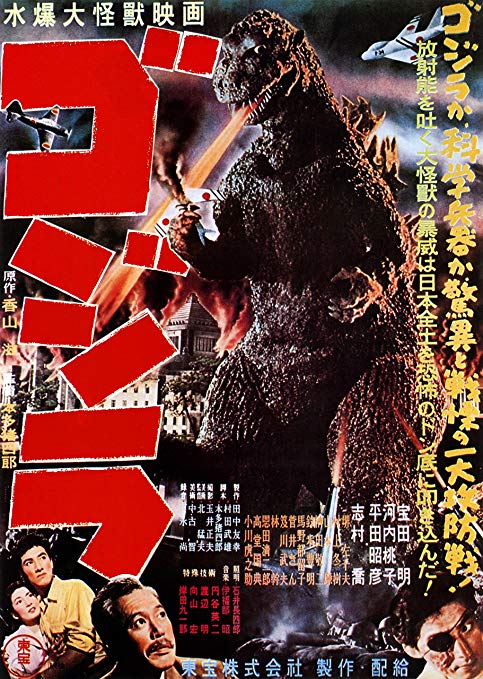
With its dark coloration, striking red lettering and montage of fearful figures, the film’s Japanese poster (see above) certainly resembles a contemporary kaidan poster, and the temptation to see ‘Godzilla’ as a horror film is further encouraged by the fact that the tragic Dr Serizawa (Akihiko Hirata) appears for some reason to reside in a Western-styled gothic crypt, where he keeps his extremely impressive array of Frankensteinian machinery in a subterranean burial chamber – the signifiers of a Hollywood horror movie perhaps acting here as a canny metaphor for the reckless, predominantly American, scientific advancements which have guided the tormented doctor (himself a traumatised war veteran) toward the construction of his oxygen-destroying “doomsday device”.

Thinking further, these horror-ish vibes are actually very much in keeping with several of the more low-key, and perhaps more personal, sci-fi films which Honda subsequently directed in-between his kaiju commitments (1958’s ‘The H-Man’ and 1963’s nightmarish ‘Matango: The Mushroom People’ immediately spring to mind). From another angle meanwhile, they also allow ‘Godzilla’ to fit neatly into an interesting international sub-set of ostensibly ‘scientific’ ‘50s alien / monster movies characterised by their brooding, overtly gothic visual aesthetic – Edgar Ulmer’s The Man From Planet X, Gerardo de Leon’s Terror is a Man and Riccardo Freda & Mario Bava’s ‘Caltiki: The Immortal Monster’, to name but a few.


3.
Given that Japan bore the brunt of the worst extremes of mass destruction that the 20th century had to offer, whilst its densely populated shores continue to abide beneath a more-or-less-constant threat of natural disaster, I’ve always been struck by the extent to which the nation’s culture has portrayed the collapse of its urban infrastructure with an almost unnerving level of enthusiasm.

In fact, there is a whole pantheon of popular Japanese art which has gleefully fetishized this forthcoming, full scale decimation to a nigh-on crazed degree, creating an entire new aesthetic of twisted girders, disintegrating concrete, bridges and overpasses swinging through space like loose tree branches, fire and debris raining down on all sides, and so forth.

Although Katsuhiro Ôtomo’s ‘Akira’ probably represents the pinnacle of this kind of “disaster-porn”, the original ‘Godzilla’ is surely also a major landmark in its development, and the terrifying beauty which Honda and his collaborators bring to Godzilla’s central rampage sequence remains absolutely startling. Looming, expressionistic shadows, vertiginous low angle camerawork and wild swatches of inky blackness all lend a genuine horror to proceedings that would never, ever be replicated by the comparatively quaint, full colour kaiju rampages which would follow through the ‘60s. Throughout its running-time in fact, ‘Godzilla’ succeeds in evoking an almost physical sensation of leaden, stomach-churning dread in its viewers, ensuring that, all these decades later, its status as the ‘Citizen Kane’ of monster movies remains unsurpassed.

Saturday, 11 January 2014

Nippon Horrors:
Genocide / ‘War of the Insects’
(Kazui Nihonmatsu, 1968)


Even when writing a weblog that prides itself on plunging headfirst into discussion of some pretty crazy motion pictures, there are some films that just present so much of a WTF it’s difficult to know what to do with them, and here we have a case in point. Quite what was going through the minds of Shochiku studio’s short-lived sci-fi/horror division when they decided to follow up their fairly jaunty low budget kaiju picture ‘The X From Outer Space’ with the cheerily titled ‘Genocide’, I almost think I’m happier not knowing.(1)

So first off, two things I’m usually reluctant to do in the course of reviewing movies: (i) classifying these sort of sci-fi / ‘nature goes bad’ disaster movies as ‘horror’. (I know strictly speaking they kind of are, but y’know… in aesthetic terms, there’re way off from what constitutes ‘horror’ in my mind.) And, (ii), giving in to the school of thought that seeks to frame everything shocking or extreme in post-war Japanese culture as a response to the trauma created by the Hiroshima and Nagasaki bombings. (It seems some Western critics like to crow-bar that issue in wherever they possibly can, but much of the time I just don’t buy it, personally.)

Both of those rules, however, are going to be jettisoned whilst we look at ‘Genocide’, a frankly extraordinary venture that resembles a humble genre programmer that’s somehow lost its mind and gone completely insane, beginning in the detached, utilitarian mode common to ‘50s and ‘60s science-goes-bad disaster films, but gradually spiralling off into a kind of beserk, hysterical fatalism, conveying a sense of absurd, nihilistic cruelty that surpasses just about any contemporary horror film, and reflecting the unthinkable reality of an era in which pointless mass death seemed ever imminent.

So how the hell did that happen…? Well, let’s begin at the beginning, shall we.

The very first thing we see in ‘Genocide’ is stock footage of an atomic bomb explosion.“The moment mankind unleashed the power of the atom..”, reads a somewhat gnomic opening caption, “..he immediately began to fear it”. So that’s the second of my above-stated caveats out the window right from the outset, I guess. I also get the feeling that anyone who bought a ticket in the hope of seeing a fun movie about killer insects is already beginning to feel somewhat uneasy.

After a beautifully garish title sequence (rather reminiscent of the similarly insect-filled credits to Teruo Ishii’s equally unhinged Horrors of Malformed Men), we join an American bomber carrying a nuclear payload, flying over Kojima Island in the Anan Archipelago on a routine exercise. The pilot Charly, played by Japanese cinema’s go-to guy for black American roles, Chico Roland,(2)spots a wasp outside the window and inexplicably freaks the fuck out, suffering flashbacks to Vietnam as he thrashes around, assaulting his fellow crew members and trying to activate the release mechanism for the bomb. Temporarily distracted by their colleague’s outburst, the crew fail to notice that they’re flying headfirst into an inexplicably gigantic swarm of insects, whose combined mass burns out the plane’s engines, setting the vessel ablaze.

From a hideaway on the nearby cliffs, a blond Caucasian woman, Annabelle (Kathy Haran, who also did some first-class freaking out in ‘Genocide’s sister film, ‘Goke: Bodysnatcher From Hell’), and her Japanese lover Joji (Yûsuke Kawazu), watch as the plane and its cargo fall to earth.

This Joji, it quickly transpires, is a bit of a creep. We soon learn that he’s been frolicking with Annabelle on the pretext that he’s out hunting for rare insects, leaving his trusting Japanese wife, a hotel maid, at the mercy of her boss, a disagreeable oaf who seems to try to rape her every five minutes. The next time we see Joji furthermore, he’s sailing into harbour in his dinghy, trying to palm off a handful of suspiciously obtained US military watches on the local fishermen. Yes, he’s a bad ‘un alright.

When army personnel make it to the island to investigate the crash meanwhile, they find the plane’s crew dead, having apparently contracted some hideous, bubonic plague-like disease whilst sheltering in a cave. That’s with the exception of Charly, who is found unconscious on the beach, having apparently fallen off a cliff whilst fleeing from his comrades. The wreck of the plane itself, and the H-bomb onboard, remain unaccounted for. So until Charly wakes up, I think Uncle Sam might want to have a quick word with Joji...

Joji’s arrest on some slightly trumped up murder charges brings the whole mess to the attention of Dr. Nagumo of the the Tokyo Biological Research Centre (Keisuke Sonoi), who, with a sense of taste and restraint typical of this film, is introduced to us via a shot that sees him stabbing a large rodent with a syringe full of bright blue fluid, apparently for real. (What can I say, you’ve gotta learn to wince and shrug this stuff off in older movies sometimes..). According to the doc, Joji has recently sent him samples of a rare insect found of Kojima island, one whose poison “..attacks the nervous system, causing madness and death”. Things just keep looking up for our poor islanders, don’t they?

Meanwhile, a world news report on the radio in the hotel bar announces that food supplies in Egypt and India are under attack from unseasonable swarms of locusts, and by the time Charly finally awakens in a hospital bed, portents of both local and global doom are accumulating so thick and fast it’s not surprising folks are starting to get a bit twitchy.

Ah, poor Charly. Rarely have I seen a character who has such a persistently dreadful time in a film as he is subjected to here. From his very first appearance on screen, he’s practically losing his mind with fear, and the catalogue of torments he experiences through the rest of the film beggars belief. After suffering severe head injuries on the beach, he awakens in an insensible state, raving about his fear of insects. So naturally the doctors decide to try to revive his memory by sitting him in a dark room and playing reels of insect footage whilst he screams in abject terror, after which he immediately gets smacked around by the attending US Colonel, who accuses him of being a hallucinating drug addict.

On his way to a military prison, he narrowly avoids being torn apart by machine-gun fire as he is kidnapped by a gang of Communist agents temporarily in the employ of the film’s main villain (who will remain nameless here). Determined to use him to locate the missing h-bomb, they tie him up, beat him and torture him with a cigarette, before trying out a new technique, confining him in a descending tunnel of that kinda gauze-like fabric that bee-keeper’s hats are made of, and pumping in a swarm of those nervous system shattering wasps.

Completely unhinged by this point, Charly is dumped by his captors on the shore of the island; out of sheer malice, they throw him a pistol before they depart, hoping he’ll wreak some kind of carnage before the insects’ poison kills him. Next, we see him staggering toward the island’s hospital, letting off shots in the air and laughing like a loon as he prepares to menace the film’s two heroines, who are within. Suddenly transformed from a hapless victim to a psychopathic monster by the poison, he suffers a singularly inglorious death, shot down from behind as he sets about trying to rape the nurse.

So basically, the unfortunate fellow spends the entire duration of the film in a state of extreme pain, terror and confusion, culminating in a pointless death that leaves everyone assuming he was a violent maniac. And as his corpse leers up at us, we’re suddenly hit with one of the film’s most singularly unglued innovations, as a hideous, electronically filtered voice that we’re apparently supposed to interpret as the ‘chorus of the insects’ begins chanting (in English): “genocide…. genocide…”.

As with the aforementioned ‘Goke’, there is a kind of vicious misanthropy at work in ‘Genocide’. In spite of the massed threats the film lines up against humanity, most of the characters seem incapable of uniting with each other or acting rationally for even a few moments. Dr Nagumo and the Red Cross nurse (Reiko Hitomi) are presented as our standard issue trustworthy, heroic characters, but aside from their obligatory presence, the whole film seems to take place in some upside down moral universe in which people routinely say things like “thank you for the poisonous insects” and “thank heavens for that plane crash”.

Just about everyone in this film’s world, it seems, is motivated either by callous selfishness or horribly misguided ideological fervour… unless, that is, they’re one of the contingent who is actively welcoming and encouraging the forthcoming nuclear/insect/plague apocalypse. Amid layers of political, global, cultural distrust and despair, “kill ‘em all and let god sort it out” seems to ‘Genocide’s general message to the world, a sentiment that is only amplified by a truly jaw-dropping plot twist that occurs midway through the film. Totally crazy and utterly black-hearted, I won't spoil the surprise for you here, but… just you wait.

Strangely enough though, despite all this bleakness, ‘Genocide’ actually remains pretty fun to watch. As an example of formula genre picture that’s gone completely off the rails into uncharted territory, it is astoundingly entertaining, and the weird, sledgehammer ineptitude with which many of its more extreme situations are portrayed, together with the randomised hysterical energy of the whole thing, is a whole lot of “WTF is UP with this movie?!” style enjoyment.

Initially, the basic characterisation, impersonal medium-shots and functional, exposition-heavy dialogue of a more traditional sci-fi / disaster movie predominates, but when the film goes full-on ape-shit following Charly’s death, the situations that transpire swiftly become so twisted, it’s almost as if the two dimensional characters can barely comprehend what’s happening to their little world. Meanwhile, the dry cinematic syntax in turn becomes freakier and freakier, until it practically collapses into an orgy of solarised stock footage, shrieking close-ups, assaultive montages and utterly bizarre psychedelic visual effects (the latter an attempt to portray the ‘mindspace of the insects’, or somesuch, as experienced by victims of the poison before they die).

And so, what could, in a more orderly, less threatening world, have just remained a mildly diverting Japanese answer to ‘Them!’ instead becomes a celluloid equivalent of Colonel Kurtz, gazing deep into the abyss, cackling as flies buzz around the heads on spikes, reflecting on the mad, unending horror of it all. Christ almighty. But, you’ve gotta laugh, haven't you? Just ask Charly.


(1)The original Japanese title, 'Konchû Daisensô', translates roughly as ‘War of the Insects’, a title that was also used for at least one English language release (see the film’s IMDB page for a poster using that name). How in the hell it ended up being called ‘Genocide’ for it’s slightly more high profile US release, I can’t begin to imagine.

(2)Chico Roland is perhaps best known for his appearances in Seijun Suzuki’s ‘Gate of Flesh’ (1964) and Shigehiro Ozawa’s ‘The Streetfighter’ (1974), as well as for playing the rebellious black GI ‘Gill’ in Koreyoshi Kurahara’s pair of cinematic molotov cocktails, ‘The Warped Ones’ (1960) and ‘Black Sun’ (1964). He always seems to present a rather weird, gentle, child-like demeanour on screen, and his frequently bizarre line readings suggest that he wasn’t very fluent in either Japanese or English. Quite who this guy was, and how he ended up appearing in so many awesome Japanese movies, I would love to know.