Thursday, 11 October 2018
Gothic Originals / October Horrors # 6:
El Mundo De Los Vampiros
(Alfonso Corona Blake, 1961)
El Mundo De Los Vampiros
(Alfonso Corona Blake, 1961)
I confess, I get all these ‘50s/’60s Mexican vampire movies a bit confused. There were just so many of them produced in such a short time frame, all with fairly similar titles.
Consulting the chapter on Mexico in Pete Tombs’ ‘Mondo Macabro: Weird and Wonderful Cinema Around The World’ (Titan Books, 1997) has however helped me to establish that ‘El Mundo De Los Vampiros’ was the third vampire film made by actor/producer Abel Salazar’s company ABSA. (Arriving about five years after Salazar revitalised Mexican fantastic cinema with 1957’s ‘El Vampiro’, ‘El Mundo..’ belatedly followed 1958’s ‘El Ataud del Vampiro’ [‘The Vampires Coffin’].)
Anyway, now that we’ve got that out of the way – ‘El Mundo de los Vampiros’ rules. It gets straight down to business right from the very first frame, as we see our vampire (Guillermo Murray, looking for all the world like a more fresh-faced, Hispanic Christopher Lee) rising from his tomb (it’s velvet-lined and has an automatic lid - nice). He wears a full opera cape, complete with one of those massive, upturned bat wing collars that only movie vampires (and Dr Strange) ever wear, and a huge silver amulet. (1)
Leaving his crypt, the vampire wonders through his splendidly cob-webbed dining room, before descending to the gigantic subterranean cavern beneath his house. Mouldering skeletons hang in chains from the walls, alongside some even more impressive cobwebs. The stone entranceway to the cavern has been crudely carved to resemble a mouth full of fangs, and beyond it, a pair of blazing stone braziers are decorated with human skulls on each corner, standing before a classic sacrificial altar. Naturally, the flames shoot upward when he gestures toward them with his cape.
After taking a few moments to admire the majesty of his interior décor, he moves on to – joy of joys – a full size pipe organ crafted entirely from hollowed out bones and skulls! Man, this is a vampire who knows how to live!
If you look this film up on IMDB, and you’ll immediately find reviewers deriding it as a “cheap Mexican vampire flick” and such like, but bugger that – this bone-organ is one of the most elaborate props I’ve ever seen in a ‘60s horror film. It must have taken somebody weeks to build this thing, and it is absolutely incredible.
As the vampire seats himself herself the keyboard and starts to lay down some dark, dissonant dirges, a brief cut away takes us above ground, to a desolate looking wilderness, in which a young couple are driving around in a land rover, having apparently lost their way.
Seemingly manifesting via some kind of underground gas jet, the vampire appears in the middle of the road, accompanied by a crowd of surprisingly effective animated bats. “Why doesn’t he move aside?”, the wife asks optimistically after her husband sounds the horn, but it is too late. Grinning, the vampire reveals fangs the size and shape of baby carrots. The woman screams, and before you know it, we’re back downstairs in the cavern, where The Count continues to work through some remarkably uncompromising modernist organ jams.
By this point, the vampire’s followers have begun to assemble. Weird looking, zombified guys in sinister, hand-sewn animal masks, body-stockings and capes, they arise from coffins scattered around the cave floor, or simply loom out of the darkness, shuffling around restlessly and awaiting further orders, strongly reminding me of the similar “creatures of darkness” featured in Jess Franco’s delirious ‘The Erotic Rites of Frankenstein’ (1972).
Acknowledging their presence, the Head Vampire shrieks in the voice of a hissing cat, before returning to his music. His followers meanwhile begin preparations for some black magick rite, bringing goblets and a dagger to the altar, before a gaggle of Vampire Brides (recognisable by their diaphanous gowns and ridiculously OTT eye make-up, seemingly modelled on Carroll Borland’s get-up in Tod Browning’s ‘Mark of the Vampire’ (1935)) make their entrance, dragging the hypnotised wife of the kidnapped couple. Her protesting husband meanwhile is chained to a stake, whilst the follower vampires chew on his neck en masse.
The sacrifice, it transpires, is to be offered to Astraroth, “the evil spirit whom all of us here have come to adore”. Before doing the deed however, the Head Vampire pauses to reflect that “..with this dagger, I was murdered more than one hundred years ago, by a man who carried the cursed name of… Colman!”
Since then it seems, our vampire has dedicated his time to tracking down and destroying the remaining members of the accursed Colman dynasty – and yes, hearing him spit the rather mundane name of Colman with great vehemence and repulsion throughout this film proves very amusing.
You’d think wiping out a single bloodline over the course of a century would be easy work for such a ferocious Lord of the Undead, but he must have been slacking off a bit, because three Colmans remain extant – a father and two daughters. Using the hypnotised bride on the altar as a kind of human scrying orb, he establishes that they are all alive and well. Quoth the Vampire; “..as long as they refuse to join the legion of the living dead, I will not be able to give the signal which will launch the conquest of the universe!” (And you’d better believe that sounds pretty impressive when solemnly intoned in Spanish).
Eventually, after giving her neck a good, erotically-charged chew, the Head Vampire plunges his dagger into the neck of the sacrificial victim, but, instead of dying, his bite revives her as one of the evil brides! Her outré eye make up is already in place, and she turns to the camera and cackles in wild and uninhibited fashion.
By this point, we are over fifteen minutes into the film, and, perhaps sensing that the monster kids in the audience probably need a break from all this blood-curdling brilliance before their little hearts expire, ‘El Mundo de los Vampiros’ takes a deep breath, and reluctantly cuts to the ‘good guys’.
Now, I’ve seen enough Mexican horror films to realise that, when we cut to the good guys, it’s generally time to put the kettle on or visit the bathroom. Although such tedium is, in fairness, a tradition that stretches all the way back to Bram Stoker, these stiffly formal scenes in which well-to-do gentlemen pay effusive compliments to each other and chivalrously praise the beauty and achievement of the film’s soon-to-be-betrothed young ladies seem to be a particular blight upon Mexico’s contributions to horror cinema.
Even here though, ‘El Mundo de los Vampiros’ manages to liven things up a bit, investing it’s inevitable post-dinner party hand-shaking with an element of intriguing weirdness almost equivalent to the extraordinary scenes which have preceded it.
We are at a soiree held, of course, by the refined Senor Colman and his two eligible daughters, and this evening they are joined by an esteemed guest who has recently returned from ‘the capital’ – the handsome musical prodigy Rodolfo Sabre (Mauricio Garcés), who is of course urged to take a turn at the piano. (2)
Rodolfo demures, explaining that his hosts would not enjoy the kind of music he plays these days. “One could say that I study the science of music, in a way – the effect of sound on living beings […] sound can kill an animal, or a human being, or make them insane,” he helpfully explains.
Persuaded to play an example of this daring new music, he sits at the keyboard and knocks out some mildly dissonant, minor key romantic melodies. Dogs outside howl, one guest feels her spirit lift from her body, and another is reminded of the death of her mother. “This music contains elements that are aggressive, humourous, religious and terrifying, it produces an effect on all types of being,” Rodolfo tells his listeners.
He furthermore claims that the music he is playing originates in Transylvania, where it is used to “summon the dead” - and, right on cue, the Head Vampire appears in the doorway, his entrance accompanied by a brief orchestral fanfare that causes everyone to stand to attention.
Adopting the conventional “hey, I’m an eccentric Eastern European aristocrat who just moved to the neighbourhood, what’s up?” approach, Count Subotoi (for that is his human name) introduces himself to the assembled guests, but soon causes a scene when Rodolfo’s sinister music causes him to freak out (as he desperately tried to prevent his fangs from protruding from his lips, we presume), precipitating his hasty departure.
From this point onward, it must be said that the film begins to drag somewhat, as it proceeds along a fairly conventional vampire movie trajectory. As such, the vampire begins the laborious process of seducing the young ladies of the Colman household, mooning outside their windows, gaining entry and neck access in the form of a bat and eventually spiriting them off to his lair, all in the tried and tested manner.
One weakness that emerges once the full-strength craziness of the film’s opening act eases off is that, whilst Guillermo Murray clearly looks the part, he does not actually make for a very charismatic vampire. In this regard, it is worth noting that ‘El Mundo..’ was the first ABSA vampire film not to feature Mexico’s best known vampire actor, Germán Robles, who by this stage seems to have moved on to a bunch of rival vampire films from other production companies.
Could we thus chalk Murray up as Mexico’s equivalent of Mike Raven..? He has a bit of that bland, “unconvincing understudy” vibe about him, but the film is otherwise so strong, and his character so blessed his outrageous, comic book action to perform, that this deficiency doesn’t make much of a dent in the overall quality.
Anyway - naturally the steadfast gentlemen of the picture gradually figure out what The Count is up to and set out to stop him and reclaim their women, etc. One thing I thought was a bit odd in this respect is that, although Rodolfo’s Transylvanian music is supposed to ‘summon’ vampires, it appears in practice to have the opposite effect of freaking them out and making them grasp their heads and writhe about in pain… so I’m not sure what that’s all about. Just a sub-titling error perhaps?
As per Mexican monster movie tradition, ‘El Mundo..’ rallies significantly after its saggy middle section, mustering it’s forces for a great, action packed finale that is easily a match for the extraordinary opening outlined in detail above.
Yet another exciting feature of Count Subotoi’s vampire lair is his impressively huge and deep PIT OF SPIKES, and this gets plenty of play in the final act, including extensive use of a rather splendid, Bava-esque forced perspective shot taken from the bottom of the pit.
Needless to say, there is much fun to be had here with Rodolfo and Senor Colman punching vampires in the face, leaping across chasms etc, all leading up to a denouement in which… well, if you’ve read this review and can’t guess the nature by which our heroes nullify vampires evil power, you’ll probably enjoy the movie even more than I did.
I don’t have much more to say in conclusion, except to note that it saddens me to note how neglected and unfairly derided these vintage South of the Border horror films continue to be in the English speaking world. Though their uneven mixture of classic gothic atmosphere and loony monster bash thrills might not be to everyone’s taste, there is a whole world here that remains more or less invisible in terms of officially-sanctioned, English-friendly releases. Digging into it through, er, other means however reveals a seemingly unending supply of films that, like ‘El Mundo de los Vampiros’, are more fun than the proverbial barrel of monkeys.
----
(1) Murray played another vampire in 1963’s ‘La Huella Macabra’ (“The Sinister Footprint”?), before going to on to what I’m sure was sterling work in ‘Neutron Traps the Invisible Killers’ (1965), ‘Planet of the Female Invaders’ and ‘Gigantes Planetarios’ (both ’66). God bless Mexico in the 1960s.
(2) Another Mexican horror veteran, Mauricio Garcés also appeared in ‘La Llorona’ (‘The Crying Woman’, 1961) and the fantastic ‘El Barón del Terror’ (aka ‘The Brainiac’, 1962), amongst other Salazer/ABSA productions.
Labels:
1960s,
Alfonso Corona Blake,
bats,
cults,
film,
GO,
gothic,
Guillermo Murray,
horror,
magic,
Mauricio Garcés,
Mexico,
movie reviews,
music,
OH18,
organs,
vampires,
villain lairs
Tuesday, 9 October 2018
October Horrors # 5:
Incense For The Damned
([no credited director], 1971)
Incense For The Damned
([no credited director], 1971)
AKA ‘Bloodsuckers’, ‘The Freedom Seeker’.
It has been many years since I last watched ‘Incense For The Damned’, and although – uh, spoiler alert? - it is not a good film by any stretch of the imagination, I still think of it fondly, recalling the time I stayed up until 2am to see it, back in the glory days when BBC2 in the UK used to screen double bills of random British horror films in the early hours of Saturday morning.
How well I remember those evenings in my rented attic room; limited to half a bottle of wine (because I could only afford one per weekend), watching Tom Paulin moan his way through Newsnight Review, wishing they’d bloody well get it over with. Blu-tacing the aerial for my tiny TV set to the best possible position on the wall, turning out the lights, and – crucially - having absolutely no idea what I was about to be presented with.
I had no background in horror movie fandom at this point in my life, and no reference works to guide me. All I had to go on was the film’s title, and perhaps a three line synopsis in the newspaper listings. On that basis, you can appreciate that the name ‘Incense for the Damned’, year 1971, Peter Cushing, plus some slightly garbled copy involving vampires, Greece, hippies and Oxford University sounded absolutely unmissable. Could I have another ‘Psychomania’ or ‘Horror Express’ on my hands…? (1)
Well, needless to say, I didn’t. I chiefly remember being staggered by how shoddy and disjointed the film seemed. I probably fell asleep a few times, but nevertheless, I got some eerie psychedelic thrills from the acid trip sequence, and some bad movie chuckles from seeing Patrick Macnee out of ‘The Avengers’ getting pushed off a cliff by a witch on a donkey (so funny).
Not a total write off then, and in fact I welcomed the experience as a necessary reminder that I shouldn’t expect to win out every time in this strange new hobby I’d developed – after all, watching stuff like this in bored bafflement is very much part of the deal one strikes with the Horror Movie Gods, and what value the wheat without the chaff etc, right?
Returning older and wiser, I now of course have some background to help me make sense of the cinematic train-wreck that is ‘Incense for the Damned’. Most pertinently, I am aware of the dread fact that Robert Hartford-Davies – the man who happy signed off on 1964’s ‘Gonks Go Beat’ – actually demanded that his name was removed from this film, leaving many prints without a credited director. If that’s not a bad omen, I don’t know what is.
In fairness, Hartford-Davis’s argument was simply that the film he had intended to make was never finished. Beginning life in 1969 as a straight adaptation of Simon Raven’s novel ‘Doctors Wear Scarlet’ with location shooting in both Greece and Oxford, the project that eventually emerged as ‘Incense for the Damned’ was abandoned prior to the completion of shooting when financing fell through.
Two years later, some nefarious producer (I’m currently unable to ascertain WHICH nefarious producer), presumably in search of an easy way to complete a double-bill, disinterred the raw footage from this unfinished project and had it cut together into ‘Incense for the Damned’, possibly incorporating some newly shot material, possibly not [see speculation below].
The result is, indisputably, a complete dog’s dinner. In the opening minutes alone, voiceover narration and heavy-handed montage are used to graft a narrative onto what seems very much like a series of unconnected fragments, and throughout the film, shots that most professional filmmakers would have abandoned due to photographic gaffs or muffed performances are proudly displayed, in-between long stretches of what seems like unedited master-shot / coverage footage.
Although few are liable to hail Robert Hartford-Davies as an overlooked cinematic visionary, the best films he directed (I’d nominate ‘The Black Torment’ (1964) and ‘Corruption’ (1967)) are actually quite accomplished, and it is easy to imagine his anger and embarrassment at seeing his dirty laundry publically aired here without his permission – especially given that the footage incorporated into ‘Incense..’ strongly suggests that it may not have just been money trouble that shut down the original production.
Seemingly shot in great haste, much of the material from Greece is so flat and muddled that it is difficult to imagine even the most sympathetic editor pulling anything reasonable out of it, whilst the cast (particularly Macnee) look confused and unhappy throughout.
As you might expect, the storyline of the film that eventually reached cinemas is fairly incoherent, leaving ‘Incense..’ feeling chronically uncertain of what kind of film it is actually supposed to be. Is it a ‘Devil Rides Out’-inspired black magic movie? (Patrick Mower plays exactly the same young-man-fallen-prey-to-evil-cult character as he did in that film.) Is it a vampire movie? (Well, there’s a vampire in it, but she’s also a witch, so..) A jet-setting travelogue / missing person thriller? (Much of the film proceeds in this vein, with a flustered Macnee holding tedious meetings with Greek Colonels and traipsing around rural areas on a donkey, etc.) (2)
Or, is it simply a ‘60s social fable about a privileged young Oxford scholar who turns his back on the establishment after discovering sex, drugs and ancient mysticism? In many ways, this seems like the most convincing interpretation of what is on offer here, with the film’s finale – in which Mower delivers an outrageous, counter-cultural “fuck you” address to the University’s assembled provosts before murdering his shallow, status-hungry fiancée and escaping across the college rooftops – feels more like a weird exploitation homage to Lindsay Anderson’s ‘If..’ (1969) than anything that belongs to a horror movie.
It is worth noting here that the Oxford-shot footage in the film’s last few reels feels a lot stronger and more ‘together’ than much of what precedes it, and indeed, this memorably off-beat conclusion is one of several isolated bits and pieces that are diverting and/or strange enough to make ‘Incense for the Damned’ worth watching at least once.
The first of these is the hippie cult “drug orgy” sequence early in the film, which made quite an impression on me during that long-ago TV viewing, and indeed remains pretty cool. Looking as if it was properly edited as a stand-alone sequence (presumably at the time of Hartford-Davis’s original production?), it sticks out like a sore thumb from the drab padding that surrounds it, with full-on, hallucinatory application of warped reflections, fish eye lens and kaleidoscopic what-nots, crazy focus pulling and some ragin’ sitar-infused psyche rock on the soundtrack, all leading up to the surprisingly explicit murder of fully nude sacrificial victim. (3)
A fine example of the kind of post-Kenneth Anger psychedelic freak-outs that so often found their way into late ‘60s / early ‘70s horror films, this sequence gives us a tantalising glimpse of the direction ‘Incense..’ might have taken had actually been made properly… even whilst our psyche-horror buzz is comprehensively harshed by the subsequent, shakily rendered daylight scene in which the victim’s mutilated body is discovered on a hillside by her mother and fellow villagers. (I’m fairly certain that all of this nudity and bloodshed must have been excised from the version of the film I originally watched on TV, by the way.)
Another definite highlight is a one-scene-wonder cameo from Edward Woodward, who appears here as an eccentric Oxford academic with a special interest in the occult. Striding purposefully around the Ashmolean Museum, Woodward enthusiastically appraises our nominal protagonist Alexander Davion of his own personal take on vampirism, which he rationalises as a kind of sexual fetish. This scene calls upon Woodward’s talents to put across a few handfuls of the most jaw-droppingly bizarre dialogue I’ve ever heard in a horror movie, and he accomplishes the task with admirable gusto.
“Are you telling me that a girl sucking the blood from a man’s neck could induce an orgasm?” Davion asks him at one point. “Now, come, come, Tony, don’t be naïve,” he replies, sounding positively thrilled by this line of chat. “Man works and loves in many ways. Some men, for instance, get excitement only from statues – the ‘Pygmalion Syndrome’. Other men can only make love in coffins. You have voyeurs, transvestites, narcissists, bestialists. Ah, it’s a funny old world we live in!”
Isn’t it just? Davion’s character, by the way, seems to have been one of the biggest casualties of this film’s unfinished/cobbled together status, in that, although he delivers the narration that ties the film together and ostensibly leads the search for Mower’s character that the opening two thirds of the movie revolves around, his performance is entirely wooden, and he basically does absolutely nothing, remaining almost invisible through much of the run-time.
In the absence of a strong lead, the role of ‘protagonist’ instead getting pushed onto other characters, with much of it landing in the lap of Senegalese actor Johnny Sekka, whose character (another gifted Oxford graduate) provides an extremely rare example of a black hero in British horror, in an era when black actors were still only liable to make an appearance in the genre as servants or voodoo cultists.
Although Sekka’s character to some extent resembles one of the heavy-handed “look, a black man can be cultured and educated too” gestures common to liberal-minded British film and TV of the ‘60s and ‘70s (see Dennis Alaba Peters’ character in ‘Department S’ for example), hints of a little more nuance still remain in the scripted dialogue that made it to the screen.
For one thing, Sekka is not terribly likeable – his character is annoyingly highly-strung throughout, and seems particularly touchy with regard to his race (“should I wear feathers and a head-dress?!” he explodes at one point when his companions question his unverified insistence that Mower has fallen under supernatural influence).
Perhaps he is right to be defensive however. In his absence, Macnee and Davion are heard to mutter darkly about how Sekka’s ‘background’ gives him a special understanding of mystical mumbo-jumbo – this despite the fact that he has presumably spent much of his life engaged in legitimate scholarly pursuits in the heart of England, and that the mumbo-jumbo they are currently investigating originates in Greece.
As in most other respects, it is difficult to figure out quite what ‘Incense for the Damned’ is trying to say here, so muddled is the film’s construction. More than anything in fact, watching it again this month makes me want to track down Simon Raven’s source novel.
There is clearly a good story with some interesting characters buried in here somewhere, if only we could piece it together, and Raven is an author I’ve been meaning to investigate for a while, so ‘Doctors Wear Scarlet’ might be a good place to start, even though the title makes it sound like a medical comedy.
In closing, you will no doubt have noted from the poster and text above that Peter Cushing appears in this film. Well, indeed he does. As the senior Oxford provost who has sponsored the career of Mower’s character, Cushing has limited screen time prior to the film’s conclusion, playing the kind of “stone-faced, conniving patrician” role he could probably do in his sleep by this point. All in a day’s work.
In the film’s final scene however, Cushing’s character addresses an internal University inquest, and makes a report on the circumstances surrounding the death of his daughter, who was killed by Mower. This speech is played out in a fixed close up on Cushing’s face, and, in stark contrast to just about everything else that has happened in this silly and blundering film, he looks absolutely distraught, barely making it through his dialogue before breaking down in tears. Genuine emotional pain seems deeply etched upon his face, and though brief, the scene is starkly upsetting. If Cushing was indeed acting here, he was doing so with an intensity that seems wholly inappropriate to the film in which he was appearing.
So… it pains me to do this, but I had to check the dates. According to IMDB, the original shoot for what became ‘Incense of the Damned’ took place in April 1969. I believe that this was before Cushing’s wife Helen became seriously ill, but I could be wrong (those more familiar than I with the details of his biography can perhaps advise).
If, however, this concluding scene was actually shot later, whilst the film was being prepped for release during 1971, that would place it in the months immediately following Helen’s death, and horror fans will not need to be reminded of the effect that this had upon her husband. If my speculation here is correct, then including this footage in the final film feels like a deeply callous and irresponsible decision on the part of whoever was in charge at this point, and I rather wish I hadn’t seen it, to be honest.
But – this is only speculation. Perhaps Cushing was simply demonstrating his prowess as an excellent actor, giving his sketchily written character a redemptive emotional arc similar to the one he played out in films like ‘Cash On Demand’ and The Flesh & The Fiends (both 1960)? Perhaps if Hartford-Davies had actually been able to put this damn thing together in the way he’d intended, we might have seen a bit more of his character, and it might have all made sense? But then again, perhaps not.
I’m not sure if anyone on the British horror scene has ever really dug into the history of this production, or whether or not there are any books or articles I could track down that might help to fill in the gaps, but there seem to be a lot of unanswered questions here. And, as the tone of this review will probably have made clear, the answers to these questions hold the potential to be considerably more compelling than the film itself.
-----
(1) A gold star for whoever came up with the ‘Incense for the Damned’ title, incidentally. Second only to ‘The Bloodsucker Leads The Dance’ with regard to really awful vampire movies with richly evocative titles.
(2) I was happy to note that the Greek Colonel who lends Macnee a helicopter is played by David Lodge, an actor who seems to have made a running joke out of appearing in extremely unlikely roles in Robert Hartford-Davis films.
(3) I initially suspected that the whole drug orgy sequence might have been shot at a later date, to liven up the film when it was prepared for release in ’71, but the cross-over of personnel and locations seems to suggest that it must actually have been shot alongside the other 1969 Greek footage.
Sunday, 7 October 2018
October Horrors # 4:
Not Of This Earth
(Roger Corman, 1957)
Not Of This Earth
(Roger Corman, 1957)
My attempts to gradually familiarise myself with Roger Corman’s pre-‘House of Usher’ filmography may have hit choppy waters last year with The Undead and Creature from Haunted Sea, but we finally make landfall here, with what must be one of the absolute best of his late ‘50s pictures.
‘Not Of This Earth’ first hit screens in February ‘57 as half of a ready-made double bill with ‘Attack Of The Crab Monsters’ and, in view of its title and poster, you may well wonder what it’s doing in the middle of a marathon of horror reviews. Well, like many of the best low budget ‘50s Sci Fi films (cf: The Man From Planet X), this one draws just as much from horror traditions as it does SF, melding the two rather nicely and inadvertently kick-starting the loose cycle of “space vampire” movies that went on to include Bava’s ‘Planet of the Vampires’ (1965), Curtis Harrington’s ‘Queen of Blood’ (1966), and, eventually, Tobe Hooper’s ‘Lifeforce’ (1985) in the process.
Admittedly, the opening scene may not bode terribly well, as a carefree bobby-soxer bids a chaste goodbye to her eager boyfriend (HIM: “don’t be a drag, you know how you flip me”, HER: “I’m hip, but if my father dug the scene, he’d put small round holes in your head”) and subsequently falls victim to the less than convincingly monstrous figure of a burly middle-aged man in a black hat and shades (Paul Birch), who proceeds to extract her blood using some kind of machinery concealed inside a suitcase.
As a characteristically modernist animated opening sequence unfolds (created by Paul Julian, this one features skulls, paint-dripping alien landscape and a roving pair of shining eyes), we would seem to be en route to yet another paranoiac “the aliens are among us” type yarn (hey, at least the special effects are cheap), but thankfully this initial premise is taken in a very different direction by Charles Griffith & Mark Hanna’s witty and relentlessly imaginative screenplay.
Next up for instance, we see the black-clad killer barging into a quiet suburban doctor’s surgery, where, using slow but precisely enunciated English that leads Beverley Garland’s nurse to assume he is some kind of visiting foreign aristocrat, he declares that he is critically ill and demands an immediate blood transfusion.
Understandably, William Roerick’s doctor is reluctant to acquiesce to “Mr Johnson”s demands, particularly given that he refuses to submit to a blood test, but the application of some voiceover psychic powers soon resolves their disagreement, with the doctor in thrall to “Johnson”, and sworn to secrecy regarding his dealings with this new patient. (1)
In fact, the doc even ends up consenting to Johnson’s wish to recruit his nurse on a full time, private basis, in order to prepare his daily transfusions and – as he puts it - “to see that I do not expire”. When Nadine (for that is Ms Garland’s character name) hears how much this weirdo is willing to pay her, she is happy to go along with this arrangement, and ends up accompanying Mr Johnson to his home, despite the reservations of her cop boyfriend (Morgan Jones), who is outside slapping a ticket on the fiend’s illegally parked sedan.
Mr Johnson’s welcoming of Nadine into his household closely mirrors the old ‘Dracula’ tradition, right down to the alien’s attempt to lock the nurse’s door without her permission, and his offering her comforts (food, access to the swimming pool) that he himself refuses to enjoy.
In fact, whilst he may be largely ignorant of human customs and behaviour, Mr Johnson nonetheless seems to know exactly how a vampire should live, and as such he has acquired an impressive mock-Tudor mansion, and has even employed a local small-time hoodlum (Jeremy, played by Corman regular Jonathan Haze) as his all-purpose cringing crony.
As well as driver, porter, cook and cleaner, Jeremy also serves duty as Johnson’s all-purpose guide to human conduct (“I told you not to drive a car before ya learn how,” he snaps at his employer in first scene). Despite happily admitting that “this guy is six kinds of a freak”, Jeremy is happy to put his suspicions on deep freeze and do Johnson’s bidding. After all, as long as his boss keeps on handing him piles of gold ingots to convert into U.S. currency, who has time for questions?
So, that’s our basic set up, and, with admirable brevity, the remainder of the film gives us something extraordinary to chew on about every five or ten minutes, regular as clockwork.
Johnson’s communication with his home planet of Davanna for instance is accomplished via a hologram-based radio transmitter and matter transfer device that he keeps in his closet, and that will turn any connoisseur of vintage space-age clobber green with envy. Describing the earth’s inhabitants to his controller as “second state, sub-human, weak and full of fright,” he subsequently recites a list of his instructions from on-high, none of the potential results of which sound very promising for the people of Earth, whose fate is either to be harnessed as blood cattle should Johnson be able to subsist on their blood, or flat-out destruction if he does not.
Next up, Johnson opens the door to Dick Miller, appearing here in the role of a dishevelled door-to-door vacuum cleaner salesman whose fast-talking patter briefly confuses the stern alien. Though he is barely on screen for two minutes before being unceremoniously stuffed in the incinerator, Miller is great here, with his unruly hair, his weary distaste for his own sales routine and his sardonic use of the word “crazy” as an all-purpose acknowledgement all suggesting that he is actually some down-on-his-luck beatnik reluctantly forced into regular employment. A joy.
Towards the end of the film meanwhile, Johnson is surprised to encounter a female of his species on the street; wearing similar wrap-around shades, she looks like a classic film noir vamp. The two aliens speak telepathically whilst browsing at a magazine stand (I wish the print was good enough for me to see what they’re reading), and the woman explains that she is fugitive who has escaped from Davanna, using the ‘dimension warp’ installed in Johnson’s closet without permission.
Johnson declares that the woman will face severe punishment for this transgression, but she responds by informing him that things have gone south pretty sharp-ish back home on their dying planet. She provides a harrowing account of Davanna collapsing into anarchy, as ‘enemy prisoners’ are drained of blood en masse to quell the hunger of the mob, prompting her to make the jump to Earth to escape the violence. Now, she too desperately needs blood, and begs Johnson to help her, prompting him to break into the doctor’s surgery where, in a horrible mix up, he selects the wrong bottle and doses her with rabid dog’s blood.
Then, just when you think you’ve already got your moneys-worth from this picture, Johnson – who is presumably beginning to feel rather desperate once the woman’s body is discovered – unveils a bizarre, flying jellyfish creature that he keeps rolled up in a glass tube(!), and sends it to attack the doctor. A wonderfully hideous, Lovecraftian creature design, this thing drops from the sky like a demonic lampshade and engulfs the poor guy’s head, Flying Guillotine style, until he ceases to struggle and thick gloops of blood trickle out from beneath it. Yowza!
Though blighted by a few minutes of unnecessary and tension-free running around in the final reel, ‘Not Of This Earth’ is otherwise a more or less perfect sci-fi/horror concoction. Clocking in at a brisk sixty-seven minutes, Griffiths and Hanna’s screenplay is superb, full of way-out ideas, razor sharp (or at least, extremely strange) dialogue and a wide variety of diverting shenanigans.
Like Corman’s more celebrated horror comedies of the era (‘A Bucket of Blood’, ‘Little Shoppe of Horrors’), the strength of the writing here makes for a film that is both eerily unnerving and genuinely funny, but with the pendulum perhaps swinging more strongly toward the former aspect on this particular occasion.
Performances too are great across the board. The odd, unnatural phrasing and impossible-to-place accent Birch employs as Mr Johnson also strike a perfect balance between humour and menace, whilst Garland makes for an absolutely swell heroine, obviously taking great pleasure in portraying a smart, capable and hard-headed woman who could easy run rings around any of the male characters.
Haze meanwhile is a gum-chewin’, street corner stupid-smart delight as Jeremy, and hell, even the cop boyfriend is kind of likeable. (You’ve got to love the moment when, after discovering that Johnson is a malevolent alien, he tells Garland “If I didn’t have to go on duty in half an hour, I’d go over there and get you out myself”.)
What I love above all most about the films that emerged from Roger Corman’s orbit across the decades (even the bad ones) is that they never play their audience for suckers. Cheap, simplistic and crassly commercial though they may be, you never get the feeling that Corman and his collaborators set out to make a movie they wouldn’t want to watch themselves.
Rarely allowing levels of enthusiasm or ingenuity to flag, Corman never talked down to his viewers the way that so many low budget operators did, only resigning himself to a “fuck it, this'll do” approach on rare occasions when the extreme haste and poverty under which his productions were undertaken made it impossible to save a picture from ignominy.
In this sense, Corman’s films strike me as a cinematic equivalent of the Marvel comic books overseen by Stan Lee during the ‘60s. Though working at crippling speed in areas of culture widely regarded as disposable, juvenile trash, these men saw no reason to let his own artistic standards slip, ruthlessly applying a credo that I’ve always taken to be one of the key rules of any creative endeavour; namely: if you set out to make something really good, with a bit of luck you’ll make something ok. If you set out to make something “ok”, you might as well give up and go home, because what you make is going to be worthless.
Though he may not have put it in quite those terms, it is this attitude that led Corman and the creatives he corralled around him to create films like ‘Not of this Earth’ – one week wonders that fell so far beneath the radar they didn’t even attract critical contempt upon their initial release, but that remain thoroughly entertaining and thought-provoking over sixty years later, keeping them alive in an era when I’ll bet 90% of the movies that gained an Oscar nomination in 1957 have been long forgotten.
---
(1) As an aside, I liked the decision here to name the alien “Johnson” – though clearly not a deliberate reference on the part of the scriptwriters, it puts me in mind of the “Johnsons” celebrated by William Burroughs in his novels, referring to the invisible, subterranean brotherhood of quiet, seemingly law-abiding citizens who are nonetheless always ready to help out a junkie, to harbour a criminal without ratting to the law, and to generally act in opposition to ‘straight’ society.
Friday, 5 October 2018
Exploito All’Italiana / October Horrors # 3:
Cannibal Apocalypse
(Antonio Margheriti, 1980)
Cannibal Apocalypse
(Antonio Margheriti, 1980)
AKA ‘Invasion of the Flesh Hunters’, ‘Cannibals in the Streets’.
Readers who have been keeping up with my reviews of Italian exploitation films over the past few years will probably not need to be reminded that I am not a fan of the Italian cannibal sub-genre. Notwithstanding ‘Cannibal Holocaust’s allegedly subversive political message, I find the socio-cultural context of these films deeply uncomfortable, whilst their execution is generally shoddy and mean-spirited, and their inclusion of genuine animal cruelty footage is absolutely abhorrent.
So, not a fun time in order words, at least for those of us who can tear themselves free from the tangled webs of prurience and nostalgia that drive so many film fans to obsess over the damn things. If schlock masterworks like Zombi Holocaust have taught me anything however, it is that the weird interzone wherein cannibal movie tropes intersect with more fantastical elements (well, zombies, anyway) is, by contrast, almost always a whole lot of fun - but just tread carefully out there folks, and keep a close eye on the wildlife.
It was in this spirit that I recently found myself sitting down to watch Antonio Margheriti’s ‘Cannibal Apocalypse’, and I am thrilled to report that I found it to be perhaps the very best entry in the rarefied sub-sub-genre of cannibal/zombie cross-overs, and, in fact, one of the most wonderfully demented ‘80s Italian horror films I’ve seen to date.
Despite the redundancy of its blunt, ‘Cannibal Holocaust’-aping title, Margheriti’s film is a deeply eccentric affair (interestingly, it was released in Italy as the more quizzical / humourous ‘Apocalypse Domani’ – ie, ‘Apocalypse Tomorrow’). Scripted by the ubiquitous Dardano Sacchetti and shot at least partially in Atlanta, Georgia, ‘Cannibal Apocalypse’ entirely ditches the cannibal film’s usual “WASP assholes meet a sticky end in the jungle” formula in favour of a storyline that takes the Vietnam flashback anxieties of Bob Clark’s ‘Deathdream’ or John Flynn’s ‘Rolling Thunder’, the urban virus outbreak paranoia of Cronenberg’s ‘Rabid’ and the no-fucks-given combat zombie mayhem of Umberto Lenzi’s ‘Nightmare City’... then hits max power on the blender, with deliriously exhilarating results.
Things do at least begin in the jungle – or at least, in one of those versions of the Vietnam War recreated using potted plants and gel lighting on a small soundstage – wherein Sergeant John Saxon (YES) is leading his boys in an ambush against a deeply entrenched cell of Viet Cong guerrillas (an enjoyable away-day for the staff of the Chinese restaurant nearest to De Paolis Studios, presumably).
Once the waiters have been defeated, Saxon’s G.I.s do a quick recon on their hideout, and find two of their MIA buddies cruelly imprisoned in a hole in the ground topped with a bamboo cage. (One of them is played by pasty-faced Italio-gore regular Giovanni Lombardo Radice, and the name of his character is – I kid you not - Charles Bukowski.)
Unfortunately, it soon becomes clear that something is very wrong with Charlie and his fellow prisoner (Tom, played by blaxsploitation regular Tony King) – well, besides the obvious, I mean. That they are chewing on some suspiciously human-looking bones is perhaps forgivable given their grim circumstances, but the two men are also foaming at the mouth and seem entirely deranged and unable to sensibly communicate. Once they are released furthermore, they display a worrying tendency toward biting people, beginning with Sgt Saxon. Uh-Oh.
Now, if you’re awaiting some insight into the nature or origins of this cannibal/zombie plague, don’t hold your breath. The possibility that the Viet Cong infected the men with the virus for some reason seems rather distasteful, but nothing in the film specifically suggests this (although I suppose we might wonder why they were kept alive by their captors given that they’re obviously such a menace). It’s equally likely however that they just ran into a cannibal in the jungle, or perhaps they were exposed to some sort of chemical, or were bitten by an infected monkey, or, well... I don’t know! Your guess is as good as mine, as Margheriti and Sacchetti certainly give us sweet F.A. to work with here. These guys are just weird, demented cannibals now, alright? What more do you need to know?
Anyway, whatever subsequently happened in ‘Nam, stays in ‘Nam, as Saxon (I should switch to using his character name I suppose – NORMAN HOPPER, folks) wakes up in the traditional cold sweat, and we flash forward an unspecified number of years to find him back at home in the States, shakily readjusting to civilian life. Hopper’s wife (Elizabeth Turner) is a local TV news reporter, and they have a handsome, white timber period property in what looks to be a quiet, leafy suburb. He has nightmares and feels a bit funny sometimes (the glossy photos of war crimes and exploding huts he keeps pinned to the wall probably don’t help), but he’s basically doing ok.
As you might imagine, Charlie and Tom are doing considerably less ok. Confined to a high security mental institution, Tom has shown little sign of improvement vis-a-vis his feral, flesh-eating condition, but Charlie has managed to recover to some degree, and has in fact been granted a release from the hospital – which is quite an achievement, given that he basically looks clinically dead.
I’m unsure whether or not it was a conscious element of Dardano’s script, but there is definitely a strong class dynamic in play here re: the very different circumstances in which Norman and Charlie find themselves after their return from ‘Nam. This makes the scene in which Charlie (who is clearly destitute, and presumably homeless) calls up his former C.O. from a payphone to ask whether he wants to meet up for a beer feel extremely uncomfortable.
Obviously not relishing the prospect of chugging bud-lite in some dive whilst swapping “hey, remember that time you found me trapped in a hole gnawing a human thigh bone?” type stories, Norman turns Charlie down cold, but immediately feels guilty about his decision – and rightly so perhaps, in view of what goes down next.
Given the bums rush by Norm, Charlie does what any lonely, traumatized Vietnam vet would do, and goes to see an Umberto Lenzi war movie which is playing down the block. Distracted by the enthusiastic necking of the couple in front of him however, our boy soon snaps and decides he fancies a chunk of that neck for himself.
This prompts an extraordinary series of events that see Charlie fleeing the cinema, blood dripping from his lips and a crowd of outraged / terrified patrons in close pursuit, at which point he attacks another woman and gets involved in a ruckus with a gang of dirt bike-riding “punks” (what?). Fleeing for his life, he soon finds himself under siege inside what appears to be a large indoor market that has closed for the day.
This being Georgia, the market naturally boasts a fully-stocked gun shop, and, one or two shotgun-blasted bikers and a security guard later, the cops are outside in force, as an irascible detective with a cowboy hat and a delightful “fuck you” attitude loses patience with the bullhorn / talk-him-out approach and prepares to get busy with the tear gas.
To break out of “plot synopsis hell” for a moment, I think it was at around this point that I first paused to shake my head and exclaim “wow, this movie is AWESOME”. Perhaps the paragraphs above don’t quite convey this awesomeness, making the film instead sound like a grim, violent trudge, but seriously – all this chaotic, hap-hazard action is a pure joy, and more than anything I think, it’s the incongruous mixture of berserk Italio-exploitation mayhem and ‘70s Deep South thriller vibes (cf: ‘Macon County Line’, or the aforementioned ‘Rolling Thunder’) that really won me over.
Anyway – as soon as Norman hears of all this hullaballoo on the TV news, he rushes straight down to help out, infiltrating the market using his superior Commando Skills™, and defusing the situation by persuading a tearful Charlie to come out with his hands up.
Thereafter however, Norman’s fragile mental stability swiftly begins to collapse. He starts sweating and grasping his head, and feels an inexplicable hunger for…. well, you guessed it. In a bizarre turn of events, the frumpy teenage girl who lives next door picks this moment to pop over with the intention of seducing Norman, and, uh….well, as he confesses to his wife that evening in a fit of remorse, “it’s not what you think - I just felt an uncontrollable urge to BITE her..”. (So that’s fine then.)
You can probably imagine the general drift the story takes after this, although ‘drift’ feels too mild a word to really describe the raging whirlwind of cannibal hospital breakouts, high velocity ambulance hi-jacks, gory-drenched flesh-eating, random jump-scare virus outbreaks and public hysteria that comprise the final act of ‘Cannibal Apocalypse’, all climaxing with Norm, Charlie and Tommy reunited along with a cannibal-ised female doctor in the sewers beneath Atlanta, heavily armed and gearing up for a fight-to-the-death against flamethrower-wielding cops, in a finale that appears to wish to pay tribute to – of all things – ‘The Third Man’. (1)
Man, what a movie. I confess, I didn’t think old Antonio had it in him, but he really knocked it outta the park on this one.
As dedicated Italian horror fans will be aware, Antonio Margheriti was well known in the industry through the ‘60s and early ‘70s for his then innovative multiple camera shooting technique, which, as I understand it, saw him filming entire scenes as master-shots taken from several different angles, then cutting the results together later to give the illusion that multiple camera set-ups had been used.
Though undoubtedly efficient, this method had the unfortunate effect of making much of Margheriti’s work feel flat and rather bland in comparison to that of his more stylistically daring peers in Italian genre cinema, and his reputation has suffered as a result, despite the wealth of extremely effective moments scattered through his filmography.
I’m unsure whether or not Margheriti was still using his multiple camera technique by the time he got around to ‘Cannibal Apocalypse’ (the profound tedium of The Squeeze would tend to suggest it was still in full effect in the late ‘70s), but either way, he sure put a rocket under it this time around, resulting in a hyper-energised, highly original movie whose “literally ANYTHING could happen next” atmosphere makes it, for my money, the director’s most rewarding film since 1964’s ‘Castle of Blood’.
Riding hard on the heels of Lenzi’s ‘Nightmare City’ and Deodato’s ‘Atlantis Interceptors’, ‘Cannibal Apocalypse’ is one the wildest action-horror rampages of its era, and as such comes highly recommended.
Unfortunately however, John Saxon himself thinks otherwise, and has spent many years deriding this film as a disgusting travesty and claiming that he was more or less hood-winked into appearing in it under false pretences – all of which makes me very sad.
I mean, if he’d found himself top-billed in ‘Make Them Die Slowly’ or ‘SS Experiment Camp’ or something, I could understand his position, but, besides the title, there’s really very little here to cause offense to anyone comfortable with the idea that violent horror movies exist – never mind a guy who happily turned up every morning to make Blood Beach, and directed a movie named Zombie Death House a few years later.
Sure, it made the ‘Video Nasties’ list in the UK, but so did ‘The Werewolf and The Yeti’ ferchrissakes. There is no animal cruelty here, minimal sexual violence, and the gory bits are pitched more or less at the level you’d reasonably expect of an early ‘80s horror movie with this kind of subject matter. So c’mon John, what’s the deal? Lighten up a bit.
[DISCLAIMER: If it turns out John Saxon is simply holding a grudge because he never got paid or something, I will respectfully withdraw the above criticism and take his side. I know it’s been nearly forty years, but keep bad mouthin’ these muthas ‘til they pay up John! We’re with you all the way!]
--
(1)As with the film’s refusal to bother even trying to explain the origins of its cannibal/zombie virus, I enjoyed the vast, plot convenience-defined variations in the time the virus takes to manifest itself; John Saxon apparently exhibits no symptoms for actual YEARS after he is bitten in ‘Nam, whilst supporting characters infected later in the movie flip out and start biting people in a matter of minutes.
Labels:
1980s,
Antonio Margheriti,
cannibals,
Deep South,
EAI,
film,
Giovanni Lombardo Radice,
gore,
horror,
Italy,
John Saxon,
movie reviews,
OH18,
Vietnam vets,
zombies
Wednesday, 3 October 2018
October Horrors # 2:
Hellraiser III: Hell On Earth
(Anthony Hickox, 1992)
Hellraiser III: Hell On Earth
(Anthony Hickox, 1992)
Say what you like about this much despised second sequel to Clive Barker’s ‘Hellraiser’, but at least it’s consistent. Whereas the more highly regarded ‘Hellbound: Hellraiser II’ sent us on a vertiginous rollercoaster ride of expectation and disappointment, aiming for a tone of serious, proper horror business before crashing and burning in a heap of nonsense, part III by contrast is troubled by no such lofty aspirations.
Right from the opening crawl, Anthony Hickox’s film sets up its stall as a mildly diverting, VHS-era trash horror movie, and, when the credits roll a distributor-friendly ninety three minutes later, that is exactly what it has delivered.
(Hickox, for those who are unaware, is the son of Douglas Hickox of ‘Theatre of Blood’ / Sitting Target fame, and seems to have spent much of the late ‘80s and early ‘90s making medium budget horror films with colons in their titles.)
Of course, much of the fan-ire heaped upon ‘Hell On Earth’ was likely instigated not by the relative qualities of the work in-and-of-itself, but rather a result of the thoughtless and reductive liberties it takes with the pre-existing Hellraiser mythos. So horrendous in fact is the demolition job undertaken here upon the ideas and atmosphere established by the preceding films, it is easy to see why so many franchise followers have found this instalment impossible to tolerate.
With sad predictability, the Cenobite “family” are nowhere to be found here, and, if we’re ever offered an explanation as to how Doug Bradley’s Pinhead ended up encased in some sort of rectangular concrete sculpture offered up for sale in one of those “macabre” art galleries that only exist in horror movies…. well, I must have missed it.
Although there are a few confused attempts to crow-bar the film into series continuity, ‘Hell On Earth’ basically feels as if it must have originated as a premise for a stand-alone horror movie, and the general consensus seems to be that it would have received a far warmer reception if it had been allowed to reach audiences in that form. (Of course, without the Hellraiser brand name, it’s likely such a project would never have achieved the necessary financing or distribution, but hey – that’s showbiz.)
On the plus side however (opinions may vary), the scriptwriters here do at least seem to have latched onto the idea that Bradley had both the chops and fan popularity to make it as a kind of post-Vincent Price horror star, and as such they do at least give the concrete-encased Pinhead plenty of ridiculously fruity dialogue to chew on (“human dreams... such fertile ground for the seeds of torment..”).
Once the Pinhead block/cube/sculpture thing (“Pillar of Souls”, it says here) has been installed in the grotesquely adorned bed chamber of sleazoid “alternative” night club proprietor J.P. Monroe (Kevin Bernhardt), the movie essentially settles down into a sort of early ‘90s Hollywood goth riff on ‘Little Shoppe of Horrors’, as Monroe, entranced by Pinhead’s hyperbolic chat, reluctantly begins feeding the souls and flesh of his regular punk-ette conquests to the demonic sculpture, with agreeably messy results.
The tone here remains light and easy-going, streamlined for general audiences both by the near-complete removal of the networks of erotic transgression and emotional suffering that defined the first two Hellraiser films, and by the glossy Americanisation of the settings and characters. What it offers the viewer in return – eg, routine deployment of moderate gore, occasional softcore nudity and alarming musical interludes from late period hair metal band Armored Saint – is unlikely to constitute much of a deal for more serious-minded fans, but as I say, if you’re willing to take it on its own terms, it’s fairly good fun.
One of the things that helped make ‘Hell On Earth’ so oddly appealing to me was its characters, who, happily, are a fairly interesting bunch. Where the traditional ‘Little Shoppe..’ narrative presents a sympathetic figure forced to do the bidding of the immobile monster, Bernhardt’s character by contrast is an utterly despicable creation – a sort of pathetic, goth-a-billy Harvey Weinstein-in-training who lures troubled and impressionable girls to the grim bachelor pad he keeps above his night club, coercing them into (presumably fairly vanilla varieties of) sexual congress whilst all the time imagining himself as some kind of Sadean libertine. When Pinhead eventually makes mincemeat of him, it feels richly deserved.
On the other side of the fence meanwhile, Terry Farrell’s TV-reporter-in-search-of-a-scoop and her older ex-hippie cameraman (Ken Carpenter) make for likeable protagonists, particularly once Farrell gets mixed up with Terri (Paula Marshall), the damaged, scatter-brained punk girl who contacted her after narrowly escaping from a rendezvous with the Pinhead statue over at Monroe’s place.
I mean, it’s not David Mamet or anything, don’t get me wrong, but by the expected standards of a movie like this, the stuff with Terri wondering incredulously at the stability of Farrell’s professional life and tidy apartment, and the uneasy relationship between the two very different women, is conveyed very nicely, thereby putting ‘Hell On Earth’ comfortably over that crucial horror movie hurdle re: ensuring the characters are sufficiently believable and appealing that that we care about their fate when they are inevitably imperilled.
Sadly, it is with all that imperilment that the movie really begins to flounder, as ‘Hell On Earth’s last few reels veer off into the realms of absurdity in a manner that must have put the blood pressure of any self-respecting ‘Hellraiser’ fans who’d stuck it out this far through the roof. There are a few pretty effective moments during this conclusion – I’m thinking particularly of the mass slaughter in the nightclub – but for the most part the FX-heavy grand finale of the movie has dated extremely poorly.
So… let’s put it like this. In Barker’s ‘Hellraiser’, the Cenobites were fascinating and terrifying creations. Avatars of a tantalising, unseen world of extreme bodily sensation, we imagined them to be veterans of deathless centuries of amoral excess; the supernatural reincarnations of human beings who have gone so far into the realm of ecstatic self-destruction that they have long ago since ceased to be human.
In ‘Hellraiser II’, I felt that the stuff tying the Cenobites back to their original, relatively recent, human identities was both reductive and poorly handled, and by the time we get to part III, the Cenobites have apparently been reduced to the level of goofy, action figure-like automatons who stomp about the backlot streets in Frankenstein’s monster poses, throwing polystyrene breezeblocks at policemen.
Helpfully, these new style Cenobites can also be instantly created by taking some supporting characters and jamming the objects most closely associated with them into their faces. Thus, the aforementioned ex-hippie cameraman ends up firing rockets from the lens embedded in his eye socket (!), whilst – most memorably – the DJ from the nightclub witnesses a miraculous, digital vision of some CDs spinning around his head before being transformed by Pinhead-magic into a lethal CD firing Go-Bot.
In the face of such rampaging nonsense, what can you do but laugh? And you know what? I like laughing. It’s fun.
A few thrills and spills, some icky gore effects, a garish period aesthetic, a bit of human interest and some utter WTF bad ideas – what more could you ask of a post-midnight video rental timekiller?
Whether or not this modest result was worth pretty much murdering the credibility of what began as the most potent and inspired horror franchise of the 1980s is questionable, but never mind. As is so often in case in popular culture, we’ve got to make do with what we’ve got rather than playing with “what ifs”, and what we’ve got here scratches that “let’s have another beer and watch a horror movie” itch a lot more satisfactorily than its miserable reputation would suggest.
Also: Motörhead did a song called ‘Hellraiser’ for this movie. It plays over the end credits. This pleases me, and makes me think kindly of the film I’ve just watched. Job well done, cross-promotion marketing guys.
Labels:
1990s,
Anthony Hickox,
Clive Barker,
demons,
Doug Bradley,
film,
goth-sleaze,
Hollywood,
horror,
monsters,
movie reviews,
night clubs,
nonsense,
OH18
Monday, 1 October 2018
October Horrors # 1:
Hellbound: Hellraiser II
(Tony Randel, 1988)
Hellbound: Hellraiser II
(Tony Randel, 1988)
Warning: pretty heavy duty spoilers for this thirty year old film follow.
As I have stated before in these pages (in last year’s review of The Void, funnily enough - a film that likely has more than a little bit of ‘Hellbound’ mixed into its polyglot DNA) -- there is nothing worse than a film that is almost really good.
In terms of the expectations one might reasonably have for a first sequel to Clive Barker’s (still exceptional) ‘Hellraiser’ directed by someone who is not Clive Barker in fact, the first few reels of ‘Hellbound’ are genuinely, unapologetically really, really good. For half an hour or so here, we have a perfect, “this-time-it’s-war” expansion of the potent themes and ideas inaugurated in the first film, confidently pulled into a bigger budget, commercial arena by a creative team who seem to have broadly understood where Barker was coming from with the whole ‘Hellraiser’ thing, and just itching to start splattering blood across the walls.
From the outset, the idea of letting Barker’s Cenobites loose within the wards of the sprawling, Victorian lunatic asylum where the first movie’s heroine Kirsty (Ashley Lawrence) finds herself confined is a tantalising one, rich in ghastly possibility, whilst the subsequent revelation that Dr Channard (Kenneth Cranham) - the corrupt and perverse, egotistical doctor who cruelly oversees this backwards institution - is secretly an artefact-hunting occultist obsessed with trying to unlock the Cenobite puzzlebox is also a delightful – if rather far-fetched – development.
The extended set-piece that sees Channard undertaking a ritual to resurrect Clare Higgins’ character Julia, utilising the blood-stained mattress upon which she was murdered and using a self-harming mental patient as an unwitting sacrificial victim, is one of the strongest and most effective gore scenes in all of ‘80s horror. Though almost sickening in its extremity (I can’t believe they really expected it to get through either the BBFC or MPAA unscathed in the late ‘80s), this sequence is horrifically compelling, and, though hair-raising in its weird psychological/symbolic implications, its nastiness never feels gratuitous.
Sickening in a slightly different way, the subsequent scenes in which Channard develops a kind of kinky relationship with the mummified, blood-drinking Julia are just as morbidly fascinating. Higgins in particular is great here, clearly enjoying her role as a monstrous femme fatale despite the various gruelling make-up jobs she presumably had to contend with, and Cranham, though clearly not really a ‘horror guy’, is an experienced enough actor to know when to just go with it, giving this villainous duo a fantastic, lip-smacking ickiness all of their own, whilst their scenes together capture a highly period specific “yuppies from hell” kind of vibe, taking the (presumably accidental) “ugly ‘80s” aesthetic that predominated in Barker’s film and running with it, to deliriously grotesque effect.
Just as we’re getting ready for the fur to really start flying as the story enters its second act however, it begins to become increasingly clear that ‘Hellbound’ does not intend to capitalise upon this strong start in quite the way we (or at least I) might have hoped.
Getting Ashley Lawrence to return as our nominal protagonist provides some welcome continuity, and throwing the mute (autistic?) puzzle-solving girl whom Channard hopes will help him unlock the Cenobite box into the mix is an interesting idea. But, whereas Barker’s film established ‘Hellraiser’ as one of the one only ‘80s horror franchises with the potential to incorporate complex, multi-layered female characters into its mythos, by the time these two girls have teamed up in ‘Hellbound’, they’ve already been whittled down to little more than wide-eyed Alice surrogates, and, as soon as they pass through a temporary gateway in the asylum wall and begin exploring the Cenobites’ dimension, the movie finds itself bound for a rather different kind of “hell” to the one the filmmakers presumably intended us to experience.
Although few (if any?) digital effects are used in ‘Hellbound’, watching the second half of the film nonetheless put me in mind of the simultaneous feelings of sensory overload and alienated boredom engendered by so many 21st century CGI “spectaculars”.
With the possible exception of Higgins’ Julia, none of the film’s characters really have a strong enough pull to their individual arcs to keep us focused after this departure from the “real world”, and any investment we initially had in them is subsequently lost, along with any sense of cause-and-effect story-telling, real world logic, suspense or narrative momentum.
As fantastical visuals, melodramatic plot turnarounds and seemingly endless corridor chases pile up with little rhyme and reason –sometimes feeling more like a goth-ified version of ‘Labyrinth’ than anything we’d wish to see in a ‘Hellraiser’ sequel - our senses are soon exhausted, leaving us easily distracted from whatever the hell is supposed to be going on.
As is so often the case in 21st century film and TV, conventional, A-to-B style plot development is more or less abandoned here, as the story turns more toward a series of ham-fisted, phantasmagorical psychodramas aimed at excavating the private traumas and family backgrounds of characters who were little more than wafer-thin to begin with. Most chronic in this regard is the protracted sequence in which Kirsty is reunited with the spirit of her monstrous Uncle Frank. Taking place in some kind of chamber filled with sheet-covered bodies on slabs, this whole business is ultimately just tedious and nonsensical, completely missing the mark of whatever portentous insight the script was presumably trying to invest it with.
Unfortunately, this approach also crosses over into the film’s treatment of the Cenobites themselves. Fascinating, terrifying, morally ambiguous and perversely beautiful creations, the four members of the first film’s Cenobite “family” are easily the most potent horror movie monsters of their era, and yet, Randel’s sequel casually torpedoes their mystery and kicks them out of the movie before the final act with scarcely more than a shrug.
Though again, it’s a potentially interesting notion, I simply do not buy the idea that Doug Bradley’s Pinhead ‘evolved’ from the spirit of a disillusioned World War One officer – at least in the way it is presented here - and to subsequently have him and his hyper-demonic family get all weepy and basically just curl up and die on us after Kirsty reminds them of their lost human identities just strikes me as the lamest, most fanbase-cheating load of weak-ass shit I’ve seen in a franchise horror film in living memory. (1)
Even worse though is the fact that the inglorious demise of Pinhead and co leaves us to battle through another half hour of additional run-time in which the role of the Big Bad is shifted across to a frankly RIDICULOUS looking Kenneth Cranham / dragon hybrid thing – a painstakingly rendered stop motion/latex creature effect than holds the rare distinction of looking even stupider than something a bunch of underpaid CG yahoos working for SyFy/Asylum might have whipped up if handed the same brief twenty five years later. Ye Gods.
In a sense I suppose, it is weirdly fitting that a Hellraiser movie should take us on a giddy journey between cinematic highs and lows, thus mirroring the “pleasure in pain” ideology so beloved of the Cenobites themselves; but, I suspect even Pinhead himself might have found the sharp plunge between the two experienced here quite gruelling. Whilst the self-evident strengths of the film’s first half make ‘Hellbound’ essential viewing for any fan of creatively executed, gory horror, what happens after that properly hurts, especially once one considers the vast potential for good stuff that has been thoughtlessly squandered.
Still, it’s not all bad I suppose. We at least get to enjoy a truly epic forced perspective / matte shot in which some tiny characters navigate a gigantic, Esher-inspired labyrinth (a well-earned round of applause to the production designer and effects team for that), whilst the general ‘look’ of the Cenobite realm reminded me very strongly of the level designs for ID Software’s epochal ‘Doom’, which turned up a few years after this film’s release, thus creating definite flashback potential for anyone who, like me, spent far too many of the golden days of their youth senselessly plasma-gunning cyber-demons. So, there’s that at least.
---
(1) Admittedly, I don’t tend to watch very many high numbered horror sequels, so I’m sure that fans of Freddy and Michael Myers et al have probably been subjected to greater indignities over the years, but for now, this “boo hoo, I used to be a real boy [collapses in pile of dust]” guff holds my personal record for lameness – very much the ‘80s equivalent of Count Dracula tripping over a hawthorn bush or falling off a balcony.
Labels:
1980s,
Ashley Lawrence,
asylums,
Clive Barker,
demons,
Doug Bradley,
film,
Hell,
horror,
movie reviews,
OH18,
Sado-Masochism,
Tony Randel
Sunday, 30 September 2018
Tomorrow!
Just a quick note to remind everybody that this blog’s second annual October Horrors marathon begins tomorrow, during in which I will attempt to post a new, full length-ish review of a horror movie here once every two days until the big day on October 31st.
Given that a lot of these reviews are likely to be written in haste and will sometimes concern films about which I don't have anything terribly original to say, I’m not sure I can guarantee my usual level of wit, insight and korrekt spelling, but posts will probably still be far too long, so that at least is consistent.
Friday, 28 September 2018
Dennis’s Library (#40):
The Curse of the Wise Woman
by Lord Dunsany
(Sphere, 1976)
The Curse of the Wise Woman
by Lord Dunsany
(Sphere, 1976)
This book has been in my possession for many years, but I confess, I’ve never got around to reading it. Though Lord Dunsany remains noteworthy to weird fiction fans as a primary influence on the early work of H.P. Lovecraft, His Lordship's brand of oneiric high fantasy has never really been my cup of tea, and though this rare departure into real world-set supernatural fiction might conceivably be worth a punt, Wheatley’s description of it as appealing primarily to “..those who love shooting, hunting and magnificent descriptions of the beauties of nature” hasn't exactly stoked my enthusiasm for giving it a try, even though the Irish political angle sounds quite interesting.
Top marks for use of the word ‘profanation’. One of my favourites.
As this is the highest number I currently own within Dennis Wheatley’s Library Of The Occult, here is a run-down of what was included within it up to this point. A pretty varied selection to say the least.
Labels:
1930s,
1970s,
bogs,
books,
celtic creepiness,
Dennis Wheatley,
horror,
Ireland,
Lord Dunsany,
Sphere,
weird tales,
witches
Wednesday, 26 September 2018
Dennis’s Library (#33):
The Ghost Pirates
by William Hope Hodgson
(Sphere, 1975)
The Ghost Pirates
by William Hope Hodgson
(Sphere, 1975)
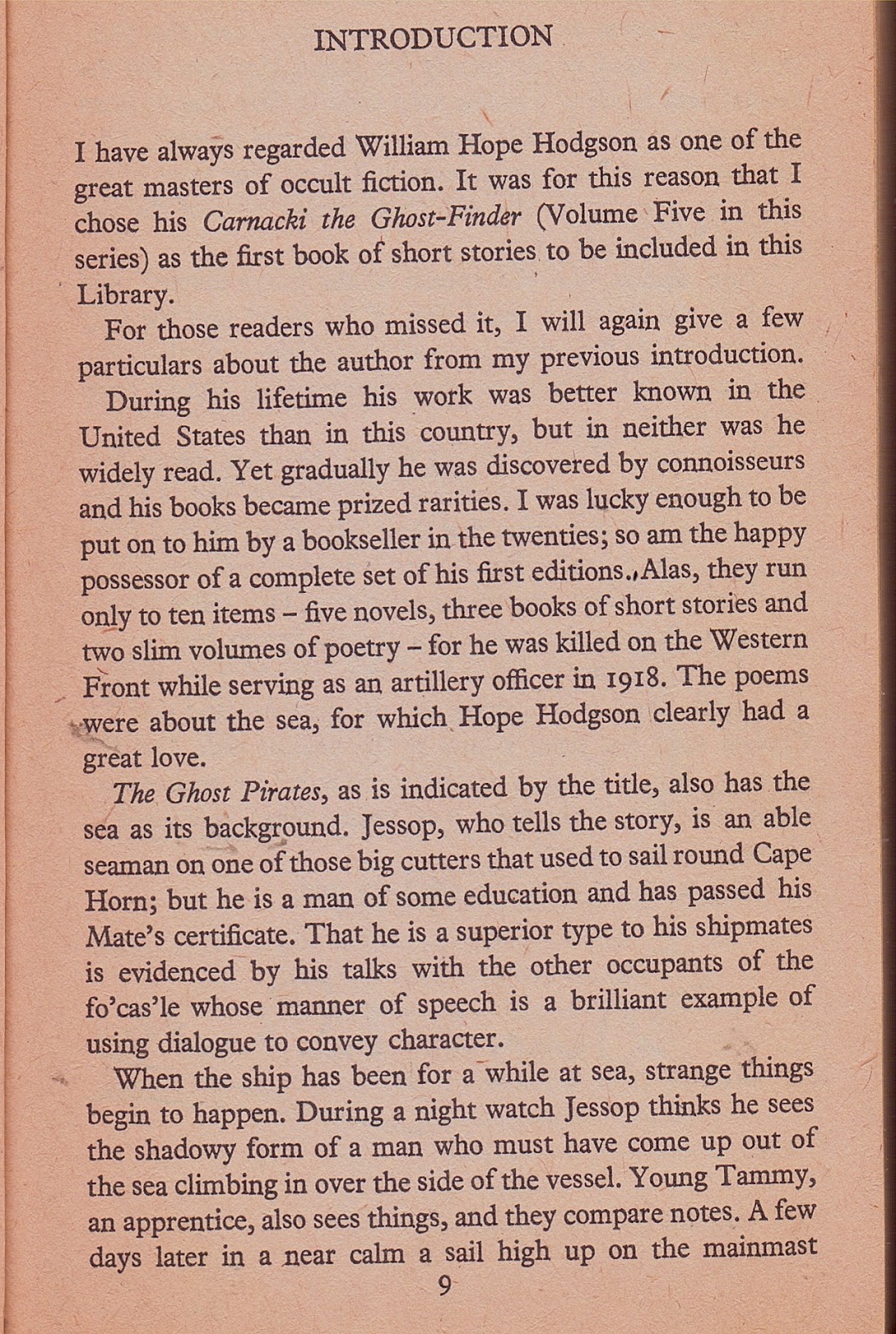
After searching for this book for much of my adult life (because if one of the greatest cosmic horror authors who ever lived had a yarn about Ghost Pirates, I want to read it), I actually found this copy in Japan a few years back, bizarrely enough.
I had intended to use it as the basis for one of my (long-neglected) series of Weird Tales posts, but after I actually started reading it, I soon put that idea aside.
It’s not that the book is disappointing as such, but… well let’s just say that it was clearly written as much for enthusiasts of nautical fiction as for fans of ghost stories. As such, the story’s supernatural elements are introduced extremely slowly and with great subtlety, whilst the relentless application of highly detailed seafaring jargon meanwhile leads to the book becoming quite difficult to follow for readers who grew up subsequent to the Great Age of Sail.
Much of the action concerns sailors running around different parts of the ship preparing for different weather conditions, and as such, a diagram to help us landlubbers identify the various decks, masts, sails and rigging referenced in the text would have proved extremely helpful. Characterisation meanwhile is fairly minimal, making it difficult to engage with what seems like a fairly boilerplate narrative of a band of able seamen caught between the regime of a sadistic and unreasonable First Mate and that of a distant and allegedly drunken Captain.
As is usually the case with Hodgson however, the novel’s supernatural revelation, when it does finally arrive, is actually a bit of a mind-blower. Rather than being harried by a more traditional ghost ship, it turns out that the vessel upon which the books characters are sailing has actually become trapped between dimensions, and thus is kind of ‘overlapping’ with the space occupied by an alternate universe vessel whose malignant, spectral occupants are gradually picking off our human crewmen one by one.
Pretty freaking far out, especially when you consider that Erwin Schrödinger first introduced the theory of parallel universes into popular thought in 1952, over forty years after ‘The Ghost Pirates’ was first published.
Here’s what Dennis had to say on the matter:
I had intended to use it as the basis for one of my (long-neglected) series of Weird Tales posts, but after I actually started reading it, I soon put that idea aside.
It’s not that the book is disappointing as such, but… well let’s just say that it was clearly written as much for enthusiasts of nautical fiction as for fans of ghost stories. As such, the story’s supernatural elements are introduced extremely slowly and with great subtlety, whilst the relentless application of highly detailed seafaring jargon meanwhile leads to the book becoming quite difficult to follow for readers who grew up subsequent to the Great Age of Sail.
Much of the action concerns sailors running around different parts of the ship preparing for different weather conditions, and as such, a diagram to help us landlubbers identify the various decks, masts, sails and rigging referenced in the text would have proved extremely helpful. Characterisation meanwhile is fairly minimal, making it difficult to engage with what seems like a fairly boilerplate narrative of a band of able seamen caught between the regime of a sadistic and unreasonable First Mate and that of a distant and allegedly drunken Captain.
As is usually the case with Hodgson however, the novel’s supernatural revelation, when it does finally arrive, is actually a bit of a mind-blower. Rather than being harried by a more traditional ghost ship, it turns out that the vessel upon which the books characters are sailing has actually become trapped between dimensions, and thus is kind of ‘overlapping’ with the space occupied by an alternate universe vessel whose malignant, spectral occupants are gradually picking off our human crewmen one by one.
Pretty freaking far out, especially when you consider that Erwin Schrödinger first introduced the theory of parallel universes into popular thought in 1952, over forty years after ‘The Ghost Pirates’ was first published.
Here’s what Dennis had to say on the matter:
Sunday, 23 September 2018
Dennis’s Library (#5):
Carnacki The Ghost-Finder
by William Hope Hodgson
(Sphere, 1974)
Carnacki The Ghost-Finder
by William Hope Hodgson
(Sphere, 1974)
To get us in the mood for the start of this year’s October Horrors season next week, I thought it would be a nice idea to highlight a few suitably eerie occult/horror-ish paperbacks from my shelves – which led me directly to pulling down the few volumes I own from The – ahem – Dennis Wheatley Library Of The Occult.
Now, say what you like about Wheatley (and I’ve said plenty in the past), but this line of paperback reprints, which he masterminded on behalf of Sphere books during the mid-70s, must have been an absolute god-send for fans of weird fiction at the time – and indeed it remains so for anyone seeking affordable second hand copies of the wide variety of obscure works the line helped bring back into circulation.
That said, I’m going to assume that most of my readers here will have at least a passing familiarity with William Hope Hodgson and his ‘Carnacki’ stories. Like most of Hodgson’s supernatural fiction, the adventures of his 'Electric Pentangle'-brandishing occult detective feel both wildly ahead of their time and frustratingly uneven – the latter largely a result of the author’s insistence upon reducing at least some of his hero’s cases to light-weight hoaxes and comic misunderstandings.
Though none of these stories really display the same extreme idiosyncrasies that defined Hodgson’s far-future myth cycle ‘The Night Lands’ or his masterpiece ‘The House On The Borderland’, the best of them are nonetheless superb, with ‘The Hog’ in particular standing as one of the most intense examples sustained cosmic horror ever printed.
If you’ve not read them before, I’d humbly suggest this book (long out of copyright and available in wide various of inexpensive editions) would make a great addition to your Halloween reading list – particularly if you can find it between these splendidly evocative covers, with unaccredited artwork paying blatant homage to Mario Bava’s ‘Kill Baby Kill!’ (1966), a film whose influence seems to have spread remarkably widely in view of how poorly received and sporadically distributed it was upon its initial release.
[UPDATE, 24/10/18: It would be remiss of me not to link to this 2012 post from John Coulthart's blog, which I stumbled upon today. Coulthart traces the use of the image from ‘Kill Baby Kill!’ back to a still which appeared in Denis Gifford's unfeasibly influential ‘A Pictorial History of Horror Movies’ (1973), from whence it was subsequently repurposed by any number of illustrators and designers.]
Well, that’s what I think about it anyway. Let’s see what Dennis had to say on the matter.
Subscribe to:
Posts (Atom)