Sunday, 28 August 2016

Exploito All’Italiana:
Blastfighter
(Lamberto Bava, 1984)


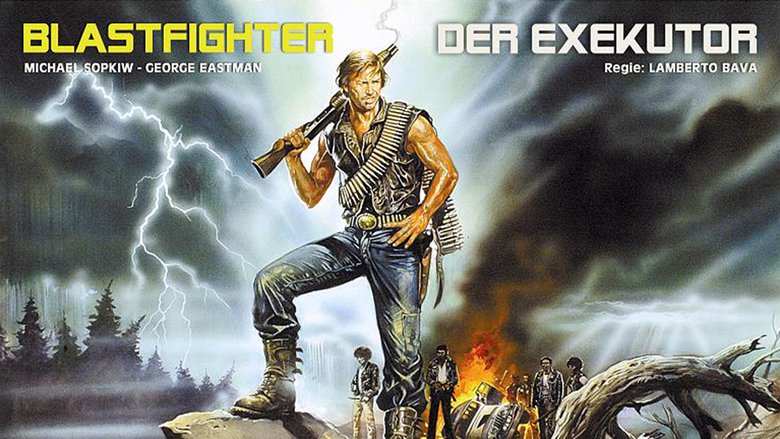
At some point in this review thread, we had to turn our gaze toward that prodigal son of the Italian exploitation business, Lamberto Bava, and what better place to start than here, as a Commandoed up moustache warrior stares us down through the barrel of a magnificently rendered shooter in what must surely count as one of the most definitive action movie posters of the 1980s (maestro Enzo Sciotti in full effect, of course).

On the basis of its title and poster artwork alone, I had always assumed that ‘Blastfighter’ must be one of those Filipino-shot gonzo war movies that so wantonly proliferated through the final decade of the cold war – you know, exploding huts, chopper stunts, bloody dog-tags, the whole nine yards. So strong in fact was my belief that ‘Blastfighter’ was one of those movies that I somehow managed to read some stuff about it on the internet, buy a copy of it (from a SHOP no less), and put the disc in my player on one of those increasingly rare post-midnight moments when I still have the energy to consider plugging in the headphones and tackling a movie before bed…. all before realising that it is in fact a different kind of movie altogether. Such is the power of Sciotti’s airbrush.

Once I discovered that what “John M. Old Jr” actually had in mind back in ’84 was a comparatively restrained backwoods Americana survival thriller, I felt a tad uneasy, but I ploughed on regardless, and ultimately I’m glad that I did. Maybe it was the woozy early hours time-slot, the accompanying glass of whisky or the complete lack of any particular expectations, but, for reasons I can neither explain nor fully justify, myself and ‘Blastfighter’ had a pretty good time together on that lonesome Saturday night.

Dardano Sacchetti’s script comprises a neatly polished Frankenstein’s monster of parts repurposed from ‘First Blood’, ‘Deliverance’ and ‘Death Wish’, and as such ‘Blastfighter’ begins as disgraced hero-cop Jake ‘Tiger’ Sharp walks out of prison, having served an eight year stretch for blowing away the politically connected scumbag who killed his wife.* (‘Tiger’ is played by Michael Sopkiw, whom you may recall from Sergio Martino’s ‘2019: After The Fall of New York’ (1983), here efficiently embodying a 2nd gen photocopy of ‘70s Franco Nero.)

As inevitably happens in such situations, ‘Tiger’ is reluctantly picked up by a limo containing his former boss in whatever elite, special operations-type police unit he belonged to, who tries to convince him to come back on-board, offering him a prototype of an experimental new super-shotgun that fires every form of projectile under the sun as a token of goodwill. (Whoever this big-wig answers to, he apparently anticipates no “COP GIVES FREE GUN TO CONVICTED MURDERER” headlines looming in his future.)

Much to our disappointment as well as the boss-man’s however, ‘Tiger’ shakes his head and declines the offer of returning to an exciting career of legally-shaky, villain-blasting mayhem, opting instead to make a lonesome new life for himself ruing his past mistakes, nursing his broken heart and espousing the cause of peace and human dignity from the comforts of his cabin in the mountains of rural Georgia. He takes the super-gun with him nonetheless though and stashes it under the floorboards on his porch, because hey – this is America, so who knows when a steadfast, law-abiding citizen will need the help of a laser-guided, pump-action grenade launcher to uphold what is good and right.

To no one’s surprise, the build-up to that day begins almost immediately, as Tiger encounters a posse of perpetually whoopin’ and hollerin’ young rednecks who are in the process of decimating the local deer population, cruelly keeping their wounded prey alive as they sling them in the back of a truck to take home. Naturally, our hero must step up to confront such barbarity, and, as you might expect given his past history, he is far from diplomatic in his approach.

As it transpires, the rednecks are making a living selling the live animals to a Chinese butcher who is hacking them up for medicinal ingredients (the racist language thrown in this guy’s direction by both sides in the film’s drama goes unchallenged, incidentally), and matters are further complicated by the fact the leader of the posse is the younger brother of Tiger’s former hunting buddy and small town rival George Eastman – now a local logging company foreman who grants tacit paternal approval to their unsavoury shenanigans on a “well it give the boys something to do” type basis.

As the antagonism between Tiger and the good ol’ boys swiftly intensifies, the stakes are raised further when his teenaged daughter (Valentina Forte) tracks him down and turns up demanding some fatherly affection. (He had previously abandoned her to an orphanage after her mother was murdered on the self-fulfilling basis that “I was a lousy cop and I’d make a lousy father too” – our hero, ladies & gentlemen.)

Inevitably, the lecherous overtures the rednecks cast in Valentina’s direction add a slight pinch of ‘Straw Dogs’ to the brew, and of course we know it’s only a matter of time before Tiger is going to be pulling up the floorboards to retrieve his mighty gat, his tache bristling with a renewed thirst for vengeance…

Driven on by the kind of inflexible moral certainty that only a truly cynical production can muster, ‘Blastfighter’ happily jettisons the relatively complex issues that weighed upon its aforementioned source texts, instead choosing present its story as an almost pre-modern popular morality tale, in which a character’s courage and martial prowess is entirely dependent upon the righteousness of their cause (as solely determined by the film’s scriptwriters), and in which real world consequences matter not a damn, so long as the cruel baddies are vanquished and the deer can gambol freely across the wooded hillsides as nature intended. (Except of course on rare occasions when some fine, upstanding sandy-haired hunter needs to shoot one of them for food, or to humanely manage the population or whatever, which is wholly acceptable – look, Tiger agrees, and you’re not going to argue with him, are you?)

Legend has it that this movie only exists at all because the budget Lamberto had lined up for a proposed post-nuke science fiction project fell through, and, having already pre-sold it to distributors under the name ‘Blastfighter’, he and his producers had to cobble something cheaper together to fill the gap. Under such  circumstances, I think everyone concerned did extremely well, but, inevitably, quality still comes on something of a sliding scale here, with ‘Blastfighter’s strongest moments (the action and outdoors stuff, chiefly) sitting right at the top end of what you’d expect of mid-‘80s Italian genre product, whilst the weakest sink to an almost Troll 2 level of face-slapping stupefaction.

The latter, it must be said, is almost entirely a result of the appalling English-as-second-language dialogue, and of the especially shoddy post-sync dubbing with which it is delivered. [English is the only language option on my DVD of the film, so I am unable to comment on how the Italian track fares in comparison.]

Regrettably, this serves to reduce many of ‘Blastfighter’s character interactions and tender “back story” conversations to a state of borderline nonsense, as actors’ on-set lip movements are inexpertly matched up with entirely inexplicable pronouncements (“there’s only one way to get pleasure in this life, but one hundred ways to get pain – don’t seem fair does it?”) that one suspects existed only as “LINE NEEDED HERE – ASK ENGLISH DIALOGUE GUY” gaps until long after principal photography was completed. Thus, we must persevere through dozens of instances of semi-meaningless, generic action movie blather whose zen-like opacity will boggle the mind of any viewers actually paying attention.

(That said, I did at least enjoy Sopkiw’s spirited “You want to know who I am? I’M A SON OF A BITCH… who wants to be left alone!” – a minor delight which more traditional line delivery would probably not have provided us with.)

That this state of affairs renders it impossible to connect with any of the film’s events on anything but the very bluntest level is hardly a surprise, but it is a particular shame in this case, given that the film-making here could under other circumstances have easily scaled the dizzy heights of actually-making-us-care.

Indeed, ‘Blastfighter’s technical acumen is actually far greater than its era and background might have led one to expect. Editing, cinematography and action choreography are all slick to a fault, whilst Sacchetti’s script (dialogue aside) is surprisingly coherent and well-paced (quite an achievement in itself from the man who gave us the dog’s dinner un-storytelling of Lucio Fulci’s early ‘80s horrors). In purely visual terms in fact, this could easily pass for a slightly rough-around-the-edges Hollywood studio film - making it all the more unfortunate that the game is up as soon as anyone opens their mouth.

Sadly, such unwarranted professionalism also elevates ‘Blastfighter’ to that particular grey area in which a film proves too well made and po-faced for viewers to simply laugh it off and enjoy it as a brainless thrill ride, whilst at the same time it is nowhere near “good” enough to generate any real emotional involvement or thematic engagement, meaning that, at the end of the day, what remains is just kind of… there.

Less the yummy cinematic junk food promised by its poster and personnel, ‘Blastfighter’ is instead more like a plate of tasteless steak and potatoes served at a quaint rural diner; despite occasional moments of uncouth wildness and genetically ingrained sleaze (could the brief flashback to Sopkiw’s wife’s death be leftover footage from one of Lamberto’s earlier gialli..?) and an absolutely bangin’ synth-rock theme from Fabio Frizzi, those who thrill to the madness and degeneracy of more typical Italian exploito product will be in for a letdown here.

If on the other hand though, you suddenly find yourself with a hankering for a reassuringly one dimensional tale of men with moustaches doing the right thing, attractively shot forest locations, badly dubbed teenage daughters, string-bending lead guitar stings and cars that explode in the slightest breeze – well, dive right into these cool Georgia waters my friend, and you won’t be disappointed.

Watchable, predictable, kind of likeable in a distant, undemanding fashion, ‘Blastfighter’ is, in a profound sense, a MOVIE. It also features a lovely country n’ western song written (though not performed) by The Bee-Gees, which plays three times in its entirety, so that's nice.

---

In closing, check out this interesting alternative promotional artwork (also by Sciotti), which I *bet* must have originated back when the film was still being envisioned as an SF-tinged ‘Mad Max’ rip-off:


---

* Whilst watching ‘Blastfighter’, I was convinced that Schwarzenegger’s ‘Commando’ also must have been a key influence, but subsequent research informs me that that film actually came out a year later, in ’85. I must have just been picking up on the shared Rambo inheritance common to both projects, I suppose.

Monday, 22 August 2016

Exploito All’Italiana:
Zombi Holocaust
(Marino Girolami, 1981)

(In the absence of any decent scans of an original Italian poster, let’s enjoy this splendid effort from Thailand.)

When it comes to the “rip off” aesthetic that increasingly dominated Italian genre cinema from the late ‘70s onwards, wherein cash-strapped producers ceased even trying to differentiate their product from the prior hits they were cashing in on, you’d be hard-pressed to find a more glorious example of the phenomenon’s ultimate, self-consuming end-point than ‘Zombi Holocaust’ – an infamously shoddy venture that forms something of a line in the sand for fans of Euro-horror/exploitation.

For many, this film represents the bottom of the barrel in terms of mindlessly derivative cine-sludge, whilst for others of a less discerning / more adventurous nature [delete as applicable], it instead forms the gateway to a whole new subterranean kingdom of trash-horror wonderment. Either way, it’s quite the thing to behold, and even the highest minded aficionados of this-sort-of-thing probably owe it to themselves to sit down and give it a try at some point – if only to test their individual tolerance for further trash-gore spelunking.

Often playing more like an extended cult cinema in-joke than a stand-alone movie, the sheer opportunistic shamelessness of the logic behind ‘Zombi Holocaust’s existence (basically: ‘Cannibal Holocaust’ was a hit? ‘Zombi 2’ [aka ‘Zombie’ (U.S.), ‘Zombie Flesh Eaters’ (U.K.)] was a hit? Et Voila = ZOMBI HOLOCAUST!) is already somewhat irresistible, whilst the fact that one of the films it is chiefly cannibalizing was *already* an unauthorised Italian sequel to a successful American movie (‘Dawn of the Dead’, released in Italy as ‘Zombi’) takes cinematic plagiarism to what at the time must have been new and giddy heights. (I’m sure if you follow the bread-crumb trail a few years down the line, you’ll find that someone in turn started making rip-offs of ‘Zombi Holocaust’, and so the glorious cycle continues.)*

Actually, the lengths to which ‘Zombi Holocaust’ goes to rip off Lucio Fulci’s film in particular are really quite extraordinary. I mean, I can see the rationale for borrowing the basic plot outline, using similar zombie make up and even rehiring the same lead actor (fan favourite Ian McCulloch) - but was there REALLY an audience back in 1980 who were liable to sit there thinking, “OMG, that isolated house in the jungle looks EXACTLY like the one in ‘Zombie Flesh Eaters’, and that low angle shot where the Landrover arrives in the village is exactly the same too! I am so psyched!”..?

I don’t know, but if such peculiar viewers did exist, they certainly would have found themselves well catered for here, as ‘Zombi Holocaust’ repeatedly reaches that baffling point on the “rip off” spectrum wherein the effort taken to painstakingly recreate entirely incidental details from an earlier film exceeds that which would have been necessary to feign originality by actually just shooting some new stuff that might have proved more appealing to the target audience… and scratching one’s head over the twisted logic of such decision-making is but one of many, many small pleasures that help make Girolami’s film such endlessly charming viewing for us jaded 21st century know-it-alls.

Taking a “2 + 2 = ?!?!” approach to combining elements of its two source texts, ‘Zombi Holocaust’s New York set opening – in which cultists belonging to an obscure Asian cannibal sect are found to be rampaging around a city hospital misappropriating body parts – is a pure, politically questionable b-movie delight. Reminding me somewhat of the equally unlikely Quetzalcoatl cultist sub-plot in Larry Cohen’s ‘Q: The Winged Serpent’, I can’t help wishing that they’d spun this idea out into an entire movie of its own.

But at the same time, I’m also glad they didn’t, because then we would have missed out on the earnest discussions conducted between the police and the pipe-smoking “Professor Drydock” (no, really) from the University, and their decision that the best solution to this problem is to ask the Mighty McCulloch (is his character a doctor of some kind, or a policeman? I’m not really sure it’s make clear) to step in and head up an expedition to the remote islands in the East Indies from which the cult originated, where, accompanied by a photogenic anthropology-studying nurse (Alexandra Delli Colli), some other guy and the obligatory interfering journalist, he will uncover the secrets of this benighted cannibal tribe and… well, I don’t know really.

I mean, wouldn’t be easier to just arrest the people who are getting up to all the monkey business at the hospital, and go from there? You know, interrogate them, look for witnesses, that sort of thing? But what do I know of police work. Pack your khakis and don’t forget the mosquito net - the boat leaves at dawn!

And so, as absurdity piles upon absurdity, ‘Zombi Holocaust’ repeatedly demonstrates that, despite its aspirations toward innard-chewing, brain-sawing video nasty infamy, at heart it really has more in common with old psychotronic favourites like ‘Mesa of Lost Women’ (1953) or ‘Horrors of Spider Island’ (1960) – a goofy, comforting little b-movie that is fully aware of its own silliness, whilst simultaneously remaining conscious of the fact that actually cracking a smile would cause the audience’s enjoyment to crumble like the Walls of Jericho.

That the credited director of this mess was actually the FATHER of Italian action supremo Enzo G. Castellari was something I initially found inordinately amusing (it’s easy to imagine Enzo taking breaks from whatever ‘Jaws’/’Dirty Dozen’ rip-off he was making at the time to field excruciating “No Dad, THIS is how you do a tracking shot..” style phone calls) - until that is, I checked IMDB and discovered that ‘Zombi Holocaust’ was actually Marino Girolami’s seventy second film as director, and that he had in fact been calling “action” on lower budget genre pictures pretty much non-stop since 1950.

We could speculate as to whether it was a deficit of quality or sheer bad luck that ensured that none of Girolami’s films prior to this one have ever gained much exposure outside of Italy, but given the number of technically accomplished European directors who found themselves delivering absolute rubbish when the VHS horror boom hit in the ‘80s, it would seem manifestly unfair to make a judgment call on his work based solely on ‘Zombi Holocaust’ - so I won’t.

Either way though, it seems likely that the director’s veteran status may have contributed somewhat to the strangely old-fashioned feel of ‘Zombi Holocaust’. Whilst it is ostensibly still a gore-soaked rampage through a tropical hell, the film somehow ends up feeling just sort of… I don’t know… nice, even whilst poorly paid local extras in ridiculous b-western Indian get-up are gobbling cream of tomato soup from some poor unfortunate’s latex torso.

Despite what I take to be the producers’ best efforts to pile on the nastiness, this one entirely lacks the mean-spirited extremity or queasy gross up agenda of a contemporary Fulci or Deodato film. Much like the minimum-of-effort “bloodshed” usually employed by Jess Franco, this is purely emblematic gore – any resemblance to the real thing is purely coincidental. Like everything in ‘Zombi Holocaust’, it’s all offered up in a spirit of pure, casual fun, with little suggestion that anyone is ever actually in pain.

And, essentially, I could continue trudging through a blow-by-blow account of all the great stuff in ‘Zombi Holocaust’ until the cows come home. There’s the square-jawed, cheque-collecting determination of McCulloch’s “I-failed-the-audition-for-Indiana-Jones-and-woke-up-here” lead performance for instance - or how about the perfectly shaped stone mold that the cannibals have lying around ready for Delli Colli after they strip her naked and body-paint her with some pretty flowers? (Hippy cannibals, eh? Well, you live and learn.).

From the adorably off-beat antics of Donald O’Brien as one of the least hygienic yet most strangely sincere mad scientists seen this side of the 1950s, to the to the bit where one of expedition’s dubiously portrayed ‘native porters’ almost throws an “oh man, you mean I gotta bury ANOTHER body..” style teenage strop after our heroes respond to the grizzly demise of his friend with scarcely more than a “huh, there ya go” shrug… well, you get the picture. There is just so much to enjoy here.

You can mock ‘Zombi Holocaust’ all you like, but to give Girolami his due, at the end of the day it is a vastly more entertaining prospect than most of the other bottom-feeding zombie/cannibal snoozefests that emerged in the early ‘80s (yes, I’m looking at you, Eurocine). This is chiefly due to the fact that, for all of its many shortcomings, the picture rattles along like a goddamned freight train, never resorting to dreary ‘padding out the run time’ type footage and rarely going more than a couple of minutes without throwing us something divertingly awesome and/or ridiculous to chew on.

Add one standing ovation-worthy Classic Gore Moment (all I need say is: outboard motor), the eventual appearence of some genuinely kind-of-scary looking zombies (well, I liked them), and a pitch perfect grinding, electronic dirge of a score from Nico Fidenco (whose 70s/80s CV is so sleazy, this almost counts as a career highlight), and, for those with the alchemical suss to suitably process it, ‘Zombi Holocaust’ is pure gold - a mighty anti-classic that no one with even the slightest fondness for Italian trash cinema could fail to love like a disfigured child.

---

* On the cannibals-meet-zombies tip, Bruno Mattei’s actually-pretty-great ‘Zombie Creeping Flesh’ aka ‘Hell of the Living Dead’ (which premiered about six months after this film) springs to mind as an obvious ‘Zombi Holocaust’ descendent, although I’m not exactly about to call the lawyers in over that one, y’know what I mean.

Tuesday, 16 August 2016

Exploito All’Italiana:
Hitch-Hike
(Pasquale Festa Campanile, 1977)


(Original Title: ‘Autostop Rosso Sangue’.)

You know this one of course. An Italian-shot / American-set three-hander in which Franco Nero plays a boorish Italian journalist and Corinne Clery his long-suffering wife. We meet the couple mid-way through an especially cantankerous caravanning/hunting holiday in a not-quite-right looking Arizona, and, when they ill-advisedly offer a lift to fugitive bank robber and all-round psychopath David Hess, the spirit (if not the precise detail) of what follows can be most eloquently expressed by the awkwardly collaged cover of this Raro DVD edition.


So.. yeah. Basically, Campanile’s film rose far, far above my (relatively low) expectations, swiftly revealing itself to be a brutally effective, edge-of-seat kidnap/survival thriller in which the outrageous outbursts of violence and psychological handbrake turns necessary to keep such a tale rolling are handled with enough gravitas to ensure the tone remains serious as cancer throughout, creating a “literally anything could happen next” atmosphere that ratchets the tension mercilessly.

When it comes to critical writing (particularly on the subject of horror or crime movies), it has long been a cliché for reviewers to try to explain their dislike for a particular authorial voice by falling back some variation of the old “when every character is completely dislikeable, why should we care what happens to them?” argument. Perhaps I’ve even used this once or twice here myself over the years, I don’t recall, but anyway – following in the footsteps of any number of talented writers and filmmakers who have provided persuasive answers to that hypothetical question, ‘Hitch-Hike’ offers a stark lesson in just how shallow and wrong-headed such a judgmental approach to story-telling can be.

As such, let the record state that every character with a speaking part in ‘Hitch Hike’ is an absolute bastard, plain and simple. The only sympathetic emotion either Nero or Hess are liable to extract from an audience is one of pity, and even then, their constant, self-centered whining gets old pretty quick. Clery meanwhile is so steely she doesn’t even have that much going for her, shrugging off the assorted indignities she suffers through with an expressionless acceptance that suggests she’s angling to push both of her ugly suitors straight off the edge of a precipice as soon as is humanly possible.

When, as here, though, the writing and performances are strong enough to force you to walk a mile or two in the characters’ shoes, well... who gives a damn for your conception of whether or not you “like” them? If you’re looking to spend some time with people whose company you’d enjoy at a dinner party, you’re in the wrong genre here right from the outset, let’s face it.

Watching ‘Hitch Hike’ in its American dub – which is really the best option, given that we get Hess as nature intended and Nero dubbing himself in heavily accented English (which makes perfect sense, given that his character is an Italian tourist) – Clery’s performance inevitably suffers as the only dubbed member of the central trio, but to be honest she’d probably make the least impression in any language. You’d be hard-pressed to find any film more comprehensively disdainful of the demands of the Bechdel test than this one, and, devious though Clery’s character may be, we’re in the darkest heart of ‘70s machismo here, and it’s the tragic dance between Nero and Hess that really commands our attention – two deeply pathetic, animalistic losers, practically frothing at the mouth to try to grasp alpha-male status from the other, straining at the leash to take each other down, with the woman serving as a combined prize, servant and all-purpose hate object.

Nero in particular gives a fantastic performance, dragging the reprehensive thought processes of a man a less imaginative film might simply have pegged as our ‘hero’ into full view and letting them sizzle and melt in the sunlight, whilst Hess – true to form – gives us a leering human monster to rival Al Lettieri in ‘The Getaway’, Andrew Robinson in ‘Dirty Harry’ or Tomas Milian in ‘Almost Human’, even as he openly mocks the off-the-peg “I came from a broken home / society made me do it” self-justifications offered by those characters, opining at one point that he had a perfectly happy childhood and supportive family, but turned to the dark side because… well, you fill in the blanks. (We’ll get the ghost of Michael Winner to mark your answers after the show.)

Taken out of context, the scene in which Hess eventually rapes Clery whilst her husband watches tied to a chair (you’re watching a movie with Hess in, so you know he’s got to do his thing, right?), would be difficult to even sit through. But, coming at the point in the film at which it does, with the black-hearted, calculating intent of all three characters writ large upon their faces, the ‘big event’ takes on an entirely different complexion. As director, Campanile deserves huge kudos for presenting this scene less as the titillating act of gratuitous abuse most of his peers would have settled for, and more as a kind of hideous, inevitable ritual through which all three parties are angling toward their own, mutually exclusive goals. Like so many bits of business in ‘Hitch Hike’, it’s the kind of scene that sticks in your mind after viewing, encouraging you to start picking at its emotional residue like a dried scab, against your better judgment. Nasty, but irresistible.

Actually, Campanile and his collaborators excel all round here. Though ‘Hitch-Hike’ rarely gets stylistically flashy, as an efficient piece of dramatic film-making in the ‘70s crime idiom, it pretty much nails it. Character interactions are text-book exemplars of bug-eyed, whisky-soaked tension (you can almost feel the spirit burn at the back of your throat), whilst the film’s action sequences are surprisingly elaborate and often pretty awesome, incorporating wild-ass, verge-of-disaster stunt work and Peckinpah-esque cross-cutting that pretty much embodies everything you’ve ever loved about low budget ‘70s action cinema.

Running an unexpectedly lengthy 105 minutes, the film’s final act may induce a certain amount of head-scratching as the story continues to ramble on for a good fifteen minutes after what seems to be its natural conclusion, but I suppose they just figured, hey, we’ve got our movie-making mojo working so good here, let’s just keep on rolling (there’s that spirit of generosity I mentioned in the previous post in full effect)… and when we do eventually reach the final pay-off, you’ll get the point loud and clear.

Accomplished as it may be in technical terms, ‘Hitch Hike’ exhibits absolutely no traces of self-conscious artistry or social responsibility, and frankly a story this relentlessly hard-boiled is better off without them. It’s as if an Umberto Lenzi movie crashed head-first into a Jim Thompson novel leaving bullet casings and panties scattered across the asphalt, and it doesn’t need no fuckin’ auteur theory getting in the way.

Though it is often pegged as a poor cousin to Mario Bava’s broadly similar ‘Rabid Dogs’ (1975), I’ve got to admit that, in my heart of hearts, I think ‘Hitch Hike’ is the better of the two films. It’s a harrowing, high octane floor-punch of a movie, and if you’ve managed to side-step it thus far in your cinematic career, now is as good a time as any to take it on the chin and see if you’re still standing when the credits roll. [Spits out blood and teeth before staggering off toward the next review.]

(PRO TIP: For a great double bill, why not try this one out alongside Luigi Bazzoni’s style-is-the-substance giallo masterpiece ‘The Fifth Cord’ (1971)? Two very different varieties of Italian filmmaking, united by their shared status in the rarefied sub-genre of “movies in which Franco Nero has his Hemingway-esque macho self-image systematically destroyed whilst he stares out at the world with big, sad eyes”.)

Monday, 15 August 2016

Exploito All’Italiana:
Introduction.

"Delivery for Breakfast In the Ruins..."

When life hits hard, geo-political certainties crumble and potential movie-watching time is compressed into aggressively fenced off, sub-ninety minute blocks once or twice a week, there is only one place for jaded cinephiles to turn for an instant hit of the good stuff: Italy. And I’m not talking Pasolini and Visconti, y’know what I mean.

The “long ‘70s” (running roughly, say, ’69 to ’83?) marked an era in which filmmakers toiling in the grimier depths of Italy’s popular film industry asked nothing of their audience, but gave them everything. Like tireless fry-cooks dishing out the cholesterol to a crowd of famished construction workers, their product might not be good for you (in any sense), but nonetheless it delivers, with a spirit of perverse generosity that it is difficult not to admire. Garish, cynical, gratuitous, delirious – it rarely fails to hit the spot.

As such, I’ve recently found myself catching up on a number of classic examples of Italian exploitation that I had never actually taken the time to sit down and watched before – possibly as a result of some misguided aspiration toward good taste, or possibly a lack of living quarters that allowed me to screen such raging crap without judgment – who knows, and who cares. This summer I’ve been making amends, and enjoying the hell out of it.

If cornered, I’ll still vigorously insist that I have little or no interest in cannibal flicks, Nazi flicks or post-‘Last House On the Left’ rape flicks, but, as we gently touch upon some of those tropes in the posts that follow and come out smiling, those still occupying the moral high ground may wish to note that standards ‘round here are slipping.

Reviews beginning tomorrow, and running intermittently for the next few weeks, I hope.

(The screen-grab above comes from Massimo Dallamano’s ‘Si Può Essere Più Bastardi Dell'Ispettore Cliff?’, aka ‘Blue Movie Blackmail’, aka ‘Super-Bitch’ (1973), which is not included in this series of reviews, but should be, because it is brilliant, and probably as much fun as all three of those titles combined.)

Tuesday, 2 August 2016

Nikkatsu Trailer Theatre #4:
THE PASSION AND POWER OF A MAN’S WORLD WITH COMPLETE CONTROL.

Although it is not a film that’s received a great deal of love from English language critics, I nonetheless enjoyed Toshio Masuda’s ‘Red Pier’ (otherwise known as ‘Red Quay’ or ‘Red Harbour’, 1958) a great deal.

A more or less quintessential example of Nikkatsu’s ‘borderless action’ formula, this one sees the basic plotline of Julien Duvivier’s classic ‘Pepe le Moko’ (1937) relocated to the port city of Kobe, wherein a jaded Tokyo hitman – rather unconvincingly portrayed by twenty three year old heart-throb Yujiro Ishihara - is hiding out from the cops, as represented by the Colombo-esque Detective Noro (Shirô Ôsaka), whilst also juggling his love-life, as a pouting show-girl (Sanae Nakahara) and a gentle, upstanding fisherman’s daughter (Mie Kitahara) compete for his attentions.

Though it inevitably veers more towards frothy romance and matinee melodrama than proper yakuza business, ‘Red Pier’ is still beautifully designed and shot, with a charming cast, swinging mod nightclubs, bustling scenes of harbor life, much dreamy rhetoric about “sailing over the ocean to freedom” (a telling Nikkatsu trademark), and, crucially, just about enough action to keep the boys in their seats alongside the girls.

It’s not the kind of movie that’s ever going to change anyone’s life, but as a breezy, exuberant popcorn flick full of enjoyable sights and sounds alongside just a touch of melancholy poignancy, it hits the spot perfectly. It’s easy to see why members of Japan’s equivalent of the baby-boomer generation get misty-eyed about these Yujiro movies – watch a few of ‘em, and perhaps you will too.

Nikkatsu’s trailer very much seems to emphasize the ‘tough guy’ angle, beginning by recapping one of my favourite bits in the movie, wherein Yujiro – who is of course portrayed as being preternaturally talented at any activity he turns his hand to – walks into a nightclub and wipes out the rival gang who have been hassling him with a single burst of gunfire that would do The Man With No Name proud. Job done, motherfuckers. A casual scene that scarcely lasts thirty seconds, clearly thrown in as an afterthought to wrap up that particular plotline with a minimum of fuss, I really dug its sheer ballsiness.

Thursday, 28 July 2016

Lovecraft on Film Appendum:
Vintage Derleth.


It stands to reason that paperback editions of the Derleth “collaborations” are less sought after, and thus less pricey and more common, than older paperbacks of genuine Lovecraft. As such, the oldest and most aesthetically pleasing “Lovecraft” p/b in my current collection is this eerily faded US edition of ‘The Shuttered Room and Other Tales of Horror’, as issued by Beagle Books in 1971. Though the ‘hand growing out of a tree stump’ motif is pretty silly, the photo collage approach used by the (uncredited) artist is very effective, and I love the muted purple and green colour palette, the ghostly trees fading into the white background, and the lovely, oh-so-‘60s font. It’s a shame none of the stories inside are much good, but what can you do.

As a bonus, here’s a UK Panther edition of Derleth’s novel ‘The Lurker At The Threshold’ [worth ploughing through on the basis that it features a few excellent passages of Lovecraft prose buried amid the Derlethian trudge, I seem to recall] that I picked up somewhere recently. Year of publication is unknown, but cover art comes courtesy of the exceptionally awesome Gino D’Achille. Perhaps not his best effort (check the galleries in the above link for more on those), but I like it all the same. The little tentacles creeping in through the broken glass are a highlight, and trying to figure out what's going on with the second view of the tower trapped in the identically angled broken pane on the upper right proves pleasantly mind-bending.

Thursday, 21 July 2016

Lovecraft On Film:
The Shuttered Room
(David Greene, 1967)


When I instigated this blog’s on-going survey of “Lovecraftian cinema” last year, I realised of course that most of the films we’d be looking at would, at best, bear a pretty marginal relationship to the writings of H.P. Lovecraft, but with David Greene’s ‘The Shuttered Room’ – the third feature made in the 1960s to include Lovecraft’s name on the credits – that thin thread of connective tissue is stretched about as far as it will go, as we are forced to contemplate an extremely loose adaptation of a story that, in all likelihood, Lovecraft never actually wrote a word of in the first place.

To be honest, I was in two minds as to whether even include ‘The Shuttered Room’ under the “Lovecraft on Film” banner, but, given that the film seems to have been consciously planned as a Lovecraft adaptation, with the author’s name appearing prominently on the credits and advertising material, I thought it best to let it in, especially in view of the fact that it’s a pretty interesting and overlooked little film that I’m actually quite keen to write about.


To begin at the beginning then - I’m assuming that most of this blog’s readers will already be familiar with the situation vis-à-vis the posthumous “collaborations” that Lovecraft’s literary executor August Derleth began to publish in the years following his friend’s death – stories which bore the names of both authors, but, to put it bluntly, featured little if any input from the more saleable and less living of the two gentlemen. (1)

‘The Shuttered Room’ was one of the last of these ill-starred tales to see the light of day, first appearing in print in 1959, and, having re-read it with what I hope is an open mind prior to writing this review, I’m sorry to say that it doesn’t have a great deal to recommend it, even when considered solely as a Derleth story.

Framed as a quasi-sequel to both ‘The Dunwich Horror’ and ‘The Shadow Over Innsmouth’, ‘The Shuttered Room’ sees a young scion of the Whateley family returning to Dunwich from his more cosmopolitan life in New York to settle the estate of his late grandfather, Luther (brother of good ol’ Zebulon) Whateley. Trouble of course ensues however when the young chap takes down the shutters on the abandoned mill his grandfather called home and unlocks the door to the forbidden room in which – via some traumatic childhood memories – our protagonist recalls his grandfather imprisoning his Aunt Sarah, who, as far as anyone recalls, lived and died within the confines of her room after she incurred her father’s wrath by tarrying with a male cousin, an heir of the cursed Marsh dynasty, whilst visiting kin in nearby Innsmouth. Soon of course, a hellzapoppin’, size-shifting example of froggy Cthuloid spawn (the offspring of Sarah and her Innsmouth beau) is on the loose, munching cattle and scaring hillbillies, and so on and so forth until a reassuringly fiery climax puts a stop to things.

In keeping with most of Derleth’s “mythos” tales, ‘The Shuttered Room’ is passable as a bit of good-natured Lovecraft fan fiction, but it is entirely lacking in the evocative prose, vistas of archaic antiquity or the sheer sense of weirdness that make HPL’s genuine writings so endlessly compelling, instead limiting itself to simply reshuffling various ideas from the master’s stories to no particularly worthwhile effect, whilst adding precious little of its own to the mix.


With such a wealth of legitimate Lovecraft stories to choose from, it remains a mystery to me why independent Anglo-American producer Philip Hazelton should have chosen to adapt this particularly forgettable little number for the screen in 1967. Searching for an explanation, I can only assume that either, a) Arkham House demanded more money to license a ‘proper’ Lovecraft tale, or, b) after deciding a Lovecraft film was the way to go, Hazelton misguidedly began his research with a copy of ‘The Shuttered Room & Other Tales’, and never got past the first story.(2)

Either way, the film’s choice of source material is particularly regrettable given that assigned screenwriters Nat Tanchuck and D.B. Ledrov seem to have decided to systematically remove all of the story’s supernatural / Cthulhu Mythos-related elements, thus reducing the already weak tea of Derleth’s tale to a so-thin-it-barely-even-exists “crazy sister in the attic” yarn that would scarcely suffice for an Amicus anthology segment, let alone a feature.

To be honest, it would have been difficult for even the most gifted of filmmakers to breath much life into the under-cooked script that Hazelton & co eventually settled on, but we can at least be thankful that the producer did at least proceed to hire some exceptionally talented personnel to help bring his project to the screen, making ‘The Shuttered Room’ a veritable who’s-who of under-the-radar British cinema talent from this era.

Making his debut feature here, director David Greene would soon go on helm a series of stylish, underrated thrillers including ‘Sebastian’ (1968) and ‘I Start Counting’ (1970), whilst editor Brian Smedley-Aston could justifiably claim to be something of a ‘cult film’ legend on the basis of his subsequent work, having edited ‘Performance’ alongside Donald Cammel before collaborating with Jose Larraz on ‘Symptoms’ and ‘Vampyres’ and eventually masterminding the Brit-sleaze classic ‘Expose’ [aka ‘The House on Straw Hill’] in 1976.

My argument regarding the wealth of talent behind ‘The Shuttered Room’ is somewhat undermined by the discovery that director of photography Kenneth Hughes is not the same Ken Hughes who directed ‘Casino Royale’ and ‘Chitty Chitty Bang Bang’, but nonetheless, the second Mr Hughes does extremely good work here, and meanwhile, perhaps the most noteworthy name on the credits for some viewers will be that of composer Basil Kirchin (who also went on to score ‘The Abominable Dr Phibes’ and ‘The Mutations’). Kirchin remains one of the most fascinating experimental musicians to have emerged from mid-century Britain, his name enough to send record collectors of a certain stripe into paroxysms of excitement to this day – but more on his contributions later.


Beyond merely outlining the history of this merry band of collaborators, ‘m afraid I know next to nothing about the production circumstances of ‘The Shuttered Room’, but my guess would be that it represents one of those instances – common during the ‘60s and early ‘70s – in which financial necessity demanded a horror film, and the aforementioned creatives, presented with a pre-existing script by the producer, decided, what the hell – I mean, it’s a chance to work on a proper movie, innit?

You certainly get the feeling that no one here really had much of an affection for horror films, or indeed much interest in abiding by the conventions of the genre as they existed in the mid-1960s, and – as much as I love ‘60s horror - it is the results of this attitude that are largely responsible for actually making the film worth watching.

In this respect you could almost place ‘The Shuttered Room’ in close proximity to Michael Reeves’ ‘The Sorcerers’ (1967) and ‘Witchfinder General’ (1968), and, although it is not remotely as memorable or artistically daring as either of those films, in a more modest sense it remains noteworthy for the unusual and somewhat forward-thinking approach it takes to material that, in lesser hands, could easily have emerged a singularly tiresome gothic timewaster.


After a rather awkward and unimpressive pre-credits ‘flashback’ sequence, featuring the parents of a terrified young girl being slaughtered by a furry-clawed POV monster-cam, the credits sequence itself shifts gears considerably, as fields of light and shadow flowing across a car windshield create a gentle, semi-abstract psychedelic effect that is emphasized by the ecstatic, minimalist textures of Kirchin’s score, immediately alerting us to the fact that we are in for a rather different kind of horror movie than the blunt exploitation stylings of the preceding sequence might have led us to believe.

Like every other Lovecraft movie made to this date, the story proper begins with a couple of conspicuously urbane strangers arriving in a forbidding and remote rural locale – in this case, the topographically reimagined “Dunwich Island” - in order to investigate their familial connection to some thrice-cursed local dynasty; but what an odd couple they are, in this instance.

When I first watched ‘The Shuttered Room’ a few years back, I remember thinking that Gig Young was just about the most dislikeable leading man I’d ever seen in a picture (yes, even worse than Nick Adams in Die Monster Die!). Now however, I’m wise enough to appreciate that he was simply appallingly miscast.

A Hollywood workhouse through the ‘40s and ‘50s (mainly specialising in comedic ‘second lead’ roles), Young was more than capable of turning in some excellent, off-beat performances in later years (see for instance his ‘suave psychopath’ turns in Sam Peckinpah’s ‘..Alfredo Garcia’ and ‘The Killer Elite’), but his days as a romantic lead were clearly long behind him by the mid ‘60s.

Apparently troubled by alcoholism and severe personal problems, Young had by this point acquired a “vibe” more befitting of villains, bastards and, well, people in Sam Peckinpah films, and as such, ‘The Shuttered Room’ finds him clearly struggling to get an angle on what the hell he’s supposed to be doing in a dashing, upstanding hero role. Apparently at a loss, his chosen response to this dilemma – that of continually smirking like a prick and occasionally drifting into Bob Hope impersonations – proves less than helpful.

Even worse is that Young’s wife is played by twenty-four year old Carol Lynley (who had recently enjoyed her first major role in Preminger’s ‘Bunny Lake is Missing’ (1965)), and the thirty year age gap between the couple is painfully apparent. Whilst Lynley appears baby-faced, barely out of her teens and as fragile and conventionally ‘beautiful’ as the role of a gothic heroine demands, Young by contrast is a smug, perma-tanned middle-aged ad exec who looks as if he’d be more at home picking a fight with someone on a Miami golf course.

Whereas an actor like Vincent Price could make this kind of age-gap relationship seem natural in the context of a horror movie, Young is just a step too far, and with zero chemistry between the couple and no background offered up to justify their unlikely romance, we’re left with the unfortunate impression that he must have tricked the poor girl into marriage by some nefarious means or other, with the result that he comes across as creepy and manipulative where the script would prefer us to see him as entirely sympathetic.


As the mismatched couple arrive on the ‘island’ to check out the derelict mill property left to Lynley’s character (maiden name Whateley, of course) by her deceased grandfather, they immediately encounter the usual cocktail of glowering hostility, doom-laden warnings and mutated/mutilated villagers, all of which adds to the suspicion that Charles Beaumont’s script for 1963’s The Haunted Palace may have exerted a considerable influence upon the development of ‘The Shuttered Room’, right down to the prominence awarded to the “mutant sibling locked in attic” trope that was also introduced in Corman’s film.

Factor in a corresponding similarity to the opening of ‘Die Monster Die!’ and it’s easy to speculate that a go-to formula for “Lovecraft movies” was already beginning to crystalise by this point, as a sub-set of the existing gothic horror blueprint epitomized by AIP’s Poe films. Predictably enough of course, it is a formula that has very little in common with anything Lovecraft actually wrote, instead incorporating a weird mish-mash of stuff that filmmakers and producers decided should probably happen in a Lovecraft type story. (Regrettably, ‘The Shuttered Room’s rather more low-key approach mitigates against the possibility of a finale that sees Lynley being sacrificed to some beast in a glowing, subterranean pit, but never mind – Daniel Haller’s ‘The Dunwich Horror’ (1970) was just around the corner.)


One of ‘The Shuttered Room’s biggest assets is its shooting locations, which see the desolate plains of, uh, Kent standing in for the wilds of the New England coastline. As utilised by Greene and his crew, several different areas in the vicinity of Faversham, Dover and the Oare Marshes Nature Reserve are combined into a cohesive filmic environment that not only allows us to believe that the film was shot on an actual sparsely populated island, but also conveys a very real sense of back-end-of-nowhere isolation that a more studio-bound film could never have achieved, suggesting a landscape in which human habitation seems like an unwelcome intrusion upon some vast and inhospitable green and brown desert. (3)

The film’s ‘set in USA / shot in UK’ status adds a faintly unheimlich air to proceedings too, as a landscape that looks unmistakably British (though I couldn’t quite tell you why) is cross-bred with American-derived names, titles and cultural references, whilst actors like Charles Lloyd Pack and William Devlin try out their best growly Hollywood tough guy accents, further contributing to the sense of geographic uncertainty.

For all this though, ‘The Shuttered Room’ still achieves a ‘sense of place’ that few ‘60s horror films can match (even if we’re never 100% sure where that ‘place’ is), very much anticipating the more atavistic, born-from-the-soil approach to the genre employed by the more widely acknowledged ‘folk horror’ classics of the early ‘70s.


Speaking of which, one element I particularly enjoyed during the opening scenes of ‘The Shuttered Room’ is the authentically perilous-looking ‘one-car’ car ferry (basically a small barge plus some ropes) that transports Young & Lynley to the “island”. The surreal sight of their gleaming Cadillac precariously balanced atop the rusty barge, hesitantly steered by two pole-wielding local extras, somehow manages to perfectly encapsulate the theme of smug, urban sophistication blundering its way into wilful, rural isolationism, strongly reminding me of Sgt. Howie’s arrival by seaplane at the start of ‘The Wicker Man’.

It is accidental details such as this that allow ‘The Shuttered Room’ to capture the feeling of a marginal and poverty-stricken rural community quite well, incorporating a subtle undertone of menace (again, quite reminiscent of ‘The Wicker Man’) that renders the obligatory “turn around and go home” type parroting of the script’s suspicious yokels wholly surplus to requirements.


Apparently warming to this theme, Greene makes much of the ‘Deliverance’-esque implications of incest and mental/physical deterioration that naturally ensue within such a set-up, dropping hints that one suspects H.P. Lovecraft might well have approved of, given his unhealthy fixation with such issues (“there’s a lotta people around here named Whateley”, glowers Devlin as a surly blacksmith).

Indeed, Greene seems to have had a yen to turn this story into more of a ‘Straw Dogs’ / ‘Deliverance’ style backwoods thriller than anything a 1967 audience would have recognised as a horror picture, and the material in this vein plays pretty well, even as the grit and menace of the urban/rural conflict narrative gels rather imperfectly with the pastoral, otherworldly impressions frequently created by the music and photography (an interesting tonal combo, for viewers with the right palette to appreciate it).

As such, one of the first things Carol & Gig encounter on Dunwich Island is your friend and mine Oliver Reed as (what else) a hulking, intimidating ne’erdowell, who proves to be the chief instigator of the film’s backwoods menace, backed up by a crew of shiftless loafers to whom he plays gang leader & all-purpose alpha male.

To be honest, I find it quite surprising that Reed was still willing to take on this kind of faintly demeaning ‘man-child’ role at this point in his career, despite having already proved his thespian chops via more challenging roles in films like ‘The Party’s Over’ (1965) and Michael Winner’s The Jokers (1967), but then, officially speaking his big break didn’t come until ‘Oliver!’ the following year, so he was still bringing home the bacon any way he could at this stage, one supposes. Still, ‘The Shuttered Room’ must have been very good for his health if nothing else – he spends most of the movie sprinting around the “island” like a maniac, when he’s not rolling around in the dirt or engaging someone in fisticuffs.

In the absence of any actual monster or horror-ish threat during the film’s first seventy minutes, Reed’s sheer physical bulk and threatening demeanor make him by default the scariest thing in ‘The Shuttered Room’, with his character emerging as a slightly goofier variant on his brooding, proto-droog gang leader from Joseph Losey’s The Damned, exhibiting an uneasy mixture of wide-eyed, childish enthusiasm and black-hearted, criminally-minded power-play. That Reed is extremely good at such a task almost goes without saying, even as the script gives him precious little to sunk his teeth into. (Given that his obligatory American accent leaves something to be desired, it’s probably just as well he opts primarily for the “physical acting” route, to be honest).


Moreso perhaps than the more obvious touchstones listed above, the bestial menace of Reed and his buddies, and the particularly harsh discomfort induced by their interaction with the urban interlopers, reminds me of nothing so much as the approach to this sort of material that became an integral part of Australian genre cinema in the 1970s and 80s, from ‘Wake in Fright’ (1971) through to ‘Fair Game’ (1986), and of course ‘Mad Max’ (1978). Certainly, the suggestion of men becoming ‘dehumanised’ when forced to survive in an isolated, ‘unnatural’ environments found in all of those films can also be strongly felt in ‘The Shuttered Room’, despite the obvious difference in the society and landscape portrayed.

(The scene in which Reed’s gang is first introduced – tearing along a dusty farm track in a beat-up truck as one of their number “dirt skis” on a plank of wood – is particularly pertinent in this regard, resembling those Australian movies stylistically as well as thematically, as Greene mixes up some wild, non-Health & Safety approved stunt-work with stylish, low angle vehicle shots and motion-blurring / focus-pulling effects.)

Should you wish to, you could probably go full circle with the exploration of this theme in ‘The Shuttered Room’, looping it right back to the horror of ‘degraded’ and ‘decadent’ rural communities that pops up with near obsessive frequency in H.P. Lovecraft’s fiction - even if Lovecraft’s assignment of the blame for these supposed problems was inevitably somewhat more reactionary than that of the implicitly liberal mid-century filmmakers who followed.


A counter-point to the bestiality of Reed and his cronies is meanwhile provided by Flora Robson, adding the obligatory “touch of class” beloved of all low budget UK productions in the role of ‘Aunt Agatha’, a character who represents one of the scriptwriters’ few attempts to actually add something new to the bare bones of Derleth’s tale, transforming the geriatric uncle who periodically turns up to beset the story’s protagonist with prophecies of doom into a far more interesting and ambiguous presence.

Aunt Agatha lives upon the upper floors of what appears to be a heavily fortified clifftop lighthouse [actually one of the two South Foreland Lighthouses in St Margaret's Bay, Dover – thanks again to Reel Streets for that one], which she shares with a fabulous-looking bird of prey (I’m unable to identify the species, but maybe any birders or ornithologists in the audience can help). Though the dialogue the script assigns to her sometimes drivels off into nonsense (a few “science vs mysticism” exchanges with Young prove particularly toe-curling), Robson – always a forceful personality - nonetheless manages to sell the character beautifully.

As the doddering yet intimidating matriarch of this sinister, marginalized community, mixing grand gestures of home-spun, quasi-pagan philosophy with razor-sharp practicality and psychological judgment, Aunt Agatha puts me in mind of an early draft for – yes, you guessed it - Lord Summerisle in ‘The Wicker Man’, whilst the sight of her at one point striding determinedly across the heath with her falconer’s gauntlet and black cloak almost takes us back to the kind of eccentric supporting characters who populated Powell & Pressburger’s rural fantasias.

Though her screen time is limited and her character’s background and motivations never satisfactorily fleshed out, Robson’s very presence makes ‘The Shuttered Room’ a more interesting and memorable viewing experience than it might otherwise have been, earning her cheque for a few days filming with aplomb.


As has already been mentioned, another great boon for ‘The Shuttered Room’ is Basil Kirchin’s exceptional score. A wide-ranging and expansive soundtrack that rarely repeats itself, Kirchin’s cues here are full of extraordinary sounds and textural juxtapositions that, like Greene’s direction, make little concession to the expectations of the horror genre circa 1967. In fact, the music here is so distinctive that it often seems to be almost telling its own story in parallel to the one being played out through the visuals, and at some points it’s a tough call as to which is the most compelling.

From the pungent, tripped out Terry Riley-esque vibes conjured during the film’s dreamy credits sequence (reeds and tape loops maybe..?), Kirchin brings in a timbrous, British folk sort of feel to accompany the couple’s arrive on Dunwich Island, with fiddle, stand-up bass and an eerie, high-pitched drone gradually giving way to more conventionally cinematic cool jazz passages and big band crescendos as the plot develops, occasionally descending into politely cacophonous improv discord during action sequences, whilst always in the background are odd, hesitant snatches of lithe, psyche-folk melody that seems to pre-empt some of Paul Giovanni’s cues for ‘The Wicker Man’ (that comparison yet again), leaving lost slivers of Pentangle-ish unease cascading across the Kentish coastline in a generally quite enchanting manner.

As you may have gathered on the basis of such hyperbole, I think Kirchin’s score here is absolutely superb – it adds hugely to the film, and in the rare event that a representative of some crate-digging record label might be reading, I would certainly love the opportunity to own it on disc. (4)


Matching their composer for open-mindedness meanwhile, Greene and DP Hughes experiment with a variety of inventive techniques in ‘The Shuttered Room’, demonstrating an particular skill for incorporating landscapes and natural features into the texture of the film, utilising compositions that make full use of the widescreen shooting ratio (an obvious technical point perhaps, but one that still stymied a surprising number of directors in the ‘60s, particularly in the horror field).

Weird-looking wide angle / fish eye effects are used to represent POV of the attic-dwelling sister (when she finally makes an appearance), and somehow this works far more effectively than such a hackneyed devices really should, adding at least some degree of horror-ish tension to a film that is otherwise entirely lacking in such, whilst good ol’ shaky handheld work, disorientating cross-cutting, extreme low angles and soft focus pastoral dreaminess are all much in evidence elsewhere.

Aided by feverish, free-form jams from Kirchin, the sequence in which Lynley flees from Reed across a plateau of stony rock pools proves a particular filmmaking tour de force, as Greene cross-cuts between footage of Reed molesting a local girl as his leering gang look on and Lynley inexplicably ignoring their antics as she strolls along the rocks, upping the tempo as Reed notices her and gives chase, switching restlessly between close ups and clifftop long shots before slamming on the breaks and using extended shot transitions to super-impose faces and landscapes, giving the chase an unaccountably delirious feeling and temporarily wrenching us out of the narrative with an outburst of ‘pure cinema’ that, given the soporific nature of the scripting, proves extremely pleasing.


As vague and ineffectual as ‘The Shuttered Room’s storytelling may be, Greene and his on-set collaborators clearly put their all into rising above it and the trying to deliver worthwhile footage, and in purely atmospheric terms they absolutely nail it, more often than not.

Far more subtle and naturalistic than the set-bound bombast of most ‘60s gothics, this plays like a more modern – more grown up? – kind of horror film, in which the ‘spookiness’ (such as it is) creeps up slowly, lurking behind and in between the words and actions of the human beings on-screen, hinting ever so gently at something intangible, just out of sight.

That that ‘something’ never really amounts to anything is obviously a disappointment, but all the same, ‘The Shuttered Room’ in some ways directly anticipates the kind of counter-cultural sensibility that would begin to creep into commercial cinema (and horror in particular) within a few years of this film’s release, with Greene’s direction incorporating an almost meditative aspect that encourages the viewer’s eye to drift across minor details within the frame - light, reflections, foliage, textures of wood and rock – whilst the story, thoroughly outgunned, falls into the background.

Making his feature debut after a long apprenticeship in TV, the director certainly seems to be having a ball with the opportunity to prove his chops on 35mm, and indeed his style is so accomplished that you could almost use ‘The Shuttered Room’ as a classroom case study in how sound and visuals can be used to overcome the constraints of mediocre subject matter. But unfortunately, at the end of the day there’s just no getting around that mediocrity. The vacuum at the centre of the film’s narrative remains so vast that no amount of behind the camera talent could have succeeded in turning the finished product into an unqualified success.


For all that I’ve rhapsodized over its finer points above, ‘The Shuttered Room’ was, is and probably always shall be a film that will leave the vast majority of viewers cold on first viewing. For horror fans, it’s an “Is that it!?” let-down, whilst for cinephiles and UK cinema aficionados, it’s a pretty but entirely aimless ramble through the countryside, prevented from developing into anything more interesting by its corny pandering to tired genre cliché. Any kind of more mainstream audience meanwhile, lacking such patience, will be liable to simply write it off as total bore, and it is hard to imagine that they would have felt much different on the issue in 1967. (I’m not sure how widely it played in the USA, but drive-in fodder this most assuredly ain’t.).

Probably the only thing that has helped keep ‘The Shuttered Room’ in circulation during the 21st century is its nominal status as a Lovecraft adaptation, and, needless to say, anyone approaching the film purely from that angle is liable to be especially disappointed by its total lack to connection to anything Lovecraft actually wrote, beyond the reuse of a few proper nouns.

As such, Greene’s film is liable to remain a footnote at best, whether in the annals of horror, Lovecraftiana or UK cinema, whilst its stilted narrative, disastrously miscast leading roles and total failure to figure out what the hell it’s all about before the credits roll reduce it, at worst, to a complete waste of time – one hundred minutes of under-cooked bru-ha-ha leading up to nothing more significant a thoroughly dreary “crazy sister in the attic” revelation that any conscious viewer will have copped to from the opening reel.

If ‘The Shuttered Room’ must ultimately be filed as a waste of time though, the combined forces of Greene, Kirchin, Hughes, Reed, Robson and the other eminently talented individuals involved in its production at least serve to render it a highly edifying waste of time, for those viewers with the right temperament to appreciate the more subtle virtues that lie just below its surface. Approach it in the right state of mind, and, as I hope I have demonstrated above, it is a tarnished gem that’s well worth the investment of a quiet evening.

As a closing testament to ‘The Shuttered Room’s unique status within the canon of ‘60s horror, let’s simply consider the fact that almost every other film I’ve compared it to in the text of this review was made later, and see where that leaves any modest claims Greene & co might make toward originality and influence.

---

---

(1) For further info on the nature of Derleth’s “collaborations” with Lovecraft, see the summary provided here within the H.P. Lovecraft online archive here.

(2) A little known figure who seems to have been operating on a similar Transatlantic basis to producers like Herman Cohen and Michael Gordon during the 1960s, Philip Hazelton’s other ventures included ‘Psyche 59’ (1959) and a German co-production named ‘Eye of the Cat’ (1969), before he relocated to the USA in the ‘70s to work on a string of (one assumes) slightly more successful Fred Williamson vehicles, including ‘Hammer’ (1972), ‘That Man Bolt’ (1973) and ‘Bucktown’ (1975). (Incidentally, I believe this must be the only article of any kind ever published which mentions August Derleth and Fred Williamson in close proximity, although I’d love to be proved wrong on that.)

(3) Anyone wishing to find out more about the locations used in ‘The Shuttered Room’ should head straight for this fantastically informative photo gallery on the Reel Streets website, whose compilers I would like to thank hugely for their help in instantly erasing the geographical uncertainty that previously afflicted me whilst watching this film.

(4) To be honest, I’m not sure whether or not the Kirchin tracks used in ‘The Shuttered Room’ have ever been issued in any form, but any soundtrack aficionados or night-haunting bootleggers who can point me in right direction will find themselves richly rewarded.