Thursday, 23 December 2010

#15
Les Yeux Sans Visage /
Eyes Without A Face
(Georges Franju, 1959)


Some quote or other on the DVD jacket proclaims Yeux/Eyes to be “..the most beautiful horror film ever made”. Who am I to argue?

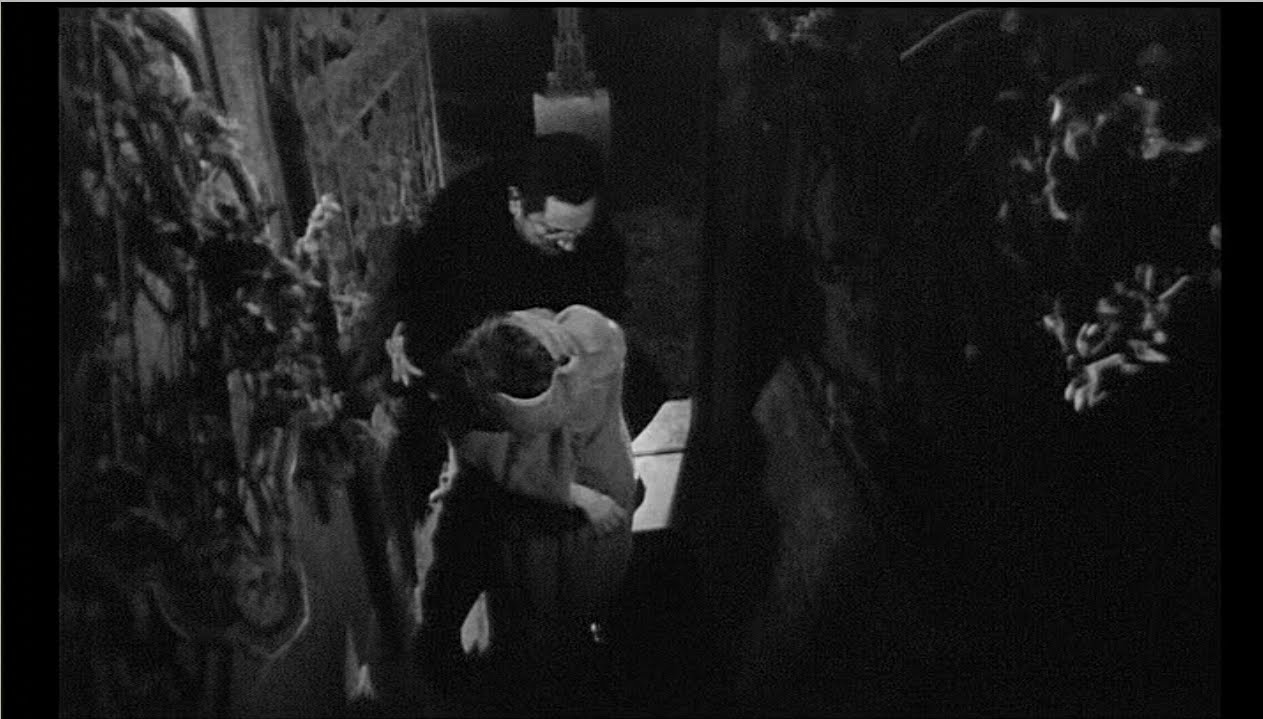
Rewatching it to harvest the above screengrabs though, it occurred to my that the beauty of Franju’s film is one that cannot be properly be communicated by still images. More than anything, it lies in the slow, deliberate camera movement, the delicate, deliberate pacing. In the flow of visual information, withheld, suggested and then, eventually, revealed.

For horror fans in particular, the film makes for fascinating viewing, acting as it does as a bridge between the older formal history of the gothic and macabre in cinema, and the more shocking, visceral future approaching over the horizon – a split which can be clearly observed as Franju takes us behind the socialised ‘mask’ of his film’s world - beyond the gauche, overcooked elegance of the Génessier house, through to the concealed world beneath it – to a place of bare concrete floors, exposed heating pipes and car garages, of caged dogs, sordid brutality and chloroformed victims being dragged around by their elbows; a place where the grotesque reality of Dr. Génessier’s surgeries is revealed to us in sickening close-up.

Looking back, we can see the French fantastique tradition of Feuillade and Fantomas - drawing room mysteries and gentle, elegant surrealism - breathing their last sad breaths. Looking forward, we see the more garish cinema of Franco and Bava, of Fulci and Argento. Of Cronenberg, Romero, “Night of the Living Dead”, “The Texas Chainsaw Massacre”. Of everything, in short, that we think of as defining ‘modern horror’. And always at the crossroads, we’ll find Franju’s masterpiece, and the mixture of desire and repulsion lurking at the heart of all horror, personified forever in the unforgettable, unhiemlich visage of Edith Scob and her white mask.

Wednesday, 22 December 2010

#16
The Devil Rides Out
(Terence Fisher, 1968)


It’s funny how I’ve always found Dennis Wheatley’s best-selling witchcraft potboilers to be an insufferable load of insufferable, sanctimonious guff, and yet somehow I love Hammer’s take on “The Devil Rides Out” - an adaptation that if anything renders its source material even more smug and puritanical.

In some ways, I’ve always thought there is almost something almost sweet about Hammer’s Manichean puritanism - something quite comforting and noble about the steadfast, upstanding heroes of their vampire movies, forever protecting their buxom womenfolk from the depravations of immoral monsters. Wheatley’s dire warnings against the forces of darkness by contrast just seem sleazy and hypocritical, like a public school master berating his charges for their ‘dirty thoughts’. Thankfully though, it is the former aspect that predominates in Terrence Fisher’s film, a thoroughly enjoyable affair that sets out to define itself as ‘the quintessential, old-fashioned witchcraft movie’ with such Victorian vigour that witchcraft movies made ten years before it end up looking modern by comparison.

One of my favourite scenes in all cinema has to be the one here in which The Duc de Richleau and his allies watch from a distance as evil sorcerer Mocata’s coven carry out their black mass on a starless Walpurgis midnight. Partly because their polite, fully-clothed ‘orgy’ is such a gas, but mostly for the moment when our heroes look on in disbelief as a giant, horned figure – “..the Goat of Mendes… the devil himself!” – rises at the climax of their ritual. I mean, that’s motherfucking SATAN, standing right right there guys! No messing around! And how do our heroes respond but by hitting the accelerator and driving their motor-car RIGHT AT HIM. Physical manifestation of the lord of all evil, pah - run the bastard over, that’ll sort him out! I can only assume it is the sheer, true-hearted bravery of our protagonists, rather than the hurled crucifix, that gets the job done, making The Horned One cut his losses and quit the scene in a puff of smoke.

It is this wonderful, bloodyminded literalism that I love above all about “The Devil Rides Out”. Faced with the prospect of trying to represent magical conflict and the evocation of demons in a movie, Fisher and co bypass all the go-to techniques usually brought in to make such subject matter palatable – excessive atmosphere, implication and subtlety, ‘monsters of the id’ style psychological peril, psychedelic freakout etc. – and instead misstep the audience by doing the last thing anyone would expect: giving it to us straight. There is something incredibly unsettling about the way the horrors of Mocata’s bestiary simply *appear* at his command, centre-screen in full light - a shock that mirrors the way one might actually feel if suddenly confronted with a boggle-eyed imp or a giant, spectral tarantula. The sequence that see The Duc and his allies under attack from the forces of darkness within their chalk circle is one of the most effective ever seen in a supernatural horror film – a masterclass in building tension and dread from almost nothing whatsoever. Whatever you do, DO NOT STEP OUTSIDE THE CIRCLE, or you will be lost. Rarely has the idea of cringing before the forces of goodness and light and promising not to be naughty seemed so tempting.

If Christopher Lee as The Duc initially comes across as a rather self-satisfied and bullying character, what with his dictatorial pronouncements, his haughty attitude to servants and his tendency to beat his friends about the head and kidnap them if he disapproves of their social life, he more than rises to the occasion when the supernatural shit starts to hit the fan – the very personification of stern, benevolent authority, with more gravitas than the cliffs of Dover. I’m not Lee’s biggest fan, but he’s great here - enough so to make me wish he’d had the chance to play good guys more often.

Although given a more low-key role than villains are usually allotted in a Hammer picture, Charles Grey too is excellent as Mocata – a casting decision that in its own way is as unusual as making Lee the good guy. Not in any way the kind cool, aspirational face of villainy more common to witchcraft movies, Grey cuts a chubby, smirking, manipulative figure – closer perhaps to the face of an actual ‘60s/’70s occult huckster. And, whilst we’re on the subject, I’ll also throw in a good word for Nike Arrighi – a striking actress who manages to turn the nothing-role of Tanith into a really engaging presence here, her demure looks and mannered performance placing her in a whole different universe from Hammer’s usual buxom beauties, and making her character all the more intriguing as a result.

For all that I enjoy it though, it must be admitted that there is a deep current of anachronistic imperialism, even flat-out racism, running through “The Devil Rides Out” that many modern viewers might find distasteful, beyond just the sight of our comfortable, independently wealthy heroes and villains cruising between country houses in their fleets of unfeasibly speedy and reliable motor-cars. I’m not usually one to try to project social consciousness onto a film that never asked to be judged on such terms, but the presence of a few black extras who are seem milling around whenever Mocata’s coven meets is a strange and completely unnecessary inclusion (perhaps trying to imply some spurious connection between Western witchcraft and African ‘hoodoo’, or merely warning us that people who consort with other races are not to be trusted), and it is hard not to read at least some sub-text into the film’s first supernatural manifestation, which sees The Duc and Rex Van Ryn reduced to stunned terror by the spectre of a semi-naked black man impudently grinning at them (“for God’s sake, don’t look into its eyes”).

But as noted, these few weird missteps aside, I find the old fashioned tone of “The Devil rides Out” perversely comforting. The staunch moralism always present in Fisher’s films is given perhaps its ultimate expression here, and, together with screenwriter Richard Matheson’s characteristically thoughtful approach to ‘us & them’ story dynamics, I feel that “The Devil Rides Out” succeeds in giving a more elegant expression to Wheatley’s dusty bluster, conveying a more genuinely humane take on the battle between good and evil. This is beautifully illustrated when Sarah Lawson’s Marie boldly steps forward to reclaim her daughter from Mocata’s altar, calling out the creepy Satanists not in the name of God, but of that which they truly lack and fear, that which ultimately separates our upstanding heroes from them - love without desire.

Tuesday, 21 December 2010

#17
The Masque of the Red Death
(Roger Corman, 1964)


“The doctor dances in the white room… but I passed close by him. Truly Prospero, do you not know me?”

Until I acquired a new copy on DVD last year, I’d built up “Masque of the Red Death” to near-mythical status in my own mind, based on catching it randomly on TV a few years ago – an event that was perhaps responsible for triggering my whole love of ‘60s gothic horror. The rich, overwhelming colours, the swirling shapes of the dancers, the suffocating, decadent evilness of the whole venture – Corman’s vision may have had little to do with the blacks and blues and empty, echoing stone chambers that Poe’s writing has always communicated to me, but on its own terms it was a real aesthetic mind-blower – a mixture of psychotropic ‘60s excess and esoteric medieval grue in Hollywood drag, fusing the core themes of Poe’s story to the more extreme accruements of its own era, like, I dunno, Kenneth Anger meets Torquemada on the set of a ‘Robin of Sherwood’ movie or something.

So naturally when it came to revisiting it, my expectations were high. And as ever with high expectations, I was slightly disappointed. Having familiarised myself in the meantime with the work of Mario Bava and Terrence Fisher, of Rollin and Margerheti and all the other masters of weird cinematic gothic, “..Red Death” made less of an impact on me than it did the first time ‘round. Nicolas Roeg’s dazzling colour-coded cinematography and Daniel Haller’s otherworldly art direction seemed somewhat less dazzling and otherworldly. Having decided that I tend to prefer Vincent Price in tragic/sympathetic roles, his portrayal of the amoral Prince Prospero, though still excellent, seemed to lack that certain something that characterises his very best performances. The metaphysical pronouncements of the emissary of the Red Death began to sound less eerily profound, more like some of yr hastily pulled together AIP mumbo-jumbo.

Of course, that’s what happens when you build things up to gigantic proportions over time. If not approached as a life-changing masterpiece, “Masque..” is merely a really, really excellent example of a technicolor era gothic, with a first class cast incorporating at least four members of the official Breakfast in the Ruins Weirdo Horror Hall of Fame, a heavy, oneiric atmosphere, an luridly imaginative script and superb production design. The film’s big set pieces – Prospero’s opening visit to the village, Juliana’s dream-sequence and blood-pledge to Satan, the manifestation of the Red Death and the closing Dance of Death – are all breathtaking.

And, all other considerations aside, we should remember: this is a film in which Patrick Magee is hung from the ceiling dressed in a gorilla suit and set on fire by a dwarf. If that doesn’t guarantee a film a place in my top 20, what would?

Monday, 20 December 2010

#18
Return of the Living Dead

(Dan O’Bannon, 1985)


“I don’t know how to tell you this Ernie, but those things in the bags aren’t weasels…”

The OTHER big horror/comedy classic of 1985, “Return of the Living Dead” is the kind of movie that it’s easy for horror fans to take for granted, but also the kind that I think it deserves more love than it’s possible to give it.

Back when I did a deathblog for Dan O’Bannon last year, I said;

“What can I possibly say about ‘Return of the Living Dead’? For all my love of the strange and wonderful and poetic and obscure in cinema, if you were to feed me enough beer and ask me about the elements that go together to create a GREAT MOVIE (as opposed to a good film), ‘Return..’ is pretty much the dictionary definition. For any Halloween “get drunk and watch movies” type party, it’s always the number one choice, now and forever – satisfaction guaranteed for horror freaks and innocent bystanders alike. Frankly, I think the fact the guy who directed ‘Return..’ died without a long and illustrious string of directing credits to his name speaks very poorly of the human race as a whole.”

And that still stands I think. The banter and three stooges capers of Burt and Frank and Ernie are little short of genius – honestly some of my favourite comic acting in any film. Giving those guys equal screen-time to the identikit dopey teenagers is a masterstroke, but the film’s tongue in cheek fake ‘punks’ are a riot too, a great parody of the kind of ludicrously unlikely ‘teen gangs’ who were routinely rampaging through cheap American movies at the time. O’Bannon’s script is a wonderfully smart piece of work - by all accounts completely reinvented from the straight-laced attempt at an alternative NOTLD sequel submitted by John Russo. O’Bannon’s addition of humour to the mix functions in much the same way it did for Southern & Kubrick’s “Dr. Strangelove” script, opening up the material to endless new freedoms and possibilities for grotesque, self-reflective fun – a comparison perhaps reflected in the welcome introduction of some absurdist cold war satire into proceedings here.

Whilst it may be tons of goofy, drunken fun, “Return..” certainly isn’t stupid, and I think the streak of nasty, pitch black wit running through it (Ernie’s spine-chilling dialogue with the captured zombie, Burt’s final phonecall to the military, the doomed ironic ending) has a lot to do with how well the movie stands up today. Add plentiful, imaginative gore, a genuinely engaging zombie survival showdown, and The Cramps, The Flesh Eaters and Roky Erickson on the soundtrack and I think you’ve got a pretty much perfect rollercoaster of an endlessly rewatchable good time horror movie. For any friends you’ve got who don’t like watching horror movies, I think this is the best one to bring over to try and and show them what they’re missing.

#19
Re-animator
(Stuart Gordon, 1985)


“..and what would the note say, Dan? ‘Cat dead, details later’?”

In this country as least, it is safe to say that Bruce Robinson’s script for his film “Withnail & I” has permeated the social lexicon to such a degree that quotations from such may be employed, sparingly and in appropriate circumstances, without fear of embarrassment or misunderstanding. Try as I might, I can’t shake the irrational urge to try to employ Dennis Paoli’s script to Stuart Gordon’s “Re-animator” to similar effect, however ill-judged and ineffectual I know such an effort would be. The film’s dialogue, and more particularly the cast’s delivery of it, carries I think a sense of the same timeless, blackened wit as Robinson’s script, but alas, at the end of the day I suppose modern life simply doesn’t provide enough opportunities to bust out with “you’re not even a second rate scientist”, or “don’t expect it to tango, it’s got a broken back”. Modern life’s loss. If I were some obnoxious jock medical student, or an obnoxious horror convention attendee, we’d be having a gas with this stuff I’m sure. But as it is, I’d at least like to think that “Re-animator”s lack of conversational universality doesn’t in any way diminish the film’s winningly twisted charm.

Only last month, I was wasting space here talking here about Stuart Gordon’s background in theatre, and the corresponding importance his best films place upon tight scripting, memorable characters and strong performances – well, obviously “Re-animator” is the prime example. Not only was it the first film Gordon made after leaving his theatrical career behind, but allegedly he was pretty much forced to resign in disgrace from the Organic Theater company which he had helped found in Chicago, such was the collective disgust of his colleagues at the idea of their director trying to make some dough via a low budget horror film. I don’t know whether or not aforementioned snooty colleagues actually went to see “Re-animator”, but the joke’s on them if they did, as the considerable success Gordon’s film has achieved is driven as much by a hard-won sense of theatrical craftsmanship as it is by nasty ideas and eye-popping gore effects.

Think about it: you’ve got a cast that’s essentially limited to five characters, their personalities and relationship to each other all carefully established and ready to kick off. You’ve got a witty, fast-moving, dialogue-driven script, two or three simple, unspectacular locations, and five really good actors. Dynamite. “Re-animator” could have worked brilliantly on stage, and the old fashioned solidity of it’s execution as a movie is doubly refreshing in the midst of a genre that so often cruises by on visceral thrills, visual weirdness, wafer-thin characters and sloppy, illogical story-telling. Of course, stage plays rarely feature shovel decapitations, intestinal strangulation and mutilated undead cats, which at heart probably has a lot to do with why I’m not writing my ’25 favourite plays’ here, but so, er, yeah – “Re-animator” is win-win on that score really.

Above all, the success of the film is in the characters and the cast, and how many ‘80s horror movies can you really say that about? I’m assuming you’ve probably seen it, so I don’t have to tell you that Jeffrey Combs is the stuff of legend, that David Gale as Dr. Hill is one of the all time great villains, that Bruce Abbot and Barbara Crampton manage to invest their traditionally dull “normal” roles (always the anchors that drag down a good gothic or Frankenstein movie) with a rare degree of depth and likeability. It says a lot that I made it cheerfully through both of Bruce Yuzna’s objectively-quite-poor sequels and thoroughly enjoyed them, such was my happiness at seeing Herbert West and Dan Cain and Dr. Hill back in action, getting up to further necrotic mischief.

Like I say, you’ve probably seen “Re-animator”. You probably don’t need me to tell you how great it is, how perfectly pitched Gordon’s mixture of black humour and genuinely disturbing nastiness is, how well paced the film is, and how, unlike the sequels, it knows exactly where to stop, and never spoils the brew by letting things boil over into silliness. It is the modest little horror movie that does *everything* right, and it is heartening that its killer rep as a fan favourite reflects that. “Who’d believe a talking head? Get a job in a sideshow!” Ha, ha, yeah… it’s all in the way he tells ‘em I think.

Sunday, 19 December 2010

Forthcoming: Rollinades


Further to the rather inadequate tribute to one of my favourite directors found below, I was thinking that next year, it might be good to undertake a kind of ‘overview’ of Rollin’s work here, and as such I’m going to try my best to write something about one of his films, say, roughly once a month during 2011.

Despite the fact that his first four vampire movies are very much the cinematic holy grail for me, Rollin made a lot of extremely strange and interesting films that extend far beyond the common view of him as “the guy who makes the sexy vampire movies”, so I will try to concentrate in particular on some of the less well known entries in his filmography. Hopefully it will be learning process for both of us, as there are still quite a few of his ‘minor’ works that I’ve yet to get around to watching, and hey, it’s likely that amazon.co.uk won’t be desperately trying to shift their warehouse surplus of all those Redemption DVDs forever, so now seems a good time to catch up and complete my collection.

In the meantime, Top # 25 Horror Movies count-down will be recommencing imminently – let’s just put this week down as ‘compassionate leave’.

Thursday, 16 December 2010

Deathblog:
Jean Rollin
(1938 – 2010)


Taking an unavoidable break from the #25 count-down, it is my sad duty to pass on the news that Jean Rollin died yesterday, at the age of 72.

Hopefully Rollin will need no introduction for regular readers of this blog, but either way, I’m too taken aback right now to really pull together the kind of grand tribute he deserves.

His films are certainly not for everyone, and that’s fine. But on behalf of those who have been touched by his work, let’s just say: thank you M. Rollin, for the dreams, the stories, the strangeness, the beauty. To myself and many others, you were one of the greats.

I had plans for tonight, but instead I think I’ll stay in, and return to where my Rollinomania began about five or six years ago: with a glass of wine and an old Redemption VHS of “Requiem for a Vampire”, complete with ridiculous fetish-porn cover photo. It was an astonishing and beautiful thing that happened when I pressed play.

Here is a quote from Tohill & Tombs’ “Immoral Tales: Sex & Horror Cinema in Europe 1956-1984”, p. 173;

“As a kid of seventeen Rollin came to England. One day he found himself, as you might expect, by the sea – in Bexhill of all places. He met a girl there and he kissed her goodbye on the beach. ‘And I have never forgotten her,’ he says now. Of course he hasn’t; she’s there in almost all his films. At their best they are expressions of just that sort of moment, when our lives seem to belong to us. When we feel the enormities of all possibilities that stretch out before us.”


So long Jean, and thanks for the memories.

Most of the images in this post – from “Le Viol Du Vampire” (1968), “La Vampire Nue” (1969), “Le Frisson des Vampires” (1970), “Lips of Blood” (1976) and “Lost in New York” (1989) - are sourced from Jeremy Richey’s Fascination: The Jean Rollin Experience. You can read Jeremy’s tribute to Rollin here.

Tuesday, 14 December 2010

#20
The Astro Zombies
(Ted V. Mikels, 1968)

Ed Wood? Doris Wishman? AMATEURS (or perhaps even worse, PROFESSIONALS). With “The Astro Zombies”, Ted V. Mikels gives us the absolute zenith of ‘60s trash cinema, standing proud in its rejection of rudimentary film-making logic, its defiance of all human reason.

Do not ask why this or that shot was included in the film. Do not ask why all this is happening, or what any of it is supposed to mean. As soon as you starting questioning what you are seeing, you will be lost. And yet the questions remain.

Why do the opening credits play out over footage of some toy robots and tanks in a quarry, accompanied by a soundtrack that sounds like it was recorded straight off an old war movie? What exactly is it that separates these ‘Astro Zombies’ from, say, a crazy dude with an impractical rubber mask on? What ARE those police guys in the head office that looks like someone’s living room with a world map hung on the wall talking about? How exactly does that guy using an oscillator to make a brain in a cake tin wobble prove that “one man’s thoughts can be transmitted directly to the brain of another”, and how does that then lead him directly to the notion of “building quasi-men to undertake interplanetary space flight with a steel skin that makes it impervious to micro-meteorites”? How does their conversation then manage to turn to the recent ‘mutilation murders’, which they decide “cannot be coincidental”? Was Wendell Corey reading his lines off a crib sheet on a table just below the bottom of the frame? And did they have to poke him with a stick to stop him falling asleep? Was it really necessary for that one sequence, in which John Carradine repairs a bit of his mad scientist apparatus by taking a small piece of circuit board out of a metal drawer and then slowly putting it back in again, to go on for, like, five minutes, complete with technical close-ups of utterly fake, purposeless objects? Come to think of it, why did they put such effort into building so much elaborate mad scientist gear and showing it all to us at length when none of it is really interesting or noteworthy in the slightest? And what is WITH that hunchback assistant guy anyway? Who’s the girl in the bikini who spends the entire movie politely chained to a slab in their lab, for no apparent reason? Why is it night, and then day, and then night again, and when that guy takes his girlfriend home to bed, it’s like midday again, only there are grasshoppers croaking away deafeningly? Does that means it’s night, or does it mean the Astro Zombie is close? What are those sort of weird, echoplexed burblings and rumblings and tape hiss noises that seem to play in the background throughout this whole movie? And am I the only one who finds them strangely soothing? Why don't ALL films have these noises?

(..pause for breath..)

What kind of crazy-ass foreign government uses a team of undercover agents consisting of Tura Satana, a knife-wielding Mexican gangster kid and a big, dumb Tor Johnson type guy in a porkpie hat? Furthermore, can I go and live in that country, wherever it is? Why does the sky keep changing colour? How can I even pass comment on the hero-guy’s plan to apprehend the Astro Zombie by sitting a pretty girl in a room and waiting until it turns up to get her? Has anyone ever actually managed to make sense of the sequence where those guys chase each other around a crummy looking swimming pool until Tura Satana shoots one of them? Where on earth did she get those astounding outfits? How awesome is the bit where the Astro Zombie ‘recharges’ itself by sticking a torch on it’s forehead and sprinting home? How can one movie manage to pack so many hare-brained schemes and baffling notions into eighty minutes and STILL find time for so much joyously interminable ‘point the camera out the car window’ suburban travelogue footage? And hold on, wow, are you telling us that thing’s supposed to be a severed head?

Remember: there are no answers. Like Jehovah himself, “The Astro-Zombies” is what it is – as inscrutable and astonishing as a transmission from another galaxy.

I know what you’re thinking: maybe Ted V. Mikels can explain what the hell his thinking was when he made this thing. Well, you remember that scene in the nightclub that looks like a country club steakhouse, where that guy is interminably demonstrating a cocktail party magic trick to the other characters while they watch that really terrifying looking stripper do her thing? You remember how the stripper was being accompanied by a bare-chested middle-aged man, frenziedly beating a pair of bongo drums? Meet Ted V. Mikels.

You still wanna ask him questions? I thought not. So seriously, just try to sit back and go with the flow, as Ted takes you places you’ve never been before, shows you patterns and colours and weird, scrunched up faces that are rarely seen by those in full command of their faculties, spits in the collective faces of taste, decency, physics, and the laws of cause & effect, initiates you into the exquisite pleasures of utter boredom, and even lets you play with his robots.

“One of the all-time worst”, said Weldon in the Psychotronic Guide, but I’d like to think he meant it affectionately.

Friday, 10 December 2010

#21
Driller Killer
(Abel Ferrara, 1979)


Ha, wow. Awesome. Whatever happened after that title card I probably would’ve loved it, but what does happen is more strange and exhilerating than anyone probably could’ve expected - a definitive piece of punk rock film-making to rate up there with “Repo Man”, “Liquid Sky” or “Night of the Living Dead”. “Driller Killer” is the only serial killer movie on this list, and it is difficult to put into words why it appeals to me so much. By rights, this should be a disgustingly indulgent ego trip on the part of Abel Ferrara, and in many ways it is. But like all of his better subsequent films, “Driller Killer”s ostensibly depressing, obnoxious, maddening surface somehow opens up to reveal a film that is utterly inspired, magically transformed by that oblique, furious energy that Ferrara-on-form always brings to proceedings.

Oh, but what an incredibly STRANGE film this is, moreso than the relatively cut n’ dried likes of “Bad Lieutenant” or “Ms 45”. I always enjoy it, but I can never quite get an angle on it. The standard line here is to point out that “Driller Killer” is not really a horror movie as such, but a personal, quasi-documentary headfuck of a film about life on the fringes of the art world in New York in the late ‘70s, with all the slasher shit thrown in as a tongue-in-cheek bonus to help secure financing and to get the movie some notoriety/distribution.

But, necessary though that observation may be for any newbies renting this one expecting “The Toolbox Murders” or whatever, the logic of it never *quite* sits comfortably with me. As jarring and ridiculous as all the driller killin’ may initially seem, crowbarred into the mumblin’, slice-of-life un-drama of the film’s wider post-Warhol, post-CBGBs era whole, Ferrara definitely ain’t making no fucking cissy art film here – the whole thing is slathered in vicious, cheap imagery, fast edits, rock n’ roll and total sleaze, all parachuted in straight from the grindhouse. Which is great! Thematic/emotional commitment, beautiful, harrowing street-life footage AND manic trash craziness – that’s a combination I can live with. After a few viewings (I know, I know), I started to treat “Driller Killer” as a comedy, and that is the approach to the material I would definitely recommend for optimum enjoyment. You may have this pre-established idea that “Driller Killer” is some grim exploration of urban alienation and psychosis, but seriously: put it on, keep thinking “THIS IS A COMEDY”, and you’ll have a pretty good time.

Ferrara’s performance as Reno is so over-the-top with all his alienated New Yorker mannerisms, it’s just flat out hilarious, and I love the way that rather than suffering from any serious psychological dysfunctions that more traditionally tend to lead characters in movies to take up mass homicide, he’s basically just really grumpy. I mean, ok, so his relationship with his old lady’s not going too smoothly, his neighbours are making a godawful racket, his flatmate bugs him, and he doesn’t wanna pay the phonebill. That doesn’t exactly make for a perfect weekend, I’ll admit. But I daresay dear reader that you and I have probably dealt with similar issues at various points in our lives, and have probably managed to resolve them without even considering the possibility of running around the streets ventilating hobos with a powerdrill. Not our Reno though. No, he JUST CAN’T TAKE IT ANYMORE, MAN! He’s GONNA SNAP! I mean, what other choice does he have..? It’s like tuning into an episode of ‘Hancock’s Half Hour’ where Tony flips out and starts beating everyone to death with a hammer.

And, squalid and sickening as they may be, the killings themselves just crack me up – less real crimes, they’re more joyous acts of self-righteous catharsis – Billy Liar mind-machinegunnings on a bloody, mass scale. So much more random and beserk than the carefully mapped out, heavily fetishised murders we’ve become accustomed to in a million Giallo and slasher flicks, it’s hilarious to see Reno just running around the streets in an uncaring rage, plunging his drill in the general direction of whoever gets in his way before charging off to cause more mayhem. And I love the fact that at no point does he even *consider* that the police might be looking for him – the film presents New York as a city in the grip of such terminal despair that you can wander around murdering people for the hell of it in the middle of the street and no one will even bother clearing up the mess, let alone try to stop you.

So many great moment of bizarre, deadpan humour in this film – I love the scene where he eats all the pizza (no explanation needed), or the ‘foreshadowing’ bit where Reno helps Pamela drill a hole in the door, and they’re all like “so you wanna hole to go here, or here, or over dere?”, “uh, I think I wan one dere, NO – over there” and so on, without either of them raising the issue of why she’s just got up in the morning and suddenly wants to drill a hole in the front door.

“Tony Coca-Cola” makes for a wonderful big-mouthed rock star asshole, who oddly doesn’t get drilled despite being the character in the movie you immediately wanna strangle, and his band’s rehearsal / concert sequences and the power struggles in the strange cult of groupies that follow them are fucking beautiful punkoid footage, at times becoming so involving it almost takes over the whole movie.

Oh yeah, and what IS that whole sequence at the start where Reno goes to the church and encounters that strange old man all about? It has nothing to do with the rest of the movie whatsoever! But it’s a stunning scene, a great opening, a really unusual introduction to our central character, so I don’t much care. I’m guessing Ferrara just thought likewise after whatever reason he’d had for filming it fell out of the script, so he left it in. Good attitude!

Above all though, I love the caption card that closes the film –


You still wanna tell me it’s not a comedy?

Thursday, 9 December 2010

#22
I Drink Your Blood
(David Durston, 1970)


“Let it be known, sons and daughters, that Satan was an acidhead. Drink from his cup! Pledge yourselves! And together we’ll all freak out!”

You said it, Horace Bones! What a great way to start a movie.

“I Drink your Blood” began life when appropriately-named producer Jerry Gross hired David Durston, a veteran TV/sexploitation director with notable counter-cultural sympathies, to come up with some ideas for a bloody, modern horror movie – something new that would bypass gothic/supernatural hokum and capitalise on the recent success of “Night of the Living Dead”, in terms of both graphic violence and, hopefully, box office.

Durston had some ideas alright, and idea number one was RABIES. Idea number two was on the front of Time magazine and his name was Charles Manson. Idea three was BLOOD and BLOOD and LSD and SATAN and MORE BLOOD and…. well anyway, Durston wrote a script, Gross flipped out and reached for his chequebook, Durston was given a free hand to cast and direct the film himself, and the rest is history (or crazy person exploitation movie history, at least).

The story Durston came up with for the film has been reiterated thousands of times, in plot synopses, capsule reviews etc, but such is its fiendish, crack-brained singularity, I think it bears repeating:

Horace Bones, played by charismatic Indian dancer Bhaskar, is the leader of a Satanic hippie cult, The Sons and Daughters of Sados, who have decided to pitch up in a remote town in Upstate New York. The town is practically deserted thanks to a big new dam project which has claimed the land, with the few remaining inhabitants staying on to cater for the attendant construction workers. But such isolation naturally doesn’t stop Horace and the gang finding people to give a hard time to, and after they assault a local girl and dose her granddad with LSD, a chubby, sour-faced youngster named Pete decides enough is enough and concocts his own unique form of revenge: drawing infected blood from a rabid dog he shot dead in the woods, he injects it into a batch of meat pies and sells them to the hippies for their dinner.

Hilariously, the film assumes that people infected with rabies would instantly transform into psychotic, wild-eyed killers who flee in terror at the sight of water, and so obviously one thing leads to another, and before you know it, berserk, bloodthirsty Satanists are staggering across the countryside leaving a trail of mayhem and dismemberment in their wake, mixing it up with an army of foam-gargling, machete-wielding rabid construction workers as an increasingly small number of uninfected characters scatter in panic, trying to get the hell toward the end credits of this f-ed up movie as fast as their square little feet can carry them.

Seemingly unaware or uncaring of the ‘sizzle not the steak’ maxim of exploitation film-making, Durston’s film barely lets up for a minute, delivering mad, unforgettable characters, stomach-churning bad taste yukks and random, inexplicable weirdness on an almost conveyer belt-like basis, spiralling off the deep end into a tornado of ever-increasing craziness, until it feels as if the film itself has been infected with rabies. As David Szulkin puts it in the liner notes accompanying my DVD copy: “just when you think Durston can’t push the delirium any further, somebody drags a dead goat across the screen… or an old man in long underwear pukes up his dentures while being strangled… or an electric carving knife strays from a side of ham with disasterous results… or… well, you get the picture.”

For its era, the violence in “I Drink Your Blood” is pretty extreme. I’m not usually at all squeamish about on-screen violence, but there is one moment here that has me covering my eyes and whispering “ah, no, please don’t go there..” every time I watch it. But they do go there, time and time again. Instead of the squalid, torturous viewing experience you might reasonably expect from a film like this though, “I Drink Your Blood”s masterstroke is that it manages to convey such an irrepressible sense of good-natured joie de vivre even in its grimmest moments, drawing us into a spirit of gleeful, blood-soaked abandon, reminiscent of a twelve year old boy in art class, happily scribbling sprawling vistas of carnage as his teacher looks on appalled. Rarely has the liberating, anarchic power of wanton violence been so purely evoked. As Jadine Wong’s Sue-Lin says at one point, as if pre-empting the movie’s critics; “fear and blood are signs of life, not death!”

It helps of course that the film is extremely well made: bright and energetic and fast-moving, imaginatively shot and tightly edited, full of lively, intense performances – a world away from the amateur hour HG Lewis gorefests that were its only real precursors – and executed with a sense of dry wit and intelligence throughout, despite some clunking dialogue and soap opera acting from the non-hippie characters (“rape is a little outside the field of an engineer, dontha think?”). It is not without a sense of wonder that one can look back after a viewing of “I Drink Your Blood” and realise that, despite the abject lunatic stupidity of the storyline, the film actually manages to NOT be at all misogynistic or reactionary, or even all that sleazy – quite an achievement for a 70s drive-in flick full of sex-crazed psychotic Satanists!

Animals may arguably get a rougher deal, but that’s probably an issue best left for another day (in short, Durston sez: no freakin’ way, I didn’t hurt any animals in my film, audience sez: yeah, sure, so all those dead rats and that freshly slaughtered goat were just conveniently lying around, were they? - Chances are, if you’re the kind of person who’s already watching a movie like this you won’t be too put out, but hey, a warning never goes amiss.)

Many commentators have tried to read a deeper social significance into “I Drink Your Blood”, based on its occasional vague stabs in the direction of race and gender issues, anti-Vietnam protest and freaks-vs-squares rhetoric, but to quote Szulkin again, “any resemblance to a master’s thesis is purely coincidental”. Better just to enjoy the movie as exactly what it is: one of the most deliriously entertaining, unashamedly nasty, purely whacked out b-movies ever made – no message, no meaning, no apologies. As the ad-libbing sheriff whose men arrive to clean up the mess concludes: “Well, what can ya say… at least it’s OVER.” Roll credits.

Wednesday, 8 December 2010

#23
Valerie & Her Week Of Wonders
(Jaromil Jires, 1970)


Sorry folks, I honestly can’t think of a single coherent observation to make about Jaromil Jires’ folk-gothic-adolescent-poetic-Vampire-fairytale at the moment, but… well it’s just wonderful really, isn’t it? Like a great psychedelic rock album turned into a film, it’s the kind of thing one obsess over, get lost in. Another one of those films that makes you wish you could claw your way through the screen and live in its world of strange, earthy beauty. Absolutely unique – there is a richness to it that positively demands multiple viewings that I wish I had time to give it. You should see it if you haven’t already.

Oh, and in case you’re wondering, it IS a horror film because it’s got vampires in it, and Redemption released my copy. END OF.

Tuesday, 7 December 2010

#24
The Fog

(John Carpenter, 1980)


“So I never hitchhiked before, and I just wanna be careful. Can I ask you something?”
“Sure.”
“Are you weird?”
“Yes. Yes, I am weird.”
“You’re weird? Thank god! The last ride I had was normal it was disgusting..”


There is something irreducible about The Fog – a simple story strongly and imaginative told, it inhabits a self-defined world oblivious to criticism. It is a slower, gentler and more visually expansive film than we would have expected from John Carpenter in 1980, and one of very few modern(ish) American horror films to zero right in on the kind of ‘comforting eeriness’ that forms such integral part of the appeal of the kind of older, ‘weird tales’ horror that the fim quietly references throughout. A beautiful communal viewing experience, “The Fog” plays as a mass media-era equivalent of the campfire ghost story so memorably narrated by John Houseman in the film’s opening.

A digression: can only speak for myself here, but I’ve always hated that Stephen King-birthed style approach to American horror stories that started to become prevalent through the ‘70s and ‘80s, wherein our story is seen to take place in a normal, healthy suburban community which is threatened by some malign outside influence. I mean, like I could give a crap whether Suzy and Bobby can get to school safely, or whether sinister occult forces are out to undermine the sanctity of marriage, or any of this other OH NO, THREAT TO THE STATUS QUO bullshit! I’m here to hang out with the weirdos! No, what I like are horror stories in which the world itself is weird - in which time and space seem frozen in some strange interzone in which the conflict or threat seems to grow, or return, from the surroundings that nature or humanity has built for it, rolling in as naturally as, well.. the fog.

I’m not sure whether I’m explaining myself very well, but this is something that is returned to time and time again in the films that appear further up this list, and it is a feeling that Carpenter captures perfectly through the town of Antonio Bay in “The Fog”.

Imagine if you will, a perpetually off-season Northern California coastal town, full of dark, empty streets, cheaply-built beach-houses stretching out into the bay. Businesses failing from a basic lack of people to patronise them, but continuing nonetheless, running on empty cos the rents are so low. Nautical knick-knacks, weather stations on the cliffs. Everyone is friendly, but kinda suspicious with it. Adrienne Barbeau is a single mother who runs a radio station that broadcasts out of a lighthouse, playing anonymous, jazzy muzak through the dark hours of the night. As the only DJ, she chooses to run the station through the night, and shuts it down during the day, for some reason. Janet Leigh is the mayor. Sailors and harbour officials look out to sea and talk boat-talk. Nobody ever really seems to do any work, and everyone is very vague about the concept of, y’know, leaving.

If you’re thinking “I wanna live there” then join the club. Come on over and and we’ll watch “The Fog” together. Rarely have I seen a more perfectly inviting mini-universe built up in a film, a place I’d be more inclined to walk straight through the screen and become part of. Dark secrets and vengeful ghost pirates notwithstanding, I wanna take a ride out to Spivey Point right now.

So many of the elements compiled in “The Fog” help to define a certain, strange strain of horror that I love, but that I don’t really have a name for. The isolation, the coastal setting. The disembodied radio broadcasts, severed communications, fragmented narration. The weird, highly localised folklore. Figures emerging from/returning to the sea. The lighthouse. These things move me wherever they turn up, but, oddly, we’ll be seeing every single one of them again in another film higher up the list – a film made before “The Fog” that I think is even better. I don’t believe the similarities are anything more than completely coincidental, but in some ways they are truly uncanny, as if the two were tapping directly into the same nexus of imagery and atmosphere…

Anyway, I could happily list the many, many qualities of “The Fog” all day long, but I’m sure that would be surplus to requirements. Should you ever find your faith in john Carpenter slipping, just consider that he made this – a film about vengeful ghost pirates so great that the vengeful ghost pirates are the least good thing in it.

For further elucidation, I direct your attention to this great piece written by Erich Kuersten of Acidemic earlier this year. I concur with all points made, and for some reason had never previously clocked the uncanny parallels to “The Birds”.

Monday, 6 December 2010

#25
The Dunwich Horror

(Daniel Haller, 1970)


“When the seasons, and the cycles of the moon were right, then they came, one by one, and gathered among these stones. They selected a beautiful girl like you, and with their black robes blending into the night, they lit candles and gathered round… and then they waited… they waited for the moment when she would allow the powers of darkness to enter her… the moment when the gate would open and The Old Ones would come through… and a strange chant echoed in the night… Yog… Sothoth… YOG… SOTHOTH!”


I know, I know – Cronenberg and Fulci don’t make the cut, and yet this load of old hoo-hah is on the list? What gives? Well, to begin at the beginning: when I started reading (and by extension, reading about) H.P. Lovecraft as an impressionable teenager, the prevailing wisdom seemed to be that there was little point trying to track down the various movies that had been made based on his work. Perhaps with the notable exception of the not-terribly-Lovecraftian “Reanimator”, word was that they were all godawful embarrassments – commercialised, watered down bowdlerisations of the master’s work undertaken by men with little interest in, or understanding of, the material they were adapting, with this 1970 AIP version of “The Dunwich Horror” being singled out for particular scorn.

And in many ways, the Lovecraft scholars were perfectly correct – arguably, there has still never been a film that has successfully captured the essence of the Cthulhu Mythos stories (the name of Lovecraft-film blog Unfilmable.com says it all really). But, taking off my po-faced Lovecraft fan hat (or sinister, diamond-encrusted tiara, I suppose) and putting on my trusty Weirdo Movie Fan fedora, I’ve got to admit that having now watched just about all of those much-maligned Lovecraft adaptations, I’ve thoroughly enjoyed them all on at least some level. If rarely leading to anything you’d file as an outright ‘classic’, a Lovecraft-based script almost always seems to lure ostensibly sane filmmakers over the hill into uncanny valley, inspiring the creation of some inexplicable, oddball films that trip themselves up in a rush to sidestep traditional horror tropes and find something eternally strange and confounding instead. Precisely the kind of films we like to watch around here in other words! “The Shuttered Room” with Oliver Reed, “The Haunted Palace” with Vincent Price, “Die Monster Die” with Karloff – all are well worth tracking down, but “The Dunwich Horror”, helmed by long-time AIP/Corman art director Daniel Haller, is the daddy of them all.

From one of AIP’s best ever animated credits sequences, to Les Baxter’s deranged ‘Black Mass in a tiki lounge’ score, to the heavy dosage of horny ‘70s pop-Freudianism, to Sandra Dee’s post-Manson naked hippie bloodlust nightmares, to endless freaky psychedelic lighting effects, a Shaw Bros style magical shoot-out finale and the erstwhile star of Gidget squirming in ecstasy with a copy of the Necronomicon between her legs on a storm-ridden cliff top altar set that looks like some it’s fallen straight out of an opium vision, I can only really quantify “The Dunwich Horror” as a hurricane of utter weirdness.

And who better to stand at the centre of this garish tempest than Dean Stockwell, in a career-best performance as the sublimely creepy Wilbur Whateley, using his questionable charms, piercing warlock-gaze and hypnotic pinky-finger wiggling to lure former beach movie queen Sandra from the confines of Miskatonic University back to the night-haunted backwater of Dunwich? Stockwell and Haller actually manage to build Whateley into a very compelling and funny character here – a self-made young master of the occult who has grown up in isolation and transcended his lowly hillbilly origins through sheer force of will, his book-learned charm mixing with an egotistical fixity of purpose to mask a poor lad who’s probably never had a chance at a proper, human relationship in his life.

As in Lovecraft’s story, the outside of the Whateley residence is a fetid, backwoods shack, but when Stockwell leads Dee inside, the scene changes to a kind of opulent, gothic entrance hall, full of esoteric murals and glowing, geometric oddities – presumably bought through mail order or painstakingly built by Wilbur himself, whilst Sam Jaffe as his embarrassing old granddad sits in the corner muttering (they have a kinda ‘Steptoe & Son’ thing going on). Perhaps my favourite moment in the whole film is when Wilbur graciously offers tea to his guest, and we see him duck through a side door into a crappy looking tract house kitchen, burning his fingers lighting the stove with a match, before he returns in majestic style with an oriental silver tea-set on a golden platter.

Then we’ve got cop movie/western veteran Ed Begley (you WILL recognise him) playing a Dr. Henry Armitage who acts as if he’s spent more time rubber-hosing informants in ill-lit basements than perusing obscure works of medieval theology in the Miskatonic library, and snigger if you will, but when the indescribable invisible creature in the Wheatley attic is eventually unleashed, I think the approach taken by the filmmakers is actually pretty effective, mixing scenes of terrified, shotgun-wielding villagers searching the woods and hills for an unknown adversary with treated stock footage of rivers overflowing, trees collapsing, undergrowth being flattened by high winds etc. Sounds unbelievably stupid on paper I know, but as handled here in tandem with gratuitous sub-2001 light show FX, I think it’s a pretty decent a way of filming the unfilmable. Oh, and Lovecraft’s dreaded whippoorwills calling home the soul of mad Lavinia Whateley is a beautifully creepy touch too – a great scene in the middle of all this raving buffoonery.

Not many people seem to like “The Dunwich Horror”, but I found it an absolute joy – a profoundly unheimlich artifact sitting right at the crossroads of so many things I love, and executed with such an unremittingly crass sense of wrong-headed inspiration – I can’t help but love it.

Sunday, 5 December 2010

25 Favourite Horror Movies:
Introduction


Ok, so, a simple concept here. I thought it might be a good idea to devote December posting here to some kind of end-of-year countdown, like I do for ‘records of the year’ over on Stereo Sanctity. The obvious problem is though: whilst I keep in touch with new music pretty well, I barely ever watch any new films or read any new books these days. To give you some idea, I’ve only been to the cinema twice this year to see new releases (not counting the films I saw at Frightfest), and I only liked one of those. Not much of a list.

One list I DID make recently though was my twenty favourite horror movies, for Final Girl’s epic October countdown, and that got me thinking: usually on this blog, I write about films I’ve watched recently that made an impression on me for whatever reason, but I've rarely ever written about my actual *favourite* films – the ones I love and keep going back to, that have helped define my outlook on cinema and life and so forth.

Trying to write an all-in list of My Favourite Films and trying to find something cogent to say about each of them would be a pretty daunting task (so many eras, so many countries, so many genres, so many weird fuzzy memories of my own personal history..), but my Top 20 Horror Movies? Yeah, that I can deal with! That sounds like fun, and, as mentioned, I’ve already written the list, even. Then maybe I can do a Top 20 of something different next year, and so on. Sounds like a plan!

Actually it’s turned out to be a Top 25, simply because there were a few films milling about just below top 20 that I really didn’t want to leave out. I would have made it 27, but to be honest with you it’s a while since I watched either “Rabid” (David Cronenberg, 1978) at 26 or “The Beyond” (Lucio Fulci, 1982) at 27, and I can’t think of much to say about them at this distance other than that I thought they were really great, so 25 it is.

A couple of quick ground rules before we begin:

#1: This is not a list of the BEST horror films ever made, by any stretch of the imagination. This is a list of my FAVOURITE ones, that strike a chord with me and that I love watching. Many of my choices are pretty uncontroversial I’m afraid, but at the same time I also often love films that are ludicrous, goofy and badly made, particularly when it comes to horror, a genre I feel often works best when it seems to have blurted straight from the mind of a crazy person. So, er, deal with it.

#2: I’ve strictly limited my choices to ONE FILM PER DIRECTOR, simply because a list clogged up with multiple Bavas, Rollins, Romeros, Cormans etc. would make for pretty dull and repetitive reading. In some cases I’ll be taking one film as being kinda representative of the director’s wider work – you guys’ll know when to call it, I’m sure.

#3: Definition of horror, blah blah blah: in general, I’m just working instinctively, going on what I think of as being ‘horror movies’. If I doubt, I tend to just think about the circumstances of the film’s production, and whether or not the people concerned were thinking “we’re making a horror movie” at the time. For instance: I’m a huge fan of David Lynch, and indeed many of his films are more genuinely horrific than anything on this list. But he’s not on it, simply because a)I’ve never thought of his work as being horror, and b)I don’t believe he has ever approached a film thinking “I’m gonna make a horror movie”. A bit vague, but hopefully you get what I mean.

#4: I’ll be trying to post every day, or at least every few days, through the rest of December. We’ll see how that goes. No guarantees. Obviously these will just be relatively short “I love this movie because…” posts rather than full reviews. Hope that’s ok.

#5: A quick honour roll of some swell flicks that didn’t quite make the cut: “Daughters of Darkness” (only saw it this weekend, so haven’t really had time to process, but wow), “The Haunting”, “The House With Laughing Windows”, “The Incredibly Strange Creatures Who Stopped Living And Became Mixed Up Zombies?!?”, “Evil Dead II”, “A Bucket of Blood” (one of my all-time faves, but nixed in accordance with rule #2), “Horror Express”, “Santa Sangre”, “Horror of Beach Party” (man, I’ve gotta do a review of that one sometime) and “Simon: King of the Witches”. Check ‘em out, if you haven’t already.

Right, that’s that. Everybody ready for a month of raving, unfettered enthusiasm? Tomorrow we set sail!

Wednesday, 1 December 2010

The Brides of Fu Manchu
(Don Sharp, 1966)


After the grimness of “Castle Freak”, some easy-going hokum seemed in order, and hokum don’t come much more easy than this confused pulp adventure romp, the second of five (five!) Christopher Lee Fu Manchu flicks produced during the ‘60s under the auspices of future sleaze/exploitation kingpin Harry Alan Towers.

“Brides of Fu Manchu” stands out as a bit of an oddity on my video shelves as the proud bearer of a British “U” (“suitable for all”) certificate, an honour it shares only with a dubbed VHS copy of “Kiki’s Delivery Service” and my box set of Ealing Comedies. Given the BBFC’s fondness for slapping the dreaded PG – bane of every bloodthirsty six year old – on any film that dares flirt with such notions as ‘mild peril’ or raised voices, this does not necessarily bode well for a tale concerning the nefarious escapades of everybody’s favourite racist caricature of an Oriental crime baron.

But then, as all British film fans know, the ways of the BBFC are as inscrutable as those of Dr. Fu Manchu himself. Take those aforementioned Ealing Comedies for instance – full of shady goings-on and grown-up situations, no doubt, but they’re heritage you see – young children will benefit from their calming and humane influence, not like some godforsaken American thing about robots shooting rockets at each other - ugh, heavens no.

You may think I’m exaggerated, but only last month I heard a spokesperson for the BBFC interviewed on Radio 4, earnestly explaining how they’d arranged for a historical drama with a certain amount of profanity and sexual content to have it’s certificate lowered due to it’s educational interest and positive message, whereas a popular comedy with similar content was given a higher certificate because it was deemed to be a load of silliness. Maybe they had a point, but making calls like that shouldn’t be part of their job. Imagine that kind of patronising attitude on a wider scale, still making the final decisions vis-à-vis which freaky, lunatic b-movies can or cannot be legally screened in the British Isles! I know things have opened up a lot in recent years, and the BBFC haven’t actually stopped me watching anything I wanted to see recently, but even so.


Anyway, enough of such griping, let’s turn our attention to the kind of wholesome fare the BBFC assures us will delight viewers of all ages – “The Brides of Fu Manchu”!

This begins with a scene in which a scantily clad girl is suspended from the ceiling by her hair, before another, hypnotised, girl hacks away her bangs with an axe, letting her fall to her doom in a pit full of venomous cobras, while a British actor playing an offensive stereotype of a Chinaman and a Chinese actress portraying his daughter look on, cackling manically and apparently taking sadistic pleasure from the proceedings.

Good work, BBFC. I mean, don’t get me wrong, personally I’d probably call my children in specially and make them watch it, but let’s just add that to the extremely long list of reasons why I don’t have any children and move on.


A Fu Manchu movie must have been almost as much of an anachronism in the 1960s as it would be today, but if the number of sequels Towers and co churned out is any indication, they certainly found an audience. And if “Brides..” perhaps understandably doesn’t make great play of the character’s alarmist ‘Yellow Peril’ origins, neither does it attempt to apologise for or reinvent him the way a modern day effort would be expected to. Fu Manchu’s ethnicity is not allotted great importance here, and is purely incidental to his role as a secret base-lurking international super-criminal who currently seems to be residing in a complex of tastefully decorated Ancient Egyptian caverns - standard issue villain in a story that essentially plays out as a cranky, Edwardian-era variation on a mid-60s Eurospy movie.

Aside from anything else, it’s certainly hard to believe Christopher Lee hung on for three more of these movies, given his obvious lack of enthusiasm for the role. To paraphrase Michael J. Weldon, they might as well have used a picture of Christopher Lee for all the acting he does here. I guess Lee was probably of the opinion that he’d earned his cheque simply by turning up and agreeing to be filmed whilst wearing the costume, and to be honest I can see his point – that moustache is simply beyond the pale.


Anyway, the net result of Sir Christopher’s acceptance of pay in return for public ridicule is that Fu Manchu, in the course of realising his fiendishly crack-brained scheme to kidnap and hypnotise the beautiful daughters of the world’s twelve most esteemed scientists in order to blackmail them into helping him hold the world to random with a radio controlled death ray (well, wouldn’t you if the opportunity arose..?), calls upon a palette of expression consisting primarily of barking orders like a bored public school PE teacher, some extremely half-hearted cackling, a great deal of standing still and, mercifully, absolutely NO attempt to act Chinese. He doesn’t even do any of that requisite sinister-Oriental-villain finger waggling type business.

In fact a far more convincing face of sadistic evil-doing in “Brides..” is provided by actual-Chinese-person Tsai Chin as Fu Manchu’s loyal daughter Lin Tang - a super-cool villainess who I wish had got more screen-time. (As the first ever Chinese member of RADA, Chin actually has a way strong CV as an actress, having appeared in everything from "You Only Live Twice" to "Memoirs of a Geisha" and that lame modern version of "Casino Royale" – thanks IMDB!)


Arrayed against this threat to civilisation as we know it, we have the forces of good, represented in the first instance by Sax Rohmer’s own Sherlock Holmes analogue, the redoubtable Sir Dennis Nayland Smith of the Yard. As portrayed here by Douglas Wilmer (from The Vampire Lovers and Jason & The Argonauts), Nayland Smith makes a wonderfully appropriate adversary for Fu Manchu – not an aristocrat or dashing hero, but a stuffy, sour-faced cardigan-wearing sort of a detective – avenging avatar of the kind of lower middle class England that still battles nefarious foreign infiltration every day in the pages of the Daily Mail.


For company, Smith has his own Watson, Howard Marion-Crawford as the jovial Dr. Petrie, chiefly notable for the purposes of this review because throughout the film I thought Smith was calling him “Peachy”, as some kind of affectionate nickname.

Like many early pulp police detectives, Nayland Smith seems to have developed a great scam wherein he spends the day sitting around in his royally appointed study overlooking Parliament Square, eschewing day to day police work and telling anyone who interrupts that he is busy contemplating the diabolical machinations of Fu Manchu – machinations so diabolical in this case that they could only really be comprehended by, say, reading a plot synopsis of “Dr. Goldfoot and The Bikini Machines” and sorta reversing it. As for what Dr. Petrie’s patients think of him spending seemingly all of his time hanging around with his detective pal asking leading questions and enjoying monologues of a heavily expositional nature, well, who can say. Maybe Rohmer’s books address these issues in more detail, but good luck reading them on the train in 2010.


I can’t tell you much about director Don Sharp – who he was, what made him tick, what the notable stylistic features running through his films are – but I can tell you that he is one of my favourite British horror/b-movie directors simply because everything he made was great fun, from “Kiss of the Vampire” to “The Devil Ship Pirates” through to all-time weirdo horror mindblower “Psychomania” in ’73, and “The Brides of Fu Manchu” is no exception. A work of sublime silliness, “Brides..” is the polar opposite of “Castle Freak”, which I watched the same weekend, in that I can’t remember a single element of it that was actually good as such, and yet I enjoyed it immensely.

Oh yeah – actually, one thing I can actually single out for praise is the various fight scenes, which were an absolute hoot! This being the pre-Bruce Lee era, Fu Manchu’s secret army of loyal kung fu guys (who insist on running around town in their pyjamas and bandanas when sent to London on undercover missions) are portrayed as being masters of that classic school boy martial art that consists of leaping into the centre of a room screaming “YAAAH”, throwing a wicker chair at somebody’s head and then getting duffed up by a middle-aged Englishman in a tweed suit. As such, the fight scenes in “Bride..”, particularly an extended number in a hospital, are blunderingly joyous affairs, full of enthusiastic barroom brawl-style fisticuffs, breathless corridor chases, wanton furniture destruction and all that good stuff. I tried to keep a tally of people getting punched in the face, but gave up when I got to about forty. It’s a sort of good natured, old fashioned violence, full of “oof!” and “blast it!” and puffing and panting – not a bit like all the violent violence you get in today’s films.


I also liked Fu Manchu’s wonderfully archaic scheme of shooting vast quantities of energy across the world using wireless sets, and his repeated declaration that he intends to blow up “the Windsor Castle”, leading to a great forehead-slapping misunderstanding on the part of our heroes, which I wont spoil for you here. I loved the brief shot in which some pyjamaed ne’erdowells make off down the Thames in a boat which they don’t even try to convince us dates from the 1920s, I loved French actress Marie Versini as our almost unbearably sweet young heroine/kidnap victim, and the shiv-wielding ‘brides’ revolting against their captors was great fun.


I loved Nayland Smith commandeering a cargo plane to hoof it over to Fu Manchu’s hideout in North Africa, and the subsequent sight of him doggedly leading a conga line of battle-hardened brides in tattered evening wear back toward civilization across the Atlas mountains, as Dr. Fu’s hideout blows up in the background and the credits prepare to roll. And no, I don’t quite get why some mountain caverns in North Africa are full ancient Egyptian stuff either, but the world is full of wonders, whatcha gonna do.


Utterly pointless, morally bankrupt and with a slightly sleazy atmosphere throughout, “Brides of Fu Manchu” is a perfect, undemanding Sunday afternoon movie. For ninety minutes, I put sensible work aside, drank a bottle of pale ale, chuckled my head off and felt great – maybe next weekend, you should do the same. In a personal modification to a recent addition to the lexicon of contemporary phraseology, I have subsequently felt an urge to describe my optimum state of being as: A FU MANCHU MOVIE IS PLAYING, AND THE BEER IS OPEN.

After “Brides..”, one Jeremy Summers helmed “The Vengeance of fu Manchu” in ‘67, before none other than Jess Franco took the reins for two further entries in the series, “Blood of..” in ’68, and “Castle of..” in ‘69. Quite what happened when Franco met Fu Manchu, I can scarcely imagine, but somehow I doubt the BBFC would be inclined to grant it a “U” certificate.