Well this has come as a bit of a shock this evening – I didn’t even know he was ill, to coin a phrase.
Obviously there’s a hell of a lot more, both good and bad, to be said about Dennis Hopper than I’m going to say here (he’s one of those rare people who lived a life so packed with incident it actually *demands* an exhaustive doorstop of a biography).
Beyond all the tales that immortalise him as a maniac, a legendary fuck-up, the ultimate Hollywood beatnik outlaw etc. though, I’ll personally remember Hopper as the guy who proved his artistic worth beyond question by getting his shit together long enough to direct one of my all time favourite films, Out Of The Blue.
So yeah, Hopper sure was quite a fella, and pulled off some tremendous stuff in his time both on-screen and off, but you’ll have all the obits in the papers and on proper movie blogs to tell you about that tomorrow. Like I say, for me it’s all a distant second to that one movie. R.I.P.
Saturday, 29 May 2010

Wednesday, 26 May 2010
Demon Lover Diary.
You remember our friend Donald Jackson, the man who brought the world Roller Blade, Hell Comes To Frogtown and, by extension, the reality-defying trauma that is The Roller Blade Seven?
Well a few years before he moved to Hollywood to get the ball rolling on that lot, Jackson was still living in his native Michigan, and made his directorial debut in 1977 with ‘Demon Lover’, by most accounts a reasonably bizarre/enjoyable regionally produced b-movie that did ok business on video in the ‘80s.
For ‘Demon Lover’, Jackson and co-producer/star Jerry Younkins hired a guy named Jeff Kreines, who drove in from out of town to work as the cameraman/DP. Kraines’ girlfriend Joel DeMott, a budding documentary-maker, tagged along to shoot some “making of..” footage and…. well let’s just say she got a lot more than she bargained for on that slippery slope between documentary gold and stark raving terror.
The video below is a ten minute montage of clips from the resulting ‘Demon Lover Diary’ (1980), and I think it speaks for itself:
If your jaw hasn’t hit the floor by the time they get to Ted Nugent’s house, well… I guess we must just be very different people.
I would dearly love a chance to see the entirety of ‘Demon Lover Diary’ (far more than I actually want to see ‘Demon Lover’), but sadly by attempts to track down a copy have thus far proved fruitless. If you can put me on the right track, please get in touch.
An excellent feature on the film can be found over at Bleeding Skull, who also give us the skinny on DeMott’s equally excellent-sounding Seventeen (1983).
Well a few years before he moved to Hollywood to get the ball rolling on that lot, Jackson was still living in his native Michigan, and made his directorial debut in 1977 with ‘Demon Lover’, by most accounts a reasonably bizarre/enjoyable regionally produced b-movie that did ok business on video in the ‘80s.
For ‘Demon Lover’, Jackson and co-producer/star Jerry Younkins hired a guy named Jeff Kreines, who drove in from out of town to work as the cameraman/DP. Kraines’ girlfriend Joel DeMott, a budding documentary-maker, tagged along to shoot some “making of..” footage and…. well let’s just say she got a lot more than she bargained for on that slippery slope between documentary gold and stark raving terror.
The video below is a ten minute montage of clips from the resulting ‘Demon Lover Diary’ (1980), and I think it speaks for itself:
If your jaw hasn’t hit the floor by the time they get to Ted Nugent’s house, well… I guess we must just be very different people.
I would dearly love a chance to see the entirety of ‘Demon Lover Diary’ (far more than I actually want to see ‘Demon Lover’), but sadly by attempts to track down a copy have thus far proved fruitless. If you can put me on the right track, please get in touch.
An excellent feature on the film can be found over at Bleeding Skull, who also give us the skinny on DeMott’s equally excellent-sounding Seventeen (1983).
Friday, 21 May 2010
Bad Lieutenant:
Port of Call New Orleans
(Werner Herzog, 2010)
Port of Call New Orleans
(Werner Herzog, 2010)

Ok, so, not a full review here, but I’m just gonna write a few paragraphs to let you know that I went to a preview screening of Werner Herzog’s “Bad Lieutenant” a couple of weeks ago (yeah, I know it’s been out in the States for a while, but it’s released in this country this week I think), and, well…. good grief, it absolutely blindsided me. Probably the best Hollywood film I’ve seen in years. And I’m not just saying that because it’s directed by some legendary genius German guy either – I mean, it’s actually more action-packed and tightly plotted and characterful and above all funny than anything the folks in LA who are supposed to specialise in such hearty fare seem to have been able to manage of recent.
I went to the screening on a whim, mainly because I was interested in seeing why a defiantly independent director like Herzog would suddenly drop everything and make a cop movie staring Nicholas Cage, and what kind of flawed, oddball movie would emerge from the process. But I certainly wasn’t expecting to enjoy it half as much as I did. Maybe the key here is: I didn’t know it was a comedy. The pre-release publicity for the film has conspicuously failed to make that point clear, and with a high-minded, non-genre director taking on subject matter that touches on crime, corruption, poverty, addiction, prostitution, racism and god only knows what else, screwball shenanigans weren’t exactly what I was expecting. But the fact is, this film is just freakin’ hilarious.
I guess I saw it with a more appreciative crowd than one might find at the local multiplex, but still, people were almost literally rolling in the aisles, applauding between scenes, laughing ‘til they choked – I can’t remember the last time I went to a screening in which the audience shared such a collective “wow, this KICKS ASS” sort of feeling. I think I got a taste of the same experience an audience in the ‘60s might have had, going to see “Dr. Strangelove” for the first time, expecting a dark meditation on the cold war. And if William Finkelstein’s screenplay for “Port of Call” is obviously not on a level with the Kubrick/Southern script (too caught up in it’s generic cop-procedural logic to fully engage with its near-apocalyptic social context, perhaps?), you’ll understand that it’s still the highest possible praise if I say there were at least *moments* in “Bad Lieutenant” that approach the same chilling sane/insane satire.
I was going to say something along the lines of “Werner Herzog is not best known for his sense of humour”, but thinking about it, that’s not quite fair. All the Herzog films I’ve seen have had definite elements of humour, even if they’re sometimes hard to spot. Like David Lynch, I suspect he’s one of those guys whose idea of funny-ness is so outside the norm that things he thinks are a tremendous gas are often missed entirely or just mistaken for bloodyminded weirdness. Tune into the right wavelength whilst watching, say, “Fitzcarraldo” though, and I’m sure you could find yourself in stitches.
And if the humour in “Bad Lieutenant” arises primarily from the script and the extraordinary performances (more of which later), things are only intensified by moments in which Herzog seems to step out from the shadows and burst the film’s bubble of headache-inducing post-CSI faux-realism completely, throwing in outbursts of outright gonzo wackiness so jarring it’s hard to believe the studio let him keep them in the final cut. And the brilliant thing about such zaniness is that it’s so completely contrived; it’s as if Herzog is hopping from foot to foot shouting “comedy, huh? Yes, I can do comedy! Look – I am one real crazy guy!”, whilst everyone else looks on baffled, willing to let The Great Director have his fun with rubber crocodiles and visible boom mics and so forth before they get back to the proper furrowed brow, drained colour stuff.
And in a way, this renders these ‘wacky’ scenes more gut-bustingly funny than they could ever have been if Herzog actually WAS the absurdist funster we know he isn’t… y’know, it’s kinda like the whole glaring inappropriate-ness of them, combined with Herzog’s misfiring enthusiasm for his idea of making a cer-azzy movie…? If you get what I mean..? Anyway, it’s great.
Well assuming you don’t get me, and assuming you could care less what Werner Herzog thinks or does, here is a phrase I never imagined I’d find myself writing for Breakfast In The Ruins: the real reason you should watch this movie is Nicholas Cage.
Now we all know Nicholas Cage has been in some shitty movies recently. Ok, so actually he’s been in a lot of shitty movies over a sustained period of time. In fact, his name may be on the verge of becoming virtually synonymous with shitty movies. To be honest, the only thing he had left in the ‘plus’ column for me before I saw this was his turn in “Wild At Heart” all those years ago. So take it from someone who went in not really giving a damn about the guy: he absolutely knocks it out the fucking park in “Bad Lieutenant”.
I know I’ve already thrown around a lot of superlatives in this review, but he really does turn in one of the greatest comic performances I’ve ever seen in a movie. It’s simply breathtaking. Over the top in all the best possible ways, but never verging into cartoon-ish Johnny Depp territory, Cage bestrides this film as a beserk, tragic colossus, tearing chunks out of his co-stars as his character lurches around through a haze of cocaine psychosis and severe back pain like some crackhead Richard III.
Alternately shuddering with rage and staring desperately into the middle distance as chaos piles up around him and occasionally collapsing into perversely touching moments of sentimental reverie, Cage’s exaggerated mannerisms and inspired line delivery not only succeed in rendering just about every scene laugh-out-loud funny and unpredictable (no mean feat over the space of two solid hours of screen-time), but also in bringing a staggering intensity to the film that I think allows Herzog in turn to raise his game, elevating what could have merely been a cynical black comedy into a magnificent example of one of his trademark one-man-against-the-world epics, operating on the same cosmic scale as his earlier masterpieces, in spite of the frenetic pace and blunt American brutality.
Throughout the film, we’re never sure quite what Cage’s character is trying to achieve or where his sympathies lie, and I don’t think he knows either. Like Herzog’s other quixotic protagonists, he’s just ploughing on tirelessly through obstacles and mental/physical trauma that would lay a lesser man down in a matter of hours, in search of something he won’t even recognise until he hits it headfirst. To make the grindingly obvious comparison, Cage really seems to pick up here where Klaus Kinski left off in the Herzog classics of yore, and if you think a comparison between the two actors is patently absurd, well – wait ‘till you’ve seen this movie, then come back to me.
In fact, whoever you are and whatever you think: just see this movie. I fear “Port of Call” is liable to be one of those films that will miss its true audience in the cinema - Werner’s rubber crocodile moments probably render it a bit too off-beat for mainstream audiences, and its toxic combination of grotesque depravity and moral ambiguity is unlikely to win it many fans in squaresville, but sadly the eyes of the art-house crowd are also liable to glaze over as soon as they get to “Nicholas Cage plays a cop..”.
(I can't help but note that the American posters for the film were universally horrid, going for the full mianstream thriller approach, whereas the European efforts have been slightly rejigged to take the 'critical plaudits / cult hit' route.)
Like “The Big Lebowski” before it though, I predict “Bad Lieutenant” will gain a whole new life on video, as news of its uncanny greatness travels by word of mouth. In fact, I’d put money on its being ranked as a future classic, but until then I guess it’s up to us weirdos to try and ensure it gets some recognition as the astonishing work it is. So please: see it, see it, tell your friends to see it and then see it again with them when they go to see it. It’s worth seeing.
Phew, rave reviews for two newly released films in the space of a week? I’ll have to rename the blog if this carries on...
And shit, that was *quite a few* paragraphs, wasn't it? Sorry.
Wednesday, 19 May 2010
Kamikaze Girls
(Tetsuya Nakashima, 2009)

As regular readers will surely have noted, I don’t tend to bother writing about many new movies, largely due to the fact that I don’t tend to bother watching any. But nonetheless, I’m extremely glad that fate threw a copy of Tetsuya Nakashima’s “Kamikaze Girls” into my path.
A film both fascinating and hugely entertaining, “Kamikaze Girls” has given me a rare insight into the nature of teenage sub-cultural identity in modern Japan. It has bombarded my senses with avalanches of incongruous cinematic imagery and cultural detritus the likes of which I have never before seen. It has introduced me to characters who exist in a world utterly removed from my own, but whose travails can’t help but remind me poignantly of my own formative years. It has touched my heart with its hymn to the virtues of friendship, non-conformity and self-definition, and has helped me both reflect on and strengthen my own philosophy of life.
And furthermore, it has succeeded in communicating all this exclusively via the medium of pretty Japanese girls flying through the air, riding motorbikes, turning into cartoon characters, singing awesome punk-pop songs and fighting with baseball bats, in a frantic, colour-saturated explosion of continuous excitement.
Verily, it is a GOOD FILM.

Young Momoko, played by Kyoko Fukada, is heavily in thrall to the ‘Lolita’ subculture, a phenomenon I daresay Nabokov never saw coming wherein Japanese girls model themselves upon an antiquated extreme of femininity, wearing incredibly elaborate, hand-stitched dresses along with bonnets, parasols and the like, generally making an effort to appear as sweet and dainty and beautified as they possibly can as they stomp around the streets of Tokyo.
Not that Momoko often gets the chance to stomp around the streets of Tokyo, stuck as she is in a featureless rural backwater, where her outlandish mode of dress and long journeys to stock up on threads at her favourite Tokyo boutique are treated with outright disbelief by the crude locals (haven’t you heard, they tell her, the supermarket has everything, and cheap).

As is common when imaginative kids discover fashion and culture in isolation, Momoko has managed to invest her chosen sub-culture with a weight of meaning that extends way beyond anything its instigators are likely to have intended, daydreaming about the excesses of the French Rococo period and fervently wishing she’d been born in 18th century Versailles. Taking the hedonism of France’s pre-revolutionary aristocrats as her inspiration, Momoko has in fact developed her own personal belief system, prioritising the relentless pursuit of personal pleasure above all things, and rejecting human relationships and earthly loyalties entirely – a belief that proves particularly useful when it comes to acquiring the necessary cash to fund her clothes habit.

It is through one of these scams (selling her deadbeat ex-Yakuza dad’s stash of counterfeit Versace gear online) that Momoko meets Ichiko (Anna Tsuchiya). Ichiko is something called a ‘Yanki’. Like some kind of post-modern Japanese mods, the Yankis, it seems, are violent girl biker gangs who ride outlandish-looking modified motorscooters and wear an odd mixture of baggy brand-name clothing and long, militaristic ‘Kamikaze coats’ embroidered with significant messages and symbols.

It occurred to me whilst watching that obviously naming your film “Kamikaze Girls” must carry a lot more resonance for a Japanese audience than for those of us in the rest of the world, and it is presumably from these Yanki coats that the title is derived. Whether they’re modelled after coats worn by WWII Kamikaze pilots, reclaimed in the manner of Western punks and bikers taking on Nazi paraphernalia for secondary level shock value (as seen on the coat of one of the 'bad' biker gangs above), or something else entirely, I’ve no idea, but I loved the way that “Kamikaze Girls” keeps throwing in fascinating details like this, showing us these previously undreamt of bits of DIY pop culture in full flight, without ever making a detailed knowledge of them a prerequisite to enjoyment of the movie.

Despite clearly identifying herself as a ‘tough chick’ (by tried & tested means of frequently spitting, headbutting, threatening and bragging), Ichiko still goes gaga over Momoko’s stash of fake Versace, and covets her grandmother’s ‘80s Honda scooter – certainly behaviour that will have any devotee of Western mod/biker subcultures scratching their heads, but such, we assume, is the way of the Yanki, a few decades and thousands of miles removed from all that junk.

And despite her tough talk of gang loyalty and comradeship, it soon becomes clear that Ichiko is just as much of an idiosyncratic loner as Momoko, apparently also stuck in the middle of the same square, rural dead-zone, and seemingly with plenty of time on her hands, despite her gang member duties. So you probably see where this is going – in spite of their obviously antagonistic cultural identities and bafflement at the other’s lifestyle choices, the unlikely friendship ™ between Momoko and Ichiko is very much the heart of this film, an opposites-attract pairing that might have seemed pretty hackneyed were it not for Tsuchiya and Fukada’s blindingly likeable, lightning-in-a-bottle performances, as played out against the film’s myriad of other delights and distractions.

To relate the assorted scrapes that Momoko and Ichigo get into together once their awkward allegiance blossoms would obviously be surplus to the plot synopsisin’ requirements of this review, but suffice to say, there is little more director Nakashima could have done to render the proceedings any more *fun*, determined as he is to reflect Momoko’s hedonistic philosophy in the appearance of the film itself, transforming this simple(?) tale of mismatched friendship into a hyper-kinetic avalanche of visual data that would make for a hugely pleasurable experience, even if one were to blank out the storyline altogether.
Every colour in “Kamikaze Girls” is as bright as it could possibly be, every action or image is as strong and stylised and rich in detail as filmic technology allows, even as the maniac-child editing piles up information about as fast as the human mind can process, an endless whirligig of tricks and gimmicks, flashbacks, fantasy sequences and films-within-films. If there is a complaint to be made that the film’s narrative drive becomes somewhat lackadaisical at times, the constant visual stimulus renders that observation akin to complaining that somebody who keeps giving you free cakes and beer isn’t doing so in an orderly and consistent enough fashion.
By way of example, here is but a sample of the audio-visual delights that zoomed by in my DVD-Player window as I watched the movie again to get some screen-grabs:


Doubtless comparisons will be made to post-MTV music vids, video games, anime and the like, but more than anything “Kamikaze Girls” reminded me of the ADD-afflicted insanity of Nobuhiko Obayashi’s “Hausu” (1977 – recently reissued on DVD, fans of A-grade lunacy take note). Both films exhibit a determination to throw every visual trick in their arsenal at the audience at every possible opportunity, to the extent that normality effectively collapses into a hyperreal blitzkrieg of fun n’ games – the only difference being that the strong, real-world characters and convincing performances of Nakashima’s movie keep things nicely grounded, whereas Obayashi spirals off down the rabbit-hole never to return. And if some of the devices utilised in “Kamikaze Girls” may thus seem a little too familiar and cutesy when taken in isolation (y’know, cartoon-ish family history montages and stuff), it’s hard to object too stringently – the “heart-warming indie-comedy” alarm bells will barely have time to start ringing before the next batch of dazzling, hallucinatory antics turns up to keep us entertained.

Unsurprisingly I suppose, the Western film to which “Kamikaze Girls” perhaps bears the closest comparison is Terry Zwigoff’s adaptation of “Ghost World”. But whereas the Clowes/Zwigoff story ultimately explores the way in which its characters’ self-created identities and cultural aspirations are routinely frustrated by the limitations of plebeian reality, the characters in “Kamikaze Girls” exist in a more privileged (post-internet, post-iphone) world in which the drawbacks of the outside world are scarcely even a CONSIDERATION.
Momoko and Ichako’s cultural identities rule their entire existence, with both offering direct veneration to their Lolita and Yanki gods (fashion moguls and legendary gang leaders respectively) throughout the film – an idea that is made more explicit when the film’s ritualistic bike gang showdown takes place in the shadow of a giant, beatific Buddha, both the statue and the girls’ ‘Kamikaze Coats’ reminding us of the presence of an older, pre-cultural overload Japanese history still peeking through the cracks.

When the Lolita and the Yanki first meet, there is a lot more at stake than just some goofy “jock meets nerd” encounter between different participants in the same system of social exchange. Here, their respective worlds, walled off by technology and isolation, are incompatible on a level John Hughes never imagined. Their mutual incomprehension is such that on their first encounter each seems to be making contact with an alien race – they can barely even figure out how to talk to each other, or undertake a commercial transaction, making their inevitable allegiance and Breakfast Club-like exchange of values even more of a fragile and unpredictable thing.

For all of this concentration on isolation and obsession though, “Kamikaze Girls” still manages to reach far happier conclusions than “Ghost World” did, with Nakashima’s film broadly coming out in FAVOUR of the importance of defining ones own world against the squares and grown-ups who would seek to undermine it, of the joys offered by fantasy, individualism and pre-emptive myth-making, and of…. well I forget what else, but everybody’s happy, and this totally kick-ass pop-punk song plays over the end credits, so we can all leave punching the air and feeling better about our own social clumsiness and teenage fashion mistakes.
Naturally tales of teenage outsiders fighting to defend their place in the world always go down well in this neck of the woods, be it in ‘Out Of The Blue’, ‘Billy Liar’ or ‘Spider Baby’, so thematically-speaking, “Kamikaze Girls” had me from the word go. But even taking such bias into account, I can’t remember the last time I saw a modern, teen-orientated film that was anything like as insightful, beautiful and berserkly enjoyable as this one. Heart = Warmed. Result!

Wednesday, 12 May 2010
VHS Purgatory:
Exorcist II: The Heretic
(John Boorman, 1977)

In collaboration with a selection of the finest film blogs the infranet has to offer Breakfast In the Ruins is proud to contribute this quality post to Blair Week, a six day extravaganza expounding on the virtues of Linda Blair and her legacy of quality motion pictures. Don't believe me? Just read on...

How weirdly appropriate it is that as the New Labour era in the UK finally grinds to a sad and desultory halt, I should be invited to help celebrate BLAIR WEEK. In fact, I’m sure this grand ironic gesture is exactly what my primarily American horror-blogging colleagues had in mind all along, the wry devils! Um… well anyway, thanks to Seth of the excellent Lost Video Archive for inviting me to take part, and let’s get down to business 1977 style.
Now tell me where to stick it if you want, but I’ve never really been much of a fan of ‘The Exorcist’. Not that I think it’s a terrible film by any means – in the context of William Friedkin’s confounding filmography of troubled and troubling movies, it’s pretty fascinating viewing. But when it comes to the film’s vast success and cultural influence, the inexplicable weight of critical attention and analysis it seems to command… I just don’t get it, man.
In fact, it bugs me to the extent that I get pretty riled whenever I see somebody casually declare The Exorcist “one of the greatest films ever made” or somesuch. I mean, sure, each to their own, but really..? This weird, incongruous mess of grindhouse shock tactics and chest-beating, post-Taxi Driver male angst? This pompous meditation on Catholic guilt that keeps collapsing into some kind of hysterical terror of female sexuality? Were we watching the same movie here? I mean, if people got all hot and bothered about, say, ‘Cruising’ instead, I could kinda dig that (or at least it would be funny), but Citizen Kane> Battleship Potemkin> THE EXORCIST? Gimme a break.
So naturally I loved the idea of ‘Exorcist II: The Heretic’ long before I’d actually seen it. What’s that you say? They made a pointless, nonsense-filled sequel that’s universally hated and reviled by the bores who champion the first film? And they put JOHN freakin’ BOORMAN in charge? Oh man, bring it on!

Actually, whilst writing this it occurs to me that Friedkin and Boorman had quite a lot in common – both obviously talented but deeply eccentric directors who accidentally managed to turn incredibly unlikely subject matter into massive commercial success during the mid-‘70s (‘Deliverance’, in Boorman’s case) and spent the next decade or two furiously proving that lightning rarely strikes twice, much to the delight of fans of weird, flawed, perverse films the world over.
On the surface, Boorman may have appeared a safer guiding hand for transforming a one-off hit into a high profile horror franchise, but if you put all of his movies side by side I don’t think you’ll find one that is even REMOTELY normal. ‘Point Blank’? ‘Deliverance’? ‘Excalibur’? ‘Zardoz’? Oh my god, fucking ZARDOZ… I mean, if you ever needed proof that the guy was off his nut – just try watching ‘Zardoz’. It’s unbelievable. But unlike Friedkin’s career nosedive post-‘Sorcerer’, somehow they kept on giving Boorman money, access to a-list stars, marketing campaigns… and the chance to direct The Exorcist II.

With all this in mind, I guess I must have been one of the few people to ever sit down to watch ‘Exorcist II: The Heretic’ with the expectation that it’s gonna be completely amazing. And… well to be honest, I was *slightly* disappointed. Don’t get me wrong – I mean, it was still pretty damn good as far as weirdo Hollywood horror films go. Certainly a lot more fun than ‘The Exorcist’ ever was, so I can still instigate pub arguments by loudly proclaiming that I like this one better without being dishonest.
The relentless logic of b-movie mathematics makes the point abundantly clear. ‘Exorcist II: The Heretic’ has a drunk looking Richard Burton belting out exorcisms, a grown up Linda Blair suffering a seizure whilst performing a tapdance routine, fuzzed out rockin’ from Ennio Morricone, and a bethroned James Earl Jones playing the demonic king of some kind of weird African locust cult. ‘The Exorcist’ does not. ‘Exorcist II: The Heretic’ wins. That’s just the way it is.

And like all of Boorman’s movies, ‘The Heretic’ is a pretty spectacular visual experience, full of wild editing, unhinged special effects, insect-wing flights across desert landscapes and dream-like collages of overlapping imagery, all serving admirably to distract the viewer’s attention from the general vagueness re: what’s actually going on.
Weirdly, I also think the film’s aesthetic seems notably ahead of its time. You’ll have to bear with me on this one, but prior to looking up the 1977 release date for this review, I’d naturally assumed that ‘The Heretic’ was made sometime in the early/mid ‘80s. The special effects and cinematography, the music, Linda Blair’s Chrome Art Deco penthouse, the mystic, neo-hippie, yuppies-listening-to-Peter-Gabriel approach to African culture – all seem to yell NINETEEN EIGHTY THREE loud and clear…. or maybe it’s just me? Pretty freaky, anyhow. Maybe we can add ‘unintentional prophet of minor cultural trends’ to John Boorman’s already impressive list of achievements, and just thank our lucky stars that Sean Connery running around in PVC pants taking orders from a giant stone head in ‘Zardoz’ didn’t have a similarly prophetic effect.
Anyway, for all this, ‘The Heretic’ wasn’t quite as great a raspberry in the face of conventional film-crit wisdom as I’d hoped. Based on what I’d previously read about the film, I was kinda expecting that Boorman would have ditched the legacy of the first film completely and set the controls for another jaw-dropping excursion into whatever makes him tick. But no – with enough co-producers and script assistants on-board to form their own football league, ‘The Heretic’ is never allowed for one second to escape its position as a SEQUEL.

Apparently, before Boorman and scriptwriter William Goodhart got involved the producers were planning to just string together a bunch of ‘unused footage’ from ‘The Exorcist’ with some thin wraparound narrative and call it a day. And whilst the finished product is obviously far more ambitious and worthwhile than that, references to the events of the first film still predominate, going as far as to integrate reconstructed flashback sequences in a rather desperate “hey, remember why we’re all here” sort of fashion, and in the grand tradition of Hollywood sequel-think, Regan, Pazuzu and the brow-furrowing emissaries of the Holy Catholic Church all return, clumsily reunited for a bigger budget THIS TIME IT’S WAR throwdown.
I can’t claim to know much about this film’s creative gestation beyond what wikipedia tells me, but ‘The Heretic’ gives the impression that Boorman and co essentially set out to make this wicked movie about Richard Burton as a renegade Catholic priest rampaging around Africa investigating witch cults, and somewhere along the way the ghost of ‘The Exorcist’ attacked that film and gutted it, wearing it’s skin like some kind of gnarly, ill-fitting disguise. To switch to another unwieldy metaphor, it’s a cuckoo film, if you know what I mean – full of imagination and talent and great ideas, but the Exorcist stuff takes over the nest and gobbles it all up. So, uh, more like a ‘cuckoo victim’ film I suppose? An unsuspecting-Sparrow-mother film..? Oh, I dunno, forget about it.
Point is, as much as I hate to agree with the outraged “but it makes no sense!” IMDB pundits – I, who eats drug-addled Czechoslovakian new wave movies for breakfast and asks for more! - ‘The Heretic’ is indeed a mess. Thankfully though, it’s a mess so full of great stuff, it makes you wonder who the hell decided ‘order’ was such a good idea in the first place.

First off, there’s the reason I’ve been asked to write about this movie for you and perhaps the reason you’re reading: the unmistakable mutant charm of Linda Blair. Ah, Linda! I’ll freely admit that I haven’t actually even seen many of Linda Blair’s films (an oversight that participation in this week long Blairfest will hopefully encourage me to correct), but as a cultural icon, I’ve always known she’s untouchable.
There’s something completely wonderful about the way that Blair’s participation in both ‘The Exorcist’ and the super-notorious made for TV sleaze-fest ‘Born Innocent’ in ’74 automatically raised her to the level of a top-billing cult/horror starlet, a name whispered in playgrounds around the world, synonymous with defiled innocence, original sin and Satanic, pre- pubescent mayhem of all descriptions…and all before she was old enough to vote.
We often don’t realise, I suppose, the extent to which the ideal of an ‘actress’ is subconsciously thrust upon us by movies both great and small. It’s worth remembering that, even in the lowliest slasher flick, filmmakers and casting directors in this none-more-patriarchal industry are predisposed to seek out the girls who are flawless and beautiful and charismatic and able to act with, at least, a competent, easily digestible proficiency. Which is not to say that Linda Blair lacks any of those virtues of course, but we’re so used to seeing women on-screen who exemplify this slightly stultifying ‘actress ideal’ that when someone like Linda, who’d probably get dropped at the first round of auditions for a leading lady role for just being a bit odd lookin’, a bit stroppy, a bit UN-actresslike, is able to pull rank based on her childhood notoriety and stomp commandingly across our screens…. well it’s just a plain beautiful thing to see, making the grown up Linda (kinda – she was eighteen circa ‘Exorcist II’) a truly distinctive screen presence.
And boy, she really plays a blinder in ‘Exorcist II’, reprising her signature role with sullen, ham-fisted grace, initiating us into the day to day life of a lonely young woman with a mind full us psychic detritus left over from a debilitating demonic possession, trying to grow up and find her place in the world, splitting her time between Louise Fletcher’s high tech paediatric psychiatry unit (or whatever it’s supposed to be) and her absent mother’s Bladerunner-like futurist Manhattan penthouse.

It’s a strange and lonely life indeed, and it’s hard not to feel for young Regan as she feeds her pet doves (DOVES/LOCUSTS – you see the kind of deep symbolism shit they’re going for here) and stares at the cold New York skyline at dawn, before heading off to spend the day forging psychic connections with handicapped children, doing creepy, precognitive surrealist drawings and fending off the enquiries of furtive priests-on-a-mission.
The aforementioned scene in which we see Regan rehearsing her part in a school production of Westside Story is probably the highlight of the whole movie. She’s enjoying herself. Her eyes lock with this moody saxophone-playing boy she fancies, and YES, for a brief moment, Regan sees herself stepping into a normal, healthy life… but NO, just at that vital second as she grins at him, Father Lamont’s demon-hunting farting around on the other side of the world send her reeling into a psychic hell-spasm, and everyone thinks she’s nuts. Camp, crazy and utterly tragic – total genius from the Blair/Boorman team.
Richard Burton is pretty memorable too as Father Lamont, a sort of Papal Dirty Harry who defies his Church superiors by takin’ crazy risks, forming a psychic bond with Regan and trace the path of Pazuzu back to Africa in order to… um, track down this guy who is able to resist demonic possession and thus represents the future evolution of mankind…? Or something like that. In a fairer world there’d be a great series of airport novels in it anyway.

Unsure how to play such an odd role, and presumably wondering throughout whether taking part in this movie was a huge mistake, Burton just sorta lunges around breathlessly, gritting his teeth and sweating a lot more than is strictly healthy as he’s regularly called back to Rome to be shaken down for his unconventional methods, emerging all the more obsessive to the extent that he spends most of the film seeming pretty unhinged, despite his ostensible role as the hero and voice of righteousness.
I loved the opening sequence, where we meet him in the middle of performing some wing-and-a-prayer exorcism on some girl in the middle of a terrifying African witchcraft ritual – another totally killer scene.
Speaking of which, it goes without saying that I also loved the whole hallucinogenic James Earl Jones locust-king sequence where he tests Richard Burton’s faith by making him walk across a bed of spikes. Great stuff.
And I loved the fact that Louise Fletcher’s psychiatrist character has some kind of machine that allows doctors to directly enter their patients’ minds, travel into their past and interact with their memories, and instead of being completely stunned, everyone’s just like, “ok, cool, let’s give it a try”.
And I love the f-ing awesome fuzz guitar n’ female choir rocker that Ennio Morricone put together for the trailer, although I don’t recall hearing it in the actual movie.
Basically I want to kiss ‘Exorcist II: The Heretic’ all over, even though it’s essentially quite rubbish.
And if there’s an obvious chauvinistic joke in there to tie this review up nicely…. I’m not gonna make it.
Enjoy the rest of Blair Week!

Our colleagues are bringing fresh Linda related content all week long:
Monday May 10:
Lost Video Archive - Savage Streets
Satan's Hope Chest - Chained Heat and Savage Island
Tuesday:
Camp Movie Camp - Grotesque
The Horror Section - Hell Night.
Wednesday:
Illogical Contraption gets Repossessed
Lines That Makes Things drops original Linda inspired artwork
Breakfast In the Ruins - Exorcist II
Thursday:
B Movies and Beyond - Summer of Fear
Camp Movie Camp - Nightforce
Friday:
The Manchester Morgue - Rollerboogie
Happy Otter - The Chilling
Saturday:
Lost Video Archive - Born Innocent
Unflinching Eye wraps it up with a look at Linda's fall from grace.
Tuesday, 4 May 2010
Pope Jacynth and More Supernatural Tales
by Vernon Lee
(Peter Owen Ltd. Hardback, 1956)
by Vernon Lee
(Peter Owen Ltd. Hardback, 1956)

I found this remarkable looking volume last year whilst browsing the ‘Horror’ section in Booth’s Bookshop in Hay On Wye.
Shelf after shelf of identikit Stephen King and Dean Koontz, until – oh my GOD, what the hell is *that?* Clearly I must own it.
In contrast to the slightly deranged outsider art style cover design, it turns out that Vernon Lee (1856 – 1935) was an extremely well-regarded writer in her day, and certainly had some friends in high places, although her work has subsequently been somewhat neglected.
The cover leafs and frontispiece tell you everything you need to know, I think. Click to enlarge;


That Sargent portrait is incredible, isn’t it? A picture worth a thousand words, etc.
Having now read a few of the stories within, I must say I’ve quite enjoyed them. Ms Lee seems to have specialised in refined, vaguely supernatural mystery stories, richly textured with classical allusions, obscure Roman Catholic lore and digressions into Italian history. Clearly about as far removed from the rest of the ‘Horror’ shelves as it’s possible to get, but perfect, relaxing Sunday night reading.
I can't find any significant info online about Wendy Des Moulins, who was responsible for the cover art here.
Wednesday, 28 April 2010
Saturday Night And Sunday Morning
by Alan Sillitoe
(Pan paperback edition, 1960)
by Alan Sillitoe
(Pan paperback edition, 1960)
 I was sad to hear of the death of Alan Sillitoe this week. Like most other people I suppose, my knowledge of his work rests solely on two excellent books he wrote at the start of his career, and the two excellent film adaptations that have become almost inseparable from them.
I recall hearing Sillitoe on Desert Island Discs a few years ago, and he seemed the very definition of a quiet, down to earth sort of guy, completely lacking that ‘I’m a writer, I have opinions and such’ mindset that even the most quiet, down to earth writers usually have. Despite the fact he continued writing throughout his life, he didn’t seem terribly bothered about discussing his work, and I remember him saying something to the effect that he’d far rather be remembered on his own merits by his family and friends than by the public at large on behalf of a couple of stories he wrote over forty years ago and no longer feels much connection with, etc. So with that in mind, I’ll leave my attempted memoriam right there.
I haven’t had a chance to read any of the obituaries – I actually learned of his passing from a colleague in work who knew him personally, and who pretty much confirms the impression given above and recommends I should give some of his later works a go – but I wonder if any journos are going to make a point of noting that the author of ‘The Loneliness of The Long-Distance Runner’ died without fanfare in hospital in Charing Cross, whilst the hullabaloo of the London Marathon was taking place just down the road on the North bank?
Strangely, I was in same area myself at the time, with the intention – completely independent of either of those events - of buying a pair of running shorts for the first time in my life. Goddamn hippie synchronicity rubbish – why won’t it leave me alone?
Naturally the only solution is scan and post this lovely old paperback edition of Sillitoe’s OTHER great book – a design notable I think as an artefact of a period in British literature when simply writing a book with a working class protagonist was enough to render it *brave* and *shocking*. I also like Pan’s ever-so-gentle attempt at sleaze-selling on the back cover: subtle mention of adultery + slipping nightgown + invocation of ‘Lady Chatterley’ = THERE WILL BE SEX, FELLAS. Classy.

Anyway, flicking through ‘Saturday Night..’ for the first time in years, it’s interesting to note how dense it is with the kind of highly specific period detail that by rights shouldn’t mean a damn thing to anyone born after about 1960, and yet how strongly Arthur Seaton’s determination not to let the bastards grind him down still resonates with me, and with others I know who’ve enjoyed the book or the film. So thanks for this one Alan – books don’t come much better.
Monday, 26 April 2010
TV Eye:
Imaginary Sharks, Blind Gunfighters and Sex in Space…
Imaginary Sharks, Blind Gunfighters and Sex in Space…

Apologies in advance for this post - it's pretty stupid. But I wrote it, so it might as well go up.
“AAh AAaaaooooOWWW!”, as Iggy Pop proclaimed at the start of about seventeen continuous takes back in the hazy days of 1970, pretending to be electrified a-new each time by the leftover fizzle of Ron Asheton’s stacks cooling down from the previous run through. And all things considered, I guess it’s not bad, as far as exclamations go. It is perhaps distantly comparable to the rather less extravagant n’ unabashed noise I made when discovering the prurient joys of 21st century junk TV a few weekends ago, which is what this post is about.
I guess I’ve touched upon my overriding disdain for modern television every now and then on this blog, and indeed, my rejection of the idiot lantern has become so ingrained in recent years that I’m basically completely ignorant of the forms modern Television takes, and the methods by which modern people watch it.
The last time I actually bothered to hook up my little movie-watching TV for television viewing, folks still did that by plugging a cable into the back that led up to an aerial on the roof, and we lucky UK residents four or five fuzzy channels to choose from. And the only things I deemed useful on any of ‘em were The Simpsons, Buffy, and the occasional movie. After all, TV rots the brain, right? Everyone knows that. And MOVIES ARE ART, and thus good for you, so I choose movies. And if today’s movie happens to be about bikini-clad surfer girls being strangled by an unconvincing slime monster with a mouthful of wieners, whilst TV is showing a documentary about the integration of non-religious imagery into Florentine art in the 16th century… well the theory still holds, damn it – don’t ask questions. Look, here comes the slime beast again!
Anyway… as I think mentioned a few posts ago, I was cat-sitting for some friends a few weekends back. Said friends are the owners of one of those new fangled boxes that you plug ya TV into that gives you like a zillion channels or something. A new experience for me, so I thought I’d sit down with the cats and bravely jump in at the deep end, checking out the kind of audio/visual stimulus that the rest of the world is getting beamed into their homes whilst I’m busy with more hermetic and self-improving pursuits, like watching old Vincent Price movies and such.
C’mon TV; I’ve got three or four free nights ahead of me; show me how rotted my brain can get!
Thursday:
For a while, things were looking pretty grim out there…. page after page on the channel guide of nada, zilch, boredom – hundreds of varieties of anti-matter anti-entertainment, just as my curmudgeonly anti-TV standpoint had led me to expect. I was gonna pack it in and watch a DVD instead when I started scrolling through channel numbers in the 500s, but it was THEN, just before the slide off into home-shopping and xtian stations, that we started to hit the, uh, ‘good stuff’. Three words for you: THE HORROR CHANNEL. I mean… wow … they have one of those? That’s pretty cool.
As it turns out though, The Horror Channel kinda sucks. When I tuned in, they were showing another thrilling installment of Friday The 13th: The Series, the existence of which is certainly news to me. I mean how the hell does that work? Does Jason whatshisname go traveling from town to town, solving the problems of simple, smalltown folks by means of stabbing them, before wondering off into the sunset for next week’s adventure? It was pretty bad anyway, so I didn’t stick with it long enough to find out. Later on, The Horror Channel were showing entries III and IV in an unknown-to-me vampire franchise called Subspecies. Full Moon Productions guy Charles Band was prominently mentioned in the credits, so hell, I thought it might be a laugh. Alas no. These movies seemed to feature interesting looking European locations and a pretty solid vampire-hunting heroine, but mostly Subspecies just gives us a load of really bad ethnic stereotyping, shoddy sets and endless scenes in which a chubby sub-Black Metal vampire guy who looks a bit like Mortiis skulks about the place throwing out garbled mouthfuls of vampiric claptrap. Seemingly this is some kind of ‘saga’, which I suppose is modern horror parlance for “people talk bollocks for hours and nothing fun ever happens”. The whole thing seemed quite bone-crushingly earnest. Ho-hum.
 Satori awaited but a few clicks away though, as I discovered ‘Movies4Men’! Christ, what the hell do they show on there, I hear you ask; razorblade adverts? sports biopics? porn? No, get this: ‘Movies4Men’ show second-string Spaghetti Westerns (and occasional action/gangster flicks), pretty much all the time! Hot dog! Now let it be said that I usually go out of my way to avoid any product specifically marketed at ‘men’, but I swear, I’ve never before felt as manly as I did when Movies4Men let me watch Antonio Baldi’s ‘Blindman’ and Abel Ferrara’s ‘King of New York’ in quick succession. I could have damn well gone out and cut down a tree and turned it into a fence whilst wearing a sweat-stained vest right there and then.
Thanks to ‘Movies4Men’, I also got to watch a happy handful of Spaghettis so obscure and underachieving no one’s even bothered to review them on IMDB in some cases. No Alex Cox plaudits for YOU, ‘Brother Outlaw’ (1971) and ‘I Want Him Dead’ (1968)! The chunks of them I watched were ok though. One of them had Tony Kendall in it. Watching Italian westerns is kind of the movie equivalent of listening to the Grateful Dead; I can all too easily just zone out let them ramble on endlessly, critical faculties disengaged, appreciation of stuff that’s actually good long forgotten.
Blindman was pretty great though! By ‘great’, naturally I mean it was totally stupid, pointless and objectionable, but what can I say? Baldi and co kick it with the kind of gusto and good humour that clear befits the tale of a blind crack-shot gunman and Ringo Starr escorting a wagon full of kidnapped prostitutes across a backlot desert, and as such it’s the kind of movie that’s impossible not to enjoy on some level. Plus, a good Spaghetti always stands or falls by its ending, and the one here is total comedy genius – as an off the cuff “ah, screw you” to anyone who was expecting the requisite shot at Leone style majesty/tragedy, it’s inspired.
Somewhere in the midst of all this I flicked over to a nearby TV movie channel and became one of the few sober adults to have ever watched Mega-Shark vs. Giant Octopus in its entirety. C’mon, don’t lie, I know you watched the trailer on youtube. And basically, I’d recommend you keep on doing so rather than investigate further, as MS vs. GO stands as perhaps the preeminent example of a film built around two ten second ‘cool bits’ to grab people’s interest on Youtube, and 89 minutes 40 seconds of cynical clock-watching.  So naturally I kinda enjoyed it, in a disconnected K-hole car-crash observation sorta fashion: guys portraying submarine captains sit on sets, shouting stuff into headphone mics and clicking Atari ST joysticks as lights flash and the camera goes shaky, interspersed with the same few unimpressive CGI shots of our prehistoric beasties, repeated ad-nauseum. Our heroes are scientists, and they spend a great deal of time DOING SCIENCE, by means of decanting brightly coloured liquids between beakers and test tubes, whilst nodding and half-smiling at each other in a “damn, we’re a great team, we’re doing good work here” sorta fashion. It was quite nice, kinda hypnotic, like that bit in “Astro Zombies” where John Carradine spends about an hour farting about in his laboratory, doing meaningless things reaaally, really slowly. God I love “Astro Zombies”. ANYWAY, back to MS vs. GO - if anyone ever explained what all this food-colouring related jollity had to do with repelling Mega-Shark before he eats California, I must have missed it, but as I say, I liked it just fine. There were ‘beautiful’ sunsets, and there was limp ecological moralizing, which was less good.
There is something deeply sad about the psychology of an industry that makes a movie called “Mega Shark vs Giant Octopus”, utilising technology by which said beasts can be realised with handy pixels rather than cumbersome model/effects work… and then delivers a film almost entirely devoid of either Mega Shark or Giant Octopus. In fact there was so little Giant Octopus it was beyond a joke – it’s like those lazy potheads with the animation software were just like, “Eight arms? Fuck that man – let’s just do another one with the shark instead”.
Gone are the days when noble gentlemen like Ishiro Honda recognised that the desire to watch movies about giant monsters hitting each other is a perfectly reasonable one, and treated their audience with appropriate respect, providing content, incident, drama, visual excitement, ideas and fun for everybody, alongside lashings of painstakingly realised monster-bashing.
By contrast, the unspoken message emanating from MegaShark vs Giant Octopus’s creators seems to be that anyone watching a film like this is probably a retard, and thus they deserve whatever tossed off crap they get. Then I bet they go home and work on their abstract photos of electricity pylons or pilot scripts for ‘intelligent’ high concept TV shows or whatever crap it is they’re REALLY into, leaving the rare opportunity to make a great bit of popular cinema they’ve been handed to wither on the vine. Fucking assholes. I know I said ‘sober’ a few paragraphs ago, but I guess by now I must have been pretty plastered, or else suffering some kind of psychotropic trash overload, because the next thing I remember I was trying to watch something called Emmanuelle in Space, which… well fuck it, I don’t have to justify myself to you. I think it was a TV series rather than a movie, but either way, sub-Red Shoe Diaries ‘erotic encounters’ interspersed with occasional repetition of the same model spaceship fly-by shot and some footage of guys wearing flimsy-looking virtual reality headsets seems to be the somewhat puzzling score here. What’s the betting that the dire softcore stuff was originally a different show/movie, and they just threw the other bits in Al Adamson style, new title, and hey presto, money in the bank! If any of your local zillion channels ever happen to be showing this one, I recommend tuning in just for the credits sequence / theme tune – I think it actually made some part of my brain melt. My hand/eye co-ordination is shot, but it was worth it. It’s truly incredible.
Even more puzzling, there was another barrel-scraping Emmanuelle spin-off on another channel that didn’t seem to have anything to do with faux-European decadence and crap softcore sex at all, and instead was some kind of made-for-TV movie about Californian lifeguards fighting CGI sharks so shoddy they make Mega Shark vs Giant Octopus look like a natural history seminar. What the hell? I don’t know who it was who originally came up with the Emmanuelle name/concept (assuming “chick has lots of sex” can be claimed as a concept) all those years ago, but I bet they must get up each morning and ritualistically punch themselves in the face for not copyrighting it.
Friday / Saturday:
Ok, so sadly the evening related above was by far the best day of my TV excursion. After that things get a bit hazy, and I resorted to watching some decent(?) movies on DVD, and even talking to people and doing other things, but I still have some mixed up memories or what transpired TV-wise. Memories that seem to confirm that when it’s not Spaghetti Westwern night, ‘Movies4Men’ show a lot of war films, and revenge thrillers and stuff. One of them was old, and Italian, and had Klaus Kinski in it, but it didn’t really hold my interest. The rest were ‘90s, and American, and blah.
The Horror Channel meanwhile continued to prove themselves the world’s leading purveyors of godawful vampire claptrap – hours upon hours of it. Jesus, somebody stake those fuckers, then at least they might shut up! If you manage to stay up late enough though, they do at least have the decency to show a weirdo cult movie or two on the weekends – usually hitting at that magic “must stay awake till the next ad break” point in the early morning, when lunatic movie imagery flows into dreams, and vice versa. I recall seeing most of The Gore Gore Girls, and thinking, Christ, this is even more vile and deranged than I remember it being. Really fucking morbid and brain-damaged and almost psychedelically primitive, even by HG Lewis standards. Not good to fall asleep to, but somehow I managed. I think the cats enjoyed it. All the bright colors and sudden movements and seething mush – repetitive barbarity on a level so basic, I think most mammals would probably get the point.
Sadly none of the TV series/TV-movie based trash I encountered during the weekend proved even remotely watchable, but somehow I soldiered on. I remember nothing.
2:30am on the third night, I should really have gone to bed, but The Horror Channel had something on their schedule called Lips Of Blood. No advance info on its contents, and naturally that’d be an obvious title for yet more ‘90s vampire claptrap, but…. there is a chance… it COULD be…. Yes, yes, it actually is! It’s a screening of the only ‘70s Jean Rollin movie I’ve never got round to watching! Hallelujah!
Obviously it was a hell of a lot better than anything else I watched this weekend, but on first go-round I don’t think it was one of my favourite Rollins. Kind of a transitory work between his earlier fun-packed vampire flicks, and the slower, more existential approach he went on to develop in ‘Fascination’ and ‘Living Dead Girl’ maybe..? Too much of the latter to really make an impression on me when I was fighting to keep my eyes open I’m afraid, although I do remember some characteristically wonderful shenanigans with the ubiquitous vampire twins.… were there four of them this time, or did I dream that? I’ll have to give ‘Lips Of Blood’ another watch when I feel more up to it.
And that makes the perfect conclusion to my TV odyssey really: staying up all night in order to blearily watch an example of precisely the kind of weird old horror stuff I usually watch at home anyway.
So, TV: it’s quite good on Thursdays, but beyond that, fergeddaboutit.
And if my hosts for the weekend (who shall remain nameless) ever read this: I’m sorry I made your cats watch a Herschell Gordon Lewis movie when they should have been out doing healthy nocturnal cat type stuff. They seemed ok about it though, I think.
Monday, 19 April 2010
Permissive
(Lindsey Shonteff, 1970)
(Lindsey Shonteff, 1970)
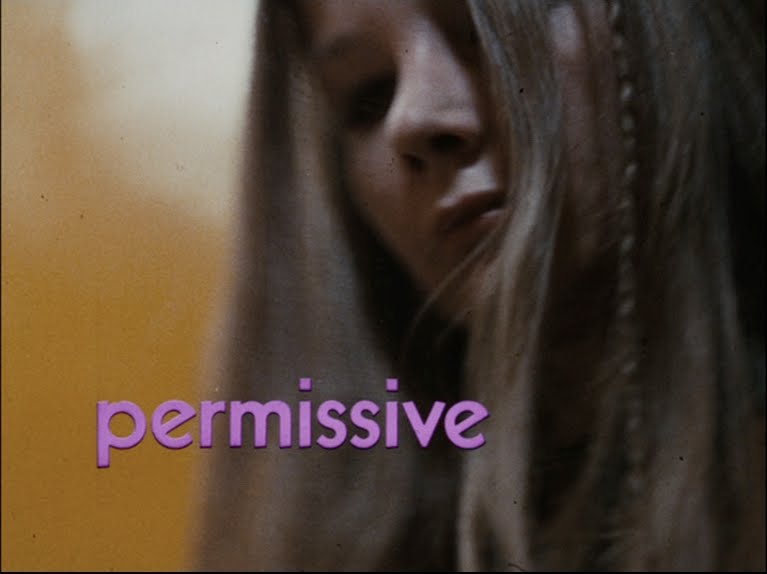 Most social histories have tended to portray 1970 as a fairly grim year for the British Isles. In the ‘mainstream’ of British life, it was the year in which Harold Wilson’s boom years ground to a halt and Ted Heath’s tory government took back the reigns of power in preparation for decade characterized by strikes, shortages, the collapse of national industry, rising unemployment and general entropy. In the underground meanwhile, 1970 was the year of dead rock stars, bad drugs, despondency and the slow death of the ‘60s dream, in which addictions deepened and acid disappeared, in which free festivals started to become disaster areas, bland post-Cream AOR trudge-rock became the norm and drab wool n’ corduroy replaced the paisley and chiffon of yore. And the weather sucked too. It was a bummer, in short.
 Not that such generalisations should be taken at face value, of course – I’m sure there were still loads of people who had a blast in 1970 – kids growing up, falling in love, having adventures, as they are apt to do, and grown ups doing the same, whilst savvy cats like The Edgar Broughton Band, Mick Farren and The Pink Fairies just blitzed through the whole period on a cocktail of booze, feedback and righteous indignation, bumping straight into punk on their way out. But nonetheless, it is this overall impression of 1970 as a colossal downer that concerns us here, as we examine ‘Permissive’, a confoundingly bleak attempt at a sexploitation flick that plays out more like an extended funeral for all the dreams of the preceding decade.
 Long discussed in hushed tones in the spaces where rare DVD-R traders meet underground music fans, largely thanks the presence of incidental music from acid folk enigmas Comus (British music geeks of a certain age reach breathlessly for their tape recorders), ‘Permissive’ can now be revealed as a film that is sullen, sordid and about as erotic as a beer-soaked hiking sock, but that is nevertheless a strangely fascinating cultural quagmire, making a perfectly obtuse addition to the BFI’s Flipside series.
With only a dufflecoat to her name, young Suzy (Maggie Stride) steps off the train in London – no back story, no hope and dreams, no nothing. Just think, a few years earlier she could have had a Smashing Time. But she’s too late; that ship has sailed, never to return. This is the London where club-footed pigeons hobble around looking for a place to die, where the only things swinging are wrecking balls and the autumnal fog never lifts. Somewhere up the road, Presuming Ed is snoozing in the bath listening to The White Album as Danny contemplates the rat in the oven.
Long discussed in hushed tones in the spaces where rare DVD-R traders meet underground music fans, largely thanks the presence of incidental music from acid folk enigmas Comus (British music geeks of a certain age reach breathlessly for their tape recorders), ‘Permissive’ can now be revealed as a film that is sullen, sordid and about as erotic as a beer-soaked hiking sock, but that is nevertheless a strangely fascinating cultural quagmire, making a perfectly obtuse addition to the BFI’s Flipside series.
With only a dufflecoat to her name, young Suzy (Maggie Stride) steps off the train in London – no back story, no hope and dreams, no nothing. Just think, a few years earlier she could have had a Smashing Time. But she’s too late; that ship has sailed, never to return. This is the London where club-footed pigeons hobble around looking for a place to die, where the only things swinging are wrecking balls and the autumnal fog never lifts. Somewhere up the road, Presuming Ed is snoozing in the bath listening to The White Album as Danny contemplates the rat in the oven.
 Suzy’s only contact in the Smoke is her friend Fiona (the excellently named Gay Singleton), who has found a niche for herself as groupie-in-chief to Forever More, a real life folk-rock combo who put out a couple of records on RCA in the early ‘70s. “He’s a bit hairy”, observes Suzy, regarding Fiona’s main squeeze Lee with understandable distaste. “Hey, would you like to meet the group?”, her friend responds, and Suzy’s fate is sealed.
In the movie as presumably in reality, Forever More are a bore – a bunch of surly hairfarmers who hammer out their lethargic, over-complex odes to pastoral idealism in dank basement clubs before retreating to safety of the nearest soul-crushingly anonymous, new-build Travelodge to ‘party’ with a few bottles of Newcastle Brown, a few joints and some weak-willed and sad-eyed runaway girls.
Suzy’s only contact in the Smoke is her friend Fiona (the excellently named Gay Singleton), who has found a niche for herself as groupie-in-chief to Forever More, a real life folk-rock combo who put out a couple of records on RCA in the early ‘70s. “He’s a bit hairy”, observes Suzy, regarding Fiona’s main squeeze Lee with understandable distaste. “Hey, would you like to meet the group?”, her friend responds, and Suzy’s fate is sealed.
In the movie as presumably in reality, Forever More are a bore – a bunch of surly hairfarmers who hammer out their lethargic, over-complex odes to pastoral idealism in dank basement clubs before retreating to safety of the nearest soul-crushingly anonymous, new-build Travelodge to ‘party’ with a few bottles of Newcastle Brown, a few joints and some weak-willed and sad-eyed runaway girls.
 “It’s a pretty happening scene, huh?”, somebody says with a faint edge of desperation, and at that moment you feel like stopping the film in order to step in and say – look man, I’ve seen some ‘happening scenes’ in my time, and this REALLY, REALLY is NOT one of them, ok?
Usually, it is part of the deal of rock n’ roll movies, and groupie/tour straggler narratives like this in particular, that they will present the corner of the music world they happen to be portraying in exciting, escapist terms – as a wild, dazzling demi-monde whose denizens laugh in the face of plebian reality. That’s essentially what we wanna see, and from ‘Summer Holiday’ through to ‘Beyond The Valley Of The Dolls’, that’s what we’re used to getting. Just look at the way Cameron Crowe took this same grim era of stale corporate rock and routine statutory rape and managed to turn it into a bucolic wonderland of sun-dappled dreams in ‘Almost Famous’ a few years back. Face it, if we wanted reality, ‘C***sucker Blues’ would be playing down the multiplex instead, and ‘Permissive’ right beside it.
“It’s a pretty happening scene, huh?”, somebody says with a faint edge of desperation, and at that moment you feel like stopping the film in order to step in and say – look man, I’ve seen some ‘happening scenes’ in my time, and this REALLY, REALLY is NOT one of them, ok?
Usually, it is part of the deal of rock n’ roll movies, and groupie/tour straggler narratives like this in particular, that they will present the corner of the music world they happen to be portraying in exciting, escapist terms – as a wild, dazzling demi-monde whose denizens laugh in the face of plebian reality. That’s essentially what we wanna see, and from ‘Summer Holiday’ through to ‘Beyond The Valley Of The Dolls’, that’s what we’re used to getting. Just look at the way Cameron Crowe took this same grim era of stale corporate rock and routine statutory rape and managed to turn it into a bucolic wonderland of sun-dappled dreams in ‘Almost Famous’ a few years back. Face it, if we wanted reality, ‘C***sucker Blues’ would be playing down the multiplex instead, and ‘Permissive’ right beside it.
 Even in the murk of the British exploitation industry, it’s hard to believe that there was time when making a sex film featuring a bunch of guys who look like Uriah Heap and some pasty-faced, malnourished girls in faded Grace Slick get-up seemed like a good idea. More likely I think, ‘Permissive’s backers (70s Britsploitation powerhouse Tigon) were counting on a more frivolous, feel-good sex/rock/youth culture flick. Director Lindsay Shonteff, still reelin’ from the sights and sounds of the ‘60s, thought he could cut some corners and get some good shit by filming reality… but unfortunately, reality had already f-ed up.
 ‘Permissive’ is at least pretty well made for such a quick, low budget affair, with some interesting directorial decisions, rich and detailed cinematography (a brief woodland sequence looks like the cover of the first ‘Sabbath album) and excellent London location shooting, not to mention some great music from the aforementioned Comus, jamming on some early versions of tunes from their classic ‘First Utterance’ LP.
The film’s chief innovation is the use of strikingly unusual time-fractured cut-up editing, in which characters seem to flash forward to their death/fate/future circumstances as soon as they’re introduced. Possibly these experiments could have been inspired by Nic Roeg’s recent work on ‘Performance’ and ‘Walkabout’, or perhaps they’re just the result of the director and editor trying to liven things up in the editing room. But either way, it works extremely well, imbuing ‘Permissive’ with a sense of disjointed artiness that the banal storyline and lifeless performances would otherwise have lacked, and helping cement the fateful, funereal atmosphere that seems to spread slowly across every aspect of the film, inadvertently allowing ‘Permissive’ entry into the strange international pantheon of off-beat sex films (mainly Japanese, it must be said) which continue to demand our interest today largely thanks to the way they inexplicably reject conventional eroticism in favour of crafting cinema that is jagged, unsettling, nihilistic and horrid.
‘Permissive’ is at least pretty well made for such a quick, low budget affair, with some interesting directorial decisions, rich and detailed cinematography (a brief woodland sequence looks like the cover of the first ‘Sabbath album) and excellent London location shooting, not to mention some great music from the aforementioned Comus, jamming on some early versions of tunes from their classic ‘First Utterance’ LP.
The film’s chief innovation is the use of strikingly unusual time-fractured cut-up editing, in which characters seem to flash forward to their death/fate/future circumstances as soon as they’re introduced. Possibly these experiments could have been inspired by Nic Roeg’s recent work on ‘Performance’ and ‘Walkabout’, or perhaps they’re just the result of the director and editor trying to liven things up in the editing room. But either way, it works extremely well, imbuing ‘Permissive’ with a sense of disjointed artiness that the banal storyline and lifeless performances would otherwise have lacked, and helping cement the fateful, funereal atmosphere that seems to spread slowly across every aspect of the film, inadvertently allowing ‘Permissive’ entry into the strange international pantheon of off-beat sex films (mainly Japanese, it must be said) which continue to demand our interest today largely thanks to the way they inexplicably reject conventional eroticism in favour of crafting cinema that is jagged, unsettling, nihilistic and horrid.
 Not that ‘Permissive’ is really jagged, nihilistic or horrid. In typically reserved English style, it’s more just… deeply MIFFED. Fed up. Washed out. A vengeful cinematic hangover. Despite the film’s title, none of the characters’ sexual exploits really bother attempting to be shocking or unconventional. So they shag each other a lot - well, why not, what else is there to do? Musicians and groupies alike seem like rats caught in the same trap, wondering forever around a maze of box-like hotel corridors, occasionally bumping into each other to share warmth and dissipate the boredom. Through most of the film, I don’t think anyone even smiles, let alone gives any indication of enjoying their partners’ company. Allan Gorrie, who went on to lead the Average White Band (never has a group been so aptly named), is presented to us as Forever More’s main man/prime catch, and even he looks like Whisperin’ Bob Harris’s uglier brother and seems to pay more attention to his cups of milky tea than he does to his lovelorn maidens.
About the biggest excitement in the world of Forever More comes when they cram themselves into the back of a Transit van for a few days playing gigs ‘up North’, and get to see some fields zooming by at the side of the motorway. And to think, these are the guys lucky enough to be signed to a major label and getting regular work! God I’m glad I wasn’t ‘on the rock scene’ in 1970. Watching ‘Permissive’, I found myself almost counting down the hours waiting for Ziggy Stardust and Roxy Music’s first album to come and save us all.
Not that ‘Permissive’ is really jagged, nihilistic or horrid. In typically reserved English style, it’s more just… deeply MIFFED. Fed up. Washed out. A vengeful cinematic hangover. Despite the film’s title, none of the characters’ sexual exploits really bother attempting to be shocking or unconventional. So they shag each other a lot - well, why not, what else is there to do? Musicians and groupies alike seem like rats caught in the same trap, wondering forever around a maze of box-like hotel corridors, occasionally bumping into each other to share warmth and dissipate the boredom. Through most of the film, I don’t think anyone even smiles, let alone gives any indication of enjoying their partners’ company. Allan Gorrie, who went on to lead the Average White Band (never has a group been so aptly named), is presented to us as Forever More’s main man/prime catch, and even he looks like Whisperin’ Bob Harris’s uglier brother and seems to pay more attention to his cups of milky tea than he does to his lovelorn maidens.
About the biggest excitement in the world of Forever More comes when they cram themselves into the back of a Transit van for a few days playing gigs ‘up North’, and get to see some fields zooming by at the side of the motorway. And to think, these are the guys lucky enough to be signed to a major label and getting regular work! God I’m glad I wasn’t ‘on the rock scene’ in 1970. Watching ‘Permissive’, I found myself almost counting down the hours waiting for Ziggy Stardust and Roxy Music’s first album to come and save us all.
 Anyway, it’s at one of the band’s unsavoury Travelodge hoedowns that Suzy bumps into a pretentious, meditating hippie kid about her own age who calls himself ‘Pogo’. In perhaps the film’s most heart-rending moment, Pogo rhetorically asks Suzy what she’s looking for in life, and she tearfully replies that she just wants something to eat. Pogo says he knows where they can get some grub, but first they have to go to “where it’s at”. After a freezing walk across town, “where it’s at” turns out to be a luggage locker in Kings Cross station where Pogo’s stashed a stale crust of bread and a lump of cheese. Clearly Pogo is a colossal twat.
 So timid and starved of affection is Suzy though that rather than punching him in the face there and then, she accepts this irritating weirdo’s hospitality, and elects to sleep rough on the street with him rather than returning to the groupie treadmill, busking in the subway and sharing a sleeping bag under the stars on a derelict bombsite. Despite Pogo’s unrelenting twattishness, this is probably the film’s most compelling and upbeat segment, with lots of beautifully desolate period location work and an almost touching chemistry between he two youngsters.
Hey, things still aren’t going great for this girl, we think, but at least she’s got a friend, even if he is a twat. That’s until Pogo is unceremoniously hit by a car anyway, the camera mobidly zooming in on his mangled body. Christ. With a broken heart and seemingly no other options, Suzy heads straight back to Forever More and proceeds to absent-mindedly sleep her way through band’s hierarchy, cruelly usurping whatever passes for ‘power’ in groupie-world from her former best friend, with tragic results.
So timid and starved of affection is Suzy though that rather than punching him in the face there and then, she accepts this irritating weirdo’s hospitality, and elects to sleep rough on the street with him rather than returning to the groupie treadmill, busking in the subway and sharing a sleeping bag under the stars on a derelict bombsite. Despite Pogo’s unrelenting twattishness, this is probably the film’s most compelling and upbeat segment, with lots of beautifully desolate period location work and an almost touching chemistry between he two youngsters.
Hey, things still aren’t going great for this girl, we think, but at least she’s got a friend, even if he is a twat. That’s until Pogo is unceremoniously hit by a car anyway, the camera mobidly zooming in on his mangled body. Christ. With a broken heart and seemingly no other options, Suzy heads straight back to Forever More and proceeds to absent-mindedly sleep her way through band’s hierarchy, cruelly usurping whatever passes for ‘power’ in groupie-world from her former best friend, with tragic results.
 Beginning with an overcast sky and ending with a lurid bathtub suicide, ‘Permissive’ is about as miserable as it gets, veering closer to the ultimate downer of Lukas Moodyson’s ‘Lilya 4Ever’ than to the kind of dubious entertainment a contemporary audience was presumably expecting; the film’s only instance of full frontal nudity is a corpse.
Whilst not a great film by any stretch of the imagination, ‘Permissive’ is certainly a unique curiosity, and on some level I suppose we should thank Shonteff for daring to rub the raincoat brigade’s noses in the dead dreams and blighted hopes of the young people they’d presumably paid their ticket money to get all hot and bothered by. And if ‘Permissive’ can be seen to present an accurate picture of youth culture in Britain circa 1970, it’s a wonder any of us made it through alive. Please, someone, bring on the glitter before it’s too late…
Beginning with an overcast sky and ending with a lurid bathtub suicide, ‘Permissive’ is about as miserable as it gets, veering closer to the ultimate downer of Lukas Moodyson’s ‘Lilya 4Ever’ than to the kind of dubious entertainment a contemporary audience was presumably expecting; the film’s only instance of full frontal nudity is a corpse.
Whilst not a great film by any stretch of the imagination, ‘Permissive’ is certainly a unique curiosity, and on some level I suppose we should thank Shonteff for daring to rub the raincoat brigade’s noses in the dead dreams and blighted hopes of the young people they’d presumably paid their ticket money to get all hot and bothered by. And if ‘Permissive’ can be seen to present an accurate picture of youth culture in Britain circa 1970, it’s a wonder any of us made it through alive. Please, someone, bring on the glitter before it’s too late…
Subscribe to:
Posts (Atom)