Friday, 17 August 2012

FRANCO FILES:
Macumba Sexual (1981)


AKA:
Amazingly, this appears to be a Jess Franco film only ever issued under one name.

Context:
Of the numerous films Franco made in the early ‘80s for Spain’s ‘Golden Films Internacional’, many seem to be pretty lightweight softcore flicks, leading me to speculate that they must have been somewhat taken aback when they threw on the reels for this one and discovered that their man had been inspired to deliver something wholly other on this excursion.

Content:
In narrative terms a straight rehash of the familiar ‘Vampyros Lesbos’ plot-line, ‘Macumba Sexual’ finds Canary Island-dwelling real estate agent Lina Romay (sporting a blonde wig in her “Candy Coster” alter-ego) being summoned to remote spot that’s either on the North African coast or a fairly large, sparsely inhabited desert island (it’s kind of unclear..?), where she finds herself falling under the psychic and sexual control of a possibly-undead African witch named, I’m afraid, Princess Obongo, played by infamous French sex/sleaze star Ajita Wilson.

Kink:
Although packed from start to finish with writhing naked bodies and orgasmic sex rites, including a few moments that are bordering on hardcore (I think the BBFC must have been sleeping on the job when they gave this an uncut ‘18’), ‘Macumba Sexual’ is not really the kind of thing that’s liable to get any well-adjusted individual ‘in the mood’, exactly.

Instead, it is one of a select handful of Franco films (his best ones, usually) in which sex is treated not just as fun and games, but as something far more dangerous and unsettling – as a means of attaining psychic domination over others, as a kind of hysterical compulsion, or a gateway by which dark forces might enter. Touching on all of these troubling notions to some extent, ‘Macumba Sexual’ is a pretty heavy trip through the darkest corners of Franco’s erotic imagination - not just a horror film with sex, or a sex film with horror, but a film in which the sex IS the horror.

Also, you get to see Antonio Mayans’ wang, and Lina walking around in some denim and lace-based outfits that present a significant challenge to the notion of ‘acceptable public apparel’. 4/5

Creepitude:
Presented by Franco as stifling, claustrophobic fever-dream where unchecked sexual dementia blurs into the menacing, repetitive trance of a folk-magick hex, the whole film has the feel of a series of hallucinations brought on by extreme heat and dehydration. The use of ‘sinister’ African imagery and fertility charms only occasionally borders on the goofy, and you can practically feel the deadening tropical heat oozing from the screen.

Often described as an “alleged transsexual”, whatever that’s supposed to imply, Ajita Wilson simply looks fucking terrifying here, and the blurry, sun-damaged footage of her striding through the sand of Lina’s dreams with her two drooling, dog-walking human slaves is truly the stuff of nightmares.

For any viewers still trying to hang on to the idea that they’re watching a conventional sex film even after all that business, the fearful mood is further enhanced by a soundtrack of droning electronic feedback and echoed faux-hoodoo vocal chants that is altogether more menacing than the kitschy fare that usually predominates in these kinda things, and Franco ups the ante further by busting out some impulsive moments of startlingly disorientating, near avant-garde filmmaking technique. 4/5

Pulp Thrills:
Nada. With the stylistic excesses of the ‘60s and ‘70s behind him, Jess is jamming econo here, and the film’s dark tone leaves little room for any genre-bending frivolity. Whether Princess Obongo’s assorted black magick fetishes and rites have any legitimacy beyond Franco’s warped imaginings and the handful of ropey props he picked up down the local tourist market is doubtful, but nonetheless the film’s magical/supernatural elements are played out in a surprisingly naturalistic and believable manner. 1/5

Altered States:
What…? Where am I? Did that just… happen? I don’t feel too good… there are sexy pictures in my mind, but they’re all kind of frightening. I think I’m going to go curl up in the corner, until it goes away. Can you open the windows, please? 5/5

Sight-seeing:
Of all the jarring modernist edifices and brutalist hotel blocks that Franco’s keen eye discovered knocking about in the Mediterranean during the ‘70s, the location used for Princess Obongo’s residence is definitely one of the most memorable – a complex of visionary Afro-futurist buildings overlooking a shimmering desert coastline, it lends an even more sinister and otherworldly quality to the events that transpire within. Elsewhere, long camel rides across the windswept desert, scruffy North African(?) harbour towns and footage of Lina travelling between islands on what appears to be an old fashioned sailing ship all combine to make ‘Macumba..’ feel somewhat like a holiday brochure put together by the Marquis DeSade. 5/5

Conclusion:
When Jess and the gang cruised out to some exotic locale to make a cheap porno in the late ‘70s/early ‘80s, most of the time they just came back with a cheap porno. But the fact that occasionally, when the stars were right, he could still knock out something as haunting and unhinged as ‘Macumba Sexual’ stands as a testament to the man’s unique talent, and as a welcome reminder of the reasons why some of us are driven to spend so much time to watching, reading and writing about his films, despite their often-pretty-questionable nature.


Tuesday, 14 August 2012

FRANCO FILES:
The Awful Dr. Orlof (1962)


AKA: “Gritos en la Noche”, “Cries in the Night”, “The Demon Doctor”, “The Horrible Dr. Orloff”, “The Diabolical Dr Satan”.

Context:
Well, this is where it all began folks. After directing a few largely unheralded features for the domestic Spanish market, 32 year old Jesus Franco exploded (well, maybe not quite ‘exploded’, but ya know what I mean) onto the world stage with ‘The Awful Dr. Orlof’. This was his first horror film, his first international co-production, his first film with Howard Vernon, and his first collaboration with Paris-based production house Eurocine, whose long reign as Europe’s leading purveyors of barrel-scraping sleazoid nonsense was largely kick-started by the success of Dr. Orlof.

Content:
Lik a number of other early ‘60s European horrors, ‘..Dr. Orloff’ unashamedly takes a hefty chunk of its inspiration from George Franju’s ‘Les Yeux Sans Visage’ (1959) (perhaps with a side order of Freda’s contemporaneous ‘..Dr. Hichcock’, and a touch of Giorgio Ferroni’s ‘Mill of the Stone Women’ (1960)), as the eponymous doctor (played by Vernon) stalks the sordid Victorian underworld of..wherever this film is supposed to be set.. in his top hat and opera cape, eyeing up beautiful girls and dispatching his zombie-like servant ‘Morpho’ (Ricardo Valle) to drag them back to his subterranean laboratory in an isolated chateau, where he conducts sinister skin graft experiments with the aim of returning beauty and vitality to his disfigured, comatose daughter. You can probably guess the rest, more or less.

Although Franco’s script is basically little more than a simplistic retelling of a story that was already over-familiar to horror fans by the time the film was released, he nonetheless returned to the scenarios presented in his first ‘hit’ again and again in subsequent years, resurrecting the characters (or sometimes just the names) of Orlof and Morpho on a regular basis, and attempting to remake the film shot for shot on several occasions.

Kink:
With the exception of a few moments of comparatively risqué footage shot for the film’s Paris release (and not included in the version I’m watching, unfortunately), ‘The Awful Dr. Orlof’ is a pretty chaste affair, conforming (on the surface at least) to the standards of decency expected of a 1962 horror movie. Look deeper however, and there is indeed a streak of weird, voyeuristic perversity bubbling up here and there, anticipating the preoccupations of Franco’s later work. In particular, the short-lived character played by Maria Silva in the film’s opening scenes certainly has the same lascivious presence as later Franco leading ladies, and the director’s particular fixations can be glimpsed both in the vigour with which she repels Morpho’s pursuit (far surpassing the traditional ‘faint & die’ approach of female victims in movies like this, despite her character supposedly being blind drunk), and also in the way that, once the brute has overpowered her and commenced carrying her unconscious body back to the lab, Franco’s camera holds close on her dangling, prone form, his interest concentrating on the motionless lady-carcass rather than the active carrier, to an extent that most filmmakers would have considered irrational and distasteful.

Although most viewers will scarcely even notice it these days, an extremely daring flash of topless nudity from one of the doctor’s unconscious victims has even led some to label ‘The Awful Dr Orlof’ “the first erotic horror film”, a claim refuted by those who point instead to an even more subliminal bit of boobage in the aforementioned ‘Mill of the Stone Women’. Both have a point I guess, but frankly if you find yourself engaged in a heated debate on the issue, it could be time to consider getting some fresh air and taking up a new hobby. 2/5

Creepitude:
In essence, ‘The Awful Dr. Orlof’ is an off-beat but well made gothic horror film, and if its plot-line is was never liable to have viewers gasping in disbelief, the fetid nocturnal atmosphere Franco conjures on his stingy sets still impresses, as does the wild vitality of the film’s chase/suspense sequences. Given the extent to which the director would soon become synonymous with a slapdash, improvisational approach to filmmaking, it’s interesting to note how deliberate everything in ‘..Dr Orlof’ seems, with mise en scene, framing and camera movements (slow dollys rather than disorientating zooms, you’ll note) all appearing to have been planned out to the nth degree. Daniel White’s startling, dissonant score helps too, and Vernon’s furtive, menacing performance (goofing slightly on Peter Lorre, not to the extent of outright pastiche) seals the deal, resulting in an overwhelming feeling of slimy, exultant creepiness. 4/5

Pulp Thrills:
Drawing not just upon the contemporary gothic tradition, but also German expressionism, 40s Monogram b-flicks, British Jack the Ripper-style Victoriana and the weird conventions of the Edgar Wallace Krimi cycle, ‘The Awful Dr. Orlof’ is a veritable car crash of mid-century European pulp aesthetics, mixing up elements from many of the popular entertainment forms that would proceed to live, die and reconstitute themselves into new forms over the coming decade. And a totally whacked out weirdo jazz soundtrack certainly doesn’t hurt either! 5/5

Altered States:
There are some who would argue that something about the staring eyes, warped surgical disasters and blaring mono sound of these early ‘60s horror movies is inherently psychotropic, but I don’t know if I’m quite buying it in this case. The wealth of dreary, uninspired investigation scenes that pad things out in between the doctor’s depredations keep dragging things back down to earth, and… well, this will probably be the first and last time I’ll ever have cause to say such a thing about a Jess Franco movie, but basically ‘..Dr. Orlof’ is just too linear and plot-driven for me to really zone out on. 2/5

Sight-seeing:
Back in the early ‘60s, circumstances meant Franco was more inclined toward films with urban settings and purpose-built sets, and as such there’s not a great deal of local colour to be found here (in fact it’s not even clear which country the film is supposed to be set in – a detail perhaps left deliberately vague to aid international sales). That canal that Orlof and Morpho row along to get to the doctor’s lab certainly looks nice though, as does the ruined chateau that’s used for the exterior shots of his hideout. 2/5

Conclusion:
Though its impact is dulled somewhat by overbearing influence of the films that came before it and the excess of the years that followed – not to mention the arid stretches of investigative tedium – ‘..Dr. Orlof’s best scenes nonetheless convey a crazy, fast-moving visceral power that marks the film out as the work of a director embarking on a different journey entirely from his gothic/krimi contemporaries.

Sunday, 12 August 2012

FRANCO FILES:
Introduction


Well, it’s been almost a year since I posted my initial reappraisal of Jess Franco’s work and promised to bite the bullet and start writing some reviews of his films. I think the time has come. As I stated in that post, I think trying to do conventional, full length reviews of individual Franco films would be foolish in the extreme. To use a rather pungent film/music metaphor, Franco is less like a guy playing individual ‘songs’ and waiting for applause and more like an avant garde noise musician – sending out a constant roar, twisting dials and pushing buttons to vary the tone and create new effect, regardless of whether you like it or not. This methodology, plus the sheer weight of his output (drawing up a shortlist, I’ve got about twenty five titles sitting here awaiting review, and I’m by no means a dedicated collector), calls for a new approach.

Thus: The Franco Files. My aim here will be to look at each of the available films in turn, outlining context and content, rating how they stack up in terms of the various factors that make for a perfect Franco viewing experience (kinkiness, creepitude, pulp thrills etc) and assessing the way in which they fit into the wider stream of the Franco-verse. I’ll probably do these write ups in fits and starts, as and when I feel like it, but the basic plan will be to do them in batches of three, each consisting of one of the earliest Franco films I have access to, one of the latest (currently I’ve not ventured much beyond the early ‘80s, mind you), and one from somewhere in the middle, thus hopefully allowing us to build up a relatively balanced picture of the innumerable wild tangents he embarked on during his three decades or so of peak productivity.

I’m probably not the first to undertake such a lunatic endeavour, and no doubt I won’t be the last (we await Stephen Thrower’s forthcoming Franco book with something akin to a teeth-grinding frenzy of anticipation), but if it helps in some small way further spread knowledge, inspire discussion - and perhaps even evoke understanding - of the work of the one man cinematic hurricane that is Jesus Franco, then perhaps all those nights when I’ve found myself dazed on the sofa at 1am wondering what in the hell I’m looking at won’t have been wasted.

Wednesday, 8 August 2012

Belated Deathblog:
Ronald Searle
(1920-2011)

When the celebrated illustrator and cartoonist Ronald Searle died in December of last year, I wanted to do a tribute post to him here, but felt that that post should consist of some choice examples of his work, rather than just pointless, poorly thought out words. Unfortunately though, my ability to present such examples was compromised by my failure to locate the volume that features all of my favourite Searle drawings, and furthermore represents my main point of connection with his work. Images available online proved generally unsatisfactory, and so, rather than cobble together some half-hearted obit post, I abandoned the idea.

Now though, the collection ‘Hurrah for St. Trinians’, published in hardback in 1948 by McDonald of London, and eventually purchased by me from a second hand bookshop in Shrewsbury for the princely sum of £2, is back in my hands, and we can proceed apace.

I have very fond memories of finding and buying this book, then sitting in the park with some friends, laughing ourselves stupid as we looked over the cartoons within. Why did we laugh so much? It’s difficult to explain really. After all, most of the ‘gags’ in Searle’s cartoons are pretty weak, bordering on non-existent, but… that’s not really the point. It’s the detail, immediacy and uncanny vitality of his artwork – sort of an unlikely combination of subtlety, precision and absolute dementia - that raises a fair few of them to the level of genius. ‘Mr Eccle Shave’ in particular has lived on in my mind, making me cackle at inappropriate moments, ever since.

As the venerable D.B. Wyndham Lewis puts it more eloquently in his introduction to the book:

“In a Parisian gunsmith’s window a short time ago I saw a delightful little automatic, handbag-size, with a butt of pink-and-blue enamel designed with Cupids and butterflies; just the thing for the Ritz cocktail hour. Encountering the satiric art of Mr. Ronald Searle in due course, it struck me at first glance that the infinite grace and finesse of his method of liquidating the Booboisie was strangely similar, but I was wrong. Mr. Searle is adverse to heat and noise. There is no bang, and his victims do not tumble off their stools in grotesque attitudes, interrupting polite conversation and annoying the barman. They subside quietly and very gently into decorative patterns and don’t know what hit them. It is, so to speak, a fine Florentine blade slipped with regretful courtesy under the fifth rib, and Mr. Searle is all too sadly aware that the Cinquecento engraving on the blade is wasted on those dopes.”

And so, without further ado, here’s the Florentine blade in action.


Monday, 6 August 2012

Scala Beyond.


Just thought I’d write a quick heads up for any London/UK based readers, to alert you to the existence of the Scala Beyond season – sequel to last year’s Scala Forever - which is taking place through August and September. I accidentally found myself wondering into the press launch for the season a couple of weeks back, and my heart swelled with joy to see a line-up of events even more idiosyncratic and crazed that last year – a veritable cornucopia of THE-KINDA-STUFF-WE-LIKE-AROUND-HERE, and a great chance to create/experience a kind of movie-going that’s neither Hollywood blandness nor sniffy arthouse, but just… weird and cool and good, y’know?

Because really, who could say no to the rare opportunity to sit in a public space with other people and watch stuff ranging from ‘The Erotic Rites of Frankenstein’ to ‘Kilink in Istanbul’ to ‘Q: The Winged Serpent’ to ‘Penda’s Fen’? Well… truth be told, I didn’t actually make it to many of last years screenings for various reasons, but I’m damn well going to do my damnedest to get along to as many as possible this year, so if anyone else out there is thinking of attending, by all means give me a shout.

In particular, those who share my belief that Saturday nights are best spent in a haze of whisky and pro-plus powering through stuff like ‘Lady Terminator’, ‘Messiah of Evil’ and ‘Fascination’ are encouraged to check out the listings for Filmbar70’s various all-nighters… could be quite an experience.

Oh, and there are other things happening in other UK cities too – Edinburgh, Manchester, Birmingham - and even out-of-town events in Cumbria, Northamptonshire etc., if you happen to live near those places.

Anyway, a full line-up of events can be perused via a handy interactive menu on the website. Good luck and god bless, etc.

Wednesday, 1 August 2012

The Devil’s Rain
(Robert Fuest, 1975)


As I found myself preparing to watch ‘The Devil’s Rain’ last week, I thought it might be fun to do something a bit different with this review - kind of a ‘Live Blog’, recording my observations as they occur to me whilst viewing. So, headphones on and VLC Player and Word document open side by side, that’s exactly what I did. Grammar, phrasing and fact checking have subsequently been revised, but aside from that, what follows is an exact record of the transactions that took place on that fateful night, between this 1975 motion picture and my brain.

00:35 Hieronymus Bosch credits sequence. Inspired or lazy? Your call. Either way, something tells me ‘The Devil’s Rain’ is unlikely to be able to live up to magnified details from ‘The Garden of Earthly Delights’ presented here.

01:00 One of those movies where you feel like the casting director (Lea Stalmaster, take a bow) should be driving around in a golden Cadillac. Ernest Borgnine, Ida Lupino, William Shatner and a pre-fame John Travolta – together at least.

01:20 Anton LaVey as ‘Technical Advisor’? Gimme a break. Total mersh Satanist movie.

01:40 Until his credit popped up, I had no idea this was directed by Robert Fuest (‘The Abominable Dr. Phibes’, ‘The Final Programme’). Expectation.. rising.

05:40 “Winds…. knocked the lines down!” – ah, William Shatner. How have I managed all these years, watching films that he’s not in?


07:20 So… Shatner’s father has returned home, cryptically noted that ‘Corbis’ is waiting in the desert, waiting for the book, then promptly melted into a pile of multi-coloured poster-paint goo, right there on the doorstep. Ida Lupino has intoned the words “In nomine Satanis” for presumably the first and last time in her storied career, and Shatner’s reaction shot says it all. So far this is… awesome? Well it depends on your point of view I guess, but I’m pretty happy with the way things are shaping up.

9:00 Grimoire hidden under the carpet. They’ll never find it there! I like how this book is being imbued with such vast metaphysical import. Kinda reminds me of those Lovecraft stories wherein even being in the room as the Necronomicon is enough to drive you to a state of nervous paralysis.

10:00 Shatner’s got a magnum and a cowboy hat. He’s going to fight the devil… on his terms. I can scarcely wait.


11:45 Goddamn. I was going to crack wise about the family’s strange, kindly-old-man servant (I think he’s a servant of some kind? Although he could just as easily be an uncle or something? I don't think it's ever made clear..), but this scene in which Shatner finds him tied to the ceiling by his feet, shrieking like a trapped beast, is actually incredibly upsetting. A very peculiar and unnerving performance from TV actor Woody Chambliss (who also played the kindly old man in Jim McBride’s unusual post-apocalypse movie ‘Glen & Randa’).


14:00 Man, the composer is reeeaaallly pushing that creepy dissonant, scraping glissandro string stuff. It can still be a great effect on soundtracks when done well, but the way he’s hammering it here is just beyond ridiculous, blasting it beyond cliché and out the other side.

16:00 Great, dreamy landscape shots illustrate Shatner’s journey to ‘the desert’. Loving the abandoned chapel set against the sky. For a mainstream(ish) studio picture, ‘The Devil’s Rain’ has a very disconnected, otherworldly atmosphere going on – reminds me slightly of dope-addled hippie era horror movies like ‘Werewolves on Wheels’ and ‘The Velvet Vampire’.


16:30 I love the way that the abandoned settlement where the Satanists dwell is obviously just a backlot Western town; “Be careful stranger, no one’s set foot in that there ghost town since they finished doing second unit work on ‘The Outlaw Josey Wales’ last month…”

16:59 Tumbleweed!

18:00 Borgnine!


18:20 Borgnine’s water is bitter…but it’s a sweet way to end a thirst. Do I detect a certain fairy tale quality to this story?

20:33 A challenge! Shatner’s faith against Borgnine’s! I don’t know what to think.


21:40 Chanting… altar… pentagram. Job’s a good ‘un.

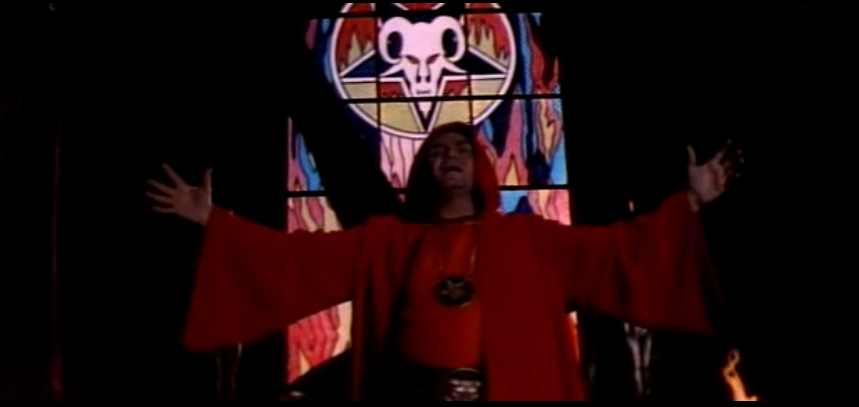
23:20 “Come forth from the abyss… open wide the gates of hell” – hmm, pretty corny stuff this. Old Anton earning his cheque, no doubt. Awesome stain glass window though, and I appreciate the shots of the dude playing the organ.

27:00 Satanists bleed multi-coloured goo. Protective talisman turns into a snake. Eyeless Lupino (un)stares on, and Shatner’s on the run. This whole sequence is really well shot.


29:00 Whoa, sudden scene change! Ok, so… is everything we’ve seen so far actually taking place in the subconscious of a woman (Mrs Preston? Shatner’s moustachioed brother’s wife?), who is taking part in some kind of ESP experiment in front of a lecture theatre full of students…?

31:30 Well, no, actually. Turns out that was just some kind of inexplicable diversion. Now we’re back down to… well I hesitate to say ‘earth’, but wherever it is the preceding scenes have been taking place…where Moustachioed Bro and his wife have returned home in search of his vanished family. The sheriff says half the county’s been washed away by the floods and he can’t possibly spare any men, but uh, if you guys want to grab some guns and go hunting for yr missing relatives in that old Western backlot town, be my guest – gimme a call in the morning or whatever and let me know how it goes. Now that’s the kind of light touch approach to law enforcement I can get with.

34:00 William Shatner fears not the torments of hell. In case you had any doubts.


37:00 Beautifully symmetrical long-shot of the car pulling up outside the frontier chapel… hokey as all this is, Fuest seems to be doing his best to build a real strong sense of oneiric disorientation…

43:00 Ladies and gentlemen, introducing John Travolta in his debut screen appearance, being kicked down the stairs by a dude with a moustache.

44:45 Red-tinted flashback to the Satanists’ origins as a heretical puritan sect back in colonial days. I’ll admit that my grasp of American history might be a bit shaky in places, but I wasn’t aware that many 17th century puritan sects made it out quite as far as Southern California..?


46:50 Love Ancestor-Borgnine’s faux innocence: oh, tis a mob of flaming torch weilding villagers at the door. What brings you fellows out here so late in the evening?

47:20 “Thou art the one… SLUT!” – another dialogue first for a great actor.

49:00 Ernie pulls some real oomph into his obligatory burned-at-the-stake “I curse you all” speech.

52:00 Ok, so thus far I wouldn’t go as far as to say this movie is ‘good’ exactly, but I certainly respect the filmmakers’ decision to turn in a film for a Hollywood studio that not only goes for a full-on delirious/dreamy fantastique atmosphere, making *no attempt whatsoever* to frame its action in the real world, but also seems to have been scripted by a somnambulant wino who once read a Dennis Wheatley book…

52:30 Holy shit! Maybe it’s just because I’m watching this with headphones on in the dark, but that wholly predictable backseat-of-the-car jump scare really put the wind up me. For all that I dissed the soundtrack above, the sound mix here was fucking murderous.

55:00 I wish I could have been there when they were filming this mass Satanist rally in the desert. Looks like a beautiful evening. All the open flame blowing in the breeze, sackcloth against yr skin… ah, that’s living.


56:15 So, uh… there was just a sudden insert shot of a dynamite explosion and now Ernest Borgnine has turned into a furry-faced, horned goat-man.

58:00 You too may wish to by sprinkled with ‘the waters of forgetfulness’ after watching Goat-Borgnine torture a shirtless William Shatner.

60:00 Goat-Borgnine looks too mischievous and lovable to really be a decent villain. I want him to caper off and lead us to a whimsical fantasy adventure of some kind, not stand here droning on about the doom that awaits our immortal souls.


70:30 This ‘devil’s rain’ vessel full of howling souls thing is a neat special effect. Very much reminds me of the kind of tricks Fuest was pulling off in ‘..Dr. Phibes’.

77:00 Vengeance of Goat-Borgnine forestalled due to melting.

79:30 More inexplicable dynamite blasts, to accompany the melting. You’d think God was some sort of unhinged mining prospector, the amount of bang-sticks he seems to be throwing around the place.

82:00 You know, everything I’ve read about this film over the years has mentioned the ridiculous amount of time dedicated to the melting of the cultists, but now that I come to watch it myself, I’m kinda disappointed. I was expecting a sequence of unparalleled repetitious madness, but actually the time allotted to the melting seems fairly reasonable. I mean, they clearly had a lot of cool melting effects to show off, and nothing much else to offer by way of a finale (give or take a few sticks of dynamite), so four or five minutes of melting doesn’t strike me as particularly excessive. In fact I could easily have gone for some more melting. I wanted a whole endless, senseless psychedelic melting extravaganza, goddamnit!


84:00 Chapel explodes – again, for no reason.

85:00 Well, there we have it folks. ‘The Devil’s Rain’. It is what it is, I suppose. Despite being probably one of the silliest films ever bankrolled by a Hollywood studio, it’s certainly worth a watch for us weirdo horror fans. It has some great ideas and distinctive visuals, and if they’d focused more on the darker aspects of the story and not made the portrayal of black magic so cartoon-ish and OTT, it could have been a pretty effective weirdo horror film. As it is though, the writing is intolerably flimsy (even from a Euro-horror fan’s POV), the acting is jaw-droppingly bad (ditto), the pacing is all over the joint, and the whole thing never quite comes together the way it should. Ah well – I still kinda enjoyed it, and I’m glad they had the guts to make it the way they did, rather than just doing some lifeless Exorcist/Omen knock-off and pleasing the suits. It brought us the sight of Ernest Borgnine turning into a giant goat and melting into a pile of poster paint goo, and for that I am thankful.


And thus ends our survey of '70s Backwoods Satanist Movies That Inexplicably Feature Great, Sam Peckipah-affiliated Actors. If anyone can think of any more that I might have overlooked though, please let me know, and I'll track them down post-haste!

Monday, 30 July 2012

Deathblog:
Chris Marker
(1921 – 2012)


Chris Marker died yesterday, on his 91st birthday.

If you’ve never watched ‘La Jetee’ (1962), now might be a good time to do so.

Tuesday, 24 July 2012

VHS Purgatory:
The Brotherhood of Satan
(Bernard McEveety, 1971)


When I reviewed lovably eccentric Louisiana witchcraft movie The Witchmaker a few years back (mental note: gotta get a watchable copy of that some time), I failed to make the connection between producer L.Q. Jones and the gaunt cowboy actor of the same name who turns up in most of Sam Peckinpah’s ‘60s/’70s films. Partly I just wasn’t paying that much attention, and partly it just seems kinda unlikely, y’know? Well, turns out that it actually was that same L.Q. Jones, and that following the success(?) of his first venture into low budget occult horror, he and co-producer/actor Alvy Moore actually took a second shot at the genre, with Jones persuading his frequent on-screen partner Strother Martin to co-star in 1971’s Texas-lensed ‘The Brotherhood of Satan’. (You’ll remember the pair as the hapless bounty hunters in ‘The Wild Bunch’, and the varmints who leave Jason Robards to die in the desert in ‘The Ballad of Cable Hogue’.)

Regrettably, what they came up with is a dull and rather mystifying stab at the early 70s “Satanic panic” sub-genre, mostly lacking the self-contained charm of its predecessor. But, it is at least a lot stranger than the already fairly strange 'Witchmaker’, and that’s gotta count for something.

What manner of madness is this, you may find yourself asking from the outset, as the film opens with motion-blurred close-ups of tank tracks crushing piles of metal, accompanied by grinding machine noise and occasional sounds of people screaming in terror, intercut with shots of a wind up toy tank (shades of ‘Astro Zombies’). When this… whatever it is.. has been completed, we see a small boy walking away from a pile of smouldering wreckage. Climbing a hill, he meets a couple of other children, including a girl who begins to brightly glow in supernatural fashion – cue animated credits sequence.

After that, we’re introduced to a happy family who are having a nice day out near a.. lake? I guess it’s a lake. Driving off, they travel along a desert road, where they discover the crushed car seen in the prologue. Heading to a nearby town to report this rather extreme ‘accident’, they meet with an inexplicably hostile reception, as the cops immediately rough up and interrogate the father, before a crowd of locals descend upon their car in a kind of mass rage. “You took them away from us!”, a man who looks rather like Fidel Castro yells despairingly as the family turn tail and get the hell out of there.

Strange stuff this. Definitely uneasy. Not at all a good end to a day at the lake. But yes – unease, unease, unease seems to be prolific TV director Bernard McEveety’s bag, his apparent disdain for establishing shots and clear transitions leaving us with an uncomfortable mixture of blurry, abstract close ups and cramped, medium shot dialogue scenes that never really settles down into any kind of sensible rhythm.

The actual storyline of the film, once we’ve figured it out, is predictable bordering on tedious – a coven of elderly citizens are using Satanic powers to prevent local people from leaving town, and hypnotising/stealing their children one by one, so that they can transfer their spirits from the older bodies to the younger and continue their unholy existence. Ho hum. A pretty straight-down-the-line set up for horror fans, and unfortunately one that veers closer to the oh-so-‘70s threat-to-the-family vibe of ‘The Stepford Wives’ or Bert I. Gordon’s achingly dull ‘Necromancy’ than to the more decadent, whacked out brand of Satanism I tend to favour.

But linear though this plot may be, it becomes unbearably confusing simply due to the film’s refusal (or inability?) to really communicate anything to us very effectively. Hard to explain quite what I mean, but basically this is the kind of film where at any point characters we’ve never seen before can start wondering around, talking about stuff we have no interest in; in which we’re never quite sure where or why a certain scene is happening, or what pertinent information we should take away from it. Whether the result of incompetent editing, heavy cutting or reliance on incomplete footage, or just an admirable (if doomed) attempt to avoid exposition-heavy dialogue, the result is that we’re often simply lost.

I know at this point you’re probably thinking “great, I love movies like that”, but the kicker here is that not a great deal happens to make any of this narrative heavy lifting worthwhile. Despite some moderate outbursts of violence and fright, the whole thing has an inescapable TV movie feel about it, which certainly gels with McEveety’s CV. But imagine a TV movie directed by someone who seems to be looking to Jess Franco as a paragon of narrative efficiency, and you’ll start to get the idea.

Not that the Franco comparison extends much further than that, unfortunately. Certainly Uncle Jess wouldn’t think much of ‘Brotherhood..’s subdued retiree Satanists, led by head cultist Strother Martin, here mustering little of the energy he brought to his western roles as he intones some totally square Satanic litanies (just yr typical “oh Lord Satan..” sorta stuff really). Admittedly, their hideout does have a couple of pretty cool sets (that cobweb-shrouded giant ankh gateway thing is a bit of an eye-opener), and all that business with making hypnotised children stand motionless on marble pillars is pretty peculiar and subliminally disturbing, but… yeah, not much doing really.

In essence I think ‘Brotherhood of Satan’ is a viewing experience very well suited to the pungent charms of this 1989 Parkfield Entertainment VHS (other titles in the “Hollywood Horror Collection” include ‘Torture Garden’, ‘The Mutations’ and ‘Blind Terror’). As well as the coating of nutritious fuzz, adding an extra layer of unearthliness to otherwise mundane imagery, it’s a good one for drifting in and out of sleep to as the VCR wheels whir.

In fact, good advice for watching this one would be… well actually good advice would be to watch something that provides some degree of entertainment value or emotional/intellectual engagement instead. But if say you were to find yourself stuck on some hellish airline where they’re showing this as the inflight movie, taking some sedatives and just letting it roll over you is definitely the way to go.

Yes, watching whilst fully awake would be a mistake. You’d only start asking questions. Why do the elderly Satanists seem to be letting a a young-ish woman join their ranks? Why - possibly as a result of this, possibly not - does one of the elderly women in the coven have to beg for her life before the altar and then stand motionless on a pillar with the kidnapped children whilst the rest of the cult mock her? What’s the reasoning behind giving Strother Martin’s character a ‘real world’ identity as the town’s mild-mannered doctor? (His secret identity as head Satanist is never revealed to the good guys, and he never uses any of the information he’s learned from hanging around with them to modify the plans of his cult - in fact he does bugger all in either of his identities really). Why, after a typically confusing scene in which it is implied that two people have died, do we see our male lead (who wasn’t there) walking shell-shocked through some hellish basement full of body bags as the police question him?

No, best not to worry about any of that. Just wash half a sleeping pill down with a few stiff drinks. As you drift in and out of consciousness, strange pictures will appear, flickering across your mind’s eye, hinting at far stranger mysteries than this the sober surface of ‘The Brotherhood of Satan’ is able to provide.

Men in monastic robes move hypnotised, formally attired children around on a chequered floor, like chess pieces.

A woman sinks into an armchair, experiencing some sort of seizure, as her husband(?) sits disinterestedly behind her, reading obscure and/or oddly translated bible verses aloud.

A distraught deputy sheriff chases the dust cloud kicked up by a departing car, waving an orange toy monkey above his head.

These are the building blocks ‘The Brotherhood of Satan’ offers the brave somnambulist. Dare you try to assemble them..?

Wednesday, 18 July 2012

Race With The Devil
(Jack Starrett, 1975)


Having inadvertently formalised the concept of “70s Backwoods Satanist Movies Inexplicably Featuring Great, Sam Peckinpah-Affiliated Actors” (or 70sBSMIFGSPAA, if you will) in my Borgnine obit post last week, I thought the least I could do was undertake perhaps the first ever deliberate overview of this much overlooked sub-genre, beginning with what is probably its commercial and creative high water mark, 1975’s ‘Race With The Devil’.

Before we begin, I’d suggest having a good look at the UK quad poster art reproduced above. Imagine walking past a cinema and seeing THAT outside!* I’m sure we can all agree that there would be no possible option but to go in and buy a ticket immediately. Clear the diary, family commitments be damned – I am going to see this movie in which Peter Fonda and Warren Oates fight hooded Satanists with shotguns and drive a tooled up camper van off an exploding bridge, and I am going to see it now.

Such is the kind of reaction ‘70s exploitation distributors seem to have been banking on through much of the decade, and so my feeling of having been born several decades too late increases. I mean, fuck Batman, y'know? I know where my hypothetical dollar is going. Not that ‘Race With the Devil’ is exactly an exploitation film in the strictest sense guess, being bankrolled and distributed by 20th Century Fox… but, well, I’ve always been a little confused as to what precisely it is, to be honest. On the one hand, it’s got a totally stupid horror plotline and a mind-blasting, action-packed poster that would put Roger Corman or Crown International to shame, but at the same time, it’s got big studio money behind it and… Peter Fonda? Warren Oates? I mean, those guys maybe weren't A-grade marquee names in ‘75, but they were still proper actors, y’know? Men who picked their projects carefully and tried to make sure they ended up in quote-unquote good films – that being a very definite distinction back in the pre-Spielberg ‘70s, and one that did not tend to embrace crazy-ass scripts about rampaging Satanists and exploding camper vans.


So what happened? How did they both end up doing this film? Did Fox throw their weight behind producers Wes Bishop and Lee Frost (whose Saber Productions brought us the unforgettable mad scientist/race relations extravaganza The Thing With Two Heads in ’72) before or after the talent was on-board? I have no idea, but I bet there must be a good story behind it.

One thing I do know is that Fonda and Oates were good buddies in real life, so maybe that had something to do with it. The pair played out a close, borderline homoerotic, friendship in Fonda’s excellent directorial debut ‘The Hired Hand’ (which I reviewed here), and as the legend has it they spent much of the early ‘70s palling around off-screen as well, buying land next door to each other in Montana, enjoying a relaxing lifestyle of huntin’, shootin’, fishin’, and no doubt male bonding like crazy.

So with its rural location shooting, rip-roaring action scenes and broadly similar tale of two happy-go-lucky dudes enjoying each other’s company, perhaps the script for ‘Race With The Devil’ simply offered them a fun way to collect a pay cheque whilst continuing to have a good time together (and without requiring them to really knock-one-outta-the-court acting-wise, the way they’d have been expected to do in a ‘serious’ film)..? Pure speculation of course, but who knows. I mean, this was the ‘70s. Maybe they just had Bishop & Frost round for dinner one night, busted out the coke, got talking about this great idea they had for a movie and hey…. y’know how these things go. Before they know it they’re sitting in the camper van, taking direction from biker movie/blaxploitation veteran Jack Starrett, wondering how all this might affect their hopes for an Oscar.


And as to the movie that resulted? Well in spite of the talent and studio backing, Bishop & Frost’s script remains pure boilerplate exploitation, reheating some Satanist paranoia from ‘Rosemary’s Baby’, mixing it up with fresh “rich city folk run into trouble in the country” riffs ala ‘Deliverance’, adding last reel car chase appeal and simmering til lukewarm. With correspondingly bland direction and lesser actors in the lead roles, ‘Race With The Devil’ could easily have been rote schedule filler of the William Girdler / William Grefe variety, but thankfully Starrett steps up to the plate with some surprisingly accomplished filmmaking, and Fonda and Oates can’t help but remain as charismatic as ever, irrespective of their intentions in taking on the project.

With a keen eye on the clock, the movie doesn’t spend a great deal of time on “getting’ to know the characters” type set up, but the stars ease into their roles so naturally it feels like we’ve known them for years. Perhaps drawing on their real life friendship, the dynamic between the two is established with scarcely a word needing to be uttered: Pete is the young(ish) hot-shot pro motorcycle racer, Warren his slightly older, crankier mechanic/garage owner buddy, and all is right with the world.

Oates is boastful and belligerent (bringing back a touch of his character from ‘Two Lane Blacktop’), but also sorta down-at-heel and self-deprecating – he realises he’ll never be as handsome or physically capable as his younger buddy, but that’s damn well not going to stop him trying, bringing his greater wealth and experience into play where necessary. This contest for alpha male status occasionally leads the two to bicker, but they always pull back from a full-scale argument, realising that their friendship is more important than their egos. Isn’t that sweet?


Of course, despite the focus on close male friendship, the film would also like to make clear that there’s nothing funny going on here, ya hear?, and to that end, both men have naturally brought their wives along for the ride. And this sadly is where the movie falls down as a potential character piece or small cast survival drama, simply because neither wife is really ever given the opportunity to develop much of a personality. It’s not that the script paints them as inept or empty-headed or anything, and it’s not the fault of actresses Loretta Swit and Lana Parker, who do a perfectly credible job; it’s just that whilst the men are granted fully fleshed out characters with a believable and interesting relationship, the women remain just.. their wives, sidelined to the extent that by the time we reach the end of the movie it’s still hard to tell them apart – a definitive example of the kind of ‘invisibility’ of married women in babyboomer-era culture that Fonda critiqued so thoughtfully in ‘The Hired Hand’ in fact. Oh well. Can’t exactly blame him for not learning his lesson here I guess, as he’s going to work solely with his ‘actor’ hat on. And like I say, this was the ‘70s. Presumably Swit and Parker’s real life equivalents were busy making sandwiches and rolling joints whilst the boys were yakking up a storm about this crazy movie they were gonna make?


Just as poorly served by the script are the film’s Satanists. Admittedly, the central sacrificial ritual that kick-starts our chase / flight narrative is pretty cool and effectively surprising / violent / chilling (plus I just can’t get over the genre-shredding surreality of seeing Warren Oates in an ill-fitting bobblehat inadvertently stumbling across a black mass – “ooh, they got, uh, some robes, and they’re havin’ themselves a dance..”). Beyond that though, the idea of an omniscient Satanic cult controlling a remote Texas county never quite convinces.

If, as if strongly implied, the cult covertly exercises control over populace and law enforcement within their domain, why do they spend most of the movie playing sneaky ‘cat & mouse’ games with the outsiders who have witnessed their sacrifice, rather than just killing them at the first opportunity? I mean, what’s their game-plan here? Do they think that if they just *scare* these people enough, they won’t bother to mention all the sinister goings-on to anyone once they’re safely over the county line? And also, if the cult exerts such omniscient power in a community of well-fed rednecks and ‘regular folk’ (presumably encompassing local officials, politicians, business leaders etc), how come their big ritual gathering is just some threadbare get together on a bare hillside, attended by a few scrawny hippie types?

Going further, we could also ask why the clerk in an apparently Satanist-affiliated gas station happily sells our heroes a shotgun and ammunition whilst they’re on the run, but… such are the questions you’ve got to contend with when you let the guys who came up with ‘The Thing With Two Heads’ write your script, I suppose.


I guess there probably wasn’t much Jack Starrett could have done to patch up weaknesses in the writing (not really your bag when yr a hired director and your producers wrote the script), but thankfully his work here is solid throughout, keeping things tense and well paced, with imaginative mise en scene, plenty of camera movement, tight cutting, bright colours and effective night shooting, plus lots of incidental local colour and period charm - everything you could ask of a no nonsense bit of commercial cinema really. Along with the quality lead performances, it’s this technical professionalism and directorial suss that goes furthest in helping ‘Race With The Devil’ live up to its unique concept, somewhat transcending its origins as a drive-in timewaster in spite of the script’s inconsistencies.

One element I thought worked really well was the ambiguity of the situations our characters encounter in the aftermath of the ritual. In particular, the scenes in which Fonda and Oates report what they’ve seen to the local sheriff are excellently played. Clearly something is awry with the cops’ flippant attitude and shoddy procedures, but to what extent are they implicated? Are they fully paid up cultists, are they just following the orders of some local bigwig who’s told them to keep clear, or are they simply lazy and inept? Even by the end of the film, we’re not quite sure.** A lot of horror stories tend to overplay their hand when it comes to stuff like this, throwing in some obvious giveaway (Lovecraft did so in just about everything he ever wrote, much as I love him), so to encounter a tale where it’s genuinely difficult to judge the trustworthiness of characters or surroundings is refreshingly unnerving.

As paranoia grows, the uncertainty that results from a mixture of incidents that could maybe, possibly be imaginary (broken phone lines in gas stations, creepy, starin’ locals) and threatening intrusions that are clearly NOT imaginary (snake in the cupboard, murdered pet dog) is well-managed, creating a sense of ever-present threat that would have been immediately dissipated if they’d filled the movie with hooded cultists running around at all hours and dudes with highly suspicious pentagram necklaces and so on.


All such subtleties are out of the window as we approach the high octane conclusion however, and, uh, yeah – the whole car chase sequence is pretty nifty, rip-roaring pre-‘Road Warrior’ fare, delivering on the posters’ promise of some wonderfully gratuitous vehicular destruction. This is the part of the movie that could really have been improved by having some red-robed cultists leaping about the place, but still… I ain’t complaining. Rednecks will do just fine. The ending that follows is a little abrupt - I could easily have gone for another fifteen minutes or so of wanton Satanist bashing – but then, I guess it’s meant to be surprising and abrupt, so, mission accomplished.

In conclusion, ‘Race With the Devil’ might not quite be the heavenly Peter Fonda / Warren Oates Satanist-blasting extravaganza of your dreams, but it’s still a lot of fun, and well worth a look as an example of an unusual, well-made mid ‘70s b-flick. Face it, It’s one of those film you’ve gotta see some time, so might as well grab some beers and get on with it.


*Although it cops out on the Satanist angle, this better known American poster for the movie is perhaps even cooler, and this alternate horror-themed effort is great too.

**Actually that’s not quite true – rewatching the movie to get some screengrabs, I noticed that there’s a brief shot of the sheriff amongst the cultists who surround the motorhome at the finale… but my point still stands I think.

Saturday, 14 July 2012

Prize of Fear
by Anne Nash

(First Ace/Stoneshire Books, 1980)


And the prize for ‘romance paperback that looks most like the poster for a kung-fu movie’ goes to…

Monday, 9 July 2012

A World Without Borgnine.


Sad news to wake up to this morning.

Still, he certainly had a good run; I bet there aren’t many movie people born during the First World War still going out to bat these days.

He’s an actor I’ve always really loved, so I wish I could do a proper, comprehensive obit and pick out a few under-appreciated gems from his vast CV etc, but sadly that’s not the sort of thing I’m very good at, at least as far as classic Hollywood and suchlike is concerned. I guess I’ve always just known him on a “that awesome guy who’s always turning up in stuff” kind of level (“oh man, I forgot Borgnine is in this thing too!”), so I’ll leave the precise details to those who know.

Although it’s a film I bet he got sick of constantly being associated with, I’ll admit that I saw him most recently when re-watching ‘The Wild Bunch’, the obvious quality of his performance in which needs no additional boosting from the likes of me. The DVD I watched it on has a great commentary track, in which the assembled Peckinpah experts who’ve been brought together to offer learned insights basically just *lose their shit* and give in to the childlike excitement of sitting in a group watching such a fantastic film. I recall that there are several points at which they drop any semblance of historical / analytical discussion and just start going “Look at Borgnine! Look at Borgnine!” Sound advice for watching just about any scene he ever appeared in, I should think. Dude just seemed to act with every muscle in his body – one of those people whose presence could improve just about any film ever made.

(PEDANTIC NOTE: Whilst on the subject, I’ve read a couple of obits on the web today that have noted that Borgnine is the last of the The Wild Bunch to die, but I can’t help feeling that’s not quite accurate. Whilst it’s true that he was the last man standing from the four who head out for the final confrontation pictured above, IMDB confirms that Jaime Sánchez, who played Angel, is still alive and kicking, and I don’t think Borg’s character would have wanted us to leave him out. [And the fact that I care about what a fictional character in a 45 year old movie might think has got to tell you something...])

Oh, and closer this blog’s usual territory… why haven’t I seen ‘The Devil’s Rain’ yet..?


Surely a vital contribution to the extremely specific sub-genre of “70s backwoods Satanist movies that inexplicably feature great Sam Peckinpah-affiliated actors” (also see ‘Race With The Devil’ (1975) and ‘The Brotherhood of Satan’ (1971)).