Monday, 5 December 2011

Femina Ridens /
The Frightened Woman
(Piero Schivazappa, 1969)


If there’s one thing I always appreciate, it’s a movie that completely fucks with audience expectations. I loved it in Larry Cohen's Bone, I loved it in Joseph Losey’s filmography, and, most recently, I loved it in writer/director Piero Schivazappa’s frankly bizarre 1969 thriller, which for ease of reference we’ll refer to as ‘The Frightened Woman’.

Initially released in Italy under the title ‘Femina Ridens’ – a name apparently taken from the gigantic female sculpture that appears in the film – Schivazappa’s film was picked up by porn auteur Radley Metzger’s Audubon Films and distributed in the USA under the name ‘The Laughing Woman’. By the time we get to the DVD era though, a consensus seems to have been established around the ‘Frightened Woman’ title, despite IMDB’s suggestion that it was initially used for some sort of English language release in the Philippines in 1975(?!).

Regardless, I remember reading a few reviews when Shameless released their restored version a couple of years back, and whilst I thought some of the screen-shots looked kinda interesting, I figured it might not be quite my sorta thing. Based on the inevitable one line synopsis - rich misogynist maniac kidnaps a woman and subjects her to a series of devious torments - it’s easy to imagine a film that will settle comfortably into one of several fairly obvious blueprints – either a straight up, Hitchcock-via-giallo style ‘woman in peril’ flick, or a slightly more elaborate ‘Most Dangerous Game’ style cat n’ mouse suspense movie. Which could be cool, but y’know… the idea doesn’t really appeal to me much, so I probably wouldn’t go outta my way, etc.

Thankfully though, I was lucky enough to find the film very much IN my way when I caught it a few months back as part of a double-bill presented by London’s Filmbar 70 as part of the Scala Forever season. I was mainly there for Lucio Fulci’s Don’t Torture a Duckling, and, impressive though that film is, to my surprise it was ‘The Frightened Woman’ that really blew me away.


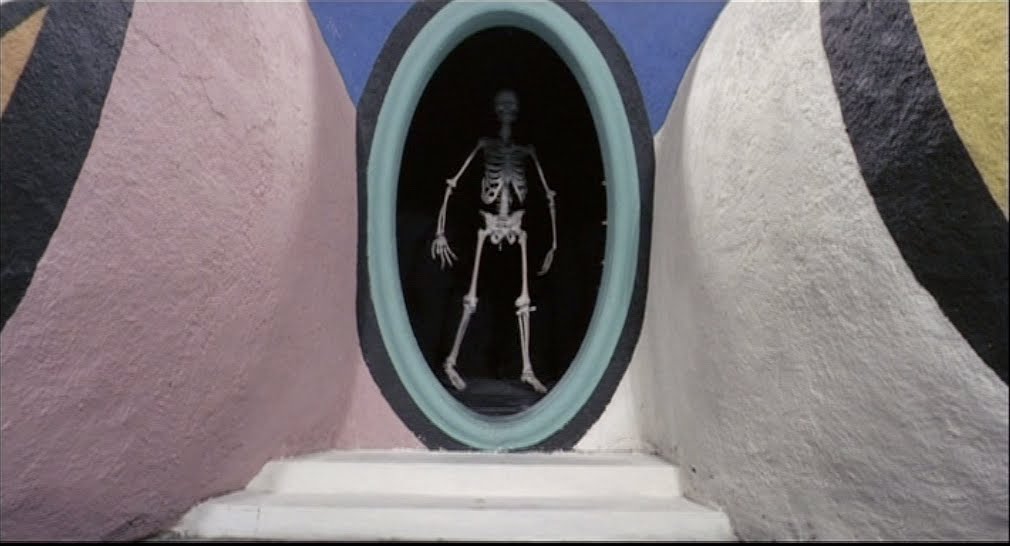
The first thing that strikes one as unusual here I think is the relative extravagance of the production values. The opening scenes set in the ‘charitable foundation’ owned by Dr Sayer (Philippe Leroy, the kind of not-quite-famous but hellishly prolific actor whom you’re sure to recognise from *something*) take place inside an astonishingly impressive building of obvious antiquity, and the (presumably) purpose built sets that compose his private mansion/torture labyrinth exhibit a consistently eye-boggling approach to interior décor that stands up to the wildest fantasias offered by Schivazappa’s more securely financed contemporaries. In fact, despite its titillating subject matter ‘The Frightened Woman’ is really more reminiscent of the work of post-Fellini directors like Elio Petri than it is of common or garden horror/giallo fare (and personally I found it more enjoyable than Petri’s ostensibly similar The 10th Victim).

(I’d love to hear some stories about the various scams and lucky coincidences that must have led the ‘The Frightened Woman’s production team to the gloriously eccentric range of locations and vehicles utilised in the film, from the aforementioned foundation building and the aircraft hanger-sized ‘Femina Ridens’ sculpture itself, to the medieval coastal fort (I could be wrong, but I think it’s the same location used in Herzog’s ‘Cobra Verde’?), to the prototype aquatic car and the vintage steam locomotive…)

The next thing you’ll notice about ‘The Frightened Woman’ is that it boasts a free-associating, faux-intellectual script to match the visuals. When Dr Sayer first meets foundation press officer Maria (Dagmar Lassander, from more awesome Italian horror flicks than I could comfortably list within these brackets), a connection between the two is initially established though a heated disagreement about the relative merits of a scheme to curb global population growth by promoting male sterilization in India. Maria is very much in favour of the idea, arguing that such a measure would not be an unreasonable step for a man who already has two or three children, and that it would greatly improve quality of life for married women in developing countries. Dr Sayer however is violently opposed, insisting that “it is essential that the fertility of the man should remain absolutely intact!”. Say whatcha like about scripting in Italian exploitation movies, but you don’t tend to get character introductions like that in ‘Strip Nude For Your Killer’.


When Maria subsequently visits Dr Sayer at his working week bachelor pad (annoyingly, the good doctor goes through this whole movie without being assigned a christian name), ostensibly to collect some files to assist her in writing her report on the sterilization thing, her attention swiftly turns to the unsettling art he has on display. Paintings by an eccentric monk, Sayer explains, based on microscope slides of various types of infectious bacteria – bubonic plague, leprosy etc. - revealing the aesthetic beauty at the heart of pestilence and death.


Overblown and showy as such digressions may seem out of context, it’s hard to deny that they fit the film’s exuberant visual style perfectly. Nonetheless though, things from here progress more or less as one would expect, as Sayer drugs Maria’s scotch on the rocks (and as an aside, doesn’t it warm your heart when all visitors to a character’s home in movies are immediately offered whisky, regardless of context? – damn us real-world people and our stupid ‘cups of tea’), and stows her prone form in his Merc, motoring off to his purpose-built pop-art labyrinth, there to spend the weekend subjecting her to various unimaginable cruelties, culminating in her death. As Sayer explains at some length after Maria awakes in chains, he is a connoisseur of female fear, a man who drinks in the heights of womanly terror as if it were the finest wine, believing it to be the highest possible form of art and so on and so forth. Conveniently, he also believes that all women are party to a grand conspiracy to achieve global dominance, achieving social and sexual self-sufficiency and reducing men to a state of servitude. How about that!

In short, some of the bits that follow in the next 45 minutes are pretty cool, some are completely ridiculous, and many are a happy mixture of the two. In terms of uhinged discomfort, special mention should be made of the scene in which Sayer forces Maria to ‘make love’ to a rubber mannequin of himself as he looks on giving orders (“you won’t be able to destroy him as you have other men!”), and the bit where he forces her to clean and massage his feet (“harder I say, have you no strength in your arms?”).

In view of the psychological profile we’ve established for him so far, it should come as little surprise that Sayer has a bit of a ‘Crimson Executioner’ thing going on, endlessly working out, grooming himself and reveling in his own perfect physical ‘perfection’ (an effect Leroy conveys far more convincingly than ol’ Mickey Hargitay, it must be said), in between his extended bursts of leering sadism.


For viewers less than enthralled by the petty sub/dom cruelties and faux-psychological yakking of this kind of horseplay, things do start to get a bit draggy after a while, but thankfully there are also plenty of jaw-dropping Italio-kitsch setpieces thrown in for us to enjoy along the way – none more so than the astonishing sequence in which Lassander dances ‘round the mod-tastic living room dressed in flimsy surgical bandages whilst swigging from a tall glass of J&B, accompanied by the authentically fucking awesome sounds of Stelvio Cipriani’s ‘Sophisticated Shake’.

In fact, could anything possibly BE more Italio-kitsch..? You tell me.


As the incongruous frivolity of sequences like this one aptly demonstrates, Schivazappa’s film manages to maintain a pleasing level of ambiguity through the potential tedium and sleaze of its ‘trapped woman’ segments, never quite allowing the two characters to settle into an easy aggressor/victim dynamic, always hinting at the possibility that their respective game-plans are quite different from those we might have expected. For all his whacked out diatribes and ubermensch sexual fantasies, Sayer never seems quite the steely, commanding presence that he’d clearly like to be – Leroy’s face conveys a certain doe-eyed fragility that seems to undermine his character’s determination, and the brief hesitations before he meets Maria’s gaze are telling. And Maria, for her part, seems to be step up to the challenges of her unenviable situation with a lot more enthusiasm than we might have anticipated – gunning for her survival by tackling Sayer’s psychological hang-ups head on, happily trying to seduce him through flattery in an attempt to form a healthy bond between them, seemingly in the hope that a bit of human warmth will force all that elitest/misogynist claptrap from his mind, or else just knock him sufficiently off guard that she might be able to make her escape. (“You don’t have to torture and kill to satisfy your sadistic desires… there are other techniques which are just as enjoyable..”, she offers optimistically. )

Despite his visual exuberance, Schivazappa’s direction is often very precise and economical. It’s a questionable point I guess – many would no doubt write off his approach here as garish and gross – but to me he seems like a director who enjoys crafting images that carry a subtle, self-reflexive absurdity, if you look at them from the right angle. Witness the slow pan up the length of a poorly executed bust of Dr. Sayer in one of the early scenes in the foundation building, or the later shots of him silently working out in his weird, shoddy looking gymnasium. As much as the script up until this point might lead us to view the doctor as an implacable, menacing figure, it’s hard not to read into these scenes a certain quiet mockery of his obvious self-delusion.


So far so good, but it’s in its final half hour that ‘Frightened Woman’ really goes off the rails.

So what exactly happens in the final half hour?

Well, uh, it’s hard to say really, without giving too much away. Basically, this happens:


Yes, that’s right – essentially the film just goes completely bonkers. Praise be!

The surprise ending, when it eventually hoves into views, probably wouldn’t be that much of a surprise to any reasonably alert viewer, were it not for the fact that we’ve just been bludgeoned with such a such a succession of hilarious and inexplicable imagery in the preceding twenty minutes that literally anything could happen next and we wouldn’t be surprised, thus making the relatively linear logic of what does eventually transpire into, well, something of a surprise. A happy one, I hope.

And there you have it. It would probably be a bit of a stretch to hail ‘The Frightened Woman’ as a ‘lost masterpiece’ or somesuch. After all, once we get our heads back together after all the craziness, we can probably cough awkwardly and adjust our ties, and soberly agree that it’s actually a bit awkwardly paced and somewhat draggy, and that it explores some of its ideas in a rather tacky and overbearing fashion. Within the rather conservative context of Italian pop cinema though, it’s certainly hard to fault Schivazappa’s originality and ambition, or to deny that he emerged, for better or worse, with a pretty unique piece of work. Personally, I enjoyed the hell out of it. Maybe you won’t, but if you’re a fan of giallo or ‘60s pop art movies or oddball European cinema in general, you could certainly do worse than give it a shot after a few drinks on a Friday night.

Monday, 28 November 2011

Deathblog:
Ken Russell
(1927-2011)


Ken Russell has actually been on my mind a lot recently, partly thanks to the BFI’s announcement that they’re finally releasing The Devils on DVD next year, and partly due to their screening of his rarely seen feature debut ‘French Dressing’ that I attended a couple of months back – very much a ‘failure’ of a film, crippled by a dreadful script and misguided production decisions, but one that I nonetheless very much enjoyed, largely thanks KR’s superb photography and lively visual imagination.

Both these events have served to get me thinking about just how *great* Ken Russell is (sorry, was : ( ), and how relatively underappreciated his contribution to British cinema has been over the years. Prior to today’s sad news, I had already decided that I should make an effort in 2012 to catch up on some of his key films that I’ve missed over the years (the aforementioned Devils, Lisztomania, The Music Lovers, Crimes of Passion, Savage Messiah etc), and to track down decent copies of the ones I have seen – basically to become a bit more active in my appreciation of a guy whose stuff I’ve always loved when I’ve happened to stumble across it.

For a director who always had such a scabrous relationship with the cultural mainstream, it’s interesting to note that my knowledge of his films is due almost entirely to seeing them on late night TV, only gradually realising that all these unexpectedly beserk, almost unbelievably intense, motion pictures were the work of the same man.

I guess ‘Tommy’ was probably the first one I saw, and, well… Jesus Christ, I still can’t get over it. I mean, I like The Who, I like daft rock band movies, I really like watching weird films, but I couldn’t even make it to the end – it was just too much, man. I couldn’t believe what I was seeing. How could a movie with this many famous people in it, holding this kind of comfortable, canonical place in popular culture, be so continuously, unrelentingly fucked up?

I tried to watch it a second time shortly afterwards and made it to the bit where some biker gangs are staging a war in a quarry or something, and a shirtless Roger Daltrey flies overhead on a hang glider, singing about how they should put their differences aside and revere him as their saviour, at which point, after an hour or so of feeling like I was being continuously kicked in the brain with a hob-nailed boot, I…just…couldn’t take it any more. I still don’t know what happens at the end. I dread to think. But that’s Ken Russell for you – too much is never enough. For anyone who’s never seen one of his films, it’s difficult to communicate just how completely indigestible, how utterly excessive, how bat-shit crazy they really are. They never settle down. Even the most commercially successful and critically approved moments in his filmography have never become anything resembling comfortable viewing.

It was probably boredom that drove me to watch ‘Women In Love’ on TV one night, and it completely blew me away. I suppose that within the context of Russell’s career it’s probably one of his more restrained works, but still, I remember it as a beautiful, intoxicating, almost psychedelic experience that had me setting out the next day to pick up a pile of the D.H. Lawrence paperbacks I’d been strenuously avoiding in second hand bookshops for years, in the hope that they might convey some of the same spirit. With no disrespect to DHL, they didn’t. What I loved about the film was Ken Russell all the way.

Fast forward a few years, and OMFG you guys, remember that incredibly f-ed up movie we saw during one of those All Tomorrow’s Parties festivals in the early ‘00s? That one where William Hurt hangs out with this shamanic tribe in South America, takes super-strong hallucinogenic drugs and fucks a gila monster to death, then comes home and takes loads of them again in an isolation chamber, regressing so far into his primitive subconscious that he actually turns into a caveman, breaks into the local zoo and eats a goat…? Yes, it was ‘Altered States’. And no, I shouldn’t have been surprised when Ken Russell’s name scrolled across the screen as we sat there slack-jawed at its conclusion.

And so it went on - ‘Gothic’, ‘Lair of the White Worm’ – it seemed like this was a guy who rarely lent his name to a film that was anything less than grotesque, astounding, monstrous and mind-blowing, and an overriding belief that Ken Russell Is The Motherfucker has been etched in my book of cinematic truths ever since, regardless of how misguided some of his career choices may have been, or how lazy I’ve been in actively exploring his catalogue.

My sole reference point for assessing Russell as a person is one of my all-time favourite £1 charity shop finds, a copy of his 2001 book ‘Directing Film’. Supposedly a practical how-to guide to the process of directing a feature film, it immediately degenerates into a stream of conscious tirade of griping, boasting, score settling, long-winded anecdotes and barely concealed attacks on assorted actors and recent Hollywood hits – cranky, rude and self-aggrandising from start to finish, I think it’s a great read.

Opening paragraph:

“Everyone who has ever tried to get a film made is a con artist. Ok, so sue me! Alright, I’ll amend that: everyone who has ever tried to set up a movie is a liar and a cheat, or at best, a big fat fibber. Everyone in the industry knows that and not only makes allowances, but actually condones it. The one exception is me.”

Over the years, I’ve heard a number of people express the opinion that Russell was a deeply unpleasant man, and whilst I’m unable to really offer an opinion in either direction, I would at least venture to suggest that he was the kind of deeply unpleasant man we could use a few dozen more of in the ‘creative arts’ at the moment.

Because seriously: alongside Michael Powell, I think Russell is the closest thing we in Britain have ever had to our very own equivalent of a Fellini or a Lynch or a Jodorowsky or a Herzog – a truly uncompromising, visionary maniac, an incredible talent on both an artistic and technical level, and, specifically from our point of view on this weblog, a man who stands in the front row of the global pantheon of truly weird filmmakers.

I’d say something like “let’s remember him in a way he would have appreciated”, only I suspect that would probably have involved not just a few sympathetic newspaper obits and fanboy blogposts, but a cast of thousands out on the streets blaring trumpets, whipping dwarfs, setting fire to public buildings and bowing down before to a giant strobe-light hologram of his face projected across Trafalgar Square, or somesuch. Hey, maybe we should do that! Uh… anyone..?

Saturday, 26 November 2011

The Wastrel
by Frederic Wakeman

(Panther, 1962 / originally published 1952)


Well the cover art is hardly likely to win any prizes, and the novel itself sounds deathly dull, but there’s a certain something about this one I’m really fond of – something that had me laughing in exultation and almost punching the air as soon as I pulled it off the shelf.

What immediately sold it to me I think is the phrase “drunkenly, he mocked life..” – an expression which I’d like to imagine finding a place in any obituaries that follow my own passing.

The back cover copy expands on this theme to pleasing effect, for the headline and first sentence at least. After that, it starts to sound pretty crappy, but the idea of this “rich, drunken boaster” taunting wife and life alike with his depraved lethargy lives on happily in my mind when I return ‘The Wastrel’ to its natural home, gathering dust on the bottom shelf.

Sunday, 20 November 2011

The Owl Service
(Peter Plummer, 1969/70)


Perfect viewing for chill British autumn (even though it’s set during the summer), I’ve recently found myself revisiting the 1969 Granada TV adaptation of Alan Garner’s ‘The Owl Service’, scripted by the author in collaboration with director and producer Peter Plummer.

Although memories of this series and its accompanying aesthetic have been extensively excavated by the Ghost Box/hauntology mob in recent years, to the point where it’s become a pretty obligatory signifier of ‘that sorta thing’, Garner’s story still holds a special place in my imagination. I’m far too young of course to have seen the series when it was first broadcast, or even when it was repeated in colour during the ‘80s.* At some point during my childhood though, my dad decided to read the book to me as a bedtime story – an endeavour he was forced to abandon about a third of the way through, because it was scaring the bejesus out of me.

I remember being completely engrossed by the tangled mystery of the whole thing – the magical dinner plates, book-destroying telekinetic outbursts, rediscovered medieval frescoes and creepy Celtic myths – but at the same time, it was clearly all a bit much for me. Used to dealing with far more straightforward narratives, I just didn’t know what to make of it all. You know that feeling - of being absolutely fascinated by the possibilities that these disparate elements seem to imply, yet terrified by the dark secrets that might be revealed in the process? For me it all started here.


Apparently my dad was under the impression that it was a children’s book – indeed, it was published as such. Many aspects of the story though - from the stifling atmosphere of familial conflict, to the deeply uncomfortable sexual undertones and the quite complex treatment of the class and ethnic identity – strike me as decidedly grown-up.

Raised in the Welsh countryside and sometimes subject to broadly similar concerns, ‘The Owl Service’ holds an obvious resonance for me, but it sticks with me above all because it provided me with perhaps my first real exposure to the kind of unresolved, emotionally resonant mystery that I’ve ended up prizing above all things in film and literature, and that has subsequently led me to Lovecraft, Machen (an unavoidable touchstone here), Nigel Kneale, David Lynch and any number of incomprehensible European horror films.

One of the things that most struck me when revisiting the TV series is how perfect the casting is. Each of the actors, simply in manner and appearance, is a perfect encapsulation of the kind of archetypal figure he or she is portraying… as I suppose befits a story in which modern, self-motivated individuals find themselves pushed into assuming inescapable roles within a reoccurring cycle of mythic fate; a kind of pre-gothic romantic tragedy imposing itself upon the contemporary world, even as its participants struggle not to succumb to their attendant stereotypes.

Every gothic of course needs a tempestuous female focal point, and I doubt Gillian Hills ever bettered her performance here as Alison, her character unmoored and never quite settled, shifting scene by scene between a manipulative brat, a childlike innocent and a naïve, natural mystic tapping into some undefined, destructive force. Although Gardner’s story remains rather coy about such things (the direction and costume choices in the TV series somewhat less so), it is clear that Alison, much like Mia Farrow’s character in ‘The Secret Ceremony’, is in the process of being simultaneously defined and strangled by her emerging sexuality, torn between the pull of childhood and adulthood, and unsure how to deal with either.

Hills herself had of course experienced what we can only assume was a pretty tempestuous teenhood, having allegedly been scouted out by Playboy at the age of 14(!), she appeared in Roger Vadim’s ‘Les Liaisons Dangereuses’ in 1959 before playing the lead in classic Brit-exploitation flick ‘Beat Girl’ a year later. It’s certainly pretty unnerving seeing her convincingly playing a seventeen year old in ‘The Owl Service’, a full decade after her first starring role and several years after her brief but memorable turn in ‘Blow Up’ helped open the floodgates for full frontal nudity in international cinema, and it’s probably not that much of a leap to assume that she incorporated some of the anxieties of her recent past into a fairly astonishing performance here.


It goes without saying I suppose that such a character should become ground zero for an old-fashioned ‘possession’ narrative – one of the many generic threads that makes up ‘The Owl Service’s distinctly odd fabric, and one that could (some would probably say should) have been merely implied by the series, rather than thrown straight at us. Garner and Prosser’s decision to literally depict Alison’s possession is still one of the most startling aspects of the series, and must have seemed outright astonishing in the context of British TV in 1969, when such supernatural grotesquery very much did NOT sit at the same table as the ‘serious’, Pinter-esque drama of the rest of the series.


As Alison’s opposite number, the ill-fated Michael Holden (who died under mysterious circumstances in a London bar in 1977) is also very good as Gwyn – his character something of a representative of a new amalgamated Welsh identity, smart and sensitive and looking to move beyond his roots in the inward-looking rural working class - a late-blooming Welsh counterpart to the Northern heroes of the late ‘50s kitchen sink new wave novels, perhaps? Whether by accident or design, Gwyn also ends up becoming the only fully welcoming, sympathetic presence in the story. Not that any of the other characters are outright dislikeable, but as in any well-composed character drama, there are no villains here. All of them embody a certain mixture of sympathy and threat - as in Pinter, we feel sorry for them in their assorted misfortunes even as we recoil from their assorted minor cruelties. But somewhat uniquely here, we also feel anxious about the damage they might wreak on the unfolding narrative itself. Will Clive’s well-meaning conniving or Roger’s frustrated bullying stir things up too quickly, forcing the dissolution of the status quo and derailing the ‘investigation’, before the secrets of the house and the land beneath it can be revealed…? Not that they’ll ever be revealed, we implicitly understand, but still, somehow, we must know, dammit.


Maybe I’ve just been watching too many cheap horrors recently, but it’s nice to encounter a story in which secondary and purely ‘functional’ characters gradually move beyond their allotted roles, attaining unexpected depth - one dimensional orges unfolding like a kaleidoscope as the psychic battles heat up. Gwynne’s mother Nancy, excellently played by TV actress Dorothy Edwards, is particularly noteworthy in this regard, as she gradually opens up about the personal history that led her back to the house, providing one of ‘The Owl Service’s several reminders that we should never be too quick to dismiss a character as a sour-faced fishwife or an empty-headed lunk - for even the most utilitarian fictional placeholder can hide revelations as vital as those of our fiery protagonists and instigators, if only the pen and camera dare grant them time.


Witness the exemplary presence of moron/sorcerer Huw Halfbacon, played by veteran Welsh actor Ray Llewellyn, through whom ‘The Owl Service’ attains a level of cracked, sinister poetry. Reminiscent of the italicized, uknowable jabber mouthed by Lovecraft’s characters in their last moments, the cadences of his outbursts still raise goose-flesh, and have clearly touched many legions of psyche-folky souls over the years, passing into the wider lexicon of those who’d seem to evoke the essence of this particular cultural backwater. “I am a stag of seven times, I am a fire upon a hill,” he exclaims at one point, stumbling backward against a gnarled treetrunk, possessed with a startling mixture of fear and exultation; “I am a hawk in the sun’s tears, I am the wolf in every mind!” Stirring stuff indeed.


Likewise, the decision to never show the character of Alison’s mother on-screen is unusual and strangely effective - emblematic of the numerous odd, seemingly random decisions made by the TV adaptation. There is no immediate practical reason why we shouldn’t see her, but as the other characters constantly discuss her and act upon her thoughts and wishes, she becomes an ever more imposing, almost fantastical presence in the narrative, always watching and commanding, always unseen.

On a more prosaic level, I really liked the strict colour coding of the story’s central trio – Alison = red, Gwyn = blue/black, Roger = green. You probably don’t need to spend too long consulting works on emotional symbolism to figure out what’s going on there, but apparently the colour scheme was devised to mirror the then-current conventions of electrical wiring (red=live, black=neutral, green=earth I believe, but best not put it to the test by asking me to rewire any old plugs), helping to explain Gwyn’s otherwise slightly perplexing comments about plug wiring in the early episodes, and also casting interesting light (so to speak) on the fact that the house in which the story is set still lacks mains electricity – a decision taken by Alison’s mother to preserve its historical ‘authenticity’ – a stance mocked by Roger when he complains of the ‘phoniness’ of rigging up an electrical doorbell for guests.


Aside from anything else, this colour-coding provides a great example of the lengths the production team went to get the most the most out of the new colour TV technology, cramming just about every shot with bright primary colours and rich natural textures, to the extent that some of the costuming in particular has an almost absurd, hyper-real quality to it, hammering home the red/blue/green dynamic until it becomes unmistakable even to a casual viewer.

Shot on 16mm film rather than the video that swiftly became the norm for colour TV productions, ‘The Owl Service’ easily overcomes such over-indulgences, and the series overall has a beautifully grainy, kinda timeless look to it that easily matches up to most late ‘60s feature films. Although very much OF its time, the aesthetic of the series seems to OWN its time rather than being owned by it, if you see what I mean.


Above all though, rewatching The Owl Service got me thinking about WHY these kind of open-ended spiritual mysteries – confusing, esoteric stories with no crowd-pleasing gimmicks and no satisfactory conclusions - were so popular on British TV during the ‘70s. Penda’s Fen, The Stone Tape, Children of the Stones etc. – it is genuinely extraordinary to think that there was a time when these troubling works were broadcast to the nation on ITV and BBC1 – the shadows of Arthur Machen and William Morris writ large across prime-time entertainment. Why, of all things, would the nationally broadcast TV series – that most conservative and closely scrutinised of media – become such a willing conduit for this kind of deliberately inexplicable product..? Was there something in the air during these years? Something in the water at Television Central?


I suppose that, much like ‘Twin Peaks’ in the USA all those years later, the success of ‘The Owl Service’ (and ‘Quatermass’ and ‘The Prisoner’ before it) proved to TV programmers that this kind of demanding, elusive drama can serve to grab the public’s imagination far more powerfully than the usual dumbed-down logic would tend to assume – a lesson that we could well do with relearning, if the past few decades’ utter collapse of creativity or expertise in British TV is anything to go by.**

And speaking of ‘Twin Peaks’ (gratuitously comparing stuff to ‘Twin Peaks’ being a bit of a preoccupation of mine it seems), the similarities – conscious or otherwise – between ‘The Owl Service’ and Lynch & Frost’s series are surely worth a mention. The nexuses of fairytale-like imagery that feature heavily in both series, repeated and expanded upon with almost ritualistic regularity as the story progresses; the sublimination of unspeakable sexual and familial troubles into supernatural form; the carefully-guarded secrets passed between members of a small rural community, understanding that they must ‘protect’ themselves from some force they sense but can’t really define; the forest-dwelling idiot-savant…. could ‘Twin Peaks’ owe more of a debt to vintage British folk-creep than is generally appreciated?

After all, the unsettling conclusion to ‘The Owl Service’ only serves to remind us of what ‘Twin Peaks’ states aloud: the owls are not what they seem.


*Shot in colour on 16mm film to show off the possibilities of incoming colour TV technology – and looking absolutely beautiful for it on the DVD - ‘The Owl Service’ was initially broadcast in black & white due to some kind of union dispute with technical staff.

**I know, I know – I’m sure those more forgiving of modernity can point me toward X, Y and Z that’s really, really good, but after so long without watching TV just turning the damn thing on gets my back up. I mean, do they not even have editors any more? Every programme looks like they’ve just fed the raw footage into some sort of application that turns it into generic cheesy montages and reaction shots fitted to canned music and… I’m sorry, I could go on for days…