Sunday, 20 February 2011

Teens on the Rampage!
A JD Paperback Special

I recently acquired a stash (well, if three can be said to constitute a ‘stash’) of classic Juvenile Delinquent paperbacks, so, uh, here goes…

The first one I had a bash at is “Savage Delinquents” by Alan Bennett (not that Alan Bennett, I’m assuming), copyrighted 1959, although this awesome looking McFadden Books edition dates from 1968.


I love the moody photo-cover and the font used on the title, and that “GANG GIRL” panel on the back is a stone-cold classic, but despite the enthusiastic seller’s blurb scribbled on the inside cover I’m afraid I found “Savage Delinquents” pretty thin gravy – a by-the-numbers tale of a good girl who goes off the rails cos her parents don’t understand her. A tough guy called ‘Bull’ takes her to ‘the club’, an ahead-of-its-time DIY community space (that’s probably not the idea Mr Bennett intended to convey) in which bad teens give in to their untamed desires, dancing to modern jazz records and indulging in some PG-rated flirting… until midnight that is, when a guy turns up with a box of ‘tea sticks’ to distribute (it’s free until they jack up the price!). Then it’s flashing colours and feelings of ‘ecstasy’ all the way.

This being some strictly “Reefer Madness” style jive, naturally it’s about a week before Lissa is stalking the streets, a wreck of her former self, prepared to sell out her best friend for one sniff of the evil weed.


Stodgy, uninspired prose wrapped around a plot consisting entirely of reheated cliché, I stuck it out for a few more chapters than turned my attention elsewhere. I’m no advocate of teen drug abuse (well, not very often anyway), but the complete failure shown by writers like Bennett to even try to investigate or understand the social, economic or practical realities of drug usage always strikes me as kinda depressing.


Much more enjoyable overall was “The Violent Ones”, edited by Brant House, here presented as a 1958 British edition from Digit Books (the classic cover to the American edition from Ace can be seen here).


“The Violent Ones” is a short story anthology, not that you’d know it from the cover blurb or the lack of any contents page, and actually contains some really killer nuggets of hard-boiled prose from writers like Evan Hunter, Hal Ellson and Murray Wolf, leavened out with a few absolute stinkers from Robert Turner and a rather out of place Robert Silverberg.

The subject matter of the stories is generic and repetitive in the extreme, establishing a formula for the JD story almost as archetypal as that of the western, with the protagonists’ life divided between weak/abusive/misunderstanding parents stuck in the cramped inner city apartment, the ‘good’, trusting girlfriend at the soda foundation, the ‘bad’ kids on the corner, the rival gang from the next block, and so forth.

What they lack in originality though, the best of these stories more than make up for in guts, with Hunter’s “See Him Die” and Wolf’s “Knives in the Street” in particular standing out as tight, violent urban tragedies, vaguely reminiscent of Chester Himes, or of one of my favourites pieces of ‘modern pulp’ writing, Jack Womack’s post-apocalyptic JD update “Random Acts of Senseless Violence”. Highly recommended.

The aforementioned Hal Ellson, author of The Knife, could make a pretty good claim to being the king of JD literature, having seemingly specialised in the genre throughout his career. But by far his best known work is 1952’s “Tomboy”, which had been continuously in print in the UK for twenty years when this 19th printing from Corgi hit the shelves with a new cover design in ’72;


From a distance, this cover could be mistaken for a photo, but it’s actually a painting (uncredited, natch). The early ‘70s date is also given away I think by the exaggerated retro ‘50s font used for the title – a motif that seems to turn up on tons of music/youth culture books through the early/mid ‘70s, perhaps prefiguring the mainstream explosion of baby-boomer teen nostalgia that emerged toward the end of that decade with American Graffiti, Happy Days, Grease et al?


Like previous editions I’m assuming, this “Tomboy” comes complete with an introduction by Dr. Fredric Wertham, the insufferable jackass best known for his 1954 book “The Seduction of the Innocent” and the subsequent moralist witch-hunt that almost destroyed the American comic book industry. Wertham thinks that Ellson’s books bring “truth” to the literature of juvenile delinquency, which we can pretty much take as a guarantee that they do anything but, and indeed, “Tomboy” takes place in a phantasmagorical pulp netherworld that bears very little resemblance to life in 1952, 1972 or any time in between.


Like “The Knife” or his stories in “The Violent Ones”, "Tomboy" is a great bit of vivid, sordid, slightly unhinged pulp, with a style that easily leapfrogs the boilerplate storyline. Any deep social relevance is entirely coincidental as Ellson gives us a rousing tale of a chain-smoking, chain-wielding, sailor’s cap clad “dirty blonde” fifteen year old notably NOT depicted on the above cover, although this US Bantam edition gets a little closer to the action;

Tuesday, 15 February 2011

Bloody Pit of Horror
(Massimo Pupillo, 1965)


Yes folks, it’s ‘Bloody Pit of Horror’! You’ve hit ‘play’, and there’s no turning back now! A jewel in the crown of pan-European exploito-horror mulch, this lively ‘shocker’ was allegedly lensed in 1965, but features a cartoonish matinee spirit and winningly naive approach to sleazy thrills that just screams NINETEEN SIXTY ONE to me. Nonetheless, ’65 it is, a year in which director Pupillo seems to have cut a bloody swathe through the world of cheap Italian horror movies, directing Barbara Steele in ‘5 Tombe Per Medium’ (aka ‘Terror Creatures From The Grave’), then knocking out this one and a third gothic horror called ‘La Vendetta di Lady Morgan’ in quick succession, despite having done little of interest either before or since.

To spare.. oh, I dunno, subterranean exploration enthusiasts, maybe?.. from disappointment, it should be noted that ‘Bloody Pit of Horror’ features no pits, bloody or otherwise. It does have a castle, and within that castle is a dungeon, which you’d think would have done nicely for an exciting title-noun that was at least vaguely accurate. But no, they had to go with ‘pit’. Whether or not the film inspires ‘horror’, and the extent to which it may be deemed ‘bloody’ are matters for further debate, which we shall perhaps return to.

Original Italian title is the slightly more dashing ‘Il Bioa Scarletto’, and the movie will also answer to ‘A Tale of Torture’, ‘Virgins for the Hangman’ or ‘The Crimson Executioner’, depending on where and when you happen to reside. ‘Bloody Pit of Horror’ seems to be the one that stuck though, and why not - that title’s gleeful, boneheaded absurdity suits the film in question perfectly.


Supposedly inspired by the writings of the Marquis de Sade (presumably in much the same way that ‘Hot Tub Time Machine’ takes inspiration from the work of H.G. Wells), goofball levels are off the scale right from the outset here, as we see an unhinged looking gentleman in a bright red KKK hood with attached cape being man-handled into a shockingly cheap looking iron maiden by some guys in sorta Roman Solider-via-Conquistador get up. An echoing PA system voiceover drones on about how this chap’s nefarious deeds will live in infamy.

“Fools, all of you! I am the Crimson Executioner!”, says The Crimson Executioner, shortly before the oversized butter knives glued onto a plywood door descend to end his life. “Ah-hahahahahahahahahahahahaha!”, he adds. “This day shall be written in blood! No man can judge me! I am the supreme law! I shall have my REVENGE!”

But more on The Crimson Executioner later. For now, we cut to the present day, where we join a group of employees from the art department of an Italian publishing house. Split evenly between dashing young photog/design guys and vapid glamour models, they are busy touring the countryside in a fleet of sports cars, in search of the perfect gothic castle in which to shoot some sexy covers for their new range of horror novels.


Whilst that concept sinks in, let us pause a moment while I make a brief appeal to any readers who may have connections in the Italian publishing industry;

I know that I don’t have much experience in photography or design per se, and I realise that my command of Italian is – how to best put it? – entirely non-existent, but all I’m saying is – if you have a vacancy, keep me in mind. After nearly a decade of gainful employment in various sectors, I really feel that your industry is one in which I could truly realise my full potential. If you were to give me a chance, you would not regret it. I understand that there might not be enough space at first for me to tag along on the expenses-paid gothic castle location scouting tours and such, but I’m willing to work my way up. Thank you.

Anyway, as you might expect, this jolly crew do manage to find a castle to fit their (apparently quite specific) needs. When no answer is received to their bangings ‘pon the front door, they assume the place to be uninhabited, and persuade a guy who seems to be the lone male model to utilise his impressive ‘jungle jim’ style skills, scaling a tower and gaining them access.


As you might also expect, the castle turns out to be far from uninhabited. It is actually the home of a reclusive individual named Travis Alexander, played by legendary muscleman and Jayne Mansfield husband Mickey Hargitay, and his… uh… (ok, deep breath) … and his squad of strapping, moustachioed man-servants, all of whom wear identical stripy sailor jerseys and tight white jeans and apparently march around barking orders and stamping their feet like soldiers on parade 24 hours a day, unquestioningly obeying their master’s every command. Many ways to finish this paragraph spring to mind, but I ain’t saying a word.

Upon discovering the intruders in his castle, Mr. Alexander indulges in some Torgo-esque toing and froing, but eventually opts to let them to stay the night, on condition that they leave him alone to enjoy his hermetic isolation, and that they do not enter the dungeon. So, naturally, the next scene sees our gang setting up their photo shoot in the medieval torture dungeon, happily swinging around on some blood-curdling looking implement, girls in bikinis and one guy wearing a skeleton suit! These publishing types, honestly.

I’ll admit that up until this point I had my suspicions that the rationale behind the whole ‘pretty girls cross-country castle tour’ concept might be less than entirely work-related, especially when it became clear that the boss of the publishing house and one of the writers were along for the ride. But in all fairness to these guys, as soon as they’re in situ it’s straight down to business, setting up the gear, ordering the models around, calculating how many rolls of film they can shoot before sunrise, etc. Rarely has the act of shooting pictures of a girl in a sexy pirate outfit being strangled by a skeleton been handled with such consummate professionalism.


Even after the film’s first fatality – which sees the guy in skeleton suit impaled with more butter knives when the rope holding aforementioned torture device in place ‘mysteriously’ snaps – the boss is determined that his team should overcome this tragedy and keep working. After all, he’s got a schedule to keep! Deadlines! I mean, can you imagine a pulp horror novel coming out a bit late, with an imperfect cover photo? It simply wouldn’t do.

So this movie’s been good woozy fun so far, but the next thing I remember is a scene that really raised the stakes big time. A scene that left me speechless, unable to even evoke the holy syllables of Whaa – Thaa – Fugg? A scene, in short, that reminds me why I got into the business of watching movies like this in the first place.

Get this: one of our male characters (who seems to be emerging as the hero of the piece) hears a cry for help from a neighbouring chamber. Rushing in, he finds one of the girls tied by her wrists and ankles in the middle of a huge artificial spider’s web! Don’t come any closer, she warns him, explaining that the killer has rigged up loads of arrows around the chamber’s walls, which are primed to fire as soon as anyone touches the web! And indeed, the walls are lined, not with crossbows and some other kind of practical arrow-firing devices, but actual longbows, mysteriously balanced against the walls somehow! Furthermore, the unfortunate lady continues, there is a poisonous spider slowly making its way towards her, and once bitten, she will die immediately! The spider in questions looks kinda like some furry, mechanical beastie straight out of puppet show, wobbling along on a plainly visible string.


After slapping myself about the face a few times to ensure that I was still awake, and that, yes, this insane spectacle was actually unfolding before me, I saw our hero lie face down on the ground, and proceed to slowly wriggle along the floor like a worm, propelling himself with odd, spasmodic movements, in a tension-building attempt to reach the doomed girl without setting off the arrows! At this point I simply raised my hands in supplication and tearfully offered praises to the gods of WTF b-cinema for showing me this thing.

And really, you could spend a lifetime pondering the whys and wherefores of how the scriptwriters came up with this deranged scenario in the first place, how it ended up actually being realised for the film in such utterly ludicrous fashion, and how the actors felt at being asked to perform in it … I mean, it’s not even clear whether we’re supposed to read the spider and web as being ‘real’, or whether they’re supposed to be mechanisms built by the killer, although frankly either scenario is equally fucking crazy. If you value your sanity, probably best put such questions aside and just let it all wash over you.


What troubled me above all about this incredible sequence though is the fact that the girl apparently seems pretty enthusiastic about the idea of dying in the middle of this spider web contraption, explaining the whole set-up to her would be rescuers in detail, and begging them to abandon her to her singularly weird fate - “Don’t you see? It’s a diabolical trap! It’s impossible for anyone to reach me! Nobody can stop the mechanism!”, etc. The killer must have been a pretty good talker, I suppose – which we can maybe take as foreshadowing of a sort.

I also loved the way that when our worm-crawling hero reaches the centre of the web-maze seconds too late to save to save the girl from the venomous bite, he expresses his frustration by picking up the ‘deadly’ spider and drop-kicking it into the middle of the web, causing a few arrows to half-heartedly flop to the ground posing no danger to anyone! Outstanding.


By this point, my goofball-measuring equipment (it’s sort of a prototype, loosely based on the Rock-o-meter from ‘Rock N’ Roll High School’) had long since overheated and ceased to function, which is just as well, as there is no way its limited capacity could have survived the white hot hurricane of goofery that is Mickey Hargitay as The Crimson Executioner – for naturally it is he who has been perpetuating all this mischief, convinced that he is the reincarnation of the aforementioned medieval torture-monger.

Taking on the guise of The Crimson Executioner, Hargitay sports a get up that makes him look rather like a pro-wrestler who decided to attend a costume party dressed as The Phantom, got drunk, lost his shirt and then decided to go for Flavor Flav instead by adding a huge, clock-like gold medallion to the ensemble. You might have thought it would be difficult for a scene featuring only one man to strictly be termed ‘homoerotic’, but then you presumably haven’t seen Hargitay gazing lovingly into the mirror, oiling his muscular torso as he rants to himself at length about the virtues of his perfect body – claims that are somewhat undermined by the fact that he adopts a slightly hunchbacked ‘gorilla posture’ and hobbles around grunting like a pirate, his features contorted into a kind of snarling mask of perpetual discomfort.


When setting out to assess Mickey Hargitay’s performance here, stock phraseology about how he ‘chews up the scenery’ or somesuch seems woefully inadequate in trying to convey the sheer ham-fisted delight he brings to the role as he capers around his torture dungeon in a state of delirious, childlike glee, accompanied at all times by the incessantly repeated ‘Crimson Executioner’ theme, which sounds a bit like the proud inventor of the world’s first underwater theremin giving a bathtub demonstration (word to composer Gino Peguri for a varied and enjoyable soundtrack all round actually).

Hagitay’s Shatner-esque cadences must be heard to be believed as he sets about tormenting the remaining characters in a manner that might have seemed fairly sadistic in a film that was less… well… y’know - a film that was less like ‘Bloody Pit of Horror’.

“The Crimson Executioner… invented the torture of icy water… for creatures like you!”, he taunts, shaking his fist at a girl who is having icy water dribbled across her back.

“I will punish you for your lechery!”, he promises, spitting in the face of the head of the publishing house, whom he has confined in a comically oversized neck manacle.

“The Crimson Executioner will torture you! Yes… will torture you… until DEATH!”, he announces to nobody in particular, spreading his arms and gazing skyward in joy.

Man, this guy is something else.

Watch entranced, as he straps two of the models onto some kind of rotating wooden contraption and pushes knives through slats in an adjacent screen at boob level, causing the fabric of their brassieres to be veeeery slowly stripped away, and their tender flesh to be cut, just a little bit! I mean, let’s not get carried away here, right? Standards of decency must be upheld. What’s that you say, Crimson Executioner..?

“My vengeance needs blood! The Crimson Executioner... CRIES OUT for blood!”


Such an instantly iconic, endlessly quotable character – I’m surprised that The Crimson Executioner hasn’t cast a wider shadow across subsequent horror history. Surely more than one ‘trash auteur’ must have watched this over the years and thought “this is great, all I need to do is get some theatrical goof-off to run around in a hood, and the rest of the movie writes itself”? One thing’s for sure – nobody who’s ever stumbled across this movie is liable to forget him, and the temptation to spend weeks after viewing wondering around the house in exaggerated wrestler stance, muttering “The Crimson executioner does this, The Crimson executioner does that”, is probably not an uncommon affliction.

Brilliantly, The Crimson Executioner’s reign of terror isn’t ended when he is outwitted or bettered in combat by our hero, as is traditional. I dunno whether I missed an important plot point here, but I’ve watched the film several times now (god help me), and it still appears that he just gets so overwrought about all the evening’s excitement that, after delivering one last fevered monologue about how his beautiful body has been “defiled” by earthly corruption, he simply keels over and dies!

A long tracking shot lingers over the multitude of carcasses that are now strewn around the dungeon floor, and the surviving couple stand in shock, wracking their brains to for some kind of profound closing message they can pull from this thoroughly meaningless outbreak of anachronistic barbarism.

“Well I won’t write any more horror stories, that’s for sure… the man who said truth is stranger than fiction made no mistake!”

You said it buddy! I mean, people in the real world made this movie – beat that, fiction.

‘Bloody Pit of Horror’ has long lurked in the Public Domain, and a splendidly murky, degraded, pixellated print of the film can be streamed/DLed from just about anywhere on the internet, including archive.org here or Youtube here. If you’ve got a reliable net connection, why, you could watch it everyday! What a world we live in! In fact, pesky family or relationship responsibilities notwithstanding, I’d go as far as to say you SHOULD watch it everyday! Go on, you know you want to.


Man, Psychovision looks pretty crappy.

Friday, 11 February 2011

Youtube Film Club:
Mindbending Russian Animation

Remember Captain Pr0nin? No? Well anyway, my brother has been busy of recent sending me links to a whole raft of really extraordinary science fiction-themed Russian animation from the ‘80s and ‘90s, that I think need to be shared.

Many of these seem to be loosely based on stories by Ray Bradbury – perhaps part of a series taken from his work? They are quite varied in style, suggesting the work of numerous animators/directors rather than a single mastermind, but all seem united by an overriding aesthetic of desperate, post-industrial pessimism.

The images and techniques used has a very late ‘70s/early ‘80s feel to them I think – it puts me in mind of the kind of stuff used by prog rock bands and the like in the late ‘70s, when they realised the jig was up and started making marginally punk-informed statements against Orwellian oppression and so forth (think Pink Floyd’s “The Wall” in particular), and also of sombre ‘80s stuff like Raymond Briggs’ “When The Wind Blows”.

I realise I may not have exactly sold these to you in the preceding paragraphs, but needless to say, they are full of strange and beautiful sounds and images and are well worth your time. Thanks again to Paul for turning me on to them, and I hope you enjoy.

We’ll start off with one that’s a fairly straightforward SF story, with English sub-titles even, and get more abstract and tripped out from thereon in.


As a bonus, here is something Paul describes as being “the beginning of an episode of a more mainstream sci fi show”. All I can say is, you know your country is suffering from serious “chaotic crumbling of monolithic super-state” type angst when shit like this is considered “more mainstream” in relation to anything. Basically it’s a sorta faux-anime deal, featuring: a man piloting a giant penis, many tentacles, shoggoth beasts, much facial hair and a moustachioed man’s head grafted onto an octopus. Ugly, desperate H.R. Giger type vibes all round. The theme tune is awesome and reminds me of the music from Transformers cartoons.Yikes.

Sunday, 6 February 2011

Deathblog:
Tura Satana

(1938 – 2011)


Well that sure is a drag.

I guess I can't really think of anything more insightful to say than "Tura Satana was awesome! (sadface)", but here's a proper tribute from Tenebrous Kate.

A double-bill of "Faster Pussycat.." and "The Astro-Zombies" beckons at some point I think... wish I didn't have work in the morning...

Thursday, 3 February 2011

Rollinades:
Jeunes Filles Impudiques/
Schoolgirl Hitchhikers
(1973)


The genesis of “Jeunes Filles Impudiques”, aka “Schoolgirl Hitchhikers”, and of Jean Rollin’s subsequent parallel career as a reluctant director of sex films, can be traced back to discussions that took place during the production of 1971’s “Requiem for a Vampire”, as succinctly recounted in Jeremy Richey’s review of the film:

“Rollin recalled to Peter Blumenstock in Virgins and Vampires and Video Watchdog that producer, "Lionel (Wallmann) obliged me to put some sex scenes in Requiem-during the dungeon sequence. I told him that I wasn't too fond of that kind of thing, and he answered, "But you do that kind of thing very well. If we made an entire film like that, I bet it would be successful. You may not like it, but you know how to do it." Rollin continued with, 'Okay, I'll do it, but I won't invest any of my own money into it.' Well he raised the money, we made the film and he was right." Hence, the first Michel Gentil film was born and shooting commenced right after Requiem wrapped.”

It seems odd to me that Wallmann was apparently impressed by the sex scenes in “Requiem..”, because watching that film today, Rollin’s unhappiness with this material seems clear. Whilst the eroticism of his first three vampire films arose naturally from their surrealistic, counter-culture milieu, the more minimal, haunted tone of “Requiem..” is quite different. My theory is that what Rollin really wanted to explore was the more innocent take on vampirism that he would later return to in 1997’s “Les Deux Orphelines Vampires” and his accompanying series of stories. But, as confirmed by the quote above, he found himself already pigeonholed as ‘the sexy vampire guy’, and erotic content was part of the deal. As such, “Requiem..”s main ‘sexy scenes’ (Marie Castel’s coupling with that dude on the clifftop outside the castle, and the scene with her tied up in the dungeon) play out like pretty routine and half-hearted sequences in what is otherwise an inspired piece of work.


It is an irony typical of Rollin’s troubled career that this diminishing interest in sexual content ended up inadvertently sparking a career in pseudonymous pornography. But however much fans might see his Gentil/Xavier films as an undignified blot on the director’s copybook, and however sad the oft-repeated stories of Rollin setting up shots then fleeing the room in embarrassment for the more hardcore films he was pushed into making may sound, it’s hard to deny that his opening gambit in the genre is an unexpected delight.

Plotted with all the depth and complexity you’d expect of such a production, “Jeunes Filles Impudiques” stars Joelle Couer, who went on to give an extraordinary performance in Rollin’s “Les Demoniaques”, and Gilda Arancio, who didn’t, as our titular hitchhikers and/or impudent filles. Sneaking into a remote house they assume to be abandoned and spending the night (in the same bed, natch), the girls encounter sad-eyed, moustachioed Rollin regular Willy Braque, an incompetent jewel thief who leads them into a series of tangles with mildly sadistic villainess Marie Helene Regne, incorporating copious nudity, tasteful humping, a great deal of light-hearted running around and poorly staged gunfights, the introduction of the world’s laziest hipster private eye and his unconventionally attired secretary, a thoroughly goofy happy ending, and even a cameo from M. Rollin himself!


The film’s sexual content is fairly mild and, appropriate to the director’s pseudonym, refreshingly gentle in its approach, meaning that, with the exception of a rather jarring torture scene, there is little here to offend anyone.. unless you’re offended by the very idea of sex being portrayed on screen.

(Or unless you object on principle to the inherently patriarchal values expressed through heterosexual male-aimed sex films I suppose… in which case, well, sure - I get where you’re coming from, but I like to try to view these things from within the cultural contexts they emerged from etc etc, and as such “Jeunes Filles Impudiques” is about the most good-natured ‘70s sexploitation films you could hope to find, made by a director whose work I enjoy, and featuring less objectionable content than any one of hundreds of more ‘respectable’, mainstream movies I could name, so I’m gonna watch it and review it and feel no shame – ok, thanks, bye.)

In lieu of sleaze, scripting, or any discernable point, the filmmakers thankfully do their best to cram this movie with a wealth of other aesthetic virtues, the nature of which I shall attempt to elucidate below.


First off, if you happen to be a fan of late ‘60s/early ‘70s fabrics and interior décor, let me just say that this film is the shit. Honestly, no lie – some of the floral pattern dresses the actresses wear here are so lovely that I was quite sad when they inevitably took them off, and even the sheets on the beds are plenty groovy. And maybe this is just me, but I also thought the house in which most of the film takes place was just too cool. Far from ‘abandoned’, it looks pretty much like the house I’d like to live in in an ideal world - walled off on its own in the middle of the woods with big, slightly dilapidated old rooms, furnished with a winning combo of baroque cast-offs, homemade hippy/bohemian touches and pleasantly weird art choices. I loved the dusty entrance hall with what look like Phillipe Druillet prints blu-tacked up the staircase, the dark wood and blue tiling in the hallways, and the psychedelic wallpaper in the master bedroom just plain blew my mind!

*

I’m thinking maybe this house actually belonged to someone in Rollin’s circle – it looks pretty genuine and lived in, more-so than the overtly kitsch interiors you tend to see in more generously budgeted ‘70s Eurocult films, and I’d love to get some further info about it. In fact, forget the shagging and the gunfights, I could have happily watched people just wander around this environment silently for 70 minutes.

Making “Jeunes Filles..” even more visually appealing, Rollin and his regular cinematographer Jean-Jacques Renon seem to have had a lot of fun putting the film together, indulging themselves with bright colours, interesting visual textures and some distinctive and memorable images. The back-lit stained glass in the windows of what the baddies refer to as the ‘Chinese house’ is a particularly striking touch, reminiscent of the exaggerated lighting effects used in “Le Frisson de Vampire”, imbuing what is otherwise a pretty plain (by ‘70s Euro-sleaze standards) production with a welcome dose of otherworldly wooziness, leading up to an actually-quite-brilliant shot that sees Regne’s character slowly emerging from the pitch-black woods clad in bright purple, as the red and yellow of the ‘Chinese house’ pulses like a UFO to her left.


It doesn’t get much more ‘Rollin-esque’ than that, and indeed, despite the director’s decision not to put his name on the film, nobody else could have made “Jeunes Filles Impudiques”. From the opening shot of the two girls strolling hand in hand through the forest, to the familiar pattern of dreamy, aimless wandering, the brilliant use of found locations, the expressionistic, silent-era style performances and almost fairy tale-like naivety – Jean is dans le maison, if you will.

Pierre Raph’s original music for the film is real highlight too – Finders Keepers put out a lovely 7” EP of it last year that I did a review of on my other blog, but I’ll repeat myself to the extent of saying that I very much enjoyed the opening/closing theme, featuring low register brass, flute and jaunty jazz percussion that puts one in mind of the most uncharacteristically upbeat spaghetti western ever made, and the cavalcades of prog rock drumming that accompany the ‘action’ scenes are great too. In fact all of Raph’s various licks here are near absurdly catchy, reflecting the inexplicable feel-good atmosphere of the film perfectly.


Another thing I really liked was the introduction of the aforementioned private eye – a sublimey goofball character who had me cracking up on several occasions. After escaping from the baddies, Coeur somehow finds her way to the nearest town (perhaps she HITCHHIKED?), where instead of alerting the police, she runs straight to this dude, who is chilling with his feet up of an afternoon, enjoying his artfully scruffy demeanour and the silent presence of his ‘secretary’;


Good work Joelle!

Later in the movie, after Joelle has been captured again and whisked off to be tortured and possibly killed by the baddies, scruffy-detective-guy proves himself the most lovably lazy crime-buster in film history, insisting that the best course of action is to enjoy a good night’s sleep and a leisurely breakfast, and hope that perhaps the villains might return at some point. Watch in delight as he gracefully slurps from one of those big bowls of chocolate the French seem to like so much, and stirs sugar into his tea, a look of simple, bleary-eyed bliss upon his chops, assuring his anxious companions that it’ll all turn out right in the end. My kinda guy! (Amusingly, the bad guys have only decamped to the ‘Chinese house’, which prior continuity has established as being about 50 yards from the main house.)


And he’s right too, everything turns out splendidly – nobody dies, and our heroines frolic happily off into the middle distance, the temporary inconveniences of sexual assault and moderate nipple torture long forgotten in their endless enthusiasm for life and adventure!

I’m guessing nobody actually paid the detective for his questionable services, but hey, he got some quality snoozing done and had a kick-ass breakfast, so who’s complaining? Back to the office, futuristic secretary-girl, the day’s work awaits!

Above all, “..Impudiques” gives the impression of being that rare thing – a sex film in which everybody seems to be having a good time. With production values even more threadbare than Rollin’s ‘official’ releases, it in some ways has the feel of an enthusiastic student film – all of the cast and crew seem thrilled with idea of making a movie, regardless of the subject matter, and throw in their energy and ideas accordingly, doing whatever they can to create something worth watching.


For all the elaborate praise I’ve bestowed on it above though, it would be wrong to suggest that “..Impudiques” is some kind of lost masterpiece. All else aside, it is still a cheap and cheesy sex flick, probably shot over a couple of weekends with a story they probably made up as they went along. Even if *I* found it uproariously entertaining, that doesn’t necessary mean you will - in fact many more discerning viewers will likely have difficulty making it past Gilda Arancio’s wig, and the English voiceover narration that sounds like it’s been run straight through Google translate.

Within its own humble sphere though, the film is a whole lot more worthwhile than it has any right to be – a testament to the charm and natural talent of Rollin and his collaborators, and a unique time capsule of an era in which it was possible to make an ‘adult’ movie that was humane, funny and genuinely enjoyable. For a thoroughly depressing experience, I recommend watching this as a double-bill with some soul-sucking late night TV ‘erotic thriller’ and weeping bitter tears for the way the human race has gone astray.

Speaking of bitter tears, I’m not usually one to get fussy about print quality etc., but I can’t end this review without a quick word about the new DVD of this movie released by Redemption. The film has been cleaned up nicely as promised, but unfortunately the disc suffers from what I guess must be a botched digital transfer or something. Played on the computer to get some screengrabs, the film was merely a bit fuzzy and pixelated, but on my stand-alone DVD player it was barely watchable, with jerky movements and picture distortion throughout. If this was a bootleg DVD-R or something I wouldn’t mind, but for Redemption to go to all the trouble of remastering an extremely obscure movie then fuck it up like this is incredibly frustrating, and for them to put it on the market as a definitive edition with a price to match is utter bullshit. I don’t know whether this is some kinda ‘first batch’ problem that the forthcoming(?) Region 2 release will sort out, but I don’t fancy laying down the cash to find out. If you’re absolutely desperate to see the movie or you happen across this disc really cheap somewhere, give it a whirl, but otherwise – not recommended.

Sunday, 30 January 2011

Destroy All Movies:
The Complete Guide to Punks on Film
edited by Zack Carlson & Bryan Connolly


Much as I love banging through a good, easy-going music or film book when I should be reading something, y’know, proper (a love reflected in a fact that I’ve got almost a whole bookcase full of the bloody things), it is rare indeed for the publishing industry to cough up a book quite so uncannily specific to the crossover zone between my cultural interests as this one. Issued in a handsomely appointed and competitively priced large format edition by venerable indie comic book magnates Fantagraphics, an immediate purchase was, needless to say, mandatory.

To get straight to the point: this book is brilliant. Everyone I’ve shown it to so far has said “um.. great” and sort of looked around nervously waiting for me to change the subject, but I don’t care – this tome’s authors and publisher have taken a risk in betting that there is an audience out there for this sort of thing, and I am proud to raise my hand and say I am it. “Destroy All Movies” is is a near-inexhaustible well-spring of obsessive pop cultural nerdery, brain-eating trash satori and immaculately hip film writing. It has been my number # 1 favourite thing ever since I acquired a copy and it is unlikely to leave by bedside table any time soon.

To my knowledge, the phenomenon of ‘punks’ in the cinema of the 1980s and 90s has never really been given much attention, serious or otherwise, despite being one of the most ubiquitous inclusions in the era’s cultural short-hand, not to mention one of the most consistently hilarious and ridiculous misappropriations of a genuine youth movement ever undertaken by popular culture.

You may think that beatniks or hippies had it bad in their day, but, as is exhaustively chronicled here, their gradual transformation into drive-in caricature pales into insignificance compared to the veritable tidal wave of leather-clad, mohawked ‘goonbags’, ‘wastoids’ and ‘manimals’ (all valuable additions to the ‘80s/’90s film crit lexicon inaugurated by this book) that exploded from video store shelves, capering across screens in every genre under the sun, perpetrating multi-coloured mayhem, either comedic or tragic, as and when required. Whether invoked as anarchic party animals, villainous sub-human scum, post-apocalyptic warriors, all-purpose barometers of urban decay or simply as wacky ‘all walks of life represented’ crowd extras, these inexplicable lunatics (together with their attendant legions of new wave harpies, vampiric leather-goths and other mixed up trendsetters) cut a bloody swathe through the era’s cinema, usually exhibiting precious little resemblance to any creature actually found on earth.

(Intrepidos Punks)


Frankly, any book on this subject would have been a home run for me. Carlson & Connelly could easily have just thrown together a few humourous essays on the subject, write-ups and interviews concerning films of major punk significance and called it a day, and I would have been perfectly happy. But no – “Destroy All Movies” is so much more than that. It is a project whose scope is little short of insane, executed with an uber-geek attention to detail that should see movie and music obsessives alike bowing in praise before the monolith of the finished work for years to come.

Basically: “Destroy All Movies” is an A to Z compendium of reviews of (to the best of the authors’ knowledge) every single film that has ever featured a punk.

No, really - Carlson in his introduction talks about how he and Connolly began their quest by visiting their (apparently quite vast) local video library and compiling a master-list of every film released between about 1977 and 1999 “that wasn’t an opera or a western” (and indeed, they found punks in one western), initiating a programme of screening all of them, in search of punks.

The results speak for themselves – over 400 wide format pages, and over 1,000 movie reviews, tracing the complete history of the cinematic punk. The small cadre of fictional films that have treated punk with any kind of authenticity or intelligence (“Repo Man”, “Suburbia”, “Ladies & Gentlemen The Fabulous Stains” etc.) are of course allotted plentiful attention, with additional cast & crew interviews slotted in as appropriate, whilst much space is also given over to the surprisingly large number of punk documentaries, underground films that emerged from punk scenes and the like, again with much interesting interview/archive material thrown in. But the real meat of the book is coverage of the innumerable bizarre representations of punk culture found within production line exploitation and studio films. Knuckleheaded sex comedies, action flicks, teen dramas and family films, horror, sci-fi and hardcore porn – all are exhaustively mined for punk content, their worth as art and entertainment assessed along the way.

This chasm between these two branches of investigation is acknowledged by the fact the book is jointly dedicated to Penelope Spheeris (director of “Suburbia” and “The Decline of Western Civilisation”) and actor John Gries (who played goof-punk overlord King Vidiot in the ’83 arcade comedy “Joysticks”), and if there is a certain awkwardness in seeing serious-ish interviews with Ian Mackaye and Richard Hell juxtaposed with capsule reviews of “Earnest Saves Christmas” and Sergio Martino’s “The Fishmen and their Queen”, well, let’s just say that’s the kind of awkwardness I can get down with.

(Joysticks)


At first I was a little sceptical regarding the book’s implied function as a Maltin-esque movie guide. I mean, it’s hard to imagine many people scanning the TV listings, thinking “I say, I think there is a slight chance that movie might have a punk in it, I’ll see when Carlson & Connolly have to say on the matter” any time soon right? But as I work my way through “Destroy All Movies” (I’ve been at it a month and I’m currently on ‘R’, not counting occasional flips ahead), the real intention behind the book becomes clear.

Beyond the punk-based conceit, what we have here is a gargantuan, heartfelt tribute to the popular cinema of the 1980s, as filtered through two guys’ obsessive trek through the VHS wastelands. What Michael Weldon’s “Psychotronic Film Guide” did for the drive-in/grindhouse golden age of the ‘50s-‘70s, “Destroy All Movies” effectively accomplishes for the video era. Appropriately, it is Weldon’s dry wit and hipster suss that helps set the tone for the writing in “Destroy All Movies”, even if Carlson and Connolly choose not to replicate the vicious concision of Weldon’s three sentence critical KOs, instead letting their bottomless enthusiasm get the better of them, routinely dedicating several lengthy paragraphs to even the most wretched hunk of cinematic driftwood. Which needless to say is fine by me – by and large, the writing in DAM is really great – the reviews flow beautifully, are packed with info, and rarely less than laugh out loud funny.

You’ll note I said “the 1980s” rather than “the 1980s and 90s” preceding paragraph, and that’s simply because, whilst the latter decade is extensively covered, the authors’ true preference and spiritual home is made abundantly clear from the outset. Rarely has the low budget / low brain cinema of the ‘80s been so lovingly hymned in print, with Carlson’s reviews in particular communicating an infectious enthusiasm for the chaos and buffoonery of the ‘80s comedy, delivering unexpected raves to “Kindergarten Cop” and “Police Academy III” whilst striving to rescue such lost party-hard masterpieces(?) as “Surf II”, “Oddballs” and “The Last American Virgin” from the jaws of landfill oblivion. And indeed, he is pretty convincing – reading these joyous descriptions of motion pictures powered entirely of foodfights, aimless nudity, drunken property damage, kamikaze fashion statements, toxic sludge and monkeys dressed in human clothing makes me wonder why I don’t have a whole bookcase full of ‘80s boner comedies to stick next to my bookcase of music/movie nerd books, further endangering whatever vestiges of meaningful human interaction remain in my life.

(Rock n' Roll High School)


By contrast, the ‘90s are routinely denounced by DAM’s authors, lamented as an era of darkness in which the magic died, the music sucked and everything started to go wrong. The death-of-our-way-of-life despair that can be glimpsed in their review of 1990’s sub-culturally confused “Pump Up the Volume” is pretty heart-rending, and the self-aware slacker comedies and limp indie dramas of the decade that followed are tirelessly savaged at every opportunity, whilst instances of mall-punk or alterna-grunge fashion are set upon with unprecedented venom.

And, hey, fair enough - at the time of writing, I can’t deny that this approach suits my own prejudices pretty well. I’m fascinated by the ‘80s, and the dire banality injected into American pop culture by the Hollywood/MTV/record industry during their post-Nirvana/Kevin Smith feeding frenzy should never be forgotten. But at the same time, I can’t help thinking that this generational schism is sadly going to date the book pretty quickly.

For guys whose cultural knowledge is evidently so sharp, Carlson and Connolly seem to have failed to take account of the way this kinda stuff changes over time. I mean, I remember a time maybe ten years so when myself and my friends treated fashion and mainstream culture of the ‘80s as an almost unspeakable anathema, a fortress of everything inauthentic and hateful in which (ironically) only punk and the nascent indie rock scene flew the flag for the stuff we cared about through our upbringing in the benighted ‘90s. And going back further, I recall the now-canonical golden age of the ‘70s being soundly ridiculed by people slightly older than me, and so on. Tricky though it may be, I think such notions need to be borne in mind if a volume like “Destroy All Movies” is to take its deserved position as a timeless, essential and regularly updated reference work. I dunno quite how you’d achieve that, other than pumping current teenagers for their views on ‘90s movies or something, but, er, yeah – whatever. It’s only a minor reservation. Minor.

Above all, I repeat: this book is incredible. Buy it, read it, love it, and long may boggle-eyed, mohawked VHS-fogged crazies rampage through our dreams.

Wednesday, 26 January 2011

Jazzman in Nudetown
by Bob Tralins

(Gaslight Books, 1964)


Well, vis a vis my previous post on the subject – I gave in. I went back for it. And furthermore, I’ve read it. Another legend lies dead at my feet, slain by nerdly curiosity and the willingness to spend money on weird junk.


Although I very much enjoyed the book, I’m gonna come right out and say that, sadly, I don’t think that Big Bob Tralins is really the smart, self-aware yukk-meister that various of his titles and cover copy might suggest. The bulk of the prose and plotting in “Jazzman..” is standard issue pulp doggerel, full of long stretches of the kind of autopilot writing that quickly turns to mush on the journey between eyes and brain. I've encountered far worse, but I've certainly read better.

Sadly, the approach to hip culture taken by the book is flat and off-message enough to convey the impression that Big Bob had never actually been without spitting distance of a real life representative of the counterculture. His arsenal of 1964 jazz reference points seems limited to the strictly trad likes of Louis Armstrong and Leadbelly, and in one chapter our beatnik narrator repeatedly refers to a bunch of aggressive rednecks lounging outside a small-town barbers shop as “hep cats” – a glaring error bespeaking a woeful failure to grok the hip vernacular.

BUT, what “Jazzman in Nudetown” may lack in authenticity, it more than makes up for in lively, if sporadic, imagination. The book’s saving grace, the thing that truly raises it to a kind of cracked, outsider poetry, is Tralins’ gloriously unhinged attempt at first person beat narration.

What Bob really seems to have taken on board here is the multitude of possibilities offered to the bored hack writer through the introduction of a free n’ easy beatnik writing style. After all, laying down some sub-Kerouac blather is easy AND fun, and Tralins seizes the opportunity with both hands here, happily throwing out whatever instinctive/alliterative crap boiled up from his noggin with gleeful abandon. Why have your hero drink whisky when he can ‘suck down on woozle juice’? Why have girls when you can have ‘wiggle witches’? And if, like Tralins, you start occasionally producing sentences that just plain make no sense whatsoever, well – cool it pops, this just ain’t your square ‘makes sense’ kinda read, you dig? Big Bob is busting out some first-thought best-thought, and it’s beautiful, man. No redrafting needed.

These outbursts of good-humoured beatitude seem to explode from the book every couple of pages like a transition from black & white into Technicolor, but sadly they become fewer and further between as the novel proceeds, with the good ol’ ‘workmanlike slog’ approach predominating from the halfway point onward. Nevertheless though, some of the best passages in ‘..Nudetown’ are timelessly demented, rendering it essentially reading for any connoisseur of beatsploitation.

So, for the record, “Jazzman in Nudetown” tells the tale of Jock Midnight, erstwhile leader of Jive Midnight and his Jive Cats, a somewhat unconventional clarinet, trombone and hambone percussion trio whose popularity has made Jock a hep-cat supreme back home in California, or so he tells us. But Jock is a long way from home as the book opens, on the lam from a Georgia correctional facility, having been framed by some racist cops who didn’t look kindly on his investigations into the disappearance of his trombone player and best buddy Fat Joe Bullets.

As he stumbles out of the woods, Jock is immediately picked up by one Lilly Mae Tinch, a gigantic, high maintenance nymphomaniac, and her accomplice Phoebe, who offer him a job, prompting the following exchange, which surely deserves a place in the history of spectacularly ill-advised chat-up lines;

--
“How’d you like a job?”
“For money?”
Both girls laughed at my expression. “What else?”
“What kind of job,” I said, locking my gaze with the big blonde’s. “You both look like a couple of sex jobs to me”.
I got away with it. They were swingers, just like I’d figured. Groovy enough to collar the jive without blinking their eyes into question marks.

--

This being a pulp smut novel, Jock’s bold approach to seduction pays swift dividends, and the extraordinary opening to the next chapter bears quoting in full;

--
“I kept feeling the empty giggle bottle under my pillow. That’s what finally woke me up. It wasn’t made to sleep on. It was dawn and the faint rays of the sun were streaming down upon the bed from between the drawn slats of the venetian blinds. I started to get up, but a heavy thigh over my hip held me fast. Lily Mae’s big arms were entwined around my chest from the back, I could feel her breath on the top of my head, and the delicious warmth of those huge breasts against my shoulders. Man! What a way to wake up!

Phoebe was on the other side of me, lying on her stomach, the pillow over her head. The creased and wrinkled sheet covered half of her lush body, exposing flesh from the center of her back in one sweep all the way down to her sleek, rounded hocks. Even in the fresh wash of morning sun she was grooby. Beautifully grooby. A ginch with a figure like a Greek cat in the Louvre with the delicate complexion of bare marble. Feeling no pain.

I never did get around to finding out if Lilly Mae was the fairy lady though. The lack of sleep, the booze, the weariness and fatigue that had been ragtiming after me finally cornered the market on my energy and swamped me. Zazzle! Did I pass out before – or after? No. I smiled at myself, remembering. Old Jock Midnight hadn’t let the girls down. Neither wiggle witch had been disappointed.

Untangling myself from the sleeping blonde boa, I eased myself down to the foot of the bed and got to my feet. I was wobbly, but I made it to the bath. Closing the door, after sloshing cold water on my face I greeted my reflection in the mirror. I looked good, real good. My complexion was as ruddy as a piece of mouldy swiss cheese that had been left in the pantry of an abandoned summer camp for girls. After the mice finished with it. Only difference was, I’d been gadzooked by two swinging cats!”

--

It is Lilly-Mae who leads Jock to ‘Nudetown’, which, disappointingly, is not some chaotic paradise of lecherous vice, but simply our freewheelin’ protagonist’s pet name for ‘Newton’, a depressingly fully-clothed redneck shithole in and around which the rest of our story takes place.

In one of the pleasantly eccentric plot twists that render this book worth reading, it turns out that Lilly Mae is a distant descendent of Blackbeard the pirate, and is seeking to retrieve his long-lost treasure from its hiding place in the Georgia swamplands. What follows is about one hundred pages-worth of crossings and double-crossings and characters being menaced with shotguns, sapped on the head and dumped in swamps, seemingly endless chase scenes and confrontations with redneck cops. Eventually, the whole thing turns into a kind of ham-fisted civil rights-era protest story, as Jock Midnight finds himself incarcerated in Nudetown jail on the basis of his being an obvious “negra-lover”, yelling beatnik-tinged obscenities from his cell window at the villainous pigs who are squaring up against the town’s peace-loving black community in the street outside.

I realise I’m making “Jazzman in Nudetown” sound pretty fantastic here, but really, it isn’t. If Bob Tralins had been able to keep up the pace of the extract quoted above, it would be a stone-cold classic, but as is I think I’d merely deem it a moderately grooby waste of a few hours.

POST-SCRIPT:

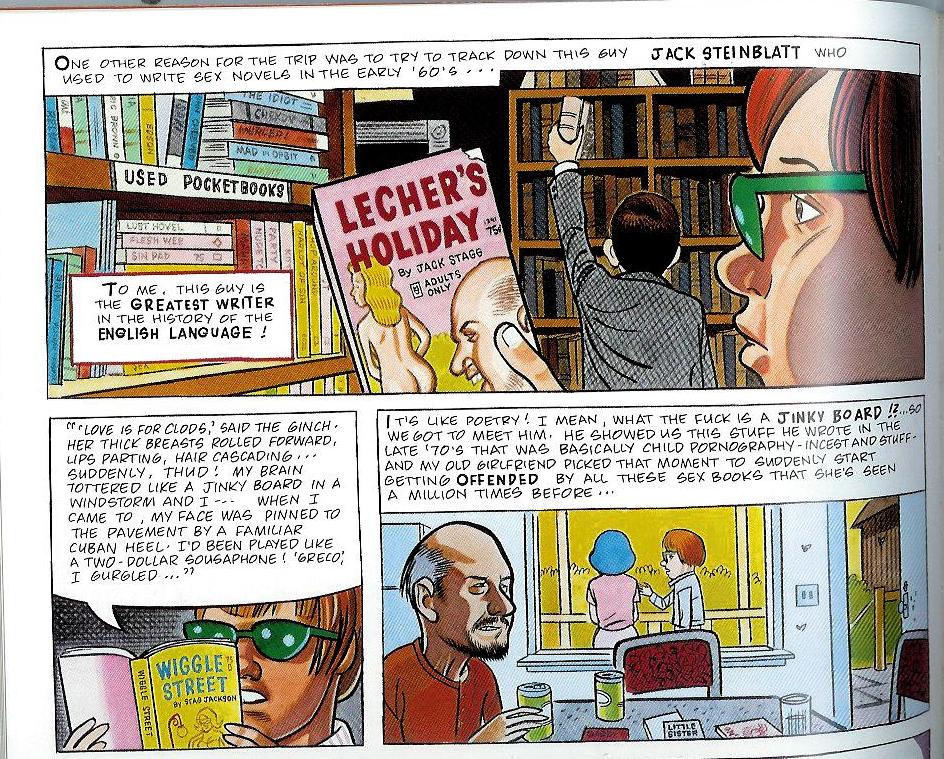
In one of Bob Tralins’ flights of beatnik fancy, he makes metaphorical reference to a “jinky board”, whatever that is. This immediately reminded me of the fictional pulp writer Jack Steinblatt featured in the Daniel Clowes comic “MCMLXVI” (which you can find in the excellent “Caricature” anthology);


Could Steinblatt be directly based on Tralins? Did Clowes actually plough his way through “Jazzman in Nudetown” at some point? Or were these mysterious “jinky boards” in fact a common element of smut-pulp vocabulary?

If you know the answers to these questions, well… probably best seek help. But let me know first.

Monday, 24 January 2011

Mopping Up # 2


As regular readers will probably note, I've mucked about with the sidebar you see to your right a bit, swapping things around and adding a few quick, clickable logos in an attempt to highlight some of the different strands I've got running here and perhaps make navigating this place a bit easier.

So just to clarify: henceforth, clicking the "Two Fisted Tales" button will take you straight to all the posts I've done about pulp book covers and related matters. Just calling it 'Pulp Fiction' or something would have been clearer, but doesn't sound as nifty. The other categories should hopefully be self-explanatory.

That is all.

Will be back with exciting new posts of one kind or another imminently.