Saturday, 28 August 2021

Noir Diary # 16:
The Criminal
(Joseph Losey, 1960)

 Even before he achieved card-carrying ‘auteur’ status following his celebrated collaborations with Harold Pinter, Joseph Losey already had a long history of turning genre conventions outside out. Early American films like psychological noir ‘The Prowler’ (1951) and anti-war allegory ‘The Boy With Green Hair’ (1948) were already total one-offs, and, after the blacklist forced his relocation to the UK, he was soon busy turning humble crime programmer ‘Time Without Pity’ (1957) into an exhausting treatise on post-industrial anxiety, before instigating an unprecedented mash-up of JD youth movie, Kneale-esque science fiction and cold war existentialism in 1962’s extraordinary ‘The Damned’.

All of which makes it interesting to consider just how uncharacteristically normal Losey’s three early collaborations with iconic Welsh tough guy star Stanley Baker turned out to be. The first film they made together, 1959’s ‘Blind Date’ [hastily reviewed on this blog way back in the mists of time] is a stylish but unremarkable whodunit, whilst 1962’s ‘Eve’ [ditto] may have allowed Baker to stretch his thespian wings a little, but is otherwise just a frothy continental melodrama, feeling uncomfortably like a strained British attempt to catch a whiff of post-‘La Dolce Vita’ decadence.

By far the strongest entry in this loose trilogy, 1960’s ‘The Criminal’, is, as its title suggests, just about as generic a crime movie (gangster & prison sub-divisions) as can possibly be imagined. Credited to playwright and future ‘Hard Day’s Night’ screenwriter Alun Owen, from an original draft by Jimmy Sangster, the script manages to trot out a formidable assemblage of hoary old clichés, as Baker’s London-Irish mob boss Johnny Bannion drifts in and out of the slammer whilst punishing his enemies, executing an audacious racetrack heist, hiding the loot, instigating a passionate affair with his ex-girlfriend’s flatmate (Margit Saad), and eventually being betrayed by his trusted right hand man (Losey’s fellow ex-pat Sam Wanamaker).

Could it have been Baker himself who reined in Losey’s more outré tendencies on these projects, I wonder? After all, he got his parallel career as a producer of no nonsense action-adventure pictures off to a flying start with ‘Zulu’ (1964) just a few years later. Indeed, ‘The Criminal’ plays to a great extent like one of the projects its leading man went on to produce (not least the similarly themed ‘Robbery’ (1967)), mixing a sense of raw nerve energy with dour, realistic brutality, whilst showcasing the talents of an extraordinary cast of character players.

Whatever the behind-the-scenes balance of power may have been though, Losey’s presence can still be felt, especially during the film’s prison sequences, which were shot on a vast purpose-built set modelled after the Victorian edifice of HMP Wandsworth (the genuine article was used for exteriors). Though impressively realistic in most respects, this set allows Losey - aided no doubt by cinematographer Robert Krasker, a veteran of Carol Reed’s ‘Odd Man Out’ and ‘The Third Man’ - to frame the action in suitably expressionistic, Kafkaesque fashion, dialling up the claustrophobia to an uncomfortable degree as he obsessively explores the complex power dynamics at play between the inmates and wardens.

In this respect, it would be easy to file ‘The Criminal’ away as the UK’s answer to Jules Dassin’s ‘Brute Force’ (1947) or Jacques Becker’s ‘Le Trou’ (1960). A more relevant point of comparison however might be Raoul Walsh’s classic ‘White Heat’ (1949), which is echoed here in the ‘out-and-in-and-out-again’ structure of the prison story, as well as by the steady accumulation of tension through the film, the betrayal/paranioa tropes and the intermittent outbursts of vein-popping male hysteria.

More importantly for its director perhaps, ‘The Criminal’ also shares with Walsh’s film the underlying notion that its tormented, working class anti-hero never really gets to experience true freedom, finding himself imprisoned just as much by the strictures of the ruthless socio-economic system which defines his actions on the ‘outside’ as he is by the more literal bars and truncheons which confine him on the ‘inside’.

Unpacking all that would be quite enough to keep most filmmakers busy, but Losey, being Losey, also insists on intermittently trying to punch through to the audience via some woefully self-conscious application of Brechtian distancing technique.

This can be most clearly seen during the ‘home-coming’ party which follows Bannion’s initial release from prison, when all music and sound effects suddenly cut out to announce the entrance of his estranged girlfriend Maggie (Jill Bennett). As the assembled partygoers split off to either side and observe her subsequent hysterical outburst like a bemused Greek chorus, what should rightfully be a fairly troubling, low key character exchange is instead imbued with the feel of a ‘West Side Story’-esque ritual showdown. Later in the film meanwhile, an emotionally troubled prisoner is allowed to deliver a long, introspective monologue direct to camera, staring fixedly at the lens in close up as the background shifts out of focus behind him.

In fairness to Losey, he soon found other, better ways to imbue his characters with an inner life, and even managed to incorporate these jarring techniques into his later, more formally experimental, films to great effect. Here though, surrounded by the dour (albeit exaggerated) naturalism of London’s criminal underworld, these attention-grabbing cinematic affectations just seem absurd, bordering on camp - which is frankly the last thing anyone needed, in a movie which was still predicated largely on the simple pleasures of watching Stanley Baker punch people in the face.

Speaking of which, Baker may have railed against being typecast in ‘hard man’ parts in subsequent years (three films in five years with ‘Hell’ in the title will do that for you, I suppose), but for those of us who love the hard-boiled persona he brought to British crime/noir cinema of the late ‘50s and early ‘60s, rest assured - we’re pretty much at Peak Stanley with ‘The Criminal’, and it’s beautiful thing to behold, even as he’s hamstrung to some extent by the necessity of slurring his trademark Welsh baritone to attempt some semblance of an Irish accent.

Essentially, Baker lends Johnny Bannion the feel of a man who, above all else, simply wants to be alone, but is cursed to be forever surrounded by other men (and even more troublingly, women) - scheming, wheedling and generally getting in his grill, 24/7. Left to his own devices, we assume, he’d be happy to remain in his outrageously decorated London penthouse, brooding over his impressive collection of jazz LPs; but alas, it’s not to be.

Lest we think we’re dealing with some Jean Gabin-esque sensitive, aesthetically-minded gangster here however, please note that Bannion has a life size photo of a nude model pasted on the back of his bathroom door, and when he is forced to resort to violence (which, of course, is frequently), there is a pure, underhanded street-fighting nastiness to his conduct which is genuinely frightening, whether belting a guard with his hand-cuffed wrists as makes an escape from a prison van, or (in one of the movie’s highlights) reducing a pair of hulking, feckless thugs who have been assigned as his cellmates to tearful agony in a matter of seconds.

Great as he is though, Baker is in constant danger of being upstaged by the rest of the ‘The Criminal’s top drawer cast of cinematic reprobates - not least BITR hero and Losey’s fellow Brechtian, Patrick Magee, getting stuck into one of his very best screen roles as the devilish-yet-craven Prison Warden, Barrows.

Venomous to a fault, Magee builds Barrows into a terrifying and fascinating figure, plumbing depths of weird perversity which I’m 99% sure the film’s script never thought to assign to him. One minute a cowering, authoritarian jobsworth, the next a Mephistophelian provocateur, Barrows seems to be perpetually attempting to stifle his true nature as a glowering sadist, but, he scarcely ever succeeds.

He can’t help addressing his underlings with a hissed, derisive “…mister”, making it sound like the disgusting insult imaginable, whilst the film’s opening sequence finds him pushing obviously-doomed stool pigeon Kelly (Kenneth Cope) down the steel steps to the prison mess hall with all the finality of a witch-hunter lighting a pyre.

Basically, you could write a whole treatise trying to get to the bottom of what makes this gimlet-eyed cur tick, and you’d still never quite get to the bottom of it. Magee’s every gesture appears to conceal some horrible, hidden purpose, and his scenes with Baker in particular crackle with an electrifying antagonism.

Elsewhere meanwhile, British horror fans will immediately feel at home as ‘The Criminal’ opens with the heart-warming sight of Patrick Wymark (‘Blood on Satan’s Claw’, ‘The Skull’) and Murray Melvin (‘The Devils’) enjoying an inevitably crooked game of poker, each looking almost impossibly shifty, and it’s likewise great to see such esteemed players as Tom Bell, Nigel Green and Rupert Davies popping up blink-and-you’ll-miss-it supporting roles. Each of these gents helps contribute to what must surely rank as one of British cinema’s most impressive gallery of villainous grotesques, creating a world so devoid of moral fortitude that Baker’s violent, self-serving antihero appears almost admirable by comparison.

For all this though, ‘The Criminal’ is also noteworthy as an example of a British film in which barely anyone on screen in actually English… well, not in the genealogically correct, WASP-centric manner which would have been recognised as such in the late 1950s, at least.

Bannion and most of his gang members are Irish, as, presumably, is Barrows, whilst the loosely allied gang (led by the affable Grégoire Aslan) who run the prison’s black market are Italian. In fact, it’s striking that, during a scene which takes place in the prison’s Roman Catholic chapel, pretty much our entire cast of characters - inmates and screws alike - are present, solemnly receiving communion!

The few ostensibly English inmates meanwhile tend to have prominent Northern accents, whilst all purpose thug ‘Clobber’ (played by Milton Reid lookalike Kenneth J. Warren, last seen around these parts in The Creeping Flesh) is Australian. As portrayed by the Jewish-American Wanamaker, the ethnicity of Bannion’s right-hand-man Carter is difficult to pin down, whilst Johnny’s girlfriend Suzanne, as played by Saad, is evidently German. In fact, the film’s the only definite, RP-enunciating southern Englishman is actually the haughty prisoner governor, marvellously played by Noel Willman (‘Kiss of the Vampire’, The Reptile).

A near-comically stern yet weak-willed exemplar of English good manners, everything in the tiny world of the governor’s office appears perfectly symmetrical. He is mildly perturbed when a dish of arrow-root biscuits accompanies his morning tea-tray (a cringing lackey apologises for the lack of digestives), seemingly oblivious to the violence, chaos and rampant corruption which define the defiantly heterogeneous community of incarcerated troublemakers beyond his door. 

Even more surprising is the notable presence of black characters in ‘The Criminal’. At the outset of the film, one of Bannion’s cellmates is a West-Indian - though seemingly not fluent in English, he seems a trusted ally nonetheless, communicating through ritual chants of “ok, sailor, ok”, along with the occasional patted shoulder - whilst, delightfully, Johnny’s cellblock also boasts a Sir Lancelot-esque calypso singer, who strums his guitar in the canteen, improvising new lyrics to reflect the prison’s latest dramas, in what seems like a homage to Jacques Tourneur’s ‘I Walked With a Zombie’ (1943). (1)

Elsewhere, during the racetrack scene, the camera briefly zeroes on a black man decked out in some kind of far-out witch doctor get-up (perhaps a real life hawker or busker of some kind?), whilst at Johnny’s home-coming party, we can even see a fully-fledged black gangster strutting his stuff in the background. (Probably not something the Krays or their bigoted ilk would have stood for, needless to say.)

Though not exactly the most progressive representations of black Britons ever seen on screen, the very presence of these characters in an era in which non-whites were generally entirely absent from popular cinema feels like a deliberate statement on the part of the filmmakers. Were they perhaps attempting to portray the criminal class as a kind of loose coalition of oppressed minorities, or just trying, however haphazardly, to provide a more realistic portrayal of working class life in the post-Wind Rush era than had usually been seen on screen up to this point..? Who knows.

Music too contributes hugely to ‘The Criminal’s overall power. In what became a recurring trope in Losey’s films, diegetic music is everywhere - not only in the myriad of songs, chants and rhymes through which the inmates communicate during the prison sequences, but also in Johnny’s prominently displayed jazz collection. As is almost inevitable for an early ‘60s Losey film in fact, UK jazz luminary Johnny Dankworth provides an exquisitely nuanced score, even as viewers are far more likely to remember the contribution made to the soundtrack by his better half, the equally ubiquitous Cleo Laine.

A striking, Nina Simone-ish, near a-cappella blues, Laine’s ‘Prison Ballad (Thieving Boy)’ plays over the film’s opening and closing sequences, and indeed is reprised a number of times in-between. You could accuse the filmmakers of over-playing this track, were it not for the fact that its haunting, icy simplicity proves so astoundingly beautiful that it stops us in out tracks each time it is heard.

Evoking a contemplative, melancholic air which eventually colours the entire film, Laine’s ballad allows this brutal, boot-to-the-face drama to veer, momentarily at least, toward the kind of fatalistic, stylised noir being explored at around the same time by directors in France and Japan.

Would it be too much of a stretch to claim that the snow-covered, rural locations in which the film’s predictably grim final act takes place reminded me of Truffaut’s ‘Tirez Sur Le Pianiste’ / ‘Shoot the Piano Player’, which premiered one month after ‘The Criminal’?

Probably, but nonetheless, that feeling is in there somewhere, helping Losey’s opus slog its way into viewers’ affections with a steely determination worthy of Baker himself. Though overlooked by critics upon release, ‘The Criminal’ now stands out as one of the strongest entries in the cycle of late 50s/early 60s British noirs within which its star proved such a defining presence, remaining sharp, brutal and disconcerting enough to make vicars, governors social workers choke on their arrowroot biscuits, however many decades down the line.

---


--- 

(1) Hearteningly, Tommy Eyrtle, playing the calypso singer, went on to enjoy a prolific career in British film and TV, notably performing his own composition ‘Man Smart (Woman Smarter)’ in the 1965 ‘Dangerman’ episode ‘Man on the Beach’. Prince Monolulu - presumably playing the un named West Indian prisoner, although he is credited as “himself” on IMDB(?!) - had less luck however. Born in the Danish Virgin Islands in 1881, he died in London in 1965, his only credit subsequent to ‘The Criminal’ being an appearance on ‘The Ken Dodd Show’ the same year.

Saturday, 21 August 2021

Deathblog:
Shinichi ‘Sonny’ Chiba
(1939-2021)

It goes without saying that I was incredibly sad to learn on Thursday that the great Sonny Chiba (‘Chiba-chan’ to many of his fans in Japan) has passed away at the age of 82, following a ten-day battle with covid-19.

Normally when a noteworthy figure passes away at a reasonably advanced age, we’re inclined to fall back on clichés of the “he had a good run” variety, but in Chiba’s case, it instead just seems heart-breaking that a man who remained so vital and energetic throughout his life, hitting his ninth decade still fighting fit and looking far younger, should meet such a miserable end. A terrible reminder (lest we needed one) of what a curse this damned virus continues to be.

Trying to summarise the entirety of Chiba’s career in film and TV is a daunting task. From his early days as a fresh-faced juvenile supporting player at Toei, he swiftly worked his way up to heroic leading roles through the ‘60s, appearing in that capacity in such delightful sci-fi/monster romps as ‘Golden Bat’ [‘Ogon Batto’] and the U.S. co-production ‘Terror Beneath the Sea’ (both 1966).

Ahoy mateys: Chiba in the early ‘60s.

Even in these early films, the energy and charisma he brought to the screen was formidable, but it was towards the end of the decade that, alongside an inevitable parallel career as a supporting player in the studio’s ninkyo yazuka dramas, before he began to reinvent himself as a martial arts / action star, soon cementing himself as Japan’s foremost exponent of screen-fighting and stunt work in a long series of increasingly outrageous karate, crime and exploitation movies.

Outside of the generally ultra-violent / adult-orientated movies he made for Toei, millions across Japan also soon knew him as the star of the somewhat more family friendly ‘Key Hunter’ and ‘The Bodyguard’ TV series, and as the founder of the self-explanatory Japan Action Club, through which he attempted to develop the nation’s stunt performers and choreographers to a level which would allow them to compete with Hong Kong’s supremacy in the field, mentoring such stars as Hiroyuki Sanada and the ever-incredible Etsuko Shihomi in the process.

On the other side of the Pacific meanwhile, Chiba gained an entirely entirely audience, becoming an unlikely American grindhouse icon after the fledging New Line Cinema, ever on the look-out for a “new Bruce Lee”, recut and redubbed Shigehiro Ozawa’s staggeringly excessive karate/gore exploiter ‘Gekitotsu! Satsujin Ken’ [‘Sudden Attack! Killer Fist’] in 1974, transforming it into ‘The Street Fighter’.

Arguably featuring a more extreme approach to on-screen violence than had been seen on U.S. screens up that point (excluding perhaps the unrated gore movies of HG Lewis and his imitators), ‘The Street Fighter’ predictably proved a box office smash in inner-city theatres, prompting New Line to repeat the procedure with just about every one of Chiba’s equally crazed early ‘70s pictures they could get their hands on, as well as Shihomi’s signature ‘Onna Hissatsu Ken’ [‘Sister Street Fighter’] series and sundry other Toei product besides.

Back home meanwhile, Chiba had repeatedly proved his thespian chops in a somewhat more serious context by this point, continuing to take supporting / second lead roles in the hard-edged jitsuroku yakuza films which dominated Toei’s A-picture output through the early ‘70s, generally playing to type as wild / out-of-control ‘human dynamo’ type characters - most memorably perhjaps in ‘Hiroshima Death Match’, the excellent second instalment of Kinji Fukasaku’s epochal ‘Battles Without Honour and Humanity’ [‘Jingi Naki Tatakai’] series (1973).

 Chiba with Meiko Kaji in ‘Wandering Ginza Butterfly: She-Cat Gambler’ (1972)

The respect gained from these more quasi-realistic yakuza roles led (or so I’ve always tended to assume) to Chiba subsequently establishing himself as a stalwart presence in the succession of more ambitious, ‘blockbuster’-style projects which came to dominate the Japanese box office once the increasingly unsustainable ‘production line’ ethos of the major studios more-or-less ground to a halt as the industry contracted in the latter half of the ‘70s.

Considerably lightening up his hard-boiled image, Chiba switched back to his ‘60s ‘heroic lead’ persona to play the driver of the titular shinkansen in Junya Satô’s ‘Speed’-inspiring epic ‘Bullet Train’ [‘Shinkansen Daibakuha’] in 1975, before moving on to such big budget productions as Fukasaku’s ‘Star Wars’-inspired ‘Message From Space’ (1978), Kôsei Saitô’s jaw-droppingly macho time travel battlefest ‘Sengoku Jieitai’ [‘G.I. Samurai’] (1979), and, most significantly, playing a long succession of brooding patriarchs and aging master swordsmen in the series of historical / fantasy epics which more or less defined commercial Japanese cinema through the early ‘80s, beginning with Fukasaku’s ‘Yagyu Clan Conspiracy’ [aka ‘Shogun’s Samurai’] in 1978.

Reprising his role as real life figure Jûbei Yagyû (‘Lone Wolf & Cub’ fans take note) through several further movies and TV spin-offs, Chiba also portrayed legendary swordsman Hattori Hanzô in several further TV series - by which point I think it’s probably safe to say his place in the popular culture of a new generation was pretty well defined.

In subsequent decades, he made a speciality of the scene-stealing cameo, regularly turning up to bring some gravitas to grizzled, former hard man yakuza / samurai roles in everything from humble V-cinema action flicks in the ‘90s to ill-starred Hong Kong co-productions, epic historical/fantasy reboots in the early ‘00s and - inevitably - Tarantino’s ‘Kill Bill’ movies, all whilst also keeping to plates spinning vis-à-vis his presence as a much-loved media personality, martial arts/fitness guru and general elder statesman of Japanese commercial cinema.

And, all this of course barely scratches the surface. I wish I had the capacity to try to do it all justice. For a wider appreciation of Chiba’s contribution to cinema, I’d recommend spending some quality time with the estimable Sketches of Chiba blog, and, right here on BITR, why not have a look at my creaky old 2013 review of one of his earliest action vehicles, 1970’s Yakuza Deka: The Assassin, or the trailer gallery for one of his craziest and most essential movies (a film so extraordinary in fact that I found it impossible to review in a more conventional manner), 1974’s inimitable Wolf Guy: Enraged Lycanthrope.

More Chiba tribute content may or may not follow soon, time allowing, but for now, to quote the retitling of New Line’s U.S. version of 1973’s ‘Bodigaado Kiba’: Viva Chiba!

Thursday, 22 July 2021

Weird Tales:
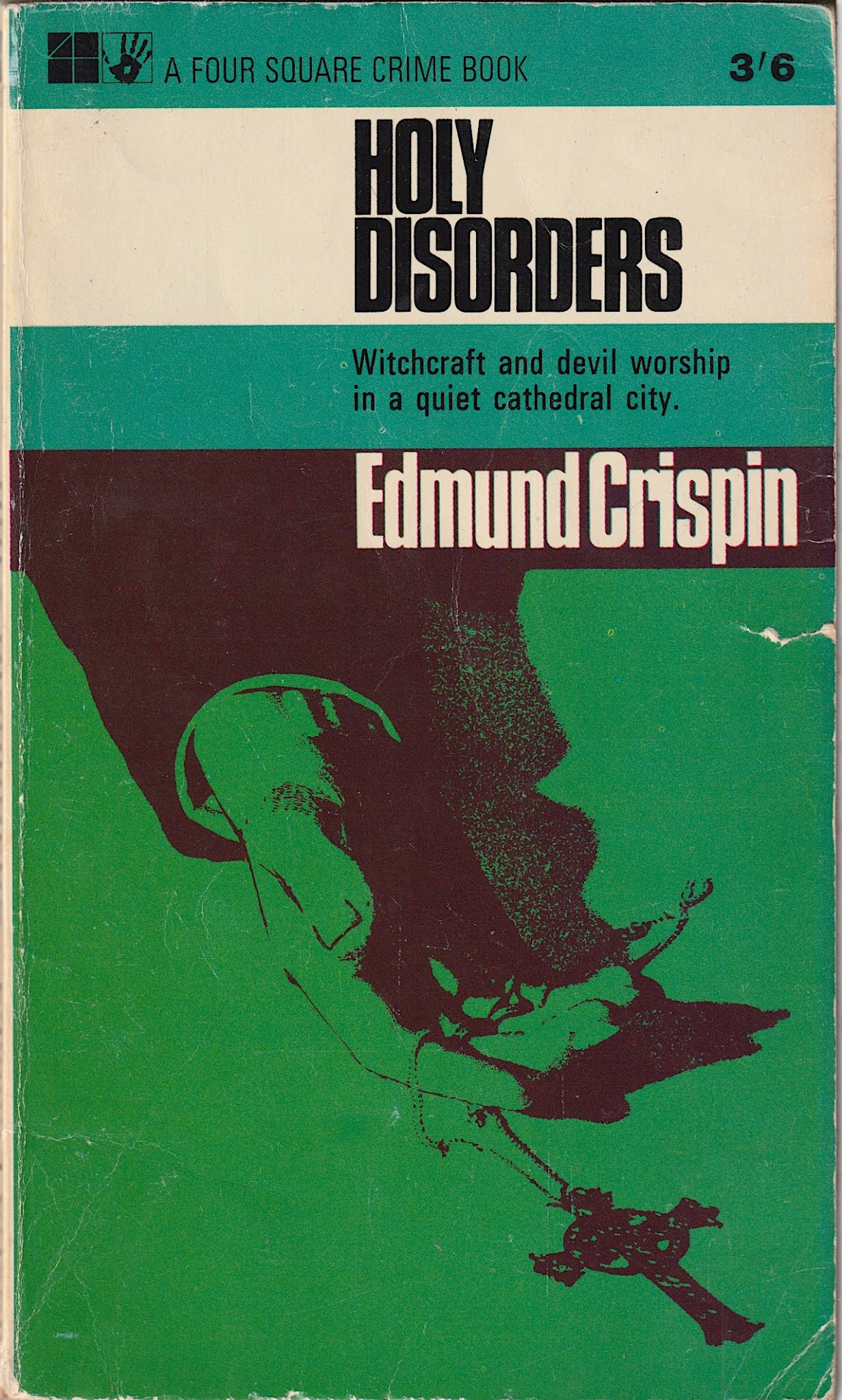
Holy Disorders
by Edmund Crispin

(Four Square, 1965 / first published 1946)


Though on the face of it this paperback looks to be yet another enticing, horror-adjacent offering from ‘60s New English Library imprint Four Square, readers familiar with Bruce Montgomery aka Edmund Crispin’s Gervase Fen novels will realise that the publishers have actually been pretty disingenuous in presenting this reprint as a straight Satanic thriller.

As the aforementioned readers will be well aware, the Fen novels are in fact broadly comedic, foregrounding an idiosyncratic campus humour pitched somewhere between P.G. Wodehouse and Bruce Robinson’s ‘Withnail & I’, leavened with cheeky, fourth wall-breaking asides and enough literary/classical in-jokes to make anyone who has not committed Palgrave’s ‘Golden Treasury’ and Bullfinch’s ‘Age of Fable’ to memory feel slightly inadequate as a human being.

Not everyone’s cup of tea, to be sure, but personally I’m happy to indulge Montgomery/Crispin’s whims, and find his books fairly amusing. More-so, I suspect, than the hypothetical 1965 reader who came into this one expecting some serious, Dennis Wheatley type affair, only to find our protagonist, retiring church music composer Geoffrey Vinter, blundering around causing havoc in the sporting goods section of a London department store during the first chapter, as he struggles to obtain the butterfly net which his friend, Oxford literary professor and amateur detective Gervase Fen, has ordered him to bring forthwith the the fictional Devonshire cathedral city of Tolnbridge.

Vinter, it transpires, has been summoned to Tolnbridge to stand in for the cathedral organist, who has been hospitalised after being bashed about the head by unknown assailants. Before he gets there however, we get to share at some length Geoffrey’s dismay at navigating Paddington Station during rush hour, his attempts to buy and imbibe several glasses of beer as he awaits his train, his developing friendship with the hapless shop clerk who has followed him from the department store in search of adventure, and his lengthy and tormented interactions with the other occupants of his train carriage, only a small handful of whom will go on to play any role in the unfolding mystery.

Amidst all this, the fact that several shambolic attempts are made on Geoffrey’s life during his journey thickens the plot, but otherwise scarcely seems worthy of note.

By chapter three (page 31), our man has finally arrived in Tolnbridge, which I take to be modelled to some extent on Montgomery’s adopted home of Totnes, although it differs from that fine town in a number of important details, not least the dominant presence of a cathedral, around which most of the book’s subsequent “action” (if such it may be termed) accumulates.

Significantly, Tolnbridge is also notrorious for “..a frenetic outburst of witch trials in the early seventeenth century, and the equally frenetic outburst of witchcraft and devil-worship which provoked them, and in which several clergy of the diocese were disgracefully involved”;

“‘This was the last part of the country,’ said Fen, “in which the trial and burning of witches went on. Elsewhere it had ceased fifty or sixty years earlier - and then hanging, not burning, had been the normal method of execution. The doings in Tolnbridge stank so that a Royal Commission was sent down to investigate. But when the Bishop Thurston died, the business more of less ceased. One of the last celebrated witch-trials in these islands was the Weir business in Edinburgh; that was in 1670. Tolnbrige continued for forty years after that, into the eighteenth century - the century of Johnson, and Pitt, and the French Revolution. Only a step away from our own times. A depressingly fragile barrier - and human nature doesn’t change much.’”

After arriving at the wrought-iron gates of the clergy-house, Vinter and newfound pal Fielding are introduced to the assortment of ecclesiastical hangers-on who will go on to comprise the story’s pool of suspects (if you don't know difference between a Precentor and a Canon, you’ll be pretty much at sea here). With Fen - effectively the Holmes to Geoffrey’s Watson - stubbornly failing to make an appearance however, there’s little for the pair to do but retreat to the nearest pub - which in this case is the ‘Whale & Compass’ (perhaps based on Totnes’s late lamented Kingsbridge Inn, or so I’d like to imagine).

To cut a long story  short, Gervase Fen eventually makes his appearance a few pints later, on page 58. Each of Crispin’s books seems to feature the detective adopting a new, loud and disruptive hobby, and in ‘Holy Disorders’ he is inexplicably fixated with capturing, and apparently performing unspecified experiments upon, various insects - hence both his demand for a butterfly net and his extended absence during daylight hours. The reason why Fen is residing in Tolnbridge, apparently at the expense of the church, is never sufficiently explained insofar as I recall, but be that as it may - with our sleuth finally accounted for, we can finally get on with the murder mystery component of the novel.

In addition to the fate of the aforementioned organist (who has been poisoned in his hospital bed, following the earlier assault), this comprises a ghoulish and somewhat surreal variation of the Locked Room mystery, in which the widely disliked Precentor, a Dr Butler, is inexplicably crushed beneath the colossal tombstone of ill-regarded medieval luminary St Ephraim - a tragedy which seemingly occurred when all doors to the building were locked, and no one else was inside.

Eccentric though his writing may be in most other respects, Montgomery/Crispin remained staunchly dedicated to the conventions of the old fashioned whodunnit, and as such, much of the text from hereon in is taken up with the gathering and consideration of alibis, methods and motives, all of which is unpacked at a length liable to prove excruciating to readers who are not fans of classic drawing room mysteries, including the provision of both a map of the crime scene and a lengthy suspect-by-suspect recap to help logically-minded readers reach their conclusion prior to what passes for ‘the big reveal’.

Although published in 1946, ‘Holy Disorders’ was evidently written during the war years, which lends an interesting backdrop to proceedings, reminding me somewhat of Powell & Pressburger’s bucolic wartime fantasias (particularly ‘A Canterbury Tale’ (1944)). 

There are frequent references to the war effort, to idle soldiers hanging about hither and yon awaiting orders, and to the latest news from overseas, and it is little surprise therefore that a further quirk is added to the already over-stuffed plot when it is revealed that the powers-that-be have detected illicit radio transmissions emanating from the vicinity of the cathedral, leading the discovery of a radio set hidden in an inaccessible part of the building, and the subsequent assumption that a cabal of Nazi spies must be abroad in sleepy Tolnbridge.

Amidst all this incident meanwhile, there is even room, surprisingly, for a little romance, as Geoffrey Vinter finds himself smitten with the daughter of the ill-fated Precentor - a graceful and demure young lady who, much in the manner of female characters in novels like this one, uncomplainingly acts as den mother and cook to the assorted oddballs hanging around the clergy-house. Like any good ‘Brief Encounter’ era Englishman, Geoffrey delivers his proposal of marriage whilst staring fixedly ahead at a row of radishes. (“Brutish roots,” he reflects, “what do they know of the agonies of a middle-aged bachelor proposing marriage?”)

This whole business is actually surprisingly affecting, forcing us to reflect on the fact that, whilst Edmund Crispin may have adopted the voice of a gout-addled college rector for his writing, Bruce Montgomery was actually only twenty-five years old when he completed this novel, and presumably subject to the same passions as other young men making their way in the world, and what have you.

With the novel’s rambling plotting already so loaded with under-developed tangents, it’s no surprise meanwhile to discover that the Black Mass / devil worship angle - though assuredly present - never amounts to much more than fairly half-hearted diversion. The irony here however is that the brief passages in which Crispin’s writing shifts away from comedy to explore more macabre subject matter are actually extremely effective, evoking an atmosphere worthy of the era’s horror/weird fiction greats;

“They paused by the hollow where the witches had burned. It was overgrown, neglected. Weeds and brambles straggled over it. The iron post stood gaunt against the fading light. They found rings through which the ropes and chains had passed. The air of the place was almost unbearably desolate, but in imagination Geoffrey saw the hillside thronged, above and below, with men and women whose eyes glowed with lust and fright and appalling pleasure at the spectacle to be offered them. […] A woman they had known - a next-door neighbour perhaps - a familiar face now become a mask of fear in whose presence they crossed fingers and muttered the Confiteor. Who next? And in the breast of that woman, what ecstasy of terror or vain repentance or affirmation? What crying to Apollyon and the God of Flies…? It needed little fancifulness to catch the echo of such scenes, even now. And here, they had accumulated - week after week, month after month, year after year, until even the crowds were sick and satiated with the screaming and the smell of burned flesh and hair, and only the necessary officers were present at the ending of these wretches, and the people stayed in their houses, wondering if it would not have been better to face the malignant, tangible living rather than the piled sepulchres of the malignant, intangible dead.”

I mean, you certainly don’t get that sort of thing in the middle of a Jeeves & Wooster.

Thereafter, this sense of a lurking evil underlying the city is given an atavistic twist via an extremely sinister (though underdeveloped) sub-plot which sees Fen interviewing a teenage girl who has been brain-washed through the use of drugs into participating in the Black Mass and carrying out the diabolical whims of her masters.

Sadly, the contemporary Satanic ceremony which Fen and Vinter subsequently manage to infiltrate proves both boring and rather farcical - it seems that the novel’s villains are merely using diabolism as a front for their more legitimately nefarious goals, again for reasons which remain somewhat unclear - but those ‘Witchfinder General’ / ‘Blood on Satan’s Claw’ vibes are really nailed down again during a section of the book in which (for reasons which appear entirely superfluous to the central narrative) our heroes are invited to read the long supressed secret diary of seventeenth century witch hunter Bishop Thurston. A section of this diary is reproduced in full, effectively comprising a short-story-within-a-novel, and once again, it is excellent stuff - a nasty little tale with a supernatural twist which could easily have found a home in any given ‘70s horror/ghost story anthology.

More representative of overall tone of the novel however are incidents such as that in which Fen and Vinter encounter a ‘Royal Professor of Mathematics’ who seems intent on reciting the entirety of Lewis Carroll’s ‘The Hunting of the Snark’ from memory, only to lose him again a few pages later following yet another visit to the pub, or the chapter which finds the investigators extracting much merriment from a visit to a potential suspect whose home boasts a pet raven resting upon a bust of Pallas above a chamber door, and a wife named Lenore, yet who pleads complete ignorance of the work of Edgar Allan Poe. (“I haven’t much time for verse - he’s good, is he?”)

In conclusion, you might say that, if Montgomery/Crispin had taken a slightly more serious approach to is storytelling there and had engaged more thoroughly with the more macabre elements of his tale, he could have written an absolutely splendid horror novel here. But, I suspect that’s rather like saying that if Noel Coward had ditched all that camp stuff and got a bit more into the rugged outdoors, he could have written a cracking western. 

At the end of the day, the Crispin/Fen novels are what they are. They are entirely reflective of the peculiarities and obsessions of their unconventional creator, but if you can angle your antenna somewhere in the vicinity of his preferred wavelength, they remain thoroughly entertaining, and certainly a little different from anything else you’re liable to find knocking about in your local Oxfam. 


Monday, 12 July 2021

Noir Diary # 15:
The Lineup
(Don Siegel, 1958)


Following the lead of the film itself, let’s start off here by getting the boring bit out of the way: Don Siegel’s ‘The Lineup’ is, technically speaking, a TV spin-off.

Also known as ‘San Francisco Beat’, ‘The Lineup’ began as a radio drama in 1950 before moving to TV via the auspices of CBS in 1953. Generally viewed as a close competitor to Jack Webb’s more successful ‘Dragnet’, the show followed basically the same formula, following the day-to-day crime-fighting travails of straight-laced SFPD detective Lieutenant Ben Guthrie (played by Warner Anderson, who here resembles a somewhat older, less physically intimidating Lee Marvin), with Tom Tully (mysteriously absent from the movie version) as his partner, Sergeant Matt Grebb.

Over a decade since Jules Dassin initially kick-started the trend for cross-breeding Film Noir tropes with shot-on-location / faux-documentary police procedural stuff in 1947’s ‘The Naked City’, it’s safe to assume that movie-goers knew the drill pretty well by this point, and one can only imagine that yet another based-on-the-hit-TV-series trudge through the same good-solid-detective-work, ‘crime doesn’t play’ type palaver didn’t exactly sound too thrilling.

Assigned director Don Siegel and screenwriter Stirling Silliphant apparently agreed. After Silliphant knocked out a script which the pair both saw as the basis for an exciting, unconventional crime movie, Siegel claims that he pleaded with producers Frank Cooper and Jaime Del Valle for the opportunity to extract the movie from the ‘Lineup’ brand and let it stand alone as its own thing - but no dice. Although Cooper & Del Valle apparently didn’t give much of a damn how the film actually turned out, a ‘Lineup’ movie had been promised, and a ‘Lineup’ movie was going to be delivered.

Needless to say, Siegel and Silliphant responded to this decision by essentially pulling the same audacious bait and switch on their audience that Robert Aldrich and A.I. Bezzerides had laid on fans of Mickey Spillane’s Mike Hammer novels a few years earlier with their extraordinary and iconoclastic ‘Kiss Me Deadly’ (1956).

Doing little to hide their disdain for the franchise they were ostensibly working within, the director and screenwriter proceeded to entirely side-line the familiar certainties that viewers of the TV show might have been expecting, largely confining the obligatory police procedural segments to the opening twenty minutes, and pointedly relegating the show’s star Warner Anderson to the bottom of the on-screen cast list.

Meanwhile, they proceeded to kick up a veritable sandstorm of darker, more challenging and just plain weirder material, resulting in a movie which, a few decades after the dust had settled, began to gain recognition as one of the most startling and forward-thinking American crime films of its era.

Right out of the gate, Siegel’s take on ‘The Lineup’ plunges us into chaos. Out of control automobiles screech around the Embarcdaero in San Francisco’s port district, as suitcases are flung around, incomprehensible yells are exchanged and a police officer is callously mown down by a speeding taxi before the driver takes a bullet in the back and careers into the side of a jack-knifed truck. When Guthrie and his surrogate partner Quine (played by frankly terrifying tough guy actor Emile Meyer) dutifully arrive on the scene to assess the damage, all they can do is despairingly ask, “why?!” (1)

Twenty minutes or so of briskly-paced but uninspiring A-to-B police-work - sticking broadly within the TV show’s remit, albeit with a somewhat harder edge and more attractive locations - help them answer this question to a certain extent, as they uncover the bare bones of an elaborate conspiracy to smuggle heroin into the city, using pre-loaded ‘oriental’ souvenirs carried through customs by unsuspecting tourists.

There are some fun moments during this opening slog - both Anderson and Mayer do solid work, there is some exquisite San Francisco location shooting and I particularly enjoyed the bit where the police’s ‘lab man’ opens up a suspect package with a flick-knife, licks a big dollop of powder off his finger and declares, “yep, it’s heroin alright” - but it is only once the focus shifts elsewhere that the movie really begins.

Indeed, Siegel had literally wanted the film to begin here, as we board a flight into the city and meet the two contractors hired by an unseen cartel to reclaim the hidden dope from its unwitting carriers -- and boy, what a pair they are.

The uncertain relationship between psycho triggerman Dancer (Eli Wallach - blank stare, twisted grimace, porkpie hat) and his older, somewhat effeminate ‘handler’ Julian (brilliantly played by Robert Keith - beady eyes, skull-like grin, pencil moustache) was reportedly intended by Silliphant to mimic that of an aspiring Hollywood star and his agent (“if he continues to listen to me, he’ll be the best,” Julian declares at one point, in the process of talking up his boy’s unparalleled talents in the field of crime). A sly, in-jokey conceit, this approach which works superbly, creating an unforgettably amoral, inscrutable odd couple whose interplay pretty much dominates the film from this moment onward. (2)

Once Julian and Dancer (god, that name) are on the scene, Guthrie and Quine fall almost entirely into the background, turning up merely to shake their heads over the latest corpses and radio in for roadblocks and ambulances. We’re 100% with the bad guys on this one, and that’s just as well, because we just can’t keep our eyes off these two creeps - They’re just fascinatingly perverse in every respect.

As Sergio Angelini thus observes in his essay on the film for the Indicator label’s Columbia Noir Vol. 1 box set, “chaos is given a face and a psychological profile while order is merely represented by men in hats”. In truth though, what keeps us so glued to the travails of these goons is that Silliphant and Siegel never allow us to get an angle on - as the guy who gives Dancer the low-down at the port puts it - “what makes [them] tick”. They are nightmare figures from a world we will never understand.

Where did they come from? (The script tells us Miami, implausibly citing their alleged tans, but if so they must have been living underground like moles.) How did they meet? Has Julian spent his entire life recruiting young psychopaths and sponging off their ill-gotten gains like some kind of sociopathic boxing promoter? What exactly is the nature of their relationship? (Let’s not even go there.)

Throughout the film, the characters Dancer and Julian encounter seem as unsure what to make us them as we are. Pushed by their port-side contact, Dancer makes some blunt statement about not having had a father, but that doesn’t really take us very far in terms of armchair psychology. Later in the film, when tearful hostage Dorothy Bradshaw (Mary LaRoche) demands to know “what kind of men” the pair are, the string of gnomic non-sequiturs the lizard-like Julian spits out in response (“women have no place in society”, “crying is aggressive and so is the law”, “people of your class don’t understand the criminal’s need for violence”) raise more questions than they answer.

All we know at the outset however is that, like all good agents, Julian has his boy learning proper English grammar (“how many characters on a street corner know how to say, ‘if I were you?’”), tempering Dancer’s sullen, animalistic incomprehension with his own twisted sense of refinement. Meanwhile, he gleefully obsesses over the poetic implications of the last words of the Dancer’s victims, which - in another wonderfully tweisted detail of Silliphant’s script - he scrupulously records in a notebook.

Add a young Richard Jaeckel to the equation as the duo’s feckless ‘wheelman’ - fish-faced, bowtied and alcoholic, he’s been drafted in at short notice after the phony taxi driver we saw in the opening got snuffed - and it’s clear the deck is stacked for some pretty hair-raising mayhem over the next sixty minutes or so.

As Angelini further notes, our ostensible ‘heroes’, the quotidian cops, don’t even get to share any screen-time with these outlandish villains. Mirroring the movie’s opening, Guthrie and Quine only make it to the final showdown in time to despairingly survey the carnage. Seemingly left speechless before the final fanfare crashes in, they are denied even their obligatory “well that just about wraps things up” sign off, closing the movie on a note of nihilistic self-destruction which an empty dedication to hard working SFPD does little to dissipate.

In spite of his legendary status amongst crime/noir aficionados, in truth I’ve always felt that Don Siegel’s work as a director can be a bit hit and miss (it’s difficult to imagine his cult gaining much traction on the basis of pictures like Private Hell 36, for example). Looking across his wider career however, he always seems to come alive when dealing with tales of morally ambiguous anti-heroes or outright maniacs of one kind or another - so of course it figures that he was absolutely at the top of his game for this one. Basically we’ve got the man who brought us ‘Riot in Cell Block 11’ and ‘Dirty Harry’ firing on all cylinders here, and the results are nothing short of spectacular. 

In fact, ‘The Lineup’ feels very much like the Ur-text of all past and future Siegel movies, revelling in the pulp-crime aesthetics of his earlier black & white pictures whilst prefiguring elements of the most memorable films he would go on to make over the next few decades (not only the high voltage action and San Fran location work of ‘Dirty Harry’, but the psychotic criminal protagonists of ‘The Killers’ (1964), the elliptical visual storytelling of ‘Charley Varrick’ (1973), and many more besides, I'm sure).

As Siegel wrangles raw, livewire energy, technical precision and unsettling, off-beat artistry here, it’s easy to understand why a young Michael Reeves made a pilgrimage to the director’s doorstep early in the ‘60s to prostrate himself before the master; as a concise summation of the director’s formal strengths and auteurist tics, ‘The Lineup’ is pretty hard to beat.

As with so many of these ‘50s Columbia flicks, the claustrophobic framing and expressionistic shadows of ‘traditional’ noir style have been thoroughly swept away in ‘The Lineup’ (aside from anything else, the entire movie takes place in daylight). Rather than merely falling back on a kind of bland quasi-realism however, Siegel and his DP Hal Mohr offer an alternative visual sensibility which proves just as compelling as the old-time good stuff.

It has often been said that, in a Siegel movie, the camera is always in the right place, and ‘The Lineup’ consistently bears this out, as he and Mohr make inspired use of the by-now-standard widescreen aspect ratio, framing the film’s locations in such a way as to highlight jagged, horizontal lines bisecting bright, white spaces, creating an anxious collage of portside cranes, highway overpasses, art deco tower blocks and advertising hoardings.

Throughout proceedings, the placid serenity of the San Francisco skyline is cut through with a jittery, urban energy, as examples of every means of mechanised transportation known to man (ships, planes, motorcycles - even a blimp at one point) roar hither and yon behind the action, emphasising the relentless velocity of the movie’s plotting whilst casually pre-empting the starkly modernist take on the crime genre inaugurated by John Boorman’s ‘Point Blank’ a decade later.

All of which of course is merely a high-falutin’ way of leading up to the fact that the extended car chase sequence which forms ‘The Lineup’s finale is totally out of control, incorporating a level of stunt-work, action direction and cranked up, adrenalin rush cutting which feels startlingly ahead of its time, pretty much single-handedly inaugurating the “beat THAT” lineage of attention-grabbing car action which would eventually go on to bring us the successive thrills of ‘Bullitt’, ‘The French Connection’, ‘To Live and Die in L.A.’ and so on.

Certainly, I’m not aware of anything else from ‘50s that even comes close to this level of visceral excitement. Even though Siegel falls back on using back projection for most of the interior car shots, it’s at least the best back projection you’ll ever see, with the actors’ reactions and the movement of the ‘foreground’ car perfectly timed to match the hair-raising swerves and near misses of the pre-shot footage, lending it a sense of realism which rarely wavers.

In fact, the sweaty, maniacal claustrophobia of these ‘in-car’ shots - which see the crooks collapse into violent, recriminatory mania as their hostages cower and shriek and the car screeches crazily to avoid on-coming traffic - anticipate yet another trope which would become a staple of hardboiled filmmaking a few decades later, primarily on the other side of the Atlantic, where similar in-car chaos was utilised to great effect in films like Mario Bava’s ‘Rabid Dogs’ (1976) and Pasquale Festa Campanile’s Hitch-Hike (1977), amongst others.

And, when we move outside for the wider exterior shots, well, the stunt-work is just honest-to-god breath-taking, climaxing in a heart-stopping emergency stop / handbrake turn on the edge of an unfinished highway overpass which would have given Jackie Chan the jitters thirty years later. (3) 

Once we stop to think about it for a few minutes of course, much of Silliphant’s script for ‘The Lineup’ is outrageously implausible. Right from the outset, the idea that an international criminal cartel would go to the trouble of planting shipments of dope on unsuspecting tourists, only to then hire a pair of highly conspicuous out-of-town psychos to collect the goods, leaving a trail of murder victims and drug traces in their wake, is totally absurd.

And, that’s before we even get on to the practicalities of smuggling junk in the handles of ivory tableware, or - my personal favourite - the notion that a reclusive, wheelchair-bound mob boss would undertake a dope pick-up himself, in-person and apparently alone… and in a location which can only be reached by navigating multiple flights of stairs, no less!

But, when a movie’s writing is this consistently inventive and attention-grabbing, when the on-screen action is so fast-moving, so packed with wild beauty and delicious craziness, the viewer is forced to engage a mind-set usually reserved for watching giallo and euro-horror movies and simply ask, who cares?

As James Ellroy points out in his characteristically scabrous contributions to the commentary track for the film recorded alongside noir expert Eddie Muller, when it comes down to it, crime fiction is essentially bullshit. Nothing as sensational or destructive as the events portrayed in this film has ever gone down in the annals of real life crime in America - so as long as you’re making shit up, why not go wild?

As in a Fulci or Argento film, each one of the aforementioned scripting absurdities allows for the creation of cinematic moments - most of them heretofore unmentioned in this review - so audacious and unexpected that only the most joyless, movie-hating pedant would really have cause to complain.

From Vaughn Taylor’s ice-cold turn as ‘The Man’, to the assassination Dancer carries out in the steam bath of ‘The Seaman’s Club’, so loaded with unspoken sexual tension it’s a wonder it didn’t jam the projector, to the horribly suggestive sight of Julian tearing apart the innards of child’s Japanese doll as its owner looks on aghast and uncomprehending - almost every scene in ‘The Lineup’ offers something unforgettable. Like some golden treasury of pulp crime excess, it all serves to build a picture of a precarious, morally bankrupt world in which our bourgeois certainties might explode into bloody violence might explode at any moment.

For a ‘50s studio film, ‘The Lineup’ ultimately presents a remarkably frightening conception of the world, and, anchored by exceptional performances for Wallach and Keith, it remains entirely believable on an emotional level, even as the plotting skirts the fringes of outright insanity, helping cementing its place in the pantheon alongside ‘The Big Combo’, ‘Touch of Evil’ and ‘Kiss Me Deadly’ as one of the very best American crime films of the ‘50s. Hard-boiled cinema at its finest.

 -----

(1) You’ll recall Emile Meyer for his role as the crooked cop in ‘The Sweet Smell oSuccess’ (1957), or perhaps as the priest in Kubrick’s ‘Paths of Glory’ (also ‘57), or as Rufus Ryker in ‘Shane’ (1953). Once you’ve seen him in anything however, his face’ll stick with you, that’s for sure.

(2) Outside of this film, I mainly know Robert (father of Brian) Keith for his role as the unconventional, sympathetic cop character in another excellent San Francisco noir, ‘Woman on the Run’ (1950), but as a solidly reliable character actor he played smaller roles in a raft of quote-unquote ‘classics’ over the years, including ‘The Wild One’ (’53), ‘Guys and Dolls’ (’55) and ‘Written on the Wind’ (’56).

(3) Legend has it that stuntman Guy Way performed this stunt with his own girlfriend in the back seat of the car, doubling the movie’s female hostage. She needed to be helped out of the vehicle, having entered a state of extreme shock, and Siegel later implied in an interview that the couple’s relationship never recovered.

Thursday, 1 July 2021

Franco Files:
Gemidos de Placer /
‘Cries of Pleasure’

(1982)

OBLIGITORY DISCLAIMER: Readers should be aware that the screengrabs above are NOT sourced from Severin’s 2019 blu-ray edition of ‘Gemidos de Placer’, which I can confirm looks splendid. They originate instead from an older, seemingly VHS or TV-sourced, scan of this film which I happened to have knocking about.

One of the pleasures of life as a Jess Franco fan is that, just when you think you’ve finally got the drop on where the great man was coming from at any given point in his sprawling and tempestuous career, he can still turn around and surprise you.

Never was this more true than during the early 1980s, a period which saw Franco cranking out a frankly bewildering quantity and variety of celluloid, most of it delivered directly to the door of his sometime paymasters at Barcelona-based Golden Film International - a firm whose naive husband and wife proprietors can easily be pictured weeping uncontrollably as yet more couriers arrive at their office door bearing new film cans to add to the ever-growing mountain of unreleased / unreleasable product piling up around them… all courtesy of the tireless Senor Franco.

As more of Franco’s Golden-era films become readily available to viewers who were denied the opportunity to obsessively haunt back-street Spanish sex cinemas in the early 1980s (largely thanks to the noble efforts of Severin Films, Stephen Thrower and Francophile underworld of the fan-sub/trading circuit), his work during this creatively fertile era is increasingly revealed as a series of sharp left-hand turns, with his output during 1982 alone ranging from lackadaisical sex comedies to sado-erotic treasure hunts, neo-noir / new wave youth movies, gothic horrors and inexplicable, family-oriented kung-fu fantasies. In the midst of which, we find the little number we’re looking at today - one of the most sombre, disturbing and formally experimental works of his entire career.

Sketchily distributed around porno theatres for a few months in 1983, with promotional material consisting solely of a generic photo-collage poster featuring a man who doesn’t even appear in the movie thrusting his Y-fronts in the direction of Lina Romay’s face, ‘Gemidos de Placer’ [‘Cries of Pleasure’] is, like many of Franco’s best erotic films, a work that only a stone-cold psychopath could emerge from feeling frisky.

Yet another descent into the soul-withering, sex-horror netherworld previously explored in the likes of Lorna the Exorcist and Doriana Grey, ‘Gemidos..’ takes place, perversely, in just about the most beautiful location imaginable – a luxurious villa situated high on the cliffs above the director’s spiritual home, the Valencian coastal town of Calpe. (1)

Bright, elevated and open to the elements (not to mention publically visible for miles around), this villa seems a frankly absurd place for this tale of insular, amoral depravity and dead-eyed introspection to play out, but… would it be too much of a stretch to suggest that Franco is deliberately playing on some Antonioni-esque notion of spiritual disconnection between human beings and their environment here? I wouldn’t put it past him.

Beginning with a stunning vista of the Calpe’s unmistakable Peñón de Ifach, the film’s opening shot slowly pans across the bay to reveal the figure of Franco’s regular camera tech/right hand man during this period, Juan Solar, here playing the mute, guitar-strumming servant who will go on to act as mute witness to the assorted atrocities committed within the villa.

After zooming in for a close-up on Solar’s fingers picking out a cyclical guitar melody as he leans precariously on the balcony’s guard-rail, the camera then pulls back as a heart-rending Daniel White piece for solo cello abruptly cuts in on the soundtrack, revealing the shimmering surface of a swimming pool. In what appears to be the director’s tribute to ‘Sunset Boulevard’, a naked male corpse (recognisable to fans as Franco’s ubiquitous ‘80s leading man Antonio Mayans) floats face down in the water.

Sadly we don’t get a narrating voiceover from Mayans’ corpse in this case, but Solar’s character instead does the honours (dubbed with Franco’s own voice, weirdly), and it is within his warped, potentially unreliable, memories we will presumably be spending the next eighty-something minutes.

Already in this this extended opening shot, we have a Leone-esque sense of grandeur and clammy, melancholy feel which immediately sets ‘Gemidos..’ apart from the fly-by-night sex comedies and exploitation flicks which surround it in Franco’s ’82 filmography, but as we slide back, noir-style, into the past, the minimalist plot which begins to unfold nonetheless feels very much like a mish-mash of familiar bits and pieces, reheated from the director’s numerous earlier tales of Sadean libertines getting up to no good in Mediterranean beauty spots.

Antonio (Mayans), apparently an idle playboy of some kind, arrives home at his villa, bringing his latest squeeze Julia (Romay) to “meet his servants,” numbering both Fenul (Solar’s character) and Marta (Elisa Vella), who soon reveals to Julia that she is actually both Antonio’s long-term lover and kind-of adopted daughter.

(This bit of plotting is patently ridiculous, by the way - Marta claims that Antonio and his wife plucked her out of poverty on the Barbary Coast when she was a young girl, and that she has lived with them ever since… despite the fact that Vella’s features are closer to being East Asian than African, and that she is clearly around the same age as the other cast members! Franco’s full spectrum disdain for realism will be further discussed below.) (2)

“He raped me when I was twelve, and I’ve loved him ever since,” Marta casually states, a troubling assertion which very much sets the tone for much of what is to follow. And yes, in addition to his new girlfriend and his live-in slave girl, turns out that that insatiable rascal Antonio also has a wife to deal with - Martina, played by Rocío Freixas. And as it happens, she is being released from the clinic today, so she’ll be home in time for dinner. Great! (3)

As you’d reasonably expect of an ‘80s Franco joint, casual nudity, languid seductions and fevered tongue-waggling are soon the order of the day, but right from the outset, the sex here is dark, with Antonio reaching his first climax with Julia as he whispers of his plan to murder Martina and steal her (apparently considerable) fortune.

Of course, Antonio is also simultaneously conspiring with Marta to do away with Julia, but… needless to say, it all becomes a bit of a blur before long, especially once Marta brings out another round of her “special cocktails” (“it’s an old recipe, from my ancestors”). They seem to have quite an effect. And, at the end of the day, does it really matter who’s doing what to whom anyway, so long as everybody cums and somebody dies?

“Twenty minutes of plot, sixty minutes of sex” may be a common complaint whenever quote-unquote ‘mainstream’ film criticism tries to get to grips with with erotica/porn, but here Franco proves that in the right hands (so to speak), the sex itself can be both aesthetically and narratively compelling, even as it progresses at the strung out, tidal pace at which he prefers to weave his weird spell. After the initial set up, the narrative progresses (in both linear and emotional terms) almost entirely through the compulsive, obsessional sexual (and occasionally homicidal) behaviour of the characters within the villa.

And, we haven’t yet mentioned the film’s primary technical innovation - namely, the fact that, uniquely within his filmography, Franco chose to shoot much of ‘Gemidos de Placer’ as a series of extended, real time single takes, in the manner of Hitchcock’s ‘Rope’.

Zooming and refocusing mid-shot in order to save time and minimise camera set-ups had of course been Franco’s standard MO for many years at this point, but even so, the amount of rehearsal and pre-planning needed to keep his cast engaged and on-point, and his compositions varied and imaginative, across ten or twelve minutes of uncut screen time must have been considerable.

Belying the semi-improvisational, “shoot first, ask questions later” methodology with which Franco is generally assumed to have assembled his films, ‘Gemidos..’ in fact stands as a testament to the kind of hard graft he was prepared to put into even the most marginal, sparsely distributed projects, when inspiration struck.

Restricted to a fixed camera position, acting as his won operator as per usual, the director’s trusty zoom lens is of course running hot throughout, as he delves once more into his hypnotic, all-consuming pursuit of sexual abstraction. Though perhaps not as psychedelic as some other Franco projects, ‘Gemidos..’ certainly has its moments.

Ranging far and wide from his voyeur’s vantage point in the centre of the room, the director/camera man shoots the languorous depravity being enacted at his behest through distorting glass screens, swinging bead curtains and even the gauze of a Japanese print screen, at times transforming the villa’s gaudily prosaic holiday home furnishings into his patented brand disorientating avant garde freakery. By and large however, this particular outing feels more narcotic than psychotropic; more an addict’s exhausted reverie than a cosmic trip into the depths of the upholstery.

Nonetheless, anyone who’d still write Franco off as a lazy or slap-dash filmmaker should consider the effort which must have gone into planning the single, extended shot which comprises Marta’s violation, murder and the disposal of her body. From his fixed position at the top of the villa’s staircase, Franco covers all of the necessary action, scanning up and down to the stairs with perfect timing to catch characters as they move from room to room, zeroing in on faces and details as required - essentially using a technique first adopted as a cost-cutting exercise to mount a remarkable display of cinematic virtuosity.

It is one of the inherent ironies of the director’s eccentric approach to cinema however that appreciation of his technical achievement here will likely be lost on many first time viewers, as they instead try to deal with the unconvincing-bordering-on-non-existent ‘special effects’ through which Marta’s death is conveyed. Franco always of course favoured, shall we say, ‘emblematic’ make-up effects over any attempt at realism, but the practical difficulties of applying stage-blood to Elisa Vella’s body whilst a shot was actually in progress seems to have pretty much flummoxed him here.

The results prove so half-hearted that they fail to really serve their intended narrative purpose, leaving us temporarily uncertain what has actually occurred. Have they just cut her a bit? Is this part of some kinky game? Has she passed out or gone to sleep? Oh, no, wait -- here comes poor old Fenul to drag the body away. That’s… pretty dark.

In a sense though, perhaps it’s just as well that the presentation of this murder is so botched - the sheer callous cruelty of seeing a remorseless couple casually kill their devoted daughter/slave in a drugged up haze midway through a sex act would be so horrible as to be almost unwatchable, were it presented in a more realistic manner. Even by the twisted standards of a Jess Franco sex-drama, the extent to which Marta is treated as human garbage by the people she claims to love her feels truly vile. (The Marquis de Sade, who is generously assigned a story credit here, would no doubt have approved.)

Nymphomania may be a ubiquitous concept in erotica, but Franco is one of few filmmakers I’m aware of who manages to portray this much ballyhooed affliction, not as a mere fantasy of female promiscuity, but as something closer to what it would presumably boil down to in reality; as a kind of all-consuming sickness, an unscratchable itch, prompting an agony of ever more remote, unsatisfactory physical debasement and mental dysfunction.

Seeing Lina Romay writhing alone on a sofa in a darkened room, contorting her body in a truly alarming (even by her standards) auto-erotic fit, whilst a plaintive guitar melody is accompanied by Franco’s own eerie, wordless vocals on the soundtrack, is a weird and dissonant experience indeed. Rivalling the aforementioned ‘Lorna..’ and ‘Doriana..’ as one of Lina’s most extreme performances, her body language in ‘Gemidos..’ becomes increasingly monstrous and unnatural as the film progresses, further complicating its ostensible function as common-or-garden erotica.

Likewise, whilst it is obligatory for any remotely kinky erotic movie to have somebody banging on about the intertwined nature of pleasure and pain at some point, Franco here dares here to remind us that this relationship is a two-way street. Pain may become pleasurable, sure, whatever, but physical pleasure can also blur all too easily into pain, and by the final stretch of this film’s debauchery, the two states have become effectively indistinguishable, as the characters’ ever-more desperate coupling begins to seem less like personal gratification and more like some kind of compulsive self-mutilation.

For a while there in fact, it seems as if poor old Antonio is actually going to be fucked to death, as, exhausted after innumerable bouts of sexual congress, he painstakingly tries to rouse himself for one more go-round, as Lina, equally pale and far-gone, dutifully mounts him. Essentially presenting sex as self-destruction, it’s an expression of mania worthy of a Zulawski movie.

Though ‘Gemidos de Placer’ lacks the pulpy / fantastical accoutrements of Franco’s earlier tales of Sadean evil-doers – no red-tinted black masses, basements full of frozen lovers or cannibal feasts for these libertines – a more prosaic, more unsettling evil is revealed in Fenul’s mumbled voiceovers, which serve to drag the film firmly into the realm of horror.

Introducing a terrible flipside to Antonio and Martina’s strutting, elitist exhibitionism, he implies that one of his main roles within the villa is to dispose of the bodies, recalling an occasion on which his master and mistress apparently killed a young boy and pleasured themselves whilst smearing their with his blood (“..he was so little - they sliced his throat like a pig”).

“I don't like it when they become soggy and begin to dissolve… covered in flies..,” he muses at the film’s conclusion, implying a recurring pattern of sexually-motivated murder which these characters have been indulging in for…. who knows how long?

In view of this knowledge of course, Martina’s closing declaration that “unlimited debauchery awaits” following Antonio’s death sounds none too promising, either for the two surviving women, or for anyone else for that matter. How long will either of them last, and who else will suffer at their hands in the process, we’re forced to ask as they painfully maneuverer themselves once again into sixty-nine position for a desultory, exhausting final sex scene which - like so much in this uniquely grim inversion of softcore smut - feels more funereal than erotic.

------------------------ 

SCORECARD: 
 
Kink: 4/5 
Creepitude: 4/5 
Pulp Thrills: 2/5 
Altered States: 3/5 
Sight Seeing: 4/5 

-------------------------

(1) If you missed it the first time around, please do check out the first (and thus far only, sadly) instalment of my Great Jess Franco Location Tour - primarily covering Calpe - here.

(2) Elisa Vella’s only other credits on IMDB comprise three other Franco films from the early/mid ‘80s, the best known being ‘Mansion of the Living Dead’ (also 1982).

(3) In addition to appearing in a number of Franco projects during 1982-3, Rocío Freixas appears to have been a regular fixture in lower tier Spanish exploitation and sex cinema between ’76 and the early ‘80s, capping off her career with an appearance in Jose A. Rodriguez’s no doubt uproarious El Erótico y Loco Túnel del Tiempo [‘The Wacky and Erotic Tunnel of Time’] in 1983.

Thursday, 24 June 2021

Pulp Non-Fiction:
The Satan Trap:
Dangers of the Occult

edited by Martin Ebon
(Doubleday, 1976)


A companion piece of sorts to last week’s post on The Satan Seller, I don’t have much to say about this odd hardback - recently liberated from a box of books on its way to the charity shop - which can’t be easily gleaned from perusing the scans above.

As you will note from the list of his other works, Martin Ebon (1917-2006) seems to have been knocking out paranormal tomes of one kind or another at a prolific rate through the ‘70s (having apparently moved on from his previous specialist subject of communism). As such, ‘The Satan Trap’ has a “clips show” kind of feel to it, consisting almost entirely of brief extracts from articles first published in journals edited by… Martin Ebon.

Giving it a skim, it’s all much as one might expect, complete with a hang-wringing introduction citing campus unrest, “rootless frustration”, horror movies and LSD a factors encouraging young Americans to blunder blindly into meddling with forces they cannot understand.

Though I can claim no knowledge of Mr Ebon’s wider oeuvre or personal beliefs, his war-time service in the U.S. State Department and Office of War Information tends to suggest he was no greater fan of the communist regimes he spent much of the ‘50s and ‘60s writing about, causing me to reflect on the unhappy possibility that the poor fellow actually spent his entire career studying things he didn’t like. (There’s a beautiful symmetry to the fact that he published ‘World Communism Today’ in 1948, followed by ‘Witchcraft Today’ in 1971.)

Be that as it may, I do love the photograph of him holding court at the American Society of Psychical Research on the back cover here. I really hope that he kept a human skull on his desk in his wood-panelled study, and had the decency to smoke a pipe whenever naïve young people came to consult him on matters pertaining to the dark arts. I mean, you’d have to really, wouldn’t you?

The interesting cover painting for ‘The Satan Trap’ is by Kurt Vargo, a veteran New York-based artist who appears to still be working today.