Wednesday, 16 June 2021

Pulp Non-Fiction:
The Satan Seller
by Mike Warnke

(Logos Books, 1972)

Naturally the ‘Pulp Non-Fiction’ header on this post should be read with heavy inverted commas, as I suspect that this particular volume rarely ventures within spitting distance of the truth…. but then, this series of posts has already veered pretty thoroughly into the realm of outright bullshit in the past, so what the hell, right?

Anyway - I’m sure that many collectors of weird/fantastical paperbacks will be able to relate to the experience of scanning across dusty shelves, alighting upon some black spines featuring exciting words like SATAN or DEVIL, and boom, before we know it, we’re heading home with a bunch of proto-Satanic Panic Evangelical Christian literature warning readers of the nebulous perils of dabbling with the occult.

Indeed, this particular sub-genre of quasi-theological blather seems to be have been so widespread during the 1970s that such volumes are sometimes difficult to avoid, even on this relatively godless side of the Atlantic.

Of course, the back cover copy here provides us with a few dead giveaways right out of the gate (“anti-occult counselling work”, “Melodyland Christian Center”), and even the cover artwork feels a bit ‘off’, with the hooded priest bearing a curious resemblance to those impressionistic “arms raised in praise” figures commonly seen on Xtian publications. (I’d like to think that this piece provided an unusually off-colour assignment for the guy who usually spent his days doing artwork for the Good News Bible or whatever.)

But, the publication date (1972) seems ripe for a bit of that post-Manson ‘Satanic hippie paranoia’ vibe I find so irresistible, and the prospect of a purportedly factual, first-hand account of some young fellow’s descent into the black arts proved too enticing for me to resist picking it up and at least giving it a quick skim-read.

A work of limited literary merit, ‘The Satan Seller’ is written largely in the perfunctory, “this thing happened, which made me feel bad, then this thing happened, which made me feel good” style common to ‘60s / ‘70s sleaze paperbacks - but with a near complete absence of sleaze. True, there are off-hand references to ‘sexual openness’ and ‘carnal favours’ to get the believers’ forbidden juices flowing, whilst the many women Mike Warnke encounters on his journey through human misery are routinely referred to as ‘chicks’ and ‘nymphos’ - but, mindful of their target audience no doubt, that’s about as far as the authors choose to go in this regard.

What is abundantly clear from the outset however is the implicit social conservatism and cultural insularity underpinning this whole racket.

After a hard luck childhood in rural Tennessee, young Mike finds himself packed off to Southern California to live with Roman Catholic relatives - so those would be his first two mistakes, presumably. Thereafter, he is soon frequenting - heaven help us - coffee shops, where, somewhat ironically, he is able to source “hard liquor” (really, this book is as such a substance abuse memoir as anything else), and also finds himself interacting for the first time with real life black people. (In fairness, this is not overtly criticised in the text, but y’know… they still make the point of mentioning it.)

Things go from bad to worse for Mike once he makes the fateful decision to enrol in - saints preserve us! - a liberal arts college, where, before you know it, he’s attempting to fit in with his groovy peers by “blowing weed” and experimenting with the wild world of LSD.

From there of course, it’s only a hop, skip and a jump until he’s mainlining speed and boosting his income by pushing the dreaded “H” around campus;

“I finally missed so many classes I was officially classified a drop-out. This put me into a different category now, a campus hanger-on. There were several of us, and we just hung around the student union building all ‘zacked’ up and looking as weird as possible.”

Deathless cliché though it may seem these days, it’s worth noting that the transition from ‘nice’ to ‘nasty’ drugs was admittedly a central narrative of the early ‘70s counterculture. Far less believable to me however is the idea that all of this campus hard drug use is supposed to be taking place prior to 1965 - a year which Warnke and his co-authors retrospectively diagnose as “a downward turning point for the entire world - for mankind”.

Without further elaboration, Civil Rights marches in Alabama, the Watts riots and Pope Paul VI’s visit to New York(!) are all cited as events signifying “..a quickening of the conflict between good and evil, God and Satan” during 1965. Furthermore;

“It was about then that the sale of narcotics suddenly accelerated, the flower children blossomed from out of nowhere, restlessness manifested itself in thousands of senseless acts all over the planet, rock music hypnotized, blanked-out thinking, and stirred confused youth to defiance of old values and traditions. Evil seemed to be afoot on Planet Earth.”

I think we get the picture. The “zacked up” Mike Warnke of 1965 however proves somewhat more susceptible to the zeitgeist, and when an acquaintance introduces him to a cabal of mystically-minded, well-to-do hipsters, he’s in like Flynn;

“We sat around in a circle and talked and smoked pot. It was not even a ritual. Just hip talk with genuine uninhibited interest in one another. No case histories, no sir! We did not even exchange last names. Dean had cautioned me about that.

As we got higher, the conversation ranged farther out into the twilight zone. Soon the fellows were snuggling up with the girls. And then they split off into couples. It was great, because there was a guy for every guy, not like most places I had been where there was a chronic chick shortage.

Cool-looking, sexy girls too. And every one was liberal. I mean, liberal! These chicks were free-lovers.”

Be warned readers - I’m a bit of a liberal myself, so who knows what might be going on around here after dark.

Suitably impressed, the young Warnke is soon a regular at these parties, finding himself on “a sex bender that was greater than any bag I had ever tried before”.

Expanding his gig as a dealer for his sinister friend Dean into more of a higher level bagman/fixer role on behalf of various shady and vague criminal enterprises, our hero gradually groks to the fact that he’s now knee-deep in “..the witchcraft kick”;

“The witches were mostly eighteen to thirty years of age, men and women from all walks of life, and I mean all: salesmen, carpenters, teachers, students, college professors, housewives, clerks, businessmen, truck drivers, and even a few preachers and priests. We were mostly white and educated, but it was open to all comers, and we had an integrated, ecumenical base that any institution would be proud of.

You could even specialize, like picking a major at college.

There were students of Satanism (utilizing the power of the devil through worship); demonology (summoning different demons - the devil’s helpers); necromancy (communication with the dead through the summoning up of spirits); vampirism (belief in vampires, blood-sucking ghosts); lycanthropy (the assumption of the form and traits of a wolf through witchcraft).

But as I said, I was getting impatient with these secondary matters, especially as I spoke to those in the know who hinted about evil spells, solemn rites, hard-core Satan worship and really deep stuff.”

Great! Let’s get to it then, shall we?

“In the centre of the circle was the altar - a granite slab supported on two sawhorses. On the slab, a girl lay on her back, nude and waiting, her skin glowing red in the light given off by the candles and the balefire glowing in a crucible nearby. An inverted cross and an image of a goat’s head stood at each end of the altar.

[…] 

The service was a Black Mass. All the traditional rituals were reversed and deliberately profaned. The sacraments were desecrated. Blasphemies took the place of prayers. Words attributed to Satan were read from the book, The Great Mother, which Dean, now standing, held open, resting the back of the book on the girl’s stomach.  

[…]

I had been high on a massive intravenous jack of speed, excited by the sudden chance to be “in,” and in addition, something in the air was going to my head. From having read and talked about rituals, I suddenly realized that the smoke curling up from the crucible on the altar was fumes of deadly nightshade - belladonna. When properly vaporized, it gave off fumes which put you in the right state of mindlessness. Under all these influences, my mind drifted off.

[…]

Later, after Dean had changed back to his street clothes - his pin-striped suit and well-pressed trousers - metamorphosed again to just an ordinary, everyday guy, I said, ‘This is for me, man. When can I get initiated?’ 

We got into the car. ‘At the next full moon,’ he said thoughtfully.”

Well, not exactly the most imaginative literary Black Mass I’ve ever encountered, but it’ll do.

Notes: 

1. What’s a ‘balefire’, exactly? Wiktionary definition. Filed away for future usage. Thanks, ‘The Satan Seller’.

2. Searching for a Satanic grimoire entitled ‘The Great Mother’, the closest match I can come up with is The Great Mother: An Analysis of the Archetype, published in 1955 by Jungian psychologist Erich Neumann. Although it’s easy to believe Dr Neumann may have claimed some space on college-educated hippie bookshelves, I very much doubt he had much to say therein on the subject of Satanism, so your guess is as good as mine here really.

Anyway, as the book goes on, Mike is properly initiated in to The Brotherhood, subsequently enjoying a memorable lesson in potion-making with a suburban witch, and seeing his drug-dealer gig expanded into that of a full-time Satanic evangelist, praying upon hip, turned on youngsters, with a steady stream of neophytes demanded by his masters. (“Screen out the squares. Soften out the marks. Provide the readiness,” he is urged.)

These particular Satanists, it soon becomes clear, live in mortal fear of actual, physical demons popping up out of the ether to molest them, should they snigger during rituals or place their toes outside the magickal circle, whilst a further note of paranoia is added by the mysterious presence of the tall, slim, taciturn ‘adepts’ who sometimes attend The Brotherhood’s rituals and are treated for all due fear and reverence. (Distant shadows of UFO/conspiracy mythology already creeping in here perhaps?)

In this vein, one thing ‘The Satan Seller’ seems at pains to make clear is that the organisation Mike has joined is a big-time proposition, its tentacles expanding into all corners of conventional society. Many of its adherents are wealthy and sophisticated, and it boasts week-long training courses, a strict line management structure and assigned offices dealing with “coven business” - filing invoices, answering correspondence and so forth. (“The chicks did a good job of keeping the place neat and tidy,” Mike notes when his newly refurbished apartment becomes one such establishment.)

Delightfully, there’s also a lot of detail about the down-to-earth practicalities of operating a covert Satanic sect;

“‘Say, Mike,’ Paul said, ‘will you give me a hand with this altar?’

‘Sure, Paul, be right there.’ I went over. ‘For the love of the devil, what did they make this slab out of, and where did you get it? It weighs a ton.’ We heaved the slab of black granite marble into the back of Paul’s pickup, then the heavy box of robes and ritual items.”

Various shenanigans which need not detain us here ensue as Mike swiftly makes his way through the ranks of the brotherhood. Enthralling as all this may seem however, things are dulled by the flat, pointedly non-salacious and comprehensively square fashion in which events are conveyed, leavened, inevitably, with achingly dull passages of soul-searching self-reflection. (For a Satan-worshipping drug-fiend, Warnke seems terribly concerned with getting to bed early.)

I did however enjoy the following bit, in which Mike, having obtained mastery over his own small coven, discusses livening up their dusty old rituals with a similarly ascended “chick”, whose forthright views he finds a little challenging;

“‘I think you need to get rid of all that archaic stuff, put a more mod appeal into the rituals. Use some acid-rock music to set the mood. Then you can shut off the music before you start the actual ceremony. Get a little hand clapping into the meetings, and, sure, go heavier into the blood and the bread.’

‘We’ve got some people who still go to Catholic Mass, then come down to the second stage,’ she continued. They go to Mass for the status and because it’s a front for the benefit of their parents, and so on, but they’re hip with us and eager to do little jobs, like stealing communion bread laid out by the priests -’

[…]

For a split second, her eyes narrowed. She wet her lips with her tongue and continued, ‘And holy water. You know the procedure with the holy bread. After the Catholic priest has consecrated it to Jesus, the guy pockets as much as he can without being noticed. Then we step on it to desecrate it and pass it around whilst we’re drinking the blood or whatever.’”

Desecrated communion wafers! Boy, I bet nobody ever thought of that one before. What kind of so-called Satanists are these guys, anyway?

Further hi-jinks ensue later in the same chapter, when\ the aforementioned “chick” instructs Mike to attend a nearby “rock concert” in order to undertake some missionary work;

“I had planned on using acid-rock to keep our young crowd tuned in. Now we had a chance to renew our acquaintance of what was ‘in’ with the hard-core hippie cult when we made the scene in Victorville.

[…]

Paul knew where we were headed and had Hank turn off on an ungraded road that went along a riverbed which had only a thin stream of water in it. Where level land fanned out in a broad valley dotted with scanty shrub, we found them, the flower children, blank eyes staring out through veils of hair.

[…]

Some had moved wrecked, engineless cars to the riverbank to use as dormitories. Some were moving aimlessly down the road, tripped out. Others were awake enough to beat noise out of tinny guitars, and a few were animate enough to sway to the discordant rhythms.”

I love how palpable the post-Manson nightmare of feral, junkyard-dwelling, braindead hippies is here. Feel the fear!

Half a century down the line, we might also be apt to wonder at the fact that the young Mr Warnke - a college drop-out who takes massive quantities of drugs, practices free love, wears bell bottoms and polka dots and ministers to a mystic, underground cult - considers himself to be entirely outside of the hippie movement. But, well… there are hippies and then there are hippies, I suppose. Who knows.

Besides which, we probably also have to take account of the fact that, despite being neck deep in counter-cultural hoo-hah, Mike still somehow manages to come on like the grand duke of squaresville. I suppose evangelical xtian rebirth will do that to you. This can be seen all too clearly a few paragraphs later, when he observes;

“When it came time for the blast, some pros in rock entertainment showed up.”

Befriending the leader of these “pros” (Lydia, “wrapped in a slinky silver sari”), Mike is allowed on-stage, interrupting their “music” (as he disdainfully refers to it, with inverted commas) for an impromptu rap on the joys of Satanism;

“‘You do for him,’ I pointed out, ‘and he does for you. When you get on a bummer, he’s there to ease you. Have hassles? No sweat. He takes care of your cares. He gives you an easy coasting and gives you a nice, soft crash pad when you need it. Heard of the magic dragon? That’s Lucifer, man! Ever hear of Pan? He’s love, man. Free and easy love. Satan’s cloven hooves are from Pan, and Pan was the natural god of love and fertility. Satan’s the pusher of all your heart’s desires and pushes up the flowers of the earth. Well, all I can say, man, is: get with it. You know.’”

You forgot ‘far out’ and ‘dig it’, Mike.

Evidently a full-blown addict by this point, Mike begins mistreating his cult-assigned slave girls (off-page, of course) and, becoming ever more frenzied in his dedication to the cause, starts sacrificing cats during his coven’s rituals, before encouraging his followers to dedicate their pinkie fingers to Satan, cutting them off and eating them(!), which I think officially makes them more bad-ass than the Yakuza, though I’d have to double-check.

Further echoes from the nexus of shady rumours which accumulated in the wake of the Manson trial [see my post on Ed Sanders’ ‘The Family’ here] can meanwhile be detected In the following digression;

“At one of the secondary meetings I got to talk with my old friend the police officer, who was present with a young lady.

‘Are you the guys who are killing all those dogs and draining their blood?’ he asked me. ‘Reports of this have increased by 500 percent over the past three months.’ He shook his head. ‘Would you talk to your people? The whole thing is causing quite a litter problem.’ I remembered reading reports in the San Francisco paper about an increase in the number of dead animals found along the highways, so I guess it was not exactly confined to our area. In some cases, the incision was made as expertly as any surgeon’s - a ‘tribute’ to our movement’s students in this art.”

Mike’s higher ups in the Satanic organisation are apparently so impressed by his evangelical fervour that, before he can even get his head together, he finds himself hustled on-board a private jet bound for (where else?) Salem, MS, there to be inducted into the company of what seem to be the next in a never-ending series of layers of well-to-do Devil-worshipping big-shots.

From hereon-in, ‘The Satan Seller’s authors go very heavy on the overtly fantastical paranoia / conspiracy stuff, portraying the Satanic overlords as the high level source of every evil on the face of the earth;

“The word Illuminati was whispered around here, too, though it was still the wispiest of references. […] A worldwide, super-secret control group with perhaps as few as a dozen at the very top… with key men controlling governments, economies, armies, food supplies… pulling the strings on every major international event… and not just now, but for generations, centuries, since the beginning of civilisation… manipulating men by their egos and their appetites, rewarding and depriving, enraging and pacifying, raising up first one side and then the other, maintaining a balance of frustration, bitterness and despair…?”

Poor old Anton LaVey and his Wurlitzer organ don’t get much of a look-in, in other words.

(Actually, LaVey makes a brief cameo in the following chapter, when big-shot Mike Warnke runs into him at some boring occult conference, summarily dismissing him, accurately though with no small degree of hypocrisy in this context, as a jive-ass phony.)

And… that just about concludes the ‘fun’ part of the book, sadly, as shortly thereafter, Mike is double-crossed by one of his underlings, forcibly ODed and thrown out on the street as part of an internal cult power struggle - at which point he finally comes to the realisation that leading a sect of blood-thirsty devil-worshippers can be a pretty cut-throat business, and that self-proclaimed devotees of evil do not necessarily make for the most reliable friends.

The narrative subsequently segues back into what I’m going to assume is something slightly closer to Mike Warnke’s actual life story, as, strung out and destitute on the mean streets of San Diego, he pulls a full 180 on his earlier life choices and, uh…. joins the navy.

Safely back within the nurturing bosom of the military-industrial complex, he in short order finds Jesus, gets shipped out to Vietnam, wonders how he can ever reconcile his new Christian faith with the horrors he finds there, heads back home shell-shocked but serene, begins his ministry, and decides that hitting the road on an “I was a teenage devil worshipper” ticket will be a good way to make a quick bu - I mean, uh, expose the evils of the international Satanist conspiracy which blights all of our lives and prevents the Lord’s earthly paradise from becoming a reality.

And speaking of making a quick buck, if there was one thing Warnke learned from his days as a Satan Seller, it’s how to milk it for all it’s worth. In addition to t-shirts, baseball caps and the book I currently hold in my hand, 1972 found Mike Warnke & Associates of Danville, Kentucky offering no less than six record albums for sale to the faithful - seven bucks a piece, postage paid.

Did these albums contain “music” I wonder? And does it lose the inverted commas when offered in praise of the correct deity? Or are they just testifyin’ and such like? I’m sure a brief google search would tell all, but I really don’t want to go down that particular wormhole just at the moment.

For now, I’ll merely conclude by noting that, for all its shameless hucksterism and bland / unimaginative prose, the central, Satanism-related segments of ‘The Satan Seller’ at least provides a fascinating (and frequently uproarious) insight into the curious confluence of mixed up ideas which initially emerged from conservative/right wing reaction to the counter-culture of the late 1960s, latching directly onto the psychic blowback from Manson, Altamont, Patty Hearst and the era’s sundry other hippie horror stories.

Often recalling the furtive, barely disguised sexual fantasies first propagated by the original witch-hunters of the late middle ages, the kind of ideas and imagery wantonly thrown about in books like this one would gradually mutate over the next few years, acquiring a degree of spurious mainstream legitimacy as they migrated into the realm of pop psychology, precipitating the more genuinely dangerous delusions of the 1980s ‘Satanic Panic’ movement. But that, thankfully, is a story for another dark night of the soul.


Wednesday, 2 June 2021

Book & Film:
The Yakuza
by Leonard Schrader

(Futura Books, 1975)

A uniquely ambitious U.S./Japanese co-production, heavily promoted by Warner Bros in the apparent belief that the notion of Japanese gangsters could provide them with some kind of post-‘Enter the Dragon’ East-meets-West cultural sensation, Sydney Pollack’s 1974 film ‘The Yakuza’ was, I think it’s safe to say, not an entirely successful venture.

The movie certainly has some strong plus points - a compelling, Casablanca-ish star-crossed romance played out between Robert Mitchum and Kishi Keiko (the casting of an capable actress who was at least vaguely within Mitchum’s own age range is to be commended); excellent production design, photography and fight choreography (most of this can probably be attributed to personnel provided by production partners Toei); and perhaps best of all, a powerful, characteristically stoic performance from ninkyo yakuza icon Takakura Ken, who could easily have transitioned into a crossover Hollywood career on the strength of his work here, had the film proved a hit.

For the most part though, ‘The Yakuza’ proves a let-down - distant, uninvolving and terminally unexciting, it never really manages to crack the surface of the sinister criminal underworld it purports to be laying bare for American viewers. Whereas we really want to camera to plunge us into the alleyways and dive bars of old Tokyo, blades and bullets flying as our heroes find themselves up to their eyeballs in international intrigue and tangled bushido melodrama, instead we get bland, master-shot heavy scenes set in ex-pat apartments or ornamental gardens, in which aspects of Japanese culture are painstakingly explained to the viewer, as if cribbed from a guidebook somebody skimmed on the flight over.

Emotionally speaking, little in the filmed version of the story really lands the way it should, and for viewers with even the slightest familiarity with actual yakuza eiga (which would admittedly have included practically no one in the film’s original U.S. audience), the movie’s crime and action content proves very weak tea indeed.

Discussing what went wrong with the production in subsequent interviews, co-writer Paul Schrader has diagnosed the problem pretty concisely. He and and his brother Leonard had conceived the project as a violent action movie. Eventual director / producer Sydney Pollack however evinced a strong dislike for / disinterest in filming action, instead expressing a wish to make a more cerebral drama about cross-cultural tensions in post-war Japan.

To the chagrin of genre movie fans the world over, Pollack does not seem to have understood that cultural differences could be effectively explored through action, and the fact that the director had no direct experience of life in Japan before jumping on a plane to begin production does not seem to have helped matters. Hence, we end up with hastily roped in Asian-American actors holding forth about honour and giri whilst gazing into ornamental fish ponds, and a film which comprehensively failed to launch a new golden age of trans-Pacific commercial movie-making. Ah well.

For an insight into how great ‘The Yakuza’ could have been under more favourable circumstances however, I highly recommend tracking down Leonard Schrader’s tie-in novelisation, published by Warner Bros’ paperback imprint in the U.S. and Futura Books in the U.K. Presumably offering a purer vision of the Schrader brothers’ initial intentions for the project, it is, to put it plainly, an absolutely fantastic read. In fact, I’d go so far as to say it is one of the best popular/genre novels I’ve read in recent years.

Somewhat at the gnarlier end of ‘70s airport paperback prose, Leonard’s writing here is raw, pulpy and direct, but it gets the job done. In stark contrast to the movie, he draws us in close to the characters, effectively short-circuiting this reader’s jaded critical faculties to ensure that even the more generic of the thriller plot-twists encountered by retired L.A. private eye and former Tokyo resident Harry Kilmer when he returns to a now-much-changed Japan in search of an old friend’s kidnapped daughter, feel urgent and fraught with personal significance.

Presumably Mitchum had already been cast when Schrader banged out this prose extrapolation of his original story, and Kilmer’s retirement, reluctant tee-totalism and habit of crunching down indigestion tablets all signal that we’re dealing here with a protagonist of a certain age, who is perhaps not in the best of physical shape for undertaking such a gruelling adventure. By contrast, his sidekick/companion on the mission, young punk Dusty Newman - a boring and forgettable character when played by Richard Jordan in the film - really comes alive here, fronting like an escapee from an Elmore Leonard book:

“Twenty-six, husky and brash, Dusty was dressed like a citrus salad: lime-green bellbottoms, lemon-lime shirt and burnt orange army jacket. He was unkempt, grubby and septic, and he didn’t care who knew it. He was everything the well-dressed detective shouldn’t be. He was chasing a turd-brown Buick.”

The function of the relationship between the two Americans is clear. The melancholic Kilmer, an old-hand at Japan having stayed on there after his war-time service, was forced to abandon his true love and return to the U.S. after the return of her hardline traditionalist ‘brother’ (Tanaka Ken - the Takakura character, of course) made their marriage impossible. The taciturn Kilmer has no reason to open up about all this, or indeed to explain the philosophical underpinnings or behavioural peculiarities of Japanese society in general, but the presence of Dusty - the brash, dumb Ugly American and presumed surrogate for the U.S. reader - gives both him and his thinnly sketched, exposition-spouting ex-pat buddies reason to spill their guts and fill in the blanks, educating us in turn.

As readers familiar with their New Hollywood history will be well aware, Leonard Schrader was uniquely placed to pull off the careful, cross-cultural balancing act required for a project like this, having spent much of his adult life in Japan, enthusiastically embracing the nation’s culture after initially arriving there and mastering the language in order to carry out missionary work (an obligation arising from the Schraders’ strict religious upbringing) - or perhaps just to escape the draft, depending on which source you choose to believe.

Captivated by the ninkyo yakuza films he found playing at local cinemas, and particularly by the intractable moral conflicts underpinning their melodramatic plotlines, Leonard appears to have communicated his enthusiasm to his brother Paul - at the time a budding film critic and protégé of Pauline Kael - who, having apparently managed to watch “around fifty” yakuza flicks at Toei’s Japanese language theatre in L.A., soon became one of the first writers to discuss the genre in the English language, penning an influential essay, ‘Yakuza-Eiga: A Primer’, published in Film Comment magazine in January 1974. [You can read it here.]

According to Wikipedia (so take this as you will), Leonard’s involvement with the yakuza meanwhile wasn’t merely limited to the movies, with the years 1969-73 reportedly finding him teaching American Literature at Kyoto University by day whilst “..slipping by night into the subculture of the Yamaguchi-gumi,” whatever that might imply. At around the same time, he met his future wife (Chieko Schrader), so we can perhaps see more than a touch of autobiography creeping into his work here, irrespective of the book’s hard-boiled pulp/genre approach.

Needless to say, this background allows Schrader to engage with this book’s Japanese setting and characters with far greater authenticity and depth than that achieved by Pollack’s film, in spite of his, shall we say, ‘rough-hewn’ prose style and unapologetically macho authorial voice.

The Dusty character in particular gains a compelling character arc here which never quite comes across in the film. Initially dismissive of what he sees as the absurd, masochistic rituals which govern the conduct of tough guy business in Japan, he eventually gets the point (in more ways than one) once shit gets real and he finds himself forced to defend his friend’s extended family from attack.

His fate, as an uncomprehending, Hawaiian shirt-wearing yahoo who meets his end thousands of miles from home, dying in a manner which the solemn Japanese hard cases around him find to be entirely in keeping with their ideals of nobility and self-sacrifice, proves strangely moving, contributing to the impressive head of emotional steam which Schrader manages to generate through the second half of his novel.

Again, it’s difficult for me to really express the extent to which this novel knocked me sideways. What more can I say - I was captivated, to the extent that, when we reach a passage in which an innocent victim is senselessly gunned down, lending Kilmer and Tanaka the impetus they need to put their differences aside and embark on a combined pursuit of bloody vengeance, I found it difficult to even read.

A singularly grim incident, relayed by Schrader with an unusually explicit, unflinching realism which feels entirely necessary to the occasion, this proved a real “close yr eyes and take ten deep breaths before turning the page” kind of moment, the like of which I’ve only very rarely encountered as an adult reader.

Revenge, Schrader is keen to communicate to us here, may be a rather sordid and unedifying concept in the west, but under the precepts of bushido which (in terms of old school / romantic genre convention at least) govern Japan’s underworld, the stakes are rather higher, extending beyond mere personal satisfaction to encompass an almost spiritual sense of blood-drenched cosmic balance. It is a forced immersion into this uncompromising mind-set which sets us up for the novel’s finale - which proves a real show-stopper, let’s put it that way. (As a side note, it is also remarkably similar in tone to the conclusion of John Flynn’s stone-cold revenge classic ‘Rolling Thunder’ (1977), scripted by… Paul Schrader.)

“Kilmer methodically re-checked the ammunition load in each firearm: the .45 had seven big slugs, the .38 six good slugs, the .32 five weak slugs and the shotgun five huge blasts. Total: Twenty-three shots without reloading, but the .32 wasn’t dependable. True total: eighteen good shots. Not enough. The Tono Clan had a fifty-four blade minimum, plus an unknown number of handguns. Stop thinking about it. Rule: expect the best.

[…]

Ken silently raised his powerfully muscled right arm and pointed straight ahead through the dark maple branches. Kilmer saw that he was pointing at the open doorway and foyer. Then Ken moved his rigid arm to the right until it pointed at the northern veranda, the small five-fingered maple leaves brushing against his hand. He glanced at the small leaves - frail and limp like the hands of dead children - and lowered his arm. He spoke in a low voice, his words terse and clipped.

‘I go in the front door. You stand over there.’

Kilmer glanced at the open northside veranda.

‘You wait for me to reach Tono and look for those who have the guns. Shoot them first.’

‘All right.’”

Whilst Pollack’s film gives us an exciting and well-executed action sequence to round things off, Schrader’s book considerably ups the ante, delivering a frenzied outburst of grand guignol excess which would be nigh on impossible to convey on film… at least without employing several rotating teams of highly skilled special effects artists over a period of several weeks and sending your entire audience running for the nearest bathroom in the process.

Imagine if you will, a scrupulously detailed, anatomically accurate account of what might actually occur were several dozen men to begin slicing each other apart with katana blades (plus a stream of bullets and the occasional shotgun blast from our gaijin protagonist) in a confined space, and… that’s what we’ve got here, pretty much. And it goes on for pages; the essential, tension-releasing ‘money shot’ of the chanbara genre extended to an absurd - though essentially realistic - extreme. Literary gorehounds take note.

Of course, we couldn’t have expected Pollack (or indeed, any filmmaker) to really bring much of that to the table in a mainstream movie, but, after the bloodshed is over and Kilmer has repaid his (considerable) debts to Tanaka in, shall we say, the traditional yakuza manner, I was disappointed to discover that the filmed version of ‘The Yakuza’ also nixes the nigh-on perfect final scene kiss-off which Schrader’s book gifts us with. This bit is more-or-less spoiler-free, so in conclusion I’ll quote it in full for you, because it’s great. Just imagine this up on screen before the credits roll;

“Amid a flurry of sayonara nods, Kilmer entered the ‘Hijack Inspection’ booth. Ten minutes later, having passed through ‘Customs Clearance,’ he stopped at the ‘Immigration’ counter and handed the official his passport.

The middle-aged official was extremely serious and stern. He glanced at Kilmer rather smugly, confident that Kilmer was a tourist before he checked the visa. Opening the passport, he said, ‘Are you the American tourist?’

‘Yeah,’ Kilmer nodded, ‘I’m the American tourist.’

The stern-faced official checked the passport photo and flipped back to the visa page. ‘Do you have the good time in Japan?’

Kilmer said nothing.

‘Everything ok,’ the official said solemnly, returning the passport and nodding for Kilmer to move along.

Domo,’ Kilmer nodded, tucking the passport in his pocket.

The official, glancing at Kilmer’s lapel, suddenly spotted the bandaged finger-stump and his eyes popped wide open. Unable to contain his curiosity, he blurted out the word: ‘..yakuza?’

Saying nothing, Kilmer turned and stepped through the plate-glass doors into the bright sunshine. Without limping he strode across the runway toward the waiting JAL jumbo jet.”

---- 


Thursday, 13 May 2021

Gothic Originals / Exploito All’Italiana:
Nosferatu in Venice
(Augusto Caminito et al, 1988)

 The tragedy of ‘Nosferatu in Venice’ is that, under more favourable circumstances, it could so easily have been great.

The character of Nosferatu - first seen of course in F.W. Murnau’s 1922 masterpiece and resurrected in the form of Klaus Kinski in Werner Herzog’s 1979 remake - remains a potent, genuinely terrifying and comparatively underused figure in the horror pantheon, whilst the city of Venice meanwhile remains one of the best places on earth in which to set a horror movie, its atmosphere of decaying, historical grandeur seeming to elevate the quality of pretty much any film project lucky enough to shoot there.

Just imagine, the grand spectacle of the Doge’s winter carnival, the bridges and alleyways thronging with depraved revellers vainly clinging on to the remnants of Italy’s moribund aristocracy, whilst below the water level, in the ancient sewers and catacombs, Nosferatu lurks, rat-like, spreading fear and death through the blood-lines of their errant daughters and abused servants... amazing. The damned thing writes itself.

Given that producer, screenwriter (and eventual director) Augusto Caminito wrangled a fairly lavish budget for the production (bankrolled at least in part by future despot Silvio Berlusconi), as well as gaining a remarkable level of access to some of the city’s most evocative shooting locations, ‘Nosferatu in Venice’ should by rights have been a sure thing - a last gasp triumph of Italian horror cinema’s twilight years. Needless to say though, that’s not exactly the way things turned out.

It would be all to easy to blame the project’s collapse into infamy and disaster entirely upon the mayhem perpetrated by Klaus Kinski (of which more shortly), but in truth things seem to have been going awry before he even arrived on set. By that point, Caminito had already hired and fired two directors (Maurizio Lucidi and Pasquale Squitieri), and - if the version of the film which was eventually released is anything to go by - the wafer thin narrative and bamboozling morass of expositional blather which comprise his screenplay are not exactly suggestive of a lost masterpiece.

Suffice to say though, if Caminito didn’t exactly have his ducks in line here, it was blood and feathers as far as the eye could see as soon as Kinski made the scene. Tales of the actor’s outrageous conduct during the 1980s are, of course, legion, but, clearly aware that ‘Nosferatu in Venice’ lived or died on the basis of his participation, this particular shoot seems to have found the actor scaling ever greater heights of maniacal narcissism.

This was made immediately evident upon his arrival, when, infamously, he refused point blank refused to wear the Nosferatu make-up which had been prepared for him, declaring instead that he would play the vampire, sans prosthetics, as a more ‘romantic’ figure, complete with his own long, thinning blonde hair.

Not only did this make a mockery of evoking the Nosferatu name in the first place (and indeed of hiring Kinski specifically to reprise his role from Herzog’s film), but even more gallingly for the producers, the crew had already shot and edited twenty minutes of footage - filmed at great expense during Venice’s winter carnival - featuring a double wearing the full Nosferatu make-up.

Consulting the sketchy contract Kinski had signed for his appearance in the film, it was determined that there was nothing in place to actually compel him to wear the make-up… and woe-betide anyone who cared to try. With a substantial chunk of the budget already in the truculent star’s pocket, there was nothing to be done but surrender to his whims, ditch the pre-shot footage, re-jig the script and try to find something else to inexpensively fill all that empty screen time.

The next disaster was quick to arrive when the film’s third director, “safe pair of hands” industry veteran Mario Caiano (best known to horror fans for 1965’s Nightmare Castle) quit after less than a day on set, walking out after a violent altercation with Kinski. Thereafter, Caminito took the reins himself, with significant (uncredited) assistance from second unit director / special effects supervisor Luigi Cozzi [also see: Paganini Horror].

We could continue discussing the difficulty Kinski provoked on set at some length here, but one anecdote related by Cozzi will hopefully prove sufficient. At one point it seems, he and Caminito left the set for ten minutes, to make a phone call and buy some cigarettes. Returning, they found Kinski sitting alone in an empty room, the entire crew having apparently packed up their equipment and left with the intention of boarding the next plane back to Rome, so heinously had the star managed to offend them during the producer/director’s brief absence.

All of this though pales into insignificance compared to the rumours surrounding Kinski’s abuse of his female co-stars, which cast an ugly pall over whatever enjoyment may still be gleaned from ‘Nosferatu in Venice’. Again, we don’t need to labour the point here - the grisly details are easily google-able, and, if true, they’re pretty horrendous.

In summary though, it seems that actress Elvire Audray (who plays the wife of the movie’s supposedly heroic doctor character, woodenly played by Yorgo Voyagis) left the film with immediate effect when - as per Cozzi’s recollections once again - Kinski disregarded an instruction to bite her on the neck during filming, and instead subjected her to what can only be described as a violent and sustained sexual assault.

Even taking into account the progress which has been made on such matters since the dark days of the 1980s, it seems extraordinary to me that Kinski was not behind bars within hours of this incident, having apparently assaulted a woman in front of multiple witnesses and a rolling camera, but… who am I to speculate on the whys and wherefores of the situation?

Be that as it may, Kinski remained on the loose, and tried the same tactics on the film’s ostensible leading lady, Barbara De Rossi, allegedly molesting her off-camera whilst shooting close ups for a scene in which Nosferatu seduces her character in her bedroom. Reportedly, De Rossi only agreed to continue work on the film after receiving a promise that she would never again be placed in close proximity to Kinski… thus necessitating further rewrites. (1)

Meanwhile, the star seems to have found what we must assume was slightly more willing recipient of his attentions in the shape of a young woman named Anne Knecht, who apparently caught his eye when she visited the set as Voyagis’s girlfriend. Despite Knecht having no prior acting experience, Kinski insisted she was cast as a hastily-scripted new character. (No wonder the female characters in the finished film are so ill-defined and interchangeable.)

Presumably to the great relief of the other cast members, Knecht went on to dutifully provide the bulk of the film’s requisite nudity, most prominently during the lengthy ‘love scene’ (I use the term loosely) which comprises the film’s the finale. Therein, we see a shockingly haggard looking Kinski groping and clambering around on Knecht’s impassive naked body for what feels like hours, whilst, in a particularly grim irony, the footage is intercut with shots of her real life boyfriend Voyagis grumpily stomping about in ineffectual ‘vampire hunter’ mode.

And so the chaos went on, until - thankfully for all concerned, I can only imagine - Caminito called principal photography to a close after six weeks, despite having only acquired around two thirds of the footage he needed to complete the scripted film - in addition that is to ten solid hours of material ‘directed’ by Kinski himself, featuring his character stalking alone through Venice’s pre-dawn streets. (Ironically, these shots actually comprise some of the best stuff in the finished film.)

In view all the palaver outlined above, it’s hardly surprising that ‘Nosferatu in Venice’ emerged as an extraordinarily disjointed mess. Unreleased for several years after shooting was completed, the film’s editing (credited to Claudio Cutry) comprises the cutting room equivalent of a dazzling high wire act, splicing together pieces of mismatched, discontinuous footage into some semblance of narrative order, with… mixed results, in spite of what I take to have been herculean efforts on Cutry’s part.

The tragedy of it all is though, there are bits of the film - sequences of shots here and there, or even entire scenes during the first half - which are genuinely excellent. 

The deep shadows and subdued, Gordon Willis-esque lighting favoured by DP Tonino Nardi lend a pungent, foreboding atmosphere to the Venetian location footage, whilst interior scenes featuring the film’s better actors (Christopher Plummer, Donald Pleasence, and Maria Cumani Quasimodo as ‘the princess’), apparently filmed in a genuine, suitably palatial Venetian villa, achieve a sense of brooding menace, reminiscent of such art-house horror staples as Borowczyk’s ‘Docteur Jekyll et les Femmes’ or Tony Scott’s The Hunger. “Terrible things happened in these chambers two hundred years ago,” we are repeatedly told, and for a moment there, we can believe it.

Even the disjointed / discontinuous editing rhythms sometimes work in the film’s favour, bringing a murky, opiated haze to proceedings, suggestive of some incorporeal, space/time warping evil which feels entirely in keeping with the symbolic/metaphysical aspect of the Nosferatu character, whilst the thinly sketched, comic book weirdness of the, uh, ‘plot line’ invests everything with a haphazard surrealism which surpasses even the ‘80s output of directors like Cozzi or Lucio Fulci for sheer bewilderment.

So, speaking of the plot, let’s try to get this straight, shall we?

A perpetually silk-clad young woman, who lives alongside several other young women in a crumbling Venetian villa belonging to an elderly princess afflicted by a cursed bloodline, invites a Van Helsing surrogate vampire expert to come and see her, because she has found an iron-bound coffin in the villa’s basement which she believes, for some reason, must be the resting place of the dread Nosferatu, who (it is apparently well known) was last seen in Venice exactly two hundred years earlier.

But, this cannot be so, the vampire expert (Professor Catalano, played by Plummer) insists, because Nosferatu actually perished in a shipwreck somewhere far away, and now rests at the bottom of the ocean. But, everyone at the villa still feels some kind of psychic ‘connection’ to the bad ol’ vampire (reflecting both the cursed bloodline business, and the fact that he committed assorted atrocities in the villa back in 1786). So, what else do do but call in a medium and hold a séance with the intention of contacting the spirit of Nosferatu, thus prompting him to awaken from his slumber and bust out of his dusty coffin way over yonder in… some other place. (Not the bottom of the ocean, at any rate.)

After taking time out to engage in some lusty dancing with a group of gypsies who - in an interesting, if politically questionable, throwback to Stoker’s ‘Dracula’ - appear to hold him in high reverence, the revived Nosferatu employs a rather vague supernatural methodology to transport himself back to Venice, where, needless to say, he sets about biting necks, leching over ladies and indulging his inexplicable passion for throwing people out of windows.

Brilliant! All makes perfect sense, right? Italian horror movie logic, god how I love it.

Also hitting that late-era Italio-horror sweet-spot, consistently undermining the film’s intermittent attempts to achieve a more ‘classy’ feel, is Luigi Ceccarelli’s score, which - perhaps reflecting the lack of funds/enthusiasm which remained for this project during post-production - sounds as it was recorded on the cheapest synthesizer available, and transferred to the film via a warped cassette tape left for too long in direct sunlight. Whether the fact that I still enjoy the music speaks to Ceccarelli’s talents or just my personal fondness for such lo-fi aesthetics, I’ll leave readers to judge for themselves.

So, for my purposes at least, this is all pretty amazing as far as it goes - but, each time we’re ready to settle back and surrender to the intoxicating, oneiric groove of the whole thing, something completely stupid happens, crashing us straight back to reality. Again and again, the film catapults us from the sublime to the ridiculous in a matter of seconds, which proves a real buzz-kill.

Nosferatu’s aforementioned return to Venice proves a good case in point. A disconnected series of images sees him gliding across unguessed at landscapes before he is seen stalking recognisable Venetian landmarks in the eerie glow of the rising/setting sun, temporarily imbuing him with an ethereal, nameless menace matching the baleful rhetoric which has previously spouted about him in the film’s heavy-handed dialogue.

When he appears, silently, in the bedroom of the elderly princess, grinning like some imp of the perverse - or like Robert Blake’s white-faced man in Lynch’s ‘Lost Highway’ perhaps - the effect is truly horrific. Utterly malevolent, Kinski is all too convincing here as the personification of death, pestilence and misfortune, come to wreak cold, impersonal suffering upon all who cross his path.

We can only savour this exquisite dread for a few seconds though, because… then he jumps up and throws the old lady out of the window! An unconvincing dummy goes SPLAT on the inevitable spiked railings which surround a small patch if garden below, and we cut to an unedifying insert shot of the 78-year-old Maria Cumani Quasimodo - evidently not impaled upon the railings - with some stage blood dribbling down her chin.

Unbelievably, this exact same defenestration gag - a ridiculous way for a supposed master vampire to deal with his prey, aside from anything else - is repeated, equally unconvincingly, several more times during the film, as if someone on the production was convinced that a few good railing impalements was all it would take to win over a post-‘Omen’ horror crowd.

Even in terms of its gory horror business though, ‘Nosferatu in Venice’ is wildly inconsistent - consider for instance a frankly incredible shot elsewhere, when Nosferatu is hit point-blank in the chest by a shotgun blast. In what was apparently a green-screen effect orchestrated by Cozzi, we see Kinski raise his arms in a mocking, Christ-like posture, revealing a perfectly spherical hole in his chest, through which we can see traffic slowly passing on the canal behind him. It’s a pretty great moment.

Essentially anchoring the first half of the film, Christopher Plummer initially seems determined to bring his A game to a frankly dreadful script, lending an admirable amount of gravitas to the rambling passages of cod-vampiric lore he is called upon to recite. As the film goes on though, and the situations get sillier, we can almost see him disengaging, his patented “ah, I see now - this is a load of shit” expression becoming increasingly difficult to hide.

And indeed, his facial muscles have a point. Entirely dismissing the accepted ‘rules’ for vampirism, Caminito’s script instead opts to just, well… make up a bunch of random shit, as Plummer’s dulcet tones are employed to inform us that, amongst other things, the illegitimate children of illegitimate parents (and/or plague victims) will inevitably become vampires, that the only surefire way to destroy a vampire is to use bullets filled with liquid mercury, and that - rather like Waldemar Daninsky - a vampire’s spirit can only achieve true death after receiving the pure love of a virgin. (Boy, I bet Kinski must’ve loved that last one!) 

I wouldn’t mind so much, only… none of these novel innovations actually seem to have much of an impact on the film’s storyline?

Back in the real world meanwhile, I’m guessing that Plummer must have also left the production before shooting concluded - having presumably completed his contractually obligated number of days, or whatever - meaning that his all-too-noticeable absence from the film’s final act is rationalised by means of a hurriedly slapped together montage of unconnected shots, which attempt to visually convey the idea that, having despaired of his ability to defeat Nosferatu following a heated argument with Donald Pleasence’s priest character, Professor Catalano has committed suicide by jumping from a bridge into the canal!

Largely avoiding such indignities meanwhile, Pleasence (who seemed to have been specialising in bringing a touch of class to creaky gothic horror movies starring hell-raising sex-pests at this point in his career) here provides good value for money as usual, playing a weak-willed, gluttonous priest who attends the elderly princess.

As has been mentioned, Maria Cumani Quasimodo (who may be recognisiable to euro-cult fans for small roles in ‘Femina Ridens’ and ‘All The Colors of the Dark’), does fine work here too, as does Clara Colosimo (a wife, mother & maid specialist in Italian movies since the early ‘60s) as the medium. It’s interesting in fact to find two such strong roles for older women in a project which otherwise seems awash with misogyny on both sides of the camera. (One shot of Colosimo cruising through the canals in her private gondola, hair defying gravity, proves particularly memorable.)

So where, ultimately, does ‘Nosferatu in Venice’ sit within the cultural hinterlands of late ‘80s Italian horror? Even assuming we can temporarily put aside the legends arising its nightmarish production, is the weird, beached husk of a movie which remains ultimately worth our time?

Well, as difficult as it may be to defend from any objective standpoint, what can I say? We still watch ‘The Lady From Shanghai’ and ‘The Private Life of Sherlock Holmes’, don’t we? We still listen to Big Star’s ‘Third/Sister Lovers’ and The Beach Boys’ ‘Smiley Smile’. So why not ‘Nosferatu in Venice’?

The difference, I suppose, is that each of those works had the hand of a legitimate creative genius behind them, and seeing that hand slip or fail or tear itself apart carries a fascination which can sometimes even surpass that engendered by the greatest of artistic triumphs.

By contrast, ‘Nosferatu in Venice’ provides us with an equally fascinating example of a creative work which reached completion (in a manner of speaking) with no one at the wheel. Cruising into harbour like the empty, cursed ship which carries Nosferatu to shore in Murnau’s original film, there is a black hole at the centre of this movie - a void where the vision or direction provided by even a mediocre guiding light would normally be found.

Kinski may have established himself as the dominant presence on set through sheer force of will, but at the same time he was clearly happy to see the film crash and burn, interested solely in the opportunities it provided for him to pamper his ego and indulge his demonical lusts. Caminito meanwhile was obviously way out of his depth with regard to all aspects of on-set filmmaking, whilst everyone else simply kept their heads down and prayed for the damn thing to end.

Nardi’s lighting, Cutry’s editing, and the steadfast presence of Plummer, Pleasence and Quasimodo - these things came through to deliver 86 minutes of tangible celluloid which we can watch today without physical pain, but beyond that… the closest thing the movie gets to an auteur is probably Venice itself, the riches of its architecture and atmosphere infusing nearly every shot, pretty much cementing my long-held suspicion that literally anything shot in this extraordinary city will to some extent be worth watching.


--

(1) Widely repeated around the internet, the film’s Wikipedia page sources the accusations concerning Kinski’s abusive behaviour on set back to both Roberto Curti’s book ‘Italian Gothic Horror Films, 1980-1989’ (2019) and Matthew Edwards’ ‘Klaus Kinski: Beast of Cinema’ (2016), whilst the stories are also reiterated to some extent by both Cozzi and soundman Luciano Muratori in the excellent documentary ‘Creation is Violent: Anecdotes from Kinski’s Final Years’, which accompanies Severin’s recent blu-ray edition of ‘Nosferatu in Venice’. We here at BITR can of course make no claims either way regarding the accuracy of these tales, especially if there are any legal professionals in the room. 

Friday, 30 April 2021

Noir Diary # 14:
Drive a Crooked Road
(Richard Quine, 1954)

Drive a Crooked Road. Now that’s what I call a great film noir title. Is it actually a great film noir movie, though? Well - yes, absolutely, I would argue, although admittedly you’d be hard pressed to really clock the film’s noir credentials from its sleek, contemporary (circa the mid-1950s) visual style.

For make no mistake, we’re in a clean, freshly laundered, proto-suburban Southern California here. The deep shadows, high contrast lighting and oppressive visual clutter which usually serve as noir’s visual signifiers have been thoroughly excised, swept away in favour of an ambient, sunshine grayscale, almost sinister in its lack of visual emphasis.

Our characters meanwhile observe a strictly smart cas dress code. Nobody here wears a hat (unless it’s a mechanic’s cap); very few of the men wear ties, irrespective of profession or social class. Being so comfortably attired, nobody seems to sweat very much, and the closest we get to a dingy dive bar is a faintly rowdy collegiate cocktail party.

A decade after Double Indemnity hit cinemas, the glamour and mystique of ‘classic’ noir has clearly been consigned to the past - a remnant of a more baroque and barbarous age, way back in the rear view mirror. It’s much easier to imagine the events of ‘Rebel Without a Cause’ taking place just around the corner than it is to picture Philip Marlowe snooping around, looking for trouble.

But, the essentials of storytelling and human psychology can’t be abandoned on the roadside quite so easily. With its tale of a desperately lonely man ensnared by the duplicitous charms of a beautiful woman, coerced into a series of criminal undertakings which will lead him, inevitably, to doom and desolation, Blake Edwards’ script for ‘Drive a Crooked Road’ scores a dead-on noir bullseye.

In fact, it feels to a significant extent like a rewrite of the 1945 Fritz Lang / Edward G. Robinson classic ‘Scarlet Street’, retaining much of that film’s slow-motion-car-crash accumulation of tragedy and unbearable sadness, even as the characters and settings are significantly rejigged and the plot machinations recalibrated for a leaner, less melodramatic age.

Key to the film’s success in this regard is a truly remarkable central performance from Mickey Rooney. By this point of course, there was already an established tradition of comic actors using pitch black noir projects to segue into more serious, dramatic roles - Dick Powell (‘Murder, My Sweet’, ‘Cornered’) and Fred McMurray (‘Double Indemnity’) immediately spring to mind. But, those guys were at least fairly conventional leading man ‘types’. The transition undertaken by Rooney in ‘Drive a Crooked Road’ is of an entirely different order of magnitude.

Turning a full 180 on both his on-screen persona as a hyperactive, pint-size song-and-dance man and his off-screen reputation as a hard-partying womaniser, Rooney here captures the essence of a particular kind of deeply introverted, socially disconnected single man with almost uncanny accuracy.

We have all, I daresay, known people like ‘..Crooked Road’s Eddie Shannon in our own lives (assuming we haven’t actually been one of them ourselves to a greater or lesser extent). Humble, quietly dignified men who perpetually avoid eye contact, as if constantly withering under the scrutiny of others. Speaking only when spoken to, they feel (or are treated) like outsiders in literally any situation. Engage them on their specialist subject however (car maintenance and motor racing in this case), and they will speak with an authority and depth of experience which defies their unassuming presence.

Incredibly, Rooney (who in real life was in the mid-way through his fourth marriage at this point, at the age of 34) is completely believable here as a man who has potentially never experienced familial love or real human connection in his entire life. As such, we can easily appreciate the extent to which Shannon finds himself twisted up beyond all comprehension when Barbara (Dianne Foster) - the very definition of the kind of ‘knockout dame’ Eddie’s chauvinist workmates at the repair shop spend their days drooling over - suddenly appears on the scene and takes an interest in, uh, ‘getting to know’ him.

We in the audience immediately recognise of course that no good can possibly come of this. With the best will in the world, there is no way in hell that a confident, attractive and apparently affluent woman like Barbara would take a legitimate, romantic interest in a nervous, emotionally stunted grease monkey who barely reaches her shoulders. So what’s her pitch, exactly?

Well, more observant viewers will figure the scam pretty quickly as soon as Eddie arrives for his first unofficial ‘date’ with Barbara, beachside in Malibu, and finds her sharing a towel with one Steve Norris (Kevin McCarthy) - a man we first saw in the film’s opening scene, observing Eddie’s victory in an amateur motor race, and remarking to his associate (Harold, played by Jack Kelly) that the winning driver is a loner with no family, who “..lives alone, and hates it”, thus making him “perfect” for their as-yet-undisclosed purpose. Uh-oh.

Blissfully unaware of this, Eddie continues to pursue his nascent relationship with Barbara - his conduct characteristically restrained, but his mind clearly way up in the clouds, unable to even process the idea of such a life-changing development. In the pair’s first public outing as a ‘couple’, he accompanies her to a party at Norris’s rented beach-house, where, smooth, confident and casual to a T, the Ivy League scum-bucket of a host begins systematically grilling Eddie on his driving expertise and his experience of souping up old cars for racing.

At some point thereafter, Steve and Harold invite Eddie round for martinis (which of course he politely declines, preferring soda), and drop the inevitable proposition. Y’see, they’ve got a fool-proof plan to knock over a bank in Orange County, but, in order to succeed, they need a car and driver with the ability to - yes, you guessed it - drive a crooked road in twenty-two minutes flat, thus beating a police roadblock.

Of course, they know it’s a big ask, and they don’t expect Eddie to make a decision straight away, but… maybe he should talk to Barbara about it. They’re sure she’d want him to be a big, brave boy and earn himself enough dough to invest in the professional racing career he’s always dreamed of.

Needless to say, seasoned noir fans won’t exactly need a motoring atlas to figure out where this is all headed.

After much painstaking preparation, the heist goes off without a hitch. (The high speed blast down a perilous mountain trail, whilst it ain’t exactly ‘The Wages of Fear’ in the suspense stakes, is excitingly shot and edited.) Eddie’s subsequent realisation of how thoroughly he’s been had however, combined with the villains’ callous failure to even understand the extent to which they’ve shattered the poor guy’s heart, swiftly leads all concerned into a hot mess from which there is no good way out for anyone.

One of the elements I found most interesting within the unfolding of this grimly fateful tale is the portrayal of Steve and Howard as the villains of the piece. Whilst plot synopses of ‘Drive a Crooked Road’ tend to describe them as ‘gangsters’, they are really nothing of the sort. Instead, they are portrayed as smug, self-satisfied New York socialites who profess to have swung by the West Coast just for a change of scene. Crime for them is presumably just a summer holiday jape, rather than an economic necessity or way of life.

Somewhat reminiscence of the fictionalised Leopold & Loeb in Richard Fleisher’s ‘Compulsion’ (1959), or their surrogates in Hitchcock’s ‘Rope’ a few years earlier, but with laziness and underachievement supplanting high IQs or intellectual rigour, they make for an exquisitely despicable pair. There is simply no excuse for, or meaning behind, the deception and abuse they pile upon both Eddie and Barbara in the name of their own self-aggrandisement.

Two years away from his career-defining turn as the paranoid everyman at the centre of Don Siegel’s ‘Invasion of the Body Snatchers’, Kevin McCarthy also seems to be playing against type here, and his sweater n’ slacks demeanour and oily Madison Avenue banter feels spot-on, making Steve Norris into a far more hateful figure than a more traditional ‘heavy’ ever would have been.

(A scene in which these two jokers run up against some real crooks, and promptly get their asses handed to them, could have been a good addition to Edwards’ screenplay, but, satisfying though it may have been, perhaps would have been just a bit too on-the-nose vis-à-vis the movie’s implicitly class-based moral schema.)

Also worthy of note meanwhile is the way that the character of Barbara develops through the film. Within the conventions of the period, it would have been all to easy for Quine and Edwards to allow her to see out the movie as the nefarious, super-charged femme fatale we meet during the first act, but the filmmakers deserve credit for instead taking things in a far more interesting direction.

Though presumably cast at least partially on the basis of her extraordinary, statuesque figure (her wardrobe, it should be noted, will be worth the entry price alone for aficionados of the era’s fashions), Dianne Foster’s performance is also extremely good, and the changes her character undergoes as she begins to realise the damage her deception is inflicting on Eddie, and how thoroughly she herself has been manipulated by the selfish and abusive Steve, soon become integral to the film’s overall emotional impact.

Ironically, it is Barbara’s growing sense of hatred, helplessness and self-disgust which serves to ultimately align her with Rooney’s spurned sad-sack, as their shared sense of victimhood lends them a closer connection than their fake ‘relationship’ ever allowed.

It is this line of thought which plays off both beautifully and horribly in the film’s haunting final shot. A starkly tragic, existential conclusion worthy of any classic-era noir, this finds Rooney babbling away, offering meaningless reassurances to the hunched, weeping woman who never cared a damn for him in the first place. Her tears are shed not for him or his supposed romantic rival, but in recognition of the bleak future of trial dates and gas chambers which now hangs over both of them, as the torch beams of the cops close in across the sand.

Behind them, the shadow of that rented beach-house looms, as indelible as the castle in a gothic horror movie, its presence placing ‘Drive a Crooked Road’ squarely in a lineage that runs right from ‘Murder, My Sweet’ and Mildred Pierce through to Robert Aldrich’s bleakly futurist ‘Kiss Me Deadly’ (1956), and subsequently to the even more perilously ambiguous worlds of Arthur Penn’s Night Moves (1975) and Altman’s ‘The Long Goodbye’ (1973).

Basically, just stay away from those damned beach-houses kids, and I’m sure everything will turn out just fine.


Thursday, 15 April 2021

Gothic Originals:
The House of Usher
(Alan Birkinshaw, 1989)

 One oft-overlooked wrinkle in the history of gothic horror cinema is the inexplicable revival of the form which seemed to take place at the close of the 1980s, nearly 20 years after the subgenre had last been considered a viable commercial prospect.

Largely (though not entirely) confined to the low budget/straight to video realm, this phenomenon is difficult to account for, but it is interesting to note in retrospect that it seems to have directly pre-empted the short-lived Hollywood gothic revival of the early/mid ‘90s, as epitomised by Coppola’s ‘Dracula’, Branagh’s ‘Frankenstein’, Neil Jordon’s ‘Interview with the Vampire’ and so on.

Could it simply be that, by the tail end of the ‘80s, slasher sequels, exorcist derivations and movies about stupid, rubber-faced goblin creatures were all thoroughly played out, yet the relentless thirst for new horror product down the local video shop yet remained unquenched, thus allowing a generation of directors and producers who came of age during the glory days of the 1960s (or in some cases directly contributed to them) to step in and pick up the slack..? I don’t know, but that seems as good of an explanation as any, so let’s go with it.

Possibly the best of these films was Stuart Gordon’s ‘The Pit & The Pendulum’ (1991), whilst the most unusual and original must be Roger Corman’s last directorial effort to date, ‘Frankenstein Unbound’ (1990). Elsewhere meanwhile, we find Argento & Romero’s oddball Poe anthology ‘Two Evil Eyes’ (1990), the Robert Englund version of ‘The Phantom of the Opera’ (1989), a new, Corman-produced ‘Masque of the Red Death’ (also ’89), and, further out on the limb within the sub-genre, Ken Russell’s characteristically bizarre ‘Lair of the White Worm’ (1988) and Dan Golden’s Bram Stoker-derived ‘Burial of the Rats’ (1994).

Strangest and seediest of all these productions though are surely the two Edgar Allan Poe derivations shot back-to-back in 1989 under the auspices of our old friend Harry Alan Towers - a man whom I assume will need no introduction to readers who have spent a certain amount time toiling in the depths of horror/exploitation cinema.

Though his most famed / notorious productions may have been far behind him by this point, the indefatigable Mr Towers had remained busy through the 1980s, lending his production talents (credited or otherwise) to a bewildering cross-section of softcore, horror and action projects, each more tasteless and disreputable than the last, some bankrolled (almost inevitably) by Cannon Films, with many co-financed and/or shot in Apartheid-era South Africa (not too cool, man).

As the decade drew to a close though, Towers must have smelled something fetid and sepulchral on the breeze. Clearly no stranger to the prospect of jump-starting moribund / public domain literary properties via the injection of a few cheaply acquired stars and vague contemporary trappings, the idea of launching his own re-do of the Corman/Poe cycle seems to have taken hold.

And, who better to assist Towers in this noble venture than Alan Birkinshaw - the man who, a decade earlier, brought us the unfeasibly entertaining Killer’s Moon?

Add Oliver Reed (then hitting the very nadir of his booze-fogged b-movie purgatory, thanks in no small part to a series of Towers collaborations) and the always-up-for-a-laugh Donald Pleasence to the equation, and you’ll readily appreciate that House of Usher ‘89 is not so much “in my wheelhouse” as actually commandeering the wheel, bottle in hand, and ploughing full steam ahead ahead toward the nearest iceberg. When the opportunity to watch it recently arose, declining was simply not an option. 


So, how does the whole thing actually pan out then? Well, diverging from Poe right from the outset (not that there’s any shame in that of course), we begin with a wealthy and fashionable American couple - Molly and Ryan, played by Romy Windsor and Rufus Swart - taking a jog in Hyde Park as part of their sojourn in England, sweatbands and reeboks in full effect as they duck back into the entrance of the swanky Park Lane Hotel.

(If you find yourself amused rather than insulted when we cut directly to a cramped interior set which if surely not representative of the accommodations offered by the swanky Park Lane Hotel… well, long story short, I think this movie might be for you.)

Somewhat inevitably, it turns out that the couple intend to visit Ryan’s long-lost uncle / only surviving relative at his remote country pile, and, in the first of many arbitrary/unconscious borrowings from earlier horror films mixed into Michael J. Murray’s screenplay, the movie briefly threatens to turn into a re-run of 1978 dud ‘The Legacy’. Subsequent events however make it seem more likely that Murray was more likely to have been cribbing from David McGillivray’s script for the late Norman J. Warren’s ‘Satan’s Slave’ (1976).

Lost on the way out to Uncle Usher’s abode, the couple swerve off the road to avoid a pair of ghostly children (a random horror trope which is never really elaborated upon), precipitating a near-fatal crash which leaves Ryan unconscious. Fleeing to the nearby mansion in search of help, Molly is greeted by sour-faced, formally-attired butler Clive (Norman Coombes), who soon thereafter ventures out to the wrecked car with a crowbar in order to correct that whole “near fatal” thing vis-à-vis her severely injured fiancée.

It’s only after waking from her obligatory dose of heavy sedatives in an extraordinarily garish, neo-classical bed chamber that Molly is introduced to haughty, soft-spoken Roderick Usher (Reed, of course), who seems to have borrowed not only his general demeanour but even his moustache from Michael Gough’s sinister uncle in ‘Satan’s Slave’.

In some ways, making Molly’s ersatz Madeline figure the inquisitive visitor to the Usher household, whilst relegating her male counterpart to the coffin-bound narcoleptic role (as per Madeline in the source text, the exact state of Ryan’s health remains unclear throughout), seems like an interesting reversal of the gender roles baked into Poe’s text. But, of course, things soon take the path of least resistance, falling back into a series of familiar horror movie ruts.

In this Usher variation you see, Roderick is determined to propagate his cursed bloodline by any means necessary - and Molly, needless to say, is his chosen vessel. Roderick also appears to be receiving experimental, life-extending medical treatment from a sleazy family doctor (Philip Godawa), briefly adding an extraneous touch of Frankensteinian mad science to proceedings.

Clive the butler’s equally sour-faced wife (Anne Stradi) meanwhile acts as reluctant housekeeper for the warped household, even though Roderick is evidently no fan of her cooking (“Clive, will you tell your wife I do not expect horse meat to be served at my table?”), whilst the servants’ mute daughter Gwendolyn (Carole Farquhar) seems to represent Molly’s best prospect for a non-crazy/evil ally as she contemplates her escape from a nightmarish future as the heavily sedated recipient of Oliver Reed’s tainted seed.


Which leads us neatly on to the matter of Reed himself. Though viewers of a cynical disposition might be tempted to assume that what we are seeing here is actually take # 26 of any given scene, during which he finally managed to recite the voluminous passages of dialogue written up for him on off-screen cue cards without corpsing or falling over, I feel there are moments here in which he actually delivers a pretty good performance.

His inimitable, hushed voice is still in good shape, which certainly helps, and though fairly static and subdued, he brings a sense of preternaturally decrepit desperation to some of his early scenes, hinting at a vulnerability rarely seen in his on-screen (or indeed off-screen) persona. Later on however, the script’s graceless dialogue and absurd situations defeat his better instincts, with Shatner-esque… pauses… tending to… predominate (thus lending further weight to the cue cards argument).

If Reed’s acting is a tad lacking in energy though, he - regrettably - seems to have retained a great deal of enthusiasm for manhandling his leading lady, in a manner which becomes increasingly questionable over the course of several scenes which call for close physical contact between himself and Romy Windsor.

I have no idea whether Windsor ever spoke about her experience making this film, or what her thoughts were on working with Reed, but she certainly looks pretty damned uncomfortable as he more-or-less dry humps her live on camera on at least one occasion. Recalling numerous tales of Reed’s less than gentlemanly conduct during this era, it seems reasonable to assume that the gusto with which he approached this task was less than entirely fictitious.

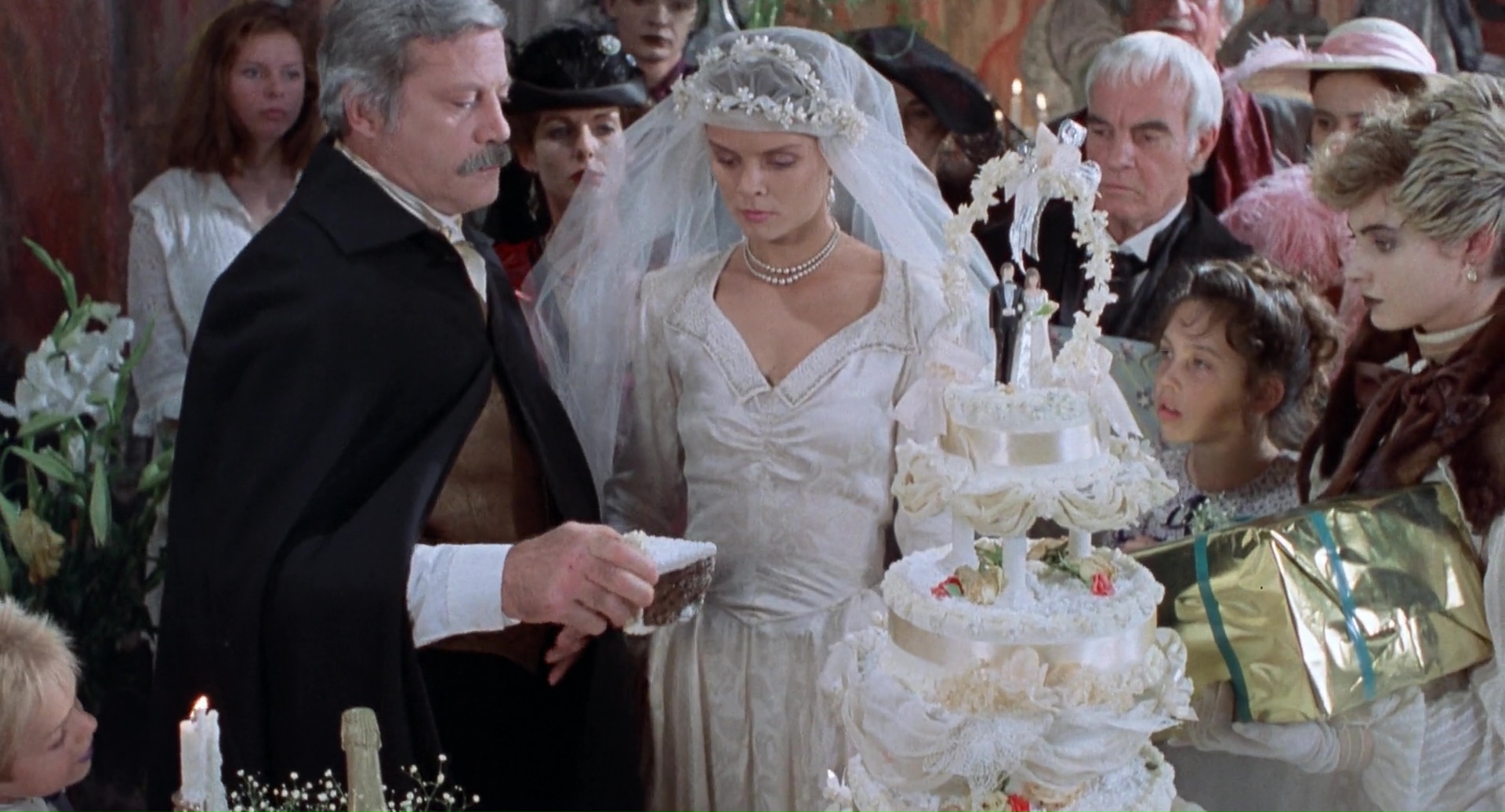
Horrifying as this seems however, even worse is to come during a particularly grotesque, hallucinogenic dream sequence (presumably modelled after those in the Corman/Poe pictures) depicting a daemonic marriage ceremony between Reed and Windsor. Here, we see Reed pick up a slice of a gigantic, tottering wedding cake, force it into Windsor’s mouth, and pull it out again with his teeth! Lord in heaven, I’ve never seen anything so repulsive.

Again, we should probably refrain from making any assumptions about a movie’s behind the scenes production circumstances, but whatever the truth of the matter, you’d better believe that this sight will leave a scar on my memory far more severe than any of the film’s ostensible ‘horror’ moments. You have been warned.


Moving swiftly on, another aspect of this ‘House of Usher’ liable to scar one’s senses is Leonardo Coen Cagli’s defiantly excessive production design, which throw the film almost immediately into a realm of phantasmagorical theatrical camp.

Although a few brief exterior shots on the Usher mansion were shot - I believe - at Knebworth House near Stevenage (an impressive Tudor edifice previously seen in ‘Horror Hospital’ (1973) and the aforementioned ‘Lair of the White Worm’), the interior sets are once again comically ill-matched.

To give credit where it’s due, Molly’s aforementioned bedroom is genuinely impressive in a crazy sort of way - a vast, medieval chamber decked out entirely in nightmarish pastel blue, it’s the kind of space which would indeed have fit the bill for a latter-day Ken Russell movie. The main ‘entrance hall’ set, complete with marble staircase, gilt curtains, hooded, faceless statues and Rubik’s Cube-styled windows, is pretty overwhelming too, conveying a similarly OTT, dreamlike feel.


Other areas within the candy-coloured mansion fare less well however, with a distinct whiff of air-brushed polystyrene and Dulux applied straight to plywood often predominating. Worst of all in this regard must be the ‘chapel’ set, which some overzealous scene painter has decorated with little black twirls, flames and spray-painted skulls, putting me in mind of the ‘goth room’ in some provincial indie nightclub. 


Uncle Roderick’s briefly mentioned background as an artist appears to have encouraged the film’s designers to load these sets up with all manner of mismatched tat, from Rodin-esque modernist sculptures to looming gargoyles, all-seeing eye covered Klimt pastiches, Italianate murals, moth-eaten Turkish carpets, faux-marble angel-y crap - you name it, and so long as it looks awful, it’s probably in here somewhere.

(It would probably be snarky to question how exactly all this is supposed to jibe with Roderick’s “acute sensitivity to certain colours”, which early in the film forces Molly to change her evening attire to “something a little more tasteful”, even though her initial choice of dress, though admittedly horrible, was actually a pretty good match for the mansion’s decor.)

Not that any of this is so dreadful in-and-of-itself, I should clarify - if anything, I appreciate the film’s wild disregard for realism and poverty-stricken attempts to overwhelm our senses. The problem lies more I think with DP Yossi Wein’s photography, which for the most part is odiously over-lit, its relentless brightness allowing no real mystery or atmosphere to accrue within these unhinged surroundings, highlighting their artificiality and essential silliness at every turn.


For all this baked-in shoddiness though, ‘House of Usher’ ’89 will still prove impossible for some of us not to enjoy on some perverse, unheimlich level. As uncharitable as some of my comments here may seem, I nonetheless found Birkinshaw’s film to be an absolute hoot, and would wholeheartedly recommend it to any admirer of distressed gothic aesthetics or oddball British horror.

Clearly a product of the same warped well-spring of inspiration which brought us ‘Killer’s Moon’, it is packed with enough uncouth eccentricities, bad ideas and baffling non-sequiturs to leave even the most jaded of psychotronic movie fans reeling - the aforementioned ‘cake incident’ foremost amongst them. (Hint when doing a psychedelic dream sequence, by the way: cutting away to shots of the dreaming character thrashing around in bed tends to spoil the effect somewhat.)

Early on for instance, we get a leering, grand guignol fake-out worthy of Todd Slaughter, as Clive the butler appears (for no apparent reason) to jam his wife’s arm into a hand-operated mincing machine, convincing us for one breathless moment that we’re witnessing a psychotic outburst of sickening gore… only for her to raise her arm from behind the machine, revealing that it’s merely the meat for tonight’s dinner being ground up. What larks.

Actually, now that I stop to think about it, pretty much all of the film’s big ‘horror highlights’ are equally arbitrary, not to mention highly derivative; hungry rat in cage (courtesy of ‘1984’, or possibly The Virgin of Nuremberg), grabby arms emerging from wall (‘Repulsion’ and/or ‘Dawn of the Dead’), head on serving platter (‘Tales That Witness Madness’ poster) - you get the idea.


Elsewhere, there is also much amusement to be gleaned from Molly’s pre-Usher profession as a hair stylist to the rich & famous. Apparently for instance, she’s so dedicated to her work that she managed to squeeze one of those full size Bakelite helmet hairdryer things into her suitcase!

Later, as she weeps inconsolably after learning that her fiancée is dead, the ever thoughtful housekeeper - distant and rude to fault through the rest of the film - picks her moment and asks, “I know you’ve got a lot on your mind, but whilst you’re here, could you do something with my hair?” Ever professional, Molly’s response is to throw her a can of mousse - “men love spikes”, she advises. (Recalling ‘Killer’s Moon’ again, moments like this cause me to wonder whether Birkinshaw had once again called upon his sister Fay Weldon to throw a few curveballs into the script.)

More emotional cross-wires can meanwhile be found in the final act, when Clive the butler learns of the deaths of his wife and child in separate Usher-instigated rampages - incidents which would play as tragic, gratuitous or cruel in most films, but here Birkinshaw pushes us straight into comedy by getting Norman Coombes to deliver two identical “OH MY GOD!” reaction shots in quick succession.

Another inexplicable curiosity meanwhile arises the film’s delightfully low rent synth score, jointly credited to two composers - George S. Clinton and Gary Chang - who both went to to enjoy noteworthy Hollywood careers, unlikely as that may seem. IMDB authoritatively informs me however that the rather fine, Carpenter-esque main theme used throughout ‘House of Usher’ was originally composed by Chang for John Frankenheimer’s 1986 Elmore Leonard adaptation ’52 Pick-up’, of all things. Had Towers just been pilfering tapes whilst visiting Cannon’s offices or something? God Only knows.


But wait a minute - didn’t I state, way back in the opening paragraphs of this review, that Donald Pleasence is in this film? Well, he is indeed! Turning up in the last half hour, he plays… well, to intents and purposes, he’s playing Saul Femm from James Whale’s 1932 ‘The Old Dark House’.

As the heretofore unmentioned lunatic brother locked in the attic, he manages to convince our heroine that he’s a poor, unfortunate fellow prisoner, before revealing, once granted his his freedom, that he’s actually a ruthless homicidal loon hell-bent on destroying everything in sight! (As in Jack Hill’s ‘Spider Baby’, these Ushers are cursed with a degenerative blood condition which pushes them further into psychosis as they get older, meaning that Pleasence’s character is pretty far gone.)

As usual, Pleasence does great work here. Evidently aware of his character’s pre-war inspiration, he has a great time putting his own spin on Brember Wills’ unforgettable performance in Whale’s film, bringing a sense of gravitas to his dialogue which temporarily even convinces us to take the film seriously. (“Thank god, an ACTOR,” I recall thinking at this point.)

Pleasance’s character is confined to a wheelchair (OR IS HE?, etc), and, apparently on account of his penchant for sculpture, he has a domestic hand drill strapped to one of his arms. Though allegedly utilised in a few moments of gory (off-screen) violence, I was chiefly struck my how thoroughly UN-threatening this looks, particularly when - in a moment which in a sense seems to sum up this movie’s crazy charm perfectly - he responds to being shut behind a locked door by a fleeing Molly by angrily drilling a series of very small holes straight into the plywood walls of the set! Whatcha gonna do Donald, hang some pictures?


Needless to say, this whole farrago concludes the only way it possibly could, with a decent into blood-curdling hysteria which Oliver Reed and Donald Pleasence rolling around on the floor in a frenzied, mutually suicidal wrestling match (shades of ‘Women in Love’ perhaps?), as the Corman/Poe-mandated conflagration erupts around them, sending these horrendous sets up in smoke once and for all.

Meanwhile, having rescued her hunky fiancée from behind a polystyrene tombstone, Romy Windsor finally flees back out into the fresh air of Knebworth House, presumably contemplating an immediate change of profession. (Actually, she went on to roles in ‘Surf Ninjas’, ‘Camp Nowhere’ and ‘Howling IV: The Original Nightmare’, but safe to say no more Harry Alan Towers productions were forthcoming.)

Towers and Birkinshaw though ploughed straight on in the same furrow, ensuring that ‘House of Usher’ was released more-or-less back to back with their visionary re-imagining of ‘The Masque of the Red Death’ - a film so assaultively crass it makes this one looks like a model of respectful sobriety by comparison. All being well, we’ll hopefully be digging into the garish mysteries of Red Death ‘89 here soon, so gird your loins folks, and make sure you come prepared. (Blindfolds, tranquilisers and hard liquor are all recommended.)