Thursday, 20 February 2020
Deathblog:
José Mojica Marins
(1936 – 2020)
José Mojica Marins
(1936 – 2020)
And so, we bid farewell to José Mojica Marins, aka Zé do Caixão, aka Coffin Joe, who departed this life aged 83 on February 19th in São Paulo, presumably still cursing god and mocking the pathetic vanities of the human race, or so I’d like to think.
When I began this blog back in 2009, some of the first posts here consisted of my ineffectual attempts to come to terms with the truly inexplicable series of films Marins more or less single-handedly created through the ‘60s and ‘70s, and all these years later, they still collectively lurk somewhere in the back of my brain like repressed memories of some unresolved trauma.
I will certainly never forget the evening, back in my long gone student days, when I stayed up even later than usual to catch a one-off TV airing of Marins’ ‘O Despertar da Besta’ [‘Awakening of the Beast’, 1970], which – extraordinarily, in retrospect - was screening on Channel 4 in the UK, as part of a season of ‘global weird cinema’ or somesuch. To say I was unprepared for what I saw that night would be an understatement. To say that I’ve never been quite the same since however would not be much of an exaggeration.
Presumably working with a sum equivalent to the catering budget on Alejandro Jodorowsky’s ‘The Holy Mountain’, Marins here produced a work which stands alongside it as the ne plus ultra of brain-breaking cinematic lunacy - and the fact that it is merely the icing on the cake of a fifteen year run of similarly disturbing, indigestible craziness, all produced for similarly miniscule budgets, under the nose of a repressive military dictatorship, no less - only adding to its power.
Although I’m of course aware that - in his mellower, later years at least - Marins was always keen to stress that the views and behaviour of his Zé do Caixão character, I’ve always felt that there is something distinctly unsettling about the fact the Coffin Joe enjoyed the status of a pop culture icon in Brazil – starring in a series of best-selling comic books, frequently appearing on TV, promoting ice lollies and making promotional public appearances, etc – whilst the films he was directing and starring in meanwhile played like the outpourings of a genuinely damaged mind.
Characterised by a sense of pill-popping intensity and nightmarish psychedelic disorinetation, a relentless appetite for misogynistic / misanthropic sadism, and a seemingly endless profusion of virulent, often incomprehensible, quasi-philosophical diatribes, delivered straight to camera by the director himself, these films are almost literally impossible to describe - they must be seen to be believed.
Whilst Marins’ first horror film, 1964’s ‘À Meia-Noite Levarei Sua Alma’ [‘At Midnight I Will Take Your Soul’] to some extent retained the conventions of traditional gothic horror, his films became increasingly idiosyncratic and disjointed as his character’s popularity increased through the ‘60s. I’m unsure to what extent there is some kind of Brazillian cultural specificity at play here, but from an outsider’s POV at least, it is strange indeed to imagine Zé do Caixão’s teenage fans packing out their local picture houses with their ice cream and popcorn to enjoy an adventure with their favourite comic book character, only to be presented with something as deranged as ‘O Despertar da Besta’ or 1967’s equally indescribable ‘Esta Noite Encarnarei no Teu Cadáver’ [‘This Night I Will Possess Your Corpse’] .
Whilst watching these films, I’ve often reflected that, if I were the Chief of Police in São Paulo during the 1960s, and I happened to visit the cinema of an evening and saw one of these flicks, I would be inclined to instruct my people to keep a very close eye indeed on this guy’s activities. I mean, just look at this stuff for godssake - he clearly must be up to no good, one way or another!
In fairness to Marins, it could equally be argued that his unique vision of extremity within the horror genre was simply so far ahead of anything being attempted by his global contemporaries that it proved impossible to contextualise at the time. That he subscribed to the belief that horror needed to be genuinely horrific is obvious, and his Zé do Caixão alter-ego could likewise ultimately represent a pure nightmare figure – a black mirror embodiment of the worst of human egotism, espousing beliefs which for all we know may have been the direct opposite of those his creator held in real life.
Certainly, the grisly demise Coffin Joe tends to meet at the end of each of his films, and Marins’ decision to title his 2008 comeback film ‘The Embodiment of Evil’, would tend to support this theory; but if this were really the case, how could we explain the existence of a film like 1970’s ‘Finis Hominis’ (‘The End of Man’, 1970), a less extreme but no less peculiar non-horror outing which instead takes the form of a kind of satirical religious parable?
Playing multiple roles here, Marins spends much of the run-time ranting direct to camera, holding forth with messianic urgency in a manner not dissimilar to the hellfire-charred rhetoric heard in his horror films. Though his words frequently descend into the realm of absolute nonsense (insofar as can be judged from the questionable English sub-titles burned into the only extant prints, at any rate), the director – as always – seems frighteningly in earnest, seemingly trying to make some very profound metaphysical points about… something or other? Quite what though, who can possibly say.
(In attempting to make sense of Marins’ extraordinary output during 1970, it might be worth noting that Wikipedia lists both ‘O Despertar da Besta’ and ‘Finis Hominis’ as exemplars of Cinema da Boca do Lixo [‘Mouth of Garbage cinema’], a grass-roots / anti-establishment film movement which grew out of the slums of downtown São Paulo in the late 1960s, blending ‘new wave’ aesthetics and low budget guerrilla technique with shocking/exploitational pop subject matter… but, that seems like a whole other cultural rabbit-hole, perhaps best left for another day.)
Despite having seemingly thrown his battered top hat into the ring with some weird out-growth of the psychedelic counter-culture during this period however, Marins often seemed reticent to discuss the philosophical or autobiographical aspects of his works in later years, after his work was belatedly discovered by the English-speaking world in the 1990s.
Alhough a sequel to ‘Finis Hominis’ appeared in 1972, Zé do Caixão was soon back to scarifying his core audience with the increasingly bedraggled likes of ‘Estranha Hospedaria dos Prazeres’ [‘Strange Hostel of Naked Pleasures’, 1976] and ‘Delírios de um Anormal’ [‘Hallucinations of a Deranged Mind’, 1978]. Even in these later, less otherworldly, films though, the genuine frisson of danger and madness – the sheer impossibility of trying to predict what might happen next – remained intact.
It may be a deathless cliché to proclaim “we will not see his like again” in obituary posts like this one, but I honestly can’t think of anyone for whom such an epitaph would seem more appropriate. In spite of the poverty and cultural isolation from which his work sprang, Marins’ understanding of, and contribution to, the aesthetics of horror cinema is vast beyond measure.
However frequently they might have done the rounds, circulating amongst fans of weird movies and outré culture, watching one of his films is still not an experience which cannot be entered into lightly. Like stumbling through the door to some forbidden netherworld you never even dreamed might exist, they will leave you feeling as if you’ve opened yourself up to possession by some slavering, unclean spirit, ready to show you things you’ve never seen before and, gods willing, will never see again.
A fond farewell then, to a true cinematic maniac.
Labels:
Brazil,
deathblog,
film,
horror,
Jose Mojica Marins,
utter lunacy
Thursday, 13 February 2020
Kaiju Notes:
Invasion of Astro-Monster
(Ishirô Honda, 1965)
Invasion of Astro-Monster
(Ishirô Honda, 1965)
FEATURING:
1.
The sixth film to feature Godzilla, 1965’s ‘Kaijû Daisensô’ [‘War of the Monsters’], known to English speaking viewers as ‘Godzilla vs Monster Zero’ or, as Criterion’s box-set has it, ‘Invasion of Astro-Monster’, feels very much of a piece with its predecessor, 1964’s Ghidorah: The Three-Headed Monster. The two films pretty much play as if they could have been shot back-to-back, although shooting dates listed on IMDB and variations in the credited crew suggest this was not in fact the case.Nevertheless, they both include the same line-up of monsters (minus Mothra this time around – apparently she was initially in the script, but got nixed for budgetary reasons), both feature enjoyably wacky sci-fi storylines, and both are undermined by a lacklustre, kiddie-friendly approach to the requisite kaiju action.
For its opening hour in fact, ‘Invasion of Astro-Monster’ gives little indication of its status as a kaiju movie. Instead, it plays more like one of Ishirô Honda’s straight SF movies, outlining the no nonsense interactions between humanity and a sneaky alien race who have popped up on the newly discovered Planet X, in a manner reminiscent of the director’s 1957 classic ‘The Mysterians’.
2.
On the plus side, a lot of the Showa-era retro sci-fi stuff showcased in ‘Invasion of Astro-Monster’ is really rather delightful. Though these films are ostensibly set somewhere in the vicinity of the present day, the film begins with Akira Takarada and token caucasian Nick Adams (last seen around these parts as the exceptionally grumpy male lead in AIP’s Die Monster Die!, released the same year), manning a rocket-ship en-route to Planet X, which appears to be hanging way out there somewhere beyond Pluto. (Because hey, why not, right? I mean, the way things are progressing here in whizzo 1965, we’ll be shooting square-jawed guys out to the far end of the solar system in brightly coloured rockets before you know it! [2020 sad face. : ( ])
Soon, our astronauts are happily stomping about on the Planet’s rocky surface, and though, disappointingly, they do not encounter The Man From Planet X, they do observe these groovy sort of periscope / stairway things which pop up from under the ground, disrupting their radio contact with Earth, and hear Japanese language loudspeaker announcements informing them that they’re heading down below to meet the neighbourhood’s resident technologically superior alien race.
These guys, it transpires, have been forced underground because King Ghidorah (whom they call ‘Monster Zero’) has ravaged the surface of their world, Reign of Fire style. The Xiliens (as they actually call themselves) thus propose a deal, wherein they will ‘borrow’ Godzilla and Rodan from Earth to help resolve their three-headed space-dragon problem, and in return they’ll give us…. a cure for cancer! Pretty great deal, huh?
But wait! These guys all wear identical black leather jumpsuits, have no discernible facial expressions and wear wavo-type sunglasses at all times, concealing their eyes. As our two-fisted astronauts soon realise, they are clearly not to be trusted. But, back on Earth, the prospect of trading a couple of bad-tempered dinosaurs for the health and happiness of millions understandably proves just too tempting for the powers-that-be to resist.
Indeed, the Xiliens will even handle transport on the deal - which must have come as a relief to the the U.N. mail room staff - and the images I will probably remember most fondly from ‘Invasion of Astro-Monster’ are those of the Xiliens’ dinky little UFOs tracking down our two resident kaiju in their hideaways (Godzilla has been chilling at the bottom of Lake Myojin in Japan’s Nagano Prefecture, for some reason) and transporting them through outer space suing high powered tractor beams. What fun!
3.
This reminds me, incidentally, of an issue that always bugs me in these ‘60s Godzilla sequels – once humanity is aware of their existence, how do the Japanese government seem to keep LOSING these giant, city-flattening monsters during the interim between movies, only to be surprised when they unexpectedly pop up somewhere new?
I mean, even leaving aside the fact that you’d presume an entirely new branch of science must have developed around the necessity of tracking, studying and containing these protean beasts, you’d think that someone would at least take the time to notice a giant and infamous monster stomping his way across a renowned beauty spot and submerging himself in a lake? Instead though, we seem to begin each movie with a round of “hmm, where could Godzilla possibly have gone?”, “oh my gosh, he’s just popped up over there, in another impressively scenic location!”, “ahh, run away, send in the little tiny tanks!”, etc.
I realise that kaiju hi-jinks must have become normalised to a certain extent in this movie-world, and that earth-bound monsters like Godzilla and Rodan perhaps don’t pose quite such an existential threat as they once did, but c’mon guys - the least you could do is keep an eye on them!
In the original 1954 ‘Godzilla’, you’ll recall, domestic scenes retained the kind of distinctly Japanese character one would reasonably expect of a mid-century Toho or Daiei film, with characters seated at floor level, sometimes in traditional dress, and interacting with their family members in the warm yet somewhat formalised manner which continues to define many Japanese households to this day.
By the time we get to the likes of ‘..Astro-Monster’, or the same year’s truly demented ‘Frankenstein Conquers The World’ (also starring Adams) however, our central characters are predominantly young, single (or newly married) city-dwellers, who are generally depicted as living independently of their extended families, dwelling in groovily-furnished yet anonymous high rise apartments. They wear suits and twin-sets, swap snappy, casual dialogue with their co-habitants, swig highballs or martinis and sit down (at a raised table) to eat steak and chips for dinner.
For viewers familiar with the more traditional, inward-looking Japanese cinema of this era, this lack of a pronounced national identity can at times feel positively eerie, lending an uncanny, alienated aura to the stories’ cheerily two-dimensional human stories. Quite how audience responded to all this at the time, I’m unsure, but it must have been difficult for them not to have interpreted it to some extent as a statement of the filmmakers’ cultural sympathies.
In a sense, Toho could be seen to be taking the ‘borderless’ philosophy adopted by their far smaller rival Nikkatsu [see my posts here and here for more more discussion of this] to a weird new extreme within their sci-fi/monster movies, and the possible reasons for this are many and varied.
Most obviously, this ‘Westernised’ feel could be read as a nod to these films’ proven success overseas, whilst it also seems to me to reflect the grander, ‘worldwide’ and quasi-futuristic, scale of the movies’ subject matter, which often invokes the idea of international cooperation in space exploration or kaiju-fighting.
Beyond this though, I can’t help but feel that gives voice to some extent to the corresponding desire shared by many Japanese citizens in the post-war era for their country to move toward the adoption of a more homogenised [for which read: American] international capitalist culture. In other words, the very same yearning which can be identified in so many of Nikkatsu’s youth films, although it finds a less conflicted, more openly aspirational expression here.
In fact, I can easily imagine Yukio Mishima and his fellow resurgent nationalists absolutely spitting feathers about Toho’s perceived kow-towing to American cultural imperialism in these films, in the unlikely event that they ever found time to go and watch them in between kendo practice and brooding on the finer points of Bushido.
“This is not what I created Godzilla for”, Honda is reported to have icily stated when he saw the ludicrous / adorable ‘victory dance’ Eiji Tsuburaya and his team devised for The Big G to perform after he dispatches King Ghidorah following some half-hearted inter-planetary pushing and shoving at the film’s conclusion. As such, it is perhaps no surprise that the next entry in the franchise saw the venerable director temporarily stepping aside, allowing Toho to bring in a new broom and a distinct change of emphasis, leading, as I recall, to a considerably more satisfactory movie overall… but we’ll see how well my memory holds up on that score in a couple of weeks.
Soon, our astronauts are happily stomping about on the Planet’s rocky surface, and though, disappointingly, they do not encounter The Man From Planet X, they do observe these groovy sort of periscope / stairway things which pop up from under the ground, disrupting their radio contact with Earth, and hear Japanese language loudspeaker announcements informing them that they’re heading down below to meet the neighbourhood’s resident technologically superior alien race.
These guys, it transpires, have been forced underground because King Ghidorah (whom they call ‘Monster Zero’) has ravaged the surface of their world, Reign of Fire style. The Xiliens (as they actually call themselves) thus propose a deal, wherein they will ‘borrow’ Godzilla and Rodan from Earth to help resolve their three-headed space-dragon problem, and in return they’ll give us…. a cure for cancer! Pretty great deal, huh?But wait! These guys all wear identical black leather jumpsuits, have no discernible facial expressions and wear wavo-type sunglasses at all times, concealing their eyes. As our two-fisted astronauts soon realise, they are clearly not to be trusted. But, back on Earth, the prospect of trading a couple of bad-tempered dinosaurs for the health and happiness of millions understandably proves just too tempting for the powers-that-be to resist.
Indeed, the Xiliens will even handle transport on the deal - which must have come as a relief to the the U.N. mail room staff - and the images I will probably remember most fondly from ‘Invasion of Astro-Monster’ are those of the Xiliens’ dinky little UFOs tracking down our two resident kaiju in their hideaways (Godzilla has been chilling at the bottom of Lake Myojin in Japan’s Nagano Prefecture, for some reason) and transporting them through outer space suing high powered tractor beams. What fun!
3.
I mean, even leaving aside the fact that you’d presume an entirely new branch of science must have developed around the necessity of tracking, studying and containing these protean beasts, you’d think that someone would at least take the time to notice a giant and infamous monster stomping his way across a renowned beauty spot and submerging himself in a lake? Instead though, we seem to begin each movie with a round of “hmm, where could Godzilla possibly have gone?”, “oh my gosh, he’s just popped up over there, in another impressively scenic location!”, “ahh, run away, send in the little tiny tanks!”, etc.
I realise that kaiju hi-jinks must have become normalised to a certain extent in this movie-world, and that earth-bound monsters like Godzilla and Rodan perhaps don’t pose quite such an existential threat as they once did, but c’mon guys - the least you could do is keep an eye on them!
4.
The presence of Nick Adams in the cast of ‘..Astro-Monster’ - presumably flown in by Toho in recognition of the Godzilla films’ phenomenal success on the export market – also served to draw my attention to the strong sense of ‘Westernisation’ (Americanisation?) which predominates in these ‘60s kaiju movies – a trend which is particularly noticeable here, as Adams is pointedly established as “one of the guys”, hanging out and bantering (in dubbed Japanese) with his fellow astronauts. (He even offers his Asian buddies some typically forward American romantic advice, although it is he, rather than they, who ends up getting involved with a female Xilien spy – ah, the irony!)In the original 1954 ‘Godzilla’, you’ll recall, domestic scenes retained the kind of distinctly Japanese character one would reasonably expect of a mid-century Toho or Daiei film, with characters seated at floor level, sometimes in traditional dress, and interacting with their family members in the warm yet somewhat formalised manner which continues to define many Japanese households to this day.
By the time we get to the likes of ‘..Astro-Monster’, or the same year’s truly demented ‘Frankenstein Conquers The World’ (also starring Adams) however, our central characters are predominantly young, single (or newly married) city-dwellers, who are generally depicted as living independently of their extended families, dwelling in groovily-furnished yet anonymous high rise apartments. They wear suits and twin-sets, swap snappy, casual dialogue with their co-habitants, swig highballs or martinis and sit down (at a raised table) to eat steak and chips for dinner.
For viewers familiar with the more traditional, inward-looking Japanese cinema of this era, this lack of a pronounced national identity can at times feel positively eerie, lending an uncanny, alienated aura to the stories’ cheerily two-dimensional human stories. Quite how audience responded to all this at the time, I’m unsure, but it must have been difficult for them not to have interpreted it to some extent as a statement of the filmmakers’ cultural sympathies.
In a sense, Toho could be seen to be taking the ‘borderless’ philosophy adopted by their far smaller rival Nikkatsu [see my posts here and here for more more discussion of this] to a weird new extreme within their sci-fi/monster movies, and the possible reasons for this are many and varied.
Most obviously, this ‘Westernised’ feel could be read as a nod to these films’ proven success overseas, whilst it also seems to me to reflect the grander, ‘worldwide’ and quasi-futuristic, scale of the movies’ subject matter, which often invokes the idea of international cooperation in space exploration or kaiju-fighting.
Beyond this though, I can’t help but feel that gives voice to some extent to the corresponding desire shared by many Japanese citizens in the post-war era for their country to move toward the adoption of a more homogenised [for which read: American] international capitalist culture. In other words, the very same yearning which can be identified in so many of Nikkatsu’s youth films, although it finds a less conflicted, more openly aspirational expression here.
In fact, I can easily imagine Yukio Mishima and his fellow resurgent nationalists absolutely spitting feathers about Toho’s perceived kow-towing to American cultural imperialism in these films, in the unlikely event that they ever found time to go and watch them in between kendo practice and brooding on the finer points of Bushido.
5.
I think it is probably safe to assume that, by this stage in the Godzilla franchise, Ishirô Honda’s heart simply wasn’t in it anymore. Though ‘Invasion of Astro-Monster’ still delivers a wealth of brightly coloured fun for the kids (and the man-child retro-sci-fi enthusiasts alongside them), hitting all the beats one would reasonably expect of a Honda sci-fi movie, a feeling of tiredness and repetition seems to pervade the whole enterprise. “This is not what I created Godzilla for”, Honda is reported to have icily stated when he saw the ludicrous / adorable ‘victory dance’ Eiji Tsuburaya and his team devised for The Big G to perform after he dispatches King Ghidorah following some half-hearted inter-planetary pushing and shoving at the film’s conclusion. As such, it is perhaps no surprise that the next entry in the franchise saw the venerable director temporarily stepping aside, allowing Toho to bring in a new broom and a distinct change of emphasis, leading, as I recall, to a considerably more satisfactory movie overall… but we’ll see how well my memory holds up on that score in a couple of weeks.
Labels:
1960s,
alien worlds,
aliens being sneaky,
astronauts,
film,
Godzilla,
Ishirô Honda,
Japan,
kaiju,
monsters,
movie reviews,
Nick Adams,
science fiction,
Toho,
UFOs
Wednesday, 5 February 2020
Noir Diary # 8:
Odds Against Tomorrow
(Robert Wise, 1959)
Odds Against Tomorrow
(Robert Wise, 1959)
So here’s a question for you: when did Film Noir – in its original, American iteration - end?
Many fans and critics understandably regard Orson Welles’ masterful ‘Touch of Evil’ (released in April 1958) as the big full stop separating the genre’s core canon from the more self-conscious revivals and reinventions which began almost immediately after its demise, and indeed, the sight of Marlene Dietrich in her final screen role, striding off toward those looming Texas oil wells after delivering her concise final words on Welles’ Hank Quinlan, feels not only like the perfect epitaph for the noir world, but a darkly poetic kiss off for the Golden Age of Hollywood as a whole. Adios, indeed.
Nothing in culture is ever quite that neat and tidy though, and some filmmakers clearly missed the memo, leaving us with a few fascinating, transitional stragglers to try to awkwardly cram into noir’s core time-frame, Robert Wise’s ‘Odds Against Tomorrow’ (released November 1959) foremost amongst them.
Before we begin discussing the film itself, a quick word on the title, as coined by William P. McGivern for his 1955 source novel. I’ve spoken before about how much I love the raw pulp poetry of these generic, one-size-fits-all crime story titles, and ‘Odds Against Tomorrow’ is one of my absolute favourites in this regard. Hopefully I won’t need to elaborate too much on why that’s the case – it speaks for itself pretty well, although knowledge of the fact that one of the central characters is a compulsive gambler adds some helpful context.
Combine it with the poster image of a desperate-looking Harry Belafonte, raising his revolver toward the heavens with gritted teeth, and you’ll appreciate that the film has long been high on my “must watch” list, be it a noir, a modern crime film, or whatever else. It’s just a stunning word/image combo, irrespective of how you’d care to classify it.
In truth, most classic noirs from the mid/late ‘50s were to some extent aware of the genre/style they were working within, and in some cases, aware of the need to bend and reshape its conventions to reflect the uncertain socio-political realities of their era. By the end of the decade, making a film in black & white, in 4:3 academy ratio, was a conscious choice, rather than the default, for an American film. (In retrospect, it’s strange to reflect on the fact that such key late period noirs as ‘The Big Combo’ and ‘Kiss Me Deadly’ were actually shot widescreen.)
By keeping the action in ‘Odds Against Tomorrow’ monochrome, confined to the tight limitations of a ‘square’ frame, Robert Wise and executive producer Belafonte seem to have been making a deliberate statement - we’re doing this one the old fashioned way. No fancy business, no bells n’ whistles – just a simple, blue collar crime flick with a minimal cast and a straight-forward, grab-the-money-and-run storyline.
This proposition is immediately confused however by the fact that ‘Odds Against Tomorrow’s credits sequence simultaneously takes a strikingly modernist stance, suggesting a film that’s setting out to get progressive in more ways than one. A veritable riot of animated, Saul Bass-esque text and kaleidoscopic, abstract imagery, the credits are cut to an impeccably sharp jazz score, composed by John Lewis of the Modern Jazz Quartet and recorded by an ensemble including such luminaries as Bill Evans and Milt Jackson.
Such stylistic choices may not raise too many eye-brows these days, but in the context of a ‘50s Hollywood crime film, they scream MOD as clearly as a Small Faces reunion in a Lambretta factory, immediately placing the film in the same envelope-pushing category as Hitchcock’s ‘Vertigo’ or Preminger’s ‘The Man with The Golden Arm’.
Once the story itself gets underway however, the approach is defiantly old school. Our setting is Upper Manhattan, and our characters exist in a world of cramped tenement apartments, down-at-heel bars and ill-lit back offices, with only the occasional bit of early morning location shooting in central park allowing them a breather. None of them are exactly what you’d call professional criminals, but they’ve all had their run-ins with the criminal underworld, skirting its perimeters like losers and misfits have since time immemorial - and when we join them, they’re each sufficiently desperate to take the plunge full time.
An ex-cop who got nailed on corruption charges at some point in the past, Burke (perennial ‘cop actor’ Ed Begley, whom we last encountered on the blog playing an unlikely Dr Henry Armitage in AIP’s The Dunwich Horror) now finds himself living in reduced circumstances in a pokey one-room office/apartment, trying to figure out a way to improve his lot and avenge himself against his former colleagues in the process.
The net result of Burke’s figurin’ is what he considers a fool-proof plan to turn over a bank in a small upstate industrial town, making use of an unguarded side door and a regular 6pm coffee delivery to swipe the entirety of the local factory’s weekly payroll whilst the doddering old clerks are busy counting it. Why, it’ll be like taking candy from a a baby etc etc, but naturally he still needs a couple of guys to help him out with the job. For obvious reasons, he can’t call on the services of any professional crooks, but… he’s got the number of a couple of schmucks who just might fit the bill.
Say hello then to Earl Slater (Robert Ryan), a middle-aged WWII vet with crippling anger management issues and an inability to hold down a legit job, who’s just served a stretch in the slammer for accidentally killing a man in a bar fight, and also to Johnny Ingram (Belafonte), a wild-living nightclub musician whose addiction to gambling has led him to a separation from his wife and child and left him heavily in debt to a local mobster.
Initially, both Slater and Ingram turn down Burke’s proposition cold after he invites them to his ‘office’ for a quiet chat. But, as their own individual circumstances deteriorate further over the coming days, they both feel they have no other choice but to slink back and reluctantly declare themselves ‘in’.
For a clearly delighted Burke, the game is on, but although the robbery he has in mind is one of the simplest in crime fiction history, this wouldn’t be a heist movie if inter-personal conflict didn’t threaten to bring down the whole operation before it’s even begun, and this is certainly telegraphed loud and clear in ‘Odds Against Tomorrow’.
Both Slater and Ingram are inexperienced, unpredictable and hate each other’s guts. Burke however is so enthused by the prospect of pulling off his big job that he turns a blind eye to this obvious problem, putting the plan into action with a bare minimum of preparation. What could possibly go wrong…?
So far then, we have a quintessential hard-boiled crime yarn – exactly the kind of solid, low budget programmer which could have emerged from RKO or Warners ten or fifteen years earlier. What sets ‘Odds Against Tomorrow’ apart however, justifying the film’s painfully hip opening credits, explaining Belafonte’s interest in the material and shifting the action definitively toward the milieu of the late ‘50s, is the reason why Slater and Ingram hate each other’s guts.
As you will no doubt have observed, Harry Belafonte is black, which means that Johnny Ingram is also black. Earl Slater meanwhile is a dyed-in-the-wool, card-carrying racist, who has only consented to work with “a coloured boy” on the job with extreme reluctance. (Ryan voices Slater with a thick, southern twang that speaks of an ugly Confederate upbringing before war and/or marriage (we presume) eventually washed him up on the shores of the Hudson.) So, you can see where this train is headed.
For all that film noir may have purported to expose the ugly underbelly of American life during the the ‘40s and earlier ‘50s, issues of racial prejudice and inequality were rarely, if ever, allowed to intrude upon the genre’s exposure of an ugly white underbelly. Whilst I’m sure there must be exceptions, off the top of my head I find it difficult to come up with any examples of pre-1955 noir in which black characters play a larger role in the narrative than that of servants, sidekicks or one-scene-wonder bit players.
(Admittedly, noir did sometimes touch upon the travails of immigrants or ethnic minorities [see ‘Cry of the City’ (1948) or Thieves’ Highway (1949) for instance], but these stories tended to concern Italian, Irish or variously European characters; all groups which modern American viewers will no doubt consider as having been fully integrated into a more monolithic demographic of undifferentiated whiteness.)
Meanwhile, the only noirs I can think of in which racism features as a plot point are other self-aware, late period examples of the genre, made by directors known for their liberal / humane beliefs, and falling comfortably within a post-Civil Rights Movement timeframe.
(Specifically, I’m thinking here of Captain Quinlan’s victimisation of his town’s Mexican populace in the aforementioned ‘Touch of Evil’ – a brilliant depiction of the kind of ‘soft’/oblique racism that has made such a regrettable comeback in 21st century political discourse, incidentally - and Timothy Carey’s memorably nasty use of a racist insult to dismiss an over-attentive parking attendant in Stanley Kubrick’s ‘The Killing’ (1956).)
Abraham Polonsky’s script for ‘Odds Against Tomorrow’ however is consistently, and unapologetically, preoccupied with issues of race, as is made clear from the film’s very first scene, which finds Slater jovially employing a racist epithet to refer to a little girl who bumps into him on the street as he approaches Burke’s office.
In throwing together a black man and a southern racist and ostensibly forcing them to work together, ‘Odds Against Tomorrow’ has sometimes found itself labelled as the hard-boiled crime genre’s answer to Stanley Kramer’s ‘The Defiant Ones’ (1958) – a label presumably applied by writers who have never actually seen the film, given that, in true noir tradition, it actually presents nothing less than a cruel, pessimistic reversal of Kramer’s ode to mutual respect and co-operation.
Here, our two central characters embody the masculine traditions of their respective cultures at their craven, self-destructive worst; right from the outset, there is ZERO prospect of Ingram and Slater coming together and settling their differences. When these men have been so twisted and chewed up by the socio-political dead-ends they were born into that they can’t respect themselves, Polonsky’s characteristically schematic script seems to be asking us, what chance could they possibly have of learning to respect each other?
(Still blacklisted on account of the socialist beliefs he articulated so clearly in his pre-HUAC one-two punch of ‘Body & Soul (1947) and ‘Force of Evil’ (1948), Polonsky pulled off a neat irony by using the name of a genuine black writer, John O. Killens, as his ‘beard’ on the ‘Odds Against Tomorrow’ script.)
Structurally, the film’s pacing is deliberately uneven, with the first hour taking the form of a long, leisurely slow-burn, as we follow Ingram and Slater through their respective daily routines and dilemmas in the days leading up to the robbery, sticking so closely to the characters that we soon feel as if we know their lives inside out.
Once they leave the city and head upstate to carry out the robbery however, the pacing tightens up considerably, Robert Wise flexing his well-oiled ‘thriller’ muscles as the shit quickly, inevitably, and fatally hits the fan, from the worst possible combination of angles.
At this point, we have no expectation that Slater and Ingram will manage to cooperate for more than a matter of seconds before they’re at each other’s throats, and indeed this turns out to be the case. If the conclusion, which sees Ryan and Belafonte blasting away at each other whilst almost literally dancing on top of a powder keg, seems fairly heavy-handed in allegorical terms, the breathless fatalism of the film’s crazed, maniacal final minutes still stuns.
It is during the long, slow build up which precedes all this however that the film’s most compelling drama is really played out; as in his earlier scripts, Polonsky’s systematic demarcation of the social and financial pressures which have driven the film’s characters into a corner is both detailed and exhaustive.
A forerunner of the kind of battle-scarred, emasculated males who would stalk their way through cinema of the post-Vietnam era, Earl Slater is tormented by his inability to earn an honest living, and feels humiliated by the fact that his younger wife (a fairly thankless role for the great Shelley Winters) is effectively ‘keeping’ him, having just won a promotion in her uptown office job.
Earl’s only outlets are drink and violence, and when – in one of the film’s best scenes – he finds himself combining the two by clobbering a feckless young solider in a neighbourhood bar, we feel as if he signs on for Burke’s robbery scheme more just to keep himself busy before depression and idleness land him back in prison than anything else.
Few American actors have been able to convey a sense of disappointment and self-disgust quite as convincingly, or with as much subtlety, as Robert Ryan, and his performance here is one of his very best (which is saying something), managing to almost wordlessly draw out the sympathetic, human side of what by any yardstick is a singularly dislikeable, wrong-headed character.
Belafonte’s character meanwhile is equally pathetic in his own way, functioning as a case study in how the proud rebellion of an urban, black male can so easily be detourned into futile self-destruction. In a key scene, Ingram mocks his wife (Kim Hamilton) for hosting the “ofay” attendees of a local PTA meeting at her apartment, sneering at what he sees as her attempts at social climbing, and the accompanying dilution of her black identity.
Whites can’t be trusted, seems to be his essential point; they’ll never share their shit with us, the only thing we can do is smash through and take it in the only way we can [for which read: crime and associated pursuits]. In this, Ingram is restating an already age-old argument which continued to echo through black American culture in the coming decades, from the startlingly heartfelt monologue delivered by Antonio Fargas as Pam Grier’s brother in Jack Hill’s ‘Foxy Brown’ (1974), to Paul Benjamin’s similar justification for the robbery he’s carried out in Barry Shear’s brilliant ‘Across 110th Street’ (1972), right through to the self-image projected by Ice T, N.W.A. and host of other gangsta-inclined MCs in the ‘90s and beyond.
The irony here of course is that Ingram’s attempts to battle the white system lead him straight into all the pitfalls The Man has left in wait for him. Certainly, this defiant hipster’s track record at the point at which we meet him offers little to be proud of – a debilitating gambling addiction, unpayable debts owed to an Italian mobster, estrangement from his family, and a tendency to work out his frustrations by getting drunk and clowning around on stage, humiliating his fellow musicians and potentially earning him the bums-rush from the one decent gig his talent actually has brought him. In his own way, he’s just as much of a hopeless loser as his opposite number, the stubborn bigot and convicted killer Slater.
Interestingly, in both of these parallel character studies, it is the example provided by women that seems to offer the only glimmer of hope in a story which – no spoiler here, I’m assuming – leaves its troubled male characters unredeemed, unrewarded and stone-cold dead.
Within the schema of Polonsky’s script, Winters’ character seems to represent the potential of an upwardly mobile female workforce, whilst Ingram’s wife’s presumed attempts to build a better life for her children through education and racial integration are contrasted with her husband’s selfish and immature attempts at rebellion.
Even noir fan favourite Gloria Grahame (‘The Big Heat’, ‘In a Lonely Place’ etc), who makes the best of an enjoyable though narratively irrelevant cameo as a neighbour with whom Ryan enjoys an extra-marital tryst, seems to present an unusually positive portrayal of female sexual independence, highlighting the pointed absence from this story of the traditional “femme fatale” figure, ready to soak up male guilt like a sponge.
All in all, this makes for a surprisingly strong line-up of progressive female role models for a ‘50s crime movie, and, though underwritten, these characters all seem designed to provide an optimistic counterpoint to what is otherwise a relentlessly bleak tale of doomed masculinity oozing toward the plug-hole.
We may have focused more on Polonsky’s input thus far, but, if you’ve kept reading up to this point, chances are you’ll be equally aware of Robert Wise’s formidable talents. One of those directors who seems doomed to be perpetually under-appreciated, condemned to “journeyman” rather than “auteur” status, Wise was one of the most articulate technicians of cinematic language to arise from Hollywood’s golden era, and his contributions to the noir canon in particular were exceptional. (1949’s ‘The Set-Up’, also starring Robert Ryan, would definitely find a place on my All Time Top 10 Noirs list, should I ever bother to make one.)
Suffice to say, Wise (who completed ‘Odds Against Tomorrow’ shortly before getting to work on ‘West Side Story’) is at the top of his game here, whilst Joseph Brun’s photography is sharp and stark as it gets - probably veering closer to the ‘realist’ as opposed to ‘expressionist’ end of the noir spectrum, but certainly not lacking in style – the set-bound scenes in particular have all the angular shadows, venetian blinds and confining vertical lines a film studies class could ask for. Dede Allen also deserves a shout-out too for her impactful editing, which in turn is perfectly matched by the rhythms of Lewis’s flawlessly cool score.
For all that it stands out as a superior piece of film artistry however, and in spite of the exhaustive length at which I appear to have written about it, I must confess that, at times, ‘Odds Against Tomorrow’ still somehow left me cold. Like ‘Force of Evil’ [which I wrote about as part of this post] before it, it’s a film I appreciated more than loved.
Though Polonsky’s script here lacks that earlier film’s indigestible, Brechtian dialogue (thank god), something about the systematic, almost bullet-pointed, way in which he defines his characters based upon their social and economic circumstances threatens to leave them lacking individual agency, curiously drained of some essential spark of humanity. Fine performances from the cast can always help to mitigate this of course, and god knows, Polonksy’s work certainly offers actors more to chew on than most Hollywood screenwriters, but another thing that didn’t quite work for me here, sad to say, is Harry Belafonte.
Don’t get me wrong here, I have great regard for Belafonte as an actor and human being, but I just couldn’t shake the feeling that he’s not quite right for the part of Ingram, despite of the fact that he provided the main impetus for actually getting this film off the ground.
(‘Odds Against Tomorrow’ was shot independently for Belafonte’s HarBel production company after he personally acquired the rights to the book, and he retains an executive producer credit.)
It’s not that his performance is bad as such – indeed, he emphasises the essential gentleness and fragility of character extremely well, and portrays his blind fear very effectively. From a modern perspective though at least, Belafonte seems too squeaky clean, too polite, too eloquent to really convince as a young Harlem hipster with a gambling habit and a grudge against the white world.
In fairness though, what now seems like miscasting here was not necessarily the fault of either Belafonte or his collaborators. Lest we forget, ‘Odds Against Tomorrow’ dates from an era in which merely putting a black actor centre stage in a straight drama was considered extremely daring.
Belafonte, like Sidney Poitier, may seem to project a mannered, rather quaint screen presence to us these days, but we must remember that as a fully-fledged black movie star during the ‘50s, he was stepping up to fill a space that previously didn’t even exist. Things would change immeasurably over the next few decades, of course, but it’s 1959 here folks, and realistically, getting a guy who was anything other than well-scrubbed with a nice smile in for this part was just NOT going to happen.
Though movie fans may have had a lot of good reasons to mourn the passing of the era of dark, monochrome glamour of which ‘Odds Against Tomorrow’ represents perhaps the very last gasp, by presenting viewers with a provocative amalgam of the American movie’s past, present and future, the film simultaneously succeeds in drawing our attention to at least a few reasons for dancing on the Golden Age’s grave, marking it out as both a key transitional moment in the history of the American crime film, and a uniquely progressive and provocative addition to the noir canon.
Labels:
1950s,
Abraham Polonsky,
crime,
Ed Begley,
film,
Gloria Grahame,
Harry Belafonte,
heist movies,
jazz,
movie reviews,
New York,
noir,
racism,
Robert Ryan,
Robert Wise,
Shelley Winters
Wednesday, 29 January 2020
Kaiju Notes:
Ghidorah:
The Three Headed Monster
(Ishirō Honda, 1964)
Ghidorah:
The Three Headed Monster
(Ishirō Honda, 1964)
FEATURING:
Godzilla!
BORING EXPLANATORY NOTE: I’m aware that ‘Ghidorah: The Three Headed Monster’ is the fifth film to feature Godzilla, whereas this is only the third entry in this supposedly chronological series of posts looking at the big guy’s movie career. Whilst working my way through the big Criterion set though, I accidentally found myself watching the American version of ‘King Kong vs Godzilla’ (1963), which I don’t wish to review until I’ve had a chance to compare it with the hopefully-slightly-less-godawful Japanese version. [Why did Criterion relegate this to a bonus disc, rather than presenting the two versions side-by-side? Not that it excuses my not bothering to check more thoroughly before hitting play on the U.S. version, but still…] Meanwhile, my wife and I also watched an old DVD of ‘Godzilla vs Mothra’ (1964) relatively recently before obtaining the new blu-ray set, so we took the decision to shuffle it to the end of our viewing schedule and instead get stuck into the next few films, which neither of us had seen before, beginning with the same year’s ‘Ghidorah: The Three Headed Monster’! Any questions? No? Good.
1.
After two films which saw Godzilla returning from a near decade long sleep to battle other, pre-existing screen monsters (King Kong, obviously, and Mothra, who had previously enjoyed her own stand-alone movie in 1961), ‘Ghidorah: The Three Headed Monster’ (or San Daikaiju: Chikyu Saidai No Kessen [‘Three Giant Monsters: The Greatest Battle on Earth’], as the Japanese had it) marks a significant change in direction for the series, not only introducing the titular monarch of space monsters, but also becoming the first of Toho’s kaiju films to adopt what we might call the “monster rally” formula, as inherited from Universal’s horror films of the 1940s and their tendency to throw all of the fans’ favourite beasties together into the same film on the flimsiest of pre-texts. It’s fitting therefore that, in many respects, this initial all-star throw-down emerges as just as just as much of a goofy, uneven mess as ‘House of Frankenstein’ had two decades earlier.
2.
One of the basic rules governing kaiju movies, I’ve always thought, is that the most successful ones need good human stories to go alongside their monster stories, and if the human-level stuff in ‘Ghidorah, The Three Headed Monster’ is perhaps not ‘good’ in the conventional sense, it is at least extremely weird, which certainly does the trick.
One of our central characters – Naoko, played by Yuriko Hoshi – is a TV reporter who works the paranormal beat for some kind of “unsolved mysteries” type show, and boy, she’s really got her work cut out for her this week!
Not only has there been an unprecedented rash of UFO sightings (Naoko visits the local believers, hanging out with their telescopes on a Tokyo rooftop), but an aeroplane carrying the revered Princess Saino of the fictional nation of Selgina (Akiko Wakabayashi, who later appeared in ‘You Only Live Twice’) has disappeared without trace in Japanese airspace, Mothra’s tiny avatars The Peanuts (Emi & Yumi Ito) are in town to make a surprise appearance on a kid’s TV show(!), strange subterranean rumblings beneath a distant volcano seem to presaging the re-emergence of some monster or other (it turns out to be everybody’s favourite supersonic turkey-bird, Rodan), AND a mysterious lady prophet (who bears an uncanny resemblance to the missing Selginian princess) has popped up in Tokyo, drawing large crowds as she claims to be channelling an alien intelligence emanating from Venus, warning of great disaster which lays ahead for the human race! What’s a girl to do, eh?
Zeroing in briefly on the Selginians, they’re certainly an interesting bunch. With their ostentatious ceremonial costumes and extreme veneration of their monarchy, I wondered whether the country was supposed to be a fictional stand-in for Thailand, but who knows, they could just as easily be ersatz Brits, I suppose. That would certainly seem in keeping with the fact that, inexlicably, the male Selginians wear Elizabethan ruffs at all times, sometimes in combination with codpieces, pantaloons and the like. What is up with this? Had Toho inherited a dressing up box from a touring Shakespeare company or something?
Well, regardless – there are certainly few sights in mid-century cinema more gloriously, cross-culturally surreal than that of some grizzled yakuza actors done up like Sir Walter Raleigh, complete with incongruous sun-glasses, whilst on board a spaceship. For this alone, ‘Ghidorah: The Three Headed Monster’ will always have a place in my heart.
In fact, the opening, almost entirely monster-free, half of this film is great deal of fun all round. The strange way in which all of the above-mentioned plot threads play into each other is delightful and highly entertaining, occasionally making me wish that they were being explored in the context of some oddball sci-fi comedy, instead of merely padding out the run-time on giant monster movie.
3.
Since I skipped over ‘Godzilla vs Mothra’, let me take this opportunity to express my undying love for Mothra, and the wonderfully weird mythos which surrounds her. She’s so different from all of the other Kaiju monsters, with her female-coded benevolent, maternal instincts, her extraordinary, kaleidoscopic appearance when in full ‘moth’ mode (sadly not seen in this film), and her ability to directly communicate with humanity via her ever-delightful intermediaries in the form of tiny island singing duo The Peanuts.
Together with the colourful rites of the ‘Infant Island’ natives who seem to spend their time continuously praising their guardian kaiju’s larval form, this all brings so much surreal, psychedelic verisimilitude to the films Mothra appears in – a feeling which is only intensified here, as, in a head-spinningly ridiculous turn of events, she intervenes to act as a peacemaker between Godzilla and Rodan, encouraging them to put their differences aside and team up to rid their planet of the invasive Space Monster…. but, more on that below.
4.
Since I’ve already broached the subject to a certain extent above, let’s get into the potentially controversial issue of kaiju gender. I’m unsure whether the films ever explicitly state that Mothra is female, but I’ve always just assumed this, on the basis of ‘her’ associations with breeding and motherhood (something the other monsters pointedly lack), ‘her’ protective/non-aggressive behaviour patterns, and the fact that ‘she’ communicates via the female voices of The Peanuts.
Likewise, I’ve always simply assumed that most of the other kaiju are male, given that they spend their time stomping about like idiots, beating their chests and walloping each other… but of course, thinking about this for even a matter of seconds reveals that these assumptions are based on nothing beyond the most remedial and reprehensible of gender stereotyping.
I’d imagine the fact that Japanese grammar – in its most basic iterations, at least – does not include obligatory gendered pro-nouns probably plays into this ambiguity to a certain extent, potentially allowing the films’ original scripts to entirely avoid the issue - and indeed, the notes accompanying the Criterion Godzilla set find writer Ed Godziszewski playing it safe in this regard, pointedly referring to the monsters using the non-gendered “it” pro-noun.
Whilst technically correct and politically advisable however, this approach feels cold and disingenuous to me, in view of the strong characters and clearly anthropomorphic personality traits with which Eiji Tsuburaya’s creations are imbued, especially in sillier films such as this one.
If I continue to instinctively refer to kaiju using gendered pro-nouns therefore, I hope that readers will be able to forgive me, on the basis that these films were produced in an era when such stereotyping of gender roles was baked into culture and went largely unquestioned. And because I mean, life is basically just feel a lot more fun when Godzilla is a dude, right…?
5.
Meanwhile, King Ghidorah (who is definitely a ‘he’ – I mean, he’s a KING, right?) definitely gets a fantastic build up here for his inaugural appearance – one of film’s strongest dramatic moments (not that that’s saying much) comes when Princess Saino, channelling the survivors of the lost Venusian civilisation, tells us of how Ghidorah single-handedly laid waste to the entirety of Venus, a planet housing a civilisation far in advance of our own.
I mean, Japan’s government may have had some fun and games with Godzilla and the gang in the past, but this SOB must he on a whole other level, surely – I mean, he’s a goddamned PLANET EATER, for goodness sake.
And, happily, his inaugural appearance in the film does not disappoint. Surely one of Tsuburaya’s most impressive and elaborate creations, King Ghidorah initially looks like the kind of thing which might have stalked Ray Harryhausen’s dreams after a few too many brandies, but he becomes even more remarkable once we realise that, like his fellow monsters, he has actually been rendered at man-in-a-suit scale rather than as stop motion, with the suit’s primary occupant – who is frequently required to hang suspended in mid-air above the film’s miniaturised sets - assisted by a small army of off-screen puppeteers, helping co-ordinate the movements of heads, wings and tails. Pretty incredible stuff!
6.
It’s a great shame therefore that the promise of this terrifying new global threat is squandered in the film’s final act, via a lacklustre and absurdly goofy final confrontation which seems liable to have left many fans hoping for a death-defying, destructo-monster showdown feeling distinctly short-changed.
In fact, in contrast to the film’s rather complex and bizarre human storyline, little effort seems to have been put into the parallel monster narrative. Godzilla and Rodan both just sort of pop up out of nowhere, for no particular reason (although I did like the way latter emerges from an apparently genuine, shot-on-location smoking volcano), and begin half-heartedly knocking lumps out of each other, just because… well, it’s what they do, right? Mothra meanwhile is only on the scene because, as mentioned, her avatars The Peanuts have travelled to Tokyo to appear on a TV show, granting the wish of some adorable young tykes whose main dream in life – as they loudly proclaim when asked - is to meet Mothra.
If Godzilla’s pattern of behaviour in previous films put me in mind of a giant cat, here he and Rodan seem more like bored children, squabbling in the playground in the last few minutes before the bell rings. Hanging about on a (conveniently uninhabited) battleground in the shadow of Mt Fuji, they basically spend their time leering and throwing rocks at each other, until Mothra (in larval form) turns up to try to convince them to put their differences aside and join forces to save humanity from the invading space monster.
Not only does this turn of events introduce us to the frankly ludicrous notion that these very different species of prehistoric monster share similar gifts of reasoning and language, we’re also apparently expected to believe that they all understand the same language – and, furthermore, it’s our language (which is to say, Japanese).
I recall watching (I think) the much later ‘Godzilla vs Gigan’ (1972) a few years back, and being absolutely appalled by the fact that the filmmakers were sufficiently disrespectful as to make Godzilla actually speak. Perhaps I should have withheld my scorn however, because here we are, nearly a decade earlier, in a movie ostensibly directed by the great Ishiro Honda himself, and the Big G and his pals are already chatting away like nobody’s business.
“Myuh, myuh myuh, we don’t want to help the humans, they’re always being mean to us, they’re a bunch of jerks,” seems to be Godzilla and Rodan’s basic position, and Mothra is like, “fine then, see if I care”. So King Ghidorah flies in, and Mothra, stuck in larval form, starts trying to fight him, getting pretty badly beaten in the process. At which point, Godzilla and Rodan are like, “hey, that big kid from another school is beating up our fellow earth-monster, let’s get him!!” And so, they change their tune and proceed to help dispatch the unspeakably mighty, literally planet-destroying Space Monster by means of knocking him about for a few minutes and kicking him up the arse, prompting him to fly away in shame, multiple tails between his legs.
Hurray, the world is saved, and everybody rejoices, as the human powers-that-be seem content to let previously city-crushing behemoths G and R loll about unmolested in a big field, because they’re heroes now, I suppose.
Ye gods – what is this rubbish? Only the fifth entry in the Godzilla canon, immediately following the extremely good ‘Godzilla vs Mothra’, and our kaiju have already been downgraded from dread-dripping stand-ins for the existential threat of nuclear war and natural disaster to the level of bickering, Saturday morning kid’s TV puppets. What comes next, I dread to think.
7.
Having said all that though, I couldn’t help but love the fact that Godzilla’s first spoken word is that all-purpose, impossible-to-really-transliterate Japanese exclamation / curse pronounced somewhat like “kyiiisurre”. Frequently heard in yakuza movies, this is often translated as “fuck” or “goddamnit”, but Criterion’s subtitles here simply went with “BASTARDS!”. For all the nonsense outlined above, someone clearly still understood the big dude’s personality pretty well.
Labels:
1960s,
aliens,
film,
Godzilla,
Ishirō Honda,
Japan,
kaiju,
monsters,
movie reviews,
science fiction,
Toho
Wednesday, 22 January 2020
Deathblog:
Jô Shishido
(1933–2020)
Jô Shishido
(1933–2020)
It’s sad to have to kick off this year’s blog posts with an obituary, but we must of course take some time here to pay tribute to the great Jô Shishido, one of the most distinctive and charismatic stars to have ever bothered the world of Japanese commercial cinema, who sadly passed away this week at the age of 86.
Shishido began his career by painstakingly working his way up through the ranks of Nikkatsu studio players during the 1950s, and it was seemingly at this point that he took the extraordinary step of undergoing an early form of facial plastic surgery in order to ‘fill out’ his cheeks. Insofar as I can tell, the reasons why he felt this was necessary have never been entirely made clear, but it has been suggested that both the studio’s criticism of his perceived ‘skinniness’ and an apparent desire to pursue tough guy / action-based parts rather than conventional romantic leads may have influenced his decision.
At times, the results of this on-going surgical dabbling gave Shishido a bizarre, ‘hamster-cheeked’ appearance which has subsequently helped endear him to cult movie fans in the West, but, perhaps more surprisingly, it doesn’t seem to have hurt his standing with image-conscious Nikkatsu at the time either.
In fact, Shishido soon carved out a niche for himself playing villains, thugs and leery, fast-talking ‘bad boys’, and by the late ‘50s he frequently found himself second or third billed alongside the studio’s leading male heart-throbs Yûjirô Ishihara and Akira Kobayashi, earning himself the nickname “Hitman Joe” (soon amended by the studio to the slightly less contentious “Ace Joe”) in the process.
He gained his first leading roles within the strange sub-genre of Nikkatsu’s borderless ‘Eastern-Westerns’, allowing the never-knowingly-modest actor to show off his horse-riding and gun-twirling skills in movies like ‘Quick Draw Joe’ (Takashi Nomura, 1961), whilst the accidental death of fellow star Keiichiro Akagi and the temporary retirement of Ishihara (who had broken his leg in a skiing accident) saw Shishido and fellow b-lister Hideaki Nitani hastily promoted to the giddy heights of Nikkatsu’s exclusive “Diamond Line” of male stars in 1961.
Poster for ‘Rokudenashi Kagyo’ [‘Tiger of the Sea’ aka ‘Ace Joe: Gambling for a Living’] (Buichi Saitô, 1961)
Even at this early stage in his career though, Shishido already seemed to find himself gravitating toward the stranger end of Nikkatsu’s output, notably starring in rebellious director Koreyoshi Kurahara’s ‘Glass Johnny: Look Like a Beast’ (1962), an unconventional feature inspired by Fellini’s ‘La Strada’ which reportedly broke with all of the studio’s usual stylistic conventions.
Throughout his early films, ‘Ace Joe’s approach to performance tended to be wilder and more daring than his Nikkatsu contemporaries, veering unpredictably between powerful, kinetic intensity and tongue-in-cheek goofery – a combination which naturally endeared him to the studio’s other resident rule-breaker, Seijun Suzuki, leading to the series of films for which he remains best known in the West.
Shishido first worked for Suzuki in the underrated, noir-tinged thriller ‘Voice Without a Shadow’ (1958), but he really came into his own playing the berserk, cartoon-ish leads in the director’s eye-popping pop art gangster rampages ‘Youth of the Beast’ and the splendidly named ‘Detective Bureau 2-3: Go to Hell Bastards!’ (both 1963), before moderating his screen persona somewhat to essay the role of the virile, shirtless fugitive who sows sexual discord amid a close-knit group of teenage prostitutes in Suzuki’s erotically charged masterpiece ‘Gate of Flesh’ (1964).
The weirder side of Shishido’s persona came to full fruition though in the film which both he and Suzuki seem destined to remain best remembered for, the extraordinary surrealist-noir fever dream ‘Branded to Kill’ (1967). Certainly, few are likely to forget Shishido’s oily, unhinged performance here as the ill-fated ‘No. 2’ assassin, his artificially-enhanced cheeks looking particularly freakish as he finds himself lost in a tangled nightmare jointly ripped from ‘Point Blank’ and ‘The Tenth Victim’, battling to beat his rivals to the hallowed No. 1 spot, in between becoming sexually aroused by the smell of boiling rice.
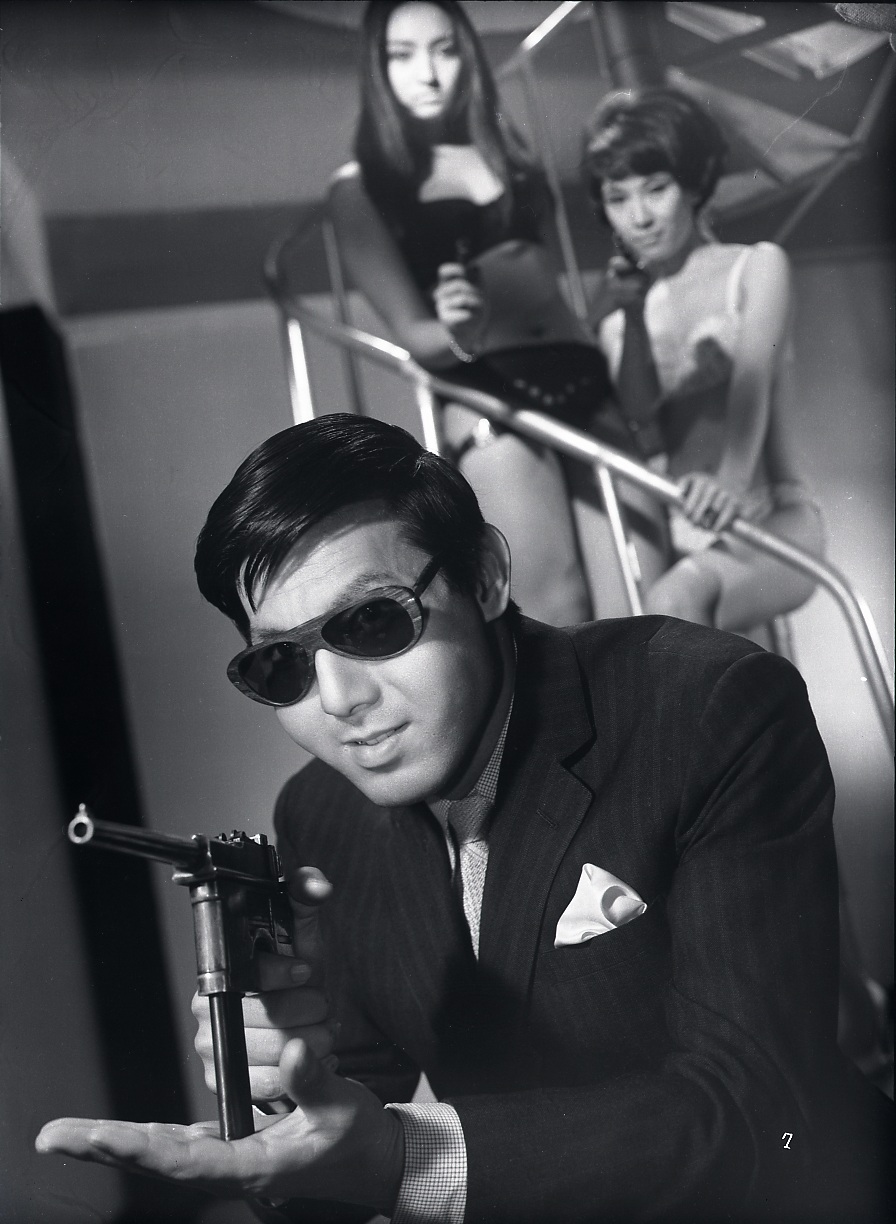
Suffice to say that ‘Branded to Kill’s promotional artwork - featuring the star wielding a Bond-esque pistol and sporting mod-ish sunglasses as his female co-stars mount a steel staircase behind him – has in recent years become possibly more widely known than the film itself, establishing itself as an iconic signifier of ‘60s cinematic cool. Fitting poetic justice perhaps for a movie which radical nature saw it alternately belittled, demonised and ignored upon its initial release, famously killing the career of its director stone-dead.
Outside of his collaborations with Suzuki meanwhile, the mid ‘60s saw Shishido becoming virtuously synonymous with the harder-edged line of action / yakuza films which Nikkatsu were beginning to produce at the time, heading up the casts of a string of my all-time favourite Japanese crime films - Takumi Furukawa’s aptly named ‘Cruel Gun Story’ (1964), Takashi Nomura’s ‘borderless noir’ ‘A Colt is my Passport’ (1967) and Yasuharu Hasebe’s proto-jitsuroku ‘Retaliation’ (1968) foremost amongst them.
Adopting the persona of a brooding, violence-prone bad-ass through these films, Shishido seems to have spent his last few years at Nikkatsu working almost exclusively in the realm of modern yakuza films, with the occasional ninkyo period film thrown in for the sake of variety, often alongside Ishikawa, Tetsuya Watari and his own younger brother, the ubiquitous Eiji Go. Rarely appearing on posters without his by-now trademark shades, gun and smouldering cigarette, Shishido seems by this point to be directly prefiguring the kind of ultra-macho persona which would be adopted in the following decade by stars like Bunta Sugawara and a post-Zatoichi Shintaro Katsu.
Cruel Gun Story (1964)
Unfortunately, Shishido’s career, like those of so many of his Nikkatsu colleagues, seems to have floundered badly after the studio turned their attentions entirely toward the production of low budget ‘Roman Porno’ sexploitation films from 1970 onwards, jettisoning the vast majority of their creative staff in the process.
In view of his considerable cred as a yakuza star, it would have seemed a natural move for Shishido to transition directly into rival studio Toei’s burgeoning slate of jitsuroku gangster movies, but for whatever reason, that never really happened, with his work for Toei during the early ‘70s restricted to an occasional guest spot here and there – most notably in two of Kinji Fukasaku’s epochal ‘Battles Without Honour and Humanity’ films (I particularly recall him making a very strange appearance as the mentally deficient brother of a gangster clan in the first entry in the underrated ‘New Battles..’ trilogy).
Like so many Japanese movie greats, he eked out a living in the ‘70s and ‘80s through TV work of one kind or another interspersed with intermittent film appearances, including several projects for ‘House’ director Nobuhiko Ôbayashi, eventually returning to yakuza territory for a string of ‘V-cinema’ shot-on-video crime flicks in the early ‘90s.
Still clearly up for a challenge however, Shishido proudly told interviewer Mark Schilling in the early ‘00s that he’d just put his “white pubes” on display in what we must assume was a brave role in S&M auteur Takashi Ishii’s erotic epic ‘Flower & Snake II’ (2005), and indeed he worked for Ishii again in 2010’s ‘A Night in the Nude: Salvation’.
Shishido’s final film appearance came in 2012 (in Manga adaptation ‘The Final Judgement’), but he has also made a great impression over the past few decades as an ever-enthusiastic interview subject, always happy to fill out the extras on releases of his films with wild tales of his time at Nikkatsu, boasting along the way of his unbeaten prowess in the field of swordsmanship, athletics and goodness knows what else, merrily stomping across the line separating fact from fiction in a never less than entertaining fashion.
Sadly, Shishido’s home was destroyed in a house fire in 2013, his collection of personal memorabilia lost along with it – nothing to laugh at there of course, but I’ll never forget the interview segment included on Arrow’s subsequent release of one of his films, in which claims that one of his neighbours started the fire, out of jealousy! (You can almost picture his relatives somewhere off camera, head in hands: “oh Dad, we’ve BEEN through this – PLEASE don’t tell the foreign film crew your neighbour started the fire!”)
One hell of a character to put it mildly, Jô Shishido was a real on-off who enlivened everything he appeared in – he will be missed.
Farewell Hitman Joe – R.I.P.
In closing, I need to acknowledge Mark Schilling’s book ‘No Borders No Limits: Nikkatsu Action Cinema’ (Fab Press, 2008), which helped me to fill in many of the details included in this post. A great overview of Nikkatsu’s ‘50s/’60s output and certainly one of the best volumes available on the subject in English, it’s still available direct from Fab Press at the time of writing.
Subscribe to:
Posts (Atom)