Saturday, 11 October 2014

Sweater off / Dead:
A ‘Bloody Moon’ Fashion Show.

Stylistically speaking, I think it could well be said that Jess Franco never really DID the 1980s. Sure, he made a lot of films in the 1980s, but in purely aesthetic terms, he never really seems to embraced the bold new era as much as we might have hoped.

Visually, much of his output during the ‘80s seems to resemble a nostalgic hangover for the jet-setting Mediterranean excesses of his ‘70s work, and more often than not, ventures toward more contemporary stylings were characterised less by directorial vision than by a sense of sad, budget-necessitated randomness that inevitably veered towards the less tolerable end of the decade’s cultural legacy (Princess Di haircuts, spandex shorts, slap bass, etc).

Perhaps due to the contribution of some outside costume/design staff and a (slightly) higher budget than usual though, ‘Bloody Moon’ stands out as a glorious exception – a film in which the man who brought us the visual delights of ‘Vampyros Lesbos’ and ‘The Girl From Rio’ can truly be seen to be adapting his sartorial passions to the era of leg-warmers, ill-fitting cowboy boots and above all, SWEATERS. (Or “jumpers” as we call them in this part of the world, but in keeping with the trans-atlantic nomenclature of the movie in question, we’ll go with “sweaters”.)

The results, needless to say, are frequently a thing of beauty. So, to further elucidate this point whilst also hopefully providing a few moments of light-weight net-pleasure to all you bored wage slaves out there patiently awaiting my next 4,000 word opus on some sleazy, forgotten horror film, here are six of the best fashion moments from this unique motion picture.

6.


Nadja Gerganoff may be no Lina Romay, but she does at least seem to have picked up a sliver of Lina’s sartorial boldness vis-à-vis her decision to go out in public dressed like this.

5.


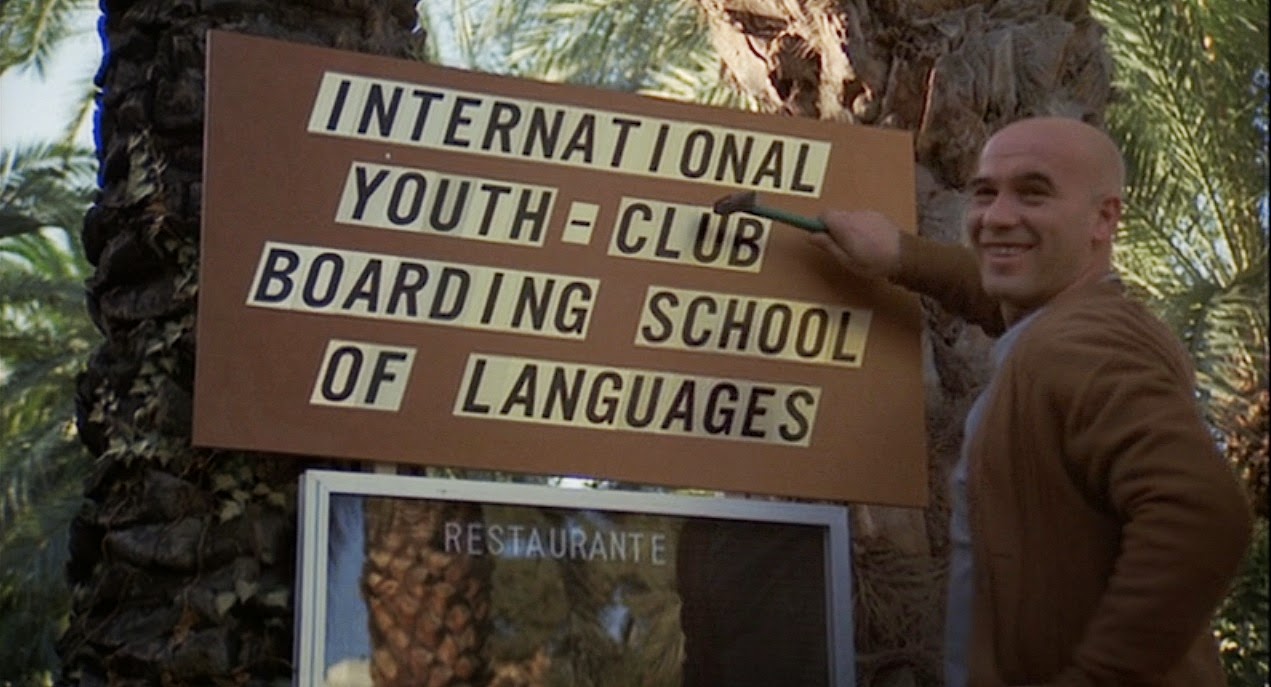
Believe it or not, this little number is only the third best sweater in ‘Bloody Moon’. At one point in the film, we learn that Angela, played by Olivia Pascal (pictured above) has actually brought an entire wardrobe of sweaters with her to the International Youth-Club Boarding School of Languages. A questionable decision for a summer break spent on the South coast of Spain you might think, but clearly Angela was well aware that competition in the sweater stakes would be heated. Will such forethought lead her to victory? Read on to find out…

4.


The girl on the right. Entire ensemble. Nuff said.

3.


Inevitably, we’re mainly concentrating on the ladies of ‘Bloody Moon’ for this list, but that’s not to say that male cast don’t have their moments too. In particular, I would like to draw your attention to the 2000AD-esque comic book design briefly glimpsed on the back of the scarred-mentalist-brother character’s leather bomber jacket. Nice one, dude.

2.


It was difficult to get a good screengrab of Angela’s majestic Grace Jones sweatshirt, but… hopefully you get the idea.

1.


I’m sorry Angela – you might have thought the Grace Jones play was a pretty unbeatable move, but nothing, and I mean NOTHING, in the world of sweaters compares to the garment being sported here by Jasmin Losensky’s Inga. Total supremacy.

Right, that's more than enough 'Bloody Moon' for now I think. See you all at the Disco Club...

Tuesday, 7 October 2014

Franco Files:
Bloody Moon
(1981)


In 1981, a group of callous German producers sparked a major incident in the esoteric world of horror movie sub-categorisation, when they thoughtlessly invited the ‘80s American Slasher Film to make incursions into the ancient kingdom of Jess Franco. Or perhaps it was the other way around. Nobody quite remembers. Either way, a confrontation was inevitable, and the results could have been catastrophic. Forces were mustered, and, in a darkened alley near a picturesque Alicante holiday village, the two sides met for a showdown.(1)

Strutting, Slasherdom paraded its arsenal:
* A large cast of young actresses, each of them more conventionally attractive and quote-unquote ‘wholesome’-looking (not to mention more frequently clothed) than those you would expect to see in a 1981 Jess Franco film.
* The shadiest and most incompetently managed Spanish language summer school in the known world. (“International Youth-Club Boarding School of Languages” reads a sign spelled out in those slanted, adhesive letters that are usually used for putting house/room numbers on front doors.)

* Teen pool party opening sequence incorporating hand-held ‘killer POV’ shots and mildly ‘transgressive’ usage of a Mickey Mouse mask.

* A bold wardrobe of ‘80s casual attire that actually seems pretty spot-on in its circa-’81 anticipation of the more garish trends of the coming decade.

* A generous scattering of conveniently placed gardening tools and industrial wood-cutting equipment.

* Lumbering, mute gardener guy as obvious red herring.

* A succession of neatly cling-filmed corpses deposited in and mysteriously removed from closets for maximum jack-in-the-box scare / ‘huh-it’s-gone-am-I-going-crazy’ effect.

* Sinister introverted brother who has been released from mental institution, but clearly shouldn’t have been because he’s crazy and murderous. I mean, just look at him - he has a scar on his face and silently stares at stuff. Nuts, I tell you.

* An excruciating American-English dub track that seems designed specifically to make every female character sound like a congenital moron, and every male sound like a sleaze-dripping closet psychopath. (And to make us laugh like a drain whenever an underpaid voice artiste sighs and gives her best shot to a line like “I bet he’s never even made it with a girl, the phony Spanish lover!”)
His pride wounded by all this unfamiliar transatlantic hoo-hah, Franco responded in kind:
* Wobbly tracking shots across picturesque Spanish harbours, culminating in a focus pull on that big goddamn rock he seems to like so much.
* Exactly the same Costa Blanca shooting locations seen fifteen years earlier in Attack of the Robots.
* An actress who looks a lot like the regrettably absent Lina Romay moping seductively in the upstairs window of a Spanish hacienda in a transparent night-dress, contemplating mischief. (The very same window used to frame Françoise Brion in ‘..Robots’, if anyone’s taking notes.)
* Wobbly, focus-blurring zoom shots of the moon, because, y’know – moon.
* A soundtrack that sounds as if the employees of a German library music label began pulling all-nighters and experimenting with Gysin/Burroughs cut-up technique.
* Language school proprietor who struts into the student “Disco Club” in a white suit & black shirt combo, momentarily looking like some decadent, DeSadean strip-club overlord.(2)
* Gore effects so audaciously shoddy they practically break the fourth wall and engage you in discussion re: the persistence of notions of theatricality and disbelief suspension in genre cinema
* Uncomfortable (and illogical) incest-based sub-plot.
* Persistent, low level evocation of that particular atmosphere of intangible, woozy dementia found in only the finest deep cuts of European trash-horror.
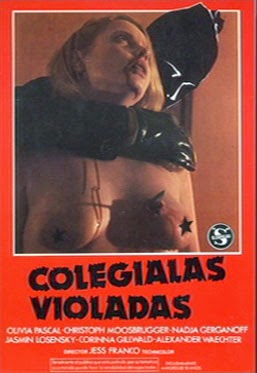
And so, battle commenced, in a conflict that will be known forever as ‘Bloody Moon’. Unless you live in Germany - then it's ‘Die Säge des Todes’ (“The Saw of Death”). Or Spain, in which case it’s ‘Colegialas Violadas’ (“Violated School Girls”). In Denmark, it was ‘Sexmord på Pigeskolen’ (“Sex-Death at the Girls’ School”?). Argentina went with ‘Terror y Muerte en la Universidad’. But no matter - to the likes of us, ‘Bloody Moon’ it is.

Legend has it that ‘Bloody Moon’s producers, keen for some reason to recruit the commercially washed up director of ‘Hellhole Women’ and ‘El Sexo esta Loco’ to their slasher dream project, lured Jess Franco on board by promising him the chance to work with up-and-coming German sexploitation star Olivia Pascal, the services of “one of the best effects guys in Hollywood”, and an original score by Pink Floyd.

Pascal materialised. The ‘Floyd did not. Effects ended up being masterminded by some guy Franco knew who handled props and owned a polystyrene head. A bit of a bummer for our long-suffering auteur, we might suppose, but seasoned Francohiles will well know that when the chips are down on a production, that’s often when the magic happens. Often, but not always. Sometimes ‘Oasis of the Zombies’ happens, but we’ve just got to cross our fingers and pray.

In the highly enjoyable interview included on Synapse’s recent blu-ray edition of ‘Bloody Moon’ (from which the screen-grabs above are definitely NOT taken), Franco speaks at length about his dislike for the film’s German composer, whom he angrily accuses of providing “fucking Dutch music”, whatever that’s supposed to mean. Hopefully we can assume that, rather than dismissing the entire cultural output of The Netherlands here, Jess is here referring to some particular form of film music popular at the time, or something like that? I’ve got no idea what he means to be honest, but regardless - if this German cat was bringing it, and Franco wasn’t digging it, my instinct is to go with Jess on this one. (Because if there’s one thing I’ve learned from the frankly unhealthy amount of time I’ve spent watching his work, it’s that JF knows a good tune when he hears one.)

Ever willing to take a deep breath and give it his best shot, Franco took up the bat and got swinging, digging into his own archive of surplus musical bits and bobs and applying a bit of the ol’ cut n’ paste to Gerhard Heinz’ credited score, with reliably off-kilter results. (The extraordinarily odd, squelchy cue that serves to weirdify the otherwise wholly routine “killer POV ascending the stairs” shot early in the film is my personal favourite moment in this regard.) 

It is easy to assume that Franco applied a similar ‘make do & mend’ spirit to all aspects of this ill-starred shoot too, his veteran’s determination to make the best of a bad job for once triumphing over the opposite tendency toward cack-handed laziness that more frequently shone through in his early ‘80s work-for-hire gigs. Despite all the initial signs of hostility between ‘Bloody Moon’s oil & water components, such inspiring leadership seems to have led to both parties in the dispute realising that they had more in common than they initially thought (after all, what was Franco’s earlier ‘Exorcism’ (1974) if not a peculiarly twisted entry in the pre-‘Halloween’ proto-slasher canon?), allowing the project’s conflicting aesthetics to blend and interact in strange and wonderful ways.

For me you see, the thing about slasher films is that their inherently minimal and repetitive format demands that, to become enjoyable for those of us who have no particular love for the genre, they must be… what’s the right word? Eccentric – that’ll do. To generate interest, a slasher must either a) be a technically excellent and emotionally involving motion picture ('Black Christmas' or Tony Williams' 'Next of Kin' spring to mind), or b), plug the gaps between dead teens with the most off-beat, aimless and just plain weird diversions that come to hand. And, given that so many products of the sub-genre’s early ‘80s golden age were cheap, amateurish films made by otherly inspired individuals for purely opportunistic reasons, many of them thankfully embark upon route b) with a great deal of gusto.

‘Bloody Moon’s Spanish-pretending-to-be-American compatriot ‘Pieces’ is perhaps the preeminent example of how things right, by which I mean wrong, by which I mean just sort of strange and confused, in this regard. The Australian-pretending-to-be-American ‘Strange Behaviour’ aka ‘Dead Kids’ is another good one, as is the genuinely-American-though-presumably-beamed-in-from-another-dimension ‘Hack O Lantern’. You can pencil in your own additions to the list, I’m sure. If not, the archives of Bleeding Skull should provide a lifetime's worth of pointers.To recap then: routine, competently made slasher = BORING. Eccentric, amateurish slasher = GOOD TIMES.

During Bloody Moon’s opening half hour, there were some shaky moments where I was worried things were heading in the former direction. The vacant, empty-eyed teens and tedious two-shot conversation scenes. The duh-brained “homages” to ‘Halloween’ and ‘Psycho’. The over-before-its-even-begun un-plotline. The surprisingly good but never quite exceptional cinematography. The presence of this so-called Nadja Gerganoff (in her only screen role) occupying the ‘slutty older sister’ role that should so rightfully belong to Lina. 

But I should have had faith. By the time a detailed discussion takes place regarding the most appropriate sweater to wear on a midnight fishing expedition with some lusty sailors, I was getting into the swing of things. After a perfectly cube-shaped polystyrene boulder narrowly misses our heroine's head, I had that nice “literally anything could happen next” buzz going on. As things stumble toward a climax, the pace quickens, slightly. Events get wilder, editing choppier, framing wonkier and music more unhinged. By the time Lina’s stand-in artlessly slices a guy in half with a chainsaw, I was ready to stand up, weeping with joy, and thank God for bringing all these people together for a few weeks on the sultry Spanish coast.

As far as the – ahem – serious consideration of Jess Franco’s cinematic legacy goes, few would seek to place ‘Bloody Moon’ on the same level as his more accomplished and personal work from the ‘60s and ‘70s. But as a Halloween-adjacent Friday night beer & pizza movie, it delivers beautifully, in ways that a non-Franco directed cynical cash-in slasher would likely never have achieved.

So, to return to where we began. It is 1981. The ‘80s American Slasher Film and the world of Jess Franco face each other across that dark alley near Alicante. Silence reigns. After a few minutes of whsipered discussion, they decide to cancel hostilities and made sweet love instead. The result? WE ALL WIN.

------------

Kink: 3/5
Creepitude: 3/5
Pulp Thrills: 4/5
Altered States: 2/5
Sight Seeing: 3/5

------------


(1) ‘Bloody Moon’s main production heavy-weight Wolf C. Hartwig was the man behind the interminable “Schoolgirl Report” series that pretty much defined the aesthetic of cheapo German sexploitation in the ‘70s (and of which Franco directed one of the stranger installments). Hartwig’s hefty catalogue of cinematic tat actually stretches as far back as 1959’s ‘Horrors of Spider Island’, and in 1977 he seemingly tried to re-balance the scales by taking the sole producer credit on Sam Peckinpah’s ‘Cross of Iron’, the same year he also handled ‘When Girls Make Love’ and ‘Confessions of a Naked Virgin’. I’ve not read up on the working relationship between Hartwig and Peckinpah, but one suspects they might not have seen eye to eye.

(2) The “Disco Club” also serves litre bottles of beer to students as a takeaway, plays lumpen, Shawaddywaddy style retro-kitsch rock n’ roll and allows entry to passing sailors (rollerskates optional). My kinda language school, as if we hadn’t established that much already.

Wednesday, 1 October 2014

This Month’s Zatoichi:
Zatoichi’s Flashing Sword
(Kazuo Ikehiro, 1964)


N.B. As observant readers will have noticed, my attempt to write about one Zatoichi film per month has slipped up a little during this summer’s regrettable posting collapse. Thankfully though, this delay has occurred at about the point when, having hopefully got to grips with the basic tenets of the series, it seems to make sense to move toward shorter, more capsule-style reviews, meaning that, hopefully, I’ll be able to throw in at least one additional review in October or November, getting us back on schedule before the end of the year. So that’ll be a big weight off your mind, I’m sure.

One result of the relentlessly prolific pace with which genre films were produced in Japan in the mid 20th century is the common phenomena of two entries in an ongoing series being made back-to-back by the same (or very similar) cast and crew, presumably working to a single, fixed budget and schedule. Sadly what often tends to result from this scenario is that the first film consumes the lion’s share of the time, enthusiasm, ideas and money, whilst the second limps out shortly afterwards looking like a bit of an afterthought - the work of exhausted filmmakers pushing to get another movie finished using whatever leftovers remained from the first production. (For a textbook example of this, see the vast difference in quality between Stray Cat Rock: Sex Hunter and the concurrently shot Stray Cat Rock: Wild Jumbo.)

I can’t guarantee that is what happened with the two Zatoichi films directed by Kazuo Ikehiro in 1964, but we can at least float it as a possibility, given that, in comparison to the frankly magnificent Zatoichi & The Chest of Gold, ‘Zatoichi’s Flashing Sword’, released four months later, is somewhat underwhelming.

Basically, this is the closest thing we’ve seen so far to a completely formulaic, business-as-usual Zatoichi picture, featuring a simplistic, pre-‘Yojimbo’ “goodies vs baddies” style plot set up that demands little in the way of engagement from the viewer, either emotional or intellectual. A tale of Zatocihi wading into a conflict between rival yakuza gangs over a valuable river-crossing concession as preparations for a big annual firework festival take place in the background, this seventh entry in the series is briskly and competently directed with the usual top notch photography and original music, but unfortunately it displays little of the admirable style and audacity that Ikehiro brought to ‘..Chest of Gold’.

In particular, I was disappointed by the fact that the whole story seems to be setting things up for a dramatic final battle taking place against the backdrop of the firework festival – which is surely the perfect excuse for an amazing and memorable sequence, right, especially in the hands of the director who worked such wonders on the preceding film..? The usual dazzling swordplay played off against the flashing lights, shadows and blinding primary colours of the festival, with booms and crashes filling the sky all around? This is gonna be awesome, surely.

Well, sadly, it never materialises, as the film instead goes for a low-key and rather perfunctory ending that sees Zatoichi casually slaughtering a few legions of yakuza within a cramped corridor set, before the film ends abruptly with our hero gloomily contemplating a head wound he received when the bad gang’s boss threw a brick at him. The long-promised fireworks meanwhile remain at a distance, visible to us only via a few bits of haphazard stock footage. A potentially great moment lost to budget and time constraints perhaps..? Who knows.

On the plus side though, this is still, as ever, wholly satisfactory entertainment, as watchable and accomplished as you could wish of a formula genre picture, with some solid fight scenes, likeable comedic shenanigans, plus plenty of the usual beautiful rural locations, fine turns from a handful of seasoned character players, and, best of all, Shintaro Katsu having just as much of a ball as usual, giving yet another rousing demonstration of how Zatoichi ended up becoming such an indelible folk hero of mid 20th century Japan. Most of the best moments in ‘..Flashing Sword’ are those that find Katsu riffing on some new variations of the gentle physical comedy skits and ad-libbed philosophical asides that help make Zatoichi an even more noble and lovable hero with each passing movie. A real giant of the Japanese screen and a uniquely compelling performer, my admiration for Katsu-san grows with each film I see him in, and the thought of spending another twenty five hours (approx) of screen-time in his presence over the coming months pleases me greatly.

Though it was the least satisfactory entry in the series thus far, it is a testament to the sheer level of quality maintained by these films that when I think back on my viewing of ‘Zatoichi’s Flashing Sword’, it still seems like a more rewarding experience than that provided by, say, about 90% of other, non-Zatoichi-related films I’ve seen this year.

Saturday, 27 September 2014

New Frontiers in Scrapbooking.


So, it occurred to me that now might be a good time to post a quick recommendation (or ‘plug’, in the contemporary vernacular) for The British Esperantist, the new paper-based venture from weblogging polymath Paul Bareham and writer & archivist Matthew Cheeseman.

Issue # 1 was declared ‘sold out’ before I had an opportunity to praise it’s virtues, but now that # 2 is with us, let me simply say that it is a splendid publication which should appeal to anyone who has ever spent time seeking beauty, oddity, hilarity and other, less easily definable feelings in the pages of obscure and forgotten printed matter.

Issue # 2 is still on sale at the time of writing for a modest £2.85 including postage.

Further info and purchasing instructions can be found here.

Tuesday, 23 September 2014

Franco Files:
Cartes sur Table /
‘Attack of the Robots’

(1966)

By the dawn of the 1960s, hatchet-faced American actor Eddie Constantine had become an pretty iconic figure in European popular cinema, playing Peter Cheyney’s hard-as-nails private eye Lemmy Caution in a series of French thrillers that included seven films between 1953 and 1963.

Two years after his final ‘straight’ Caution film, things took a rather strange turn when Constantine found himself reprising his best known character in the lead role of Jean-Luc Godard’s inscrutable arthouse sci-fi mash-up ‘Alphaville’, and with his screen persona thoroughly beyond-the-looking-glass by that point, it’s a fair bet that things scarcely got any more normal for Eddie when 1966 found him working for Jess Franco, playing the lead in two films completed that year.

One was the self-explanatory ‘Residencia para Espias’, and the other the little number we’re looking at today. Released around Europe with the inexplicably bland title ‘Cartes sur Table’ (‘Cards on the Table’), the film reached American shores under the somewhat more punchy ‘Attack of the Robots’, and, whilst neither title really bears *that much* relevance to the events portrayed therein, no prize is offered for guessing which of the two names I prefer.

So, with an English title that suggests a sci-fi movie and a star chiefly associated with two-fisted detective roles, it comes as something of a surprise to settle into ‘Attack of the Robots’ and discover that what we're watching here is actually nothing less than a fully-fledged euro-spy film, marching out in all its Bond-ripping finery.

As a director ever shackled to the whims of contemporary box office trends, Franco made a number of films during the ‘60s that fall vaguely within the ‘eurospy’ bracket, but, crucially, he seems to have had little interest in making anything like a straight treatment of the genre. The live action comic book of ‘Lucky The Inscrutable’ (1967) is too weird and uneven to really hit its appointed generic prerequisites, whilst 1968’s two ‘Red Lips’ films are simply too goofy to count, and I’ve not yet had a chance to see the aforementioned ‘Residencia..’, meaning that, for now, ‘Attack of the Robots’ is by default the closest thing we have to a genuine Jess Franco eurospy film.

Of course, being a Franco film, ‘Attack..’ is still full of off-piste diversions and eccentricities, pushing heavily toward the sillier end of the genre’s stylistic spectrum and often toppling over into full-blown spoof territory. But nonetheless - aficionados of the marginally more well-known second string spy extravaganzas filling cinemas through the mid ‘60s will feel thoroughly at home here, in spite of the director’s relentless piss-taking.

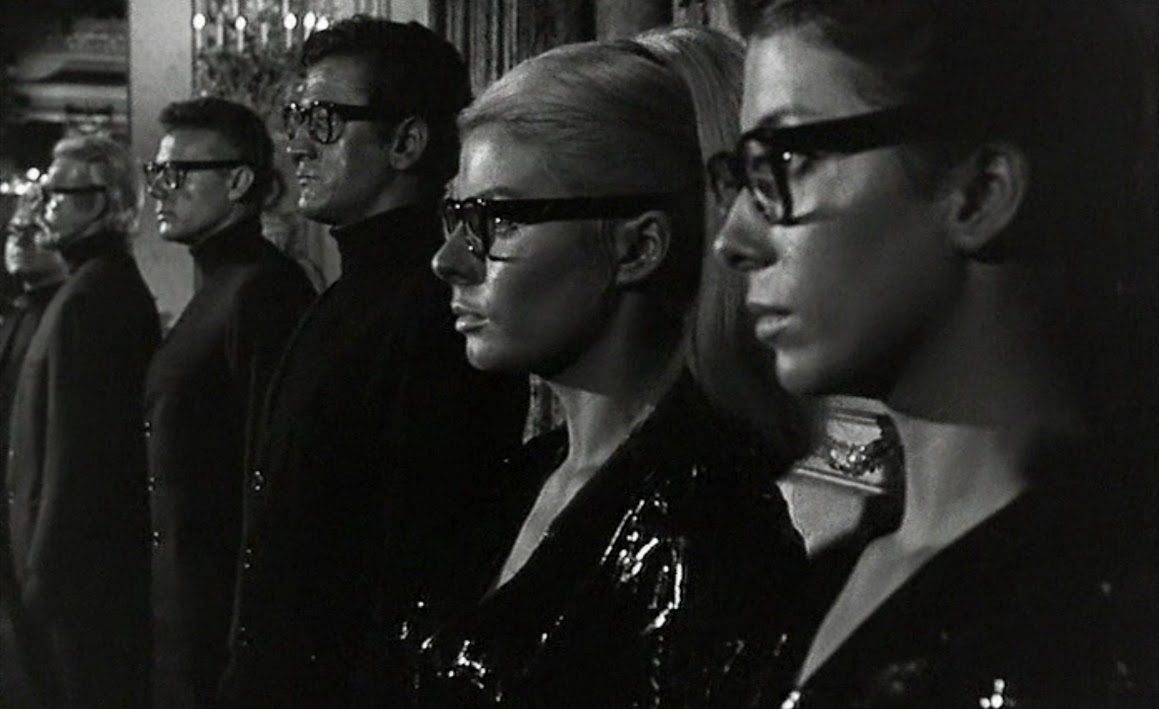
Anyway! Plot summary! So, it seems mysterious assassins in black-face make up, black turtlenecks and Michael Caine glasses are popping up all over the place, annihilating important people as they head into big buildings to do important things! What the hell are the forces of international law and order going to do about it..?

(The loveably unconvincing globe-trotting during this opening assassination montage eases us into the low budget eurospy vibe perfectly, as on-screen captions inform us we’re visiting Buenos Aires, Amsterdam etc, despite seeing nothing more than vague shots of cathedral steps and airport runways.)

About ten minutes of exposition-laden chat at Interpol HQ follows, eventually leading us to introduction of Eddie Constantine, here not playing Lemmy C, but our old pal “Al Peterson” (in the English dub), a troublesome former agent picked out of a rolodex by an administrator with a surprisingly thorough knowledge of his operatives’ blood types. (Having copped that the assassins all have the same rare blood type y’see, they need an agent who matches it, vis-à-vis the general idea that the villains will latch on to him and pick him up for, well, whatever processes they use to create these ‘robot’ assassins… and Lemmy – I mean Al – is the only man for the job.)

Within the eurospy context, the comment that Peterson can be found “somewhere on this planet with a gorgeous blonde & a bottle of scotch” tells us all he need to know about our hero’s persona, even if the sexy dame we see him sweet-talking when the action cuts to a riverside casino in some questionably exotic ‘oriental’ locale is actually a brunette.

Much business with living statue geisha girls, soul-witheringly cheesy xylophone music and subterranean opium dens follows, as Eddie finds himself kidnapped by a cackling, shrieky-voiced Chinese agent named Lee Wee (Vincente Roca),(1) prompting an overload of sub-Fu Manchu orientalism that combines with a kind of bizarre back-and-forth slapstick comedy routine and some surprisingly elaborate set dressing to create the impression of a sequence that could have been taken from a film thirty years older than this one.

After he gets through with all that, our man finds his old buddies from Interpol waiting in his hotel room, and is duly given the lowdown. And if shooting in Bangkok or Buenos Aires may be off the menu for yr average Jess Franco production, his budget could at least stretch to a week or two in sunny Alicante, whence Peterson is soon dispatched with a new cover identity, a bag full of improbably dangerous gadgetry and the winningly Bond-like mission of simply hanging around drinking and womanizing until the bad guys obediently turn up to pounce on him. (“How many James Bond films have you seen recently?”, Eddie asks his handlers. “More than you’d think” comes the rather gnomic reply.)

Upon his ‘arrival’ in Spain, Constantine drops the obligatory tuxedo and returns to his more familiar uniform of a shabby looking suit & tie with crumpled, ill-fitting hat, reasserting the visual identity he had constructed for himself in the Lemmy Caution films, even as ‘Attack of the Robots’ ostensibly finds him playing a different character in a very different scenario.(2)

Within minutes, Eddie - sorry, Al - has scoped out a beautiful but suspicious dame (Sophie Hardy, in her only role for Franco), checked into a fancy hotel, indulged in a fist-fight with an overly effusive Mexican, and been spied upon by a furtive agent in a safari suit (‘60s Franco regular Marcelo Arroita-Jáuregui). And for the next thirty minutes or so things proceed in much the way you’d imagine really, which is just dandy.

Presumably filmed in close proximity to the preceding year’s The Diabolical Dr. Z (much of the same supporting cast reappear here, as do some of the props, most likely), ‘Attack of the Robots’ was also co-authored by that film’s scriptwriter, future Luis Bunuel collaborator Jean-Claude Carriere, whom we might conceivably credit with some this film’s more darkly witty moments.

The hackneyed Lee Wee stuff might not be terribly successful as comedy, but once we get past that, much of the rest of the film is actually pretty funny, with the combination of Franco’s cartoon-ish enthusiasm and a few well-placed zingers that I assume Carriere smuggled into the script leading to some genuinely amusing moments - not least the obligatory “gadget demonstration scene”, which is one of the best spoofs of such I recall seeing, as Eddie’s handlers palm off a series of increasingly absurd devices upon him with perfect deadpan unconcern, including a pair of electrified driving gloves that supposedly carry enough charge to kill “twenty adults, or about thirty children”, and, brilliantly, an explosive, poison gas equipped cigar whose contagion can only be avoided through use of a secret vial of antidote that can only be accessed by playing a particular jig on a flute disguised as a fountain pen (you might want to read that back a few times).

Further spoofy shenanigans follow in the shape of a random kid sending messages back to the villains using a ‘radio’ hidden inside a toy car,(3) and an agent who spends much of the film glued to a payphone delivering a series of uber-conspicuous code messages (“the roses and the gladioli have been set in the vase at last. You can play the delicate melody… but only in the minor key”). You get the general idea, I’m sure.

Unlike a crime or horror picture, a ‘60s spy movie really needs the oversaturated blast of cheap Eastman colour to get its groove on, and as such, ‘Attack..’ suffers somewhat from being shot in black & white, however admirable Franco’s moody, noirish photography might be. With this in mind, perhaps the decision to go as broad as possible with the humour may have been seen as the fimmakers’ best hope of overcoming such obvious budgetary limitations in the terminally overcrowded 1966 spy movie marketplace…? But who knows.

Either way, it was probably a good move. Rarely has there been a genre or an era in which the distinction been ‘serious’ examples of a form and spoofs thereof was as wafer-thin as in the post-‘Thunderball’ hey-day of these kinda movies, and, regardless of his producers’ intentions, Franco seems to have been very much on board with this on ‘Attack..’, amping up the same kind of breezy, good-natured bonhomie that predominated in La Muerte Silba un Blues to create a film that is similar in spirit to the uproariously entertaining Tony Kendall / Brad Harris ‘Kommissar X’ movies.(4)

From a directorial point of view, the filmmaking here is competent, briskly paced and engaging in a workmanlike sorta way, with only occasional lapses into sluggishness, even if Franco’s camerawork is nowhere near as inspired as it was in ‘..Dr. Z’ or Necronomicon. Fans worried that ‘Attack..’ might be little more than a goof-off should relax however, as, happily, the envelope-pushing kinkiness and general pop art dementia that crept into ‘..Dr. Z’ is back here in spades.

Just dig the movie’s villainess (Françoise Brion as “Lady Cecilia Addington Courtney”) wearing a shiny PVC dress as she takes a riding crop to similarly attired female ‘robots’ for instance, or a kidnapped girl being dragged around in chains prior to her dry ice and electric shock-based conversion into a ‘robot’. Franco was still riffing on exactly the same pulpy “women in chains” kinda stuff right through to the late 1970s of course, via Dietrich-era bangers like ‘Blue Rita’ and ‘Swedish Nympho Slaves’, and, though obvious limited by the more modest conventions of mid-‘60s action-adventure fare, he nonetheless has plenty of space to indulge his whims here.

Speaking of which, there are also two absolutely great nightclub scenes to enjoy here. Nothing quite as far-out as the “Miss Muerte” routine from ‘..Dr.Z’ perhaps, but classic Franco all the same. Clad in skin-coloured bodysuit & feather boa, Hardy vamps upon a velvet-curtained stage alongside a string quartet and a bunch of vaudeville bongo guys as feather fall from the sky, and later, apparently in the same room, she lounges in lingerie on a round central stage, looking more than a little like Maria Rohm in ‘Venus In Furs’ as she removes her stockings. It’s all a tad saltier than the “good clean fun” approach to sex appeal found in most eurospy flicks, but then would we really expect anything less from Uncle Jess?

Another thing you can always rely on Franco to come through with (in this era at least) is a damn good villain lair, and he certainly doesn’t let us down on that score here, building (perhaps literally) on ‘..Dr Z’s memorably zany lab scenes to create a direct precursor to what became the ultimate expression of his own particular brand of psyched out villain-lair cool in 1968’s staggering ‘The Girl From Rio’.

Allegedly located on a secluded island accessible only by motorboat (allowing Franco to indulge in a few woozy ‘out on the boat’ hand-held shots that prefigure the distinctive opening to ‘72’s ‘Countess Perverse’), the above-ground section of this particular lair consists of a beautiful hacienda-style summerhouse that longtime Franco viewers will probably feel they know their way around pretty well, given that both the exteriors and interiors have appeared intermittently in the director’s films across at least three decades. (Off the top of my head, it’s definitely one of the main locations for both ‘Plaiser a Trois’ (1972) and ‘Bloody Moon’ (1981), and no doubt many others besides.)

Filmed with high angles and heavy shadow, the shots in which Eddie make his through this building and its surroundings have a nice gothic horror feel to them, but naturally it’s when we get below ground that things really kick off. Here we find loads of great ‘computer’ machinery – giant dials, rows of flashing lights, rehabilitated typewriter keyboards, big “don’t pull this one” electricity levers, you name it – spread across an operations room that comes complete with a flashing light-enhanced world map (sadly not a transparent perspex one, but you can’t have everything), and rows of zombified fembot secretaries typing away at their ‘space-age’ workstations.

It is here that we also meet Lady Courtney’s male counterpart, “Lord Percy” (yes, the villains here are supposed to English toffs, presumably), who turns out to be none other than the esteemed Spanish thespian Fernando Rey - a man who was certainly no stranger to knocking out generous handfuls of b-movie appearances in between his more prestigious assignments.(5)

The finale, in which Rey’s character is toasted alive in his own electronic robot-making machine – a dry ice-filled perspex tube surrounded by stylized asymmetrical electrical cables into which the victim is lowered via a sort of medieval torture chamber chain & pulley system - proves a prime bit of sub-‘Bride of Frankenstein’ craziness, and the elaborate bedchamber scene between Constantine and Brion, with the ‘robots’ lined up around the bed, has a delightful air of sado-sexual weirdness to it too, all combining with some requisite eurospy goon-pummeling and self-destruct button pushing to ensure that, regardless of the merits of what transpired beforehand, the last few reels of ‘Attack of the Robots’ are an absolute hoot.

Whilst it’s not really anything special in the grand scheme of things, and is unlikely to inspire much in the way of widespread enthusiasm from 21st century viewers unaccustomed to the subtle joys of this-sort-of thing, ‘Attack of the Robots’ nonetheless sits high on the list of comparatively rare ‘60s Franco flicks that should prove essential viewing for both fans of the director’s work, and enthusiasts of breezy, low budget ‘60s pulp fare in general – a wonderfully off-beat eurospy contender that’s thoroughly entertaining on its own generic merits, even as its more erotic and surreal aspects directly prefigure some of the director’s later work, much to the delight of those of us out there taking note of such things.

---

Kink: 3/5
Creepitude: 1/5
Pulp Thrills: 5/5
Altered States: 2/5
Sight Seeing: 3/5

---


(1) An actor with an impressive CV of credits in European genre movies, Roca also appeared for Franco in ‘..Dr Z’, ‘Lucky The Inscrutable’, ‘The Bloody Judge’, ‘Sadisterotica’ and ‘Night of the Assassins’, and stepped beyond the Francoverse for bit-parts in ‘A Bullet For The General’, ‘Companeros!’ and ‘Horror Express’, amongst others. Whether or not he played an excruciating ching-chong Chinaman in any of them, I’m unsure at the time of writing.

(2) It’s likely that Constantine’s costume change may have been more of a marketing gimmick than anything else. The continued popularity of his “Lemmy Caution” screen persona across Europe can perhaps be gauged from the fact that in several countries, distributors went as far as to attach the name ‘Eddie’ to this movie’s title. E.g., ‘Kortene på Bordet, Eddie’ (“Cards on the Table, Eddie”, Denmark), ‘O Eddie Enantion tis Speiras ton Dolofonon’ (“Eddie Against the Gang of Murderers”, Greece).

(3) For more on those, begin here.

(4) Basically the child just holds the car to his mouth and talks into it, without the filmmakers even bothering to insert an appropriate sound effect – talk about a cheapskate effect. I half suspect Franco just found some kid playing with a toy car on the street and roped him into doing a few shots for the movie with the promise of some candy.

(5) Perhaps Franco hooked up with Rey when they were both working on Welles’ ‘Chimes At Midnight’ a year or two earlier? Just a thought. Either way, this was Rey’s only appearance in a Franco film to my knowledge.

Tuesday, 16 September 2014

Nippon Horrors:
Snake Girl & Silver Haired Witch
(Noriaki Yuasa,1968)


Whether by accident or design, 1968 seems to have been a bit of a banner year for Japanese horror films, with such weird delights as The Living Skeleton and Genocide appearing from Shochiku, ‘The Snake Woman’s Curse’ unleashed via Toei, and Kaneto Shindô’s arthouse kaidan classic ‘Kuroneko’ released by Toho. It was the struggling Daiei studios though who seemed to be leading the pack in this mini-boom, not only fighting The Great Yokai War, but also managing to squeeze a whole host of late period kaidan pictures into their ’68 release schedule, including Tokuzô Tanaka’s ‘The Snow Witch’ and Satsuo Yamamoto’s ‘Kaidan Botan Dourou’ (aka ‘Bride from Hades’), amongst others.

A somewhat more off-beat entry on Daiei’s ’68 scorecard however comes in the form of ‘Hebi Musume to Hakuhatsuma’ (literal translation: ‘Snake Girl and Silver-Haired Witch’), an interlinked adaptation of two stories by flamboyant horror manga pioneer Kazuo Umezu, brought to the screen by Noriaki Yuasa, a director best-known for his tireless work on the Gamera series.

Shooting in no frills, regularscope black & white (whether for budgetary or aesthetic reasons who knows, though either explanation is plausible), Yuasa here succeeds in pulling off that rarest of feats: a film that mixes full-on horror with childlike whimsy without betraying either side of that equation, meaning that Umezu’s child-orientated tale of what happens when your attic-dwelling big sister turns out to be a blood-thirsty snake monster emerges as a movie both spine-chilling and delightful in equal measure – a singular piece of fantastic cinema that could appeal equally to viewers of all ages, assuming they’re not too adverse to a good dose of horror-y business.

A pre-credits sequence depicting the murder of a maid in the basement home-lab of natural history specialist Dr. Nanjo sets the tone nicely, as the usual ultra-ominous Japanese horror music accompanies an opening shot of a hairy, clawed hand lifting a snake from its cage, swiftly followed by a graphic death-by-snake that proves extremely creepy, if none too convincing.

This leads us into a wonderfully pulpy credits sequence, the camera drifting across a panorama of dinosaur bones, oversized test tubes and other mad scientist ephemera as lightning flashes, rain hammers the windows and somebody on the soundtrack goes nuts on the theremin. Needless to say, the possibility of my not enjoying this film is already fading fast.

As the story proper gets underway, we are introduced to our heroine Sayuri (Yachie Matsui), daughter of the aforementioned Dr Nanjo, a plucky yet rather somber young girl who finds herself leaving the safety of the convent boarding school she has known for many years and returning to her family home, where, uh, things are not well, to say the least.

Sayuri’s mother, we are told, is very ill following a head injury received in a car accident, and as such, she seems a little distant and disconnected, descending the stairs in the manner of a gothic heroine and apparently regarding everything around her with a great deal of uncertainty. Dad meanwhile seems like a nice chap, irrespective of all the weird stuff he keeps in his basement, but unfortunately he announces shortly after Sayuri’s arrival that he must fly to Africa immediately to study a new species of poisonous snake that has been discovered there. Such is the life of a leading specialist in rare reptiles and creepy-crawlies I suppose.

This leaves the balance of power in the household largely resting with bossy housekeeper Shige, and it doesn’t take long for Sayuri to figure out something a little more tangibly strange is going on here. The mysterious stranger who stares at her through a hole in her bedroom ceiling provides the first clue, and when this unseen interloper progresses to dropping live snakes on her pillow, and her mother responds by ordering her to perform her devotions before a household shrine from which a ghostly, living face stares back…. well I think it’s safe to say we’ve reached the “get the hell out of there straight away!” stage in record time.

During its first half hour, ‘Snake Girl & Silver Haired Witch’ sets out quite a smorgasbord of familiar horror tropes, from the weird doctor father, to the reclusive wife who’s gone a bit mad, the clawed monster killer and the ubiquitous ‘watcher in the attic’ mythos (presumably a direct reference to the famed Edogawa Rampo story of that name). Later on, things open up a little to take in elements of the inevitable “mutant / sub-normal family member secretly locked in the attic” sub-genre, throwing in the ever-present silver-haired witch of kaidan tradition for good measure, and even trying out a few riffs on the old “woman with disfigured face becomes monster” routine. Quite a line-up of thrills and chills there for us to get to grips with, and thankfully the script allows all of these ingredients to percolate for a good long while before we’re eventually given something like the full story.

Style-wise, Yuasa matches this surfeit of narrative elements with a wealth of gleefully executed horror imagery. From the threatening shadows and staring, lizard-like eyes of the snake-sister in the attic to the flashes of lightning throwing shadows on wall-partitions in classic kaidan style, the rich chiaroscuro lighting and gothic, western-style furnishings of the Nanjo house and the gratuitous close-ups of snakes and scorpions in Dad’s basement, the atmosphere here is laid on thick enough to slice up and serve for supper.

Whilst the make up and visual effects here are sometimes crude, they are never less than imaginative, and Yuasa proves a capable ring-master for the film’s numerous monstrous goings-on, deploying what we can assume was a fairly limited effects budget for maximum audience impact. In particular, the first full reveal of the snake girl, briefly glimpsed as Sayuri sees her sneaking through the dark of her bedroom at night, is absolutely fucking terrifying. A bit too slow and sinister to really count as a ‘jump scare’ maybe, but I’d still defy any viewer to not be thoroughly shaken up by it – a classic horror movie moment, perfectly executed.

Such shock moments serve to highlight just how resilient our young heroine is in the face of mind-bending horror, as Sayuri seems to retain her composure through a succession of sights and sounds that would send most adults screaming in terror. I mean, when was the last time you saw a horror movie in which a protagonist calmly accepts the notion that she will henceforth share a bed with the were-creature she has previously seen stalking around in the dead of night sporting glowing eyes and reptilian fangs? Nothing seems to phase Sayuri, and her quiet reticence, capable manner and determination to rebuilding a loving family life against all the odds certainly makes her one of the more likeable child protagonists in horror movie history.

Opting to use a child as the central character is of course one of the main things that leads ‘Snake Girl..’ toward its unconventional mixture of kid’s movie whimsy and grown up horror, and, if we’ve mainly been discussing the latter here so far, the former element really comes into its own during a series of absolutely spectacular, kaleidoscopic dream sequences, during which the filmmakers really go all out to try to replicate the oneiric / psychedelic drift and scratchy visual overload of Umezu’s groundbreaking manga artwork.

Accompanied by a delicious soundtrack of ‘Carnival of Souls’-esque wurlitzer unease, these dream sequences really come out of nowhere, stretching the movie’s sense of reality to breaking point. Once they get going, they really throw the kitchen sink at us too, as poor Sayuri’s sleeping spirit is subjected to a cavalcade of spinning hypno-wheels, floating kabuki masks, slo-mo dream flights through tunnels of pulsing light, leering white-haired hags with detachable floating werewolf hands, a doll-like ‘Alice in Wonderland’ dream avatar, further snake-related hullaballoo and even a somewhat unconvincing rubber spider attack - all employed by the movie’s malign forces in an attempt to freak out unflappable heroine yet further, treating us to some of the most delightfully unhinged in-camera special effects ever seen in Japanese cinema in the process. Really way-out stuff, these sequences will prove obvious highlights for any dedicated weird world movie fans in the audience, and you won’t be surprised to learn that most of the screen-grabs I’ve posted at the top of this review are harvested from them.

Running parallel to all this though, ‘Snake Girl..’ also functions to some extent as a decidedly grown up dysfunctional family drama, following the secret sister / snake girl’s introduction to the story in the solid, ostensibly non-supernatural shape of Tamami (Mayumi Takahashi).

Confined to the attic and kept out of sight of both her father and the world at large on the dubious logic that she’s a bit grumpy and “can’t learn a thing in school” (hey, don’t look at me, that’s the only explanation the fan-subbed dialogue gives us), Tamami’s in her non-snake incarnation is revealed to be a petulant, bullying older sister with heavy self-esteem issues, and the rather uncomfortable intimations of child abuse relating to her confinement are quickly swept aside as the film begins to focus instead on Sayuri’s valiant attempts to befriend her troubled sister, and upon the hidden power that the aggressive Tamami seems to wield over the more fragile adult women of the household.

And where, you might ask, does the noble Dr. Nanjo fit into all this? Well, curiously enough, Sayuri’s father is treated throughout as a compassionate, nigh on saint-like figure, with the film inviting us to believe that he is completely ignorant of all these malicious goings-on in his household, even as viewers familiar with the perhaps more cynical logic of Western horror films will no doubt be left screaming at such an eminently questionable loose end in the plotting. (I mean, reclusive scientist father with a basement full of caged snakes and over-sized chemistry equipment + daughter who seems to transform into a snake monster at night = you do the math!)

At a push, the combination of this saintly father figure and the equally estimable ‘big brother’ character (a happy-go-lucky young guy who works at the Convent school and turns up at irregular intervals to offer Sayuri nuggets of upbeat life advice) could seem to push ‘Snake Girl..’ (presumably accidentally) into that weirdly misogynistic realm of socially conservative melodrama that will sadly be all too familiar to viewers of vintage Asian and Indian films. (Y’know the kind of thing – where the men in a family remain lofty, noble figures, unaware of the conflicts and machinations of the weak and/or scheming women stirring up trouble beneath them, and so forth.)

After the movie takes this turn toward more domestic concerns in its second half, the responsibility for providing scariness increasingly shifts to the aforementioned silver-haired witch, whose appearance, cool though it is, eventually sets things up for a regrettably rushed and silly conclusion that very nearly destroys the not inconsiderable wealth of audience goodwill the film has built up by this point, with an inexplicable action showdown on a convenient building site scaffold (anyone else get sick of that particular trope?), and a fairly witless Scooby Doo-esque wrap up that seems to imply that all the preceding events were the work of purely human villainy, irrespective of the numerous instances of blatantly supernatural business we’ve already been shown. All a little suspicious if you ask me, especially with the good Doctor getting off scot-free on his convenient post-showdown return from Africa.

At the end of the day though, such flaws (presumably the fault of either rushed scripting or the difficulties of combining two separate manga stories into a single narrative) are eminently forgivable in the face of ‘Hebi Musume to Hakuhatsuma’s manifest strengths.

Whereas the same studio’s ‘The Great Yokai War’ seemed uneven and confused in its mixture of juvenile and adult impulses, Yuasa’s film skillfully blends them into a cohesive whole whilst also taking on board all of the visual ambition and imagination of the aforementioned film, resulting in a gloriously atmospheric dose of pulpy horror, delivered with a charm and conviction that – prior to its conclusion at least – easily wins it a space alongside such eerie, all-ages classics as Jaromil Jires’s ‘Valerie and her Week of Wonders’ and Richard Blackburn’s ‘Lemora: A Child’s Tale of the Supernatural’. Splendid viewing in other words, and another great addition to Japan’s oft-neglected legacy of horror/fantasy cinema.


(The poster below advertises a triple feature, combining ‘Hebi Musume to Hakuhatsuma’ with ‘Gamera vs Gaos’ (1967) and ‘Warning From Space’ (1956). Respectfully borrowed from Tokyo Scum Brigade.)


Saturday, 13 September 2014

Content Warning!


 As readers who have visited this site in the past week or so will no doubt have noticed, some sensitive soul has finally hit the ‘report objectionable content’ button and subjected Breakfast In The Ruins to the imposition of one of blogger’s monolithically pointless ‘Content Warning’ pages.

No big deal really of course. Many of my favourite weblogs have had one in place for years, and to be honest, I was wondering how long I could get away with posting the kind of vaguely adult-orientated content that often predominates here without getting the dreaded warning page slapped on it. (For the record, I continue to operate this blog with a self-imposed '15' rating, even if we are skirting the NSFW boundary from time to time.)

Looking more closely at the wording on the warning page, I do find the use of the word "objectionable" is a bit galling, as it seems to imply that I'm espousing some extremist ideology or propagating deliberately offensive material or something, rather than just occasionally using curse words or posting non-explicit screen-grabs from old sexploitation films or whatever else it was that our anonymous button-pusher took umbrage with.

Oh well, never mind – at least it'll keep the riff-raff out.

And speaking of content; I’m aiming to return to a regular schedule of posting from early next week, and will do my best to keep it up. Apologies again for this summer’s posting collapse.

Thursday, 4 September 2014

Pan People.


Amid all those artful Penguins, we haven’t had many examples of the more ‘old school’ approach to paperback crime covers on here for a while, so, here’s a cheery trio of UK Pan editions I just picked off the top of the book-heap, all featuring artwork from the ubiquitous Sam “Peff” Peffer - definitely one of the most consistent and classy British pulp cover artists I’m aware of.

‘Dames Don’t Care’ was actually a birthday present a few years back from some friends I’ve sadly lost touch with since (sorry about that guys, if you’re reading). I skim-read it at the time and found it a hell of a lot of fun as I recall – an example of Peter Cheyney pushing the ultra-hard boiled, cod-American thug vernacular style of his Lemmy Caution books to the point of absolute oblivion. Needless to say, none of the raging, desperate white trash characters featured in the book look anything like the more well-appointed couple seen on the front of this edition, leading me to suspect that the illustration was either just a generic, one-size-fits-all crime cover, or else a spare painting left over from some other assignment, slapped on here by a cost-conscious editor on a deadline.

Conversely, the Pan edition of ‘Lady in the Morgue’ must count as a bit of a minor brit-pulp classic, not only for the macabre and unusual cover painting, but for the frenzied back cover blurb (“..cuts grim mortuary capers over a volcano of violence..”), and even the press quotes are good too. Maybe not a paperback that’ll blow your mind on first glance, but in terms of the wonderful and peculiar stuff that keeps me coming back to these books, it’s got the complete package for sure.

Not much to say about about ‘The Endless Colonnade’, except 1. Hitchcocksploitation!, and 2. Ouch, quite a burn on John Buchan from the Evening News.

A nice interview with ‘Peff’ himself, alongside fellow cover artist Pat Owen, can be found here. Plenty of interesting recollections about life in the cover art business, but the thing that really knocked me out was the revelation that, for a lot of these covers, the publisher actually paid for reference photographs to be taken in advance, arranged on the artist’s instructions complete with models and costumes, and THEN paid the artist to paint the cover based on the photos! Truly, the mind boggles.

Oh, and by the way, apologies again for the continuing lapse in regular content on this blog. Just to keep you updated, I’m slowly getting back to some blog writing done after an unavoidable lay off, and, though I still have a pretty daunting workload to get through in other areas of life, I hope to be back in business with some fresh movie reviews by about this time next week, fingers crossed. Thanks again for your patience.

‘Lady in The Morgue’ dates from 1959 (originally published 1937), ‘Dames Don’t Care’ is 1960 (originally published 1937), and ‘The Endless Colonnade is 1959 (published for the first time).