Monday, 12 May 2014

Nippon Horrors:
The Great Yokai War /
‘Spook Warfare’

(Yoshiyuki Kuroda, 1968)


It would be interesting, I think, to know precisely when Japan’s legion of Yokai Monsters ceased to be a genuinely frightening presence in the nation’s mythology – boogeyman-esque nasties conjured up by parents to keep their children in line, or to put the wind up them on cold nights sitting around the kotatsu heater – and began to take on the slightly more… whimsical aspect generally assigned to them in post-war popular culture.

A definite turning point in this regard would seem to be emergence of legendary manga artist Shigeru Mizuki in the early 1960s, and in particular, the phenomenal popularity of his character Kitaro. A shaggy-haired, one-eyed ‘monster boy’ whose independently mobile second eye is, rather bizarrely, inhabited by the spirit of his late father, Kitaro represents an ambivalent but generally benevolent supernatural presence – a friend of the Yokai who often acts as a kind of intermediary between humanity and the monsters, using his powers either to punish human greed and egotism, or, more frequently, to combat more malevolent ‘outsider’ monsters who are feeding off the defenceless humans on his patch.


Earlier in his career, Mizuki had been advised by his editors that his interest in folkloric monsters was too ‘dark’ to be incorporated into a mainstream comic strip, and perhaps this is the reason why, with Kitaro, the artist took a more light-hearted approach to the material, tempering the macabre weirdness of his often extraordinary imaginings with a tone of gentle black humour, somewhat reminiscent of ‘The Addams Family’, presenting Kitaro’s Yokai pals as goofy, somewhat likeable creatures, and making sure that their adventures were always neatly wrapped up with minimal harm done to innocent human by-standers.

As such, there is always a certain conflict between humour and genuine nastiness running through Mizuki’s work, but regardless, he apparently worked this balance well enough to make ‘Kitaro’ a massive hit, pretty much single-handedly reigniting public interest in the culture surrounding the Yokai, and defining their subsequent presentation to such a degree that many Japanese still have trouble differentiating monsters with roots in folklore from those which Mizuki invented from scratch.

With the popularity of Mizuki’s Yokai tales increasing through the 1960s, happily coinciding with the post-Godzilla/Ultraman boom in Japanese monster action, it was perhaps only a matter of time before the spooks got their shot at live action, big screen glory, and thus we come to Daiei’s 1968 production ‘The Great Yokai War’ (released in the USA under the wonderful title ‘Spook Warfare’). Whilst the film is in no way a direct adaptation of Mizuki’s manga, the spirit of his work is very much in evidence in Yoshiyuki Kuroda’s extremely strange motion picture.


For foreign viewers coming to it cold, I can only imagine that ‘The Great Yokai War’ must seem like a colossal WTF from start to finish, and even to those familiar with the ways of the Yokai, it proves a pretty peculiar business. For one thing, you certainly know you’re in for something a bit different when a Japanese movie – a product of surely one of the most inward-looking and culturally specific film industries in the world - opens with a prologue set amid the ruins of ancient Babylon, where a pair of Islamic-looking treasure-hunters are busy defiling the sanctity of some sand-blasted tomb or other.

In doing so, a solemn voiceover informs us, they are about to unleash the spirit of the all-powerful demon who was single-handedly responsible for the downfall of Babylonian civilisation. And indeed, the voiceover doesn’t lie. Lightning blasts! Earthquake! Whirlwind! And as our unfortunate nomads are buried beneath falling debris, a singularly gnarly, winged reptilian man-in-suit monster takes flight! Good grief.

Next, we cut to a narratively pointless but absolutely delightful Ray Harryhausen-esque sequence in which the winged demon descends upon a sailing ship making its way across a storm-tossed sea – a mixture of nautical model shots, back-projected monster-suit action and screaming, piratical crew member close-ups that serves both to demonstrate the kind of ambition this film intends to throw into its special effects, and also to bring a tear of joy to the eye of anyone with even the slightest love of ‘60s monster movies.


We are never given any explanation as to why this being of pure evil should head straight for Japan after being awakened in the middle of the Mesopotamian desert, but nonetheless, that is what he does, hitting shore in a remote coastal district where a respected local magistrate and his daughter are enjoying a quiet fishing trip. (Oh, and this all takes place during the Edo period by the way, so it’s top-knots and kimonos all round - you’d have to wait for Takashi Miike’s 2005 remake of this film to see your favourite Yokai running amok in contemporary Tokyo.)

The demon’s primary MO is soon revealed to be a kind of vampiric body snatching / mind control type operation, as he corners the magistrate in a spooky, cobweb-enshrouded rural shack, disarming him using a mixture of smoke, lightning and magical laser blasts, and bloodily consumes his soul, taking on his likeness and setting out to further extend his hidden influence within the man’s household. Not that our Babylonian antagonist really does a great deal to hide his presence, as the previously mild-mannered patriarch returns home and immediately begins yelling unreasonable commands at his family and servants, slaying the pet dog and violently smashing and burning the assorted shrines and religious icons dotted around his homestead.

Watching the ensuing chaos from a pond in the house’s courtyard is a curious Kappa – one of Japan’s reptilian river monsters, here represented as a kind of lovable, proto-Howard the Duck sort of fellow. As a supernatural creature, the Kappa is able to see the demon in his ‘real’ form, and, suitably startled, bravely sets out to take this scary intruder down with some Kappa kung-fu, getting his ass kicked in short order.


Tail between his legs, the Kappa retreats to an eerie, abandoned cemetery - a wonderful set, looking like it could have been taken straight from one of Mizuki’s drawings, with cluttered, ruinous mise en scene, overgrown weeds and voluminous quantities of gel-lit, multi-coloured Yokai Smoke - and reports his experiences to the local assembly of Yokai.

Everybody’s favourites are represented here, from the stretchy-necked woman Rockuro-kubi to the weird, one-eyed bouncing umbrella creature Karakasa-kozō, and Futa-kuchi-onna, the self-explanatory ‘two-mouthed woman’. Their leader and spokesman is the big-headed, staff-wielding Abura-sumashi, his oversized cranium presumably acting as movie code for “big brains”.(1)

Whilst the Yokai are largely ambivalent about the fate of the local human populace, they are a pretty patriotic bunch it seems, and on hearing the Kappa’s tale, they express concern that the preeminent reputation of Japanese spooks will be tarnished if they let this foreign interloper rampage around unchecked, taking over people’s minds and tearing down the sacred symbols of national tradition. (Do you detect a metaphor in there somewhere, readers? If so, I’m just going to whistle and look the other way.)


So, reccy missions to the magistrate’s house are attempted and plans are hatched, whilst, inevitably, a parallel ‘human’ storyline also emerges, wherein the noble fiancée of the magistrate’s daughter figures out that there is some demonic business going on and sets out to consult his uncle, a venerable Buddhist monk of an evil-fighting persuasion, leading to a couple of rather intense sequences of Asian-style folk magic business that play out like a far less icky version of one of those ‘Black Magic’ type Shaw Bros horror movies.

As neither human nor supernatural counter-attacks appear to have much of an immediate impact on the growing power of the Babylonian interloper though, the Yokai start to put the word out to their brother and sister spooks around the country, gradually assembling a full scale spectral army, as preparations for the Great War of the title start to get underway, building up to one whopper of a mind-bending, monster-bashing climax.


Director Yoshiyuki Kuroda didn’t have a great deal of directorial experience when he went to work on this film, and prior to this assignment I think he was primarily known as an effects guy – a background which certainly makes sense when viewing ‘The Great Yokai War’, in which a rather uncertain tone and underdeveloped narrative is livened up through the application of great art direction and lashings and lashings of outlandish special effects.(2)

In writing about films like this one, I always feel the need to preemptively defend their visual effects against hordes of hypothetical naysayers, pointing out that, sure, ‘The Great Yokai War’s creature designs are neither high-tech nor very convincing… but if you’re watching a movie as crazy as this and expect it to be ‘convincing’, then god knows, I can’t help you. What the effects ARE here is simple, imaginative, a lot of fun to look at and basically just really weird-looking, which I think is basically all you can ask of a barmy ‘60s monster movie.

Although I casually mentioned Harryhausen earlier in this review, that comparison is of course highly misleading. In keeping with the majority of Japanese fantasy cinema from the ‘60s, stop-motion and other ‘in-camera’ means of realising monsters are almost entirely avoided here, with all of the creatures instead created ‘live-on-stage’ style, with full-head masks, life-size suits and the like predominating. As such, it’s clear that Yuroda’s budget and expertise in no way allowed him to replicate the kind of rubbery fantasias exploited by Toho and Tsuburaya in the same period, but watching this film’s crew strive to create extraordinary results from their obviously limited means certainly makes for an enjoyable and – there’s that word again - delightful experience.


Several of the most prominent characters for instance are lumbered with fixed-expression head masks that allow for little facial movement, which immediately gives a bit of a goofy, childish feel to proceedings, but if you honestly find yourself taking offence at the Kappa’s boggle-eyes or the Babylonian demon’s leery fixed-grin, you have a harder heart than I, especially given the kind of exuberant physical acting that both performers employ to make up for such shortcomings.

Beyond his high-school-art-class level mask, the Kappa is basically just a guy in green body-paint and what looks like a few bits of an old ‘jungle lad’/barbarian outfit, but it is the actor’s spirited and strangely elegant capering that really sells the character. A similar approach is taken with Abura-Sumashi, who is presumably just played by a child wearing a giant papier-mâché head, but again, the results are so pleasing that you’d be hard-pressed to find fault with such an arrangement.

Daimon – as the Babylonian demon is referred to in the subtitles and cast list – also has a *very* cool costume, immobile head aside, looking not dissimilar to the kind of creature that might have turned up in one of Daiei’s ‘Diamajin’ films (see footnote 2). Scaly and bony with a thick carapace, curly back-spikes, a belt of skulls and, strangely, feathered wings, he certainly makes for a formidable and scary bad guy.


The Karakasa-kozō meanwhile is represented by a life-size puppet bouncing around on strings – an utterly bizarre addition to any film – whilst Rockru-kubi’s stretchy necked attack is realised by means of a wild assemblage of flailing, flesh-coloured hosepipe, and the use of a lot of conveniently placed foreground objects for the actress to poke her head around. Nonetheless, she is a wonderfully sinister presence, and her one-on-one fight with Daimon is definitely one the film’s highlights, perhaps the overall peak of its “I can’t believe what I’m seeing here” awesomeness.

Well, prior to the conclusion, anyway. Here, as Daimon splits himself into a number of clones then grows to full scale kaiju proportions, the Yokai army close in to attack him, and the filmmakers decide to make best possible use of their twenty or so functional monster suits through extensive application of super-imposition, building up layer upon layer of shiny, transparent Yokai legions by the simple means of slapping loads of different shots on top of each other, to sublimely freakish, psychedelic effect. This ‘March of the Yokai’, shot in slow motion, with the spectral hordes traversing rivers, clouds and mountains, and their ensuing epic battle with Daimon, is one of the most extensive spectacles of mindbending fantastic cinema I’ve seen for many a month. (And as an aside, I like how many of the Yokai seem to tie handkerchiefs around their heads when they go to ‘war’, making them look a bit like desperate, battled-scarred fighters from a Kurosawa movie or something.)


As you may have gathered from some of the descriptions above, ‘The Great Yokai War’ features comical character designs and gentle slapstick humour that could have come straight from kid’s adventure movie, but frequently mixes them up with moments of unnervingly gruesome horror, leading to a tonal discrepancy that is never quite resolved. In addition to the demon’s gory neck-chomping antics and a few other bloody, gaping wounds, the atmosphere of the film is persistently ominous, and Shigeru Ikeno’s dissonant, Ifukube-esque music is often terrifying.

One sequence in particular, in which a pair of young children are forced to flee their home and take refuge in the ghost-infested cemetery as their parents are slaughtered by demon-possessed samurai, seems purpose-built to send unsuspecting little ones straight into a screaming vortex of no-sleep-for-a-month trauma, but apparently none of this stopped ‘The Great Yokai War’ from finding a home as a frequent holiday TV fixture in Japan, so who knows, maybe kids in the Far East are just made of sterner stuff?

With this mixture of kiddie-friendly creatures and genuine threat, ‘The Great Yokai War’ could perhaps be seen as a precursor to something like Joe Dante’s ‘Gremlins’. But whereas that film managed to merge the two impulses very smoothly, Kuroda is less successful, with the resulting stylistic confusion perhaps serving to make things a bit too weird and alienating for casual viewers. Whilst the appearance of the Yokai is clearly quite cutesy, with the exception of the Kappa they are never really anthromorphised very much, nor allowed to develop their own personalities. And whilst their refusal to really give much of a fuck about the fate of the humans in the film is pretty refreshing for those of us with an ingrained hatred of Disney/Hollywood schmaltz, the spooks’ failure to become “relatable” also leads to something of a character-vacuum at the centre of the movie, especially given the rather dry and unengaging nature of the accompanying human drama.


Really though, such confusion is probably to be expected when you realise that Kuroda and his collaborators were basically going way off the map here, with no established set of genre conventions to guide them: in addition to horror and kid’s fantasy, there’s a hefty dose of kaiju eiga DNA in the mix, to say nothing of some distant hints at kaidan ghost stories, and even a fair amount of chambara-style period drama. With all these generic tropes flying around but never quite coalescing into a coherent whole, it is probably best to view ‘The Great Yokai War’ as a complete one-off, and one whose drawbacks are very much the result of its untested and somewhat unique style.

And, more importantly of course, those drawbacks never even come close to outweighing the sheer pleasure that the film’s wildly ambitious visuals, macabre atmosphere and unhinged creature designs have to offer to anyone with a fondness for unusual international fantasy cinema. In fact, if your tastes veer more toward the exceptionally weird, lower budget and culturally specific end of the scale, you can peg this one up as a ‘must see’ for sure... but then if you've read this far, you probably don't need me to tell you that.

As with just about every character or concept that emerged from Japanese popular cinema during the ‘60s, it seems that one film just wasn’t enough for Daiei’s Yokai, and they soon returned for ‘One Hundred Yokai Stories’ (1968) and ‘Journey with Ghosts Along Tokaido Road’ (1969). I’d imagine my quest to find both of those in watchable, sub-titled form might be worthy of a series of films in its own right, but nonetheless, I hope I’ll be able to share my thoughts on them with you sooner or later.

For now though, let's all wave goodbye to these spectral defenders of Japan's supernatural sovereignty, as they dance eerily back across the misty mountains. They may be apt to scare the shit out of us in nocturnal graveyards from time to time, but they're a good bunch really... well, provided you've got your visa papers in order and aren't planning to eat anyone or make with the mind control, at least.


----

(1)Many thanks to the indispensable Yokai.com for helping me get all those names straight – a wonderful resource, and a great way to waste a few idle hours at work.

(2) Kuroda’s main claim to fame prior to this film was as effects supervisor on Daiei’s series of ‘Daimajin’ movies, of which three were made in 1966. A similarly off-beat kind of period kaiju / Shinto mythological(?) type creation that perhaps represents the nearest relative to what we see in ‘The Great Yokai War’ and its sequels, you can learn more about ‘Daimajin’ via this informative post at Cool Ass Cinema.

Thursday, 8 May 2014

Bande Dessinée Adulte.


Not much  going on here beyond a glorified link post with some pilfered images I’m afraid, but, since I no longer ‘do’ tumblr, I thought this might be a good space in which to share a link to this wonderful collection of scanned French (or Italian-translated-into-French?) fumetti covers that I discovered earlier today. (Tip-off via Monster Brains.)

Though I’m often fairly ambivalent about their contents, I absolutely love the hyper-sleazoid, ultra-pulp painted covers on these ‘70s/’80s fumetti, and a few favourites I’ve discovered through the aforementioned site are displayed above. Well, a few of the more tasteful ones anyway, because I’m still at least trying to keep things family-friendly ‘round here, goddamnit. Or PG-13 rated, at least. So, ‘15’ in the UK I suppose, or… well NOTHING BELOW THE WAIST anyway, that’s all I’m sayin’. (Mops brow with handkerchief and looks pensive.)

(Also quite interesting is this link, from the same site, which rather exhaustively chronicles instances in which imagery on these covers was ripped off from movie posters, stills, magazine photos, porn and, well, yeah - mostly porn, to be honest…)

Sunday, 4 May 2014

Thursday, 1 May 2014

Penguin Crime Time:
The Nose on my Face
by Laurence Payne

(1964)


Cover drawing by David Frost.

Total classic Penguin Crime cover. British Crime incarnate.

Movie fans with good memories may remember Laurence Payne more for his acting career, which took in roles in everything from 'The Trollenberg Terror' (1958) to 'Ben Hur' (1959). His last feature film appearance was Hammer's 'Vampire Circus' in 1972.

Sunday, 27 April 2014

Penguin Crime Time:
The Widows of Broome
by Arthur Upfield

(1962 / first published 1951)


Cover design by John Sewell.

Despite not knowing much about the author or his work, I think Arthur Upfield’s Australian crime novels sound quite interesting – an impression that is aided somewhat by the wonderfully creepy, sci-fi-ish cover illustration on this particular edition, which I’m planning to get stuck into during my flight to Japan this month. That’s eleven hours in the air, so here’s hoping Mr. Upfield’s prose is up to snuff. (Don’t worry readers, I’ll also be packing an Elmore Leonard and a Graham Greene, in case ‘The Widows of Broome’ proves a bust.)

Actually, by the miracle of pre-scheduled weblog posts, I will already have taken said flight by the time you’re reading this, and I hope you won’t mind me keeping this place ticking over whilst I’m abroad via the series of posts showing off some of my ever-growing stash of those immaculate green hipsters of the pulp fiction bookshelf, Penguin Crime paperbacks. Normal service to resume shortly.


Sunday, 20 April 2014

Franco Files:
Lorna the Exorcist
(1974)


AKA:

‘Les Possédées du Diable’, ‘Caresses de Chattes’, ‘Les Possédées du Démon’ [all titles used in France?], ‘Exorcism’ [Norway], ‘Sexy Diabolic Story’ [Italy], ‘Linda’ [U.S.A.], ‘Kleine Feeksen Maken Veel Heibel’ [‘Little Vixens Make a Lot of Fuss’(!), Belgium]

Context:

For my money, Jess Franco’s artistic (if not commercial) peak as a filmmaker came in the early ‘70s, around the time he began making extremely low budget movies for French producer Robert deNesle.(1) I can’t pretend to know much about deNesle, or Franco’s working relationship with him, but I can at least state my belief that many of the films that resulted – as highlighted by Mondo Macabro’s recent DVD releases of ‘Sinner’, ‘Countess Perverse’, ‘Plaisir à Trois’ aka ‘How To Seduce A Virgin’, and ‘Lorna the Exorcist’ – are very good indeed.(2)

As such, it is high time we got around to looking at some of them in this review strand. On a personal note, it was my initial viewing of 1974’s ‘Lorna The Exorcist’ that first convinced me that, more than just being some zany Euro-trash guy, Jess Franco at his best is a cinematic artist well worth paying attention to, with no disclaimers and quotation marks needed. So, this is one I’ve been building up to for a while, I guess.

One of Franco’s darkest and most troubling films, ‘Lorna..’ apparently proved just as unapproachable for ‘70s distributors and audiences as it does for 21st century reviewers, leading to what is probably one of the more convoluted and unfortunate release histories in a filmography full of convoluted and unfortunate release histories. Intermittently ignored, shortened, recut, redubbed, retitled and shopped around Europe and the USA in various states of disrepair through the remainder of the ‘70s, it was perhaps most widely seen in a truncated version that cut sections of the original film together with unrelated hardcore sex scenes.

As a result, Mondo Macabro’s heroic restoration of what they claim is the closest possible approximation of Franco’s original cut of the film splices together material taken from a multitude of prints and audio sources, leading to a viewing experience that is sometimes choppy, ragged and damaged… but would we really want it any other way? Looking like a film that's only barely escaped from some lost, night-haunted dungeon of euro-smut dementia, the resurrected ‘Lorna..’ is an absolute masterpiece of crazed, marginal cinema, and I bow before MM for bringing it to us in its (more-or-less) complete form.

Content:

First thing to note, in case you were wondering, is that ‘Lorna the Exorcist’ features no exorcists and no exorcisms (although by god, the characters could certainly do with some by the halfway point). Actually, the film’s most widely used title is a misnomer several times over, given that Lorna is the name of the supernatural presence whose influence a would-be exorcist would be called upon to get rid of, but you know how it is – European cinema was so exorcist-mad in the wake of Friedkin’s original, I’m sure deNesle could probably have just pulled out an old gladiator movie or something, called it “Hey Hey It’s Exorcist Time!” and still made money, so let’s just be glad he got behind this film instead, regardless of what he called it.

In brief then, ‘Lorna The Exorcist’ concerns the Faustian pact made by a weak-willed businessman (Guy Delorme) with the titular Lorna Green (Pamela Stanford), a mysterious woman whom he meets and indulges in a one-night stand with whilst trying to earn some dough in a seafront casino.(3) We don’t learn all this until a flashback sequence midway through the film, but the basic gist of their agreement is that Lorna’s magic will ensure his wealth and success in the coming years… but that his first born daughter belongs to her.(4)

Nineteen years later, the man is living in moneyed splendour with his wife (Jacqueline Laurent), and his daughter Linda, who, conceived around the time of his dalliance with Lorna, has now grown up into the shapely form of Lina Romay. (Hope you’ve got all those L names straight.)

With Lorna long-forgotten, the family are planning a holiday to celebrate Linda’s 18th birthday, when Dad unexpectedly gets a call. The time has come for Lorna to claim what is hers, and she commands that the family return to the site of the father’s original bargain/seduction to make the delivery. Unable to refuse, but limply determined to try to do something to save his daughter once they get there, Dad changes their travel plans accordingly, and the scene is set for a very unhappy holiday indeed.


Kink & Creepitude:

In looking at this particular film, I decided that the only possible option was to combine these two categories, simply because the ‘sex’ and ‘horror’ elements within ‘Lorna..’ are so thoroughly intertwined that attempting to examine them separately would be an impossible task.

Several times in earlier reviews (cf: Macumba Sexual, Doriana Gray), I have touched upon Jess Franco’s unique conception of the ‘sex horror’ film. At the risk of repeating myself, Franco's basic approach is to side-step the more common practice of simply throwing sex into a horror framework (or vice versa), and to instead make films in which the sex *becomes* the horror, and in which horror arises from the sex, pulling the (assumedly hetero-male) viewer’s libido into strange and frightening new places in the process – a goal that I think ‘Lorna..’ realises more powerfully than any other film he ever made.

Before the horror gets underway however, the film does at least begin in conventionally ‘sexy’ fashion. Right from the opening moments (after a rather generic credits sequence that indulges Franco’s love of random foliage footage), we’ve got Pamela Stanford kissing a full length mirror and rubbing herself through diaphanous gown before reclining, legs spread, on a bed as Lina appears, similarly under-clothed, at her French windows. So far, all this is plotless, contextless – for all we know, we could just be watching some old porno loop, but nonetheless, it is somehow completely entrancing, even when stretched across the better part of ten minutes.

The haunting, cyclical electric guitar melody and ‘floating’ camerawork, the eerie slo-mo drift of the women’s movements and Stanford’s frankly mental make-up & wig all contribute to a thoroughly oneiric experience that’s more akin to a Jonas Mekas/Jack Smith style experimental short than yr average softcore bump n’ grind, forcing even the most sceptical of viewers to admit that a skilled filmmaker, fully engaged with the material, is behind the camera here… even as he finally gives in to the urge to hit the zoom and zero in on somebody’s beaver every thirty seconds.(5)

So far then, we’re basically just watching an unusually well-made porn film, but nonetheless, there is a strange ritualistic feel to this opening dream sequence that prefigures the horrible abuses of the sexual urge (both the characters’ and the viewers’) that will follow through the next ninety minutes, as ‘Lorna..’s sexual content gradually drops this conventional/comforting vibe completely and begins more to resemble some kind of transgressive art-porn assault-film, taking jaded Euro-sleaze fans way outside their preferred comfort zone with a fevered intensity and sense of suffocating WRONG-ness that rarely lets up.

Strangely, our first hint that there is something a bit more unsettling than usual going on here comes via an inexplicable sub-plot that features Franco himself playing a doctor in a rather cramped looking lunatic asylum (make of that what you will), treating a writhing mad woman with an aversion to pants. Presented with no overt connection to rest of the story, this character/set-up is of course a reoccurring motif in Franco’s films (see Dracula: Prisoner of Frankenstein, for example).

On one level, the inclusion of a hospitalised mad-woman can be seen as a cheap way to raise an “is it all in her mind..?” type psycho-psychedelic dilemma, or just as a bit of bonus titillation or random space-filling weirdness, but the disturbing significance of this archetype within the endlessly self-referential ebb and flow of Franco’s work was fully uncovered a few years later in ‘Doriana Gray’, and that film’s big reveal is perhaps prefigured here as the actress – whom we might most sensibly assume to be one of Lorna’s prior ‘victims’ - goes about her freaked out writhing in a manner far too fractured and agonised to rouse anything other than deep uneasiness in the viewer in spite of her gratuitous nudity, as her hysteria seems to build in parallel with the film’s main plot - her psychic connection to Lorna or Linda (or both) presumably cueing her in to events as they transpire.

From here, we’ll bypass a lot of story set-up stuff and another, slightly more sinister, dream (OR IS IT?) coupling between Lorna and Linda, clearly setting the scene for the latter’s psychic domination by the former, and move on to what is probably one of the most shocking and bizarre moments in Franco’s entire filmography – the bit best referred to simply as the “literal case of the crabs” scene, wherein Lorna’s vengeful black magic bestows a terrible fate upon Linda’s biological mother.

A pretty pivotal scene in the movie, this is where the gloves really come off, so to speak. A total WTF by anyone’s standards, it’s just… I mean … crabs?! What? Why, in god’s name, Jess, why? What the hell were you thinking? Ok, so insert shots of some other poor lady’s vagina are clearly used for the close-ups, and there are no shots of the crabs, um, emerging or anything (thank god), but still, JESUS F-ING CHRIST JESS, what are you trying to do to us here..?

Grotesque as it is though, this madness does actually make perfect sense within Franco’s own cosmology. As Stephen Thrower perceptively points out in an interview included on the Mondo Macabro DVD, female genitalia is of course the relentless focus of Franco’s camera - the absolute centre of the sexual impulse that dominates his films. So to show this part of the body visibly contaminated by evil, inhabited by monsters… what more of a completely literal demonstration of the director’s sex = horror nightmare trip could you ask for..?

And after that, well… up to this point, we were simply watching another oddball Franco sex film, but after the crabs, there is a feeling that ANYTHING could happen, and, like any good horror director, Franco ruthlessly tightens the screws (no pun intended). Pre-crabs, the relationships within the family only seemed *slightly* strange, and the Linda/Lina seductions still had the potential to play as easy-going, soft-porn fun, but, post-crabs, all bets are off, and things quickly begin to become almost unbearably uncomfortable and fucked up.

Frankly, the idea of a family trapped in a cramped hotel room under heavy psychic assault from some sort of omniscient witch would be a frightening enough idea even without all the sexual ickyness, but Franco’s real genius in the last half hour of this film is the way he really goes all out on the sex/horror project, filling every moment with horror that is sexy, and sex that is horrific, refusing to allow viewers any kind of either/or get-out clause.

Perhaps on a pure, lizard brain level, the remaining Linda / Lorna scenes, or the sight of Linda writhing naked in front of her father, might be considered as sexy as anything in a more conventional erotic movie, but the way the director rampages fearlessly across usually unbreakable taboos here, pulling notions of familial dysfunction, mental illness and psychic cruelty into these emotionally excruciating sexual encounters is both daring and genuinely frightening. Attraction and repulsion, sex-drive and death-drive, fear and desire, animal lust vs. moral imperitive - these are the dualities at the core of every horror film, surely, and here Jess Franco sets out to explore them with a sledgehammer.

As Lorna begins insisting that she is Linda’s mother as she appears out of nowhere to seduce and/or abuse her ‘daughter’, both suckling and bloodily deflowering her shortly after the poor girl has witnessed the traumatic primal image of her biological mother writhing naked in unspeakable pain, and as we see Linda, utter madness in her eyes, offering herself spread-legged to her doomed father, well…. we’ve gone so far beyond the comfort zone of the kind of ‘raincoat brigade’ audience this film was ostensibly made for by this point, it’s a wonder Europe’s more sensitive perverts weren’t fleeing from the cinemas in tears.

Not in any way a vision of a ‘cool’ or aspirational witch, Pamela Stanford’s Lorna eventually looks flat-out insane as she looms over Linda, waiting to possess her soul. Her strength arising only from the brutality of her attack and the defencelessness of her victims, she is a desperate and twisted creature, looking like a vampire long deprived of blood, or a near-death Warhol circle junkie… kind of rat-like and almost physically falling apart beneath her OTT glam-rock make up as she frantically pushes herself into the fresh mind and body of the poor Linda.

“I am sterile, like all who come from beyond..”, Lorna declares at one point; such a striking and chilling line of dialogue. Despite obsessively pursuing sex, and feeding off the sexual subjugation of her victims, she can gain no satisfaction or relief whatsoever from it, and it is the horror inspired by the resulting emptiness that drives her to madness – a black-hearted judgement on the meaninglessness of abusive/pathological sexual behaviour perhaps, and a similar condition to that which afflicts many of the supernatural denizens of Franco’s sex-horror films, from ‘Female Vampire’ to ‘Doriana Gray’ and beyond.

5/5

Pulp Thrills:

Even with all of the above going on, Franco always had such a great feel for way-out modernist furnishings and peculiar pop-art visuals (see ‘sight-seeing’, below), and in particular, Lorna’s space age bachelor pad is absolutely amazing. It looks like any self-respecting ‘60s Euro-spy protagonist’s dream-home, and when Howard Vernon himself stomps in, playing a cameo as some kind of Morpho-like minion (inexplicably named Maurizius in the script, but fans will know he’s a Morpho really) and wallops Guy Delorme in the face with a spiky sea-shell…. well, that’s some kinda pulp movie heaven, right there.

Regarding the film’s more extreme sexual content, Pete Tombs in the notes accompanying the Mondo Macabro DVD draws a connection with the blood-curdling excesses of the numerous porno-horror fumetti that were popular in Europe at around the time this movie was made – not something that had occurred to me, but I can definitely see where he’s coming from vis-a-vis the constant, gratuitous nudity and surreal, puerile gross-ness often on display here.

3/5

Altered States:

As I hope has been made clear in the preceding sections of this review, ‘Lorna The Exorcist’ conveys a heavy, authentically nightmarish atmosphere at almost all times. Lorna’s ambiguous relationship to reality (is she a witch, an evil spirit, a ghost..?) and her sudden appearances and dreadful acts, together with the otherworldly angles and gleaming glass walls of the looming holiday complex and the “I can’t believe this is happening” disbelief expressed by the trapped and persecuted family all combine to take ‘Lorna The Exorcist’ way-out-there way quickly, as Franco manages to thoroughly trash our sense of reality, even whilst firmly rooted in a budget-conscious world of real-life location-shooting with minimal use of lighting, visual tricks or special effects.

This being a Franco film though, we’ve got to have at least some ‘down time’, and the most significant departure from the oppressive, claustrophobic atmosphere that dominates the rest of the films is – hey hey - the disco scene! I mean, you didn’t think Jess Franco was going to make a soul-destroying sex-horror film without one of those did you?

Clearly shot on the fly at a real discothèque with little in the way of pre-planning or staging, this sequence has a brutally drab, realist vibe to it that is completely at odds with the kind of glorious stylisation Franco usually brought to such scenarios. Filmed largely in fixed camera long-shot, it is hideously embarrassing for all concerned, and flat-out hilarious in places, revealing Lin(d)a & co. to be one weird family unit. Despite their uptight demeanour upon entering ‘the club’, the family immediately take a table and order scotch (“bring the bottle, it’s cheaper that way” (!)), before father, mother and daughter immediately get up and hit the dancefloor, nervously frugging to overdubbed library jazz amid the crowd of teenagers. Damnedest thing I ever saw, and the combination of Lina’s utterly misguided one-piece outfit (I won’t even try to describe it) and the artless, home movie feel of the scene just pushes it over the edge. A portrait of family life, Jess Franco style? I sure hope so.(6)

The stilted awkwardness of this sequence seems to characterise all of the movie’s sporadic attempt to have its characters interact with the ‘real’ world (check out the bit where Guy Delorme phones up the hotel concierge and basically says something like “could you send a doctor please, my wife has died, oh and by the way, I need a gun..” as if that was somehow normal behaviour), and ironically these lapses succeed in making the film feel even weirder, creating a sharp division between those imprisoned by Lorna’s malign influence, and those who are simply oblivious to it.

Like the film itself, André Bénichou’s music score takes a simple & cost-effective premise (solo electric guitar) and gradually renders it totally twisted, as the spidery, hypnotic melody that accompanies much of the film is gradually filtered through a woozy swamp of effects units (delay, wah-wah, distortion etc.) until it becomes completely unrecognisable, lending a horrible feeling of dread to the film’s more unwholesome sequences. Definitely one of the most distinctive and experimental scores ever commissioned for a Franco film.

4/5

Sight-seeing:

The scene that introduces us to the family takes place in very grand, palatial interior that I’m SURE I remember seeing elsewhere in the Franco canon (‘Sinner?’, ‘Doriana’?). After that though, the majority of ‘Lorna..’ takes place in the purpose built ‘new city’ of La Grande-Motte, established in the late 1960s by architect Jean Balladur in the Languedoc-Roussillon region in the South of France.

A jaw-dropping feat of near-fantastical modernist architecture, La Grande-Motte is a weird, package tour utopia, an artificial harbour dominated by ziggurat style pyramid-hotels incorporating towering, geometrically patterned walls of overlapping glass & steel. The perfect setting for a Jess Franco film in other words, and, inventively used by the director, it’s disorientating shapes and surfaces serve to give the ‘Lorna..’ an almost sci-fi feel a times (very much recalling Godard’s similar use of pre-existing architecture in ‘Alphaville’).

The positioning of ancient gothic horrors within this kind of futurist, post-war European landscape is of course a trait that runs through many of Franco’s films, and here place and theme seem to gel perfectly. More than ever, the location becomes a conscious part of the story, and the mid-film flashback sequence directly ties Lorna’s apparent ‘haunting’ of this holiday complex to the actual construction of the buildings within it. As her Faustian seduction of Linda’s father plays out, we cut away to shots of cranes and building crews, literally constructing the maze within which the characters are later trapped.

Lorna’s laconic voiceover describes the new development as “a doomed attempt to create something from the solitude”, raising the eerie notion that her spirit could have been roaming this uninhabited coastal hinterland since time immemorial, until the weird curves of newly constructed buildings once again allowed her to attain new, equally ‘modern’ physical form, returning once more to terrorise and feed off the living.

4/5

Conclusion:

Lina, Linda, Lorna…. what does it all mean? And then he gives his ex-wife the credit for writing the ‘script’!(7) What was going through Jess Franco’s mind when he made this thing? Probably best not think too hard on the matter, if we want to get out of here alive. As with so many makers of mind-destroying, idiosyncratic art, chances are he didn’t think about it at all. I bet he just scribbled down a few ideas, set out with his cast and camera, did it, sent the reels back to the producer, went off to make the next one.

He’d already been through the same process dozens of times by this point, so who knows what strange stars were aligned for this one, but what emerged is I think possibly the best film he ever made: a horrifyingly visceral, uncompromising and utterly absorbing outpouring of freakish, Freudian nightmare. ‘Terrible’ in the literal, old fashioned sense of the word, it is a feverish anti-masterpiece in which the director’s usual b-movie fun and games become entirely possessed by the kind of dreadful, inexplicable power that is only hinted at in most of his other films.

Whilst ‘Lorna..’ still offers up all the kitschy good times fans might expect of an early ‘70s Franco production – gratuitous sex, weird architecture, psychedelic Mediterranean holiday vibes, ridiculous disco excursions, Pamela Stafford plastering on her make-up like house-paint, Howard Vernon bashing someone in the face with a seashell – it also captures a moment in which the maestro completely transcended his legend, producing a film whose unglued intensity pushes it more into the realm of Andrzej Zulawski’s ‘Possession’ or Walarian Borowczyk’s ‘Dr Jekyll et les Femmes’.

Aptly summed up by Thrower as “a film of profound unhealthiness”, ‘Lorna..’ is the kind of movie that all those ‘cinema of transgression’ goofballs from the ‘80s and ‘90s WISH they could have made, and it deserves to be seen as a cornerstone of any study of the kind of ‘sex-horror’ films that dare to take that label at face value.


(1) Non-Francophone readers may like to note that deNesle’s name is apparently pronounced DA-NELL, rather than DE-NESEL or somesuch – knowledge that may save you from ridicule the next time you are called upon to publically debate the merits of early ‘70s French soft-porn producers. Working as a producer since 1950, it appears deNesle had occasional brushes with respectability via projects like George Franju’s ‘Judex’ (1963), but his general output prior to hooking up with Franco can probably be more aptly represented by such titles as ‘Girl Merchants’ (1957), ‘The Night They Killed Rasputin’ (1960) and ‘Sadistic Hallucinations’ (1969). Check out his CV on IMDB – it’s a hoot.

(2)In fairness, there are a number of other, as-yet-unseen-by-me Franco / deNesle joints that we might assume to be of somewhat lesser quality - ‘Robinson and his Tempestuous Slaves’, ‘Celestine, an All-Around Maid’ and ‘The Lustful Amazons’ for instance - but I’m not writing any of them off until I’ve actually seen them.

(3) I probably won’t need to remind readers well-versed in Francology that Lorna Green was also the name of Janine Reynaud’s character in Necronomicon. Although their back stories are quite different, I suppose we could maybe *just about* accept the notion that this is a return appearance by the same character… the initial Lorna’s unquiet spirit still roaming about the Mediterranean coast after completing her initial spate of vengeance, sating her appetite with new victims, perhaps..? The idea’s there if you wanna run with it.

(4) Having not seen this film for a while before revisiting it for this review, I could have sworn that Jack Taylor played the role of the father… funny how the mind plays tricks on you (particularly when you keep force-feeding it Jess Franco films). To be honest, I kind of wish it was Jack Taylor. I like Jack Taylor.

(5) At this stage, Franco was still usually shooting softcore, but often pushing things to the very edge of hardcore, and whilst I have no particular desire to see explicit sex on screen, the rather silly close-ups here of the ladies waggling their tongues mere millimetres from each other’s pubes sort of make you wish he’d crossed the line and just got on with it.

(6) Whilst we’re on the subject of crap bits in the film, it’s also worth noting that the flashback sequence illustrating Lorna’s initial meeting with Lorna’s father is undermined by an absolutely interminable casino scene that just goes on and on, to no very clear purpose.

(7) Though I believe the couple were estranged by this point in the wake of Lina, Franco’s wife Nicole Guettard continued to work with him throughout the ‘70s and ‘80s, often credited as a co-writer or “script supervisor” (what a job that must have been). So her appearance here isn’t entirely unexpected, but still… picking up the sole writing credit under her rarely used “Nicole Franco” name, on a film that focuses heavily on dysfunctional family relationships..? I can’t speak for the writing talents or proclivities of the former Mrs Franco, but I find it hard to believe anyone other than Jess wrote a word of this movie (assuming anyone ever wrote it down at all), and I can’t help suspecting there’s some kind of weird or cruel joke going on there somewhere, but it’s not my place to speculate. Trying to make sense of the credits on Jess Franco films is often a bit like trying to decode a cold war spy cypher or something, so who knows.


Tuesday, 15 April 2014

This Week’s Wheatley:
Dennis’s Mates.


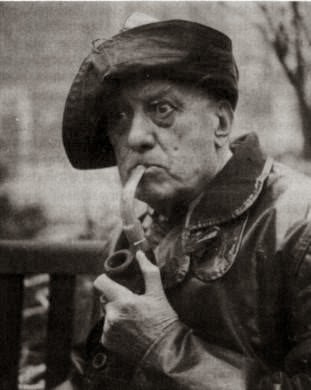
 “The Reverend Montague Summers was a most interesting man. He was not only a great authority on witchcraft, werewolves and the rest, but also wrote a number of excellent books on Restoration theatre. He always dressed a clergyman, and, with the silvery locks that curled down on either side of his pale, aristocratic face, he was the very picture of a restoration bishop. But quite a number of people maintained that he had either been defrocked or had never taken holy orders at all.

I remember his telling me one evening of an exorcism he had performed in Ireland. The wife of a cottager was apparently possessed by a devil. When Summers arrived she was foaming at the mouth and had to be held down. With bell and book he performed the ceremony. A small black cloud issued from the woman’s mouth. She became quiet, the black cloud disappeared into a cold leg of mutton that had been put on the table ready for supper. A few minutes later, it was seen to be swarming with maggots.

Summers asked my wife and me to spend the weekend at his house in Arlesford. We motored down on the Friday afternoon. When we were taken round the garden, my wife spotted the most gigantic toad she had ever seen, and in the bedroom we were given there were a dozen enormous spiders.

On the Saturday morning my host took me into a room that was empty except for a pile of books. Picking up a small leather-bound volume, he said, ‘Look, this is just the thing for you. It is worth far more, but I’ll let you have it for fifty pounds.’ I did not want it and, anyhow, could not have afforded it. Much embarrassed, I said so. Never have I seen a man’s expression change so swiftly. From benevolent calm it suddenly became filled with demoniac fury. He threw down the book and flounced out of the room. An hour later I had sent myself a telegram. By Saturday evening my wife and I were home again in London. That was the last I saw of the ‘Reverend’ Montague Summers.”


“Rollo Ahmed was a very different character. He was an Egyptian by birth, and from his father’s family had acquired his initial knowledge of the ‘secret art’. However, his mother was a native of the West Indies and, while Rollo was still in his ‘teens, his parents decided to leave Egypt. For many years he lived with them in devil-ridden islands and the little-explored forests of Yucatan, Guiana and Brazil. In these places he acquired first hand knowledge not only of the primitive magic of the forest Indians, but also of Voodoo and the use of obeahs. Later he explored Europe and Asia for further knowledge of the mysteries and for a while lived in Burma, where he became a practitioner of Raja Yoga.

He was a small, slim man, neither bombastic nor subservient, with a most cheerful personality and a ready laugh, and he spoke English perfectly. Several times he dined with us in Queen’s Gate. On one occasion on a freezing night in mid-winter he arrived without a hat or overcoat, dressed in a thin summer suit. He had walked all the way from Clapham Common; yet his hands were glowing with warmth. This he declared was due to his practicing yoga, and he offered to teach my wife and me yoga breathing. We had a few lessons, but were too heavily engaged with other matters to follow it up.”

[…]

“From him I learned a great deal. Later I was told that he had slipped up in a ceremony and failed to master a demon, who had caused all his teeth to fall out. Soon after the opening of the war, I lost sight of him, as I had other things to think about.”


“I was introduced to Aleister Crowley by a friend of mine who was a very well-known journalist and later, as a Member of Parliament, became one of the leaders of the Socialist Party. I will therefore refer to him as Z. Crowley dined with my wife and me several times. He was a fascinating conversationalist and had an intellect of the first order.”

[…]

“Having had Crowley to dinner several times, I told my friend Z. that, although I found him intensely interesting, I was convinced he could not harm a rabbit.
‘Ah!’ Replied Z. ‘Not now, perhaps. But he was very different before that affair in Paris.’ The affair in Paris was as follows.
Crowley wanted to raise Pan. One of his disciples owned a small hotel on the Left Bank. Crowley, with his twelve disciples, took it over for the weekend and the servants were given a holiday. On Saturday night a big room at the top of the house was emptied of all its furniture, swept and garnished. Crowley and his principle disciple, MacAleister (son of Aleister), were to perform the ceremony there, while the other seven remained downstairs. He told them that, whatever noises they might hear, in no circumstances were they to enter the room before morning.
Down in the little restaurant a cold collation had been prepared. The eleven had supper and waited uneasily. They all had a great deal to drink, but got only stale-tight. By midnight the place had become intensely cold. They heard shouting and banging in the room upstairs, but obeyed orders not to go up. The door was locked and they could get no reply to their anxious calls, so they broke it down.
Crowley had raised Pan all right. MacAleister was dead and Crowley, stripped of his magician’s robes, a naked gibbering idiot crouching in a corner.
Before he was fit to go about again, he spent four months in a lunatic asylum. Z., who told me all this, had been one of the disciples, and an eye-witness to this party.”

----

All text from the chapter ‘Modern Occultists’ in Dennis Wheatley’s ‘The Devil And All his Works’, pp. 256 – 261.

Photographs via the internet.

---

Thursday, 10 April 2014

This Month’s Zatoichi:
New Tale of Zatoichi
(Tokuzô Tanaka, 1963)


Hitting Japanese cinemas in March 1963, the third Zatoichi film saw the series moving to colour for the first time, with a suitably heroic new main theme from the legendary Akira Ifubuke pointing the way toward a new identity for the character as the star of a successful, ongoing franchise.

Brighter colours and rousing music haven’t done much to lighten the load of the emotional baggage we left our hero carrying at the end of the previous film however, and only five minutes into this one, he’s already weeping, having been forced to needlessly slay a gang of young warriors out to avenge the boss he killed in the last film, setting the scene for another tragedy-laden instalment, in which Zatoichi’s anguish about his past life choices and the unending cycle of violence in which he is caught up informs the whole of the narrative.

Drinking in an inn with a childhood friend (a poverty-stricken itinerant musician, on the road with his young family) shortly after this initial confrontation, Ichi is already rueing his decision to take up swordsmanship in the first place. “I did things I shouldn’t have done, cut those I shouldn’t have cut”, he muses, establishing a tone that is even more deeply melancholic than his previous adventures, if such a thing is possible.

Before that though, we have at least a few moments of jollity and good cheer to enjoy. Settling into what was already becoming his best-loved role, Shintaro Katsu’s charisma is certainly firing on all cylinders here, in spite of his character’s remorseful mood. Visibly delighted at the chance to catch up with his old buddy, it’s only a matter of minutes before he grabs his friend’s shamisen and knocks out a few verses of what seems to be Zatoichi’s new theme song!

Suitably doleful in tone, the lyrics of this composition largely seem to concern his financial situation, but, somewhat in the manner of a delta blues singer, Katsu’s haunted, world weary delivery imbues the material with a heavy depth of meaning lurking just below the surface, earning Ichi an immediate round of applause from the Inn’s patrons… just before a gang of black-masked bandits burst in, and his cycle of troubles begins again.

Actually though, Ichi’s handling of this particular situation provides a good model for how he might begin to escape his blood-soaked wheel of karma. Mutely submitting to the robbers’ demands so as not to imperil his fellow drinkers, the next morning finds Ichi dragging the ne’erdowells out from their yakuza hideout like naughty school boys, publically shaming them for their conduct in front of their gang boss, who obliges them to return with interest the money they stole from the destitute travellers lodged at the inn. Thus, justice is served, villainy is punished, and Ichi’s credentials as a champion of the people are reasserted, without a drop of blood being spilled. If only it could always be that simple…

‘New Tale..’s main plot-line hoves into view shortly thereafter when another confrontation between Ichi and the would-be revengers on his tail is disrupted by the intervention of none other than Ichi’s *sensei*. Yes, that’s right, the man who taught our invincible hero all he knows about the way of the sword, no less.

Those who were a bit put out by the second film’s weight of back story will be further disconcerted here, as Ichi accompanies his teacher Banno (Seizaburô Kawazu) back to his training academy in Ichi’s hometown, where a warm welcome awaits him. (1) He even finds him to visit his grandmother, for goodness sake! But, as always, a mass of new trouble and moral dilemmas await him.

By this stage in the series, we know very well the value Zatoichi places on loyalty and friendship, and how fervently he respects those he considers his friends . But, unfortunately for our hero’s sensitive nature, it is gradually made clear to us viewers that the venerable Banno-san is actually a bit of an underhanded fellow on the quiet – a real jerk, you might even say. He is heavily involved with some sinister covert dealings involving large sums of money, a kidnapping scheme and a gang of renegade samurai, and… well in short, things aren’t looking too good at Ichi’s alma mater, to be honest.

Ignorant of these goings-on though, our hero is busy reacquainting himself with the sensei’s beautiful and demure young sister Yayoi (future series regular Mikiko Tsubouchi ), who of course throws herself at the blind man almost immediately, declaring her undying love for him in much the same manner that every pure-hearted woman he has thus far encountered in the series seems to have done. (2)

This time though, perhaps reflecting the longer time they have known each other, Ichi is sincerely moved by Yayoi’s feeling for him and agrees on the spot to marry her and settle down, furthermore vowing upon his life that he will forthwith become an honest and peaceful man, abandoning his ties to the yakuza lifestyle and rejecting the way of the sword. Katsu’s performance here is, as ever, is very affecting, but oh dear, given that there are still twenty-plus blind swordsman adventures yet to come, we can probably see where this is going, can’t we? Shall I start the clock to see how many minutes of screen-time his heartfelt oath of non-violence lasts..?

Well actually, he makes a pretty credible effort over the next half hour, in spite of the heavy odds laid against him. First off, when the mismatched couple announce their wedding plans to Yayoi’s brother, be proves to be a right sod about it, ranting and raving, revoking Ichi’s status as his star pupil and hurling all sorts of insults around re: the masseur’s lowly status, before throwing him out of his house for good and refusing to let him say goodbye to his betrothed.

Ichi’s vow of non-violence also holds firm through what to me is definitely the stand-out scene in this film- the wonderful (and indeed, bloodless) confrontation that ensues when Ichi and his future bride come face to face with the brother of that dead boss from the earlier film, still determined to get his revenge. I won’t bother outlining in words what transpires when, instead of drawing his sword, Ichi merely kneels before his attacker awaiting the death-blow, but it is a beautiful little scene that symbolises the very best of the ‘honour and humanity’ ethos embodied by these ninkyo yakuza films.

The more brutal logic of the martial arts / chanbara film is also very much in play though, and setting Zatoichi up in direct conflict with the guy who taught him his skills is of course a classic move within the genre; a fool-proof way of maintaining dramatic tension after two and a half films in which we’ve basically established that our hero’s near-superhuman abilities allow him to kill any regular opponent in three seconds flat. For all of this story’s more high-minded ideals, I’m sure the folks in the cheap seats were well-aware of what they paid their money for, and a suitably gruelling master vs. pupil showdown between Ichi and Banno is clearly on the cards.

Perhaps on this film’s original release there might have been at least some impressionable viewers still wondering whether Zatoichi would manage to uphold his vow and settle down to live a peaceful life with his young bride, but, fifty years down the line, modern viewers can well assume that they didn’t make another twenty movies about Shintaro Katsu hanging around his homestead growing cabbages, and I’m sure I won’t be spoiling anything by telling you that the film ends exactly as you’d expect it to, with a bereft Yayoi standing alone amid a forest clearing full of slain yakuza, her dead brother in the centre, as Zatoichi marches forlornly into the foggy night. “Miss, I guess I am just that kind of a man” he concludes before turning away in shame, resigned to his fate.

Another handsome looking production from Daiei studios, ‘New Tale..’ brings an earthy, subdued colour palette to the Zatoichi series that seems to emphasise the character’s lowly social standing, conveying a deeper feeling for rural Japanese life than many other period genre films, in spite of a few instances in which studio sets are clearly used as stand-ins for exterior locations.

Director Tanaka proves himself a solid hand on the tiller even if he doesn’t quite match the sense of visual drama that Mizumi and Mori brought to the proceedings, and overall the film is another highly entertaining business, lovely to look upon, always watchable, and well played, with Ifubuke‘s remarkable score adding a pretty epic feel in places.(3) It suffers somewhat in the script department however, with poor pacing and a lot of largely inconsequential toing and froing padding things out and rather diluting the central dramatic arc. Perhaps it could have benefited from a shorter run-time, ala film # 2, but nonetheless - during its best scenes at least, ‘New Tale..’ is a match for anything that came before, following the example of its predecessors in weighing down our poor hero with more emotional turmoil than a normal man could bear.

By the end of this instalment, Ichi has found and lost happiness, regained and destroyed his honour as a respectable citizen, and lost his respect for a friend father figure whom he has subsequent killed with his own hand. With all the grief and regret he has piled up over the past three films, it’s a wonder Ichi hasn’t packed it in and settled down with his cabbages by this point, wife or no wife. But whether he likes it or not, the franchise must roll on, and a mere five months later he was back in cinemas in ‘Zatoichi The Fugitive’, which seems appropriate.

---

(1) A prolific character actor and instantly recognisable ‘face’ for Japanese movie fans, some of Kawazu’s more notable credits include parts in ‘Mothra’, ‘Yojimbo’, Shôhei Imamura’s ‘The Insect Woman’, Seijun Suzuki’s ‘Tattooed Life’, Kinji Fukasaku’s excellent ‘Japanese Criminal Gangs: Boss’ and Norifumi Suzuki’s astounding ‘Sex & Fury’.

(2) It won’t spoil anyone’s enjoyment of the film either way I suppose, but it seems pretty unlikely that the 50-something Banno would have an 18 year old sister, don’t you think? Wouldn’t it have been easier all round for the script to make her his daughter, or is there some sort of culture-specific element here that I’m missing..? If not, maybe we can just put it down to another example of the weird minor inconsistencies that seem to frequently pop up in these Zatoichi scripts…

(3) An extremely busy director of action and chanbara pictures throughout the ‘60s, Tanaka handled two more Zatoichis, a few ‘Sleepy Eyes of Death’ pictures and numerous sequels to Yasuzô Masumura’s 1965 yakuza/war film ‘Hoodlum Soldier’ (also starring Katsu), amongst others. In the ‘70s he moved over to TV, where he picked up a yet more work from Katsu-affiliated franchises, directing numerous episodes of both the ‘Zatoichi ‘and ‘Lone Wolf & Cub’ TV series. He also made a pretty fun-sounding horror film – English title ‘The Haunted Castle’ – in 1969; now added to my “must track down” list.